Of Weather and Warnings: A Pro-Life Meditation

The weather in Washington, D.C. was dismal on Saturday: more than two inches of rain. 2018 has now surpassed 1889 to become the wettest year since records have been kept. So far, more than 62 inches of rain have fallen this year; the annual average is only about 40 inches.

On this cold, rainy December morning, a group of us stood in front of a Planned Parenthood clinic in northeast D.C, just as we do on many Saturdays throughout the year. We prayed the Rosary and the Divine Mercy Chaplet. We sang some Christmas carols. We engaged in some sidewalk counseling. We called the “escorts” to conversion. These escorts try to shield the women entering the facility from having to hear the truth we speak and our pleas to reconsider their plans to abort their children. The escorts are trained to keep their eyes fixed forward and to avoid making eye contact with us. I say to them, “One day you will stand with us. We are praying for your conversion and for an anointed realization of what abortion really is.”

Earlier in the day I read a psalm from the Office of Readings that contained God’s lament of how lost and corrupted His people and nation have become.

The psalm begins with a reminder of the blessings the Lord lavished on His people:

O give thanks to the Lord for he is good:
for his love endures forever.
Who can tell the Lord’s mighty deeds?
Who can recount all his praise?

… He threatened the Red Sea; it dried up
and he led them through the deep as through the desert.
He saved them from the hand of the foe;
he saved them from the grip of the enemy.
The waters covered their oppressors;
Then they believed in his words;
then they sang his praises
(Psalm 106:1-2, 9-12).

In the United States, we too have been blessed and favored.

The psalm continues with the lament of God (through the psalmist):

But they soon forgot his deeds
and would not wait upon his will.
They yielded to their cravings in the desert.

… They fashioned a calf at Horeb
and worshiped an image of metal,
exchanging the God who was their glory
for the image of a bull that eats grass.
They forgot the God who was their savior,
who had done such great things in
Egypt,
such portents in the
land of Ham,
such marvels at the
Red Sea.

… Then they scorned the land of promise:
they had no faith in his word.
They complained inside their tents
and would not listen to the voice of the Lord.

… They bowed before the Baal of Peor;
ate offerings made to lifeless gods.
They roused him to anger with their deeds
and a plague broke out among them
(Psalm 106:13-14, 19-22, 24-25, 28-29).

In the next part of the psalm comes the greatest darkness of all:

… They worshiped the idols of the nations
and these became a snare to entrap them.
They even offered their own sons
and their daughters in sacrifice to demons.
They shed the blood of the innocent,
the blood of their sons and daughters
whom they offered to the idols of
Canaan.
The land was polluted with blood.
So they defiled themselves by their deeds
and broke their marriage bond with the Lord
(Psalm 106:36-39).

Yes, so evil did their hearts become that they sacrificed their own children on the altars of the pagan gods with whom they committed adultery. This is where we are today in the U.S. Some “celebrate” abortion and worship at the altar of “choice” and “sex without consequence,” even if others must die as a result.

I do not suppose that every patient who enters an abortion clinic fully understands the meaning of her plans or intends to worship Baal, but I believe that she will be traumatized as the life in her womb is either surgically removed or burned away through caustic chemicals. Perhaps she has been misled. Maybe she has been pressured by her parents or by the irresponsible “father” of the child. It is also possible that she coldly enters knowing full well what she does; that is for God to know. I only pray that when she does come to understand what she has done, she will not despair; the Church is still here for her through the Sacrament of Confession as well as Project Rachel and other support groups.

Collectively, we Americans know what we are doing. The science is clear that human life begins at the moment of conception. The Pro-life message is effective and clear. Our consciences are testifying to us. We know better and are better than this. We once forbade the killing of the innocent through abortion. This once Christian nation has forgotten the God who has blessed and saved us; we have scorned the promises of our own land.

God will not forever abide our rejection of His vision. The blood of the innocent cannot forever be silenced as they cry out to God from the soil of this blessed and rich land. One day soon God say to us,

What have you done? The voice of your brother’s blood is crying out to me from the ground (Gen 4:10).

In the Liturgy of the Hours each psalm has a New Testament verse to frame it. Psalm 106 is paired with this warning:

These things have been written for a warning for us, for we are living at the end of the ages (1 Corinthians 10:11).

Beware indeed; there will be a reckoning. Stand up now and choose sides. The Lord’s justice cannot be forever avoided. Perhaps He will delay, simply for the sake of the remnant who pray and witness against this killing, which is claimed the lives of more than 50 million children in the U.S. since the legalization of abortion in 1973.

Psalm 106 stood to warn an ungrateful and increasingly faithless people of the punishment that awaited them if they did not repent and end the infanticide as well irreligion and injustice within them. It can be no less for us, who have been even more blessed than they. God laments our condition more than we can know. In mercy He offers us time to convert, but injustice cannot forever continue. God will and must end this if we will not.

On a dreary, cold, rainy morning in D.C., both the weather and Psalm 106 speak ominously to our condition. What is the forecast for tomorrow? That depends on us.


Five Steps to Better Mental Health – A Homily for the Third Sunday of Advent

In modern times, we tend to link our notions of happiness and inner well-being to external circumstances and happenstance. We think that happiness will be found when the things of this world are arranged in the way we like. If we can just accumulate enough money and creature comforts, we think we’ll be happy and have a better sense of mental well-being.

Yet many people can endure difficult external circumstances while remaining inwardly content, happy, and optimistic. Further, many who have much are still not content but rather are plagued by mental anguish, anxiety, and unhappiness. Ultimately, happiness is not about good fortune or circumstances; it is an “inside job.”

St. Paul wrote,

For I have learned to be content whatever the circumstances. I know what it is to be in need, and I know what it is to have plenty. I have learned the secret of being content in any and every situation, whether well fed or hungry, whether living in plenty or in want (Phil 4:11-12).

It is interesting to note that Paul wrote these words, as well as those of today’s second reading, from his jail cell! It’s not just a bunch of slogans.

In today’s second reading, Paul tells us the “secret” to his contentedness, to joy and mental well-being regardless of the circumstances. He gives us a plan that (if we work it) will set the stage for a deeper inner peace, a sense of mental well-being and contentedness that is not easily affected by external circumstances. Let’s review what St. Paul has to say as a kind of “five-point plan.” (I am indebted to Rev. Adrian Rogers for the alliterative list, though the substance is my own reflection.)

Here is the text of St. Paul’s “five-point plan” for better mental health:

Rejoice in the Lord always. I will say it again: Rejoice! Let your moderateness be evident to all. The Lord is near. Do not be anxious about anything, but in everything, by prayer and petition, with thanksgiving, present your requests to God. And the peace of God, which transcends all understanding, will guard your hearts and your minds in Christ Jesus. [Finally, brothers, whatever is true, whatever is noble, whatever is right, whatever is pure, whatever is lovely, whatever is admirable—if anything is excellent or praiseworthy—think about such things. Whatever you have learned or received or heard from me or seen in me—put it into practice. And the God of peace will be with you] (Phil 4:4-9).

Note that the final two sentences (shown above enclosed in [square brackets]) are not included in today’s liturgical proclamation, but I feel that they add to the overall picture so I include them here.

Step I. Rejoice in the Presence of the Lord Rejoice in the Lord always. I will say it again: Rejoice! Let your moderateness be evident to all. The Lord is near.

Of supreme importance in the Christian life is requesting, receiving, and cultivating the gift of the Lord’s presence. We are too easily turned inward and become forgetful of God’s presence. To become more consciously and constantly aware of His presence is to be filled with joy and peace.

As an aside, note that the text mentions joy (χαίρω – chairoo) but also moderateness. The Greek word used is ἐπιεικὲς (epieikes), which means to be gentle, mild, forbearing, fair, reasonable, or moderate. Epieíkeia relaxes unnecessary strictness in favor of gentleness whenever possible. Such an attitude is common when one is joyful and unafraid. By contrast, an unbending and unyielding attitude often bespeaks fear.

There are of course times when one should not easily give way, but often there is room for some leeway and the assumption of good will. A serene mind and spirit, which are gifts of the presence of God, can often allow for this; there is an increasing ability to allow things to unfold rather than to insist on controlling outcomes and winning on every point.

The central point is that as we become more aware of God’s presence and thus more serene and less inwardly conflicted; we no longer need to shout others down or to win all the time. We can insist on what is true but can express ourselves more moderately and calmly. We are able to stay in the conversation, content to sow seeds rather than insisting on reaping every harvest of victory.

Cultivating a joyful sense of the presence of God and seeing the serenity and moderateness that are its fruits is a first step toward, and a sure sign of, better mental health and greater contentment.

Step II. Rely on the Power of the Lord Do not be anxious about anything, but in everything, by prayer and petition … present your requests to God.

There are very few things as destructive to our mental health as worry. Worry is like sand in a machine. Not only does it hinder the workings of the machine, it damages it. Simply being told not to worry, though, isn’t very helpful. St. Paul is not simply saying, “Don’t worry.”

Paul has already laid groundwork for the diminishment of worry by telling us to cultivate a sense of the presence of God. When I was a young boy, my father left for the Vietnam War. During the year he was away, I spent many anxious nights worrying about a lot of things. As soon as my father returned, my fears went away. Daddy was home, and everything was all right.

To the degree that we really experience that God is near, many of our fears subside. My own experience is that as my awareness of God’s presence has grown, my anxieties have significantly diminished.

Paul also says that the power of God is only a prayer away. Here, too, I (and many others) can testify that God has a way of working things out. However, He may not always come when you want Him or handle things exactly as you want. When I reflect on my life, I can truly say that God has always made a way for me. None of my struggles and disappointments ever destroyed me; if anything, they strengthened me.

Whatever it is, take it to the Lord in prayer. Ponder deeply how He has delivered you in the past, how He has made a way out of no way, how He has drawn straight with crooked lines.

Let the Holy Spirit anoint your memory to make you aware of God’s saving power in your life and recall how God has delivered you. Because prayer is both effective and an ever-present source of power, these memories should provide serenity.

Prayer is the antidote. So much worry, which is a kind of mental illness, dissipates when we experience that God is present and that His power is only one prayer away.

So, the second step to better mental health is knowing by experience that God can and will make a way.

Step III. Remember the Provision of the Lord … with thanksgiving …

Thanksgiving is a way of disciplining the mind to count our blessings. Why is this important? Because we become negative too easily. Every day billions of things go right while only a handful go wrong, but what do we tend to focus on? The few things that go wrong! This is a form of mental illness that feeds our anxiety and comes from our fallen nature.

Gratitude disciplines our mind to count our blessings. As we do this, we begin to become men and women of hope and confidence. Why? Because what you feed, grows. If you feed the negative, it will grow; if you feed the positive, it will grow. God richly blesses us every day; we need but open our eyes to see it.

Step three is disciplining our fallen mind to see the wider reality of our rich blessings. This heals us and gives us great peace and a serene mind.

Step IV. Rest in the Peace of the Lord And the peace of God, which transcends all understanding, will guard your hearts and your minds in Christ Jesus.

As we begin to undertake these steps, our mental outlook and health improve. Gradually, serenity becomes a deeper and more stable reality for us. The text here says that this serenity will not only be present, it will “guard” (or as some translations say, “keep”) our hearts and minds in Christ Jesus. In other words, as this serenity grows it screens out the negativity of this world and the demons of discouragement. Having this peace allows us to see the Lord; seeing the Lord deepens that peace—and the cycle grows and continues!

It has been my experience that the profound anxiety and anger that beset my early years has not only gone away but is unlikely to return given the serenity I now increasingly enjoy. I am guarded and protected increasingly by the serenity God gives.

Step V. Reflect on the Plan of the Lord Finally, brothers, whatever is true, whatever is noble, whatever is right, whatever is pure, whatever is lovely, whatever is admirable—if anything is excellent or praiseworthy—think about such things. Whatever you have learned or received or heard from me or seen in me—put it into practice.

A maintenance plan – As this serenity, this sense of well-being, comes to us, St. Paul advises a kind of maintenance plan wherein we intentionally and actively focus our thoughts and attention on what is godly, true, good, and beautiful.

What you feed, grows. While we may need to stay informed about the news of the world, beware a steady diet of the 24/7 news cycle. The media tend to focus on the bad news, on what is controversial and/or adversarial. If it bleeds, it leads. Too much exposure to that and you’re unsettled before you know it. Limit your portions of this and focus on the greater, better, and lasting things of God. Ponder His plan, His truth, His glory, and His priorities.

An old song says, “More about Jesus would I know, more of his saving mercy show, more of his saving fullness see, more of his love who died for me.”

Yes, more about Jesus and less about this world. How can we expect to maintain our mental health and serenity on a steady dose of insanity, misplaced priorities, adversity, darkness, chaos, and foolishness?

Do you want peace? Reflect on the Lord’s plan for you.

So, then, here are five steps to better mental health. It all begins with the practice of the presence of the Lord, calling on His power and being grateful for His providence, savoring His peace (which inevitably comes), and turning our attention more to the things of God and less to the things of this world.

Here’s to good mental health for us all! In times like these, we need to balance our sorrow with rejoicing in God’s ability to draw good from even the worst of circumstances.

Jesus’ Urgency to Save Us, as Seen in a Christmas Commercial

The John Lewis Christmas commercial shown below has a surprise ending. We are led through a traditional story line about a child who can’t wait for Christmas, but there’s a twist at the end. You may wish to watch the ad before continuing, lest my comments ruin the surprise.

As I watched the commercial, I was first reminded of these Scripture passages: It is more blessed to give than to receive (Acts 20:34), and God loves a cheerful giver (2 Cor 9:7).

There is something more than a cheerful giver illustrated in this ad, though. Indeed, the young boy is an urgent giver, one who cannot wait to give the gift he has to offer. The hours and days creep by. When will he finally be able to give his gift? Finally, the day arrives, finally!

This seemed strangely familiar to me, that it was speaking to a biblical theme. Then it hit me. Yes! This was Jesus on His final journey to Jerusalem, urgent and eager to give us the gift of our salvation, to snatch us from the kingdom of darkness and translate us to the kingdom of light. Scripture has this to say about this almost impatient desire in Him:

  • As the time approached for him to be taken up to heaven, Jesus resolutely set out for Jerusalem (Luke 9:51).
  • Jesus exclaimed, “I have come to bring fire on the earth, and how I wish it were already kindled! But I have a baptism to undergo, and what constraint I am under until it is completed!(Luke 12:49)
  • Jesus said, “The hour has come for the Son of Man to be glorified. … Now my soul is troubled, yet what shall I say? ‘Father, save me from this hour’? No, it was for this very reason I came to this hour. Father, glorify your name!” … Now is the time for judgment on this world; now the prince of this world will be driven out. And I, when I am lifted up from the earth, will draw all people to myself.”(John 12:23, 27-28, 31-32).

Scripture says that as Jesus’ apostles followed Him up the road to Jerusalem for His final journey, they were “amazed and afraid” (cf Mk 10:32). Fearful of Jesus’ predictions of His own death, the disciples protested, But Rabbi … a short while ago the Jews there tried to stone you, and yet you are going there? (John 11:8) Finally, seeing Jesus’ determination, Thomas (likely in exasperation) said, Let us also go, that we may die with him (John 11:16).

Yes, Jesus set His face like flint as He journeyed toward Jerusalem, eager to give the gift of salvation. What distress, what impatience until He must have felt until He could give that gift! Resolutely, He went forth with fervor.

Think about these things as you watch this Christmas commercial.

https://youtu.be/pSLOnR1s74o

A Humorous Call to Confession

blog-1215Sometimes our pets teach us a lot about ourselves. The video below shows various dogs resisting the taking of a bath. Some hide; some go limp and become passive; others get feisty.

I see here a similarity with Catholics when they hear that it is time for Confession. Advent is an important time to go to Confession because we are preparing for the birth of our Savior. He is called Jesus (a name that means “God saves”) because He will save us from our sins. It would be a rather perfunctory and hollow Christmas without a preceding Confession, would it not?

And yet some Catholics, much like the dogs in this video, scamper away to hide. Others just look nervous and resist. Still others get hostile and say, “No way!”

This is just a fun way to say, “It’s time for Confession, time to wash our sins away!”

Enjoy this video. Dogs are so much fun, aren’t they?

Why Was Jesus Born When and Where He Was?

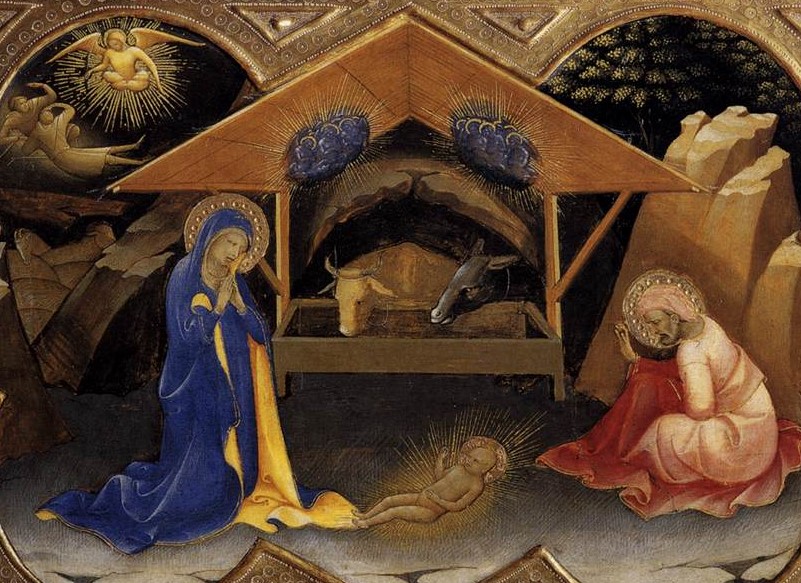
The Nativity, Lorenzo Monaco (1414)

In preparation for the coming of Christmas, we have been discussing some of St. Thomas Aquinas’ writings. In this last installment we’ll be looking at his commentary on the time and place of Jesus’ birth.

We live in a culture that tends toward a kind of temporal pride. We think that we have come of age, that we are smarter and wiser than our forebears. Scientific, technical, and medical knowledge are more highly developed to be sure, but there is more to life than what falls into those realms.

The religious version of temporal pride is expressed in this utterance: “If Jesus lived in our times, He would …” The sentence is then completed with any view we favor or consider to be “enlightened” and “modern.” Jesus did not choose to live in our time, however, and there may well be good reasons for that. As God, He could have chosen any age—and He did not choose ours.

St. Thomas Aquinas, who lived in the 13th century, pondered the reasons for the time and place of Jesus’ birth in his Summa Theologica. In it he addressed some of the questions and objections raised during his era.

The time of the Lord’s birth – St. Thomas discussed this in his Summa Theologica, Part III, Question 35, Article 8. He used as his starting point St. Paul’s attestation to the fittingness of the time of Christ’s birth: When the fullness of the time was come, God sent His Son, made of a woman, made under the law (Gal 4:4). Here, the “fullness of time” is understood to mean “at the designated or determined time.” St. Thomas wrote,

Whereas [other men] are born subject to the restrictions of time, Christ, as Lord and Maker of all time, chose a time in which to be born, just as He chose a mother and a birthplace. And since “what is of God is well ordered” and becomingly arranged, it follows that Christ was born at a most fitting time.

St. Thomas responded as follows to objections raised in his day regarding the time of Christ’s birth:

Some objected that because Christ came to grant liberty to His people, it was not fitting that He came at a time when the Jewish people were subjected to Roman occupation and the Herodian dynasty (Herod was not a true Jew). St. Thomas answered that because Christ came in order to bring us back from a state of bondage to a state of liberty, it was fitting that He be born into bondage with us and then lead us out. We can grasp this logic in a wider sense when we consider that He assumed our mortal nature in order to give us an immortal nature; He died in order to restore us to life. St. Thomas, referencing Bede, wrote that Christ submitted Himself to bondage for the sake of our liberty. He also added that Christ wished to be born during the reign of a foreigner so that the prophecy of Jacob might be fulfilled (Genesis 49:10): The scepter shall not be taken away from Juda, nor a ruler from his thigh, till He come that is to be sent. The bondage was not to be ended before Christ’s coming, but after it and through it.

Others objected that the time of year, near the winter solstice, was not fitting for Christ’s birth. They argued that it was not fitting for the Light of the World to be born during the darkest time of the year. Thomas replied that Christ wished to be born at a time when the light of day begins to increase in length so as to show that He came to draw man back to the light, according to Luke 1:79: To enlighten them that sit in darkness and in the shadow of death.

The place of Christ’s birth – St. Thomas discussed this in the Summa Theologica, Part III, Question 35, Article 7.

Christ willed to be born in Bethlehem for two reasons. First, because “He was made … of the seed of David according to the flesh,” as it is written (Romans 1:3); … Therefore, He willed to be born at Bethlehem, where David was born, in order that by the very birthplace the promise made to David might be shown to be fulfilled. The Evangelist points this out by saying: “Because He was of the house and of the family of David.” Secondly, because, as Gregory says (Hom. viii in Evang.): “Bethlehem is interpreted ‘the house of bread.’ It is Christ Himself who said, ‘I am the living Bread which came down from heaven.’”

St. Thomas responded to some objections to Bethlehem as the place of Jesus’ birth.

Some argued that Christ should have been born in Jerusalem because it is written (Isaiah 2:3) that “The law shall come forth from Sion, and the Word of the Lord from Jerusalem,” and that because Christ is the very Word of God, made flesh, He should have come into the world at Jerusalem. St. Thomas answered that Christ, as the Son of David, fittingly echoed David’s priestly/kingly role. King David was born in Bethlehem and finished his ministry as priest/king in Jerusalem, so it was fitting that Christ as King be born in Bethlehem and, as true High Priest, die in Jerusalem.

Others argued that Bethlehem was too poor and unseemly a place for the Christ to be born. Thomas responded, [The Lord] put to silence the vain boasting of men who take pride in being born in great cities, where also they desire especially to receive honor. Christ, on the contrary, willed to be born in a mean city, and to suffer reproach in a great city. Thomas added, [And] that we might acknowledge the work of God in the transformation of the whole earth, He chose a poor mother and a birthplace poorer still. He cited Scripture: “But the weak things of the world hath God chosen, that He may confound the strong” (1 Corinthians 1:27).

Still others argued that because Scripture (Matthew 2:23; Isaiah 11:1) said “He shall be called a Nazarene,” Christ should have been born in Nazareth. Thomas easily dispatched this objection by observing that one is not always born where one is raised. He also added (referencing Bede), He wished to be born at Bethlehem away from home…in order that He who found no room at the inn might prepare many mansions for us in His Father’s house.

With St. Thomas to guide and teach us, we have pondered over the past few days some aspects of the incarnation and birth of our Lord. May you who have read and I who have presented be enriched by the teachings of the Lord through the great St. Thomas Aquinas.

Below is a link to an organ prelude on the hymn “Bethlehem of Noblest Cities,” also known as “Earth Hath Many a Noble City.” It is accompanied by beautiful art related to Bethlehem. Here are the words to the hymn:

Earth hath many a noble city;
Bethlehem, thou dost all excel:
out of thee the Lord from heaven
came to rule his Israel.

Fairer than the sun at morning
was the star that told his birth,
to the world its God announcing
seen in fleshly form on earth.

Eastern sages at his cradle
make oblations rich and rare;
see them give, in deep devotion,
gold and frankincense and myrrh.

Sacred gifts of mystic meaning:
incense doth their God disclose,
gold the King of kings proclaimeth,
myrrh his sepulcher foreshows.

Jesus, whom the Gentiles worshiped
at thy glad epiphany,
unto thee, with God the Father
and the Spirit, glory be.

Would Jesus Have Come If Adam Had Not Sinned? Why Did He Wait So Long Before Coming?

Reproduction of image by Georg Cornicelius (1888)(original destroyed)

Continuing our series of questions related to the Incarnation, we next ponder whether Jesus would have come at all had we not sinned in the garden. We also consider why He waited thousands of years before coming to our rescue.

Would Jesus have come if Adam had not sinned?

St. Thomas Aquinas (in his Summa Theologica) first states that there are different opinions on the matter. He also notes that God’s power is not limited and therefore God could have become incarnate even if sin had not existed. However, St. Thomas believes that if man had not sinned then the Son would not have become incarnate. As I often do, I’ve presented St. Thomas’ words in bold italics, while my commentary appears in plain red text.

For such things as spring from God’s will, and beyond the creature’s due, can be made known to us only through being revealed in the Sacred Scripture, in which the Divine Will is made known to us. Hence, since everywhere in the Sacred Scripture the sin of the first man is assigned as the reason of Incarnation, it is more in accordance with this to say that the work of Incarnation was ordained by God as a remedy for sin; so that, had sin not existed, Incarnation would not have been (Summa Theologica, Part III, Question 1, Article 1).

While theological speculation may have its place, it is certain that the Incarnation was instituted by God first and foremost as a remedy for sin. While the Incarnation offers more than is required to remedy sin (e.g., an increase in human dignity (because God joined our family), God’s visitation, the opening of a heavenly (not merely earthly) paradise), Scripture presents remedy for sin as God’s primary motive. In remedying our sin, God shows the greatness of His mercy because He does not merely restore us but elevates us to a higher place. The least born into the Kingdom of God is greater that the exemplar of the Old Covenant, John the Baptist. Had we not sinned and had God merely wanted to elevate us, He could have done so in other ways. It seems to me that St. Thomas’ position is best suited to the evidence.

If the Incarnation is a remedy for sin, why did God wait so long to apply it?

St. Thomas provides a sensible answer that addresses aspects of the question we might not have considered. His answer is found in the Summa Theologica (part III, question 1, article 5). First, he addresses why the Incarnation did not happen before sin:

Since the work of Incarnation is principally ordained to the restoration of the human race by blotting out sin, it is manifest that it was not fitting for God to become incarnate at the beginning of the human race before sin. For medicine is given only to the sick. Hence our Lord Himself says (Matthew 9:12-13): “They that are in health need not a physician, but they that are ill … For I am not come to call the just, but sinners.”

Next, St. Thomas addresses why the Incarnation did not happen quickly, soon after Original Sin, rather than thousands of years later. He sets forth four reasons:

First, on account of the manner of man’s sin, which had come of pride; hence man was to be liberated in such a manner that he might be humbled and see how he stood in need of a deliverer. … For first of all God left man under the natural law, with the freedom of his will, in order that he might know his natural strength; and when he failed in it, he received the law; whereupon, by the fault, not of the law, but of his nature, the disease gained strength; so that having recognized his infirmity he might cry out for a physician, and beseech the aid of grace.

Quick solutions to problems do not always permit proper healing to take place. Most parents know that if they solve every problem a child has, important lessons may be lost. It is often beneficial to live with our questions for a while so that the answers are more appreciated and more effective.

Indeed, it took us humans quite a while to acknowledge the seriousness of our sin and pride. Shortly after Eden, the tower of Babel indicated that human pride was still a grave problem. Even when given the Law, a good thing, the flesh corrupted it, turning its perfunctory observance into an occasion for pride. The prophets then had to keep summoning Israel and Judah back to the Lord and away from prideful self-reliance. The Assyrian invasion of the Northern Kingdom and the Babylonian Captivity only further illustrated the depths of our sin, so that this cry went up: “O Lord, that you would rend the heavens and come down” (Is 64:1).

We had to be led gradually to recognize our profound need for a savior. Otherwise, even if the remedy were offered, too few might reach for it.

Secondly, on account of the order of furtherance in good, whereby we proceed from imperfection to perfection. Hence the Apostle says (1 Corinthians 15:46-47): “Yet that was not first which is spiritual, but that which is natural; afterwards that which is spiritual … The first man was of the earth, earthy; the second man from heaven, heavenly.”

There is a kind of theology of grace implicit in this answer. Grace builds on our nature, and it is our nature, physically and spiritually, to grow gradually. While sudden conversions and growth spurts have their place, the best and most typical growth is that which occurs steadily and in stages.

Thirdly, on account of the dignity of the incarnate Word, for on the words (Galatians 4:4), “But when the fullness of the time was come,” a gloss says: “The greater the judge who was coming, the more numerous was the band of heralds who ought to have preceded him.”

Here is underscored the dignity of the Son of God, that many should precede Him, announcing Him. There was also a need for us to be prepared to meet Him, so that we would not miss Him or refuse Him when He came. As Malachi says, See, I will send the prophet Elijah to you before that great and dreadful day of the Lord comes. He will turn the hearts of the parents to their children, and the hearts of the children to their parents; or else I will come and strike the land with total destruction (Mal 4:5-6). Those who were prepared were able to abide the day of the Lord’s coming and heed His call.

Fourthly, lest the fervor of faith should cool by the length of time, for the charity of many will grow cold at the end of the world. Hence (Luke 18:8) it is written: “But yet the Son of Man, when He cometh, shall He find think you, faith on earth?”

This is an interesting aspect of the question that many might not consider; we typically ponder more what is good for us than what is good for succeeding generations. It is sadly true, though, that fervor, both collective and individual, can fade as a wait becomes lengthy. Therefore, St. Thomas suggests that God appointed a time for the Incarnation within human history such that the greatest possible number of people could be saved.

Why Did the Second Person of the Trinity, Rather Than the Father or the Holy Spirit, Become Incarnate?

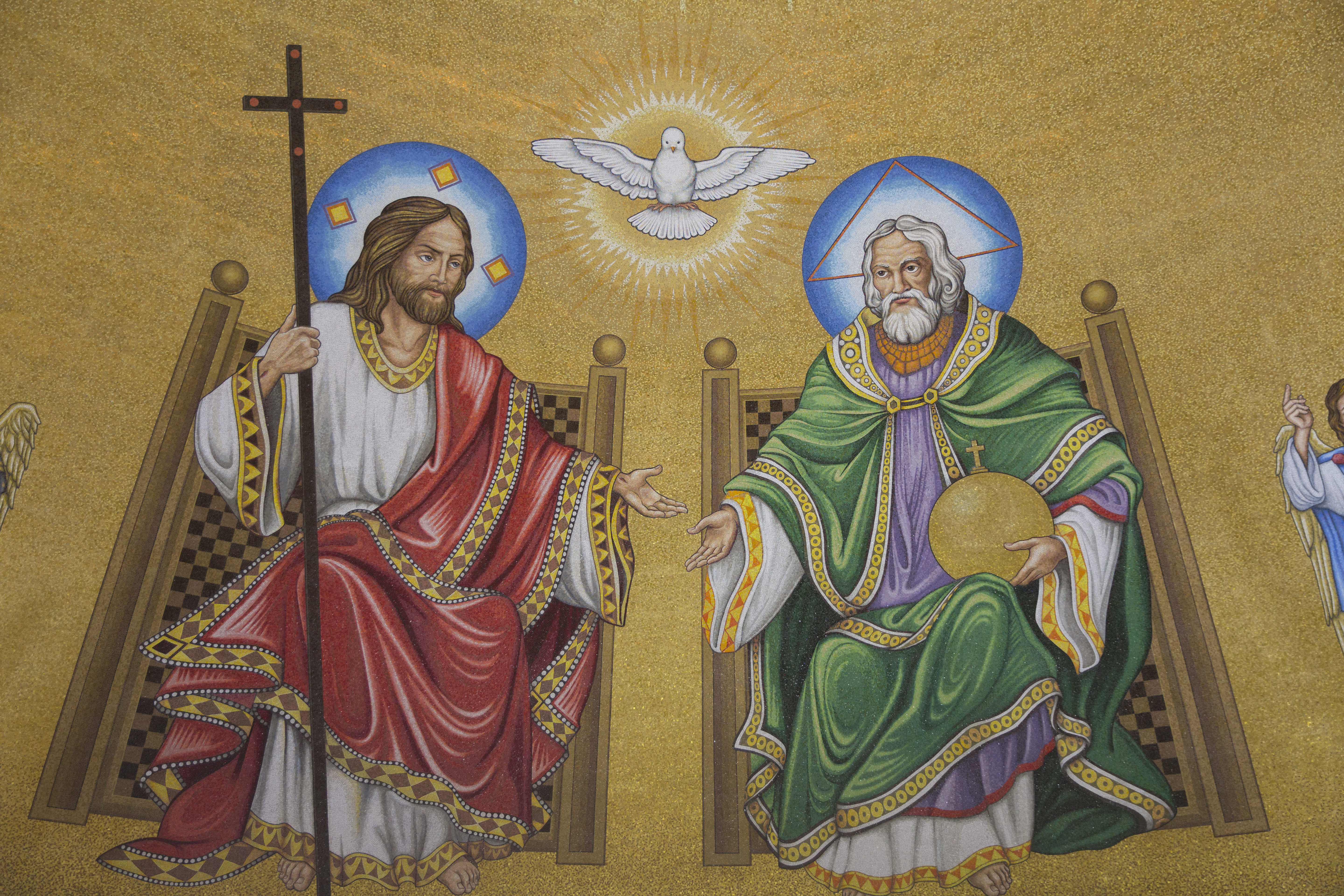
Trinity Dome. Credit: J. Lippelmann, Catholic Standard

As we await the approaching Feast of Holy Christmas, we have been pondering some of St. Thomas Aquinas’ teachings on the Incarnation. Today we will consider why it was the Son, the Second Person of the Blessed Trinity, who became incarnate.

Most people have never even thought of this question let alone sought to answer it. God could have chosen many different ways to save us; He chose to act as He did not because it was required but because it was fitting. It falls to us to ponder, using Scripture and our own reason, why His chosen way was fitting and what we can learn from this.

As always, St. Thomas Aquinas provides rich resources for us. I present below his teaching from the Summa Theologica (part III, question 3, article 8) in bold, italics; my poor commentary appears in plain red text. St. Thomas proposed four reasons as to why it was most fitting for the Son to become incarnate.

I. First, on the part of the union; for such as are similar are fittingly united. Now the Person of the Son, Who is the Word of God, has a certain common agreement with all creatures, because the word of the craftsman, i.e. his concept, is an exemplar likeness of whatever is made by him. Hence the Word of God, Who is His eternal concept, is the exemplar likeness of all creatures. … for the craftsman by the intelligible form of his art, whereby he fashioned his handiwork, restores it when it has fallen into ruin.

When the Father created all things, He uttered a Word (i.e., Let there be light). He creates through His Word (the Logos), and the Word of God is Christ. Therefore, in speaking creation into existence by the Logos, God impresses a kind of logike (logic) on all things.

In this way the Son, the Logos, has a “certain common agreement with all creatures,” who bear something of logic or likeness to Him. If this be so, then, as St. Thomas reasons, God the Father would best repair His creation by the same Word through whom He first created it.

II. Moreover … Man is perfected in wisdom (which is his proper perfection, as he is rational) by participating the Word of God, as the disciple is instructed by receiving the word of his master. Hence it is said (Sirach 1:5): “The Word of God on high is the fountain of wisdom.” And hence for the consummate perfection of man it was fitting that the very Word of God should be personally united to human nature.

While it is true that Original Sin affected our bodily integrity, perhaps our greatest wound was the darkening of our intellect, which was (and is) our greatest gift, the distinguishing characteristic between us and brute animals. So, it is especially fitting that the Word of God, who is also the Wisdom of God, should be joined to our nature and bring healing to us in this way.

St. Paul writes, Do not be conformed to this world, but be transformed by the renewing of your mind. Then you will be able to discern what is the good, pleasing, and perfect will of God (Rom 12:2). Even human words can instruct; all the more, then, can the Word of God made Flesh enlighten and heal us. This shows forth the fittingness that the Word—the Son, the Second Person of the Trinity—should become flesh.

III. The reason of this fitness [of the Second Person becoming flesh] may [also] be taken from the end of the union, which is … the heavenly inheritance, which is bestowed only on sons, according to Romans 8:17: “If sons, heirs also.” Hence it was fitting that by Him Who is the natural Son, men should share this likeness of sonship by adoption, as the Apostle says in the same chapter (Romans 8:29): “For whom He foreknew, He also predestinated to be made conformable to the image of His Son.”

In other words, because it is sons who inherit, it is fitting that He who is Son by nature should become incarnate. So shall we, conformed to His image as sons through our adoption and membership in His Body, also inherit the Kingdom and glory through the healing He effects in us.

IV. [Further], the reason for this fitness may be taken from the sin of our first parent, for which Incarnation supplied the remedy. For the first man sinned by seeking knowledge, as is plain from the words of the serpent, promising to man the knowledge of good and evil. Hence it was fitting that by the Word of true knowledge man might be led back to God, having wandered from God through an inordinate thirst for knowledge.

In grasping inordinately for the wrong kind of knowledge (the knowledge of evil) and in insisting on his own right to decide what was good and what was evil, Adam sinned. In and of itself, seeking knowledge is good; it was the object that was disordered (and thus forbidden). Because humans have this thirst to know (of itself good), all the more reason that God should offer us the true Word and Wisdom of God: the Son.

For the Word to become flesh is thus more fitting. In effect, God the Father says, “Let me offer you what you were really seeking but sought inordinately.” For this reason, the Son, who is the Word, who is Truth itself, becomes incarnate.

Four Reasons That the Incarnation was Fitting, According to St. Thomas Aquinas

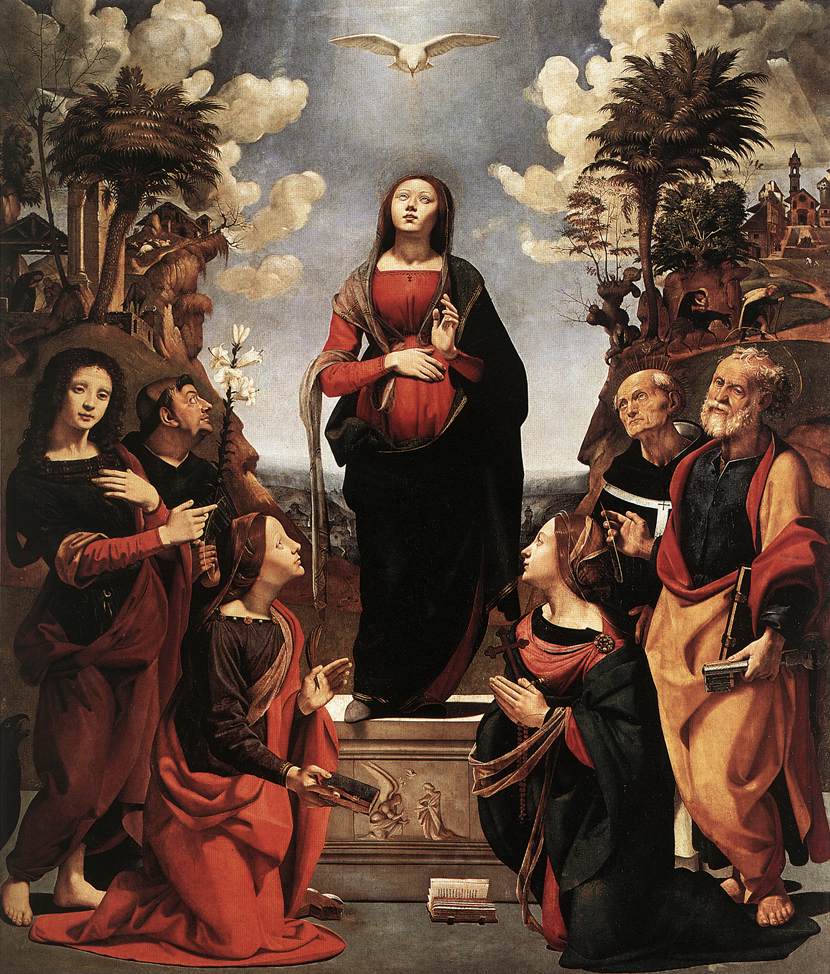
Incarnation of Jesus, Piero di Cosimo (1505)

As we approach the Christmas feasts, it is good for us to ponder aspects of the Incarnation. In this post, I would like to consider what St. Thomas Aquinas teaches about its fittingness. God was not radically “required” to do everything as He did. We do well to ponder why the manner of the Lord’s incarnation is “fitting,” why it makes sense.

St. Thomas, referencing St. John Damascene, gives four reasons for the fittingness of the incarnation of Christ:

But, as Damascene says (De Fide Orth. iii, 1), by the mystery of Incarnation are made known at once the goodness, the wisdom, the justice, and the power or might of God—“His goodness, for He did not despise the weakness of His own handiwork; His justice, since, on man’s defeat, He caused the tyrant to be overcome by none other than man, and yet He did not snatch men forcibly from death; His wisdom, for He found a suitable discharge for a most heavy debt; His power, or infinite might, for there is nothing greater than for God to become incarnate …” (Summa Theologica III, 1.1)

Here are each of Thomas’ (Damascene’s) reasons, along with some less-worthy commentary from me.

I. His goodness, for He did not despise the weakness of His own handiwork – To despise more literally means to look away or disregard something. God did not do this with Adam and Eve nor with us, their descendants, who have ratified their sinful choice. He continues to love us and call us.

Consider that even at the moment of the Original Sin, God first rebuked the devil and announced a solution that from woman would come forth a son destined to crush the power of the evil one. This protoevangelium (first good news) signals that God has not given up; He already has plans to save us. Although God would go on to announce the painful consequences of Adam’s sin, He does so only after announcing that His mercies are not exhausted, and His goodness is not altered.

Thus, God does not despise (look away from) His creation. Even His punishments are meant to heal us and to prepare us for the offer of something far greater: no mere earthly paradise, but Heaven itself. At the Incarnation, therefore, God’s goodness and fidelity to His promise is evident. Jesus, our promised Savior, is the hand extended to us in God’s goodness.

II. His justice, since, on man’s defeat, He caused the tyrant to be overcome by none other than man, and yet He did not snatch men forcibly from death – God, in making us free, “must” respect our free choices, not cancel them. If He canceled them, we would not have true freedom.

God does not undo our choices or remove their consequences; He builds on them. This is His justice at work.

We got into this mess through a man, a woman, and a tree. God will use these very elements to free us. The new Adam is Christ; the new Eve is Mary; the tree is the cross. Just as the first Adam and Eve were free but sinless, so Christ and Mary are sinless. While the first Adam and Eve said no in disobedience, Christ and Mary say yes in obedience.

God Himself, in Christ, joins our family and cancels the sin of Adam in a way that respects our first choice, but shows a different result. He takes the very suffering and death we chose and makes that the way back. The cross of Christ and our own share in that cross become the way back, the way to heavenly glory.

In His justice, God does not cancel our choices (and thereby our freedom). He does not “snatch us forcibly from death.” Rather, in His justice, He honors our freedom by taking our choices and their consequences (suffering and death) and making them the very way back to Him and to glory. He justly respects our choices but offers us another way.

III. His wisdom, for He found a suitable discharge for a most heavy debt – A mere man, say a prophet or a holy man, could not atone for our sins. Our debt is simply too high (see Matt. 18:24ff). A man alone does not have the power to save. God alone would have nothing to do with our case. As the God-man, Jesus has both the power to save us and the brotherhood to speak and act for us. We are saved by the human decision of a divine person. This shows both God’s justice and His wisdom, for He is not overcome by the conundrum of human impossibility and divine recusal. In the Incarnation, both truths are fittingly regarded and yet overcome.

IV. His power or infinite might, for there is nothing greater than for God to become incarnate – How can the infinite enter the finite? How can the eternal enter time? How can God, whom the very heavens could never contain, dwell in Mary’s womb and rest in her arms? Alpha et O matris in gremio! (Alpha and Omega sit in mother’s lap!) Here, God shows His mighty power to astonish us with His paradoxical wisdom and ways.

St. Thomas quotes St Augustine: The Christian doctrine nowhere holds that God was so joined to human flesh as either to desert or lose … the care of governing the universe … God is great not in mass, but in might. Hence the greatness of His might feels no straits in narrow surroundings (Ibid, ad 4).

God’s power is paradoxically demonstrated in the fact that He can make himself small but suffer no loss in ability or supreme power.

As the great feast of the Birth of the Lord approaches, I wish a merry and fitting Christmas to you all.