What Was the Lord Doing on Tuesday of Holy Week?

It is Tuesday of Holy Week. Jesus likely arises early, as did all the ancients. Days both ended and started early, at dusk and dawn, prior to the advent of electric lighting. They leave Bethany and head back to Jerusalem. Perhaps a few converts can be made before the transcendent events of the Passion begin.

It is only a couple of miles, mostly downhill, to Jerusalem. As they come down the steep hill they see the fig tree Jesus had cursed the day before.

As they were walking back in the morning, they saw the fig tree withered from its roots. Peter remembered it and said, “Look, Rabbi! The fig tree You cursed has withered.” (Mk 11:20-21).

Jesus had cursed the fig tree, a metaphor for the ancient chosen people, for lack of faith, justice, and charity, the expected fruits in its branches. (This was discussed in more detail in yesterday’s post.) The fig tree reminds us of the day of judgment. “Lip service” faith is easy, but Jesus is looking for real fruit in the branches.

The apostolic band walks on further with Jesus, and they eventually arrive at the Temple, where they are immediately confronted by the Temple leaders:

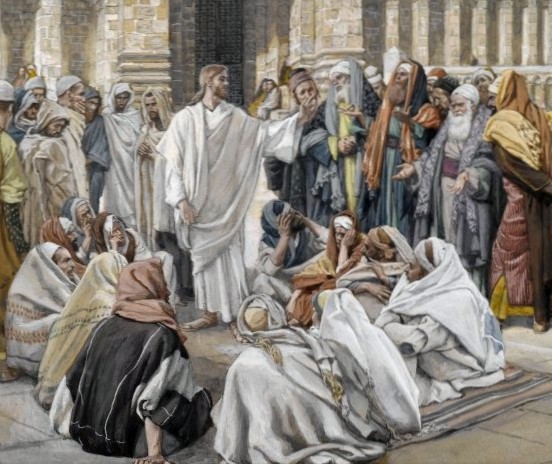
At their return to Jerusalem, Jesus was walking in the temple courts, and the chief priests, scribes, and elders came up to Him. “By what authority are You doing these things?” they asked. “And who gave You the authority to do them?” “I will ask you one question,” Jesus replied, “and if you answer Me, I will tell you by what authority I am doing these things. The baptism of John, was it from heaven or from men? Answer Me!” They deliberated among themselves what they should answer: “If we say, ‘From heaven,’ He will ask, ‘Why then did you not believe him?’ But if we say, ‘From men’…” they were afraid of the people, for they all held that John truly was a prophet. So they answered Him, “We do not know. And Jesus replied, “Neither will I tell you by what authority I am doing these things” (Mk 11:27-33).

Jesus questions their question with a question. He seems to engage in the Socratic method, making them examine their premises. In this dialogue the leaders are confronted with their own insincerity. They are asked to consider that their own “authority” is based not on truth, but on power and its trappings. They are asked to consider that they have “too much to lose” because they root their authority in the power and accolades of the people. They are not true leaders, for they do not seek the truth but rather only what confirms their power.

Do not scorn or laugh at them—many of us are in the same condition.

Jesus turns to them and others in the Temple area, teaching them in numerous parables (Mk 12:1). In these parables He lays bare their hearts and reminds them that although they are leaders they are refusing God’s offer of salvation and His invitation to the true feast to which their rituals point.

Jesus begins,

But what do you think? There was a man who had two sons. He went to the first and said, ‘Son, go and work today in the vineyard.’ ‘I will not,’ he replied. But later he changed his mind and went. Then the man went to the second son and told him the same thing. ‘I will, sir,’ he said. But he did not go. Which of the two did the will of his father? “The first,” they answered. Jesus said to them, “Truly I tell you, the tax collectors and prostitutes are entering the kingdom of God before you. For John came to you in a righteous way and you did not believe him, but the tax collectors and prostitutes did. And even after you saw this, you did not repent and believe him (Mat 21:28-32).

Lip service is not obedience. Their refusal to come to faith is disobedience to God. He desires obedience more than ritual observances and sacrifices (see Psalm 40:6).

Jesus warns them that their plots to kill Him will end badly:

A man planted a vineyard. He put a wall around it, dug a wine vat, and built a watchtower. Then he rented it out to some tenants and went away on a journey. At harvest time, he sent a servant to the tenants to collect his share of the fruit of the vineyard. But they seized the servant, beat him, and sent him away empty-handed. Then he sent them another servant, and they struck him over the head and treated him shamefully. He sent still another, and this one they killed. He sent many others; some they beat and others they killed. Finally, having one beloved son, he sent him to them. ‘They will respect my son,’ he said. But the tenants said to one another, ‘This is the heir; come, let us kill him, and the inheritance will be ours.’ So they seized the son, killed him, and threw him out of the vineyard. What then will the owner of the vineyard do? He will come and kill those tenants and give the vineyard to others. Have you never read this Scripture: ‘The stone the builders rejected has become the cornerstone. This is from the Lord, and it is marvelous in our eyes’?” (Mark 12:1-11)

At this, the leaders sought to arrest Jesus, for they knew that He had spoken this parable against them. Fearing the crowd, though, they left Him and went away (Mk 12:1-12). They will return shortly with other interrogators.

Matthew records that Jesus then told the following parable, likely to others in the Temple area. In it, He warns them of the urgency of the dramatic decision that is upon them. Do they want salvation in the way God offers? Do they desire the Kingdom of God and its values or do they prefer the present but passing desires of the world? Are they willing to be clothed in the garments of righteousness that God himself provides or do they prefer to wear the fashions of the world?

Once again, Jesus spoke to them in parables: “The kingdom of heaven is like a king who prepared a wedding banquet for his son. He sent his servants to call those he had invited to the banquet, but they refused to come. Again, he sent other servants and said, ‘Tell those who have been invited that I have prepared my dinner. My oxen and fatlings have been killed, and everything is ready. Come to the wedding banquet.’ But they paid no attention and went away, one to his field, and another to his business. The rest seized his servants, mistreated them, and killed them. The king was enraged. He sent his troops to destroy those murderers and burn their city. Then he said to his servants, ‘The wedding banquet is ready, but those I invited were not worthy. Go therefore to the crossroads and invite to the banquet as many as you can find.’ So the servants went out into the streets and gathered everyone they could find, both evil and good, and the wedding hall was filled with guests. But when the king came in to see the guests, he spotted a man who was not dressed in wedding clothes. ‘Friend,’ he asked, ‘how did you get in here without wedding clothes?’ But the man was speechless. Then the king told the servants, ‘Tie him hand and foot and throw him outside into the outer darkness, where there will be weeping and gnashing of teeth.’ For many are called, but few are chosen” (Matt 22:1-14).

Now come various interlocutors. Note that the Pharisees, Herodians, and Sadducees agreed on nothing but that Jesus had to go. They “teamed up” against the Lord! This indicates the depth of their fear: even enemies will be embraced to rid the city of this upstart preacher who so threatens their shared power.

Later, they sent some of the Pharisees and Herodians to catch Jesus in His words. “Teacher,” they said, “we know that You are honest and are swayed by no one. Indeed, You are impartial and teach the way of God in accordance with the truth. Now then, is it lawful to pay taxes to Caesar or not? Should we pay them or not?” But Jesus saw through their hypocrisy and said, “Why are you testing Me? Bring Me a denarius to inspect.” So, they brought it, and He asked them, “Whose likeness is this? And whose inscription?” “Caesar’s,” they answered. Then Jesus told them, “Give to Caesar what is Caesar’s, and to God what is God’s.” And they marveled at Him (Mk 12:13-17).

This is an attempt to draw Jesus into a cheap political debate and thereby cause division among His admiring crowd. Their concern about taxes is insincere because even those who dispute paying taxes to Caesar walk about with Caesar’s money. Jesus will not be called off message; He says to them, [Give] to God what is God’s.” In this case what they are to give to God is faith in the one whom He has sent, Jesus.

The next opponents of Jesus are the Sadducees, who deny that there is a resurrection of the dead and seek to ridicule belief in Heaven through a complex and unlikely scenario:

Then some Sadducees, who say there is no resurrection, came and questioned Him: “Teacher, Moses wrote for us that if a man’s brother dies and leaves a wife but no children, the man should marry the widow and raise up offspring for his brother. Now there were seven brothers. The first one married and died, leaving no children. Then the second one married the widow, but he also died and left no children. And the third did likewise. In this way, none of the seven left any children. And last of all, the woman died. In the resurrection, whose wife will she be? For all seven were married to her.” Jesus said to them, “Aren’t you mistaken because you do not know the Scriptures or the power of God? When the dead rise, they will neither marry nor be given in marriage. Instead, they will be like the angels in heaven. And regarding the dead rising, have you not read about the burning bush in the book of Moses, how God told him, ‘I am the God of Abraham, the God of Isaac, and the God of Jacob.’ He is not the God of the dead, but of the living. You are badly mistaken (Mk 12:18-27).

Yes, they are badly mistaken; they seek to understand heavenly realities using earthly notions. Because the Sadducees only accepted the first five books of the Old Testament, Jesus uses a passage from Exodus as well as their own logic against them. The Sadducees denied the resurrection by saying that God is a God of the living, not the dead. If that be so, though, why does the Lord call himself the God of Abraham, Isaac, and Jacob, all of whom have been dead for over four centuries? They must be alive to God! In this way, the Sadducees are set aside.

Finally, a scribe steps forth. Although he is likely seeking to refute Jesus, the conversation ends up being promising:

Now one of the scribes had come up and heard their debate. Noticing how well Jesus had answered them, he asked Him, “Which commandment is the most important of all?” Jesus replied, “This is the most important: ‘Hear O Israel, the Lord our God is One Lord, and you shall love the Lord your God with all your heart and with all your soul and with all your and and with all your strength.’ The second is this: ‘Love your neighbor as yourself.’ No other commandment is greater than these.” “Right, Teacher,” the scribe replied. “You have stated correctly that God is One and there is no other but Him, and to love Him with all your heart and with all your understanding and with all your strength, and to love your neighbor as yourself, which is more important than all burnt offerings and sacrifices.” When Jesus saw that the man had answered wisely, He said, “You are not far from the kingdom of God” (Mk 12:28-34).

Speaking to His claim to be Messiah and Lord, Jesus invokes the authority of Scripture, reminding them that in Psalm 110 (a messianic psalm) the Messiah is called “Lord,” not merely the Son of David.

While Jesus was teaching in the temple courts, He asked, “How can the scribes say that the Christ is the son of David? Speaking by the Holy Spirit, David himself declared: ‘The Lord said to my Lord, “Sit at My right hand until I put Your enemies under Your feet.”’ David himself calls Him Lord. So how can He be David’s son?” And the large crowd listened to Him with delight (Mk 12:35-37).

Matthew records Jesus delivering a series of woes directed against the leaders and teachers of that time. These are delivered in a lengthy passage, which is available here: Seven woes. It is quite severe and shows a strong indictment of those who “major in the minors,” who maximize the minimum and minimize the maximum. Jesus concludes by saying,

You snakes! You brood of vipers! How will you escape being condemned to hell? Therefore, I am sending you prophets and sages and teachers. Some of them you will kill and crucify; others you will flog in your synagogues and pursue from town to town. And so upon you will come all the righteous blood that has been shed on earth, from the blood of righteous Abel to the blood of Zechariah son of Berekiah, whom you murdered between the temple and the altar. Truly I tell you, all this will come on this generation.

“Jerusalem, Jerusalem, you who kill the prophets and stone those sent to you, how often I have longed to gather your children together, as a hen gathers her chicks under her wings, and you were not willing. Look, your house is left to you desolate. For I tell you, you will not see me again until you say, ‘Blessed is he who comes in the name of the Lord’ (Matthew 23:33-39).

To emphasize the contrast, Jesus notes a poor widow who gives a small amount but in reality far more generously than do those “leaders” with hardened hearts. Matthew then observes,

Jesus left the temple and was walking away when his disciples came up to him to call his attention to its buildings. “Do you see all these things?” he asked. “Truly I tell you, not one stone here will be left on another; every one will be thrown down” (Matthew 24:1-2).

They crossed the Kidron Valley and went up on to the Mount of Olives. Matthew records,

As Jesus was sitting on the Mount of Olives, the disciples came to him privately. “Tell us,” they said, “when will this happen, and what will be the sign of your coming and of the end of the age?” (Matthew 24: 3-4)

Sitting atop the Mount of Olives, with Jerusalem displayed before Him, Jesus gives the terrifying and yet exhilarating “Mount Olivet Discourse.” It is quite lengthy and is available here: Mt. Olivet Discourse. In it, Jesus describes the coming destruction of Jerusalem, which took place in 70 A.D., forty biblical years after His Ascension. The destruction was the result of a foolish war with the Romans. Had the Jewish zealots accepted Jesus’ call to preach the gospel to the nations, the Romans would have been seen as brothers to convert rather than as enemies to kill. Over a million Jewish people died in that terrible war.

According to Matthew, Jesus also tells the “Parable of the Sheep and Goats” and the “Parable of the Wise and Foolish Virgins.” Mark concludes with this: And no one dared to question Him any further (Mk 18:34).

It seems it was back to Bethany that Tuesday night, likely to stay at the house of Martha, Mary, and Lazarus, but perhaps with Simon the Leper. It has been a long day of parables and teaching and of engaging with hostile opponents.

Tune in tomorrow, when it is “Spy Wednesday.”
 

What Was the Lord Doing on Monday of Holy Week?

According to Matthew 21:10-17, Mark 11:15-17, and Luke 19:45-46, Jesus returns to Jerusalem today. Seeing shameful practices in the Temple area, He cleanses it. The Gospels also recount His weeping over Jerusalem and His cursing of the fig tree. Matthew and Mark relate that He returned to Bethany that night. Let’s look to the details. 

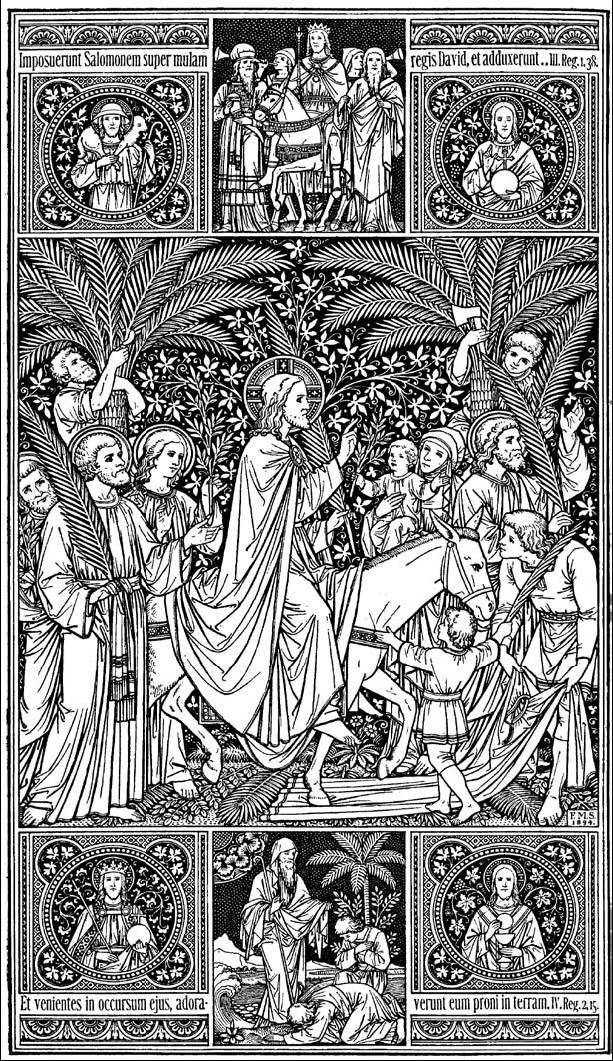
Prelude: The Scriptures record that Jesus went to Bethany on the Sunday evening after His triumphal entrance into Jerusalem (Palm Sunday):

[Jesus] went into the temple courts. He looked around at everything, but since it was already late, He went out to Bethany with the Twelve (Mk 11:11).

It is likely that Jesus stayed at the house of Martha, Mary, and Lazarus. Bethany was a mere two miles from Jerusalem (though a steep climb), just over the Mount of Olives.

Pain: The next morning (Monday) Jesus arises and goes back toward Jerusalem. Luke records that as He came over the crest of the hill on the Mount of Olives He wept:

As Jesus approached Jerusalem and saw the city, He wept over it and said, “If only you had known on this day what would bring you peace! But now it is hidden from your eyes. For the days will come upon you when your enemies will barricade you and surround you and hem you in on every side. They will level you to the ground—you and the children within your walls. They will not leave one stone on another, because you did not recognize the time of your visitation from God” (Lk 19:41-44).

Today on this spot there is a chapel named Dominus Flevit (the Lord wept), which is in the shape of a teardrop. From here Jesus could see the whole city spread out below. He could also see forty years into the future to the time when the Romans would destroy the city and Temple, the culmination of a horrible and pointless war (64-70 A.D.) for liberation from the Romans. Had Jesus’ message been heeded, the Romans would not have been regarded as enemies to kill but rather as brothers to convert to the gospel.

Passionate Anger: Mark recalls an event as they come down the hillside:

The next day, when they had left Bethany, Jesus was hungry. Seeing in the distance a fig tree in leaf, He went to see if there was any fruit on it. But when He reached it, He found nothing on it except leaves, since it was not the season for figs. Then He said to the tree, “May no one ever eat of your fruit again.” And His disciples heard this statement (Mk 11:12-14).

The fig tree is widely interpreted as representing the Jewish people. The Lord looked for fruits among His chosen people but found none. Jesus’ rebuke of the tree illustrates His righteous anger at and disappointment in their lack of the fruits of faith. Scripture says elsewhere,

And the men of Judah are [the Lord’s] pleasant planting; and he looked for justice, but behold, bloodshed; for righteousness, but behold, the outcry! (Is 5:6-7)

And Jesus told this parable: “A man had a fig tree planted in his vineyard, and he came seeking fruit on it and found none. And he said to the vinedresser, ‘Look, for three years now I have come seeking fruit on this fig tree, and I find none. Cut it down. Why should it use up the ground?’ And he answered him, ‘Sir, let it alone this year also, until I dig around it and put on manure. Then if it should bear fruit next year, well and good; but if not, you can cut it down’” (Luke 13:6-9).

Seeing no fruit in this last hour, Jesus in effect finishes the parable. The hour of judgment has come upon ancient Judah.

Many misunderstand the phrase that it was “not the season for figs,” falsely concluding that it was thus “unfair” to expect figs on the branches. However, it is for this very reason that one would expect to find figs growing in the branches, for if it were the harvest one would expect bare branches as the figs would have just been harvested. It is before the harvest that one expects to find figs, even if not fully ripe, growing in the branches. Seeing nothing but leaves, Jesus curses the tree.

Pivotal Event: The cleansing of the Temple was indeed a pivotal event. Here is Mark’s account:

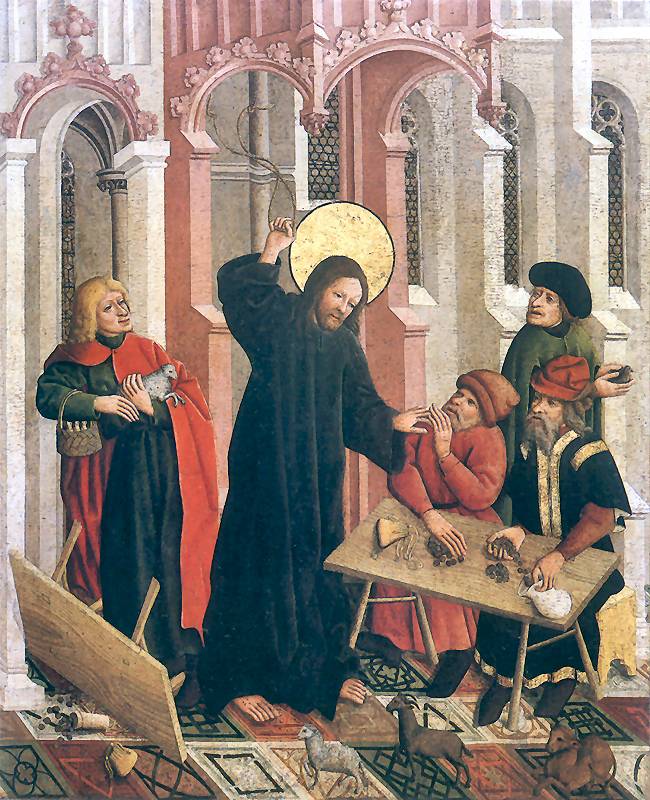
And they came to Jerusalem. And he entered the temple and began to drive out those who sold and those who bought in the temple, and he overturned the tables of the money-changers and the seats of those who sold pigeons. And he would not allow anyone to carry anything through the temple. And he was teaching them and saying to them, “Is it not written, ‘My house shall be called a house of prayer for all the nations’? But you have made it a den of robbers.” And the chief priests and the scribes heard it and were seeking a way to destroy him, for they feared him, because all the crowd was astonished at his teaching (Mk 11:15-18).

The Lord’s grief and anger grow worse as He enters the Temple. What made him so angry? Mark’s Gospel states the reason most clearly: It is not the selling of animals (which were needed for the sacrifices) per se, but that they were being sold in a part of the Temple grounds reserved for the Gentiles to pray. This is an insult and amounts to a denial that the prayers of the Gentiles mattered at all. Jesus was about to die in order to reunite God’s scattered children. And I, when I be lifted up from the earth, will draw all people unto me (Jn 12:32).

As for the Temple being a den of robbers, the implication is that the dealings there are unjust and exploitative.

Why is this a pivotal moment? The action of Jesus is a prophetic judgment made in the very center of the Temple leaders’ power. The Temple was the locus of their power and prestige. It is not lost on them for a moment that Jesus has threatened all of this, not merely by what He has said but by his popularity among the people.

According to John’s Gospel (which actually remarks on this earlier in Jesus’ ministry), when the Temple leaders demanded a sign and an explanation for this action Jesus said,

Destroy this temple, and in three days I will raise it up again.” “This temple took forty-six years to build,” the Jews replied, “and You are going to raise it up in three days?” But Jesus was speaking about the temple of His Body (Jn 2:19-21).

This had a further impact on the Temple leaders, who would later accuse Jesus (at His trial) of threatening to destroy the temple (e.g., Mk 14:58).

Theologically, Jesus is saying that Temple worship is over. He is the temple. He is the priest. He is the lamb. It is His blood that will cleanse us. Temple worship is ended because what it pointed to (Jesus) is now here. Its purpose is fulfilled in Him.

Quite a day, this Monday of Holy Week! Can you sense the grief and anger of the Lord? Remember, His anger is a righteous one. Everything was being fulfilled for the ancient people, but many are rejecting the very one God has sent to save them. Jesus cannot remain indifferent to their tragic rejection. He both weeps and has a grieving anger.

Do we weep for the condition of our world? Do we pray and seek to call forth the fruits of faith, justice, and truth?

Jesus does not give up. He will spend the next day teaching and seeking to win as many as possible to the truth of the gospel.

The Scriptures conclude Monday of Holy Week in this way:

And he left them and went out of the city to Bethany, where he spent the night (Matt 21:17).

Perhaps Jesus is consoled in His grief and anger by the presence of friends like Martha, Mary, and Lazarus. Perhaps He finds solace in the company of His apostles and others. Scripture says,

A faithful friend is a sturdy shelter:
he that has found one has found a treasure.
There is nothing so precious as a faithful friend,
and no scales can measure his excellence.
A faithful friend is a medicine of life;
and those who fear the Lord will find him
(Sirach 6:14-16).

Stay close to the heart of the Lord. Be His “consolation.” Be the reparation for the rejection by so many others.


See What the End Shall Be – A Homily for Palm Sunday

The Passion, which we read in the liturgy for Palm Sunday, is too long to comment on in detail, so we will only examine a portion of it here.

It may be of some value to examine the problems associated with the more moderate range of personalities involved. The usual villains (the Temple leaders, Judas, and the recruited crowd shouting, “Crucify him!”) are unambiguously wicked and display their sinfulness openly. But there are others involved whose struggles and neglectfulness are more subtle, yet no less real. It is in examining these figures that we can learn a great deal about ourselves, who, though we may not openly shout, “Crucify him,” are often not as unambiguously holy and heroic as Jesus’ persecutors are wicked and bold.

As we read the Passion we must understand that this is not merely an account of the behavior of people long gone, they are portraits of you and me; we do these things.

I. The Perception that is Partial – Near the beginning of today’s Passion account, the apostles, who are at the Last Supper with Jesus, are reminded of what the next days will hold. Jesus says,

This night all of you will have your faith in me shaken, for it is written, “I will strike the shepherd, and the sheep of the flock will be dispersed.” But after I have been raised up, I shall go before you to Galilee.

Note that the apostles are not being told these things for the first time; Jesus has spoken them before on numerous occasions:

From that time on Jesus began to explain to his disciples that he must go to Jerusalem and suffer many things at the hands of the elders, chief priests and teachers of the law, and that he must be killed and on the third day be raised to life (Matt 16:21).

When they came together in Galilee, he said to them, “The Son of Man is going to be betrayed into the hands of men. They will kill him, and on the third day he will be raised to life.” And the disciples were filled with grief (Matt 17:22-23).

We are going up to Jerusalem, and the Son of Man will be betrayed to the chief priests and the teachers of the law. They will condemn him to death and will turn him over to the Gentiles to be mocked and flogged and crucified. On the third day he will be raised to life” (Matt 20:18-19).

Thus we see that the Lord has consistently tried to teach and prepare them for the difficulties ahead. He has told them exactly what is going to happen and how it will end: not in death, but rising to new life. But even though He has told them over and over again, they still do not understand. Therefore He predicts that their faith in Him will be shaken.

Their perception is partial. They will see only the negative, forgetting that Jesus has promised to rise. Because they cannot see beyond the apparent defeat of the moment they will retreat into fear rather than boldly and confidently accompanying Him to His passion and glorification (for His passion is a lifting up; it is His glorification). Instead they will flee. He has shown the “what the end shall be,” but they can neither see nor accept it. Thus fear overwhelms them and they withdraw into a sinful fear, dissociating themselves from Jesus. Only a few (Mary, His Mother; John; Mary Magdalene; and a few other women) would see Him through to the end.

As for the rest, they see only what is gory and awful, missing what is glory and awesome. Their perception is quite partial. Paradoxically, their blindness comes from not hearing or listening to what Jesus has been telling them all along.

We, too, can easily suffer from a blindness caused by poor listening. The Lord has often told us that if we trust in Him, then our struggles will end in glory and new life. But, blind and forgetful, we give in to our fears and fail to walk the way of Christ’s passion boldly. We draw back and dissociate ourselves from Jesus, exhibiting some of the same tendencies we will observe in the people of that day.

Next, let’s examine some of the problems that emerge from this partial perception and forgetful fear.

II. The Problems Presented – There are at least five problems that emerge. They are unhealthy and sinful patterns that spring from the fear generated by not trusting Jesus’ vision. Please understand that the word “we” used here is shorthand and does not mean that every single person does this. Rather, it means that collectively we have these tendencies. There’s no need to take everything here personally.

1. They become drowsy – A common human technique for dealing with stress and the hardships of life is to become numb and drowsy; we can just drift off into a sort of moral slumber. Being vigilant against the threat posed to our souls by sin or the harm caused by injustice (whether to ourselves or to others) is just too stressful, so we just “tune out.” We stop noticing or really even caring about critically important matters. We anesthetize ourselves with things like alcohol, drugs, creature comforts, and meaningless distractions. Prayer and spirituality pose too many uncomfortable questions, so we just daydream about meaningless things like what a certain Hollywood star is doing or how the latest sporting event is going.

In the Passion accounts, the Lord asks Peter, James, and John to pray with Him. But they doze off. Perhaps it is the wine. Surely it is the flesh (for the Lord speaks of it). Unwilling or unable to deal with the stress of the situation, they get drowsy and doze off. Grave evil is at the very door, but they sleep. The Lord warns them to stay awake, lest they give way to temptation, but still they sleep. Someone they know and love is in grave danger, but it is too much for them to handle. They tune out, much as we do in the face of the overwhelming suffering of Christ visible in the poor and needy. We just stop noticing; it’s too painful, so we tune out.

The Lord had often warned them to be vigilant, sober, and alert (Mk 13:34, Matt 25:13, Mk 13:37; Matt 24:42; Luke 21:36, inter al). Other Scriptures would later pick up the theme (Romans 13:11; 1 Peter 5:8; 1 Thess 5:6, inter al). Yes, drowsiness is a serious spiritual problem.

Sadly, God described us well when He remarked to Isaiah, Israel’s watchmen are blind, they all lack knowledge; they are all mute dogs, they cannot bark; they lie around and dream, they love to sleep (Is 56:10).

We do this not only out of laziness, but also out of fear. One strategy is to try to ignore it, to go numb, to tune out. But despite the sleepiness of the disciples, the wicked are still awake; the threat does not go away by a drowsy inattentiveness to it. Thus we ought to be confident and sober. Life’s challenges are nothing to fear. The Lord has told us that we have already won if we will just trust in Him. The disciples have forgotten Jesus’ promise to rise after three days; we often do the same. So they, and we, just give in to the stress and tune out.

2. They seek to destroy – When Peter finally awaken, he lashes out with a sword and wounds Malchus, the servant of the high priest. The Lord rebukes Peter and reminds him of the vision: Put your sword away! Shall I not drink the cup the Father has given me? (John 18:11) Jesus then heals Malchus, who tradition says later became a follower.

In our fear, we, too, can often lash out and even seek to destroy our opponents. But if we are already certain of our victory, as the Lord has promised, why do we fear? Why do we need to suppress our opponents and enemies ruthlessly? It is one thing to speak the truth in love, boldly and confidently. But it is quite another to lash out aggressively and seek to win a debate. In so doing, we may lose a soul. The Lord healed Malchus, seeing in Him a future disciple. The Lord saw what the end would be. Peter did not. In fear, he lashed out with an aggression that did not bespeak a confidence in final victory.

It is true that we are required to confront evil, resist injustice, and speak with clarity to a confused world. But above all, we are called to love those whom we address. There is little place for fear in our conversations with the world. The truth will out; it will prevail. We may not win every encounter, but we do not have to; all we must do is plant seeds. God will water them and others may well harvest them. In Christ, we have already won. This confidence should give us serenity.

Peter has forgotten Jesus’ promise to rise after three days; we often do the same. So Peter, and we, give in to fear and lash out, driven by a desire to win when in fact we have already won.

3. They deny – Confronted with the fearful prospect of being condemned along with Jesus, Peter denies being one of His followers or even knowing Him at all. He dissociates himself from Christ. And we, confronted with the possibility of far milder things such as ridicule, often deny a connection with the Lord or the Church.

Regarding one of the more controversial Scripture teachings (e.g., the command to tithe; the prohibition against divorce, fornication, and homosexual activity) some might ask, “You don’t really believe that, do you?” It’s very easy to give in to fear and to respond, “No,” or to qualify our belief. Why suffer ridicule, endure further questioning, or be drawn into an unpleasant debate? So we just dissociate from, compromise, or qualify our faith to avoid the stress. We even congratulate ourselves for being tolerant when we do it!

Jesus says, If anyone is ashamed of me and my words in this adulterous and sinful generation, the Son of Man will be ashamed of him when he comes in his Father’s glory with the holy angels (Mk 8:38). But too easily we are ashamed. And so, like Peter, we engage in some form of denial. Peter is afraid because he has forgotten to “see what the end shall be.” He has forgotten Jesus’ promise to rise after three days; we often do the same. We lack confidence and give in to fear; we deny in order to avoid suffering with Jesus.

4. They dodge – When Jesus is arrested, all the disciples except John “split.” They “get the heck out of Dodge.” They are nowhere to be found. After Jesus’ arrest, it is said that Peter (prior to his denials) followed the Lord at a distance (Mk 14:54). But as soon as trouble arose, he “scrammed.”

We, too, can run away. Sometimes it’s because of persecution by the world. But sometimes it’s our fear that following the Lord is too hard and involves sacrifices that we are just not willing to make. Maybe it will endanger our money (the Lord insists that we tithe and be generous to the poor). Maybe it will endanger our playboy lifestyle (the Lord insists on chastity and respect). Maybe we don’t want to stop doing something that we have no business doing, something that is unjust, excessive, or sinful. But rather than face our fears, whether they come from within or without, we just hightail it out.

The disciples have forgotten that Jesus has shown them “what the end shall be.” In three days, he will win the victory. But, this forgotten, their fears emerge and they run. We too, must see “what the end shall be” in order to confront and resist our many fears.

5. They deflect – In this case our example is Pontius Pilate, not one of the disciples. Pilate was summoned to faith just like anyone else. “Are you a king?” he asks Jesus. Jesus responds by putting Pilate on trial: “Are you saying this on your own or have others been telling you about me?” Pilate has a choice to make: accept that what Jesus is saying as true, or give in to fear and commit a terrible sin of injustice. The various accounts in Scripture all make it clear that Pilate knew Jesus was innocent. But because he feared the crowds he handed Jesus over.

Note that Pilate did this. The crowds tempted him through fear, but he did the condemning. Yet notice that he tries to deflect his choice. The text says, he took water and washed his hands in front of the crowd. “I am innocent of this man’s blood,” he said. “It is your responsibility” (Mat 27:24). Well actually, Pilate, it is also your responsibility. You had a choice and you made it. Your own career and your own hide were more important to you than justice was. And though you wanted to do what was right and were sympathetic with Jesus, merely wanting to do what is right is not enough.

So, too, for us. We also often favor our career or our hide over doing what is right. And in so doing, we often blame others for what we have freely chosen. “I’m not responsible because my mother dropped me on my head when I was two.”

We are often willing to say, in effect,

“Look, Jesus, I love you. You get my Sundays, and my tithe, and I obey you (generally, anyway). But you have to understand that I have a career; I need to make money for my family. If I really stand up for what’s right, I might not make it in this world. You understand, don’t you? I know the company I work for is doing some things that are unjust. I know the world needs a clearer witness from me. I’ll do all that—after I retire. But for now, well, you know… Besides, it’s really my boss who’s to blame. It’s this old hell-bound, sin-soaked world that’s to blame, not me!”

We try to wash our hands of responsibility. We excuse our silence and inaction in the face of injustice and sin.

And all this is done out of fear. We forget “what the end shall be” and focus on the fearful present. We lack the vision that Jesus is trying to give us: that we will rise with Him. We stay blind to that and only see the threat of the here and now.

III. The Path that is Prescribed – By now you ought to know the path that is prescribed: see what the end shall be. In three days we rise! Why are we afraid? Jesus has already won the victory. It is true that we get there through the cross, but never forget what the end shall be! Today we read the Gospel of Friday, but wait till Sunday morning! I’ll rise!

We end where we began with this Gospel: This night all of you will have your faith in me shaken, for it is written: ‘I will strike the shepherd, and the sheep of the flock will be dispersed;’ but after I have been raised up, I shall go before you to Galilee.

Yes, after He has been raised He goes before us into Galilee. And for us, Galilee is Heaven. Whatever our sorrows, if we are faithful we will see Jesus in the Galilee of Heaven. Never forget this vision. After three days, we will rise with Him and be reunited with Him in the Galilee of Heaven.

So take courage; see what the end shall be! The end for those who are faithful is total victory. We don’t need to drowse, destroy, deny, dodge, or deflect; we’ve already won. All we need to do is to hold out.

I have it on the best of authority that Mother Mary was singing the following gospel song with St. John for a brief time while at the foot of the cross, as they looked past that Friday to the Sunday that was coming:

It’s all right, it’s all right.
My Jesus said he’ll fix it and it’s all right.

Sometimes I’m up sometimes I’m down.
But Jesus he’ll fix it and it’s all right.

Sometimes I’m almost on the ground.
My Jesus said he’ll fix it and it’s all right.

A Different Look at the Cross

When I was young and throughout my seminary years, I usually contemplated the crucifix and Jesus’ suffering on the Cross somberly. It was my sin that had put Him there, that had made Him suffer. The Cross was something that compelled a silent reverence in me, and suggested that I meditate deeply on what Jesus had to endure. I would often think of John, Mary, and the other women beneath the Cross, mournfully beholding Jesus’ slow, painful death.

These were heavy and somber notes, but deeply moving themes.

In addition, the crucifix made me think about the fact that I would have to carry a cross and go through the Fridays of my life. I needed to learn the meaning of sacrifice.

Liturgically, I saw the crucifix as a way of restoring greater reverence in the Mass. Through the 1970s and 1980s, most parishes had removed crucifixes, quite often replacing them with “resurrection crosses,” or just an image of Jesus floating in mid-air. I used to call this image “touchdown Jesus” since it so closely resembled a football referee indicating a score. In those years we had moved away from the understanding of the Mass as a sacrifice; we were more into “meal theology.” The removal of the crucifix from the sanctuary was a powerful indicator of this shift. Many priests and liturgists saw the Cross as too somber a theme for their vision of a new and more welcoming Church, upbeat and positive.

This Cross-less Christianity often led to what I thought was a rather silly, celebratory style of Mass in those years, and I came to see the restoration of the crucifix as necessary to bring back proper balance. I was delighted when, through the mid-1980s and later, the Vatican began insisting in new liturgical norms that a crucifix (not just a cross) be prominent in the sanctuary and visible to all, and further, that the processional cross had to bear the image of the crucified.

Balance Restored – I was (and still am) very happy about these new norms because they restore the proper balance. The Mass is a making-present of the once-for-all, perfect sacrifice of Jesus on the Cross; it is also a sacred meal, whose power comes from that sacrifice. I also believed that such a move would help restore proper solemnity to the Mass, and to some extent that has occurred.

All of this background is just to say that I saw the cross — the crucifix — in somber, serious tones. The theme was meant to instill solemnity and encourage meditation on the awful reality of sin and on our need to repent.

But the Lord wasn’t finished with me yet; He wanted me to see another understanding of the Cross.

He wanted me to also experience the “good” in Good Friday, for the Cross is also a place of victory and love, of God’s faithfulness and our deliverance. There’s a lot to celebrate at the foot of the Cross.

It happened one Sunday during Lent of 1994, one of my first in an African-American Catholic parish. It being Lent, I expected the typically celebratory quality of Mass in the parish to be scaled back a bit. Much to my surprise, though, the opening song began with an upbeat, toe-tapping gospel riff. At first I frowned, but then the choir began to sing:

Down at the Cross where my Savior died,
Down where for cleansing from sin I cried,

There to my heart was the blood applied;
Glory to His name!

Ah, so this was a Lenten theme! It was odd to me to hear the Cross being sung of so joyfully.

This was quite new for me. Perhaps it shouldn’t have been, but it was. The Catholicism of the 1970s and 1980s with which I was familiar found it necessary to remove the cross in order to celebrate, but here was celebration with and in the Cross!

The choir continued,

I am so wondrously saved from sin,
Jesus so sweetly abides within;

There at the Cross where He took me in;
Glory to His name!

The congregation and choir were stepping in time and clapping, rejoicing in the Cross, seeing it in the Resurrection light of its saving power and as a glorious reflection of God’s love for us. Up the aisle the procession wound. The last verse was transposed a half-step up to an even brighter key:

Oh, precious fountain that saves from sin,
I am so glad I have entered in;

There Jesus saves me and keeps me clean;
Glory to His name!

Yes, indeed, glory to His name! A lot of dots were connected for me that day. The Cross indeed was a place of great pain, but also of great love. There was grief, but there was also glory; there was suffering, but there was also victory.

Please do not misunderstand my point. There is a place and time for quiet, somber reflection at the foot of the Cross, but one of the glories of the human person is that we can have more than one feeling at a time, even conflicting ones.

Balance – Some in the Church of the 1970s and 1980s rejected the Cross as too somber a theme, too negative. They wanted to be more upbeat, less focused on sin; and so, out went the Cross. There was no need to do this, and it was an overreaction. At the Cross, the vertical, upward pillar of man’s pride and sin is transected by the horizontal, outstretched arms of God’s love. With strong hand and outstretched arms, the Lord has won the victory for us: there at the Cross where he took me in, glory to his name!

The balance is both for the individual and for the Church. Some prefer a more somber meditation on the Cross to prevail, while others feel moved by the Spirit to celebrate joyfully at the foot of the Cross. The Church needs both. I suppose we all need some of both experiences. Yes, it is right to weep at the Cross, to behold the awful reality of sin, to remember Christ’s sacrifice; but we should rejoice, too, for the Lord has won the victory for us, right there: Down at the Cross. There’s a lot of good in Good Friday.

Here is the song I heard that Sunday in 1994, sung in very much the style I remember.

Bite Your Tongue! A Homily for the 8th Sunday of the Year

The first reading this Sunday reminds us that our speech discloses our character:

When a sieve is shaken, the husks appear; so do one’s faults when one speaks. The fruit of a tree shows the care it has had; so too does one’s speech disclose the bent of one’s mind.

Praise no one before he speaks,
for it is then that people are tested
(Sirach 27:4-7).

What we say reveals a great deal about us—more than we imagine. Speech is among our greatest gifts, yet self-mastery in speech is among the rarest. Some of the most common sins we commit are related to speech: gossip, idle chatter, lies, exaggeration, harsh attack, and uncharitable remarks. With our tongue we can spew hatred, incite fear, spread misinformation, tempt, discourage, promote error, and ruin reputations. With a gift capable of bringing such good, we can surely cause great harm!

The Letter of James says this:

We all stumble in many ways. Anyone who is never at fault in what he says is perfect, able to keep his whole body in check. When we put bits into the mouths of horses to make them obey us, and thus we can turn the whole animal. Or take ships as an example. Although they are so large and are driven by strong winds, they are steered by a very small rudder wherever the pilot wants to go. Likewise, the tongue is a small part of the body, but it makes great boasts.

Consider how a great forest is set on fire by a small spark. The tongue also is a fire, a world of evil among the parts of the body. It corrupts the whole body, sets the whole course of one’s life on fire, and is itself set on fire by hell.

All kinds of animals, birds, reptiles and sea creatures are being tamed and have been tamed by mankind, but no human being can tame the tongue. It is a restless evil, full of deadly poison. With the tongue we praise our Lord and Father, and with it we curse human beings, who have been made in God’s likeness. Out of the same mouth come praise and cursing. My brothers and sisters, this should not be (Jam 3:2-10).

Although one may conquer any sin by God’s grace, those associated with speech are among the hardest to overcome. Sometimes it seems as if our speech is being controlled by a separate, baser part of our brain. We can be halfway through saying something before realizing how foolish and sinful we are being. Scripture speaks artistically of the sinful tongue.

Here are some common sins of the tongue:

The Lying Tongue – speaking falsehoods with the intention of misleading others.

  • The LORD detests lying lips, but he delights in people who are trustworthy (Prov 12:22).
  • A false witness will not go unpunished, and one who utters lies will not escape (Prov 19:5).
  • Not every story should you believe (Sir 19:14).

The Backbiting Tongue – talking about others behind their backs, injuring their reputations through detraction or slander.

  • A man’s tongue can be his downfall. Be not called a detractor; use not your tongue for calumny (Sir 5:13-16).
  • Whoever slanders his neighbor secretly I will destroy. (Psalm 101:5).

The Indiscreet Tongue – spreading confidential, unnecessary, or hurtful information about others.

  • He that goes about as a tale-bearer reveals secrets, therefore keep no company with such a one (Prov 20:19).
  • A gossip betrays a confidence; so avoid a man who talks too much (Prov 20:19).
  • He who repeats an evil report has no sense. Never repeat gossip… Let anything you hear die within you; be assured it will not make you burst. (Sir 19:5, 14).
  • Thou shalt not go up and down as a tale-bearer among thy people (Lev 19:16).

The Flattering Tongue – exaggerating the good qualities of others in order to ingratiate ourselves to them.

  • May the Lord silence all flattering lips and every boastful tongue (Ps 12:4).
  • Wounds from a friend can be trusted, but an enemy multiplies kisses (Prov 27:6).
  • May the Lord silence all flattering lips (Ps 12:4)

The Proud Tongue – speaking boastfully or in an overly certain way. There is a saying that a proud tongue comes with two closed ears. Those of proud tongue are not easily corrected and do not qualify or distinguish their remarks as they should.

  • May the Lord silence every boastful tongue, Those who say, “By our tongues we will prevail; when our lips speak, who can prevail over us?” (Ps 12:4-5)
  • The prudent man does not make a show of his knowledge, but fools broadcast their foolishness (Prov 12:23).

The Overused Tongue – saying too much, which usually ushers in sin by its excess.

  • A fool’s voice [comes] along with a multitude of words (Ecc 5:2).
  • When words are many, sin is inevitable, but he who restrains his lips is wise (Prov 10:19).
  • A fool delights in airing his own opinions (Prov 18:2)

The Rash Tongue – speaking before one should, often without having all the information.

  • Be not rash with your mouth, and let not your heart be hasty to utter anything before God (Ecc 5:1).
  • Be swift to hear, but slow to answer. If you have the knowledge, answer your neighbor; if not, put your hand over your mouth (Sir 5:13).
  • Even a fool is thought wise if he keeps silent, and discerning if he holds his tongue (Prov 17:28).

The Quarrelsome Tongue – speaking in an overly opinionated way, attacking others personally, and/or provoking unnecessary division.

  • Fools’ words get them into constant quarrels; they are asking for a beating (Prov 18:6).
  • Drive out the mocker, and out goes strife; quarrels and insults are ended (Prov 22:10).

The Cursing Tongue – wishing harm upon others, often that they be damned.

  • He loved to pronounce a curse—may it come back on him. He found no pleasure in blessing—may it be far from him (Ps 109:17).
  • Whoever curses his father or mother, his lamp will be extinguished in deepest darkness (Prov 20:20).

The Piercing Tongue – speaking harshly or severely without reason.

  • Some people make cutting remarks, but the words of the wise bring healing (Prov 12:18).
  • The heart of the righteous weighs its answers, but the mouth of the wicked gushes evil (Prov 15:28).
  • Do not rebuke an older man harshly, but exhort him as if he were your father.  (1 Tim 5:1-2).

The Silent Tongue – failing to speak up when we ought to warn people of sin, call them to the Kingdom, and announce the truth of Jesus Christ. In our age, the triumph of evil and poor behavior has been facilitated by our silence. As prophets, we are called to speak God’s Word.

  • Proclaim the message; persist in it in season and out of season; rebuke, correct, and encourage with great patience and teaching (2 Tim 4:2).
  • Israel’s watchmen are blind; they are all ignorant, they are all dumb dogs, they cannot bark (Is 56:10).

Yes, our speech is riddled with what it should not have and lacking in what it should. How wretched is our condition! Well, James did say, Anyone who is never at fault in what he says is perfect. Indeed, if anyone masters his tongue, he is a spiritual superman!

Set a guard over my mouth, O LORD; keep watch over the door of my lips (Ps 141:3).

Help me, Lord. Keep your arm around my shoulder and your hand over my mouth! Put your Word in my heart so that when I do speak, it’s really you speaking.


Be Different, Be a Christian – A Homily for the 7th Sunday of the Year

Are you a Christian? Before you answer, consider these other questions: Do you love your enemy? Do you do good to them who hate you? The honest answers to these questions are at the very heart of Christianity and represent what distinguishes a Christian from others. Let’s follow Jesus’ teachings in several stages. In so doing, we can learn our truest identity and how He seeks to transform us.

The ATTITUDE of a Christian

Jesus said to his disciples, “To you who hear I say, love your enemies, do good to those who hate you, bless those who curse you, pray for those who mistreat you. To the person who strikes you on one cheek, offer the other one as well, and from the person who takes your cloak, do not withhold even your tunic. Give to everyone who asks of you, and from the one who takes what is yours do not demand it back. Do to others as you would have them do to you.”

In effect, Jesus is telling us to put an end to the cycle of injustice and violence, by His grace. The Christian is to stand in the gap and say, “It ends with me.” This is Jesus’ game plan, his battle strategy. Defeat Satan’s cycle and thwart his plan to get two birds with one stone. Satan’s usual tactic is to inspire hatred or vengeance in someone, who then attacks us; in response, we lash back and become just like our enemy. In this way, Satan has captured two disciples for the price of one. The Lord tells us not to fall for that. We are to kill our enemies with kindness, get them with goodness, and lure them with love.

Note, then, four attitudes that the Lord distinguishes:

Merciful Love your enemies, do good to those who hate you, bless those who curse you, pray for those who mistreat you. We ought to remember how merciful God has been to us. Even when we mistreated Him and were His enemies through sin, God show[ed] his love for us in that while we were yet sinners Christ died for us (Rom 5:8). Allow God to make you aware of His abundant mercy so that you are deeply grateful and thus equipped to love your enemy and mercifully withhold your wrath and vengeance toward him.

Meek To the person who strikes you on one cheek, offer the other one as well, and from the person who takes your cloak, do not withhold even your tunic. Meekness is the virtue that governs anger. It is the proper middle ground between too much anger and not enough. Even when anger is an appropriate response, meekness moderates it, steering it away from destructive ends to helpful ones. It takes a strong person to control his anger, to refrain from retaliating or seeking revenge. Through meekness, we can also direct our anger toward the proper target: Satan. Use the energy of anger to defeat Satan’s plan!

Magnanimous Give to everyone who asks of you, and from the one who takes what is yours do not demand it back. We are too easily angered when people seek our time, talent, or treasure; this anger can give way to wrath. Those who are magnanimous are open to being asked, at peace with saying no when necessary, and generous in sharing their gifts. Christians graced by Christ are less apt to say, “This is mine; leave me alone” and more likely to realize that God has been good to them. This joy in what God has given them disposes them to generosity with others. Joy is like an energy that fuels magnanimity.

Meet Do to others as you would have them do to you. An old meaning of “meet” is suitable, proper, fitting, correct, or just. Christians are aware that if we want the world to be more just, it has to begin with us. We understand that we are going to need the help of others in countless ways and therefore treat others as we hoped to be treated. We sow justice, mercy, and patience in order to reap them in others.

The ALTITUDE of a Christian

For if you love those who love you, what credit is that to you? Even sinners love those who love them. And if you do good to those who do good to you, what credit is that to you? Even sinners do the same. If you lend money to those from whom you expect repayment, what credit is that to you? Even sinners lend to sinners and get back the same amount. But rather, love your enemies and do good to them, and lend expecting nothing back; then your reward will be great, and you will be children of the Most High, for he himself is kind to the ungrateful and the wicked. Be merciful, just as your Father is merciful.

Christians are supposed to stand out. By God’s grace, we are to rise above mere human norms. Note what Jesus expects of us:

We are to Excel – In effect, Jesus asks us these questions: How are you excelling? What makes you different from a virtuous atheist or pagan? What credit is it to you if you only do what they do? What makes you different from a sinner? The mark of a Christian is

  • that we love our enemies,
  • that we do good to them who do ill to us,
  • that we lend even when we expect to get nothing back, and
  • that we stop the cycle of injustice and violence.

We are to Exemplify – The text goes on to say, and you will be children of the Most High, for he himself is kind to the ungrateful and the wicked. Be merciful, just as your Father is merciful. In Matthew’s Gospel, Jesus says, But I say to you, Love your enemies and pray for those who persecute you, so that you may be sons of your Father who is in heaven; for he makes his sun rise on the evil and on the good, and sends rain on the just and on the unjust (Mat 5:44-45). Thus, we are to exemplify, to show forth who God is. We are to demonstrate that we are true children of the Father by doing what He does.

The ASSETS of a Christian

Stop judging and you will not be judged. Stop condemning and you will not be condemned. Forgive and you will be forgiven. Give, and gifts will be given to you; a good measure, packed together, shaken down, and overflowing, will be poured into your lap. For the measure with which you measure will in return be measured out to you.

Jesus teaches that, by His grace, we should do the following to store up treasures in Heaven:

Forego CondemnationJesus says, Stop condemning and you will not be condemned. Condemning means quickly and routinely seeking the worst of punishments for others. There are no second chances, no tempering of punishment or consideration of the context or background of people’s struggles; “Hang ’em high” is the cry of condemnation. Punishment is meant to be remedial. There are times when the strictest of punishments must be meted out, but typically only after lesser measures have been unsuccessful. However, correcting an erring brother is a spiritual work of mercy.

  • My brothers, if one of you should wander from the truth and someone should bring him back, remember this: Whoever turns a sinner from the error of his way will save him from death and cover over a multitude of sins (James 5:19-20).
  • Let the word of Christ dwell in you richly, teach and admonish one another in all wisdom (Col 3:16).
  • Thou shalt not hate thy brother in thine heart: thou shalt in fact rebuke thy neighbor, and not suffer sin upon him (Lev 19:17).
  • Brethren, if someone is detected in sin, you who live by the Spirit should gently set him right, each of you trying to avoid falling into temptation himself (Gal 5:25).

Nevertheless, be careful. The Lord says, The measure that you measure to others will be measured back to you (Mat 7:2). James also warns, Merciless is the judgment on the one who has shown no mercy (James 2:13). Thus, among our assets in Heaven will be mercy stored up for us at our judgment if we show mercy to others.

Forgive Transgressions – Jesus says, Forgive and you will be forgiven. If we do this, there is the promise of forgiveness being shown to us at our judgment. For if you forgive men their trespasses, your heavenly Father also will forgive you; but if you do not forgive men their trespasses, neither will your Father forgive your trespasses (Mat 6:13-15).

Freely Give – Jesus says, Give, and gifts will be given to you. Paradoxically, one of the ways we keep something in the Kingdom of God is by giving it away. When we give it away, we thereby store it up in Heaven.

  • I tell you, use worldly wealth to gain friends for yourselves, so that when it is gone, you will be welcomed into eternal dwellings. Whoever can be trusted with very little can also be trusted with much, and whoever is dishonest with very little will also be dishonest with much (Luke 16:9).
  • Whoever sows sparingly will also reap sparingly, and whoever sows generously will also reap generously. Each man should give what he has decided in his heart to give, not reluctantly or under compulsion, for God loves a cheerful giver. … As it is written, “He has scattered abroad his gifts to the poor; his righteousness endures forever.” Now he who supplies seed to the sower and bread for food will also supply and increase your store of seed and will enlarge the harvest of your righteousness. You will be made rich in every way so that you can be generous on every occasion, and through us your generosity will result in thanksgiving to God (2 Cor 9:6-11).
  • Jesus said to him, “If you would be perfect, go, sell what you possess and give to the poor, and you will have treasure in heaven; and come, follow me” (Matt 19:21).
  • Do not lay up for yourselves treasures on earth, where moth and rust consume and where thieves break in and steal, but lay up for yourselves treasures in heaven, where neither moth nor rust consumes and where thieves do not break in and steal (Matt 6:19).

Fully Receive a good measure, packed together, shaken down, and overflowing, will be poured into your lap. For the measure with which you measure will in return be measured out to you. Here, then, is the promise of our assets if we become, by God’s grace, true Christians. In effect, your yardstick will become a boomerang. Let it come back to bless you. If you have been merciful you will find mercy. If you have forgiven you will find forgiveness. If you have given it shall be returned to you many times over. These are the assets of the Christian. Invest wisely!

Blessing or Woe: You Decide. A Homily for the 6th Sunday of the Year

The Gospel passage this Sunday is Luke’s version of the Beatitudes. Being paradoxical, they are difficult to understand. We do not usually refer to the poor as blessed, but rather the well off; we do not typically call those who mourn blessed, but rather the joyful.

The word “beatitude” itself means “supreme blessedness.” In ancient Greek, makarios (blessed) referred to a deep, serene, and stable happiness largely unaffected by external matters. It also corresponds to the Hebrew word asher, which is more of an exclamation.

Each beatitude could easily be translated to begin in this way: “O, the blessedness of ….” Such a translation emphasizes that something is being described and experienced rather than prescribed.

So, it is critical to understand that beatitude is not something we achieve; rather, it is something we receive. The Beatitudes declare an objective reality as the result of a divine act. The use of the indicative mood in the passage should be taken seriously; we should not turn it into an imperative. In other words, as noted, the Beatitudes are more descriptions than prescriptions. Jesus is not simply saying that we should be poor or meek and then God will bless us. Rather, He is saying that this is what the transformed human person is like; this is what happens to us when He lives His life in us and transforms us; this is what our life is like when His grace and the power of His cross bring about in us a greater meekness and poverty of spirit—we will experience being blessed.

This helps to explain the paradox of some of the Beatitudes. We are still blessed even when we are poor, or mourning, or persecuted. Further, we are confirmed in blessedness by such realities because they serve as reminders that we are not at home in this world; God and His kingdom are our preoccupation and the source of our true beatitude.

In Luke’s version of the Beatitudes there are also woes described for those who reject the Lord’s offer. Let’s pair them up and consider them together, seeing the choice the Lord presents in each case: blessing or woe.

Blessed are you who are poor, for the kingdom of God is yours.

Who are the poor? They are those who, by God’s grace, have their true treasure in Heaven rather than on earth. They are poor to this world but rich to God. They have learned to depend on Him and are not obsessed with the passing riches of this world.

All of us are dependent on God, but we may not realize it. The poor in spirit are those who have come to peace in the knowledge that they depend on God for every beat of their heart, for every good thing they have. Humans strongly resist any such sense of dependence or lack of control. Many people strive to acquire wealth, power, and possessions in order to create the illusion that they are in control—they are not. Ultimately this whole system will fail; it is a recipe for frustration and unhappiness.

Further, control is like an addictive drug. The more we get, the more we need in order to feel less anxious. Our modern age illustrates this. Consider, for example, modern medicine, through which we can control things we never could before. Are all our fears gone as a result? No. Humans have never lived so long nor been so healthy, yet we have never been so anxious about our health. Our medicine cabinets are filled with prescriptions and over-the-counter medications, but we still worry! Control is an illusion, an addiction all its own. In the end, it seems we can never have enough of it to feel sufficiently “safe.”

How blessed are those who delight in depending on God, who realize that every beat of their heart is His gift and that everything they have is from Him and belongs to Him! They are blessed because they are free from the countless fears that flow from an endless quest for illusory control.

But woe to you who are rich, for you have received your consolation.

It’s nice to be rich, but if that’s all you live for, that’s all you’ll get. When it’s over it’s over, and then comes the judgment. Paradoxically, the only way to retain riches is to give them away or use them in serving others. Jesus instructs,

Store up for yourselves treasures in heaven, where moth and rust do not destroy, and where thieves do not break in and steal. For where your treasure is, there your heart will be also will be (Matt 6:20).

St. Paul says,

Instruct those who are rich in the present age not to be conceited and not to put their hope in the uncertainty of wealth, but in God, who richly provides all things for us to enjoy. Instruct them to do good, to be rich in good works, and to be generous and ready to share, treasuring up for themselves a firm foundation for the future, so that they may take hold of that which is truly life (1 Tim 6:17-19).

If we hoard wealth when others are in need or use our wealth in unjust ways, we may enjoy comforts in this world, but a stern judgment awaits. Live with the final judgment in mind; share and be generous. Jesus warns of woe that will come to those who resist his grace to be generous.

Blessed are you who are now hungry, for you will be satisfied.

All of us hunger physically, but the important thing is to hunger for God and the things waiting for us in Heaven. Many people hunger for anything but God—wealth, power, popularity, the latest fad.

It is in our hunger that we make room for God. It is then that we seek Him.

How blessed are those who hunger and thirst for the righteousness and justice of God and the values of His Kingdom! God will satisfy them with the joy of living under His law and they will rejoice to see the wisdom of His ways. They hunger for God’s Word and devour it when they find it. They rejoice to see God put sin to death in them and bring about virtue. They are excited and satisfied at what God is doing in their life. They are blessed indeed.

But woe to you who are filled now, for you will be hungry.

If we are filled with the things of this world, there is no room for God. Worldly things can only satisfy temporarily; being finite they cannot fill the infinite longing we have. We were made to know and love God; He alone can satisfy our longing. If we refuse this true food and true drink (see John 6:55), which is Christ Himself in the Eucharist, there awaits only a longing that will one day be permanent if we reject the Lord to the end. The Lord warns of woe to those who resist His gift to feed them with His Body and Blood and fill their minds with His Word.

Blessed are you who are now weeping, for you will laugh.

Who are those who weep? First, they are those who are not obsessed with emotional happiness and who accept sorrow as a part of life. Their sorrow is not about merely worldly things. They weep because they delight in the Kingdom of Heaven yet see the awful state of most of God’s people. They see so many who do not know God nor why they were created. They see people willfully locked in sin and darkness. They see still others who are victims of the sins of injustice and oppression. Because of these things they weep, mourn, and pray. This beatitude is the basis of intercessory prayer and deepening love for sinners. Because we mourn, we pray for the world.

Again, the object of this beatitude is rooted in the Kingdom of God and its values, not the passing values of this world. If our car gets scratched or the stock market goes down and we may mourn, but that’s not the subject of this beatitude.

How blessed are those who mourn over what really matters and who pray! They will laugh in the sense that God will console, strengthen, and encourage them. He will cause their mourning to bear fruit in prayer and action for others. To mourn in this way is to be blessed. It is a grief that “hurts so good,” because we know that it brings abundant blessings for the world as it intensifies our prayer and our own commitment to God and His Kingdom.

Woe to you who laugh now, for you will grieve and weep.

Rejoicing with the world is like celebrating on the Titanic before it hits the iceberg. The ride is wonderful for a while but then comes the cold and unforgiving depths. Too many in our world live frivolous lives. They “major in the minors.” They call good or no big deal what God calls sin; they even celebrate it and praise it. Jesus says, woe to them. While there are things to enjoy in this world, there is also much to lament. Sin and injustice, moral darkness, and confusion are nothing to celebrate. The Lord warns of woe to those who do not let Him transform their hearts so that they grieve over sin and darkness.

Blessed are you when people hate you, and when they exclude and insult you, and denounce your name as evil on account of the Son of Man. Rejoice and leap for joy on that day! Behold, your reward will be great in heaven. For their ancestors treated the prophets in the same way.

In life we are going to suffer, so it might as well be for something decent and noble. How blessed are those who, because they love God and His kingdom, are hated by this world! At least they share a common lot with Jesus. They know that only false prophets are loved by all. There is a paradoxical serenity that comes from this sort of persecution because it is a sign that we are no longer of this world, that the world has lost its hold on us and thus hates us (Jn 15:19). Forsaking this world and being hated by it, they are blessed, because the Kingdom of God is theirs in abundance.

Woe to you when all speak well of you, for their ancestors treated the false prophets in this way.

If the world is cheering for you, you’re playing on the wrong team, the losing team. The “world” is the set of philosophies, power structures, and inclinations at odds with the teachings and truths of God. A friend of the world becomes an enemy of God (James 4:4). Jesus says,

If the world hates you, understand that it hated Me first. If you were of the world, it would love you as its own. Instead, the world hates you, because you are not of the world, but I have chosen you out of the world. Remember the word that I spoke to you: ‘No servant is greater than his master.’ If they persecuted Me, they will persecute you as well (Jn 15:18-20).

Jesus warns of woe to those who pitch their tents in this world. It is passing away as are all those who seek its friendship. Jesus warns of the woe that comes from being too friendly with a lost and sinful world.

In all these ways, the Lord paints a kind of picture for us of the transformed human person. He shows us what happens to us as He lives His life in us.

Decisions have consequences. Depending on our choice to let God work in our life or not, there is either blessing or woe. Choose the blessings, dear brethren, choose the blessings.

One of my mentors over the years was the late Fr. Francis Martin, a teacher at the Dominican House of Studies (among many other places), a great scholar of Scripture, and the author of numerous books and articles; he also gave many a retreat for priests. Here are some of his reflections on the Gospel:


Children Go Where I Send Thee – A Homily for the 5th Sunday of the Year

This Sunday’s Gospel describes the call of Simon Peter, one that takes place in several stages. While it is presented in a compact time frame, for most of us it takes place over a longer period, as the Lord works to deepen our faith and heighten our call.

The upshot of the Gospel is that Peter’s faith is strengthened by his obedience to the Lord’s command.

Let’s see how the Lord grows Peter’s faith.

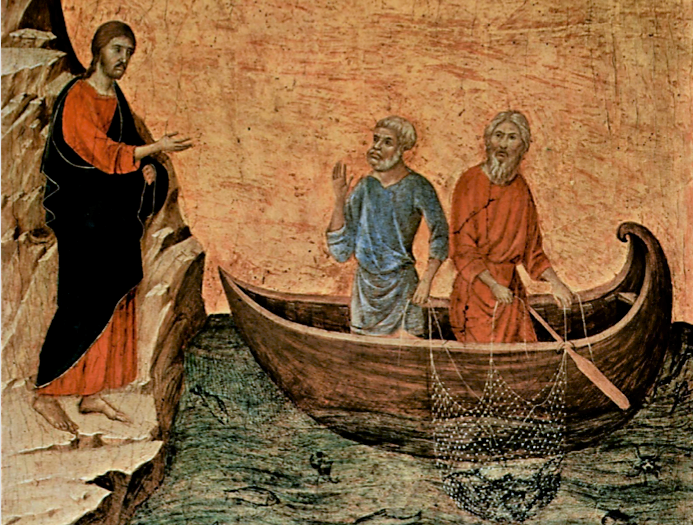
The Help that isn’t Hard – The text says, While the crowd was pressing in on Jesus and listening to the word of God, he was standing by the Lake of Gennesaret. He saw two boats there alongside the lake; the fishermen had disembarked and were washing their nets. Getting into one of the boats, the one belonging to Simon, he asked him to put out a short distance from the shore. Then he sat down and taught the crowds from the boat.

It may astonish us, but God seeks our help. What did Peter have? He had a boat at the ready and, as we shall see, a tender heart. What do you have? All of us have talents, gifts, access, and availability that God can and wants to use. The way the Lord has set things up, He “needs” our help. God, who made us without our help, will not save us without our help. Call this what you will—cooperative grace, collaborative grace, or my personal favorite: responsible grace—but God seeks to engage us in our own salvation and in the salvation of others. He wants our help.

The main point in terms of Peter’s progression in the faith is that this initial request (to put out from shore) is a small one; it’s not hard for Peter and helps him to learn the obedience of faith.

This is where the Lord begins with both Peter and us. He trains us in greater obedience through small things. Don’t overlook the small, daily acts of obedience to the Lord. Through them the Lord trains and equips us for greater things. If the Lord can trust us in small matters, He can and will trust us with larger ones.

The Hesitation that must be Healed – The text says, After he had finished speaking, he said to Simon, “Put out into deep water and lower your nets for a catch.” Simon said in reply, “Master, we have worked hard all night and have caught nothing, but at your command I will lower the nets.”

Peter is willing to do something routine for the Lord. After all, how hard is it to let the Lord use your boat for a while? Now the Lord invites Peter to go a little deeper, to “put out into deep water.” For a moment, Peter hesitates. He is tired and discouraged—so much work and so little to show for it. There was probably some doubt in Peter’s heart and a hint of sarcasm in his voice, because later he repents and calls himself a sinful man. Yes, here is a hesitation that must be healed if Peter is ever to see his blessings and reach his destiny.

So, too, for some of us. Perhaps we’ve heard the Lord calling us to some task but hesitated because we were tired or discouraged. I’ll come to Church and say a few prayers, but please, Lord, don’t ask anything more of me.

Perhaps we are fearful. Deep waters bring greater threats. As the water gets deeper the stakes get higher. Somehow, we must step out in faith, to get out of our comfort zone and head for deeper waters. Like Peter, we can hesitate, thinking of all sorts of reasons why what the Lord asks of us is not a good idea.

How is Peter healed of his hesitation? In a countercultural way, Peter is healed by the obedience of faith; that is the central point of today’s Gospel.

Yes, Peter’s healing is caught up in his acknowledgement that the Lord commands it. Peter says, But at your command I will lower the nets. Peter finds strength and consolation in the Lord’s command. Paradoxically, there is something freeing about being under authority.

We live in a culture that tends to regard authority with cynicism, even rewarding some amount of rebellion. Further, our flesh tends to bristle at being under authority. Again, there is something freeing about being under authority.

As a Christian, I derive a lot of serenity and courage when I understand that the Lord commands something of me. While the world may balk at the demands of the moral life and find much of it too difficult or demanding, I often find that it is enough for me to know that the Lord both teaches and commands it. This gives me both serenity and confidence. Even if some aspect of my flesh may hesitate, knowing that my Lord and His lawful representatives (my bishop and the Magisterium) command something frees me and gives me the courage to understand that I am doing God’s will. Any natural hesitancy I might have is often quickly dispatched when I realize that I am being commanded by the Lord.

On a given Sunday morning, a person might consider skipping Mass, preferring to sleep in or perhaps finding it difficult somehow. Knowing that it is commanded (the third commandment) helps him to overcome his hesitancy. The same is true for the rest of the moral law and also certain vocational matters and actions required of the Christian, not under a general command but under a specific call from the Lord.

In this way of obedience, the Lord draws Peter to deeper waters. Peter’s hesitation must be healed if he is to see his faith deepen and his call heighten.

The Harvest that is Hauled – The text says, When they had done this, they caught a great number of fish and their nets were tearing. They signaled to their partners in the other boat to come to help them. They came and filled both boats so that the boats were in danger of sinking.

In this matter the Lord grants Peter a great grace: enjoying the fruits of obedience in an immediate way. In other cases, the harvest is not so swift, but this much is always true: it is promised, and it will come, whether today or years from now.

The Lord says elsewhere, using a more terrestrial image, the harvest is plentiful (Mat 9:37). The Lord is providing an audiovisual aid. Obviously, the harvest that the Lord heralded was not about fish; it was about human beings. Indeed, the harvest is plentiful. Consider all the people whom the Lord has touched after these humble beginnings in a backwater of Israel. Not only are there more than one billion Catholics in the world today, but there are countless others who lived before us and many (only God knows how many) who will come after us. Yes, it is a bountiful harvest!

Some days and times are better for fishing or harvesting than others. St. Paul speaks of the gospel as being “in season and out of season” (2 Tim 4:2), but even in those times that the Lord designates for pruning or for the field to lie fallow, He is only preparing for future growth. The Lord says, “the harvest is plentiful,” and His Word prevails.

In the West it seems that the seasons have turned against us, but we must remember that even in winter the farmer must stay busy preparing the soil, removing the rocks, and laying down fertilizer.

Yes, the Lord is heralding a harvest, and we must work no matter the season. Even if we do not see the full harvest, the Lord will, as will others who come after us. Jesus says elsewhere, Thus the saying “One sows, and another reaps” is true. I sent you to reap what you have not worked for. Others have done the hard work, and you have reaped the benefits of their labor” (John 4:37).

The bottom line is this: just do your work. Obey what the Lord commands and know that a harvest is heralded and will be hauled in someday. The nets will be strained, and the boats heavily weighed down. The harvest will come, and it will come with abundance. Just keep working and obeying what He commands.

The Humility that Heightens – The text says, When Simon Peter saw this, he fell at the knees of Jesus and said, “Depart from me, Lord, for I am a sinful man.” For astonishment at the catch of fish they had made seized him and all those with him, and likewise James and John, the sons of Zebedee, who were partners of Simon. Jesus said to Simon, “Do not be afraid; from now on you will be catching men.” When they brought their boats to the shore, they left everything and followed him.

In falling to his knees, Peter is about to raised higher by the Lord. Peter realizes that his hesitation and doubt have been sinful and that had he persisted in not obeying the Lord, he would have blocked his blessings.

Notice that Peter is not described as having a cringing humility but rather a healthy one.

Healthy humility raises us; it does not cast us down. Bowing in healthy humility does not crush us; it heightens our status. The Lord, having led Peter to a healthy obedience and humility, in effect tells him, “Come up higher. Your concern now will not be fish but rather the care of human souls who are precious to me. You will be my co-worker in a far more important enterprise.” Yes, healthy humility raises us.

Thus, Peter’s humility is a productive one. It is the godly sorrow of which St. Paul writes,

Even if I caused you sorrow by my letter, I do not regret it. Though I did regret it—I see that my letter hurt you, but only for a little while—yet now I am happy, not because you were made sorry, but because your sorrow led you to repentance. For you became sorrowful as God intended and so were not harmed in any way by us. Godly sorrow brings repentance that leads to salvation and leaves no regret, but worldly sorrow brings death. See what this godly sorrow has produced in you: what earnestness, what eagerness to clear yourselves, what indignation, what alarm, what longing, what concern, what readiness to see justice done (2 Cor 7:8-11).

Peter’s humility is productive because it is godly. Humility and sorrow equip him for greater duties, duties no longer related fish but to human souls.

How different this is from mere shame (which Paul calls worldly sorrow)! Shame often locks us into unhealthy, paralyzing self-loathing. Godly sorrow increases our zeal to do God’s will and thereby equips, empowers, and enables us when He calls—and the Lord does call.

Peter, through obedience and humility, is now ready to leave everything and follow Jesus. The Lord has led him to this point in stages. It began with a request for help that wasn’t hard, a small obedience, but then the Lord called Peter deeper, to a more difficult obedience. Peter needed to have his hesitation healed. Experiencing this healing, he hauled in a harvest that illustrated what his lack of faith and obedience might have cost him. It humbled him but also heightened him. Having his faith deepened in Jesus, Peter is now ready to follow the Lord. It is always better to walk in humility and obedience than in pride!

In all of this, don’t miss the key, the golden chord: At your command, I will lower the nets. Faith is rooted in obedience and humility. That is the key to our growth as disciples.

St. Peter is still a rookie, but his first season holds great promise. He will not go through life without injury, but in the end, he too will be the rock (in Christ) who is ready to roll.