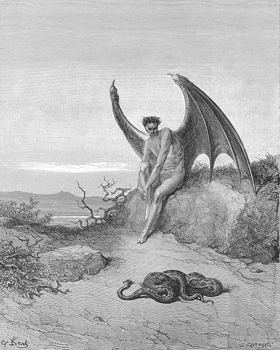
Titles and Descriptions of Satan from the Rite of Exorcism and What They Have to Teach Us

blog-9-7-2015In the realm of demonology there is a cautious balance to maintain. Sadly, an exorcist must usually inflict pain upon demons in order to drive them out. This is done through the prayers of the Rite of Exorcism and through other things recommended by the rite such as the use of holy water, the use of relics, the touch of a stole, and the use of the Holy Cross.

And yet the exorcist must be careful not to hate demons or harbor unjust anger toward them. For in so doing, they would have him; he would be drawn into their territory. If they can get him to hate and to have vengeful anger then they have made him to be like themselves; he is theirs, little better than they save for the possibility that he can still repent.

Hence the exorcist and any who would pray for deliverance from demons for themselves or others, do well to stay inside the norms of the Church and Scripture. These norms warn and set limits for those who would confront demons, lest they stray by pride or anger.

What are some of these norms? Here are just a few, but they are properly cautionary to be sure.

  1. A lay person should never undertake to drive out demons except by the following simple formula: “I command you, all evil spirits to leave me at once in the name of Jesus Christ the Lord.” At no time should a lay person ever engage a demon in conversation, ask questions, or in any way seek information.
  2. The same holds true for priests who engage in minor exorcisms. While they are permitted to use more elaborate imprecatory prayer found in the Manual of Minor Exorcisms, priests are not to go beyond the commands therein. They are not to ask questions or to demand names or signs from demons.
  3. Only appointed exorcists, delegated by the bishop, may or should inquire of the names and numbers of demons, their time of entry, why they possessed the individual, their rank, and so forth. The rite makes clear that only necessary questions should be asked. Other impertinent information is both unnecessary and harmful.
  4. Within the formal Rite of Exorcism, an exorcist does well to stick to the formulas, expressions, and norms of the rite. Banter, insulting language, and toe-to-toe debate are to be avoided. Good exorcists indicate that returning to the prayers of the rite is essential when demons seek to engage in debate, ridicule, and diversionary talk. Obmutesce pater mendacii (Be silent, father of lies) is a quick command from the rite to order the demons to be silent, and it is a good way to refuse to enter into pointless conversation or ridicule.

Scripture attests to the need to refrain from reviling demons:

For Even Michael the archangel, when he disputed with the devil and argued about the body of Moses, did not dare pronounce against him a reviling judgment, but said, “The Lord rebuke you!” (Jude 1:9)

Further, hate and ridicule of any person (angelic or human) whom God has created is an ungodly attitude. Scripture says,

For you O Lord love all things that are and loathe nothing that you have made; for you would not fashion what you hate (Wisdom 11:24).

Therefore anyone who confronts demons or suffers their oppression is warned that hatred and unjust anger, reviling and ridiculing, is no way to fight them, for if we do so we become like them.

That said, exorcists and priests must often use strong language approved by the minor and major prayers of exorcism, most of which are drawn from Scripture or Sacred Tradition.

Consider, for example, the following rebuke of Satan from Scripture:

How are you fallen from heaven, O Lucifer, son of the morning! How are you cut down to the ground, who did weaken the nations! For you have said in your heart, “I will ascend into heaven, I will exalt my throne above the stars of God: I will sit also upon the mount of the congregation, in the farthest sides of the north: I will ascend above the heights of the clouds; I will be like the most High.” Yet you shall be brought down to Sheol, to the depths of the lake of fire (Is 14:12-15).

These verses speak truth. They do not revile; they say what happened and they point to Lucifer’s prideful fall.

The Rite of Exorcism has collected many descriptions from Scripture and Tradition. They are not intended to ridicule or revile, but rather to remind Satan of who and what he has chosen to become. They remind him of his pride, his destruction by God’s justice, his ultimate fate, and the many ways he seeks to harm us. Consider, then, some of the “titles” and descriptions of Satan drawn from both the old and new rites of exorcism:

Enemy of the faith

Foe of the human race

Carrier of death

Robber of life

Shirker of justice

Root of evil

Fomenter of vice

Seducer of men

Traitor of the nations

Instigator of envy

Font of avarice

Source of discord

Exciter of sorrows

Transgressor

Seducer full of deceit and lies

Enemy of virtue

Persecutor of the innocent

Horrible dragon

Prince of accursed murder

Author of incest

Leader of sacrilege

Teacher of all negative action

Teacher of heretics

Inventor of every obscenity

Hateful one

Scourge

Unclean spirit

Every satanic power  

Every assault of the infernal adversary  

Legions congregations and diabolical sects

Evil dragon

Diabolical legion

Inventor and teacher of every lie

Enemy of man’s salvation

Prince of this world

Deceiver of the human race

Ancient foe of mankind

Father of lies

Evil dragon

Cunning serpent 

All you powers of darkness

Get thee gone, Satan! 

I have compiled a pdf of these in both Latin and English here: Titles of Satan from the Rite of Exorcism.

Thus, whether driving out Satan in a major exorcism or seeking to expel his oppression in a minor exorcism, all are cautioned not to stray from the understandings and descriptions of Satan that the Church provides in Scripture and Sacred Tradition. Again, the reason for this is that Satan seeks to draw us into his world of hatred and revilement. Do not go there in your thoughts and surely not in your heart.

It may be hard to accept, but God does not hate Satan. God does not hate even the worst of sinners. Surely justice requires God to recognize the final disposition of a person (angelic or human). Some are justly permitted to live apart from God’s kingdom in a hellacious parallel universe; that is their choice. But God does not hate fallen angels or fallen humans. God is Love and Love does not hate—and neither should we.

We ought to be sober about what sin has done to demons, fallen angels who were once glorious. But now, through the ugly disfigurement of sin, they are in darkness and are horribly contrary to the glory for which they were made. They are to be pitied and kept at a distance. They will not change (for angels choose once and for all). Their lies are to be resisted. Though they can still appear as lightsome, it is only for a time and then their terrifying state of horror and darkness roars forth.

Do not be deceived. But do not hate, either. Be sober, watchful, and distant from the once-glorious fallen angels we rightly call demons.
Healing Medicine for Strident Times – A Reflection on a Teaching on the Liturgy from Joseph Ratzinger

8.30.15 blog postOne of the most concise and cogent descriptions of these often strident times came from Joseph Cardinal Ratzinger in 1986. It is contained in, of all places, his treatise on the theology of sacred music in a book called The Feast of Faith (Ignatius Press, 1986). His comments have recently been republished in a larger compendium of his works: Collected Works: Theology of the Liturgy (Ignatius Press, 2014, Vol 11).

It hard to describe our times as anything but contentious. Loud, strident protests often predominate over reasoned discourse and thoughtful argumentation.

To be sure, every era has had, and needed, protest and public opposition to injustices that are too often hidden. There is a time and place for loud protest and the use of memorable sound bites.

But it is the predominance of loud protest and civil disobedience that stands out. Sound bites, slogans, and simplistic “war cries” have to a large extent replaced thoughtful, reasoned discourse. Volume, power, and visually flashy techniques are prized and used more and more. Such approaches too frequently produce more heat than light.

Consider, then, this remarkable analysis by Joseph Cardinal Ratzinger, written back before the Internet and social media had turned up the volume even more. He paraphrases an insight by Gandhi, applies it to his analysis of our times, and then proposes a healing remedy to restore balance:

I would like to note a beautiful saying of Mahatma Gandhi … Gandhi refers to the three habitats of the cosmos and how each of these provides its own mode of being. The fish live in the sea, and they are silent. The animals of the earth scream and shout; but the birds, whose habitat is the heavens, sing. Silence is proper to the sea, shouting to the earth and singing to the heavens. Man has a share in all three of them. He carries the depths of the sea, the burden of the earth, and the heights of the heavens in himself. And for this reason, all three properties also belong to him: silence, shouting, and singing.

Today—I would like to add—we see only the shouting is left for the man without transcendence, since he only wants to be of the earth. …

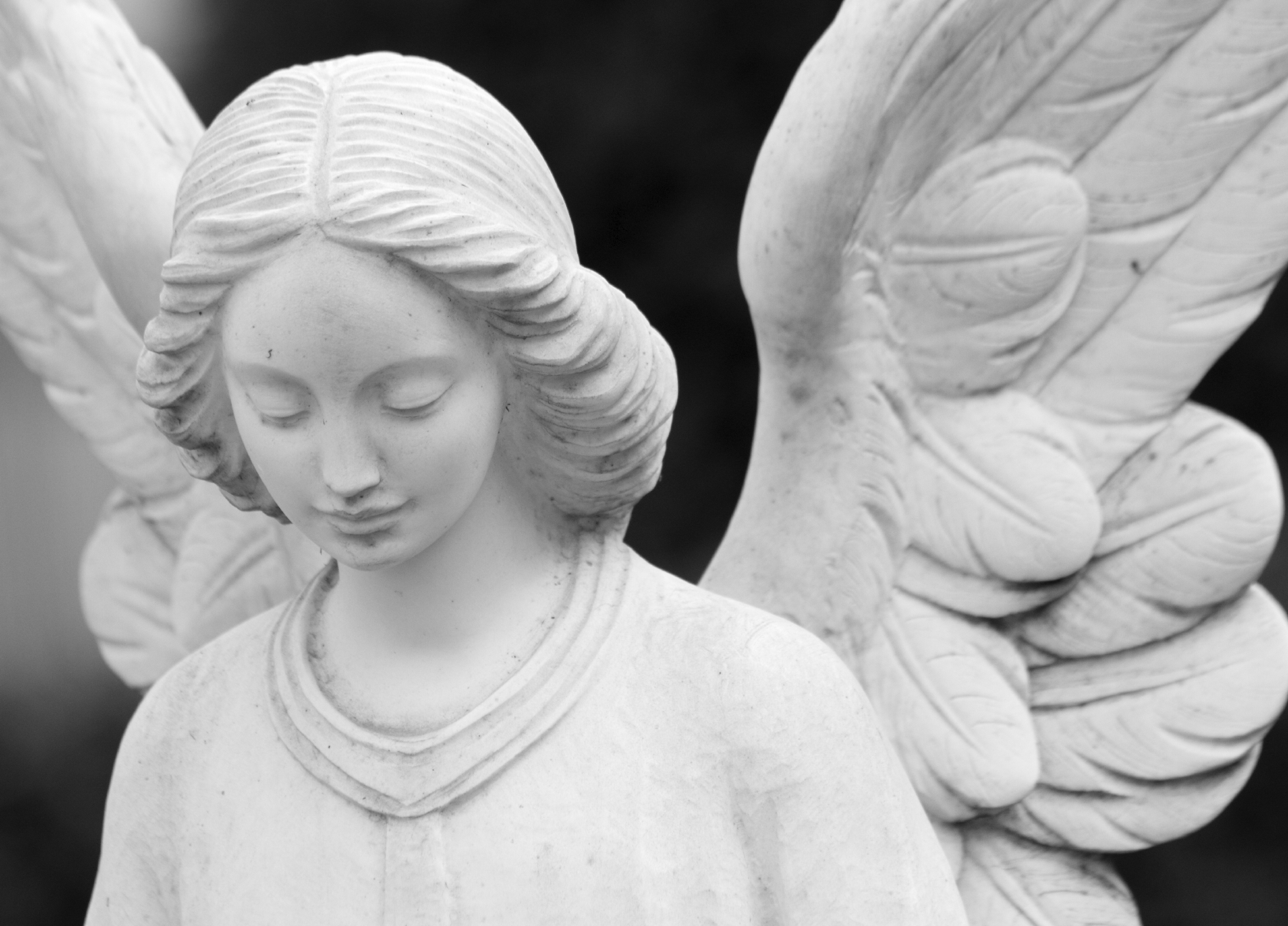
The right liturgy, the liturgy of the Communion of the Saints, restores totality to him. It teaches him silence and singing again by opening him to the depths of the sea and teaching him to fly, the angels’ mode of being. It brings the song buried in him to sound once more by lifting up his heart. …

Right liturgy … liberates us from ordinary, everyday activity and returns to us once more the depths and the heights, silence and song … Right liturgy … sings with the angels … is silent with the expectant depths of the universe, and that is how it redeems the earth (Joseph Cardinal Ratzinger Collected Works, Vol 11, Theology of the Liturgy, Ignatius Press, p. 460).

This is a remarkable analysis and application of liturgy and cosmology to the issues and imbalances of our day! It is in the vein of “Save the Liturgy, save the world.” For indeed, only in the worship of God do we find our true selves. Only in the liturgy is our true personality formed. The human person in his glory unites the material and spiritual orders. We are capable of pregnant, expectant silence; of the joyful shout of praise and the Gospel going forth; and of the song of Heaven.

But as Ratzinger points out, we are too often reduced to a preoccupation with and a valuing of only one aspect: the shouting of the earthbound creatures of this world.
But the liturgy—good and proper liturgy—trains us in all three and accomplishes the balance that is often lost today. The liturgy is a training ground, not only for our heavenly destination, but also in what it means to be truly human.

Read the good Cardinal’s reflection; consider carefully what the Pope Emeritus teaches. It will bless your soul. I know it has blessed mine.
Here is a song of the heavens:

Men and the Liturgy – Thoughts on a Recent Survey

blog 8.18.15A recent study of more than 1400 Catholic men from over 1000 parishes indicates a substantial disconnect from the Church and a dissatisfaction with what the Church offers and how she ministers to men. The survey was conducted in the fall of 2014 and an analysis of the results was published by Matthew James Christoff, Director of The New Emangelization Project (Helping Priests Become More Effective in Evangelizing Men).

It is clear that “men” are not monolithic; they have a range of views and preferences. But overall, the men surveyed feel disengaged from the Church and sense little interest from the Church in listening to them or reaching out to them. Further, there are some concerns that, in general, are shared more by men than by women. While the study indicates a number of themes and recommendations, I will not reproduce them all here. You can and should read those at the link above.

But there are two issues on which I would like to focus, since we often discuss them here on this blog: liturgy and homilies. The men in the survey, especially in the narrative comments, had some pointed observations about both areas (see pages 9 and 20-21). And while the preferences and concerns do not break out simply into men’s opinions vs. women’s opinions, it is clear that there are overall tendencies in what men prefer or find satisfying.

Liturgy – Modern liturgy has emphasized community, warmth, welcome, inclusiveness, accessibility, and being easily understood. Parishioners are often encouraged to greet those around them warmly, shake hands, hold hands, etc. Music has often become emotive and lyrical (rather than metered and march-like) and the themes emphasize welcome, intimacy with God, reconciliation, love, etc.

None of these things are wrong in themselves, and there are masculine ways of expressing and experiencing these things, but there is a lack of balancing virtues that are often more appealing to men such as duty, call, honor, awe, reverence, respect, transcendence, sacrifice, spiritual warfare, and the struggle against evil.

Stirring, metrical hymns paired with equally vigorous verses describing virtues and themes such as adoration, obedience, faith, strength, hope, God’s power and glory, the ultimate victory of God and the faithful, tend to appeal more to men and masculine ideals.

It does not have to be one thing or the other in the liturgy; it really is about greater balance. Much of the modern liturgical fare in many (though not all) parishes is weighted toward aspects more often preferred by women. And while most men do not talk about it much, when asked, they consistently report being uncomfortable with and uninspired by modern liturgies.

It is no surprise then that men (according both to this and other polls as well as anecdotal observation) are on average more likely than women to prefer the solemn, formal liturgies of the traditional rites. The discipline, skill, and almost military-like precision appeal to many men. Tradition here need not refer only to the pre-conciliar forms, but also to newer forms that contain more traditional elements and formality.

Homilies – Most of the men polled indicated that they respond more to a homilist who sounds like a leader, summons and challenges them, calls for courage, and articulates a clear stance on the moral issues of our day.

The men surveyed noted that often the emphasis seems to be on “safe” homilies, designed not to unsettle or offend, homilies in which God’s love is emphasized more so than the challenging themes of discipleship like obedience, repentance, sacrifice, resistance to the world, and willingness to rebuke sin within our families. Soft and suggestive tones are “in,” while bold and directive sermons are harder to find.

Here, too, it need not be one or the other, with one being bad the other being good. Rather, it is the lack of balance that is the problem. Men do not ordinarily speak about these views, but, when asked, are fairly consistent in their sense that the balance is off. They feel that sermons do not seem to be aimed at them and do not involve themes or topics that are most interesting to them.

You can read more at the link above, paying special attention to page 9 and pages 20-21.

Clearly, whenever we speak of liturgy we are hitting the “third rail” and blood can boil. Just remember that this is a discussion and the goal is to listen and to find balance. There is obviously overlap in what men and women think. All men don’t feel the same way any more than all women feel the same way. Let’s also avoid reducing this to a matter of right vs. left, pre-conciliar vs. post-conciliar, etc. Say what you mean, and mean what you say, but don’t say it mean.

The Most Essential Question of Every Liturgy – A Meditation on a Teaching From Joseph Ratzinger

blog070515There is a legend of how the liturgy and the Faith took hold in Rus (Russia). Prince Vladimir of Kiev was seeking a right worship for his people and sent representatives to look into various faiths and also liturgies. When emissaries went south to observe the Greek Christian Liturgy, they returned saying that they were not sure if they had been in Heaven or on Earth, so beautiful was what they had seen in the Hagia Sophia in Constantinople. They were sure that God dwelt there among men.

It is only a legend, however; the roots of Christian faith among the Russians is a lot more complicated. But the legend does capture the fact that the Byzantine Liturgy of the Eastern Church was a significant factor in advancing Christianity among the people who populate what is today Russia, the Ukraine, Georgia, and other nearby lands.

Joseph Ratzinger (Benedict XVI), while noting the legendary quality of the story, speaks to this legend to underscore that the Sacred Liturgy can and does have a missionary quality that can inspire and draw others to the one true God.

Exactly how the liturgy does this, however, is a matter of debate. Some would argue that it is essentially the beauty of the Liturgy and its capacity to draw us away from the mundane that leads people to God. Others emphasize a more didactic quality, wherein the elements of the liturgy must be intelligible and quickly grasped by the faithful and made applicable to daily life.

Of course we want to avoid a false dichotomy, in which one vision must be chosen to the exclusion of the other. Both notions have important insights. Yet in our time it is clear that, at least in the Roman liturgy, the emphasis has fallen on making the liturgy more intelligible and relevant to modern life, than ethereal and meant to draw us up and out of the ordinary through sublime beauty.

Cardinal Ratzinger, writing in 2005, said of this trend,

The way of thinking about “missionary liturgy” that became widespread in the fifties is, at the least, ambiguous and problematical. In many circles, among people concerned with liturgy, it led, in a quite inappropriate fashion, to turning a didactic element in the liturgy, and its comprehensibility even for outsiders, into the primary standard for shaping liturgical celebrations. Likewise, the saying that the choice of liturgical forms must be made with respect to “pastoral” points of view betrays the same anthropocentric error. The liturgy is then being constructed entirely for men. … Thus suggestions for styling liturgy became profane models, drawn for instance from the way meetings are held … or socialization rituals. God does not actually play a role there; it  is all concerned with winning people over, or keeping them happy and satisfying their demands. … No faith [is] aroused in that way [p. 332].

His language is quite strong here. Yet anthropocentricism (the belief that man rather than God is at the center of existence) remains a consistent, troubling trend in liturgy today. It is a hard mentality to break in a culture so centered on consumerism and “pleasing the customer.” This may work well in markets, but in faith and to some degree in education, it is a harmful trend. God, the liturgy, and truth itself do not exist to please us, but rather to summon us to challenging heights, beyond our mere pleasures and passions.

I have written before on this blog about anthropocentrism (HERE). And while we obviously cannot wholly abandon a notion of the liturgy being intelligible, we are ultimately being drawn into mysteries above and beyond us and thus the liturgy should have mysterious and sublime aspects.

In the same essay Cardinal Ratzinger wrote,

What persuaded the emissaries of the Russian Prince of the truth of the faith celebrated in the … liturgy was not … arguments that seemed clearer than those of other religions. What moved them was in fact the mystery as such, which demonstrated the power of the truth actually, transcending the arguments of reason … The Byzantine liturgy was not, and is not, concerned to indoctrinate other people or show them how pleasing and entertaining it might be. What was impressive about it was particularly its sheer lack of practical purpose, the fact that it was being done for God and not for spectators. … It was simply striving to be pleasing to God as the sacrifice of Abel had been pleasing to God … turning the gaze toward God was what allowed God’s light to stream down [and] … be detected even by outsiders [p. 331-332].

And there is the money quote: it was being done for God and not for spectators. … It was simply striving to be pleasing to God.

How different this is from today, when the liturgy seems so focused on us. Everything must be understood (using the vernacular both literally and figuratively). Music must not be too taxing and must be something the people can sing along with. Rituals must not be too elaborate. And, ironically, in the one place where intelligibility is most important (the sermon), it is often said that it should be brief and more an exhortatory than an instructive moment.

None of these things are intrinsically bad, but they are out of balance. There is little notion that the liturgy is directed first and foremost to God, that it is worship of God, that the rituals are for Him and are a sacrifice of praise, not merely a ceremony that pleases us.

It is not unfair to say that in the older form of the Roman Rite (especially low Mass) the people were so uninvolved as to be almost unnecessary, an afterthought. Everything was done by the priest and the servers. But perhaps we have overcorrected. Turning toward the people, introducing more vernacular, and simplifying the rites were seen as a way to involve and reintegrate the whole people of God, the whole Body of Christ into the sacred action of Christ as head and High Priest giving perfect worship to the Father.

But now may be a time for us to consider bringing back the balance we have lost, reintroducing sacred language, teaching more that God and the worship of Him are the essential focus of our liturgy. A gentle reintroduction of orienting especially the Eucharistic Prayer toward God, through a unified posture and direction of all toward the Cross, may be helpful (under the guidance of the bishop). The Liturgy of the Word can and should remain directed toward the people, for they are the goal of this proclamation.

Many will debate exactly what is to be done and how quickly, but it seems clear that balance needs to be restored in most parish settings. The ultimate goal, as Cardinal Ratzinger wrote, is that our Liturgy be done for God more than for spectators, that we simply strive to be pleasing to God. The inclusion of God’s people is important, but not in a way that forgets our collective purpose of worshiping of God, who is worthy of our sacrifice of praise. It should not be reduced merely to what pleases us.

Pope Benedict observed elsewhere that for those who prefer traditional Liturgy there is also a risk in reducing the liturgy to mere aestheticism, in which what is considered beautiful and more ancient is preferred, and is the focus for that reason. The manifestation may be more lofty and less worldly, but the error is the same: liturgy is what pleases me and its purpose is to cater to my tastes. Things in the traditional arena can get very particular, such that Roman vs. Gothic vestments, tabernacle veils vs. none, or a missed genuflection by the celebrant can become contentious and lead to uncharitable remarks after Mass.

There is not time in this post to lay out the essentials of liturgy as Scripture sets them forth. I have done that elsewhere in the past. But God gave at least the essentials on Sinai to Moses, to His disciples at the Last Supper, and to John in Revelation 4, 5 and 8. From these essentials we build and set our focus on what pleases God.

The deepest questions of any liturgy should be, “Was God worshipped?” and “Was God the true focus of our hearts?”

On Reverence and Reserve in the Holy Liturgy – A Meditation on an Instruction by St. Cyprian

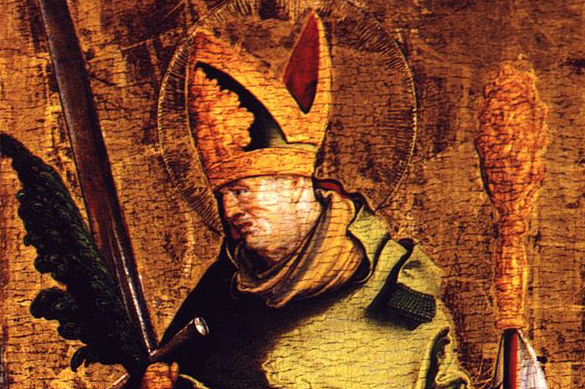
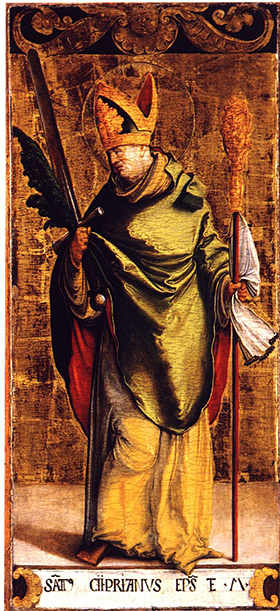
Heiliger_CyprianusIn the Office of Readings we are currently sampling from a treatise on the Lord’s Prayer by St. Cyprian. One of those readings earlier this week offered some cautionary notes on what might be termed “reverential reserve” when celebrating the Sacred Liturgy.

Before quoting St. Cyprian, I’d like to make some observations regarding the role of culture and history. Of course, dear reader, you are free to skip my poor musings and jump right to the teaching of St. Cyprian, who outranks me substantially by being a bishop, a martyr, a Father of the Church, and a Saint!

St. Cyprian surely calls for some reserve in prayer, both private and public. But I wonder how to quantify reserve? And how is it related to respect? I have certainly seen and participated in worship experiences that were “over the top.” In such instances the music was too loud, the musicians were more in the role of performers, and the “house was “rocking” more so than praying. In gospel music there is a distinction between Church gospel and “performance gospel.” The first inspires prayer and praise while the second is designed more to please and excite the audience. Christian contemporary music has similar distinctions. Some pieces can be deeply prayerful or stirring works of praise, while others have more of a “listen to me!” quality or even a “pep rally” feel.

Even in more traditional forms like chant, polyphony, and orchestral Masses there have been excesses that the Church eventually weighed in on. Chant, though seemingly the least capable of excess, did have times and schools in which the use of proportional rhythm or overly extended melismata sometimes obscured the text. Gallican Chant was more florid than Roman, and during the late Middle Ages the people of Paris flocked to places like Saint Denis and Notre Dame to hear the increasingly musical chants now sung in organum. It was quite the rage.

During the Polyphonic Age the rich harmonies and often-complex intertwining of parts sometimes overshadowed the text. The borrowing of secular tunes was also problematic. The Church Palestrina helped lead the way back to a simpler form that emphasized the sacred text over the rich harmonies.

Orchestral Masses increasingly grew to resemble operas. The settings, quite musical and elaborate, wowed the worshippers. They were also quite lengthy: some Glorias and Creeds lasted more than twenty minutes. But here, too, some popes (e.g., Pius X) sought to set limits.

As you can see, excess is not just a modern phenomenon.

Searching even further back, we see that even in  biblical times worship was an often noisy affair. Nehemiah 8 describes a kind of Liturgy of the Word that featured the people shouting “Amen” during the preaching, falling to the ground, weeping, and so forth. Many of the Psalms directed the people to clap their hands and raise their voices with shouts of joy. Psalm 150 speaks of trumpets, lutes, cymbals, and many other loud instruments that were often used in worship.

Thus we see in all eras a tendency to a certain “excess,” if a respectful reserve is the norm. Indeed, there are some cultures in which sitting quietly to pray seems almost disrespectful. In the African-American congregations in which I have served, it is often said that “God is worthy of our praise!” or, “Hallelujah is the highest Praise,” or “Make a joyful noise unto the Lord … give Him the highest praise.” Charismatic worship has similar features and declarations.

But in every age some limits have had to be found. Even in the earliest days St. Paul had to caution the Corinthians and others to maintain decorum and to set limits on speaking in tongues, prophesying, and so forth. He says to them regarding the Liturgy, Let all things be done decently and in good order (1 Cor 14:40).

And all of this background finally leads us to St. Cyprian, who in the passage quoted below summons us to a kind of sober reserve as the norm for liturgy. In some ways Cyprian, though living in North Africa, displays a kind of Roman temperament and reserve. Latin was his native tongue. And there is, to be sure, a kind of sober reserve evident in the Roman Rite and the Roman prayers, especially the Collects, which are often terse, brief, and quite to-the-point. The whole shape of the Roman Rite is sober and brief. Other forms of this Rite, especially the Gallican and Mozarabic, were far more elaborate and elongated.

And thus St. Cyprian writes from this sort of experience—or so it would seem. But for all of us, his call for reserve can be salutary, even if there are cultural differences that might permit a more demonstrative worship. Consider the words of St. Cyprian as a good reminder that some boundaries are necessary:

Let our speech and our petition be kept under discipline when we pray, and let us preserve quietness and modesty–for, remember, we are standing in God’s sight. We must please God’s eyes both with the movements of our body and with the way we use our voices. For just as a shameless man will be noisy with his cries, so it is fitting for the modest to pray in a moderate way. …

When we meet together with the brethren in one place, and celebrate divine sacrifices with God’s priest, we should remember our modesty and discipline, not to broadcast our prayers at the tops of our voices, nor to throw before God, with undisciplined long-windedness, a petition that would be better made with more modesty: for after all God does not listen to the voice but to the heart, and he who sees our thoughts should not be pestered by our voices … And we read in the Psalms: Speak in your hearts and in your beds, and be pierced. Again, the Holy Spirit teaches the same things through Jeremiah, saying: But it is in the heart that you should be worshipped, O Lord.
Beloved brethren, let the worshipper not forget how the publican prayed with the Pharisee in the temple–not with his eyes boldly raised up to heaven, nor with hands held up in pride; but beating his breast and confessing the sins within, he implored the help of the divine mercy. … and he who pardons the humble heard his prayer.

(from the Commentary on the Our Father by St. Cyprian, bishop and martyr (Nn. 8-9: CSEL 3, 271-272))

To be sure, Cyprian wrote this as a true Roman. But it is a corrective, or at least a good reminder, for us all. Exuberance has its place, especially in certain cultures, but proper order is also essential. Again, as St. Paul says, Let all things be done decently and in good order (1 Cor 14:40). Amen.

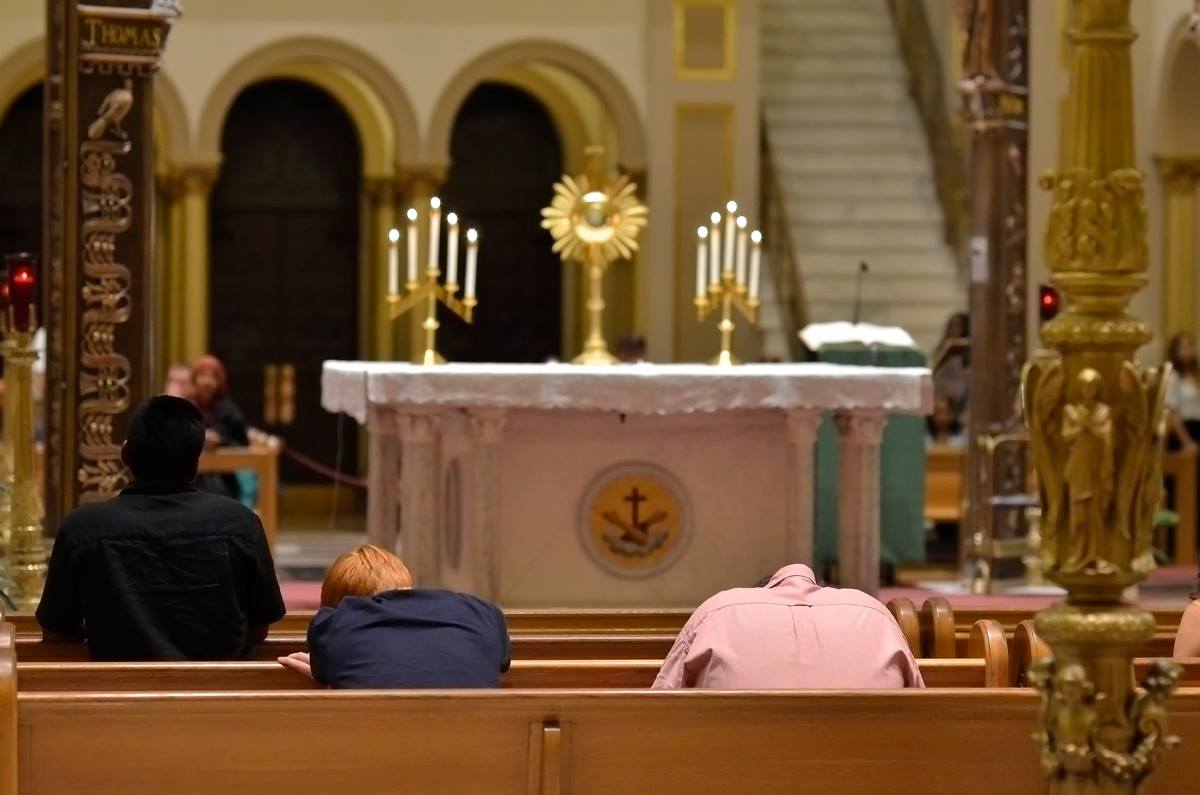
A Word By Word Translation and Study of the Latin Hymns Used at Benediction

071813I sometimes get requests for help in understanding the Latin texts of the very familiar hymns for Eucharistic Adoration and Benediction. The O Salutaris and Tantum Ergo, though familiar to many Catholics remain only vaguely understood in terms of a word-for-word translation. Most know the poetic English renderings (“O Saving Victim Opening Wide” and “Humbly Let us Voice our Homage”) but this does not necessarily facilitate a word-for-word understanding as the Latin is sung. What I hope to do here, and in greater detail in the attached PDF files, is to give a very literal rendering that preserves the word order of the Latin so that one can understand the Latin precisely. In the PDF I also give a brief word study of each word in both hymns. It is my hope to bring these hymns more alive for the faithful who sing them who may not be highly skilled in Latin.

1. The O Salutaris – The Author is St. Thomas Aquinas. These are the last two verses of a longer hymn Verbum Supernum Prodiens (The heavenly Word, going forth) which was composed for Lauds (Morning Prayer) of the Divine Office of Corpus Christi. The meter is Iambic Dimeter, accentual with alternating rhyme. This hymn was said to so please even the hostile Rousseau that he would have given all his poetry to be its author. I propose here to record the Latin text to the left and then a very literal English translation to the right which also preserves the word order for easy comparison:

    • O salutaris Hostia (O saving victim)
    • quae caeli pandis ostium (who of heaven opens the gate – i.e. who opens the gate of heaven)
    • bella premunt hostilia (wars press hostile – i.e. hostile wars press)
    • da robur fer auxilium (give strength, bear aid)
    • Uni Trinoque Domino (To the One and Threefold Lord)
    • sit sempiterna gloria (may there be eternal glory)
    • qui vitam sine termino (who life without end)
    • nobis donet in patria (to us may he grant in the Fatherland)

I have prepared a printable and more thorough word study here:Study the O SALUTARIS

2. The Tantum Ergo– The author is St. Thomas Aquinas. It was composed for Vespers (Evening Prayer) of the Divine Office for the Feast of Corpus Christi. The meter is trochaic tetrameter catalectic, rhyming at both the caesura and at the end of the line. These two verses are the last two of the full hymn Pange Lingua. There is here a wonderful union of sweetness of melody with clear-cut dogmatic teaching. I propose here to record the Latin text to the left and then a very literal English translation to the right which also preserves the word order for easy comparison:

    • Tantum ergo sacramentum (So great therefore a sacrament)
    • veneremur cernui (let us venerate with bowed heads)
    • et antiquum documentum (and the ancient document)
    • novo cedat ritui (to the new, give way, rite i.e. gives way to the new rite)
    • Praestet fides supplementum (may supply faith a supplement i.e. may faith supply a supplement)
    • Sensuum defectui. (of the senses for the defect i.e. for the defect of the senses)
    • Genitori Genitoque (To the One who generates and to the one who is generated (i.e. Father and Son)
    • Laus et jubilatio (be praise and joy)
    • Salus, honor, virtus, quoque (health, honor, strength also)
    • sit et benedictio (may there be and blessing)
    • Procedenti ab utroque (to the One proceeding from both)
    • Compar sit laudatio (equal may there be praise i.e. may there be equal praise)

I have prepared a printable and more thorough word study here: Study the TANTUM ERGO.

I hope that this may be of some help along with the printable PDF word studies.

Here is setting of the Tantum Ergo by Mozart which I paired with some video footage I found:

A Pet Peeve about the New Roman Missal from a Priest Who Otherwise Loves It.

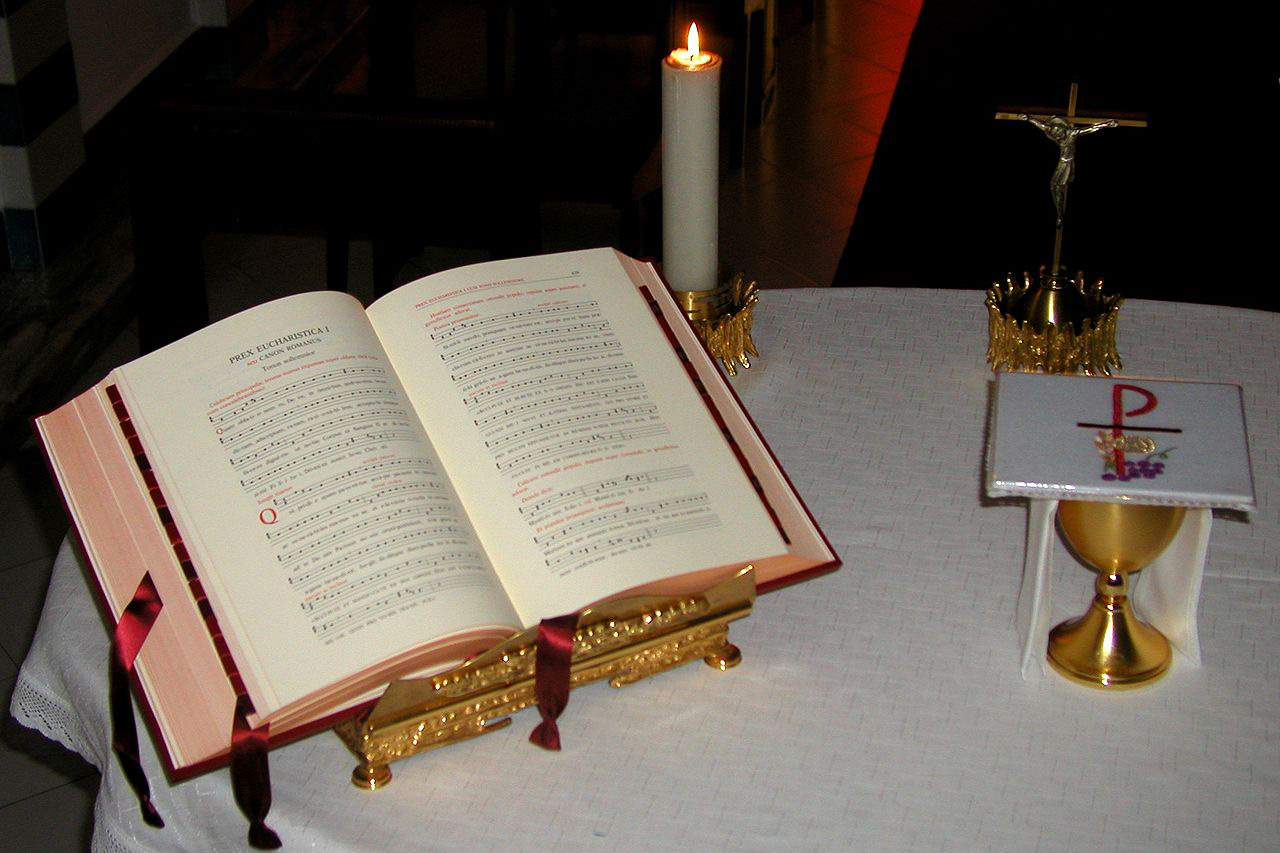
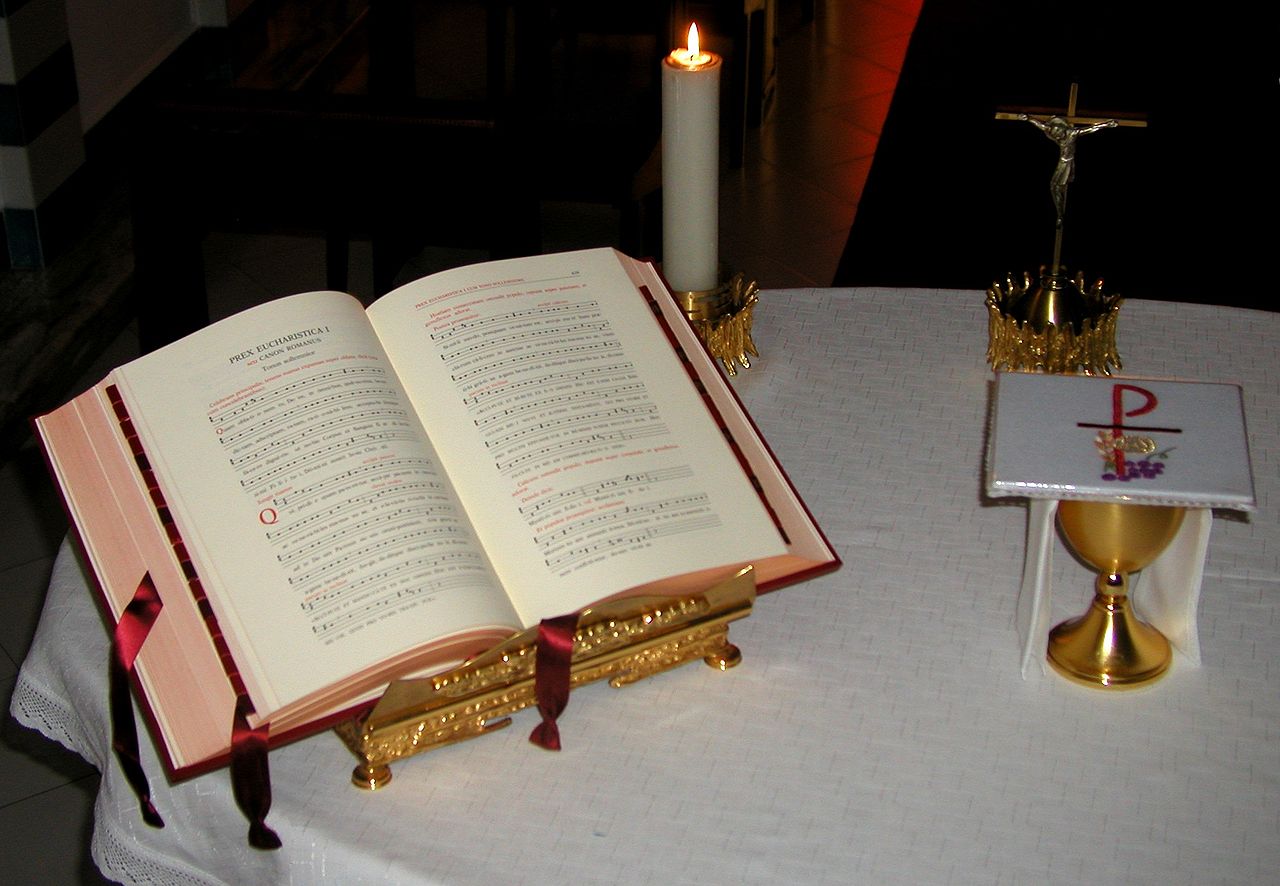
"Missale Romanum"  Original uploader was Lima at French Wikipedia - Transferred from fr.wikipedia to Commons..  Licensed under  CC BY-SA 2.5 via Wikimedia Commons
“Missale Romanum” Original uploader was Lima at French Wikipedia – Transferred from fr.wikipedia to Commons.. Licensed under CC BY-SA 2.5 via Wikimedia Commons

I am a big fan of the New Roman Missal. The English is edifying, and rather close to the Latin in both meaning and cadence. At times, it challenges the priest who must carefully prepare to pray it well. But that is good. Reading the prayers of the missal cold is a bad idea, and at least glancing at the collects before Mass is to be encouraged as preparation.

But one thing about the new Roman Missal disturbs me. Where is the Latin? The old “Sacramentary” had the Eucharistic prayers on other common and proper settings in Latin in the back of the book. And this gave the priest the option of praying some of the Mass in Latin when it was deemed appropriate.

A helpful option – I frequently celebrate Mass at the convent in my parish and the Sisters will not infrequently sing the ordinary responses in Latin. In the past, when they sang a Latin Sanctus, I would responding in kind by proclaiming the Canon in Latin. It was easy, all I had to do was flip to the back. But now I’d have to have an entirely different book at hand.

This should not be. Basic Latin settings of the Mass should be in an appendix in the Roman Missal.

Perhaps there is a published version out there does supply this? If so let me know. Remember I am speaking of the altar missal that the Priest reads from at Mass, not a hand missal. Perhaps the Latin is in some super secret place in the books I have? I have looked in four published versions, and with the exception of the Pater Noster, from what I can tell, there isn’t a lick of Latin anywhere in the book.

Perhaps if some of you know a version out there that does supply the Latin texts, great, but another question still remains: Should not any approved version of the English Roman Missal supply the basic Latin prayers, as did the “older” version of the “Sacramentary?”

Again, I like the New Roman Missal. But its lack of Latin options does not serve the Church or the Liturgy well. Perhaps we can desire and ask that future editions be required to supply basic Latin Options. Is this too much to ask?

A funny story about the convenience of having the Latin comes to mind. Back before I was ordained a priest, in seminary years, I worked for a brief time in a parish with an older pastor. And every now and then a rather disruptive woman came to daily Mass who, among other things, insisted on standing, hands extended, and praying the Eucharistic Prayer aloud while the priest was proclaiming it.

After the first incidence he took her aside after Mass and asked her to stop, but she said she had “every right” to exercise her “priesthood” and would continue to pray along with the celebrant aloud.

A few weeks later she returned and adopted her orans posture and began to pray aloud with the opening lines of the canon. The priest stopped, and publicly asked here to refrain, again she refused. So he said, “OK, pray with this.” And he flipped to the back and began to pray the Canon in Latin.

She was twice stymied. Not only was she unable to recite along, but it seemed she also clearly hated Latin and left. The congregation that day gleefully smiled at the charitable but clear way the pastor had corrected the problem. I don’t recall that the woman ever returned to that particular parish.

Any way, just a little pet peeve about the New Roman Missal. Has any one else commented on this? If so, I missed it. In the mean time I have purchased a Missale Parvum (Small or thin Missal) to keep near at hand.

Oremus!

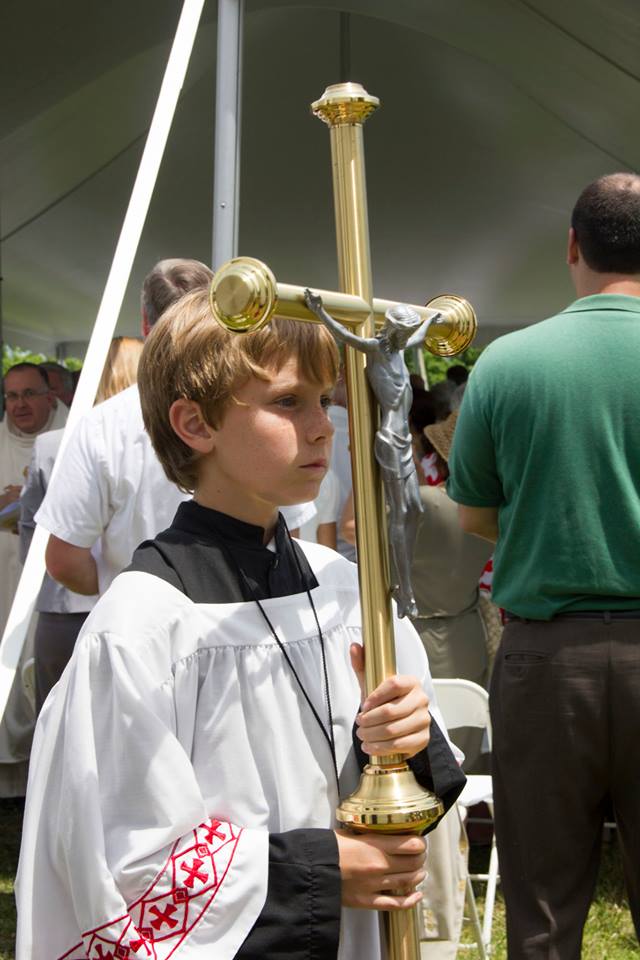
An Inspiring and Beautiful Video for Altar Servers

011813-pope-1The Video at the bottom of the page was sent to me today and I want to say that I find it beautiful.

What makes the video so good is that it inspires a spirituality for the server that includes some of the following encouragement and advisement:

  1. That the Mass is mystical, beyond mere human sight, and that the server must learn to be sensitive to what lives beyond ordinary perception and become more spiritually aware.
  2. In so doing he should lead others to greater reverence by the example of supreme awareness of the presence of God.
  3. He should also, by his reverence  lead others to understand that what takes place on the altar is the making present of the most important moment in all of human history.
  4. The Altar server also provides practical leadership for the congregation as to when to sit, stand and kneel.
  5. Even the folded hands, pointed upward are meant to direct attention upward to God.
  6. The manner of his clothing (e.g. dress shoes, pressed trousers etc) are meant to and ought to show that what he is doing is a matter of utmost seriousness and importance.
  7. Our body, (posture etc) and our clothing impact our disposition, so all we do should be to help our hearts worship, and lead others to the same.
  8. Prayer, especially the rosary, is a good way to prepare one’s heart to be a better server.
  9. The goal is to have your heart in the right place.

A couple of other things I like about the video, that the man interviewed models well a piety that is serious but not somber looking. Not everyone gets this balance right, and some who are trying to look prayerful merely look sad, angry, or bored. But the man in this video shows an appropriate balance, a kind of natural and serene sobriety well suited to the Mass.

The images throughout the video are also beautiful and the photography is wonderful.

I suspect (sadly) that not all will be happy with some of the more traditional elements in the video: the ad orientem celebration of mass and the expressed preference for the cassock and surplice, rather than the alb. There is also no reference to girls serving. However, none of these aspects is forbidden. Perhaps a word about each.

  1. The ad orientem celebration of Mass (I speak here of the Ordinary Form), while less common, is not forbidden. I use it occasionally, after proper catechesis, in smaller settings in my parish. We have several side altars in the Church that I use on occasion, and I have also used the high altar for that purpose from time to time.  The catechesis I use includes the fact that the priest does not have his back to us. Rather we are all facing God, looking to the liturgical east for Christ to come again. I will say I would not adopt this position in my main Sunday liturgies at this time without consulting with the Bishop, simply out of respect for the fact that he is the chief liturgist of the diocese. But for smaller liturgies of a more private or intimate character, I do use the eastward orientation occasionally.
  2. The cassock and surplice – the preference here for this vesture is traditional. And while the current norms speak of the alb as being the common vesture for ministers of every rank in the Mass, (GIRM # 336). However the cassock and surplice are not forbidden and tend to be worn today especially by clerics who assist at mass but are not celebrating or concelebrating. As such, the cassock and surplice have a more priestly look. For this reason I think it unadvised that a girl or woman should wear the cassock and surplice. In my own parish the seminarians that assist us, as well as some of the older men wear the cassock and surplice. The younger boys and all the girls and women wear the alb.
  3. That only males are envisioned as servers – Here again, while it is common in most parishes today that box sexes serve, it is not required that the pastor observed this permission. For pastoral reasons, such as encouraging priestly vocations, the pastor may employ only men and boys as servers if he sees fit. In my last parish that is what we did. In my current parish, I inherited a server program that uses both sexes, and younger as well as older people. The mix is good and I see no reason to change it. But it is neither wrong for a pastor to make use of only males in this role. Neither is it wrong for the lay faithful to seek to encourage this sort of approach, as the video makers do.

I hope you will find this video as inspiring and beautiful as I do. And, just as the video we looked at last week did not please all, I do pray and ask for charity toward, and the presumption of good will by those who have made and produced this video. It is a good effort and has an important message in regard to reverence and spiritual preparation for altar servers.