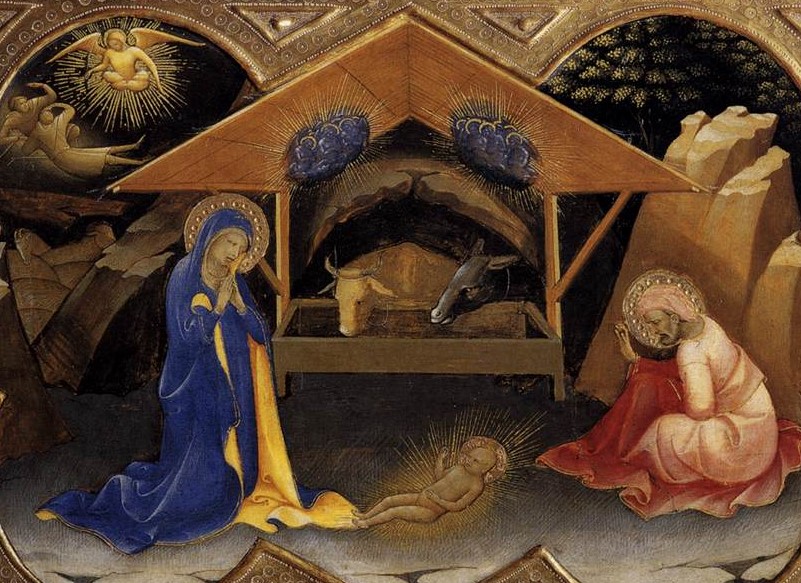
Why Was Jesus Born When and Where He Was?

The Nativity, Lorenzo Monaco (1414)

In preparation for the coming of Christmas, we have been discussing some of St. Thomas Aquinas’ writings. In this last installment we’ll be looking at his commentary on the time and place of Jesus’ birth.

We live in a culture that tends toward a kind of temporal pride. We think that we have come of age, that we are smarter and wiser than our forebears. Scientific, technical, and medical knowledge are more highly developed to be sure, but there is more to life than what falls into those realms.

The religious version of temporal pride is expressed in this utterance: “If Jesus lived in our times, He would …” The sentence is then completed with any view we favor or consider to be “enlightened” and “modern.” Jesus did not choose to live in our time, however, and there may well be good reasons for that. As God, He could have chosen any age—and He did not choose ours.

St. Thomas Aquinas, who lived in the 13th century, pondered the reasons for the time and place of Jesus’ birth in his Summa Theologica. In it he addressed some of the questions and objections raised during his era.

The time of the Lord’s birth – St. Thomas discussed this in his Summa Theologica, Part III, Question 35, Article 8. He used as his starting point St. Paul’s attestation to the fittingness of the time of Christ’s birth: When the fullness of the time was come, God sent His Son, made of a woman, made under the law (Gal 4:4). Here, the “fullness of time” is understood to mean “at the designated or determined time.” St. Thomas wrote,

Whereas [other men] are born subject to the restrictions of time, Christ, as Lord and Maker of all time, chose a time in which to be born, just as He chose a mother and a birthplace. And since “what is of God is well ordered” and becomingly arranged, it follows that Christ was born at a most fitting time.

St. Thomas responded as follows to objections raised in his day regarding the time of Christ’s birth:

Some objected that because Christ came to grant liberty to His people, it was not fitting that He came at a time when the Jewish people were subjected to Roman occupation and the Herodian dynasty (Herod was not a true Jew). St. Thomas answered that because Christ came in order to bring us back from a state of bondage to a state of liberty, it was fitting that He be born into bondage with us and then lead us out. We can grasp this logic in a wider sense when we consider that He assumed our mortal nature in order to give us an immortal nature; He died in order to restore us to life. St. Thomas, referencing Bede, wrote that Christ submitted Himself to bondage for the sake of our liberty. He also added that Christ wished to be born during the reign of a foreigner so that the prophecy of Jacob might be fulfilled (Genesis 49:10): The scepter shall not be taken away from Juda, nor a ruler from his thigh, till He come that is to be sent. The bondage was not to be ended before Christ’s coming, but after it and through it.

Others objected that the time of year, near the winter solstice, was not fitting for Christ’s birth. They argued that it was not fitting for the Light of the World to be born during the darkest time of the year. Thomas replied that Christ wished to be born at a time when the light of day begins to increase in length so as to show that He came to draw man back to the light, according to Luke 1:79: To enlighten them that sit in darkness and in the shadow of death.

The place of Christ’s birth – St. Thomas discussed this in the Summa Theologica, Part III, Question 35, Article 7.

Christ willed to be born in Bethlehem for two reasons. First, because “He was made … of the seed of David according to the flesh,” as it is written (Romans 1:3); … Therefore, He willed to be born at Bethlehem, where David was born, in order that by the very birthplace the promise made to David might be shown to be fulfilled. The Evangelist points this out by saying: “Because He was of the house and of the family of David.” Secondly, because, as Gregory says (Hom. viii in Evang.): “Bethlehem is interpreted ‘the house of bread.’ It is Christ Himself who said, ‘I am the living Bread which came down from heaven.’”

St. Thomas responded to some objections to Bethlehem as the place of Jesus’ birth.

Some argued that Christ should have been born in Jerusalem because it is written (Isaiah 2:3) that “The law shall come forth from Sion, and the Word of the Lord from Jerusalem,” and that because Christ is the very Word of God, made flesh, He should have come into the world at Jerusalem. St. Thomas answered that Christ, as the Son of David, fittingly echoed David’s priestly/kingly role. King David was born in Bethlehem and finished his ministry as priest/king in Jerusalem, so it was fitting that Christ as King be born in Bethlehem and, as true High Priest, die in Jerusalem.

Others argued that Bethlehem was too poor and unseemly a place for the Christ to be born. Thomas responded, [The Lord] put to silence the vain boasting of men who take pride in being born in great cities, where also they desire especially to receive honor. Christ, on the contrary, willed to be born in a mean city, and to suffer reproach in a great city. Thomas added, [And] that we might acknowledge the work of God in the transformation of the whole earth, He chose a poor mother and a birthplace poorer still. He cited Scripture: “But the weak things of the world hath God chosen, that He may confound the strong” (1 Corinthians 1:27).

Still others argued that because Scripture (Matthew 2:23; Isaiah 11:1) said “He shall be called a Nazarene,” Christ should have been born in Nazareth. Thomas easily dispatched this objection by observing that one is not always born where one is raised. He also added (referencing Bede), He wished to be born at Bethlehem away from home…in order that He who found no room at the inn might prepare many mansions for us in His Father’s house.

With St. Thomas to guide and teach us, we have pondered over the past few days some aspects of the incarnation and birth of our Lord. May you who have read and I who have presented be enriched by the teachings of the Lord through the great St. Thomas Aquinas.

Below is a link to an organ prelude on the hymn “Bethlehem of Noblest Cities,” also known as “Earth Hath Many a Noble City.” It is accompanied by beautiful art related to Bethlehem. Here are the words to the hymn:

Earth hath many a noble city;
Bethlehem, thou dost all excel:
out of thee the Lord from heaven
came to rule his Israel.

Fairer than the sun at morning
was the star that told his birth,
to the world its God announcing
seen in fleshly form on earth.

Eastern sages at his cradle
make oblations rich and rare;
see them give, in deep devotion,
gold and frankincense and myrrh.

Sacred gifts of mystic meaning:
incense doth their God disclose,
gold the King of kings proclaimeth,
myrrh his sepulcher foreshows.

Jesus, whom the Gentiles worshiped
at thy glad epiphany,
unto thee, with God the Father
and the Spirit, glory be.
Would Jesus Have Come If Adam Had Not Sinned? Why Did He Wait So Long Before Coming?

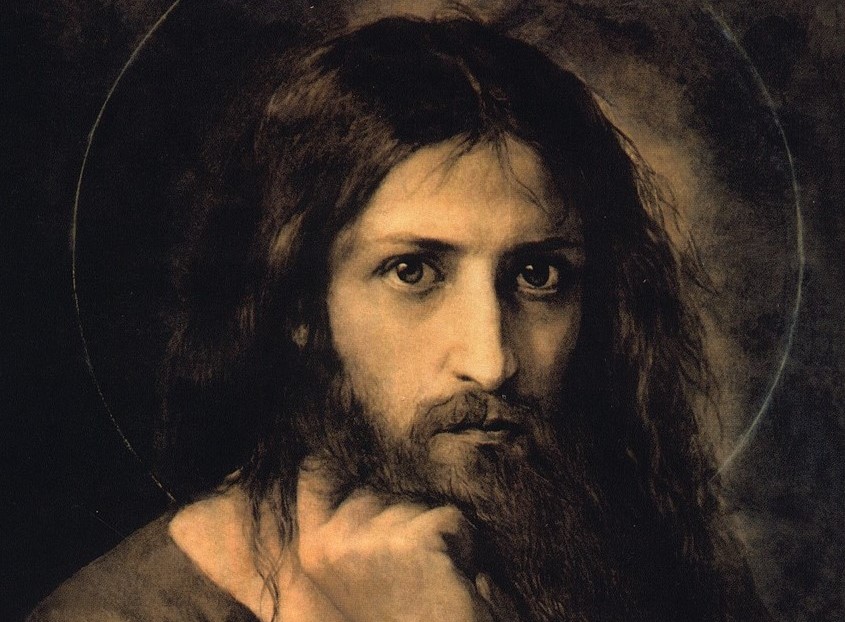
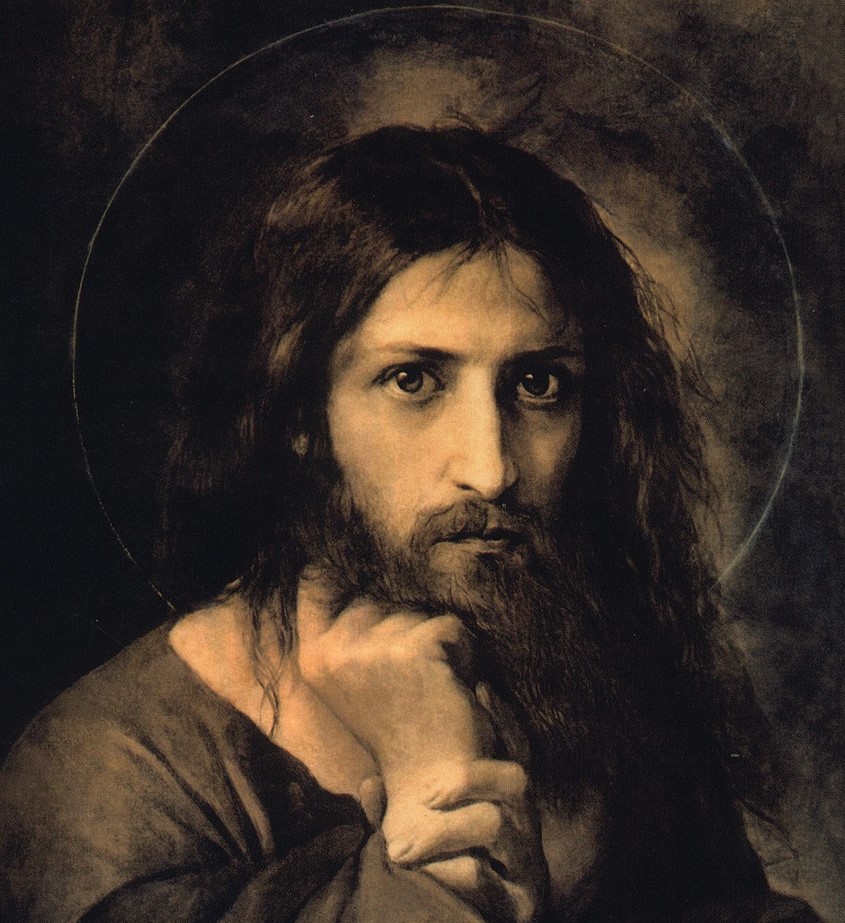
Reproduction of image by Georg Cornicelius (1888)(original destroyed)

Continuing our series of questions related to the Incarnation, we next ponder whether Jesus would have come at all had we not sinned in the garden. We also consider why He waited thousands of years before coming to our rescue.

Would Jesus have come if Adam had not sinned?

St. Thomas Aquinas (in his Summa Theologica) first states that there are different opinions on the matter. He also notes that God’s power is not limited and therefore God could have become incarnate even if sin had not existed. However, St. Thomas believes that if man had not sinned then the Son would not have become incarnate. As I often do, I’ve presented St. Thomas’ words in bold italics, while my commentary appears in plain red text.

For such things as spring from God’s will, and beyond the creature’s due, can be made known to us only through being revealed in the Sacred Scripture, in which the Divine Will is made known to us. Hence, since everywhere in the Sacred Scripture the sin of the first man is assigned as the reason of Incarnation, it is more in accordance with this to say that the work of Incarnation was ordained by God as a remedy for sin; so that, had sin not existed, Incarnation would not have been (Summa Theologica, Part III, Question 1, Article 1).

While theological speculation may have its place, it is certain that the Incarnation was instituted by God first and foremost as a remedy for sin. While the Incarnation offers more than is required to remedy sin (e.g., an increase in human dignity (because God joined our family), God’s visitation, the opening of a heavenly (not merely earthly) paradise), Scripture presents remedy for sin as God’s primary motive. In remedying our sin, God shows the greatness of His mercy because He does not merely restore us but elevates us to a higher place. The least born into the Kingdom of God is greater that the exemplar of the Old Covenant, John the Baptist. Had we not sinned and had God merely wanted to elevate us, He could have done so in other ways. It seems to me that St. Thomas’ position is best suited to the evidence.

If the Incarnation is a remedy for sin, why did God wait so long to apply it?

St. Thomas provides a sensible answer that addresses aspects of the question we might not have considered. His answer is found in the Summa Theologica (part III, question 1, article 5). First, he addresses why the Incarnation did not happen before sin:

Since the work of Incarnation is principally ordained to the restoration of the human race by blotting out sin, it is manifest that it was not fitting for God to become incarnate at the beginning of the human race before sin. For medicine is given only to the sick. Hence our Lord Himself says (Matthew 9:12-13): “They that are in health need not a physician, but they that are ill … For I am not come to call the just, but sinners.”

Next, St. Thomas addresses why the Incarnation did not happen quickly, soon after Original Sin, rather than thousands of years later. He sets forth four reasons:

First, on account of the manner of man’s sin, which had come of pride; hence man was to be liberated in such a manner that he might be humbled and see how he stood in need of a deliverer. … For first of all God left man under the natural law, with the freedom of his will, in order that he might know his natural strength; and when he failed in it, he received the law; whereupon, by the fault, not of the law, but of his nature, the disease gained strength; so that having recognized his infirmity he might cry out for a physician, and beseech the aid of grace.

Quick solutions to problems do not always permit proper healing to take place. Most parents know that if they solve every problem a child has, important lessons may be lost. It is often beneficial to live with our questions for a while so that the answers are more appreciated and more effective.

Indeed, it took us humans quite a while to acknowledge the seriousness of our sin and pride. Shortly after Eden, the tower of Babel indicated that human pride was still a grave problem. Even when given the Law, a good thing, the flesh corrupted it, turning its perfunctory observance into an occasion for pride. The prophets then had to keep summoning Israel and Judah back to the Lord and away from prideful self-reliance. The Assyrian invasion of the Northern Kingdom and the Babylonian Captivity only further illustrated the depths of our sin, so that this cry went up: “O Lord, that you would rend the heavens and come down” (Is 64:1).

We had to be led gradually to recognize our profound need for a savior. Otherwise, even if the remedy were offered, too few might reach for it.

Secondly, on account of the order of furtherance in good, whereby we proceed from imperfection to perfection. Hence the Apostle says (1 Corinthians 15:46-47): “Yet that was not first which is spiritual, but that which is natural; afterwards that which is spiritual … The first man was of the earth, earthy; the second man from heaven, heavenly.”

There is a kind of theology of grace implicit in this answer. Grace builds on our nature, and it is our nature, physically and spiritually, to grow gradually. While sudden conversions and growth spurts have their place, the best and most typical growth is that which occurs steadily and in stages.

Thirdly, on account of the dignity of the incarnate Word, for on the words (Galatians 4:4), “But when the fullness of the time was come,” a gloss says: “The greater the judge who was coming, the more numerous was the band of heralds who ought to have preceded him.”

Here is underscored the dignity of the Son of God, that many should precede Him, announcing Him. There was also a need for us to be prepared to meet Him, so that we would not miss Him or refuse Him when He came. As Malachi says, See, I will send the prophet Elijah to you before that great and dreadful day of the Lord comes. He will turn the hearts of the parents to their children, and the hearts of the children to their parents; or else I will come and strike the land with total destruction (Mal 4:5-6). Those who were prepared were able to abide the day of the Lord’s coming and heed His call.

Fourthly, lest the fervor of faith should cool by the length of time, for the charity of many will grow cold at the end of the world. Hence (Luke 18:8) it is written: “But yet the Son of Man, when He cometh, shall He find think you, faith on earth?”

This is an interesting aspect of the question that many might not consider; we typically ponder more what is good for us than what is good for succeeding generations. It is sadly true, though, that fervor, both collective and individual, can fade as a wait becomes lengthy. Therefore, St. Thomas suggests that God appointed a time for the Incarnation within human history such that the greatest possible number of people could be saved.

Four Reasons That the Incarnation was Fitting, According to St. Thomas Aquinas

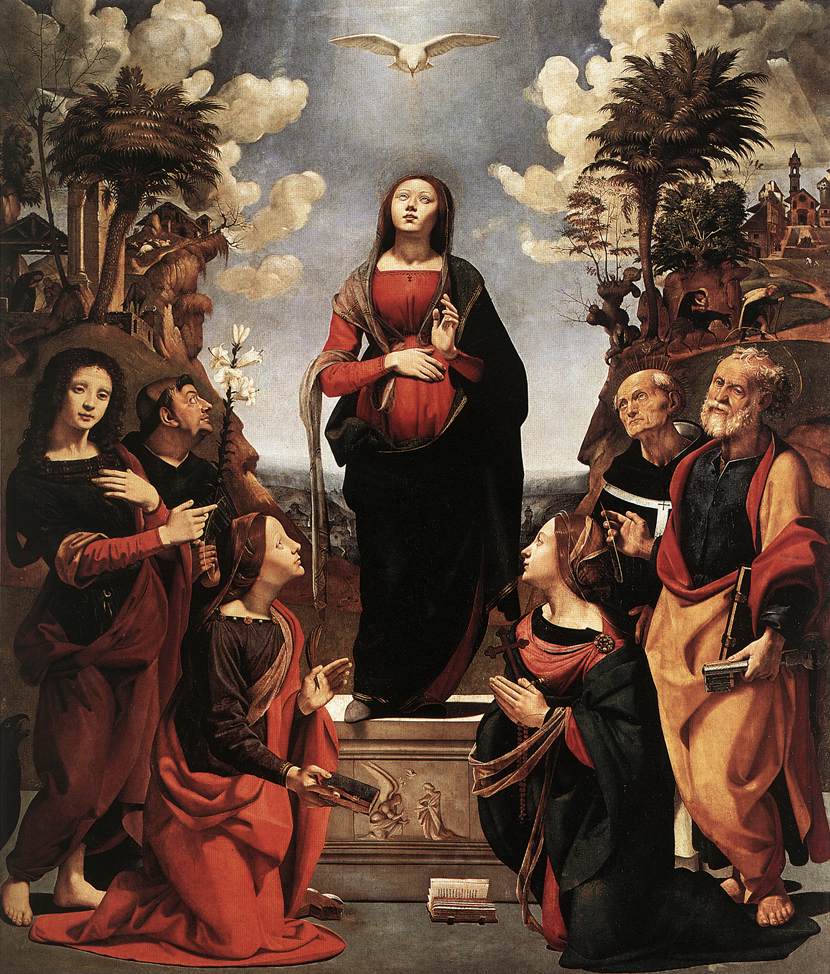
Incarnation of Jesus, Piero di Cosimo (1505)

As we approach the Christmas feasts, it is good for us to ponder aspects of the Incarnation. In this post, I would like to consider what St. Thomas Aquinas teaches about its fittingness. God was not radically “required” to do everything as He did. We do well to ponder why the manner of the Lord’s incarnation is “fitting,” why it makes sense.

St. Thomas, referencing St. John Damascene, gives four reasons for the fittingness of the incarnation of Christ:

But, as Damascene says (De Fide Orth. iii, 1), by the mystery of Incarnation are made known at once the goodness, the wisdom, the justice, and the power or might of God—“His goodness, for He did not despise the weakness of His own handiwork; His justice, since, on man’s defeat, He caused the tyrant to be overcome by none other than man, and yet He did not snatch men forcibly from death; His wisdom, for He found a suitable discharge for a most heavy debt; His power, or infinite might, for there is nothing greater than for God to become incarnate …” (Summa Theologica III, 1.1)

Here are each of Thomas’ (Damascene’s) reasons, along with some less-worthy commentary from me.

I. His goodness, for He did not despise the weakness of His own handiwork – To despise more literally means to look away or disregard something. God did not do this with Adam and Eve nor with us, their descendants, who have ratified their sinful choice. He continues to love us and call us.

Consider that even at the moment of the Original Sin, God first rebuked the devil and announced a solution that from woman would come forth a son destined to crush the power of the evil one. This protoevangelium (first good news) signals that God has not given up; He already has plans to save us. Although God would go on to announce the painful consequences of Adam’s sin, He does so only after announcing that His mercies are not exhausted, and His goodness is not altered.

Thus, God does not despise (look away from) His creation. Even His punishments are meant to heal us and to prepare us for the offer of something far greater: no mere earthly paradise, but Heaven itself. At the Incarnation, therefore, God’s goodness and fidelity to His promise is evident. Jesus, our promised Savior, is the hand extended to us in God’s goodness.

II. His justice, since, on man’s defeat, He caused the tyrant to be overcome by none other than man, and yet He did not snatch men forcibly from death – God, in making us free, “must” respect our free choices, not cancel them. If He canceled them, we would not have true freedom.

God does not undo our choices or remove their consequences; He builds on them. This is His justice at work.

We got into this mess through a man, a woman, and a tree. God will use these very elements to free us. The new Adam is Christ; the new Eve is Mary; the tree is the cross. Just as the first Adam and Eve were free but sinless, so Christ and Mary are sinless. While the first Adam and Eve said no in disobedience, Christ and Mary say yes in obedience.

God Himself, in Christ, joins our family and cancels the sin of Adam in a way that respects our first choice, but shows a different result. He takes the very suffering and death we chose and makes that the way back. The cross of Christ and our own share in that cross become the way back, the way to heavenly glory.

In His justice, God does not cancel our choices (and thereby our freedom). He does not “snatch us forcibly from death.” Rather, in His justice, He honors our freedom by taking our choices and their consequences (suffering and death) and making them the very way back to Him and to glory. He justly respects our choices but offers us another way.

III. His wisdom, for He found a suitable discharge for a most heavy debt – A mere man, say a prophet or a holy man, could not atone for our sins. Our debt is simply too high (see Matt. 18:24ff). A man alone does not have the power to save. God alone would have nothing to do with our case. As the God-man, Jesus has both the power to save us and the brotherhood to speak and act for us. We are saved by the human decision of a divine person. This shows both God’s justice and His wisdom, for He is not overcome by the conundrum of human impossibility and divine recusal. In the Incarnation, both truths are fittingly regarded and yet overcome.

IV. His power or infinite might, for there is nothing greater than for God to become incarnate – How can the infinite enter the finite? How can the eternal enter time? How can God, whom the very heavens could never contain, dwell in Mary’s womb and rest in her arms? Alpha et O matris in gremio! (Alpha and Omega sit in mother’s lap!) Here, God shows His mighty power to astonish us with His paradoxical wisdom and ways.

St. Thomas quotes St Augustine: The Christian doctrine nowhere holds that God was so joined to human flesh as either to desert or lose … the care of governing the universe … God is great not in mass, but in might. Hence the greatness of His might feels no straits in narrow surroundings (Ibid, ad 4).

God’s power is paradoxically demonstrated in the fact that He can make himself small but suffer no loss in ability or supreme power.

As the great feast of the Birth of the Lord approaches, I wish a merry and fitting Christmas to you all.

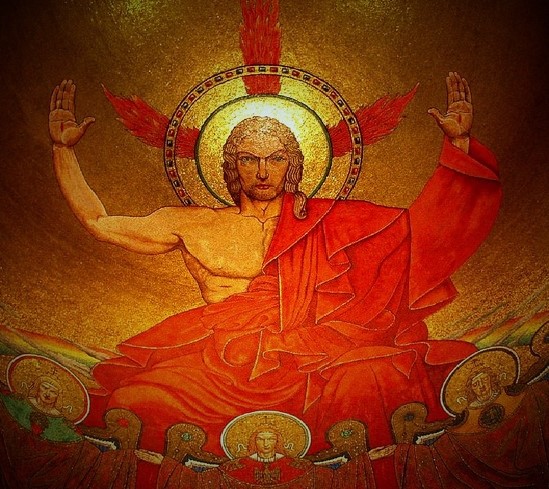
Awesome or Awful? A Reflection on the Mosaic of Christ in Majesty at the Basilica in Washington

looking upI have spent quite a bit of time at the Basilica of the Immaculate Conception here in Washington, due to ordinations and other special occasions. As I walk up the main aisle I never fail to be moved by the scene above the apse of Christ in majesty. (See one of my photos to the right.)

I have discovered that very few people are neutral on this image of Christ seated in Judgment. People either love it or hate it. I recall a discussion here on the blog over four years ago that elicited lots of different opinions.

Those who hate it say that He looks angry, and many also don’t care for the Roman toga, and bare shoulder and right chest. To others, who prefer more “inclusive” depictions of Christ, His blond hair, blue eyes, and exceptionally white skin make him seem too European.

Those who love the image say they like the fact that Christ is presented as strong and formidable. For them, this image is a relief from many other modern portraits of Christ, which present Him as a thin, willow-wisp of a man with an often weak look upon His face. But the Christ in majesty of the Basilica is someone who is to be taken seriously and to whom we must render an account.

My own thoughts have shifted over the years. As a younger man, I disliked this work. But over the years and after thoroughly studying the Scriptures, I have come to greatly admire this image of Christ. I often go to the Basilica, and when I do I always stand in the nave and look to Him for strength. I am often filled with joy and holy reverence as I gaze upon His towering strength and sublime majesty. He is a strong and manly Christ who speaks to me. He does not look angry to me. Rather, He seems to be saying, “Have confidence. I have overcome the world.” The inscription above the image also inspires me:

Christ reigns, Christ Rules. Eternal Victor, Eternal King
His kingdom is an everlasting Kingdom that shall not be taken away

You surely have your own thoughts about this image and I encourage you to share them in the comments section. But first, I would like to examine some of the details of this image. Some of them may be obvious, but others you may not have noticed.

1. Flames of fire in the halo – The New Testament Scriptures indicate that Christ will judge the world by fire (cf 1 Cor 3:13; Heb 10:27; 2 Peter 3:7-12). Christ is clearly seated in judgment and he will judge the world by fire and also purify those who are to be saved through fire (cf 1 Cor 3:13-15; Malachi 3:3). Further, Both Daniel and the Book of Revelation speak of fire and flashes of lightning around the Throne of God. So it is that these flames indicate the Holiness of Christ and the fact that he will both judge and purify through fire. This fire need not be understood as a physical fire but at least as a spiritual fire.

2. His angry (?) look – Many who observe the image say that Christ looks angry. On one level this seem likely, since on the Day of Judgment there is not going to be any fooling around. The Scriptures speak of this day as a Day of Wrath (Mat 3:7; John 3:36; Rom 1:18; Rom 2:8; Rom 5:9; Col 3:6; 1 Thess 1:10; Rev 6:16; Rev 11:18, inter al), at least it will be so for those who have rejected God’s offer and have not been saved from the wrath.

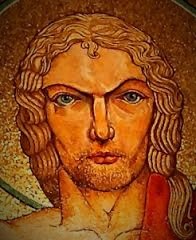
closeup for blogBut let’s look a little closer at Christ’s face (at left). Look closely at his eyes. Notice that the one on the right (His left eye) is more rounded and serene than the one on the left (His right eye), which is narrower and more piercing. Notice also that the eyebrow on the right is more arched and peaceful, while the one on the left is angled downward in a severe look. Take your hand and cover the side on the left and see that He appears more serene. Then cover the side on the right and notice that He appears more severe. This is very common in Eastern iconography, which likes to present both the justice and mercy of God on the face of Christ. It is subtle, but it is meant to be. Otherwise, we’d have a weird looking face! On the Day of Judgment there will be mercy for those who have shown mercy and severe justice for those who have been severe (Mat 5:7; Mat 7:2; James 2:13), for justice and mercy are alike with Him (cf Sirach 5:7). Looking into His eyes, I am reminded of the stunning text from Hebrews that says of Christ, No creature is concealed from him, but everything is naked and exposed to the eyes of him to whom we must render an account (Heb 4:13).

3. What of his other facial features? – The artist seems to have captured the fact that the Book of Revelation described the glorified Christ as having hair like wool. But notice what it says of the color: His head and hair were white like wool, as white as snow (Rev 1:14). Perhaps the artist thought that snow-white hair would be too shocking, but we definitely have blond hair here.

The eyes look to be blue, or possibly green. Here, too, the artist has not conformed as well to the description in the Book of Revelation, which says, his eyes were like blazing fire (Rev 1:14). This would be hard to depict artistically; it might look as if Jesus had red eye!

Add the blond hair and blues eyes to His white complexion and we clearly have a European Christ. There is only a vague account of the complexion of Christ in Scripture: His face was like the sun shining in all its brilliance … His feet were like bronze glowing in a furnace (Rev 1:15-16). These texts speak more of brightness than color. I know that this notion of inclusivity drives some people crazy, who prefer a color blind society, and it would be a joy to get there. But we cannot simply ignore these as reasons why some do not like this image of Christ. The Bible’s silence on the skin color of Christ demonstrates that our issues today with skin color were not pertinent to Scriptural times.

4. What of his red garment? – In Revelation 19, Christ appears riding a strong white horse and John speaks of the robe He wore: He is dressed in a robe dipped in blood, and his name is the Word of God (Rev 19:13).

5. What of his right arm being bared? Here, too, I am mindful of a passage from Isaiah that says, The LORD will lay bare his holy arm in the sight of all the nations, and all the ends of the earth will see the saving power of our God (Is 52:10). It is a symbol of His strength and His power to save and put down His enemies.

6. What of the fact that He is seated? As we have noted, this is a depiction of the Last Judgment. And of that judgment, Scripture says, When the Son of Man comes in his glory, and all the angels with him, he will sit on his throne in heavenly glory. All the nations will be gathered before him, and he will separate the people one from another as a shepherd separates the sheep from the goats. He will put the sheep on his right and the goats on his left (Matt 25:41-43). I am mindful of the old Latin hymn Dies Irae, which poetically says, “When the Judge his seat attaineth, and each hidden deed arraigneth, nothing unavenged remaineth.”

7. What of the angels at his feet? In the Book of Ezekiel (1:4-21 and 10:1-22), there is a vision of the four living creatures or Cherubim around a throne, each having four faces, four wings, four sides, the stature and hands of a man, and the soles of a calf. Further, we have already seen that when the Lord returns He will be accompanied by His angels. Finally, Psalm 99 says, The LORD reigns, let the nations tremble; he sits enthroned between the cherubim, let the earth shake. Great is the LORD in Zion; he is exalted over all the nations (Ps 99:1-2). Somebody say, “Amen!”

I expect some of you will have things to add, possibly corrections or different interpretations. Remember it’s art, not science. One interpretation doesn’t necessarily preclude another. Especially valued are additions to the list that would include insights from Scripture, Tradition, and/or techniques of iconography. When we’re done, I’ll update the post to include things you might be able to add or clarify.

By the way, I am grateful to Jem Sullivan, currently the archdiocese’s Secretary for Education, who a few years back authored a book called The Beauty of Faith. Using Christian Art to Spread the Good News. In it, she encourages what I have tried to do here. Namely, that we should carefully study and pray Christian Art as a kind of lectio divina before the painted or sculpted word.

Here is a video of some unique pictures I took at the Basilica five years ago. They are taken from the Clerestory, a place few visitors go.

A Further Meditation on Christ the King and Son of Man

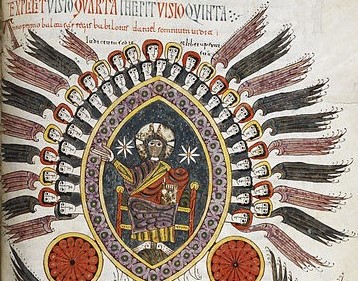
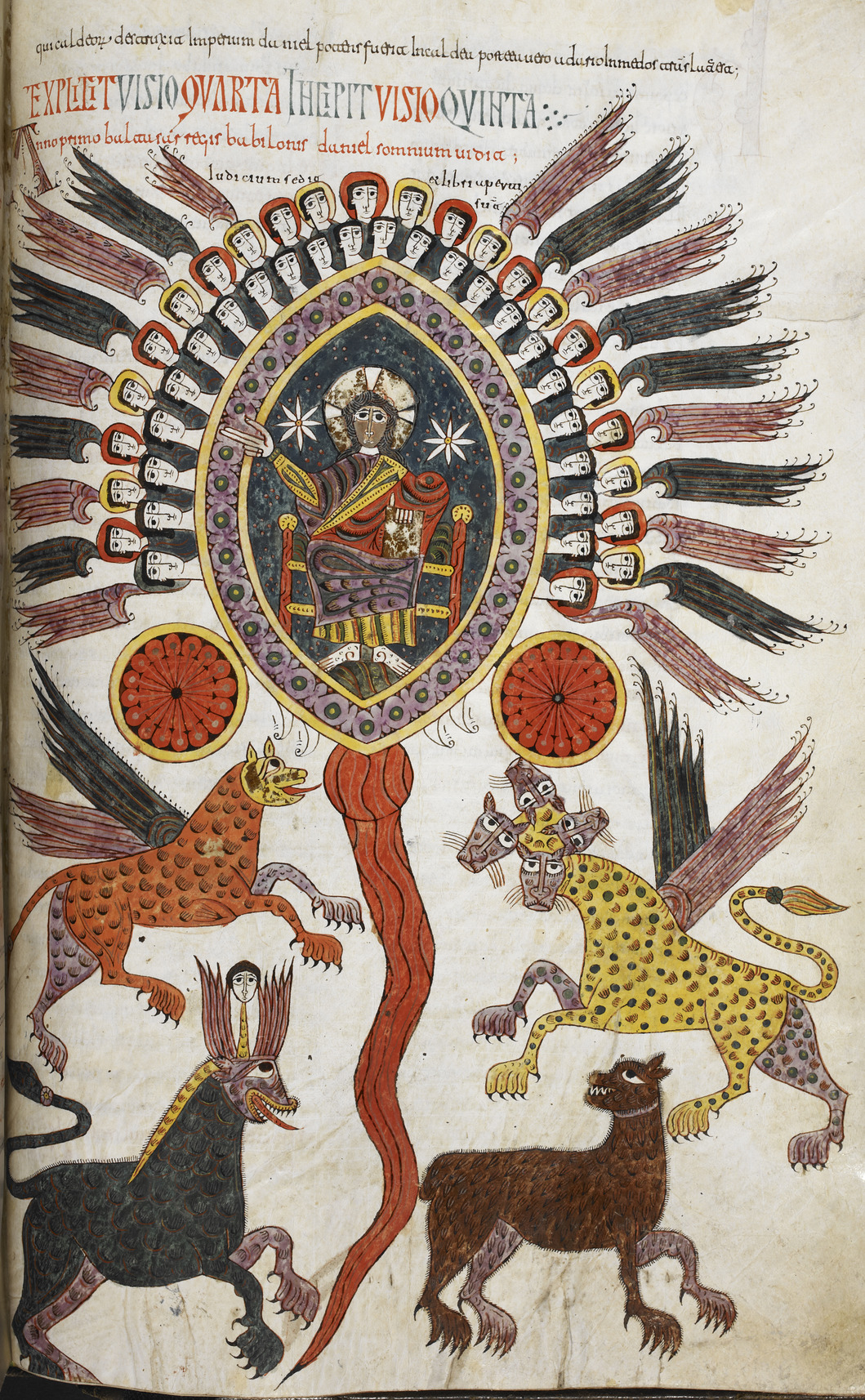
Daniel’s Vision, from the Silos Apocalypse (1109)

At Sunday’s Mass (Feast of Christ the King) we read an important passage from Daniel 7. It is important not only for its prophecy but also because Jesus implicitly sets it as an interpretive key for His own ministry and mission and an explanation of why He calls Himself the “Son of Man” so frequently.

Many modern readers think that “Son of God” is both a higher and clearer title than “Son of Man.” However, as we will see below, the title “Son of God” could be ambiguous.

Let’s consider the passage from three different perspectives: its historical meaning, its Christological meaning, and its current meaning. Here is the text:

In the vision I [Daniel] saw during the night, the four winds of heaven stirred up the great sea, from which emerged four immense beasts, each different from the others. The first was like a lion, but with eagle’s wings. … The second was like a bear …. It was given the order, “Up, devour much flesh.” After this I looked and saw another beast, like a leopard; on its back were four wings like those of a bird, and it had four heads. To this beast dominion was given. After this, in the visions of the night I saw the fourth beast, different from all the others, terrifying, horrible, and of extraordinary strength; it had great iron teeth with which it devoured and crushed, and what was left it trampled with its feet.

I was considering the ten horns it had, when suddenly another, a little horn, sprang out of their midst, and three of the previous horns were torn away to make room for it. This horn had eyes like a man, and a mouth that spoke arrogantly.

As I watched, thrones were set up and the Ancient One took his throne. His clothing was snow bright, and the hair on his head as white as wool; His throne was flames of fire, with wheels of burning fire. A surging stream of fire flowed out from where he sat; Thousands upon thousands were ministering to him, and myriads upon myriads attended him.

The court was convened, and the books were opened. I watched, then, from the first of the arrogant words which the horn spoke, until the beast was slain, and its body thrown into the fire to be burnt up. The other beasts, which also lost their dominion, were granted a prolongation of life for a time and a season.

As the visions during the night continued, I saw One like a son of man coming, on the clouds of heaven; When he reached the Ancient One and was presented before him, He received dominion, glory, and kingship; nations and peoples of every language serve him. His dominion is an everlasting dominion that shall not be taken away, his kingship shall not be destroyed (Daniel 7:2-14).

Historical meaning Daniel prophesied that four kingdoms would persecute God’s people. Each was represented by a beast similar in appearance to a known animal but with symbolic differences.

Most scholars interpret the kingdoms as Babylon, Medo-Persia, Greece, and Rome. Indeed, each of these did persecute the ancient Jews (the Romans persecuted Christians as well). The last kingdom in the prophecy was particularly fierce and received special attention. A single horn (symbolizing power) is said to far eclipse the power of the other horns. This horn had eyes like a man and spoke arrogantly. God sat in judgment, finally casting this fourth kingdom into the abyss, the lake of fire. Sic semper tyrannis (thus always to tyrants). God the Father then ushered in “one like a Son of Man” who would rule all nations and have a kingdom that would never be destroyed or taken away.

Daniel prophesied what we have come to know as the Kingdom of God our Lord Jesus Christ, which is also the Church, the Body of Christ.

Christological meaning – It is primarily this passage that inspires Jesus’ use of the phrase “Son of Man” to refer to Himself. In effect, Jesus says, “I am the one of whom Daniel speaks. I am He who receives from the Father dominion, glory, and kingship. I am He of whom Daniel said, nations and peoples of every language serve him. I am He whose Kingdom is an everlasting kingdom that shall not be taken away, and my kingship shall not be destroyed.

To many modern ears, the title “Son of God” seems higher than “Son of Man.” Among the ancient Jews, though, “Son of God” could refer to an angel or a human. Further, ancient Jews did not conceive of God as having a son, so it might not seem unusual or significant that Jesus or anyone referred to himself as a son of God. In other words, the title “Son of God” could be ambiguous to ancient hearers. Jesus does call Himself “God’s son” (e.g., Jn 11:4; Jn 10:36), but the meaning is debated and the title was not always challenged by His listeners. However, the title “Son of Man” is unique in biblical literature and refers to the eternal ruler, the anointed one, the Christ, whose status and unassailable power is clearly set forth by Daniel.

In using the title Son of Man, Jesus asserts that He is the anointed and eternal ruler to whom Daniel pointed, that all things are His and all are subject to Him. This is a high Christology to say the least. Jesus is Eternal Christ and King.

Current meaning – The meaning for today is that Jesus will conquer any person, nation, or power that arrogantly asserts its dominance or oppresses His people. Psalm 2 says this of the Christ, the Messiah, who is our Lord Jesus:

Why do the nations conspire, and the peoples plot in vain? The kings of the earth rise up and the rulers take counsel together against the Lord and against his anointed, saying, “Let us break these chains and throw off their shackles!”

The One enthroned in heaven laughs; the Lord scoffs at them. He rebukes them in his anger and terrifies them in his wrath, saying, “I have installed my king on Zion, my holy mountain.”

I will proclaim the Lord’s decree. He said to me, “You are my son; today I have become your father. Ask of me, and I will make the nations your inheritance, the ends of the earth your possession. And you will break them with a rod of iron; you will dash them to pieces like pottery.”

Therefore, you kings, be wise; be warned, you rulers of the earth. Serve the Lord with fear and celebrate his rule with trembling. Lest he be angry and your way lead to destruction for his wrath can flare up in a moment. Blessed are all who take refuge in him! [Psalm 2]

So, all nations and things are subject to Christ and the Church, which as His Body shares in this indefectibility. Christ promised this:

And I tell you that you are Peter, and on this rock, I will build my Church, and the gates of Hell will not overcome it (Mat 16:18).

Gates are a symbol of power, and the power of Hell cannot destroy the Church. This does not mean that disciples will not suffer persecution, imprisonment, or even death, or that there will not be sin and foolishness in the Church. However, the Church is the indefectible Body of Christ, who was

[R]aised from the dead is seated at the Father’s right hand in the heavenly places, far above every principality, authority, power and dominion, and above every name that is named, not only in this age but also in the one to come. And [the Father] put all things under his feet and gave him as head over all things to the Church, which is his Body, the fullness of him who fills all in all (Eph 1:20-23).

Why, then, is evil still so prevalent and why do the Lord’s enemies seem to prosper? Scripture says,

When God subjected all things to him, He left nothing outside of his control. Though at present, we do not see everything subject to him. But we see Jesus, who was made a little lower than the angels, now crowned with glory and honor because He suffered death, so that by the grace of God He might taste death for everyone. In bringing many sons to glory, it was fitting for God, for whom and through whom all things exist, to make the pioneer of their salvation perfect through suffering (1 Cor 15:27-30).

Thus, the victory of the Lord over this world’s pride and arrogance, over nations and principalities that assert power unto evil, is often a paradoxical one. Pride is conquered by humility. In dying Jesus destroys death; in rising He restores life. Make no mistake, the victory has already been won and it is a total one. Although the battle plays out through history, the victory of all who suffer with the Lord for the truth is already secured.

Consider for a moment the darkest, most evil day ever: There was a darkening of the sun and an earthquake. The Son of Man hung lifeless from the cross. To any worldly observer he appeared to have lost; evil seemed to have been victorious. Just as Satan was running his victory lap around the cross, Jesus went down into the Devil’s trophy room, Sheol, and turned it out. While Satan was gloating, Jesus awakened the dead and summoned them to new life. The gates of Heaven swung open and slammed up against the gates of Hell. One of the prayers of exorcism rebukes Satan by reminding him that Jesus in horto superavit, spoliavit in cruce, et de sepulchro resurgens tua tropaea in regnum transtulit lucis (Jesus overcame you in the garden, despoiled you on the cross, and rising from the tomb, bore off your trophy into the Kingdom of Light).

Yes, the victory is total, but it is obtained paradoxically: through humble obedience and in the suffering of death. The victory is certain for all who are on the battlefield for the Lord.

As evidence, I propose the Church herself. During the lifetime of the Church, nations have risen and fallen, empires have come and gone, errors and heresies have flourished and then withered. Where is Caesar now? Where is Napoleon? Where is the USSR? They are all gone; we are still here preaching the Gospel and celebrating the sacraments. We have read the funeral rites over all who said they would bury us. Yes, we have endured their wrath, sat in their prisons, heard their threats, been hauled into their courts, and even been killed by them—but the Church is here, and they are gone. One by one all things are put under Christ’s feet. The Church has always had enemies within her as well, including clergy of every rank—but we are still here. It is clear that the Church is indefectible, but only by God’s grace!

Jesus Christ is the eternal King, and His kingdom shall never be destroyed. Daniel saw this in one “like a Son of Man” who received His kingdom from His Father. Jesus has proven that He is that Son of Man.

Christ reigns, Christ Rules. Eternal Victor, Eternal King. His kingdom is an everlasting Kingdom that shall not be taken away!

Get on the winning team! Understand that the victories and methods are sometimes paradoxical, but know by faith that the end is sure, the victory has already been won.


He Will Come Like a Thief to Take Back What Is His

One of the more interesting and surprising images the Lord used for Himself was “thief.” There is an example of the reading for Wednesday of the 21st week of the year. I’ll comment more on this specific passage in a moment, but first here are some other texts in which He used this imagery:

  • But understand this: If the owner of the house had known at what time of night the thief was coming, he would have kept watch and would not have let his house be broken into. So you also must be ready, because the Son of Man will come at an hour when you do not expect him (Matt 24:33; Lk 12:39).
  • Remember, then, what you received and heard. Keep it, and repent. If you will not wake up, I will come like a thief, and you will not know at what hour I will come against you (Rev 3:3).
  • “Behold, I am coming like a thief! Blessed is the one who stays awake, keeping his garments on, that he may not go about naked and be seen exposed” (Rev 16:15).

St. Peter also used the image of a thief, but perhaps out of reverence for Christ he applied it more to the Day of Judgment.

  • But the day of the Lord will come like a thief, and then the heavens will pass away with a roar, and the heavenly bodies will be burned up and dissolved, and the earth and the works that are done on it will be exposed. (2 Peter 3:10).

In today’s first reading, which we will discuss in more detail, St. Paul used a similar image.

  • Now, brothers and sisters, about times and dates we do not need to write to you, for you know very well that the day of the Lord will come like a thief in the night. While people are saying, “Peace and safety,” destruction will come on them suddenly, as labor pains on a pregnant woman, and they will not escape. But you, brothers and sisters, are not in darkness so that this day should surprise you like a thief … let us be sober, putting on faith and love as a breastplate, and the hope of salvation as a helmet. For God did not appoint us to suffer wrath but to receive salvation through our Lord Jesus Christ (1 Thess 5:1-4; 8-9).

It is provocative and even shocking that Lord would compare Himself to a thief. Let’s consider some of the implications.

1. By this image the Lord turns the tables. Thievery suggests unjust possession. In this sense, the Lord is clearly not a thief; rather, He is using a simile. He says that He is like a thief, not that He is a thief. Indeed, how can the owner of all things unjustly possess what is already His?

The impact and indictment of the reference is on us, not on the Lord. That He would seem to any of us to be like a thief is indicative of our injustice, not His. Too easily we forget that the things we call our own are God’s and God’s alone. We are stewards, not owners. When the Lord comes to take what is rightfully His—and has always been His—we should be grateful to hand it back with interest (see the Parable of the Talents). To those who have forgotten that they are mere stewards, the Lord will seem to come to steal from them. They will see His coming as a threat because He will put an end to their schemes and worldly wealth.

Because they wrongly see these things as theirs, they will see Him as a thief—or worse, a robber. In the Parable of the Vineyard (Matthew 21:30ff) the Lord says that they will beat His prophets and even kill His Son. The injustice and crime are theirs. God cannot steal what He already owns. The vineyard was His and He rightly sought His portion of its proceeds. Murderously, they sought to withhold what they thought was theirs but in fact was not.

The Lord’s ways are justice and truth. God will take back all that is His. We will pay for what we have stolen through greed, injustice, selfishness, lust, and gluttony. To those who forget that He is the true owner of the vineyard, He may appear to be like a thief, but it is really we who are thieves. We will cry “Thief!” but the Lord will simply reply, “You are the man; it is you who have said it” (see 2 Sam 12:7; Matt 26:64).

2. By this image the Lord speaks to the hidden quality of His presence to some. In using the image of a thief (Κλέπτης (kleptes) in Greek) the Lord speaks of a stealthy, hidden presence. Thieves do their work in hiding or when we are unaware. A robber, on the other hand, confronts you, taking what he wants with violence while you can only watch helplessly.

The word thief here is indicative of the Lord’s hidden presence. The Lord is not a thief, but He seems like one to those who are forgetful of His presence. Don’t fool yourself into thinking that He is not in the house of your life; He sees and knows everything.

3. By this image the Lord puts to the lie the illusion of our own hiddenness. Thieves work in hiding. Many people who sin and misuse what the Lord owns often forget that nothing is hidden from God. Thus they meet the definition of a thief because they attempt to take or misuse secretly what is not theirs to begin with.

God may seem hidden and distant, but He is not. He sees everything, knows everything, and is reckoning everything. Every “hidden” deed of ours is written in the book. An ancient hymn says,

Lo the Book exactly worded
Wherein all has been recorded
Thence shall judgment be awarded.

When the Judge his seat attaineth
And each hidden deed arraigneth
Nothing unavenged remaineth (Dies Irae).

God is watching, and He is closer to you than you are to yourself.

4. By this image the Lord exhorts us to remember and to be ready. A break-in at my rectory motivated me and the staff to become more careful and vigilant, but why should the loss of passing goods cause us more concern than the certain arrival of the Lord, the true owner of all things? Although He may seem to come like a thief, He is not a thief. The real questions I should be asking myself are these: Am I a thief? Have I used what God owns in ways that are against His will or that displease Him? If so, He will come when I least expect it and take what I wrongfully think is mine. I may think Him a thief, but He is not. As true owner, He cannot unjustly possess what is already His.

We had better think about this now because the Lord is already in the house and His presence will be disclosed at any moment. Are you ready? Are you watching? Be vigilant. The Judge stands at the gate, but He has the key, not you.

Is He a thief? No. Are you a thief? Am I?

Epilogue: When Jesus was praying in the Garden of Gethsemane, Judas, who was a thief (see John 12:6), led a band of brigands to arrest Him. Stepping forward, Jesus turned the tables on them and said, “Have you come out as against a robber, with swords and clubs to capture me?” (Mk 14:48) Yes, He turned the tables on them and on the temple leaders who sponsored them. They saw Jesus as a usurper, as one who came to steal their priesthood and leadership. He was no thief, no robber. He was the great High Priest, the One who came to fulfill everything that they were supposed to be preaching. It was they who sought to kill Him and unjustly take the vineyard for themselves. To thieves, robbers, and murderers, Jesus was like a thief, but He was not. They were thieves—and even worse, robbers and murderers.

When Jesus says that He may be coming like a thief, be careful; the Lord will come to take back what is His.

By Breaking a Wooden Yoke, You Forge an Iron Yoke!

This Monday is the feast of the Transfiguration, which means that we missed reading a powerful passage from the Book of Jeremiah that was otherwise assigned to Monday of the 18th week of the year. It is practical, profound, and sweeping in its implications, and it comes to us from the Lord through the mouth of Jeremiah the Prophet:

By breaking a wooden yoke, you forge an iron yoke! (Jeremiah 28:13)

Rather than looking at the historical meaning (i.e., that God was going to use Assyria to humble Israel), let’s consider what it means for us today.

What is the wooden yoke if it is not the cross? Indeed, the Lord says as much: Come to me, all who labor and are heavy laden, and I will give you rest. Take my yoke upon you and learn from me; for I am gentle and lowly in heart, and you will find rest for your souls. For my yoke is easy, and my burden is light (Matt 11:28-30).

The Lord has a paradoxical answer for us who labor and are heavenly burdened. He tells us to take the yoke and burden that He has for us. The yoke is a symbol for the cross, and like most yokes, it connects us with another—the Lord! To be sure, God does have a yoke for us. We do need purification and discipline. However, the yoke He has for us is “easy.” The Greek word used is χρηστός (chrestos), which also has the connotation of being well-fitting, serviceable, or adapted to its purpose. The Lord’s yoke for us is productive unto the end He has in mind: our healing and salvation.

Do not turn the yoke (cross) into something abstract or think of it only in terms of major things such as cancer. The cross also has real, practical, daily dimensions such as exercising self-control and moderation. The cross (yoke) includes resisting sin, forgiving, and living chastely and courageously despite difficulties or persecution. These crosses are common to all true Christians. There are also some specific crosses that each of us carries, ones that the Lord permits for our humility and purification. Perhaps it is a physical illness or infirmity; maybe it is a spiritual emotional struggle; perhaps it is the loss of a loved one, job, or home.

These things are the wooden yoke, the cross of the Lord, and He carries it with us for we are yoked with Him (praise God). Because these burdens are from Him, they are well-suited to us; they are just what we need to avoid even worse things, including Hell itself.

What if we break and cast aside the wooden yoke, as many do today by ridiculing the Christian moral vision and the wisdom of the cross given to us by Jesus?

By breaking a wooden yoke, you forge an iron yoke! (Jeremiah 28:13)

How is this? Consider the toll that indulging in the moment can take. In rejecting the wooden yoke of moderation, chastity, and the limits of God’s moral law, we forge the iron yoke of addiction, obesity, financial trouble, sexually transmitted diseases, broken families, and all the heartache that follows. Pornography, lust, alcohol, and drugs enslave with an iron yoke. In refusing the grace to forgive, we fuel violence and conflict. Many wars in the world today are fought over grievances that stretch back hundreds or even thousands of years. Our greed fuels an insatiable desire for more, and we begin to live beyond our means or to live in such a way that bring us more stress than happiness. Even the simple neglect of our daily duties causes work to pile up and seem overwhelming.

All of these are like iron yokes; they come upon us because we break the wooden yoke of the cross. To be sure, fulfilling our daily duties, living moderately, chastely, and soberly are all crosses because they involve some degree of self-denial, at least in the moment. However, the wooden yoke is a lot easier than the iron yoke that results if we cast aside the more manageable, and well-fitting yoke of the cross.

Pay attention, fellow Christian, Satan is a liar. He offers to lift the gentle yoke of the Lord. He expresses “outrage” that the Lord should require any suffering or discipline from us. He “takes our side” and utters a complaint on our behalf, but he is a liar and a fraud. Once we let him lift the wooden yoke he locks us in an iron yoke. Do not forsake the wooden yoke of the cross, for if you do, an iron yoke is sure to follow.

It is a simple pearl of wisdom, yet it is so often ignored: By breaking a wooden yoke, you forge an iron yoke! (Jeremiah 28:13)

“Strange but Rich Verses” File: What Does Acts 1:4 Mean by Saying that Jesus was Eating Salt with Them?

There is an unusual verse that occurs in the first chapter of the Acts of the Apostles, describing a gathering of Jesus and the apostles after the resurrection but before the ascension. For the most part, modern translations do not reveal the full oddity of the verse. The verse in question, as rendered by the Revised Standard Version Catholic Edition, is this:

And while staying with them he charged them not to depart from Jerusalem, but to wait for the promise of the Father (Acts 1:4).

However, a number of scripture scholars, including none other than Joseph Ratzinger, point out that the verse is more literally translated as follows:

And while eating salt with them he charged them not to depart from Jerusalem, but to wait for the promise of the Father.

The Exhaustive Concordance of the Bible, better known as Strong’s Concordance, makes no mention of the connection of the word συναλιζόμενος (synalizomenos) to salt. It parses the word as syn (with) + halizo (to throng or accumulate) to arrive at the definition “to assemble together.”

However, another source, A Grammatical Analysis of the Greek New Testament (Pontifical Biblical Institute), includes a different analysis of the word: syn (with) + halas (salt), to arrive at the definition “to take salt together” or by extension, “to share a meal.”

So, there seem to be two rather different notions of the etymology. It is also interesting that none of the writings of the Greek Fathers that I was able to consult make any mention of the possible connection to salt, though St. John Chrysostom does connect the word to a meal rather than a mere gathering.

I know just enough Greek to be dangerous; I certainly cannot sort out why different sources parse the word differently, but for our purposes let’s just chalk it up to a difference among experts, much as is the case with another passage on which I have written here: Agapas vs. Philo.

I would like to explore the translation that the Lord was “eating salt with them.” How odd to our modern ears, especially when the “food police” today treat salt almost as a poison! Despite that, salt is still precious today, even if less necessary than it was in the ancient world.

Let’s consider what Pope Emeritus Benedict wrote (as Joseph Ratzinger):

For a correct understanding … the word used by Luke—synalizómenos—is of great significance. Literally translated, it means “eating salt with them.” Luke must have chosen the word quite deliberately. Yet what is it supposed to mean? In the Old Testament the enjoyment of bread and salt, or of salt alone, served to establish lasting covenants (cf Num 18:19, 2 Chron 13:5). Salt is regarded as a guarantee of durability. It is a remedy against putrefaction, against the corruption that pertains to the nature of death. To eat is always to hold death at bay—it is a way of preserving life. The “eating of salt” by Jesus after the Resurrection, which we therefore encounter as a sign of new and everlasting life, points to the Lord’s new banquet with his followers … it has an inner association with the Last Supper, when the Lord established the New Covenant. So the mysterious cipher of eating salt expresses an inner bond between the [Last Supper] and the risen Lord’s new table fellowship; he gives himself to his followers as food and thus makes them sharers in his life, in life itself … the Lord is drawing the disciples into a New Covenant-fellowship with him … he is giving them a share in the real life, making them truly alive and slating their lives through participation in his Passion, the purifying power of his suffering (Jesus of Nazareth Vol. 2, pp. 271-272).

So indeed, salt and covenants are tied. Here are a few verses that make the connection:

  • Whatever is set aside from the holy offerings the Israelites present to the Lord I give to you and your sons and daughters as your perpetual share. It is an everlasting covenant of salt before the Lord for both you and your offspring (Numbers 18:19).
  • Don’t you know that the Lord, the God of Israel, has given the kingship of Israel to David and his descendants forever by a covenant of salt? (2 Chronicles 13:5)
  • Season all your grain offerings with salt. Do not leave the salt of the covenant of your God out of your grain offerings; add salt to all your offerings (Leviticus 2:13).

It makes sense that Luke would refer to Jesus as eating salt with the disciples. To untrained ears it may seem odd, but to ears tuned to the biblical world the reference has great significance. Jesus is affirming the New Covenant and this expression points to that.

Of course, it is no mere table fellowship; it is the meal of the New Covenant we have come to call the Mass. Hence, without doing disservice to Luke’s description, we can say (in our more developed theological language) that during the forty days before He ascended, the Lord celebrated Mass with them. Thus, the Emmaus description (Luke 24:30) of Jesus at the table giving thanks, blessing the bread, breaking it, and giving it to them so that they recognize Him therein, is not the only allusion to a post-resurrection Mass.

Is it “Eating salt with them” or “Staying with them”? You decide, but I vote for salt. 😉