What is the Wrath of God? A Study of a Common Biblical Theme

In Tuesday’s reading at daily Mass (Tuesday of the 28th Week) there was a reference to the wrath of God: The wrath of God is indeed being revealed from heaven against every impiety and wickedness of those who suppress the truth (Romans 1:18). St. Paul goes on to set forth a host of social ills that result from the suppression of the truth, including the approval of homosexual acts, as evidence of a darkened intellect and debased mind (Rom 1:28).

But what is God’s wrath? It is spoken of often in Scripture and is a subject we must treat carefully. On the one hand we cannot simply dismiss the concept as contradictory to the fact that God is love, but neither can we deny God’s wrath as unfit in terms of His love.

It seems worthwhile to consider some aspects of the very complicated reality of the wrath of God. There is not enough space to cover the whole topic in this post, but the comment section will stay open, as always, for your continued additions and subtractions. What are some ways that we can explain and understand the wrath of God? Let me propose a few.

The wrath of God is not merely an Old Testament concept. It is mentioned quite frequently in the New Testament as well. For example, consider the following New Testament passages:

  1. Jesus said, “Whoever believes in the Son has eternal life, but whoever rejects the Son will not see life, for God’s wrath remains on him” (John 3:36).
  2. The wrath of God is being revealed from heaven against all the godlessness and wickedness of men who suppress the truth by their wickedness (Rom 1:18).
  3. Do not take revenge, my friends, but leave room for God’s wrath, for it is written, “It is mine to avenge; I will repay,” says the Lord (Rom 12:19).
  4. Let no one deceive you with empty words, for because of such things [e.g., sexual immorality] God’s wrath comes on those who are disobedient (Eph 5:6).
  5. For God did not appoint us to suffer wrath but to receive salvation through our Lord Jesus Christ (1 Thess 5:9).
  6. The angel swung his sickle on the earth, gathered its grapes and threw them into the great winepress of God’s wrath (Rev 14:19).

There are at least a dozen other New Testament texts I cite, but allow these to suffice. So it is clear that the “wrath of God” is not some ancient or primitive concept with which the New Testament has dispensed. And notice, too, that the wrath of God is not something reserved simply for the end of the world. It is also spoken of as something already operative in certain people.

So again, what is God’s wrath and how can we reconcile it with His love?  Consider some of the following images or explanations of God’s wrath. None of them alone explains it, but considered together, an overall understanding may emerge.

  1. Image: God’s wrath is His passion to set things right. We see this image of God’s wrath right at the beginning in Genesis, when God cursed Satan and uttered the protoevangelium (the first good news): I will make you and the woman enemies … one of her seed will crush your head while you strike at his heel” (Genesis 3:15). God is clearly angered at what sin has done to Adam and Eve and continues to have anger whenever He beholds sin and injustice. He has a passion for our holiness. God wants what is best for us. He is angered by what hinders us. Surely all sins provoke His wrath, but there are five that especially cry out to Heaven: willful murder (Gen. 4:10); the sin of the Sodomites (Gen. 18:20; 19:13); the cry of the people oppressed (Ex. 3:7-10); the cry of the foreigner, the widow, and the orphan (Ex. 20:20-22); and injustice to the wage earner (Deut. 24:14-5; Jas. 5:4) (cf Catechism of the Catholic Church # 1867). In terms of sin, injustice, and anything that hinders the possibility of salvation, God has a wrathful indignation and a passion to set things right. This is part of His love for us. God’s wrath may be manifested through punishment, by disturbing our conscience, or simply by allowing us to experience the consequences of our sin and injustice.
  2. Clarification: God’s wrath is not like our anger. In saying that God is angry we ought to be careful to understand that however God experiences anger (or any passion), it is not tainted by sin. God is not angry the way we are. When we get angry we often experience an out-of-control quality; our temper flares and we often say and do things that are excessive, if not sinful. It cannot pertain to God to have temper tantrums or to “fly off the handle,” to combine anger with an unreasonable lashing out. The way God experiences anger is not something we can fully understand but it is surely a sovereign and serene act of His will, not an out-of-control emotion.
  3. Clarification: God is not moody. God does not have good days and bad days, good moods and bad ones. Scripture seems clear enough on this subject when it indicates that God does not change. Consider this from the Book of James: Every good and perfect gift comes from above, from the Father of lights, in whom there is no variableness or shadow of turning (James 1:17). The fact that God shows wrath does not mean that He has suddenly had enough or that His temper has flared, or that His mood has soured. God is. He does not change. As Scripture says, He is not variable. And this leads us to the next image.
  4. Image: The primary location of God’s wrath is not within God; it is in us. Perhaps the best definition I have heard of God’s wrath is this: God’s wrath is our experience of the total incompatibility of our sinful state before the Holiness of God. Sin and God’s holiness just don’t mix. They can’t keep company. Consider fire and water. They do not mix; they cannot coexist in the same spot. Bring them together and you can hear the conflict. Think of water spilled on a hot stove; hear the sizzling and popping; see the steam rising as the water flees away. If, on the other hand, there is a lot of water, the fire is overwhelmed and extinguished. But the point is that they cannot coexist. They will conflict and one will win. This is wrath: the complete incompatibility of two things. It is this way between sin and God’s utter holiness. We must be purified before we can enter the presence of God otherwise we could never tolerate His glory. We would wail and grind our teeth and turn away in horror. The wrath is the conflict between our sin and God’s holiness. God cannot and will not change, so we must be changed, otherwise we experience wrath. But notice that the experience is in us primarily and not in God; He does not change. He is holy and serene; He is love. If we experience His wrath, it is on account of us, not Him. Consider the next image.
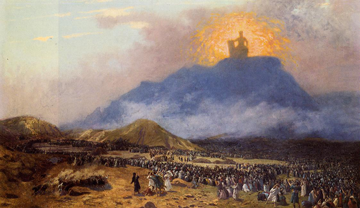
  5. Image: It is we who change, not God, and this causes wrath to be experienced or not. Consider the following example. On the ceiling of my bedroom is a light with a 100-watt light bulb. At night before bed, I delight in the light; I am accustomed to it. But then at bedtime I turn off the light and go to sleep. When I wake up it is still dark (at least in the winter), so I turn on the light. Ugh! Grrr! Now the light is too bright and I curse it! Now, mind you, the light has not changed one bit. It is still the same 100-watt bulb it was hours earlier. The light is the same; it is I who have changed. But do you know what I do? I blame the light and say, “That light is too harsh!” But the light is not harsh; it is just the same as it was when I was happy with it. Because I have changed I experience its wrath, but the wrath is really in me. Consider the experience of the ancient family of man with God. Adam and Eve walked with God in the cool of the evening when the dew collected on the grass (cf Gen 3:8). They had a warm friendship with Him and did not fear His presence. After sinning, they hid. Had God changed? He had not, but they had, and they now experienced him very differently. Fast forward to another theophany. God had come to Mt. Sinai. As He descended, the people were terrified, for there were peals of thunder, flashes of lightning, clouds, and the loud blast of a trumpet. The people told Moses, “You speak to us, but let not God speak, else we will die!” (Ex 20:19) God, too, warned Moses that the people could not get too close lest His wrath be vented upon them (Ex 19:20-25). Now, again, had God changed? No, he had not. He was the same God who walked with them in the cool of the evening in a most intimate way. It was we who had changed. We had lost the holiness without which no one can see the Lord (Heb 12:14). The same God, unchanged though He was, now seemed frightening and wrathful.
  6. What, then, shall we do? If we can allow the image of fire to remain before us we may well find a hopeful sign in God’s providence. Since God is a holy fire, a consuming fire (cf Heb 12:26; Is 33:14), how can we possibly come into His presence? How can we avoid the wrath that would destroy us? Well, what is the only thing that survives in the presence of fire? Fire itself! So it looks as if we’d better become fire if we want to see God. And thus it was that God sent tongues of fire upon the Apostles and upon us at our Confirmation. God wants to set you and me on fire with the Holy Spirit and in holiness. God wants to bring us up to the temperature of glory so that we can stand in His presence.See, I will send my messenger, who will prepare the way before me. Then suddenly the Lord you are seeking will come to his temple; the messenger of the covenant, whom you desire, will come,” says the LORD Almighty.  But who can endure the day of his coming? Who can stand when he appears? For he will be like a refiner’s fire or a launderer’s soap. He will sit as a refiner and purifier of silver; he will purify the Levites and refine them like gold and silver. Then the LORD will have men who will bring offerings in righteousness, and the offerings of Judah and Jerusalem will be acceptable to the LORD, as in days gone by, as in former years (Mal 3:1-4). And indeed Jesus has now come: For you have turned to God from idols to serve the living and true God, and to wait for his Son from heaven, whom he raised from the dead—Jesus, who rescues us from the coming wrath (1 Thess 1:10-11).

So there is a “wrath of God.” As I have tried to show, it is more in us than it is in God. But I will not say to you that there is no wrath in God. Scripture is clear in indicating that wrath does pertain to God’s inner life. What exactly it is and how God experiences it is mysterious to us. We can say to some extent what it is not (as we did above), but we cannot really say what it is exactly. But far richer is the meditation that the wrath of God is essentially within us. It is our experience of the incompatibility of sin before God. We must be washed clean in the Blood of the Lamb and purified. Most of us will need purification in Purgatory, too. But if we let the Lord perform His saving work, we are saved from His wrath, for we are made holy and set on fire with God’s love. And fire never fears the presence of fire. God is love, but He will not change. So it is that love must change us.

One of the greatest cinematic depictions of the wrath of God occurred in the movie Raiders of the Lost Ark. The Nazis sinfully think they can open the Ark of the Covenant and endure the presence of God. What they get is wrath, for sin cannot endure the reality of God’s presence. “Enjoy” this clip:
 

Genesis and Genre – A Brief Consideration of the Need to Understand Literary Form

blog10-8The Bible has within its pages many literary forms: history, poetry, prayer, prose, theology, liturgical instruction, cosmology, genealogy, philosophy, parable, moral tale, and so forth. How exactly to read its pages and understand them is often a matter of understanding the genre.

The word genre comes directly from the French word meaning “kind” or “sort.” Further back, it stems from the Latin word genus and the Greek word genos (γένος). Genre is the term for a category of literature, art, or culture (e.g., music) based on a set of stylistic criteria.

Now someone might ask me, “Do you read the Bible literally?” That’s like someone asking, “Do you interpret the library literally?” I would respond by saying that it depends on what section I’m in. If I’m in the science or history section, I might well read a book there literally. But if I’m in the poetry, fiction, or children’s storybook section, I would not likely read a book there literally. In those sections I would understand that stories and images are being used to make a point rather than merely to present facts.

We know how to exercise some sophistication when it comes to the library, but many seem to lose this perspective when it comes to the Bible. Often we can fail to distinguish literary forms and thus try to force a book or passage to be what it is not.

In reading the Book of Genesis, especially the early chapters, many fail to appreciate the different literary forms. They want the creation stories to be science or exact history when in fact they are more poetic and theological than scientific. The stories advance the real and true point that God alone created everything there is out of nothing, and did so in an intentional and systematic way in which He was involved at every stage. This is the sacred and theological truth set forth by the Genesis accounts.

The text does not propose to be in the form of a science textbook. Consider, for example, the accounting of the “days” of creation. Although light is created on the first day, the Sun and Moon are not created until the fourth day. So what does it mean to speak of a “day” when the very sun by which we define the length of the day does not even exist yet? Further, the notion of light apart from the Sun, is a somewhat abstract concept.

If someone asks me if I read the account of creation literally I ask them, “Which one?” This usually leads to a puzzled look. But the fact is, Genesis sets forth two accounts of creation that are very different.

  1. In the first account (Gen 1:1-2:4) we see a period of seven days. First there is the creation of light, then the sky and the ocean, then vegetation, then the Sun and the Moon, then fishes and birds, then the animals, and finally Adam and Eve.
  2. The second account of creation (Gen 2:4-25) does not mention a time frame. It begins with the creation of Adam, then the planting of a garden, then the creation of animals, and then the creation of Eve.

Hence, we have two very distinct versions of creation. In no way can they be harmonized, yet neither are they in absolute conflict. Each describes the same event, but from a different angle and with a different level of focus on detail. Neither account alone contains all the details. But together, they contain all God wants us to know about the creation of the cosmos.

If asked to describe the visit I made to the Holy Land I could start at the beginning and give a day-by-day account, or I could choose to start at the end and work backward. Or instead of responding chronologically, I could just present some highlights. I could also describe the trip according to themes (e.g., Old Testament sites and New Testament sites). I might select the method of presentation depending on the particular audience. Each of my responses would be true and yet they are all different. My response would depend on my purpose and the audience to whom I am presenting.

So then a little sophistication is required in dealing with the accounts of creation. If we take a literal and rigid notion of history, we can err by trying to make Genesis what it is not. It does not conform to the modern genre of historical writing, which tends to be comprehensive and strictly chronological. These Genesis accounts are quite willing to speak to us of creation poetically and selectively, even reversing the timeline. This is because their purpose is not to give us a blow-by-blow account of precisely how God created everything. Exact times and dates are not the point. The point is that God is the purposeful, sole, and sovereign Creator. God, who is present and active at every stage, is the point. Another important point is the dignity of the human person. The first account accomplishes this by making man the culmination of the creation story; he is created on the seventh day. The second account makes this point, but by beginning with man and having everything formed around him and for him.

The Catechism of the Catholic Church says of these accounts,

Among all the Scriptural texts about creation, the first three chapters of Genesis occupy a unique place. From a literary standpoint these texts may have had diverse sources. The inspired authors have placed them at the beginning of Scripture to express in their solemn language the truths of creation—its origin and its end in God, its order and goodness, the vocation of man, and finally the drama of sin and the hope of salvation. Read in the light of Christ, within the unity of Sacred Scripture and in the living Tradition of the Church, these texts remain the principal source for catechesis on the mysteries of the “beginning”: creation, fall, and promise of salvation (CCC  # 289).

This all leads to an interesting question that I was asked recently by a parishioner: “How did Adam and Eve’s kids have kids?” The questioner seemed to imply that since only Cain and Abel were mentioned (no females) there couldn’t have been other kids. In other words, the premise seemed to be that Genesis represents an exact and fully inclusive history, like modern history texts. Since only Cain and Abel were mentioned, then only Cain and Abel existed. But this premise is flawed; Genesis is not meant to be a complete, seamless, chronological account. Just because daughters were not mentioned does not mean that they did not exist. Genesis 4:17 does mention the wife of Cain. Other women are mentioned in the genealogy that is in Genesis 4. (Note the problem of incest is too long to be addressed here and will be the subject of another post. It is wrapped up in the question of monogenism/polygenism.)

The fact is, Genesis does not propose to give us all the details or to answer all of our questions. Something is left to the reader: a sophistication that recognizes that Genesis is historical yet not written in the form of modern history texts. We cannot expect all the details and must presume the presence of other children (especially daughters born to Adam and Eve).

So, in the end, there must be some sophistication used in understanding of Scripture. Genesis is neither a scientific account nor was it written in the way of a modern history text. It does speak of historical facts, but in a selective and poetic manner. Accepting this distinction is critical, lest we go down all sorts of rabbit holes, expecting Genesis to provide a complete and seamless account that it does not propose to give in the first place.

The Sanctus – A Far More Remarkable Prayer than You Might Imagine. A Reflection on a Teaching of Joseph Ratzinger

blog9-13-2015What we call the Sanctus, or the Holy, Holy, Holy of the Mass is not one prayer or one acclamation, but two. And this fact presents a teachable moment for us as well as providing a defense of a practice that is often scorned by modern liturgists.

The two parts of the Sanctus are as follows:

  1. The Sanctus – Holy, Holy, Holy, Lord God of Hosts. Heaven and Earth are full of your Glory.
  2. The Benedictus – Blessed is He who comes in the name of the Lord. Hosanna in the Highest.

The first part comes from the Book of Isaiah:

I saw the Lord sitting upon a throne, high and lifted up; and the train of his robe filled the temple. Above him stood the seraphim. Each had six wings: with two he covered his face, with two he covered his feet, and with two he flew. And one called to another and said, “Holy, holy, holy is the Lord of hosts; the whole earth is full of his glory!” (Is 6:1b-3)

And thus this acclamation is that of the highest heavens and the highest rank of the angels, the Seraphim (“burning ones”), who stand before the throne of God in Heaven. It is their acclamation that Isaiah overheard in the vision he felt utterly unworthy to experience.

That we, mere mortals, take up this acclamation is bold indeed. We are enabled to sing it only on account of the saving ministry of Jesus, our savior. Through Jesus, and as members of His Body, we now have access to the Holy of Holies in Heaven!

Scripture says,

But when Christ appeared as high priest of the good things that have come, passing through the greater and more perfect tent (not made with hands, that is, not of this creation) he entered once for all into the holy places, not by means of the blood of goats and calves but by means of his own blood, thus securing an eternal redemption (Heb 9:11-12).

Therefore, brothers, since we have confidence to enter the holy places by the blood of Jesus, by the new and living way that he opened for us through the curtain, that is, through his flesh, and since we have a great priest over the house of God, let us draw near with a true heart in full assurance of faith, with our hearts sprinkled clean from an evil conscience and our bodies washed with pure water (Heb 10:19-22).

Yes our singing of this great acclamation of the highest angels is bold, but our boldness is only in Jesus. Otherwise, how could we dare to enter the Holy of Holies in Heaven and take up the song that only angels of the highest rank sing?

At every Mass, the priest (in the Preface Dialogue) bids us, Sursum Corda (Lift up your hearts). In other words: Brethren we are now in Heaven with Christ our Head and are swept up into the heavenly Liturgy. Therefore we give thanks to the Father through Christ His Son and our Lord. And with the Cherubim, the Seraphim, and all the heavenly hosts we, with one voice, proclaim, Holy, Holy, Holy, Lord God of Hosts … This is an acclamation of great ascent of the Lord into the Holy Place.

The second half of the Sanctus is a very different acclamation. It is far more earth-bound and comes from a completely different Scripture. It is the song of the Hebrew children, who greeted Jesus as the Messiah when he entered Jerusalem, meek and humble, riding on a donkey:

Hosanna! Blessed is he who comes in the name of the Lord! Hosanna in the highest heaven! (Mk 11:9-10)

How different this second half is! It is an acclamation of praise, but by men not angels. And though it resonates to the highest Heaven, it is an acclamation from the earth. It is in praise of the Lord, who has descended in the incarnation and is entering the earthly Jerusalem.

The first part of the Sanctus was of angels to the Lord who dwells in highest Heaven. The second half, the Benedictus, is of men to the Lord, who descended to these lower realms of our earth.

Thus what we call the Sanctus is a complex combination of two very different prayers, two very different scriptural acclamations, two very different contexts.

For this reason it was common in the Traditional Latin Mass (today, the Extraordinary Form of the Mass) to split the Sanctus, singing part one before the consecration and part two after it. Cardinal Joseph Ratzinger, speaking in 1996 at Regensburg, mentioned this practice and explained it in the following manner:

Whereas the Sanctus evolved from Isaiah 6 and was then transferred from the heavenly to the earthly Jerusalem and so became the song of the Church, the Benedictus is based on a New Testament rereading of Psalm 118:26. In the Old Testament text this verse is a blessing at the arrival of the festive procession in the Temple. On Palm Sunday it received a new meaning … When the youths of Jerusalem shout this verse to Jesus, they are greeting him as the Messiah, as the King of the last days who enters the Holy City.

[So] the Sanctus is ordered to the eternal glory of God; in contrast, the Benedictus refers to the advent of the incarnate God in our midst. For this reason the Benedictus is meaningful both as an approach to the consecration and as an acclamation to the Lord who has become present in the Eucharistic Species (Joseph Ratzinger, Collected Works, Vol XI “Theology of the Liturgy” Ignatius Press, p. 477).

And thus the Lord, who dwells in the Highest Heaven, descends at the consecration to dwell humbly among us as our food. So, in the Old Latin Mass, it was considered the appropriate time to sing, “Blessed is He who comes in the Name of the Lord.” Yes, blessed is He who has descended from the highest Heaven and is now present among us in the Eucharist upon our Altar. May the highest praises be His!

It seems such a glorious acclamation in this sense and with this background. And so it’s no wonder that the united text of the Sanctus was “paused” midway and the second half routinely sung after the consecration.

In a way it is sad that this was altogether lost in the Ordinary Form. This seemingly perfect acclamation was replaced by newly composed acclamations called “The Mystery of Faith,” which imitate the Eastern Liturgies. They are not bad in themselves, but they wholly replaced something that was beautiful and also adequate. Most liturgists insisted that the old practice of splitting the Sanctus in two was to be stopped without exception. Cardinal Ratzinger continues,

The reformers of the Liturgy, following the Byzantine rite, composed an acclamation of the people “We proclaim your death, O Lord …” But the question of other possible acclamations … has been proposed. 

It is evident to me that there is no more appropriate or more profound acclamation, or one that is more rooted in tradition than precisely this one: Blessed is He who comes in the Name of the Lord.

The pedantic proscription of such a split … should be forgotten as quickly as possible (Ibid, p. 478).

Most liturgists would severely frown on eliminating one of the Mystery of Faith acclamations from the Ordinary Form of the Mass in favor of splitting the Sanctus. But as the Cardinal, now Pope Emeritus, opines, we might wish to consider it as an option. For now, the option exists only in the Extraordinary Form of the Mass.

Yet in the end, much is gained by reflecting on the text of the Sanctus. It is actually two texts, and shows the remarkable and beautiful tension of ascension and condescension, of transcendence and immanence, of the heavenly Jerusalem and the earthly one, of angels and men.

Two texts, two songs, one Sanctus. A remarkable moment in the Liturgy!

Here is a polyphonic and an orchestral Sanctus:

Five Qualities Necessary for an Evangelizer – from St. Paul

Blog9-8-2015St. Paul describes a kind of modus vivendi (a way of living) for himself and for us; the passage was read at Mass on Monday. It has a dynamic urgency about it that we ought not to overlook.

It is Christ whom we proclaim,
admonishing everyone and teaching everyone with all wisdom,
that we may present everyone perfect in Christ.
For this I labor and struggle,
in accord with the exercise of his power working within me (
Col 1:28-29).

As with many biblical texts, it is often helpful to start at the end and work backward. Unlike modern discourse, which usually goes from cause to effect, ancient discourse often works from effect to cause. And that is the case here with St. Paul’s text. So, let’s ponder St. Paul’s description of the life (modus vivendi) of an evangelizer. We’ll begin with the last line and work toward the first.

I. The Source of an Evangelizer – St. Paul says, in accord with the exercise of his power working within me.

St. Paul speaks of a kind of dynamic power at work within him that gives him a burning urgency. Indeed, the word translated here as “power” is δυνάμει (dynamei), a word from which we get the English word “dynamite.” Yes, it is a dynamic and explosive power. It is the same sort of burning urgency that Jeremiah spoke of when he wrote,

Because for me the word of the LORD has resulted in reproach and derision all day long. But if I say, “I will not remember Him Or speak anymore in His name,” Then in my heart it becomes like a burning fire Shut up in my bones; And I am weary of holding it in, And I cannot endure it (Jer 20:8-9).

And St. Paul himself also wrote,

For when I preach the gospel, I cannot boast, since I am compelled to preach. Woe to me if I do not preach the gospel! (1 Cor 9:16)

Yes, in the heart of a true evangelist the Word of God is like a dynamic, explosive power. It burns to get out and has an explosive power that must go forth. This power gives St. Paul a burning love for people and stirs within him an urgency to speak and to act.

And that leads us to the preceding line.

II. The Struggle of an Evangelizer – St. Paul writes, For this I labor and struggle.

On account of the dynamic power of love and truth within him, St. Paul describes himself as laboring and struggling. The Greek word translated here as “struggle” is particularly powerful. It is ἀγωνιζόμενος (agonizomenos), from the word agōnízomai . We get the English word “agony” from this. Agōnízomai means to be like one who is engaged in an intense athletic contest, conflict, or warfare. It speaks of a great struggle and an intense striving for a goal or finish line.

And thus while “struggle” is a perfectly adequate translation of the word, we ought not to lose sight of the fact that agōnízomai speaks to a struggle that is intense and urgent, one that is focused and foremost.

In using this term St. Paul indicated that, inspired by God, he really cared about the salvation of souls and knew that he needed to contend for souls against the world, the flesh, and the devil. He undertook immense work and endured many sufferings. He was hungry; he survived a shipwreck; he was despised, pursued, beaten, scourged, stoned, imprisoned, and finally killed.

I wonder how many of us are this urgent for souls or are “agonizing” for them. For too many of us, even Church leaders (who are most responsible for the care and conversion of souls), evangelizing and spiritually directing souls is something we “get around to” if we have time after the committee meeting or after the building contractor comes by to give the estimate on the roof repairs.

Very few Christians today see their own lives and the lives of others as caught up in a great drama between life and death, Heaven and Hell. There is more often a sleepy universalism that presumes that almost everyone will be saved in the end. Never mind that the Bible says just the opposite. We would rather stay in our dream world, in which “everyone will live happily ever after.”

Meanwhile, St. Paul and countless other evangelizers like St. Francis Xavier were “in agony” to save souls. They traveled to far-flung places, enduring terrible trials because they saw that many were headed for destruction unless they heard the call to “repent and believe the good news.” They had an urgency for souls and a sense of the dramatic conflict between good and evil, light and darkness, the world and the Kingdom. It is an urgency that too many of us lack.

Of his urgent concern St. Paul wrote, There is the daily pressure on me of my anxiety for all the churches. Who is weak, and I am not weakened? Who is scandalized and I am not indignant? (2 Cor 11:29)

Compare this to how settled down many are today with the assault of evil on children, parishioners, spouses, and so many people we know and love. Oh, for just a little more of the “agony” that St. Paul and the saints felt for souls and for the Gospel!

There is nothing deader than a dead priest, nothing deader than a dead parent. Why? Because so much of the eternal salvation of souls depends on them being alive and alert.

III. The Satisfaction of an Evangelizer – Continuing with the preceding line, St. Paul describes that his goal, his satisfaction, is not mere “safety” for souls but their perfection and completeness in Christ. He writes, that we may present everyone perfect in Christ.

The Greek word translated here as “perfect” is τέλειον (teleion), from téleios, meaning to arrive at a goal or end. By extension it means to be mature by having gone through the necessary stages to reach the end goal. It means to be complete, whole, mature, or finished.

And thus the work of an evangelizer is not just to summon people away from sin and destruction, but also to lead them to wholeness and maturity in Christ. To be complete is not merely to lack sin, it is to have all the virtues up and running; it is to be at peace, stable, serene, confident, joyful, and holy. This is what all pastors, parents, and evangelizers should want for the people about whom they care. This alone will satisfy a true evangelizer.

The expensive home that is the American dream might only provide a place in which our children are miserable. God’s house and His dream for us draws us to deepening and lasting joy.

For what are we laboring as we care for others? Is it merely for comfort in a passing world or is it for completion (the perfection of teleios)?

Don’t be satisfied with anything less than being whole and complete.

IV. The Strength of an Evangelizer – Toward this purpose, then, St. Paul describes his work: admonishing everyone and teaching everyone with all wisdom.

With the exception of the youngest of children, people cannot be forced to convert or to have faith. And so we must be content to teach, as St. Paul says. But he does not simply say that we should “teach”; he also says that we should “admonish.”

To admonish is to warn, to put some pressure on the logic and reasoning of another. The Greek word for admonish is nouthetéō and means most literally “to put something in the mind” of another (noús, (mind) + títhēmi, (to place)).

Whereas teaching seeks to present something to the mind for consideration, admonishment seeks to put something in the mind by appealing to an urgent motive.

And this is a significant problem today. Sermons and catechetical instruction often lack admonishment, lack urgency. Too many sermons are merely informational and suggestive rather than bold and urgent.

St. Paul often referred to himself as a kerux, a Greek word meaning “messenger,” but with the notion of being a herald or town crier: one who stands in the square and proclaims a message of news and importance.

As clergy, parents, catechists, and leaders we need to deliver our messages with a sense of urgency. We are not just teaching; we are admonishing! We not just seeking to inform, but to transform others by God’s grace.

Joyful, urgent proclamation and admonishment are essential for the Gospel to have its effects.

V. The Substance of an Evangelizer – Finally, in the first line, St. Paul says, It is Christ whom we proclaim.

Is it? Or are we just proclaiming ideas and slogans? How can we proclaim Christ if we have barely met Him?

When Andrew went to Peter he said, “We have found the Messiah!” (Jn 1:41) There must have been an urgent look on Andrew’s face, a look of burning love, for Peter followed him straightaway to the Lord.

Later, as recounted in the Acts the Apostles, Peter and John were summoned before the rulers of the Temple to explain why they were causing a stir. The text says, When they saw the courage of Peter and John and realized that they were unschooled, ordinary men, they were astonished, and they noted that these men had been with Jesus (Acts 4:13).

How about you and me? Would anyone know that we have been with Jesus? It is Christ whom we proclaim, not mere ideas but Truth Himself. Where, then, is our courage? What will lead others to see that we have been with Jesus?

What will lead them to note that we have been with Jesus is for us to be with Jesus. Prayer is at the heart of our authority. It is Christ whom we proclaim. And if it is really Christ we proclaim then people may be mad, sad, or glad at what we say, but they certainly won’t be bored or unclear about our message! It is Christ whom we proclaim.

Biblical Teaching on the Use of Colorful and Harsh Language

blog.8.23In the Sermon on the Mount, the Lord warns of using uncivil and/or hateful words such as “Raqa” and “fool.” And yet the same Lord Jesus often used very strong language toward some of His opponents, sometimes calling them names such as vipers and hypocrites.

We live in a world that often insists on the use of gentle language and euphemisms. While doing so is not a bad thing, we also tend to manifest a kind of thin-skinned quality and a political correctness that is too fussy about many things, often taking personally what is not meant personally.

What is the overall teaching of Scripture when it comes to this sort of colorful language? Are there some limits and ground rules? Let’s take a look.

The word “civility” dates back to the mid-16th century and has an older meaning that referred to one who possessed the quality of having been schooled in the humanities. In academic settings, debate (at least historically) was governed by a tendency to be nuanced, careful, cautious, formal, and trained in rhetoric. Its rules often included referring to one’s opponents with honorary titles (Doctor, Professor, etc.) and euphemisms such as “my worthy opponent.” Hence as the word has entered into common usage, it has come to mean speech or behavior that is polite, courteous, gentle, and measured.

As one might guess, there are a lot of cultural variances in what is considered to be civil. And this insight is very important when we look at the biblical data on what constituted civil discourse. Frankly, the biblical world was far less dainty about discourse than we have become in 21st-century America. The Scriptures, including the New Testament, are filled with vigorous discourse. Jesus, for example, really mixes it up with His opponents—even calling them names. We shall see more of this in a moment. But the Scriptures also counsel charity and warn of unnecessarily angry speech. In the end, a balance of the scriptural witness to civility must be sought along with an appreciation of the cultural variables at work.

Let’s examine a few of the texts that counsel charity as well as a modern and American notion of civility:

Words from a wise man’s mouth are gracious, but a fool is consumed by his own lips (Eccl 10:12).

The quiet words of the wise are more to be heeded than the shouts of a ruler of fools (Eccles 9:17).

Anyone who says to his brother, “Raqa” is answerable to the Sanhedrin. But anyone who says, “You fool!” will be in danger of the fire of hell (Matt 5:22).

Do not let any unwholesome talk come out of your mouths, but only what is helpful for building others up according to their needs, that it may benefit those who listen (Eph 4:29).

Fathers, do not provoke your children, lest they become discouraged (Col 3:21).

With the tongue we praise our Lord and Father, and with it we curse men, who have been made in God’s likeness. Out of the same mouth come praise and cursing. My brothers, this should not be (James 3:9-10).

Everyone should be quick to listen, slow to speak, and slow to become angry (James 1:19).

Let your conversation be always full of grace, seasoned with salt (Col 4:6).

Therefore encourage one another and build each other up (1 Thess 5:11).

But now you must rid yourselves of all such things as these: anger, rage, malice, slander, and filthy language from your lips (Col 3:8).

Let us therefore make every effort to do what leads to peace and to mutual edification (Rom 14:19).

Brothers, if anyone is caught in any transgression, you who are spiritual should restore him in a spirit of gentleness. Yet do not regard him as an enemy, but warn him as a brother (Gal 6:1).
.

Now instead, you ought to forgive and comfort [the repentant sinner], so that he will not be overwhelmed by excessive sorrow (2 Cor 2:7).

All these texts counsel a measured, charitable, and edifying discourse. Name-calling and hateful or unnecessary expressions of anger are out of place. And this is a strong biblical tradition, especially in the New Testament.

But there are also strong contrasts to this instruction evident in the Bible. And a lot of it comes from an unlikely source: Jesus. Paul too, who wrote many of the counsels above, often engages in strident denunciations of his opponents and even members of the early Church. Consider some of the passages below, first by Jesus, then by Paul and other Apostles:

Jesus said, “You brood of vipers, how can you who are evil say anything good?” (Matthew 12:34)

And Jesus turned on them and said, “Woe to you, teachers of the law and Pharisees, you hypocrites! You shut the kingdom of heaven in men’s faces. You yourselves do not enter, nor will you let those enter who are trying to. “Woe to you, teachers of the law and Pharisees, you hypocrites! You travel over land and sea to win a single convert, and when he becomes one, you make him twice as much a son of hell as you are. “Woe to you, blind guides! … You strain out a gnat but swallow a camel. “Woe to you, teachers of the law and Pharisees, you hypocrites! You clean the outside of the cup and dish, but inside they are full of greed and self-indulgence. … You hypocrites! You are like whitewashed tombs, which look beautiful on the outside but on the inside are full of dead men’s bones and everything unclean. … And you say, ‘If we had lived in the days of our forefathers, we would not have taken part with them in shedding the blood of the prophets.’ So you testify against yourselves that you are the descendants of those who murdered the prophets. Fill up, then, the measure of the sin of your forefathers! “You snakes! You brood of vipers! How will you escape being condemned to hell?” (Matt 23 varia)

Jesus said to them, “If God were your Father, you would love me, for I came from God and now am here. I have not come on my own; but he sent me. … You belong to your father, the devil, and you want to carry out your father’s desire. … He who belongs to God hears what God says. The reason you do not hear is that you do not belong to God” (John 8:42-47).

Jesus said, Isaiah was right when he prophesied about you hypocrites; as it is written: “These people honor me with their lips, but their hearts are far from me” (Mark 7:6).

And Jesus answered them, O faithless generation, how long am I to be with you? How long must I tolerate you? (Mark 9:19)

Jesus said to the disciples, “If you, then, though you are evil, know how to give good gifts to your children, how much more will your Father in heaven give good gifts to those who ask him!” (Matt 7:11)

Jesus said to the crowd, “I do not accept praise from men, but I know you. I know that you do not have the love of God in your hearts” (Jn 5:41-42).

So he made a whip out of cords, and drove all from the temple area, both sheep and cattle; he scattered the coins of the money changers and overturned their tables (John 2:15).

Then Jesus replied, “Have I not chosen you, the Twelve? Yet one of you is a devil!” (John 6:70)

Paul: O senseless Galatians, who hath bewitched you that you should not obey the truth … As for those circumcisers, I wish they would go the whole way and emasculate themselves! (Galatians 3, 5)

Paul against the false apostles: And I will keep on doing what I am doing in order to cut the ground from under those who want an opportunity to be considered equal with us in the things they boast about. For such men are false apostles, deceitful workmen, masquerading as apostles of Christ. And no wonder, for Satan himself masquerades as an angel of light. It is not surprising, then, if his servants masquerade as servants of righteousness. Their end will be what their actions deserve (2 Cor 11:11-14).

Paul on the Cretans: Even one of their own prophets has said, “Cretans are always liars, evil brutes, lazy gluttons.” This testimony is true. Therefore, rebuke them sharply, so that they will be sound in the faith (Titus 1:12-13).

Peter against dissenters: Bold and arrogant, these men are not afraid to slander celestial beings…these men blaspheme in matters they do not understand. They are like brute beasts, creatures of instinct, born only to be caught and destroyed, and like beasts they too will perish. … They will be paid back with harm for the harm they have done. … They are blots and blemishes, reveling in their pleasures while they feast with you. With eyes full of adultery, they never stop sinning; they seduce the unstable; they are experts in greed—an accursed brood! … Of them the proverbs are true: “A dog returns to its vomit,” and, “A sow that is washed goes back to her wallowing in the mud” (2 Peter 2, varia).

Jude against dissenters: These dreamers pollute their own bodies, reject authority and slander celestial beings….these men speak abusively against whatever they do not understand; and what things they do understand by instinct, like unreasoning animals—these are the very things that destroy them. Woe to them! They have taken the way of Cain; … These men are blemishes at your love feasts, eating with you without the slightest qualm—shepherds who feed only themselves. They are clouds without rain, blown along by the wind; autumn trees, without fruit and uprooted—twice dead. They are wild waves of the sea, foaming up their shame; wandering stars, for whom blackest darkness has been reserved forever. … These men are grumblers and fault finders; they follow their own evil desires; they boast about themselves and flatter others for their own advantage (Jude 1:varia).

Now most of the passages above would violate modern norms about civil discourse. Are they sinful? They are God’s word! And yet they seem rather shocking to modern ears. Imagine getting into your time machine and going to hear Jesus denounce the crowds and calling them children of the devil. It really blows a 21st-century mind!

I want to suggest to you that these sorts of quotes go a long way toward illustrating the cultural dimension of what it means to be civil. The bottom line is that there is a great deal of variability in what people consider civil discourse. In some cultures there is a greater tolerance for anger. In New York and Boston, edgy comments and passionate interruptive debate are common. But in the upper-Midwest and parts of the Deep South, conversation is more gentle and reserved.

At the time of Jesus, angry discourse was apparently more “normal,” for as we see, Jesus Himself engages in a lot of it, even calling people names like “hypocrites,” “brood of vipers,” “liars,” and “wicked.” Yet the same Scriptures that record these facts about Jesus also teach that He never sinned. Hence at that time, the utterance of such terms was not considered sinful.

Careful, now—be careful here. I am not saying it is OK for us to talk like this because Jesus did. We do not live then; we live now; and in our culture such dialogue is almost never acceptable. There ARE cultural norms we have to respect to remain in the realm of Charity. Exactly how to define civility in every instance is not always clear. An old answer to these hard-to-define things is “I know it when I see it.” So perhaps it is more art than science to define civility. But clearly we tend to prefer gentler discourse in this day and age.

On the other hand, as already observed, we also tend to be a little thin-skinned and hyper-sensitive. And the paradoxical result of insisting on greater civility is that we are too easily “outraged” (one of the more overused words in English today). We take offense where none is intended and we presume that the mere act of disagreeing is somehow arrogant, intentionally hurtful, or even hateful. We seem so easily provoked and so quick to be offended. All of this escalates anger further, and charges of hate and intolerance are launched back and forth when there is merely sincere disagreement.

Balance – The Scriptures give us two balanced reminders. First, that we should speak the truth in love, and with compassion and understanding. But it also portrays to us a time when people had thicker skin and were less sensitive and anxious in the presence of disagreement. We can learn from both biblical traditions. The biblical formula seems to be “clarity” with “charity,” the truth with a balance of toughness and tenderness. An old saying comes to mind: “Say what you mean, mean what you say, but don’t say it mean.”

Here are two videos that depict the zeal of Jesus and a bit of his anger. The passages are from John 6 and John 8.

Veil in Reverse – A Reflection on the Veiling of Moses’ Face

blog7-22In most traditional Catholic settings, we think of the veil as something a woman wears, a sign of traditional modesty and prayer. In this sense we consider it something good and positive, though perhaps some among us are less enthusiastic.

But in the readings from Exodus that we are hearing in daily Mass, the veil is presented in far more ambivalent terms:

As Moses came down from Mount Sinai with the two tablets of the commandments in his hands, he did not know that the skin of his face had become radiant while he conversed with the LORD. … the children of Israel … were afraid to come near him. … he put a veil over his face. Whenever Moses entered the presence of the LORD to converse with him, he removed the veil until he came out again. On coming out, he would tell the children of Israel all that had been commanded. Then the children of Israel would see that the skin of Moses’ face was radiant; so he would again put the veil over his face until he went in to converse with the LORD (Exodus 34).

Even the mere afterglow of God’s glory was something that the people of old could not tolerate. Thus Moses wore a veil to shield them from God’s glory. This is man in his sinful state: incapable of withstanding even the afterglow of God’s holiness.

On the one hand, this humility is admirable. Unlike many today, even religious people, the ancients knew that God was utterly holy, and that they were not. Many and varied were the rituals that recalled God’s holiness and our sinfulness.

An often repeated (but disputed) tradition is that the High Priest who went into the Holy of Holies once a year on the feast of Yom Kippur entered with much incense, lest he catch a glimpse of the Holy One and be struck dead on account of his sins. It is also said that he wore bells sewn into his garment so that when he prayed, bowing and moving, those outside the veil knew that he was still alive. It is further said that he had a rope tied around his ankle so that if he were to be struck dead he could be dragged out without others having to enter the Inner Sanctum, thus themselves risking death, in order to retrieve the body!

Whether this is true or not, it is clear that the ancient Jews understood that it was an awesome thing to be in the presence of the living and holy God! For who can look on the face of God and live? (cf Exodus 33:20)

How different this understanding is from that of us moderns, who manifest such a relaxed and comfortable posture in the presence of God, in His holy Temple. As we discussed on the blog last week, almost any sense of awe and holy fear has been replaced by an extremely casual disposition, both in dress and in behavior. But there’s no need to rehash all of that in today’s post; you can read another blog that I wrote here: Remove Your Sandals!

It is clear that if the ancient Jewish practice was at one extreme, we are clearly at the other.

However, it would be a dubious position to hold that God expects the kind of fearsome reverence manifested in ancient Israel. Jesus clearly came to grant us access to the Father, through the forgiveness of our sins. Scripture says that as He died on the Cross,

… Jesus cried out again with a loud voice, and yielded up His spirit. And behold, the veil of the temple was torn in two from top to bottom; and the earth shook and the rocks were split (Matt 27:50-51).

Yes, the veil in the temple was torn in two from top to bottom. Extra-biblical traditions (e.g., Josephus) also hold that after the earthquake, the large brass doors of the temple swung open and stayed that way.

Isaiah said, On this mountain he will destroy the veil that veils all peoples, the shroud that covers all nations (Is 25:7). This prophesy is clearly fulfilled at the moment that Jesus dies on the Cross on Mount Moriah (Golgotha) and the veil of the Temple is rent. On account of the cleansing blood of Jesus that reaches us in our baptism, we gain access again to the Father. And thus we have a perfect right (granted us by grace) to stand before the Father with hands uplifted to praise Him.

So the veil is parted, torn asunder by Jesus. Thus the veil that veiled Moses’ face has something of an ambivalent quality. While it does symbolize a great reverence, it also signifies a problem in need of resolution. We were made to know God, to be able to look on the face of our God and live. Sin made us incapable of doing this. Thus the veil that Moses wore was one that ultimately needed to be taken away.

St. Paul beautifully speaks of us as looking on the face of the Lord with unveiled faces.

Setting forth the truth plainly, we commend ourselves to everyone’s conscience in the sight of God. And even if our gospel is veiled, it is only veiled to those who are perishing. The god of this age has blinded the minds of unbelievers, so that they cannot see the light of the gospel that displays the glory of Christ, who is the image of God. … For God, who said, “Let light shine out of darkness,” has made his light shine in our hearts to give us the light of the knowledge of God’s glory displayed in the face of Christ (2 Cor 4:2-6).

We are not like Moses, who would put a veil over his face to prevent the Israelites from seeing the end of what was passing away. But their minds were made dull, for to this day the same veil remains when the old covenant is read. It has not been removed, because only in Christ is it taken away. Even to this day when Moses is read, a veil covers their hearts. But whenever anyone turns to the Lord, the veil is taken away. … And we, who with unveiled faces contemplate the Lord’s glory, are being transformed into his image with ever-increasing glory, which comes from the Lord, who is the Spirit (2 Cor 3:13-18).

And so for some, the veil remains; it is a veil that clouds their minds. This is not a veil of modesty or reverence; it is a veil of “unknowing,” which must be removed by the gift of faith.

So in the Exodus account we have a kind of “veil in reverse.” Most of us, at least those with a traditional bent, think of the veil as something beautiful and reverent—and it is. But the veil of Moses spoke of the sins and sorrows of the people; it was a veil that needed to be removed.

That said, I think that we moderns must find our way back to some degree of reverence and awe before the presence of God. Even in the New Testament and after the resurrection, there are stories of both St. John and St. Paul encountering the glory of the Lord Jesus manifested from Heaven. So awesome was this theophany that both of them were struck down. Paul, as yet unbaptized, was also blinded. John, though not blinded, fell to his face.

The removal of the veil of Moses is both necessary and prophesied. Cringing fear must give way to hopeful confidence and joy in the presence of the Lord. But especially in these proud times, when self-esteem is an inordinate focus, there must be some manner in which we come to realize that we are in the presence of the Holy One of Israel.

As the ancient hymn from the Liturgy of St. James says, All mortal flesh must keep silence, and with fear and trembling stand, pondering nothing earthly minded, for with blessing in His, Christ our God to Earth descendeth, our full homage to demand.

The veil of Moses is removed, but the “veil” of reverence, whether physical or metaphorical, must remain.

The Fire Next Time: A Meditation on the Glance of God from the Fiery Cloud

blog7-22As we read through the Book of Exodus in daily Mass at this time of year (16th Week of the year) there comes the passage about the crossing of the Red Sea. As God parted the waters, He went on ahead of the people in the fiery column of His presence. And describing the Egyptians pursuit of the Israelites is this passage:

In the night watch just before dawn
the LORD, through the column of the fiery cloud,
cast a glance upon the Egyptian force that threw it into a panic
; (Ex 14:25)

It’s quite a remarkable line, filled with drama and mystery. And though it is a matter of vindication for the Israelites and all who seek to follow God, we cannot fail to have a holy fear of the Lord, whose mere glance could send an ancient, powerful, and well-trained army into a panic.

What are we to make of this look of the Lord, this glance of God? It is a look that sees into the depths of the heart, discloses thoughts, lays bare guilt, and burns away rationalizations and pretensions. It is a look of truth that diffuses lies and error. And yes, it is a look of love, a look that offers the light of truth to those who will accept and endure its disclosing power and seek to acclimate themselves to its bright glory.

Perhaps some other Scriptures will help frame this glance of God.

  1. On the Lord’s Day I (John) was in the Spirit, and I heard behind me a loud voice like a trumpet … I turned around to see the voice that was speaking to me. And when I turned I saw seven golden lampstands, and among the lampstands was one like a Son of Man…The hair on his head was white like wool, as white as snow, and his eyes were like blazing fire….His face was like the sun shining in all its brilliance (Rev 1:12-18, selected).
  2. I lifted my eyes and looked, and behold, there was a certain man…his face had the appearance of lightning, his eyes were like flaming torches (Dan 10:6).
  3. And I saw heaven opened, and behold, a white horse, and He who sat on it is called Faithful and True, and in righteousness He judges and wages war. His eyes are a flame of fire, and on His head are many diadems; and He has a name written on Him which no one knows except Himself. He is clothed with a robe dipped in blood, and His name is called The Word of God (Rev 19:11-13).
  4. The Lord is in his holy temple, the Lord, whose throne is in heaven. His eyes look down on the world; his gaze tests mortal men (Psalm 11:4).
  5. For the word of God is living and active and sharper than any two-edged sword, and piercing as far as the division of soul and spirit, of both joints and marrow, and able to judge the thoughts and intentions of the heart. And there is no creature hidden from His sight, but all things are open and laid bare to the eyes of Him with whom we must render an account (Heb 4:12-14).
  6. For [The LORD] looks to the ends of the earth and sees everything under the heavens (Job 28:24).
  7. And the wicked say: “The Lord does not see; the God of Jacob pays no heed.” Mark this, most senseless of people; fools, when will you understand? Can he who made the ear, not hear? Can he who formed the eye, not see? Will he who trains nations not punish? Will he who instructs us not have knowledge The Lord knows the thoughts of men. He knows they are no more than a breath (Psalm 94:8-11).
  8. And Jesus looked at them and said … (Cited in dozens of places in all four gospels).

Yes, the look, the mere glance; the fiery eyes of God, which see but also give light.

And to those who love the light, his look can be that of love, even when that look must disclose our sins, hurts, resentments, or erroneous thoughts. Yet it is a look that can heal, even if it first wounds or convicts.

But to those who prefer the darkness (cf John 3:19), the look is blinding, disconcerting, and provokes a wrath in them that they project back on God, who is Love.

And thus from the pillar of fire the Lord cast a glance! In what condition does His glance find you and me? And how do you and I experience His glance?

It Happened, but It Wasn’t Holy or Helpful – Biblical Teaching Against Polygamy

the Word of God

Given cultural trends and recent court decisions to redefine marriage, the move to accept and legalize polygamy and polyandry has intensified. For example, an essay at Politico declares, “It’s time to legalize polygamy.” Another article at Slate Magazine is entitled “Legalize polygamy.”

Some are already coining the term “trouple” or “throuple” to describe “marriages” of three people (of any combination of sexes).

Such moves are not unexpected and are sure to beginning coming through the courts and legislatures soon. Clearly, the Catholic Church does and will oppose such moves based on Natural Law and biblical arguments.

But the biblical stance on polygamy is less clear than it is on homosexual acts (which are unequivocally condemned at every historical stage of biblical record). Polygamy, on the other hand, while not envisaged by God in His plan for marriage (see below), was tolerated in biblical history. Some of the greatest biblical patriarchs had numerous wives. And God does not punish them for this. Indeed, He works with them and blesses them to lead Israel.

Yet as we shall see, the Scriptures do teach against polygamy, but more phenomenologically than legally or theologically. In other words, the fact that the patriarchs engaged in polygamy is presented to us as a fact, as a phenomenon, and little direct explanation, defense, or condemnation is given. However, the phenomenon of polygamy almost always led to trouble. And this reality is presented, too, as we shall see.

Thus the Bible does teach against polygamy, but more in the form of a morality tale than a direct condemnation. The fact is, polygamy leads to serious trouble. Departing from God’s plan always leads to trouble. This is all the more so for marriage. So while admitting that the biblical approach is different in the case of polygamy, let’s survey what the Scripture reports of the trouble that polygamy causes.

God’s clear plan for true marriage – When God sets forth marriage as described in the Book of Genesis, there is poetically but clearly set forth a definitive form for marriage: one man and one woman in a stable, lasting, fruitful relationship of mutual support. For God said, It is not good for the man to be alone. I will make a suitable helpmate for him (Gen 2:18). Already we see that “helpmate” is singular, not plural. After teaching the man that animals are not suitable companions, God puts Adam into a deep sleep and fashions Eve from his rib (cf Gen 2:21). Note again that in presenting a suitable helpmate for Adam, God created Eve, not Steve. And so we see that marriage does not include any notion of homosexual union. But neither did God create Eve and Ellen and Sue and Jane as collective helpmates for Adam. And so implicitly and poetically, but clearly, we see excluded the notion of polygamy.

God’s plan for marriage is one man and one woman. Scripture goes on to insist that marriage be a lasting union, for it says that a man shall “cling” (Hebrew = דָּבַק  = dabaq) to his wife (singular, not plural), and the two (not three, four, or more) of them shall become one flesh (Gen 2:24). God then went on to tell them to be fruitful and multiply (Gen 1:28).

So far, it’s clear enough: one man and one woman in a stable, fruitful relationship of mutual help and support.

But then, what to make of the polygamy of the patriarchs (Jacob, Moses, Gideon, David, Solomon, and many others)? Does God approve of this? There is no evidence that He thunders from on high at their seemingly adulterous and clearly polygamous behavior. The fact that they have several wives goes unrebuked, and is mentioned more in passing in the Scriptures, narrated with little shock. For example, Nathan the Prophet has many things for which to rebuke David, but having multiple wives is not among them.

What of this polygamy?

We ought to begin by restating that the Scriptures teach in various ways. There is the methodology of straight rebuke, wherein sin is both denounced and punished. But there is also a more subtle and deductive way, in which Scripture teaches more through story than prescription. And in this way, the Scriptures do teach against polygamy. For we learn by story and example how polygamy causes nothing but trouble. In fact it leads to factions, jealousy, envy, and at times, murder. But as we shall see, the problem is less the wives themselves than the sons they have borne.

But, to be clear, polygamy was a common thing among the Old Testament patriarchs. The list is not short:

  1. Lamech (a descendant of Cain) practiced polygamy (Genesis 4:19).
  2. Abraham had more than one wife (Genesis 16:3-4; 25:6, some are called concubines).
  3. Nahor, Abraham’s brother, had both a wife and a concubine (Genesis 11:29; 22:20-24).
  4. Jacob was tricked into polygamy (Genesis 29:20-30) and later he received two additional wives, making a grand total of four wives (Genesis 30:4, 9).
  5. Esau took on a third wife to please his father Isaac (Genesis 28:6-9).
  6. Ashur had two wives (1 Chronicles 4:5).
  7. Obadiah, Joel, Ishiah, and those with them “had many wives” (1 Chronicles 7:3-4).
  8. Shaharaim had at least four wives, two of which he “sent away” (1 Chronicles 8:8-11).
  9. Caleb had two wives (1 Chronicles 2:18) and two concubines (1 Chronicles 2:46, 48).
  10. Gideon had many wives (Judges 8:30).
  11. Elkanah is recorded as having two wives, one of which was the godly woman Hannah (1 Samuel 1:1-2, 8-2:10).
  12. David, had at least 8 wives and 10 concubines (1 Chronicles 1:1-9; 2 Samuel 6:23; 20:3).
  13. Solomon, who breached both Deuteronomy 7:1-4 and 17:14-17, had 700 wives and 300 concubines (1 Kings 11:1-6).
  14. Rehoboam had eighteen wives and sixty concubines (2 Chronicles 11:21), and sought many wives for his sons (1 Chronicles 11:23).
  15. Abijah had fourteen wives (2 Chronicles 13:21).
  16. Ahab had more than one wife (1 Kings 20:7).
  17. Jehoram had multiple wives (2 Chronicles 21:17).
  18. Jehoiada, the priest, gave king Joash two wives (2 Chronicles 24:1-3).
  19. Jehoiachin had more than one wife (2 Kings 24:15).

Well, you get the point. So we have to be honest: polygamy, at least among wealthy and powerful men, was practiced and its practice brought little obvious condemnation from God or His prophets.

But the silence of God does not connote approval, and not everything related in the Bible is told by way of approval. For example, it would seem that God permitted divorce because of the hard hearts of the people (cf Matt 19:8). But to reluctantly permit, as God does, is not to command or to be pleased. Jesus would later withdraw divorce and remarriage from the range of tolerated behaviors. And polygamy seems to have largely abated by the time of Jesus.

And, as we have noted, God teaches in more than one way in the Scriptures. For the fact is, polygamy, whenever prominently dealt with (i.e., mentioned more than merely in passing), always spelled “trouble” with a capital “T”.

Consider some of the following internecine conflicts and tragedies.

  1. Jacob had four wives, whom he clearly loved unequally: Leah (with whom he felt “stuck” and whom he considered unattractive), Rachel (his first love), Bilnah (Rachel’s maid), and Zilpah (Leah’s maid). Leah bore him six sons and a daughter (Reuben, Simeon, Levi, Judah, Issachar, Zebulan, and Dinah). Rachel was stubbornly infertile but finally bore him Joseph and Benjamin. Bilnah bore him Naphtali and Dan, and Zilpah bore him Gad and Asher.

Now all these sons by different mothers created tension. But the greatest tension surrounded Joseph, of whom his brothers grew jealous. His father Jacob favored him because he was Rachel’s son. This led to a plot by the other brothers to kill him, but Joseph ended up being sold into slavery to the Ishmaelites. At the heart of this bitter conflict was a polygamous mess. The unspoken but clear teaching is, “Don’t do polygamy.”

  1. Gideon had many wives (Jud 8:30) and by them many sons. Scripture tells a story of terrible violence and death that results from these many sons by different mothers, all competing for kingship and heritage.

Now Gideon had seventy sons, his direct descendants, for he had many wives. His concubine who lived in Shechem also bore him a son, whom he named Abimelech. At a good old age Gideon, son of Joash, died and was buried in the tomb of his father Joash in Ophrah of the Abiezrites. Abimelech, son of Jerubbaal (i.e., Gideon), went to his mother’s kinsmen in Shechem, and said to them and to the whole clan to which his mother’s family belonged, “Put this question to all the citizens of Shechem: ‘Which is better for you: that seventy men, or all Jerubbaal’s sons, rule over you, or that one man rule over you?’ You must remember that I am your own flesh and bone.” When his mother’s kin repeated these words to them on his behalf, all the citizens of Shechem sympathized with Abimelech, thinking, “He is our kinsman.” They also gave him seventy silver shekels from the temple of Baal of Berith, with which Abimelech hired shiftless men and ruffians as his followers. He then went to his ancestral house in Ophrah, and slew his brothers, the seventy sons of Jerubbaal (Gideon), on one stone. Only the youngest son of Jerubbaal, Jotham, escaped, for he was hidden (Judges 9:1-5).

At the heart of this murderous and internecine conflict was polygamy. These were brothers who competed for kingship, power, and inheritance; brothers who had little love for one another since they were of different mothers. Abimelech’s loyalty was not to his brothers, but to his mother and her clan. Thus he slaughtered his brothers to win power.

Among other lessons in this terrible tale is the lesson of chaos and hatred caused by polygamy. It’s as if to say, “Don’t do polygamy.”

  1. King David had at least eight wives (Michal, Abigail, Ahinoam, Eglah, Maacah, Abital, Haggith, and Bathsheba) and ten concubines. Trouble erupts in this “blended” (to say the least) family when Absalom (the third son of David), whose mother was Maacah, sought to overcome the line of succession and gain it for himself. When his older brother Chileab died, only his half-brother Amnon stood in the way. The tensions between these royal sons of different mothers grew very hostile. Amnon raped Absalom’s sister Tamar, and Absalom later had Amnon murdered for it (cf 2 Sam 13).

Absalom fled and nourished hostility for his father David. Eventually he sought to overthrow his father’s power by waging a rebellious war against him. Absalom is killed in the ensuing war and David can barely forgive himself for his own role in the matter (2 Sam 18:33).

But the family intrigue isn’t over. Solomon would eventually become king, but only through the intrigues of his mother, Bathsheba, David’s last wife. As David lay dying, his oldest son Adonijah (son of David’s wife Haggith), the expected heir (1 Kings 2:15), was acclaimed king in a formal ceremony. But Bathsheba conspired with Nathan the Prophet and deceived David into thinking that Adonijah was mounting a rebellion. She also reminded David of a secret promise he had once made to her that Solomon, her son, would be king. David then intervened and sent word that Solomon would be king. Adonijah fled, returning only after assurances of his safety by Solomon. Yet despite those assurances Adonijah was later killed by Solomon.

Here, too, are the complications of a messed up family situation. Sons of different mothers hating each other, wives playing for favorite, securing secret promises, and conspiring behind the scenes. At the heart of many of the problems was polygamy. Once again the implicit teaching is, “Don’t do polygamy.”

  1. Solomon, it is said, had 1000 wives (700 wives and 300 concubines). Again, nothing but trouble came from this. Scripture says,

King Solomon, however, loved many foreign women. … He had seven hundred wives of royal birth and three hundred concubines, and his wives led him astray. As Solomon grew old, his wives turned his heart after other gods, and his heart was not fully devoted to the Lord his God, as the heart of David his father had been. He followed Ashtoreth the goddess of the Sidonians, and Molech the detestable god of the Ammonites. So Solomon did evil in the eyes of the Lord (1 Kings 11:1-6).

The tolerance of pagan religious practices encouraged by these wives, along with other policies, led to great hostility and division in the kingdom. Finally, after Solomon’s death, the northern kingdom of Israel seceded from Judah.  There was never a reunion and both kingdoms were eventually destroyed by surrounding nations.

Lurking in the mix of this mess is polygamy. Once again, the lesson is, “Don’t do polygamy.”

  1. Abraham’s dalliance with his wife’s maid Hagar, while not strictly polygamy (more adultery, really), also leads to serious trouble. Hagar bore Ishmael at the behest of Abraham’s wife, Sarah. But Sarah grew cold and jealous of Hagar and Hagar fled (Gen 16). She eventually returned and gave birth to Ishmael. Later, when Sarah finally bore Isaac, Sarah concluded that Ishmael was a threat and had to go. She had Abraham drive Hagar away (Gen 21).

Ishmael went on to become the patriarch of what we largely call the Arab nations. Isaac’s line would be the Jewish people. And the rest, as they say, is history.

Polygamy, once again, lurking behind a whole host of problems. Don’t do polygamy.

So the Bible does teach on polygamy and, through stories, teaches us of its problematic nature. We ought not to be overly simplistic when interpreting these stories, as if to say that polygamy was the only problem, or that these things never happen outside polygamous settings. But polygamy clearly played a strong role in these terrible stories.

It would seem that in the Old Testament God tolerated polygamy, as he tolerated divorce, but nowhere did He approve of it.

In Matthew 19, Jesus signals a return to God’s original plan and hence prohibits divorce. For he says, Moses permitted you to divorce your wives because your hearts were hard. But it was not this way from the beginning. I tell you that anyone who divorces his wife, unless the marriage is unlawful, and marries another woman commits adultery” (Matt 19:8-9). He also says, Have you not read, that at the beginning the Creator ‘made them male and female,’ and said, ‘For this reason a man will leave his father and mother and be united to his wife, and the two will become one flesh’? So they are no longer two, but one. Therefore what God has joined together, let man not separate (Matt 19:4-6).

Back to Plan A – So, whatever one may argue with regard to the Old Testament’s approach to marriage, Jesus makes it clear that we are going back to Plan A: one man and one woman in a stable, fruitful relationship of mutual support.

And thus the Scriptures do teach against polygamy. Even if it was tolerated, God taught them through bitter experience, “Don’t do polygamy.” It is trouble with a capital ‘T.’

While the first video accurately but lightly depicts the polygamy of Jacob, the next two videos recall the problems it engendered.