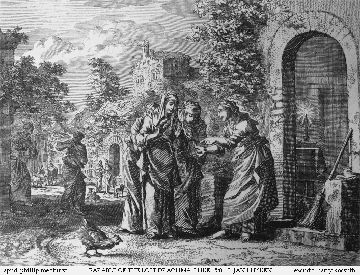
 To most of us, parables are stories told by Jesus to illustrate and clarify what He teaches. We have read the parables in the context of two thousand years of a tradition that interprets them in a certain way. But in their original context, parables are really more like riddles. The apostles noted that while Jesus would speak to the crowds in parables, when He retreated into the house with the apostles He would explain the meaning (cf Mat 13:36). Plain teaching is given “in the house,” in the Church, but among the crowds it’s parables.
To experience the riddle-like quality of a parable consider this made-up parable (without millennia of preaching tradition to explain it):
A man went out to wash his car. He took with him a bucket filled with soapy water and some sponges. As he washed the car, some of the dirt came off at once. Some of it came off only after much scrubbing. Some of the dirt didn’t come off at all. Let him who has ears to hear, take heed.
Hmm… It’s a bit of a riddle. You sort of get it, but much is also unclear. Perhaps there are several interpretations. But what does the author really want us to learn here? In a sense we are left with more questions than answers, but at least it makes us think.
This was likely the first reaction to many of the parables. Frankly, some of them still puzzle and admit of various interpretations.
Take for example the parable of the man with a hundred sheep, or the woman with ten coins (which we read at daily Mass on Thursday). In one sense the parables clearly emphasize God’s care for even one lost sinner.
But the stories in themselves don’t make a lot of sense. They challenge our conventional thinking; they are quirky and describe people doing things that we most likely would not do. Who would ever do what the shepherd of the lost sheep or the woman with the lost coin did? No one, really. One one level, they’re just plain crazy.
Perhaps that is one of the most fundamental points Jesus is making here. Our heavenly Father’s love for us is just plain crazy. By using the word “crazy,” I do not mean that it is irrational, but it does stretch the limits of our human thinking. So permit a preacher’s hyperbole so that we can enter into the astonishing quality of God’s love and mercy. It cannot be understood or really explained in human terms. Who really understands unlimited and unconditional love? Who can really grasp the depths of God’s mercy? His grace is amazing in that it goes completely beyond our ability to comprehend; it transcends human concepts. Thank God! If God were like us we’d all be in trouble. Frankly, we’d all be in Hell!
Let’s look at both parables. The full texts can be found here: Luke 15.
I. The Parable of the Lost Sheep – The Lord speaks of a shepherd who leaves ninety-nine sheep in order to search for one that is lost. Would a shepherd really do this? Probably not! The passage drips with irony, even absurdity. Perhaps if the shepherd thought that the lost sheep was likely nearby he might venture over the next hill, but the average human shepherd would probably cut his losses and stay with the ninety-nine. Many of us might even consider it irresponsible to leave ninety-nine in order to search for one.
Some people try to make sense of this parable by appealing to possible shepherding practices of the first century. Many of the Fathers of the Church postulated that the “ninety-nine” were the angels in Heaven and we, fallen humanity, the straying sheep that God goes off to find. The angels in turn rejoice when the “lost sheep” is found. Perhaps.
But what if trying to “solve” the parable or have it make sense misses the point: that God’s love for us is extravagant, personal, puzzling, and just plain “crazy.” Maybe it is teaching that God loves us for “no good reason.” He seems to love us even more when we stray. He intensifies His focus on the one who strays. To us this is not only crazy, it is dangerous and possibly enabling. Don’t try to figure it out. Don’t analyze it too much. Just be astonished, be amazed. Yes, this is crazy. That God loves me is crazy, unexplainable.
II. The Woman and the Lost Coin – A woman loses a drachma, a small coin. It’s not worth that much, really, perhaps one day’s wages. In modern terms, it would equate to less than a hundred dollars. It’s not insignificant, but not really a huge amount either. She sweeps diligently for it. So far, this seems reasonable. I’d probably look around a while for a missing “Benjamin.”
But then it gets crazy. She finds it and rejoices to such an extent that she spends most, if not all of it, on a party celebrating the found coin!
But that is exactly the point. God doesn’t count the cost. He doesn’t weigh His love for us in terms of whether it is “worth it.” Some try to explain the craziness away by suggesting that perhaps the coin had sentimental value as part of her dowry or a ceremonial head-dress of ten coins. But here, too, overanalyzing and trying to explain or make sense of it may well miss the point.
This woman is crazy because God is crazy. He is crazy to love us this much. His love for us is extravagant beyond what is humanly reasonable or explainable. Don’t try to figure it out. Don’t analyze it too much. Just be astonished, be amazed. Yes, this is crazy. That God loves me is crazy, unexplainable.
Some will object to this reading of the parables, preferring the authority of the Church Fathers or of other traditional readings. But these interpretations are not dogmatic and parables of this nature may admit of various interpretations.
Remember, too, that Jesus addressed this parable to: the Pharisees and the teachers of the law who muttered, “This man welcomes sinners and eats with them” (Lk 15:1). These were men who thought they had it figured out: God loves us because we keep the precepts of the Law. Isn’t it possible that to them, Jesus gives this retort: “What if God loves you for no human reason at all? What if God loves because God is love and that is what love does: it loves? What if you cannot simply account for God’s love in human terms?”
You can take this theory or leave it, but at least allow it to illustrate that many of the parables had and still have a riddle-like quality, and that simply settling in on one explanation may sacrifice that. Jesus gave us parables in order to challenge us and to provoke conversation both among and within ourselves. Don’t end the conversation too quickly. Even after hearing the usual explanation, consider asking, “What else could this parable mean?”