
Clarifying the Confusion on Confirmation

Some one once said that Confirmation is the Sacrament in search of a theology. While not true the statement does capture that there is a lot of incorrect and sometimes silly teaching about this sacrament to young people. It is the season for Confirmations and I want to explore the what the Catechism teaches about the sacrament but first exclude certain common but incorrect notions about Confirmation.

1. Confirmation is not a Sacrament of Maturity – Canon Law (891) states that Confirmation is generally to be administered at about the age of discretion, which age is understood to be seven (Canon 97.2). It may be administered earlier if there is “danger of death” or “grave cause,” The same Canon allows the conference of bishops to determine another age” for reception of the sacrament. While one may argue that a later date for the Sacrament is pastorally advisable, (e.g. to keep young people engaged in catechetical instruction) one simply cannot argue that it is a “Sacrament of maturity” when Church law generally presupposes its celebration at the age of seven. This is made clearer by the fact that most Eastern Churches, and the Orthodox confirm infants.

2. Confirmation is not “becoming an adult in the Church.” – This is just plain silly. I was taught this as a mere seventh grader and found it laughable even then. Seventh graders are not adults. They are children and remain so even after confirmation.

3. Confirmation is not a sacrament where one claims or affirms the faith for himself – Baptism confers faith. To claim that Confirmation “allows me to speak for myself” is to imply that this is how faith comes about. It is to imply that baptism somehow did not actually give real faith and now I am getting it by “speaking for myself.” Faith is a gift, it is not something I cause by speaking for myself, it is something I receive as unmerited and as free. I received faith at baptism. Confirmation strengthens faith that is already there but it does not cause it. Further it is a bit of a stretch to say that seventh or eighth graders really “speak for themselves.”

4. Confirmation does not “complete Christian initiation” and “make me a full Catholic.” – One of the problems with delaying confirmation is that the three sacraments of initiation are celebrated out of proper order. The proper order of celebration is: Baptism, Confirmation, Holy Communion. Hence it is Holy Communion that completes initiation not confirmation. That we celebrate it out of order creates a lot of confusion and makes initiation a little murky. The Rite of Christian Initiation for Adults observes the proper order. Some diocese in this country have returned to this for children as well. In a couple of diocese of which I am aware the bishop comes to the parish and confirms the seven year old children and then, at the same Mass, gives them First Holy Communion.

So what is Confirmation?

1. Confirmation is the Christian’s Personal Pentecost – The Catechism of the Catholic Church says, The sacrament of Confirmation is the full outpouring of the Holy Spirit as once granted to the apostles on the day of Pentecost (# 1302) Before Pentecost, the Apostles were fearful, confused and secretive, gathering only behind locked doors. But, Suddenly from up in the sky there came a noise, like a strong driving wind which was heard all through the house where they were seated. Tongues as of fire appeared which parted and came to rest on each of them. All were filled with the Holy Spirit. They began to..make bold proclamations as the Spirit prompted them. (Acts 2:1-4) Consider the change in these men! They had been fearful and confused. Now they are courageous, boldly proclaiming Christ with insight and an effectiveness so great that three thousand were added that very day to their number. This is what can happen when we really yield to the power of the Holy Spirit. It is in the Sacrament of Confirmation that we called to experience the outpouring of the Holy Spirit to strengthen us for our mission of spreading and defending our faith. The very word, Confirmation comes from the Latin word Confirma, meaning to strengthen.

2. Confirmation strengthens and quickens our faith for witness and mission – The essential grace (or gift) of the Sacrament of Confirmation is that we should be strengthened equipped for mission. And what is that mission? Again the Catechism teaches, Jesus Christ has marked a Christian with the seal of his Spirit by clothing him with power from on high so that he may be his witness (CCC # 1304).The Catechism also teaches how the sacrament accomplishes this great strengthening within us: Confirmation…is the sacrament which gives the Holy Spirit in order to root us more deeply in the divine filiation, incorporate us more firmly into Christ, strengthen our bond with the Church, associate us more closely with her mission, and help us bear witness to the Christian faith in words accompanied by deeds (CCC # 1316).

See too how this sacrament is given to us not only for our own sakes but also for the world: …enriched with a special strength of the Holy Spirit…the [confirmed] are, as true witnesses of Christ, more strictly obliged to spread and defend the faith…( # 1285) Further, A candidate for Confirmation…[must] be prepared to assume the role of disciple and witness to Christ, both within the ecclesial community and in temporal affairs [i.e. “the world”] (CCC # 1319).

3. The Biblical roots of the Sacrament – Jesus had promised to send the Holy Spirit. For example He said,

 Nevertheless I tell you the truth: it is to your advantage that I go away, for if I do not go away, the Counselor will not come to you; but if I go, I will send him to you….I have yet many things to say to you, but you cannot bear them now. When the Spirit of truth comes, he will guide you into all the truth; for he will not speak on his own authority, but whatever he hears he will speak, and he will declare to you the things that are to come. (John 16:7ff).

He also told them, But you shall receive power when the Holy Spirit has come upon you; and you shall be my witnesses in Jerusalem and in all Judea and Samaria and to the end of the earth. (Acts 1:8) And yet again, Behold, I send the promise of my Father upon you; but stay in the city, until you are clothed with power from on high. (Lk 24:49)

Within days, while they were gathered in prayer, the Holy Spirit descended on them like tongues of fire (See Acts 2:1-4 recounted earlier). The Apostles began to boldly proclaim the gospel from that day on.

Those who believed in the apostolic preaching were baptized. But in addition to baptism these apostles also laid hands on the faithful that they might receive the Holy Spirit. Sometimes this was done at the time of baptism and sometimes it was done later. Consider for example these two texts.

When the Apostles in Jerusalem heard that Samaria had accepted the word of God, they sent Peter and John to them. The two went down to these people and prayed that they might receive the Holy Spirit. It had not as yet come down upon them any of them since they had only been baptized in the name of the Lord Jesus. The pair, upon arriving imposed hands on them and they received the Holy Spirit.” (Acts 8:15-19)

This text shows some separation between the time of baptism and the time of confirmation (the “receiving of the Spirit). The text also explains our Catholic tradition of generally reserving the sacrament for the bishop to celebrate since, in the early Church, the Apostles made it part of their mission to impose hands for the outpouring of the Spirit. Phillip the Deacon had performed the baptisms in Samaria but he waited for the apostles to confirm them in the Spirit.

This next text shows the Apostle Paul baptizing. Because he, an apostle is present, there is no delay in confirming the newly baptized in the Spirit

“When they heard this, [Paul’s preaching] they were baptized in the name of the Lord Jesus. As Paul laid his hands on them, the Holy Spirit came down upon them and they began to speak in tongues and utter prophecies.” (Acts 19:5-6)

Thus we see the Biblical roots of the Sacrament of Confirmation. Jesus promised the Spirit and did in fact send Him on the day of Pentecost. The Apostles understood that they were not to keep this experience to themselves. So, as the catechism teaches, From that time on the apostles, in fulfillment of Christ’s will, imparted to the newly baptized by the laying on of hands the gift of the Spirit that completes the grace of Baptism….The imposition of hands is rightly recognized by the Catholic tradition as the origin of the sacrament of Confirmation, which in a certain way perpetuates the grace of Pentecost in the Church. (CCC # 1288)

4. The Importance of our Confirmation – More than ever, we need to take the power of God given in this sacrament seriously. All too frequently many Catholics are hindered by fear and confusion from proclaiming the Gospel to the world. This need not be so. There is just too much that needs to be done in proclaiming the Kingdom. We must speak boldly for Christ and announce his salvation day after day. [F]or God did not give us a spirit of timidity but a spirit of power and love and self control. Do not be ashamed then of testifying to our Lord..! (2 Tim 1:7-8) And this gift is not just for some; every member of the faithful is called to receive a special out-pouring of the Holy Spirit.

We have a mission to spread the Gospel in union with the Church by what we say and what we do. It is tragic indeed that so many have seen fit to leave this essential task to others. There is a saying that is sadly true: “Evil triumphs when the good remain silent.” Is this not what has happened in our day? How could a nation with so many Christians living in its midst have so many confused and lost sheep? If the Apostles could be so changed for their mission by the Holy Spirit, so can we. We are called to spread that faith handed down from the Apostles to our family, friends, co-workers and neighbors. And we must do so in season and out of season. In our Confirmation Christ unites us more firmly to himself and his Church, increases the gifts of the Holy Spirit within us and gives us special strength to live holy lives and to spread and defend the faith (cf CCC # 1303). It is in Confirmation especially that Christ lays his hands upon us to strengthen us for this mission of evangelization. The task may seem daunting but this is exactly why Christ himself strengthens us so that we can truly say I can do all things in Christ, who strengthens me. (Phil 4:13)

This Blog Post is available as a PDF Document here: The Sacrament of Confirmation

Here’s a little video I put together for the youth on Confirmation. The Song says, “You should be a witness. Why don’t you testify? Stand up and be a witness for the Lord! Don’t be  afraid to be a witness!”
Why Celebrate Mass in Latin?

Today beginning at 12:30 pm here in Washington at the Basilica of the National Shrine of the Immaculate Conception, a Solemn High Pontifical Mass in the Extraordinary Form will be celebrated in the Great Upper Church. For those unfamiliar with all the Church jargon of the previous sentence let me decode. The “extraordinary Form” of the Mass is the form of the Mass as it was celebrated prior to 1965 when Liturgical changes brought about the Mass as we have it today. Prior to these changes the Mass was celebrated exclusively in Latin with only the homily (and sometimes the readings) in English or whatever the local language was. The celebrant also faced in the same direction as the people which some have wrongfully described as the priest “having his back to the people.”  To say this is a “Solemn High” Mass means that all the ceremonial options are observed. There is incense, extra candle bearers, and many of the prayers and readings  of the liturgy are sung. The celebrant is also assisted by a deacon and subdeacon. To say this is a pontifical Mass means that it will be celebrated by a bishop and will include two extra deacons and an assisting priest. Bishop Edward Slattery of Tulsa is today’s celebrant.

For those who are unfamiliar or unappreciative with the splendor of  the Latin Liturgy in this form soem questions often arise.

1. Why pray in Latin or any language unfamiliar to the language of the people who attend? 

Simply put, praying in Latin is to pray in what has been a sacred language for the Church. It is a common feature of cultures down through human history that they often prayed in a language other than the language of the home and streets. To pray liturgically is to enter heaven, a world apart from the every day world. To use another and more ancient language is a common way many cultures have underscored this.

At the time of Jesus, the synagogue services and the Temple liturgy used ancient Hebrew. Jesus and his contemporaries did not speak Hebrew at home or in the streets any longer. They spoke Aramaic. But when they prayed they instinctively used the ancient prayers which were Hebrew.

In the early Church it appears that the earliest years saw the use of the Greek language for the Liturgy. It seems to have been used even though many people spoke Latin throughout the empire. But many did not think Latin was suited for the Liturgy which required a more elevated language than what most people spoke. By the 5th Century however Latin came to be introduced in the Western Empire as it became an older and more venerable language to them. Eventually Latin wholly replaced Greek in the liturgy of the Church in the Western empire (except a few remnants such as the Kyrie). It remained the language of worship until about 1965 when the local languages were allowed. However, it was not the intent of the Church that Latin should wholly disappear as it has largely done. Latin remains for the Church the official language of her worship. 

So, why pray in Latin? Why not? It is for us a sacred language of worship and there is an instinct in human culture that liturgy is  world apart where we enter heaven. It is not wrong to pray in the local language but, truth be told, it is not the usual practice in human history.  

 2. Why does the celebrant face away, or “have his back to us?”

It is really a wrongful description to say the celebrant has his back to us. What is really happening is that the celebrant and the people are all facing the same direction. They are looking toward God. On the center of every older altar was a crucifix. The priest faced it to say Mass and all the people faced it with him. He and they are turned toward the Lord.

In the ancient Church, they not only faced the cross, they also faced to the east to pray. An ancient text called the Didiscalia written about 250 AD says,  Now, you ought to face to east to pray for, as you know, scripture has it, Give praise to God who ascends above the highest heavens to the east . In later centuries it was not always possible to orient the Church so that everyone could face east. But the Crucifix above the altar represented the east and the Lord. Hence everyone  faced the Lord to pray.

The idea of facing each other to pray is wholly modern and was never known in the Church prior to 1965.  Hence the answer is that the celebrant is facing the Lord to pray and so are we.

3. Why is so much of the Mass whispered quietly?

Not everything is whispered but the much of the Eucharistic prayer is. Historically the whispered Eucharistic prayer (or Canon) developed in monastic settings where it was not uncommon for more than one liturgy to be celebrated at the same time at various side altars. In those days priests did not concelebrate masses as they do frequently today. Each priest had to celebrate his own mass. In monasteries where numerous priest might be in residence, numerous liturgies might be celebrated at similar times. In order not to interrupt each other, the priests conducted these liturgies with a server quietly. This practice continued into modern times.

Over time this monastic silence came to be regarded as a sacred silence. The whispering of the prayers was considered a sign of the sacredness of the words which “should not” be loudly proclaimed. (There are other more complicated theological trends that swept the liturgy too complicated to go into here that also influenced the move to a more silent liturgy) At any rate, the practice of a sacred silence came to be the norm eventually even in parish churches. Hence the hushed tones were not an attempt to ignore the faithful who attended or make their participation difficult but it was associated with a holy silence. People knelt, praying as the priest prayed on their behalf.

In the past century as literacy increased among the lay faithful it became more common to provide them with books that contained the texts of the liturgy and those who could read were encouraged to follow along closely. Through the 1940s and 50s these books (called “missals”) became quite common among the laity. By the 1950s there were also some experiments with allowing the priest to have a microphone or to raise the level of his voice so the faithful could follow more easily. These “dialogue Masses” were more popular in some place than others. Sacred silence was still valued by many and adjusting to a different experience was not always embraced with the same fervor, it varied from place to place.

Today, with the return in some places to the celebration of the Old Latin Mass (called officially the “Extraordinary Form”) this sacred silence is once again in evidence. For those who are not used to it, it seems puzzling. But hopefully some of this history helps us understand it. Once again we are faced with the dilemma of how loudly the priest should pray the Canon (Eucharistic Prayer) at such Masses. There are different opinions but a fairly wide consensus that the prayer should be generally said in a very subdued voice.

Religious Life in the Movies

This is a clip I posted on Youtube  from the 1958 Movie, “The Nun’s Story” starring Audrey Hepburn as a young woman named Gabriel Vandermal who becomes Sr. Luke of a fictional French Women’s Order. The movie, as you shall is stunningly beautiful and the liturgical scenes are carefully done. This movie is available for purchase at Amazon.com and I recommend it to your library.

However the following should be noted. The movie presents a rather negative portrait of Religious Life by emphasizing its hardships and demands to the exclusion of its joys and benefits. It more than suggests that many aspects of Religious Life at that time were unreasonable and unnecessarily harsh. Perhaps they were at times. Some older Sisters I’ve talked with tell me that many aspects of this movie are accurate and things were tough in the old days. An interesting aspect of the portrait presented is that primary source of the hardships was the women toward each other. It is common in some current narratives, especially from older women religious, to speak of the old Church as patriarchal, male dominated, and hence oppressive to women. Yet in this piece from that actual period, the clergy are distant figures, and the main interplay is with the women and how they both support and also oppress one another.

If this movie is a reasonably accurate portrait of religious life in the first half of the 20th century (sounds so long ago now!) then it is clear that reforms were needed. However, as an outside observer who is both male and barely old enough to remember the old Church, I must say I deeply regret that the reforms that may have been necessary got so out of balance for many women’s Religious communities. An over-correction seems to have set it in in many, though surely not all. The abandonment of the Religious Habit, community life, a common apostolate, and deep love for the Church seems to have been lost, in some. Thankfully there are many Religious Communities of women which never succumbed to the radical notions that swept others. Also, there are many new, thriving and exciting new Communities of Women religious as well. In my own convent are the Servants of the Lord and the Virgin of Matara. (they wear a blue and gray habit).  They are imbued with deep love for the Lord, our Lady and the Church. They seem quite happy and foster great holiness within their sisters. They seem also to have found a good balance between the following of a clear rule and of doing so in a way that is respectful of the humanity of each each sister. There is nothing of the robotic and unhappy obedience depicted in this movie. The Sisters I know are quite alive and experience their religious life in a deeply human way.

The movie The Nun’s Story surely has a strong point of view that could have been more balanced. I cannot imagine that it was quite as strict or unhuman as this movie depicts. Further, Sr. Luke makes a decision in the movie that is problematic from the point of view of the vows she made. Nevertheless, with these cautions I strongly recommend the movie. It is beautiful, though controversial in some aspects. I post the clip here in the interest of seeing a brief look at Religious life in the wider culture and in the movies. Enjoy this beautiful video.

Mass on the Move: The Hidden Mass on the Road to Emmaus

Today’s Gospel of the two disciples on the road to Emmaus (Luke 24:13ff) does more than present a resurrection appearance. It also presents the Mass in seminal form as I will show. In doing this Luke and the Holy Spirit teach us that the Mass is the essential and most vivid way that we encounter Christ now. The two disciples also learn this lesson for as soon as they recognize Christ “in the breaking of the bread” he vanishes from their earthly eyes. In effect Christ teaches them they will no longer see him in an earthly  way but now they will see him with the eyes of faith in the Eucharist, the liturgy and, by extension, in all the sacraments.

So for us to who to encounter the risen Lord Jesus, this Gospel teaches us that the Mass is the most perfect way and place we will encounter him. Let’s examine this resurrection appearance and see it for what it is, a Mass.

  1. Gathering Rite – The Curtain rises on this Mass with two disciples having gathered together on a journey: Now that very day two of them were going to a village seven miles from Jerusalem called Emmaus  (Lk 24:13). This is what we do as the preliminary act of every Mass. We who are pilgrims on a journey come together on our journey. It so happens for these two disciples that Jesus joins them: And it happened that while they were conversing and debating, Jesus himself drew near and walked with them (Luke 24:15). The text goes on to inform us that they did not recognize Jesus yet. Now for us who gather at Mass it is essential to acknowledge by faith that when we gather together, the Lord Jesus is with us,  for Scripture says, For where two or three are gathered in my name, there am I among them (Matt 18:20). it is a true fact that for many of us too, Jesus is unrecognized! Yet he is no less among us than he was present to these two disciples who fail to recognize him. Liturgically we acknowledge the presence of the Lord at the beginning of the Mass in two ways. First, as the priest processes down the aisle the congregation sings a hymn of praise. It is not “Fr. Jones” they praise it is Jesus whom “Fr. Jones” represents that they praise. Once at the Chair the celebrant (who is really Christ) says, “The Lord be with you.” And thereby he announces the presence of Christ among us promised by the Scriptures. The Mass has begun, our two disciples are gathered and the Lord is with them. So too for us at every Mass.
  2. Penitential Rite – The two disciples seem troubled and the Lord inquires of them the source of their distress: What are you discussing as you walk along? (Lk 24:17) In effect the Lord invites them to speak with him about what is troubling them. It may also be a gentle rebuke from the Lord that the two of them are walking away from Jerusalem, away from the site of the resurrection. Clearly their sorrow and distress are governing their behavior. Even though they have already heard evidence of his resurrection (cf 24:22-24), they seem hopeless and have turned away from this good news. The text describes them as “downcast” (24:17). Thus the Lord engages them is a kind of gentle penitential rite and  wants to engage them on their negativity. So too for us at Mass. The penitential rite is a moment when the celebrant (who is really Christ) invites us to lay down our burdens and sins before the Lord who alone can heal us. We too often enter the presence of God looking downcast and carrying many burdens and sins. We too like these two disciples may be walking in wrongful directions. And so the Lord says to us, in effect, “What are thinking about and doing as you walk along. Where are you going with your life. And thus again we see in this story about two disciples on the road to Emmaus, the Mass that is so familiar to us.
  3. The Liturgy of the Word – In response to their concerns and struggles the Lord breaks open the Word of God, the Scriptures. The text says: Then beginning with Moses and all the prophets, he interpreted to them what referred to him in all the scriptures (Luke 24:27). Notice that, not only does the Lord refer to Scripture but he interprets it for them. Hence the Word is not only read, there is also a homily, an explanation and application of the Scripture to the struggles these men have. The homily was a good one too for later, the disciples remark: Were not our hearts burning (within us) while he spoke to us on the way and opened the scriptures to us? (Luke 24:32) And so too for us at Mass. Whatever struggles we may have brought to the Mass, the Lord bids us to listen to his Word as the Scriptures are proclaimed. Then the homilist (who is really Christ) interprets and applies the Word to our life. It is a true fact that the Lord works through a weak human agent (the priest or deacon) but God can write straight with crooked lines and as long as the homilist is orthodox, it is Christ who speaks. Pray for your homilist to be an obedient and useful instrument for Christ at the homily moment. After the homily we usually make prayers and requests of Christ. And so it is that we also see these two disciples request of Christ: Stay with us, for it is nearly evening and the day is almost over. (Luke 24:29) Is this not what we also say in so many words: Stay with us Lord, for it is sometimes dark in our lives and the shadows are growing long. Stay with us Lord and those we love so that we will not be alone in the dark. In our darkest hours, be to us a light O Lord that never fades away. Yes, this whole brief journey of Jesus and the disciples is surely familiar to us who attend the Catholic Mass!
  4. The Liturgy of the Eucharist – Christ does stay with them and then come the lines that no Catholic could miss: And it happened that, while he was with them at table, he took bread, said the blessing, broke it, and gave it to them (Luke 24:30). Yes, the Mass to be sure. Later, the two disciples will refer back to this moment as the breaking of the bread(Luke 24:35), a clear Biblical reference to the Holy Eucharist. The words of Mass come immediately to mind: “While they were at supper He took the bread, and gave you thanks and praise. He broke the bread, gave it to his disciples and said, take this all of you and eat it: this is my Body which will be given up for you.” A fascinating thing happens though: With that their eyes were opened and they recognized him, but he vanished from their sight (Luke 24:31). First note that it is the very act of consecration that opens their eyes. Is this not what Holy Communion is to do for us? Are we not to learn to recognize Christ by the very mysteries we celebrate? The liturgy and the sacraments are not mere rituals, they are encounters with Jesus Christ, and though our repeated celebration of the holy mysteries our eyes are increasingly opened if we are faithful. We learn to see and hear Christ in the liturgy, to experience his ministry to us. The fact that he vanishes from their sight teaches us that he is no longer seen by the eyes of the flesh, but by the eyes of faith and the eyes of the heart. So though he is gone from our earthly, fleshly, carnal sight, he is now to be seen in the Sacrament of the Altar, and experienced in the liturgy and other sacraments. The Mass has reached it’s pinnacle, for these two disciples and for us.
  5. Dismissal Rite– Not able to contain their joy or hide their experience the two disciples run seven miles back to Jerusalem to tell their brethren what had happened and how they encountered Jesus in the breaking of the bread. They want to, have to,  speak of the Christ they have encountered, what he said and what he did. How about us? At the end of every Mass the priest or deacon says “The Mass is ended, go in peace.” This does NOT mean, “OK, we’re done here, go on home and haver nice day.” What it DOES mean is: “Go now into the world and bring the Christ you have received to others. Tell them what you have heard and seen here, what you have experienced. Share the joy and hope that this Liturgy gives with others.” Perhaps you can see the word MISSion in the word disMISSal? You are being commissioned, sent on a mission to announce Christ to others. The Lucan text we are reviewing says of these two disciples: So they set out at once and returned to Jerusalem where they found gathered together the eleven and those with them…..Then the two recounted what had taken place on the way and how he was made known to them in the breaking of the bread (Lk 24:33,35). How about us. Does our Mass finish as well, as enthusiastically?

So there it is, the Mass on the Move. For a Catholic this resurrection account is unmistakably a Mass. True it is in seminal form, but all the elements are there. The teaching is clear, the risen Lord Jesus is now to be found in the Liturgy and the Sacraments. It is for us only to have our eyes opened and to recognize him there.

On Fixing a Dreadful Error And Taking a Graceful Bow

We are in the heart of Lent but for one day we step back into the Christmas cycle. It is nine months before Christmas and today we celebrate the true feast of the Incarnation. December 25 is the Lord’s birth but today is His incarnation as he is conceived in his Mother’s womb. TODAY the Word becomes flesh.

This needs to be emphasized in an age of abortion where some in our culture deny explicitly or implicitly that human life begins at conception. You are aware that a new translation of the Mass will soon come to us in the English speaking world. It is long needed and treasures of the faith kept hidden for long decades (except for those know Latin) will become visible again.

Among the most egregious errors of the current English version is in the Creed which erroneously indicates that Jesus became man at his birth, rather than his conception. Here is what the current version says:

For us men and our salvation He came down from heaven: by the power of the Holy Spirit, He was born of the Virgin Mary , and became man.

Notice that the text says he became man when he was born. As a poor translation of the Latin text it is irritating enough but to have this mistranslation exist when abortion is thought a legal right is a complete disaster. The Latin text does not say that Jesus became man at his birth (celebrated December 25), but rather at His incarnation (celebrated March 25). Here is what the the Latin text says:

Qui propter nos homines et propter nostram salutem descendit de caelis. Et incarnatus est de Spiritu Sancto ex Maria Virgine, et homo factus est.

The New Translation which will be implemented in a little over a year renders it correctly in the following way:

For us men and for our salvation he came down from heaven, and by the Holy Spirit was incarnate of the Virgin Mary, and became man.

I for one am grateful for the accuracy. The whole translation is going to take some getting used to but it will be of great benefit to see our Holy Faith, so beautifully articulated in the Latin text, properly translated and conveyed at last. Since 1970 the text has been really little better than a paraphrase and so much is lost. This mistranslation of the Creed is but one of ten thousand examples where the current translation is woefully inaccurate and/or incomplete. But surely the mistranslated Creed  is most egregious for the reasons stated.

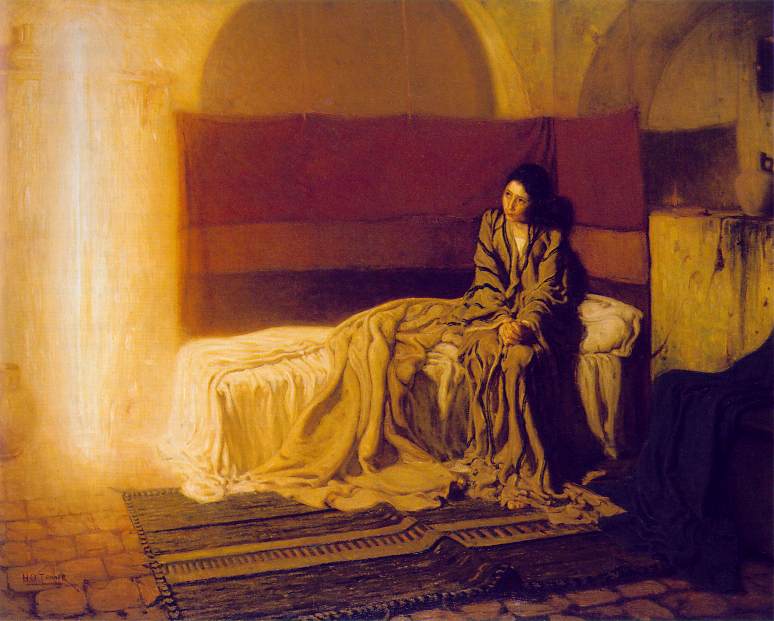
A final thought on this section of the Creed – The Bow. The Congregation is instructed to bow at the words: and by the Holy Spirit was incarnate of the Virgin Mary, and became man.  This is in recognition of the great mystery that the incarnation is. How can God, whom the very heavens cannot contain dwell in the womb of the Virgin Mary? How can the infinite become an infant? It is a mystery too great and so we bow in reverence. In the Traditional Latin Mass the practice is to kneel at these words. Such was the practice until about 1970 when it was replaced by a bow. Personally I think we Americans are terrible at bows and would be happy if the genuflection returned. In other cultures bowing is graceful and natural. For most of us here it is awkward and usually lacks proportional and graceful movement. But bow we are told and bow we should. One ought to fold the hands and bow at the waist. Think of your waist as the hinge, not the neck and shoulders which should not move in proportion to the shoulders. The bow is a reverent acknowledgment of the mystery of the Incarnation we celebrate today. Interestingly enough there are still two days  in the year when we still kneel at the words of the incarnation. We kneel and pause at these words on Christmas and today, March 25, The Feast of the Annunciation. Otherwise we bow, as gracefully as possible 🙂

I am curious if you bow at these words in the Creed and if it is common in your parish. Does your clergy bow, do they teach others to do so? Just asking!

Happy Feast Day!

Reverencing Mystery

In the secular world a mystery is something which baffles or eludes understanding, something which lies hidden or undisclosed. Now the usual attitude of the world toward mystery is to resolve it, get to the bottom of or uncover it. Mysteries must be overcome! The riddle or “who-done-it” must be solved.

In the religious world mystery is something a bit different. Here mystery refers to something revealed by God which largely or completely escapes what we can know by our intellect alone and unaided by God through grace and revelation. These are not worldly mysteries but mysteries of the faith.  From the perspective of faith it is also usually that case that a mystery is something partially revealed by God but much more of which lies hidden. So something is seen, but much more is unseen.

For the Christian then, mysteries are not something to solved or overcome so much as to appreciate and reverence. In worldly mystery it is something to approach and with daring, perseverance and smarts to conquer. But the mysteries of faith are something to be considered with humility and reverence realizing we can never exhaust their meaning or capture and conquer their full essence.  A few thought on the mysteries of faith:

  1. Consider the picture at the upper right of the iceberg and allow it to be an image for the mysteries of faith. Above the water line we see something of the iceberg, but beneath the waterline, remains much more, hid from our eyes (except in a picture like this).
  2. Consider the mystery of creation. In the book of Sirach, after a long list of the marvels of creation there comes this magnificent line: Beyond these, many things lie hid; only a few of God’s works have we seen. (Sirach 43:34) This is mystery, what we see is far surpassed by what we do not see!
  3. Consider the mystery of the human person. Think of someone you know rather well, perhaps a spouse, family member or close friend. There is much about them that you see and know, but even more of which lies hid. You can see their body, but only the external parts of it. Much more lies active and intricate beneath the skin. You “see” aspects of who they are in terms of their personality and mannerisms and so forth but much more lies hid from your knowledge such as their inner thoughts, aspects of their history, and deeper drives and motivations that may lie hidden even to them in many ways. As time goes on and relationships deepen the “mystery” of the human person unfolds and more is revealed. Yet the mystery of the human person is never “solved” and it would be irreverent to assume we ever could or should do so. No, this  mystery must be reverenced and approached with humility and if we ever really think we have some one (even our selves) “figured out” we are badly mistaken and transgress the dignity of the person. Scripture says, More tortuous than all else is the human heart, beyond remedy; who can understand it? I, the LORD, alone probe the mind and test the heart (Jer 17:9-10). Surely we are on a journey to understand and the discover as the mystery of our selves and the others as our life unfolds but the mystery must always be respected and reverenced, not solved in order to be controlled and manipulated.
  4. Herein lies a problem with modern American culture that should be critiqued and that is the tendency to lack modesty. One definition of modesty is “reverence for mystery.”  Part of the dignity of the human person is not simply to be on open display in an indiscreet way. In deeper relationships more is revealed in increasingly appropriate ways. Close friends share more and understand more. Spouses, ideally, share even more to include the deep intimacy of the body. The disclosing of the mystery of the human person in appropriate ways based on the depth of relationship is at the heart of modesty. But today too many things of a private nature  are too easily sought and disclosed. A nosey media is partially to blame along with an increasingly odd tendency for many today to want to disclose matters that should remain private. Talk shows come to mind wherein a person or celebrity “tells all.” In today’s physcotherapeutic culture there is also the tendency to request and also to provide too much information about personal things. Surely close friends and family may be an appropriate audience for such disclosures but immodesty causes many to reveal indiscreetly  what should remain private. Clearly too, physical immodesty is epidemic and we have discussed it here before. And this also fails to reverence the mystery due the human person by putting on display that would should only be revealed in the most intimate and appropriate settings. Mystery is at the heart of the dignity of the human person. Modesty is reverence for that mystery, immodesty is a lack of reverence  (cf 1 Cor 12:22ff).
  5. Consider the mystery of the Liturgy and the Sacraments– We see much in the Liturgy and the celebration of the Sacraments but far more remains hidden from our eyes as these mysteries are celebrated. (You may well know that the Eastern Churches and especially the Orthodox Churches refer to the sacraments as the “Mysteries”). Consider a baby being baptized. We see the water poured and hear the words. Perhaps there is a cry. But what remains unseen is even greater: The child dies, is buried with Christ and rises to new life with him in an instant (Rom 6:1-4). Sin is washed away, an inheritance is received, true membership into the Body of Christ is conferred, the office of Priest Prophet and King are received, divine sonship is conferred and on and on. Far more is actually happening that we see or even know. This is mystery, something seen, yet far, far more unseen.  Consider the Liturgy, the altar is there,  a priest, the faithful gathered, words and gestures perceived. But far more is unseen: Christ the high priest is the true minister, the physical church building gives way to the truth that we are mysteriously caught up into heaven and the heavenly liturgy surrounded by countless saints and angels worshipping the Father and we as members of the Body of Christ render the Father perfect praise and thanks through, with and in Jesus our head.
  6. Herein lies a problem with the Liturgy in modern times– In recent decades there has been a laudable attempt to make the Liturgy more intelligible to people. However there is a trade off to be careful of. The mystery of the Liturgy and the sacraments must be reverenced. In our attempt to make everything intelligible and accessible we risk offending the dignity of the liturgy and sacraments which are ultimately NOT fully intelligible or explainable. They are  mysterious (in the way we are using the word) and ineffable (not reducible fully to words). In the ancient Church the Liturgy was surrounded by the disciplina arcanis (discipline of the secret) wherein only fully initiated Catholic Christians were permitted to witness it. Sacramental catechesis was carried on largely AFTER the celebration of the Sacraments (Mysteries) in a process called mystagogia (a Greek word meaning “Education in the mysteries”).  I do not argue here for a complete return to those days but one of the characteristics of the modern age and the manner in which liturgy is often celebrated is the lack in a sense of mystery. It often seems that everything has to be “seen” and “understood” to be authentic or relevant, or so the thinking goes with some. But this is wrong on two levels. First, everything CANNOT be seen. Most of the liturgy in fact lies hid from our earthly eyes. Secondly most of the liturgy cannot be understood. It is mystery to be reverenced and appreciated as such. It is “other” and beyond what this world can ever fully appreciate. We can grow in our appreciation of it as the years go by but never solve or understand it fully here on this side of the veil. Somehow this appreciation of the mystery of the Liturgy and Sacraments must be balanced with the attempt to render our worship “intelligible.” I put intelligible in quotes for we can only use that term in a relative manner.
  7. Finally it remains true that our longing to enter fully the mystery of God and our very selves will one day be fulfilled. St. Paul speaks of this when he writes: Now we see but a poor reflection as in a mirror; then we shall see face to face. Now I know in part; then I shall know fully, even as I am fully known ( 1 Cor 13:12). You may be aware that the Greek word (title) for the last book of the Bible is  Ἀποκάλυψις (Apocalupsis) which means “unveiling.”  One day, the great mystery of this world, of ourselves, and God’s plan will be fully unveiled. For now, we reverence these mysteries of our self, others, the liturgy, the sacraments, creation itself and God’s plan. One day they shall be revealed. A caution here. I do not think we will ever exhaust the mystery of God (and perhaps not even ourselves). I do not think all eternity will ever be enough to exhaust the full mystery of God who is infinite and can never be fully comprehended in essence  by his finite creatures.

Reverence mystery, relish mystery, respect mystery. Magnum mysterium, admirabile sacramentum!

Lost Liturgies File: The Churching of Women

Today as I write this it is the Feast of the Presentation (February 2). Some determine this feast to be the definitive end to the Christmas cycle and it is perhaps appropriate that yet another snowfall is descending on Washington. Biblically this feast commemorates the Jewish practice of a woman presenting herself at the temple forty days after the birth of a male child in order to be “purified” and blessed by the priest. Mary as an observant Jew fulfilled this obligation and it is recorded in Luke 2:22-24:

When the time of their purification according to the Law of Moses had been completed, Joseph and Mary took him to Jerusalem to present him to the Lord (as it is written in the Law of the Lord, “Every firstborn male is to be consecrated to the Lord”and to offer a sacrifice in keeping with what is said in the Law of the Lord: “a pair of doves or two young pigeons.”

The Jewish practice of “purifying” a woman after childbirth was set forth in the Book of Leviticus 12:1-8:

The LORD said to Moses, “Say to the Israelites: ‘A woman who becomes pregnant and gives birth to a son will be ceremonially unclean for seven days, just as she is unclean during her monthly period. On the eighth day the boy is to be circumcised. Then the woman must wait thirty-three days to be purified from her bleeding. She must not touch anything sacred or go to the sanctuary until the days of her purification are over.  If she gives birth to a daughter, for two weeks the woman will be unclean, as during her period. Then she must wait sixty-six days to be purified from her bleeding. ” ‘When the days of her purification for a son or daughter are over, she is to bring to the priest at the entrance to the Tent of Meeting a year-old lamb for a burnt offering and a young pigeon or a dove for a sin offering. He shall offer them before the LORD to make atonement for her, and then she will be ceremonially clean from her flow of blood.” ‘These are the regulations for the woman who gives birth to a boy or a girl. If she cannot afford a lamb, she is to bring two doves or two young pigeons, one for a burnt offering and the other for a sin offering. In this way the priest will make atonement for her, and she will be clean.’ “

As you can see, there is a fairly negative concept at work here. A woman becomes ritually unclean by giving birth. This was due to the flow of blood and/or other fluids at birth. Even more distressing to modern notions is that a woman who gave birth to a daughter was considered ritually unclean for even longer! Alas, it is well that the power of the Church to bind and loose has freed us from this thinking. Keep in mind that this was ceremonial law, not moral law and, hence, the Church is not setting aside immutable moral law in abrogating such notions of ritual impurity.

Nevertheless the custom and instinct of blessing women after childbirth was retained in the Church with an altered understanding from Jewish teaching. That rite came down through the centuries and was intact until very recent times and was referred to in many places as the “Churching of Women.” (The official Latin title of the Rite was actually benedictio mulieris post partum – (the blessing of women after giving birth))The rite was largely discontinued in the 1960s in the wake of the Second Vatican Council. The Book of Blessings published in 1984 does contain a “Blessing of a Woman after Childbirth” but it is seldom used and is significantly altered from the old rite in use until about 1965.

The reasons for the discontinuance are many. I remember my mother and other  women of my mother’s generation saying they had been taught the Jewish history of this rite and thus rejected it for that reason. But the Catholic Church was clear to distinguish its practice from the Jewish roots. Pope Gregory as early as the 6th Century protested any notion that defilment was incurred by childbirth. Further, the prayers of the old “Churching of Women” Rite never mentioned a need for purification and spoke only of blessing and thanksgiving. So those who taught women of my Mother’s generation against this practice were probably engaged more in polemics than true Church history. Another reason for the discontinuance was probably and simply that so many things were dropped during the changes in the wake of the Council.

On this Feast of the Presentation I would like to recommend this beautiful ritual to your attention. In an extended sense it fulfills What Mary did today, forty days after the birth of Christ. Surely we do not understand it in an Old Testament way, but we rescue and fulfill the tradition with the beauty of Christian faith and the dignity of women who are mothers.

I have attached a PDF version of it here:  The Churching of Women.  Though it has never been required by the Church it is a beautiful way to welcome back and bless a woman who has perhaps been away for a few weeks  giving birth. She has labored well for her family, her child and the Church and this ritual can serve simultaneously as a blessing and thanksgiving extended by the Church to the noble women who are our mothers. The blessing can be given after a baptism, after mass, collectively to recent mothers, or individually. It is true that the current baptismal rite contains a blessing for the mother but this older rite is a more single and special blessing. The Pope’s recent Motu Proprio permitting the older forms of the sacraments to be used has made these older rituals also more available. Here is the concluding prayer of the rite:

Almighty, everlasting God, through the delivery of the blessed Virgin Mary, Thou hast turned into joy the pains of the faithful in childbirth; look mercifully upon this Thy handmaid, coming in gladness to Thy temple to offer up her thanks: and grant that after this life, by the merits and intercession of the same blessed Mary, she may merit to arrive, together with her offspring, at the joys of everlasting happiness. Through Christ our Lord.

I looked for a video depicting the Churching of Women but found none. Instead enjoy this video by Shirley Ceasar which celebrates the love of a mother as an image of God’s love:  The full cost of my love is “no-charge”

The Seating Plan at the Last Supper

Most of us who live now think of the Last Supper in terms that are familiar to us. In our imagination Jesus and his apostles sit around a square table on chairs. Jesus is a the center and his apostles arrayed around him. The famous painting of Leonardo Da Vinci (See right)  is uppermost in most modern minds when thinking of the Last Supper.

But the real Last Supper was different in many significant ways. Some of the following I am about it present is still a matter of debate other aspects of it are undisputed.

  1. Jesus and the Apostles did not sit on chairs at a table. Rather they reclined on ground or on mats and pillows, leaning on their left elbow (either forward of back) and eating with their right hand. Their legs were stretched out behind them. (See picture at left, click to get a bigger size) This was the typical fashion for eating in the ancient world. That they reclined to eat is made plain in the Gospel of Mark: While they were reclining at the table eating, he said, “I tell you the truth, one of you will betray me–one who is eating with me(Mk 14:18).  It also explains some things that seem strange to us moderns. First of all why did John lean back on Jesus’ chest to ask him a question? (Jn 13:25;  21:20) This would be strange and physically awkward in a modern upright table setting. But reclining on one’s side on a mat meant you had to lean back to talk to the person next to you. There is also another strange scene where Jesus is reclining to eat in the home of a Pharisee and and a woman begins to anoint his feet (Luke 7:38).  In a modern upright table setting this would mean she’s have to be under the table. Strange indeed! But in the ancient setting the posture was such that one’s feet were behind and thus the woman could approach Jesus from behind and begin to anoint his feet without his prior knowledge.
  2. The Place of honor in modern western settings  at a typical long rectangular table is either at the center or at one end. Everyone is seated upright and facing in to the center and can generally see all the others well. However, in the ancient meal setting the table was  “U” shaped either as a half circle or with 90 degree arms. Instead of sitting at the center of the table (as in DaVinci’s painting above) the host or honored guest sat at the far left corner. Further, everyone sat on one side on the outside of the table allowing the inside of the table to open for servers.  The picture to the right is from a very early mosaic in Ravenna, probably made well before the 5th Century. At this early time the artists still had access to the memory of the actual practices at the time of Jesus and thus depicts the Last Supper as it was more likely arranged. Notice that Jesus is at the head of the left corner and his disciples are arrayed in a sloping ark behind and sloping to his left. This was the usual setting for the ancient meal and especially something as formal as a passover meal.
  3. It would seem that the place of second honor was at the other end of the U shaped table on the right corner. This would help explain why Peter is not at Jesus’ immediate right or left and has to motion to John across the room to lean back and ask Jesus a question (Jn:13:24-25). Since Peter would like have had the other place of honor it makes sense that he would be across the room and unable to ask Jesus himself.

Thus the whole setting of the Last Supper was rather a different setting that most modern people imagine. Leaning on elbows and eating with one hand would all be very awkward to us. But I suppose they’d think what we do strange as well. The question of the arrangement also factors into modern discussions of liturgical orientation and Mass facing the the people vs. Mass facing away from the congregation toward God. I’m sure that this will emerge in the discussion but it is clear from the Ravenna Mosaic that Mass facing east toward God and not toward the people did not offend ancient notions of the Mass as the “Lord’s Supper.” To the ancients formal meals featured the honored guest at one end angled away a bit  from most of the other guests.

I am sure that this final observation may generate some discussion in the comments but it is also meant to explain some of the theology and history that Pope Benedict has asked us to consider in the discussion of orientation in the Liturgy.

The following clip is a humorous scene from the Passion of the Christ. Mary is puzzled over Jesus making a tall table to eat at. She cannot imagine that anyone would want to eat sitting up. She says, “This will never catch on!”