I first posted the video at the bottom two years ago on this blog. I thought it was quite funny and a humorous look at the culture of Catholicism. In no way did I think the “deacon” in the video was ridiculing the faith. In fact it was really more a spoof on used car salesmen who will often do anything to sell a car.
But, when I published the video there were a number of strong reactions in the combox from readers who did not think the commercial funny at all, and offensive to boot. Here are a couple of examples:
I’m sorry. I know the attempt at humor was well meant and may appeal to some. But I found it in bad taste and almost offensive. It was the use of sacred words and realities in such a flippant manner that I could not appreciate.
Not funny and what is being promoted? Open on Sundays? What about keeping the Sabbath Day holy?
Others thought differently –
I thought this was a brilliant way to connect…Sometimes we get just too uptight and try to keep our religion in a pretty box. Well done brother, I hope to see more.
My favorite line is: “We’re on South Water Street, just before it turns into Wine” That’s funny and clever! Anyway, some here don’t agree. I see it as lighthearted humor and some of you clearly do not.
As I have said, I think the spoof is more on car salesman, and not that far from the truth either. I remember that, some years ago, in the Catholic Standard, our Archdiocesan Newspaper, a certain Deacon, who was also a car dealer, used to advertise each week. He loved to point out that he was a permanent Deacon at such-and-so a parish. There was more than a hint in his add that he had a special deal for practicing Catholics: “An outrageously low price for a new or used car! Just bring a Church Bulletin and get the discount!” Hey, why not. I think if I’d been in the market for a car I might of just paid him a visit!
But humor is clearly risky sort of a thing, for what often makes it funny is that goes out to the edges, sometimes engages in stereotyping, and usually has a element of truth wrapped up in hyperbole and histrionics. We human beings are often funny even when we’re doing serious stuff and a good laugh doesn’t always mean ridicule, sometimes it means appreciation of the traits we notice in others.
Finally, the word humor and humility are likely related. The Latin word “humus” means soil, earth or ground. Another root of the word is the Latin and Greek word “humor” referring to the water and other bodily fluids that make up our bodies. Either way, we are dust and water and unto dust we shall return. Recalling this is a way to remember, among other things, that we not take ourselves too seriously. Proper humor and laughter that is not ridiculing in intent, can help us to be more humble.
I am interested in what you think of the video below. Is the humor of it appropriate, as I think it is? Does some or all of it go too far? What’s the balance between being able to laugh at ourselves and being too uptight? Clearly some people, two years ago were offended. I was not. What do you think?
Anyway, enjoy this rather humorous and well done video.
Permit me to go in this post from serious sublimity, to silly stretching. But I saw a car ad the other day and recalled an insight of how God saves us. “How one earth?” you may say. Well, on the Feast of the Triumph of the Holy Cross lets look….
Let me begin with the sublime. And for that I turn to Archbishop Fulton J Sheen. Many years ago (more than 25) I got a series of 24 cassette tapes. They were wonderful recordings of a set of instructions he prepared for converts to the Catholic Faith. If you have never heard of that series you can find it here: A Sheen Catechism.
In this series, Archbishop Sheen made an insightful point that I am relating to you from memory. I beg mercy if I do not quote him exactly, but his point related to soteriology, the theology of how we are saved. Now to be clear, we are saved by the obedience of Christ. But not all the consequences of our sinful choice were eliminated. Some of these consequences the Lord takes up as a means to save us. It is of these consequences that Archbishop Sheen sepaks. Again, what I relate is not verbatim but is as close as I can remember:
Consider that God were conducting a great symphony, a symphony that He Himself composed, of sublime beauty. Now suppose he wrote that symphony in the Key of A. Having assembled His orchestra God brings them to attention and begins the symphony. But suppose in the front row, the first and second violinists, filled with a sense of rebellion and boredom by the third measure, insisted on playing the note A-Flat, rather than the A-natural called for by the score. This of course created a terrible dissonance. And so God, the great conductor and composer brought the orchestra to a halt by tapping his baton. Looking to the first and second violinists, he said, “My symphony has been ruined. I will forgive but the note has sounded and gone forth. It will not be recalled. So, what was that note you played?” The first and second violinists said “A-Flat!” “Fine then,” said God, “Let us begin our new Symphony in the key of A-Flat.” And raising his baton, he began.…
What is Archbishop Sheen saying here? He is saying that in saving us, God does not merely undo or cancel every effect of our choice. Jesus does obey, saying yes to the Father, whereas we had said no and hence we are saved by his obedience. But God does not merely come in and say, well, you got that wrong so I am just going to reverse everything you did and put it back to the way I want it. There is a very deep reverence that our all-powerful God has for our freedom we had to chose in this sense. And so he chooses to write straight with the crooked lines, the consequences of our sinful choice.
What then does God do? Using Sheen’s analogy he takes our “A-Flat,” the consequences of our choice and uses it as the key note in a new symphony. In other words, though God had given life, and paradise (A Natural), Adam and Eve chose the way of suffering and death (A-Flat). Hence, rather than merely erase what they had done, God said, “I will come and, through suffering and death, (A-Flat), compose a new symphony with an even greater ending. Through the suffering and death of my own Son, and by his obedience, I will compose a new symphony, one that ends with humanity not in some mere earthly paradise, but a heavenly one. One that ends with humanity not as just humanly perfect, but as sharers in Divine nature. Yes, my Son will take A-Flat and make of it a new song, an even greater song.” O felix culpa, O admirabile commercium (O happy fault, O wondrous exchange)!
Where our demise came through a man (Adam), a woman (Eve), and a tree, now too our redemption would would come from a new Adam (Christ) and include a new woman (Mary) and the tree of the cross. Suffering death, the chosen note of Adam and Eve (A-Flat) would now be the first note in a new symphony, bringing life and glory, all by God’s grace.
And our suffering and crosses too would do the same in this new symphony, this new song. As scripture says, This light, temporary nature of our suffering is producing for us an everlasting, weight of glory, far beyond any comparison (2 Cor 4:17). Yes, God took our sour note and and composed a new song, with a greater ending.
And that brings us the video below. I have to say, maybe I am just zany-brainy, but I saw Archbishop Sheen’s soteriological point in, of all places, a car ad for the “KIA Soul” (yes, aptly named). And I realize that what I am doing is pure eisegesis, that is, reading a meaning into the video that the originator likely never intended. But go with me on this little journey.
As the video opens a terrible war is raging between two unknown parties. A-Flat is in loud evidence. In fact, if you have a good Bose woofer, the pounding A-Flat explosions shake the floor. The whole landscape and almost everything is in shades of gray, and everything is in ruins. Yes, this is the sour note of A-flat alright: death, violence, barrenness, not a living thing in sight, even the warring parties are robots.
Suddenly into this scene drives a bright green “KIA Soul” with three occupants. Let the green represent life, and the three occupants, represent the Father, Son and Holy Spirit. (I know they’re hamsters, but stay with me).
The warring parties stop, stunned by this bright green car, and aim their weapons at it. Out emerge the three living creatures, the Trinity, far more alive than any of the fighting robots. A tense moment ensues.
The middle figure is a Christ figure, for he wears purple, a sign of his royalty and his passion.
Suddenly the Christ figure cries out and all three in the Trinity begin to stop their feet. It is the same pounding A-Flat beat that the robots have been creating by their killing, it is a kind of a sound of death.
But now the Trinity is using the A-Flat beat to dance!
Suddenly, one of the robots starts to tap his foot, other robots quickly join in and before long, all are dancing. Same A-flat beat, but the Trinity has composed a new symphony around it.
Weapons drop and the dancing ensues. Some of the dead even come back to life. The former flying war machines emanate rainbow patterns in the background.
In a very symbolic moment the Christ figure in purple stands atop a concrete circle in the shape of a tree stump, as if Christ on his Cross in triumph dancing to A-Flat. The A-Flat of suffering that leads only to death is becoming life. A-flat doesn’t need to lead to war, if accepted it can lead to glory. The Lord teaches them a new song to the same note.
In the final scene the “Trinity” drive down a road flanked by enthusiastic praises as the A-Flat dance continues.In the distance is the mountain where God dwells on high.
OK, too weird? Call me a dreamer but this is what I see. If all you choose to see is a car commercial, fine. But it never hurts to see Christ where ever we can. Man had disobeyed and ushered in an A-Flat world of suffering and death. God forgave us and Jesus undid our disobedience. But God, showing a reverence for us even in our struggle, takes our A-Flat of suffering and death and makes it a road to glory, the way to heaven.
Some rather sobering, even shocking data is available over at the CARA (Center for Applied Research in the Apostolate) blog. The data stunningly refutes the claim that the way to reach young Catholics is via the Internet. I must say I was more and more startled as I read the data, thinking, “This can’t be so.” But the bottom line seems that if you are a Catholic, reading this or other Catholic blogs for information or encouragement about your faith, you are a very rare bird. If you are under 30, and reading Catholic blogs and news sites, you are the rarest of birds.
Let’s look at the data. The text from the CARA report is in bold black italics, my comments are plain text red. The full CARA post is here: CARA on New Media
Millennial Catholics (born after 1981) represent about one in five adult Catholics (19%) and….are sometimes described as the digital or new media generation. Many in the Church assume that the way to connect with this emergent generation of Catholics is not through traditional print media, television, or radio, but online—through blogs, Facebook, YouTube, and Twitter accessed on smart phones, tablets, and e-readers. The hope is often stated that we may be able to use new media to get this generation “back into the real world pews” that are more often populated by their parents and grandparents.
Yes, this is surely the premise in every discussion I have had, with anyone who has an opinion, and it is surely my own. It is widely assumed that within ten years paper books as we know them are going away, Catholic newspapers will all but disappear, and all Catholics will contribute their money to the parish electronically. The basic premise is that we are at the end of an era, and that many such things are simply going to disappear as younger people take their place. But not so fast, says the data. The landscape is a bit more complicated and pace of change less like lightening and more like a slow walk.
The Catholic Press Association (CPA) of the United States and Canada recently commissioned CARA to conduct a national poll of adult Catholics to measure their media use. CARA partnered with Knowledge Networks to conduct the survey in May and June 2011. The survey was completed by 1,239 self-identified Catholics who were 18 years of age or older (resulting in a sampling margin of error of ±2.8 percentage points)….. 1200 is a pretty normal sample size.
The findings from these studies suggest that the emerging picture for new media use by Catholic adults overall—and especially among the Millennials is not as promising as many hope or assume. The problem is…the Internet is a much more vast space and is navigated by search and social network….You likely won’t even get it on their computer screen or iPhone unless they are interested in it and looking for it.
It’s the same lesson we have to learn in evangelization. The “build it and they will come” days are over. We have to open our Church doors and go out and meet and engage people, not just hope they will come. We have to be in this work for the long haul, and realize that relationships, and connections are just as important, as spiffy content. Developing interest is more the key than simply being “out there” with jazzy stuff.
First, the study shows that only a slight majority of Catholics (52%) pay “a great deal” or “quite a bit” of attention to national news….In the new media age, they don’t have to. Thirty years ago many had only over-air television reception with three networks, and local radio and newspapers to choose from. The news was an inescapable part of the broadcast. With the development of cable television, satellite radio, the Internet, e-readers, etc. the content available to most has now expanded exponentially. In this new media environment, many have “narrowcasted” themselves into their interests—whatever these may be—and have largely tuned out the world that is not of their immediate interest. Entertainment has often trumped news, information, or other content when making these choices. Attention to news is lowest among young Catholics.
I wrote an article here at this blog on this very topic almost two years ago: Living in a Self Selected Universe. A paradoxical effect of the “global communication age” is that many people increasing set up their own world to live in. Shared experience is becoming more and more rare. Most people I know NEVER watch the news anymore, unless something shocking has happened. Otherwise they listen to music, have a steady diet of sports, or watch their favorite shows, and check in on only a very highly selective set of Internet sites that suit their pre-programmed interests. So, while more of everything is available, less is actually consumed or experienced, that’s the paradox.
What about use of religious and spiritual content?….When it comes to Catholicism, more often than not, traditional media still have a much broader reach in a “new media” age. Despite what conventional wisdom or anecdote may suggest, Millennials do not overwhelmingly prefer reading content online compared to print. A third of these respondents indicate a preference for online content (32%), while another third prefers reading print (33%). Thirty-five percent do not have a preference either way.
And here is a really big surprise. I am not surprised that younger Catholics do not read or view, a lot of Catholic content. We have to work on that. But I AM surprised that those who do, show no substantially higher preference for “new media.” In fact it would seem that more are content to make use of traditional printed media. I am still convinced that the number preferring new media will continue to grow, but am most surprised it is not far higher.
While 22% of adult Millennial Catholics have read a print copy of their diocesan newspaper in the last three months (compared to 26% of all adult Catholics) only 4% of those in this generation have sought this out and read it online. Seventy percent of Millennials have no awareness of any of the major national print Catholic magazines and newspapers. Only one title, Catholic Digest, garners more than 7 percent awareness among Catholics under 30 and this publication has among the lowest web traffic of any title listed, 423 visitors per day at the time of this post.
And here is double bad news. Not only do most Catholics not read or view Catholic materials, but having them in the “new” format has not helped. The bottom line remains that most Catholics are simply not that interested in what their Church or the faith teaches or offers. Secularism is very deep among even “pew sitters” it would seem, many of whom check off the “God-box” on Sunday and have little recourse or interest in their faith otherwise. Rare indeed, are those who go to Mass these days (27%) and rarer still are those who invest time in the faith and what the Church offers later in the week.
This disinterest in Catholic media also means that most Catholics who do hear about the Church, hear it through a secular and usually hostile media or format. That breads another whole set of problems.
Of those Catholics who do read religious or spiritual content, most are doing so in print, not online. Catholics are also more likely to watch religious or spiritual video content on television than online and to listen to religious or spiritual audio over the radio or on a CD than in online podcasts. Fascinating. I am feeling very odd and “different” right now.
Of the new media offerings, Millennials are generally no more likely (accounting for margin of error) than older Catholics to say they have done anything online or through the use of e-readers related to religion or spiritually.
I have sensed this for a while now too, that the so-called age gap is mistaken, and that most of my readers, and those who listen to my Podcasts, are closer to me in age (I am 50) and that those who are much younger, may be out on the Internet, but not at Catholic sites, or sites like mine. Frankly the same is true of my more than 4,000 Facebook friends. The majority are closer to me in age.
The news on YouTube is not much better….the Vatican’s channel ranks #3,562 on YouTube in video’s viewed globally…..Search for any video including a “Catholic” reference and sort by “most views.” But be very cautious as there is a vast amount of offensive content (with many, many views) and you’ll find much of it to be designed for entertainment rather than anything informational, educational, or devotional.
Yes, it really is a terrible experience to search on YouTube for anything Catholic. Some of the most hateful, anti-Catholic stuff is out there. Some of it is semi-pornographic or just plain lewd. It seems there are a lot of people on YouTube who really, I mean really, hate the Catholic Church. I also have a YouTube page and I get some of the most hateful comments on very innocent videos I post. YouTube is a real “wild west” kind of environment and it is very clear that anti-Catholic videos are far more popular than videos which celebrate or promote the Faith. Sad, really.
The current discourse surrounding Catholic new media is often very rosy and optimistic. The data just do not match this conversation—yet. There certainly is no shortage of very successful Catholic blogs with significant followings…But these typically do not reach audiences to where they would be considered mass media. The survey results indicate that only 6% of Catholic adults (and 8% of Millennials) read a religious or spiritual blog in the three months prior to being surveyed. But what can be concluded is that creating content for new media does not mean people will use it. The era of broadcasting is over. In a narrowcasted world, people have to be aware of and want to visit and use your content. Right now not enough Catholics seem interested or aware. Pretty straight-forward and cogent conclusion!
Although Millennial Catholics are using new media frequently, they have yet to use it for religion and spirituality in any great number. Will they ever? How can this be achieved? Those are unanswered and difficult questions for now. Is it the content? Is it the crowded media environment? Is it a culture consumed by pop media and entertainment? Is it secularization? This study generated just as many questions as it did answers. New media will require new research and a new understanding.
I am interested in what you think, and especially your answer to some of the questions raised here at the end.
Yes, if you are reading this blog or other Catholic sites, you are WAY above average 🙂 Yes, you are a rare bird. Please keep reading and encourage others to read Catholic sites. Otherwise, most of what they get is through hostile and secular sources. Many of the bigoted, and hateful anti-Catholic YouTube videos have millions of views. Many pro-Catholic videos are luck to break 5000 views. Do the math, and once again we realize, it’s not a new medium that’s going to spread the faith alone. It’s evangelization, pure and simple. Tell someone about the Lord and the faith, and draw them to the sites that will nourish their faith. It’s old fashioned, one to one, person to person, word of mouth Evangelization that wins the day in the end.
We have all experienced times in our life when God seems distant, quite far from our heart and mind. Perhaps we been influenced in this experience by disappointment, loss, grief, depression or boredom. Praying seems hard, and God seems to hide his face.
Some years ago, I was given a prayer card of sorts; really more of a spiritual “bookmark” that said the following
How can I find God when he seems so far?
Ah, careful, the harder you look, the more distance you create between Him and you.”
So what can I do about the distance?”
Understand that it isn’t there.”
Does that mean that God and I are one?”
No, not one. Yet, not two.
How is that possible?
The sun and its light,
the ocean and the wave,
the singer and his song
–not one….not two.
One of the great mysteries and balances of theology is to grasp that God is transcendent and “other,” not to be equated with the sum total of his creation (pantheism). For he transcends, is above, beyond and greater than all he has made. And yet, he is also present to everything he has made and sustains every fiber of being in this universe, and every atom, molecule and cell of my being. He is closer to me than I am to myself.
Colossians 1:17 says of Jesus: All things were created by him and for him. He is before all things, and in him all things hold together. Yes, this world is created by the will and love of God and held together by him and in him.
A letter was addressed to one Jane Crofut by her minister in the Thornton Wilder play “Our Town” and the address went like this
Jane Crofut
The Crofut Farm
Grover’s Corners
Sutton County
New Hampshire
United States of America
Continent of North America
Western Hemisphere
The Earth
The Solar System
The Universe
The mind of God
Yes, we caught up in the heart and mind of God, and Christ holds all creation together in himself. We are the result of his love, and not just at our conception, at every moment, every beat of our heart, every thought of our mind, every movement of our body, every stirring of our soul, all sustained by him, and rooted in him as first cause.
He is not far, just feel the beating of your heart, the breeze on your cheek, the warmth of the sun, and behold the color purple behold those you love, even those you struggle to love. Even the thoughts we sometimes have that God seems distant would not be possible unless he were close, very close and sustaining every fiber of our being. He is closer to me than the sun is to its light, the ocean is to its wave, the singer is to his song. He is closer to me than I am to myself.
Where is God, when he seems so distant? Not far. Not far at all.
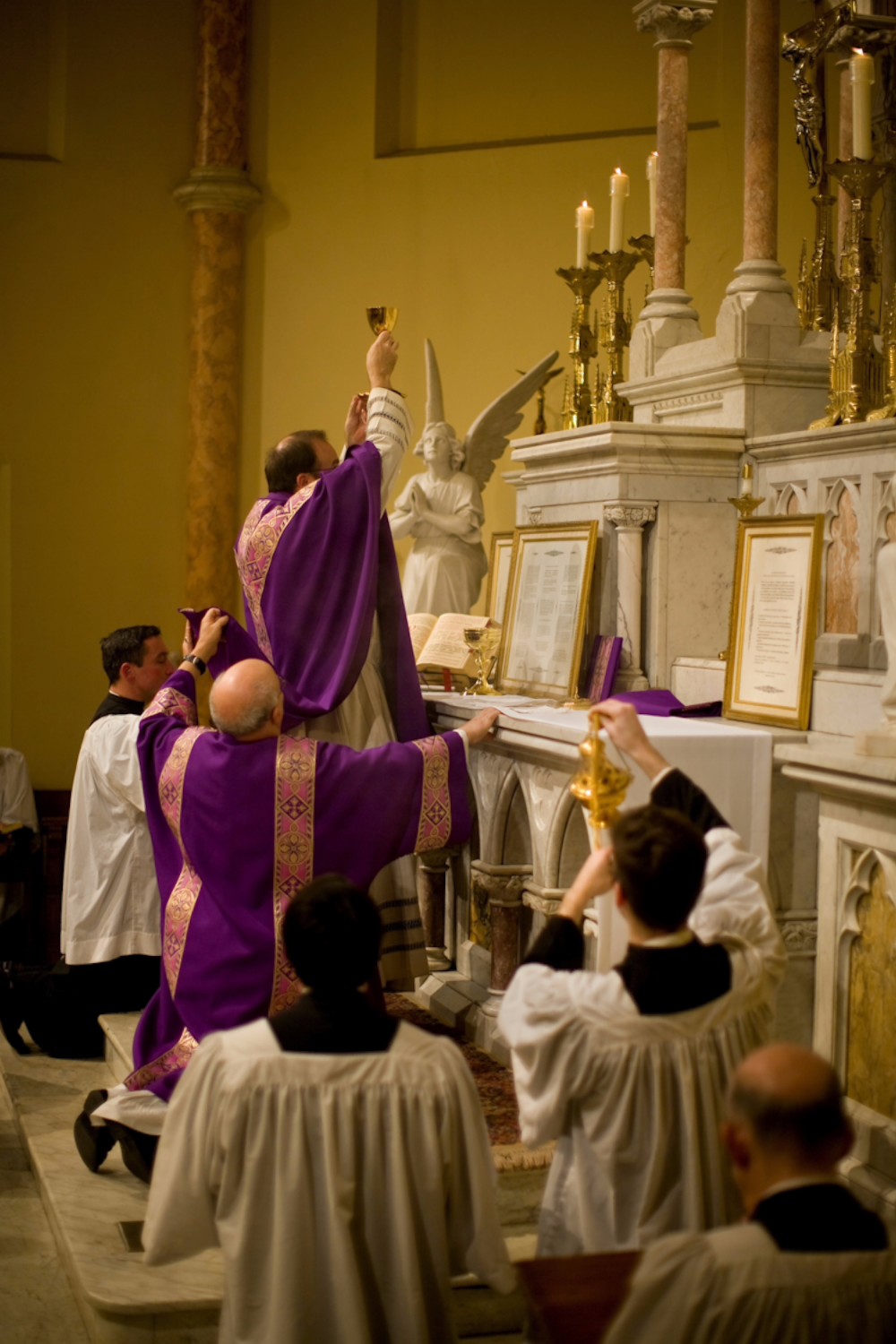
It was almost 15 years ago. I was At Old St. Mary’s here in D.C. celebrating Mass in the Latin (Extraordinary Form). It was a solemn high Mass. I don’t suppose I thought it any different than most Sunday’s but something quite amazing was about to happen.
As you may know the ancient Latin Mass is celebrated “ad orientem” (towards the Liturgical East). Priest and people all face one direction. What this means practically for the celebrant is that the people are behind him. It was time for the consecration. The priest is directed to bow low, his forearms on the altar table the host between his fingers.
As directed I said the venerable words of Consecration in a low but distinct voice, Hoc est enim Corpus meum (For this is my Body). The bells rang as I genuflected.
But behind me a disturbance of some sort, a shaking or rustling in the front pews behind me to my right. And then a moaning or grumbling. What was that? It did not really sound human, more like the grumbling of a large animal such as a boar or a bear, along with a plaintive moan that did not seem human. I elevated the host and wondered, “What was that?” Then silence. I could not turn to look easily for that is awkward for the celebrant in the ancient Latin Mass. But still I thought, What was that?
But it was time for the consecration of the chalice. Again, bowing low and pronouncing clearly and distinctly but in a low voice: Hic est enim calix sanguinis mei, novi et æterni testamenti; mysterium fidei; qui pro vobis et pro multis effundetur in remissionem pecatorum. Haec quotiescumque feceritis in mei memoriam facietis (for this is the cup of my Blood, of the new and eternal covenant; the mystery of faith; which will for the many be shed unto the remission of sins. When so ever you do this, you do it in my memory).
Then, I heard another sound this time an undeniable moan and then a shriek as some one cried out: “Leave me alone Jesus! Why do you torture me!” Suddenly a scuffling as some one ran out with the groaning sound of having been injured. The back doors swung open, then closed. Then silence.
Realization – I could not turn to look for I was raising the Chalice high over my head. But I knew in an instant that some poor demon-tormented soul had encountered Christ in the Eucharistic, and could not endure his real presence displayed for all to see. And the words of Scripture occurred to me: Even Demons believe and tremble (James 2:19).
Repentance – But just as James used those words to rebuke the weak faith of his flock I too had to repent. Why was a demon-troubled man more aware of the true presence and astonished by it than me? He was moved in the negative sense to run. Why was I not more moved in a positive and comparable way? What of the other believers in the pews? I don’t doubt that any of us believed intellectually in the true presence. But there is something very different and far more wonderful in being moved to the depth of your soul! It is so easy for us to be sleepy in the presence of the Divine, forgetful of the miraculous and awesome Presence available to us.
But let the record show that one day, almost 15 years ago, it was made quite plain to me that I held in my hands the Lord of Glory, the King of heaven and earth, the just Judge, and Ruler of the kings of the earth. Is the Lord truly present in the Eucharist? You’d better believe it, even demons believe that!
Why not? Why shouldn’t I aim high? And really, is it that high? Is it really so unrealistic to ask every member of my congregation to shepherd one soul back to the sacraments and the practice of the faith in the next year? Is that so impossible, for each one to reach one, and work with them for a year and to invite them to come and learn more of the faith?
Well, I’m going to try. As a parish we have been engaged in a door-to-door evangelization campaign and that’s been going quite well, actually. Over 1500 homes have been visited and our Sunday numbers are up by 50.
But I am also aware that friendship and family are a more fruitful vein than the “cold-contact” approach of door to door. We’re going to keep doing that because we need to obey Christ who sends us out two by two. But every congregant knows at least five members from among their family or friends who need to come to God’s house either because they have drifted, or because they have never had a Church home at all. It’s time to go to work and shepherd them back.
And this isn’t going to be a one-time ask, a la “Come to Christmas Mass with me.”
What I am am asking is a year-long effort that would include some of the following:
Introduce – On our Parish feast day in couple of weeks I am going to ask every member of the congregation to prepare to commit to the Lord that they will shepherd one soul back to mass.
Pray and discern – Between September 18th and the Feast of Christ the King, we are to pray and ask the Lord who that person might be. It may not be the obvious one, such as a spouse or a child. Then again it may be. But pray and ask the Lord for guidance: “Who Lord? Who? Speak to my heart Lord, show me who. Who is it that I reasonably know and will be able to gently shepherd?”
Commit – On the feast of Christ the King we will be asked to commit to shepherd the soul to the Lord by spending the next year praying, some fasting and abstaining too, befriending, drawing closer and meeting with that person. They will be ask to place the name of this person on a card. The cards will be collected and placed near the altar, Masses will be offered each week for these souls.
Reflect on personal testimony – During Advent each congregant who has agreed will be asked to write a letter of testimony and thanksgiving to the Lord thanking him for the gift of the faith, the Church and Sacraments and to say something of why they are glad to be a Catholic and how the Lord has blessed them in their practice of the faith. These letters will be presented as a gift of thanksgiving to God at Christmas time. Writing these letters will also help the faithful to hone their own testimony which they can later share with the soul they are shepherding.
On-going Parish formation – During the period after Christmas and through Lent, directed Bible Studies and seminars will also be conducted in the parish that will guide people on how to lovingly converse with the person they are leading back. There are many “meeting stories” in the Bible (e.g. Jesus with the woman at the well, Nicodemus, Peter and Andrew and so forth). These passages and other resources will be given the parishioners to help them engage in a kind of friendship evangelization. The first step in friendship evangelization is friendship. And these studies will help equip parishioners to draw close to the person they are praying to lead back in a way that is not manipulative or secret, but which is also not filled with pressures.
Relate and befriend – Over the period of the year, make it a habit to contact and speak with the person. Talk with them, listen to their stories and ideas. Find out where they hurt and where they find joy. Find out how they drifted from Church or why they have never gone in the first place. Perhaps they have felt hurt or betrayed by the Church, perhaps they are not used to considering the real meaning of their life and have never taken time to consider that this life will end. There is a real power in listening to people in a respectful and loving way. In this stage we also tell our own stories and how the Lord has blessed us and what the Church, the sacraments, the Word of God and fellowship have done for us.
Invite – Without lots of pressure, begin to invite them to Church functions. They may not be ready to sit in a pew on Sunday for worship. But we will have concerts, Bible studies, dinners, movie nights, the blessing of the animals.
Pray and fast – Continue to pray, as will the parish. Consider some fasting, and abstinence, or take up a spiritual practice such as the Rosary or Divine Mercy Chaplet, devotional reading etc. and offer it as a sacrifice to the Lord for the return to the faith the person you are shepherding.
Invite – As the relationship deepens, let the Lord help you to know when and how it is best to explicitly ask this person to either resume the regular practice of their faith or to begin to come regularly on Sunday’s with you. A good time to aim for this is early October when RICA and Adult education classes resume.
Assess – As the year draws to a close on the Feast of Christ the King 2012, we will see if our numbers have doubled.
There is an acronym that is applied to projects that are undertaken: S.M.A.R.T. And I think this on meets the Criteria:
Specific – Each one reach one
Measurable – Double the size of Sunday attendance
Achievable – It is quite possible for every congregant to take up this challenge and, over a year meet many if not all the milestones.
Realistic – to Double our Sunday Attendance is challenging but not unrealistic if everyone does their part and we remember that the Lord has our back.
Time Based – 1 year, with specific milestones on the way.
It is a true fact that simply increasing numbers is not the only, or even most important goal. But rather, that we should authentically evangelize and draw souls to Christ, to his Sacraments, his Word and the fellowship of the Church. At the heart of evangelization is relationship: meeting Christ in others, allowing them to meet Him in us. This is what Christ did, he went out and met others and summoned them to the Kingdom by stages and through relationships. He tells us to do them: Go therefore and make disciples of all the nations, baptizing them and teaching them to observe all that I have commanded you. And Lo I am with you always, until the end of the world. (Matt 28:19)
Am I crazy? Perhaps, but at least call me a fool for Christ. I am going to aim high, that we double our Sunday numbers. Not just for the number’s sake, but for what they represent, souls coming back to God’s house, to be nourished at the altar of the Word and Eucharist, to be more deeply immersed in Christ.
How about you? Will you be crazy too? Are you willing to join me in being a fool for Christ? Let’s get started, there is a work to do.
Photo Credit: A Painting by the artist Atanur Dogan
Here’s a nice video that celebrates the Catholic Faith and can help us get our testimony together. The second half of the video contains a wonderful litany of gifts that are present in the Catholic Church.
I recently came across the following dialogue. I do not know the source, though it is in the form of the sayings of the desert Fathers:
To a distressed person who came to him for help the Abbot said, “Do you really want a cure?” And the man replied, “If I did not, would I bother to come to you?” “Oh yes” said the Abbot, “Most people do.” “If not for a cure, then for what do they come?” asked the distressed man. And the Abbot said, “They come not for a cure, that’s painful. They come for for relief.”
Yes, real cures, and substantial healing are not easy. Often true healing comes only after lengthy surgery, whether physical or spiritual. And those who have sought true healing know, and have come to experience, that it takes guts to be healed.
True spiritual and moral healing requires that we accept significant change and be willing to have our thinking and habitual practices challenged and replaced. In confronting what ails us, we often come to discover that its cause is far deeper than we thought, and that its remedies are far more sweeping and paradoxical than we had imagined.
Once, in the aftermath of a nervous breakdown, that saw me hospitalized for a week and ordered to take a month off to recuperate, I went to a priest and spiritual director who specialized in the care of priests in need of psycho-therapeutic counseling. I explained to him that I had frozen in fear, and panic, and I felt my life had gone out of control. “I never want my life to go out of control again,” I said. He said, “Until you let go of your need to be in control, you will never be well.”
Paradoxical indeed, and scary too. But I have discovered through the years how right he was. My only way “out” of my anxiety was to journey deeper toward its center and find the Lord waiting for me there. Yes, it took guts to be healed. And I’m glad the Lord didn’t let me run somewhere else for mere relief. Healing was harder than relief, but better and lasting.
The Lord Jesus was journeying one day through Jericho (cf Luke 18:35ff) and a certain blind man kept calling out, “Jesus Son of David, have mercy on me!” Finally the Lord stopped and asked this blind man, “What do you want me to do for you?” A strange question, perhaps, to ask of a blind man. But consider that this man’s life will be totally changed if Jesus heals him. More will be expected of him and it will no longer be tolerated that he should sit and beg of others. All that he has known will vanish as a new world, and new expectations dawns on him. So Jesus asks what he really wants, healing or relief? “Lord I want to see!” And he not only saw, but proceeded to follow Jesus up the road. A new vision, a new path, a new destination, a new life. It takes guts to be healed.
And so Jesus asks you and me too, “What do you want me to do for you?” Careful how you answer. Remember, it takes guts to be healed. Too many want mere relief and not real healing. They want comfort rather than true change.
“What do you want me to do for you?”
As you view this video, I ask your prayers for a young man (in his late 20s) who visited the parish this week. He came back to the church of his childhood, remembering a more innocent and simple time in his life. And now that his life has become hell though drugs and other bad choices, he has a decision to make. Pray that he has the guts to accept the long healing he will need to come forth from his hell on earth. As I heard his story I thought of this song:
I assisted at a wedding this past weekend that encompassed both space and time. The groom was a White American, the Bride was Ethiopian. Now you will surely understand that space is involved, for Ethiopia is far from the USA. But time is also involved here, for the African notion of “Saturday at 10:00 AM” is not the same as the American one, at all.
Be on time. Not! – Yes, the wedding was scheduled for Saturday at 10:00 AM. The priest from Ethiopia cautioned the wedding party at the Friday rehearsal (which started late), “You must be on time tomorrow, for the organist is from America and must be somewhere else at noon. And the parish is American, and Americans go by the clock! So, be on time!”
Come Saturday morning and it is just before 10:00 AM. The groom’s side of the Church is filled with White Americans. On the bride’s side, not a soul! The wedding finally began about 11:15 AM and many of the the lovely Ethiopian bridesmaids felt hurried, at that! “Why are you rushing us?” one said, “This is a moment to be enjoyed!” The priest from Ethiopia was embarrassed but not surprised. “Neither am I surprised” I reassured him. “If the organist must leave, I will supply the recessional .”
No I was not not surprised. For I have come to discover in various ways, that we Americans (and some Europeans) are really the few for who “the clock” has all that much to say. For most of the rest of the world, “the clock” is more like the speed limit sign is for us in America, a “suggestion,” a general “parameter,” more than something to be all that particular about.
A few stories to illustrate:
A friend of mine went to the Dominican Republic a few years back. He called the local Catholic parish and inquired (in Spanish) of the priest: “What times are Masses this weekend?” After a pause the priest said, “Sunday.” “I know” said my friend, “But what time on Sunday?” Again a puzzled silence, and the priest said again, “Sunday.” “Hmm…?” pondered my friend…. Then, like a light going off the priest said, “Ah! I sense by your accent that you are an American, si?” “Yes” said my friend. “Well here in our Country, you see,” said the priest, “We gather on Sunday morning, and when most have arrived, we begin…So, you see, Mass is Sunday morning, when all have arrived! Please come and join us on this Sunday morning, you are most welcome!”
Once, at my last parish, we celebrated the First Mass of a new priest, Fr. Carlos. It was scheduled for 8:00 pm Saturday, and the whole extended Latino family had joyously decorated the hall that afternoon, after the Ordination. Silly me, I actually had the Church unlocked and ready to go at 8:00 pm. But there was not a soul in sight, nor a car in the parking lot. By 8:45 pm the first people began to arrive. Slowly folks trickled in. Now it is 9:15 pm and the new priest arrives. Along with him an entourage of other priests. By 9:30 pm I, the ugly American, am fully anxious. I gathered the priests and said, “Fathers, we must vest now! Please, come to the sacristy at once.” One of the older Latino priests looked at me and said, “Father! Do not worry of the time, we live in eternity!” “Fine Father,” I responded, “But I have to be up for 8:00 AM Mass! Let’s get this Mass underway.” The priests looked a me with pity and began to vest.
In my own experience with the African American Community I have also come to experience the reality of what many playfully call “colored people time” (aka “CP Time”). Now we’re not as bad as being an hour or more late, but our 11:00 am Mass never begins at 11:00 am, usually 10 past, or even 15 past the hour. Neither do we have a fixed time when Mass has to be over. The 8:00 AM Mass usually goes toward 9:15 or 9:30. The 11:00 am Mass ends toward 1:00 pm. Why rush when you’re with the Lord? One time I got Mass done in under an hour, and a rather angry African American woman came to me and said, “Next time you don’t have enough to say Father, send the Deacon over.” For, a Mass in under hour, seems something of a disgrace to an African American matriarch.
I once asked a Latino friend, “How do you catch a plane in your culture, what with time being so vague?” “Well,” said he, “We go to the airport, and if the plane has already left, (and they never leave on time), then we go to the lady at the booth and book another one. We are not anxious, these things happen.”
Yes, anxious, I guess that is the key word. We Americans do fret the clock. There is an old expression, Let not the sands of time get in your lunch. In other words, the moment is to be savored, there will be time to take care of other things. An old gospel song says, Don’t let this moment pass you by.
I am not convinced our American way is so bad. In our culture, timeliness is a way of showing respect, and is experienced as a kind of charity. Being on time ensures everyone is both respected and treated with kindness. Further it means that things go smoothly and are well coordinated. Without this agreed upon framework, most Americans are bewildered and angry and feel personally disrespected.
But I have also come to experience that our close attention to clock time is not shared by most of the rest of the world. Further, they mean no disrespect when they are incredibly late by American standards. In fact, I usually get a blank look when I exhibit consternation that a someone is almost 1.5 hours late for a wedding. They just don’t “get it” when I say, “Why are you so late?!” I might as well be saying, “Why whirlwind major drum marcher flibberdy-jibbet?!” I just get a blank stare from them, as if to say, “Late?” They find my exasperation strange and unfathomable and look to others around them who just shrug.
We Americans control things by measuring them. In the careful measuring of time, land, money, assets, polls, statistics, and scientific data, we feel a sense of control, and often try to show superiority to others with command of such facts. There is something consoling about the notion that we know we are 93 million miles from the sun, our planet circles it in 365 .25 days, that this is Tuesday, and 95% of American have some belief in God. Further the average temperature in DC is 84 degrees for this day. Yes, we feel better, some how in control, when we know these things and have them carefully measured.
And as for time, I surely feel in control when I know that I have a meeting at 10, and appointments at 2 and 3 pm. Now I know what my day will be like. Or so I think.
But it is fascinating to me that so many others in the world neither need or value this sort of control. For them it seems OK to have general plans and then, let things unfold, rather than attempt to control and manipulate all outcomes. Yes, a completely different way of living.
And we may boast that we have the strongest and most efficient economy in the world on account of this. The Chinese and Japanese also have strong economies and, as far as I know, they also have a precision about clock time.
But at what price do we have these things? Just over 40% of Americans are prescribed psychotropic drugs to deal with the stress of our culture (Oh!, did I just quote a statistic? Sorry! Some how knowing numbers makes me feel in control).
I am not sure what is best, but huge numbers of Africans, Central and South Americans are just not obsessed with time like we are. Neither are Middle Easterners. It seems a little humbling to me that so many others live in a completely different world than I do, time wise. I am not saying we are wrong, only that billions live differently, and are more focused on the present, than what comes next, according to a mechanical clock. I frankly don’t know how they do it, so wedded am I to a clock. But they do.
God too reminds us that for him a thousand years are like a day, or a watch in the night. Further, eternity is not chronological time, it is the fulness of time. And for those of us who are obsessed with clock time, God cautions, wait, be still, have patience, be not anxious. The Lord says he is coming soon, but he does not mean it according to our clocks. And to those who insist on knowing times and seasons, he says we know not the day or the hour, and it is not for us to know the times or the seasons of God’s plan (eg. Matt 24:36; Acts 1:7).
Does anybody really know what time it is? No, actually we do not. But time is something that surely divides us. Some of us see the clock as a precision instrument to be strictly followed, others of us see it as a sort of speed limit sign that is broadly interpreted.
I like our Western precision, but admit it comes at a price for indeed, too often the sands of time get in our lunch.
In this video, Fr. Francis Martin talks a it about the concept of time in the Middle East and the flexible notions of time that predominate in the Scriptures. The context of his reflection is the incident of the cleansing of the Temple. John says Jesus did that at the beginning of his ministry, and the synoptic Gospels place it at the end of Jesus’ ministry. The discrepancy about time bothers us Westerners, but time was less an obsession to the evangelists who used time creatively and theologically, and were less obsessed with measurements. This video is an excerpt. Please see all of Fr. Martin’s videos here: Fr Martin Videos