
Blog of the Archdiocese of Washington
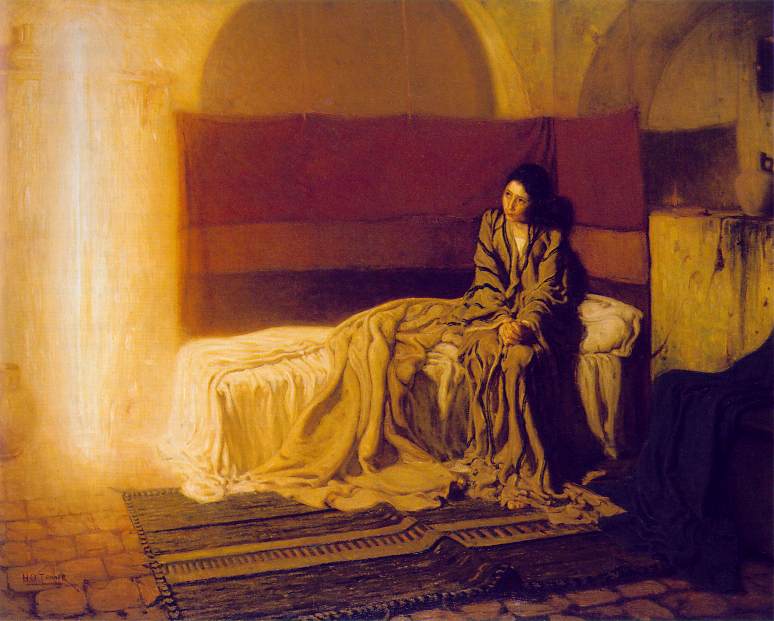
In preparation for the Feast of the Annunciation I picked up Jesus of Nazareth, Vol. 3 (The Infancy Narratives), by Pope Emeritus Benedict. I was very moved by a brief reflection that he made on Mary as the Angel Gabriel left her. His remarks consider her faith in a very touching manner.
I must say that I have always been moved—and intrigued—by the faith of the Blessed Mother. She is mulier fortis (a strong woman) and “a woman wrapped in silence,” a phrase that forms the title of an excellent book by Fr. John Lynch. The pope’s words capture both her faith and her mystery:
I consider it important to focus also on the final sentence of Luke’s Annunciation narrative: “And the angel departed from her” (Luke 1:38). The great hour of Mary’s encounter with God’s messenger—in which her whole life is changed—comes to an end, and she remains there alone, with a task that truly surpasses all human capacity. There are no angels standing around her. She must continue along the path that leads to many dark moments–from Joseph’s dismay at her pregnancy, to the moment when Jesus is said to be out of his mind (cf. Mark 3:21; John 10:20) right up to the night of the cross.
How often in these situations must Mary have returned inwardly to the hour when God’s angel had spoken to her, pondering afresh the greeting: “Rejoice, full of grace!” And the consoling words: “Do not be afraid!” The angel departs; her mission remains, and with it matures her inner closeness to God, a closeness that in her heart she is able to see and touch (Jesus of Nazareth, The Infancy Narratives, Kindle edition (loc 488-501)).
I am moved by this image of Mary, there all alone, perhaps wondering how it would all unfold and whether what she just experienced had really happened. The angel departs and she is alone (and yet never alone).
As background, I would like to say that I have read some accounts of Mary’s life that placed her in such rarefied air that I could no longer relate to her. I vaguely remember reading some accounts of visionaries saying that Mary did not even have to do housework because the angels swept the house, did the dishes, and so forth. Some other accounts spoke of how she had detailed foreknowledge of everything that would take place in her life as well as in Jesus’ life. I even recall one purported visionary who wrote that Mary had extensive theological discussions with Jesus even while He was still an infant. I do not remember who these alleged visionaries were or if any of them were even approved visionaries. Yet in the early 1980s a large number of books were published containing the observations of various “visionaries.”
Such accounts often left me cold and made me feel distant from our Blessed Mother. They also did not seem to comport with the Scriptures, which present Mother Mary as a woman of great faith, but one who has to walk by faith and not by perfect sight, just as all of us do. She wonders at Gabriel’s greeting, is troubled, and does not understand how it will all work out (cf Luke 1:29).
Yet she presses on and we next see her having made haste to the hill country, rejoicing in ecstatic praise with her cousin: My spirit rejoices in God my savior! She still does not know how it will all work out, but in spite of that she is content to know the One who holds the future; it is enough for now.
Years later, when she finds Jesus teaching in the Temple after days of agonized searching for the “missing” boy, she does not fully understand His explanation (Luke 2:48-50), but ponders these things within her heart (Luke 2:51).
At the wedding feast at Cana, Jesus seems almost to rebuke His mother. Although the text omits many of the details, there must have been something in her look, something of the look that only a mother can give to a son. By now, Mary’s understanding of her son has surely deepened; she has known Him and pondered and reflected in her heart over Him for more than thirty years. She simply looks at Him, and He at her—a look that only the two would have known. Something passed between them, a look of understanding. Whatever it was remains wrapped in silence; it’s none of our business, something that only she and her Son could know. Whatever it was, it prompts her to turn and with confidence, knowing the situation will be well-handled, says to the stewards, “Do whatever he tells you” (Jn 2:5).
Of the three years to follow we know very little. We know that she is not far away. We see her in Mark 3:31 as she asks after Jesus, seemingly concerned that others are saying “He is beside himself!”
Now we find her gently and supportively present at the foot of the Cross. The sword that Simeon had prophesied (Lk 2:35) is thrust through her heart. More than thirty years earlier she could only wonder what Simeon meant when he said that her child was destined for the fall and the rise of many in Israel and that a sword would pierce her heart (Luke 2:33). In the intervening years her faith had surely deepened; now, here she is at the foot of the Cross. It is her darkest hour, but surely all those years of pondering and reflecting on these things in her heart helps to sustain her.
Yes, Mother Mary is a woman wrapped in silence. We know so little, for she is reflective and quiet. She says little, silently standing by, silently supportive of Jesus in His public ministry. Now, again silently, she is at the foot of the Cross.
Yes, this is the Mary, this is the Mother that I know: a woman of faith but also a human being like you and me. As the Pope Benedict suggested, she is a woman who had to make a journey of faith without knowing how everything would work out, without the omniscience that some visionaries ascribe to her. She knew what the angel had said, but it seems clear that she did not know how it would all come to pass. She, like us, walked by faith and not by earthly sight.
Mary is the perfect disciple, the woman of faith, the one who presses on, not knowing all, but pondering and reflecting everything in her heart.
Cross-posted at the Catholic Standard: A Woman Wrapped in Silence – A Meditation for the Feast of the Annunciation
This was recorded with the Institute of Catholic Culture. Please find out more about this wonderful Organization by clicking the link
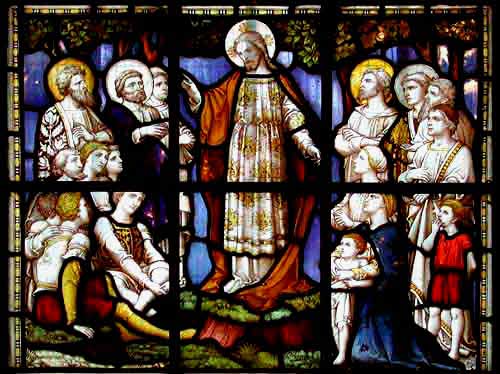
Jesus said something in yesterday’s Gospel (4thSunday in Lent) that I think we can apply to our current troubles:
While it is daytime, we must do the works of Him who sent Me. Night is coming, when no one can work (John 9:4).
A purely natural understanding would be that the passage is merely noting that worked stopped at sundown by necessity in those times, but of course the text is far deeper. Let’s ponder two related spiritual meanings and apply them to this time of crisis.
First, as St. Ambrose observes of this text, “Daytime is this present life; night is death and the time that follows death” [*]. He then warns us have a sober fear of death and to realize that now is the time to accept what God is offering because tomorrow is not promised.
In the midst of this pandemic, we are enduring something of a foretaste of “death.” For most of us the crisis will not result in our physical death, but many things we freely did just a couple of weeks ago are for the time being dead to us. We cannot do much of the work we normally do; we cannot follow through on most of the plans we made. A “night” of sorts has come upon us. However, many things arestill available to us, things we may have previously neglected: prayer, reading of Scripture, repenting of our sins, spending time with family, calling old friends. How will we use this time?
Second, this passage resonates with the great battle between light and darkness, the predominant theme of John’s Gospel.The battle cry is announced in the Prologue:
In Him was life, and that life was the light of men. The Light shines in the darkness, and the darkness has not overcome it(John 1:4-5).
In John chapter 3, Jesus sets forth the drama of the battle for each individual:
And this is the verdict: The Light has come into the world, but men loved the darkness rather than the Light, because their deeds were evil. Everyone who does evil hates the Light, and does not come into the Light for fear that his deeds will be exposed. But whoever practices the truth comes into the Light, so that it may be seen clearly that what he has done has been accomplished in God(John 3:19-21).
In Sunday’s Gospel, Jesus heals the man born blind and brings him into the Kingdom of Light. This Gospel also demonstrates the spiritual darkness of those who stubbornly resist Jesus, the Light of the World. From Jesus comes this warning and judgment:
For judgment I have come into this world, so that the blind may see and those who see may become blind(John 6:39).
And then Jesus’ “hour” came: the hour to confront the kingdom of darkness through His Passion, Death, and Resurrection. Judas goes out to betray Jesus, and of this event John simple writes,
And it was night (John 13:30b).
Jesus’ words in Sunday’s Gospel remind us of the great battle that is all around us. It is a battle for souls, beginning with our own, but extending to family and friends. In our complacency, we often forget this great and dramatic battle. Many of our diversions and preoccupations are not available to us in this crisis; we are heading into a kind of spiritual desert. We have to take the time to ask ourselves important questions: Where am I going with my life? Do I know the Lord? Are my priorities pleasing to Him? Am I fulfilling my responsibility to teach the faith to my family and to announce the kingdom to others? For what sins do I need to repent? For what should I be grateful? When “normal life” resumes, what will I have learned? Will I apply it?
Yes, in a time like this we can see more clearly the dramatic battle that each of us is caught up in. Take some time to better engage the battle, for yourself and for others. If you find a good fight, get in it. The fight for souls is a good one! Pray, fast, talk, and witness. Seek the light of the many online offerings from the Church and from fellow believers that have proliferated in recent weeks.
Use this time wisely. The virus may go away, but the battle will continue until your final breath.
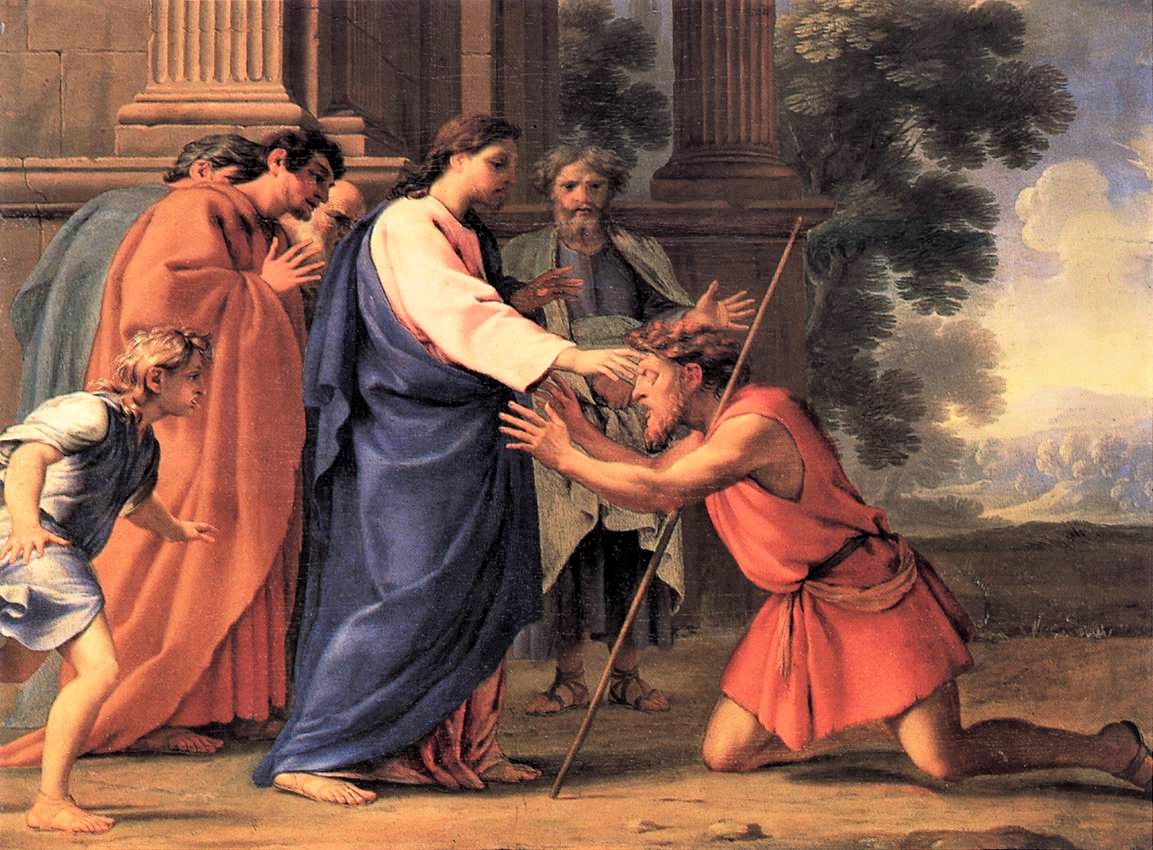
In today’s Gospel, Jesus, the Light of the World, brings light to a man born blind. If you are prepared to accept it, you are the man born blind, for all of us were born blind and in darkness. It was our baptism and the faith it gave that rendered us able to see and to come gradually more fully into the light. The man in today’s Gospel shows forth the stages of the Christian walk, out of darkness and into the beautiful light of Christ. Let’s take a moment to ponder the stages of the blind man’s walk, for each of us is the man.
I. The Problem that is Presented – We are introduced to a man who was blind from birth, incapable of seeing at all. As Jesus passed by he saw a man blind from birth. His disciples asked him, “Rabbi, who sinned, this man or his parents, that he was born blind?” Jesus answered, “Neither he nor his parents sinned; it is so that the works of God might be made visible through him. We have to do the works of the one who sent me while it is day. Night is coming when no one can work. While I am in the world, I am the light of the world.”
So there is the problem: he is blind; he has no vision. On account of Original Sin, we lost all spiritual vision. We could not see God or endure the light of His glory. This lack of vision causes many to have no “vision” for their life. They don’t know why they were made or what the true purpose of their existence is. Many cannot see past the sufferings of this world to the glory that awaits. Others have retreated into the material world and cannot see beyond it. Still others have retreated even further, away from reality into the realm of their own mind, their own opinions. St. Augustine describes this condition of the human person as curvatus in se (man turned in on himself). Yes, there is a blindness that imprisons many in the darkness. Even for us who believe there are still areas where it is hard for us to see. Coming to see God more fully, and to see ourselves as we really are, is a journey; one we are still on.
While the disciples want to dwell on secondary causes, Jesus sidesteps these and focuses on solutions. Assessing blame is unproductive; healing the man is uppermost. In a statement dripping with irony, Jesus says that the works of God will be made visible in a blind man. For the foolishness of God is wiser than man’s wisdom, and the weakness of God is stronger than man’s strength (1 Cor 1:25). Yes, God can make a way out of no way and write straight with crooked lines.
II. The Purification that is Prescribed – Having diagnosed the problem, Jesus begins the work of healing this man. When he had said this, he spat on the ground and made clay with the saliva, and smeared the clay on his eyes, and said to him, “Go wash in the Pool of Siloam”—which means Sent. So he went and washed, and came back able to see.
Hopefully, you can see baptism here. Jesus tells him, “Go wash … he went and washed, and came back able to see.” The Catechism of the Catholic Church says this of the Sacrament of Baptism:
This bath is called enlightenment, because those who receive this [catechetical] instruction are enlightened in their understanding … Having received in Baptism the Word, “the true light that enlightens every man,” the person baptized has been “enlightened,” he becomes a “son of light,” indeed, he becomes “light” himself (CCC 1216).
Baptism is required in order to truly see. It is no accident that John mentions the name of the pool to which the man goes: Siloam, a name meaning “sent.” Jesus sends him and He sends us. Baptism is required. Jesus says elsewhere, Truly, truly, I say to you, unless one is born of water and the Spirit, he cannot enter the kingdom of God (John 3:5).
Notice that the man comes back able to see. But just because you’re able to see doesn’t mean you actually do see. Right now I am able to see the Statue of Liberty; my eyes function properly, but I do not see it; I have to make a journey in order to do that. Similarly, the man here is able to see Jesus, but he does not yet see Him. He has a journey to make in order to do that. He has a long way to go to see Jesus fully, face to face. Baptism is not the end of our journey but the beginning of it. It renders us able to see, but we are still newborn babes. We need to grow. We can see, but there is plenty we haven’t yet seen.
III. The Perception that is Partial – The man can see but still does not know much of the one who has enabled him to see. His neighbors and those who had seen him earlier as a beggar said, “Isn’t this the one who used to sit and beg?” Some said, “It is,” but others said, “No, he just looks like him.” He said, “I am.” So they said to him, “How were your eyes opened?” He replied, “The man called Jesus made clay and anointed my eyes and told me, ‘Go to Siloam and wash.’ So I went there and washed and was able to see.” And they said to him, “Where is he?” He said, “I don’t know.”
So he’s able to see. But he hasn’t yet seen much. The man must grow in faith to come to know who Jesus really is. Look at how his partial perception is described. For now, he merely understands Jesus as “the man called Jesus.” To him, Jesus is just “some guy.” When asked where Jesus is, all he can say is that he doesn’t know. Although he is able to see, he does not yet actually see Jesus.
This describes a lot of Christians. They know about Jesus but they don’t know Him. Many Catholics in the pews are “sacramentalized but unevangelized.” That is, they have received the sacraments but have never really met Jesus Christ; they do not know Him in any more than an intellectual way. Many don’t even expect to know Him. He is little better to them than “the man called Jesus.” They’ve heard of Jesus and even know some basic facts about Him, but He is a distant figure in their lives. When asked questions about Him, they respond like this man: “I don’t know.”
IV. Progress through Persecution and Pondering – The text goes on to show us the progress that this formerly blind man makes in coming to know and finally see Jesus. It is interesting that this progress comes largely through persecution. Persecution need not always be understood as something as severe as being arrested and thrown in jail. It can come in many forms: puzzlement expressed by relatives and friends, ridicule of Catholicism in the media, or even those internal voices that make us question our faith. In whatever form, though, persecution has a way of making us face the questions and refine our understanding. Our vision gets clearer as we meet the challenges.
Notice the man’s progress thus far. He has been baptized and is now able to see, but he still knows little of Jesus, referring to Him only as “the man called Jesus,” He doesn’t know where Jesus is. He is about to grow, though, and does so in several stages.
In stage one of the man’s post-baptismal growth his neighbors turn on him and bring him to the Pharisees, who interrogate him because Jesus had healed him on the Sabbath.
They brought the one who was once blind to the Pharisees. Now Jesus had made clay and opened his eyes on a Sabbath. So then, the Pharisees also asked him how he was able to see. He said to them, “He put clay on my eyes, and I washed, and now I can see.” So some of the Pharisees said, “This man is not from God, because he does not keep the Sabbath.” But others said, “How can a sinful man do such signs?” And there was a division among them. So they said to the blind man again, “What do you have to say about him, since he opened your eyes?” He said, “He is a prophet.”
Notice what this persecution does for him. As he is challenged to say something about Jesus, he moves beyond calling him “the man called Jesus” and describes Him as a prophet. The man has gained some insight. A prophet speaks for God and Jesus is the Word made flesh.
In stage two of the man’s post-baptismal growth the Pharisees doubt his story and broaden their persecution, interrogating and threatening his fearful parents.
Now the Jews did not believe that he had been blind and gained his sight until they summoned the parents of the one who had gained his sight. They asked them, “Is this your son, who you say was born blind? How does he now see?” his parents answered and said, “We know that this is our son and that he was born blind. We do not know how he sees now, nor do we know who opened his eyes. Ask him, he is of age; he can speak for himself.” His parents said this because they were afraid of the Jews, for the Jews had already agreed that if anyone acknowledged him as the Christ, he would be expelled from the synagogue. For this reason, his parents said, “He is of age; question him.”
In stage three of his post-baptismal growth we note that the continuing persecution seems to make him grow even stronger and more able to withstand his opponents. Note his determination and fearlessness during the second interrogation he faces, which includes ridiculing him and placing him under oath:
So a second time they called the man who had been blind and said to him, “Give God the praise! We know that this man is a sinner.” He replied, “If he is a sinner, I do not know. One thing I do know is that I was blind and now I see.” So they said to him, “What did he do to you? How did he open your eyes?” He answered them, “I told you already and you did not listen. Why do you want to hear it again? Do you want to become his disciples, too?” They ridiculed him and said, “You are that man’s disciple; we are disciples of Moses! We know that God spoke to Moses, but we do not know where this one is from.” The man answered and said to them, “This is what is so amazing, that you do not know where he is from, yet he opened my eyes. We know that God does not listen to sinners, but if one is devout and does his will, he listens to him. It is unheard of that anyone ever opened the eyes of a person born blind. If this man were not from God, he would not be able to do anything.” They answered and said to him, “You were born totally in sin, and are you trying to teach us?” Then they threw him out.
The result of this is to further deepen his vision of Jesus. At first, he saw Jesus only as “the man called Jesus.” Then he sees Him as a prophet. Now he goes further and sees Him as “from God.” He’s progressing from sight to insight. His ability to see, given to him in baptism, is now resulting in even clearer vision.
V. Perfection that is Portrayed – The man has been thrown out of the synagogue, as many early Christians were. He has endured the hatred of the world and the loss of many things. When Jesus heard that they had thrown him out, he found him and said, “Do you believe in the Son of Man?” He answered and said, “Who is he, sir, that I may believe in him?” Jesus said to him, “You have seen him, the one speaking with you is he.” He said, “I do believe, Lord,” and he worshiped him.
Now the man’s vision is clear. After all this, he finally sees. Not only does he see Jesus, he sees who Jesus is. First he saw Him only as “the man called Jesus.” Then he sees Him as a prophet. Next, he says that He is from God. The final stage is the best of all. He actually sees Jesus and falls down to worship Him. Jesus is not only from God, he is God. Christ has fully enlightened him.
This is our journey, moving in stages to know Jesus more perfectly. One day we will see Him face to face; we will see Him for who He is.
Where are you on this journey? If we are faithful, our vision is getting better daily, but it is not yet complete. Scripture says,
For now, make this journey. Make it in stages. Come to know who Jesus is.
I have it on the best of authority that the man, on his journey to Jesus, sang this song:
Walk in the Light, beautiful light. Come where the dew-drops of mercy shine bright. Walk all around us by day and by night, O Jesus the Light of the World!
Let there be light!
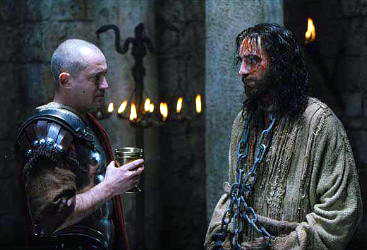
We might do well at a moment like this to ponder the First Station of the Cross, in which Jesus is tried before Pilate. At a critical moment Pilate said, “Do you not know that I have authority to release you and authority to crucify you?” Jesus answered, “You would have no authority over me if it were not given to you from above”(John 19:10-11). Jesus thus acknowledges Pilate’s authority as governor but reminds him of its true origin.
Most of us right now are experiencing increasing restrictions on our movement; policies have been put into place that have changed how we live, work, and even pray. Some people are understanding and supportive of the measures; others are concerned about the erosion of civil liberties. Still others believe that more should have been done. My view on this does not matter; I write as a priest, not an expert in public policy. One thing I would like to say is that you and I have the luxury of “armchair quarterbacking,” whereas those in civil authority must make extremely difficult and complex decisions. I, for one, am glad I don’t have to make them.
Citizens certainly have the right to question their leaders, but right now for my own peace of mind, I need to spend some time accepting the First Station of the Cross. The point of the First Station is not that Pilate is just or good but that his authority was granted to him by God. In Romans we read,
Everyone must submit himself to the governing authorities, for there is no authority except that which is from God. The authorities that exist have been appointed by God. Consequently, the one who resists authority is opposing what God has set in place … Therefore, it is necessary to submit to authority, not only to avoid punishment, but also as a matter of conscience. This is also why you pay taxes. For the authorities are God’s servants, who devote themselves to their work. Pay everyone what you owe him: taxes to whom taxes are due, revenue to whom revenue is due, respect to whom respect is due, honor to whom honor is due(Rom 13:1-7).
This sort of talk shocks most modern Americans. To be sure, St. Paul is giving a general norm, not an absolute one. There are times when a ruler commands obedience to what is evil; in such a case he must be resisted. As a general rule, though, we have a duty to obey just laws and policies. We might also remember that Nero was the emperor when St. Paul wrote this. Hence, St. Paul does not give this norm simply for good leaders or leaders whom we like. The Catechism of the Catholic Church says this about authority:
Every human community needs an authority to govern it. The foundation of such authority lies in human nature. It is necessary for the unity of the state. Its role is to ensure as far as possible the common good of the society. The authority required by the moral order derives from God: [see Romans 13:1-2 above]. The duty of obedience requires all to give due honor to authority and to treat those who are charged to exercise it with respect, and, insofar as it is deserved, with gratitude and good-will. …If rulers were to enact unjust laws or take measures contrary to the moral order, such arrangements would not be binding in conscience (CCC 1898–1900,1903).
In our current situations, citizens can and should stay in vigorous discussion with government leaders and officials, but as we do so we must remember the principles set forth above, which are so contrary to the modern, adversarial approach.
When bishops began suspending public Masses, many of us were alarmed. We wondered if less severe methods would have been more appropriate (e.g., limiting the number of people at each Mass). As the maximum number of people permitted in public gatherings has dropped (from 250 to 100 to 25 to 10) even that option became essentially unworkable. The bishops cannot simply defy public authority in this matter. For most of us, the decision has been made: public Masses are suspended for the near future.
As for me, I need to spend time at the First Station of the Cross. Note that I am not comparing our leaders to Pilate. Rather, I am focusing on St. Paul’s astonishing words, The authorities that exist have been appointed by God (Rom 13:1). In writing this, he echoes Jesus’ words to Pilate: You would have no authority over me if it were not given to you from above. At this astonishing moment of upheaval and fear, unprecedented in my lifetime, I can only pray for our leaders, both civil and ecclesial.
Lord, at this point it is out of my hands. Help me to be at peace with that. I know that ultimately everything is in Your hands; everything will ultimately be all right. But I also know that You have placed difficult matters into the hands of our leaders. I do not envy the difficult choices they must make. I only ask that You guide them, Lord. May they be neither too severe nor too lax, neither too fearful nor too bold. We seem to be heading into some difficult days. Help us. Save us. Have mercy on us, and keep us by Your grace. And because you said, “You have not because you ask not” (James 4:2), I’ll ask, “How about a miracle cure, Lord?” Meanwhile, grant me the trust in You that is the only source of my peace. Thank you, Jesus.
Here’s another William Byrd classic lamenting the suffering of the Catholic Church in England. Translated the text reads:
Be not angry, O Lord, enough,
neither remember our iniquity for ever.
Behold, see, we who beseech thee, we are all thy people.
The holy cities are a wilderness.
Sion is a wilderness, Jerusalem a desolation.
The reading for Tuesday’s Mass (Tuesday of the Third Week of Lent) was astonishingly applicable to our current situation. It also brings up a controversial question: are we experiencing punishment for our sins? The modern world has grown proud; we have largely forgotten our vulnerability. Worst of all, we have collectively cast God aside. In this sense we do not need to directly attribute this chastisement to God. Rather, the deep wound to our own sense of invincibility is itself the source of our pain and punishment.
We have been felled quickly, bewildered with an intense fear unthinkable just a month ago. Much of the fear is focused on our mortality. The lack of supernatural faith and the heavy focus on “this world,” a world that seeks only material blessings, fuels this fear. To those without faith, death appears to be the end of everything.
Let’s look at the reading from Tuesday’s Mass (Daniel 3:25, 34-45):
Azariah stood up in the fire and prayed aloud:
“For your name’s sake, O Lord, do not deliver us up forever,
or make void your covenant.
Do not take away your mercy from us,
for the sake of Abraham, your beloved,
Isaac your servant, and Israel your holy one,
To whom you promised to multiply their offspring
like the stars of heaven,
or the sand on the shore of the sea.
One of the difficulties of this crisis is the uncertainty; we don’t know how long it will last. We ask the Lord not to deliver us up “forever,” for with no end in sight it may seem like forever. We must pray for God’s mercy to come suddenly, unexpectedly—even if we do not deserve it.
For we are reduced, O Lord, beyond any other nation,
brought low everywhere in the world this day
because of our sins.
Some people believe it is wrong to speak of the role of sin in this crisis, but the sin referred to here is our collectivesin. A virus may come from a natural source, but it has been aggravated by both human action and inaction, some of it sinful. Our biggest sin, however, is our pride, which leads us to believe that a crisis such as the one we are experiencing is not possible, that we are invincible. How quickly this virus has laid us low! We think, because of our towering buildings, economic power, and advanced technology, that we are not vulnerable to the things our forebears faced. It would appear that we are not. I, too, have been rocked back on my heels by the terror that has come so swiftly upon us. I, too, have learned that I must check my pride and humbly accept this blow.
We have in our day no prince, prophet, or leader,
no burnt offering, sacrifice, oblation, or incense,
no place to offer first fruits, to find favor with you.
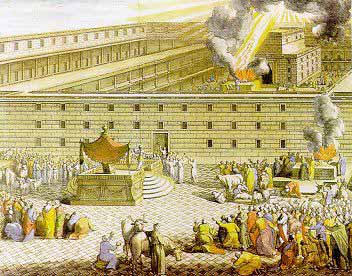
Azariah, who prayed this prayer, had experienced the destruction of the Temple in Jerusalem and the end to the sacrifices so dear to the Jewish people.
I am deeply saddened at the end of public Masses across the country and the world—just when we need them most. Even the great celebrations of Holy Week and Easter seem to be in danger of cancellation. I am grateful that the private celebration of Mass by priests is at least still possible.
But with contrite heart and humble spirit
let us be received;
As though it were burnt offerings of rams and bullocks,
or thousands of fat lambs,
So let our sacrifice be in your presence today
as we follow you unreservedly;
for those who trust in you cannot be put to shame.
In the current situation, during which we cannot gather together, we must make repentance and humility the focus of our private prayer. We must also deepen our commitment to follow the Lord “unreservedly.” I have seen and heard the pain of so many of the faithful at the loss of Mass and regular reception of the Eucharist. This should increase our longing for and appreciation of the Lord’s Body and Blood and stir within us contrition for our indifference. May our loss become gain as we hunger more intensely for the Holy Eucharist.
And now we follow you with our whole heart,
we fear you and we pray to you.
Do not let us be put to shame,
but deal with us in your kindness and great mercy.
Deliver us by your wonders,
and bring glory to your name, O Lord”
Yes, Lord, we ask for a miraculous cure for both this disease and our fear. Deliver us by your wonders, O Lord.
The song performed in the video below, Tristitia et anxietas, was composed by William Byrd as a lament for English Catholics, who lost almost everything in the English “reformation.” One of its lines, translated, says this:
Sorrow and anxiety have occupied my inmost self.
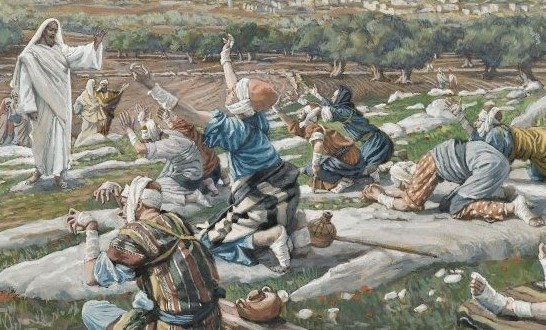
The first reading for Mass on Monday (Monday of the third week of Lent) was striking in its relation to the current time of turmoil. It reminds us of our vulnerability. Despite all our strength, we are individually and collectively in need of tremendous grace and mercy from God. For all our concern about the physical threat of this virus, we should be even more concerned about our spiritual vulnerability. In the reading, from 2 Kings 5, we are told of the great strength and wealth of Naaman, the Assyrian commander:
Naaman, the army commander of the king of Aram,
was highly esteemed and respected by his master,
for through him the LORD had brought victory to Aram.
Of his wealth it is said:
So Naaman set out, taking along ten silver talents,
six thousand gold pieces, and ten festal garments.
Despite this wealth we are told:
But valiant as he was, the man was a leper.
In Scripture, leprosy is not merely a physical disease; it is a symbol of sin, which disfigures as it eats away at us.
In this time of vulnerability to disease and fear, consider this brief reflection:
Yes, Lord, Naaman was a gifted man. He was a strong man and yet a leper, a sinner in need of Your mercy. Help me, O Lord, to see in him an image of myself: gifted by you, undeservedly so, and yet still a leper in great need of your mercy. Help me to see myself as I really am: a man loved by you, gifted by you, but ultimately a leper, a sinner in need of your mercy. Like Naaman, I need Your perfect mercy. Just as Naaman washed himself in the river seven times, I need Your seven sacraments, Your seven gifts of the Holy Spirit, Your seven cardinal virtues, and Your seven beatitudes. Above all, I need You.
May all of us who are making this journey through disease, vulnerability, and fear see beyond the merely physical dangers to the far worse spiritual dangers with which sin imperils us.
Have mercy on us, O Lord!