Back when I was in Mount St. Mary’s Seminary over twenty years ago, Rap music had burst on the scene. But the thing about rap in those days was that it was more clever than today (if you ask me). Rap at that time was supposed to rhyme. Today, it sounds just alot more like rambling soliloquies and a little too unintelligible. Again, just my opinion. But “back in the day” Rap had to rhyme and so you had to be very creative.
Some of the guys in the seminary were working in the inner city of Baltimore and they developed the “Jesus Rap.” I was amazed at how creative it was and have kept it all these years. Living in working in the inner city I would take it out and dust it off every now and again and I’ve adapted it over the years, a little change here and there, but it’s basically the same. I wish I could give credit by name to the seminarians (now priests) who wrote it but their names are lost in the dust bin of my memory.
But enjoy this (Old Fashion) “Jesus Rap” You’ll need to provide your own rhythm by tapping on the desk as you read. And please! Read it with a little rhythm! If you can’t do it ask a fifth grader.
NOW THE THING ABOUT JESUS, HE’S HIGH ABOVE THE REST,
THAT’S WHY I WEAR THIS CROSS ON MY CHEST.
HE LEADS ME TO THE FATHER,
I’M SO GLAD I COULD CLAP!
SO WON’T YOU JOIN ME NOW TO DO THE JESUS RAP!
PRAY TO JESUS,
WORSHIP JESUS.
I WAS DOWN! FEELING DEPRESSED!
MAYBE IT’S BECAUSE MY LIFE WAS A MESS.
IN DESPAIR! SO FULL OF DOUBT!
WELL I TURNED TO JESUS AND HE HELPED ME OUT!
NOW MY LIFE IS DANDY,
EVERYTHING’S A SNAP!
DO YOU WANT THE SAME?
THEN DO THE JESUS RAP!
PRAY TO JESUS
WORSHIP JESUS
PRAY TO JESUS
WORSHIP JESUS (Fade)
– – – – – – – –
Now here’s a video that “so bad its good.” Here are three suburban teenage girls trying to rap and, well, lets just admit, sometimes we white folks are a bit “challenged” in this area 🙂 They surely do a better job than I could! Actually they are quite creative in rapping several gospel stories such as the water made wine and the walking on the water. Enjoy!
And here’s another rap that’s a little more “hip.” It’s an interesting blend of rap, freestyle and call-response. I am NOT recommending this for Mass! Save it for the Church hall. Warning:This video was made using well-trained rappers, do not try this at your Church hall without proper supervision and safety gear.
Two weeks ago, I was fortunate enough to make a pilgrimage to Rome with one of our parishes. The trip struck me in many different ways, two that I’ll blog about here.
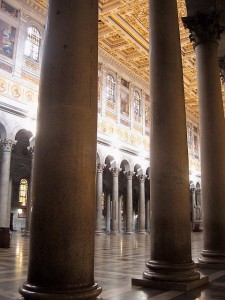
The first was the awe-inspiring beauty of the churches there. The picture to the right is just one of the many pictures I took in Rome…my picture-taking slowed after the first three days because there was just too much beauty to take it!
Additional, after a while many of the churches seemed more like museums. About half the churches did not have the Blessed Sacrament present, most buzzed with tourists doing their best to keep quiet, and amid the gilded enormity of the spaces, it was hard to find an intimate space in which to pray.
Obviously I don’t say this to criticize these artistic masterpieces or their preservation in any way. I just think that I was expecting to be struck in a more reverent, spiritual way by these buildings.
Surprisingly this “disappointment” made me appreciate our little chapel here at the Central Pastoral Administration building of the Archdiocese. Anyone who has heard me talk about this chapel knows how little I care for its design. Picture a big empty box, plain brick walls, angular color-block stained-glass windows, spotty lighting, grayish carpet, and our lovely 70s-era avocado-green leather kneelers.
But ya know what? Even in that artless room, I feel closer to Him than I did standing in the exquisite St. Paul Outside the Wall. Why? Because Jesus is present in the Blessed Sacrament! And in the afternoons when I go to pray, I know He is there for me…regardless of how ugly the kneelers are.
My Lord and my God, I firmly believe that you are here, that you see me, that you hear me.
I adore you with profound reverence; I ask you for pardon of my sins and grace to make this time of prayer fruitful.
My Mother Immaculate, Saint Joseph my father and lord, my Guardian Angel intercede for me.
-Handbook of Prayers
A generation has passed since the publication of the boldly pastoral and prophetic encyclical Humanae Vitae which upheld the ancient ban on the use of artificial contraception. Perhaps no teaching of the Church causes the worldly to scoff more than our teaching against artificial contraception. The eyes of so many, Catholics among them, roll and the scoffing begins: Unrealistic! Out of touch! Uncompassionate! Silly! You’ve got to be kidding!
The Lord Jesus had an answer to those who ridiculed him in a similar way:
“To what can I compare this generation? They are like children sitting in the marketplaces and calling out to others: ” ‘We played the flute for you, and you did not dance; we sang a dirge and you did not mourn.’ For John came neither eating nor drinking, and they say, ‘He has a demon.’ The Son of Man came eating and drinking, and they say, ‘Here is a glutton and a drunkard, a friend of tax collectors and “sinners.” ‘ But time will prove where wisdom lies.” (Matt 11:16-18)
Indeed, times DOES prove where wisdom lies. Some forty or more years after widespread acceptance of contraception set in how have we done? Perhaps it is best to review some of the “promises” that contraceptive advocates made, then review the prophecies of Paul VI. Then lets review the record, looking at the “fruits” of contraception.
The Promises of the Contraception Advocates:
Happier Marriages and a lower divorce rates since couples could have all the sex they wanted without “fear” of preganancy.
Lower abortion rates since there would be far fewer “unwanted” children.
Greater dignity for women who will no longer be “bound” by their reproductive system.
More recently contraceptive advocates have touted the medical benefits of preventing STDs and AIDS.
What were some of the concerns and predictions made by Pope Paul VI? (All of these are qutoes from Humanae Vitae)
Consider how easily this course of action could open wide the way for marital infidelity (Humanae Vitae (HV) # 17)
A general lowering of moral standards. Not much experience is needed to be fully aware of human weakness and to understand that human beings—and especially the young, who are so exposed to temptation—need incentives to keep the moral law, and it is an evil thing to make it easy for them to break that law. (HV # 17)
Another effect that gives cause for alarm is that a man who grows accustomed to the use of contraceptive methods may forget the reverence due to a woman, and, disregarding her physical and emotional equilibrium, reduce her to being a mere instrument for the satisfaction of his own desires, no longer considering her as his partner whom he should surround with care and affection. (HV # 17)
Who will prevent public authorities from…impos[ing] their use on everyone. (HV # 17)
So, forty years later, who had the wisdom to see? The World or the Church? Well lets consider some of the data:
The divorce rate did not decline. It skyrocketed. Divorce rates soared through the 1970s to to the 1990s to almost 50% of marriages failing. In recent years the divorce rate has dropped slightly but this may also be due to the fact that far fewer people get married in the first place, preferring to cohabitate and engage in a kind of serial polygamy drifting from relationship to relationship. The overall divorce rate despite its slight drop remains high, hovering in the low 40% range. Contraceptive advocates claim that divorce is a complicated matter. True enough. But they cannot have it both ways, claiming that contraception would be a “simple” fix to make marriages happier and then, when they are so horrifyingly wrong, claiming that divorce is “complicated.” Paul VI on the other predicted rough sailing for marriage in advent of contraception. Looks like the Pope was right.
Abortion rates did not decrease. They too skyrocketed. Within five years the pressure to have more abortion available led to its “legalization” in 1973. It has been well argued that, far from decreasing the abortion rate, contraception actually fueled it. Since contraception routinely fails, abortion became the contraception of last recourse. Further, just as the Pope predicted sexual immorality became widespread and this too led to higher rates of abortion. It is hard to compare promiscuity rates between periods since people “lie” a lot when asked about such things. But one would have to be very myopic not to notice the huge increase in open promiscuity, cohabitation, pornography and the like. All of this bad behavior made more possible by contraceptives also fuels abortion rates. Chalk up another one for the Pope and the Church.
The question of women’s dignity is hard to measure and different people have different measures. Women do have greater career choices. But is career or vocation the true source of one’s dignity? One’s dignity is surely more than their economic and utilitarian capacity. Sadly, motherhood has taken a real back seat in popular culture. And, as the Pope predicted women have been hypersexualized as well. Their dignity as wives and mothers has been set aside in favor of the sexual pleasure they offer. As the Pope predicted many modern men, no longer bound by marriage for sexual satisfaction, use women and discard them on a regular basis. Men “get what they want” and it seems many women are willing to supply it rather freely. In this scenario men win. Women are often left with STDs, they are often left with children, and as they get older and “less attractive” they are often left alone. I am not sure this is dignity. But you decide who is right and if women really have won in the new morality that contraception helped usher in. I think the Pope wins this point as well.
As for preventing STDs and AIDS, again, big failure. STDs did not decrease and were not prevented. Infection rates skyrocketed through the 1970s and 1980s. AIDS which appeared on the scene later continues to show horribly high rates. Where is the promised deliverance? Contraceptives it seems, do not prevent anything. Rather they encourage the spread of these diseases by encouraging the bad behavior that causes them. Here too it looks like the Church was right and the world was wrong.
Add to this list the huge teenage pregnancy rates, the devastation of single parent families, broken hearts and even poverty. The link to poverty may seem obscure but the bottom line is that single motherhood is the chief cause of poverty in this country. Contraception encourages promiscuity. Promiscuity leads to teenage pregnancy. Teenage pregnancy leads to single motherhood (absent fatherhood). Single motherhood leads to welfare and poverty. Currently in the inner city over 80% of homes are headed by single mothers. It is the single highest factor related to poverty.
Declining birth rates are also having terrible effects on contracepting cultures. Europe as we have known it is simply going out of existence. I have written on that before HERE: Contraception is Cultural Suicide! Europe’s future is Muslim. They have huge families. Likewise here in the USA white and African American communities are below replacement level. Thankfully our immigrants are largely Christian and share our American vision. But for the Church the declining birthrates are now resulting in closing schools, parishes, declining vocations and the like. We cannot sustain what we have on a population that is no longer replacing itself. Immigration has insulated us from this to some extent but low Mass attendance has eclipsed that growth and we are starting to shut down a lot of our operations.
Conclusion: Time will prove where wisdom lies. What have we learned in in over forty years of contraception? First we have learned that it is a huge failure in meeting its promises. It has backfired. It has made things worse, not better. Marriage, families, children have all taken a huge hit. Bad behavior has been encouraged and all the bad consequences that flow from it are flourishing. Most people seem largely disinterested in this data. Hearts have become numb and minds have gone to sleep. I hope you are not among them and that you might consider this information well and share it with others. Time HAS proved where wisdom lay. It’s time to admit the obvious.
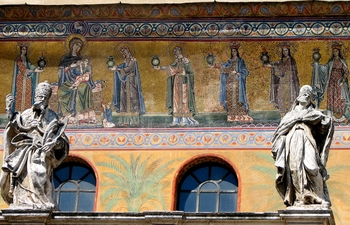
This is the screen saver on my computer at work. It is the facade of the Church of Santa Maria in Trastevere, in the Trastevere neighborhood in Rome. It depicts the women from Matthew’s Gospel and the story of the wise and foolish virgins (Matthew 25). The church sits in the middle of a bustling piazza and so it looks as if the women are carrying is right into the middle of life in the piazza. The Gospel story has an Advent feel to it because it reminds us that we know not the day or hour when our Lord will return and so we need to be alert and ready, looking for to walk right into the midst of our lives–here and now!
Limits and Promise
A few years ago I came across this poem by someone called T.J. O’Gorman of whom I know nothing other than this work which is an Advent favorite of mine.
It really should be “The Faith and our World.” Faith comes first and all things should be seen by the light of Faith. But many people have it exactly backwards. Instead of the world being on trial it is more often our Faith and the Scriptures that end up on trial. For a Christian it should be the world that comes under our scrutiny through the Word of God and the truth of our Faith. We ought to have some pretty tough questions for the world:
Why is revenge and violence your way?
Why do you celebrate promiscuity?
Why do you constantly think that money and power is what makes you great?
Why do you kill the unborn and praise it as a right?
Why do you reject the wisdom of prior years as recorded in the Scriptures and Tradition?
Why do you hate authority and any limits on your behavior?
Why do you struggle so much with addiction?
Why can’t you stay married?
Why are your children’s test scores dropping? Why are they getting pregnant? Why do they have STDs?
Why are your priorities so messed up?
Why are you so worked up about silly things like Hollywood and Sports but not very interested in Faith, truth and justice and your final end?
Why do you trust the shifting opinions of men more than the lasting truth of God?
Most Christians should be asking these sort of pointed questions to a world gone mad. But too many, filled with worldly thinking, put the Church, and Scripture on trial and demand answers only of these.
The fact is, too many Catholics tuck their faith under their politics, under their worldview, under their preferences. Instead of judging politics by faith, faith gets judged based on political views. Most Christians are far more passionate about politics than faith and if there is a conflict between what their faith says and what “the Party” says, guess what gives? A large number of Catholics base their moral reasoning not on Scripture or Church teaching but on what Hollywood stars, politicians, and pop-culture figures say.
And therefore when the Church does speak and/or Scripture is referenced and it goes against any of the modern thinking from the world gone mad, angry denunciations, or scoffing, laughter and so forth come forth even from Catholics. It is exactly backwards. It is the world that deserves this treatment. It is the world that deserves to come under our scrutiny and answer to our faith. The world should seem downright strange and alien to us, inimical to our understanding. The Book of James makes it plain:
Know you not that friendship with the world is hatred toward God? Anyone who chooses to be a friend of the world becomes an enemy of God. (James 4:4)
And God does in fact seem an enemy to many. They may not be able to see it that clearly so they direct their condemnation at the Church or at the Bible. But in the end these are just deflections since the Church and Scripture are merely reporting what God clearly teaches.
In the end, why not put the world on trial? Why not test the world by faith and see all things by the light of faith? Why not store up some pointed questions for a world gone mad? The early Christians who renounced the ways of the world and knew that the Lord had called them out of the world had a saying: Let grace come, and the world pass away. Maranatha! (Come Lord) (Didache, 10)
The following video is an excerpt from a sermon I preached Yesterday here at the Parish. Audio is me, photos are of the parish.
I have noticed that it is very common today that moral assessments seem to center quite a lot around the intentions and feelings of the person involved. What is actually being done seems less significant and as long as a person “means well” or feels something is right then it is OK for them and we should make no further moral discernments. It is enough for too many that the person feels the act is right and means well.
But the fact is such criteria are NOT enough. Moral uprightness consists in doing well, not just meaning well or feeling well. Intentionality is not wholly insignificant, especially when it comes to assigning a level of “culpability” (guilt or blame). But intentionality and surely feelings cannot be the only determinative factors in assessing a moral act. We must look at the act itself, what actually happens, as the primary consideration of the moral quality of that act. We cannot simply say that something is good, it must actually be good.
Let me give a few examples as to why the actual, concrete act is the essential factor in determining the goodness or fittingness of an act.
Every day I move between the buildings that make up our parish plant. Going in and out of buildings requires the use of keys. Now many of these keys look alike. As I approach the Church door, I take out my keys and put what I think is the Church key in the lock. Now I do this with best of intentions. I think I am doing what is right, I feel that what I am doing is right. Only problem is that I put the rectory key in the Church lock. Despite all my good intentions, despite that I thought and felt I was doing what was right, the lock does not turn. All the good intentions in the world will not make that lock turn. I may swear that I think I am right, and that I feel right. But none of those things will win the day and turn that lock. I actually have to DO what is right to get the proper result. The right key has to go in the right lock to get the right result. What I actually do is the determinative factor. Feelings, thoughts and intentions cannot win the day.
To get to your house you tell me to turn right on Park Ave. But I turn left. I may think you said left, I may sense or feel I am going in the proper direction, I may intend to be doing what is right but none of that is going to change the fact that I am going 30 mph in the wrong direction and am not going to get to your house until I actually DO what is right.
There is a can of paint in a hallway as I walk down. I kick the can of paint over and paint spills all over the floor. Whether I did so intentionally or not will not change the fact that we’ve got a mess on our hands here that has to be cleaned but. But in this example, intentionality and what I think or know is important to determine how blameworthy I am. It is possible that my act of kicking the paint over was purely accidental. Perhaps I was unaware that painting was going on in the hall and I could not see the can as I rounded the corner. In this case my culpability (or blameworthiness) is probably very low if not non-existent. But suppose I knew there was painting going on and failed to exercise proper attentiveness. I kick the can of paint over through carelessness. In this case I have some blame. But suppose I saw the can of paint and (perhaps out of anger) purposefully kicked it over. Now my blame is full. So intentions, knowledge and feelings are important in assessing the blameworthiness of a person. But these things cannot render a bad thing good. No matter what my intentions thoughts or feelings, we still have a big mess to clean up. The objective truth is that there is paint all over the floor. Simply saying, I had good intentions or didn’t know any better does not make the mess go away.
Too many people today use flawed or incomplete reasoning when it comes to morally assessing acts. Intentions, how a person feels, or what they think and know can affect blameworthiness buy they cannot make a bad thing good, they cannot make an evil act upright, they cannot remove the harm or negative results of an incorrect, bad or evil act. There is still a mess to clean up. There is still a U-turn to make, there is still a right key to find. Reality sets in.
There is a lot of flawed moral reasoning today around the issue of intentionality, feelings and thoughts. Important though these factors are they cannot undo reality. They cannot form the basis for judging the uprightness or wrongness of an act. Time to get back to reality in moral judgments. Time to do well, not just mean well. Time to actually do what is right not just think or feel you’re right. Back to reality.
The following video is a good example of the world’s moral reasoning. A man is in jail. All we need to know is that he meant well and had the best of intentions. How he landed in jail, all the other wrong things he’s done in his life, they matter so little that we are not even told what they were. ALL that matters is that he had the best of intentions. “Enjoy” the video.
What do Buffalo Bill Cody, Johann Christian Bach, Salvatore Dali, Dorothy Day and Emperor Constantine have in common? They are all converts to the Catholic Faith!
In the Department of Evangelization and Family Life, we spend a lot time looking at research that studies the number of Catholics who have stop practicing the faith or left the Church or feel alienated from the Church. Happily, we also oversee the welcoming of new Catholics to the Church.
One of the great pleasures of working with an RCIA (Rite of Christian Initiation of Adults) program is hearing the stories of what makes people decide to explore the Catholic Faith. Some of the stories are remarkable; a chance meeting with a Catholic, falling in love with the writings of Flannery O’Connor, trying lots of other churches and just not finding the right fit, thinking about all the people you admire and realizing one thing they share in common is the Catholic faith. These are the stories heard around a table in a Church meeting room. Wouldn’t it be fascinating to know what made Salvatore Dali or Buffalo Bill Cody make the decision to start exploring the Catholic faith? I find stories of conversion intriguing, not only for learning how the person is awakened to the presence of God in his or her life but also seeing how persistent the Lord is in urging, prompting, leading, and guiding people toward his Father and toward the Church.
Here Comes Everyone
After seeing the video below, I also am reminded that from the time Jesus first started inviting people to follow him, he did not have just one kind of person in mind, he casts his net long and wide. Artists and emperors, writers and wranglers, actors and activists; poets and preachers; penniless and prosperous—all have a place at the table of the Lord.
What is it that really hold us in bondage? What is it that is truly the source of our problem, our sins, our selfishness, our anger, our lust and pride? Original Sin? Yes but where does the wound of sin really set up shop in us and stay open for business? What does it tap into for its strength? Scripture has an interesting answer to this question:
Since the children have flesh and blood, he too shared in their humanity so that by his death he might destroy him who holds the power of death—that is, the devil— 15and free those who all their lives were held in slavery by their fear of death. (Heb 2:14-15)
Now this passage is clear enough that the first origin of sin is the devil. But it also teaches that the devil’s hold on us is the “fear of death.” This is what he exploits to keep us in bondage. When I explore this teaching with people I find that it is difficult for many to understand at first. For many, especially the young, death is kind of theoretical. It is not something many people fear on a conscious level. Every now and then something may shake us out of our complacency (perhaps a brush with death) but as a general rule the fear of death is not something that seems to dominate the thoughts of many. So what is meant by the “fear of death” and how does it hold us in bondage?
Well, what if we were to replace the word “death” with “diminishment”? This can help us to see what this text is getting at. It doesn’t take long to realize that each diminishment we experience is a kind of “little death.” Diminishments make us feel smaller, less powerful, less glorious.
What are some examples of diminishments we might experience? At one level, a diminishment is anything that makes us feel less adequate than others. Maybe we think others are smarter, or more popular. Perhaps we do not feel handsome enough, pretty enough, we’re too tall, too short, too fat, wrong color hair. Maybe we hate that others are richer, more powerful, better spoken, better looking. Maybe we are older and wish we were younger and stronger, thinner and more energetic again. Maybe we are younger and wish were older, wiser, richer and more settled. Maybe we feel diminished because we think others have a better marriage, nicer home, better kids, or live in a better neighborhood. Maybe we compare ourselves to a brother or sister who did better financially or socially than we did.
Perhaps you can see how the fear of diminishment (the fear that we don’t compare well to others) sets up a thousand sins. It plugs right into envy and jealousy. Pride comes along for the ride too since we seek to compensate our fear of inadequacy by finding people whom we feel superior to. We thus indulge our pride or we seek to build up our ego in unhealthy ways. Perhaps we run to the cosmetic surgeon or torture ourselves with unhealthy diets. Perhaps we ignore our own gifts and try to be someone we really are not. Perhaps we spend money we really don’t have trying to impress people so we feel less adequate. And think of the countless sins we commit trying to be popular and fit in. Young people, and older ones too, give in to peer pressure and do sometimes terrible things. Young people will join gangs, use drugs, skip school, have sex before marriage, pierce and tattoo their bodies, use foul language, gossip etc. Adults too have many of these things on their list. All these things in a quest to be popular and to fit in. And fitting in is about not feeling diminished. And diminishment is about the fear of death because every experience of diminishment is like a mini death.
Advertisers too know how to exploit the fear of death (diminishment) in effectively marketing their product. I remember studying this in the Business School at George Mason University. What advertisers do to exploit our fear of diminishment is to actually diminish us. The logic goes something like this: you are not pretty enough, happy enough, adequate enough, comfortable enough, you don’t look young enough, you have some chronic illness (depression, asthma, E. D. diabetes) , etc. So use our product and you will be adequate again, you won’t be so pathetic, incomplete and basically diminished. If you drink this beer you’ll be happy, have good times and friends will surround you. If you use this toothpaste or soap or cosmetics, beautiful people will be around you and sex will be more available to you. If you drive this car people will turn their heads and so impressed with you. Message: you are not adequate now, you do not measure up, you are not perfect (you are diminished) but our product will get you there! You will be younger, happier, healthier and more alive. Perhaps you can see how all this appeal plugs into greed, pride, materialism, worldliness, and the lie that these things will actually solve our problem. They will not. In fact appeals like this actually feed our fear of diminishment and death even more because they feed the notion that we have to measure up to all these false or unrealistic standards.
OK, got the point? Fear of Death (diminishment) is the fundamental drive that keeps us in bondage. Now the text above says that Jesus died to free us from all this. So if freedom is available where do I find it? Let me recommend the following steps:
Recognize the demon, name it: “Fear of Death” or if it helps “Fear of Diminishment.” Learn its moves, tactics, hidden appeals (like we discussed above). And when you see the ugly little demon rebuke him in the name of Jesus.
Ask the Lord for the gift of gratitude; the gift to be grateful for what he has given you, how he has made you, the talents and abilities he equipped you with, the home, family and life he has granted.
Beg for the grace to experience that you are mightily loved by God. That you are unique and irreplaceable.
Watch less TV, draw back more from popular culture. Draw deeply from the font of Scripture and Catholic Tradition, read time-tested classics and edifying materials (like this blog ( 🙂 ).
Accept that there are people who have gifts you do not have. Pray for the gift to rejoice in their gifts and that the Lord can bless you through the gifts and talents of others. Realize that you have gifts others do not have and bless them with these gifts too.
Remember that we can only see the outward appearance of things. Often when we size other people up as having a wonderful life we don’t really know what we are talking about. Many people have hidden sorrows, sins and setback of which we know little.
Realize that you are going to die. But realize too that if we die in Jesus we are not diminished, we gain everything. Allow this understanding of physical death to be vision you have of every true diminishment, large or small. It is not ultimately death, it is humility. And without humility we will never get to heaven.