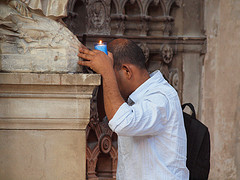
Some two hundred years ago, a Cherokee Indian named Drowning Bear allowed a missionary to read to him several chapters of the Bible. After having listened for some time, Drowning Bear said to the missionary: “It seems to be a good book; strange that the white people are not better after having had it for so long.”
Drowning Bear’s implication was that if we actually lived in obedience to the Word of God, our lives would be dramatically better as a result. This was precisely our Lord’s point in today’s gospel. Jesus invites us not only to hear his Word; he wants us also to act on it. To put it another way, God’s Word was spoken not simply for our information. Instead, it’s meant for our application, that our lives might be blessed with transformation.
For this to happen, however, we first need to listen. We can’t act on God’s Word if we can’t hear it! Unfortunately, listening isn’t something we’re always good at doing. In an old joke, a crabby husband asks his wife, “Why do women talk so much?” To which his rightfully annoyed wife replied: “Because we have to say everything twice!” The joke’s point is that we don’t always listen very well to each other. Sometimes we also don’t listen very well to God- and there’s nothing too funny about that
It might be that we’re too distracted to listen to God. When the “Word of the Lord” is proclaimed for us, our expected response is “Thanks be to God.” If we were honest, however, we probably should say, “Huh? Could you say that again?” One contributing factor is “information overload.” Through every conceivable form of media – electronic and otherwise- we’re bombarded with more data than we’re able to handle. It can shatter our attention spans and make us very reluctant to add any additional voices to the mix- even if it’s God’s.
Another reason we don’t listen well to God’s Word is that it gets drowned out by “cultural static.” It’s easy to understand why this happens. The world literally shouts at us – “Look at me! Buy me! Sleep with me!”- and we can’t seem to hear anything else- especially God, who typically speaks in whispers. And the same world that shouts at us insists that we join the rat race. We wind up so exhausted that making time for God’s Word seems like a luxury, something to put off for a day when we’re less stressed. It’s not that we’ve pushed God’s Word away; it’s simply been squeezed out.
But sometimes we do push God’s Word away, because we don’t want to hear it. We’re afraid of what we might be told and what changes God will call us to make in our lives. Maybe it’s about money. Or forgiveness. Or our relationships. Or sex. Perhaps we’re too proud, too angry, or too addicted to listen. Whatever it may be, we know that with knowledge comes responsibility, so we try to take the “ignorance is bliss” approach. When we do this, it’s not society or our schedules that’s interfering with the Word of God. We have only ourselves to blame, because we’ve stuck our fingers in our ears.
We only plug our ears, however, when we think that God’s Word might have something valid to say to us. At times, we think just the opposite. We don’t make ourselves deaf to God’s Word; we simply dismiss it, because we’re convinced that it has nothing to say to us, or that it’s too confusing or old-fashioned to bother with. Should this be the case, we’re in good company. St. Augustine, a great figure from the Church’s first centuries, once felt exactly the same way. As a young man, he read the Bible in his quest for truth, but found himself disappointed. He didn’t encounter the lofty philosophy he preferred to read, but accounts of violent conflict and very imperfect people that left him confused.
All that changed when Augustine met St. Ambrose, whose preaching helped him understand the Bible for what it is: An inspired account of God’s unfolding plan throughout history, all leading to Jesus. Augustine came to appreciate that not only is Jesus the key to understanding the Bible, but that Jesus himself is heard through the Bible. The Bible is the Word of God- because through it we hear the voice of Jesus, who is the Word of God: the Word-made-flesh.
It is this voice that today’s Scriptures challenge us to listen to, and act upon, today. In our noisy world, we can be deaf to God’s Word. In our selfish world, it’s tempting to resist God’s Word. In our skeptical world, it’s fashionable to dismiss God’s Word. In our overscheduled world, it’s easy to neglect God’s Word. Yet we neglect God’s Word at our peril. Life can be hard, challenging, painful, confusing. Maybe that’s why Jesus spoke of powerful winds and rain in his parable, because they describe what we feel like we’re contending with at times. Jesus’ point was that if we build our life upon his Word, we’ll have the strength and resources to withstand the flood waters when they rise. And if we don’t, we won’t, and we risk being swept away by the currents.
To build our lives upon God’s Word is like building our house on rock, as Jesus said. Think of Manhattan, if you will: Perhaps the greatest concentration of brick, mortar, steel and timber anywhere in the world. And all of it rests upon a huge mass of rock. Anything else couldn’t bear the weight. That’s true of our lives, too. Sometimes we have a heavy load to bear; it can seem like we have the weight of the world upon our shoulders! We can bear the strain…but only if our life’s foundation is the rock of the Word of God.
Drowning Bear was right: God’s Word is good, and we have indeed had it a long time. But it’s up to us to listen, act, and allow ourselves to be changed.
This week brings an end to our six week meditation on the Sermon on The Mount of Jesus (Matt 5-7). We do well to remember some basic fundamentals about this wonderful sermon of our Lord:
The Lord is not merely reciting moralisms. The word moralism tends to refer to the mere recitation of rules and norms more as slogans than as deep truths that emerge from a vision of life.
The Lord is describing more than he is prescribing. In effect he is painting a picture of what the transformed human being is like. What happens to a human person whom the Lord, through his indwelling Holy Spirit, is transforming? We will review some of this picture below.
This transformation is a work of God, not of the flesh. It is the Lord who works this in us by living his life in us. As we enter more deeply into a life-changing and transformative relationship with Jesus this is what begins to happen in us and what begins to grow.
This concept of a life changing and transformative relationship will be important to remember in today’s Gospel passage when the Lord declares rather solemnly that he does not “know” some of us.
In today’s Gospel we come face to face with the ultimate necessity of allowing the Lord to transform us. The Lord, in the Sermon on the Mount , is offering us a whole new life and we must choose to accept it and see our life change, based on it, or we will simply be unfit to enter the Kingdom of Heaven.
Our flesh hates these sort of “all or nothing” scenarios. We prefer things to be vague and fuzzy. We prefer a “many paths to God” scenario. But in the end our preferences do not change the reality which the Lord sets before us: we are going to spend eternity either with God or apart from him. There is heaven or there is hell. Tertium non datur (no third way is given). The Lord chooses to finish this sermon with an urgent call: Either come to know me by faith and let me transform you or be unfit to enter the reign of God. You and I must choose.
Let’s look at this Gospel in three stages.
I. The Discipleship that must be seen – The text says, “Not everyone who says to me, ‘Lord, Lord,’ will enter the kingdom of heaven, but only the one who does the will of my Father in heaven. There is a strong tendency in our flesh to be intentional but not actual, and then to think that is enough. It is very easy for our flesh to make commitments but then not keep them. To be verbally supportive, but not be willing to make the sacrifices necessary to be actually supportive. And too often we tell ourselves that this is enough.
But at some point we have to realize that it is not enough to mean well. We actually have to do well. Scripture says elsewhere: If anyone has material possessions and sees his brother in need but has no pity on him, how can the love of God be in him? Dear children, let us not love with words or tongue but with actions and in truth. (1 John 3:17-18).
To illustrate another way, if you give me directions to get to your home, I actually have to follow them to get there. I cannot, a certain intersection, say, “Well I don’t feel like turning here,” and then think I am going to arrive at your home. Likewise, I cannot be negligent in the details, just breezing through intersections and only half paying attention, and think I will arrive at the destination. I have to actually follow the directions. Vaguely following them is not enough, and explicitly ignoring or violating them will send me to the wrong end of town. Now, God has told us how to get home to heaven. Yet too often we want to think that we can carelessly navigate through life and still end up at the proper destination. Others think that they can outright disobey one or more of the directions and still get home. It just doesn’t work that way. The only way home is to obey the directions given us.
It is true that the Lord allows us U-turns and permits us, when we get lost, to make a cell phone call (repentance and confession) to clarify directions and redirect. But in the end, the critical point is, we simply have to obey. There is just no other way. Saying Jesus is Lord is not enough. He actually has to be Lord. The term “Lord” refers to one who has authority, who has ownership. And so Jesus says elsewhere: Why do you call me “Lord” and not do what I tell you? (Luke 6:46). The Lord wants to be clear with us: it is simply not possible to enter the kingdom of heaven unless we obey.
Our flesh wants to water this down and think that merely intending to obey, merely meaning well and having positive thoughts about God is enough, or that following some of the time, or most of the time is enough. It is not. Obedience, actually following the directions is also necessary.
Only Jesus himself perfectly obeys the Father. That is why it is necessary for us to allow Jesus to live his life in us. Only knowing the Lord and allowing him to transform us in the ways he has described in previous weeks will enable us to reach our destination. Only Jesus living in us can bring about saving obedience.
But note, this obedience has to be real. The transformation that Jesus offers us is not an abstraction. It is about a real change in our life. Merely saying I have given my life to the Lord is not salvation. The real proof that we have actually given our life over to God, not just saying we have, is to be actually experiencing the transformation he has promised. This alone can get us home.
Ok, so the Lord is being very clear with us here. Actual obedience is the only way home. There just isn’t any other way.
II. The Disclosure that is sure – The text says: Many will say to me on that day, ‘Lord, Lord, did we not prophesy in your name? Did we not drive out demons in your name? Did we not do mighty deeds in your name?’ Then I will declare to them solemnly, ‘I never knew you. Depart from me, you evildoers.’ There is a sure and certain Day of Judgment looming for each one of us. Scripture says elsewhere: For we must all appear before the judgment seat of Christ, that each one may receive what is due him for the things done while in the body, whether good or bad (2 Cor 5:10). The day is fixed and it is certain when our true disposition with be disclosed. Are we true disciples or just actors? Is Jesus really our Lord or just somewhere on our list of friends? Have we really obeyed or just played fast and easy occasionally “checking off the God-box?”
But here is the key question. Do we know the Lord and does he know us? Notice how Jesus says to them, “I never knew you.” We studied before that to “know” in the Bible almost always means more than mere intellectual knowing. To “know” in biblical terms means to have deep, intimate, personal experience of the thing or person known. Notice how deeply relational knowing is, in this sense. It is one thing to know about God and something far deeper to KNOW God. And Lord invites us to this sort of relationship:
* That we know him and are known by him.
* That our relationship with him is not merely having some intellectual impression, or a command of certain fact, but rather, that we have a deep experience of him,
* That we be in living, conscious contact with him,
* That we be in a transformative relationship with him,
* That we become increasingly one with him.
* That we know him, and allow him to know us.
And thus the Lord declares here to them that he does not know them. That they have not agreed to, or permitted the knowing relationship which is at the heart of heaven, and which would have prepared them for heaven. They insist that they “know” Jesus but their description highlights a mere intellectual knowing and a kind of “using” of the Name of Jesus. They “used” his name but did not really call on His name. They knew of him but they did not KNOW him. It is very possible for priests, religious and other religious leaders to announce Jesus but not to hear him calling them. Any Christian can fall into this trap. They love to discuss religion but do not really have true faith. They will argue for and about God, but refuse to be transformed by Him. They will consider God, but only on their own terms.
What does it mean to be known by God? In the end, the only way into heaven is to know God and be known by him. To be in a transformative relationship with Jesus Christ that is living and conscious and very real. The evidence of this relationship is not just that we say we have it, but that we are experiencing the real fruits of it. And the fruits of this relationship are what Jesus is offering to do for us and has been describing all along in the Sermon on the Mount:
That we are poor in spirit, meek, hungering and thirsting for righteousness, merciful, single-hearted, and peaceful (Mat 5:3-11)
That we are salt and light (Matt 5:13-16)
That we have authority over our anger and are respectful of and reconciled to our brethren (Matt 5:21-26)
That we have authority over our sexuality, have pure minds and hearts, free from lust and sexual exploitation (Matt 5:27-30)
That we love our spouse and family members, are faithful to our marital commitments and hold marriage in high esteem (Matt 5:31-32)
That we are true to our word, faithful to our commitments and speak the truth in love (Matt 5:33-37)
That we feel no need to retaliate and are generous in serving and toward the poor and needy (Matt 5:38-42)
That we love our enemies and persecutors. That we develop a compassion and understanding of the troubled people we meet and want only that which is good for them (Matt 5:43-48)
That we have a deep affection for the heavenly Father and a trusting relationship that drives out fear and anxiety of what others think or what may happen. (Matt 6)
To truly know the Lord Jesus and be in a knowing relationship with him is to experience this sort of transformation and more. Lip service does not yield this sort of radical transformation. Only knowing and being known by the Lord can bring forth this sort of fruit. And only this sort of transformation can make heaven possible for us. Jesus says,
I am the vine; you are the branches. If a man remains in me and I in him, he will bear much fruit; apart from me you can do nothing. If anyone does not remain in me, he is like a branch that is thrown away and withers; such branches are picked up, thrown into the fire and burned…..This is to my Father’s glory, that you bear much fruit, showing yourselves to be my disciples. As the Father has loved me, so have I loved you. Now remain in my love. If you obey my commands, you will remain in my love, just as I have obeyed my Father’s commands and remain in his love. (John 15:5-10)
Thus, our obedience, the keeping of the commandments, is a chief sign that we are actually in this transformative relationship that alone can prepare us for heaven. Notice that the keeping of the commandments is the fruit of love, not the cause or it. It is the fruit of our relationship with Jesus, not the cause of it. It is the fruit, of the vine, not the cause of the vine. To remain in Jesus is to know him and be known by him. This alone is the way to heaven. There just isn’t any other way. And the day that will disclose our choice is looming for each of us.
III. The Designation that is Supplied – The text says, Everyone who listens to these words of mine and acts on them will be like a wise man who built his house on rock. The rain fell, the floods came, and the winds blew and buffeted the house. But it did not collapse; it had been set solidly on rock. And everyone who listens to these words of mine but does not act on them will be like a fool who built his house on sand. The rain fell, the floods came, and the winds blew and buffeted the house. And it collapsed and was completely ruined.
A pretty simple parable in essence. Either you are going to be among the wise in heaven or the fools in hell. Either we will listen to Christ and build on the solid rock of his teachings and thus withstand the storm that is coming, or we will foolish refuse to listen and not withstand the coming storm.
Make no mistake, the storm is coming. It will surely come for us on the day of judgment.
But it is also possible to see this parable applied to everyday life. Some people live foolishly. Perhaps it starts when they are young. They goof off in school, get bad grades, join gangs, have an arrest record before 15. Others smoke dope, drink excessively, fornicate and so forth. And before you know it their whole house is close to collapsing: no job, no income, pregnant at 15, full of STDs, addicted, going nowhere. Or divorced, remarried, divorced again, had a baby by a third woman. All their income going to alimony and child support, complicated visitation rights, and one big mess for a life, not anyone’s Father, just some baby’s daddy. Life gets complicated pretty fast when we foolishly indulge in sin! And the storms multiply and the house eventually collapses. A ruined, foolish life already experiencing hell.
But others live wisely. Perhaps as youngsters they studied hard, went to Church, obeyed their elders, learned self-control and were careful about the company they kept. And sure enough, doors opened: College, then a good job. A carefully discerned marriage to one spouse, a marriage marked by fruitfulness and fidelity. In the end their children too were a blessing. Such a life is not trouble free but it is a LOT simpler and the storms are less frequent. And when the storms do come, the house of their life does not collapse for is to set on the solid foundation of God’s teaching. He here is the life of the wise, fruitful and heavenly bound.
In the end, there’s just no other way. Either be wise: know Christ and be known by him, or be a fool. Let Christ find you. Know him and be known by him. Let him transform you and prepare you for heaven. There’s just no other way.
Some Computer problems today mean I cannot easily post a new blog tonight. Back up to speed tomorrow. I could not think of a better post to re-post that this one with a few additions:
The maker of all humans beings (GOD) is recalling all units manufactured, regardless of make or year, due to a serious defect in the primary and central component of the heart. This is due to a malfunction in the original prototype units (code named Adam and Eve 1.0) resulting in the same defect in all subsequent units. This defect has been technically termed “Sorrow Inducing Non-morality (S.I.N.). Some of the symptoms include:
Loss of direction
Foul vocal emissions
Amnesia of Origin
Lack of peace and joy
Selfish or violent behavior
Depression or confusion in the mental component
Fearfulness
Idolatry
Rebellion
Sometimes the units are just plain mean.
The Manufacturer, who is neither liable nor at fault for this defect is providing factory-authorized repair and service, free of charge, to correct this defect. The Repair Technician, Jesus, has most graciously offered to bear the entire burden of the staggering cost of these repairs. Some of the following procedures will be necessary in this repair:
The disk in the heart component must be scrubbed clean of all viruses.
The mental component must be overwritten with new software, (especially WORD of GOD 3.0)
Virus Protection software (such as Pure Eyes 2.0) must be installed to protect the unit from further damage.
Connection to the Maker of all all human beings (GOD) must be re-established through the restoration of communication software in the unit. This is done by installing COMMUNION 2.0 Software and reconfiguring the USB (Upward Soaring Brotherhood) port.
Communications protocols must be upgraded to make sure that the unit says “only the good things men need to hear” and to be sure the unit speaks only that which is true.
Please bring your unit to the nearest Catholic Parish for immediate service. While it is true that WORD of God 3.0 is available for immediate download, an interpretive key must be installed on site at the Catholic parish. Without this interpretive key, WORD of God 3.0 may not function properly in the unit. Further, scrubbing the disk of the heart component can only be done by an authorized technician as well as the installation of COMMUNION 2.0 software. Jesus has personally authorized these technicians to do the work necessary to repair your unit. Upon arrival at a Catholic Parish ask to see the Properly Registered, Indwelt & Elected Service Technician (P.R.I.E.S.T.).
WARNING: Continuing to operate the human being unit without correction voids any manufacturer warranties, exposing the unit to further dangers and problems and will result in the unit being permanently quarantined. For more information on avoiding the “Hell sub-routine” send a kneemail to Jesus at: [email protected]
Please note that emergency service is always available. For information on the location of Catholic Churches and regular service hours go to www.masstimes.org
Two men walking approached a standing ladder. One passed right under it. His companion, however, gave it a wide birth. “You don’t believe that old superstition, do you?” asked the first man. “Not really,” the other answered, “but I don’t want to take any chances- just in case.”
Sometimes we approach prayer the way the second man approached the ladder. We don’t really think it’s going to make a difference, but we go ahead and do it – just in case.
That’s how Peter thought in today’s gospel, when he expressed amazement that a fig tree Jesus cursed had withered. Jesus used this moment to teach us that we shouldn’t be surprised or shocked when our prayers make a difference. Prayer isn’t like wishing upon a star or tossing a coin down a well. Instead, our prayers are offered to a living God who listens, cares, and who always answers in the way that’s best for us. Prayer changes things, and we should always have faith that it does.
We don’t want to be like the crowd who gathered during a drought to pray for rain. The priest sent them home, insisting it wouldn’t rain that day. “Why not?” they demanded. “Because none of you brought an umbrella.”
We have talked before here about some concerns in regard to the New American Bible. Both the translations, and especially the footnotes, are matters of concern. Now comes the news that a revised version is being issued March 9. Here are excerpts of the press release:
The New American Bible, revised edition (NABRE), the first major update to the New American Bible (NAB) translation in 20 years, has been approved for publication…..The NABRE will be available in a variety of print, audio and electronic formats on March 9, Ash Wednesday.
The new translation takes into account advances in linguistics of the biblical languages, as well as changes in vocabulary and the cultural background of English, in order to ensure a more accurate translation. This issue is addressed in the apostolic exhortation of Pope Benedict XVI, Verbum Domini, in which the pope says, “The inculturation of God’s word is an integral part of the Church’s mission in the world, and a decisive moment in this process is the diffusion of the Bible through the precious work of translation into different languages.”
The new translation also takes into account the discovery of new and better ancient manuscripts so that the best possible textual tradition is followed. The NABRE includes the first revised translation of the Old Testament since 1970 and a complete revision of the Psalter. It retains the 1986 edition of the New Testament. Work on most books of the Old Testament began in 1994 and was completed in 2001. The 1991 revision of the Psalter was further revised between 2009 and 2010.
I have seen a few samples of the text and there are things to affirm.
1. The dreadful 1991 Psalter is gone. So significant were the problems with the 1991 Psalter that the Vatican rescinded approval for its use in the liturgy. Among the problems with the older Psalter was an excessive use of “inclusive” language. One of the main problems with this is approach is that it shreds the messianic psalms of their reference directly to Christ. For example, in certain Psalms the text, “Blessed is the man” is often a reference to Christ who alone fulfills the psalm perfectly. Man, in such cases, does not merely mean, “the person who.” However, the 1991 Psalter in current NAB versions renders this phrase, Blessed is the Man as Happy those. In so doing, they lose, not only the gender, (for Christ is male), but they also make the reference plural. Hence a reference to Christ is wholly obscured.
The new Psalter looks to have resolved this problem. I do not have access to the whole new Psalter so I cannot say if it will wholly resolve things. However, one psalm in the sample set is psalm 8. The 1991 version crudely rendered verse 5-6 as What are humans that you are mindful of them, mere mortals that you care for them? Yet you have made them little less than a god, crowned them with glory and honor. The new text says, What is man that you are mindful of him, and a son of man that you care for him? Yet you have made him little less than a god, crowned him with glory and honor.
2. As for inclusive language in general the press backgrounder (found HERE) states the following:
Does this Bible use inclusive language? This edition reflects the original meaning of the texts. Much of the original material, especially in thee narrative books, was gender specific and remains so. All references to God retain the traditional use of masculine pronouns. Where the original reference was gender neutral, the translation reflects that.
This is hopeful, for although some support “inclusive” language, we must remember that we are dealing with a sacred text. It is dangerous to claim to be “more enlightened” than the sacred texts, and then set about editing the text. Hebrew and Greek make greater use of nuance in grammatical gender than English and we ought to respect that fact since, it was in these languages that God chose to set forth his relevation. We conform to the text, we do not merely conform it to us.
3. It’s time for a new translation. A lot has happened since 1970, to which most of the current NAB Old Testament translation dates. Biblical scholarship has clarified texts. In English usage certain usages have change. Of this last point the press release gives a few examples:
Samples of longer text changes are at the end of this document, but some words that no longer appear include “booty” (replaced with “plunder”), “cereal” (replaced with “grain”), and “holocaust” (replaced with “burnt offering”). That is because they have taken on new meanings for modern readers and could distract from the original intent of the Scripture. [1]
All this said, there remain some on-going concerns remain.
1. The 1986 New Testament remains unchanged. There are significant issues in regard to that translation. For example, it renders Gabriel’s salutation to Mary as Hail favored one! (Lk 1:26) instead of the usual and traditional (and probably more accurate) Hail full of grace! There is also the tendency to render the Greek word porneia (sexual immorality) as merely “immorality” (which could mean anything). This is a consistent problem in the Pauline corpus. We have discussed more on these issues here: http://blog.adw.org/2010/08/puzzlement-over-porneia-and-a-pet-peeve/
2. There may be an interpretive key in the new translation of the Old Testament that many do not favor. In a text I was not given access to it would appear that a historicist approach is being taken. Here is an excerpt from the USA Today article that describes the problem:
One change may set off alarms with traditionalists, in a passage many Christians believe foreshadows the coming of Christ and his birth to a virgin. The 1970 version of Isaiah 7:14 says “the virgin shall be with child, and bear a son, and shall name him Immanuel.” The 2011 text refers to “the young woman” instead. It elaborates that the original Hebrew word, almah, may, or may not, signify a virgin.[2]
Now what this seems to indicate is what I call here a historicist approach. In this approach the interpretive key seeks to answer the question “How would a Jew of the 8th Century BC (in this case) understand this verse?” It is possible, and even probable, that a Jew of that era would think merely that a young girl would grow up, get married and have a baby.
But, frankly, I am not all that concerned with how a Jew of the 8th Century BC would understand it. For, as a Christian, I read the Old Testament in the light of the New Testament. And this text is clearly a reference to Mary and Christ. Almah signifies virgin, or young woman in Hebrew because, in that culture, young women were virgins (imagine that!).
New Testament Christians have rightly translated this verse as virgin because its reference to Mary is clearer and virgin is a perfectly acceptable way to translate Almah. But it looks like the editors of the NABRE want us to see it more as a Jew of the 8th Century BC would see it.
Catholic principles allow this interpretation but many do not prefer it since allusions are lost. St. Paul said regarding the Old Testament, these things were written for our instruction (Rom 15:4; cf 1 Cor 10:11). Jesus told the Jewish people of his day regarding the Old Testament: You search the Scriptures because you think that in them you have eternal life; it is these that testify about Me (Jn 5:39).
Hence it seems more proper to read the scriptures not in an historicist sense, but as historical texts fulfilled in the New Testament, and understood in the light of the New Testament. I wish the NABRE would have used this approach which, at least according to this text, it did not.
3. The Footnotes of the New Testament are extremely problematic in places. At times they seem to directly question Catholic doctrine and the scriptural roots of it. We have talked more about that here: http://blog.adw.org/2010/09/new-american-bible-problems-on-purgatory/ I raised one problem, and commenters raised many other issues in the footnotes of the NAB New Testament.
It is my presumption that these bad footnotes will remain in the NT, even though the OT has been revised. Let us hope that the bishops will choose to pull the bad notes and replace them with better ones. Then the NAB will be “safer” for use by the inquiring faithful. Frankly, I struggle to hand it to the faithful with those footnotes. I have not seen the footnotes for the Old Testament in the NABRE and hope they will better annunciate the roots of Catholic teaching.
In the end, there is hope for this new translation. More will be known to us of this new translation next Wednesday when it goes live at the USCCCB website: http://www.usccb.org/nab/bible/index.shtml
The NAB remains the most widely used Catholic Bible and is tied to the liturgy. This new version will require further review at the Vatican before it is approved for liturgical use, but it is likely to take its place in the Catholic liturgy in the next few years. I look forward with hope to on-going improvements in the New Testament sections and will receive the revised Old Testament with great and hopeful expectation this Wednesday.
After losing an important battle, King Louis XIV of France complained, “Has God forgotten how much I’ve done for him?” That’s a deeply arrogant statement! But let’s not cast any stones. It’s easy to conclude that God owes us something.
That’s what James and John did in yesterday’s gospel. Because they were disciples, they assumed they were entitled to special favors, and approached Jesus with a demand: “We want you to do for us whatever we ask of you.”
In today’s gospel, Bartimaeus also approached Jesus. But he didn’t make any demands. Instead, he offered a humble plea: “Jesus, Son of David, have pity on me.”
These two different approaches were met with two different responses from Jesus. James and John’s request was denied, and Jesus actually took them down a notch. But Bartimaeus’ prayer was granted. His sight was restored, and he was praised for his faith.
Maybe it’s significant that Bartimaeus is described as a beggar. As St. Augustine wrote, “Man is a beggar before God,” because it’s as a beggar that we should approach God in prayer. If our prayer is “Give me what I deserve,” we’ll likely wind up disappointed. But if we pray, “O Lord, please give me what I need,” we’ll find, like Bartimaeus, that God always does.
Colleges and Universities are usually thought to be a place where knowledge is conferred. But one is justified; it seems, in questioning whether knowledge can be conferred in settings where common sense and prudence are so gravely lacking. Here are excerpts from an article today in the Washington Examiner:
New Jersey’s flagship state university has decided to allow male and female students to share rooms in three dorms in an effort to make the Rutgers’ New Brunswick campus more inclusive for gay students after a highly publicized suicide last year.
Starting this fall, all students — whether gay, lesbian, transgender or heterosexual — can choose either male or female roommates under the pilot program. Men and women will share bathrooms.
A similar, but smaller, pilot program is being launched at the Newark campus.
A number of other schools, including the University of Maryland, New York’s Columbia University and Washington’s George Washington University, offer similar housing options….
Rutgers got wide attention last year after freshman Tyler Clementi killed himself by jumping off the George Washington Bridge into the Hudson River. Authorities say that days before, his roommate in a dorm used a webcam to capture Clementi during an intimate encounter with another man…..[Following] there was increased scrutiny of the way gay, lesbian and transgender students are sometimes treated on campus….
The absurdity and imprudence of campus life grows graver with each decade. College Campuses, as a general rule, are a grave threat to the moral life of the students who attend. Students, who need clear guidance on moral issues, are thrown by faculty and parents into a moral cesspool of drugs, alcohol, and illicit sexual union. The irresponsibility of college faculty and administrators is nothing short of horrifying.
Of course we have journeyed to this latest absurdity of males and females sharing dorm rooms in stages.
Many years ago many colleges were not even co-ed, due to the reasonable premise that sexual temptation and distractions were problematic in a learning environment. Those colleges that were co-ed carefully segregated the young men and women in separate dorm buildings altogether. Women’s dorms were carefully protected. A guard in the front lobby limited access, and if a young woman had a male visitor she would come down to the lobby and meet him there. Men were not allowed beyond the lobby.
Now I was not born yesterday, and I surely know that there may have been some sneaking around and use of back entrances and fire escapes. But in the end, colleges had strict policies that both discouraged fornication and limited opportunities for the behavior. This was prudent and responsible.
By the late sixties boundaries began to disappear and faculty and college administrators began to shed their sense of responsibility for the moral life of the students. This, of course, is one of the more serious problems of the modern age wherein we no longer share a moral vision and/or have a care for the moral condition of one another. Never mind the terrible toll that all the drinking, drugs and sex has on the young men and women. The dangerous behaviors, the STDs, pregnancy, abortion and moral confusion, never mind all that. That is “none of our business.”
It is a malfeasance due to the utter neglect shown by those who ought to have greater care for the overall well-being of the students. To them the Lord has this to say, It would be better for him to be thrown into the sea with a millstone tied around his neck than for him to cause one of these little ones to sin (Luke 17:2)
Through the 1970s and into the 80s common dorm buildings for men and women become more the norm. There was the fiction of separate floors, but what is a staircase to desirous tweens and twenty-somes.
The next absurdity was common bathroom facilities on mixed floors. Why did the women even tolerate such an indignity? Even as a male, I would never have gone to a college where they would suggest to me the absurdity of shared toilet stalls and showers for men and women together.
And now the final blow: “Just let ‘em shack up openly,” as an officially sanctioned university policy. After all, who really cares about their moral life? Who’s really to say anyway? Or so the stinking thinking seems to be.
And then, just to add more absurdity, the leap is made that somehow all of this is really meant to be “gay-friendly.” What young college men and women shacking up has to do with affirming the gay lifestyle is surely opaque to me. To someone such as me, uninitiated in the sexual revolution, the explanation the university gives about this connection still makes no sense, even once it is offered. Living in the same dorm room says only one thing to me: fornication is fine. Of course it isn’t fine and colleges ought not encourage such imprudent and, I would add, sinful behavior.
I don’t know what I would do if I were a parent today. I don’t think I could send my kids off to most colleges or universities. I’d have to look carefully for a traditional Catholic College.
Some argue we have to send them off to the big name places so they can get a good career. To this Jesus has something to say, What does it profit a person to gain the whole world and lose his soul? (Mark 8:36). We need to re-examine our priorities. What is more important, the degree and career, or one’s soul? Parents usually want to know something of the tuition costs of college and will often go up with their kid to orientation. But do they ask to meet with the Catholic Chaplain? Do they assess the moral climate? Do they insist on proper housing and reasonable moral safeguards for their children?
And we clergy too have to think about this. For it often happens that someone will say, “Great News!, My Kid just got a full scholarship to Harvard or Columbia or whatever.” And we clergy say, “Great!” when what we should say is, “Ok, now who is going to preach the Gospel to your kid up there so he stands a chance of not losing his soul?” For it is quite possible, in the current moral climate of college, for a reasonably decent kid to go in, come out a Harvard lawyer, but be headed straight for hell. How serious are we clergy in speaking to our departing college kids about the moral climate and the need to resist it? Even before they pick a college, how insistent are we that they look for a moral climate better that Rutgers et al.?
As for me, I do gather my departing college students and give them the “stay with Jesus talk.” We do try and connect them with the local Catholic parish or Newman center. I want them to enter the college scene with sobriety (pardon the pun), and realizing that they are often heading for a real moral swamp, that they had better not wade in. But I need to do more. I need a small cadre of volunteers to call our students regularly and make sure they are getting to Mass, going to confession and avoiding sin.
We have to do better by our children than to send them to moral swamps. Where are the outraged parents and alumni of these colleges? Places like Rutgers can only get away with this sort of absurd plan because parents and alumni either don’t care, or are silent. We too, if we remain silent are part of the problem. I told a certain college I once did some studies with, that they would never get a dime or a recommendation from me as an alumnus until they cleaned up their moral act.
To end on a positive note, there ARE some very good Catholic colleges out there that still care for the moral life of the young people entrusted to their care. The Cardinal Newman Society keeps a pretty good watch on the health of Catholic Colleges and has issued a guide “Choosing a Catholic College” to assist parents and college bound students in seeking a healthy moral and academic environment that is in conformity with Catholic teaching.
We need to be serious. Many colleges are a serious threat out children’s moral welfare and eternal salvation. Orate et vigilate! (pray and be watchful!)
Photo Credit: New Brunswick City, NJ (Right Click for Properties).
In a letter, a woman complained bitterly to an advice columnist that a homeless person hadn’t thanked her for the pocket change she’d given him. The columnist explained to her that we don’t always get recognized for the good we do. Today’s gospel reminds us that we shouldn’t expect to.
Yet that’s exactly what James and John did. They assumed that because they followed Jesus, they deserved special positions of honor and prestige. Jesus had to teach them that to follow him is to be a servant, and servants don’t go looking for recognition or reward. True service is selfless. It’s concerned with others’ needs, not our own.
This is something we often need to be reminded of, especially in our relationships. So often, we’ll try to love others…if they’re loving to us. Or we’ll try to love them… because we want them to love us in return. Or we’ll try to love them… because we want to feel good about ourselves.
But how often do we love others just for love’s sake? Probably not as often as we should. Maybe not as often as we think. Yet that is what Jesus does for us; this is what Jesus calls us to do. The world needs the love we have to share. And this love doesn’t seek rewards. Because true love is reward enough in itself.

 bombarded with more data than we’re able to handle. It can shatter our attention spans and make us very reluctant to add any additional voices to the mix- even if it’s God’s.
 what changes God will call us to make in our lives. Maybe it’s about money. Or forgiveness. Or our relationships. Or sex. Perhaps we’re too proud, too angry, or too addicted to listen. Whatever it may be, we know that with knowledge comes responsibility, so we try to take the “ignorance is bliss” approach. When we do this, it’s not society or our schedules that’s interfering with the Word of God. We have only ourselves to blame, because we’ve stuck our fingers in our ears.