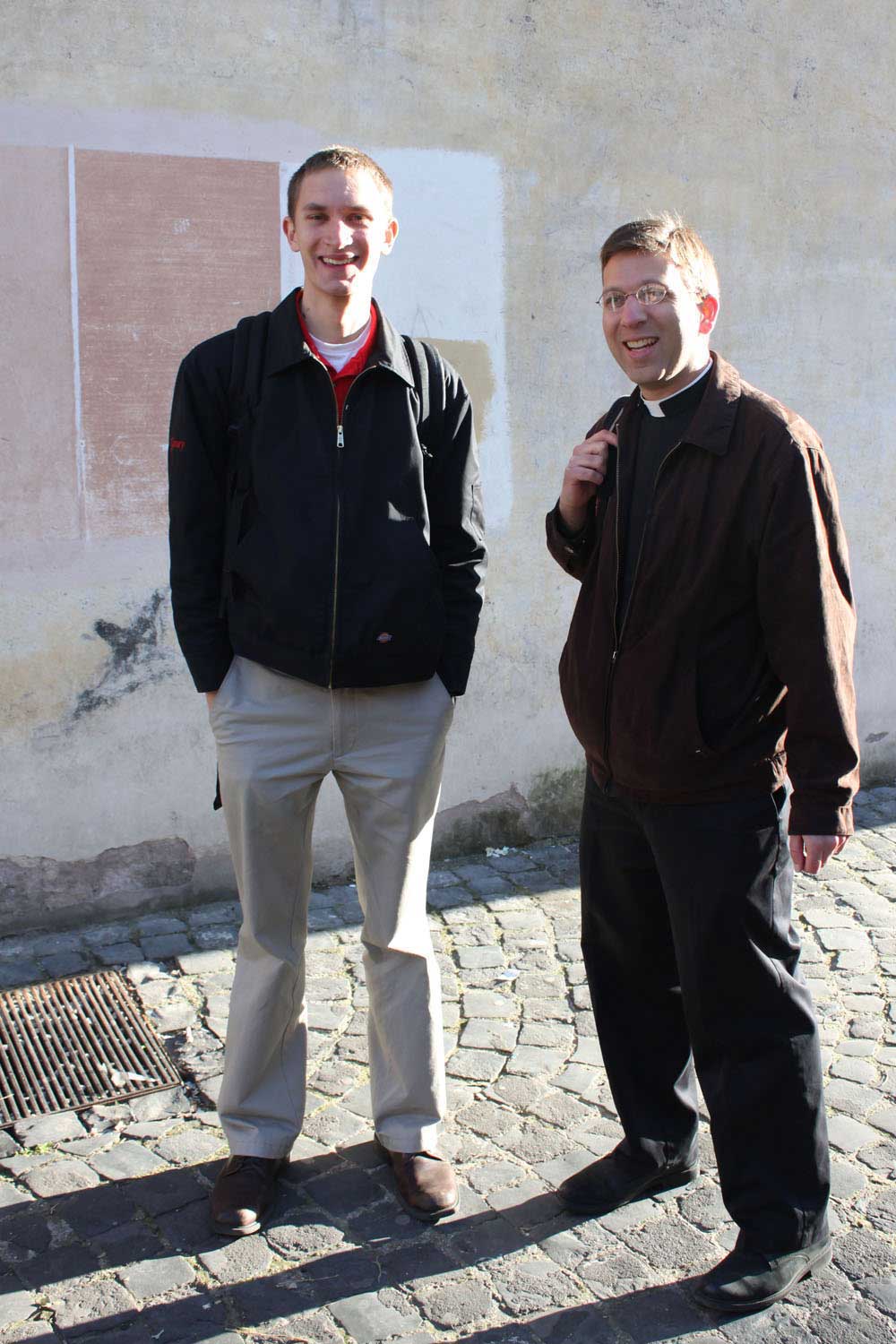
This morning pilgrims starting from the North American College were blessed with clear skies for a relatively short trek to San Cecilia. The church, found in Rome’s Trastevere neighborhood, literally “across the Tiber” from the ancient city of Rome, is located just at the bottom of the Janiculum Hill. Excavations under the church suggest that it is built over the baths of St. Cecilia’s home, where Roman authorities first tried to execute her by drowning. Failing to do so, executioners attempted to decapitate the saintly woman, but failed again, ultimately leaving St. Cecilia to die of her fatal wounds. Tradition holds that prior to dying she entrusted all her goods to the church and asked Pope Urban to turn her home into a place of worship.
St. Cecilia gives great witness to Christ’s question in the Gospel, “Can you drink of the chalice I am going to drink?” As today’ celebrant noted in his homily, the sons of Zebedee enthusiastically replied “yes” to Christ’s question out of sheer love and devotion for Our Lord, but perhaps without a full understanding of the questions implications. In the case of St. Cecilia, who likewise replied yes, it might be said that she did so with greater awareness of the implications to her response. She was seeking to live the Christian life at a time when it was an illegal religion and fully aware that it could be punishable by death.
Saying “YES”
Throughout the centuries various men and women, lay, religious and cleric, have responded yes to Christ’s question and have aided in passing on the faith from generation to generation. As such, the faith has come down to each one of us. Having received that faith, Our Lord now poses the question to each of us, Can you drink of the chalice I am going to drink?
This season of Lent offers us an opportunity to reflect on our readiness to drink from Christ’s chalice in witness to the faith. The season gives us a chance to strengthen ourselves by turning to God and seeking to keep a proper relationship with the world and those around us through prayer, fasting and almsgiving. These practices deepen and fortify us interiorly so we can give public witness to our faith in ordinary and extraordinary ways; to live our faith in such a way that others will take notice. Doing so, we will express our desire to drink from Christ’s chalice.
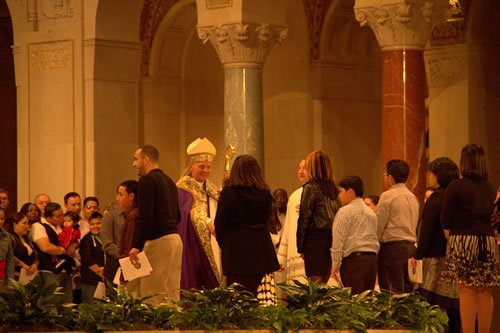
For one candidate, his journey to the Catholic faith began with a conversation with a Buddhist monk. For a couple expecting their first child, it was the result of hours of conversation about what was missing in their lives and what they wanted to be able to give their child. I knew these two stories and I wondered at the amazing number of ways our Lord calls people to a deeper relationship with him and with the church as I watched Cardinal Wuerl greet more than 1,000 men, women and children who will enter our church at Easter.
A church of many faces
In five different languages the names of the elect were called and they started to move forward. One young boy’s sneakers lighted up as he climbed the steps into the sanctuary at the Basilica. Cardinal Wuerl bent down on one knee to greet him eye to eye! Young girls in flip-flops and tattooed young men followed. There were people dressed in the suits they wear as the walk the halls of Congress and people dressed to head to work at hospitals, restaurants and construction sites following the ceremony. There were whole families coming into the church and there were college students who have made the decision on their own. Some walked the length of the Shrine with the hand of their sponsors on their shoulders. Some had huge smiles and some looked a bit overwhelmed by the size of the sanctuary, the presence of the Cardinal and bishops and unsure of what would happen next. I couldn’t help but wonder at what exactly was the event or turning point in their lives that led them to this moment today.
An Evangelizing Church
Though the event or turning point is as unique as each individual, in chatting with the newest members of our church, what is repeated over and over is the importance of feeling welcomed and the witness and testimony of the Catholics they have met in their RCIA classes, at the parish and in their workplaces. In the Catholics they met, they encountered Christ!
Agents of the New Evangelization
I also wondered how many more people might we welcome if all of us were more faithful to our mission as evangelizers. As Cardinal Wuerl reminds us in his pastoral letter, Disciples of the Lord: Sharing the Vision, all of us share in the mission of evangelization. “To be true disciples of the Lord, believers must bear witness to their faith, and ‘witnesses testify not only with words, but also with their lives.'” affirms Pope John Paul II. It is not too early to start thinking about who in your life you can invite to come to know Our Lord and whom we can welcome next year at the Rite of Election.
Do you remember Norm from the TV series Cheers? He once said, “It’s a dog eat dog world, and I’m wearing Milk Bone underwear.” That’s funny, but also a tragic reflection on the nature of human relationships, especially in the world of work.. As leadership gurus like to say, we need to learn to swim with the sharks.
When our hearts are set on gaining power and influence, it doesn’t matter who gets trampled upon or left behind. Perhaps this may make us a bit uneasy, but we can always rationalize it by saying things like “It’s not personal, it’s business,” or “Nice guys finish last.”
But is that really true? Not according to Jesus in today’s gospel. He had just told his disciples about his impending torture and execution. But what happens next? The “Sons of thunder,” along with their mother, make a power grab. They thought: Jesus’ time is short, so we’d better make our move to be on top in his kingdom. Carpe diem; you snooze, you lose.
They didn’t express any concern about Jesus’ fate, and they didn’t seem to care what their friends might think. Evidently, their selfish ambition had blinded them to compassion or concern about anyone else.
Jesus turned this situation into a teachable moment. He conceded that the world may seem to belong to those who can swim with the sharks. But as for his disciples, we are to swim against the tide. He invites us to follow in his footsteps- by living a life of service; by being focused on others’ needs; by being humble; by cherishing sacrifice, not selfishness.
The world may indeed delude us into thinking that “nice guys finish last.” Except, Jesus reminds us, in the race that really counts.
We usually think of the 1950s as an era when just about everyone went to Church. But the cover from the 1959 Saturday Evening Post at the right indicates that even at that time there were already trends underway that indicated not all was perfect in paradise. It is a long and unfortunate trend that men have often left the spiritual upbringing of the Church to their wives and stayed home on Sundays.
A recent CARA blog post written by Mark Gray takes a closer look at the data of Mass attendance from the 1950s and indicates that our perceptions of the high mass attendance in the 1950s may need some adjustment. This is due to the fact that much of the data was based on self-reporting of Catholics. Such reporting is often unreliable since, bluntly stated, people tell fibs to survey takers. Sometimes they tell fibs to themselves. Consider the scenario:
Poll taker: Do you go to church on Sundays?
Respondent: Sure! (Which really means sometimes).
Poll taker: Of the 52 Sundays a year, how many would you say you are in Church?
Respondent: Oh, at least 50 (Which really means more like 10).
The fact is, people like to look good to poll takers, and often answer the question in flattering ways rather than purely truthful ways. This was even more likely the case in the 1950s when Sunday Church attendance was more of a social expectation than today.
Even today, 42% of Catholics polled say they go to Mass each Sunday. But we know from harder data (such as head counts) that the number is closer to 30%
I’d like to put some excerpts of the CARA blog post here and make a few comments along the way. The actual article is fairly long and you can read the rest here: Deconstructing Mass Attendance Numbers
As usual, the Article excerpts will be in bold, black italics, and my remarks in plain text red.
Didn’t everyone go to church in the 1950s?…. But the fact that [the Norman Rockwell Painting above] made it on to the cover of America’s magazine of record at the time indicates that it resonated with the culture of this period [1959]. This issue of the Post was published at a time when weekly Catholic Mass attendance was peaking, as measured in Gallup telephone surveys (74% in 1958 and 72% in 1959).
[But] in 2008, Gallup surveys estimated Catholic Mass attendance in any given week had fallen to 42%. Don’t giggle. I know you don’t believe that 42% of Catholics nationally attend Mass in any given week and you’re right. But why do we believe 74% did in 1958?[Well said. Many of us who quote statistics on Mass attendance exaggerate the 1950s number upward and the current numbers downward because it suits our point. I have been guilty of this. It reminds me of an old GK Chesterton sayings, Many people use statistics like a drunkard uses a light pole, for support rather than enlightenment].
You can only get an attendance percentage by dividing the Mass attendance count….by the number of self-identified Catholics in the parish boundaries that could have attended. [And this sort of data is harder data than self reporting Catholics called on the phone who will tend to exaggerate the frequency of their attendance. This sort of data is a lot harder to come by and requires careful headcounts in parishes. Many dioceses conduct an October headcount. But even four weeks of data is not, of itself enough since there are great seasonal swings in many parishes. Real data collection is hard work].
Perhaps more can be said by taking a second look at a researcher who was in many Catholic parishes studying Mass attendance in the 1950s. Joseph H. Fichter, S.J., (granduncle to current CARA research associate Fr. Stephen Fichter) famously studied parish life by going door to door and taking censuses, making Mass attendance head counts, observing parish life, and documenting everything possible both qualitatively and quantitatively. [Like I said, data collection is hard work]
Fichter estimates Mass attendance levels based on the number of individuals registered with the parish. But he also provides the counts for dormant Catholics…. people who self-identify their religion as Catholic but who do not attend Mass [at all]. Thirty-eight percent of the Catholics within the parish boundaries he studied in this book were dormant. Thus, at the outset we know that typical weekly attendance by the measure of this study could have been no more than 62%. But [the number drops further when we consider that only] 79% of the non-dormant Catholics attended Mass on a typical weekend. So [in combining these two facts] the total percentage of self-identifying Catholics attending Mass in this study was estimated to be about 49%. [OK, I see your eyes crossing with all the numbers. But the critical number is that the number of Catholics attending Mass EVERY week was really closer to 49% in the 1950s when properly adjusted. So the 74% number is too high. Mark Gray explains why in the next paragraph].
Attendance over-reports [in Gallup-like surveys] occur as people being interviewed over the phone respond to their interviewer with answers about their behavior that they believe to fit socially desirable expectations. So typically the respondent has just told the interviewer their religion and then they are asked how often they attend services. Many respond in a way that they believe is socially acceptable—even if it does not fit their actual pattern of attendance.
We have some early evidence of this in the Americans’ Use of Time Study, 1965-1966. Here, 57% of Americans when asked directly about their church attendance reported that they had attended in the last week. However, only 39% of these respondents actually indicated attending religious services when recording their time use hour by hour in diaries (i.e., an indirect measurement)…. [OK, so basically people lie, err….fib. Fact is we do tend to over estimate how good we do 🙂 ].
Father Fichter’s observations also indicate that some of the Mass attendance of the 1950s was not as “active”[i.e. devout] as we might remember it. Here is a passage that likely still resonates with your observations of parish life today:
“A measure of the parishioners’ devotion to the Mass and of their fulfillment of this obligation is seen in the numbers who arrive late and who leave early. By actual count it was noted that, at all Sunday Masses, 8.37 per cent of the congregation arrived after Mass had started and that 6.35 per cent left before it was completed. … Although we have no accurate count, we have noticed that many of these persons are duplicated in both categories. In other words, those who come late also tend to leave early. … The younger males constitute the majority of those who omit part of the Mass, while older females make up the majority who arrive in church well in advance of Mass” (1951, pg. 138)……“By actual count, 35.08 per cent of the congregation read the missal all during Mass, while another 22.08 per cent read some sort of prayer-book while following the priest’s reading of the Gospel. … The remaining persons simply stare off into space, although several men in the last pews sometimes read a copy of Our Sunday Visitor during Mass” (1951, pg. 138). [Oops, maybe a little less devout than some of us remember. I DO remember the silly legalisms of the past where people asked questions like, “How late can I be to Mass and still fulfill my obligation?” My sense is that the trends noted here are a little worse today despite the Mass being in English. A lot of Catholics still give the impression that they are at Mass merely to “check off the God box” and that they seek the fastest Mass possible. Many are devout today, but many are not].
Over a year of Masses, on average, attenders were much more often female (about 7 in 10 or more) than male—a composition that can only result from some men, perhaps like the man in the Rockwell illustration above, staying home. [I want to post on this topic sometime soon].
Many cite CARA’s weekly Mass attendance figure in the low 20 percent range. Some also then cite Gallup’s figure from the 1950s and attempt to argue that Mass attendance has fallen from nearly 80% to just above 20%. This is misleading and inaccurate…..as shown above, the Gallup numbers for the 1950s are inflated…. [Again, I plead guilty to some of this].
Currently, CARA surveys indicate that 23% of self-identified adult Catholics attend Mass every week. Yet, in any given average week, 31% of Catholics are attending…. Note there is considerable local variation in Mass attendance levels with higher levels in the Midwest and lower in coastal urban areas). During Lent and Advent, Mass attendance increases into the mid-40 percent-range and on Christmas and Easter, an estimated 68% of Catholics attend. [This is a good distinction. I sometimes hear the 23% number and other times the 31% number and wonder which it is].
[OK, so what’s the Bottom Line?]
Thus, if one is seeking to make a comparison of Mass attendance in the 1950s to now, the drop is not 80% to 20%. Instead it is from a peak of 62% in 1958 to about 31% now. This is still a remarkable decline. It means that the Mass attendance you see at Christmas and Easter is a lot like the attendance you might have seen in a typical week in the late-1950s.
OK I know, it was a lot of numbers, but in the end, the report suggests that we need to trim a bit off the extremes and bring both numbers a little more toward the middle. In the end, we have still suffered an enormous decline and the recent wave of church and school closings demonstrates that. In these leaner times we do well to consider that it is more important than ever that we be at our posts. It is simply a fact that we need one another to survive.
Our Roman station church liturgies take us today to the church of St. Balbina. Little is known of this saint, though it is said she was a virgin who died a martyr’s death. Her remains are located under the main altar of this church, which has been in use since the late 4th century A.D. The church is located south of the Vatican on the Aventine Hill, very near the Circus Maximus. In a way this location is fitting because most if not all of the Christians who were martyred for their faith in Rome would have been murdered not in the Coliseum, but in Circus Maximus, under the shadow of the Emperor’s palace.
Today’s first reading from Isaiah calls us to recognize our sinfulness in the eyes of the Lord. But this recognition of our sin is not without hope, for the Lord also offers us the opportunity of returning to him. Speaking through Isaiah the Lord says, “Wash yourselves clean!…Though your sins be like scarlet, they may become white as snow”. The homily this morning focused on this invitation, which is part of every celebration of the Eucharist. At the beginning of every Mass, we are called to remember our sins, adopting the attitude of the tax collector in the Temple who prayed, “O God, be merciful to me a sinner”. And we then cry “Lord, have mercy!”, like the two blind men on the road to Jericho who called out to Jesus, “Lord, Son of David, have pity on us!” Like these two blind men, we thus dispose ourselves to encounter the Lord Jesus in the Eucharist.
During Lent, we are called to remember that it is only through the sacrifice of Jesus Christ that we are able to follow the command of the Lord to “Wash ourselves clean!” Our Lord calls us today to recognize that we are still not perfect, that we still cling to some sins, large or small. But he also invites us to again repent, and to receive his forgiveness in the Sacrament of Reconciliation. For it is only in this Sacrament, in this particular encounter with the Lord Jesus, that “though our sins be like scarlet, they may become white as snow!”
When my grade school son asked me about the appropriateness of a word he’d heard at school, I explained that he shouldn’t use it under any circumstances. He looked at me and said: “But Dad, I’ve heard you and Mom use it!” Oops… I realized that what I had taught my son was: “Do as I say, but not as I do.”
Which is not a good position to be in, as Jesus acknowledged in today’s gospel, when he lamented that the religious leaders of his day didn’t always practice what they preached. But that could be said about any one of us, couldn’t it? We all give moral instruction or correction to others, and we run the risk of being a hypocrite: of talking the talk, without walking the walk.
Sometimes we realize this and choose not to say anything at all, when actually we should be saying something. For instance, many parents avoid speaking about sex or drinking or drugs with their children, because their own histories are, shall we say, less than perfect.
So what are we to do? If we say something, others might simply roll their eyes at us; but if we say nothing, they might turn their eyes elsewhere and find answers that are contrary to those Jesus would give. Thankfully, Jesus suggests a way forward when he taught about humility in today’s gospel. When speaking to others about moral matters, we need to humbly admit that we ourselves are far from perfect, and humbly place ourselves beside those we instruct, instead of exalting ourselves above them. Because at one level, we all stand before Christ as brothers and sisters: as students before our teacher, servants before our master, sinners before our savior.
Should we do this, what others will hear is: “Do as Jesus says…not as I do.”
In his book Jesus of Nazareth Part II The Holy Father takes up the issue of the Evangelization of the Jewish People and offers a position that I must say quite surprises me. As an obedient son of the Church, I must also say that it is for me somewhat of a corrective position. For the position he annunciates has not been my point of view. I trust the Pope and must now consider how I must amend my prior thinking based on his observations. Yet, truth be told, I am still a bit stunned by what he says.
It is a fact that the Pope has set his reflections outside the Papal Magisterium, for he says in the forward to volume 1:
It goes without saying that this book is in no way an exercise of the Magisterium, but is solely an expression of my personal search “for the face of the Lord” (cf. Ps 27:8). Everyone is free, then, to contradict me. I would only ask my readers for that initial good will without which there can be no understanding. (Jesus of Nazareth, Vol. 1, Forward, xxiv)
Nevertheless, I cannot simply regard him as any sort of theologian with whom I may dispute. He, even when he speculates outside the formal magisterial structures, commands my respect and my soul ought to be teachable even in these matters.
So, with all this in mind let me set forth what the Pope teaches about the evangelization of the Jewish People and offer a few reflections.
Background – The Pope, in Chapter Two of Jesus of Nazareth (Vol. 2) is reflecting on the evangelical mission of the Church to preach the Gospel to all the nations. The urgency with which the Apostles undertake this mission is related to the teaching of Jesus that the Gospel must first be preached to all the nations prior to his coming (Matt. 24:14; Mk 13:10). Thus, the End Time can come only after the Gospel has been brought to all peoples. The Pope calls this period “the time of the Gentiles” (Cf. Rom. 11:25-26).
During this time, he argues that the principle focus and mission of the Church is ad Gentes (to the nations). For as Paul teaches, A hardening has come upon part of Israel, until the full number of Gentiles come in, and so, all Israel will be saved (Rom. 11:25-26). For now, the Pope argues, the Church’s priority is, thus, the Gentiles.
Let me allow the Pope to speak:
In this regard, the question of Israel’s mission has always been present….Here I should like to recall the advice given by Bernard of Clairvaux to his pupil Pope Eugene III on this matter. He reminds the Pope that his duty of care extends not only to Christians, but: “You also have obligations toward unbelievers, whether Jew, Greek, or Gentile” (De Consideratione III/1, 2). Then he immediately corrects himself and observes more accurately: “Granted, with regard to the Jews, time excuses you; for them a determined point in time has been fixed, which cannot be anticipated. The full number of the Gentiles must come in first. But what do you say about these Gentiles?. . . …(De Consideratione III/1, 3).
Hildegard Brem comments on this passage as follows: “In the light of Romans 11:25, the Church must not concern herself with the conversion of the Jews, since she must wait for the time fixed for this by God, ‘until the full number of the Gentiles comes in’ (Rom 11:25)….(quoted in Sämtliche Werke, ed. Winkler, I, p. 834).
The prophecy of the time of the Gentiles and the corresponding mission is a core element of Jesus’ eschatological message. The special mission to evangelize the Gentiles, which Paul received from the risen Lord, is firmly anchored in the message given by Jesus to his disciples before his Passion. The time of the Gentiles—“the time of the Church”—which, as we have seen, is proclaimed in all the Gospels, constitutes an essential element of Jesus’ eschatological message.
….In the meantime, Israel retains its own mission. Israel is in the hands of God, who will save it “as a whole” at the proper time, when the number of the Gentiles is complete….the evangelization of the Gentiles was now the disciples’ particular task…. (Jesus of Nazareth, Vol 2, pp. 44-46).
To be honest this notion is completely new to me. I have never considered the Jewish people a temporarily lower priority for the Church, let alone temporarily exempt from the evangelical mission of the Church. The initial thought of this troubles me. Yet the Pope seems clearly to hold this view, for though he quotes others, he does not critique their views.
I have always considered the Jewish People to be an essential focus of the evangelical mission of the Church, here and now. It seems to me that Paul, as he evangelized went first to the Synagogues and gained whatever converts he could, and then turned to the Gentiles. He speaks of his ministry as bringing good or ill to those who obey or disobey, Jew first, then Gentile (Rom 2:9-10).This, at least, was my thinking and what it was based on.
Yet now, having laid my teaching at the feet of Peter, it appears that I may have “run in vain” (cf. Gal 2:2). The Pope seems to hold, (granted he does not formally teach it), that the time of the Jews is only later. For now, the focus is the Gentiles.
In a way this explains a lot. I have often been puzzled over the low priority given the mission to the Jews in Rome. There even seems to be a certain apologetic opinion among some in Rome, that the Jews should not be “proselytized” and evangleized, and that those who do so, are doing something wrong. Some have even gone so far as to say the Jews are already in a saving covenant (which I do not thing the Pope is saying here). I have usually presumed such positions were more than influenced by a European anxiety and (an understandable) guilt over the Holocaust that made Church officials anxious to suggest the Jewish people were lacking something, in not having faith in Christ. I never considered a theological basis for the position as the Pope has presented it here.
I have read some rather vigorous discussions about Romans 11 where Paul writes, as already noted: I do not want you to be ignorant of this mystery, brothers, so that you may not be conceited: Israel has experienced a hardening in part until the full number of the Gentiles has come in. And so all Israel will be saved. (25-26).
Some have interpreted this passage to mean that the Jewish People will all be saved ultimately.
Some think it means literally every Jew,
Others think that most Jews will be saved and that “all Israel” is more of a corporate notion than an “every man, woman and child,” notion.
Still others, such as I, have thought that “all Israel” refers to believers in Jesus Christ, both Jew and Gentile. For, it would seem, that Paul defines Israel only as those who accept the Messiah, Jesus. For, in Romans 11 he describes Israel as an olive tree. And unbelieving branches were pruned off (11:20), and believing branches (Gentiles) were grafted in. The pruned branches can be re-grafted, but only if they come to faith in Jesus. Thus, in the end, “all Israel” means believing Jews and Gentiles together in Christ. And though surely Paul is hopeful that many of the pruned branches will be re-grafted, it has seemed to me that “all Israel” can refer only to true believers in Jesus Christ, Jew and Gentile.
If I understand the Pope however, it would appear that my grasp of Romans 11 (as stated in # 4 above) has been flawed, at least insofar as the position he annunciates. If I interpret him properly, He sees “all Israel” as referring to those Jews who will be saved at the end of the age.
So here is to me a stunning passage that requires me to carefully rethink how I have understood the matter. This is so even though the Pope does not claim magisterial authority, at least for me, since I respect even his non-infallible teaching and want to give it serious consideration and assent.
Some Questions – And yet I wonder of the practical application of this view and have some questions. Please understand that these questions are not rhetorical, they are actual questions I have because I want to learn.
Does this mean that it is always wrong to seek Jewish converts?
Or does this position of the Pope simply explain why the mission field of the Jewish people has been meager? (For, as Paul says, a hardening has come upon them for a season until the full number of Gentiles enters).
While it is possible to understand a corporate conversion of the Jews at the end of the age, what of the Jews today and yesterday? Are they included in this notion? What will come of them?
Are the Jewish People today in an operative covenant with God that we as Catholics ought to recognize (as some suggest in quoting Rom 11:29 for God’s gifts and his call are irrevocable)? Or did the Old Covenant end with the destruction of the temple? (as others suggest in quoting Hebrews 8:13 which says, By calling this covenant “new,” he has made the first one obsolete; and what is obsolete and aging will soon disappear)?
Well, enough said, you need not, dear reader, follow me all the way as I think out loud. But in a brief couple of paragraphs the Pope has managed to powerfully question the way I have thought. I still have questions but I am willing to be taught. Perhaps some of you have wrestled with this already and have something to offer to the discussion. Above all, I am sure the Pope would be happy to know that his book has us thinking, discussing and praying.
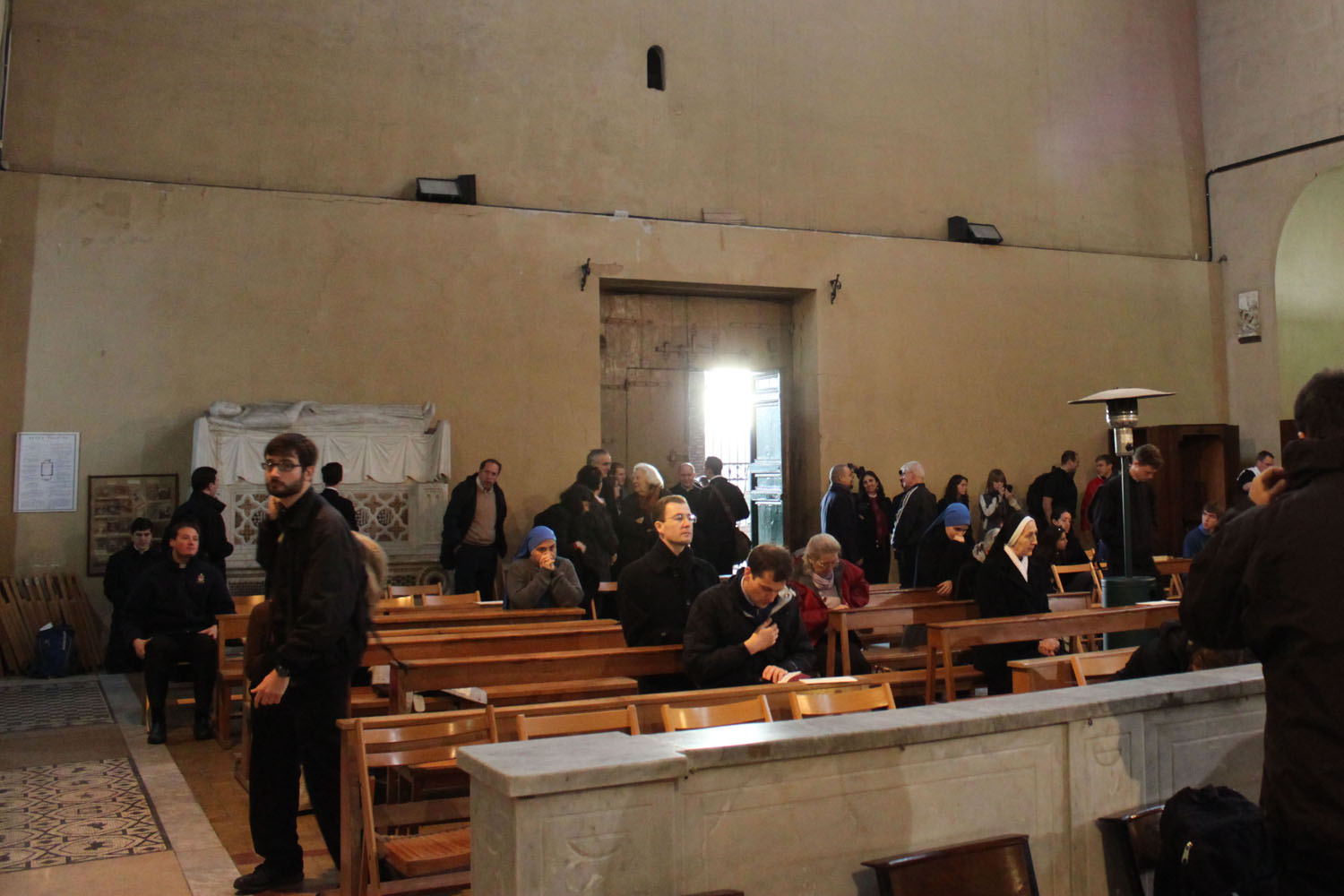
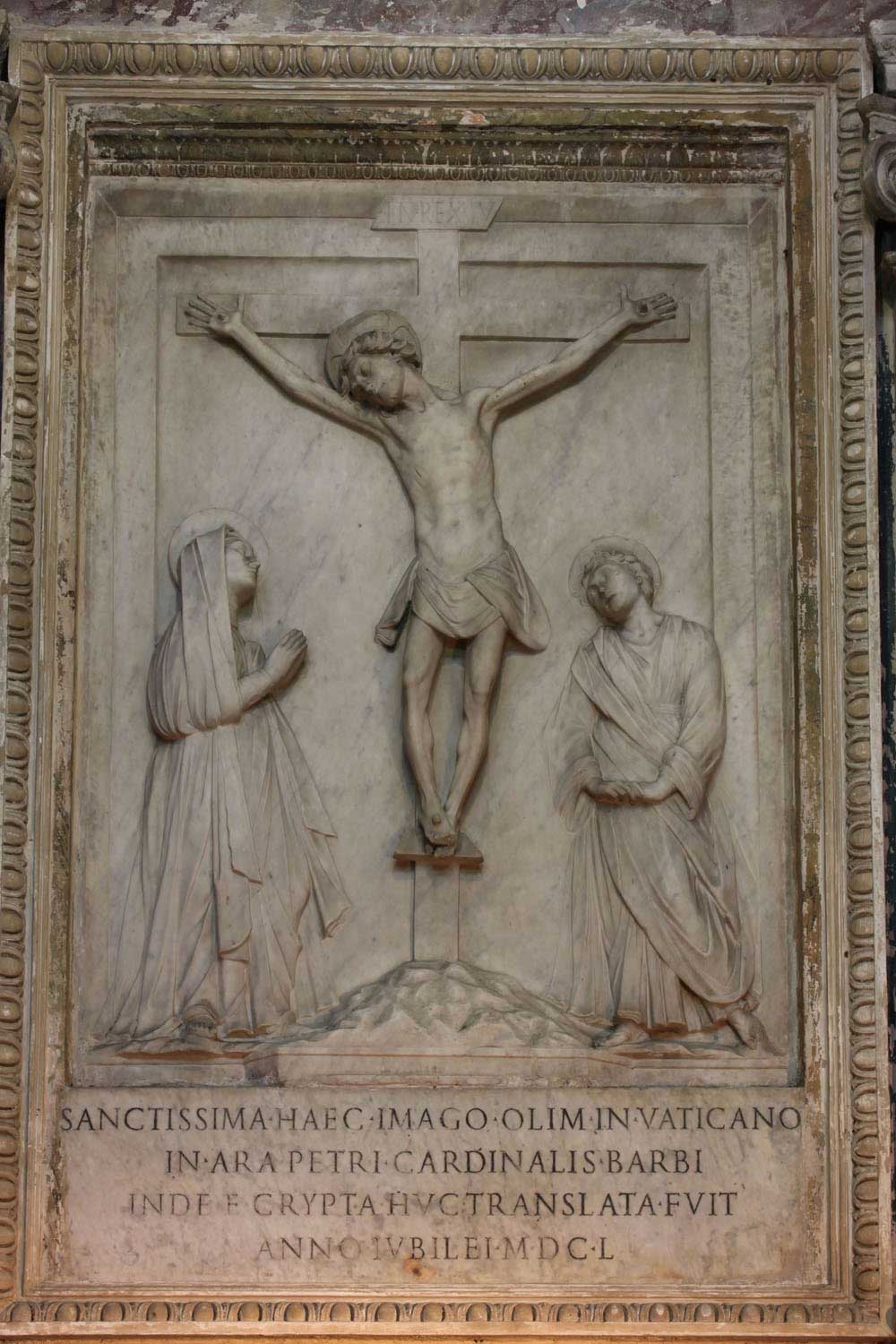
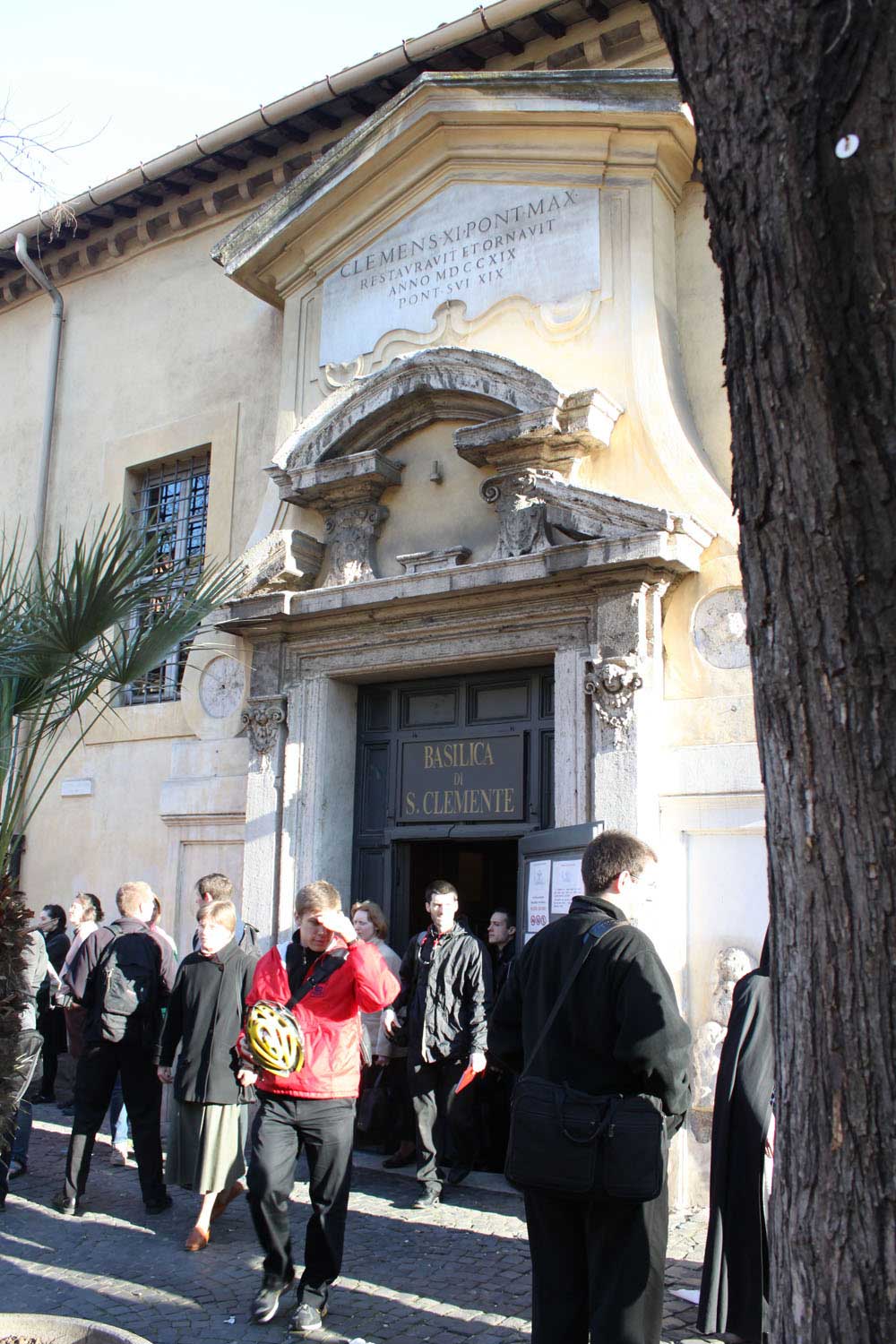
One of the delights to be discovered about the city of Rome is its three-dimensionality: the city exists in layers. In a three-thousand-year-old city, it seems that every building is built on top of an older building. In the case of today’s station church, in fact, two older buildings. The current church of St. Clement, dedicated in 1128 and named after the fourth pope, rises on the ruins of its older 4th century predecessor. This, in turn, lies on top of a cluster of buildings from the imperial Roman era, one of which belonged to a wealthy Christian and had been entrusted to the Church for use as a parish. Few buildings better exemplify the continuity of our faith from its earliest days as a small and persecuted sect to its current status as a mature and flourishing religion.
Ecumenical Considerations
In addition to these archaeological delights, St. Clement holds another type of treasure: the relics of both St. Clement and of St. Ignatius of Antioch. The two men took opposite routes in their lives: St. Clement was exiled from Rome around 100 by the emperor and was later martyred near the Black Sea in the east, where he had gone to evangelize; St. Ignatius was arrested around the same time in Antioch (in Syria) and brought west to Rome to be thrown to the lions in the Coliseum. Today’s celebrant noted that in this church, “The Church breathes deeply with both lungs” – that is, with a faith handed on by both eastern Greek and western Latin Christians. We might pause today in our own Lenten journey to pray for the many other Christians who are also making this journey to Easter, our Orthodox and Protestant brethren, and to ask God that, through Christ, we might soon all be united in worship and belief as were Sts. Clement and Ignatius.
Pilgrim Profile
After Mass I stopped to chat with a tall and lanky college student who sang in today’s choir. Ephrem Shaffer is a seminarian from the diocese of St. Cloud, Minnesota, and a student at the University of St. Thomas in St. Paul, Minnesota. Ephrem arrived in Rome in January for a semester abroad, along with some 30 other students from St. Thomas. His dark and cold morning walk this morning to the 7 a.m. station church Mass took him about 50 minutes – “Done in a Lenten spirit of penance!” he laughs. But the lure of seeing ancient churches and approaching saints’ relics is tough to resist. “It is hard to think of faith as mythical after visiting these places. The saints are real people, and they have passed on to us an Incarnational faith.”