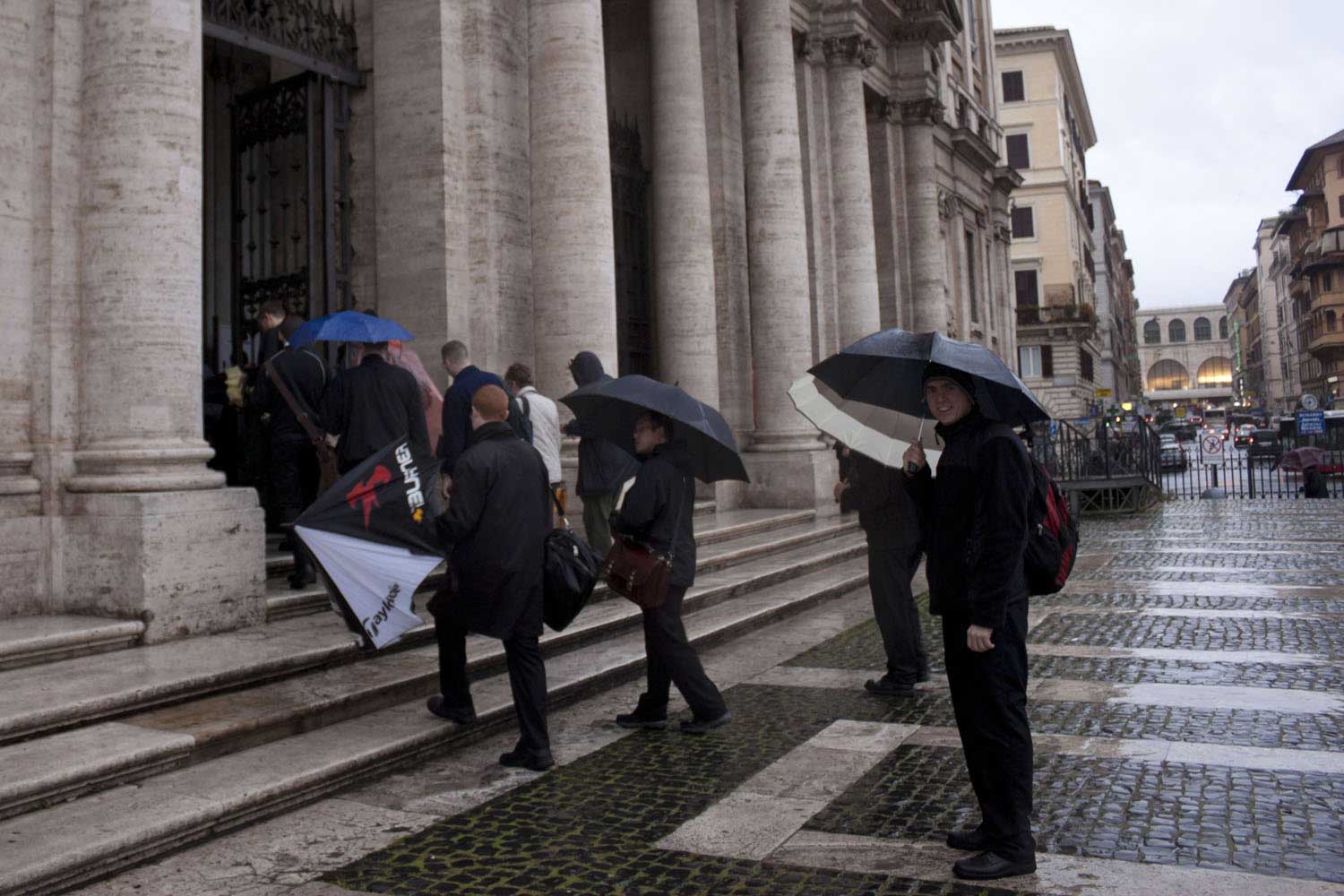
This morning pilgrims continued their Lenten journey along a well trod path as they made their way to the Basilica Santi XII Apostoli, where relics of Sts. Philip and James the Lesser are housed beneath the high altar. As the pilgrims walked and prayed they traversed the Piazza del Popolo, came behind the Pantheon and passed by the Church of Santa Maria sopra Minerva, till finally arriving at Piazza Ss. Apostoli. The church, located near both the Gregorian and Angelicum Universities, is one well known to the students of the North American College. In fact, today’s walk is one that many seminarians make daily to go to and from school and the College. This serves as a great reminder that our journey with the Lord plays itself out largely in our “regular” day-to-day lives.
Today’s readings invite us to a life of greater virtue. From the prophet Ezekiel we hear, “He shall live because of the virtue he practiced,” and in the Gospel Jesus instructs us that we must strive for righteousness greater than that of the scribes and Pharisees. They observed the externals of the Jewish laws but lacked a proper disposition of heart. We are blessed to have the Lenten season each year because it gives us a chance to examine the dispositions of our own hearts. Jesus makes it clear that we can’t just aim at fulfilling minimum obligations, but that we must strive for hearts and minds that, with God’s grace, are free from even harboring ill thoughts, feelings or intentions towards others. This goal finds its practical fulfillment in our day-to-day lives.
The season of Lent with its call to greater prayer, fasting and almsgiving allows us a chance to examine our attitudes and intentions and to ask God’s grace to help us love more like Him. By cooperating with His grace we’ll find our day-to-day path transformed. It will gradually become more and more the path of Christ. We’ll change too! We’ll become a greater blessing to ourselves, our family, our friends, and everyone we encounter as we increasingly grow in resemblance to Christ, Our Lord.
There are many references to “the flesh” in New Testament Scripture, especially in the letters of St. Paul. The phrase confuses some who think it synonymous with the physical body. It is true that there are many times when Scripture uses the word “flesh” to refer to the physical body. However when the definite article “the” is placed before the word “flesh” we are dealing with something else. Only very rarely does the Biblical phrase “the flesh” (ἡ σὰρξ (he sarx), in Greek) refer only to the physical body (eg. John 6:53; Phil 3:2; 1 John 4:2) , but almost always the phrase refers to something quite distinct from the physical body.
What then is meant by the term “the flesh” (ἡ σὰρξ)? Perhaps most plainly it refers to that part of us that is alienated from God. It is the rebellious, unruly and obstinate part of our inner self that is operative all the time. It is that part of us that does not want to be told what to do. It is stubborn, refuses correction, and does not want to have a thing to do with God. It bristles at limits and rules. It recoils at anything that might cause me to be diminished or something less than the center of the universe. The flesh hates to be under authority or to have to yield to anything other than its own wishes and desires. The flesh often desires something simply because it is forbidden. The Protestants often call the flesh our “sin nature” which is not a bad term in summarizing what the flesh is. In Catholic tradition the flesh is where concupiscence sets up shop. Concupiscence refers to the string inclination to sin that is in us as a result of the wound of Original Sin. If you do not think that your flesh is strong, just try to pray for five minutes and watch how quickly your mind wants to think of anything but God. Just try to fast or be less selfish and watch how your flesh goes to war.
The flesh is in direct conflict with the spirit. “The spirit” here refers not to the Holy Spirit but to the human spirit. The (human) spirit is that part of us which is open to God, which desires him and is drawn to him. It is that part of us which is attracted by goodness, beauty and truth, which yearns for completion in God and to see His face. Without the spirit we would be totally turned in on ourselves and consumed by the flesh. Thankfully our spirit, assisted by the Holy Spirit draws us to desire what is best, what is upright, good and helpful.
Perhaps it is good that we look at just a few texts which reference “the flesh” and thus here in Lent learn more of the flesh and its ways. This will help us to be on our guard and to rebuke it by God’s grace and learn not to feed it. I make some comments in red with each quote.
1. The Flesh does not grasp spiritual teachings – [Jesus said] The Spirit gives life; the flesh counts for nothing. The words I have spoken to you are spirit and they are life. (John 6:63)
Having taught on the Eucharist, most of his listeners ridicule his teaching and will no longer take Jesus seriously. So Jesus indicates that their hostility to the teaching on the Eucharist is of the flesh. The flesh demands that everything be obvious to it on its own terms. The flesh demands to see physical proof for everything; demands that it be able to “see” using its own unregenerate power. And if it cannot see based on its own limited view, it simply rejects spiritual truth out of hand. In effect the flesh refuses to believe at all since what it really demands is something that will “force” it to accept something. Inexorable proof which faith demands takes things out of the realm of faith and trust. Faith is no longer necessary when something is absolutely proven and plainly visible to the eyes of flesh. The flesh simply refuses to believe and demands proof.
2. The flesh is not willing to depend on anyone or anything outside its own power or control – For it is we who are the circumcision, we who worship by the Spirit of God, who glory in Christ Jesus, and who put no confidence in the flesh— though I myself have reasons for such confidence. If anyone else thinks he has reasons to put confidence in the flesh, I have more: circumcised on the eighth day, of the people of Israel, of the tribe of Benjamin, a Hebrew of Hebrews; in regard to the law, a Pharisee; as for zeal, persecuting the church; as for legalistic righteousness, faultless….I [now] consider this rubbish, that I may gain Christ and be found in him, not having a righteousness of my own that comes from the law, but that which is through faith in Christ (Phil 3:3-9 selected)
The flesh wants to be in control rather than to have to trust in God. Hence it sets up its own observance, under its own control. And when it has met its own demands it declares itself to be righteous. Since the flesh hates being told what to do it takes God’s law and makes it “manageable” based on the flesh’s own terms. So, for example, if I am supposed to love, let me limit it to my family and countrymen but I am “allowed” to hate my enemy. But Jesus says, no, love your enemy. The flesh recoils at this for unless the law is manageable and within the power of the flesh to accomplish it, the Law cannot be controlled. The flesh trusts only in its own power. The Pharisees were “self-righteous” That is to say, they believed in a righteousness that they themselves brought about through their flesh power. But the Law and flesh cannot save. Only Jesus Christ can save. The flesh refuses this and wants to control the outcome based on its own power and terms.
3. The Flesh hates to be told what to do – For when we were controlled by the flesh, the sinful passions aroused by the law were at work in our bodies, so that we bore fruit for death. (Rom 7:5)
The disobedience and rebelliousness of the flesh roots us in sinful behavior and prideful attitudes. The prideful attitude of the flesh is even more dangerous than the sins that flow from the flesh since pride precludes instruction in holiness and possible repentance that lead to life. But the flesh does not like to be told what to do. Hence it rejects the testimony of the the Church, the scriptures and the conscience. Notice, according to the text, the very existence of God’s Law arouses the passions of the flesh. The fact that something is forbidden makes the flesh want it all the more! This strong inclination to sin is in the flesh and comes from pride and indignation at “being told what to do.” The flesh is refuses God’s Law and sets up its own rules. The flesh will not be told what to do.
4. Flesh is as flesh does – Those who live according to the flesh have their minds set on what the flesh desires; but those who live in accordance with the spirit have their minds set on what the spirit desires. The concern of the flesh is death, but the concern of the spirit is life and peace (Rom 8:5-6)
The flesh is intent on things of this world, upon gratifying its own passions and desires. On account of the flesh we are concerned primarily with ourselves and seek to be at the center. The flesh is turned primarily inward. St Augustine describes the human person in the flesh as “curvatus in se” (turned in upon himself). But the spirit is that part of us that looks outward toward God and opens us the truth and holiness that God offers. Ultimately the flesh is focused on death for it is concerned with what is passing away: the body and the world. The human spirit is focused on life for it focuses on God who is life and light.
5. The Flesh is intrinsically hostile to God – The mind of the flesh is hostile to God. It does not submit to God’s law, nor can it do so. Those controlled by the flesh cannot please God. (Rom 8:7-8)
The flesh is hostile to God because it is pridefully hostile to any one more important than itself. Further the flesh does not like being told what to do. Hence it despises authority or anyone who tries to tell it what to do. It cannot please God because it does not want to.
6. The Flesh abuses freedom – You, my brothers, were called to be free. But do not use your freedom to indulge the flesh; rather, serve one another in love. (Gal 5:13)
The flesh turns God given freedom into licentiousness. Licentiousness is to demand freedom without limit. Since the flesh does not want to be told what to do it demands to be able to do what ever it wants. In effect the flesh says, “I will do what I want to do and I will decide if it is right or wrong.” This is licentiousness and it is an abuse of freedom. It results in indulgence and paradoxically leads to a slavery to the senses and the passions.
7. The Flesh Demands to be fed – So I say, live by the Spirit, and you will not gratify the desires of the flesh. For the flesh desires what is contrary to the Spirit, and the Spirit what is contrary to the sinful nature. They are in conflict with each other, so that you do not do what you want. (Gal 5:16-17)
Within the human person is this deep conflict between the flesh and spirit. We must not be mistaken, the flesh is in us and it is strong. It has declared war on our spirit and on the Holy Spirit of God. When the spirit tries to obey the flesh resists and tries to sabotage the best aspirations of the spirit. We must be sober about this conflict and understand that this is why we do not do what we most know is right. The flesh has to die and the spirit come more alive. What you feed grows. If we feed the flesh it will grow. If we feed the spirit it will grow. What are you feeding? Are you sober about the power of the flesh and do you and I therefore feed our spirit well through God’s word and holy communion, through prayer and the healing power of confession. What are you feeding?
8. The Flesh fuels sin – The acts of the flesh are obvious: sexual immorality, impurity and debauchery; idolatry and witchcraft; hatred, discord, jealousy, fits of rage, selfish ambition, dissensions, factions and envy; drunkenness, orgies, and the like. I warn you, as I did before, that those who live like this will not inherit the kingdom of God (Gal 5:19-210)
This catalogue of sins for Galatians 5 is not exhaustive but is representative of the offensive and obnoxious behavior that flows from the flesh. Be sober about the flesh, it produces ugly children.
So here is a portrait of “the flesh.” It is ugly. You may say I have exaggerated, that the flesh is not really this bad. Well I am not, just buy a newspaper and see what the flesh is up to. You may, by God’s grace, have seen a diminishment in the power of the flesh in your life. That is ultimately what God can and will do for us. He will put the flesh to death in us and bring alive our spirit by the power of his Holy Spirit. But step one is to appreciate what the flesh is and understand its moves. Step two is to bring this understanding to God through repentance. Step three is, by God’s grace, to stop feeding the flesh and start feeding the spirit on prayer, scripture, Church teaching and Holy Communion. Step four is to repeat steps 1-3 for the rest of our lives. God by his grace will cause the flesh to die and the spirit to live by his grace at work in us through Jesus Christ.
There is no musical better at (humorously) depicting the flesh as Camelot. Here are a few video clips that depict well the flesh
In this first video Sir Lancelot ponders what a great and perfect guy he is. He goes so far as to say that “Had I been made the partner of Eve we’d be Eden still!”
In this clip, the Knights (in the flesh) ridicule goodness and sing “Fie On Goodness!”
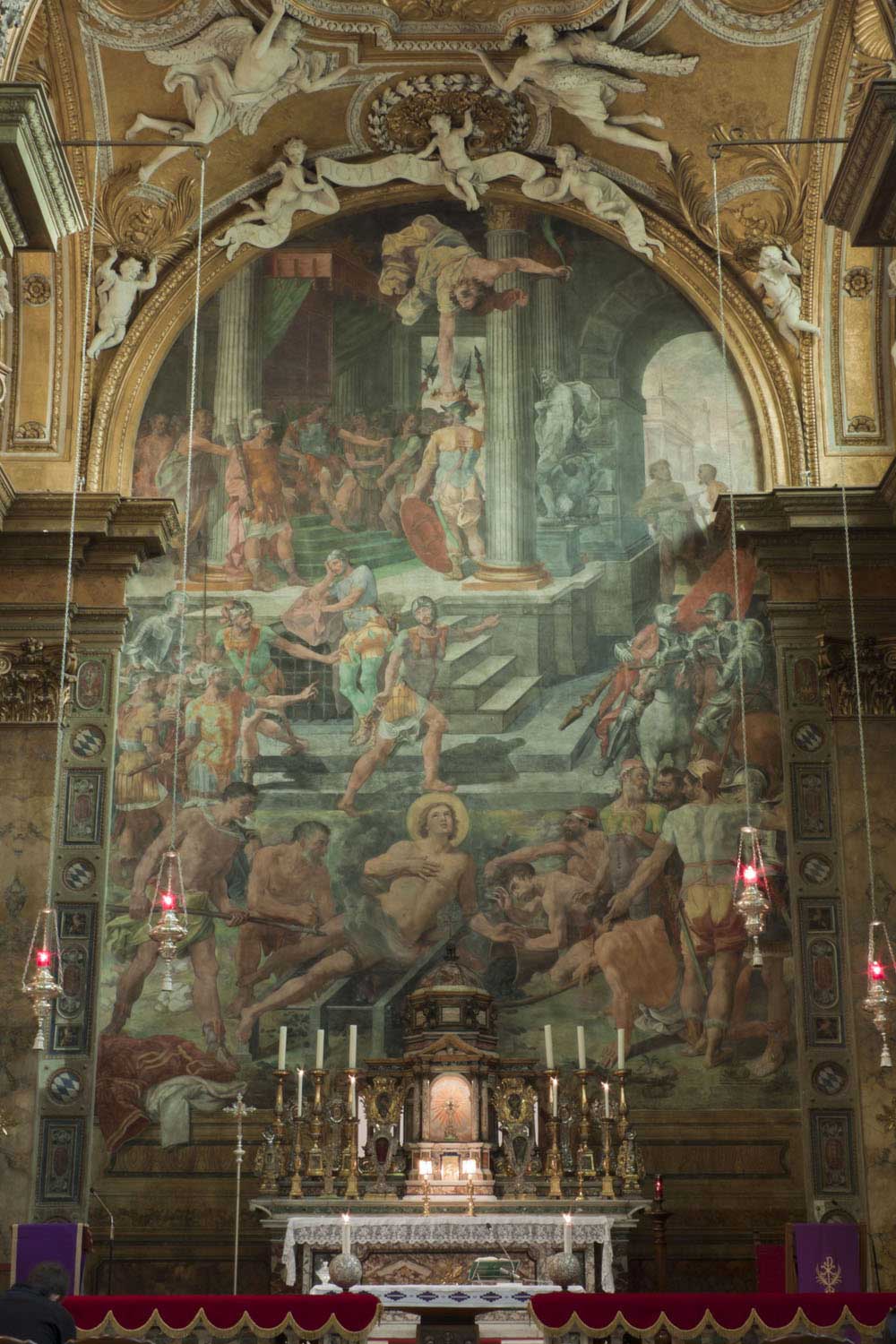
Today’s Station Church, San Lorenzo in Panisperna, marks the spot of one of the most famous martyrdom’s in Christian history. Lawrence, one of the deacons in the Roman church, was arrested along with Pope Callixtus in August of the year 258, when Christianity was still illegal. Soldiers demanded that Lawrence hand over the treasures of the church, and in response the witty deacon gathered not gold and silver but the poor whom the Church served. Angered, the soldiers imprisoned Lawrence, who with his palpable Christian character soon managed to convert even the jailor. The only option remaining for the soldiers was execution, so they tied Lawrence to a grill and lit a fire underneath. Eventually, Lawrence would die as a witness to his faith in Christ, but not before getting in the last word: halfway through the ordeal, the saint mocked, “You can turn me over now… I’m done on this side!”
Testimony to Hope
How do martyrs suffer for their belief in Christ in such a joyful and free way? The answer boils down to the strength of the Christian’s faith, and the hope that results from such faith. A Christian who has faith is one who believes that God has spoken through Jesus, and therefore believes Jesus’ words are true. A Christian who has hope goes a step beyond, being able not only to believe Jesus’ words are true, but to trust God as delivering on all the promises Jesus has made. The result of such faith and hope is thus an abiding joy, because such a believer sees behind every circumstance the loving providence of God. The Father, revealed by Jesus, can bring good out of any situation, and someone who believes this is true and trusts the Father to act, cannot help but see life through the lens of joy. Hence the wit of today’s saint, and the insightful comment of Pope Benedict, then Cardinal Ratzinger: “deep joy of the heart [is] the true prerequisite for a sense of humor, and thus humor is, in a certain sense, the measure of faith.” (p. 80, Principles of Catholic Theology, San Francisco: Ignatius Press, 1987.)
Seek, knock, ask
Today’s Gospel, Matthew 7:7-12, invites us to practice the gifts of faith and hope. “Ask and it will be given to you; seek and you will find; knock and the door will be opened to you. For everyone who asks, receives; and the one who seeks, finds; and to the one who knocks, the door will be opened. Which one of you would hand his son a stone when he asked for a loaf of bread or a snake when he asked for a fish? If you then, who are wicked, know how to give good gifts to your children, how much more will your heavenly Father give good things to those who ask him.” Here we see the trust of Jesus in the Father, and Jesus’ invitation for us to live out of such a trust. At Baptism, we were given the gifts of faith and hope, but today Jesus invites to act on these gifts. Do we? If not, reading the Scriptures daily can be a good remedy, because it will open our eyes to the God we profess and lead us to trust him in every circumstance. Only then can we become the joyful saints we’re all called to be, and, hopefully, with a little bit of humor too.
Everyone’s a bit Irish on St. Patrick’s Day, it’s often said. Of course, this is just an excuse so that those who aren’t Irish (like me) can join in all the fun. Erin go bragh!
At the same time, it does happen to be true- in a manner of speaking. All Catholics are part of St. Patrick’s family, though the communion of saints. We’re all one in the household of God, just as God is one: Father, Son, and Holy Spirit.
In perhaps the most famous story of his life, St. Patrick was standing in a grassy field, teaching a crowd about the Trinity. His listeners, however, couldn’t comprehend that three Persons could be one God. So St. Patrick picked up a shamrock, showed it to the people, and they understood: God is three and one, just as one shamrock has three leaves.
The shamrock is a symbol seen at every St. Patrick’s Day celebration. But it’s also a symbol of what we celebrate as Catholics every day: That regardless of where we come from- Ireland or India, Tipperary or Timbuktu, we are all one in God.
In the Gospel for Wednesday, Jesus rebuked the people of his time for their stubborn and unrepentant hearts:
This generation is an evil generation; it seeks a sign, but no sign will be given it, except the sign of Jonah. Just as Jonah became a sign to the Ninevites, so will the Son of Man be to this generation. At the judgment the queen of the south will rise with the men of this generation and she will condemn them, because she came from the ends of the earth to hear the wisdom of Solomon, and there is something greater than Solomon here. At the judgment the men of Nineveh will arise with this generation and condemn it, because at the preaching of Jonah they repented, and there is something greater than Jonah here.” Luke 11:29-32
Stubborn? – It is a notable issue that sometimes sets up in both individuals and cultures, that the heart becomes obstinate, stubborn, incorrigible, and unrepentant. Increasingly, the heart becomes hardened and unlikely to change, even despite overwhelming evidence that the course one is on is destructive, and a source of pain.
Perhaps a couple of examples from our culture will help to illustrate what the Lord is teaching.
The Problem of Promiscuity – The past fifty years have featured an explosion of promiscuity. I do not argue that there was no sexual sin prior to 1960, but it is a far wider problem today both in quantity and degree. And the results of promiscuity are demonstrable and terrible: STDs, AIDS, teenage pregnancy, abortion, a devastation of marriage and family. Divorce rates have soared. Co-habitation and other alternative arrangements have proliferated.
Children are the ones who suffer by not being raised in two-parent families under the formative influence of a father and mother, male and female. Sure enough, under stress, the rates of Juvenile delinquency have gone up [1] even as test scores [2] and graduation rates [3] have diminished. Promiscuity also leads to poverty since the chief cause of poverty in this country is single motherhood [4]. Children living in fatherless homes are 5 times more likely to live in poverty, 9 times more likely to drop out of school, 37% more likely to abuse drugs, 2 times more likely to be incarcerated, 2.5 times more likely to become a teen parent, 20 times more likely to have behavioral disorders, 32 times more likely to run away [4].
Well, you get the point. Promiscuity causes diseases, divorce, and devastation of the family, which in turns harms children through abortion, poverty and irregular family situations. Statistically, the results are clear, even staggering.
Yet, despite this, there seems little willingness in our culture to learn or even to reflect on the relationship of promiscuity to great harm. One might expect a rational person or culture to observe these sorts of results and say, “Gee, this is pretty bad. Maybe we should change the way we behave.” But not only is such a reconsideration not evident among most, but a kind of doubling down of bad behavior is occurring. There are increasing demands that the Church and other “moral police” be silenced and cease their “intolerant” attitudes. There are also demands that the government supply condoms, promote contraception, fund abortion, provide welfare that financially incentivizes single motherhood, and promote “values-neutral” sex education in schools. Even AIDs research though good and fine in itself, is often demanded in the absence of any appreciation that celibate behavior is an important aspect of prevention.
At some point we have to see how promiscuity is destroying us. The breakdown of the family is a civilization-killer. But still we seem, as a culture to be unable or unwilling to change the way we think and the way we behave.
And thus we see illustrated what the Lord condemns: a stubborn and unrepentant heart.
Another example is our greed. At some level, we know by experience that our affluence vexes us sorely. The more we have, the more stressed out we become. The more affluent we become, the more Americans go on psychiatric and psychotropic drugs [5]. We are busy and stressed trying to maintain our extravagant lifestyles. We have never lived so long and healthy, and we have never been so anxious about our health. We have never had so much and never been so anxious about “the economy” and “the stock market.” Money worries us constantly. We buy things we can’t afford, and our credit cards worry us. We buy, and then are not satisfied, for now a newer model has been issued and we feel “poor” (we are NOT poor) and diminished for not having the latest. More, fancier, bigger, deluxe options, but along with it, stress, dissatisfaction, and anxiety.
Despite knowing all this (and we DO know it), we still want more. No matter the evidence, we still upgrade, enlarge, and accessorize. At some point you’d think we say, “Enough. All this stuff is driving me crazy, I think I will simplify my life, and ask the Lord to make we satisfied with essentials, or at least with less.” But we don’t, and we stubbornly adhere to the greed (the insatiable desire for more) that we know vexes us sorely. In effect our hearts have become stubborn and unrepentant both as individuals and as a culture. It just seems we collectively refuse to change in this regard. And thus we see illustrated what the Lord condemns: a stubborn and unrepentant heart.
In Lent, we do well to ask the Lord to soften our hard hearts. The Lord said to Moses on several occasions that we are a stiff-necked people (Eg Ex 32:9; 33:3; Deut 31:27; inter al). And through Isaiah He says that our neck is iron and our forehead is bronze (Is 48:4). To Ezekiel he said we are stubborn and obstinate, not to mention hard of heart (Ez 2:4; 3:7).
It’s OK he still loves us. But we need some serious help. And Lent is a good time to appreciate that. We need this help as individuals and as a culture. We tend to be stubborn and unrepentant. We tend to justify our behavior and have a cultivated blindness that refuses to see what is plainly before us.
Two Christians were speaking. One said, in my church there are many miracles! The other asks, “So you consider it a miracle if God does someone’s will?” “Yes!” said the other. “Hmm….” said the second, “In my church it is considered a miracle if someone does the will of God.”
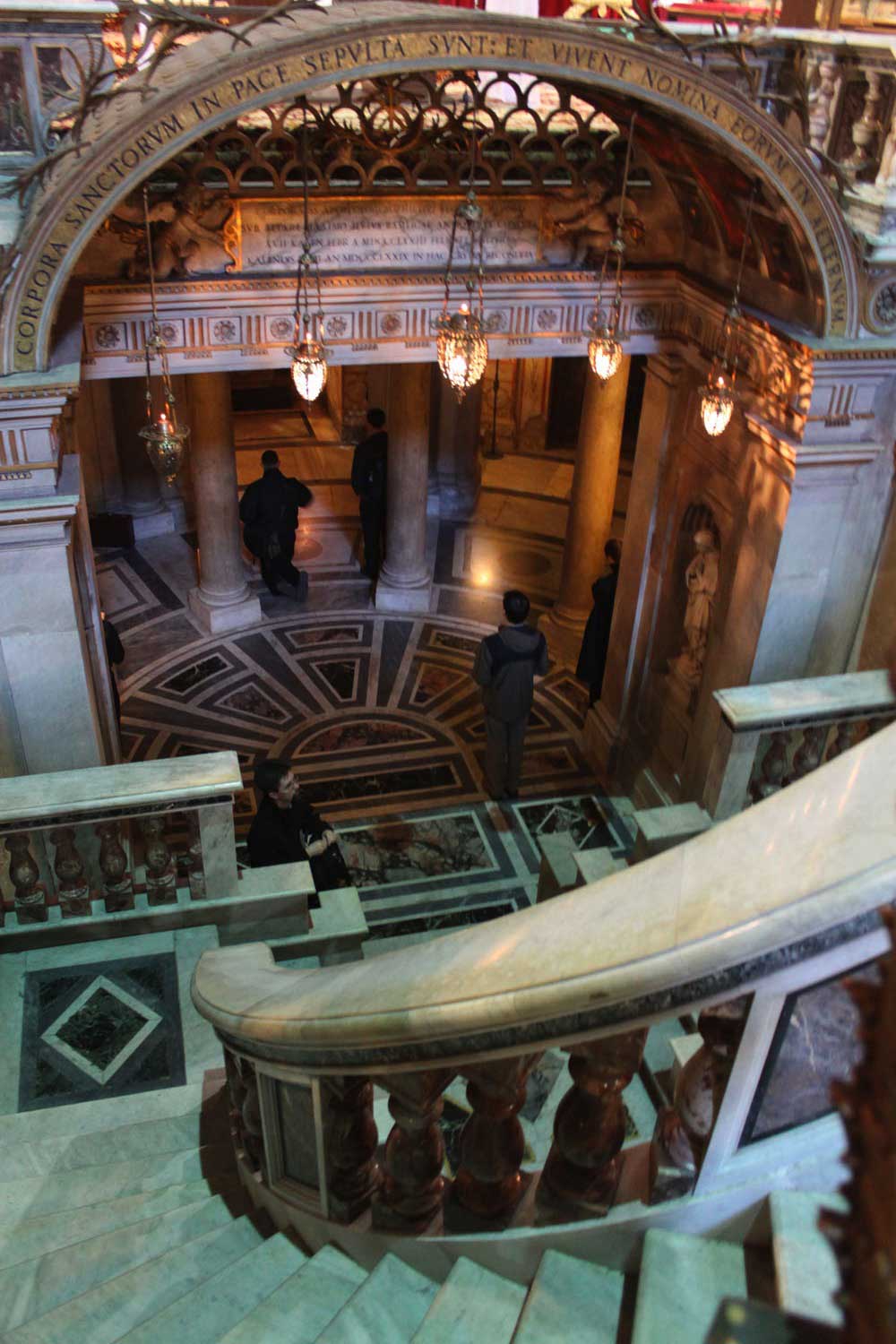
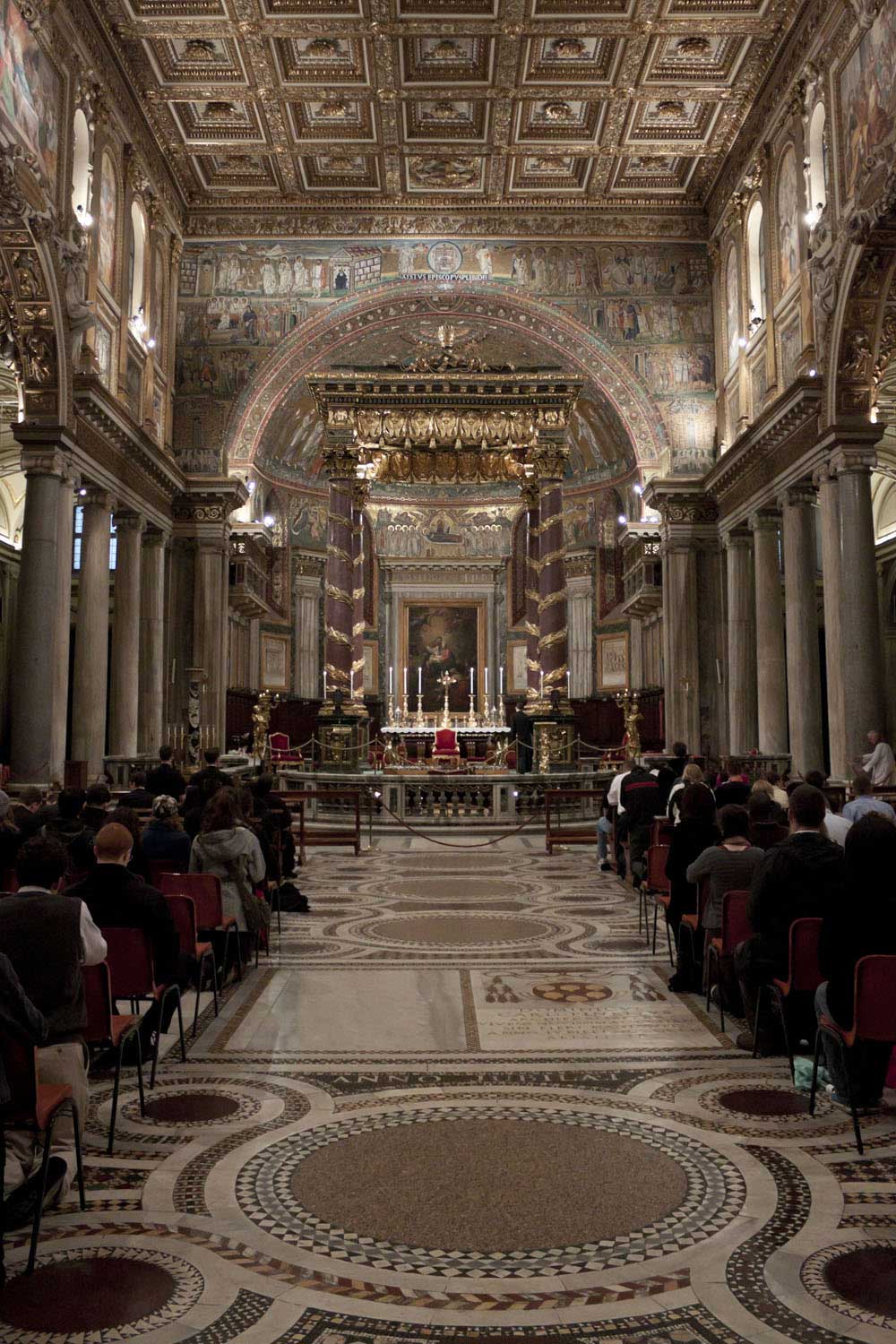
Warm rain joined pilgrims this morning on their way to the oldest church in the West dedicated to Our Lady, St. Mary Major. Miraculous snow on 5 August 353 AD marked the spot where Our Lady desired this church to be erected on the Esquiline Hill. The title Our Lady of the Snow took. After the Council of Ephesus in 431, which named Mary as the Mother of God, Pope Sixtus III began construction. Relics of the original crib that held baby Christ are kept in a reliquary here. The remains of St. Jerome rest in the crypt.
Feeding our love for the Eucharist through Fasting
In today’s readings, Christ continues to call us to purify our desire for authentic conversion through fasting. May our fasting this Lent increase our love for the Eucharistic. We can apply the desire we have for things we are offering up to the Eucharist. Transform the craving you have for food, into thirst for the Eucharist. May the pangs of hunger we feel, the sacrifice of abstaining from meat on Fridays, or coffee without sugar, or bread without butter, or fries without ketchup, be small but effective ways of increasing our appetite for the Eucharist, intensifying our desire to be united to Christ, to allow him to be more present to us than we are to ourselves, so that our days become either periods of thanksgiving after we have received Holy Communion or anticipation looking forward to the next time we will receive Christ. By converting our longing for material things into devotion for the Eucharist, may we allow Christ to reign in us.
In view of the selfishness and self-absorption that pervades our culture, we hear these days about the “Me Generation.” One psychologist, however, refers to it as the “Don’t Blame Me Generation.” She writes, “it is based on a belief system like this: ‘I am more important than most people; I am good; therefore I am incapable of doing bad things.’” What we have, she concludes, is a generation of people who don’t think they need to change anything about themselves.
In today’s gospel, Jesus spoke about another generation of people who didn’t see their need for change. Through his very presence amongst them as the incarnate Son of God, this generation was presented with something far greater than the wisdom of Solomon and the preaching of Jonah. Yet still they didn’t change; they just didn’t see the need. Jesus might very well have directed his words to our “Don’t Blame Me Generation” of today. And indeed he does.
In contrast, the people of Nineveh, when they heard God’s word through Jonah, recognized their need for change. And when they repented in sackcloth and ashes, they learned that God never spurns a humble and contrite heart. You and I will experience this as well, whenever we embrace our need for change and repent. As we celebrated in today’s psalm, God has mercy on us in his goodness; in his compassion he wipes out our offenses; he washes us from our guilt; and cleanses us from our sins. So while “Don’t blame me” may be the cry of our generation, Jesus invites us to make “Have mercy on me” our cry of faith.
Readings for today’s Mass: http://www.usccb.org/nab/031611.shtml
It is often a fact that we have had to discuss difficult subjects on this blog. For, it is also a fact that our culture is in serious trouble. But it is also a notable trend that God is renewing his Church. I am seeing increasing signs of a springtime for the Church, at least here in America.
As I walk past the rose bushes out front of the rectory I see the first red shoots emerging from the pruned stumps. Last October my rose bushes were over seven feet tall. In November they were pruned all the way back to one foot. But, the young red shoots are emerging.
And in this I see an image of the Church. The overall numbers in the Church still seem troubling, especially for those of who remember the days of packed Churches and waiting lists to get into Catholic Schools. In those days, the Church stood tall and proud. But the days of pruning came, as a cultural winter set in, and we have seen closings and very lean years. Yet, the young red shoots of a new season are appearing on this rosebush of the Church, if you ask me.
1. Vocations to the Priesthood in many areas are returning. Here in Washington we are preparing to open a new pre-theologate. Our ordination numbers are up and many superb men are presenting themselves for service of the Church. I am very impressed with our new priests of the last 15 years. They are solid men who love the Church, are obedient to the Magisterium and liturgical norms, and have zeal to proclaim Christ.
2. In my parish the convent became so full the Servant Sisters of the Lord had to seek larger quarters. 25 of them moved. Only four remain in our convent, but I expect the convent to fill again soon. Many Religious orders that have retained their traditions such as the habit, communal life, and a focused apostolate are doing well, if not thriving. The Dominican Sisters in Nashville and those in Michigan are over-flowing with vocations.
3. One of my apostolates is the Traditional Latin Mass and I find an amazing number of young people who are attending. They are also meeting each other and marrying. More than half my weddings these days are from the Latin Mass community. They are solid couples, committed to the Church’s teaching on marriage. A good number of the couples I have wedded have gone on to have nice, large Catholic families.
4. The Catholic blogosphere has lit up with many outstanding, faithful and informative sites. Yes, there are some bad ones out there that feature dissent. But frankly, it is clear that the real energy is at the faithful sites. There is a graying of dissent and a thirst for the truth.
5. EWTN and Catholic Radio have a great presence and authentic voice throughout the world.
6. Great publishing houses like Ignatius Press, OSV, and fine Catholic Publications are available to the faithful in abundance.
7. There are many thriving movements in the Church that both reflect diversity and manifest great devotion for the Lord and the Church.
8. Better sense of the Battle – I think an increasing number of Catholics who remain, (remember only 25% go to Church), have an overall better sense that they are in a battle. They are, increasingly sober and serious about the state of the world and the necessity of being distinct from it. Too many Catholics of the past just wanted to fit in and get along. I think this attitude is beginning to diminish. This is certainly so among the younger clergy and religious and a growing fact among especially the younger faithful.
9. Many younger Catholics are more open to the Church’s teaching. They see the disastrous and often ruined lives of the generation that preceded them and seem more open to admitting the errors of modernist tendencies.
10. There are many new and flourishing Catholic Colleges and Universitiesthat have risen to replace many of the seemingly unreformable ones. Likewise, there are many good movements on College campuses such as Newman Centers, and groups like the Fellowship of Catholic University Students (FOCUS). Groups like these give Catholics a fighting chance on many secular (and even some Catholic) campuses where the moral and academic setting is hostile and poisonous. Other groups such as the Cardinal Newman Society (CNS) keep an eye on Catholic Colleges and both praise the good ones and warn parents of the bad ones and bad trends.
11. Open Dissent and Liturgical Abuses seldom go unanswered now. Many Catholics now zelously step forward to set the record straight and demand on-going reform.
Yes, the red shoots are beginning to appear on the pruned rosebush of the Church. My list is just a quick one, anecdotal and incomplete. I would be grateful if you would add to this list. Where do YOU see signs of growth and spring?
Little by little the Lord is raising up men and women in the Church who, by his grace, are ushering in reform and purification. Who do you know like this and what do you see?
I realize that some of you will also want to differ with my view or add areas where we need further improvement (e.g. greater love for and direct service of the poor). Please do so. My picture is incomplete; the rose shoots are just now appearing.
I want to finish with a Scripture from last Saturday’s Mass that speaks with joy of the work of God to rebuild the ruins:
[L]ight shall rise for you in the darkness,
and the gloom shall become for you like midday;
Then the LORD will guide you always
and give you plenty even on the parched land.
He will renew your strength,
and you shall be like a watered garden,
like a spring whose water never fails.
The ancient ruins shall be rebuilt for your sake,
and the foundations from ages past you shall raise up;
“Repairer of the breach,” they shall call you,
“Restorer of ruined homesteads.” (Is 58:9-14)
Photo Credit: Flickr (Right click on Photo for URL)
This video depicts the work of FOCUS, mentioned above. It illustrates well the kind of reform I see springing up in the Church. The Video is very inspiring.