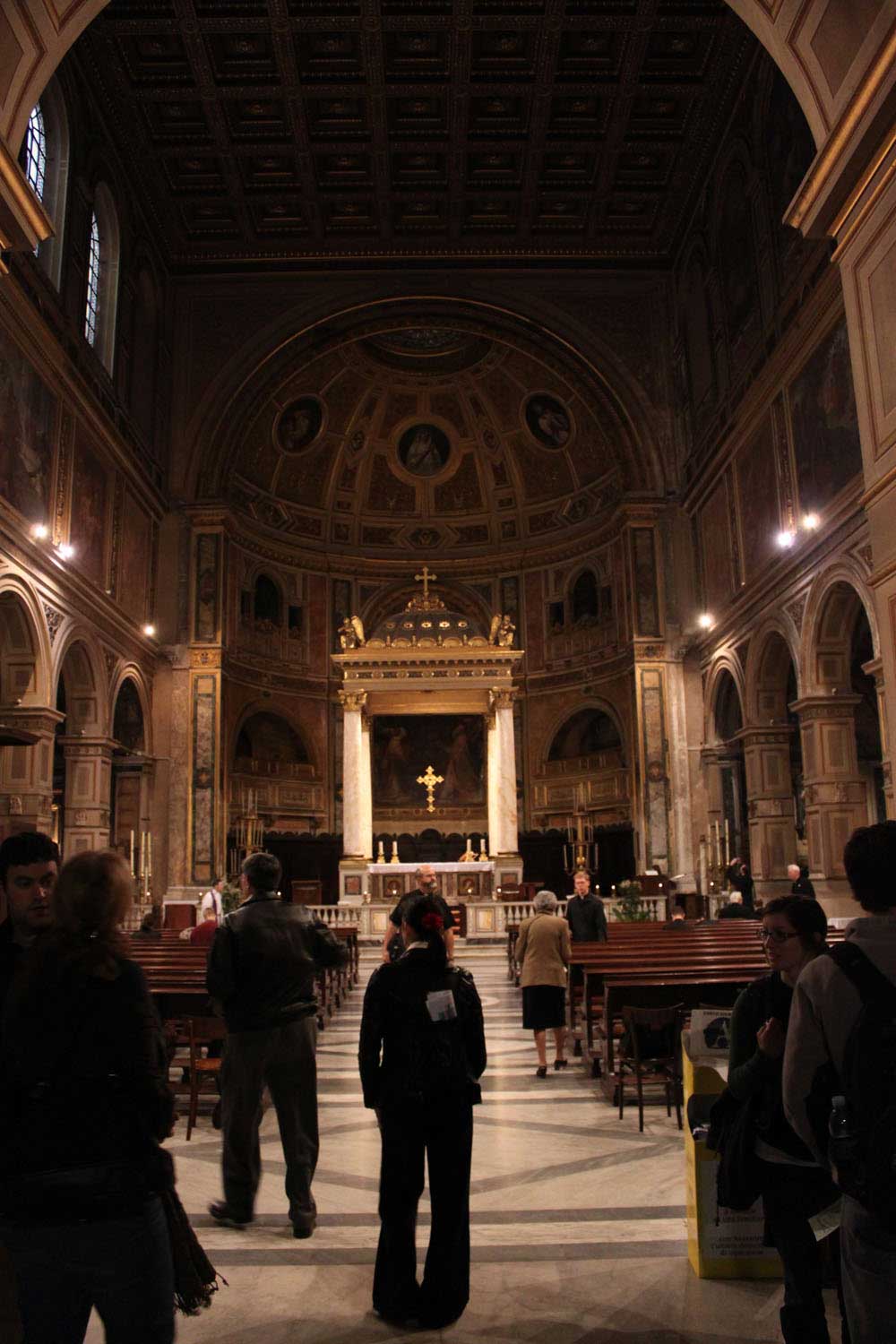
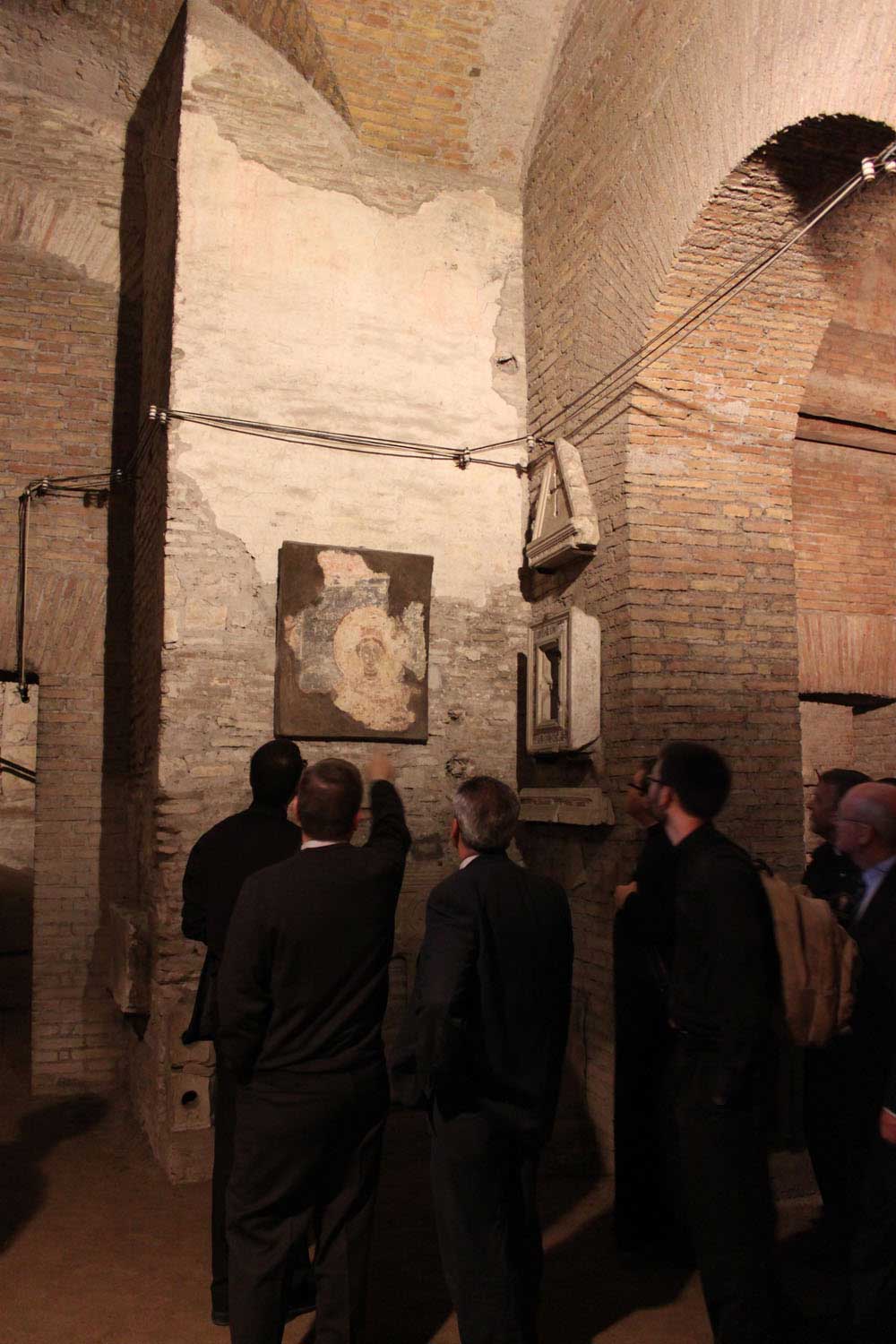
The Thursday after the Fourth Sunday of Lent brings us to San Martino ai Monti. Originally a house church, the original structure was built by Saint Sylvester (314-335) and was later dedicated to St. Martin of Tours (317-393) and Pope St. Sylvester. A preparatory meeting for the Council of Nicea in 325 was held here. Here Christians in Rome first proclaimed the Nicene Creed, a practice that continues to this day through the entire catholic world.
God’s Fidelity
Our reflection today is on the fidelity of God. The Lord made a promise to Israel, to build a house for it, to make it a great nation with descents beyond number. The Holy Catholic Church is the new Israel and the Lord’s promise extends to each of us. We often think of making acts of faith in the Lord, but don’t as often think about His fidelity to us, His great love for us. Even when we fail to trust in Him, even when we fail to follow His word, He is still faithful to us. He will never turn back on his promise. He is always there for us, always available. Because of our sins, we have much to answer for. But because of God’s promise, He has more to answer for. God is faithful
One evening, Stephanie my wife prayed for guidance as to whether or not she should return to work part time. The very next morning, an absolutely perfect job practically fell into her lap. To us, this was an obvious sign from God. Yet that night, as we adjusted our family budget to reflect Stephanie’s new income, we started to worry about money. God had just answered our prayer and shown us how much he cares for us. But still we didn’t “get it;” still we didn’t trust.
Sadly, that’s all too common, as reflected in today’s Scripture readings. In the first, God’s people rejected him for an idol, even after he had freed them from slavery in Egypt. And in the gospel, there were those who refused to believe in Jesus, even though they were surrounded by evidence that he was the one sent by the Father. In both cases, people just didn’t “get it.” God had done so many good things for them. But still they doubted him, rejected him, and forgot about him.
Sometimes we’re guilty of the same things. When times are hard, we can doubt God’s love and care for us. And when times are good, we can forget about God altogether, and replace him with the idols of success, beauty, security, and wealth. We do this even after God has done so many good things for us. Things that should make us “get it,” and call forth our obedience, our trust, and most of all, our love.
I have a large Icon of Christ in my room (see photo at right). What icons from the Eastern tradition do best is to capture “the Look.” No matter where I move in the room Christ is looking right at me. His look is intense, though not severe. In the Eastern spirituality Icons are windows into heaven. Hence this icon is no mere portrait that reminds one of Christ, it is an image which mediates his presence. When I look upon him, I experience that he knows me. It is a knowing look and a comprehensive look.
The Book of Hebrews says of Jesus, No creature is concealed from him, but everything is naked and exposed to the eyes of him to whom we must render an account. (Heb 4:13).
But his look in the Icon is not fearsome, it is serene and confident. Hence the text from Hebrews goes on to say, Therefore, since we have a great high priest who has passed through the heavens, Jesus, the Son of God, let us hold fast to our confession. For we do not have a high priest who is unable to sympathize with our weaknesses, but one who has similarly been tested in every way, yet without sin. So let us confidently approach the throne of grace to receive mercy and to find grace for timely help. (Heb 4:14-16)
Particularly in Mark’s Gospel there is great emphasis on the eyes and the look of Jesus. A frequent expression in that Gospel is “And looking at them He said….” Such a phrase or version like it occurs over 25 times in Mark’s Gospel referring to Jesus.
Looking on Christ, and allowing him to look on you is a powerful moment of conversion. Jesus himself said, For my Father’s will is that everyone who looks to the Son and believes in him shall have eternal life, and I will raise him up at the last day.” (Jn 6:40) and the First Letter of John says, What we shall later be has not yet been revealed. We do know that when it is revealed we shall be like him, for we shall see him as he is (1 Jn 3:2).
There is just something in us that seeks the face of God and desires that look of love that alone can heal and perfect us. I often think of this verse from Scripture when I am at Eucharistic Adoration: Look! There he stands behind our wall, gazing through the windows, peering through the lattice. (Song 2:9). Yes, I long to see the Lord, and the Scripture also speaks of his longing to “see” us.
Here are some scriptures that remind us to seek the face of the Lord and to look to him:
Seek the LORD and his strength; seek his presence continually! (1 Chron 16:11)
If my people, who are called by my name, will humble themselves and pray and seek my face and turn from their wicked ways, then will I hear from heaven and will forgive their sin and will heal their land. (2 Chron 7:14)
You have said, “Seek my face.” My heart says to you, “Your face, LORD, do I seek.” (Ps 27:8)
Look to the LORD and his strength; seek his face always. (Ps 105:4)
I [the Lord] will return again to my place, until they acknowledge their guilt and seek my face, and in their distress earnestly seek me. (Hosea 5:15)
Everyone who looks to the Son and believes in him shall have eternal life, and I will raise him up at the last day. (John 6:40)
He who loves me will be loved by my Father, and I too will love him and show myself to him. (John 14:21)
Blessed are the pure in heart, for they will see God. (Matt 5:8)
Now we see but a poor reflection as in a mirror; then we shall see face to face. (1 Cor 13:12)
For God, who said, “Let light shine out of darkness,” made his light shine in our hearts to give us the light of the knowledge of the glory of God in the face of Christ. (2 Cor 4:6)
An old song says: We shall behold Him, Face to face in all of His glory….The angel will sound, the shout of His coming, And the sleeping shall rise, from their slumbering place. And those remaining, shall be changed in a moment. And we shall behold him, then face to face.
Allow Christ to look on you.
This video is a wonderful collection of many of the looks of Jesus and the reaction of the people that follows that look. Pay special attention to it. The video also features a lot of “looks” that come from us. Notice how people look upon Jesus, and how they, as human beings react, as they look on Jesus. Look for the “looks” in this video. The final looks are especially moving.
The Patriarchal Basilica of Saint Paul Outside the Walls is the largest church in Rome after Saint Peter’s Basilica and is sometimes referred to as the “Ostian Basilica” because of its location along the Ostian Way. The Apostle Paul was brought to Rome as a prisoner and martyred between the years 64 and 67 during the persecution of Nero. Aquae Salviae, today’s Tre Fontana, about two miles from the basilica, is the traditional site of Paul’s martyrdom. Since he was a Roman citizen, his execution was probably by beheading rather than public torture. The body was claimed by the Roman matron Lucina, who buried it in her family tomb near a vineyard on the road to Ostia. An oratory was soon erected over it.
This basilica was the traditional site of the First Scrutiny of the Catechumenate. This is the reason why a major basilica was erected by Gregory the Great as a station church in mid-week. The tomb of the Apostles, called so specially by Christ, reminds one of the Lenten theme of conversion.
Today, let us take some time to pray for the more than 1,100 men, women and children(catechumens and elect) coming into the church in the Archdiocese of Washington at Easter.
Adapted from the Pontifical North American College Guide to the Station Churches
Certain husbands are quite comfortable calling their fathers-in-law “Dad.” Other husbands, however, find that to be awkward or inappropriate. The prospect makes them uneasy.
Sometimes we can be uneasy about calling God our “Father,” or even “Dad,” as Jesus always did. In fact, this so outraged our Lord’s critics in today’s gospel that they wanted to kill him! Calling God our “Father” hopefully doesn’t infuriate us like that, but it sure can make us feel uncomfortable.
We can be fine praying to “Almighty God,” as that title reflects God’s distance from us. But “Father” speaks of God’s nearness; it implies love, family, and intimacy. And that can scare us, because we worry about getting too close to God. After all, who knows what that might lead to? We wonder: “What will God ask of me? What demands could he make? How might my life have to change?” It can seem easier, and a whole lot safer, to keep God at arm’s length.
Jesus challenges us to move beyond our fears. As our brother, he wants us to know the Father, not only as one who dwells above us, but also as one who abides within us. The same life and love the Father gives to Jesus, is also offered to us. Our Father doesn’t want to be kept at arm’s length. Instead, he wants to hold us in his arms.
We live in a time where some of the troubling philosophical premises of previous centuries have reached full flower. In particular the skepticism of our time, which plagues us, goes back several hundred years. Doubt and cynicism are a huge factor in our times and they underlie a lot of the atheism and agnosticism of this modern age.
Allow me for a moment to speculate as to how we have gotten here. As with all things, there are many causes, but I suspect that a lot of it goes back to Rene Descartes and his (flawed, I think) attempt to overcome the doubt he experienced. And, due to the significant influence he had, he set forth a kind of “Cartesian Anxiety” which keeps us from attaining to a proper balance between certainty and doubt, faith and reason, body and mind. I think it has also severed our ties with the world as it is and has caused us to retreat into our minds.
Cartesian anxiety is a term that refers to a longing for absolute certainty, and the belief that scientific methods, should be able to lead us to a firm and unchanging knowledge of ourselves and the world around us. It is called Cartesian due to its connection to René Descartes who sowed seeds of extreme doubt by insisting upon a kind of absolute or ontological certainty in things. Western civilization has suffered from unrealistic expectations as to the basis of knowledge, and a kind of anxiety ever since, that we can really know anything in a way that will satisfy our doubt. Let’s take a brief look at Descartes. If you think you know about Descartes then skip the block and go to the implications.
René Descartes lived in the Dutch Republic during the first half of the 17th Century. – He is widely held to be the Father of Modern Philosophy.
Descartes, uses a method of fundamental doubt, wherein he rejects any ideas that can be doubted, and then tries to re-establish them in what he considers a firm foundation for knowing them as actual or genuine.
This led Descartes, ultimately to only a single “provable” principle, namely that thought exists. He states this in his treatise, Discourse on the Method and Principles of Philosophy. It is here that we get the well-known cogito ergo sum (I think, therefore I am). In other words, since I doubt, something or someone must be doing the doubting, as so, the fact that I doubt proves my existence. Somewhat more negatively, the well-known phrase could be: “I doubt, therefore I am.”
It seems to me that this is where things begin to go off track since doubt and skepticism move to the center. Further, Descartes seems to conclude that he can only be certain that he exists because he thinks. He considers the senses unreliable. Only thought itself is evident to Descartes as a basis for what is undoubtedly real and existing. He considers that, in order to properly grasp the nature of things we must put aside the senses and use the mind.
Descartes thus went on to construct a system of knowledge that largely discarded perception as unreliable and admitting only deductive reasoning as a method of thinking or knowing.
Descartes was not an atheist and claimed to be able to prove God’s existence but in so doing he had to back away just a bit from his exclusion of the senses as reliable. In effect he argues that because God is benevolent, he can have some faith in what his senses communicate to him. For God has provided him with a mind and with senses and does not wish to deceive him. Thus, he does admit of the possibility of acquiring knowledge about the things based on deductive reasoning and perception via the senses.
Descartes also seems to back away from the radical skepticism his rationalism implies. He argues that since sensory perceptions come to him involuntarily, they are thus, in fact, “out there.” The fact that these sensory perceptions come to him apart from his willing them, is evidence of the existence of something outside of his mind, and thus, an external world.
I personally think that Descartes fails in his attempt to re-establish a basis for reality. For, he first sows the seeds of a radical doubt then, according to me, has to break his own rule to reconstruct some semblance of reality outside his own doubting mind. But to do this he introduces a priori assumptions (e.g. God is benevolent), which, while I agree with them, are assumptions, nonetheless. Either the senses are not reliable, as he first argues, or they are to some extent reliable. In which case he must abandon his original rationalist and reductionist premise that only the inner mind is demonstrably real.
Even though I think he tried to resolve or back away from his radical doubt, In failing to clearly resolve it he left us with a legacy of Cartesian disconnectedness from reality and retreat into the mind.
OK, I hope I haven’t lost or bored you. But here are a few of the problems that seem to flow from Descartes and the Cartesian Anxiety he set forth. I do not say he held all these problems, only that they stem from what he pondered.
1. The retreat into the mind and loss of connection with reality. In radically distrusting his senses, Descartes disconnects himself (and us) from the world of reality. What is real is only what is in my mind. The actual “is-ness” of things is no longer the basis of reality. Now, it is just my thoughts that are real. Reality is not “out there” but it is only in my mind. It is what I think that matters.
This leads to a lot of the absurdity of modern times where we tend to overlook reality and reduce everything to opinion. We often think of things abstractly and as “issues.”
For example, abortion is an “issue” for many people, rather than the dismemberment of a human baby. Many tend to think of abortion abstractly and repackage “it” as choice, or a woman’s right. But abortion is not an abstraction. There is something actually happening “out there” in the real world. An actual child is being dismembered and suctioned into a jar. But the Cartesian retreat into the mind allows many to continue to think of abortion abstractly and as an issue. And the mind, detached from reality can do some pretty awful rationalizing. Showing actual pictures of abortion seems to have little affect on those who have retreated into their minds and think of abortion abstractly as an issue, rather than a real thing.
The same is true for the issue of homosexuality. Any even rudimentary look into the biology and design of the body makes it clear that something is disordered with homosexual activity. The man is for the woman, not for the man. The biology is clear. But with the Cartesian retreat into the mind, the body no longer has anything to say to many people. “What does the body have to do with it?” Many ask. All that seems to matter is what they think. It is opinion, not reality, that wins the day. Thought overrules the body, dismisses the external reality. Here again is the Cartesian flight from the real world into the mind.
And the same holds true for just about every moral issue today. It is merely my thoughts and intentions that matter. What I am actually doing is, to the Cartesian dualist is not that important. It is what I think that matters.
2. Reality is no longer revelatory – The revelation that comes simply from the way things are, is “not reliable” and is mere opinion in this Cartesian world we have inherited. Scripture and the Natural Law tradition had held that creation and the way things are were revelatory for us. St. Paul says, For what can be known about God is evident to them, because God made it evident to them. Ever since the creation of the world, his invisible attributes of eternal power and divinity have been able to be understood and perceived in what he has made (Romans 1:18-19). There was a confidence in the Scriptures, and Natural Law Tradition, that the created world, that reality, provided a reliable guide to what was right and true. We had only to study the “is-ness” of things to learn. But this is all jettisoned in the Cartesian world, which remains skeptical that we can really know or reliably perceive the “there” out there.
3. The Cartesian worldview is also unrealistic in insisting upon “absolute” proof. To insist that we, who are contingent and limited beings, can prove or know something absolutely is both arrogant and unrealistic. In the Christian worldview their remains a mystery to all things, a hiddenness that we come to accept. Now mystery does not mean we are clueless. We are clearly able to perceive and come to know what God reveals. But mystery is the Christian acceptance of the fact that things are partially revealed, but that much more lies hidden and unseen.
For example, every human being is a mystery. We are surely able to perceive many things about the people we know. We see their physical presence and know many things about them. But there is also a glorious hiddenness to every person related to their inner life and their place in God’s plan. This is mystery: things are revealed, but at the same time, much lies hidden.
Hence the absolute proof demanded by the Cartesian world is unrealistic.
But simply because we do not know all things, does not mean we know nothing. A balance is required where we can be confident about what we do know and honest about what we do not know. Some degree of doubt or uncertainty is part of the human experience. Yes, we can actually know things, though not as absolutely as demanded by the Cartesian notion of hyperbolic doubt.
4. And this unrealistic notion of needing absolute proof in order to know things is what leads to the Cartesian anxiety of our times and causes us to set up intellectual idols. We tend in our culture to divinize science and the scientific method. And, I would argue, we do this out of Cartesian anxiety. We seem to desperately need absolute proof and so we entertain the notion that science can provide this. Of course, scientific theories change all the time, but never mind, we’re talking about an idol here, and the anxious search for absolute proof is willing to overlook facts like this. “Perhaps older theories have given way, but now we REALLY know! Now the proof is in, and the theory is absolutely proven!” Or so we think. But this is anxiety; it is not reality. Science will continue to change with new data, as it must. And science does not know or prove many things absolutely. We know a lot, but there is a lot we do not know. Good scientists know this and freely admit it. Science alone cannot be our elixir for the radical doubt that troubles us.
And so, here we are. The Cartesian world is in full flower. But it is not a lovely flower. It has led us to an imbalance. On the one hand we distrust reality and have retreated into our minds. Yet, paradoxically we seem desperate to prove some things absolutely to overcome the anxiety that extreme doubt produces. Our confidence in reality as a reliable guide was set aside as we have increasingly retreated into our minds. But, without reality as a reliable guide, we have sought something to soothe the anxiety that uncertainty causes. And so we trot out science and anoint experts and entertain the fiction that they can give the absolute proof our Cartesian anxiety demands.
It is a perfect storm caused by an unrealistic demand that everything be absolutely proven to be knowable at all. As usual, faith provides a better balance. For the fact is, there are many things we cannot know with absolute proof, but we can still know them as reliable. Not everything is known with absolute certainty, but that does not mean it is not known at all. Faith and trust are an important way of knowing. God trains us to trust him through faith. And this also helps us to learn to trust ourselves, our senses, and the reality of the things around us. It even helps us to trust one another.
St. Augustine well described the human person without God as curvatus in se (turned in on himself). That is what seems to have happened to us as we have retreated into our minds. Through faith God can turn us out again to creation, to truth, to one another, and to Himself. This is the real cure for our Cartesian Anxiety.
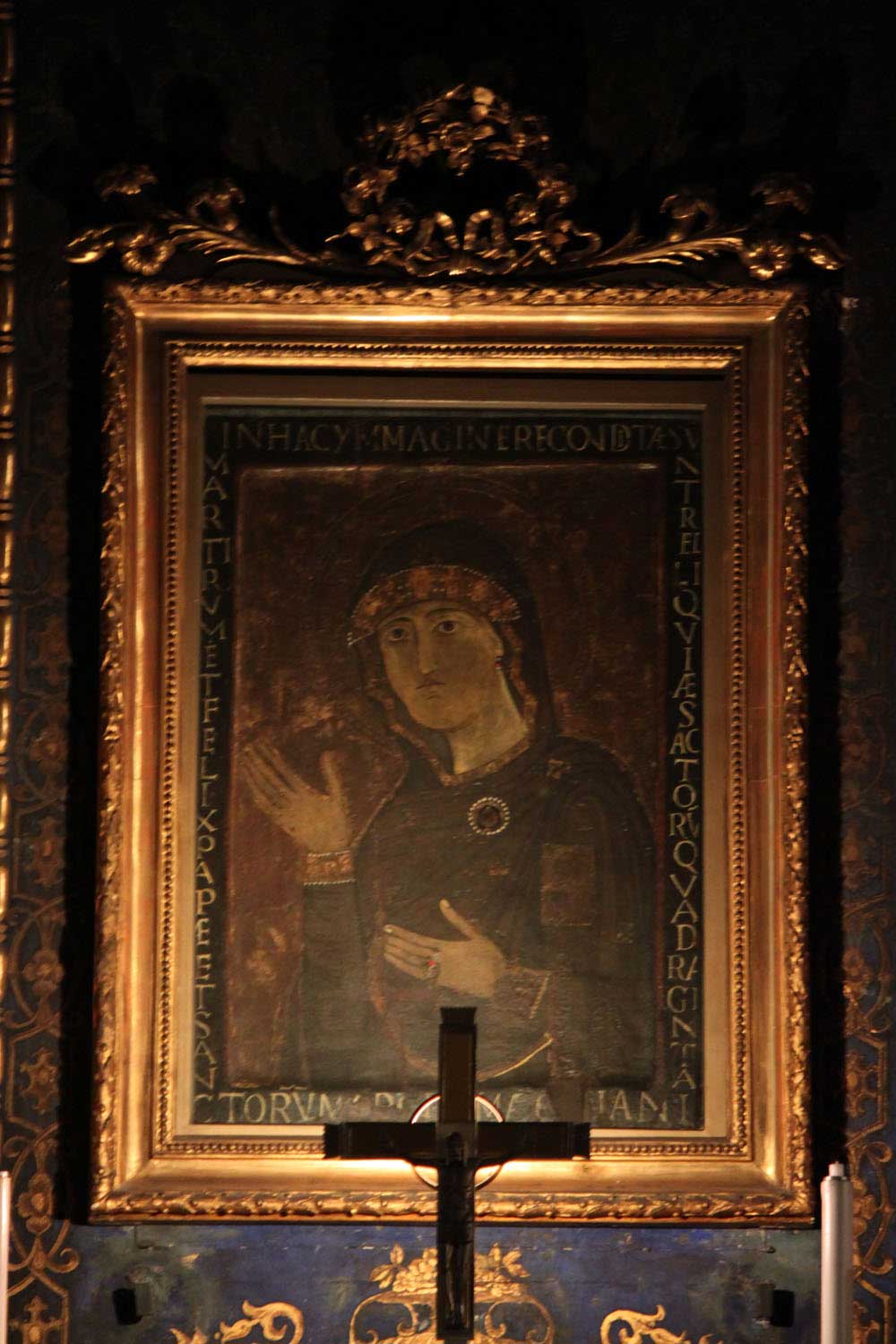
Today’s Church, San Lorenzo in Damaso (St. Lawrence in Damaso) once recalls the memory of St. Lawrence, the great deacon-martyr or Rome whom we celebrated earlier this Lent. Pope Damasus I (366-384) built one of the original twenty-five parishes of Rome nearby, not long after Emperor Constantine had legalized Christianity in 313. The Basilica then went through various phases: in 1484 it was demolished to make room for a new Palace, which later became the papal chancellery but included a newly designed Renaissance church within. The present basilica is the result of this Renaissance church, renovated after damages from the Napoleonic occupation of Rome at the turn of the 18th century and a fire in 1939. Of note are the remains of Pope St. Damasus, and Sts. Eutychius, John Calybites, and Hippolytus, as well as a beautiful Byzantine icon of Our Lady and a miraculous crucifix before which St. Bridget of Sweden often prayed.
The Word as an Instrument
In today’s Gospel (Jn 5:1-16) Jesus heals a crippled man. “‘Do you want to be well?’ The sick man answered him, ‘Sir, I have no one to put me into the pool when the water is stirred up; while I am on my way, someone else gets down there before me.’ Jesus said to him, ‘Rise, take up your mat, and walk.’ Immediately the man became well, took up his mat, and walked.” There’s something abrupt about this
miracle: the passage does not explicitly highlight the importance of faith in Jesus, or some great act of confidence on the crippled man’s part. Instead, the man only implicitly answers “yes” to Jesus’ question, and it is Jesus’ command, “rise,” that heals the man. The focus is on the power of Jesus’ word, and might remind us that listening to his word daily can be a powerful instrument of healing in our lives.
If Jesus’ word contains such power it must be taken seriously, and therefore we cannot dismiss Jesus’ somewhat off-putting command to the man later in the Gospel: “Look, you are well; do not sin any more, so that nothing worse may happen to you.” What a paradox—just this past Sunday we heard Jesus say a man was born blind not because of sin, but, “so that the works of God might be made visible through him.” (Jn 9:2) Has Jesus changed his mind? Does illness come from sin, or not? Following the Gospels closely and reflecting within the context of the whole Bible, we can affirm both answers. Sin can lead to suffering, as told by the story of Adam and Eve in the Book of Genesis, Psalm 107:17, and affirmed by St. Paul in his letter to the Corinthians (1 Cor 11:30). But there is need to view suffering in the context of our relationship with the Father: although God does not want us to suffer, He may allow it, and always can bring forth a greater good. It’s this truth that we will celebrate on Good Friday and Easter Sunday, when God allowed even his sinless Son to suffer, only to bring about our salvation; and it’s this truth that led St. Augustine to comment on Adam and Eve’s sin, “O happy fault that merited such and so great a Redeemer!”
Mother as Teacher
Whether our suffering is due to past sins that we’ve confessed, or is something we’ve received without personal fault, do we trust God can bring good out of either? If not, there is a shortcut: let us begin by looking through the eyes of Mary, who trusted completely in the Father, but whose heart, as a loving mother, was “pierced” as she looked upon Her Son on the Cross. Here, at the foot of the cross, Our Mother teaches us to trust in God especially when there is no human reason to do so. Images of Mary remind us to trust as she did, but even better is to allow Mary to pray with and for us, especially with the time-and-saint-tested rosary.
“Practice random acts of kindness and senseless acts of beauty,” a popular slogan a few years back, challenged our culture in which what we do, and how we do it, is carefully calculated to help us get ahead and get noticed. In our world, stopping to perform a small kindness can knock us off schedule; reputations and resumes aren’t enhanced by random, unrecognized deeds.
Consider, however, what Jesus did in today’s gospel. He saw a pool full of sick, needy, diseased people. As far as the world was concerned, they had nothing of much value to offer. Nevertheless, even though he was busy, Jesus stopped, healed a disabled person, then vanished into the crowd before others made a big deal about it.
Why did Jesus do this? First of all, because he could. Likewise, each and every one of us, with our time, talent, and treasure, is able to do a lot. Perhaps more than we often realize.
Second, Jesus did what he did because he is humble. It would have been easy for him to have drawn attention to himself by his miracle. Yet Jesus acted discretely, and without fanfare.
Third, Jesus did what he did purely out of love, because there was nothing to gain in return for healing this man. Jesus didn’t even receive a “Thank you” for his efforts; the man he healed didn’t even know Jesus’ name.
Our Lord invites us today to follow his example by making random acts of kindness with humility, and out of love, just because we can.

 Written By Fr. C. Gallagher