If you found on your doorstep this morning a filthy, starving, homeless man surrounded by stray dogs, how you your react? What would you do? What would you see?
Would you see an opportunity to love, an opportunity to heal, an opportunity to serve? Would you see a hurting and needy brother? Would you see the face of Christ himself? Or would you be disgusted, scared, annoyed, and worried about the impact on your property value? Would you try to ignore him and hope that he’d go away?
This seems to be what the rich man in today’s gospel did. It’s not that he couldn’t see Lazarus, because he even knew his name! He simply was too hard of heart, too indifferent, to do anything to help him. The rich man chose to separate himself from the plight of Lazarus his neighbor- a separation that continued after they both had died, except with a dramatic reversal of fortune.
Jesus told this parable to challenge our way of thinking about the needy, so that we can change our way of acting toward the needy. Jesus challenges us to see the Lazarus on our doorstep as a brother, not a burden; as an opportunity, not an inconvenience; as a person, not a problem.
He’s not asking us to do the impossible. What he is asking is that we change our attitude, and then to do what we can. Which may be more than we think! If you’ll recall, Lazarus would have been satisfied with table scraps- a reminder that even the small things we do can seem so great to those who have so little. Or as St. Anselm once said: “The fasts of the rich are the feasts of the poor.”
Though we are in tough economic times we Americans live very well. Even the poorest among us live like royalty compared to the poor in many other parts of the world. And we do well, especially in Lent, to recall that our standard of living is partially possible because others work for pennies to produce our many consumer products.
A Worm in the Apple? In today’s Washington Post there was an article that draws me to consider anew my need to remember the poor. The article gives a look behind the scenes of how our relatively inexpensive electronic products are made. The article is entitled “Mike Daisey Discovers the Worm in Apple.” Daisey is a storyteller and has a show at a local theater entitled “The Agony and the Ecstasy of Steve Jobs.” In it, he recalls a trip he made last year to China where, he was given tours of the factories where Apple Hardware is assembled. Here let me quote some excerpts from the article written by Jane Horwitz:
Daisey traveled last spring to Shenzhen, China, where Apple’s and other companies’ hardware is made by subcontractors such as Foxconn. He posed as a businessman to gain access to many factories and used an interpreter to talk with workers.
Daisey was appalled by the working conditions — factory floors packed with 25,000 and more workers, some children, doing 12- and 18-hour shifts or longer, living in cramped quarters and shadowed by factory security people.
“I expected it to be bad. I expected it to be harsh. I was not actually prepared for how dehumanizing it was. I wasn’t actually prepared for the scale of it. .That was what shocked me,” Daisey says
Learning how his beloved iPhone, iPad and other gadgets were made broke his heart, he says. “I miss the pleasure of browsing technology in a world where the consequences didn’t cost people’s lives. I miss a sort of unfettered world where the big questions were what [a device’s] specifications were ….. a sort of techno-libertarian landscape that I didn’t even fully know that I inhabited…..”
Daisey portrays Apple co-founder Jobs not as a villain, but as a tough visionary who has yet to be enlightened about the China issue.
Our modern economy is almost a miracle: Relatively inexpensive goods, plentiful variety, year round produce, quick delivery, and few shortages. I said it is almost a miracle. For the truth is our abundant and relatively inexpensive products are often made possible for us because many in the world work for pennies to produce them. As Daisey notes they often have terrible working conditions and long hours as well. It seems almost impossible to me that I can buy a decent shirt for under $20, especially when I consider the cost of the materials, shipping and overhead. It has to be the cheap labor that makes it possible. The same is true for our marvelous electronics. They are often astonishingly inexpensive considering what we get. Here too, considering all the parts, research and development costs, shipping, overhead and all. Again, it has to be the labor costs that are low. Daisey’s portrait here confirms that.
I realize that economies are complicated things. I am not an economist and cannot easily envision a different way. It is possible that in trying to fix this problem of inequity, we may make things worse for the poor. It often seems the most dangerous thing the poor can hear is: Hi, we’re from the government and we’re here to help you.
But noting that there IS a problem may be the first stage of justice. We human beings like to stay sleepy. We don’t like to ask too many questions like, “Where did this product come from and how can it possibly be so cheap?” Questions like these are uncomfortable, because deep down, most of us know the answer isn’t pretty. So we don’t ask, we don’t even wonder. But honestly we should ask, we should wonder, and we should face the truth, that a lot of our comfort and prosperity, a lot of our cheap products, are made possible because others, who supply us, live with far less and are paid little.
The Pope on sleepiness – Regarding our sleepiness, our wish to remain drowsy and dreamily unaware of injustice, the Pope has a remarkable mediation in his new book, Jesus of Nazareth, Vol II. He is meditating here on the summons that Jesus gave the disciples in the Garden to “stay awake and watch, lest they give way to temptation” (Mk 14). The Pope writes: Across the centuries it is the drowsiness of the disciples that opens up possibilities for the power of the evil one. Such drowsiness deadens the soul, so that it remains undisturbed by the power of the evil one at work in the world, and by all the injustice and suffering ravaging the earth. In its state of numbness, the soul prefers not to see all this; it is easily persuaded that things cannot be so bad, so as to continue in the self-satisfaction of its own comfortable existence. Yet this deadening of souls, this lack of vigilance….is what gives the evil one power in the world. On beholding the drowsy disciples, so disinclined to rouse themselves, the Lord says, “My soul is very sorrowful , even to death.”
It is easy to feel overwhelmed in the face of so complex an issue, an issue involving a world-wide economy with 100,000 moving parts, not mention many governments, some of them corrupt, and a complicated interplay between money, materials and manpower. What is the best solution? Is it a boycott? Is it protests? Daisey suggests in the article that maybe we ought to stop upgrading our stuff for a while to send a message. But would that really help the poor, or would it possibly cause them greater harm? Here a scripture comes to mind: The poor are caught in schemes that others have made (Ps 10:2).
Personal Reform? This is not an economic blog, and not a political one. Hence I do not propose immediate solutions along those lines, if they even exist. What I do propose is a more personal reform. I propose that we ask questions of ourselves and others, that we ponder justice. That we develop a greater love and solidarity for the poor, many of whom are integral to our “miracle” economy (troubled though it currently is). Perhaps we can consider being personally more generous to the needy and the poor when we are given opportunities to do so. Gratitude to the God is essential for all we have, but part of this gratitude should also include deep prayer to God for the world’s poor, many of whom supply our economy by their blood, sweat and tears. And as our love of the poor deepens, our desire of justice for them also grows.
Personal practice – The next time I pick up that tomato at the store, perhaps I can consider that some one far less affluent that I may have picked or processed it. The next time I gleefully open the box with the brand new computer, filled with excitement as on Christmas morning, I ought to remember the Chinese peasant who may have had a hand in assembling it and who could never dream of owning one that nice for himself.
Ask God for a deeper love for the poor, the many unknown souls who are the hidden foundation and the hidden cost in our inexpensive products. Demanding draconian solutions may not be what is best, but love and gratitude for the poor will surely lay a foundation for greater justice and a desire to find creative solutions.
One Day God came to Cain and asked, Where is your brother? As if also to say, How is your brother? Account for me as to his welfare. Cain shrugged, Am I my brother’s keeper? (cf Gen 4:9). Well you know the answer. We ARE the keeper, we ought to have care for the welfare of others. In Lent we ought to pray for a deepening care for the welfare of others.
Photo Credit: Ethicalstyle.com (Right click for URL)
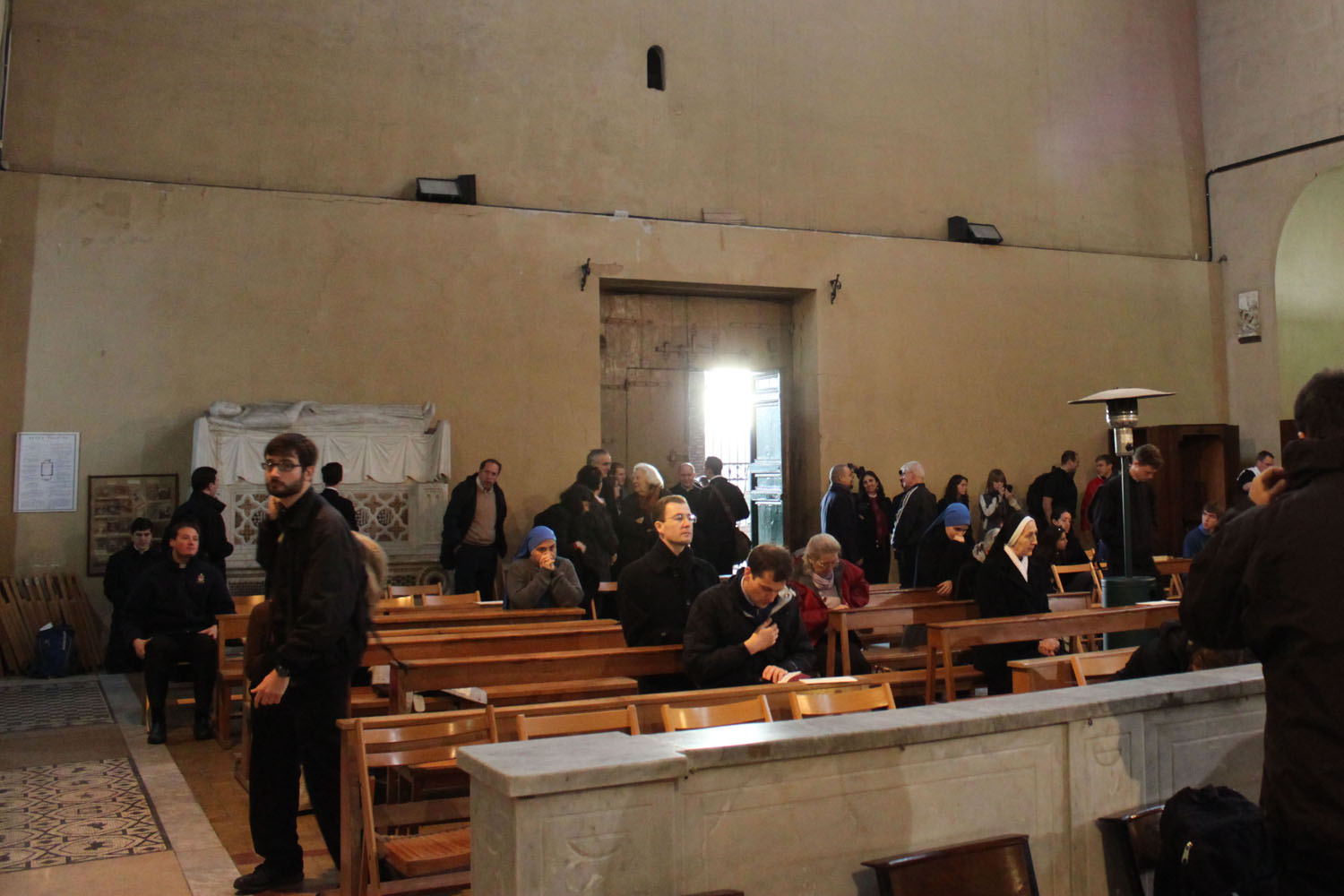
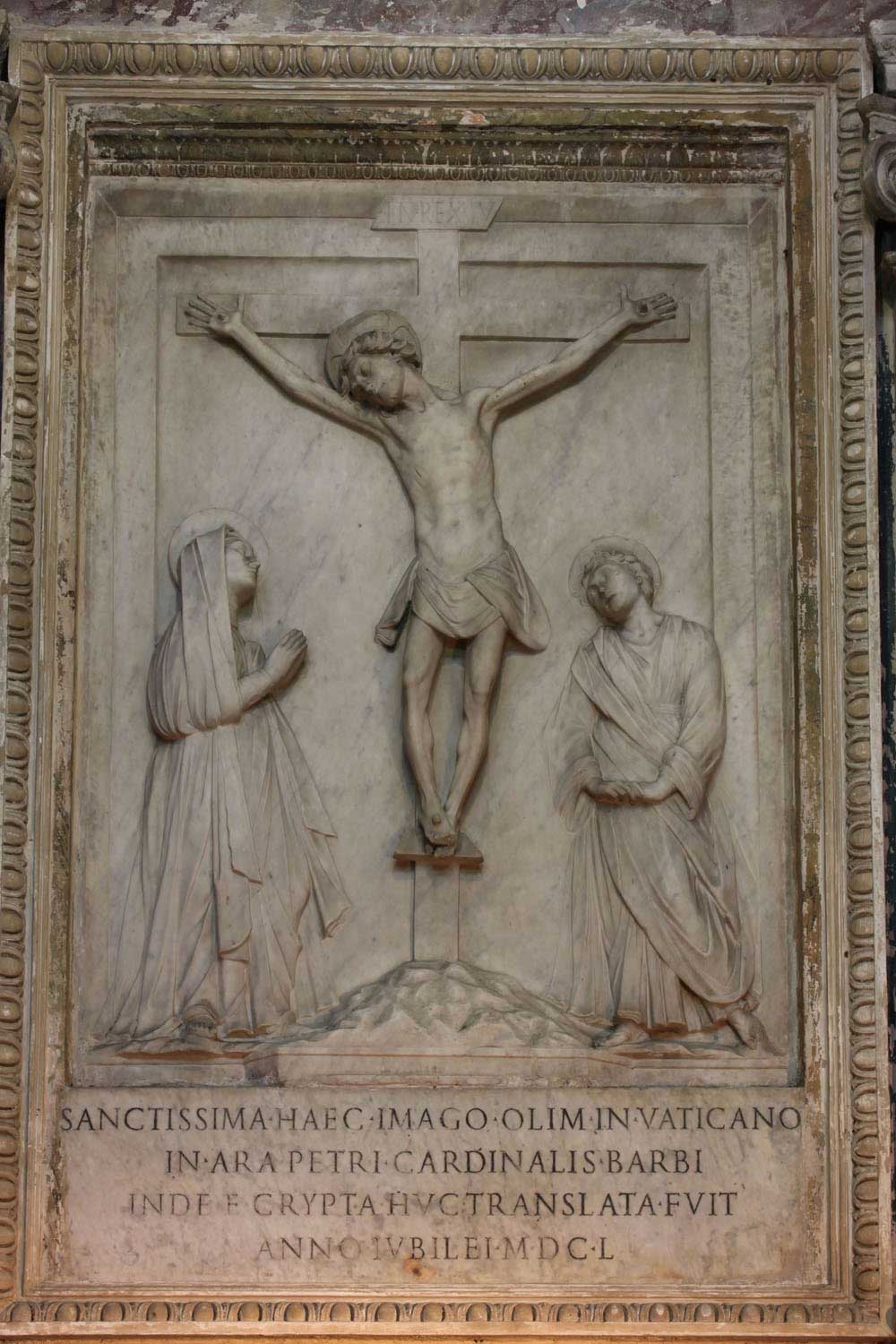
This morning pilgrims starting from the North American College were blessed with clear skies for a relatively short trek to San Cecilia. The church, found in Rome’s Trastevere neighborhood, literally “across the Tiber” from the ancient city of Rome, is located just at the bottom of the Janiculum Hill. Excavations under the church suggest that it is built over the baths of St. Cecilia’s home, where Roman authorities first tried to execute her by drowning. Failing to do so, executioners attempted to decapitate the saintly woman, but failed again, ultimately leaving St. Cecilia to die of her fatal wounds. Tradition holds that prior to dying she entrusted all her goods to the church and asked Pope Urban to turn her home into a place of worship.
St. Cecilia gives great witness to Christ’s question in the Gospel, “Can you drink of the chalice I am going to drink?” As today’ celebrant noted in his homily, the sons of Zebedee enthusiastically replied “yes” to Christ’s question out of sheer love and devotion for Our Lord, but perhaps without a full understanding of the questions implications. In the case of St. Cecilia, who likewise replied yes, it might be said that she did so with greater awareness of the implications to her response. She was seeking to live the Christian life at a time when it was an illegal religion and fully aware that it could be punishable by death.
Saying “YES”
Throughout the centuries various men and women, lay, religious and cleric, have responded yes to Christ’s question and have aided in passing on the faith from generation to generation. As such, the faith has come down to each one of us. Having received that faith, Our Lord now poses the question to each of us, Can you drink of the chalice I am going to drink?
This season of Lent offers us an opportunity to reflect on our readiness to drink from Christ’s chalice in witness to the faith. The season gives us a chance to strengthen ourselves by turning to God and seeking to keep a proper relationship with the world and those around us through prayer, fasting and almsgiving. These practices deepen and fortify us interiorly so we can give public witness to our faith in ordinary and extraordinary ways; to live our faith in such a way that others will take notice. Doing so, we will express our desire to drink from Christ’s chalice.
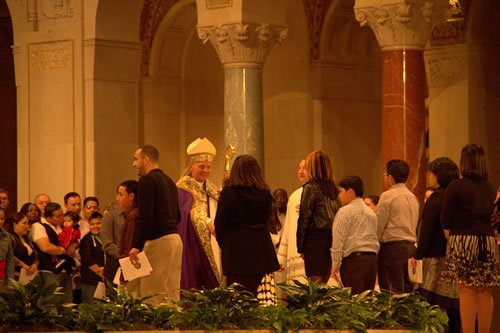
For one candidate, his journey to the Catholic faith began with a conversation with a Buddhist monk. For a couple expecting their first child, it was the result of hours of conversation about what was missing in their lives and what they wanted to be able to give their child. I knew these two stories and I wondered at the amazing number of ways our Lord calls people to a deeper relationship with him and with the church as I watched Cardinal Wuerl greet more than 1,000 men, women and children who will enter our church at Easter.
A church of many faces
In five different languages the names of the elect were called and they started to move forward. One young boy’s sneakers lighted up as he climbed the steps into the sanctuary at the Basilica. Cardinal Wuerl bent down on one knee to greet him eye to eye! Young girls in flip-flops and tattooed young men followed. There were people dressed in the suits they wear as the walk the halls of Congress and people dressed to head to work at hospitals, restaurants and construction sites following the ceremony. There were whole families coming into the church and there were college students who have made the decision on their own. Some walked the length of the Shrine with the hand of their sponsors on their shoulders. Some had huge smiles and some looked a bit overwhelmed by the size of the sanctuary, the presence of the Cardinal and bishops and unsure of what would happen next. I couldn’t help but wonder at what exactly was the event or turning point in their lives that led them to this moment today.
An Evangelizing Church
Though the event or turning point is as unique as each individual, in chatting with the newest members of our church, what is repeated over and over is the importance of feeling welcomed and the witness and testimony of the Catholics they have met in their RCIA classes, at the parish and in their workplaces. In the Catholics they met, they encountered Christ!
Agents of the New Evangelization
I also wondered how many more people might we welcome if all of us were more faithful to our mission as evangelizers. As Cardinal Wuerl reminds us in his pastoral letter, Disciples of the Lord: Sharing the Vision, all of us share in the mission of evangelization. “To be true disciples of the Lord, believers must bear witness to their faith, and ‘witnesses testify not only with words, but also with their lives.'” affirms Pope John Paul II. It is not too early to start thinking about who in your life you can invite to come to know Our Lord and whom we can welcome next year at the Rite of Election.
Do you remember Norm from the TV series Cheers? He once said, “It’s a dog eat dog world, and I’m wearing Milk Bone underwear.” That’s funny, but also a tragic reflection on the nature of human relationships, especially in the world of work.. As leadership gurus like to say, we need to learn to swim with the sharks.
When our hearts are set on gaining power and influence, it doesn’t matter who gets trampled upon or left behind. Perhaps this may make us a bit uneasy, but we can always rationalize it by saying things like “It’s not personal, it’s business,” or “Nice guys finish last.”
But is that really true? Not according to Jesus in today’s gospel. He had just told his disciples about his impending torture and execution. But what happens next? The “Sons of thunder,” along with their mother, make a power grab. They thought: Jesus’ time is short, so we’d better make our move to be on top in his kingdom. Carpe diem; you snooze, you lose.
They didn’t express any concern about Jesus’ fate, and they didn’t seem to care what their friends might think. Evidently, their selfish ambition had blinded them to compassion or concern about anyone else.
Jesus turned this situation into a teachable moment. He conceded that the world may seem to belong to those who can swim with the sharks. But as for his disciples, we are to swim against the tide. He invites us to follow in his footsteps- by living a life of service; by being focused on others’ needs; by being humble; by cherishing sacrifice, not selfishness.
The world may indeed delude us into thinking that “nice guys finish last.” Except, Jesus reminds us, in the race that really counts.
We usually think of the 1950s as an era when just about everyone went to Church. But the cover from the 1959 Saturday Evening Post at the right indicates that even at that time there were already trends underway that indicated not all was perfect in paradise. It is a long and unfortunate trend that men have often left the spiritual upbringing of the Church to their wives and stayed home on Sundays.
A recent CARA blog post written by Mark Gray takes a closer look at the data of Mass attendance from the 1950s and indicates that our perceptions of the high mass attendance in the 1950s may need some adjustment. This is due to the fact that much of the data was based on self-reporting of Catholics. Such reporting is often unreliable since, bluntly stated, people tell fibs to survey takers. Sometimes they tell fibs to themselves. Consider the scenario:
Poll taker: Do you go to church on Sundays?
Respondent: Sure! (Which really means sometimes).
Poll taker: Of the 52 Sundays a year, how many would you say you are in Church?
Respondent: Oh, at least 50 (Which really means more like 10).
The fact is, people like to look good to poll takers, and often answer the question in flattering ways rather than purely truthful ways. This was even more likely the case in the 1950s when Sunday Church attendance was more of a social expectation than today.
Even today, 42% of Catholics polled say they go to Mass each Sunday. But we know from harder data (such as head counts) that the number is closer to 30%
I’d like to put some excerpts of the CARA blog post here and make a few comments along the way. The actual article is fairly long and you can read the rest here: Deconstructing Mass Attendance Numbers
As usual, the Article excerpts will be in bold, black italics, and my remarks in plain text red.
Didn’t everyone go to church in the 1950s?…. But the fact that [the Norman Rockwell Painting above] made it on to the cover of America’s magazine of record at the time indicates that it resonated with the culture of this period [1959]. This issue of the Post was published at a time when weekly Catholic Mass attendance was peaking, as measured in Gallup telephone surveys (74% in 1958 and 72% in 1959).
[But] in 2008, Gallup surveys estimated Catholic Mass attendance in any given week had fallen to 42%. Don’t giggle. I know you don’t believe that 42% of Catholics nationally attend Mass in any given week and you’re right. But why do we believe 74% did in 1958?[Well said. Many of us who quote statistics on Mass attendance exaggerate the 1950s number upward and the current numbers downward because it suits our point. I have been guilty of this. It reminds me of an old GK Chesterton sayings, Many people use statistics like a drunkard uses a light pole, for support rather than enlightenment].
You can only get an attendance percentage by dividing the Mass attendance count….by the number of self-identified Catholics in the parish boundaries that could have attended. [And this sort of data is harder data than self reporting Catholics called on the phone who will tend to exaggerate the frequency of their attendance. This sort of data is a lot harder to come by and requires careful headcounts in parishes. Many dioceses conduct an October headcount. But even four weeks of data is not, of itself enough since there are great seasonal swings in many parishes. Real data collection is hard work].
Perhaps more can be said by taking a second look at a researcher who was in many Catholic parishes studying Mass attendance in the 1950s. Joseph H. Fichter, S.J., (granduncle to current CARA research associate Fr. Stephen Fichter) famously studied parish life by going door to door and taking censuses, making Mass attendance head counts, observing parish life, and documenting everything possible both qualitatively and quantitatively. [Like I said, data collection is hard work]
Fichter estimates Mass attendance levels based on the number of individuals registered with the parish. But he also provides the counts for dormant Catholics…. people who self-identify their religion as Catholic but who do not attend Mass [at all]. Thirty-eight percent of the Catholics within the parish boundaries he studied in this book were dormant. Thus, at the outset we know that typical weekly attendance by the measure of this study could have been no more than 62%. But [the number drops further when we consider that only] 79% of the non-dormant Catholics attended Mass on a typical weekend. So [in combining these two facts] the total percentage of self-identifying Catholics attending Mass in this study was estimated to be about 49%. [OK, I see your eyes crossing with all the numbers. But the critical number is that the number of Catholics attending Mass EVERY week was really closer to 49% in the 1950s when properly adjusted. So the 74% number is too high. Mark Gray explains why in the next paragraph].
Attendance over-reports [in Gallup-like surveys] occur as people being interviewed over the phone respond to their interviewer with answers about their behavior that they believe to fit socially desirable expectations. So typically the respondent has just told the interviewer their religion and then they are asked how often they attend services. Many respond in a way that they believe is socially acceptable—even if it does not fit their actual pattern of attendance.
We have some early evidence of this in the Americans’ Use of Time Study, 1965-1966. Here, 57% of Americans when asked directly about their church attendance reported that they had attended in the last week. However, only 39% of these respondents actually indicated attending religious services when recording their time use hour by hour in diaries (i.e., an indirect measurement)…. [OK, so basically people lie, err….fib. Fact is we do tend to over estimate how good we do 🙂 ].
Father Fichter’s observations also indicate that some of the Mass attendance of the 1950s was not as “active”[i.e. devout] as we might remember it. Here is a passage that likely still resonates with your observations of parish life today:
“A measure of the parishioners’ devotion to the Mass and of their fulfillment of this obligation is seen in the numbers who arrive late and who leave early. By actual count it was noted that, at all Sunday Masses, 8.37 per cent of the congregation arrived after Mass had started and that 6.35 per cent left before it was completed. … Although we have no accurate count, we have noticed that many of these persons are duplicated in both categories. In other words, those who come late also tend to leave early. … The younger males constitute the majority of those who omit part of the Mass, while older females make up the majority who arrive in church well in advance of Mass” (1951, pg. 138)……“By actual count, 35.08 per cent of the congregation read the missal all during Mass, while another 22.08 per cent read some sort of prayer-book while following the priest’s reading of the Gospel. … The remaining persons simply stare off into space, although several men in the last pews sometimes read a copy of Our Sunday Visitor during Mass” (1951, pg. 138). [Oops, maybe a little less devout than some of us remember. I DO remember the silly legalisms of the past where people asked questions like, “How late can I be to Mass and still fulfill my obligation?” My sense is that the trends noted here are a little worse today despite the Mass being in English. A lot of Catholics still give the impression that they are at Mass merely to “check off the God box” and that they seek the fastest Mass possible. Many are devout today, but many are not].
Over a year of Masses, on average, attenders were much more often female (about 7 in 10 or more) than male—a composition that can only result from some men, perhaps like the man in the Rockwell illustration above, staying home. [I want to post on this topic sometime soon].
Many cite CARA’s weekly Mass attendance figure in the low 20 percent range. Some also then cite Gallup’s figure from the 1950s and attempt to argue that Mass attendance has fallen from nearly 80% to just above 20%. This is misleading and inaccurate…..as shown above, the Gallup numbers for the 1950s are inflated…. [Again, I plead guilty to some of this].
Currently, CARA surveys indicate that 23% of self-identified adult Catholics attend Mass every week. Yet, in any given average week, 31% of Catholics are attending…. Note there is considerable local variation in Mass attendance levels with higher levels in the Midwest and lower in coastal urban areas). During Lent and Advent, Mass attendance increases into the mid-40 percent-range and on Christmas and Easter, an estimated 68% of Catholics attend. [This is a good distinction. I sometimes hear the 23% number and other times the 31% number and wonder which it is].
[OK, so what’s the Bottom Line?]
Thus, if one is seeking to make a comparison of Mass attendance in the 1950s to now, the drop is not 80% to 20%. Instead it is from a peak of 62% in 1958 to about 31% now. This is still a remarkable decline. It means that the Mass attendance you see at Christmas and Easter is a lot like the attendance you might have seen in a typical week in the late-1950s.
OK I know, it was a lot of numbers, but in the end, the report suggests that we need to trim a bit off the extremes and bring both numbers a little more toward the middle. In the end, we have still suffered an enormous decline and the recent wave of church and school closings demonstrates that. In these leaner times we do well to consider that it is more important than ever that we be at our posts. It is simply a fact that we need one another to survive.
Our Roman station church liturgies take us today to the church of St. Balbina. Little is known of this saint, though it is said she was a virgin who died a martyr’s death. Her remains are located under the main altar of this church, which has been in use since the late 4th century A.D. The church is located south of the Vatican on the Aventine Hill, very near the Circus Maximus. In a way this location is fitting because most if not all of the Christians who were martyred for their faith in Rome would have been murdered not in the Coliseum, but in Circus Maximus, under the shadow of the Emperor’s palace.
Today’s first reading from Isaiah calls us to recognize our sinfulness in the eyes of the Lord. But this recognition of our sin is not without hope, for the Lord also offers us the opportunity of returning to him. Speaking through Isaiah the Lord says, “Wash yourselves clean!…Though your sins be like scarlet, they may become white as snow”. The homily this morning focused on this invitation, which is part of every celebration of the Eucharist. At the beginning of every Mass, we are called to remember our sins, adopting the attitude of the tax collector in the Temple who prayed, “O God, be merciful to me a sinner”. And we then cry “Lord, have mercy!”, like the two blind men on the road to Jericho who called out to Jesus, “Lord, Son of David, have pity on us!” Like these two blind men, we thus dispose ourselves to encounter the Lord Jesus in the Eucharist.
During Lent, we are called to remember that it is only through the sacrifice of Jesus Christ that we are able to follow the command of the Lord to “Wash ourselves clean!” Our Lord calls us today to recognize that we are still not perfect, that we still cling to some sins, large or small. But he also invites us to again repent, and to receive his forgiveness in the Sacrament of Reconciliation. For it is only in this Sacrament, in this particular encounter with the Lord Jesus, that “though our sins be like scarlet, they may become white as snow!”
When my grade school son asked me about the appropriateness of a word he’d heard at school, I explained that he shouldn’t use it under any circumstances. He looked at me and said: “But Dad, I’ve heard you and Mom use it!” Oops… I realized that what I had taught my son was: “Do as I say, but not as I do.”
Which is not a good position to be in, as Jesus acknowledged in today’s gospel, when he lamented that the religious leaders of his day didn’t always practice what they preached. But that could be said about any one of us, couldn’t it? We all give moral instruction or correction to others, and we run the risk of being a hypocrite: of talking the talk, without walking the walk.
Sometimes we realize this and choose not to say anything at all, when actually we should be saying something. For instance, many parents avoid speaking about sex or drinking or drugs with their children, because their own histories are, shall we say, less than perfect.
So what are we to do? If we say something, others might simply roll their eyes at us; but if we say nothing, they might turn their eyes elsewhere and find answers that are contrary to those Jesus would give. Thankfully, Jesus suggests a way forward when he taught about humility in today’s gospel. When speaking to others about moral matters, we need to humbly admit that we ourselves are far from perfect, and humbly place ourselves beside those we instruct, instead of exalting ourselves above them. Because at one level, we all stand before Christ as brothers and sisters: as students before our teacher, servants before our master, sinners before our savior.
Should we do this, what others will hear is: “Do as Jesus says…not as I do.”

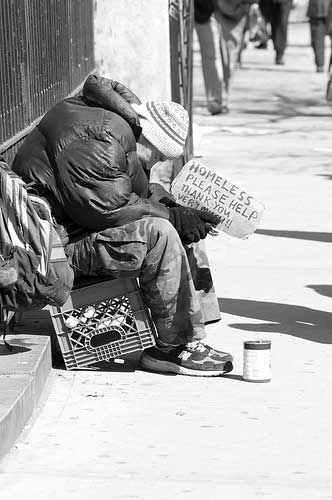 If you found on your doorstep this morning a filthy, starving, homeless man surrounded by stray dogs, how you your react? What would you do? What would you see?