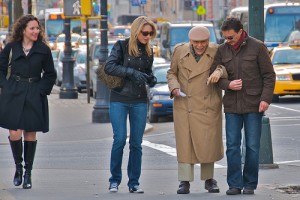
“Practice random acts of kindness and senseless acts of beauty,” a popular slogan a few years back, challenged our culture in which what we do, and how we do it, is carefully calculated to help us get ahead and get noticed. In our world, stopping to perform a small kindness can knock us off schedule; reputations and resumes aren’t enhanced by random, unrecognized deeds.
Consider, however, what Jesus did in today’s gospel. He saw a pool full of sick, needy, diseased people. As far as the world was concerned, they had nothing of much value to offer. Nevertheless, even though he was busy, Jesus stopped, healed a disabled person, then vanished into the crowd before others made a big deal about it.
Why did Jesus do this? First of all, because he could. Likewise, each and every one of us, with our time, talent, and treasure, is able to do a lot. Perhaps more than we often realize.
Second, Jesus did what he did because he is humble. It would have been easy for him to have drawn attention to himself by his miracle. Yet Jesus acted discretely, and without fanfare.
Third, Jesus did what he did purely out of love, because there was nothing to gain in return for healing this man. Jesus didn’t even receive a “Thank you” for his efforts; the man he healed didn’t even know Jesus’ name.
Our Lord invites us today to follow his example by making random acts of kindness with humility, and out of love, just because we can.
A recent announcement of journey home to the Catholic Faith was made by the well known pro-life advocate Bryan Kemper. His announcement letter is posted below. Not only can we rejoice to have a fine and prophetic new member, but, in reading his letter, we can also see certain hallmarks that have led him to the Church. The things he mentions are also things others have mentioned. I would also like to discuss something he does NOT mention.
First here is the letter he sent to his supporters on his blog. I have taken the liberty of adding a few reflections which appear in plain text red.
Dear friends,
I know this may come as a shock to many of you; I am in shock in a way my self. I have spent the past 23 years living my life for Christ always wanting to serve Him and know His truth.
I have been a member of the Orthodox Presbyterian Church for almost 10 years as I was so inspired by the liturgy and reverence I found there. I have also been in a constant journey for God’s truth, studying His Word as well as church history. After many, many years of resisting a calling that I tried to suppress I have finally felt the peace of God with my decision to join the Catholic Church. Please note his reference to being inspired by the liturgy and reverence in the Orthodox Presbyterian Church. I want to comment on that below.
I know that many of you will be confused, even concerned for me. I know that you will have many questions and even be tempted to try and dissuade me from this decision. While I will most certainly talk to you about what God is doing here, I will not be entering into any debates about this right now.
I want to let you know this is not made lightly; I fought against this for years. There are several things that led me to search and finally choose to go back to the Church. I will share a few things in brief here and would love to sit down in person some time with you if you want to peacefully discuss them in more detail.
Every true spiritual journey is marked by profound consideration and often painful discernment. He clearly has love for the traditions which have nourished and sustained him and cannot lightly leave that behind. I have made this journey with others who have joined the Catholic Church and found that their love and appreciation for what has sustained them and is an important aspect of the gifts they bring to the Church. The Church is wonderfully enriched by the fact that they do not cast aside what they have received in the past, but rather that they transpose and apply it to the Catholic setting. For there is great zeal, love and knowledge of Scripture, a fine tradition of preaching, hymnody, an appreciation for a personal walk with the Lord, and countless other gifts in the Protestant traditions. We are indeed enriched by those who join us.
Church authority: There are simply thousands and thousands of denominations and every time someone disagrees with another teaching of their church they simply start a new one. The Catholic Church has had it’s teaching since the beginning of the Church in the scriptures. There is no way God can be happy with thousands of denominations or so-called non-denominational churches. It seems that when people disagree on doctrine it often results in another break off church. The fact is that current Christian teaching can differ so much between two churches that it really constitutes different religions and different Gods. There must be one established truth that God gave us, one that has remained from the time of Christ.
We have talked a lot about this in this blog. It is the chief problem with the Protestant approach. When no one is Pope, everyone is Pope and there are no real ways of resolving difficulties and the conflicts that inevitably happen when two or more human beings are together. One of the glories of the Catholic Church has been her integrity in terms of authority and unity in terms of doctrine.
There are, to be sure, squabbles among the faithful as to emphasis and direction. But when the problem is doctrinal, or the non-doctrinal debates become too divisive, we DO have a way of ultimately resolving it and remaining in a coherent unity.
Some of the older, main-line Protestant denominations were able to keep this for a time when Scripture’s authority and veracity were unquestioned. But in recent decades, the main-line denominations no longer agree on authority of Scripture in terms of its plain meaning, and the differing views have caused major ruptures in the Episcopal, Methodist, Lutheran, and Presbyterian branches. It is most often the moral questions, such as homosexuality and abortion, that prove most problematic. And without Scripture, tradition and authority the severing into ever wider varieties is inevitable.
Mr. Kemper could not have said it better than when he speaks of there being one established truth that has remained intact since the time of Christ.
Pro-life and Contraception: There is only one church that has been consistent from the time of Christ to today on the teaching of pro—life and contraception. Before 1930 there was never a single Christian church in history to accept any form of contraception and today there is only one that absolutely has kept this Christian teaching and truth.
Praise God for this insight. The Catholic Church has often been excoriated for not keeping up with the times. But of course, as Mr. Kemper notes, this is not the role of the Church. Rather, she is to consistently hold to the truths that come to us from Christ through the Apostles. Though sorely tempted by her own members to update in terms of contraception and, to some extent, abortion, the Church has held firm to what she has received.
In terms of pro-life issues, you may recall that we discussed on this blog some time ago what David French, a well known Protestant author said of the Catholic Church:for almost forty years has been the beating heart of the American pro-life movement….One cannot spend five minutes with thoughtful Catholics without understanding how the defense of life is a fundamental and integral part of the DNA of the church. Since the defense of life is theologically-grounded, it is functionally and practically independent of any secular ideology. Life is not just an “issue,” for a Catholic; it is at the core of the Gospel. [1]
Yes, dedication to pro-life issues and holding firm on the teaching about contraception are two glories of the Church. And, it is important to see that this sort of prophetic stance is winning new members for us, members who bring great gifts and zeal with them. We ought not fear being prophetic and zealous lovers of life. God is both renewing us and blessing us with new members like Bryan Kemper.
Communion or the Eucharist: I have always believed that communion was more that just a symbol and in looking back at early church teaching it is crystal clear that this was taught from day one. St Ignatius of Antioch a student of John the Apostle taught on this and clarified it well.
Here too is the central glory of the Catholic Church, that we unvaryingly hold to the true presence of Jesus Christ in the Eucharist. I cannot tell you how many have come to the Church or returned to her on this count. The Scriptures could not be clearer on this point and, as Mr. Kemper notes, the Church Fathers also held it from day one. What a magnificent glory it is that we have Christ truly present in our tabernacles and truly receive him in Holy Communion. To remain devoted to Christ in the Eucharist is surely a necessary requirement for the Church if we want the Lord to bless us with new members.
These are just a few of the things that drew me back into the Catholic Church; however there is so much more. I was baptized Catholic as a child so the process is not as complicated for me. I will be starting RCIA classes and working towards confirmation.
I am asking my friends to pray for my family’s journey and me as I truly seek to be closer to Christ. My relationship with Christ is the most important thing in my life and I hope my friends will stand by me, as I grow closer to Him.
As for the work of Stand True; it will remain focused on educating, activating and equipping young to stand up for life and Christ. We have always been an organization that reaches out to and works with all Christians and we will remain true to that. A great work he is doing.
For Christ I stand,
Bryan Kemper
The original statement is found here: Journey Home
So, there is much to be grateful for here. Clearly the beauty, and the integrity of the Church on many issues continues to inspire new members to join us.
I would like to mention something Mr. Kemper did not say and ponder for a moment the possible meaning of it. You will note above that he said: I have been a member of the Orthodox Presbyterian Church for almost 10 years as I was so inspired by the liturgy and reverence I found there. Among the things he did not list, as his reason for joining the Catholic Church, was the inspiration and reverence related to the liturgy. It may well be that he did not discuss this for the sake of brevity. But I wonder if we might not perhaps be willing to learn why the liturgical experience did not make the list?
The fact is that too much Catholic liturgy today comes across as neither inspiring nor reverent. There is nothing wrong with our liturgy in essence. It is the glorious Mass handed on to us by Christ and the Apostles. But the way we celebrate it in the typical Catholic parish is often problematic. It is rushed, sermons are poor and music is sometimes of questionable taste. Further, people dress casually, and sometimes act irreverently in the Church. Many too, seem bored and disengaged from what is going on. Clergy too often seem to celebrate in a perfunctory manner, and liturgical abuses sometimes taint the celebration.
In dealing with converts from the main-line denominations, one of the hurdles I have discovered they often have to clear is the question of liturgy. They come from liturgical traditions that are not as elaborate as the full Catholic Tradition. However, their traditions are marked by a noble simplicity that has engaged them well. There is a great tradition of hymn singing, and congregational involvement. There is also a tradition of fine preaching that includes a lengthier, teaching oriented sermon that fully develops the scriptural text. Their congregations tend to be smaller and the services less numerous. Community is more intimate and so forth. It is often a sacrifice for many of them to leave this and come to an often less cozy and reverent environment that predominates in many of our larger parishes. To be sure, Catholicism offers a wide variety of liturgical experiences and reverence is not easily defined as jsut one thing. But it ought to be noted that Mr. Kemper did not mention the reverent liturgies of the Church on his primary list. We might learn something from this.
Bryan Kemper’s entrance into the Church is something to rejoice in. Obviously he sees and appreciates something in the Church that has caused him to make what is a big step for him. Pray for him as he makes this transition. Further, we ought as Catholics, to rejoice in the prophetic witness of the Church and how many are still inspired to join. Something is going right here and we ought to be grateful at what the Lord is doing. Not only does the Church enrich and inspire others to membership in the Body of Christ, but the Church is also enriched by the gifts that others, like Bryan Kemper brings. Let us rejoice and give thanks.
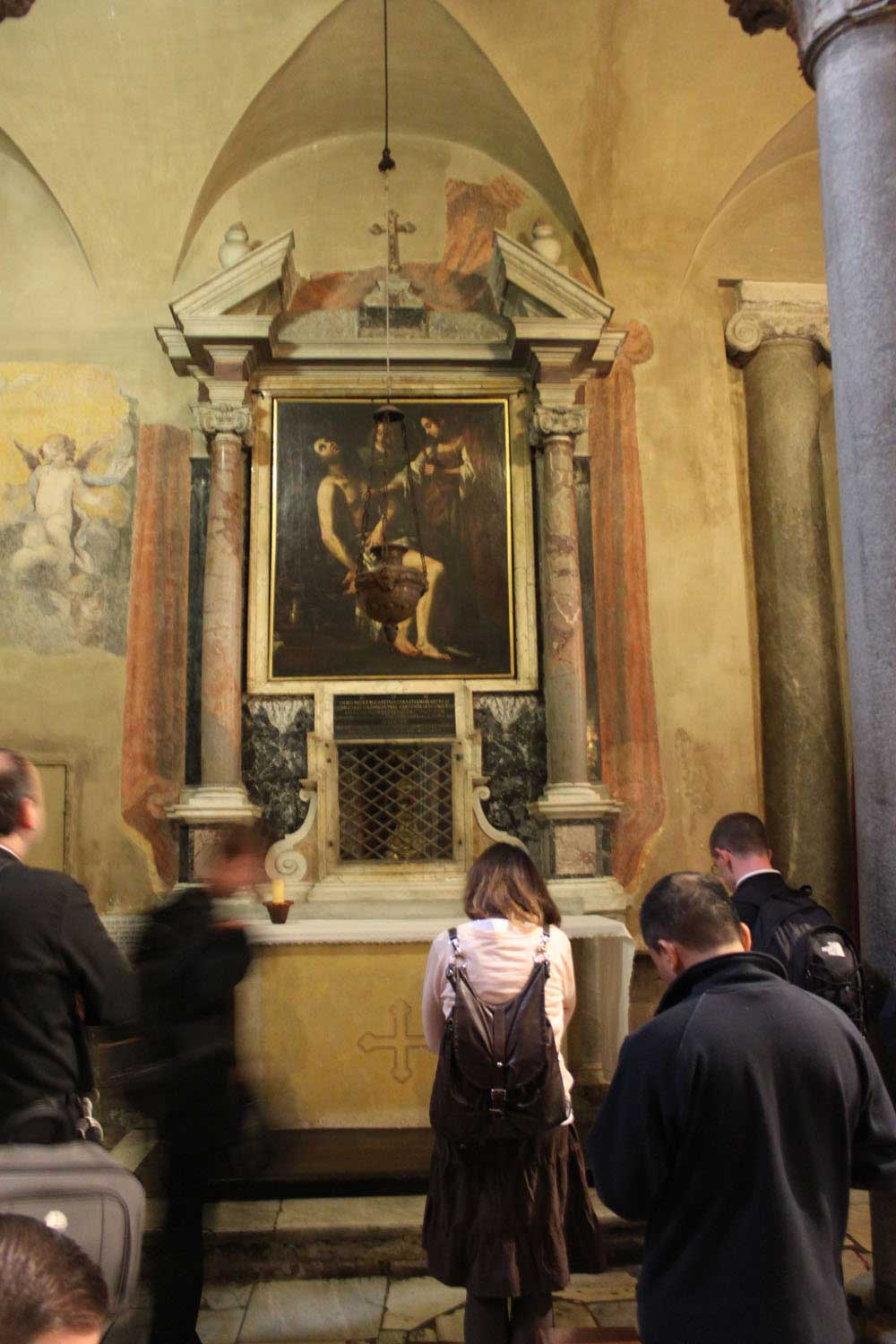
Today, to begin the fourth week of our Lenten Station Church Pilgrimage, we journeyed to the church of Santi Quattro Coronati (Four Holy Crowns). A few blocks from the Coliseum, this church building dates back to the days of Emperor Constantine and was first used as a church around the year 630. It commemorates two groups of martyrs. The first group, for whom the church was named, was four Christian soldiers who refused to sacrifice to pagan gods and so were killed during the Diocletian Persecution. The second group was five stone masons who were killed for refusing to make a statue of a pagan god. In giving their lives for love, these two groups of heroic martyrs remind us of Christ’s unwavering love for us, even to the point of His death on a cross. As Lent draws closer to Good Friday, we remember that it is not just the martyrs who remind the world of Christ’s faithful love. We too must listen to how the Lord is calling us to show the world that God is a God of mercy and love. In this way we become witnesses to Jesus just as the martyrs were.
On the strength of Jesus’ Word
In today’s Gospel, Jesus challenges us to have faith in Him. A royal official approaches Jesus and begs that He heal his dying son. Rather than performing an obvious miracle, Jesus simply tells the official, “You may go; your son will live.” St. John tells us that “the man believed what Jesus said to him and left.” How many of us would have had that reaction? Would we have believed as easily as the official did? Most of us would have asked Jesus for a sign to prove that the boy would actually be healed. Jesus’ word would not have been enough. Or how many of us, trying to live out the Christian life, really believe that Jesus can heal our sinful nature? Every day we try to follow Christ, and yet we repeatedly fall. Today, Jesus is calling us to remember the gift of faith we have been given in our baptism. We do not need to approach God with doubt, wondering whether He will love us with all our faults. We approach Him as children, confident in His unending love. Following Christ is not a matter of picking ourselves up by the bootstraps. Rather, it is a life of faith in Christ who freely gives us the grace to follow Him. All He asks of us is to live out this gift of faith. Today Jesus is calling us to believe in His goodness and be open to his healing power in our lives.
If American expatriates in Rome have a “home”, it is Saturday’s station church, the church of Santa Susanna. This church is the American parish in Rome, entrusted to the Paulist Fathers in 1922 for their ministry to the American community in Rome. Today it is a thriving parish which serves Americans working at the embassy and other expats. The station church pilgrims received a warm welcome from the parish Saturday morning, and they even hosted us for coffee and croissants after Mass! (Doughnuts are hard to come by in Italy.)
The church has ancient roots, being built on the site of a Christian house used for worship starting in the fourth century. We are told that the house belonged to the family of St. Susanna, martyred in the persecutions of the late third century. Susanna’s adherence to the Christian faith came to light when she spurned an offer of marriage, having made a secret vow of virginity for the sake of the kingdom of God.
The story of Susanna reminds us how precious a gift the early Christian Church considered avowed virginity. Not only did such a vow contravene the Roman Empire’s interest in population increase, but it also was surprising in light of the many Old Testament references to a family as a blessing. (cf. Ps 128:3) But for the earliest Christians, the presence of virgins was a witness to their faith in Jesus the Messiah. Virgins not only served Christ (and him alone) as their living Lord, but they were also an eschatological sign of our life in heaven, where we “neither marry nor are given in marriage.” (Mt 22:30) Let us pray that the charism of avowed virginity may flourish in our Church even today.
Sir Alec Guinness, the famous actor, made what he called a “negative bargain” with God when his eleven-year old son contracted polio. If his son recovered, Guinness promised, he wouldn’t stand in his son’s way to become Catholic. The boy did recover, and his father kept his promise. A few years later, Alec Guinness became Catholic himself.
Some might take a rather cynical view of Guinness’ attempt to lure God to the bargaining table. After all, he only turned to God when he had no one else to turn to! Yet that’s been the experience of many people, not just Alec Guinness. So often it’s only when we have our backs pressed against the wall that we give God any real consideration. But God can work with that. He knows that it’s when we’ve hit rock bottom that we’re the most open to receiving his grace.
We can see this in today’s gospel. The royal official approached Jesus in desperation, with no other motive than to secure the healing of his dying son. Jesus knew this. “Unless you people see signs and wonders,” he complained, “you do not believe.” The royal official didn’t contest the point. He simply continued to beg Jesus. And Jesus did heal his son, whereupon the official’s entire household became believers.
All this goes to show that God will meet us wherever we are, because even more that we might desire to be with God, God desires to be with us!
We live in an age where youth is celebrated and aging is lamented. Generations ago, age was the “hoary crown of wisdom,” the elders were reverenced and the young stood when they entered. But in this age of the visual, this age of television, everything is reversed. I remember a line from a song (by The Who) when I was a teenager which said, “Hope I die before I get old.”
The Photo at right is me at 5 years old, my dad to the right was 38, my grandfather was 68. All three of us were named “Charles Evans Pope.” Now they’re both gone on, and its just me. The world laments age and death, But as I look at this photo I rejoice for them and myself. They were men of faith, their journey is done, and my is well past noon. And as I journey in their wake, I marvel at what the Lord is doing for me.
Yes, as for me, I must say, I’m glad I’m getting older. I know, you’ll say, “At 50 you’re just a child.” But I am not child, I’m half past dying and celebrating that God has brought me a mighty long way. Yes, I’ve discovered that the gifts of God have come more alive in me as my youthful vigor has dissipated. I see those old pictures of myself in my twenties, looking young, tan and trim, now I’m old(er), white and fat. But though my body has gone south for the winter of life, now my soul has come alive as never before.
St. Paul says, Therefore, we are not discouraged; rather, although our outer self is wasting away, our inner self is being renewed day by day (2 Cor 4:16).
Yes, indeed, I am a witness. I have to admit, my body isn’t exactly wasting away (it actually tends to gain weight), but it surely is not the sound sleek body of my youth. But this I can surely attest, my inmost self is being renewed and strengthened with each passing day. I have become more prayerful, more joyful at what God is doing, more aware of his presence and his ways. I am seeing sins put to death and better things come alive.I am less fearful, more confident, less angry, more serene.
Inverse proportionality – Yes, even though my physical stamina is less, I get winded climbing stairs now, my spiritual strength is better than ever. At age 50, I am more alive than I was at age 20. Glory be to God! I would never want to be 20 again, the Lord has just brought me too far and done too much for me, to ever want to set the clock back again. A few particulars occur to me that suggest an inverse proportion between youthful vigor and spiritual growth.
My physical eyesight has become very poor. I am quite crippled without my glasses now. Until forty I did not wear glasses at all. But since forty I have come to place where, without my glasses everything is just a hazy blur. And yet, I spiritually see things I never did before. The word of God jumps off the page in new ways. There are new insights, new enlightenment as to what God is saying. I rejoice in this new inner vision that has come upon me in this second half of my life and I look with great expectation to the even deeper vision He will give me as I age.
My hearing has become poorer with the onset of middle age. I have had a certain hearing loss since birth but now it becomes worse. But here too, I have learned to listen more attentively and to look at others while they speak. This connects me more deeply to them.
I also have new insights into the people I am privileged to know. I have come to appreciate how wonderfully quirky we all are and how closely related our gifts are to our deficits. Though my physical vision is poor, my insight into the glory and the struggle of those closest to me is a gift I appreciate and hope to see grow even more with the passing years.
Even as my physical hearing has diminished, my spiritual hearing has become far more acute. I hear things in God’s word I never did before. I hear God speaking to me on my spiritual walk with greater sensitivity. We have very good lectors and a marvelous choir in my parish and I marvel at what I hear from them each Sunday. Faith comes by hearing, and as I age I am more sensitive to what I hear at Mass and in sacred moments. When I was young, I was tuned out at Mass. The priest was just “some dude” up there talking and the Choir, well they weren’t singing rock, so what did it matter. But God has opened my ears as I have aged to appreciate his voice in newer and wider ways. Thanks be to God. He speaks to me throughout my day and I hear his voice more consistently.
As I age, I am less physically able to accomplish things I once did on my own. I now fear heights and can’t climb tall ladders. I have a hard time lifting heavy things without injury. But all this has made me more humble and more appreciative of the help that others can give. Gratitude and an proper sense of interdependence are a gift I have discovered with age. In the gift of age God has helped me be more grateful and connected to others.
As I age and become less physically “glorious,” I appreciate more deeply the beauty and glory of Creation. Indeed, it astounds me in new ways. Each new discovery shouts out the glory of God to me. I am far more appreciative of the present glory of God than I ever was as a youth, when the focus was more on me. Now simple things, like the color purple, the magnificence of Spring, the quiet still after a heavy snow, the wonder and awe created by watching a science channel show on the mysteries of the deep oceans. As I have become more vincible and fragile with age, the world far more astonishes me and makes me cry, Glory to God!
As I have aged I have discovered limitations. But this has made more humble and understanding of the struggles of others. When I was young I was impatient. There was little I could not do, or at lost thought I could not do. But, now, experiencing more of my limits I have seen compassion and understanding awaken in me, patience too.
As I have aged, I am more easily fatigued. I usually need an afternoon nap and am blessed to be able to take one, living as I do “above the store.” It’s the only way I can get through my evening appointments. Yet, what a gift a nap is. I am mindful of Psalm 127 which says, In vain is your earlier rising, your going later to rest, you who toil for the bread you eat; for the Lord pours gifts on his beloved while they slumber (v. 4). Yes, God does pour his gifts on us even when we slumber. And as I age a I grateful even for the gift of a brief rest.
More could be said. I am glad to be getting just a bit older. I am running to meet God, and every day brings me closer. I can’t wait to see Him. I am like a child in Mid December who can’t wait for Christmas morning. That the days speed by more quickly only increases the longing for me. Each day, each step, closer to God.
And while my body goes south, my soul looks up. The weaker my physical flesh, the stronger my spirit and soul. The weaker my eyes, the deeper my spiritual vision and insight. The duller my physical hearing, the more intent my spiritual ears. God is good, he takes the one gift and returns another and greater gift.
And the best is yet to come! The Gospel today was of the man born blind who came to see, and God said to me at Mass today, in the words of a Gospel song, “You ain’t seen nothing yet!” Scripture affirms: Beyond these, many things lie hid; only a few of his works have we seen (Sirach 43:34).St. Paul says, When I was a child, I talked like a child, I thought like a child, I reasoned like a child. When I became a man, I put childish ways behind me. Now we see but a poor reflection as in a mirror; then we shall see face to face. Now I know in part; then I shall know fully, even as I am fully known. (1 Cor 13:11-12)
I’m running to meet God. Age is a glorious thing, bring it on!
This song says, Sicut cervus desiderat ad fontes aquarum,ita desiderat anima mea ad te, Deus. (As the deer longs for running water, so longs my soul for you, O God). The text is from Psalm 42:1 I would compare the song to a musical sigh. Palestrina has captured well the longing of the human heart for God here. Another gift that I think comes with age.
Throughout her life, a dear friend of mine has endured many hardships and experienced much heartbreak. During her twenty-five years of marriage, her husband had numerous affairs, became an alcoholic, and subjected her to extreme psychological abuse, giving her no support as she struggled to raise five children. Since their separation, he has been unfaithful to their divorce settlement, often leaving her in a precarious financial situation. She now is wrestling with a number of health problems. Yet instead of becoming a bitter and defeated individual, she has come to enjoy a deep, abiding, and truly remarkable faith.
She tells me that she used to find strength in the popular “Footprints” story in which a man dreams of his life as a walk along the beach with the Lord. Most of the time, two sets of footprints were visible in the sand- one for Jesus, and one for the man. However, during times of suffering, pain, and trial, there was only one set of footprints. The man was angry and he challenged Jesus. “Where were you when I needed you most?” he cried. Jesus replied, “I was with you all along! When you see only one set of footprints, it was then that I carried you.”
These days, however, she doesn’t find much inspiration in this story. She explains that she no longer has to ask Jesus about where he was during the most painful periods in her life. She now knows, through her experience, that Jesus is always at her side. Suffering didn’t weaken her faith. Instead, it made it grow stronger.
This is also the experience of the “man born blind” in today’s gospel. Like my friend, he has endured a truly “hard knock life.” Until his encounter with Jesus, he’d spent his days as a panhandler, begging small change from passers-by. Most probably, people tossed him insults as often as they tossed him money, considering that the disciples themselves suggested out loud that he must be some sort of sinner. But then Jesus healed him, restoring his vision and giving him a new lease on life.
Ironically, however, this is when the man’s plight becomes even worse. Nobody shares his joy in his newfound sight. Instead, he’s met with suspicion, interrogation, and hostility. His own parents kept him at arm’s length. Religious leaders berate him as one “born in utter sin” and cast him out of the synagogue. Not only did this make him a pariah in the Jewish community, it also placed him in violation of Roman law, as it legally made him an atheist. So pity the poor man born blind! Instead of being allowed to celebrate his grace-filled encounter with Jesus, he’s alienated from his family, ostracized by his religion, and made a criminal in the eyes of the state. Yet, even after all of this, the “man born blind” was still able to embrace Jesus as his savior.
The story of the “man born blind” is meant to be our story as well. As St. Augustine once wrote, the man born blind stands for the whole human race. His experience teaches that our life of faith, which begins at baptism, can grow through difficult testing and suffering.
The gospel demonstrates this in a subtle way. It begins by making suggestive references to the sacrament of baptism. Consider how Jesus healed the “man born blind.” To begin with, Jesus made clay with his saliva and anointed the man’s eyes. This recalls two things. First, the anointing intentionally calls to mind the anointing with oil in the baptism ritual. Second, the clay expresses our belief that in baptism one is made a “new creation,” just as the first human being was created from clay in the Genesis story.
Next, Jesus instructs the blind man to wash in the “Pool of Siloam,” which, we’re specifically told, means “Sent.” These too are baptismal references. Baptism washes away our sin in a pool of water, and it unites us with Jesus, the one sent by the Father. Finally, having followed Jesus’ instructions, the man was able to see Jesus, who had just identified himself as the “light of the world,” just as in baptism we’re “enlightened” to “see” Jesus with eyes of faith.
This healing event, however, was only the beginning of the man’s journey of faith. His faith came to maturity only through his experience of testing and suffering. When his back was against the wall, he found no help or comfort from his family, the government, or his community of faith. He had no one else to turn to but Jesus! And even that took a leap of faith, because Jesus was seemingly absent throughout his ordeal. It was only when the man had hit “rock bottom” that Jesus re-appeared in person.
But maybe that’s precisely the point. It takes great faith to trust in Jesus when he doesn’t seem to be there. But that’s what the “man born blind” did. He trusted, and his faith grew. We can see this in the progressively more insightful terms he used in reference to Jesus. For instance, when first asked as to how his eyes were opened, he explained that he was healed by the “man called Jesus.” Later, when challenged again, he called Jesus a “prophet.” When pressed he even further, he asserted that Jesus was “from God.” Ultimately, after having been expelled from the synagogue, he fell down at Jesus’ feet and worshipped him as Lord.
It’s true that, as the old proverb goes, “Into every life a little rain must fall.” For some people, this rain is just a sprinkle; for others, it’s a downpour. Yet the story of the “man born blind” offers us hope that this inevitable rain, instead of dampening our faith, may help it blossom and flourish.
In today’s Gospel, Jesus, the Light of the World, brings light to a man born blind. If you are prepared to accept it, you are the man born blind, for all of us were born blind and in darkness. It was our baptism alone, and the faith it gave, which has rendered us able to see, and, by stages, to come more fully into the light. The man in today’s Gospel shows forth the stages of the Christian walk, out of darkness, and into the beautiful light of Christ. Let’s take a moment and observe these stages evident in this man, for we are the man.
I. The Problem that is Presented – We are introduced to man who was blind from his birth, he is quite incapable of seeing at all. The text says: As Jesus passed by he saw a man blind from birth. His disciples asked him, “Rabbi, who sinned, this man or his parents, that he was born blind?” Jesus answered, “Neither he nor his parents sinned; it is so that the works of God might be made visible through him. We have to do the works of the one who sent me while it is day. Night is coming when no one can work. While I am in the world, I am the light of the world.”
So there is the problem, he is blind, he has no vision. And this us. On account of Original Sin we had lost all spiritual vision. We could not see God, or endure the light of his glory. This lack of vision causes many to have no “vision” for their life. They don’t know why they were made, or what the true purpose of their existence is. Many cannot see past the sufferings of this world to the glory that waits. Still others have retreated into the material world and cannot see beyond it. Others have retreated even further, away from reality into the realm only of their mind, their own opinions and so forth. St. Augustine describes this condition of the human person as curvatus in se (man, turned in on himself). Yes, there is a blindness that imprisons many in the darkness. And even for us who do believe there are still areas where it is hard for us to see. Coming to see God more fully, and ourselves as we really are is a journey we are still on.
While the disciples want to dwell on secondary causes, Jesus sidesteps these concerns and focuses on solutions. The fact is he is blind, assessing blame is unproductive. Healing the man is uppermost. In a statement, dripping with irony, Jesus says that the works of God will be made visible in a blind man. For the foolishness of God is wiser than man’s wisdom, and the weakness of God is stronger than man’s strength. (1 Cor 1:25). Yes, God can make a way out of no way and write straight with crooked lines. So Jesus gets to work.
II. The Purification that is Prescribed – Having diagnosed the problem and noting that the man is in darkness, Jesus, the Light of the World, begins the work of healing this man. The text says, When he had said this, he spat on the ground and made clay with the saliva,and smeared the clay on his eyes, and said to him, “Go wash in the Pool of Siloam” – which means Sent -. So he went and washed, and came back able to see.
Hopefully, you can see baptism here. Jesus says, “Go and wash.” – He went, he washed and he came back able to see. Yes, this is baptism. The Catechism of the Catholic Church says of Baptism: This bath is called enlightenment, because those who receive this [catechetical] instruction are enlightened in their understanding… Having received in Baptism the Word, “the true light that enlightens every man,” the person baptized has been “enlightened,” he becomes a “son of light,” indeed, he becomes “light” himself.…(CCC1216).
Baptism is required, in order to truly see. It is no mere aside that John mentions the name of the pool to which the man goes: Siloam, a name which means “sent.” Jesus sends him, and He sends us. Baptism is required. Jesus says elsewhere: “Truly, truly, I say to you, unless one is born of water and the Spirit, he cannot enter the kingdom of God. (John 3:5)
Notice he comes back ABLE to see. But just because you’re able to see does not mean you actually DO see. Right now I am able to see the Statue of liberty, my eyes work fine for that. But I do not yet see it. I have to make a journey to do that. Thus, the man here is able to see Jesus, but he does not yet see him. He has a journey to make in order to do that. Though able to see but he, like we, has a long way to go to see Jesus fully, and face to face. Baptism is not the end of our journey but the beginning of it. It renders us able to see. But we are still new born babes. We need to grow. We can see, but there is plenty we haven’t seen yet.
III. The Perception that is Partial – Hence we notice the man can see, but he still does not know much of the one who has enabled him to see. Notice what the text says: His neighbors and those who had seen him earlier as a beggar said, “Isn’t this the one who used to sit and beg?” Some said, “It is, ” but others said, “No, he just looks like him.” He said, “I am.” So they said to him, “How were your eyes opened?” He replied, “The man called Jesus made clay and anointed my eyes and told me, ‘Go to Siloam and wash.’ So I went there and washed and was able to see.” And they said to him, “Where is he?” He said, “I don’t know.”
So he’s able to see. But he hasn’t seen much. The man must grow in his faith to come to know who Jesus Really is. Look at how his partial perception is described. For now, he merely understands Jesus as “the man called Jesus.” To him, Jesus is just some “dude,” some “guy.” And then they ask where Jesus is, and all he can say is that he does “not know.” Hence although he able to see, he does not yet actually see Jesus.
And this describes a lot of Christians. They know about Jesus but they don’t know him. Many Catholics in the pews are “sacramentalized but unevangelized.” That is, they have received the sacraments, but have never really met Jesus Christ and do not know him in any more than an intellectual way. Many don’t even expect to know him. He is little better to them than “the man called Jesus.” They’ve heard of Jesus, and even know some basic facts, but he still remains a distant figure in their lives. And when asked questions about him, they respond like this man, “I don’t know.”
The man needs to make progress, and he will and we shall now see. Remember, you are the man.
IV. Progress Through Persecution and Pondering – The text goes on to show us the progress this formerly blind man makes in coming to know and finally see Jesus. It is interesting that this progress comes largely through persecution. Now persecution for us need not always be understood as being arrested and thrown in jail etc. Persecution can come in many forms such as puzzlement, expressed by relatives and friends, ridicule of Catholicism in the media, or even those internal voices that make us question our faith. But, in what ever form, persecution has a way of making us face the questions, and refine our understanding. Our vision gets clearer as we meet the challenges.
Notice the man’s progress up till now. He HAS been baptized and is now able to see. But he still knows little of Jesus calling only “the man called Jesus,” and not really knowing where Jesus is. But, he is about to grow, and he does so in several stages.
In stage one of his post-baptismal growthwe that his neighbors turn on him and bring him to the Pharisees who interrogate him because Jesus had healed him on a sabbath. The text says,
They brought the one who was once blind to the Pharisees. Now Jesus had made clay and opened his eyes on a Sabbath. So then, the Pharisees also asked him how he was able to see. He said to them, “He put clay on my eyes, and I washed, and now I can see.” So some of the Pharisees said, “This man is not from God, because he does not keep the sabbath.” But others said, “How can a sinful man do such signs?” And there was a division among them. So they said to the blind man again, “What do you have to say about him, since he opened your eyes?” He said, “He is a prophet.”
Thus notice what this persecution does for him. As he is challenged to say something about Jesus he moves beyond calling him “the man called Jesus” and describes Jesus as a “prophet.” He has gained some insight here. A prophet speaks for God and, Jesus is the Word, made flesh.
In Stage two of his post-baptismal growth we see that the Pharisees doubt his story and broaden their persecution to interrogate and threaten his fearful parents, and then they call him back and put him under oath and declare Jesus to be a sinner. The text says:
Now the Jews did not believe that he had been blind and gained his sight until they summoned the parents of the one who had gained his sight. They asked them, “Is this your son, who you say was born blind? How does he now see?” his parents answered and said, “We know that this is our son and that he was born blind. We do not know how he sees now, nor do we know who opened his eyes. Ask him, he is of age; he can speak for himself.” His parents said this because they were afraid of the Jews, for the Jews had already agreed that if anyone acknowledged him as the Christ, he would be expelled from the synagogue. For this reason his parents said, “He is of age; question him.”
In stage three of his post-baptismal growth we note that the continuing persecution seems to make him grow even stronger and more able to withstand his opponents. Note his determination and fearlessness in the second interrogation he faces which includes ridiculing him and placing him under oath:
So a second time they called the man who had been blind and said to him, “Give God the praise! We know that this man is a sinner.” He replied, “If he is a sinner, I do not know. One thing I do know is that I was blind and now I see.” So they said to him, “What did he do to you? How did he open your eyes?” He answered them, “I told you already and you did not listen. Why do you want to hear it again? Do you want to become his disciples, too?” They ridiculed him and said, “You are that man’s disciple; we are disciples of Moses! We know that God spoke to Moses, but we do not know where this one is from.” The man answered and said to them, “This is what is so amazing, that you do not know where he is from, yet he opened my eyes. We know that God does not listen to sinners, but if one is devout and does his will, he listens to him. It is unheard of that anyone ever opened the eyes of a person born blind. If this man were not from God, he would not be able to do anything.” They answered and said to him, “You were born totally in sin, and are you trying to teach us?” Then they threw him out.
The result of this is to further deepen his vision of Jesus. For, at first, he saw him only as “the man called Jesus,” then he sees him as a prophet, now he goes further and sees him as “from God.” He’s progressing from sight to insight. His ability to see, given him in baptism is now resulting in even clearer vision.
This then, leads us to the final end of this gospel and this man’s journey.
V.Perfection that is Portrayed – He has been thrown out of the synagogue, as many early Christians were. He has endured the hatred of the world, and the loss of many things. Now, cast aside, and hated by the world, the Lord approaches him. The text says:
When Jesus heard that they had thrown him out, he found him and said, “Do you believe in the Son of Man?” He answered and said, “Who is he, sir, that I may believe in him?” Jesus said to him, “You have seen him, the one speaking with you is he.”He said, “I do believe, Lord, ” and he worshiped him.
Now his vision is plain. After all this, he finally sees. He sees, not only Jesus, but Who Jesus is. First he saw him only as “the man called Jesus.” Next a prophet. Next, he says, he is from God. But this final stage is the best of all. He actually sees Jesus and falls down to worship Him, Jesus is not only from God, he IS God. Christ has fully enlightened this man.
This is our journey, moving in stages to more perfectly know Jesus. One day we will see him face to face. But even before that time we are called to grow in faith by stages so that we see Jesus for who he is.
Where are you on this journey? Our vision is daily getting better if we are faithful but it is not yet complete. Scripture says
For now we see in a mirror dimly, but then face to face. Now I know in part; then I shall understand fully, even as I have been fully understood. (1 Cor 13:12)
Beloved, we are God’s children now; it does not yet appear what we shall be, but we know that when he appears we shall be like him, for we shall see him as he is (1 John 3:2)
My soul is thirsting for God, the God of my life; when can I enter and see the face of God? (Psalm 42:2)
For now, make this journey. Journey in stages. Come to know who Jesus is.
I have it on the best of authority that the man, on his journey to Jesus, sang this song: Walk in the Light, beautiful light. Come where the dew-drops of mercy shine bright. Walk all around us by day and by night, O Jesus the Light of the World!

 “Practice random acts of kindness and senseless acts of beauty,” a popular slogan a few years back, challenged our culture in which what we do, and how we do it, is carefully calculated to help us get ahead and get noticed. In our world, stopping to perform a small kindness can knock us off schedule; reputations and resumes aren’t enhanced by random, unrecognized deeds.