One cell phone company’s ad campaign features a character in all sorts of remote places asking, “Can you hear me now?” The implication is that if he were using another cell phone provider, his words would have fallen on deaf ears.
It’s frustrating when others fail to hear what he have to say, for whatever reason. But it’s tragic when we fail to hear what God has to say to us. Consider today’s gospel. Jesus gave two examples of God’s people refusing to hear God’s word as spoken by God’s prophets, Elijah and Elisha. People didn’t like God’s word as spoken through Jesus either, and they tried to kill him.
All of us are guilty of failing to listen to God’s word. Maybe our Lord is challenging us through today’s gospel to ask ourselves what it is we don’t want to hear, won’t allow ourselves to hear, or are failing to hear because we just aren’t listening at all. Is it about money? Forgiveness? Our use of time? Sex? Are we too proud to hear? Too angry? Too indifferent? Too addicted?
Perhaps we can all use the remainder of Lent to truly open our ears to God, so that should he say to us, “Can you hear me now?” our answer will be an emphatic “Yes!”
Back in seminary days, an older priest, and well known scripture scholar, who was leading us in a retreat, stopped his train of thought, perhaps perceiving we were having difficulty, and said, “Do you know what is the biggest obstacle for us in understanding the Word of God?” I was expecting a geeky answer like, “We don’t know enough Greek,” or “We haven’t studied the Historical Critical Method carefully enough.” But the priest pleasantly surprised me we he paused, looked around the room and then said, “The biggest obstacle we have to understanding the Word of God, is our sin.” (Fr. Francis Martin, who has a video ministry here: Fr. Francis Martin YouTube Page). Scholars, academicians, even unbelievers, to some extent, can tell you what a biblical text is talking about, about its historical context etc. But only the holy, the Saints, can tell you what the text really means. He went on to encourage us in the discipline of study, but warned us that all the study in the world could not be of great help, if we did not have a clean heart. Indeed, a theologian who does not pray is a dangerous man.
And Old Gospel song says, “None can walk up there, but the pure in heart.” In the plainest sense, “up there” means heaven. But “up there” also refers to the higher things of God and the spiritual life. To walk “up there” means to be able to see and grasp the things of God, and, increasingly, God himself.
Fulton Sheen was famous for saying toward the end of his life something to the effect, that we have tried, in modern times, every possible way to build up the Church: committees, study groups, task forces, seminars, advanced degrees in every sort of theology and religious study. But there is only one thing that we have not tried, and that is holiness. He went on to recommend that every priest commit to make a daily Holy Hour.
This week in the Office of Readings from the Breviary the following reading recalls of all these things:
God is seen by those who have the capacity to see him…. All have eyes, but some have eyes that are shrouded in darkness, unable to see the light of the sun. Because the blind cannot see it, it does not follow that the sun does not shine. The blind must trace the cause back to themselves and their eyes.
In the same way, you have eyes in your mind that are shrouded in darkness because of your sins and evil deeds. A person’s soul should be clean, like a mirror reflecting light. If there is rust on the mirror his face cannot be seen in it.
In the same way, no one who has sin within him can see God. But if you will you can be healed. Hand yourself over to the doctor, and he will open the eyes of your mind and heart. Who is to be the doctor? It is God, who heals and gives life through his Word and wisdom…. If you understand this, and live in purity and holiness and justice, you may see God. But, before all, faith and the fear of God must take the first place in your heart.
From the book addressed to Autolycus by Saint Theophilus of Antioch, bishop
So there it is, None can walk up there, but the pure in heart. Blessed are the Pure of Heart, for they shall see God (Matt 5:8).
Biblical Portrait – This coming Sunday we will read the Gospel of the man born blind. In a pivotal moment, Jesus smeared this man’s eyelids with clay and sent him to the Pool of Siloam to wash. He comes back able to see. When asked how he came to see he says, in effect, “I went, I washed and now I see.” This is baptismal theology even if in seminal form. We cannot see until we are washed. In the end it is Baptism, Confession and a holy life by God’s grace that give the greatest light, that lay the foundation to enable us to “walk up there.”
Testimony of St Cyprian – One of the great theologians and Fathers of the Church, St. Cyprian, experienced the vision that Baptism and holiness brings:
And I myself was bound fast, held by so many errors of my past life, from which I did not believe I could extricate myself. I was disposed therefore to yield to my clinging vices; and, despairing of better ways, I indulged my sins…But afterwards, when the stain of my past life had been washed away by means of the waters of rebirth, a light from above poured itself upon my chastened and now pure heart; afterwards, through the Spirit which is breathed from heaven, a second birth made of me a new man. And then in marvelous manner, doubts immediately clarified themselves, the closed opened…and what had been thought impossible was able to be done (“Letter to Donatus,” 4).
St. Cyprian was a learned man. He knew his theology, had studied law and rhetoric. But only after baptism did some things make sense, seem possible and enable Cyprian to “walk up there.”
I too am a witness of this. I have come to understand some things only after many years of prayer and growth: daily holy hours, daily mass and the liturgy of the hours, weekly confession, only then do some things clarify and does that which had been in darkness come to light. Studies have had their place in my life to be sure, But only the path to holiness (combined with study) can ever really bring light.
We’ve tried everything else, how about holiness? Study is great, don’t neglect to study the faith, but holiness is even greater. I have some people in spiritual direction who have not spent years studying theology, but they grasp well, almost as if by infused knowledge, the things of God. This is wisdom. A great intellect is a wonderful gift, but a pure heart is the greatest gift of all.
Here’s a video on the beauty of prayer especially before the Blessed Sacrament. It is set to the words of a beautiful Eucharistic Hymn “Jesus My Lord, My God, My All” directed by the late Richard Proulx (RIP).
Like so many of us, English poet Francis Thompson spent much of his life running away from God. At one time he had trained for the priesthood, but was rejected as unsuitable. He later studied medicine, but never managed to pass his final examinations. Hopeless and angry, he turned away from God and became a destitute opium addict on the streets of London.
Yet all was not lost. He managed to submit an essay and a poem to a Catholic magazine. For months they sat unread in a file. But when they were finally examined, it was determined that they were the work of a true talent. The magazine editor and his wife befriended Thompson and arranged for his stay at a countryside monastery, where his health improved, and his faith in God was restored.
Thompson ultimately composed the “Hound of Heaven,” a well-known and much-loved poem. It describes God, like a hound chasing a hare, patiently but persistently pursuing the poet’s soul, in spite of his futile attempts to flee, avoid, or find substitutes for God. “I am He Whom thou seekest,” concludes God. “Rise, clasp my hand, and come.”
We can see a similar pattern in the relationship between Jesus and the Samaritan woman, as described in today’s gospel. Like Francis Thompson, she at first didn’t want anything to do with Jesus. When she saw him approaching, her first thought must have been, “Please- just go away!” There was a reason she was drawing water at noon, the hottest part of the day: She wanted to avoid meeting anyone else! But Jesus understood that. And so it was he who opened the conversation.
This has been the experience of many people, including myself, and perhaps you too. We didn’t set out on a quest for Jesus; we didn’t go looking for God. Instead, it was God who came looking for us. As a priest friend of mine once said, “God isn’t like a stuffy aristocrat, sitting aloof in a drawing room somewhere, keeping a polite distance from us. Instead, he’s more like a Jewish mother, nudging us, pushing us, cajoling us, craftily scheming that we might allow him into our life.”
But back to the Samaritan woman. After Jesus’ initial approach, she remains guarded and cautious- and rightly so! As there was a long-standing animosity between Jews and Samaritans, it was highly unusual for Jesus to have spoken with her. And there were gender issues too. Men just didn’t speak in public with women, who were considered second-class citizens.
The Samaritan woman was understandably suspicious of Jesus’ motives, and she hesitated to accept his gift of living water. But don’t we sometimes act this way? Is not “No thanks, I already have all I need” our first reaction when someone tries to interest us in something religious? We get defensive, because we wonder what their true intentions are.
Thankfully, Jesus knows us- and the Samaritan woman- all too well. He persists and convinces her to accept his gift. But she sadly misunderstands what it is he offers. So Jesus tries a different tactic, revealing his knowledge about her multiple marriages. Jesus doesn’t reject her for this. He doesn’t say, “Come back here after you straighten out your life.” He says instead, “I know what your life is like, and with the grace I’ll give, it can change for the better!”
This is an important point, because for many people an imperfect past is an obstacle to continued conversion. One Methodist pastor recalls how he and his wife once suggested a dinner outing with friends who had just moved into a new home. The new homeowners were eager to meet at a restaurant, but the pastor sensed that they weren’t ready for houseguests. The conversation at dinner confirmed this. “We want you to come see the house,” they said, “but only after we get it all cleaned up!”
The pastor concludes, “Is not this our way with God? We want everything to be just right when we relate to God. And when it’s not, we turn away and try to run. We dare not invite Christ into our life! The only problem: God pursues us.”
Again, back to the Samaritan woman. By this time, she’s warming to Jesus. She’s gone from seeing him as a hostile male Jew to perceiving him as a prophet! But maybe this frightens her a little. We can imagine that she’s had some painful relationships, in light of her five ex-husbands. Perhaps she’s afraid of getting too close to Jesus. And so, to sidetrack their new friendship, she asks distracting questions about the proper place for worship and the coming of the Messiah. In effect, to keep things from getting too personal, she steers the conversation away from matters of the heart to matters of the head.
We’re sometimes guilty of exactly the same thing. We can be attracted to God, but we don’t want to get to close to him. Who knows what that may involve? We find it easy to pray to “Almighty God,” a title that reflects God’s distance from us. But it can be hard to call God “Father,” as Jesus always did, because this implies love, family, and intimacy. So often we seek to keep God at arm’s length- just like the Samaritan woman.
But Jesus wanted more from his relationship with her, and we wants more from his relationship with us. He’ll stop at nothing short of a deep, abiding friendship. At the end of their conversation, Jesus revealed to the Samaritan woman that he is the Messiah, and her faith came to completion. Today, Jesus continues his conversation with us, that we too might drink his living water. “How wonderful and how great,” wrote St. Cyprian, “is the patience of God!”
As we examine the Gospel for this weekend’s Mass we do well to understand that is fundamentally a gospel about our desires and how the Lord reaches us through them. Prior to looking at the text, consider a few things:
What it is that really makes you happy? There are endless ways this question could be answered. We desire so many things: food, water, shelter, clothing and creature comforts. We long for a sense of belonging, affection, & peace. Sometimes we hope for stability and simplicity, at other times we yearn for change and variety. Our hearts are a sea of desires, wishes and longings. The gospel today says that a woman went to the well to draw water. She is each one of us and her desire for water is a symbol of all our desires.
Have you ever considered that your desires are in fact infinite? Can you even think of a time that you were ever entirely satisfied, a time when you needed absolutely nothing? Even if you can imagine such a time, it didn’t last did it? In fact our desires are infinite, without limit.
The well in today’s gospel symbolizes this world. Jesus says to the woman and to us: “Every one who drinks of this water will thirst again.” The world cannot really provide what are looking for. No matter how much this world offers us, it will never ultimately satisfy us, for the world is finite and our desires are infinite. In this way our heart teaches us something very important about ourselves: We were not made for this world, we were made for something, for someone, who is infinite, who alone can satisfy us. We were made for God.
The Water offered is the Holy Spirit – Jesus says elsewhere: If any one thirst, let him come to me and drink. He who believes in me, as the scripture has said, ‘Out of his heart shall flow rivers of living water.'” Now this he said about the Spirit, which those who believed in him were to receive…(Jn. 7:37-39).
The Catechism of the Catholic Church has this to say about the meanings of our longings: The desire for God is written in the human heart, because man is created by God and for God; and God never ceases to draw man to himself. Only in God will he find the truth and happiness he never stops searching for…With his longings for the infinite and for happiness, man questions himself about God’s existence. In all this he discerns signs of his spiritual soul. The soul, the seed of eternity we bear in ourselves, irreducible to the merely material, can have its origin only in God (Catechism # 27, 33).
Scripture too speaks to us our desires: Of You my heart has spoken: “Seek His face.” It is your face O Lord that I seek; hide not your face! (Psalm 27:8-9). Or again, Only in God will my soul be at rest, he is my hope, my salvation (Psalm 62:1,5) St. Augustine wrote classic words to describe our hearts’ truest longing: Thou hast made us for Thyself O Lord and our hearts are restless till the rest in Thee. (Confessions 1,1).
With this in mind, let’s look at the journey that this woman (this means you) makes to Jesus. Things start out rough but in the end she discovers here heart’s truest desire. The journey is made in stages.
Rendezvous – Notice that the initiative here is Jesus’ As the Lord teaches elsewhere, It was not you who chose me, It was I who chose you (John 15:16). Jesus encounters a woman from Samaria at Jacob’s well. She desires water, but Jesus knows that her desire is for far more than water or anything that the world gives. Here desire has brought her face to face with Jesus, a holy and fortunate rendezvous, if you will. Jesus begins a discussion with her about her heart’s truest longing.
Request – The discussion begins with a request. The text says: It was about noon. A woman of Samaria came to draw water. Jesus said to her, “Give me a drink.” Imagine, God asking you for anything. What a stunning thing! What can she or we really give God? The answer is simply this, the gift of our very self. God has put a threshold before our heart that even he will not cross, unless we say yes. This request of Jesus initiates a discussion, a dialogue of two hearts. As we shall see, the woman, like most of us, struggles with this dialogue. It is, to be sure a delicate, even painful process for us to accept the invitation to self-giving the Lord makes. Something in us draws back in fear. Scripture says, It is an awesome thing to fall into the hands of living God! (Heb 10:31).
Rebuke – Sure enough, she draws back with fear and anger. She says, “How can you, a Jew, ask me, a Samaritan woman, for a drink?” –For Jews use nothing in common with Samaritans. In our journey to God, we do not always trust or understand Him at first. Some fear to relate to God because they think their freedom will be lost, or too many changes will be required. Others loathe the commandments, or fear they cannot keep them. Still others are angry at the unexpected twists and turns of this life and do not want to trust a God who doesn’t always play by their rules. The woman’s anger, in particular, is based on the prejudices of the day. Her anger is not really at Jesus, it is at “the Jews” to whom Samaritans are hostile. This is sometimes the case with God as well. It is not always the Lord Jesus, or God the Father, that people hate or distrust, it is Christians. For it remains true, some have been hurt by the Church, or by Christians. Others have prejudiced opinions influenced by a hostile media and world. But, praise, God, Jesus is willing to stay in the conversation, and so we next see:
Repetition – Jesus repeats his offer for a relationship. He says, If you knew the gift of God and who is saying to you, ‘Give me a drink,’ you would have asked him and he would have given you living water. I don’t know about you, but I am mighty glad that the Lord does not merely write us off when we say no. Jesus stays in the conversation and even sweetens the deal by making an offer to give her fresh, living water. The Lord does the same for us. First he gave the Law, then he gave the prophets, now he gives his Son. It just keeps getting better. First he gave water, then he changed it to wine, then he changed it to his blood. And, despite our often harsh rejection of God, he keeps the dialogue open and going.
Ridicule – The Woman is still hostile and now even ridicules Jesus: Sir, you do not even have a bucket and the cistern is deep; where then can you get this living water? Are you greater than our father Jacob, who gave us this cistern and drank from it himself with his children and his flocks? To the world, the teachings of God often appear to be foolishness. People often dismiss religious faith as fanciful and unrealistic. But here too the Lord is patient and continues on.
Reminder – Jesus now re-frames the question by reminding the woman of the obvious: Everyone who drinks this water will be thirsty again. What she is relying on can’t come through for her. The world’s water does not satisfy us, the world’s delights are transitory. They promise ultimate satisfaction, but twenty minutes later we are thirsty again. The world is the gift that keeps on taking, it takes our money, our loyalty, our freedom, our time, and gives us only transitory, and ultimately unsatisfying pleasures, in return. It’s a bad deal. Every one who drinks from this well be thirsty again.
Re-upping the offer – Jesus says, But whoever drinks the water I shall give will never thirst; the water I shall give will become in him a spring of water welling up to eternal life. Here the Lord speaks of happiness and satisfaction that he will give, that grows in us and makes us more and more alive. The “water” he offers, as we saw above, is the gift of the Holy Spirit. As the Holy Spirit lives in us, and transforms us, we become more and more content with what we have. As the life of God grows in us we become more alive in God and joyful in what he is doing for us. This is what the Lord offers us: the gift of a new and transformed life, the gift to become fully alive in God. I am a witness of this. How about you?
Result – The woman has moved in Jesus’ direction. She has warmed to his offer and so she says: Sir, give me this water, so that I may not be thirsty or have to keep coming here to draw water. Here is the result of the Lord’s persistence. Thank God that he does not give up on us, he keeps calling, even when we say no, even when we sin, he just keeps call our name!
Requirement – Jesus want to give this gift, but first he must help her make room for it. For the truth is, she has unrepented sin. A glass that is filled with sand cannot be filled with water. The sand must be emptied first and then the cup cleansed. Only then can the water flow. Thus Jesus says, “Go call your husband and come back.” The woman answered and said to him, “I do not have a husband.” Jesus answered her, “You are right in saying, ‘I do not have a husband.’ For you have had five husbands, and the one you have now is not your husband. What you have said is true.” Now she does what most of us do when we are in an uncomfortable spot, she changes the subject. She attempts to engage in a discussion about what mountain to worship on. Jesus is patient with her and answers her, but ultimately draws her back to the subject, which is her heart and what her desires are really all about.
Reconciliation – Now here the conversation gets private, we are not permitted to listen in. It is just between Jesus and her. But whatever it was, she in elated and will later declare: “He told me everything I ever did.” And there is no sense in her tone that Jesus was merely accusatory. Rather it would seem that Jesus helped her to understand her heart, and her struggle. And old song says, I once was lost in sin but Jesus took me in and then a little light from heaven filled my soul. He bathed my heart in love and he wrote my name above and just a little talk with Jesus made me whole. Here Jesus reconciles her with God and with her own self.
Rejoicing – The woman left her water jar and went into the town and said to the people, “Come see a man who told me everything I have done. Could he possibly be the Christ?” They went out of the town and came to him. Do not miss that little detail: she left her water jar. The very thing she was depending on to collect the things of the world is left behind. What is your water jar? What do you use to gain access to the world and to collect its offerings? For most of us, it is money. And scripture says, For the love of money is a root of all kinds of evil. Some people, eager for money, have wandered from the faith and pierced themselves with many griefs (1 Tim 6:10). At any rate she is joyfully empowered to leave this enslaving water jar behind. Now, freed from its load, she is able to run to town and declare Jesus to others. Her joy must have been infectious, for soon enough they are following her out to meet the Lord!
So here is the journey of a woman who is ultimately each one of us. This is our journey, out of dependence, out of a kind of enslaving attachment to the world, and unto Jesus, who alone can set us free. Here is our journey to understand that our desires are ultimately about God.
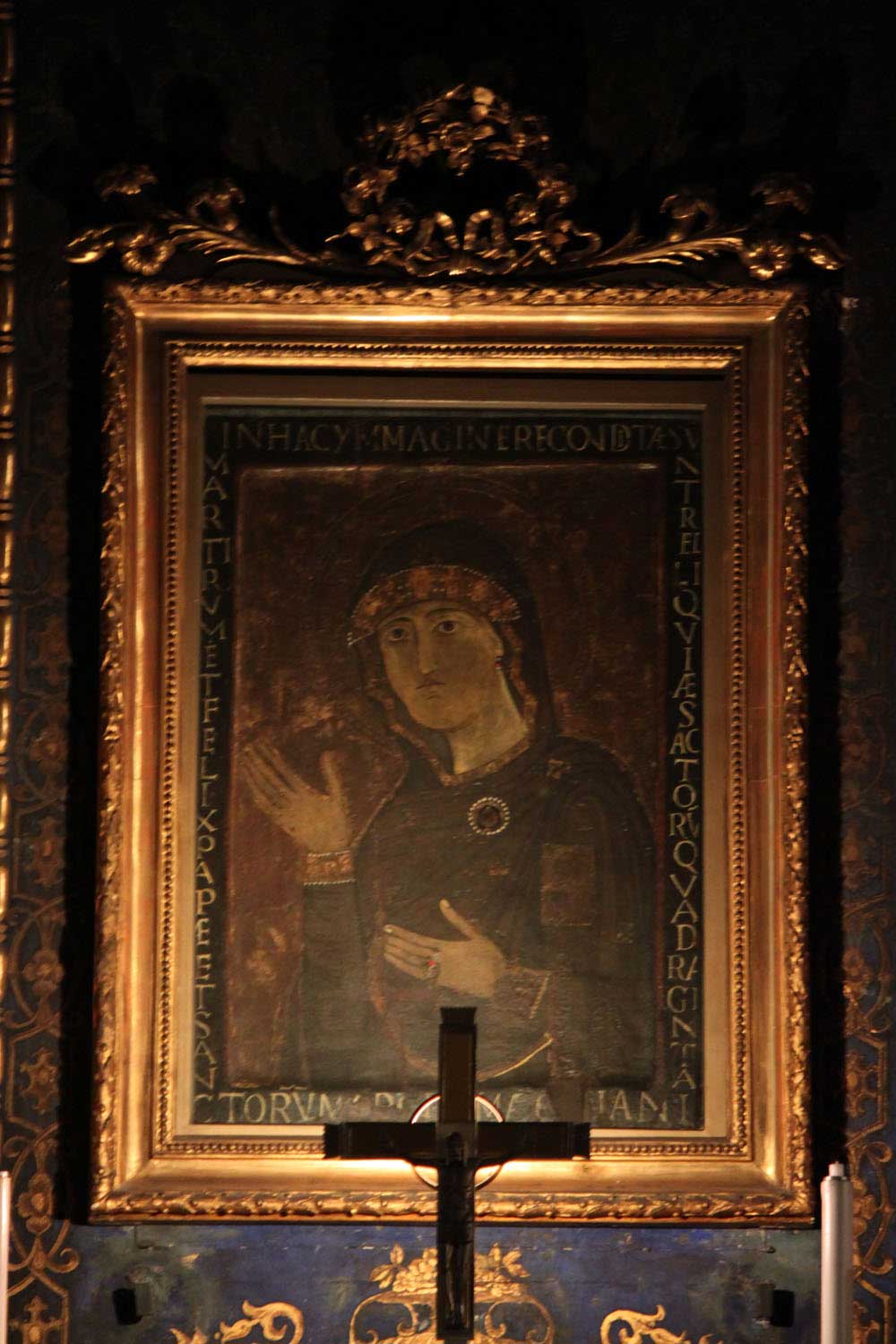
The station church of Saints Marcellinus and Peter is located between St. Mary Major and St. John Lateran at the intersection of two busy streets. These two saints, who are mentioned in Eucharistic Prayer #1 (The Roman Canon), were both beheaded for their faith. This small church no longer holds their remains (they were re-located to Germany in the 9th century for use in the new churches there), but it still preserves the memory of their witness to the Father’s love for all of us.
Today’s homily takes up the theme of Lent as a season of conversion, of metanoia, of purifying our ways of thinking. The stational liturgy today asks us to admit our need for further conversion, and shows us the way back to the Father.
Learning from Our Father’s Generosity
The well-known parable of the Prodigal Son asks us to confront the attitude of the elder son present in all of us. The elder son becomes angry at the generosity shown by the father for the younger son, a son who seemed to have lived the easy life, full of pleasure and enjoyment. This anger is not just because the younger prodigal son is welcomed back; it’s because the father’s love seems disproportionate to the actions of his sons. From the elder son’s point of view, the father seems to be more generous to the younger son; in fact, he seems to love the younger son more despite what the elder son has done for the father. “Look,” he says, “all these years I served you and not once did I disobey your orders; yet you never gave me even a young goat to feast on with my friends!”
Are we angry because others seem to be rewarded for doing nothing? Are we angry because our burdens seem to be more difficult than others’? Are we angry because we have to follow certain rules and others don’t, and they seem happier for it? In a word, are we angry because God still hasn’t given us our due? If we have these thoughts in our hearts, we really don’t know what redemption means. We really don’t know what Jesus accomplished through his passion death and resurrection.
But we can rediscover this Lent what it means to be saved. It’s appropriate that this station church, which is always connected to this Gospel in Lent, should have a shrine over there to Lourdes. It is at Lourdes where so many people who are ill and fearfully sick come to find rest. They bring the burden of feeling abandoned by God to Mary; they bring the heavy load of being the sickest person they know to this shrine and discover with and through Mary how much they are already blessed by God; how much they have already been given by God, freely, gratuitously, out of the generosity of his fatherly heart. They learned the meaning of what the father told his elder son, “Everything I have is yours”.
Mary, pray that we your sons and daughters may come to know this Lent the gratuitousness of divine love, a love that we already possess. And pray that we may in turn give that love to others. Amen.
One of the great yet largely unknown hymns of the Church is Take My Life, and Let it Be. It was written by Frances R. Havergal, in February of 1874 and speaks of the Christian’s total consecration to God.
I thought of this hymn today while talking with someone and thought too how appropriate it was as I write today on the evening of the Feast of the Annunciation. For, in today’s reading at Mass we read:
Sacrifice or oblation you wished not,
but ears open to obedience you gave me.
Holocausts or sin-offerings you sought not;
then said I, “Behold I come. (Psalm 40:7-8)
Now this psalm refers especially to Christ, but also then to us; for it is not enough to be ritually observant. No indeed, Jesus has established a new manner of sacrifice. The priests of the Old Testament sacrificed something other than themselves: lambs, goats, turtledoves and so forth. But Jesus our High Priest sacrifices himself. In the New Testament, the priest and victim are one and the same.
Hence Psalm 40, above, declares that the sacrifice Jesus offered was not to kill an animal, but to obey, and offer himself. The same pattern is for us, who share in the royal priesthood of Christ.
While not all of us are ministerial priests who serve at the altar, all of us, by virtue of our baptism share in the royal priesthood. Hence we are to imitate Jesus, our high priest.
It is not enough for us to engage merely in ritual observance. In the end we must make the sacrifice of obedience, sacrificing our will, and wishes. Further, we must say with Jesus, “Behold I come.” That is to say, “I offer you the sacrifice of my own life, my mind, heart, will, strength, and body.”
St. Paul says, I urge you, brothers, in view of God’s mercy, to offer your bodies as livings sacrifices, holy and pleasing to God – this is your act of worship. (Rom 12:1). This is what we offer to God, the gift of our very selves.
Consider this as you meditate on one of the great hymns of the 19th Century. Frances Havergal speaks of how she came to write it:
I went for a little visit of five days….. (to Areley House)….. The last night of my visit after I had retired….; it was nearly midnight. I was too happy to sleep, and passed most of the night in praise and renewal of my own consecration; and these little couplets formed themselves, and chimed in my heart one after another till they finished with “Ever, Only, ALL for Thee!”[1]
And these are the words she wrote:
Take my life, and let it be consecrated, Lord, to Thee.
Take my moments and my days; let them flow in ceaseless praise.
Take my hands, and let them move at the impulse of Thy love.
Take my feet, and let them be swift and beautiful for Thee.
Take my voice, and let me sing, always, only, for my King.
Take my lips, and let them be filled with messages from Thee.
Take my silver and my gold; not a mite would I withhold.
Take my intellect, and use, every power as Thou choose.
Take my will, and make it Thine; it shall be no longer mine.
Take my heart, it is Thine own; it shall be Thy royal throne.
Take my love, my Lord, I pour at Thy feet its treasure store.
Take myself, and I will be ever, only, all for Thee.
Yes, all for thee Lord. The sacrifice I offer to you is more than my money, more than my time, the sacrifice I offer is my very self, in imitation of your Son. My it be so Lord, ever more truly so, that my sacrifice be whole and entire: ever, only all for thee.
Here is a modern version of this old hymn. The video links the words to vocations to the priesthood and religious life, but the hymn can surely refer to us all, whatever our state.
Today, the Church celebrates the feast of the Annunciation. Through Mary’s “Yes” to God, the Word became flesh within her womb. Today’s readings at Mass reflect Mary’s perfect cooperation with God’s will that helped bring about the redemption of mankind.
The responsorial psalm today is, “Here I am, Lord; I come to do your will.” The second reading (Hebrews 10:4-10) teaches about Jesus Christ living the will of his Father. Jesus always prayed, “Behold, I come to do your will.” Finally, in today’s Gospel, we hear Mary’s words that changed the course of human events and invited God into our world: “Behold, I am the handmaid of the Lord. May it be done to me according to your word.” (Lk. 1:38)
The station church today is San Vitale. This church, going back to the fourth century, was a shrine to San Vitale, his wife, and sons – all of whom were martyrs for the faith. The martyrs are some of the Church’s greatest examples of people who followed God’s will very closely, even to the point of death.
In more recent history, the church of St. Vitale was connected to yet another martyr. During the 16th-century persecution of Catholics in England, Bishop John Fisher refused to sign the Oath of Supremacy that denied the pope’s authority and declared Henry VIII the head of the Church in England. Pope Clement VII named Fisher a cardinal and entrusted today’s station church, San Vitale, to Fisher as his titular church. Fisher was martyred for the faith in 1535, soon after being named a cardinal. Like our Lady and Jesus, he said “yes” to the will of God.
This feast of the Annunciation, let us stay close to our Lady, so that with her we can say, “I am the handmaid of the Lord. May it be done to me according to your word.” By following God’s will, we too can be the instruments who bring Christ into the world.
It’s a very special and wonderful moment when someone learns that they’re going to become a new parent. Yet first-time moms and dads can be apprehensive too. They may worry: “Am I up to the job? How will I juggle work and family? Will my baby be okay? How is my life going to change? Can we afford this?” Expectant parents can feel overwhelmed by their new responsibilities. Some even suffer depression.
Given this, we can appreciate how Mary may have felt at the Annunciation. It was an angel of light- not a nurse- who told her that she’d be a mom. What’s more, she wouldn’t be an ordinary mom- she was going to be a queen mother, as her son was to be a king who would rule forever! To top it off, she wasn’t even married yet, and somehow her child was to be conceived by a “Holy Spirit.”
Scripture describes Mary as frightened and confused- and who could blame her? Thankfully, Gabriel understood. He told Mary to put away her fears, and assured her that nothing is impossible for God.
But – aren’t Gabriel’s words meant for us too? Like Mary, we may face situations that seem daunting- things that fill us with fear, appear impossible, or make no logical sense, and we wonder how it all fits into God’s plan. We may find ourselves asking Mary’s question: “How can this be?”
When we do, Mary invites us to imitate her surrender, entrusting ourselves into the hands of a trustworthy God by saying, “Thy will be done.” Even though we may be afraid; even though we may not understand; even though the way ahead looks dark.
To know “The Lord is with thee” was enough for Mary. And praise God, the Lord will be with us too.