“The business of America is business,” said President Calvin Coolidge in the 1920’s. And I think we can appreciate what he meant. We Americans work hard, and we like to make money.
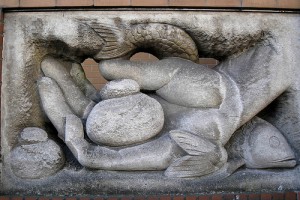
However, today’s gospel has a message for us. We heard of people who came to Jesus seeking food. They wanted to fulfill their legitimate material, physical needs. And Jesus wants to meet these needs. That’s why, just the day before, he had fed these same people with loaves and fishes. But then he urged them, on this day, to look beyond the physical and the material. They should work for the food that only he can give.
We Americans need to hear these words. Because sometimes in our preoccupation with work, “the business of business,” we forget about what Jesus really wants us to work for; in our focus upon the material, we neglect the spiritual. The challenge for us is not to become so immersed with putting bread on the table, that we deprive ourselves of the bread of life.
I am preparing some notes for a Retreat for Priests that I will be preaching this summer. And one of the Key texts I will be using is Paul’s farewell speech to the presbyters (priests) of the early Church. Here is a skilled bishop and pastor, exhorting others who have pastoral roles in the Church. Lets take a look at this text and apply its wisdom to Bishops and priests as well as to parents and other leaders in the Church.
Paul’s Farewell Sermon – The scene is Miletus, a town in Asia Minor on the coast not far from Ephesus. Paul, who is about to depart for Jerusalem summons the presbyters (priests) of the early Church at Ephesus. Paul has ministered there for three years, and now summons the priests for this final exhortation. In the sermon, St. Paul cites his own example of having been a zealous teacher of the faith who did not fail to preach the “whole counsel of God.” He did not merely preach what suited him or made him popular. He preached it all. To these early priests Paul leaves this legacy and would have them follow in his footsteps. Let’s look at excerpts from this final exhortation. First the text them some commentary:
From Miletus Paul had the presbyters of the Church at Ephesus summoned. When they came to him, he addressed them, “You know how I lived among you the whole time from the day I first came to the province of Asia. I served the Lord with all humility and with the tears and trials that came to me…., and I did not at all shrink from telling you what was for your benefit, or from teaching you in public or in your homes. I earnestly bore witness for both Jews and Greeks to repentance before God and to faith in our Lord Jesus…..But now, compelled by the Spirit, I am going to Jerusalem……“But now I know that none of you to whom I preached the kingdom during my travels will ever see my face again. And so I solemnly declare to you this day that I am not responsible for the blood of any of you, for I did not shrink from proclaiming to you the entire plan of God….. (Acts 20:1-38 selected)
Here then is the prescription for every Bishop, every priest and deacon, every catechist, parent and Catholic: that we should preach the whole counsel (the entire plan of God). It is too easy for us to emphasize only that which pleases us or makes sense to us or fits in our worldview. There are some who love the Lord’s sermons on love, but cannot abide his teachings on death, judgment, heaven and hell. Some love to discuss liturgy and ceremony, but the care of the poor is far from them. Others point to His compassion, but neglect his call to repentance. Some love the way he dispatches the Pharisees and other leaders of the day, but become suddenly deaf when the Lord warns against fornication or insists that we love our neighbor, enemy and spouse. Some love to focus inwardly and debate over doctrine, but the outward focus of true evangelization to which we are commanded (cf Mat 28:19) is neglected.
In the Church today, as a whole, we too easily divide out rather predictably along certain lines and emphases: Life issues here, social justice over there; strong moral preaching over here, compassionate inclusiveness over there. When one side speaks, the other side says, “There they go again!”
And yet somewhere we must be able to say with St. Paul that we did not shrink from proclaiming the whole counsel of God. While this is especially incumbent on the clergy, it must also be true for parents and all who attain to any leadership in the Church. All of the issues above are important and must have their proper place in the preaching and witness of every Catholic, clergy and lay. While we may have gifts to work in certain areas, we should learn to appreciate the whole counsel and the fact that others in the Church may be needed to balance and complete our work. It is true, we must exclude notions that stray from revealed doctrine, but within doctrine’s protective walls, it is necessary that we not shrink from proclaiming and appreciating the whole counsel of God.
And if we do this we will suffer. Paul speaks above of tears and trials. In preaching the whole counsel of God, (not just your favorite passages and politically correct and “safe” themes), expect to suffer. Expect to not quite fit in with people’s expectations. Jesus got into trouble with just about everyone. He didn’t just offend the elite and powerful. Even his own disciples puzzled over his teachings on divorce saying “If that is the case of man not being able to divorce his wife it is better never to marry!” (Matt 19). Regarding the Eucharist, many left him and would no longer walk in his company (John 6). In speaking of his divine origins many took up stones to stone him, but he passed through their midst (Jn 8). In addition he spoke of taking up crosses, forgiving your enemy and preferring nothing to him. He forbade even lustful thoughts, let alone fornication, and insisted we must learn to curb our unrighteous anger. Preaching the whole counsel of God is guaranteed to earn us the wrath of many.
As a priest I have sadly had to bid farewell to congregations, and this farewell speech of Paul is a critical passage whereby I examine my ministry. Did I preach even the difficult stuff? Was I willing to suffer for the truth? Did my people hear from me the whole counsel of God, or just the safe stuff?
How about you? Have you proclaimed the whole counsel of God? If you are clergy when you move on…..if you are a parent when your child leaves for college…..if you are a Catechist when the children are ready to be confirmed or have reached college age…..If you teach in RCIA and the time comes for sacraments……Can you say you preached it all? God warned Ezekiel that if he failed to warn the sinner, that sinner would surely die for his sins but that Ezekiel himself would be responsible for his death, (Ez 3:17 ff). Paul is able to say he is not responsible for the death (the blood) of any of them for he did not shrink from proclaiming the whole counsel of God. How about us?
The whole counsel of God; not just the safe stuff, the popular stuff, not just the stuff that agrees with my politics and those of my friends. The whole counsel, even the difficult stuff, the ridiculed things. The Whole Counsel of God.
This video contains the warning to the watchmen (us) in Ezekiel 3. Watch it if you dare.
Our parish Director of Religious Education, Kathy Kramer, and I once had a conversation in our church’s sanctuary. Her two delightful young boys were playing nearby, and at one point they got near the tabernacle. Kathy asked them to settle down. “This is where we pray, not where we play,” she said. One of her boys asked “Why?” Kathy explained, “Because Jesus is in the tabernacle.” With a puzzled expression on his face, the little boy looked at the tabernacle, then at me, and finally at Kathy. Then he asked, “What he doing in there?” I looked at Kathy and said: “This one’s all yours, Mom!” But Kathy was cool. After a brief pause, she looked at her son and said: “Jesus is there reminding us of how much he loves us.”
Blessed Pope John Paul II made the very same point in a little document he wrote not long before he died called “Church of the Eucharist.” It was written as a teaching document, and it’s an excellent one at that. But the Holy Father concluded this work with a very personal final chapter. He wrote, “Allow me, dear brothers and sisters, to share with deep emotion…my own testimony of faith in the Most Holy Eucharist.” He reflected with gratitude on how he had celebrated Mass and contemplated its mystery every day since his ordination in Poland in 1946. Then he said, “Every day my faith has been able to recognize in the consecrated bread and wine the divine Wayfarer who joined the two disciples on the road to Emmaus and opened their eyes to the light and their hearts to a new hope.”
In saying this, he was of course referring directly to today’s gospel. As we heard, on the evening of that first Easter day, the “wayfaring” Jesus revealed himself in the “breaking of the bread”- one of the earliest titles for the Mass. And following this, the two disciples recalled how their “hearts burned” as Jesus explained the Scriptures to them.
The way this event is described is meant to remind us that we too encounter the risen Jesus at Mass. First, Jesus himself speaks to us when the Scriptures are proclaimed, and our hearts should burn within us. And then Jesus presents himself to us in the consecrated bread and wine, his Body and Blood. In other words, the risen Jesus is met, not just by the first disciples on that first Easter, but also by us every time we participate in the Eucharist. Indeed, this and every Sunday, to again quote the Holy Father, “is Easter which returns week by week.”
What a tremendous gift this is! Pope John Paul II called it the “gift par excellence,” and he dearly wanted all of us to cherish it for what it is. “In the Eucharist we have Jesus,” he wrote, “we have his redemptive sacrifice, we have his resurrection, we have the gift of the Holy Spirit, we have adoration, obedience, and love of the Father.” “Were we to disregard the Eucharist,” he continued, “how could we overcome our own deficiency?
Yet sometimes we Catholics do disregard the Eucharist. We neglect it or take it for granted. It’s heartbreaking to read that only one third of Catholics in the United States today attend Mass on any given Sunday. It’s sad, and it’s also ironic, since it is the Eucharist that attracts so many non-Catholic Christians to join our church. A parishioner here once explained to me that while she had been born and raised a Christian, it was her desire for the gift of Jesus in the Eucharist that led her to become a Catholic.
St. Elizabeth Ann Seton, who essentially founded our country’s Catholic school system, had a similar experience. She had been a New York Episcopalian until her husband’s illness in 1803 led both of them to the warmer climate of Rome to seek a cure. While there, she met kind and generous Catholic people who explained to her that Jesus could be met in the Mass. This greatly appealed to her in her loneliness and concern for her husband’s health. She wrote this to her sister back home: “While I face the full loneliness and sadness of my case, I cannot stop tears at the thought, “My God, how happy I would be, even so far away from all so dear, if I could find you in the church as they do.’”
Do we feel that way about the Eucharist, or do we think otherwise? Is Mass something we anticipate with joy, or do we dread it as a burden or an inconvenience? It participation at Mass a top priority, or is it something we do only occasionally, or even rarely? Yes, sometimes we do have legitimate reasons for missing Mass on Sunday. But more often than not, we don’t. In one of his books, Fr. Oscar Lukefahr asks this question: If we were offered a week’s salary to skip Mass this morning, would we go anyway? If our answer is yes, then God bless us. But if our answer is no, not only do we disobey God’s command, but we show that God is less important to us than money- or any number of other things. Indeed, it would show that we were out of touch with the true God, who is worth infinitely more than anything this passing world has to offer.[1]
Participating at Mass, Fr. Lukefahr point out, is really the only thing that Jesus specifically asks us to do for himself. “Do this in memory of me,” was his command to us at the Last Supper. In light of all that he’s done for us, how could we possibly ignore his request? How could we ever refuse such as blessing?[2] As Kathy Kramer reminded her son, Jesus presents himself in the Eucharist to remind us of how much he loves us. In gratitude, shouldn’t we faithfully present ourselves to Jesus at the Eucharist, to show how much we love him?
[1] Fr. Oscar Lukefahr, We Worship: A Guide to the Catholic Mass
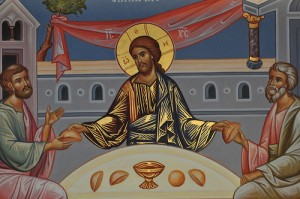
In today’s gospel we encounter two discouraged and broken men making their way to Emmaus. The text described them as “downcast.” That is to say, their eyes are cast to the ground, their heads are hung low. Their Lord and Messiah has been killed; the one they had thought would finally liberate Israel. Yes, it is true, some women had claimed he was alive, but these disciples have discredited the reports and are now leaving Jerusalem. It is late in the afternoon. The sun is sinking low.
The men cannot see or understand God’s plan. They cannot “see” that he must be alive, just as they were told. They are quite blind as to the glorious things that have already happened, hours before. Their eyes are cast downward. And, in this, they are much like us, who also struggle to see and understand that we have already won the victory. Too easily we are downcast, our eyes cast downward in depression rather than upward in faith.
And how will the Lord give them (and us) vision? How will he enable them to see his risen glory? How will he encourage them to look up from their downcast focus and behold new life?
In effect, if you are prepared to “see” it, the Lord will celebrate Holy Mass with them. In the context of a sacred meal we call the Mass, he will open their eyes, and they will recognize him, they will see glory and new life.
Note that the whole gospel, not just the last part, is in the form of a Mass. There is a gathering, a penitential rite, a Liturgy of the Word, Intercessory prayers, a Liturgy of the Eucharist, and an Ite Missa est. And, in this manner of a whole Mass, they have their eyes opened to Him and to glory. They will fulfill the psalm which says: Taste, and see, the goodness of the Lord (Psalm 34:8).
Lets look at this Mass, which opens their eyes, and ponder how we too taste and see in every Mass.
Stage One: Gathering Rite – The Curtain rises on this Mass with two disciples having gathered together on a journey: Now that very day two of them were going to a village seven miles from Jerusalem called Emmaus (Lk 24:13). We have already discussed above that they were in the midst of a serious struggle and are downcast. We only know one of them by name, Cleopas. Who is the other? If you are prepared to accept it, the other is you. So they (this means you, this means me) have gathered. This is what we do as the preliminary act of every Mass. We who are pilgrims on a journey come together on our journey.
It so happens for these two disciples that Jesus joins them: And it happened that while they were conversing and debating, Jesus himself drew near and walked with them (Luke 24:15). The text goes on to inform us that they did not recognize Jesus yet.
The Lord walks with us too – Now for us who gather at Mass it is essential to acknowledge by faith that when we gather together, the Lord Jesus is with us. For Scripture says, For where two or three are gathered in my name, there am I among them (Matt 18:20). It is a true fact that for many of us too, Jesus, though present, is unrecognized! Yet he is no less among us than he was present to these two disciples who fail to recognize him.
Liturgically we acknowledge the presence of the Lord at the beginning of the Mass in two ways. First, as the priest processes down the aisle the congregation sings a hymn of praise. It is not “Fr. Jones” they praise, it is Jesus, whom “Fr. Jones” represents, that they praise. Once at the Chair the celebrant (who is really Christ) says, “The Lord be with you.” And thereby he announces the presence of Christ among us promised by the Scriptures.
The Mass has begun, our two disciples are gathered and the Lord is with them. So too for us at every Mass. The two disciples still struggle to see the Lord, struggle to experience new life and that the victory has already been one. And so too some of us who gather for Mass. But simply the fact that these disciples (us) are gathered is already the beginning of the solution. Mass has begun, help is on the way!
Stage Two: Penitential Rite – The two disciples seem troubled and the Lord inquires of them the source of their distress: What are you discussing as you walk along? (Lk 24:17) In effect the Lord invites them to speak with him about what is troubling them. It may also be a gentle rebuke from the Lord that the two of them are walking away from Jerusalem, away from the site of the resurrection.
Clearly their sorrow and distress are governing their behavior. Even though they have already heard evidence of his resurrection (cf 24:22-24), they seem hopeless and have turned away from this good news. As we have well noted, the text describes them as “downcast” (24:17).
Thus the Lord engages them is a kind of gentle penitential rite and wants to engage them on their negativity.
So too for us at Mass. The penitential rite is a moment when the celebrant (who is really Christ) invites us to lay down our burdens and sins before the Lord who alone can heal us. For, we too, often enter the presence of God looking downcast and carrying many burdens and sins. We too, like these disciples may be walking in wrongful directions. And so the Lord says to us, in effect, “What are thinking about and doing as you walk along? Where are you going with your life?
The Lord asks them, and us, to articulate our struggles. This calling to mind of our struggles for them and us in the penitential rite, is a first step to healing and recovery of sight.
And thus again, we see in this story about two disciples on the road to Emmaus, the Mass that is so familiar to us.
Stage Three: Liturgy of the Word – In response to their concerns and struggles the Lord breaks open the Word of God, the Scriptures. The text says: Then beginning with Moses and all the prophets, he interpreted to them what referred to him in all the scriptures (Luke 24:27).
Notice, not only does the Lord refer to Scripture, but he interprets it for them. Hence the Word is not only read, there is also a homily, an explanation and application of the Scripture to the struggles these men have. The homily must have been a good one too, for later, the disciples remark: Were not our hearts burning (within us) while he spoke to us on the way and opened the scriptures to us? (Luke 24:32)
And so too for us at Mass. Whatever struggles we may have brought to the Mass, the Lord bids us to listen to his Word as the Scriptures are proclaimed. Then the homilist (who is really Christ) interprets and applies the Word to our life. It is a true fact that the Lord works through a weak human agent, (the priest or deacon), but God can write straight with crooked lines. As long as the homilist is orthodox, it is Christ who speaks. Pray for your homilist to be an obedient and useful instrument for Christ at the homily moment.
Notice too, though they do not fully yet see, their downcast attitude has been abated. Their hearts are now on fire. Pray God, too, for us who come to Mass Sunday after Sunday and hear from God how victory is already ours in Christ Jesus. God reminds us, through successive Sundays and passages which repeat every three years, that though the cross is part of our life, the resurrection surely is too. And we are carrying our crosses to an eternal Easter victory. If we are faithful to listening to God’s Word, hope and joy build within our hearts and we come, through being transformed by Christ in the Liturgy to be men and women of hope and confidence.
Stage Four: Intercessory Prayers – After the homily we usually make prayers and requests of Christ. We do this based on the hope that his Word provides us that he lives, he loves us and he is able. And so it is that we also see these two disciples request of Christ: Stay with us, for it is nearly evening and the day is almost over. (Luke 24:29)
Is this not what we also say in so many words: “Stay with us Lord, for it is sometimes dark in our lives and the shadows are growing long. Stay with us Lord and those we love so that we will not be alone in the dark. In our darkest hours, be to us a light O Lord that never fades away.”
And indeed, it is already getting brighter for we are already more than halfway through the Mass!
Stage Five: Liturgy of the Eucharist – Christ does stay with them and then come the lines that no Catholic could miss: And it happened that, while he was with them at table, he took bread, said the blessing, broke it, and gave it to them (Luke 24:30). Yes, the Mass to be sure. All the basic action of the Eucharist are there: he took, blessed, broke and gave. It is the same action as at the Last Supper and the same action in every Mass. Later, the two disciples will refer back to this moment as the breaking of the bread (Luke 24:35), a clear Biblical reference to the Holy Eucharist.
And so, the words of Mass come immediately to mind: “While they were at supper He took the bread, and gave you thanks and praise. He broke the bread, gave it to his disciples and said, take this all of you and eat it: this is my Body which will be given up for you.”
A fascinating thing happens though: With that their eyes were opened and they recognized him, but he vanished from their sight (Luke 24:31).
Note that it is the very act of consecration that opens their eyes. Is this not what Holy Communion is to do for us? Are we not to learn to recognize Christ by the very mysteries we celebrate? Are we not to Taste and See?
The liturgy and the sacraments are not mere rituals, they are encounters with Jesus Christ, and though our repeated celebration of the holy mysteries our eyes are increasingly opened if we are faithful. We learn to see and hear Christ in the liturgy, to experience his ministry to us.
The fact that he vanishes from their sight teaches us that he is no longer seen by the eyes of the flesh, but by the eyes of faith, and the eyes of the heart. So though he is gone from our earthly, fleshly, carnal sight, he is now to be seen in the Sacrament of the Altar, and experienced in the Liturgy and other Sacraments. The Mass has reached it’s pinnacle, for these two disciples and for us; for they have tasted and now they see.
Consider these two men (and us) who began this gospel quite downcast. Now their hearts are on fire and they see. The Lord has celebrated Mass to get them to this point. And so too for us, the Lord celebrates Mass to set our hearts on fire and open our eyes to glory. We need to taste in order to see. Consider a fuller number of verses from that psalm (34):
I sought the Lord, and he answered me; he delivered me from all my fears. Those who look to him are radiant; their faces are never covered with shame. This poor man called, and the Lord heard him; he saved him out of all his troubles. …Taste and see that the Lord is good; blessed is the man who takes refuge in him (Psalm 34:4-8).
Yes, blessed are we if we faithfully taste in order to see, every Sunday at Mass.
Stage six: Ite Missa est – Not able to contain their joy or hide their experience the two disciples run seven miles back to Jerusalem to tell their brethren what had happened and how they encountered Jesus in the breaking of the bread. They want to, they have to, speak of the Christ they have encountered, what he said and what he did.
How about us? At the end of every Mass the priest or deacon says “The Mass is ended, go in peace.” This does NOT mean, “OK, we’re done here, go on home, and haver nice day.” What it DOES mean is: “Go now into the world and bring the Christ you have received to others. Tell them what you have heard and seen here, what you have experienced. Share the joy and hope that this Liturgy gives with others.”
Perhaps you can see the word MISSion in the word disMISSal? You are being commissioned, sent on a mission to announce Christ to others.
The Lucan text we are reviewing says of these two disciples: So they set out at once and returned to Jerusalem where they found gathered together the eleven and those with them…..Then the two recounted what had taken place on the way and how he was made known to them in the breaking of the bread (Lk 24:33,35). How about us. Does our Mass finish as well, as enthusiastically? Can you tell others that you have come to Christ in “the breaking of the bread,” in the Mass?
So Jesus has used the Mass to drawn them from gloom to glory, from being downcast to delighted, from darkness to light. It was the Mass, do you “see” it there. It is the Mass. What else could it be?
“It was a dark and story night” is widely understood to be a terrible beginning to a novel! However, a dark and stormy night proved to be a perfect time for Jesus to reveal something of himself to his friends.
After sunset, as today’s gospel recalls, the disciples were straining to row their boat in the face of powerful winds. Seeing their struggle, Jesus came to them, walking on water. Not only did this demonstrate Jesus’ power over nature. It also suggested his power over death- which water represented in the Jewish imagination.
As he approached them, the Lord assured his friends by saying, “I am Jesus.” Simple words- but rich with meaning. “I AM” is God’s own name as spoken to Moses at the burning bush; “Jesus,” in Hebrew, means “God saves.” Jesus concluded with an invitation: “Do not be afraid.”
What Jesus communicated to his disciples that night, he also says to us: “There’s no need to fear. I am Jesus; I am God. When life is dark and stormy, and you’re straining into the wind, I will come to you. I will save you from your fears; I will save you from death.”
St. Catherine of Siena summed it up very well: “Be comforted in Christ crucified, and do not be afraid.”
OK, you know the typical drill of a TV commercial: As the scene opens, some buffoon of a man, usually a husband, is struggling to have a clue as to what something is all about. Sure enough, an all-knowing woman (usually the wife), rolling her eyes and shaking her head in pity, is there to help the stupid buffoon of a man not utterly ruin everything. And of course the product being peddled is usually part of the solution. And, by the way, did I mention that the man is stupid? In an alternate version, it is the children who are all-wise, and they help the idiot father figure things out as they step in with the product. And of course we’re all supposed to laugh: “Ha, Ha, Ha look at that stupid guy. What an idiot!”
Obviously these ads are not trying to sell anything to me. I am far more prone to refuse to buy any product that says, “Hey, buy our product you buffoon.” Perhaps they are targeted to women? Even worse, to children?
OK, now remember this is a “rant.” And a rant is “to talk in a noisy, excited, or declamatory manner.” I don’t lack any sense of humor, and can laugh at myself and the male sex from time to time. But, after a while, these ads are wearying, and their frequency does indicate to me something that is fundamentally unhealthy in our culture.
The greatest harm, I think, comes to children who see men, and especially fathers, presented as idiots, crude, foolish, lustful and just plain stupid. A steady diet of this served up in commercials does not help them respect their elders, especially their fathers, and other male authority figures.
Neither does it really help women. The “men are idiots” thinking may have a certain “charm” or humor angle, (i.e., it’s interesting at times to poke fun at the differences between men and women), but in the end, it isn’t a good attitude to cultivate. Women do owe men respect, just as a fellow human beings. And, for those who accept Scripture, a husband is at the head of the house. Ridicule and caricature, are not helpful dispositions in cultivating family love and unity.
Neither do these ads help men. It is always best for men to see their best qualities exemplified. Instead what they get is a portrait that men are not only stupid, they are lazy, unfaithful, lustful, inappropriate, addicted to beer, lousy fathers, unkempt, inattentive to their wife and kids due to sports, and did I mention, stupid? How does a steady diet of this help men?
Some argue that these ads, of reflect culture. Really? Are all men like this? They may reflect culture in the sense that male characteristics are often on the outs and that it is politically correct to caricature men. Try reversing the roles and put the woman in the role of buffoon and see how that would fly.
But not only do the ads reflect culture, they help shape it. Again I ask, how does all this negativity help men and boys to understand what is good about them? There are very few healthy male portraits in current culture. It is not only the buffoonery of the ads, it is the extremely violent and hyper-sexualized “heroes” of the movies, idiosyncratic actors, freakish rock and rap stars, often immoral or out of control sports figures, effeminate, and weak sitcom “dads,” and the thuggish, criminal and unfaithful men of series such as Sopranos. None of this helps young men toward grasping their better nature and becoming good, responsible husbands and fathers.
So there is my rant. Below are a number of videos that portray the “men are idiots” commercials. As always, I am interested in your thoughts.
Barley bread and little fish were a typical “workingman’s lunch” in Jesus’ day; they were a first century “po’ boy san’wich,” if you will. Its mention into today’s gospel in a sign that the crowds who followed Jesus into the dangerous wilderness were poor, in addition to being hungry.
Parallels with the Eucharist are also in today’s gospel. It’s Passover time, as it was for the first Eucharist. The crowd’s reclining on the grass anticipates the disciples reclining at table in the Upper Room. Jesus’ taking loaves, giving thanks, and passing them on are the same as his actions at the Last Supper. And the gathering of fragments into baskets, according to ancient interpretation, implies the unity that the Eucharist signifies for the Church.
What the combination of inferences to the hungry poor and the Eucharist seems to be saying to us is this: We who feed on Jesus in the Eucharist are in turn to seek out and feed Jesus in the faces of the poor. Jesus commands us, just as he instructed his disciples: “You give them something to eat.”
At the Bottom of this post is an encouraging excerpt taken from a video, The Catholic Priest Today, produced by the Cresta Group. In it we are reminded once again of the resiliency of the Church, and that the Holy Spirit can make a way out of no way.
From a worldly perspective one would expect vocations to the priesthood to take a real hit in the wake of the sexual abuse scandal. Yet in many, if not most dioceses, vocations are up, or at least steady. One of the seminarians in the film clip says, “I want to get close to our Lord, I want to pray, I want to help other people get close to Christ and I’m not going to let the scandal that’s been perpetrated by an another generation worry me, I’m part of the solution, I’m not a part of the problem.” Well, said.
Here in Washington our vocations are strong. Many fine men are coming to us to discern a vocation to the priesthood. We are opening a pre-theologate house of formation, since our numbers are strong and we expect them to continue to be so, even to grow. God the Holy Spirit is up to something good. Some of our men come to us straight from college, others have had a career path of some years.
I have remarked before how pleased I am with the caliber of the seminarians I meet. They love the Church, have a strong and manly devotion to our Lord and our Lady, and deeply desire to preach the Gospel with courage and without compromise. They are committed to and well immersed in the teachings of the Church and seem keenly aware of the cultural obstacles that must be addressed. Many of them too, have experienced first hand the necessity of speaking the faith with clarity to a world that increasingly finds belief in God untenable.
I have also seen a wonderful turnaround in our seminaries. I have shared before how problematic things were when I was studying back in the early 1980s. But here too, great reform has been effected, stemming largely from the Vatican Visitations conducted some years ago. But reform has also come, quite frankly, from the students themselves and from the ranks of newer teachers who have entered the system. There is an increasing thirst and insistence on solid, authentic Catholic teaching, and sound liturgical practice.
Yes, God is raising up, a whole new generation of priests. He is purifying, and invigorating a whole new generation of priests. I am mindful of the 132nd Psalm which says of Israel and the Church:
I will clothe her priests with salvation and her faithful shall ring out their joy. There David’s stock will flower; I will prepare a lamp for my anointed. I will cover his enemies with shame but on him my crown shall shine. (Psalm 132:15-17)
Truly our enemy, Satan, has sought to rejoice over a destruction of the priesthood. But it would seem God has other plans!
All this said, continue to pray. Remember that Satan hates priests in a particular way. For if the shepherd is struck, the sheep are more easily scattered. Priests, indeed the whole priesthood, is under consistent attack by Satan. Surround your priests with prayer. Ask the Lord to put a hedge of protection around them.
When I was first ordained, my mother looked at me with concern and said, “Satan wants you, to destroy you. But I am praying for you. And when you feel tempted, remember, I am praying for you.” She most concerned about the effect that the young ladies would have over me. I recall feeling a little embarrassed by what she said, and I replied, “Aw mom, don’t worry about me, I’m not even all that handsome.” But I could tell she was serious and she said again, “Remember.” And praise God, I have always felt the protection of those prayers and been faithfully celibate. And though I am far from sinless in other areas, I have never felt any crisis related to my vocation. Even now that she is gone on to God, I know those prayers continue and I feel their effects.
I know and experience too the prayers of my parishioners. Every morning some of faithful women in the parish do a morning conference call and pray together. And they tell me that they pray for me every morning. Yes, I am the result of prayer. And I ask of God that I too will always be part of the solution, not the problem in the priesthood.
So even as we give thanks to the Lord for the way he is raising up new and faithful vocations to the priesthood and religious life, remember to pray. Satan cannot be happy, he’s taken his best shot at the priesthood and here we still are. But pray! He’s surely not done, and every priest you know is under special attack. So pray, and to quote my mother, “Remember!”
Photo Above: Me in my seminary days, being designated acolyte. My mother is in the (blurry) background looking on, next to my father.
This video clip is taken from The Catholic Priest Today, sponsored by the Midwest Theological Forum, and produced by the Cresta Group. For more Visit Here.

 “The business of America is business,” said President Calvin Coolidge in the 1920’s. And I think we can appreciate what he meant. We Americans work hard, and we like to make money.
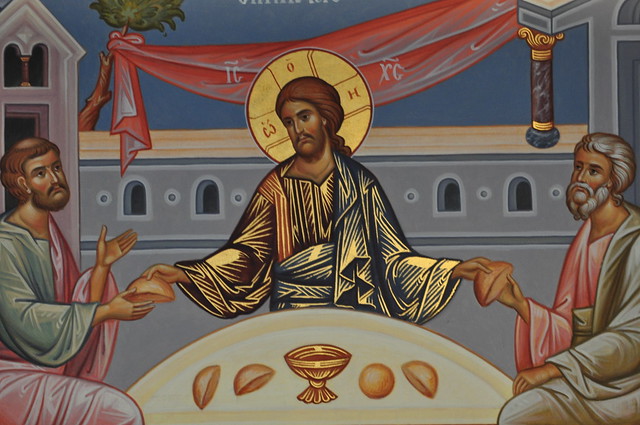 In today’s gospel we encounter two discouraged and broken men making their way to Emmaus. The text described them as “downcast.” That is to say, their eyes are cast to the ground, their heads are hung low. Their Lord and Messiah has been killed; the one they had thought would finally liberate Israel. Yes, it is true, some women had claimed he was alive, but these disciples have discredited the reports and are now leaving Jerusalem. It is late in the afternoon. The sun is sinking low.