A few weeks ago I was delighted to hear that Catholic University of America made the decision to return to single-sex dormitories. I have blogged a good here at this site of horrible moral life on college campuses, and wanted to blog on the good news of CUA’s decision, but found others had beat me to it, and done a fine job in reporting it.
You most surely know my view on this topic and it is summarized briefly as “Bravo Catholic University!” Bravo CUA president John Garvey! The prevailing idea on most college campuses of putting young men and women in the same building, in close living conditions, with little supervision, is one of the most absurd things we could do. This sort of thing could variously filed under: “How could we ever have been so stupid?” or “Common sense takes a holiday,” or, “Your kidding right?”
And don’t tell me about the over 18, “they’re adults now” notions. Maturity doesn’t magically happen at 18. In fact, given the foolish climate at most colleges, maturity may even step backward for a few years for many college students.
Back in my parents day (they went to college in the early 1950s) the women lived in a separate dorm that had a reception area in the lobby with a receptionist. Young men were not permitted in the upper floors, and young ladies would come down and meet their dates, or other visitors, in those public areas. (I know there was some sneaking around, I am not naive, but the system was still more prudent than today’s open fornication culture).
I am not sure if Catholic will go this far, in implementing the new policy, but any steps in the right direction are most welcome.
Lawsuit looming? Now comes the news that, John Banzhaf, a professor at nearby George Washington University Law School, intends to bring suit to prevent CUA from implementing the change. Patrick Lee of the Wall Street Journal reports on this. Here is an excerpt:
John Banzhaf, a professor at George Washington University Law School, says he intends to sue Catholic University over the same-sex plan, Inside Higher Ed reports.
Banzhaf told the Law Blog that his argument rests on the District of Columbia’s Human Rights Act, which prohibits discrimination in public accommodations, commercial spaces, housing and employment based on any number of factors, including sex, race, religion and marital status. Reinstating single-sex dorms would constitute gender discrimination, Banzhaf maintains.
The only exception allowed under the act is for “business necessities,” which means the Catholic University must demonstrate that it can operate the school and remain in business only by instituting a single-sex dorm policy, Banzhaf said. Given that the university has been offering coed housing for decades, it is unlikely the exception will apply in this case, he said.
The university issued a prepared statement in response to a Law Blog request for comment, saying it had not yet received or reviewed any legal documents regarding Banzhaf’s intent to sue and that it was “confident that the law does not require men and women be housed together in residence halls.”
Mr. Banzhaf apparently has too much time on his hands and wants to insert himself into a matter that is none of his business.
Here is yet another example of the attempt to erode religious freedom. Catholic University has a number of reasons to move to single-sex dorms, but chief among them is a moral vision flowing from our religious convictions. Fornication, carousing, drunkenness, lewd conduct, and so forth, are forbidden a Christian. Further, prudence, the avoidance of scandal and occasions of sin is incumbent upon the Christian individual and community. But Mr Banzhaf will have none of this, even if it does not directly involve him. Not only would he like to disagree with us (which is his right) but he insists on limiting our freedom to live as our faith directs. Once again the Church must go back to court to insist on our religious liberty. It is the same drip, drip, drip we have discussed before (e.g. HERE) as the secularists seek to erode our religious liberty.
For some reason, I am mindful of a line from St. Paul who had to endure interference in Christian matters as well. He wrote: Some… have infiltrated our ranks to spy on the freedom we have in Christ Jesus, and to make us slaves (Gal 2:4). I do not know Mr Banzhaf’s personal motivation, but in the wider, highly secularized, (and I would add, neo-pagan) world, the presence of Christians is increasingly obnoxious. It would seem it is not enough for this world to abhor us and what we stand for, but they must also seek to restrict us from practicing our faith, publicly, and even in a our own institutions.
Increasing numbers want to limit severely our religious liberty and force us to observe secular norms as though we were bondsmen to the secular vision and state. But we are not bondsmen, we are free men and women in Christ Jesus. We also have the Constitutional right to practice our faith publicly and to seek to influence others to do so as well, by evangelization, both internally and externally.
Please pay attention to the drip, drip, drip of the erosion of religious liberty. Do not brush it off as no big deal. We may well win this one, but endless numbers of legal cases and legislative actions against religious liberty are already in the works, or soon to come. And we must be ready to fight every one of them.
This ABC News report isn’t exactly balanced. I personally know there is more support at CUA than this rather cynical report depicts:
UPDATE: Cardinal Newman Society President Patrick J. Reilly appeared on Fox news today. Video is here, please also see relevant blog posts at the Cardinal Newman blog: Cardinal Newman Society
St. John of the Cross wrote: “From my observation, our Lord is to a great extent unknown by those who claim to be his friends.” I thought of these words while reflecting on today’s gospel.
Jesus spoke of those who called him “Lord,” and who even claimed to have acted in his name. Nevertheless, Jesus said, they never really knew him. These words remind us that cultivating a personal relationship with the Lord is to be a priority in our life, not an afterthought.
Our Lord gives us clues on how to do this in today’s gospel reading. First, we need to listen to him as he speaks to us through Scripture, Church teaching, and in prayer. Yet we need to do more than listen. We also need to act. “Everyone who listens to these words of wine and acts on them,” said Jesus, “will be like a wise man who built his house on rock. On the other hand, Jesus describes the person who listens but doesn not act as a fool.
A young student once asked German theologian Karl Rahner what books he should read in order to grow in faith. “No books!” Father Rahner replied. “Go instead and serve the city’s poor.” That young person needed to act, in addition to “listening.”
And so do we. Today, each of us is challenged to be wise- to build our houses upon rock- by listening to Jesus, and acting in his name- that we might know him, as a true friend.
In the Gospel for Wednesday’s Mass, Jesus says: Beware of false prophets, who come to you in sheep’s clothing, but underneath are ravenous wolves. By their fruits you will know them. (Matt 7:15). Of course we first think of individuals when we see a verse like this. But the Lord’s teaching can, and should be applied also to philosophies.
One of the terribly destructive philosophies is a false notion of freedom. The sinful world, going all the way back to Satan’s deceit in the garden, thinks of freedom as being able to do whatever I please. In effect those who hold this, flaunt their false notion of freedom saying in effect, “I will do what I want to do, and I will decide if it is right or wrong. No one will tell me what to do.” It is freedom in the abstract, freedom for its own sake, rather than for the sake of being able to do what is right.
That this notion of freedom is false is evident from its fruits. For although many, in modern times, claim to march under the banner of freedom from being told what to do, it becomes clear that many of them end up it a terrible state of increasing slavery and bondage.
For this era when a false notion of freedom is exulted is also an era of increasing addiction to alcohol, drugs, pornography, sex, and a general lack of self control. And with greed and materialism, whatever we have is never enough. There is thus a bondage to things, a kind of incapacity to live without endless numbers of things and creature comforts. Therefore we also see increasing bondage to credit, both personally and nationally. We simply “cannot” stop our runaway spending. There is also an increasing lack of ability to make and keep commitments and many feel “compelled” to divorce, leave the priesthood and religious life.
None of this shouts the freedom that so many boast of. Rather there is evident, bondage, inability, compulsion, addiction, and an out of control quality to modern life.
You will thus know by its fruits that false freedom is not true freedom. It masquerades in the “sheep’s” clothing of liberty, but underneath it is the ravenous wolf of bondage. Many cry “Liberty!” when they really mean “libertine” and “licentious.” They are headed straight for bondage. St. Augustine said,
For of a perverse will, was a lust made; and a lust served, became custom; and custom not resisted, became necessity. (Confessions 8.5)
The Catechism also says,
The more one does what is good, the freer one becomes. There is no true freedom except in the service of what is good and just. The choice to disobey and do evil is an abuse of freedom and leads to “the slavery of sin.” (CCC # 1733).
And thus we arrive at the definition of true freedom which is the capacity to obey God.
And what are the fruits of true freedom? An increasing liberation from the power of sin, the increasing capacity to do what is right and just by the power of God. True freedom brings greater self control, the ability to moderate one’s desires and have them submitted to right reason. True freedom brings serenity, for one’s life is in greater balance and harmony.
By true freedom, the innumerable sorrows of false freedom listed above are largely avoided and one’s life is simpler, more focused, and one enjoys the results of a disciplined and reasonable life. Sorrows and suffering are not eliminated but are diminished for many of their sources in excess, addiction and compulsion are removed. True freedom ushers in, by God’s power, the life that Jesus Christ died and rose to give us.
So what do you want, the fake freedom of the world, or the glorious freedom of the children of God? (Rom 8:21)
The Gospel for today’s Mass features two hard sayings, or expressions, of the Lord. They are “hard” because they offend against a modern notion. And since they are difficult for us “moderns” to hear and we are easily taken aback by their abrupt and coarse quality. Here is the “offending verse:
Do not give what is holy to dogs, or throw your pearls before swine, lest they trample them underfoot, and turn and tear you to pieces.” (Mt 7:6)
The modern notion offended against here is: You’re not supposed to call people ugly names. This notion, though not wrong in itself, has become a rather excessively applied norm in our times and also misses the point in terms of this passage. We live in dainty times where many people are easily offended. These are thin-skinned times of fragile egos where the merest slight often brings threats of lawsuits. Even observations intended as humor are excoriated and hurtful and out of line. And so, horror of horrors, here we have Jesus calling certain (unnamed) people dogs and swine! Explanations are demanded in times like these of such horrible words coming forth from the sinless Lord Jesus.
Sophistication is needed – One of the reasons we are so easily offended in our modern age is, frankly, that we lack sophistication. We seem to have lost understanding, to a great extent, of simile and metaphor.
A simile is a figure of speech comparing two unlike things and normally includes words such as “like” and “as.” For example: “He is as swift and strong as a horse!” Similes have the two ideas remain distinct in spite of their similarities.
Metaphors compare two things without using “like” or “as”. For example, “He’s a real work-horse!” Metaphors are usually more forceful than similes since the distinction intended between the compared things is often ambiguous. For example if I were to observe someone doing something mean or cruel I might say, “Wow, what a dog!” Now the expression does not mean I have gone blind and think that this person is actually a dog. I mean that he is manifesting qualities of a (wild or mean) dog. However, just how distinct he is from an actual dog is left open to interpretation. But for the record, I am NOT saying he is a dog.
The point here is that some sophistication and appreciation for the nuances of language and the art of comparison are necessary as we negotiate life’s road. In modern times we seem to have lost some of this and so, are easily offended.
This does not mean that no one ever intends offense, it only means that more is necessary than simply hearing everything in a crudely literal way. The usual modern person in my example would object, “Hey, he called me a dog!” No, what he means is that you have taken on some of the qualities of a wild dog. Now to what extent he means you are like a dog is intentionally ambiguous and an invitation for you to think of how you may have surrendered some of your humanity and become more like baser creatures.
Examining what the Lord says – This sort of sophistication is necessary as we examine two of the Lord’s “offensive” sayings here. Let’s look at them both in terms of their historical root and then to what is being taught.
1. First of all let’s be clear that the Jewish people were not indicating positive traits when they used the term dog or swine to refer to someone. Dogs in the ancient world were not the pets of today. They were wild, and ran in packs. Pigs were unclean animals and something no Jew would ever touch, let alone eat. These are strong metaphors indicating significant aversion to some aspect of the person.
2. Do not give what is holy to dogs– This was a Jewish saying that was rooted in tradition. Some of the meat that had been sacrificed to God in the Temple could be eaten by humans, especially the Levites. But in no way was it ever to be thrown to dogs or other animals to eat. If it was not eaten by humans it was to be burned. Hence holy and sanctified meat was not to be thrown to dogs because it was holy.
3. [Do not] throw your pearls before swine, lest they trample them underfoot – Pearls were an image for wisdom in the Old Testament. Now the point here is that pigs valued nothing they could not eat. Pearls could not be eaten, thus if they were placed before pigs they would sniff them, determine they were not food, and simply trample them underfoot.
4. So what is being said? Sacred matters, sacred things, wisdom, and participation in sacred things should not be easily offered to those who are incapable of appreciating them. There are those who despise what we call holy. There is little that can be done in such cases except deny them the pleasure of tearing apart holy things or trampling them underfoot. Jesus is saying that some people are like dogs who tear apart sacred things and have no concept of their holiness. Some people are like pigs who do not appreciate anything they cannot eat or use for their pleasure. They simply trample under foot anything that does not please them or make sense to them in the same way that pigs would trample pearls underfoot or dogs irreverently tear apart blessed food dedicated to God.
Further, there are some who, though not hostile, are ignorant of sacred realities. They do not perhaps intend offense but it is necessary that they should be taught and then admitted to sacred rites or further instructed on deeper mysteries. Children, for example in the Western Rite, are not given the Holy Eucharist until they can distinguish it from ordinary food. Further, it is a necessary truth that some more advanced spiritual notions such as contemplative prayer are not often appreciated by those who have not been led there in stages.
The Lord is thus indicating that holy things are to be shared in appropriate ways with those who are able to appreciate them. It is usually necessary to be led into the Holy and just walk in unprepared or unappreciative.
In the ancient Church there was something known as the disciplina arcani (discipline of the secret) wherein only the baptized and confirmed would be admitted to the sacred mysteries of the Liturgy. Given the holiness with which the early Christians regarded the Mass, they exactly observed what the Lord is saying here. Careful instruction and gradual introduction to sacred truth was necessary before entering something so holy as the Sacred Liturgy. Even the unintentional trampling underfoot of sacred realities through simple ignorance was to be strictly avoided. To be sure, these were difficult times for the Church and persecution was common. Hence the Lord’s warning to protect the holy things was not just that they might be trampled underfoot but also that those who were like unto wild dogs and swine might not turn and tear you to pieces (Mat 7:6).
In the centuries after the Edict of Constantine the disciplina arcani gradually dissipated. Some remnants of it revived in the modern RCIA wherein the Catechumens are dismissed halfway through the Mass to reflect more fully on the Liturgy of the Word. And yet we have much to relearn in modern times about a deep reverence for the Sacred Liturgy. It would NOT seem opportune to lock our Church doors as in ancient times. But preserving good order in the Liturgy, encouraging reverence, proper dress, and instilling deeper knowledge of the true meaning of the Sacred Liturgy are all important ways to ensure that we do not trample underfoot what is sacred.
The Third Hard Saying destroys a notion that is to most moderns a dogma. The “dogma” is that just about everyone is going to heaven. It is one of the most damaging notions of modern times since it removes a sense of urgency in earnestly seeking our salvation and staying on the narrow road that leads to salvation. Against this destructive and presumptive notion of practically universal salvation Jesus says,
Enter through the narrow gate; for the gate is wide and the road broad that leads to destruction, and those who enter through it are many. How small the gate and narrow the road that leads to life. And those who find it are few (Matt 7:12-13).
Do you see that word: few. We need to sober up and come to a biblical understanding that our salvation must be earnestly desired and sought. God’s love for us is not lacking, but our love for him often is. “Many” says Jesus are on a path of indifference or outright rejection of the kingdom.
Now the Kingdom of God is not some abstraction, or some golf course, or playground in the sky. The Kingdom of God is the full realization of God’s plan and will. It includes Kingdom values like justice, love of the poor, mercy, kindness, chastity, love of God and neighbor, the praise of God, rejoicing in the truth of God’s word, and so forth. It is clear that many (to quote Jesus) live in opposition or indifference to these values. Only a few, (to quote Jesus) come to appreciate and are willing to receive these into their life wholeheartedly.
Yes, this is a hard saying of Jesus. Many are on the path to destruction, only a few in the road to salvation. The Lord is telling us the truth, not to panic us, but to sober us into earnestly desiring our own salvation and seeking it from God with devotion. It is also to make us sober and urgent about the condition of others, to stop making light of sin and indifference and to work hard to evangelized and call sinners to repentance.
We need to realize that our tendency and that of others is to turn away from God. There is a great drama to our lives and we are either on one road or the other. No third way is given. Not a popular teaching to be sure. It offends modern notions. But it is true because Jesus says it to us in love.
And old song says: Sinner please don’t let this harvest pass, and die and lose your soul at last.
A servant’s heart should characterize every Christian. Yet not every Christian lives the life of a servant. I think this is part of what Jesus laments in today’s gospel when he says that not many people find their way through the narrow gate.
Unfortunately, we have a culture that discourages us from becoming servants. Instead, it conditions us to be selfish, and to think only of our own needs. Consider how marriage is typically understood these days. So often our primary concern is, “Am I happy in my marriage?” Which is a fair question to ask. But as servants, should not the primary concern be instead, “Is my spouse happy in our marriage?” Whether we’re married or not, we can easily become so concerned about ourselves and our needs, that we forget about the needs of all those people God has given us to love: family, friends, neighbors, co-workers…whomever. We wind up waiting for other people to make us happy. They in turn wait for us to make them happy! And everyone winds up unhappy.
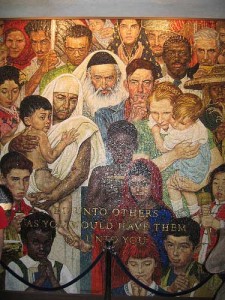
But Jesus tells us, “Do to others what you would have them do to you.” Think about that. If we really followed this “Golden Rule,” how might our relationships change? How might we change? It’s all about thinking of others first. It’s all about having a “servant’s heart.” Some would call this a “paradigm shift,” and it is! But Jesus says, quite simply, that it is the way to “life.”
Scripture says, For here we have no lasting city, but we seek the city that is to come (Heb 13:14). It also says, for what is seen is transitory, but what is unseen is eternal (2 Cor 4:18). And yet again, And the world is passing away along with its desires, but whoever does the will of God abides forever. (1 Jn 2:17). And even yet still, For the present form of this world is passing away (1 Cor 7:31).
Well OK, I suppose you get it by now. But actually we DO struggle to get it. We get so attached to things here and think, “well here’s a howdy do” to the latest in things.
I still remember my first shiny new 8-Track player. The picture at the right is from the 1979 Sears Catalog and looks a lot like my dad’s machine. Funny how almost everything displayed on this 1979 stereo is gone now: record player, 8-Track, cassette, all gone.
Some years ago, I remember laughing at that old technology as I went into the record store and bought the latest CD recordings. “Now this is it,” I thought, “music has reached perfection.” And less than ten years after that I ripped my closet full of CDs to my iPod and carted those now “old fashioned things” out the door. How amazingly fungible our technology and culture has become. And while a little fascination is understandable at “something new,” we do well to remember it’s all passing away.
I ran across this list of Nine Things That will Disappear in Our Life. Let me give you the list and make some comments. I am less convinced as the list goes on, I must say, but here they are.
1. The Post Office . Get ready to imagine a world without the post office. They are so deeply in financial trouble that there is probably no way to sustain it long term. E-mail, Fed Ex, and UPS have just about wiped out the minimum revenue needed to keep the post office alive. Most of your mail everyday is junk mail and bills.Yes, and the bills are fast going away too, I am doing more on line. In fact almost none of my bills do I pay by check. I do all my major bills online and even many of the one-time bills. Only Charitable donations get the paper check these days. Even my parish tithe is taken right out of my account. The parish bills are another matter. We, are still using the old paper heavy approach to paying them. Accountants are slow to change their ways and auditors still want to see tons of paper when they make their triennial visit. There will continue to be some need and ability to post a paper letter, but there is no reason to have a whole Postal Service to do this.
2. The Check . Britain is already laying the groundwork to do away with checks by 2018. It costs the financial system billions of dollars a year to process checks. Plastic cards and online transactions will lead to the eventual demise of the check. This plays right into the death of the post office. If you never paid your bills by mail and never received them by mail, the post office would absolutely go out of business. This is already largely true for me, as I’ve said. However, I currently have no way to get funds to another person. Let’s say I wanted to send $100 to my nephew, how would I do it with out a paper check. If the check really is going to disappear as early as 2018 in England, I think we’ll have to have a pretty convenient way to transfer funds electronically, person to person. I would also add that cash itself will be greatly reduced as a daily reality. Right now, I carry almost no cash. And when I run out, it may take me days to notice and days more to replenish it. I pretty much live off my debit card. I can see that in the next 10 years even smaller scale venders (like hotdog sellers at the corner) will be expected to take plastic. There are already devices the size of a cell phone that let you swipe a card and send the transaction. Of course we may wonder what will happen to beggars if we go increasingly cashless.
3. The Newspaper . The younger generation simply doesn’t read the newspaper. They certainly don’t subscribe to a daily delivered print edition.That may go the way of the milkman and the laundry man. As for reading the paper online, get ready to pay for it. The rise in mobile Internet devices and e-readers has caused all the newspaper and magazine publishers to form an alliance. They have met with Apple, Amazon, and the major cell phone companies to develop a model for paid subscription services. Definitely see this too. When I was a kid we used to have milk delivered to our door. Supermarkets, and better, cheaper refrigeration put an end to that. Electronic versions of newspapers are already a reality and the paper versions are going bye bye. I must say though, there is more to the demise of the newspaper industry than technology. Many people have come to consider the traditional newspaper publishers arrogant and biased. Simply making electronic versions of these papers available is not going to stem their demise. People just want more variety and views with their news now and the newspapers stubbornly refused to do that for too long.
4. The Book . You say you will never give up the physical book that you hold in your hand and turn the literal pages. I said the same thing about downloading music from iTunes. I wanted my hard copy CD. But I quickly changed my mind when I discovered that I could get albums for half the price without ever leaving home to get the latest music. The same thing will happen with books.You can browse a bookstore online and even read a preview chapter before you buy. And the price is less than half that of a real book. And think of the convenience! Once you start flicking your fingers on the screen instead of the book, you find that you are lost in the story, can’t wait to see what happens next, and you forget that you’re holding a gadget instead of a book. We’ve talked about this before. I still think there will continue to be need for physical books that feature a lot of art and drawings. But I’ll admit, my physical book collection is one third the size it used to be, and it is still shrinking. The first books to go were the large reference books, for the Internet took their place. Who needs the Catholic Encyclopedia when newadvent.org has it on line. More recently my Kindle has started filling and I do like reading text on it. The screen is very agreeable to my eyes. So other books are being “set loose” from my shelf. But for the record, I do not see the total demise of the book coming. It’s like the movie theater, in the era of DVDs. There’s still something special about seeing things on the wide screen. There are just going to be some books that need that physical edition to really show their stuff. Fewer to be sure, but still here in thirty years.
5. The Land Line Telephone . Unless you have a large family and make a lot of local calls, you don’t need it anymore. Most people keep it simply because they’ve always had it. But you are paying double charges for that extra service. All the cell phone companies will let you call customers using the same cell provider for no charge against your minutes. Yes, businesses still have the land line needs though. I have yet to see a cell phone switchboard and some of the easy switching back and forth between multiple lines that land lines offer. But for personal stuff, I live on my cell phone. I would like to see cell phones integrated in business settings so that, when I get to my desk I can just plug that baby into a larger module and have easier dialing, intercom options, and other lines available to me. It’ll come, but I don’t see it yet. Also, when I do radio interviews they always want me on a land line. Simple reason, the quality is better and the technology is more reliable. So, before land lines disappear altogether, things like this will have to be addressed.
6. Music . This is one of the saddest parts of the change story. The music industry is dying a slow death. Not just because of illegal downloading. It’s the lack of innovative new music being given a chance to get to the people who would like to hear it. Greed and corruption is the problem. The record labels and the radio conglomerates are simply self-destructing. Over 40% of the music purchased today is “catalog items,” meaning traditional music that the public is familiar with. Older established artists. This is also true on the live concert circuit. To explore this fascinating and disturbing topic further, check out the book, “Appetite for Self-Destruction” by Steve Knopper, and the video documentary, “Before the Music Dies.”This is crazy, music will never die. How we share music surely has changed. And all the corruption in the industry and people stealing music is a problem. But in the end, the soul has to exhale. Musicians will continue to make music even if the money is poor. You just have to understand the soul of a musician. Music is here to stay. The music industry as a multi-billion dollar things is something else. But music itself will never die as long as we human beings have life and breath.
7. Television . Revenues to the networks are down dramatically. Not just because of the economy. People are watching TV and movies streamed from their computers. And they’re playing games and doing lots of other things that take up the time that used to be spent watching TV. Prime time shows have degenerated down to lower than the lowest common denominator. Cable rates are skyrocketing and commercials run about every 4 minutes and 30 seconds. I say good riddance to most of it. It’s time for the cable companies to be put out of our misery. Let the people choose what they want to watch online and through Netflix. I think what they mean here is the television as “dumb monitor” enslaved to the schedules set by networks will go away. This is probably true that networks and stations as we know them may begin to disappear. However, I wonder if we will get the same quality programming if everyone is just living in their own little TV world. It Nat Geo can’t be sure a proposed series on crocodiles will get enough orders, it might not make it in the first place. If we atomize the audience by narrow casting, a lot of the benefits of broadcasting might go away. I don’t watch a lot of TV, but when I do, I often surf and find something interesting that just catches my eye. This experience will be lost if I’m just ordering from a menu. Sometimes sampling from the buffet is a richer experience.
8. “Things” That You Own . Many of the very possessions that we used to own are still in our lives, but we may not actually own them in the future. They may simply reside in “the cloud.” Today your computer has a hard drive and you store your pictures, music, movies, and documents. Your software is on a CD or DVD, and you can always re-install it if need be. But all of that is changing. Apple, Microsoft, and Google are all finishing up their latest “cloud services.” That means that when you turn on a computer, the Internet will be built into the operating system. So, Windows, Google, and the Mac OS will be tied straight into the Internet. If you click an icon, it will open something in the Internet cloud. If you save something, it will be saved to the cloud. And you may pay a monthly subscription fee to the cloud provider. In this virtual world, you can access your music or your books, or your whatever from any laptop or hand held device.That’s the good news. But, will you actually own any of this “stuff”or will it all be able to disappear at any moment in a big “Poof?” Will most of the things in our lives be disposable and whimsical? It makes you want to run to the closet and pull out that photo album, grab a book from the shelf, or open up a CD case and pull out the insert. I already store a lot of things in “the cloud.” But I’ll be honest, I keep backups on my backup drives too. I don’t currently use any cloud software solutions, they’re too expensive. But, I would never keep all my data just “out there.” I keep my 2 terabyte backup drive humming away in the background along with Carbonite.
9. Privacy . If there ever was a concept that we can look back on nostalgically, it would be privacy. That’s gone. It’s been gone for a long time anyway. There are cameras on the street, in most of the buildings, and even built into your computer and cell phone. But you can be sure that 24/7,”They” know who you are and where you are, right down to the GPS coordinates, and the Google Street View. If you buy something, your habit is put into a zillion profiles, and your ads will change to reflect those habits. And “They” will try to get you to buy something else. Again and again. The “man” is watching. To be clear, privacy is going to get harder and harder to ensure. Sounds like the birth of another industry! Purchase Privacy insurance now, only $19.95 per month. Morph yourself monthly and be a man who’s hard to see or remember. And remember: Nationwide is on the Hide.
Here’s a song that moved from my vinyl record collection (45rpm), to my eight track collection, to my CD library, and now resides on my iPod and also in “the cloud” as a backup. It is the timeless and perfect voice of Karen Carpenter (RIP). Have you ever heard her voice in the head phones, (err, I mean, Bose ear buds)? It is fabulous.
No marriage is truly successful, I’ve heard it said, unless husband and wife are each other’s best critic. And, it’s conventional wisdom that effective parenting involves establishing fair but consistent boundaries for children. In both of these activities, making sound judgments is an essential component.
This is good to remember when considering today’s gospel. We do need to judge others’ actions; Jesus doesn’t deny this. What he does insist is that we examine our motives before we do.
We usually can’t judge a person’s motives. We can judge what they do, however. But before we do, we need to consider our motives. That’s because when we judge, we assume a measure of moral authority. And that carries with it great potential to hurt the person whose actions are being judged. We know this, and that’s why criticisms are frequently employed as weapons in arguments, tools of manipulation, or expressions of our own insecurities. It’s true that we most criticize in others those things we dislike about ourselves.
The only proper motive for making a judgment is love. When we judge another’s actions, it should be with the intention that they mature as a human being, grow in holiness, and that our relationship with them might deepen. That’s loving judgment. Just as God loves, when he judges us.
Under the current liturgical norms there is greater flexibility than some would wish regarding both diversity and inculturation. Most of you who read this blog regularly know that I am probably more appreciative of legitimate (please note that word) diversity. I celebrate both the Traditional Latin Mass (usually in the solemn high form) and also pastor a parish with strong African American roots where we use gospel music, spirituals and exhibit charismatic enthusiasm.
However, I must add, that in the African American community, such things ARE traditional and considered sacred and reverent by most of my parishioners. In fact the traditional hands folded, with a rather solemn look and minimal responsiveness, feels oddly out of place to many in my parish. Some will say to me when I note their joy and enthusiasm, “Father I’ve just got to praise Him. He’s been so good to me!” The fact is there ARE cultural differences in how people understand and express reverence and the liturgy is right to embrace legitimate differences.
But there is also a deep end of the liturgical pool, where we are no longer in touch with the foundation. There is a precipice, we must avoid where we are no longer in the realm of tradition or legitimate diversity. It is place where we have simply cast aside proper liturgical boundaries and the fundamental focus of the liturgy is lost.
And that fundamental focus is, of course, God. At some point it becomes clear that liturgy has devolved into a self centered circus which celebrates human exotica, not the truth of God of the beauty and proper order that is proper to God and the things of God.
And the bottom of this post are two very disturbing videos from Europe that exhibit a total loss of focus on God, and an obsession with exotic and strange human behaviors. Childlike simplicity before God is a virtue, but childishness is no virtue at all. It is simply obnoxious, and should be rebuked, as silly children often are with the admonition: “Grow up!”
The first video features a bizarre clown liturgy of sorts. I think these absurdities are largely gone form the American scene. The German priest and other ministers process down the aisle of the church in various stages of clown dress. The priest (Fr. Bozo?) wears a clown nose and comes down the aisle in a superman cape. Later he dons a jester’s cap as he “proclaims” (makes a joke of ?) the gospel. The opening song has a polka rhythm and is done in the style of carousel music. The homily seems more of a standup routine, than a sermon on the Word of God.
Some one may respond, “But Father, But Father, isn’t Mass supposed to be joyful and relevant?” Yes, but there is plenty of that possible within the norms of the Mass. Come to my parish and I will show you joy and exuberance within the tradition of the sacred. It is not necessary to don secular clown attire and turn the liturgy into a carnival. There is nothing sacred in any tradition about bozo noses and jester hats. There is no sacred tradition associated with carousel music and priests wearing superman capes. Carnivals (literally: “farewell to meat”) did and do occur in some cultures on Fat Tuesday, but outside the church, in the town square. There are no liturgical norms that envision Bozo noses, for example, by indicating that the color of the Bozo nose should match the color of the vestment of day 🙂 .
Many questions arise at seeing this video. Where is the local Bishop? Has he disciplined the clergy and sought to instruct the people on the true nature of liturgy? How have the clergy gone so wrong? Probably in stages. But who instructed them? How widespread is this problem in Europe?
The second video, in Austria, I think, is of a so-called “Western Mass.” That’s “western” in the sense of the “old wild west,” and Country and Western music. The people dress in old wild west garb and Mass is celebrated in the midst of a picnic. During the Mass the people are eating and drinking. Many are also smoking, even during the canon and distribution of communion, we see some puffing away. During the homily, the priest congratulates himself and the people on making the Mass so available. And he opines that this is more of what we have to do to make the Church credible to people. He also claims the local Cardinal’s approval for the whole thing. Meanwhile, people puff on cigarettes and open soda pop cans. Communion was opened to non-Catholics as well.
Sigh… But this is what often happened as the Western World has turned in on itself (curvatus in se). In the anthropocentric shift that occurred as early as the 16th Century “man” has become increasingly fascinated with himself. God has been moved to the periphery, (kicked to the curb if you will), and Man has moved to the center.
And this anthropocentric notion has surely plagued modern liturgy. There’s a kind of an “aren’t we great” mentality. So that anything “we do” should be brought into the sacred liturgy. People ride carousels, aren’t we great! So let’s celebrate what we do in the liturgy. People goof off and sing silly songs and smoke and drink, too. And since we’re great, why not celebrate this greatness in the liturgy too?
And what should be God-centered: about God and what he has done, becomes all about us and what we do, even the silliest, least sacred, and sinful things about us. So “we” gather and celebrate “us.” God? Oh sure, he’s invited too, he is invited to praise us and delight in us almost as much as we do, if he wants. This is, after all about us and for us isn’t it?
But that’s just the point. It isn’t about us. It is about God, and what he has done for us in saving and setting us free. It is about the great paschal mystery, it is about adoring, worshiping and praising the God who has rescued us from this present evil age (Gal 2:1).
And God has not left us to figure out how best to praise him. He has given us the Scriptures and Sacred Tradition, wherein he carefully spells out the form of the heavenly liturgy in order that we may properly enter into it. He carefully set it forth in Exodus 25-39 and told Moses to follow the pattern exactly. Christian Tradition, having received this teaching from antiquity, saw it fulfilled and transposed by Christ, (et antiquum documentum, novo cedat ritui – and the ancient document gives way to the newer rite), but all the essentials are still there. And they are developed and set forth in the Book of Hebrews and the Book of Revelation, as the heavenly liturgy is disclosed and set forth. Christian antiquity did not just “make things up.” Our Liturgy is based on the revelation of the heavenly Liturgy. As St. Paul says, For I handed on to you what I myself received (1 Cor 11:23).This paradosis (or handing on) is an essential quality of liturgy and the faith.
The modern age has shown a forth a tremendous rupture in this receiving and handing on of the Tradition, a Tradition which comes from God himself.
Here too, the heart of the problem seems to be the self-centered, and self enclosed quality of our times. If those who came before me handed on something precious from God which does not seem immediately understandable and relevant to me, it is too easy to cast it aside, rather than to try and understand it, and conform to it. If it doesn’t speak to me, it is worthless. If it DOES speak to me it is worth everything! This is insisted upon, even if it is silly and not appropriate for the occasion. Because it speaks to me I am permitted to put it on display. It is like children running about and being silly at a time and place where this is not appropriate. Correction is needed from some adults in the room.
As stated at the beginning, there is legitimate diversity and inculturation permitted in the liturgy. Some who are more traditional in the Church are too quick to condemn what is permitted and what is, in fact, experienced as sacred by others. But it doesn’t take and anthropologist to know that bozo noses, jester hats, superman capes, smoking and drinking during mass and so forth, are not sacred and never have been. They are secular to the core and have no place in the sacred liturgy, a liturgy revealed to us by God, not made up by us, and not a kindergarten playroom either.