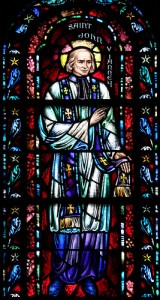
St. James, St. John, and their mother, from what we heard in today’s gospel, approached Jesus with a terribly selfish request. They wanted positions of power and prestige in his kingdom- something that would place them head and shoulders over their friends and fellow apostles.
It’s easy for us to cast stones at Sts. James and John. At the same time, however, most of us are probably guilty of having made selfish requests of God ourselves. In a sense, then, it’s kind of nice to know that people who eventually became saints did exactly the same thing.
It’s even nicer to know, however, they with God’s grace they were able to move beyond their selfishness. The lives of James and John show us that as our relationship with God matures, selfishness is replaced by service- a desire to serve Jesus, who himself came not to be served, but to serve, and give his life as a ransom for many. For his part, St. James- whose feast we celebrate today- did indeed achieve that greatness he desired. But he did so only through service- by drinking the chalice of Jesus, and giving his life for him.
Today is an opportunity for us to assess the state of our relationship with the Lord. Are we selfish, or servants? If all we’re asking for is “What can I get?” perhaps we should ask for one more thing: A servant’s heart.
I remember my first experience of being the topic of discussion on the Internet. It was about a year before I was asked by the Archdiocese to be a blogger for this Blog of the Archdiocese. I had been on the cover of US News and World Report. The photo was taken of me celebrating the Traditional Latin Mass. (See photo at right). The photo circulated on some of the Blogs at that time and while the reaction was, overall, positive, I was quite surprised by some of the highly critical and personal nature of the negative remarks:
Look he’s not using canonical fingers (I was).
He’s leaning back too far (maybe)
He’s holding the chalice too high and looks far too dramatic (maybe, but I was praying, not counting inches of altitude).
Why’s that deacon touching the altar – he no right to do that! (because he’s older and needed to steady himself).
Why are those vestments so modern? (What ever)
The Burse should have been on the gradine, not the mensa (oh what a wretch am I!)
Why does that Monsignor have a red (actually it was fuchsia) pom on his biretta? (seen in another photo). Who does he think he is, some prelate? (Actually I didn’t know any better, and was given the biretta by an older Msgr to wear who had it from the days before 1970 when the norms for vesture changed. I have discontinued the pom).
US News should have sought out the Fraternity or the Institute for a better picture (sigh….yes!)
Etc.
One kind lady finally intervened and said, “Stop! You’ll make it so no priest ever wants to celebrate the old rite.” She was right and I have been told by a lot of younger guys who love the Traditional Mass that they are “scared” to celebrate it. There are various reasons but one of them is the lack of breathing room for honest mistakes and the need to learn by experience. Some of them have experienced that this that doesn’t seem offered by some of the very few (but sadly vocal) rubricists in congregations, and more on the Internet who seem to want to demonstrate their knowledge of some of the most arcane details, at the expense of others.
The experience for me was a kind of wake up call to the nastiness that sometimes sets in on blogs where people interact with people they don’t really know. There is, thus, little appreciation for the feelings or the personal dignity of the ones with whom they disagree or critique.
As I have I now been blogging for over two years, I have become accustomed to difficulties the Internet can sometimes present to civil discussion. The vast majority of commentators here are kind, and willing to engage in mutually respectful conversation in the comment threads. I am able to post most of the comments that come in without any concern.
I DO appreciate vigorous and honest discourse and am undisturbed that disagreements are frankly aired. But there comes a line that, when crossed, makes me hit delete, or post the comment, but with a blow of the referee’s whistle.
Recently however, I am getting more comments that are just plain rude, mean or unnecessarily personal. I have had to press the delete button more than I’d like. It is not just the use of profanity that is alarming (and that too is becoming more common), but it is the excoriation of one’s opponents with dismissive labels and terms which either question their orthodoxy, or their love of the poor, label them as rigid or as communists, etc.
There is also the unnecessary ridicule of positions. And most of these comments come in the context of a discussion outside dogmatically defined issues, where reasonable people, reasonable Catholics, can differ and terminology may have more than one meaning, where the presumption of good faith and the celebration of the Catholic faith ought to be presumed. Gentle corrections are appreciated, but making a person look foolish is usually unnecessary.
The most nasty remarks often center around liturgy and the social doctrine of the Church.
As for liturgy, while there are norms to which we must submit, there is also legitimate diversity permitted by the Church. It is alright to have and state preferences, and even advocate for them. But too often various “camps” hurl stones back and forth and look down on others who are merely exercising legitimate options. The lovers of the Traditional Latin Mass have spent years in exile and been treated very poorly. Others who prefer more charismatic forms of the Mass are also ridiculed by some. And both these communities can also dish it out. But to be clear, as long as we stay inside the guard rails of the norms, there are various and legitimate lanes, whatever your preference. A little mutual respect please.
As for the social doctrine of the Church, here too there is a wide variety of understanding as to the application of those teachings. Catholics of different political backgrounds will differ on how best to apply some of the norms in caring for the poor. Further there has been the division of the Church along certain lines, the life and moral issues on one side, and the social issues on the other. To be sure, we need a division of labor. Everyone can’t do everything. Those who advocate for the poor ought to be glad that others are working to end abortion. And those in the pro-life community ought to be glad, and see as partners, those in the Church who advocate for, and serve the poor. We should value one another as the basis for any discussion. There may still be differences on details and emphasis, but the over all demeanor should be one of grateful appreciation for the work of the other. That should set the tone for the discussion.
Even in the necessary corrections where a commentator, or the blog author, has strayed from doctrinal accuracy, it is healthy to presume good will on their part, and that they did not wish or intend to stray from Catholic teaching. Further it is helpful to assume that terminology can and does often have technical uses, and more colloquial uses as well. This is not a blog for highly trained theologians, it is for the ordinary faithful who often speak in manners that are more relaxed and less technical. Rushing to accuse others of “error” or “heterodoxy” or humiliating them for the terminology of their comment may win the argument, but discourage a member of the faithful from ever evangelizing again, or being “out there” with their faith. Here too, gentle correction and distinction can be helpful, but with love. We are all brothers and sisters.
As for those outside our faith some of whom may initiate with a hostile tone, I will often call them on it and encourage them to stick to the issue. But here too, we who respond ought to try and stick to the issue.
Some helpful advice was recently posted at The New Liturgical Movement regarding comments and, while the subject at hand was artistic criticism, I have the adpated the advice for our context. Please consider what David Clayton says:
It seems to be an aspect of human nature that criticism flows more easily than praise, and this is never more apparent in the comments at the bottom of blogs! However, some subjects particularly seem to attract the ire of readers…I always hold my breath. I know it will attract a hail of criticism from people who worry that it does not conform to what they believe to be the standard…Criticism and differing opinions are not bad things in themselves. After all, we are trying to re-establish a culture of beauty in the West and beauty by its very nature it is difficult to pin down precisely. One should expect differing reactions and ideas of what is good. So please, let’s have them. However, I would like to make some points about the nature and tone of some of the criticisms made.
First, a request: if you are stating opinions, please do so in the spirit that concedes that others may have other perfectly valid opinions. Like email, blog comments seem to be a forum in which it is difficult not to express things abruptly and so appear rude. It’s not always easy I know, to make sure that what we write has a gentle manner. I would ask us all to try. [People] must expect critique of their position, but they should not have to put up with rudeness. ….
If you can explain why you think as you do, that would be helpful, especially if you don’t like something. If you do not, then what you are giving us [seems] just a subjective opinion….[And] if they are opinions, let’s make it clear that this is all they are rather than presenting them as indisputable truths….
Archeologism: the comments of some seem to stem from an assumption that culture existed in a perfect form at some point in the past and that the work of man over time has caused it to degenerate. The main concern for those who believe this, therefore, is a strict conformity to the past glorious (sometimes arbitrarily assigned) age. Working from tradition, in contrast, is more nuanced. It respects the past and does not seek change without good reason, but always seeks to understand why something was done in a particular way. It accepts that sometimes we must develop and reapply the core principles in response to contemporary challenges or if there is a need to communicate something new. Sometimes this development will be so great that a new tradition is established…..
Dealing with imperfection: even if something is partially wrong or in error or even just disliked, it doesn’t mean that we can’t learn something from it……
As a general principle, given that we are in a process of re-establishing a culture of beauty, I would generally advocate a conservative approach to what goes in our churches at the moment. However,…. flexibility and adaptability underpinned by good discernment is the source of richness and vigor in Christian culture. …No doubt along the way there were innovations … that were rejected as a whole, but nonetheless contributed something to what eventually became … acceptable.
A final disclaimer. I do not claim I get the balance and the tone perfectly. This post is not written from on high, from one who is perfect, to those who are not. Rather this is for “us” who interact on this relatively new medium of the Internet where the face and person on the other side of the screen are not seen. Yet those with whom we interact ARE human persons. In recent months I have been increasingly bothered at the tone of some incoming comments, most of which I had to delete, and you never saw. Some of them were just plain unkind, others hypercritical, still others rude and riddled with personal attack. Some others were clearly only an attack, and not a request for real discussion. Some were directed personally at me, others at some of the commentators here. Still others were mean-spirited attacks at the bishops, those who prefer other permitted liturgical forms, or those who come from a different theological tradition within the Church than they.
I will say that some of these comments cause me great personal grief, whether for myself or those who are unfairly or excessively attacked. So for us all, whom Christ loves, and for whom he died, let’s consider that the one on the other side of the screen is a human person, worthy of respect. And to be clear, most of us don’t need this post in an absolute sense, but just as a gentle reminder. God bless you.
While passing an airport bookstore, I had a few minutes to spare and thought I’d look to see what was on offer in the religion section. As I browsed, I passed Fiction, Romance, Business, Bestsellers, History, Children’s, even Psychology- but no “Religion” or “Spirituality” or anything like that. Frankly, I was rather surprised! But at the same time, I was reminded that our culture doesn’t often encourage us to think beyond the “here-and-now”- which, of course, our religion does.
How often do we think beyond the “here-and-now?” A factoid I read recently said that 64% of Americans today believe that they’ll go to heaven. However, I wonder how often these folks actually think about heaven? Or how much time they spend preparing for heaven?
The truth is, Jesus wants us to prepare for heaven. In fact, he wants us to make preparing for heaven the top priority in our life. If you’re a Catholic of a certain age who grew up with the old Baltimore Catechism, you’ll remember that one of the first questions was: “Why did God make you?” And the answer was: “God made me to know Him, to love Him, and to serve Him in this world, and to
be happy with Him for ever in heaven.” Very simple, but very true. God made us for heaven, and this life is meant to be a preparation for it.
Lots of people these days talk about planning for “the future.” However, when they speak about the future, they’re speaking about retirement. And that’s fine. But as Christians, the most important future we need to plan for is not retirement, but heaven. Isn’t that what Jesus says to us in today’s gospel? In his parables of the buried treasure and the pearl of great price, he speaks about spending all of one’s resources to gain the kingdom of heaven- a kingdom whose fullness we’ll encounter not in this life, but the next. Because even though we can sometimes taste a little bit of heaven on earth, it’s only after we die that we can hope to experience the real thing.
When my son was in kindergarten, he said to me: “Daddy, I learned at Mass that earth isn’t our real home. Earth is like a hotel. Our real home is in heaven!” And he was right, of course. Our real home is in heaven with God. It’s this home that we need to spend this life preparing for.
One way God helps prepare us for this life is by testing us. God tests us by presenting us with choices, because choices determine our commitments, and commitments shape our character, and it’s our character we’ll take with us into eternity. In today’s first reading from First Kings, we heard how God tested Solomon by offering him anything he might ask for. Solomon passed his test by refusing selfish gifts of power, riches, or long life, and choosing instead wisdom, that he might better serve God’s people.
God tests us in similar ways, every single day. In fact, everything that happens to us is a test, because everything that happens to us, happens for a reason. Remember: God is in control. This means that everything that happens God has allowed to happen. And everything he allows to happen he does so for a reason- often so that we can grow by being tested. We heard St. Paul speak of this in today’s reading from his letter to the Romans. He said: “We know that all things work for good for those who love God, who are called according to his purpose.” Why? So we can be “glorified” by being “conformed to the image of his Son.”
St. Paul is saying here that God allows all things to happen so that we can become more like his Son, and spend eternity with him in heaven. This includes not just the good things, but the bad things as well. Because it’s through the bad things that we can often grow the most, by facing the most difficult choices. That’s why God allows them to happen. As St. Augustine once wrote, “God would rather bring good out of evil than to prevent it from happening in the first place.”
If we make the right choices, God will bring good out of evils we face. For instance, they challenge us to completely surrender ourselves to God, by showing us that we aren’t in control. They give us opportunities to exercise forgiveness, grow in compassion, and learn humility. They invite us to reconsider our priorities, as so many people did after 9/11. And they remind us that heaven is our true home- that place where every tear is wiped away, and suffering is no more.
When we’re in the midst of suffering, it’s very easy for us to lose sight of this. I recently read a devotional which spoke about a bird that had flown into a house. To get it to back outdoors where it belonged, the author tried to “shoo” it with a broom. The bird, however, became frightened. It thought it was being attacked or punished, when all along the guy with the broom was trying to do it a favor. Sometimes God needs to whack us with a broom, if you know what I mean. At the time, we may think we’re being attacked or punished, but in reality God is doing us a favor, acting in love to get us moving in the right direction- the pathway to heaven.
Regardless of what our culture might tell us, heaven is our true home. Heaven is where God wants us to be for all eternity. And heaven is what God wants us to prepare for-beginning today. This is what motivates the choices God makes for us. Let’s pray for the grace that the choices we make, will be choices that lead us back home to him. As St. Therese the Little Flower once said, “I will do anything for heaven!”
The Gospel today asks a most fundamental question: “What is it that you most value?….What is it that you most want?” Now be careful to answer this question honestly. We tend to answer questions like this as we “should” answer them, rather than honestly. But when we’re with the doctor, (and Jesus is our doctor), the best bet is to answer honestly, so we can begin a true healing process. And the fact is, we all need a heart transplant. That is, we need a new heart, one that desires God and the things waiting for us in heaven, more than any earthly thing.
So let’s take a look at this Gospel that sets forth, in three fundamental movements, the “what” and the “worth” of the Kingdom of God, along with a “warning” that reminds us, we have a choice to make.
I. What – The Gospel uses three images for the kingdom, two of which we will look at here, and the third of which we will look at later. The first two images are that of the buried treasure and the pearl. Both these images have some significance elsewhere in the scriptures and studying them will be helpful in fine tuning our understanding of the gift of the Kingdom Jesus is discussing.
A. Buried Treasure – The concept of treasure (here buried treasure) is mentioned elsewhere by Jesus:
Do not store up for yourselves treasures on earth, where moth and rust destroy, and where thieves break in and steal. But store up for yourselves treasures in heaven, where moth and rust do not destroy, and where thieves do not break in and steal. For where your treasure is, there your heart will be also. (Matt 6:19-21)
Hence this image of treasure that Jesus uses today, is an image for the heart and for our deepest desires, for our treasure is linked to our heart. One of the greatest gifts that God offers us is the gift of a new heart. One of the most fundamental prophetic texts of the Old Testament announces what Jesus has fulfilled:
Oh, my people, I will sprinkle clean water on you, and you will be clean; I will cleanse you from all your impurities and from all your idols. I will give you a new heart and put a new spirit in you; I will remove from you your heart of stone and give you a heart of flesh. And I will put my Spirit in you and move you to follow my decrees and be careful to keep my laws. (Ezekiel 36:25-27)
Thus, the great treasure of the Kingdom of God gives us a new heart, for by choosing this treasure, our heart is changed. To have a new heart is to see and experience our desires change. We are less desirous and focused on passing worldly things, and more on the lasting treasure of the Kingdom of heaven. We begin to love what, and who, God loves. We begin to love holiness, justice, chastity, goodness, righteousness, and truth. We begin to love our spouses, family members, the poor, even our enemies more as God loves them. Our hearts become alive with joy and zeal for the Kingdom of God and an evangelical spirit impels us to speak what we believe and know to be true.
Yes, the buried and hidden treasure of the Kingdom of God, unlocks our heart and brings new life coursing through our veins and arteries, through our very soul. In choosing this treasure we get a new heart. For where our treasure is, there also will be our heart.
B. Pearl – The second image of the pearl is from the wisdom tradition where holy Wisdom is likened to a pearl. And here too is described one of the most precious gifts of the Kingdom of God: the gift of a new mind through holy Wisdom. And what is the new mind? It is to begin to think more and more as God thinks, to share in his priorities and his vision. It is to see, increasingly as God sees and to have the mind of Christ (cf 1 Cor 2:16). With this new mind, we see through and reject worldly thinking, worldly priorities and worldly agendas. We come to rejoice in the truth of God and to grasp more deeply its beauty and sensibility. What a precious gift the new mind is, to think with God and to have the mind of Christ.
So here are two precious manifestations of the Kingdom of God: a new heart and a new mind, which is really another way of saying, “a whole new self.” This then leads to the next movement of the Gospel.
II. Worth – What are these offerings of the Kingdom worth and what do they ultimately cost? The answer is very clear in this gospel, they cost, and are worth, EVERYTHING. Regarding the hidden treasure and the pearl, the text says that both men went and sold all they had for these precious offerings. They were willing to forsake everything for them.
Now, be careful not to reduce this Gospel to a moralism. Notice that these men were eager to go and sell, forsake, everything else. They did this not because they had to, so much as they wanted to. And they wanted to pay the price and were willing to do so, even with eagerness, because they were so enamored of the glory they found. And here is the gift to seek from the Lord, a willing and eager heart for the Kingdom of God, so eager that we are willing to forsake any, and everything for it.
For ultimately the Kingdom of God does cost everything, and we will not fully inherit it until we are fully done with this world and its claims on our hearts.
But the gift to seek from the Lord is not that we, with sullen faces and depressed spirits, forsake the world as if we were paying taxes. No! The gift to seek is that we, like these men, be so taken by the glory of God and his kingdom that we are more than willing to set aside anything that gets in our way, that we should be so eager for the things of the Kingdom that the world’s intoxicating and addictive trinkets matter little to us and the loss of them means little.
Do you see? This is the gift. The reception of heart that appreciates the true worth of the Kingdom of God, such that no price is too high. Scriptures says elsewhere:
<>
What is more, I consider everything a loss compared to the surpassing greatness of knowing Christ Jesus my Lord, for whose sake I have lost all things. I consider them rubbish, that I may gain Christ (Phil 3:8)
For this light momentary affliction is preparing for us an eternal weight of glory beyond all comparison (2 Cor 4:17)
I consider that our present sufferings are not worth comparing with the glory that will be revealed in us. (Rom 8:18)
No eye has seen, no ear has heard, no mind has conceived what God has prepared for those who love him (1 Cor 2:9)
But one thing I do: Forgetting what is behind and straining toward what is ahead, I press on toward the goal to win the prize for which God has called me heavenward in Christ Jesus (Phil 3:13-14).
<>
Yes, the Kingdom of God is more than worth any price we must pay, and ultimately we will pay all. Pray for an eager and willing spirit that comes from appreciating the surpassing worth of the Kingdom!
III. Warning – The final movement contains a warning about judgment. For, ultimately regarding the Kingdom of God, we either want it or we don’t want it. Hence the Lord speaks of a dragnet that captures everything (and this is the summons all have to come to the judgment). And those who want the Kingdom and have accepted its value and price will be gathered in. And those who do not want the Kingdom of God and do not accept its value will be escorted off.
For there are some who do not value the Kingdom. They may desire heaven, but it is a fake heaven of their own making, not the real heaven of the fullness of the Kingdom of God. The true heaven is the Kingdom of God in all its fullness and the Kingdom of God includes things like, forgiveness, mercy, justice, the dignity of life, love of the poor, chastity, God at the center (not me), the celebration of what is true, good and beautiful, and the love, even, of one’s enemy.
Now there are many who neither want nor value some or most of these things. When the net is drawn the decisions are final. And though we may wish a magic, fairy tale ending where suddenly the opponents of the Kingdom love it, God seems clearly to say that, at the judgement, one’s decision for or against the Kingdom is final and fixed forever.
An old song says, “Better choose the Lord today, for tomorrow, very well might be too late.” Thus we are warned, the judgment looms and we ought to be earnest in seeking a heart from the Lord that eagerly desires the Kingdom and appreciates its worth, above all others, and all things. In the end you get what you want. You will have either chosen the Kingdom or not.
So pray for a new heart, one which values the Kingdom of Heaven above all else. We ought to consider ourselves warned.
A Gospel today about we truly value in three movements.
This song says, You can have all this world, just give me Jesus.
Imagine yourself in those years, some 25 years ago or before. Cell phones were not yet common.
Now imagine the deep winter months in rural North Dakota. The temperature can dip to 30 below and blizzards and snow-squalls can set in quickly. What if you are driving from one town to another and you car breaks down? Sometimes it is forty miles to the next town. If it’s 30 below with wind or blowing snow, walking even a short distance can kill you.
All you can do is wait for help to drive by. Remember there are no cell phones, this is rural North Dakota, and, especially in bad weather, help might not come for a long time. With a broken down car, no heat, and the temperature so cold, death could come soon.
My North Dakota friend told me that his mother often asked him in winter as he would leave in the car, “Do you have candles with you?!”
People in that region, in those years, and I suppose some today as well, used to carry a box of votive candles with them in the car, and some matches too. On frigid day, if the car broke down, or got stuck in the snow, lighting even one candle and cracking the window just slightly (for ventilation), could mean the difference between life and death.
Just one candle, maybe two, could warm the car enough to stave off death. And Catholic votive candles were the perfect choice.
What are votive candles if not a symbol of our prayer, our hope in God. They also are a burnt offering, and an memorare of our prayer burning before God.
And if one candle can save a life, how about one prayer?
In most cases the full power of prayer is hid from us here. But I suspect one of the joys of heaven will be that we will see what a remarkable difference our prayer really made, even our distracted and poorly executed prayers. Perhaps someone in heaven will come to us and say, “I am here because you prayed.” Perhaps we will see how our prayers helped avert war, turn back violence, save children from abortion, and convert hearts. We will know that our prayers helped open doors, brought blessings, and contained damage.
Just one prayer. Just one candle.
Do you have candles with you? Have you prayed? You never know, you might save a life in this cold world.
Here is a sermon I preached at the White House about five years ago on the power of prayer.
When I reflect on the witness of St. Mary Magdalene, one thing that always impresses me is the she “kept the faith”- even when “keeping the faith” was terribly hard; even when “keeping the faith” didn’t seem to make much sense.
While Jesus hung dying on the cross, and after most of Jesus’ friends had run away out of fear, she stayed and kept watch. We can only imagine the thoughts, feelings, and temptations that swirled around her that day: anger, confusion, terror, helplessness, loneliness, resentment.
It would have been very easy for her to have run away too. But she didn’t. She stayed; she “kept the faith.” Certainly out of courage; and maybe because she knew that at that moment, faith was the only thing she had left; faith was the one thing she really needed. Her reward? She saw the risen Jesus- something that those who had run away had to wait to experience.
The witness of St. Mary Magdalene can inspire us to “keep the faith”- when things seem their bleakest, when our friends aren’t there for us, when God himself seems to be distant or indifferent. Because as she learned, there is a light at the end of the tunnel, just like the first rays of the sun on Easter morning.
Years ago, in seminary, one of my brother-seminarians from North Dakota gave me an image of prayer. It occurs to me to tell this winter story in the midst of the heat wave that has most of the U.S. in its grip.
Imagine yourself in those years, some 25 years ago or before. Cell phones were not yet common.
Now imagine the deep winter months in rural North Dakota. The temperature can dip to 30 below and blizzards and snow-squalls can set in quickly. What if you are driving from one town to another and you car breaks down? Sometimes it is forty miles to the next town. If it’s 30 below with wind or blowing snow, walking even a short distance can kill you.
All you can do is wait for help to drive by. Remember there are no cell phones, this is rural North Dakota, and, especially in bad weather, help might not come for a long time. With a broken down car, no heat, and the temperature so cold, death could come soon.
How will you survive?
Candles.
My North Dakota friend told me that his mother often asked him in winter as he would leave in the car, “Do you have candles with you?!”
People in that region, in those years, and I suppose some today as well, used to carry a box of votive candles with them in the car, and some matches too. On frigid day, if the car broke down, or got stuck in the snow, lighting even one candle and cracking the window just slightly (for ventilation), could mean the difference between life and death.
Just one candle, maybe two, could warm the car enough to stave off death. And Catholic votive candles were the perfect choice.
What are votive candles if not a symbol of our prayer, our hope in God. They also are a burnt offering, and an memorare of our prayer burning before God.
And if one candle can save a life, how about one prayer?
In most cases the full power of prayer is hid from us here. But I suspect one of the joys of heaven will be that we will see what a remarkable difference our prayer really made, even our distracted and poorly executed prayers. Perhaps someone in heaven will come to us and say, “I am here because you prayed.” Perhaps we will see how our prayers helped avert war, turn back violence, save children from abortion, and convert hearts. We will know that our prayers helped open doors, brought blessings, and contained damage.
Just one prayer. Just one candle.
Do you have candles with you? Have you prayed? You never know, you might save a life in this cold world.
Here is a sermon I preached at the White House about five years ago on the power of prayer.
When little kids don’t want to hear something, they’ll stick their fingers in their ears and mutter “Blah, blah, blah” to drown out whatever is being said to them. We adults are more sophisticated in how we tune things out. But we do it, nevertheless.
We need to appreciate this in order to understand Jesus’ words in today’s gospel. On the surface, they sound like Jesus spoke in parables to confuse people on purpose, and that only an elite few would comprehend his teaching. And that’s partly right: Not everyone does comprehend Jesus’ teaching. But not because Jesus wants to confuse them. It’s because people just don’t want to hear.
If you recall, Jesus quoted the prophet Isaiah. And throughout history, the message of God’s prophets has been rejected time and time again. They spoke challenging words, calling on people to change their ways and turn their lives around. And folks generally don’t like to hear that sort of thing. So they tuned out.
People tune out Jesus’ message too, and we can be just as guilty as anyone else. Jesus calls us to believe in a God we cannot see, carry a cross and suffer with him, love our enemies, forgive those who hurt us, and be humble, selfless, servants. We hear these things and sometimes we want to stick our fingers in our ears and go “blah, blah, blah.”
But ignorance isn’t bliss, when it comes to the Word of God. As hard as they may be to hear, they’re the words of truth and life. “Blessed are your ears, because they hear,” said the Lord. Jesus invites us today to take our fingers from our ears, so we can “understand with our hearts,” “be converted” and be healed.