A well-known parenting expert, Dr. William Sears, writes about once having had a pretty big shouting match with his wife Martha in their kitchen. At one point their two young children, unaware of what was going on, walked into the kitchen, and then immediately turned and walked out. However, after playing outside for awhile, the two came back, only to find their mom and dad laughing, the fight long over.
Initially, Dr. Sears admits, he was distressed that his children had witnessed the fight. Later, however, he concluded that maybe they’d learned a valuable lesson, which is this: Two people can fight and wrestle with a difficult issue without their relationship being threatened, because they are truly committed to one another, having pledged to each other their unconditional love.
Such unbreakable commitment is part of the brilliance of God’s design for marriage, affirmed by Jesus in today’s gospel. In marriage, a man and a woman enter into a permanent, life-long bond, so that when the going gets rough, they don’t take the easy way out, packing up their bags and walking away. They’re forced to stay together and, with patience, love, courage, and forgiveness, to work through their difficulties and, with God’s grace, to grow as a couple, and as individuals.
This is God’s way with us, isn’t us? He has invited us into a permanent relationship- a covenant- which the Bible often describes as a marriage. And through it all, through all our ups and downs, God sticks with us, even if and when we walk away. In his unconditional love, God stays committed to us, even when we break our commitment to him- time, and time, and time again. Not for his benefit; not for his growth; but for ours.
What with Stephen Hawking’s show “Curiosity” on full display, I too would like to express my curiosity about something in the Universe. And that something, is “order.” We are told by scientists that the universe seems to have exploded into being almost 14 billion years ago. And this explosion is still flying outward at almost 100 million miles an hour at the edges. The sparks and embers, and gas clouds of this fiery explosion are visible in the universe all about us. Fine, seems plausible enough and the evidence seems substantial.
But explosions do not usually lead to order, they more usually lead to chaos and disorder. Yet, as we observe the created world, we observe extensive order, galaxies, planetary systems, and the like. And, here on earth there is on display an extensive and exquisite amount of order all the way from the macro world of geophysical forces and weather, to micro world of the cell and atom. Order is evident everywhere, and not just within isolated systems, but also among and between them, as they act together in a marvelous harmony and unity of purpose. Consider how every cell and atom of your body, ordered systems in themselves, act together in harmony, forming ever more complex and ordered systems, to ultimately be the complex and ordered system that is you.
How such order? It is a great curiosity to me, if we were to keep God, or at least some controlling intelligence, out of the picture, how such order has come about, not just once by chance, but repeatedly.
Shazam! What if I were to tell you, that a tornado recently went through junk yard. As you can imagine there was a horrible amount of junk whirling around in the air. But here’s where the story really gets interesting. It seems that the tornado swirled that junk together just right because as the wind died down all those banana peals, cans, broken pieces of pottery, stuffing from old mattresses springs, car parts etc all swirled together into a fully functioning 747 jumbo jet airliner with a filled fuel tank and fully equipped cockpit. There was even a logo emblazoned on the tail fin: “Tall Tales Airlines.”
“Ah,” you say, ” The story’s touching but it sounds like a lie!” And sure enough, it is a tall tale. But how different is it really from what some atheists, and also certain evolutionists want us to believe about creation? I say some evolutionists because there are some forms of evolution that a Catholic may accept. For example a mitigated form of evolution that holds that things have evolved but God has guided the process.
But what many atheists and evolutionists want you to accept is that evolution, in fact everything that happened after the big bang is a chance happening, that evolution is “blind,” and that no intelligence guides it. It just happened by a chance coming together of certain forces and processes that has produced everything we see including ourselves. It all just happened on its own. Now if that seems plausible to you, then I have a 747 to sell you.
And this world, even our own bodies, are far more complex than a 747 Jumbo liner. And just as a mindless tornado can’t likely whip out a fully functioning 747 neither would a mindless explosion produce a fully functioning and orderly universe or even a fully functioning human person.
The existence of these orderly and complex systems surely bespeaks an intelligent designer. If you landed on a planet in some distant galaxy and found in the sand a functioning watch it is not “unreasonable” to conclude that some one with intelligence designed and made this for a purpose. You may not see any life on the planet now, but at some point there was intelligent life either living here or that visited here. But the point is that you would be on good grounds to conclude that the watch pointed to an intelligent designer.
Now I know that Science can’t formally call this designer “God.” We who believe do that. But it does not seem unreasonable to me that, within its own discipline, science can at least theorize an intelligence, a designer, is indicated by the evidence. At least scientists could allow the theory to coexist with other proposed explanations of the order and design we obviously encounter. The stubborn refusal by many in the scientific world to do this seems more ideological than scientific. And they hold it with the kind of “religious” zeal they claim to be above. They call us the fanatics but I wonder who really is more fanatical. Who really is ignoring the evidence here? To a large extent I think that it takes more “faith” to “believe” that all this happened by chance or due to blind evolution than simply to believe that an intelligent designer set all this forth.
I’d like to give two examples from creation to illustrate just how intricate and multi-layered creation is and then pose the ask the question “Dumb Luck or Design?”
MAGNIFICENCE OF LIFE– Consider the awesomeness of the human body. Its chemistry is just as extraordinarily well tuned as is the physics of the cosmos. Our world on both sides of the divide that separates life from lifelessness is filled with wonder. Each human cell has a double helix library of three billion base pairs providing fifty thousand genes. These three billion base pairs and fifty thousand genes somehow engineer 100 trillion neural connections in the brain—-enough points of information to store all the data and information contained in a fifty-million-volume encyclopedia. And then after that, these fifty thousand genes set forth a million fibers in the optic nerves, retinae having ten million pixels per centimeter, some ten billion in all, ten thousand taste buds, ten million nerve endings for smell, cells that exude a chemical come-on to lure an embryo’s lengthening neurons from spinal cord to target cell, each one of the millions of target cells attracting the proper nerve from the particular needed function. And all this three-dimensional structure arises somehow from the linear, one-dimensional information contained along the DNA helix. Dumb Luck or Design?
RARE EARTH ! The earth on which we live and which, by God’s grace sustains our life is surely miraculous. Consider the following facts. The life support system we call the solar system has just the correct distribution of large and medium sized planets to have swept clean most of the space through which Earth must travel. There are thus few asteroids anywhere near our path! Further, large gas giants like Jupiter and Saturn, “catch” comets in their gravitational fields and keep these comets from targeting earth. Our star, the Sun, is just the right size to consume its supply of hydrogen and produce energy at a rate that provided the time and conditions for life to form. Our orbit through space, at 93 million miles from the Sun, departs from a true circle by only 3 percent. Were it as elliptical as is the orbit of Mars, the next planet out, we would alternate between baking when closer to the Sun and freezing when distant. Earth contains just enough internal radioactivity to maintain its iron core in a molten state. This produces the magnetic umbrella that deflects an otherwise lethal dose of solar radiation. The volcanic activity driven by this internal heating is just adequate to have released previously stored subterranean waters into our biosphere, making them available for life processes, but not so much volcanism as to shroud our planet in dust. Earth’s gravity is strong enough to hold the needed gases of our atmosphere but weak enough to allow lighter noxious gases to escape into space. All this is balanced at just the correct distance from our star so that our biosphere is warm enough to maintain water in its liquid, life-supporting, state, but not so warm that it evaporates away into space. A just-right Earth with just the needed gravity, radioactivity, magnetic field, and volcanic activity to support life is located at just the correct distance from the Sun to nurture the inception and development of life…all the ingredients come together in just the way. Dumb Luck or Design?
Earlier this year, many people gave up using Facebook during Lent. They’d concluded that they were spending way too much time posting, sharing, tagging, poking, and whatever else is done on Facebook!
Facebook is one of the many new vehicles of social communication that have emerged in the past few years. All in all, they’re a good thing! They bring people together and can be effective tools in spreading the gospel. Just visit the website of the Archdiocese of Washington: we’re on Twitter, You Tube, Facebook, and we have podcasts and a daily blog.
At the same time, these things have their downside too. They can become an obsession, keeping us from work and family. And they certainly spread a lot of material this is, at the very least least, at odds with our faith.
I say all this because today is the feast day of St. Clare of Assisi. We know her as a friend and disciple of St. Francis, and she cared for him in his final days. She was so inspired by his witness that she founded a religious order for women, known today as the Poor Clares, who lived a life of work and prayer within their monasteries.
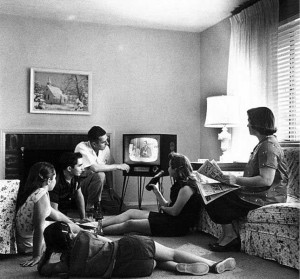
When Clare was elderly and no longer able to attend Mass with her sisters, they posted a picture of the Mass on the wall of her room, so when they were gathered in chapel, she could gaze at her picture and be with them in Spirit. It was because of this that in 1958 she was named the patron saint of television, which at that time was the “cutting edge” new media.
As we use the new media available to us in our day, we can be challenged by St. Clare to use them only in ways that are consistent with our faith: in moderation, bringing friends and family together, spreading good news, and building up the kingdom of God.
As you may be aware heresy is not usually or simply the teaching of error or falsehood. What heresy more often involves is the teaching of one (or several) truths out of balance or proportion to other truths.
The Greek word from which heresy derives ishaireisthai meaning “to choose or pick.” So the heretic usually chooses one truth but rejects other truths that might balance or nuance it. Some early heretics so emphasized the humanity of Christ that there was no room left for the divinity of Christ. Others so emphasized his divinity there was no room for his humanity. Heresy is frequently a struggle with extreme or exclusive thinking, a lack of balance.
Take an example from a parable in the Gospel that illustrates a delicate balance and how we often get this balance wrong today:
And Jesus told them this parable: “There once was a person who had a fig tree planted in his orchard, and when he came in search of fruit on it but found none, he said to the gardener, ‘For three years now I have come in search of fruit on this fig tree but have found none. So cut it down. Why should it exhaust the soil?’ He said to him in reply, ‘Sir, leave it for this year also, and I shall cultivate the ground around it and fertilize it; it may bear fruit in the future. If not you can cut it down.’” (Luke 13:5-9)
Now this parable very carefully and delicately balances two concepts: God’s patience and, also, our ultimate judgment. God is patient and merciful, that is true, but that does not exclude the fact that we will and must one day face judgment before him. Plain and simple, both truths are taught and we must hold them both. Here are those truths:
Truth # 1 – For those of us who still live here, it is a time of God’s patience, grace and mercy. Not only is God exhibiting patience with us he is, as the parable states “cultivating the ground around us and fertilizing.” In other words he is sending every necessary grace to help us grow in holiness, bear the fruits of righteousness and to be ready for the day of judgement. Praise the Lord for his mercy his patience and his grace.
Truth # 2 – But there comes a day of reckoning, a day of judgement. There comes a moment when we must show forth the fruits of righteousness or be “cut down.” Elsewhere Jesus elaborates on this teaching: “I am the true vine, and my Father is the gardener. He cuts off every branch in me that bears no fruit, while every branch that does bear fruit he prunes so that it will be even more fruitful….If a man remains in me and I in him, he will bear much fruit; apart from me you can do nothing. 6If anyone does not remain in me, he is like a branch that is thrown away and withers; such branches are picked up, thrown into the fire and burned. (John 15:1-6). The point here is that we must all face judgement and our life must be assessed.
Now one of the heresies of our time is that we are all for truth Number 1 but many simply reject truth number 2, or downplay it so much, that it no longer has any substance. Many in our time “choose” 1 and reject 2. Or they so emphasize 1, that 2 gets lost. It is easy for us to love mercy and celebrate it. And well we should. But judgment is also essential for our consideration and must balance truth 1.
And here is the key point: balance. Orthodoxy is about balance. And, what is at stake here in this parable is the theological virtue of hope. Without balance hope is lost and becomes either presumption or despair.
What is hope? Hope is the confident expectation of God’s help in attaining eternal life. Presumption and despair are both sins against hope.
Despair rejects the confident expectation that we can have of God’s help and grace. The one who despairs either doubts God’s grace, love and mercy, or does not consider them powerful enough to help him.
Presumption sins against hope by rejecting any real need for God’s help. As St. Paul says, “Who hopes for what one [already] has?” (Rom 8:24) For example, let’s say I have misplaced my Bible. Now I search for it in hopes that I will find it. But once I find it what happens to hope? It is fulfilled but it is also gone, no longer necessary. Many people today simply presume that they will have heaven. They don’t really need to hope for heaven, they already have it! Judgement and hell simply are not likely or even “possible.” Thus they sin against hope. How? In effect they simply choose (haireisthai) truth # 1 (mercy and aptience) and reject truth # 2 (judgement).
Again, orthodoxy is about balance. Heresy is about picking and choosing. Some heretics pick one Bible verse or concept and make it the whole thing. But orthodoxy is about the whole range of truths held in proper balance and proportion. God is merciful but he also truthful. God is patient but there does come a day of reckoning: reward for some, exclusion for others. We find balance in all of Scripture not just favorite scriptures. All of Catholic dogma not just what we like.
This song speaks of God’s patience now, but also of an ultimate day when we die (are cut down) and face judgment. It says, “You can run on for a long time” (God’s patience), “But sooner or later God will cut you down (There is death, judgement and final reckoning). Enjoy a little Johnny Cash:
Eighteen centuries ago, St Lawrence was the deacon in Rome responsible for the church’s treasury. When a hostile Emperor sought to confiscate the church’s assets, Lawrence distributed everything to the poor. When an official demanded to see the church’s wealth, Lawrence gathered the poor before him and said “Behold, here is the Church’s treasure.” For that, he was cruelly executed.
Lawrence’s witness, however, asks us the question: How do we see the poor? Do we see them as the church’s treasure? Or do we seem them otherwise?
For instance, do we look down on them as inferior, lower class, a public nuisance, or a tax drain?
Perhaps we think they’ve gotten what they deserve. Polls reveal that the prevailing view in America is that “people are poor because of a character flaw like laziness, promiscuity, addiction, or moral failing.”
It could be that we don’t see the poor at all. Either because we intentionally ignore them or, because of where we live and work, they’re “out of sight and out of mind.”
Or maybe, because of our faith, we idealize the poor in some pious, romantic, unrealistic sort of way.
St. Lawrence, deacon and martyr, challenges us to see the poor as brothers and sisters in the human family, to be treated, not with contempt or even pity, but with compassion, respect, generosity, and humility. As befits people with God-given dignity. As befits the treasure of the Church.
I have been reading a rather lengthy report on poverty in America written by Robert Rector and Rachel Sheffield of the Heritage Foundation. The Full and lengthy report is here: What is Poverty in America Today? I am going to present some excerpts here.
The authors use substantial data from the Census Bureau and the Residential Energy Consumption Survey (RECS) of the Department of Energy to paint a portrait of poverty in America.
Their data suggests to me that we ought to consider distinguishing three basic categories when it comes to understanding our obligations to those with less: the impoverished, the poor, and the needy.
First there is the category of the impoverished, those living in deep poverty. Let me begin by quoting from the report:
Each year for the past two decades, the U.S. Census Bureau has reported that over 30 million Americans were living in “poverty.” In recent years, the Census has reported that one in seven Americans are poor. But what does it mean to be “poor” in America? How poor are America’s poor?
For most Americans, the word “poverty” suggests destitution: an inability to provide a family with nutritious food, clothing, and reasonable shelter. For example, the Poverty Pulse poll taken by the Catholic Campaign for Human Development asked the general public: “How would you describe being poor in the U.S.?” The overwhelming majority of responses focused on homelessness, hunger or not being able to eat properly, and not being able to meet basic needs.[1]
Yet if poverty means lacking nutritious food, adequate warm housing, and clothing for a family, relatively few of the more than 30 million people identified as being “in poverty” by the Census Bureau could be characterized as poor.[2] While material hardship definitely exists in the United States, it is restricted in scope and severity. The average poor person, as defined by the government, has a living standard far higher than the public imagines.
[Only] a small minority are homeless.
To a family that has lost its home and is living in a homeless shelter, the fact that only 0.5 percent of families shared this experience in 2009 is no comfort. The distress and fear for the future that the family experiences are real and devastating. Public policy must deal with that distress. However, accurate information about the extent and severity of social problems is imperative for the development of effective public policy.
Hence, it would seem that those we call impoverished, those who live in poverty, are those who do not have the capacity for even the basic essentials such as shelter, clothes, food and water. Largely this is the homeless population this country and they exist in true poverty.
The report goes on the to distinguish the second tier of the less fortunate who I would call the poor. Here we see those who are not homeless, they do have food and many basic amenities, but they are in a financially fragile condition. Decades ago we would often refer to these as the working poor. However, in the age of welfare a significant number of the poor do not work, and hence that distinction not longer fully applies. Among the poor there is a both a range and a variability. The report begins with the poor in the most fragile state and says,
[T]here is a range of living conditions within the poverty population. The average poor family does not represent every poor family.
Fortunately, the number of homeless Americans has not increased during the current recession.[6] Although most poor families are well fed and have a fairly stable food supply, a sizeable minority experiences temporary restraints in food supply at various times during the year. The number of families experiencing such temporary food shortages has increased somewhat during the current economic downturn.
Thus, among the poor are those who remain at risk of impoverishment due to lack of food and basic essentials. Perhaps this is seasonally due to fact that some jobs have seasonal qualities. Some also have illness like asthma, which are affected by the season. Perhaps too the vulnerability is due less to seasons than to the economy. In a downturn in the economy like we are experiencing their working hours are cut, or their job eliminated. Other family factors such as the health of family members or various crises make the poor at the lower end edge more toward permanent, temporary or seasonal impoverishment and make them vulnerable to true destitution.
But among the poor are those who do not range toward the bottom, near destitution. They may be stably poor in the sense that their income is below the Federal Poverty line, but in no way are they destitute. Here is where the report makes some findings that some may find controversial, but they seem well backed up by extensive data. The report says,
The federal government conducts several other surveys that provide detailed information on the living conditions of the poor. These surveys provide a very different sense of American poverty.[8] They reveal that the actual standard of living among America’s poor is far higher than the public imagines and that, in fact, most of the persons whom the government defines as “in poverty” are not poor in any ordinary sense of the term.
The Chart below shows information for 2005 for poor U.S. households (those with cash incomes below the official poverty thresholds). While poor households were slightly less likely to have conveniences than the general population, most poor households had a wide range of amenities. As Chart 2 shows, 78 percent of poor households had air conditioning, 64 percent had cable or satellite TV, and 38 percent had a personal computer.[14]
Hence it is clear that those beneath the poverty line are not always lacking in a number of significant conveniences and comforts. The numbers are based on the aforementioned Residential Energy Consumption Survey (RECS) published each year by the US Department of Energy. Toward the bottom of the list the lack of Internet access is of significance, since it is an important way of connect with the wider world and thus a help up and out of poverty if well used. But, other things being equal, being poor in America is nothing like the like the utter destitution Americans often see in other parts of the world, even close at hand in the Caribbean Islands. In such places the poor often live literally in cardboard boxes and shanties with no running water, electricity or plumbing. In is clear that most of the poor in America are impoverished,are not destitute. Many are vulnerable as stated above, but not in true poverty as I have suggested is a term that should be used for the truly destitute.
A further feature in the report is the encouraging note that we have made progress in ensuring that the poor live in better conditions. While it is often held that the War on Poverty has done nothing to push back the poverty level (still at 30%), that may not be entirely true. As we have seen, the Federal Government defines a certain level of income to indicate whether one is poor or not. But income is not the whole story. Frankly the poor live in better conditions today than they used to as seen in the chart above. Frankly we ALL live better than we used to, and the poor are no exception. The report says,
[There has been] Improvement in Poor Households over Time. Because the RECS has reported on the living conditions of the poor for several decades, it is a useful tool for charting the improvement in living conditions among the poor over time. For example, the chart at right shows the percentage of all households and the percentage of poor households that had any type of air conditioning between 1970 and 2005. Although poor households were less likely to have air conditioning in any given year, the share of households with air conditioning increased steadily for both groups over the 25-year period. By 2005, the two rates converged as air conditioning became nearly universal in U.S. society.
Another example is the share of all households and the share of poor households that had a personal computer from 1990 to 2005. Personal computers were rare in 1990 but spread widely through society over the next 15 years. Computer ownership among the poor increased substantially during the period. In 1990, only 5 percent of poor households had a computer. By 2005, the number had risen to almost 40 percent.
I will say that living among the poor for almost seven years and continuing to advocate for them even now has brought me into many a Public Housing Development. And although the amenities listed above were in evidence the living conditions were poorly affected by dilapidated housing and poorly maintained housing units. Much of this is caused however by the social conditions existent in those projects. I recall working hard for a particular housing development in Southeast Washington to be renovated which it was, in 2001. By 2007 when I left the neighborhood it was boarded up and vacant once again.
The usual scenario is that a small percentage of residents become junkies, (it only takes a few). Then they get desperate for money to buy drugs or pay off a drug dealer. So they begin to strip out the appliances and plumbing in their apartment, and sell them for drug money. The damage spreads through the building since they wreck the plumbing, cause leaks and water leaks to the floors below before building maintenance has time to shut it off. Next comes mildew and electrical problems. This leads to further vacancies. As a building begins to go vacant, vacant apartments are perfect targets for more desperate vandals. Once the process starts, a building can go from filled to vacant and derelict in six months.
This is not the case in every public housing unit, just the worst ones. In this case the report issues a surprising finding, that to some extent does not comport with my experience:
Of course, the typical poor family could have a host of modern conveniences and still live in dilapidated, overcrowded housing. However, data from other government surveys show that this is not the case.[19] Poor Americans are well housed and rarely overcrowded.[20] In fact, the houses and apartments of America’s poor are quite spacious by international standards. The typical poor American has considerably more living space than does the average European.[21]
Forty-three percent of all poor households own their own homes. The average home owned by persons classified as poor by the Census Bureau is a three-bedroom house with one-and-a-half baths, a garage, and a porch or patio.[22]
Nearly all of the houses and apartments of the poor are in good condition. According to the government’s data, only one in 10 has moderate physical problems. Only 2 percent of poor domiciles have “severe” physical problems, the most common of which is sharing a bathroom with another household living in the building.[23]
Well, not so sure the conditions I saw were that pleasant but I did live among the poorest of the poor deep in the Government Housing Projects, usually poorly run and maintained.
The final category I would list but cannot develop here now is the category of the needy. The needy may have no financial concerns at all. Their needs may center more around spiritual, emotional and psychological things. Further, perhaps due to age or handicap they may need physical assistance. Young children surely need teaching. Troubled teenagers need counseling and mentoring. Alcoholics need support groups and assistance to remain sober, and so forth. This category has little to do with money, food or shelter, but it can be related to it.
In the end, I suggest a threefold distinction as stated above: the impoverished, the poor, and the needy. Surely the truly impoverished need out immediate and on-going help to provide their basic need. The poor too need support, for many of them are financially vulnerable without some assistance to lend stability to their lives. The needy have various concerns that we ought to be personally willing to address as well.
But poverty, and being poor and needy in America is less monolithic than most assume and coming to see the complexity can help us target our resources more effectively.
We have obligations to the needy, the poor and the destitute, but it also helps to see that there is a range to the problem. Further, we actually have made some progress, if we look deeper into the data. The graph at the top of this page shows the steep decline in the Black poverty rate from 1966 to now. The strong emergence of the Black Middle Class is a hidden secret of this land.
Progress HAS been made – There is work to do, but simply saying that the poverty rate in this land has never budged from 30% may not be an accurate picture, for how the poor live and what it really means to be poor in America are poorly understood by most Americans. Progress has been made.
This Video presents some of the startling realities of destitution in a country not far from our own shores. Many parishes here in Washington have sister parishes in Haiti:
About ten years ago, environmentalists commonly and proudly displayed a bumper sticker that said, Earth First. While no one wants a dirty planet, unnecessary pollution, and wasteful use of resources, “Earth First” was erroneous from a Christian perspective, for it made a pretty clear declaration that the Earth outranked humanity in terms of importance. But Scripture speaks of the Earth as having been given to man and that we are to be its sovereign stewards:
Then God said, “Let us make man in our image, in our likeness, and let them rule over the fish of the sea and the birds of the air, over the livestock, over all the earth, and over all the creatures that move along the ground. So God created man in his own image, in the image of God he created him; male and female he created them. God blessed them and said to them, “Be fruitful and increase in number; fill the earth and subdue it. Rule over the fish of the sea and the birds of the air and over every living creature that moves on the ground.” Then God said, “I give you every seed-bearing plant on the face of the whole earth and every tree that has fruit with seed in it. They will be yours for food. And to all the beasts of the earth and all the birds of the air and all the creatures that move on the ground—everything that has the breath of life in it—I give every green plant for food.” And it was so. (Gen 1:20-28)
Later, God chose a man and his family, Noah, to be instrumental in “ecologically” saving all the living things of the earth, by building an ark to endure the flood. After the flood, God again renewed and extended the sovereign stewardship of humanity in the Covenant with Noah:
Then God blessed Noah and his sons, saying to them, “Be fruitful and increase in number and fill the earth. The fear and dread of you will fall upon all the beasts of the earth and all the birds of the air, upon every creature that moves along the ground, and upon all the fish of the sea; they are given into your hands. Everything that lives and moves will be food for you. Just as I gave you the green plants, I now give you everything. (Gen 9:1-3)
Thus, from a Biblical perspective the human race is at the pinnacle of God’s creation and the earth is given to man for his sake. He is to rule over it as a steward. We are stewards for the world belongs to God. But he has given us an authority and primacy over other creatures.
Clearly to abuse creation by excessive and wasteful practices, or by permanently destructive practices is both foolish and a sinful use of the gift God has given us. There is a proper Christian environmentalism rooted in love for God, what he has created, and for the human family, here, now, and yet to come.
But extreme environmentalists set aside our biblical tradition and exalt the earth over man: Earth First!Man is something of a foreign element on the pristine earth of the radical environmentalist. They do not see the human family as part of the created world or integral to it. And surely they do not us as sovereign in any sense. We are really more like a destructive blight that must be turned back, a foreign element that has been introduced. Man is the enemy of the imagined pristine order. Human = intrinsically bad. We are, to the extremists, an unqualified disaster for this planet and the greatest favor we could do the earth would be to cease to exist, or at least exist in dramatically fewer numbers. Never mind the complete economic and social collapse a dramatic drop in population would cause. Bring it on, say the radicals. Man is a blight, an infestation that must be removed from their imagined pristine world.
This sort of thinking has begun to make its appearance in movies and series. One example we have discussed here before is the series “Life after People” which imagines (fantasizes?) what would happen to the earth if all humans just disappeared. It was a very creative series, by the way, lots of good special effects, and interesting information. I wrote more on that here: Life After People and Thermodynamics
Another example of this is the recent movie, Rise of the Planet of the Apes. I would like to present excerpts from an excellent movie review by National CatholicRegister film critic Steven D. Greydanus to explore this theme. To be clear, he likes the movie, and it does sound very good. But he also does a good job articulating the problem of a kind of self-loathing that has crept into the post modern scene. I will present just a brief excerpt of his review here. The full review can be read here: National Catholic Register Movie Review of Rise of the Planet of the Apes.
As per usual I will put Mr. Greydanus’ text in bold, black italics. My own remarks are in plain text, red.
Rise of the Planet of the Apes is a smartly made, effective movie — but what sort of movie is it, exactly?
From its opening scene,Rise establishes a theme of innocent apes terrorized and abused by human beings. … Ape-on-ape cruelty is seen, but in captivity, where the apes are mistreated in a bleak animal-control facility by the facility director and his sadistic son.
It is typical of Hollywood to present a nemesis, or any opponent to “our hero,” or, “our side” in an extreme, almost cartoonish manner. They are unambiguously evil. In this case it is man, the whole human race, that is evil. Of course the nemesis, us, must be presented as sadistic, rotten to the core, thoroughly worthy of defeat and destruction. In the typical world of Hollywood we must not even have a small parcel of pity or understanding of the one, of the enemy, (us), who must be destroyed.
Even when we see some problematic behavior on the part of the apes, it would seem that it is somehow still our fault, that we have interfered with the natural harmony of these magnificent creatures. Never mind that apes, chimps and other primates often exhibit vicious territorial and mating disputes in the “pristine” wild.
So, it would seem, that man is the problem, and whatever problems the apes do have is merely the internalizing the behavior of the oppressor (us). No matter how you look at it, we are the problem.
The ape uprising is depicted as an oppressed population rising up against the oppressors. The climactic [moment], a clash of human and ape forces on a mist-shrouded Golden Gate Bridge….the film’s sympathies are with the approaching creatures, not with the humans. Nothing identifies the humans making their stand on the bridge with anything as nobly human as the ideals evoked in that climactic image from the original [Planet of the Apes] film.
He’s referring to final scene of the 1968 movie Planet of the Apes (which you can see HERE) in which Charlton Heston comes upon the ruins of the Statue of Liberty. The implication of that scene was that something truly good had been lost, destroyed. Humanity had achieved something good, and now it was lost.
It would seem that the humanity described as confronting the apes on the bridge in this current movie, have nothing noble that is worth saving. If this is so, then it is another example of the self-loathing so widespread in the post modern West.
We do not need to succumb to pride to say that there are wonderful things that the human race has accomplished, things that are good, worth saving and even advancing. This notion is increasingly absent in radicalized sectors of the West who see death and non-existence as preferable to any good we might accomplish. Here is an aspect of what the last two Popes have called the “Culture of Death” in the West.
The last act of Rise is both compelling and troubling in a way that reminds me of the History Channel’s series “Life After People” [series], a surprise hit that vividly extrapolates the science of how the natural world would reassert itself over the works of man if human beings suddenly vanished from the earth. The science of how abandoned buildings decay and crumble, domesticated animals return to feral conditions and so forth is fascinating, but there’s something disconcertingly nihilistic about the sensationalistic evocation of the world going on in the sudden absence of people.
Yes, a fascinating show to be sure. I watched every episode on DVD. To me it was a fascinating demonstration of entropy, which is related to the second law of thermodynamics. Fundamentally, unless complex systems are acted upon by a force or energy outside themselves, they tend to return to their basic elements. This is entropy. Take man, and the energy he supplies away from his constructed “complex systems” and they return to their basic elements over time. As we look at the Universe we also observe complex and orderly systems, which suggests that they are organized by an outside force or principle. We who believe call this Principle, God.
This was the lesson of “Life After People” for me. But it became clear that some, watching the show, were just a little too excited about the idea of this planet without people, and it became a fantasy series for self-loathing post modernists.
[Life After People’s] tagline, “Welcome to Earth … Population: Zero,” captures the spirit of what troubles me. In a world rife with posthuman philosophy, in which human beings are often seen as a blight on the planet and eco-nihilists like the Voluntary Human Extinction Movement fantasize about “phasing out the human race” to “allow Earth’s biosphere to return to good health”…..We’re invited to contemplate a world without people, not in existential terms, but in terms of how fascinating the results are….that the achievements of human civilization no longer have meaning.
I couldn’t have said this better.
I’m not necessarily indicting Life After People, or Rise of the Planet of the Apes, as “posthuman…” For what it’s worth, I enjoyed Rise while I was watching it. It works well as a prequel to the original film, complete with obligatory quotations and clever visual references. My concerns may be as much a matter of cultural context as content. Still, cultural context can be as important as content in what a work has to say to us.
Register film critic Steven D. Greydanus blogs at NCRegister.com
So the Movie seems interesting enough.
But even more interesting, in a troubling way, is the self-loathing of increasing numbers in the post modern, post human West who seem to think that the best thing man can do is decrease and die. A tragic, but inevitable outcome of the culture of death, buffeted by waves of relativism, and a rejection of Biblical Revelation; a Revelation that describes man as flawed, yet God’s highest and noblest creature here on earth, loved for his own sake; loved by God who made him, and who gave him the whole world to cherish and use with moderation and gratitude.
Photo Credit: Screenshot from the Movie
Here is a trailer for the Movie that also shows how some of the special effects are done:
–
There is a line that is common in the African American Spirituals which says, God gave Noah the rainbow sign, No more water, but the fire next time! It is a line of creative genius and also a gloss on a text from Second Peter that speaks of the Second Coming of the Lord:
By these waters also the world of that time was deluged and destroyed. By the same word the present heavens and earth are reserved for fire, being kept for the day of judgment and destruction of ungodly men….The heavens will disappear with a roar; the elements will be destroyed by fire, and the earth and everything in it will be laid bare. Since everything will be destroyed in this way, what kind of people ought you to be? You ought to live holy and godly lives (2 Peter 3: 6-7;11-12)
Many of the ancient hymns and prayers of the Church also speak of the Lord as judging the world by fire. The beautiful hymn Libera me from the Requiem Mass asks mercy from the Lord dum veneris īudicāre sæculum per ignem (when you will come to judge the world by fire). Many of the prayers in the old Rituale Romanum (once again permitted for use) conclude by invoking the name of the Lord Jesus qui venturus est judicare vivos et mortuos, et saeculum per ignem (who will come to judge the living, the dead, and the world by fire). This is especially true in the prayers of baptism.
Now, fire is worth respecting, and no one comes away from fire unchanged. We are either warmed by it, or burned. But fire must be respected, and we ignore it to our peril. In current times, when knowledge and appreciation of the Last Things (death, judgment, heaven and hell) is poor, we do well to consider that the Lord will judge the world by fire.
Even before that time we will all likely face our personal judgement which St. Paul likens to passing through fire. Even for those who are saved there is a kind of purgatorial fire to encounter. St Paul writes:
Each one’s work will become manifest, for the Day will disclose it, because it will be revealed by fire, and the fire will test what sort of work each one has done. If the work that anyone has built on the foundation survives, he will receive a reward. If anyone’s work is burned up, he will suffer loss, though he himself will be saved, but only as through fire. (1 Cor 3:13-15)
So the world, indeed we all, will be judged by fire. And this is a fire we ought to respect more than any earthly fire. For though we have a respect and proper fear of earthly fire, and may even be able to control it, this last fire must be encountered as it is! It is a fire that will purify the saved, but only as through fire, it is a fire that will bring to destruction to what is evil. But either way, it is a fire, and a fire to be respected.
Too many make light of judgment today. Too many announce the immediate arrival of the deceased into heaven. They usher Jesus away from the Judgment Seat, take the seat themselves, and pronounce that, “Joe is in heaven!” They usually follow this “canonization” with some triviality such as “He’s probably playing poker with Jesus and Noah right now!” (For presumably “Joe” liked poker here, and thus heaven must include poker (of all things)).
Yes, there is a great setting aside of any notion of judgment. I always remind the family and friends, at a funeral, to pray for the dead. “For too many Christian funerals miss a step these days,” I tell them. “Scripture does not say when you die you go straight to heaven, it says we must face judgement first:”
And inasmuch as it is appointed for men to die once and after this comes judgment (Heb 9:27)
For we must all appear before the judgment seat of Christ, so that each one may receive what is due for what he has done in the body, whether good or evil (2 Cor 5:10)
For we will all stand before God’s judgment seat…So then, each of us will give an account of himself to God. (Romans 14:10,12)
God will judge men’s secrets through Jesus Christ, as my gospel declares (Rom 2:16)
Always speak and act as men destined for judgment (James 2:12)
Among many other texts, indeed dozens by Jesus himself that we will detail in another post.
The complete ignoring of the judgement that follows death is emblematic of our age which answers to no one. Even among Christians, there is a widespread trivializing of the notion of judgment. Yet Jesus in ways too countless to set forth here, commands a sobriety about judgment and says, But I tell you that men will have to give account on the day of judgment for every careless word they have spoken (Matt 12:36). If even our words will be judged, how much more so our deeds which many make light of.
I have no doubt that God is rich in mercy but too many Christians have descended to such a rather presumptive notion of that mercy, that they barely bother to even seek it, or ask for it. They judge presume it. Thus at funerals we wholly pass over the notion of judgment. Too few priests mention it and most laity haven’t considered it in years.
Further God is Truth Himself and he will not simply call good in us what is defective or sinful. Judgement is a moment of truth where the divine physician makes a true diagnosis, not a flattering one. And whatever remains unfinished he, by his grace and power will bring it to completion. This too is part of his mercy as well as his justice. Some purgation is surely a likely reality for most adults who die. St. Paul speaks of us as unfinished works when he says, And I am sure of this, that he who began a good work in you will bring it to completion at the day of Jesus Christ (Phil 1:6). Do we really think that “Joe” is just going to walk into heaven just as he died, with a pack of cards in his hands, no less? Perhaps some saints have been fully perfected by their death, but it seems more likely most of us will need purgation and to pass through purifying fire as St. Paul describes.
So, we are back to fire. And fire must be respected. Back-slapping at funerals ought to be replaced with a little more knee-bending and confident but sober prayer for our beloved who have died. They would probably appreciate a little more prayer from us, for they have encountered Truth, unlike a lot of us who still like to entertain fanciful notions, contrary to Scripture that judgment is either non-existent or “no big deal.”
Fire ought to be respected. And the fire of God’s judgement ought to be the most respected fire of all. The old spirituals say it plain:
I would not be a sinner, I’ll tell you the reason why. I’m afraid my Lord might call my name, and I would be ready to die. (For) God gave Noah the rainbow sign. No more water, but the fire next time!
–
Here’s a little video I put together for young adults. It’s fun (rooted in a song by Creedence Clearwater Revival) but serious in its call to repentance and preparation for judgment.



 [There has been] Improvement in Poor Households over Time. Because the RECS has reported on the living conditions of the poor for several decades, it is a useful tool for charting the improvement in living conditions among the poor over time. For example, the chart at right shows the percentage of all households and the percentage of poor households that had any type of air conditioning between 1970 and 2005. Although poor households were less likely to have air conditioning in any given year, the share of households with air conditioning increased steadily for both groups over the 25-year period. By 2005, the two rates converged as air conditioning became nearly universal in U.S. society.