We have all experienced times in our life when God seems distant, quite far from our heart and mind. Perhaps we been influenced in this experience by disappointment, loss, grief, depression or boredom. Praying seems hard, and God seems to hide his face.
Some years ago, I was given a prayer card of sorts; really more of a spiritual “bookmark” that said the following
How can I find God when he seems so far?
Ah, careful, the harder you look, the more distance you create between Him and you.”
So what can I do about the distance?”
Understand that it isn’t there.”
Does that mean that God and I are one?”
No, not one. Yet, not two.
How is that possible?
The sun and its light,
the ocean and the wave,
the singer and his song
–not one….not two.
One of the great mysteries and balances of theology is to grasp that God is transcendent and “other,” not to be equated with the sum total of his creation (pantheism). For he transcends, is above, beyond and greater than all he has made. And yet, he is also present to everything he has made and sustains every fiber of being in this universe, and every atom, molecule and cell of my being. He is closer to me than I am to myself.
Colossians 1:17 says of Jesus: All things were created by him and for him. He is before all things, and in him all things hold together. Yes, this world is created by the will and love of God and held together by him and in him.
A letter was addressed to one Jane Crofut by her minister in the Thornton Wilder play “Our Town” and the address went like this
Jane Crofut
The Crofut Farm
Grover’s Corners
Sutton County
New Hampshire
United States of America
Continent of North America
Western Hemisphere
The Earth
The Solar System
The Universe
The mind of God
Yes, we caught up in the heart and mind of God, and Christ holds all creation together in himself. We are the result of his love, and not just at our conception, at every moment, every beat of our heart, every thought of our mind, every movement of our body, every stirring of our soul, all sustained by him, and rooted in him as first cause.
He is not far, just feel the beating of your heart, the breeze on your cheek, the warmth of the sun, and behold the color purple behold those you love, even those you struggle to love. Even the thoughts we sometimes have that God seems distant would not be possible unless he were close, very close and sustaining every fiber of our being. He is closer to me than the sun is to its light, the ocean is to its wave, the singer is to his song. He is closer to me than I am to myself.
Where is God, when he seems so distant? Not far. Not far at all.
As we’re all very aware, we’re observing a significant anniversary this Sunday: the 10th anniversary of 9/11. There’s understandably been a huge media focus on this event: in print, online, on the radio, and especially on TV. It’s very easy for us to get sucked in.
This happened to me after 9/11 itself. The media attention was 24/7, and like so many I was glued to the coverage for days on end. I spoke about this with a Catholic friend, when at one point in our conversation she asked: “When am I going to start praying?” She realized that she was so immersed in the news of that tragedy, that she’d neglected to lift it up to the Lord in prayer. Just like me.
Hopefully that won’t happen this year. Indeed, here we are in church, having come together to pray. And through our prayer, we can look back on those terrible events through the eyes of Christ. The media will look back on that day through all sorts of different eyes: survivors and soldiers; policemen and politicians; Manhattanites and Muslims. But in prayer, we can look upon it as a Christian.
When Jesus looks out upon our world, he loves what he sees. He can’t help but do that! Jesus is God, God is perfect love, and God can’t deny his own nature. Knowing this can help us to look out upon the world with love- for everything, and everyone. Including the events of 9/11- as hard as that may be.
Think of it this way: God the Father created the world through his Son, and when they were finished they looked upon it and exclaimed: “It is good.” Later, God the Son looked out upon that same world as he hung on a cross. And even in his pain, he looked out upon that world with love. He looked upon those who unjustly condemned him, and he loved them. He looked upon those who hurled scorn and contempt, and he loved them. He looked upon the empty ground where his friends should have been, and he still loved them. He looked upon those who had driven nails into his hands and feet, and not only did he love them, he forgave them for what they had done.
Can we look back upon 9/11 with love and forgive those responsible? Indeed, can we look back upon any painful event with forgiveness, especially toward those who have hurt us most deeply, and most personally? That is our Lord’s invitation to us; that is his challenge to us.
Our Lord spoke to us just moments ago through the gospel we heard. Peter asked: “How many times am I to forgive one who hurts me? Seven times?” “No,” Jesus will insist, “Seventy times seven times.” How are we to understand this? Are we to keep score for the times someone has hurt us? Is there to be a limit to our forgiveness, whether it be “three strikes and you’re out” or “seventy times seven strikes and you’re out?” Of course not. God doesn’t ration the forgiveness he showers upon us, and he doesn’t want us to ration the forgiveness we extend to others.
To grasp what Jesus meant, we need to appreciate that the number seven was associated with perfection, and therefore with God, because God is perfect. By teaching us to forgive seventy-seven times, Jesus is driving home the point that we’re to forgive like God forgives: without limit, without restriction, without compromise, without any strings attached. We can’t earn God’s forgiveness, and we shouldn’t expect others to have to earn it from us.
But how can we apply this to 9/11? How can Jesus’ words help us view that event through his eyes? To answer that, we should recall that forgiveness is a decision- it’s a choice to refrain from retaliation, revenge, or a desire to take an eye-for-an-eye. Dr. Martin Luther King, Jr., had some wise words on this score. “An eye for an eye,” he promised, “leaves everyone blind.”
Yet so many wanted to take an eye for an eye after 9/11. Referring to the terrorists, one politician announced: “God may have mercy on you, but we won’t!” That was anger speaking. And it’s normal to feel angry when hurt or attacked. But we can’t that anger harden into bitterness, resentment, or a thirst for revenge. Adding evil to evil is the devil’s work. To bring good out of evil is God’s work, and that’s where we come in. When we forgive, we bring an end to the cycle of violence and hate.
If such forgiveness doesn’t seem fair to us, we’re absolutely right! Forgiveness isn’t fair. An eye-for-an-eye is fair. Strict justice is fair. Through forgiveness, we temper justice with mercy. As has often been said, “Justice is getting what you deserve. Mercy is not getting what you deserve. Grace is getting what you don’t deserve.” By God’s free gift of grace, we’re able to not give to others what they justly deserve, through the mercy of forgiveness.
But does being forgiving people turn us into doormats or punching bags? Does it invite someone to hurt us over and over again? Does it encourage terrorists to strike again? Not at all. Forgiveness doesn’t preclude justice. Blessed Pope John Paul II forgave the gunman who tried to assassinate him. But that gunman remained in prison. Dangerous criminals can be forgiven, and kept off the street at the same time. Terrorists can be forgiven, while we still act to protect our nation, and defend the common good.
By forgiving them, however, we let go of the desire for revenge; by forgiving, we can view them and what they did, not through eyes of hate, but through eyes of love. Just as Jesus sees them- he who begs us to love our enemies. Indeed, it is they who are the very measure of our love. Dorothy Day put it well: “I really only love God, as much as I love the person I love the least.”
Today’s Gospel draws us into a remarkably sensitive area of the faith, that of forgiving others who may have harmed us. There are many who been authentically hurt, and others who that offering forgiveness will make them vulnerable to further harm. Forgiveness is something we experience as a very personal call, and it may, in some cases, be the most challenging thing we have ever been asked to do.
I have titled this Homily carefully, for if we read the parable closely, we must come to understand that mercy and forgiveness are not something we do out of our own flesh. Rather, mercy and forgiveness are a capacities we must find within us as the result of a stunning realization of the mercy we ourselves have been shown. As the remarkable reality f God’s incredible mercy for us, dawns upon us, our hearts are moved and suddenly we don’t hate anyone, and forgiveness is something which flows from our broken, humbled hearts. This is a gift which the Lord offers us. Let’s look at this Gospel in four movements.
I. THE PRESENTATION OF THE PROBLEM – The text says, Peter approached Jesus and asked him, “Lord, if my brother sins against me, how often must I forgive? As many as seven times?” Jesus answered, “I say to you, not seven times but seventy-seven times.
In effect Peter’s question seems to presuppose that there needs to be a limit to forgiveness, that it is unrealistic to expect human beings to forgive without limit. And many would likely agree with Peter, and might not be even as generous in setting the number at seven times. But Jesus answers by speaking in Jewish way that means essentially, “Peter, we cannot set limits on mercy or forgiveness. Just forgive without limit.”
This of course raises many questions and people like to use extreme examples to illustrate that they think such a principle absurd or impractical. “Do you mean to say a wife should always welcome back her physically abusive husband if he says, “I’m sorry?!” Should a business welcome a stealing employee back and put him in charge of the cash register, just because he said, “I’m sorry?” “Should I have to let my alcoholic uncle stay and disturb my children just because he says he’s sorry and swears he won’t do it again?” Etc.
At some level these questions presuppose that forgiveness is to be fully equated with pretending something never happened, or that forgiveness obliges me to exhibit no change in the relationship, letting “bygones be bygones.” But, in fact we are not always able to live in peace, and have relaxed boundaries with people who have shown themselves to be untrustworthy in a consistent or fundamental way. Forgiveness does not usually oblige us to put ourselves or others at unreasonable risk, or, frankly, to merely set the sinner up for another fall.
But even though we may have to erect necessary and proper boundaries with those who have sinned against us, we are still summoned to forgive them. But what does forgiveness mean in situations like this?
In effect, forgiveness is letting go of the need to change the past. To forgive may not always mean we can simply return to the status quo ante, but it does mean that we are able to let go of resentments, bitterness, desires for revenge, hatefulness, and the need to lash out for what a person did or did not do. Forgiveness means we are able to set down the bowling balls of hatred and anger we so often carry about. It means we can even learn to love those who have harmed us, and have understanding for the struggles that may have contributed to their harmful behavior. Forgiveness can even mean that we are happy for the welfare of those who have hurt us and pray for their continued well being. Ultimately, forgiveness is freeing for us, and a crushing weight is removed when we receive this gift from God.
But how are we to receive this gift? The Lord gives an important insight for us to grasp in the verses ahead.
II. THE POVERTY THAT IS PROFOUND – The text says, That is why the kingdom of heaven may be likened to a king who decided to settle accounts with his servants. When he began the accounting, a debtor was brought before him who owed him a huge amount. Since he had no way of paying it back, his master ordered him to be sold, along with his wife, his children, and all his property, in payment of the debt. At that, the servant fell down, did him homage, and said, ‘Be patient with me, and I will pay you back in full.’
The Lord’s parable begins by describing a man (this means you) who owes a huge amount. The Greek text says he owed ten thousand talents (μυρίων ταλάντων). Scripture scholars love to debate exactly how much this would be in modern currency. But for our purposes, it is a Jewish way of saying this guy owed many millions of dollars and he’s not just going to work a little overtime or take a part time job to pay it off. This is a debt that is completely beyond his capacity to pay. This man is toast, he has a profound poverty in that he is completely incapable or ever hoping to make a dent in what he owes.
But understand, this man is you and me. This is our state before God. We have a debt of sin so high and heavy that we can never hope to be rid of it on our own. I don’t care how many spiritual pushups we do, how many novenas, chaplets and rosaries, masses, fastings, pilgrimages, and gifts to the poor. We can’t even make a noticeable dent in the debt we owe.
People like to make light of sin today, and say stupid things like, “I am basically a good person” or “At least I’m not as bad as that prostitute over there.” OK, so you’ve got $500 and she’s only got $50. Big deal, the debt is three trillion. None of us can even come close. Without Christ paying the difference, we’re toast, finished, off to jail, off to hell. For we have all committed the infinite offense of saying “no” to a God who is infinitely holy. You and I just don’t have the resources to turn back the debt.
If it seems I belabor this point, fine. But we really have to get this through our thick skulls. We are in real trouble without Christ. And the more we can grasp our profound poverty and that hell is our destination without Jesus, then the more we can appreciate the gift of what he has done for us. So let this sink in: We are in big trouble, our situation is grave. And old song says, In times like these, you need a savior.
III. THE PITY THAT IS PERSONAL – The text says, Moved with compassion the master of that servant let him go and forgave him the loan.
Look at that! Don’t miss this! The WHOLE DEBT is paid. Complete and dramatic mercy! And notice how personal the mercy is. The text uses intensifiers: the master of THAT SERVANT let HIM go and forgave HIM the loan. This man is you. God has done this for you. You.
Now if we miss this point, nothing else makes sense. We have got to let it get through to us what God has done for us. And if we do, it will equip us to show mercy.
One day it will finally dawn on us that the Son of God died for us, died for me. And when it does, our stone hearts will break and love will pour in. And, with broken humbled hearts, we will find it hard to hate anyone. And in our gratitude we will gladly forgive those who have hurt us, even those who still hate us. With a new heart that the Lord can give us, we will forgive gladly, joyfully, and consistently out of gratitude and humility at what God has done for us.
But we have to get this. We have to know our poverty and inability to save ourselves. And then we have to know and experience that Jesus paid it all, that he saved us wholly and freely. And if this will break through for us, we will forgive and love others.
If we do not get this, and refuse to let the Holy Spirit to minister this gift to us, some pretty awful things will happen that are detailed in the final section of this gospel.
IV. THE PITILESSNESS THAT IS PERILOUS – The text tells a very tragic story: When that servant had left, he found one of his fellow servants who owed him a much smaller amount. He seized one of his fellow servants and started to choke him, demanding, ‘Pay back what you owe.’ Falling to his knees, his fellow servant begged him, ‘Be patient with me, and I will pay you back.’ But he refused. Instead, he had the fellow servant put in prison until he paid back the debt. Now when his fellow servants saw what had happened, they were deeply disturbed, and went to their master and reported the whole affair. His master summoned him and said to him, ‘You wicked servant! I forgave you your entire debt because you begged me to. Should you not have had pity on your fellow servant, as I had pity on you?’ Then in anger his master handed him over to the torturers until he should pay back the whole debt. So will my heavenly Father do to you, unless each of you forgives your brother from your heart.”
Apparently this wicked servant never got in touch with his true poverty and refused to experience the gift that he himself had received. And in refusing this, his heart remained unbroken, it remained hard, it was stone. Having experienced no mercy (though mercy HAD been extended) he was willfully ill-equipped to show mercy to others. And being callously unaware of the unbelievable gift he had been given, he remains unchanged. In so doing and being, he was unfit for the Kingdom of God, which can only be entered by gladly receiving mercy.
And yet, many Christians are like this. They go about quite unaware and unappreciative of either their need for mercy, or that incredible mercy has been extended them. Unaware, they are ungrateful, and ungrateful, their hearts are unbroken, and no light or love has really been able to enter there. Hurt by others they therefore hurt back, or hold grudges, or grow arrogant and unkind. They lack compassion or understanding for others and consider themselves superior to others, whom they see as worse sinners than themselves. Forgiveness is considered by them to be either a sign of weakness, or something that only foolish people do. As for them, “they don’t get angry, they get even.”
And it all begins with a person who has never known just how grave their condition and awful their poverty really is. You say, ‘I am rich; I have acquired wealth and do not need a thing.’ But you do not realize that you are wretched, pitiful, poor, blind and naked (Rev 3:17). And refusing to see their poverty they do not appreciate their gift, and so the terrible cycle ensues.
Scripture warns in many places of our need to experience and show mercy:
Matt 6:14 For if you forgive men when they sin against you, your heavenly Father will also forgive you. But if you do not forgive men their sins, your Father will not forgive your sins
Matt 5:7 Blessed are the merciful, for they will be shown mercy.
Matt 7:2 For in the same way you judge others, you will be judged, and with the measure you use, it will be measured to you.
Luke 6:37 Do not condemn, and you will not be condemned. Forgive, and you will be forgiven.
Matt 18:35 This is how my heavenly Father will treat each of you unless you forgive your brother from your heart.
James 2:13 For judgment without mercy will be shown to anyone who has not been merciful. But mercy triumphs over judgment!
Sirach 27:30 The vengeful will suffer the Lord’s vengeance, for He remembers their sin in detail. Forgive your neighbor’s injustice, then when you pray, your own sins will be forgiven. Can anyone nourish anger against another and expect healing from the Lord? Can anyone refuse mercy to another like himself and then seek pardon for his own sins? Remember your last days, set enmity aside. Remember death and cease from sin. Think of the Commandments, hate not your neighbor, remember the Most High’s covenant, and overlook faults.
I don’t know about you, but I am going to need mercy on the day of judgement. And the Lord actually teaches in texts like these that we can have influence over the standard of judgment he will use. Do you want to find mercy? Then receive it now from him, and show it to others. Otherwise you will be judged with strict justice. And I promise you, you don’t want that. For if strict justice is the measure, we will surely go to Hell. We just owe too much to think we can make it without mercy.
OK, a tough gospel, but a freeing one too. It is sure that some of us find it hard to forgive. And some have been very deeply hurt. But in the end, forgiveness is a gift we have to receive from God. It is a work of God in us. And we should, and must ask for it. Even if we feel very hurt, seek the gift, it will bless you and prepare you to receive more mercy. But hear carefully the warnings. For if we cling to our anger, and refuse the freeing gift of forgiveness, we become unfit for the kingdom of heaven. No matter how deep our hurts we cannot ultimately justify our anger and refusal to forgive. God has just been too good to us. And if that will dawn on us, our hearts will break with joy and be filled with love. And forgiveness will surely come with a new heart.
Photo Credit: From the Josephite Collection
This songs says, Your grace and mercy brought me through, I’m living this moment because of you. I want to thank you, and praise you too, your grace and mercy brought me through.
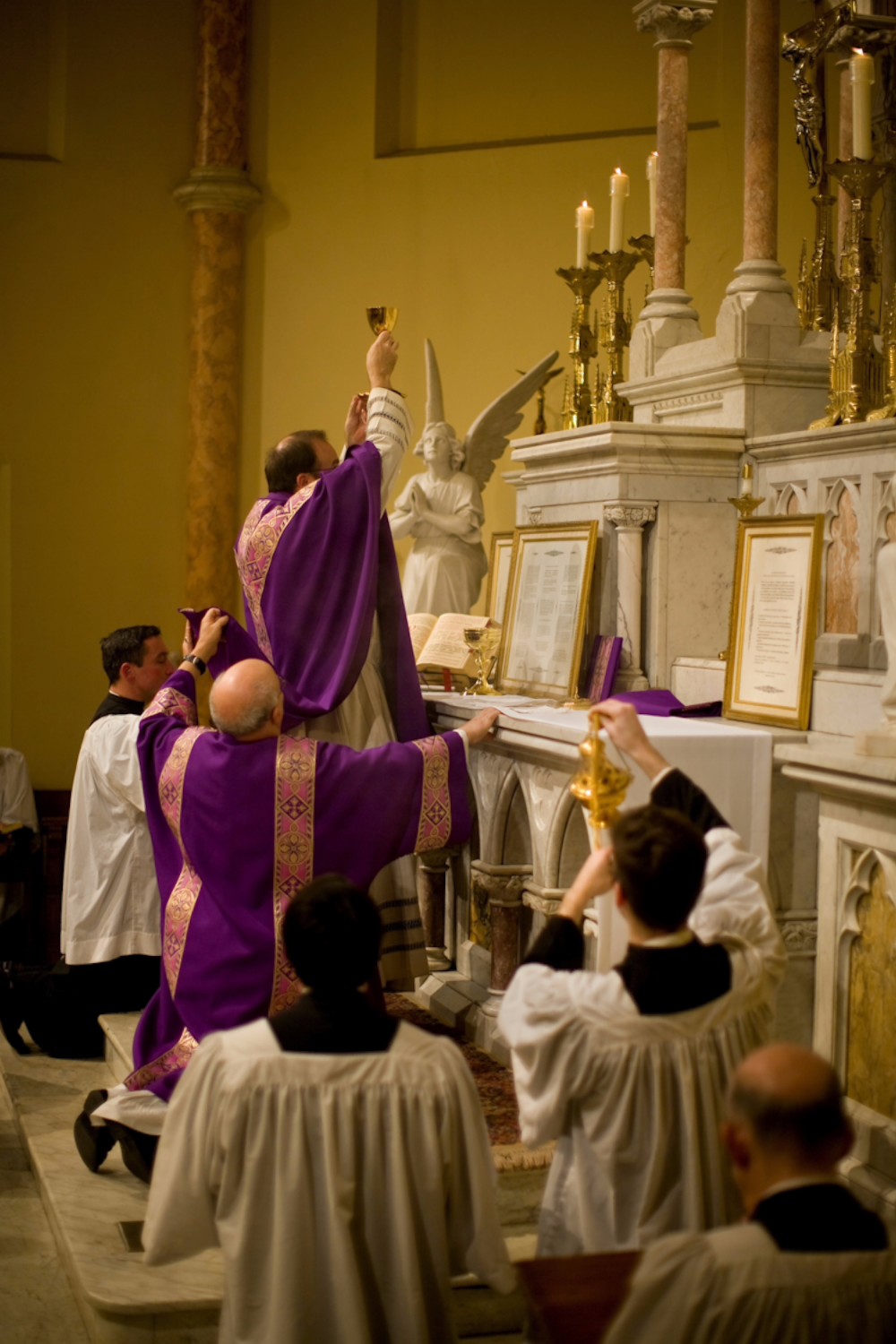
It was almost 15 years ago. I was At Old St. Mary’s here in D.C. celebrating Mass in the Latin (Extraordinary Form). It was a solemn high Mass. I don’t suppose I thought it any different than most Sunday’s but something quite amazing was about to happen.
As you may know the ancient Latin Mass is celebrated “ad orientem” (towards the Liturgical East). Priest and people all face one direction. What this means practically for the celebrant is that the people are behind him. It was time for the consecration. The priest is directed to bow low, his forearms on the altar table the host between his fingers.
As directed I said the venerable words of Consecration in a low but distinct voice, Hoc est enim Corpus meum (For this is my Body). The bells rang as I genuflected.
But behind me a disturbance of some sort, a shaking or rustling in the front pews behind me to my right. And then a moaning or grumbling. What was that? It did not really sound human, more like the grumbling of a large animal such as a boar or a bear, along with a plaintive moan that did not seem human. I elevated the host and wondered, “What was that?” Then silence. I could not turn to look easily for that is awkward for the celebrant in the ancient Latin Mass. But still I thought, What was that?
But it was time for the consecration of the chalice. Again, bowing low and pronouncing clearly and distinctly but in a low voice: Hic est enim calix sanguinis mei, novi et æterni testamenti; mysterium fidei; qui pro vobis et pro multis effundetur in remissionem pecatorum. Haec quotiescumque feceritis in mei memoriam facietis (for this is the cup of my Blood, of the new and eternal covenant; the mystery of faith; which will for the many be shed unto the remission of sins. When so ever you do this, you do it in my memory).
Then, I heard another sound this time an undeniable moan and then a shriek as some one cried out: “Leave me alone Jesus! Why do you torture me!” Suddenly a scuffling as some one ran out with the groaning sound of having been injured. The back doors swung open, then closed. Then silence.
Realization – I could not turn to look for I was raising the Chalice high over my head. But I knew in an instant that some poor demon-tormented soul had encountered Christ in the Eucharistic, and could not endure his real presence displayed for all to see. And the words of Scripture occurred to me: Even Demons believe and tremble (James 2:19).
Repentance – But just as James used those words to rebuke the weak faith of his flock I too had to repent. Why was a demon-troubled man more aware of the true presence and astonished by it than me? He was moved in the negative sense to run. Why was I not more moved in a positive and comparable way? What of the other believers in the pews? I don’t doubt that any of us believed intellectually in the true presence. But there is something very different and far more wonderful in being moved to the depth of your soul! It is so easy for us to be sleepy in the presence of the Divine, forgetful of the miraculous and awesome Presence available to us.
But let the record show that one day, almost 15 years ago, it was made quite plain to me that I held in my hands the Lord of Glory, the King of heaven and earth, the just Judge, and Ruler of the kings of the earth. Is the Lord truly present in the Eucharist? You’d better believe it, even demons believe that!
We recall today the birthday of Mary- a time of new beginnings. Not only do we celebrate the birth of a new life, we also celebrate the beginning of a new chapter in salvation history. We ourselves may be experiencing new beginnings at this time of year- perhaps the start of a new school year, or the launch of new work initiatives after the summer slowdown.
Any new beginning can be a time of excitement and hope as we anticipate its possibilities, opportunities, and challenges. But new beginnings can also give rise to apprehension and worry. We may fear what the future may hold, or become anxious about letting go of what’s comfortable and familiar.
If this is true for us, today’s Scripture readings can speak to our situation in three ways:
First, Paul explained that all things work together for the good of those who have been called by God- and that means us!
Second, as Luke’s gospel asserts that Jesus’ birth came about only through the power of the Holy Spirit, we are reminded of the Spirit’s presence and power in our lives;
Third, the gospel reminds us that God has a plan. He had a plan for our salvation that lead to the births of Mary and Jesus; and he has a plan for each of our lives as well.
In short, for each and every one of our new beginnings, the Holy Spirit is always present to guide us to embrace God’s unique plan for our lives, which we’re assured is designed for our good. And, since it is her birthday, we can entrust our new beginnings to the protection of Mary our Mother, as together we pray: Hail Mary…
Why not? Why shouldn’t I aim high? And really, is it that high? Is it really so unrealistic to ask every member of my congregation to shepherd one soul back to the sacraments and the practice of the faith in the next year? Is that so impossible, for each one to reach one, and work with them for a year and to invite them to come and learn more of the faith?
Well, I’m going to try. As a parish we have been engaged in a door-to-door evangelization campaign and that’s been going quite well, actually. Over 1500 homes have been visited and our Sunday numbers are up by 50.
But I am also aware that friendship and family are a more fruitful vein than the “cold-contact” approach of door to door. We’re going to keep doing that because we need to obey Christ who sends us out two by two. But every congregant knows at least five members from among their family or friends who need to come to God’s house either because they have drifted, or because they have never had a Church home at all. It’s time to go to work and shepherd them back.
And this isn’t going to be a one-time ask, a la “Come to Christmas Mass with me.”
What I am am asking is a year-long effort that would include some of the following:
Introduce – On our Parish feast day in couple of weeks I am going to ask every member of the congregation to prepare to commit to the Lord that they will shepherd one soul back to mass.
Pray and discern – Between September 18th and the Feast of Christ the King, we are to pray and ask the Lord who that person might be. It may not be the obvious one, such as a spouse or a child. Then again it may be. But pray and ask the Lord for guidance: “Who Lord? Who? Speak to my heart Lord, show me who. Who is it that I reasonably know and will be able to gently shepherd?”
Commit – On the feast of Christ the King we will be asked to commit to shepherd the soul to the Lord by spending the next year praying, some fasting and abstaining too, befriending, drawing closer and meeting with that person. They will be ask to place the name of this person on a card. The cards will be collected and placed near the altar, Masses will be offered each week for these souls.
Reflect on personal testimony – During Advent each congregant who has agreed will be asked to write a letter of testimony and thanksgiving to the Lord thanking him for the gift of the faith, the Church and Sacraments and to say something of why they are glad to be a Catholic and how the Lord has blessed them in their practice of the faith. These letters will be presented as a gift of thanksgiving to God at Christmas time. Writing these letters will also help the faithful to hone their own testimony which they can later share with the soul they are shepherding.
On-going Parish formation – During the period after Christmas and through Lent, directed Bible Studies and seminars will also be conducted in the parish that will guide people on how to lovingly converse with the person they are leading back. There are many “meeting stories” in the Bible (e.g. Jesus with the woman at the well, Nicodemus, Peter and Andrew and so forth). These passages and other resources will be given the parishioners to help them engage in a kind of friendship evangelization. The first step in friendship evangelization is friendship. And these studies will help equip parishioners to draw close to the person they are praying to lead back in a way that is not manipulative or secret, but which is also not filled with pressures.
Relate and befriend – Over the period of the year, make it a habit to contact and speak with the person. Talk with them, listen to their stories and ideas. Find out where they hurt and where they find joy. Find out how they drifted from Church or why they have never gone in the first place. Perhaps they have felt hurt or betrayed by the Church, perhaps they are not used to considering the real meaning of their life and have never taken time to consider that this life will end. There is a real power in listening to people in a respectful and loving way. In this stage we also tell our own stories and how the Lord has blessed us and what the Church, the sacraments, the Word of God and fellowship have done for us.
Invite – Without lots of pressure, begin to invite them to Church functions. They may not be ready to sit in a pew on Sunday for worship. But we will have concerts, Bible studies, dinners, movie nights, the blessing of the animals.
Pray and fast – Continue to pray, as will the parish. Consider some fasting, and abstinence, or take up a spiritual practice such as the Rosary or Divine Mercy Chaplet, devotional reading etc. and offer it as a sacrifice to the Lord for the return to the faith the person you are shepherding.
Invite – As the relationship deepens, let the Lord help you to know when and how it is best to explicitly ask this person to either resume the regular practice of their faith or to begin to come regularly on Sunday’s with you. A good time to aim for this is early October when RICA and Adult education classes resume.
Assess – As the year draws to a close on the Feast of Christ the King 2012, we will see if our numbers have doubled.
There is an acronym that is applied to projects that are undertaken: S.M.A.R.T. And I think this on meets the Criteria:
Specific – Each one reach one
Measurable – Double the size of Sunday attendance
Achievable – It is quite possible for every congregant to take up this challenge and, over a year meet many if not all the milestones.
Realistic – to Double our Sunday Attendance is challenging but not unrealistic if everyone does their part and we remember that the Lord has our back.
Time Based – 1 year, with specific milestones on the way.
It is a true fact that simply increasing numbers is not the only, or even most important goal. But rather, that we should authentically evangelize and draw souls to Christ, to his Sacraments, his Word and the fellowship of the Church. At the heart of evangelization is relationship: meeting Christ in others, allowing them to meet Him in us. This is what Christ did, he went out and met others and summoned them to the Kingdom by stages and through relationships. He tells us to do them: Go therefore and make disciples of all the nations, baptizing them and teaching them to observe all that I have commanded you. And Lo I am with you always, until the end of the world. (Matt 28:19)
Am I crazy? Perhaps, but at least call me a fool for Christ. I am going to aim high, that we double our Sunday numbers. Not just for the number’s sake, but for what they represent, souls coming back to God’s house, to be nourished at the altar of the Word and Eucharist, to be more deeply immersed in Christ.
How about you? Will you be crazy too? Are you willing to join me in being a fool for Christ? Let’s get started, there is a work to do.
Photo Credit: A Painting by the artist Atanur Dogan
Here’s a nice video that celebrates the Catholic Faith and can help us get our testimony together. The second half of the video contains a wonderful litany of gifts that are present in the Catholic Church.
I recently came across the following dialogue. I do not know the source, though it is in the form of the sayings of the desert Fathers:
To a distressed person who came to him for help the Abbot said, “Do you really want a cure?” And the man replied, “If I did not, would I bother to come to you?” “Oh yes” said the Abbot, “Most people do.” “If not for a cure, then for what do they come?” asked the distressed man. And the Abbot said, “They come not for a cure, that’s painful. They come for for relief.”
Yes, real cures, and substantial healing are not easy. Often true healing comes only after lengthy surgery, whether physical or spiritual. And those who have sought true healing know, and have come to experience, that it takes guts to be healed.
True spiritual and moral healing requires that we accept significant change and be willing to have our thinking and habitual practices challenged and replaced. In confronting what ails us, we often come to discover that its cause is far deeper than we thought, and that its remedies are far more sweeping and paradoxical than we had imagined.
Once, in the aftermath of a nervous breakdown, that saw me hospitalized for a week and ordered to take a month off to recuperate, I went to a priest and spiritual director who specialized in the care of priests in need of psycho-therapeutic counseling. I explained to him that I had frozen in fear, and panic, and I felt my life had gone out of control. “I never want my life to go out of control again,” I said. He said, “Until you let go of your need to be in control, you will never be well.”
Paradoxical indeed, and scary too. But I have discovered through the years how right he was. My only way “out” of my anxiety was to journey deeper toward its center and find the Lord waiting for me there. Yes, it took guts to be healed. And I’m glad the Lord didn’t let me run somewhere else for mere relief. Healing was harder than relief, but better and lasting.
The Lord Jesus was journeying one day through Jericho (cf Luke 18:35ff) and a certain blind man kept calling out, “Jesus Son of David, have mercy on me!” Finally the Lord stopped and asked this blind man, “What do you want me to do for you?” A strange question, perhaps, to ask of a blind man. But consider that this man’s life will be totally changed if Jesus heals him. More will be expected of him and it will no longer be tolerated that he should sit and beg of others. All that he has known will vanish as a new world, and new expectations dawns on him. So Jesus asks what he really wants, healing or relief? “Lord I want to see!” And he not only saw, but proceeded to follow Jesus up the road. A new vision, a new path, a new destination, a new life. It takes guts to be healed.
And so Jesus asks you and me too, “What do you want me to do for you?” Careful how you answer. Remember, it takes guts to be healed. Too many want mere relief and not real healing. They want comfort rather than true change.
“What do you want me to do for you?”
As you view this video, I ask your prayers for a young man (in his late 20s) who visited the parish this week. He came back to the church of his childhood, remembering a more innocent and simple time in his life. And now that his life has become hell though drugs and other bad choices, he has a decision to make. Pray that he has the guts to accept the long healing he will need to come forth from his hell on earth. As I heard his story I thought of this song:
The other day I spoke with a woman who attends the 7:15 am daily Mass at my parish. She comes to Mass and then stays to pray before the Blessed Sacrament. “I just can’t pray at night,” she said, “so I have to do it early in the morning.”
I know exactly what she means. I have some friends who love all-night adoration at a local parish, and they’re always trying to get me to come. However, I’m not good for much after 10:00 PM, and I joke with my friends that I’m not a “nocturnal Christian.” My best praying, like the woman at my parish, is done in the morning.
Which is okay! God makes both early birds and night owls. One is not necessarily better than the other. But regardless of which one we are, we do need to pray, and we need to pray in a regular, disciplined way.
For prayer to become a “holy habit,” it’s best to pick a particular time and place- just like Jesus, who in today’s gospel chose to pray at night, on the top of a mountain. We might find it best to pray at night, like our Lord, or we might prefer the morning. It ultimately doesn’t matter, as long as we do it. Especially as God is available, all the time.