I’ve often been impressed at the capacity of the Old African American Spirituals to treat of serious matters in a clear yet almost joyful way. This is true even of very serious concepts like sin and judgment. Look at some of the creative lines all from different spirituals:
I would not be a sinner, I’ll tell you the reason why. I’m afraid my Lord might call my name and I wouldn’t be ready to die.
Some go to Church for to sing and shout, before six months they’s all turned out!
Everybody talkin’ ’bout heaven aint a goin’ there, Oh my Lord!“
Where shall I be when the first Trumpet sounds, Oh where shall I be when it sounds so loud, when it sounds so loud as to wake up the dead, Oh where shall be when it sounds. How will it be with my poor soul, Oh Where Shall I be?
Better watch my brother how you walk on the cross! Your foot might slip and your soul get lost!
God gave Noah the rainbow sign, no more water but the fire next time!
The last one was a gloss on 2 Peter 3 and all of them are deeply scriptural and serious appeals to the human soul but they do so in a way that is creative. They get you tapping your foot and invite you to a joyful consideration of the need to repent before it’s too late.
Given all the reticence to discuss the four last things (death, judgment, heaven and hell) songs like these may help to re-open the door to necessary conversations between preacher and congregation, parents and their children. They are a valuable resource. The lines above can be found in the following songs listed in the same order as the quotes.
Jesus is a Rock in a Weary Land (as well as a number of old spirituals)
Ezekiel Saw the Wheel
I Got Shoes
Where Shall I Be?
Ezekiel Saw the Wheel
Didn’t it Rain Children!?
I want to conclude with a creative spiritual about the Last Judgment that is featured in the video below. Note that it is rich in Biblical references, it is joyful, a toe tapper and makes a serious point along with a wish: “In That Great Gettin’ Up Mornin Fare You Well!” First the text (with phonetic Spelling) and then the video:
I’m Gonna tell ya ’bout da comin’ of da judgment Der’s a better day a comin’,
Fare thee well, fare thee well
– Chorus:In dat great gettin’ up mornin’,
Fare thee well, fare thee well
In dat great gettin’ up mornin’,
Fare thee well, fare thee wellOh preacher fold yo’ bible,
For dat last soul’s converted,
Fare thee well, fare thee well
– Blow yo’ trumpet Gabriel,
Lord, how loud shall I blow it?
Blow it right and calm and easy,
Do not alarm all my people,
Tell dem all come to da judgment,
Fare thee well, fare thee well
–
Do you see dem coffins burstin,
do you see dem folks is risin’
Do you see dat fork of lightenin’,
Do you hear dat rumblin’ thunder,
Fare thee well, fare thee well
Do you see dem stars a fallin’,
Do you see da world on fire,
Fare thee well, fare thee well
–
Do you see dem Saints is risin’,
Fare thee well, fare thee well
See ’em marchin’ home for heaven,
Fare thee well, fare thee well
Fare thee well po’r sinners, fare thee well, fare thee well
Fare thee well po’r sinners, fare thee well, fare thee well!
There are many good version of this out on You tube I have picked this one because the words are easiest to hear. Enjoy!
I have published on this Hymn before but want to post on it again at the beginning of Advent in hopes that a few of you who have the influence and ability may see that this hymn in used in your parishes for Advent at some point.
For my money the best Advent hymn ever written is Veni Redemptor Gentium (Come Redeemer of the Nations) written by St. Ambrose in the 4th Century.
One of the beautiful things about the ancient Latin Hymns is how richly theological they are. Not content to merely describe the event in question, they give sweeping theological vision and delve into the more hidden mysteries of each event.
So here we are beginning Advent and Jesus is coming, get ready! Well yes, but he is not just coming, he is redeeming, dying, rising, ascending and reigning at the Father’s Right Hand! But how can we get all that into an Advent Hymn? Well, just below you can read the text and see how.
Full vision – But for now ponder the theological point that hymns like this make. And it is this: that no act of God can merely be reduced to the thing in itself. Everything God does is part of a sweeping master plan to restore all things in Christ, to take back what the devil stole from us! Too often we see the events of our redemption in a disconnected sort of way, but it is all really one thing, and the best theology connects the dots. It is not wrong for us to focus on one thing or another, but we must not forget it is all one thing in the end.
Without this reminder, we can develop a kind of myopia (a limited vision) that over-emphasizes some aspect of redemption and thus harms the rest by a lack of balance. In the 1970s and 80s we had all resurrection all the time, but no passion or death.
Christmas too has its hazards as we get rather sentimental about the “baby Jesus” but miss other important aspects of his incarnation. The passion and death are present in his birth in homeless poverty, the swaddling clothes, the flight into Egypt and so forth. The Eucharist is evident in his birth at Bethlehem (House of Bread) and his being laid in a manger (feed box for animals). His glory as God and his ultimate triumph are manifest in the Star overhead and the Angels declaration of glory! You see it is all tied together and the best theology connects the dots.
So with that in mind I present you to this wonderful Advent hymn so seldom sung in our Catholic Parishes. It can be sung to any Long Meter tune but is usually sung to its own melody (Puer Natus – see video below). I give here only the English translation but the PDF you can get by clicking here: ( VENI REDEMPTOR GENTIUM) contains also the Latin text. I think the poetic translation reprinted here is a minor masterpiece of English literature and hope you’ll agree. Enjoy this sweeping theological vision of the mystery of advent caught up into the grand and fuller vision of redemption.
Among the theological truths treated in this brief hymn are these: His title as Redeemer, his virgin birth, his inclusion of the Gentiles, his sinlessness, his two natures but one person, his incarnation at conception, His passion, death, descent into hell, ascension, his seat at the Father’s right hand, his divinity and equality with the Father, his healing and sanctification of our humanity so wounded by sin, his granting us freedom and eternal life, his renewing of our minds through the light of faith, his opening of heaven to us.
Not bad for seven verses! St. Ambrose, Pray for us! And now the hymn:
Come, thou Redeemer of the earth,Come testify thy virgin birth:All lands admire, all times applaud:Such is the birth that fits our God.– Forth from his chamber goeth he,That royal home of purity,A giant in twofold substance one,Rejoicing now his course to run.– The Virgin’s womb that glory gained,Its virgin honor is still unstained.The banners there of virtue glow;God in his temple dwells below.– From God the Father he proceeds,To God the Father back he speeds;Runs out his course to death and hell,Returns on God’s high throne to dwell.– O Equal to thy Father, thou!Gird on thy fleshly mantle now;The weakness of our mortal stateWith deathless might invigorate.– Thy cradle here shall glitter bright, And darkness breathe a newer light, Where endless faith shall shine serene, And twilight never intervene.
–
All laud, eternal Son, to theeWhose advent sets thy people free,Whom with the Father we adore,And Holy Ghost, for evermore.
–
This video gives you an idea of what the hymn tune for Veni Redemptor Gentium sounds like. The words in this version are slightly different but the hymn tune is perfect. Try not to dance as it is sung. You can find the melody for this hymn tune in the hymn tune index of most hymnals. This hymn tune is called “Puer Natus.” The words to this hymn however can be sung to any Long Meter (LM) hymn tune.
Advent begins with both a bang and a whisper. Now that Thanksgiving is out of the way, stores, commercials, and TV channels are roiling with the frenetic energy of Yuletide cheer, while each of us struggles to remember what it is we are actually preparing for.
But the clash between noise and stillness is nothing new. Thinking of the Messiah’s coming, Isaiah begs the Lord to come in thunder and earthquake, while St. Mark reminds us that Jesus comes so quietly that we might miss him unless we keep careful watch.
The first beatitude helps us resolve the apparent conflict: “Blessed are the poor in spirit, for theirs is the kingdom of heaven.” Our world has its own values and priorities, according to which the poor are usually somewhere between despised and pitied, but never blessed. Jesus opens the door here to a new way of living: the poor in spirit are those who don’t need to create their own meaning, to wrest wealth, power, and happiness from the world by their own brute strength. The poor in spirit place their hope in God, and live in his presence wherever they happen to be, however chaotic or earth-shaking their surroundings may be.
Jesus Christ is the stillness at the heart of the world’s noise. He invites us to become poor in spirit, to be with him now, sharing a foretaste of the kingdom of heaven even on this earth.
But Christ will come again, with a splendor and a majesty that will shake loose the foundations of the world—stillness doesn’t mean immobility. We can’t make ourselves ready for that day by our own power; we can’t force ourselves to be poor in spirit. Jesus himself prepares us for his Second Coming through this beatitude, offering us a new wealth, a new kingdom, and new life: grace. May the life of grace grow in us this Advent, letting us live in God’s presence, in noise and in quiet.
Today’s meditation: Ask God to increase your desire for him.
A couple of items have appeared in the news which, when juxtaposed, go a long way to show just who the real threat is in the Church/State debate of recent decades. I’d like to excerpt these stories and make some comments. But first, we do well to recall the First Amendment of the U.S. Constitution:
Congress shall make no law respecting an establishment of religion, or prohibiting the free exercise thereof; or abridging the freedom of speech, or of the press; or the right of the people peaceably to assemble, and to petition the Government for a redress of grievances.
The part that concerns us here are the first two clauses, the establishment clause and the free exercise clause.
It will be noted that the oft repeated phrase, “separation of church and state” does not occur here and it occurs nowhere in the U.S. Constitution. Such a phrase is an interpretation of the First Amendment and is used by most moderns increasingly to mean that religious expression has no place in the public square or in any Government sponsored or affiliated setting. Of course this is a novel idea and any reading of history up until the most recent of times finds such a radical notion almost wholly lacking in public discourse.
Clearly the “establishment clause” forbids the State to endorse as its own official Church any particular faith, or sectarian denomination. But the same amendment forbids the State to act in such a way as to prohibit the free exercise of religion.
As written the Amendment seems more aimed at protecting the church and citizens from the power of the State to either pressure a particular religious observance, or forbid the same.
Many moderns however see the First Amendment as protecting the State and citizens from religious influence of any sort. Historically this represents a shift and, I would argue, a misinterpretation of the purpose of the First Amendment. Ultimately it is not the State that needs protection, it is the Church and the religiously observant who need freedom, both from coercion, and forbiddence.
Some also misuse and, I would argue, misinterpret the First Amendment to mean that the Church and faith should have absolutely no influence in open society, and that the government should somehow protect them from having to experience the annoyance of any public religious expression, or practice. Further, that the religiously observant have no right to be active in the political process and that government should utterly ignore all religious points of view, simply because they are religious.
But the religiously observant have just as much a right to free speech and to petition the Government as any other group. That some find our presence annoying or objectionable is quite beside the point. I, as everyone, find many points of view annoying and objectionable. But that does not give me a basis to demand that they be ejected from the public square simply for that. And neither do the religiously observant lose their First Amendment rights merely because some find us an annoyance to their secular views.
In the end, the First Amendment exists to enhance and protect free speech and religious expression, not hinder it. Further the amendment is an action on the State and a limit to its power to act. It is the Church, and the religiously observant, who are protected. To the degree that there can be no establishment of a State Religion, secularists are also protected, but they are not and cannot be protected from any religious influence in the public square.
And this background leads to a couple of stories in the news recently that illustrate the debate and what the real threat ultimately is. (My remarks are in red).
Rhode Island’s governor said Tuesday that lawmakers upset with his decision to call the blue spruce erected in the Statehouse a “holiday tree” instead of a “Christmas tree” should focus their energy on feeding the poor.
The Governor’s comment on feeding the poor is insulting, and sidesteps the fact that the Legislature had voted last year, when a similar controversy came up, that the tree should be termed by its traditional name: “Christmas Tree.” Hence the Governor is ignoring the directive of the duly elected and empowered to Legislature. So there is more to the story than his response indicates.
According to Gov. Lincoln Chafee, calling the tree a “holiday tree” instead of a “Christmas tree” is in keeping with Rhode Island’s founding in 1636 by religious dissident Roger Williams as a haven for tolerance, where government and religion were kept separate.
Tolerance it would seem, for the Governor, is for everyone but Christians who had better shut up about Christ at Christmas time.
Chafee insists he’s just respecting the state’s history as a place respectful of all religions. The colony’s hands-off policy toward religion quickly attracted sects that had been persecuted elsewhere. Rhode Island boasts both the nation’s first Baptist church and the oldest surviving Jewish synagogue.
Fine, but the usual way of handling such things is to allow various expressions. For example, even here in crazy Washington, the display at the ellipse features a Christmas tree, a Nativity set, a large Jewish Menorah (Chanukah lights), a Yule Log, I have even seen some commemorations of the Winter Solstice (Druids?).
As a Christian, I do not insist that the Menorah be renamed a “Holiday Lampstand” or that the Yule Log (with its roots in European paganism) be called a holiday log, or that those who celebrate a solstice event must call it a “Holiday Sundown Hoedown” That would all be silly. And the Governor is also being silly and selective.
I can understand (though not agree with) secularists who would like any and all religious displays to disappear from government buildings. But let them engage the political process like any other group. Most High Court decisions do not agree that displays on Government lawns and public squares amount to an establishment of religion. But let the secularists get politically active if they want to try an influence public policy and work their wishes through the legislatures. We too will do the same.
But Meanwhile, a Christmas tree, so called and ordered so named by the elected legislators is no real threat to anyone, especially when other displays are allowed. It may annoy some, but freedom from annoyance is not a constitutional right or something the Government can or should protect everyone from.
But here IS a real threat to the first Amendment and summarized in an article at the Cardinal Newman Society
The monks of Belmont Abbey College sued (HHS) because the government left them no choice. The government is forcing these devout monks to purchase certain drugs for their students and employees, in violation of their religious convictions. For example, the government now requires the college to purchase Plan B (the “morning-after pill”) and ella (the “week-after pill”) for their students. These drugs likely cause abortions, which is a grave sin to the monks. It is one thing for the government to decide it should distribute these drugs itself, which of course is not part of this new law. But it is quite another for the government to mandate that religious Americans with conscientious objection purchase these drugs and participate in their distribution.
The law also forces the college to pay for “related education and counseling” about these drugs. The monks may preach to their students against abortion and contraception on Sunday morning, but on Monday the feds will make the college pay for a counselor to send the exact opposite message to its students. The First Amendment forbids this type of forced speech and burden on religious exercise.
We have detailed here before the mounting threats to Religious Freedom in this country (Just click in the “religious liberty” tag below). For all the talk in recent decades about what a terrible threat religious expression is to the so called “separation of Church and State,” the real threat comes from the government, not the Church. For the government has the power to coerce by fining, penalizing, disqualifying and decertifying Church and religious run institutions who do not tow the line in some of the government’s favorite social stances such as abortion, gay “marriage” and so forth. As can be seen, once again, the Church must go to court to defend our right not to be coerced to pay for and endorse things we consider immoral.
Such threats are mounting and, even should we win some of these cases, we will not win them all. Religious freedom will gradually erode. And even when we do win, the sheer number and complexity of these cases presents an enormous financial and legal burden on the Church, which is having to fight on dozens of fronts in jurisdictions across the country at the Federal, State and local level.
Congress shall make no law respecting an establishment of religion, or prohibiting the free exercise thereof.
As we wrap up November and the traditional meditation we make on the four last things (death, judgement, heaven and hell), A classic meditation of St. Cyprian comes to mind. It is a meditation on a fundamental human struggle to be free of undue attachment to this world and to truly have God, and the things waiting for us in heaven, as our highest priority.
St. Cyprian has in mind the Book of James, and also the Epistle of St John. Yes, surely these dramatic texts are present in his mind as he writes. Hence, before pondering St. Cyprian, it may be good to reference these pounding and uncompromising texts:
You adulterous people, don’t you know that friendship with the world is hatred toward God? Anyone who chooses to be a friend of the world becomes an enemy of God…..Draw near to God, and he will draw near to you. Cleanse your hands, you sinners, and purify your hearts, you double-minded. (James 4:4,8)
The Lord Jesus, of course, had first said,
No one can serve two masters. Either he will hate the one and love the other, or he will be devoted to the one and despise the other. You cannot serve both God and Money. (Matt 6:24)
And St. John also adds:
Do not love the world or anything in the world. If anyone loves the world, the love of the Father is not in him. For everything in the world–the cravings of sinful man, the lust of his eyes and the boasting of what he has and does–comes not from the Father but from the world. The world and its desires pass away, but the man who does the will of God lives forever. (1 John 2:15-17)
Nothing is perhaps so difficult to imagine, especially for us moderns, as being wholly free of the enticements of the world. These texts, so adamant and uncompromising, shock us by their sweeping condemnation of “the world.” Who can really say that they have no love for the world?
We may perhaps find temporary refuge in some distinctions. For, while the adulterous love of attachment, and preference for the world, over its creator is certainly to be condemned. Yet, surely the love of appreciation for what is good, true and beautiful in the world is proper. Does not St. Paul speak of those things which God created to be received with thanksgiving by those who believe and who know the truth. 4For everything God created is good, and nothing is to be rejected if it is received with thanksgiving, 5because it is consecrated by the word of God and prayer. (1 Tim 4:3-5).
Our distinction, though proper, cannot provide most of us full cover however, since we also know that the adulterous love of this is still aplenty in our soul, whatever noble love we also have. And the lust of the world is more than willing to sacrifice the good, the true and the beautiful, not to mention God himself, for lower pleasures.
Only God can free us. And while some are gifted to gain remarkable poverty of spirit long before departing this world, for most of us, it is the dying process itself that God uses ultimately to free us from the lust of this world. Slowly we die to this world as we see our skills, strength and looks begin to fade in late middle age. As old age sets in we say farewell to friends, perhaps a spouse, perhaps the home we owned. Our eyesight, hearing and general health begin to suffer many and lasting assaults, and complications begin to set in.
For those who are faithful, (and I have made this journey with many an older parishioner and family member), it begins to occur that what matters most is no longer here; that our true treasure is in heaven and with God. A gentle longing for what is above grows. Slowly the lust of this world dies, for those who are faithful and let God do his work.
Yet too many, even of those who believe, resist this work of God. While a natural fear of death is to be expected, too many live in open denial and resistance of what is inevitably coming. Our many medicines and creature comforts help maintain the illusion that this world can hold, and some people tighten their grip on it. A natural fear of death is supplanted by a grasping fear, rooted in a lack of faith and little desire for God.
And this is where we pick up with St. Cyprian:
How unreasonable it is to pray that God’s will be done, and then not promptly obey it when he calls us from this world!
Instead we struggle and resist like self-willed slaves and are brought into the Lord’s presence with sorrow and lamentation, not freely consenting to our departure, but constrained by necessity.
And yet we expect to be rewarded with heavenly honors by him to whom we come against our will! Why then do we pray for the kingdom of heaven to come if this earthly bondage pleases us? What is the point of praying so often for its early arrival if we should rather serve the devil here than reign with Christ.
The world hates Christians, so why give your love to it instead of following Christ, who loves you and has redeemed you?
John is most urgent in his epistle when he tells us not to love the world by yielding to sensual desires. Never give your love to the world, he warns, or to anything in it. A man cannot love the Father and love the world at the same time. All that the world offers is the lust of the flesh, the lust of the eyes and earthly ambition. The world and its allurements will pass away, but the man who has done the will of God shall live for ever.
Our part, my dear brothers, is to be single-minded, firm in faith, and steadfast in courage, ready for God’s will, whatever it may be.
Banish the fear of death and think of the eternal life that follows. That will show people that we really live our faith.
We ought never to forget, beloved, that we have renounced the world. We are living here now as aliens and only for a time. When the day of our homecoming puts an end to our exile, frees us from the bonds of the world, and restores us to paradise and to a kingdom, we should welcome it.
What man, stationed in a foreign land, would not want to return to his own country as soon as possible? Well, we look upon paradise as our country, and a great crowd of our loved ones awaits us there, a countless throng of parents, brothers and children longs for us to join them. Assured though they are of their own salvation, they are still concerned about ours. What joy both for them and for us to see one another and embrace! O the delight of that heavenly kingdom where there is no fear of death! O the supreme and endless bliss of everlasting life!
There is the glorious band of apostles, there, the exultant assembly of prophets, there, the innumerable host of martyrs, crowned for their glorious victory in combat and in death. There, in triumph, are the virgins who subdued their passions by the strength of continence. There the merciful are rewarded, those who fulfilled the demands of justice by providing for the poor. In obedience to the Lord’s command, they turned their earthly patrimony into heavenly treasure.
My dear brothers, let all our longing be to join them as soon as we may. May God see our desire, may Christ see this resolve that springs from faith, for he will give the rewards of his love more abundantly to those who have longed for him more fervently. (Treatise on Mortality: Cap 18:24, 26: CSEL 3, 308, 312-314)
Amen.
As November ends, remember the four last things: death, judgment, heaven and hell. Prepare eagerly to meet God, run toward him with joy and confidence, calling on Him who made you for himself. Death will surely come. Why not let it find you joyful, victorious and confident; eager to go and meet God?
I, like you, have read with interest the reactions of many to the new translation, after its first week of use. Most of the remarks I have read are quite positive. A smaller, though not insignificant number, are negative, some strikingly so. No need to summarize all the remarks here. I am personally a big fan of the new translation and have carefully and joyfully prepared my congregation for it. Our first Sunday went off without a hitch.
There is one strain of negative reaction I would like to address however, since it goes to the heart of a common misunderstanding of the Liturgy. The negative reaction basically stated is:
I can’t easily understand what Father is saying in those long, run-on sentences. It doesn’t make sense to me and I get lost in all the words.
It is a true fact that the new translation preserves more authentically the sentence structure of the Latin original which, like older English, makes greater use of subordinate clauses. For example, consider the prayer from the first Monday of Advent with subordinate clauses indented,
Keep us alert,
we pray, O Lord our God,
as we await the advent of Christ your Son,
so that,
when he comes and knocks,
he may find us watchful in prayer and exultant in his praise.
This manner of speaking is more formal and ancient.
The just abrogated translation of 1970 turned the rich sentence structure of the Latin prayers into a series of declarative statements:
Lord our God,
help us to prepare for the coming of Christ your Son.
May he find us waiting,
eager in joyful prayer.
Not only is the language less elaborate and more informal, it also omits the humbly beseeching quality of the Latin, and wholly omits the Scriptural allusion of Jesus standing at the door and knocking (cf Rev 3:20)
Now, if the priest who recites or sings the prayer is careful with the commas, and alters his tone of voice properly, the new translation is quite intelligible, and also quite beautiful. My own mind lit up as I recited the new prayer above, this morning.
That said, it may still be harder for some in the pew to attend the words of the priest, even if it is well spoken, since the use of sentences with subordinate clauses requires the listener to hold one thought, while a subordinate thought is articulated, and then the speaker branches back to the main thought.
So lets grant that it is a little harder.
But here we come to an important insight that, though it is not politically correct, is still true: The priest is not talking to you. He is not directing the prayer to you, and the first purpose of the prayer is not that you understand it perfectly. The prayer is directed to God, (most often, to God the Father). The priest is speaking to God, and is doing so on your behalf, and that of the whole Church. And God is wholly able to understand the prayer, no matter how complicated its structure.
Too often in modern times we have very anthropocentric (man-centered) notions of the Sacred Liturgy. With the return to the vernacular, and mass celebrated toward the people, (neither intrinsically wrong), there is often the wrongful conclusion that the Liturgy is about us, the gathered assembly. Surely there are aspects celebrated on our behalf and for our benefit, especially the Liturgy of the Word and the reception of Holy Communion, but the prayers of the Sacred Liturgy are addressed to and focused on God.
When we understand God as the addressee, the notion of “formalism” in the texts we use makes more sense. One may reasonably argue that, in private prayer, simple and personal words from the heart are most appropriate. But in the Sacred Liturgy, which is both communal and where the words are carefully chosen in accord with ancient practice, nobility and a stately seriousness are important and instinctive. It is God to whom we speak, and our language down through the centuries, in the liturgical context, has been courtly, rich and marked with a sobriety and elevated quality. While this notion was largely set aside in 1970, it has been recovered now.
If the text is less immediately understandable (it need not be) to the human listeners, it must be recalled that we are not the first or intended audience, God is.
Surely intelligibility to the average “pew sitter” is not wholly unimportant, for the Liturgy has a critical teaching role (lex orandi, lex credendi). Further, if the faithful are to join their prayers to that of the celebrant, some degree of intelligibility is helpful. But, frankly, it is not essential. Otherwise the faithful could not validly attend Mass in foreign lands, and the Mass could not be offered in Latin. Likewise young children would be excluded, since many of even the simplest words mean little to them. Full participation in the liturgy is deeper than mere auditory comprehension.
So the central point here is that God is the one to whom our liturgical prayers are directed. This is often forgotten today, and the complaint that the new prayers are “harder to understand” (they are not intrinsically so) belies a premise that “my personal understanding” is the central point. It is not.
I can hear a thousand “yes, but” s coming in the combox. And many of these will be quite valid. Distinctions are important, as is balance.
Intelligibility, while not the most important thing, IS important. And hence, we priests who celebrate the Mass using the new texts, need to work carefully to master the texts so that what we say is not lost in an ungraceful and stumbling proclamation. God and God’s people deserve our best effort.
There are some contexts where intelligibility is absolutely critical. Here is one of my favorite Berlitz commercials that illustrates a critical failure to communicate:
I sink zey are sinking about making za person sink zey are sinking.
Outside, there is a great drama of light and darkness is unfolding before us. The light is giving way to darkness.
Here in the Northern Hemisphere the days are getting very short just now. And they’re going to get even shorter. In Washington DC, where I live, it is dark by 5pm. On cloudy days it is almost dark by 4pm. My brothers both live further north, one in St. Paul the other in Seattle. It’s dark even earlier there.
An old expression (probably by Yogi Berra) goes, “It’s getting late very early out there.”
For us, who live in modern times of electricity, the drama is less obvious, little more than an annoyance as we switch on more lights.
But think of those who lived not long before us, in a time before abundant electrical lights. Perhaps it was possible to huddle near a candle or fire, but in the end, the darkness put a real stop to most things. Neither work, nor reading, nor most forms of recreation could take place. Darkness was a significant factor.
Recently, in a widespread power outage, I was struck at just how really dark it was outside at night without the streetlights and lights from homes. Frankly it was hard to venture out. Bearings were quickly lost and I stumbled over simple things like a curb or fence post. We moderns just aren’t used to this.
Once I toured Luray Caverns in the nearby Shenandoah Mountains. At the bottom of the caverns hundreds of feet down they gathered us near the center of a large cave and shut off the lights. The darkness was overwhelming. It was almost a physical feeling. I felt a wave of slight panic sweep through me and was so relieved when the lights came back on. Is this what it is like to be blind? Light is very precious.
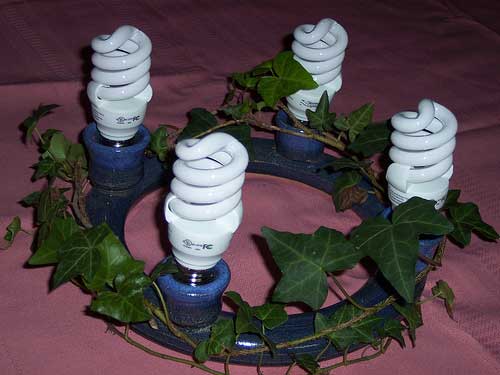
And so, here in a “deep and dark December,” the light continues to recede. The spiritual impact of this drama of light is brought into the Church. Our hymns turn to images of light. The darker it gets, the more candles we light on the Advent wreath. In the darkest moments of December our Advent wreath is at its brightest. As Scripture says, The light shines in the darkness, and the darkness has not overcome it….The true light that gives light to everyone was coming into the world. (John 1:5, 9). And old prayer says, Within our darkest night you kindle a fire that never dies away.
As the drama of light outside continues, December 21 and 22nd are the shortest, darkest days of the year. By December 23rd, the ancients noticed a slight return of the Light. Now the morning star heralds something new, something brighter.
People, look east. The time is near
Of the crowning of the year.
Make your house fair as you are able,
Trim the hearth and set the table.
People, look east and sing today:
Love, the guest, is on the way.
And then, on December 24th, in the deep center of one of the the longest nights, the liturgy of Christmas begins, Christ is born and on December 25th a new light shines. From then on, the days get longer.
Yes, a great drama of light is unfolding before us. It is Advent. It is time to recognize our need for the light and just how precious Jesus, the light of the world is. Ponder in these darkest days the beauty of the light.
Consider too the theme of light in many of the Advent songs we sing. Here are few excerpts, mostly from Old Latin Hymns:
From Veni, Veni, Emmanuel:
O come, thou Dayspring from on high,
And cheer us by thy drawing nigh:
Disperse the gloomy cloud of night
And death’s dark shadow put to flight
Rejoice, rejoice Emmanuel,
Shall come to thee O Israel.
From the German Hymn Wachet auf:
Wake, awake, for night is flying;
The watchmen on the heights are crying:
Awake, Jerusalem, at last!
Midnight hears the welcome voices
And at the thrilling cry rejoices;
Come forth, ye virgins, night is past;
The Bridegroom comes, awake;
Your lamps with gladness take;
Alleluia! And for His marriage feast prepare
For ye must go and meet Him there.
From Conditor Alme Siderum
Creator of the stars of night,
Thy people’s everlasting light
Oh Christ, thou savior of us all,
We pray thee hear us when we call
From Vox Clara ecce intonat:
Hark! a thrilling voice is sounding;
“Christ is nigh,” it seems to say,
“Cast away the works of darkness,
O ye children of the day.”
Wakened by the solemn warning
Let the earthbound soul arise;
Christ, her Sun, all ill dispelling,
Shines upon the morning skies.
From the Liturgy of St. James, 4th Century (Σιγησάτο παρα σὰρξ βροτεία):
Rank on rank the host of heaven
Spreads its vanguard on the way,
As the Light of light descendeth
From the realms of endless day,
That the powers of hell may vanish
As the darkness clears away.
From Veni Redemptor Gentium:
Thy cradle here shall glitter bright,
And darkness breathe a newer light,
Where endless faith shall shine serene,
And twilight never intervene
Enjoy this Advent and watch for the Light, it will surely come