Have you ever seen “The Family Man,” a film starring Nicholas Cage? Cage’s character is an wealthy businessman who’d made a choice thirteen years earlier to leave behind the woman he was to marry to pursue his professional dreams. But then one day he wakes up to find he’s been given a glimpse of what might have been if he’d made a different choice. He’d married the woman instead of having left her. She’s loyal and loving, and they have two beautiful children and a supportive network of friends. Having experienced this, Cage comes to regret the choices he’d made. So when he’s returned to his real life, he fights valiantly to restore what he had lost, and make a reality the glimpse he’d been given of what might have been.
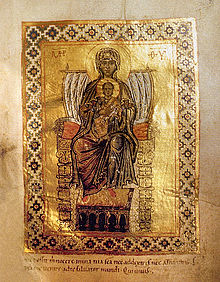
In Mary, our mother, you and I are given a glimpse of what might have been if different choices had been made, if the choice to sin had never been made, leaving us with a fallen human nature. Through the Immaculate Conception, God preserved Mary from this condition, allowing us to behold in her a life of perfect faith, love, and obedience to God’s will. We see in Mary what we might have been today.
However, Mary’s witness should give us, not only a longing for what might have been, but also a sign for what might yet be. This is because Mary’s Immaculate Conception made possible the Virgin Birth of Jesus Christ, who came to heal us, and restore what had been lost. Through Jesus, we can hope that the perfection Mary enjoyed on earth might be ours to enjoy one day in heaven. Which makes our commemoration today, not an occasion of longing and regret, but a celebration of gratitude and hope.
Sometimes people are nostalgic for an era they never lived in. They might prefer the fashion, the music, or the mores of a bygone era, or they might look forward to some future period when all of their political or cultural aspiration will be realized. On one level, a critical evaluation of the glories of the past can be helpful in giving us a measuring stick for our own achievements. Nevertheless, we must be always conscious of the importance of living our lives to the full in the world in which we really exist, not obsessed with our own imaginary construction of the past or future.
The reason for this is that although there is a certain contingency to our existence at this moment in history—I did not choose to enter the world I did, but happened to do so following upon the concrete decisions of others that ordered their lives in a certain way—nevertheless my existence at this moment fits into God’s providential plan. There is no contradiction between contingent human decisions and divine providence. God freely creates the soul of each of us at the moment of conception, a moment that occurs on the basis of the union of our parents. This, incidentally, is the core of the tragedy of abortion—although this child may not be desired by his or her parents, whatever the contingent circumstances may be, he or she is created and loved by God.
On the Feast of the Immaculate Conception, we celebrate the marvelous congruence between the contingent human action and divine providence in the conception of Mary. The parents of the Virgin conceived her in the normal manner, but on this occasion God not only created her soul but did so in a way that preserved her from every stain of sin by virtue of the death of his Son, which he foresaw, preparing her to be a worthy dwelling for Jesus. Mary’s parents lived at a particular moment of history, unchosen by themselves, and decided to marry each other at a time they themselves chose. The child that was born to them, whom they decided to name Mary, was to play an integral role in the mystery of redemption: in the fullness of time, at the exactly appropriate moment, she was to bear a son, and name him Jesus.
Meditation: Reflect on the ways God’s providence has worked in your life through contingent events. Pray for your parents, and those who have played an important role in your life.
It is a notable fact that our Lord and his Mother lived in a time long before photographs, even at a time, and among a people, where drawings and portraits of people were almost unknown. Also notably absent in the Sacred Scriptures are any details regarding the physical appearances of most Biblical figures, unless a detail is necessary for the story (e.g. Zacchaeus being short, Goliath tall, Leah being less attractive due to her misshapen eyes). But generally there seems to be an almost complete lack of preoccupation with such things in the Biblical narrative. And even when we are told that David was handsome or Bathsheba was beautiful, we are not really told how.
We live in a polar opposite world when it comes to images. Everything is visual, and we are quite obsessed with appearance and looking acceptable and good, and how other people look.
We attach great meaning (for better, but usually for worse) on our physical appearance. We divide out over race, skin tone, hair etc. We also prize thinness and ridicule fatness, we worry if we are tall enough, pretty enough, if our hair is too straight or not straight enough, if we are tan enough or too dark skinned, and when age sets in many head for the cosmetic surgeon.
Instructive! Thus when we wonder as to what Jesus or Mary “looked like,” it may be instructive for us to reflect on why the Lord would have them live in a time and place, where this data would NOT be supplied us. For, in the end, they look like us. And some historical sketch or painting, had one ever been made, would only tend to limit our vision, rather than allow us to identify with them.
To the question what did Mary look like we may garner five possible answers:
None of your business.
Why do you care?
She looks just like you think she looks.
She looks like you, because she is your mother.
She is far more beautiful than you ever imagined (My favorite answer).
But answer four is probably the most helpful when it comes to accepting the diverse ways she is depicted.
Most of us American Catholics see her in very European terms. Historically this may be dubious, by why shouldn’t we see here as looking like us. She is after all our mother.
As I walk though the dozens of chapels in the Basilica of the Immaculate Conception here in Washington, I see her as Chinese, American, Lithuanian, Mexican, Filipino, Korean, African, Lebanese, Irish, Ethiopian, and so on. And why shouldn’t these various Ethnicities see her as looking like them, she is, after all their mother.
In her various apparitions her look varies too. La Virgen de Guadalupe “La Morena” (= dark skinned) is surely different than the descriptions we have from other sights such as Fatima or Lourdes. But here too, why can’t the heavenly beauty of Immaculate Mary, so brightly reflective of God’s glory, not refract through the prism of human experience in different colors and ways?
What does Mary look like? She is our Mother, she looks like us. Jesus is our brother (and Lord), he looks like us.
Today is the Feast of St. Nicholas. The real St. Nicholas was nothing close to the St. Nick (Santa Claus) of the modern age. He was a thin curmudgeonly man with a zeal for the Lord that caused flairs of anger. Compromise was unknown to him. The slow transformation of him into “Jolly ole’ Saint Nicholas is a remarkable recasting of him centuries in the making. Some years ago the Washington Post featured an article entitled Poles Apart: Nicholas of Myra; How a 4th-Century Bishop Achieved Fame 1,500 Years Later, With a Whole New Attitude.
Since I had to blog twice yesterday (due to the need to respond to the current Washington Post article on Clergy Sexual Abuse) I thought I might take a break and present excerpts from the article that detail the real St. Nicholas of Myra. It is a very engaging look at the cantankerous Saint who lived through some very tough times.
I am aware that hagiography (the study of the Saints) is sometimes more art than science. I cannot vouch for every detail in the article and would be interested if some of you intrepid hagiographers what to clarify, correct or add to the details given.
The Full Article (which details, somewhat thoroughly, St. Nicholas’ transition to Santa) can be read here: Poles Apart. I have also placed a PDF of the whole article which is more easily printed here: PDF – Poles Apart Nicholas and Nick
Enjoy this excerpt on the real St. Nicholas of Myra (aka Santa):
The year is 325. The place is Nicaea, a small town near the Black Sea in what is now Turkey. Thousands of priests, 318 bishops, two papal lieutenants and the Roman emperor Constantine are gathered to face a looming church crisis…..
One of the churchmen rises to speak. Arius, from the Egyptian city of Alexandria, tells the gathering that Jesus was not divine. He was just a prophet. Suddenly, a second man is on his feet, an obscure, cantankerous bishop named Nicholas. He approaches Arius, fist raised menacingly. There are gasps. Would he dare? He would. Fist strikes face. Arius goes down. He will have a shiner. Nick, meanwhile, is set upon by holy men. His robes are torn off. He is thrown into a dungeon.
Peer down through the bars. Behold the simmering zealot sitting there, scowling, defiant, imprisoned for his uncompromising piety. Recognize his sallow face? No? Well, no reason you should. But he knows you. He’s been to your house many times….
[O]n this holiday we examine the puzzling paradox of Santa Claus. On the one hand, we have the modern Santa, a porcine, jolly man who resides at the North Pole with a woman known only as Mrs. Claus. …
On the other hand, we have the ancient Santa. Saint Nicholas. Paintings show a thin man. He was spare of frame, flinty of eye, pugnacious of spirit. In the Middle Ages, he was known as a brawling saint. He had no particular sense of humor that we know of. He could be vengeful, wrathful, an embittered ex- con….No doubt, Saint Nick was a good man. A noble man. But a hard man.
Nicholas was born in Patara, a small town on the Mediterranean coast, 280 years after the birth of Christ. He became bishop of a small town in Asia Minor called Myra. Beyond that, details of his life are more legend than fact….He became a priest at 19, and bishop in his twenties….Diocletian ruled the Roman Empire; it was the early 300s, and…began the “Great Persecution.”…. Nicholas kept preaching Christianity, and was arrested and tortured for disobeying the new laws. He spent more than a decade in jail. Among his punishments, according to Saint Simeon’s 10th-century history, were starvation and thirst. That is how Santa got skinny…. Twelve years later, AD 312, ….Constantine triumphed. Across the empire, bishops and priests returned to work and Nicholas got out of jail. He tended to local business. He was not pleasant about it. At the time, Myra was a hotbed of Artemis-worship…Nicholas prayed for vengeance, and his prayers were answered. Artemis’s temple crumbled. ” …The priests who lived in Artemis’s temple ran in tears to the bishop. They appealed to his Christian mercy. They wanted their temple restored.….Nicholas was not moved. Prison had left him in no mood for compromise. “Go to Hell’s fire,” he is said to have said, “which has been lit for you by the Devil.”
The Time of Nick In his lifetime, Nicholas crusaded against official corruption and injustice, seeing both as an affront to God. Supposedly, his intervention — through fire-and-brimstone denunciations of corrupt officials — saved at least a half-dozen innocent men from the gallows or the chopping block. He was forgiven for punching Arius and rescued from the dungeon. In the end, his views on the Trinity were vindicated by the adoption of the Nicene Creed, which declares Christ divine. Saint Nick died on Dec. 6. The year could be 326 or 343 or 352, depending whose account you rely on. Why we know the day of the year, but not the year itself, will be explained forthwith…..
……Nicholas of Myra might not seem like the kind of person who relates to kids, and few acts attributed to him involve children. There are two, though neither is exactly the stuff of sugar plums and Christmas stockings. In one tale, widely told, Nicholas secretly delivers three bags of gold to a penniless father. The debtor dad uses the loot as dowries so his three girls do not have to become prostitutes….The second anecdote tells of the time a tavern owner robbed, murdered three children, hiding their remains in pickle barrels. …Fortunately, Saint Nicholas happened to walk through the tavern-keeper’s door….Soon, all three boys, were back home, reeking of pickle juice. What became of the shopkeeper is unrecorded…. By the Middle Ages, Nick had become the patron saint of children, and he had a new gig: gift-giving. Throughout Europe, the legend spread: He delivered trinkets to good kids and twigs to naughty ones. It was an uneasy transition — from curmudgeon to cuddle-bear. ….
🙂 As said above you can click on those links to read the full story of how St. Nicholas of Myra morphed into Santa Claus.
Here’s a Medieval Version of “Jolly old St. Nicholas.” The text is the Introit for the feast of St. Nicholas (Statuit ei Dominus) and translated says: The Lord made unto him a covenant of peace, and made him a prince, that the dignity of the priesthood should be to him forever.
A CBS Morning News report from Sunday casts a scornful eye on the Church, and proceeds, in ten minutes, to list a series of grievances designed to make us think that most Catholics think the Church is heading “backwards” from the reforms of the 1960s. Now of course the fact that we don’t pass the requirements assigned by CBS news editors neither alarms or surprises me.
But for the sake of balance some reply ought to be made to the picture of the Church presented in the CBS piece. For while it will be granted that there are some of the faithful who are unhappy with the current “direction” of the Church, there are many, including myself, who are delighted that we are regaining a proper doctrinal and pastoral footing again. Some are happy that we are beginning to discover that being popular and well thought of by the world is not our first mission.
No one is perfectly happy with every aspect of Church life, but how could we be when human beings are in the mix? But, again, for the record, there are many who are satisfied with the overall movement of the Church back to her fundamental identity. Many too are pleased that there is a growing acceptance that we (along with Jesus) are destined to be a “sign of contradiction.” We’re just not going to fulfill the world’s expectations and the news media’s checklist of requirements to be “acceptable.”
In the video below you will see a number of issues trotted out that that supposedly divide Catholics and cause them concern. While there is no time to comment on the whole video a few thoughts come to mind.
1. First that there is division among Catholics is granted (though not to the degree that the report indicates). In a Church of a billion members, it is not hard to find a few disaffected souls. But the premise seems to be that if there is division, the Church is therefore doing something wrong. For the record, Jesus caused divisions, and got crucified for it. That points to human sinfulness, not that Jesus did something wrong. That some are unhappy with certain Church policies and dogmatic teachings, does not mean that the Church is wrong either. Whenever human beings gather in numbers more than one, there are going to be some divisions, it is the human condition.
2. There is a lot of simplification in the lead example about St Joseph’s Hospital in Phoenix. We are told that the tragic abortion that took place there was “a choice either to lose the baby or to lose the mother and the baby.” But that was not really what happened. The directly intended choice was to end the life of the baby.
We are told that the mother’s high blood pressure was caused by the pregnancy and the only way to end what was becoming life threatening was to abort. I am not a doctor and so must stipulate the medical facts, but I am surprised to hear that high blood pressure is caused by pregnancy (a natural condition of a human female). I suppose it could be aggravated by the pregnancy. At any rate, I admit that these rare cases present serious difficulties for both doctors and moral theologians.
But the Church is not crudely approaching such cases. There are the rare cases of something called “double effect” wherein the Church accepts that a certain treatment, say the removal of a highly cancerous womb, my result in the death of a child in that womb. But the key point is that the death of the child is not intended and will be avoided if possible.
In no way may we directly intend or cause the death of another human being to save another. And that is what happened here, the child was killed to save the mother. It was not that a certain treatment meant to stave off the High Blood pressure indirectly and unintentionally caused the death of the child (which would be a double but unintentional effect). Rather the child was directly and intentionally killed.
We do not live in a time that appreciates nuance, especially when ideology is present. However, such distinctions are important and Catholic moral theologians are careful in such manners. We do not blithely disregard the life of the mother, and there are circumstances where, on account of double-effect, treatment given to a mother which indirectly results in the loss of the child can be accepted. The image of the Church as simply backward and uncaring is not a fair characterization. But what was chosen here was to end one life to save another.
3. The news report makes the dialogue between Bishop Olmstead and St Joseph hospital seem very short and perfunctory. But the discussions between the Bishop and the hospital were quite lengthy. Only toward the end of the report are we informed that the hospital refused to admit any wrong doing, and insisted it would reach a similar decision in such cases in the future. Only then Did the Bishop regretfully have to declare it to be no longer Catholic.
4. The report also makes it seem as though the Bishop excommunicated Sr. Margaret in a punitive sort of way. Rather, no, it would seem that she had excommunicated herself automatically. While Canon lawyers dispute at times what it means to procure abortion, and thereby by incur automatic (laetae sententiae) excommunication, it would seem that Sr. admitted that she “procured” abortion. The Bishop then informed her the automatic excommunication applied. We are only told much later in the piece that she has been restored to communion, which can be done in the context of a good confession, either with the bishop or a priest to whom such faculties have been granted. Sister has apparently availed herself of that. The priest they consulted, Fr Thomas Doyle, whom they call a “canonist,” misspeaks by calling the excommunication cruel. As a Canonist, he should know better, that the excommunication is automatic and hence cruelty would not seem a proper word. Further it is an excommunication that can be lifted and has been.
And so on for the CBS report. Like most secular media, they miss most of the nuance, over-simplify and don’t really even make an attempt to show the other side. Even in interviewing Bishop Olmstead, it is clear to me, as a viewer, that most of what he said must have ended up on the cutting room floor. They have him state the facts and his conclusion, but his reasons seem largely edited to this viewer.
In the end we have CBS scolding the Catholic Church for not being what CBS thinks we should be. But the last time I checked, the purpose of the Church is not to be up to date and follow secular opinion. I think we generally answer to a higher authority who has already been pretty clear about the fundamental moral issues of our time.
If one seeks a denomination that is willing to be more in agreement with modern secular views, there are a good number of them out there. Funny though, they are even more challenged to find members than the Catholic Church. Time will prove where wisdom lies.
In the final lines of yesterday’s Gospel, John the Baptist says,
I have baptized you with water; he will baptize you with the Holy Spirit (Mk 1:8).
Matthew and Luke add: and with fire.
We ought to consider, What does it mean to be baptized with the Holy Spirit (and with fire)? In the first place we must be careful to indicate, right from the beginning, that Baptism in the Holy Spirit is not distinct, different, or later than our reception of the Sacrament of Baptism. Rather it is the unfolding and deepening experience of what the Sacrament of Baptism (and Confirmation) have effected in us.
In a strictly theological sense, John the Baptist is distinguishing his Baptism, which was merely a washing that signified repentance, from the Baptism of Christ, which actually brings forgiveness and the bestows the very life of God, and all the graces of this new life to the believer. We are not merely washed of our sins in the Sacrament of Baptism, we are made new, and the seed of God’s very own life, love and grace are sown in us, to grow. We are actually sanctified and made new.
Some of the Fathers of the Church have this to say:
Theophylus – The baptism of John had not remissions of sins, but only brought men to penitence. He preached therefore the baptism of repentance, that is, he preached that to which the baptism of penitence led, namely, remission of sins, that they who in penitence received Christ, might receive Him to the remission of their sins.
Jerome – For what is the difference between water and the Holy Ghost, who was borne over the face of the waters? Water is the ministry of man; but the Spirit is ministered by God.
Bede – Now we are baptized by the Lord in the Holy Ghost, not only when in the day of our baptism, we are washed in the fount of life, to the remission of our sins, but also daily by the grace of the same Spirit we are inflamed, to do those things which please God
The Catechism of the Catholic Church says,
According to the Apostle Paul, the believer enters through Baptism into communion with Christ’s death, is buried with him, and rises with him: Do you not know that all of us who have been baptized into Christ Jesus were baptized into his death? We were buried therefore with him by baptism into death, so that as Christ was raised from the dead by the glory of the Father, we too might walk in newness of life. (Rom 6:3-4) The baptized have “put on Christ.” (Gal 3:27) Through the Holy Spirit, Baptism is a bath that purifies, justifies, and sanctifies (1 Cor 6:11). Hence Baptism is a bath of water in which the “imperishable seed” of the Word of God produces its life-giving effect. (CCC 1227-1228)
This quote from the Catechism then moves us beyond the merely Theological answer to the question, “What does it mean to be baptized with the Holy Spirit?” and opens also, the “experiential” question: What is it “like” to be baptized with the Holy Spirit?
Experientially, It means knowing what we have received in Baptism and Confirmation. But here, “knowing” does not mean mere intellectual knowing (οἴδα – odia in the Greek New Testament). Rather it means experiential knowing (γινώσκo – ginosko in the Greek New Testament). It is one thing to “know about” God and to be able to pass a religion test. But to be Baptized with the Holy Spirit is to “know” the Lord, personally, deeply, intimately. It is to be in a life changing, transformative relationship with the Lord. It is experiential faith.
Too many people are satisfied with with living their faith by inference, rather than by experience. In other words, they are content to go along saying what they heard some one else say. “Jesus is Lord and risen from the dead” because my mother says so, or my preacher says so, (or even), the Bible says so. All of this is fine, for faith first comes by hearing. But there comes a point when YOU have to say so, because you personally know it to be true.
And this is what it means to be Baptized with the Holy Spirit and with fire. It is to be able to say, “In the laboratory of my own life I have tested the Word of God and found it to be true. I have personally met and know the Lord, I know Him for myself.”
In other words, it is having faith come alive! Faith that is real, tested and certain. It is knowledge that is personal. It is to be a first hand witness to the power of Jesus Christ to change my life, for I am experiencing it in the laboratory of my very own life. He is changing and transforming me. I am seeing sins put to death and wonderful graces come alive. I am more serene, confident, loving, generous and chaste. I am more forgiving, patient, trusting and patient. I love the poor more, and I am less attached to this world. My prayer is becoming deeper as I sense his presence and power in my life. Yes, God is working in my life and He is real. This is my testimony. What is yours?
But this is what it means, experientially, to be baptized with the Holy Spirit (and with fire).
And this is also at the heart of evangelization. How are you going to convert anybody if you’re not convinced yourself? Parents, you want your kids to go to Church? Great, and proper. But why do you go? Because it’s Church law? Alright, fine, but shouldn’t there be a deeper reason? To be Baptized with the Holy Spirit is to go to Mass and make the Christian walk because you know and love Jesus Christ yourself, and you want to bring your children into that living, powerful and life transforming experience of the Lord in prayer, the Mass, the Liturgy, and the Sacraments. That’s what you’re after. And that’s what it means to be baptized in the Holy Spirit.
Pay attention to these word of St. John the Baptist. He, through the Holy Spirit, is teaching us about the “normal Christian life,” which is to be alive, joyful, confident, serene and thrilled at what God is doing in my life, at to know (not just know about) the Lord. “I baptize you with water, BUT HE, will baptize you with the Holy Spirit” And he will light a fire in your life, a fire that never dies away, but that grows in intensity as it transforms your very self.
Let he who has ears to hear, heed what the Spirit is saying. Baptism is not a tedious ritual, it is a transformative reality.
Photo Credit: Yousuf Karsh, 1962, The Books These are the Sacraments (By Bishop Fulton J Sheen).
Here is Father Francis Martin on the Baptism in the Holy Spirit.
The world doesn’t work the way it should. Freak accidents ruin our plans; the greatest passions dwindle to boredom; our best friends annoy us; death snatches our loved ones and they are gone. Conflict is built into the structure of the world—we are not even at peace with ourselves. The sin of Adam has shaken the earth, and nothing is stable anymore.
Sin causes us pain because it doesn’t belong. God made the world good, free from sin and death. But when Adam and Eve rejected God’s love and chose to create their own path to happiness, they lost the special gifts of closeness to God that they had enjoyed, and the earth became a place of struggle and pain.
But sin is not the last word about us. Our hearts still long for God, and he gives us his grace that we might be lifted out of our sin and filled with the very presence of the Divine Trinity. This is our hope—that God did not make us for death, but for life eternal as his adopted sons and daughters. Jesus came to earth for this purpose, and he will come again to bring this work to completion.
God calls us to hope for a goodness that we often can’t see, that will be fulfilled only in the world to come. In Advent especially we realize that the longing for heaven can itself be a kind of pain, because we see the brokenness of the world and the brokenness of our own hearts, caused by the blows of sin, and we yearn for the wholeness of Christ.
Christ offers us this holy longing in the second beatitude: “Blessed are those who mourn, for they shall be comforted.” Left to our own devices, we mourn selfishly, sinking into self-pity whenever something of ours—a relationship, a piece of property, even a comfortable lie—is taken away from us. By God’s grace, we long for his presence and mourn what separates us from him, hoping to be made more like him; we mourn our sins and those of the world because we long for Christ to come again and bring us the comfort of the heavenly Jerusalem.
Today’s meditation: Reflect on Jesus’ mercy. Offer God one of your selfish desires and ask him to take it away.
An old spiritual says, God gave Noah the rainbow sign, No more water, but the fire next time. The second reading in today’s Mass speaks to us of the “Fire next time” and again reminds of the need to be ready for the coming of the Lord. Note four aspects of this reading:
1. The PATIENCE that is PURPOSEFUL. The text says, Do not ignore this one fact, beloved, that with the Lord one day is like a thousand years and a thousand years like one day. The Lord does not delay his promise, as some regard “delay,” but he is patient with you, not wishing that any should perish but that all should come to repentance.
Though the Lord seems long delayed in coming (2000+ years!), the text tells us that this patience is so that as many of us can be saved as possible.
But notice that the text says that God wants us to come to repentance. So God’s patience should not be seen as a place for presumption, but, rather, a time for repentance. This is no time to say, “Later.” This is a time to be serious about repentance and preparation to meet the Lord.
Note too that the Greek word here translated as repentance is μετάνοιαν (metanoian), referring not just to better behavior, but also to new mind. For our transformation is not merely external but also internal. When, what we think changes, so does our behavior. When our thinking is conformed to God’s revealed truth, our priorities, feelings, desires and decisions all begin to change as well. Conversion and repentance are the result of being a changed and transformed human being with a new mind.
2. The PASSING that is PERILOUS. The text says, But the day of the Lord will come like a thief, and then the heavens will pass away with a mighty roar and the elements will be dissolved by fire, and the earth and everything done on it will be found out.
In effect, the text says that God’s gonna set this world on fire one of these days. And when he comes it will be
A. Sudden – For the text says that the Day of the Lord will come like a thief. This is quite a consistent image that Jesus used for the Day of Judgement as well. But the image should not be true for us who wait and watch. St. Paul says, But you, brothers, are not in darkness so that this day should surprise you like a thief….So then, let us not be like others, who are asleep, but let us be alert and self-controlled. (1 Thess 5:4,6).
Further the image of the thief is also not for us if we realize that all we have and are belong to God. For those who are worldly, and claim authority over themselves and ownership over their things, God is a thief who comes suddenly, and in a hidden way. He overtakes their apparent ownership and possession and puts an end to it. To them he seems a thief as he “steals” what they consider theirs. They are badly misled.
But for we who watch and are prepared (pray God), the Lord comes not to take, but to give; to bestow and reward as we inherit His Kingdom.
B. Shocking – For the text speaks of the heavens as roaring and of fire which overwhelms, and by it, all will be dissolved with fire.
Now here too, the image, though shocking, should not alarm us if we are already on fire. At Pentecost, and personally, at our baptism and confirmation, the Lord lit a fire in us to set us spiritually on fire; to bring us up to the temperature of glory. Thus, for those in the Lord, the “weather” on that day will seem just fine.
The prophet Malachi speaks of the twofold experience of the Day of the Lord in this way: “Surely the day is coming; it will burn like a furnace. All the arrogant and every evildoer will be stubble, and that day that is coming will set them on fire,” says the Lord Almighty. “Not a root or a branch will be left to them. But for you who revere my name, the sun of righteousness will rise with healing in its wings. Notice therefore, that for some the Day is burning with wrathful heat, but for the Just, it is a sunny day wherein the Sun (Son) of righteousness will bring warmth and healing (Mal 4:1-3).
An old spiritual glosses on this verse saying, God gave Noah the rainbow sign, no water but the fire next time. Thus God wants to get us ready by setting us on fire with his love and grace. If God is a Holy Fire then we must become fire ourselves in order to endure the day of his coming.
C. Showing – for the text says, all things will be revealed.
So it would seem that this fire burns away the masks many people wear and they are seen for they are. The Lord says, But I tell you that men will have to give account on the day of judgment for every careless word they have spoken (Matt 12:36). And again he says, There is nothing concealed that will not be disclosed, or hidden that will not be made known. What you have said in the dark will be heard in the daylight, and what you have whispered in the ear in the inner rooms will be proclaimed from the roofs. (Lk 12:2-3).
Now even the just may wince at this, for all have a past and would prefer the past stay in the past. But I have sometimes seen, when I have visited 12 Step meetings, how many will recount vividly what they did when they were drinking. And they do so with little shame and much laughter, for they share it among those who understand, and as one who has been set free from the source of the problem. Perhaps for the just on that disclosing Day it will be like that.
But for those who are among the unrepentant, consider the embarrassment and fear as their secrets, sins and injustices are disclosed among those who are also unforgiving and unmerciful. A bad scene really.
3. The PRESCRIPTION that is PROCLAIMED – the text says, Since everything is to be dissolved in this way, what sort of persons ought you to be, conducting yourselves in holiness and devotion, waiting for and hastening the coming of the day of God, because of which the heavens will be dissolved in flames and the elements melted by fire….Therefore, beloved, since you await these things, be eager to be found without spot or blemish before him, at peace.
The text asks rhetorically “What sort of persons ought you to be?!” The answer in a word is “fiery.” God has lit a fire in us to purify and refine us. Hence on that Day, when the Lord will judge by fire, we will pass through. And though some final purifications (purgation) may take place, the fact that the fire has been kindled in us, and fanned into flame, will mean just that, purification, not destruction. St Paul describes the just as going through the purgatorial fire that leads to purfication rather than destruction in hell: If any man builds on this foundation using gold, silver, costly stones, wood, hay or straw, his work will be shown for what it is, because the Day will bring it to light. It will be revealed with fire, and the fire will test the quality of each man’s work. If what he has built survives, he will receive his reward. If it is burned up, he will suffer loss; he himself will be saved, but only as one escaping through the flames (1 Cor 3:12-15).
So the prescription for us is that we let God set us afire now so as to purify us, making us more holy and devout. The fire now of His Holy Spirit is the only thing that can truly prepare us and permit us later to endure the day of his coming and be spared the “wrath to come” (cf 1 Thess 1:10; Matt 3:7; Romans 5:9; 1 Thess 5:9) when God will judge the world and everything in by fire.
4. The PERFECTION that is PROMISED – The text says, But according to his promise we await new heavens and a new earth in which righteousness dwells.
This text presents the possibility that the created world will not so much be destroyed as purified by this fiery judgment of God. While the text may also signify a total destruction of all that now is, and a replacement of it by a new heavens and earth, it is also debated that the created world will instead be renewed, rather than destroyed and replaced. This view would correspond with other texts (e.g. Isaiah 11); and Romans 8 For the creation was subjected to frustration, not by its own choice, but by the will of the one who subjected it, in hope that the creation itself will be liberated from its bondage to decay and brought into the glorious freedom of the children of God.(Rom 8:20-21).
Whatever the solution, to the debate, the bottom line is that the new (or renewed) world will be a heaven wedded to earth in which full righteousness of God will be manifest. Further, we will be without spot or blemish and at peace. Yes, God’s gonna set this world on fire one of these days, Hallelujah. And God’s fire purifies that which is holy, and burns away all which is lacking or unholy. God will restore all things in Christ!

 Have you ever seen “The Family Man,” a film starring Nicholas Cage? Cage’s character is an wealthy businessman who’d made a choice thirteen years earlier to leave behind the woman he was to marry to pursue his professional dreams. But then one day he wakes up to find he’s been given a glimpse of what might have been if he’d made a different choice. He’d married the woman instead of having left her. She’s loyal and loving, and they have two beautiful children and a supportive network of friends. Having experienced this, Cage comes to regret the choices he’d made. So when he’s returned to his real life, he fights valiantly to restore what he had lost, and make a reality the glimpse he’d been given of what might have been.