Over the last month, I have been thinking about the relationship of body and prayer. At the Maryland March for Life in Annapolis, I fell in step with a woman who looked to be in her seventies’ using a cane and keeping a good pace as we walked up the long hill toward Lawyers’Mall. I wondered what made her drive through rush hour traffic to Annapolis to walk with us. Surely, her prayer would have been no less powerful had she chosen to stay at home and pray. A few days later, driving through DC, stopped at a traffic light, a young woman, standing perfectly still on the sidewalk caught my attention. Actually, the rosary she was holding is what caught my eye. Why, I thought, did she choose this spot and then I saw it. She was praying as part of the 40 Days for Life Campaign, at the Planned Parenthood Clinic. Two weeks ago, hundreds gathered in front of Health and Human Services to raise their voice in prayer and petition. Last Saturday, more than 200 young adults traced a 12 mile path through the city on the Seven Church pilgrimage in preparation for Holy Week. On Sunday, parishioners took palms and processed through parking lots, along sidewalks and into church. On Friday, at a number of parishes in the archdiocese, people will gather to follow the stations through local neighborhoods. All together, we seem to be a church in motion, on the move! Not just on the move, but on pilgrimage and more importantly, in prayer. At certain times, it just seems right to raise our minds, hearts and bodies in prayer.
In the tradition of St. Dominic
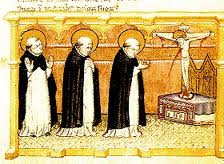
It seems right because just as we experience the presence of God through our bodily senses, our bodies themselves can be an expression of prayer. Saint Dominic, founder of the Order of Preachers teaches us that “gestures of the body powerfully dispose the soul to prayer.” The Dominican Family captured “nine ways of prayer” that were the practice of Dominic, not just in communal prayer but also as part of his private prayer. I discovered this booklet when I was a student and it has deepened my appreciation for making my posture an extension of my prayer. Dominic would have been right at home in any one of our rallies, walks or processions because pilgrimage is just one of nine ways of prayer.
Triduum Prayer
As we enter the celebration of the Triduum, we practice many of the bodily expressions of prayer. Thursday, we will be invited to kneel in adoration of the Blessed Sacrament—to watch and wait with our Lord. On Good Friday, many of us will gaze on the Stations of the Cross as we commemorate our Lord’s passion. Our priests will prostrate themselves in front of the altar and we will be invited to venerate the cross, by kneeling or kissing our touching the feet of our Lord. At the Vigil, our catechumens will kneel in the saving waters of Baptism or bend and receive the life-giving water as it is poured over their heads.
What of the nine ways of prayer might you be able to make a part of your Triduum. If you have not fasted as much or as well as you hoped, Friday is the perfect day to practice the prayer of the bodily discipline. While kneeling is the traditional form of prayer before the Blessed Sacrament, Dominic’s fifth way of prayer is to stand before the altar, perfectly erect, deeply reverent. The seventh position is a familiar one of hands raised in praise, is it an expression that you can use in personal prayer? In his eighth posture, study becomes prayer as he sits and contemplates God’s word.
As we walk with Jesus through his passion and death and as his body becomes for us the gift of our salvation, we are invited to pray in body, mind and spirit.
In some ways its been a tough year for clergy on the blogs. A lot of what I consider to be bishop bashing has been going on, and lots of wrath and venom for the Catholic clergy in general. While I expect this from the secular world, most of it of late has come from certain segments of the Catholic laity.
For many on the right, we clergy don’t take up their agenda with sufficient zeal or follow it to last detail. Hence we are a grave disappointment. For many on the left we have long been dismissed as an outdated “boys only club” with an out-dated and irrelevant doctrine.
In all this we clergy are not merely innocent victims. Though the doctrine of the Church we teach is not flawed, we who preach it are flawed. We have sins and shortcomings. Sins of omission, and of commission. I am not sure we deserve as much venom as we get, and I remain very alarmed at the open hostility to bishops who are, after all, our shepherds and fathers. My own earthly father was not perfect but I had been schooled to appeal to my father with respect and do air my differences with him privately and with deference to the fact that he was my father.
But the fact is we clergy do need your mercy and forgiveness, your prayers and understanding, your patience and encouragement and also your kind but clear rebuke. For we do fall short in many ways and are sometimes unaware or insensitive to the negative impact of our personal shortcomings.
If there ever was a golden age when the clergy were all we want them to be, I am not sure when it was. For even at the beginning the apostles showed forth sin, ineptitude, and the struggle to live perfectly the life they proclaimed. Even after Pentecost any reading of Acts or the pastoral epistles shows some divisions and shortcomings of the clergy. Paul’s advice to Timothy and Titus to be careful before laying hands on men also suggests that there had been troubles.
Wednesday of Holy Week is traditionally called “Spy Wednesday” since it is this day when Judas conspired with the Temple Leadership to hand Jesus over. He would accomplish his task the evening of the next day, but today he makes arrangements to hand Jesus over and is paid.
One way to reflect on this terrible sin is to reflect that Judas was among the first priests called by Jesus. We see in the call of the Apostles the establishment of the ministerial priesthood. Jesus called these men to lead his Church and minister in his name. But one of these priests went wrong, terribly wrong, and turned against the very one he should have proclaimed.
Among the other “first priests” we also see great weaknesses evident. Peter in weakness denied Jesus, though he repented later. All the others except John fled at the time of the passion. And so here we see the “sins of the clergy” made manifest. Christ did not call perfect men. He promised to protect his Church from officially teaching error but this does not mean that there is no sin in the Church and among those who are called to lead. The story of Judas shows that even among those who were called, one went terribly wrong.
In recent years there has been much focus on the sins of Catholic Priests who went terribly wrong and sexually abused the young. The vast majority of priests have never done such things, but those who did so inflicted great harm.
There are other sins of the clergy that have nothing to do with sexuality that may also have caused great harm. Maybe it was an insensitive remark. Perhaps it was the failure of a priest to respond at a critical moment such as a hospital visit. Whatever it might be that has caused you harm or alienation, please don’t give up on God or the on the Church. If a priest or Church leader has caused you grief or to feel alienated please know that there are other priests, deacons, and lay leaders who stand ready to hear your concerns and offer healing. Let the healing begin. Ask among your Catholic family and friends for recommendations about helpful and sensitive priests or Church leaders who can listen to your concerns, address them where possible, and offer another opportunity for the Church to reach out to you with love.
On this “Spy Wednesday” pray especially for priests. We carry the treasure of our priesthood in earthen vessels. As human beings we struggle with our own issues. We have many good days and some less than stellar moments too. The vast majority of Priests are good men, though sinners, who strive to do their very best. But some among us have sinned greatly and caused harm to the Body of Christ, as did Judas. Some of us may have caused harm to you. Please accept an invitation to begin anew.
If you have stayed away through some hurt or harm caused by any leader of the Church, strive on this “Spy Wednesday” to still find Christ where he is found. Among sinners and saints too, in the Church he founded: Perfect in her beauty as the Bride of Christ but consisting of members who are still “on the way” to holiness.
As usual, after all my verbiage, a music video offers this message better than I ever could. Allow this powerful video to move you if you have ever been hurt or know someone who has.
The Gospel from Monday of Holy Week presented an interesting a challenging picture for those of us who wish to be disciples of the Lord. For a brief moment the focus shifts to Lazarus. Lets consider the text and ask some questions of our selves:
Six days before Passover Jesus came to Bethany, where Lazarus was, whom Jesus had raised from the dead….The large crowd of the Jews found out that he was there and came, not only because of him, but also to see Lazarus, whom he had raised from the dead. And the chief priests plotted to kill Lazarus too, because many of the Jews were turning away and believing in Jesus because of him. (Jn 12:1, 10-11)
Now here are some the questions that come to mind for us, especially in the Holy Week, wherein we are summoned to walk with our Lord to the Cross and unto the resurrection. Let’s consider the questions in a kind of reverse order from the text on Lazarus.
The text says of Lazarus, many of the Jews were turning away and believing in Jesus because of him. Is anyone you know turning away from the world and believing because of you?
The text says of Lazarus, And the chief priests plotted to kill Lazarus too. Is any one plotting to kill you, or is anyone persecuting you? I suppose the answer to that question would be based on the answer to the first. For if we are effectively witnessing to Christ and the teachings of his Gospel, we will experience some degree of hatred. But if we are watering down the Scripture, hiding its controversial moral demands, or striving to please this world, we will likely be loved by one and all. Jesus said, Woe to you when all men speak well of you, for that is how their fathers treated the false prophets (Lk 6:26). And again Jesus said, “If the world hates you, keep in mind that it hated me first. If you belonged to the world, it would love you as its own. As it is, you do not belong to the world, but I have chosen you out of the world. That is why the world hates you. Remember the words I spoke to you: ‘No servant is greater than his master.’ If they persecuted me, they will persecute you also. If they obeyed my teaching, they will obey yours also. They will treat you this way because of my name, for they do not know the One who sent me. (Jn 15:18-21) So again the question: are you persecuted at all? Are you hated at all? Is anyone plotting your downfall? That will likely depend on whether you strive to fit in with this world, or to be a sign that will be contradicted (as was Christ and Lazarus). We are not looking for a fight, but if we are authentic to the Gospel, dislike and hatred will find us.
The text says of Lazarus that Jesus had raised him from the dead. Has Christ raised you from the dead? What made Lazarus a threat was that he was alive. Are you alive? And here is a critical point: Many were coming to Jesus by way of Lazarus because Lazarus WAS ALIVE. So again the question, Are you alive in Christ Jesus? Would anyone look to you and see and understand what it means to be alive in Christ? Can you testify, like Lazarus, “I was dead, but Christ has given me life, He has put sin to death in me and raised me to new and more abundant life!”
So to stitch the questions together: Has Christ given you life and joy, and thus made you an effective witness, that turns many from the sinful and confused world to Christ? And has this witness been so effective that some hate you for it? Has your witness been so effective and joyful, but also clear and contradicting of the world’s agenda (power, sex, pleasure, vengeance, possessions, popularity etc) that many also hate you for your contrary witness and would like to undermine it and you?
Jesus did not die because he was a conformist who worked at fitting in and pleasing everyone. He is God and Lord who demanded repentance and summoned us to a faith that believed in the good news of deliverance from the sin we repented of. To a faithless generation he summons us to faith and offers it. To and unchaste and sexually confused world he summons us to chastity and offers it. To a greedy world he summons us to generosity and offers it. To an unforgiving and vengeful world he summons us to forgiveness and love of enemy and offers the grace and gift to do it.
And we killed him for it. He just didn’t fit it to this world’s agenda. Frankly, he irked just about everyone: the Pharisees, the Sadducees, the Herodians, and the Zealots, even the Romans. These political and worldly groups all hated each other but they all agreed on this: Jesus must go.
Outside the Gate: Scripture says, Jesus, in order to sanctify the people by his own blood, suffered outside the city gate. Therefore go to him outside the camp and endure the insults he endured (Heb 13:12-13). Yes, outside the city gate. No city, no “polis” no “city-state” no political organization could contain him or tame him. So he died outside the gate, rejected by all. And only a very few had the courage to join him at the foot of that cross.
And so here is a question for Holy Week. Are you and I willing to suffer with Christ, and if necessary die with him, outside the gate? The world is becoming increasingly hostile to Biblical faith. Many of the ancient truths contained right in our Catechism are called bigotry, hatred, intolerance, foolishness and superstition by the world, and those indoctrinated in and enamored of the world’s ways. Are you and I willing to be humiliated, excoriated and hated for the Gospel of Jesus Christ? Are we willing to have even our heartfelt and joyful defenses of the faith be laughed at, misrepresented and called hateful? Are we willing to be hated by most?
The Gospel is increasingly “out of season” and we are sure to have greater challenges in the years ahead. Here too the Book of Hebrews calls us to courage:
Recall the days gone by when, after you had been enlightened, you endured a great contest of suffering. At times you were publicly exposed to insult and trial; at other times you associated yourselves with those who were being so dealt with. You even joined in the sufferings of those who were in prison and joyfully assented to the confiscation of your goods, knowing that you had better and more permanent possessions. Do not, then, surrender your confidence; it will have great reward. You need patience to do God’s will and receive what he has promised. For just a brief moment, and he who is to come will come; he will not delay. My just man will live by faith, and if he draws back I take no pleasure in him. [But] We are not among those who draw back and perish, but among those who have faith and live (Heb 10:35-39).
Yes, are you and I willing to die with Christ? Holy Week is not just a distant memory. It is now. And if we walk with Christ on the way of the Cross, walk with him outside the city gate, we too will rise with him victorious over this world.
But for now the Cross seems clearer every day, but so does the crown that waits:
In the world ye shall have tribulation: but be courageous; I have overcome the world (Jn 16:33).
This video shows how the martyrs suffered far more than we. The first verse of the song says,
Once to every man and nation, comes the moment to decide,
In the strife of truth with falsehood, for the good or evil side;
Some great cause, some great decision, offering each the bloom or blight,
And the choice goes by forever, whether darkness or the light.
I know that most of you who read this blog are good Catholics and don’t need to read this 🙂
But perhaps you know some one who does. If so, print the PDF of this Column and slip it under the door, or over the transom, of a lukewarm or fallen away Catholic. Jesus will be glad you did.
It’s Holy Week and Lent is drawing to a close. Have you made a good confession? It just doesn’t seem possible that any Lent can be complete or even proper without going to confession. In many diocese there is a “Light is On for You” outreach wherein confession is available in all the parishes of that diocese every Wednesday night from 6:30 pm – 8:00pm. That is surely the case here in the Washington Area. I’ll be in the box waiting for people this Wednesday! So will all the other priests in the Washington and Arlington Dioceses. I am aware that Boston and other dioceses are doing something similar. But wherever you are it’s not too late to get to confession.
There are a number of reasons people postpone or even refuse to go to confession. Here are a few, plus a helps and suggestions.
1. I don’t need to go to the priest to confess my sins. Really? I wonder where you might have heard that? Is there some Bible verse that says that? Or is it, perhaps, just an unproven opinion? For scripture nowhere says, that you should only tell your sins privately to God. To the contrary, it says, Declare your sins, one to another (James 5:16). This same text goes on to specify that the priest is the one to do this and declares: The prayer of a righteous man is powerful and effective. Hence the Scriptures do not affirm a merely private notion in terms of confession. Quite the opposite. I have written more on the thoroughly Biblical origin of the Sacrament of Confession HERE. Please consider reading it if you have doubts that confession is an integral part of the life of a Christian.
2. I’m anxious because it’s been a long time and I have forgotten the ritual. Be of good cheer, you are not alone. Priests are well aware that many people need a little help with the format and things like the Act of Contrition. And don’t be too quick to think of Confession merely in terms of ritual. Fundamentally, Confession is a discussion. Feel free to ask the priest questions and to request help. If you’d like to review some of the aspects of Confession, how to prepare, and how the rite is celebrated here is a good site: How to Make a Good Confession.
3. I don’t have a lot of time and am not available to go at the usual time. Consider calling your parish or a nearby parish and asking for an appointment with the priest when you ARE available. Most priests are quite willing to make time to hear confessions at other than usual times. This is one of the essential reasons we were ordained. In larger cities there are often monasteries and Religious houses that make confession available all through the week at frequent hours. Here in DC both the Basilica and the Franciscan Monastery are legendary as places to go daily at all the major hours to celebrate Confession.
4. I don’t have to go if I don’t have mortal sin. Well, perhaps a lawyer will agree with you. But two things come to mind. First even little things have a way of piling up. Before long a room can look pretty cluttered, one little thing at a time. Secondly, mortal sin isn’t as rare as some people think. There is not the time to develop a whole theology of sin here, but simply realize that it is possible for all of us to do some pretty harsh and mean-spirited things, to say things that harm the reputation of others, to indulge in highly inappropriate sexual thoughts, to look a pornography, engage in masturbation, skip miss on Sunday, be prideful, thin-skinned and egotistical, misuse God’s name and refuse charity to the poor. And many of these things can become mortal sin, or are, by nature mortal sin. There is an old saying: Nemo judex in sua causa (no one is a judge in his own case). Simply making declarations that “I don’t have mortal sin” might not be a judgment you should be making. Regular confession is a more humble approach, it is less legalistic and also brings forth the grace to avoid sin in the future.
4. I don’t know what to confess. This is a common problem today where moral formation in our culture and even among Catholics is poor and generally vague. But there is help available. The sight already mentioned How to Make a Good Confession has a pretty good examination of conscience. I have also posted before what I consider one of the best helps I have discovered in preparing for confession. It is called the Litany of Penance and Reparation and is available by simply clicking on the title. If you prefer a more biblical preparation trying reading this passage:
Put to death, therefore, whatever belongs to your earthly nature: sexual immorality, impurity, lust, evil desires and greed, which is idolatry. Because of these, the wrath of God is coming. You used to walk in these ways, in the life you once lived. But now you must rid yourselves of all such things as these: anger, rage, malice, slander, and filthy language from your lips. Do not lie to each other, since you have taken off your old self with its practices and have put on the new self, which is being renewed in knowledge in the image of its Creator. Here there is no Greek or Jew, circumcised or uncircumcised, barbarian, Scythian, slave or free, but Christ is all, and is in all. Therefore, as God’s chosen people, holy and dearly loved, clothe yourselves with compassion, kindness, humility, gentleness and patience. Bear with each other and forgive whatever grievances you may have against one another. Forgive as the Lord forgave you. And over all these virtues put on love, which binds them all together in perfect unity. Let the peace of Christ rule in your hearts, since as members of one body you were called to peace. And be thankful. Let the word of Christ dwell in you richly as you teach and admonish one another with all wisdom, and as you sing psalms, hymns and spiritual songs with gratitude in your hearts to God. And whatever you do, whether in word or deed, do it all in the name of the Lord Jesus, giving thanks to God the Father through him. (Col 3:5-17)
It’s pretty hard to read a passage like this and come away thinking we have little to confess.
The bottom line is this: Go to Confession. Make the time. We find time for everything else. Remember how Lent began with this plea on Ash Wednesday: We are ambassadors for Christ, as if God were appealing through us. We implore you on behalf of Christ, be reconciled to God!…Behold, now is a very acceptable time; behold, now is the day of salvation (2 Cor 5:20, 6:2).
The Passion which we read in today’s liturgy is too long to comment on in detail. We are only able to take a portion and examine it.
The usual villains such as the Temple leaders, Judas, and the recruited crowd, which shouted “Crucify him!” are fairly obvious in displaying their sinfulness and are unambiguously wicked. But there are others who participate in the Passion accounts whose sinfulness, struggles and neglect are more subtle, but still real and contribute significantly to the Lord’s sufferings on Good Friday. It is perhaps, in these figures that we can learn a great deal about ourselves. For while we may not overtly shout “crucify,” we are often not as holy and heroic as the persecutors were wicked and bold.
As these behaviors are noted, we must understand that WE do these things. For the Passion accounts are not merely portraits of people long gone, they are portraits of you and me. We do these things.
So, lets look at sins and weaknesses of Jesus followers (us) in three stages.
I. The Perception that is Partial – In the middle of the Last Supper, in today’s Gospel the disciples of Jesus are reminded of what the next days will hold. Jesus says,
All of you will have your faith shaken, for it is written: I will strike the shepherd, and the sheep will be dispersed. But after I have been raised up, I shall go before you to Galilee.
Note that the apostles are reminded of these facts since Jesus has said them before on a few occasions. For example:
From that time on Jesus began to explain to his disciples that he must go to Jerusalem and suffer many things at the hands of the elders, chief priests and teachers of the law, and that he must be killed and on the third day be raised to life. (Matt 16:21)
When they came together in Galilee, he said to them, “The Son of Man is going to be betrayed into the hands of men.They will kill him, and on the third day he will be raised to life.” And the disciples were filled with grief. (Matt 17:22-23)
We are going up to Jerusalem, and the Son of Man will be betrayed to the chief priests and the teachers of the law. They will condemn him to death and will turn him over to the Gentiles to be mocked and flogged and crucified. On the third day he will be raised to life!” (Matt 20:19)
Thus we see that the Lord has consistently tried to teach and prepare them for the difficulties ahead. He has told them exactly what is going to happen and how it will end: NOT in death, but rising to new life. But though he has told them over and over, they still do not understand or see. Thus he predicts that their faith in in will be shaken.
For their perception is partial and they will see only the negative, and forget that he has promised to rise. Since they cannot see beyond the apparent defeat of the moment they will retreat into fear and not boldly and confidently accompany him to his passion and glorification (for his passion IS is lifting up, his glorification). Instead they will flee. He has shown the “what the end shall be.” But they cannot see or accept it. Thus fear overwhelms them and draw back into a sinful fear and disassociation from Jesus. Only a few, Mary his Mother, John, Magdalene, and a few other women would see him through to the end.
But as for the rest, they see only what is gory and awful, and miss what is glorious and awesome. Yes, their perception is quite partial and their blindness comes, paradoxically, from not hearing or listening to what Jesus has been telling them all along.
We too can easily suffer from a blindness caused by poor hearing. For the Lord has often told us, that if we trust, our struggles will end in glory and new life. But, blind and forgetful, we give way to our fears and fail to boldly walk the way of Christ’s passion. We draw back and disassociate ourselves from Jesus and exhibit some of the same tendencies and problems we will now observe in the people of that day.
So lets examine some of the problems that emerge from the partial perception and forgetful fear of many of the disciples and others.
II. The Problems Presented – The problems that emerge are at least five. They are unhealthy and sinful patterns that emerge from the fear generated in not trusting Jesus vision and refusing to see it. We can consider them one by one. Please understand that the word “we” used here is shorthand and does not mean that every single person does this. Rather, it means that, collectively, we have these tendencies. But no need to take everything here personally.
A. DROWSY– One of the common human techniques for dealing with stress and the hardships of life is to just go numb and drowsy. We can just doze off into a moral sleep. Being vigilant to threats posed to our souls by sin, or the harm caused by injustice, (whether to ourselves or others) is just too stressful. So we just tune out. We stop noting or really even caring about critically important matters. We anesthetize ourselves with things like creature comforts, meaningless distractions, alcohol or drugs. We go into a kind of moral sleep and we begin to lack a prayerful vigilance. Prayer and spirituality pose too many uncomfortable questions. So we just tune out and daydream about meaningless things like what a certain Hollywood star is doing, or what the latest sports stats are.
In the passion accounts, Peter, James and John are personally asked by the Lord to pray with him. But they doze. Perhaps it is the wine. Surely it is the flesh (for the Lord speaks of it). But unwilling or unable to deal with the stress the Lord is clearly under, they just tune out, go numb, and doze off.
Grave evil is at the very door. But they sleep on. The Lord warns them to stay awake, lest they give way to temptation. But still they sleep.
Someone they know and love is in grave danger, but it is too much, so they just tune out, much as we tune out at the overwhelming suffering of Christ in the poor and needy. We just stop noticing. It’s too painful, so we tune out.
The Lord had often warned them to be vigilant, sober and alert (Mk 13:34, Matt 25:13, Mk 13:37; Matt 24:42; Luke 21:36, inter al). Other scriptures would later pick up the theme (Romans 13:11; 1 Peter 5:8; 1 Thess 5:6, inter al). For drowsiness is a significant and serious spiritual problem.
Sadly God described us well when he remarked to Isaiah: Israel’s watchmen are blind, they all lack knowledge; they are all mute dogs, they cannot bark; they lie around and dream, they love to sleep. (Is 56:10)
But, despite the sleepiness of the disciples, the wicked are still awake, and the threat does not go away by a drowsy inattentiveness to it. Thus we ought to be confident and sober. Life’s challenges are nothing to fear, for the Lord has told us we have already won, if we trust him. But the disciples have forgotten Jesus promise to rise after three days. And so, often, have we. So they, and we just give way to stress and tune out.
B. DISASSOCIATING– Peter, confronted with the fearful prospect of being condemned with Jesus denies that he knows him or is one of his followers. He disassociates himself from Christ. We too, confronted with the possibility of far lesser things like ridicule, will often deny a connection with the Lord or with the Church.
Someone might say of one of the more controversial passages of scripture (such as prohibitions on divorce, fornication, homosexual activity, commands to tithe, etc), “Oh, you don’t really believe that, do you?” And it’s too easy to give way to fear and either say “no” or to qualify our belief. Why suffer ridicule, endure further questioning, or experience the unpleasantry of debate?
So we just disassociate, compromise, or qualify our faith to avoid the stress.We even congratulate ourselves for being tolerant, etc. when we do it.
Jesus says, If anyone is ashamed of me and my words in this adulterous and sinful generation, the Son of Man will be ashamed of him when he comes in his Father’s glory with the holy angels. (Mat 16:21). But too easily we ARE ashamed.
And so, like Peter, we engage in some form of denial. Peter was afraid because he has forgotten to “see what the end shall be.” He has forgotten that Jesus will rise after three days. So too do we often forget that. So we lack confidence and give way to fear, and we deny, so as to avoid suffering with Jesus.
C. DODGING – Simply put, when Jesus is arrested, all the disciples except John split. They “get the heck out of Dodge.” They are nowhere to be found. One of them, (could it be Mark himself?) ran off naked.
After Jesus’ arrest, it is said that Peter, prior to his own denials had followed the Lord, “at a distance” (Mk 14:54) but as soon as trouble rose, he too scrammed.
And we too can run. Sometimes it’s persecutions from the world. But sometimes its just our own self-generated fear that following the Lord is too hard, and involves too many sacrifices we are just not willing to make. Maybe it will endanger our money since the Lord insists that we tithe and be generous to the poor. Maybe it will endanger our playboy lifestyle since the Lord insists on chastity and respect. Maybe we are doing something we have no business doing, that is unjust, excessive or sinful. But, rather than face our fears, whether from within or without, we just high-tail it out.
The disciples forgot that Jesus has shown them what the end shall be. In three days he would win the victory. But, this forgotten, their fears emerged and they ran. We too, must see what the end shall be to resist and confront our many fears.
D. DEFLECTING – Now in this case our example is Pontius Pilate, not one of the disciples. But the fact is that Pilate was summoned to faith, just like anyone else. “Are you a King?” he asked Jesus. And Jesus responds by putting Pilate on trial: “You say so.” In other words, “It is you who have said these words. Do you think they are true?”
The fact is, Pilate has a choice to make. Either he will accept what Jesus is saying as true, or he will give way to fear and commit a terrible sin of injustice. Now the texts all make it clear that Pilate knew Jesus was innocent. But, because he feared the crowds he handed Jesus over.
Now, note PILATE did this. The crowds tempted him through fear, but HE did the condemning. Yet note that he tries to deflect his choice. Mark says he handed Jesus over to please the crowd, But Matthew adds, he took water and washed his hands in front of the crowd. “I am innocent of this man’s blood,” he said. “It is your responsibility!” (Mat 16:21). Well, actually Pilate it is also YOUR responsibility. You had a choice and you made. Your own career and hide were more important that justice. And, though you wanted to do what was right and were sympathetic with Jesus, merely wanting to do what is right is not enough.
So too for us. We also will favor our career or hide over what is right. And in so doing we will often blame others for what we freely choose. “I am not responsible, my mother dropped me on my head when I was two” ….etc.
In effect we are often willing to say, “Look Jesus, I love you. You get my Sundays, and my tithe and, generally I obey you. But you have to understand, I have a career, I need to make money for my family. If I really stand up for what is right, I might not make it in this world. You understand, don’t you?…I know the company is doing some things that are unjust, I know the world needs a clearer witness from me….and I’ll do all that, after I retire. But for now…..well, you know. It’s really may boss whose to blame. It’s this old hell bound sin soaked world that’s to blame. Not me!” And we wash our hands and excuse our silence and inaction in the face of injustice and sin.
And all this is done in fear. We forget what the end shall be and get focused on the fearful present. We lack the vision Jesus is trying to give us that in three days we will rise with him. But we stay blind to that and only see the threat of now.
III. The Path that is Prescribed – OK, by now you ought to know the path that is prescribed: See what the end shall be! In three days we rise! Why are we afraid? Jesus has already won the victory. It is true, we get there through the cross. But, never forget what the end shall be! Today we read the Gospel of Friday, but wait till Sunday morning! I’ll rise!
We end where we began with this gospel: All of you will have your faith shaken, for it is written: I will strike the shepherd, and the sheep will be dispersed. But after I have been raised up, I shall go before you to Galilee.
Yes, after he has been raised, he goes before us into Galilee. And for us, Galilee is heaven. Whatever our sorrows, if we are faithful we will see Jesus in the Galilee of heaven. Never forget this vision. After three days we will rise with him and be reunited in Galilee.
So take courage, see what the end shall be! The end for those who are faithful is total victory. We don’t need to drowse, destroy, deny, dodge and deflect. We’ve already won. All we need to do is hold out.
An old Gospel songs says, I promised the Lord that I would hold out! He said he’s meet me in Galilee! So hold out, Galilee is not far, in three days we rise with him.
The video below is a very creative representation of what the day and night sky on Earth would look like if the earth had rings like Saturn. It is well worth a view.
But it puts me in the mind of pondering the delicate balance of life on this earth and, though the artwork in the video is beautiful, I suspect that the presence of rings would dramatically alter life on this earth, perhaps even annihilate it.
By way of disclaimer, let me say I am not a geologist or astronomer. But a number of things concern me about the presence of rings and then cause me, as a Christian and amateur theologian, to once again thank God for the incredible and rare conditions he maintains on this earth, so that we can live. Let me explain.
Rare Earth?? While most people, including most scientists, presume that there may be billions of inhabitable planets out there a lot like earth, there is another theory base (called “rare earth theory”) that is dubious of such a high number.
There are not just a few things that come together to support life on earth, there are many. Here are just a few:
The earth is at just the right distance from the sun so that water is warm enough to melt, but not so hot as to boil and steam away into space. Water is also able in this habitable zone to both evaporate and condense at lower levels in the atmosphere, thus permitting a more even distribution of water, and a cycle of water over dry land known as precipitation.
The earth is in a “habitable zone” in the galaxy too. Closer to the center of galaxies, radiation and the presence of wandering planetoids make life there unlikely.
We have the nearby presence of two “gas giants” (Jupiter and Saturn) that attract and catch many wandering asteroids and comets and keep them form hitting the earth often.
Our molten core and volcanism generate a magnetic field that protects the earth from the most harmful rays of the sun. Volcanism also has a role in helping generate our atmosphere and in cycling rich minerals widely.
Our sun is just the right kind of star, putting out a fairly steady amount of energy. Other types of stars are more variable in their output and this variance can utterly destroy life or cause it to be impossible due to the extremes caused.
The earth’s fairly rapid rotation reduces the daily variation in temperature It also makes photosynthesis viable since there is enough sunlight all over the planet.
The earth’s axis tilt relative to it orbital plane is also just right to allow seasonal variations that help complex life but not so tilted as to make the seasons too extreme.
The moon also has a good effect by causing tides that are just enough to permit tidal zones (a great breading ground for diverse life) and not too severe so as to destroy life by extreme tides.
So life here is in the balance of many fascinating things (and a lot more I don’t have time to mention). Just Google “Rare Earth Theory” to read more.
Now, what would rings do to this balance? I suspect a lot of damaging things. Three particularly come to mind.
Interference with the tides might be significant since I suspect that the gravitational effect of the rings (rings, though they look like thin wafers, are really bands of rocks in fairly close orbit around a planet) would likely pull the ocean water over the area nearest where they orbit. This in turn would likely cause a loss in the ebb and flow of tides in areas further from them, limiting the benefit of the tides in many areas. Many estuaries would likely not exist. Estuaries are wonderful areas where salt and fresh water mix and a variety of life sets up.
I also suspect that, due to gravitational effects on the sea, many sea currents would be interfered with. This too would effect weather and limit the even distribution of heat and cold on the planet, so wonderfully done now by weather and sea currents.
I wonder too if the rings might not interfere with the magnetic field around the earth. This would be more the case if a lot of the rocks that made up the rings were of a significant metallic makeup. Without the proper magnetic field, we all cook. Bye Bye life.
Finally, it seems certain that rocks from the ring would frequently fall out of orbit, to earth. If large enough, these falling rocks could cause extinction level events. Bye Bye life.
So, enjoy the video of the pretty rings and THANK GOD we don’t have them!
Life on this earth may be a far more rare and miraculous reality than we think. The more I learn of life, the more amazed I become at what the Lord has done. If science has done anything for me, (and it has done a lot), it has surely increased my wonder and awe for God. God has done a marvelous thing in creating this universe and an even more marvelous thing in creating and sustaining this earth. An old hymn says:
O tell of God’s might, O sing of His grace,
Whose robe is the light, whose canopy space,
His chariots of wrath the deep thunderclouds form,
And dark is His path on the wings of the storm.
The earth with its store of wonders untold,
Almighty, Thy power hath founded of old;
Established it fast by a changeless decree,
And round it hath cast, like a mantle, the sea.
Thy bountiful care, what tongue can recite?
It breathes in the air, it shines in the light;
It streams from the hills, it descends to the plain,
And sweetly distills in the dew and the rain.
Praise the Lord for Planet earth, and behold, life is in the balance, the perfect balance.
What are we to make of the 20th Century? Like any period it is marked with its glories and its horrors. In his now classic work Modern Times, historian Paul Johnson gives a sober assessment of the 20th century and estimates, many think conservatively, that 100 million died in war and for ideological reasons in that violent century. Perhaps no century can be said to have been bloodier.
It was a century of the imposition of every sort of collectivism from communism, fascism, tribalism, and socialism , all with catastrophic results. Whole populations were the subject of social experiments; and here too, with the predictable and horrific results as economic, political, and social, theories, population “control” and other hideous visions gave way to human suffering. Millions were sacrificed in the name of collectivism in places like the USSR, China, Germany, Cambodia, Turkey, and Africa.
It was a century of endless war and further untold bloodshed that extended even into the womb as abortion too ran rampant on the globe. Our capacity to kill ourselves in huge numbers and horrifying ways reached terrifying heights in arms races and the development of gruesome weapons of mass destruction, conventional, chemical, biological and nuclear.
Faith too suffered unimaginable setbacks as Europe all but lost its Christian and Jewish faith. In both Europe and the US, Churches and Synagogues emptied as atheistic Communism, secularism, and various forms of humanism (i.e. man at the center), moral relativism, and indifferentism swept the Western World.
Families and the family structure were devastated by war, dislocation, the sexual revolution, divorce, expansive and intrusive governments with oppressive population policies, and foolish social experimentation. There are few places left in the Western World today where the family, (nuclear or extended) can be said to be strong. And as the family, the fundamental unit of civilization, has unraveled, it seems increasingly uncertain that Western culture can survive such a mortal wound.
Paradoxically, amidst all this bloodshed, war, disorder and unraveling, technological progress has been nothing less than astonishing: Electricity, radio, television, computers, telephones, the Internet, faxes, cellular technology, air-conditioning, agricultural advances, amazing medical advances and breakthroughs, astonishing scientific discovery and progress, space travel, visits to the moon and back, global communication, global economies, and remarkable market efficiencies that provide huge numbers of products and services quickly and inexpensively.
Yes, amidst all the grave darkness and bloody death of the 20th Century, we have also come (at least in the Western World) to a place or remarkably good health, nutrition and life-span with endless numbers of creature comforts and pleasantries.
The 20th Century, the worst and the best, all at once, murder and medicine, war and wealth, sorrow and science, genocide and genome projects, monstrosities and moon shots.
I am of the mind that to understand the 20th Century and its colossal contours, that no simple or natural explanation is possible. While one may see its technologies as having emerged from an organic development, I cannot personally understand the global horrors, and the great and sudden falling away from the faith in purely natural terms. Something supernatural, I would say Satanic, has afflicted us and sent “ordinary” human wickedness over the top. The bloodshed is too global, too organized and sweeping to be merely of human origin. As St. Paul says, For our struggle is not against flesh and blood, but against the rulers, against the authorities, against the powers of this dark world and against the spiritual forces of evil in high places (Ephesians 6:12).
October 13, 1884, Pope Leo XIII had just finished celebrating Mass in a chapel in the Vatican. At the Mass were a few Cardinals and members of the household staff. Suddenly the Pope stopped at the foot of the altar. He stood there for about 10 minutes, as if in a trance, his face ashen white. The going straightway from the Chapel to his office, he composed the prayer to St. Michael and later issued instructions that it be said after all Low Masses everywhere in the world. He explained that, as he was about to leave the foot of the altar, he had suddenly heard voices – two voices, one kind and gentle, the other guttural and harsh. There he heard the voice of Satan in his pride, boasting to Our Lord: “I can destroy your Church.” The gentle voice of Our Lord: “You can? Then go ahead and do so.” Satan replied, “To do so, I need more time and more power.” The Lord said, “How much time? How much power?” “75 to 100 years, and a greater power over those who will give themselves over to my service.” was Satan’s reply. Mysteriously our Lord said, “You have the time, you have the power. Do with them what you will.”
No Catholic is required to accept this event as an article of faith. But there is something about the 20th Century, something awful. As observed, the 20th century is not without its merits. But the degree and scope of wickedness, suffering and the widespread falling away from the faith in the West set apart the 20th Century and cause me to ponder if Leo’s “Job-like” vision is true.
Many questions rush through our mind in reference to this vision: Why would God permit this? Was it to test, prune and purify his Church? Why does God allow Satan any influence at all? Is this fair? When did the 100 years begin and end? Will spring come soon? Do God and Satan even talk in terms of “years” and if so, does the word correspond to our use of it? If this vision happened, why did the Lord let Leo XIII hear it?
I have no simple answers to questions like these. You are free to dismiss the notion and see the 20th century as wholly unremarkable in its wickedness and falling away from the faith. But there is something about the 20th Century, something awful. Did Pope Leo have the answer? Surely the Sovereign LORD does nothing without revealing his plan to his servants the prophets (Amos 3:7). Was Pope Leo that Prophet?
I am interested in your thoughts.
Here is a Ten Minute synopsis of the 20th Century:
We live in a reductionist culture that has tended to reduce love to kindness. The results are often quite problematic as we shall see.
Kindness is a very great thing and has an important place in our relationships. Kindness is evidenced by goodness and charitable behavior, a pleasantness, tenderness and concern for others.
According to Aristotle, kindness is an emotion manifesting itself by the desire to help somebody in need, without expecting anything in return. Peter Kreeft defines kindness as “sympathy, with the desire to relieve another’s suffering.” [Envoy Magazine, Vol 9.3, p. 20]
However, as Kreeft himself notes, it is a very great mistake to equate kindness with love. Kindness is an aspect of love, but it is necessarily distinct from love. For is sometimes happens that love, which wills what is best for the other, may deem it best not to remove all suffering. A father, in fact may impose punishment on a child out of love. Kindness generally seeks to alleviate suffering and negativity. Love understands that suffering often has a salvific role. My parents disciplined me out of love. Had they been merely kind to me, I would likely have been spoiled, undisciplined and ill-equipped for life.
Paradoxically the more we love the more we will often see mere kindness diminish. Consider how kind we can be to strangers. We may sometimes give money to strangers with little questions asked. But if a son or daughter asks for money we may often want to know why and, even if we give it, we will frequently lecture them about being more responsible with their money. The interaction may be less kind, but it may also be more loving for it seeks to end the problem, rather than merely relieve the symptom of the problem.
The good eclipses the best – And herein lies the danger of reducing love to kindness. In simply seeking to alleviate the suffering of the moment, or to give people what they want, many deeper issues go unresolved and worsen. Welfare has created a slavish dependence for many in our culture. And it is not just the poor in our cities. There is corporate welfare, and many other subsidies and entitlements, that too many can no longer go without. Rather than addressing the root causes of poverty, dependence or poor economic conditions and bad business models, kindness interrupts love’s deeper role and treats only the suffering of the moment. In this sense what is merely good (i.e. kindness) replaces what is truly best (Love). True love gives what is best, not merely what is immediately preferred.
Further, Many false expectations are centered in the exaltation of kindness over love. Generally this is manifest in the fact that suffering of any kind is seen as obnoxious, and even the cause for legal action. It has also led to our demands for comfort to become immoderate. Demands for euthanasia flow from this sort of thinking as well.
A final and very terrible effect often flows from mistaking mere kindness for love is that it disposes many towards atheism. Here I simply want to quote Peter Kreeft because he says it so well
It is painfully obvious that God is not mere kindness, for He does not remove all suffering, though He has the power to do so. Indeed, this very fact — that the God who is omnipotent and can, at any instant, miraculously erase all suffering from the world, deliberately chooses not to do so — is the commonest argument that unbelievers use against him. The number one argument for atheism stems from the confusion between love and kindness. [Peter Kreeft, Envoy Magazine, Vol 9.3, p. 20]
Kindness is a very great attribute and it surely has its place. But we must carefully distinguish it from love. Exalting kindness over love amounts to a denial of the wisdom of the Cross. Kindness focuses on comfort and alleviating suffering and this is a very great thing. But love is greater thing for it wills what is best, not what is merely desired.
Finally, just to reiterate. Kindness is not separate from love, but it must be subsumed to love which is wider and deeper. If kindness is in fact subsumed to love, it can be very beautiful and powerful. If it is detached from love or ignores love’s wider and deeper call, kindness can literally kill. Here is a video that beautifully illustrates kindness tied to sacrificial love.

 I know that most of you who read this blog are good Catholics and don’t need to read this 🙂