Every Round Goes, Higher, Higher. A Meditation on the Gospel for the 2nd Sunday of Lent

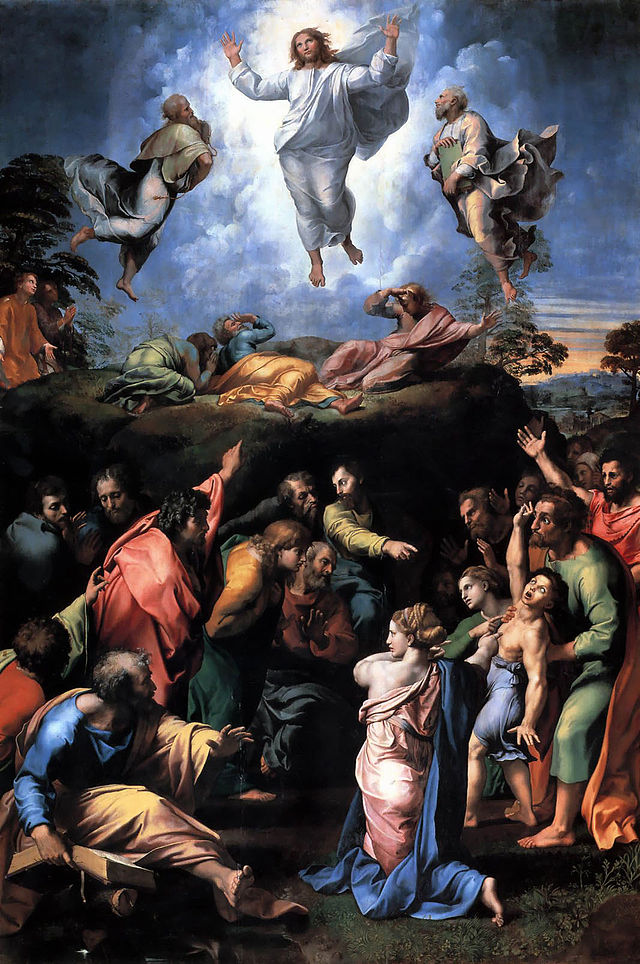
022313The second Sunday of Lent always features the transfiguration. This is done in the first place because we are following the Lord on his final journey to Jerusalem and this journey up Mt Tabor was one of the stops Jesus himself made with Peter, James and John. It is commonly held that Jesus did this to prepare his apostles for the difficult days ahead. There’s a line from an old spiritual which says, Sometimes I up, sometimes I’m down, sometimes I’m almost on the ground…..but see what the end shall be. And this is what the Lord is doing here: he is showing us what the end shall be. There is a cross to get through, but there is glory on the other side.

There also seems a purpose in placing this account here in that it helps describe the pattern of the Christian life which is the paschal mystery. For we are always dying and rising with Christ in repeated cycles as we journey to an eternal Easter (cf 2 Cor4:10). This Gospel shows forth the pattern of the cross, in the climb, and rising, in the glory of the mountaintop. Then it is back down the mountain again, only to climb another mountain, (Golgotha) and through it find another glory (Easter Sunday). Here is the pattern of the Christian life: the paschal mystery. Let’s look a little closer at the Gospel in three stages.

I. The Purpose of Trials. The text says – Jesus took Peter, John, and James and went up the mountain to pray.. Now we often pass over this fact, that they had to climb that mountain. And the climb was no easy task. Any one who has been to the sight of Tabor knows what high mountain it is. The climb was almost 2000 feet, high and steep. It may have taken the better part of a day and probably had its dangers. Once at the top it is like looking from an airplane window out on the Jezreel Valley (a.k.a. Megiddo or Armageddon).

So here is a symbol of the cross and of struggle. A climb was up the rough side of the mountain: exhausting, difficult, testing their strength.

I have it on the best of authority that as they climbed they were singing gospel songs: I’m comin’ up on the rough side of the mountain, and I’m doin’ my best to carry on! Another songs says, My soul looks back and wonders how I got over! Yet another says, We are climbing Jacob’s ladder, every round goes higher, higher.

Now, this climb reminds us of our life. For often we have had to climb, to endure and have our strength tested. Perhaps it was the climb of getting a college degree. Perhaps it was the climb of raising children, or building a career. What do you have that you really value that did not come at the price of a climb….of effort and struggle?

And most of us know that, though the climb is difficult, there is glory at the top is we but endure and push through. Life’s difficulties are often the prelude to success and greater strength.

Though we might wish that life had no struggles, it would seem that the Lord intends the climb for us. For, the cross alone leads to true glory. Where would we be without some of the crosses in our life? Let’s ponder some of the Purposes of problems:

  1. God uses problems to DIRECT us. Sometimes God must light a fire under you to get you moving. Problems often point us in a new directions and motivate us to change. Is God trying to get your attention? “Sometimes it takes a painful situation to make us change our ways,” Proverbs 20:30 says: Blows and wounds cleanse away evil, and beatings purge the inner most being. Another old gospel song speaks of the need of suffering to keep us focused on God: Now the way may not be too easy. But you never said it would be. Cause when our way gets a little too easy, you know we tend to stray from thee. Sad but true, God sometimes needs to use problems to direct our steps to him.
  2. God uses problems to INSPECT us. People are like tea bags.. if you want to know what’s inside them, just drop them into hot water! Has God ever tested your faith with a
    problem? What do problems reveal about you? Our problems have a way of helping to see what we’re really made of. I have discovered many strengths I never knew I had through trials and testings. There is a test in every testimony and trials have a way of purifying and strengthening our faith as well as inspecting our faith to see whether it is really genuine. 1 Peter 1:6 says, In this you greatly rejoice, though now for a little while you may have had to suffer grief in all kinds of trials. These trials are only to test your faith, to see whether or not it is strong and pure.
  3. God uses problems to CORRECT us. Some lessons we learn only through pain and failure. It’s likely that as a child your parents told you not to touch a hot stove. But you probably learned by being burned. Sometimes we only learn the value of something health, money, a relationship by losing it. Scripture says in Psalm 119:71-72 It was good for me to be afflicted so that I might learn your decrees and also in Psalm 119:67 it says Before I was afflicted, I strayed. But now I keep you word.
  4. God uses problems to PROTECT us. A problem can be a blessing in disguise if it prevents you from being harmed by something more serious. A man was fired for refusing to do something unethical that his boss had asked him to do. His unemployment was a problem-but it saved him from being convicted and sent to prison a year later when management’s actions were eventually discovered. Scripture says in Genesis 50:20 as Joseph speaks to his brothers You intended to harm me, but God intended it for good to accomplish what is now being done, the saving of many lives.”
  5. God uses problems to PERFECT us. Problems, when responded to correctly, are character builders. God is far more interested in your character than your comfort. Romans 5:3 says We can rejoice, too, when we run into problems and trials, for we know that they are good for us they help us learn to be patient. And patience develops strength of character in us and helps us trust God more each time we use it until finally our hope and faith are strong and steady. And 1 Peter 1:7 says You are being tested as fire tests gold and purifies it and your faith is far more precious to God than mere gold; so if your faith remains strong after being tried in the fiery trials, it will bring you much praise and glory and honor on the day of his return.

So here it is, the cross symbolized by the climb. But after the cross comes the glory. Let’s look at stage two:

II. The Productiveness of Trials. The text says, While he was praying his face changed in appearance  and his clothing became dazzling white. And behold, two men were conversing with him, Moses and Elijah,  who appeared in glory and spoke of his exodus  that he was going to accomplish in Jerusalem. Peter and his companions had been overcome by sleep,  but becoming fully awake,  they saw his glory and the two men standing with him. As they were about to part from him, Peter said to Jesus,  “Master, it is good that we are here; let us make three tents, one for you, one for Moses, and one for Elijah.” But he did not know what he was saying. While he was still speaking,  a cloud came and cast a shadow over them,  and they became frightened when they entered the cloud. Then from the cloud came a voice that said,  “This is my chosen Son; listen to him.”

All the climbing has paid off. Now comes the fruit of all that hard work! The Lord gives them a glimpse of glory! They get to see the glory that Jesus has always had with the Father. He is dazzlingly bright. A similar vision from the book of revelation gives us more detail:

I turned around to see the voice that was speaking to me. And when I turned I saw seven golden lampstands, and among the lampstands was someone like a son of man, dressed in a robe reaching down to his feet and with a golden sash around his chest. The hair on his head was white like wool, as white as snow, and his eyes were like blazing fire. His feet were like bronze glowing in a furnace, and his voice was like the sound of rushing waters. In his right hand he held seven stars, ….. His face was like the sun shining in all its brilliance. When I saw him, I fell at his feet as though dead. Then he placed his right hand on me and said: “Do not be afraid. I am the First and the Last. I am the Living One; I was dead, and now look, I am alive for ever and ever! And I hold the keys of death and Hades. (Rev 1:12-17)

Yes, all the climbing has paid off. Now comes the glory, the life, the reward or endurance and struggle. Are you enjoying any the fruits of your crosses now? If we think about it, our crosses, if they were carried in faith have made us more confident, stronger. Some of us have discovered gifts, abilities and endurance we never knew we had. Our crosses have brought us life!

  1. The other night I went over to the Church and played the pipe organ. It was most enjoyable and the fruit of years of hard work.
  2. And not only have my own crosses brought me life, but the crosses of others have also blessed me and brought me life. I live and work in buildings that others saved and scrimped and labored to build. I have a faith that martyrs died to hand on to me, that missionaries journeyed long distances to proclaim. See the trials do produce. Enjoy it!
  3. St. Paul says, that this momentary affliction is producing for us a weight of glory beyond all compare (2 Cor 4:14). He also says For I consider that the sufferings of this present time are not worth comparing with the glory that is to be revealed to us. (Rom 8:18).
  4. An old gospel song says, By and by, when the morning comes, and all the saints of God are gathered home, we’ll tell the story, of how we’ve overcome. And we’ll understand it better, by and by.

So then, here is the glory that comes after the climb. Here is the life that comes from the cross. Here is the paschal mystery: Always carrying about in our selves the dying of Christ so also that the life of Christ may be manifest in us (2 Cor 4:10).

III. The Pattern of Trials – The text says, After the voice had spoken, Jesus was found alone. They fell silent and did not at that time tell anyone what they had seen..

Notice that, although Peter wanted to stay, Jesus makes it clear that they must go down the mountain for now and walk a very dark valley, to another hill, Golgotha. For now, the pattern must repeat. The cross has led to glory, but more crosses are needed before final glory. An old spiritual says, We are climbing Jacob’s ladder….every round goes higher, higher, soldiers of the cross!

This is our life. Always carrying within our self the dying of Christ so also that [the rising of Christ], the life of Christ may be manifest in us (cf 2 Cor 4:10).

There are difficult days ahead for Jesus and the apostles. But the crosses lead to a final and lasting glory. This is our life too. The paschal mystery, the pattern and rhythm of our life.

This Homily was recorded and is available in mp3 here: http://frpope.com/audio/2%20Lent%20A%202011.mp3

Here is an excerpt from the Song We are Climbing Jacob’s Ladder. The Text says that every round goes higher, higher! Almost as if imagining a spiral staircase even as the rounds get pitched higher musically. For this is the pattern of our life that we die with Christ so as to live with him. And each time we come back around to the cross, or back around to glory, we are one round higher and one level closer to final glory.


Life is a Dance! A Simple Idea Writ Large

Thou hast turned for me my mourning into dancing (Ps 30:11)

Let them praise his name with dancing, (Ps 149:3)

a time to weep and a time to laugh, a time to mourn and a time to dance (Eccl 3:4)

I will build you up again and you will be rebuilt, O Virgin Israel. Again you will take up your tambourines and go out to dance with the joyful. (Jer 31:4)

Then maidens will dance and be glad, young men and old as well. I will turn their mourning into gladness; I will give them comfort and joy instead of sorrow. (Jer 31:13)

They send forth their children as a flock; their little ones dance about. (Job 21:11)

and while they dance they will sing: “In you all find their home” (Psalm 87:7)

First Person Plural

Multiracial Hands Making a CircleIt is a very brief word that begins the Lord’s prayer, “Our”, as in “Our Father.” Note that it is in the first person plural. Such a little insight, yet such a powerful one.

We live in times that emphasize the first person singular: I, me, mine my rights, my opinion, my choice, my lifestyle, my personal statement, my personal relationship with God, the God of my understanding, etc.

We could probably do with a little more the first person plural. Our Lord, our Father, our family, our children, our Catholic faith, our heritage, our common lot.

Yes, just a little more of the first person plural.

At a funeral yesterday, a priest friend of mine said of the deceased simply, “She lived her life in the first person plural.” And all the assembled nodded their heads as they recalled how she had summoned them to family unity, and lived her life caring for others. Yes, and Ms. Lillie insisted that her children and grandchildren. and great-grandchildren should do the same, living decent, God-fearing lives, living in a way that was respectable, and respected others. And she insisted on justice, caring for those in need in the family, and beyond.

Yes, living our lives in the first person plural, something to think about, something to recover.

It is true, there is a certain glory in the insistence of our modern age on the dignity and the rights of the individual. But too often, we fail to balance it properly with the common good. We do well to remember once again the first person plural. Are we individuals? Yes, but we’re all in this together.

Am I my brother’s keeper? You are indeed. First person plural: “Our Father…”

Signs are not the point, they point to the point. A reflection on our fascination with signs and wonders.

022013In the Gospel for today’s Mass (Wednesday of First Week of Lent) the Lord Lord says, This generation is an evil generation; it seeks a sign, but no sign will be given it, except the sign of Jonah (Lk 11:30). The Lord Jesus says much in this brief verse, but perhaps we can first focus in on the human tendency and even obsession with “seeking a sign” quite usually to the detriment of of more serious matters.

There is a seeming fascination that most people have with signs and visions, with portents and prophecies. Even non-believers seem endlessly to run to “end of the world” prophecies, to doomsayers and predictions of global catastrophes. Mayan Calendars, Nostradamus, Edgar Casey et al. are regular features on the History Channel, Science Channel etc.

Many Christians too seem overly fascinated with end the world scenarios from the Book of Revelation, and 1 Thessalonians. Identifying antichrists, beasts of the apocalypse, 666 and so on has caused rivers of ink to spill and forests of paper to contain the musings over signs and secrets.

Catholics get quite fascinated with all sorts of messages, often said to be from Mother Mary, approved or not. The latest rage is the Prophecy of St. Malachy (most likely a fake). But before this latest rage we’ve been through “three days of darkness” scares, and numerous apocalyptic visions of seers et al. Yes, an endless fascination with all the details an intricacies often takes up a lot of oxygen in the room.

Yes, we humans love signs and secrets, prophecies and portents. Now, to be sure, lest the com box light up too much, there are legitimate prophecies, even beyond the Old Testament, that the Church has recognized as at least worthy of belief and attention. Among these are approved apparitions of the Blessed Mother and locutions and visions of certain saints. But even these must be understood as secondary to the primary sources of Revelation: Scripture and Sacred Tradition. Not only are they secondary, but they are in service of Revelation.

The problem comes, when there is an emphasis of signs and wonders (even in legitimate apparitions) over the solid food and main staple of our diet, Divine Revelation. When fascination of the details of secondary things, eclipses an appreciation of the clearer and more primary things.

And this is one aspect of what Jesus condemns, that an “evil age” seeks a sign.

It is as if to say, this age, seeks more to be intrigued than to discover the truth and live it; to be entertained rather than enlightened and evangelized. It is an age that craves curiosities more than conversion, is more interested in a kind of side-show thrill than in repenting and doing daily work of believing; it is an age that seeks relief more than true healing, fascinating facts, rather than full faith. Too easily we maximize the minimum and minimize the maximum, we stress the significance of signs more than the seriousness of sin.

But signs point somewhere they are not THE point. If I see a sign that says “Washington” with an arrow, I don’t park there and say I am in Washington. I do not stop and take pictures of the sign and endlessly study its intricate details. No, I take a quick look and I go where the sign points, I go to the fuller reality it indicates. The sign is not the point, it points to the point.

And thus Jesus lifts up the sign of Jonah as the proper paradigm for signs and says,

No sign will be given [this present evil age]…except the sign of Jonah.  Just as Jonah became a sign to the Ninevites, so will the Son of Man be to this generation. …at the preaching of Jonah they repented, and there is something greater than Jonah here.”

In other words the Ninevites did not just ponder the sign of Jonah and endlessly debate its intricacies and connection to other prophecies, they followed the sign, they repented. They sought God to whom the sign pointed and begged his mercy.

And so too for us. Simply being fascinated by and collecting all the latest details of some prophecy, be it a seer, a doomsayer, an apparition, whether approved, unapproved or yet to be approved is not enough. We must follow the sign.

And frankly, any true seer or prophet is only going to say what we already know: Repent and Believe the Gospel. They are not going to add to Revelation at all. If Seers and prophecies pronounce the end of the world, we already know that, “Children it is the final age” (1 John 2:8).

Mother Mary predicted wars at Fatima, we already knew that: “Wars and rumors of wars” (Mk 13:7). The critical thing Mother Mary said was not about wars, it was about repentance. And what she said at Fatima, she had already said at Cana, “Do whatever my Son tells you!” (Jn 2:5).

The danger is that in our endless fascination with the details, and our debates about the hidden meanings of signs, we miss “the point” of a sign. Signs point, and every true sign points to only one thing: Repent and believe the Gospel.

Jesus says plainly that of this “present evil age” (cf Gal 2:1) only one sign will really be given: the Sign of Jonah. So whatever Mother Mary has said, whatever Sr. Faustina, St. Margaret Mary, and many others have said, it all comes down to one thing: Repent and believe the Gospel.

Don’t get lost in the weeds, don’t debate too many details, or emphasize non-essentials. don’t miss “the point” of every true sign: Repent and believe the gospel. In all the variations, only one sign is given. Follow where it points, Repent and believe.

A Case for Communion in an unlikely place.

I was tipped off by a parishioner  to a social commentary in an unlikely place, a journal for Engineers, called ECN. In the article Karl Stephan, Consulting Engineer, Texas State University, San Marcos writes on the decline of the average American worker to find stability in the workplace, and that this instability has ripple effects in the family and does not make our future as a culture very bright.

Karl Stephen refers to this decline as a problem with “communication” But his use of the term as he defines it is closer to what we in the theological world call communion, or Koinonia.

In his own insightful way he points out that if we cannot find and maintain a higher degree of communion, we are likely doomed to steady decline as a culture and will not be able to sustain the taller growths that have led to our great achievements of the past 100 years.

Let me present a few excerpts for your consideration along with my own commentary in red. These are excerpts, the full article is here: Do We Know What We Are Doing?

Back in the 17th century, the word [“communication”]used to mean “anything good that two or more people have in common.” Communication meant not just talk, but trade, education, the town or country where people live together, institutions of all kinds—in short, the whole social fabric of benevolent interaction among human beings..

Again, I would argue that what he enunciates here is close to our concept of communion (koinonia) at least at the human level.

We may be facing a future in which the coming generation increasingly cannot find work that allows them an adequate means of social communication….

A big factor in this problem is the deterioration of the family structure, which is both a cause and an effect of economic changes. The family is probably the most vital and intimate form of social communication of all. Any nation which neglects the preservation and encouragement of the family will sooner or later end up running on fumes, because mentally and physically healthy, disciplined, competent workers capable of long-range planning do not simply grow on trees. They typically come from healthy families, and the fewer of those there are, the fewer upstanding citizens we will have to work with in the future.

Exactly. As a pastor who has had a School associated with his parish for much of my priesthood, I can also attest that much of what we describe as a problem with education, and much of what we ascribe to poorly run schools, is more often a problem rooted in family decay.

It may not be realistic to suppose we can turn out brilliant scholars and above average students, when nightly we send these children home to dysfunctional families and often highly deleterious situations in their homes.

The same is true for catechesis. It is not realistic to suppose that teaching children for an hour a week, no more than 30 days out of the year is going to bear a lot of fruit when they go back to homes where,  God is seldom mentioned, and the teaching of the Church and Scriptures are ignored or openly defied.

It is a true fact that our schools need great reform, as does catechesis, but one cannot wholly lay the blame at the feet of educators and catechists. Even very effective programs are not going to bear much fruit in the absence of a good family setting.

Our author speaks sobering words when he says, Any nation which neglects the preservation and encouragement of the family will sooner or later end up running on fumes…. Indeed the soil in this country grows ever thinner and we are less and less able to sustain the taller growths demanded if we wish to see the kind of technological and economic progress that we have in the past.

[In recent decades] the new-model corporation [has] emerged leaner, meaner, and more efficient….Engineers made these productivity gains possible with all the technology, communications systems, and automation improvements that have come online in the last several decades. [But as he will point out, people got left behind and were increasingly seen as an inefficiency in a system that prizes efficiency above all].

[But] corporate America is becoming a victim of its own success. In 1947, lifetime employment of wage-earners working for large corporations was the norm, and over that lifetime the average hourly worker with only a high-school education could expect to get married, buy a house, a couple of cars, have some kids, and maybe put one or two of the kids through college. And that is pretty much what happened.

Today, by contrast, a person starting out even with an advanced college degree can expect during one’s career to work for many companies, most of which will get bought out, restructured, or moved offshore at some point, and even engineers with good starting salaries will be fortunate to be continuously employed without large gaps in employment or having to do extensive retraining at several points…..

Yes, both of my brothers, and most of my parishioners are caught up in this instability in modern life. Even some of the largest and most stable companies of the past have been bought out, sold, or are endlessly reworked. Job security seems to be a thing of the past, even at the highest levels.

All of this causes serious social ripples, especially at the level of the family. It is hard to underestimate the toll that uncertainty takes, as well as the social costs of being uprooted and frequently forced to move about the country. 

I certainly know as a priest that parish life is rendered far less stable with all the moving about many Catholics are expected to make. Fewer and fewer are the parishioners who have been in the parish a long time. A nearby parish that caters  mainly to Capitol Hill workers has few families for longer than five years. Developing leadership, vocations and other works requiring committed stability is difficult.

Not only is the high-school dropout of today unable to get a decent job; he can’t afford many of the things that today’s economy makes. That drying up of the domestic market is what Mr. Friedman sees as the really ominous cloud on the horizon. Already, many U. S. companies are finding that their growth markets are mainly overseas.

Yes, economic isolation is growing and a permanent underclass is being formed among those who cannot academically compete. I find that many College Grads in my parish are competing for jobs as simple Admin assistants, even store clerks, and fast food workers.

If even college grads are fighting for these jobs, what does that say to those who for economic or academic reasons cannot get college degrees? What it says is that they will spend most of their life economically isolated and standing little chance of any upward mobility.

The despair that even college grads face, let alone mere High School grads does not bode well for social stability and health in the decades ahead.

We assume that this is because domestic markets are simply saturated, but maybe they are actually shrinking because the less-employed U. S. workers can’t afford to buy the things that the corporations make. The result? Millions of young people who can’t get a decent job, can’t afford stable relationships and the other promises of the American dream, and who may turn America into something closer to one of those countries where mobs of unemployed young men create continual civil unrest…..

Ominous. Last summer we look with shock as European Youth rioted in the streets. And while the roots of that unrest are linked to socialism, the picture we saw last summer may be repeated here for different reasons. The current economy shows little signs of suddenly opening up to a wider job market. Social and economic mobility seem increasingly locked down, new doors seem unlikely to suddenly open up. 8% unemployment (the real number is far higher and we all know it), has become so “normal” that it isn’t even reported anymore.

All of this becomes a downward cycle as the current economy further destabilizes the communion necessary for strong communities and families. And as those institutions further destabilize, the capacities for producing strong well trained workers and problem solvers further diminishes. And as  strong well trained problem solvers and those who invent new technologies and industries recede from the scene, the capacity to pull out from the decline further erodes, and the downward cycle continues. Add to all this the stifling of creativity by growing government regulations and intrusive policies, and a kind of perfect storm is emerging.

At the end of the day the communion we so desperately need seems increasingly hard to find. Marriages happen later as young people strive to find elusive stability before marriage. And families in crisis or families that are formed only very late tend to be small and lacking in the synergy most necessary for a favorable future.

As our author points out, communion, or as he calls it “communication” is at the heart of our problem, and at the heart of the solution. It is as he says, not just the ability to talk, but also to trade, give and receive education, to have some roots in the town or country and live together with others is an historical less ephemeral way. It is stably participating in institutions of all kinds. In short it is the whole social fabric of interaction among human beings.

All of this is strained today, at almost every level. Even in the Church, the decline in Holy Communion is not only problematic, it is emblematic of tear in social communion at every level.

It is the work of the Devil to divide and he has succeeded well. Spare us O Lord and restore our lost communion. Without you, and without one another we fall, and indeed great is our fall. Parce Domine, et miserere!

A Critique of Moral Relativism in a Monkees Song?

021813There is a song about the sadness of moral relativism in an unusual place: “The Greatest Hits of the Monkees.”

Some who are old enough may remember growing up with the songs of the Monkees. I confess their song “Only Shades of Gray” was not one I remember well from those days. But it is a fascinating song about moral relativism.

Some think it’s just a song about growing up. But to most it speaks of a time when things were more certain and compares it to these more modern times when it seems everything is disputed and up for grabs, no more black and white, only shades of gray.

It is all the more poignant that the song was written in the turbulent 60s and, perhaps, represented the anxiety generated by those times when just about everything was being thrown overboard.

Now I know that it is wrong to point any particular age as the “golden age.” Scripture itself warns against this: Do not say: How is it that former times were better than these? For it is not in wisdom that you speak this (Ecclesiastes 7:10). I am also aware that not everyone feels the same about the “good old days.” For some they were not all that good. We should not forget the terrible wars of the early half of the 20th Century. Further, I serve in a parish that is predominantly African American and for many of my parishioners previous days featured “Jim Crow” laws, disenfranchisement, lynching and enforced segregation.

And yet, it remains also true that some fifty years ago we had a much wider consensus on basic moral teachings and appropriate behaviors.

  1. Premarital sex was considered gravely wrong and guarded against, even if it was not perfectly observed. Remember chaperons and separate dormitory facilities?
  2. Easy divorce and remarriage was considered wrong, and it was in fact legally difficult to get divorced.
  3. Abortion was illegal
  4. And it never even entered our minds to give children in school contraceptives.
  5. There was also strong consensus against homosexual activity and the thought of homosexuals demanding to marry and being taken seriously was something that would have seemed from an episode the Twilight Zone.
  6. Families were larger and most were intact.
  7. There was also a general appreciation of the role of faith and prayer in American life.
  8. I could go on but perhaps this is enough.

Here too I can hear the objections: “We might have had those standards but we didn’t live them well…. Things went on behind the scenes, families weren’t perfect, many kids still had sex etc. etc….”

But I will respond by saying, At least we had those standards and saw them as truths to be respected. It is an extreme measure, a kind of nihilism, to say that since we do not live up to our standards perfectly we should not have them at all.

And I also know we were more wrong about some things in the past. We were more racist and less open to legitimate diversity, less concerned about pollution. But here too it is extreme to say that because we were wrong about some things in the past the whole thing should be thrown out. Why not keep the best and purify what is needed?

So here we are today, is a radically relativistic and nihilistic time where there is less and less agreement about the most basic of moral issues. And, without a common basis for discussion, such as Natural Law, or the Judeo-Christian worldview, we are left to a battle of wills, an increasing power struggle where the one who shouts the loudest, has the most money, wins an election or has the most access wins, at least for the moment.

It is what Pope Benedict has described as the “Tyranny of Relativism.” Reason and principles increasingly do not transcend political, economic and social distinctions. There are fewer and fewer shared values that every one agrees on no matter what their party or background. Public policy is rooted more in power than in right reason. We are a culture without a “cultus” i.e. without God, or even a higher truth outside ourselves to which we all look and have general agreement. Closed in ourselves and our own little world we are like crabs in a basket, fighting and clawing for the top. There is nothing we acknowledge from above to order us.

Whatever our struggles of the past, we used to agree on more. Many of those certainties have been replaced by a wide presumption that everything is just shades of gray.

Listen to the song. Don’t forget my disclaimers. I do not propose a simplistic old=good; new=bad scenario. I just write to provoke thought. Please feel free to comment. . First the words, then the video.

  • When the world and I were young,
  • Just yesterday.
  • Life was such a simple game,
  • A child could play.
  • It was easy then to tell right from wrong.
  • Easy then to tell weak from strong.
  • When a man should stand and fight,
  • Or just go along.
  • Refrain:
  • But today there is no day or night
  • Today there is no dark or light.
  • Today there is no black or white,
  • Only shades of gray.
  • I remember when the answers seemed so clear
  • We had never lived with doubt or tasted fear.
  • It was easy then to tell truth from lies
  • Selling out from compromise
  • What to love and what to hate,
  • The foolish from the wise.
  • It was easy then to know what was fair
  • When to keep and when to share.
  • How much to protect your heart
  • And how much to care.

“I am the One Who fished you out of the mud, Now come over here and listen to me.”A Meditation on the Fear of the Lord.

021713Perhaps it will be of help to develop a theme set forth in the Gospel this past Sunday. The Lord Jesus at one point rebukes the devil and says, Away from me, Satan! For it is written: ‘Worship the Lord your God, and serve him only.'” (Lk 4:8)

Jesus is tapping into the Old Testament vision of the “Fear of the Lord” as Deuteronomy says,

Fear the LORD your God and serve him. Hold fast to him and take your oaths in his name. (Deut 10:20)

or again

Fear the LORD your God, serve him only (Deut 6:13).

I have written extensively on the “Fear of the Lord” HERE and HERE.   But for our purposes here let us reflect on the magnificent gift that it is to fear the Lord. And, if you don’t mind, I’d like to begin with the personal.

I want to say that I am awestruck, utterly astonished, at how good God has been to me. His gifts to me have amazed me. I do NOT deserve them and can only conclude that I received them for the benefit of others AND that God is utterly gratuitous, giving gifts simply because He is good, rather then because we are deserving.

I want to add that even the setbacks in my life have been “gifts in a strange package.” I have come to discover that even the dark passages, wherein I grew lost and angry, have now turned to bless me. My crosses have become the tree of life for me by His grace.

Let me repeat, I am utter astonished, dumfounded, amazed, astounded, bewildered, blown away, boggled, bowled over, overwhelmed, startled, stunned, stupefied, and taken aback by God’s love, grace and mercy.

Why do I say all of this (other this in profound gratitude)? Because, this is most fundamentally what it means to “Fear the Lord.” To fear the Lord is not a cringing fear, which waits for a punishing blow. It is a holy reverence, born in love and deep appreciation, indeed awe at Who God is, and how good and holy He is.

To fear the Lord is to hold Him in awe, It is to be amazed at what he has done for me.

In every Mass Jesus says, “Do this in remembrance of Me.” What does it mean to remember? To remember is to have so present in my mind and heart what the Lord has done for me, that I’m grateful, and I’m different. It is to go to the foot of the cross and finally have it dawn on me that He died for me.

And as that happens, as I begin to realize what He has done, my heart is broken open, and love, appreciation and gratitude begin to flood in. A deep love and holy reverence, an awe begins to fill my heart.

This is the Holy Fear of the Lord.

And out of this Holy Fear, born in love and appreciation, I dread, that is I fear, the thought of ever offending God who has been so good to me.

This is the Holy Fear of the Lord. I invite you to visit the links above to see how this is born out in scripture.

In this fear, this appreciative love, we want to obey God, we are eager to serve and reverence Him, because He is good, not merely because he can punish.

I am mindful of an old rabbinic tale which meditates on why God, over and over again says, when giving the Law in Deuteronomy ends every command with the expression “I am the Lord.” (e.g. Lev. 22) An Old Rabbi, unnamed, says,

Let me tell you what God means when he says this! He is saying, ‘Look! I am the One who fished you out of the mud, Now come over here and Listen to me!

Indeed, yes Lord, You have been good to me! You have done more than fish me out of the mud, you have saved me from Hell, you snatched me from the raging waters and set me on firm rock. Yes Lord, I love you, and whatever you want, I want. Whatever you don’t want, I don’t want it.

This is the Fear of the Lord. Ask for this holy gift. It is the solution to many temptations.

The Gospel Train reaches Temptation Station: Stay on Board Children! A Meditation on the Gospel for the First Sunday of Lent

021613There’s an old Gospel song tradition that speaks of the Christian life as a ride on the “Gospel Train.” But the Gospel Train not always and easy ride with perfect scenery. But you gotta get your ticket for the Gospel Train and stay aboard.

Mysteriously, the train sometimes passes through difficult terrain and life’s temptations. But just stay on board! Jesus too, on his way to glory faced trials, hatred, and even temptation (yet without sin).

Today the Gospel Train pulls into “Temptation Station” and we are asked to consider life’s temptations. The three temptations faced by Jesus are surely on wide display in our own times. What are these temptations and how do we resist them?

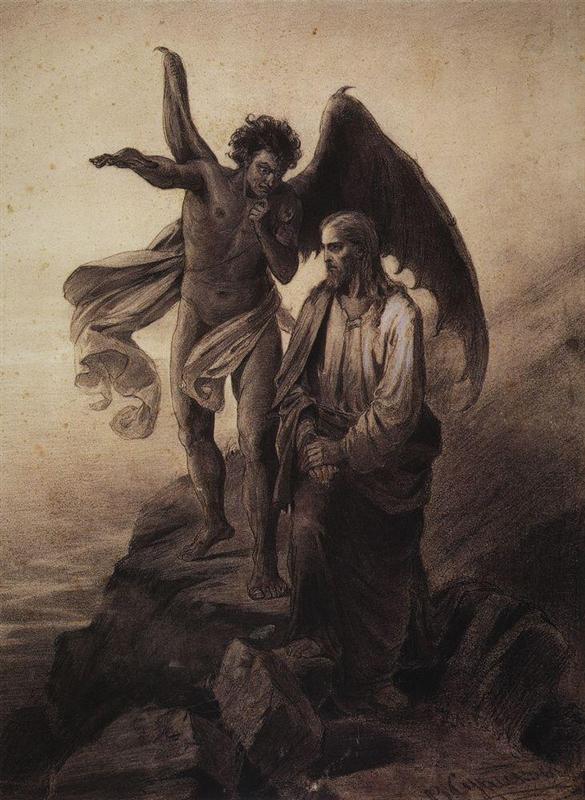
In the desert scene of this Gospel, the Lord Jesus faces down three fundamental areas of temptation, but all of them have one thing in common: they seek to substitute the cross for a couch.

In a way the devil has one argument: “Why the Cross?!” And his question is not a real one, but a rhetorical one. He wants you to blame God for the cross, and, in your anger, to reject God as some despot.

Well, pay attention Church, the cross comes from the fact that you and I, ratifying Adam and Eve’s choice, have rejected the tree of life, for the tree that brought death. We, along with satan (I refuse to capitalize his name) may wish to wince at, and scornfully blame God for the Cross, but in the end, the cross was our choice.

And if you think that you have never chosen the tree of death and that God is “unfair,” then prove to me that you have never sinned, and I’ll accept that you never chose the Tree of the Knowledge of Good and Evil,  over the Tree of Life and that you deserve something better than the cross. I’ll accept that you never insisted on “knowing” evil as well as good.

Otherwise, you’ve made the same self-destructive, and absurd choice that the rest of us have, and it is not God that is cruel but we who are wicked who are to blame for the presence of the cross. And, thus  the cross comes not from God but from us.We ought to stop blaming God for evil, suffering and the Cross and look into the mirror. And the glory of this gospel is that the Lord Jesus enters into this twisted world of OUR making and endures its full absurdity for our sake. If there is evil in this world, it is our choice, not God’s.

OK, are we over “blame God” thing and ready to focus on our own issues? If that be the case then let us look to some areas of temptation that satan is able to exploit because WE indulge them.  Let us also see the answer that the Lord Jesus has for these temptations. For the Lord, though tempted, never yields.

1. Pleasures and Passions The devil encourages Jesus to turn stones into bread. After having fasted, the thought of bread is surely a strong temptation. In effect the devil tells Jesus to “scratch where it itches,” to indulge his desire, to simply give in to what his body craves.

We too have many desires and we too are told by the devil in many ways to scratch where it itches. Perhaps no generation before has faced temptation in this area so strongly as we. We live in a consumer culture that is well skilled at eliciting and satisfying our every desire. All day long advertisements reach into our mind to excite desire and to advise that we MUST fulfill our every desire and wish. If something is out of stock or unavailable in exactly the form we want we are indignant. “Why should I have to wait? Why can’t I have it in that color?” and so forth. The advertiser’s basic message is “You can have it all!” This is a lie of course but it is told so frequently that we feel entitled to just about everything.

Some of our biggest cultural problems are problems of over-indulgence. We are a culture that struggles with obesity, addiction, sexual misconduct, greed, and an over-stimulation that robs us of an attention span, and this causes boredom to be a significant issue for many who are too used to the frantic pace of a video game or action movie. We have done well in turning stones to bread.

To all this Jesus rebukes the devil by saying, “Man does not live on bread alone.” In other words there are things that are just more important and bread and circuses, than creature comforts and indulgence. Elsewhere Jesus says, “A man’s life does not consist in the abundance of his possessions.” (Lk 12:15). I have written on this in another post: The Most Important Things in Life Aren’t Things

2. Popularity and Power –  Taking Jesus up a high mountain the devil shows him all the nations and people of the earth and promises them to him if Jesus but bow down and worship the devil. This is a temptation to power but also to popularity for the devil promises him not only sovereignty but also glory.

Since most of us are not likely to attain to sovereignty, and since temptation is only strong in those matters that seem possible for us, I will focus on popularity. Here too we face a lot of this in life. One of the deeper wounds in our soul is the extreme need that most of us have to be liked, popular, well thought of, respected, and to fit in. We dread being laughed at, scorned or ridiculed. We cannot stand the thought of feeling minimized in any way.

For many people the desire for popularity is so strong that they’ll do almost anything to attain it. It starts in youth when peer pressure “causes” young people to do lots of stupid stuff. They will join gangs, get tattoos, piercings, wear silly clothes. Many a young lady desperate to have a boyfriend and thus feel loved and/or impress her friends, will sleep with boys or do other inappropriate things to gain that “love.” As we get older we might be willing to bear false witness, make compromises etc to advance our career, lie to impress others, spend money we don’t have to buy things we don’t really need, to impress people we don’t really like. Likewise, we can tempted to be silent when we should speak out for what is right and so forth.

All of this is a way of bowing before the devil since we are, in effect, willing even to sin in order to fit in, advance, or be popular. Here Jesus says, You shall worship the Lord, your God, and him alone shall you serve.

The real solution to this terrible temptation to popularity is to fear the Lord. When we fear God we need fear no one else. If I can kneel before God, I can stand before any man. If God is the only one we need to please, then we don’t have to run around trying to please everyone else. Here too I have written on this matter elsewhere: What Does It Mean To Fear the Lord?

3. Presumption and Pride Finally (for now) the devil encourages Jesus to test God’s love for him by casting himself off the highest wall of the Temple Mount. Does not scripture say that God will rescue him? The devil quotes Psalm 91: With their hands they will support you, lest you dash your foot against a stone. In our time the sin of presumption is epidemic.

Many people think that they can go one behaving sinfully, recklessly, and wantonly and that they will never face punishment. “God is love!” they boldly say, “He would never send anyone to hell or punish!” In saying this they reject literally thousands of verses of Scripture that say otherwise. But they have refashioned God, and worship this idol. “God does not care if I go to Church,” they boldly declare, “He does not care if I live with my girlfriend.” The list continues to grow.

The attitude is that no matter what I do God will save me. It is boldly presumptive to speak and think like this. It is true that Hell and punishments are difficult teachings to fully comprehend and square with God’s patience and mercy. Nevertheless God teaches it and we need to stop pretending that it really isn’t for real. This is presumption.

I have written elsewhere on the topic of Hell and why it makes sense in the context of a God who loves and respects us: Hell Has to Be.

A mitigated form of presumption is procrastination wherein we put off our return to the Lord day after day. Of this it is said,

There were three demons summoned by satan as to their plan to entrap as many human beings as possible. The first demon announced that he would tell them there is no God. But Satan wasn’t too impressed. “You’ll get a few, but not many, and even those atheists know deep down inside that someone greater than them made them and all things.” The Second demon said he would tell them there was no devil. But satan said, “That won’t work, most of them have already met me and know my power. Finally the third demon said, “I will not tell them there is no God or no devil, I will simply tell them there is no hurry!” And satan smiled an ugly grin and said, “You’re the man!

And thus presumption, pride and their ugly cousin presumption are widespread today.

Jesus rebukes satan by quoting Deuteronomy: You shall not put the Lord, your God, to the test. We ought to be very careful about presumption for it is widespread today.

This does not mean we have to retreat into fear and scrupulosity. God loves us and is rich in mercy, but we cannot willfully go on calling “no big deal” what God calls sin and takes seriously. Hence we should be sober about sin and call on the Lord’s mercy rather than doubt we really need it and just presume God doesn’t mind etc.

Our train is leaving the station soon. It is to be hoped that you and I have benefited from this brief stop and have stored up provisions for the journey ahead such as: insight, resolve, appreciation, understanding, determination and hope.

The journey ahead is scenic but also difficult and temptations are a reality. But as the Old Gospel Song says: The Gospel train’s a’comin’, I hear it just at hand. I hear the car wheel rumblin’ And rollin’ thro’ the land. Then Get on board, Children, Get on board, there’s room for many a more!

Never heard the song? Here it is: