When I was younger and through my seminary years I had usually seen the crucifix and Jesus’ suffering on the cross in somber tones. It was my sin that put him there, had made him suffer. The cross was something that compelled a silent reverence, and suggested to me that I meditate deeply on what Jesus had to go through. Perhaps too I would think of Mary and John and the other women mournfully beneath the cross beholding Jesus slowly and painfully dying. These were heavy and somber notes, but deeply moving themes.
In addition the crucifix also called forth memories that I must carry a cross and go through the Fridays of my life. I needed to learn the meaning of sacrifice.
Liturgically I also saw the crucifix as a way of restoring greater reverence in the Mass. Through the 70s and 80s parishes had largely removed crucifixes and replaced them, quite often, with “resurrection crosses,” or just an image of Jesus floating in mid air. I used to call this image “touchdown Jesus” since he floated in front of the cross with his arms up in the air as if indicating a touchdown had just been made. In those years we had moved away from the understanding of the Mass as a sacrifice and were more into “meal theology.” The removal of the crucifix from the sanctuary was powerfully indicative of this shift. Many priests and liturgists saw the cross as too “somber” a theme for their vision of a new and more welcoming Church, upbeat and positive.
A cross-less Christianity tended to give way to what I thought was a rather silly celebratory style of masses in those years and I came to see the restoration of the Crucifix as a necessary remedy to restore proper balance. I was delighted when, through the mid 80s and later, the Vatican began insisting in new liturgical norms that a crucifix (not just a cross) be prominent in the sanctuary and visible to all. Further, that the processional cross had to bear the image of the crucified, not just be a bare cross.
Balance Restored – I was very happy about these new norms (and still am) because they restore the proper balance in seeing the Mass as a making present of the once-for-all perfect sacrifice of Jesus on the cross. It is also a sacred meal, but it is the sacrifice that gives it its power. I further thought that such a move would help restore greater and proper solemnity to the Mass, and to some extent this has been true.
All of this background just to say that I saw the Cross, the crucifix, in somber, serious tones, a theme that was meant to instill solemnity and sobriety, a meditation on the awful reality of sin and our need to repent. And all of this is fine and true.
But the Lord wasn’t finished with me yet and wanted me to see another understanding of the Cross. He wanted to balance my balance!
In effect he wanted me to experience also the “good” in Good Friday. For while the cross is all the things said above, it is also a place of victory and love, of God’s faithfulness and our deliverance. There’s a lot to celebrate at the foot of the cross.
It happened one Sunday in Lent of 1994, one of my first in an African American Catholic Parish. It being Lent, I expected the highly celebratory quality of Mass to be scaled back a bit. But, much to my surprise, the opening song began with an upbeat, toe-tapping gospel riff. At first I frowned. But the choir began to sing:
Down at the cross where my Savior died,
Down where for cleansing from sin I cried,
There to my heart was the blood applied;
Glory to His name!
Ah, so this WAS a Lenten theme! But how unusual for me to hear of the cross being sung of so joyfully. (You can hear the song in the video below; try not to tap your toe too much).
It was something quite new for me. Perhaps it shouldn’t have been but it was. The 70s and 80s Catholicism that had been my experience found it necessary to remove the cross to celebrate. But here was celebration with and in the cross! Here was the good in Good Friday.
The Choir continued:
I am so wondrously saved from sin,
Jesus so sweetly abides within;
There at the cross where He took me in;
Glory to His name!
Congregation and choir were stepping in time and clapping, rejoicing in the cross, seeing it in the resurrection light of its saving power and as a glorious reflection of God’s love for us. Up the aisle the procession wound and the last verse was transposed a half step up, an even brighter key:
Oh, precious fountain that saves from sin,
I am so glad I have entered in;
There Jesus saves me and keeps me clean;
Glory to His name!
Yes, indeed, glory to his name! A lot of dots were connected for me that day. The cross indeed was a place of great pain, but also of great love, there was grief, but there was also glory, there was suffering, but there was victory.
Please do not misunderstand my point. There IS a place and time for quiet, somber reflection at the foot of the cross. All the things said above are true. But one of the glories of the human person is that we can have more than one feeling at a time. We can even have opposite feelings going on at almost the same moment!
The Balance – Some in the Church of the 70s and rejected the cross as too somber a theme, too negative. They wanted to be more upbeat, less focused on sin, and so, out went the cross. There was no need to do this and it was unbalanced. For at the cross, the vertical, upward pillar of man’s pride and sin is transected by the horizontal and outstretched arms of God’s love. With strong hand, and outstretched arms the Lord has won the victory for us: there at the cross where he took me in, glory to his name!
And the Balance is for the individual, and for the Church. For some prefer a more somber meditation on the cross to prevail and others feel moved by the Spirit to joyfully celebrate at the foot of the Cross. The Church needs both, and I suppose we all need some of both experiences . Yes, it right to weep at the cross, to behold the awful reality of sin, to remember Christ’s sacrifice. But rejoice too, for the Lord has won victory for us, right there: Down at the Cross. There’s a lot of good in Good Friday.
Here is the song I heard that Sunday in 1994, sung in very much the style I heard.
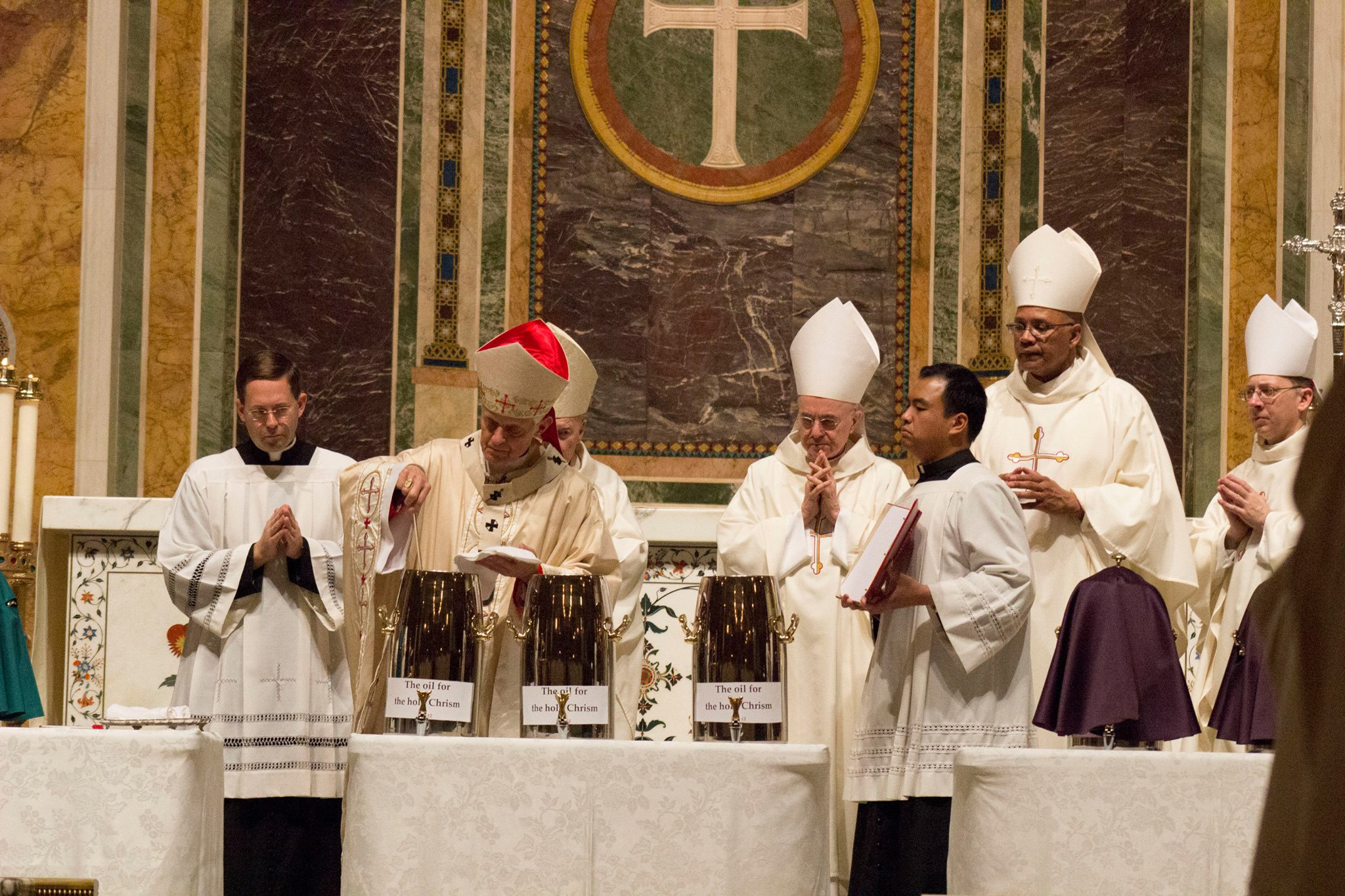
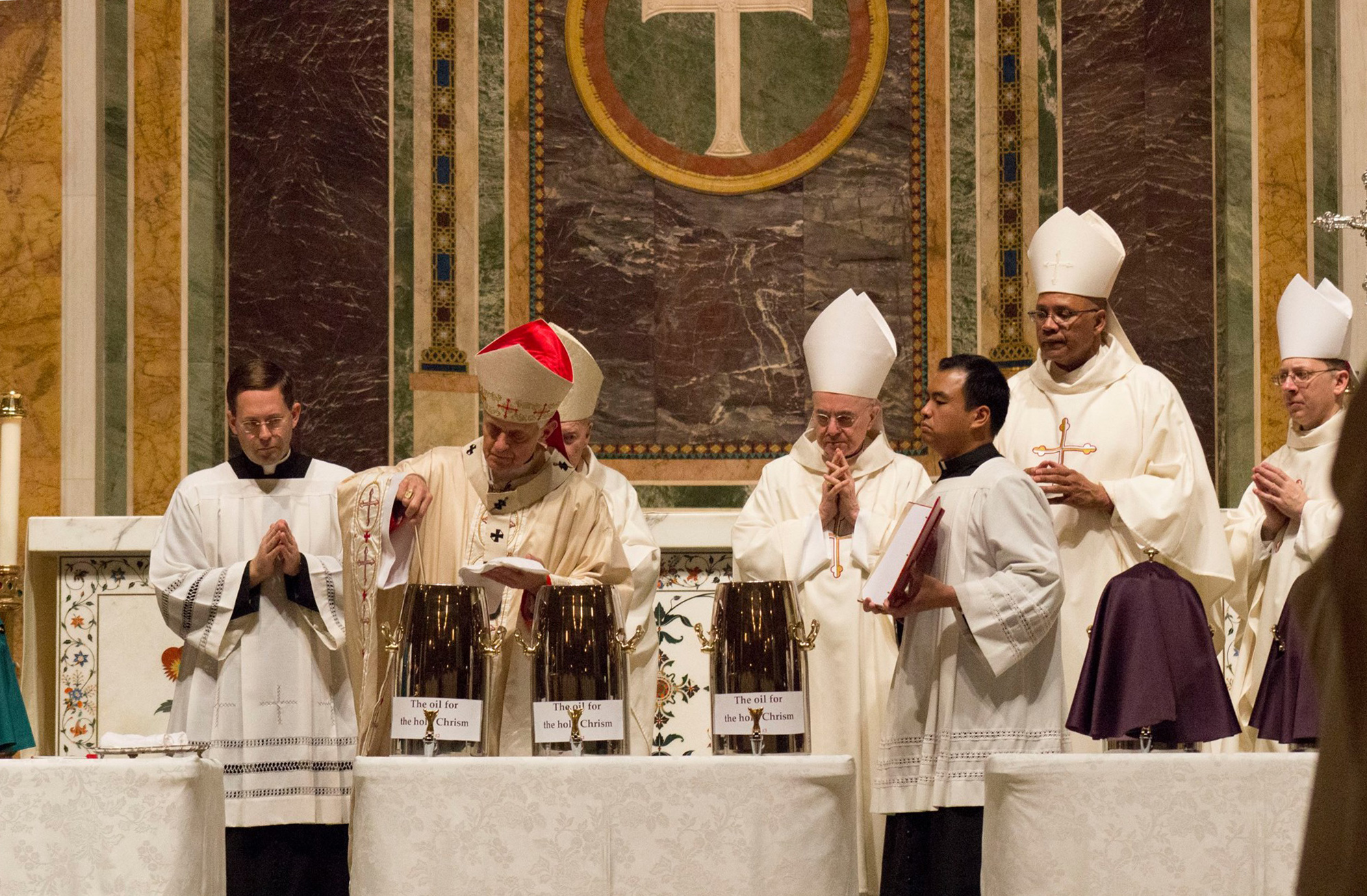
Tonight we celebrated the Chrism Mass for the Priests of the Archdiocese of Washington, and Cardinal Wuerl gave an insight that he shares partially on his own blog, and developed a bit further in the homily tonight.
Let’s begin with what he posed on his own blog regarding the election of the Pope:
What a joy it was when that plume of white smoke came out of the chimney of the Sistine Chapel announcing the election of a Pope. Almost an hour passed between the emergence of the smoke and the arrival on the balcony of Cardinal Jean-Louis Tauran to announce “Habemus papam!” (“We have a Pope!”). Yet already in the Square during that wait there were roars of “Viva il Papa!” (“Long live the Pope!”). Without even knowing who was chosen to be the new Pope the crowd, estimated at about 100,000 people, were already rejoicing and wishing him well. This scene said something quite profound. We wish well the Pope whoever he is – because he is the Pope – the Successor to Peter.
How true this is. We Catholics were prepared to love the Pope and support him long before we knew his name. Somehow, for faithful Catholics, we instinctively know, despite all the anti-authority attitudes of Western culture, that the Pope is Christ’s true vicar and the one who unites us. Whatever his name, nationality or background, he represents Christ, and is the successor to Simon Peter to whom the Lord entrusted the task of uniting and strengthening us, whom the devil would sift (divide) like wheat. (cf Luke 22:31)
And thus, even before knowing the name of the Pope we cried out: Viva il Papa!
But as Cardinal Wuerl went on to develop in tonight’s homily, we must not overlook the “N” that is in the Eucharistic prayer. And thus we see reference to “N., our Pope,” and “N., our Bishop.” “N” of course stands for “Name.”
At first glance the “N” reminds us that the men in those offices come and go, though the office remains.
But we must also not forget that, except for brief periods, that “N” is filled in with a name of an actual person. “N” signifies a real man. For our allegiance to the Lord Jesus, through the Pope and our Bishop, cannot simply be an abstraction. Our unity with the Lord and one another cannot only be a concept or idea. Rather it is incarnationally lived and experienced in union with the actual “N” who holds that office. I am not merely in union with the Pope or the Papacy, but rather with Francis our Pope, and, for me, Donald our Bishop.
This is important especially in the context of the Protestant notion of the (so-called) “invisible Church.” For most of them the “Church” is not something or anything to which they can actually point and say, “Now here is a manifestation of the Church.” Rather, for most of them, the Church is an invisible and hyper-spiritualized entity. In a way it can mean almost anything the individual believer says it means, and one can pretty much set their own parameters for what the Church means to them.
But Catholicism is incarnational. And while admitting that there are obviously spiritual dimensions to the Church, we insist on understanding the Church incarnationally and sacramentally.
Consider the sacraments for example. They convey spiritual realities, but are mediated through physical and incarnational realities: Water, bread, wine, oil, the laying of hands and so forth. Ritual and human interaction are essential to faith in the Catholic, and I would argue biblical, understanding of faith and the Church. Christ Jesus does not merely speak out of the ether to individual believers in their rooms. He speaks through his Church, and through the Word, sacraments and rituals he inspired within his Church.
None of this is an abstraction or generality. Jesus is not just an idea and did not merely leave teachings behind. He is an actual person, Human and Divine. And rather than write a book or simply leave teachings behind, he founded an actual Church, with actual leaders, structures and sacraments. Jesus called actual men to be is Apostles, and an actual man, Simon Peter to unite and strengthen the apostles and all the faithful through them.
And so too today, there is an actual Church, actual successors to the apostles, and and actual representative of Christ, an actual vicar (or representative of Christ the Head) to whom we can point: Francis our Pope. There are actual successors to the apostles, whom we can name. For me it is “Donald” our Bishop.
So the Church is not some invisible or ghostly reality. And like any sacrament, the spiritual reality of the Church is manifest incarnationally through physical realities and actual people to whom we can point.
There’s something about the “N” in Eucharist prayer, something beyond the abstract, the general, something beyond a mere idea. Indeed, “N” is not merely something, it is someone: Francis, Donald, your own bishop’s name.
No “invisible Church” here. Quite visible (see photo above), quite incarnational.
There is an important “logion” (utterance) of Jesus on his way to the cross that speaks powerfully to this modern age of ours, and is fulfilled in a gruesome manner in our times.
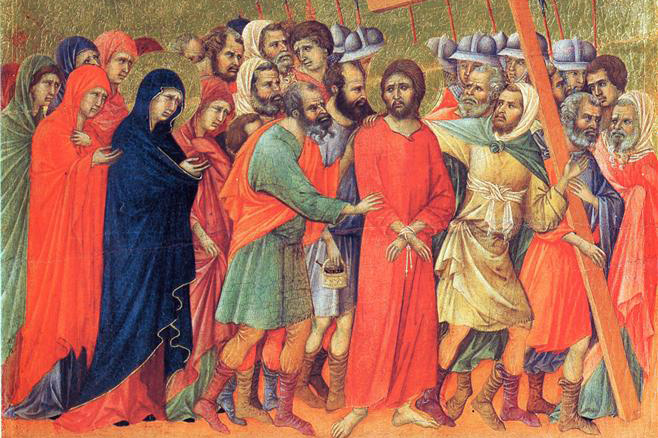
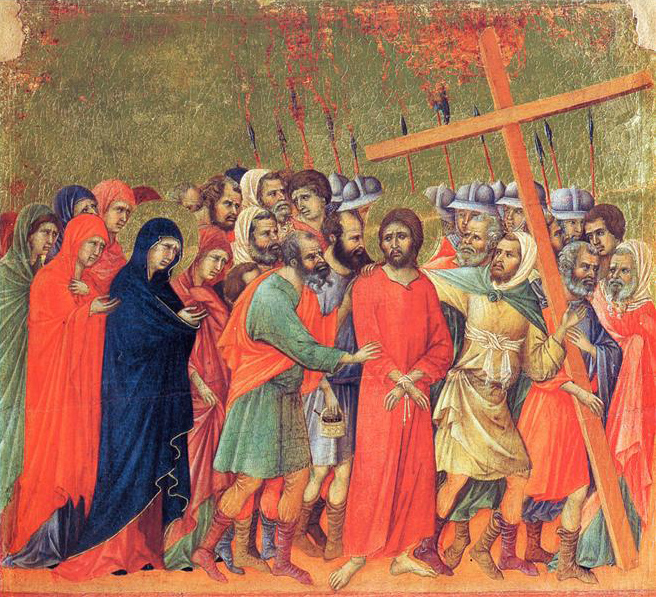
It is the word of Jesus to the women who lamented him as he made his way to Crucifixion:
A large crowd of people followed Jesus, including many women who mourned and lamented him. Jesus turned to them and said, “Daughters of Jerusalem, do not weep for me; weep instead for yourselves and for your children for indeed, the days are coming when people will say, ‘Blessed are the barren, the wombs that never bore and the breasts that never nursed.’ At that time people will say to the mountains, ‘Fall upon us!’ and to the hills, ‘Cover us!’ for if these things are done when the wood is green what will happen when it is dry?”
In this text is a likely historical context rooted in the First Century. But Scripture, as I pray you know, was not written merely for First Century Christians. It also speaks to our times. In fact it may speak more ghoulishly to our times than to the First Century, as we shall see. Lets take a look at the First Century context, only briefly, and then turn attention to our owns times.
The First Century context of Jesus’ words is surely rooted in 70 AD and the terrible culmination of a 3 1/2 Year war of the Jewish people with the Romans, (66-70 AD – The War actually culminated with the fall of Masada in 73AD). Jesus had spoken of this terrible war extensively in i the the Mount Olivet Discourse (Matthew 24:1 – 25:46; Mark 13:1-37; Luke 21:5-36), and He even wept as he looked upon Jerusalem just before his Palm Sunday entrance:
As he approached Jerusalem and saw the city, he wept over it and said, “If you, even you, had only known on this day what would bring you peace—but now it is hidden from your eyes. The days will come upon you when your enemies will build an embankment against you and encircle you and hem you in on every side. They will dash you to the ground, you and the children within your walls. They will not leave one stone on another, because you did not recognize the time of God’s coming to you.” (Luke 19:41-44)
And now, as these woman weep for him, we weeps for them and their children. For indeed, the says are coming, in forty short (biblical) years when they will see a destruction so overwhelming that, as Josephus records, 1.2 million Jews will die. And the terrible and suicidal phrase of asking the mountains to fall on them etc. are a Jewish way of lamenting that death is preferable to the calamity that is upon us!
And so we see the First Century fulfillment of the passage. Indeed, those women who lamented him had little idea about how awful it would get for them and their children, for sin and rebellion, hatred and revenge, would have their way, and boil over like a cauldron. 70 AD would bring a bloodbath like the world had never seen until that time.
But what of us? How, does this text speak to us? It a word or three: Horribly, poignantly and prophetically.
It does not take a genius to see that the Lord’s words are true for us in ugly and sickening ways. Our bloodbath is far worse that 70 AD. 55 million are dead from abortion in America alone since 1973. And add to that the 100 Million + who were killed in the last century alone for ideological purposes in two world wars, a cold war, and the pogroms and systematic starvation of Stalin, Mao, Pol Pot and their successors.
Though we like to think ourselves civilized in comparison to previous centuries, our blood bath is far deeper than any age before. True, we murder our millions in less publicly brutal ways. We do not experience hoards of warriors descending from day to day on unsuspecting cities. Our brutality takes place in more hidden ways, out of sight if you will, in concentration camps, abortion “clinics”, killing fields, and remote locations away from cameras.
Yes, our murder seems more abstract, but it is not. The death toll is almost unimaginable. And meanwhile we go on considering ourselves civilized.
And the Lord Jesus, looking beyond 70 AD must have seen our times and had them in mind when he said to those women of old that they would see an enemy (Satan): dash you to the ground, you and the children within your walls.
Yes, Satan has deceived us with deceptions of power, distortions of freedom, and crushing lies of “choice.” 55 million dead in American alone since 1973, our children dashed to the ground.
The Lord goes on to say, the days are coming when people will say, ‘Blessed are the barren, the wombs that never bore and the breasts that never nursed.’ Yes, and those days are here, days when people celebrate barrenness, have themselves surgically sterilized, and celebrate contraception. The days are here when the greatest danger seems to be the “terrible and fearsome proposition” of getting pregnant, of having “too many children.”
Yes, the days are here when most people cry out: blessed is barrenness, blessed are small families. Life it would seem, is a terrible burden to be contracepted and aborted away and some awful threat. It is an age that cries out “Blessed the career women who has not stymied her life and progress by the terrible and terrifying prospect of children.”
Yes, said the Lord to those ancient women, in effect, “You think this is bad? The days are actually coming when things will be so bad and so dark that people will celebrate NOT having children, will celebrate barrenness.”
But the Lord does not stop there. He goes on to describe quite well the culture of death so literally lived out in our times: people will say to the mountains, ‘Fall upon us!’ and to the hills, ‘Cover us!’
One may argue that this is just a Jewish way of speaking that indicates despair. Perhaps. But we live it out quite literally in our times, for it is the refrain of the culture of death. And what is the culture of death? It is the mentality that increasingly sees the death or non-existence of human beings as the “solution” to problems. In our times there has arisen a group of radicals who see human beings as a hindrance to their ecological goals, and they seek population reductions and even dream of a pristine earth without humanity. They peddle History Channel programs such as “Life after People” as a kind of fantasy of their vision and advocate contraceptive and abortive policies that see mankind as the problem that must be eliminated. In effect they cry to the mountains “fall on us” and dream of a world that is “post-human.” They even peddle disaster movies as though they were longing for it all.
You may say, I exaggerate. Fine. But would you ever dream we would be were we are today in fifty short years of social engineering, and anti-life policies?
Jesus spoke to the women that day of their own time, but surely his words describe our own times in sickening detail, times where barrenness is exalted and the fertility of large families treated with shock and even contempt, times where extremists have infected the modern psyche with notions that human beings are worse than roaches on this planet and that things will be better without us, or with dramatically fewer of us.
Of times like 70AD and times like these Jesus says, “Weep.”
Yes, Blessed are those who mourn for they shall be comforted. (Matt 5:4). And who are those who mourn? They are those who see the awful state of God’s people, that God is not know to them, that they do not glorify God or even know why they were made, they are confused, deceived, and misled. And some, seeing this are mourning and weeping, they are led to prayer and action, to speaking out, and pointing once again to the light, from the dark places of times like these.
Mourn with Jesus, and pray for a miraculous conversion for times like these, times which seem eerily consistent with the dreadful things Jesus prophesied.
The Passion which we read in today’s liturgy is too long to comment on in detail. We are only able to take a portion and examine it.
The usual villains such as the Temple leaders, Judas, and the recruited crowd, which shouted “Crucify him!” are fairly obvious in displaying their sinfulness and are unambiguously wicked.
But there are others who participate in the Passion accounts whose sinfulness, struggles and neglect are more subtle, but still real and contribute significantly to the Lord’s sufferings on Good Friday. It is, perhaps, in these figures that we can learn a great deal about ourselves. For while we may not overtly shout “crucify,” we are often not as holy and heroic as the persecutors were wicked and bold.
As these behaviors are noted, we must understand that WE do these things. For the Passion accounts are not merely portraits of people long gone, they are portraits of you and me. We do these things.
So, lets look at sins and weaknesses of Jesus followers (us) in three stages.
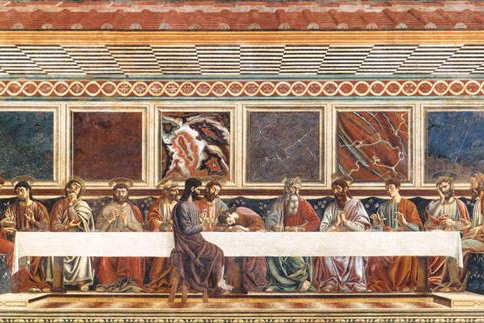
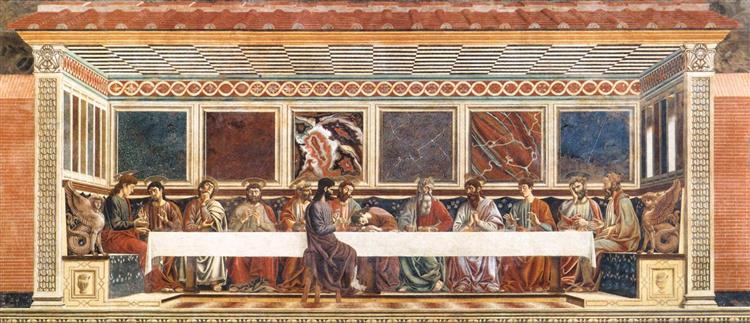
I. The Perception that is Partial – In the middle of the Last Supper, in today’s Gospel the disciples of Jesus are reminded of what the next days will hold. Jesus says,
I have eagerly desired to eat this Passover with you before I suffer, for, I tell you, I shall not eat it again until there is fulfillment in the Kingdom of God…for the Son of Man indeed goes as it has been determined; but woe to that man by whom he is betrayed…..It is you who have stood by me in my trials;
and I confer a kingdom on you, just as my Father has conferred one on me, that you may eat and drink at my table in my kingdom; and you will sit on thrones judging the twelve tribes of Israel.
But note that the apostles are reminded of these facts of Jesus coming sufferings in the context of future glory. Yes, He will suffer, but so as to usher in a Kingdom. Jesus does not merely preach the Cross, he preaches the glory that comes from this cross. He does it here, and he has said this to them before on a few occasions. For example:
From that time on Jesus began to explain to his disciples that he must go to Jerusalem and suffer many things at the hands of the elders, chief priests and teachers of the law, and that he must be killed and on the third day be raised to life. (Matt 16:21)
When they came together in Galilee, he said to them, “The Son of Man is going to be betrayed into the hands of men.They will kill him, and on the third day he will be raised to life.” And the disciples were filled with grief. (Matt 17:22-23)
We are going up to Jerusalem, and the Son of Man will be betrayed to the chief priests and the teachers of the law. They will condemn him to death and will turn him over to the Gentiles to be mocked and flogged and crucified. On the third day he will be raised to life!” (Matt 20:19)
Thus we see that the Lord has consistently tried to teach and prepare them for the difficulties ahead. He has told them exactly what is going to happen, AND, how it will end: NOT in death, but rising to new life, not in defeat but the ushering in of a new Kingdom, of light over and against the kingdom of darkness.
But though he has told them over and over, they still do not understand or see. They will be overwhelmed by the cross and all of the (except John) will flee.
Why? For their perception is partial and they will see only the negative, and forget that he has promised to rise. Since they cannot see beyond the apparent defeat of the moment they will retreat into fear and not boldly and confidently accompany him to his passion and glorification (for his passion IS is lifting up, his glorification). Instead they will flee. He has shown the “what the end shall be.” But they cannot see or accept it. Thus fear overwhelms them and draw back into a sinful fear and disassociation from Jesus.
Only a few, Mary his Mother, John, Magdalene, and a few other women would see him through to the end.
We too can easily suffer from a perception that is partial. For the Lord has often told us, that if we trust, our struggles will end in glory and new life. But, blind and forgetful, we give way to our fears and fail to boldly walk the way of Christ’s passion. We draw back and disassociate ourselves from Jesus and exhibit some of the same tendencies and problems we will now observe in the people of that day.
So lets examine some of the problems that emerge from the partial perception and forgetful fear of many of the disciples and others.
II. The Problems Presented – The problems that emerge are at least five. They are unhealthy and sinful patterns that emerge from the fear generated in not trusting Jesus vision and refusing to see it. We can consider them one by one. Please understand that the word “we” used here is shorthand and does not mean that every single person does this. Rather, it means that, collectively, we have these tendencies. But no need to take everything here personally.
A. DUPLICITY – In today’s overall liturgy there is a kind of whiplash, for we begin by the shout “Hosanna!” And within minutes, we then shout “Crucify Him.” And in this we see both our inconsistency and even outright duplicity. The book of James says, From the same mouth come blessing and cursing. My brothers, these things ought not to be so. (James 3:10) But it often is so and thus we see first, our duplicity.
B. DEBATES and DISTRACTIONS – The scene of the Last Supper is as disgraceful as it is sad. Jesus has just announced that he will be betrayed. And rather than focus on the common enemy and threat, the apostles get into a debate among themselves about who is the greatest. In the midst of this debate Judas is able to slip away.
We too often permit our common enemy, Satan, to go untouched, while we debate and posture and among ourselves. We don’t even lay a glove on him since we are too busy fighting each other. We squabble over power, prestige and possessions.
Within the Church we argue over liturgy, vestments and styles of music, who has power or prominence, who is in what wing of the Church etc. We spend endless energy arguing over the significance of the Pope wearing red shoes and ermine or not, and Judas (Satan) goes about unhindered. Meanwhile we have lost the culture. Satan has shredded our families, schools, and other key institutions. He slips away unharmed. And we argue over polyester vestments.
Our distractions and debates gravely harm our capacity to focus on pushing back the kingdom of darkness. In John’s account as Judas slips away, John writes simply, “It was night.”
And so it is night in our culture. And it has become so very dark on our watch, as we are distracted by endless debates about things that are secondary. Satan s lips away into the darkening night of our culture and great harm has come while we debate on. We are endlessly distracted while our enemy goes forth unhindered.
C. DROWSINES– One of the common human techniques for dealing with stress and the hardships of life is to just go numb and drowsy. We can just doze off into a moral sleep.
Being vigilant to threats posed to our souls by sin, or the harm caused by injustice, (whether to ourselves or others) is just too stressful. So we just tune out. We stop noting or really even caring about critically important matters.
We anesthetize ourselves with things like creature comforts, meaningless distractions, alcohol or drugs. We go into a kind of moral sleep and we begin to lack a prayerful vigilance. Prayer and spirituality pose too many uncomfortable questions.
So we just tune out and daydream about meaningless things like what a certain Hollywood star is doing, or what the latest sports stats are.
In the passion accounts, Peter, James and John are personally asked by the Lord to pray with him. But they doze. Perhaps it is the wine. Surely it is the flesh (for the Lord speaks of it). But unwilling or unable to deal with the stress the Lord is clearly under, they just tune out, go numb, and doze off.
Grave evil is at the very door. But they sleep on. The Lord warns them to stay awake, lest they give way to temptation. But still they sleep. Someone they know and love is in grave danger, but it is too much, so they just tune out, much as we tune out at the overwhelming suffering of Christ in the poor and needy. We just stop noticing. It’s too painful, so we tune out.
The Lord had often warned them to be vigilant, sober and alert (Mk 13:34, Matt 25:13, Mk 13:37; Matt 24:42; Luke 21:36, inter al). Other scriptures would later pick up the theme (Romans 13:11; 1 Peter 5:8; 1 Thess 5:6, inter al). For drowsiness is a significant and serious spiritual problem.
Sadly God described us well when he remarked to Isaiah: Israel’s watchmen are blind, they all lack knowledge; they are all mute dogs, they cannot bark; they lie around and dream, they love to sleep. (Is 56:10)
But, despite the sleepiness of the disciples, the wicked are still awake, and the threat does not go away by a drowsy inattentiveness to it. Thus we ought to be confident and sober. Life’s challenges are nothing to fear, for the Lord has told us we have already won, if we trust him. But the disciples have forgotten Jesus promise to rise after three days. And so, often, have we. So they, and we just give way to stress and tune out.
D. DISASSOCIATING– Peter, confronted with the fearful prospect of being condemned with Jesus denies that he knows him or is one of his followers. He disassociates himself from Christ.
We too, confronted with the possibility of far lesser things like ridicule, will often deny a connection with the Lord or with the Church. Someone might say of one of the more controversial passages of scripture (such as prohibitions on divorce, fornication, homosexual activity, commands to tithe, etc), “Oh, you don’t really believe that, do you?” And it’s too easy to give way to fear and either say “no” or to qualify our belief. Why suffer ridicule, endure further questioning, or experience the unpleasantry of debate?
So we just disassociate, compromise, or qualify our faith to avoid the stress. We even congratulate ourselves for being tolerant, etc. when we do it.
Jesus says, If anyone is ashamed of me and my words in this adulterous and sinful generation, the Son of Man will be ashamed of him when he comes in his Father’s glory with the holy angels. (Mat 16:21).
But too easily we ARE ashamed. And so, like Peter, we engage in some form of denial. Peter was afraid because he has forgotten to “see what the end shall be.” He has forgotten that Jesus will rise after three days. So too do we often forget that. So we lack confidence and give way to fear, and we deny, so as to avoid suffering with Jesus.
E. DODGING – Simply put, when Jesus is arrested, all the disciples except John split. They “get the heck out of Dodge.” They are nowhere to be found. One of them, (could it be Mark himself?) ran off naked.
After Jesus’ arrest, it is said that Peter, prior to his own denials had followed the Lord, “at a distance” (Mk 14:54) but as soon as trouble rose, he too scrammed.
And we too can run. Sometimes it’s persecutions from the world. But sometimes its just our own self-generated fear that following the Lord is too hard, and involves too many sacrifices we are just not willing to make. Maybe it will endanger our money since the Lord insists that we tithe and be generous to the poor. Maybe it will endanger our playboy lifestyle since the Lord insists on chastity and respect. Maybe we are doing something we have no business doing, that is unjust, excessive or sinful. But, rather than face our fears, whether from within or without, we just high-tail it out.
The disciples forgot that Jesus has shown them what the end shall be. In three days he would win the victory. But, this forgotten, their fears emerged and they ran. We too, must see what the end shall be to resist and confront our many fears.
F. DEFLECTING – Now in this case our example is Pontius Pilate, not one of the disciples. But the fact is that Pilate was summoned to faith, just like anyone else. “Are you a King?” he asked Jesus. And Jesus responds by putting Pilate on trial: “You say so.” In other words, “It is you who have said these words. Do you think they are true?”
The fact is, Pilate has a choice to make. Either he will accept what Jesus is saying as true, or he will give way to fear and commit a terrible sin of injustice.
In order to avoid making a stance Pilate sends Jesus to Herod. But Herod deflects as well. Now the texts all make it clear that Pilate knew Jesus was innocent. But, because he feared the crowds he handed Jesus over.
Now, note PILATE did this. The crowds tempted him through fear, but HE did the condemning. The text says, The verdict of Pilate was that the demand of the crowd should be granted. Matthew’s account has him say, I am innocent of this man’s blood,” he said. “It is your responsibility!” (Mat 16:21).
Well, actually Pilate, it is also YOUR responsibility. You had a choice and you made. Your own career and hide were more important that justice. And, though you wanted to do what was right and were sympathetic with Jesus, merely wanting to do what is right is not enough.
So too for us. We also will favor our career or hide over what is right. And in so doing we will often blame others for what we freely choose. “I am not responsible, my mother dropped me on my head when I was two” ….etc.
In effect we are often willing to say, “Look Jesus, I love you. You get my Sundays, and my tithe and, generally I obey you. But you have to understand, I have a career, I need to make money for my family. If I really stand up for what is right, I might not make it in this world. You understand, don’t you?…I know the company is doing some things that are unjust, I know the world needs a clearer witness from me….and I’ll do all that, after I retire. But for now…..well, you know. It’s really may boss whose to blame. It’s this old hell bound sin soaked world that’s to blame. Not me!” And we wash our hands and excuse our silence and inaction in the face of injustice and sin.
And all this is done in fear. We placate the crowd and give them what they want.
We forget what the end shall be and get focused on the fearful present. We lack the vision Jesus is trying to give us that in three days we will rise with him. But we stay blind to that and only see the threat of now.
III. The Path that is Prescribed – OK, by now you ought to know the path that is prescribed: See what the end shall be! In three days we rise! Why are we afraid? Jesus has already won the victory. It is true, we get there through the cross. But, never forget what the end shall be! Today we read the Gospel of Friday, but wait till Sunday morning! I’ll rise!
We end where we began with this gospel: and I confer a kingdom on you, just as my Father has conferred one on me, that you may eat and drink at my table in my kingdom; and you will sit on thrones judging the twelve tribes of Israel.
Yes, after he has been raised, Jesus will go before us into Galilee. And for us, Galilee is heaven. Whatever our sorrows, if we are faithful we will see Jesus in the Galilee of heaven. Never forget this vision. After three days we will rise with him and be reunited in Galilee. One day we will reign with him, if we hold out and journey to Galilee.
So take courage, see what the end shall be! The end for those who are faithful is total victory. We don’t need to drowse, destroy, deny, dodge and deflect. We’ve already won. All we need to do is hold out.
An old Gospel songs says, I promised the Lord that I would hold out! He said he’s meet me in Galilee! So hold out, Galilee is not far, in three days we rise with him.
Back in February I gave a talk to a large group (300+) at the Blessed John Paul II Shrine here in Washington. The topic was a pastoral plan for the family. The video of that talk became available recently and I thought I’d share it here.
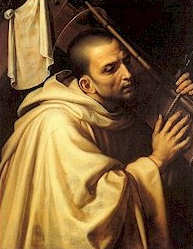
In yesterday’s Post we considered the 12 Steps of Pride set forth by St. Bernard of Clairvaux. In escalating ways, the 12 twelve steps draw us up to an increasingly mountainous and enslaving pride.
St. Bernard also lists the 12 steps to deeper humility (I am using the list from Vultus DeiHERE) and it is these that we consider in this post. As with yesterday’s post, the list by St. Bernard is in red, but the commentary on each step are my own poor reflections. Take what you like and leave the rest. For St. Bernard’s own reflections, consider purchasing the book he wrote: Steps of Humility and Pride.
(1) Fear of God– to fear the Lord is to hold God in awe. It is to be filled with wonder and all at all God has done, and who he is.
Cringing, servile fear is not counseled here. Rather, the fear rooted in love and deep reverence for God is what begins to bring us down the mountain of pride.
It is a look to God, and away from ourselves and our egocentric tendencies, that begins to break our pride.
Scripture says The fear the Lord is the beginning of wisdom (Prov 9:10). To fear the Lord is to turn to the Lord, seeking answers, seeking meaning, realizing that in God is all wisdom and knowledge. To fear the Lord is to hunger and thirst for his truth and righteousness. To fear the Lord is to look outside and upward from myself to God.
Here begins our journey down the mountain of pride, a simple and loving look to God who alone can set us free from the slavery that pride and sinfulness created for us.
(2) Abnegation of self-will – In the garden, Jesus said to his father, Father, not as I will, but as you will (Lk 22:42). And this is what abnegation of the will means. It is to be willing to surrender my will to God’s will, to subsume my decisions under his.
Pride demands to do what it pleases, and to determine whether it is right or wrong. But in this stage of humility I am willing to look to God.
The Saints say, “If God wants it, I want it. If God doesn’t want it, I don’t want it.” The prideful person says “How come I can’t have it? Its not so bad. Everybody else is doing it.”
But on the journey away from pride, and having come to a fear of the Lord, now the we are more joyfully ready to listen to God, and to submit his vision will for us.
(3) Obedience – And now, having obtained to a more humble disposition of heart, we are more capable and wiling to obey. Obedience moves from the hearing to the heeding of God’s word, of God’s holy will, and of being willing to surrender our stubborn wills. We are made ready, by God’s grace, to execute that will, to obey and put into action the will of God. And thus the descent of the mountain of pride begins apace, toward the freedom of the children of God, little by little.
(4) Patient endurance – , Embarking on this journey down the mountain of pride and striving to hear and understand God’s will and to obey him, one can surely expect obstacles both internally and externally.
Our flesh, that is, our sin nature, does not simply and wholeheartedly surrender, but continues to battle. Our flesh resists prayer, resists being submitted to anything other than his own wishes and desires. And thus, internally, we suffer resistance from our sinful nature.
But little by little we gain greater self-discipline and authority over our unruly passions. This is truly a struggle, requiring patience, and an enduring spirit and will.
Externally too, we often encounter resistance as we try to come down from the mountain of pride. Perhaps old friends seek to seduce us back to former ways. Perhaps too the structures of our pride remain standing; structures such as willfulness, self-reliance, powerful positions, etc., continue to draw us away from our intentions come down the mountain of pride and further embrace humble submission to God. Perhaps the world continues to demand that we think and act out of old categories that are not of God, and still hold us bound to some extent.
Patient endurance is often required to see such things born away. Yes, it often takes years of patient and persistent action, even decades, for the sinful world dominated by structures of sin and rebellion, to lose its grip on us.
(5) Disclosure of the heart – Perhaps the most humble journey, as we come down the mountain of pride, is the journey in to our wounded hearts. Scripture says, More tortuous than all else is the human heart; beyond remedy; who can understand it? I, alone, the LORD, explore the mind and test the heart (Jer 17:10).
To make this journey, requires a lot of humility as we see our sinful drives, and also many misplaced priorities. We must often uncover unpleasant memories, and even trauma from the past, that we have experienced or have inflicted on others. And in that place of our heart we are called repentance and to show forgiveness and mercy, or to accept that we must be forgiven and shown mercy.
We may be asked to remember and to realize that we have not always been 100% right, and that we have sometimes acted unjustly and sinfully toward others, that we have a times been insensitive. This is a very humbling journey, but a necessary one as we continue to come down from the mountain of pride.
(6) Contentedness with what is – Contentedness is a form of acceptance and is a very great gift to seek and to receive. We can distinguished a kind of external and internal contentedness.
External acceptance is rooted in the capacity to live serenely in the world as it is, and to realize that God allows many things we don’t prefer for a reason and a season. Acceptance does not connote approval of everything. Indeed there are many things in the world that we ought not approve of. But acceptance is the willingness to humbly live and work in a world that is neither perfect nor fully according to our preferences. Some things we are called to change, other things to endure. And even in those things we are called to change, we may have to accept that we cannot change them quickly or at all right now. Jesus told a parable about the wheat and tares and cautioned not to act precipitously to remove the tares, lest the wheat be harmed. It is a mysterious fact that God leaves many things unresolved and part of our journey in humility is discern what we are empowered to change and what we must come to accept as beyond our ability to change.
Internal contentedness is a gratitude for what we have and a freedom from resentment about what we do not have. In pride we demand that our agenda, our menu be fully followed. In our journey toward humility we come to be more content to gratefully accept what God offers and to say, “It is enough O Lord. I am most grateful!”
(7) Lucid self-awareness – In pride we are often filled with many delusions about our self, and usually think more highly of our self than we ought. We are often unaware of just how difficult it can be to live or work with us.
But as we continue down the mountain of pride, fearing the Lord, submitting our will to his in docility and obedience, being more honest about the deep recesses of our heart, our disordered drives and unrealistic agendas, we are now increasing prepared to embrace true humility.
Humility is reverence for the truth about our self. It is a lucid self awareness that appreciates our gifts, remembers that they ARE gifts. And it is an awareness also of our struggles and of our on-going need for repentance and the grace of God.
With lucid self awareness I am increasingly learning to know my self more as God knows me (cf 1 Cor 13:12). This is because, as we come down from the mountain of pride into deeper humility, God discloses more to us just who we really are. We become more and more the man or woman God has made us to be, and our self-delusions and the unrealistic demands of the world begin to fade. The darkness of these illusions is replaced by a lucidity of self awareness where we are able to see and understand our self in a less ego-centric way. We are mindful of what we are doing, and thinking, and how we interact with God and others. But we do this in a way that strongly aware of the presence and grace of God. We come to self awareness in the context of living conscious contact with God throughout the day.
(8) Submission to the common rule – The ego-centric and prideful person resists being told what to do and is largely insensitive to the needs of others and the common good. The proud man thinks he knows better than the collective wisdom of the community.
But as our journey down the mountain of pride continues, into deeper humility, we become more aware of the effects we have on others and how we must learn to interact and cooperate with others for goals larger than our self. Humility teaches that the world does not simply revolve around me and what I want, and that sometimes the needs of others are more important than my own. Humility helps us accept that laws exist most often to protect the common good and that, while individual rights are also important to protect, humility make me more willing to submit my personal needs and agenda to the needs of others and the wisdom of the wider community.
(9) Silence –Silence is a respectful admission that other people have wisdom to share and important things to share. The proud person interrupts frequently and quickly thinking he knows already what the other person is saying or that what he has to say is more important. But as humility grows, we become better listeners, appreciating that others may be able to offer us knowledge or wisdom that we currently lack.
(10) Emotional sobriety – Many of our emotional excesses are rooted in pride and ego-eccentricity. When we are proud we are easily offended, easily threatened. For fear begets anger.
And, as we saw yesterday, the initial stages of pride are often rooted in inordinate curiosity, mental levity and giddiness. All of these things cause our emotional life to be excessive and disordered.
But as we now grow deeper in humility we are less ego-centric and thus we are less fearful and less easily offended.
And having our mental life focused on more substantial and less frivolous things, also adds stability to our thought life. We are less carried off into gossip, intrigue, rumor and so forth. We are less stirred up by the machinations of advertisers and less disturbed the 24/7 “breaking news” cycles of the cable news marketers. We are more thoughtful and less likely to rush to judgments that often unsettle us.
The humble person trusts God more and is thus not easily unsettled by all these mental machinations. And it is thoughts that generate feelings.
Thus as our thought life becomes more measured, and our conclusions more humble and careful, our emotions are less volatile and we attain to an emotional serenity and sobriety.
This is a very great gift to seek and cultivate by God’s grace.
(11) Restraint in speech – As we are more emotionally stable, less anxious, and stirred up, our speech and demeanor reflect our serenity. We are less likely to interrupt, to speak in anger or be unnecessarily terse or harsh. We don’t need to “win” every debate but are content perhaps to stay in the conversation or be content to sow seeds and leave the harvest for later or for others. Our serenity tends to lower our volume and speed in talking and we are more able and content to speak the truth in love, with clarity, but also with charity.
(12) Congruity between one’s inside and one’s outside – We saw in yesterday’s post on pride, the problem of hypocrisy. The Greek word “hypocritas” refers to acting. Hypocrites are actors playing a role that is not really them.
The proud and the fearful are always posturing and aligning themselves with what makes for popularity and profit. But as humility reaches its goal, integrity, honesty and sincerity come to full flower.
This is because, by the gift of humility, we open ourselves to be fully formed by God. Having turned our look to God, and made the journey into our heart, we discover the man or woman God has made us to be, and we begin to live out of that experience in an authentic and non-pretentious way. Since, by humility we are more focused on God we are less nervously self-conscious.
By the gift of lucid self-awareness described above, we are comfortable in our own skin. We do not need to posture, dominate, compare or compete. Rather, our inner spiritual life and focus on God now inform our whole self.
Humility has now reached its goal, for humility is reverence for the truth about our self. We are sinners who are loved by God. And as we make the journey to discover our true self before God, we become ever more grateful and serene, and we live out of this, inner life with God are enabled to walk humbly with our God (Micah 6:8).
Thanks be to God for these insightful lists of St. Bernard of Clairvaux and St Benedict which has so aided in this reflection! Pray God we all are able to make the journey down form the mountain of pride and into deeper humility.
So you think the idea of the 12 Steps is new. Well, if you think you’ve got a new idea, go back and see how the Greeks put it, or in this case how the Medieval Latins put it. St. Bernard of Clairvaux identified twelve steps up the mountain of pride. These are detailed in a work by him entitled Steps of Humility and Pride.
In today’s post we focus on the Twelve Steps of Pride. Tomorrow, on the Twelve Steps of Humility (from St Benedict’s rule). Here I list the 12 Steps of Pride only briefly and give a brief commentary on each which is mine, so don’t blame St. Bernard. 🙂 Again, the list is his. The inferior comments are mine.
One will note how the 12 steps grow far more serious as we go along and and lead ultimately to the slavery of sin. The steps tend to build on one another, beginning in the mind, moving to behavior, and then to deepening attitudes of presumption and ultimately bringing forth revolt and slavery. For if one does not serve God, he will serve Satan.
Twelve steps up the mountain of pride. Think of these like escalating symptoms:
(1) Curiosity – There is such a thing as healthy curiosity but often we also delve into things we ought not: other peoples affairs, private matters, sinful things and situations, and so forth. What makes such curiosity to be annexed to pride is that so often we think we have a right to know things we do not. And hence we pridefully and indiscreetly look into things that we ought not, things that are not for us to know, or which are inexpedient and distracting for us, or perhaps the knowledge which we seek is beyond our ability to handle well. But casting all caution aside, and with a certain prideful and privileged sense we pry, meddle, and look into things we ought not as if we had a right to do so. This is sinful curiosity.
(2) Levity of mind – Occupying our mind with things not appropriate grows and we tend to become playful in wider matters. Here too, there is a valid sense of humor and a kind of recreational diversion that has a place. A little light banter about sports or pop culture may provide momentary diversions that are relaxing. But too often this just about all we do and we pridefully cast aside matters about which we should be serious and pursue only light and passing things. In ignoring or making light of serious things pertaining to eternity and delving only into entertaining and passing things, we pridefully ignore things to which we ought to attend. Hours watching sitcoms and “reality” TV but no time for prayer, study, instruction of children in the faith, caring for the poor, and so forth is a lack of seriousness that manifests pride. We lightly brush aside what is important to God and substitute our own foolish priorities. This is pride.
(3) Giddiness – Here we move from a levity of mind to the frivolous behaviors they produce, behaviors in which we over-emphasize lightweight experiences or situations, at the expense of more serious and important things having to do with profundities. Silly, vapid, foolish and capricious behaviors indicate a pride wherein one is not rich in what matters to God. We pridefully maximize the minimum and minimize the maximum. We find all the time for frivolities but no time for prayer or study of Holy Truth.
(4) Boasting – Increasingly locked into our little world of a darkened intellect and foolish behavior we begin to exult in lower behaviors and consider such carnal behaviors to be a sign of greatness. And thus we begin to boast of foolish things. To boast is to speak and think of oneself more highly than is true or reasonable. While we should learn to appreciate the gifts we have, we ought to recall that they ARE gifts give us by God and often through others who helped us develop them. St. Paul says, What have you that you have not received? And if you have received it, why do you boast as though you had not? (1 Cor 4:7) But the boaster thinks too highly of himself either asserting gifts he does not have or forgetting that what he does have is a grace, a gift. This is pride. And, as we have seen our boasting tends to be about foolish and passing things.
(5) Singularity– Our world gets ever smaller and yet we think ourselves even greater. We are king alright, king of an ant hill, rulers of a tiny speck of dust sweeping through the immensity of space. But as our pride grows we too easily we forget our dependance on God and others for who and what we are. There is no such thing as a self made man. We are all contingent beings, very dependent on God and others. Further, we also too easily draw into our own little mind and world and tend to think that something is so just because we think so. Withdrawing only to our own counsel we discount the evidence of reality and stop seeking information and counsel from others. The man who seeks only his own counsel has a fool for and adviser, and a prideful adviser at that. Singularity is pride. Yet this pride swells as our world gets ever smaller and more singular, focused increasingly only on our self.
(6) Self-conceit – Here is described an unjustly favorable and unduly high opinion of one’s own abilities or worth. As our world gets ever smaller and our pride ever greater our self focus and delusion grows ever stronger and we become increasingly self-referential. Something is now so merely because I say so. I am fine because I say so. Never mind that all of us are a mixture of strengths and weaknesses, sanctity and sinfulness. Too easily we grow blind to just how difficult we can be to live with. Too easily we find faults in others but fail to see them in our very self. Further, we too easily seek for others to favorably compare our self, thinking, “Well at least I am not like that prostitute or drug dealer over there.” But being better than a prostitute or drug dealer is not the standard we must meet. Jesus is the standard we must meet. But rather than refer our self to Jesus and seek mercy, we refer our self to others we look down on and give way to pride.
(7) Presumption – Now even God’s judgements must cede to ours. I am fine and will be saved because I say so. This is a sin against hope wherein we simply take salvation as granted and due to us no matter what we do. In effect we already claim to possess what we do not. It is right for us to confidently hope for God’s help in attaining eternal life. This is the Theological virtue of Hope. But it is pride to think we have already accomplished and possess what we do not already have or possess. It is a further pride to set aside God’s Word which over and over teaches us walk in hope and seek God’s help as a beggar, not as a possessor or as one legally entitled to glory in heaven. Presumption is pride.
(8) Self-justification – Jesus must now vacate the Judgment seat because I demand his place. Not only that, but he must also vacate the cross because I don’t really need his sacrifice. I can save myself, and frankly I don’t need a lot of saving. Self-justification is the attitude that says I am able, by my own power to justify, that is save myself. It is also an attitude that says, in effect: “I will do what I want to do and I will decide if it is right or wrong.” St. Paul says, I do not even judge myself. My conscience is clear, but that does not make me innocent. It is the Lord who judges me. (1 Cor 4:3-4). But the prideful person cares only for his own view of himself and refuses to be accountable ultimately even to God. The prideful person forgets that no one is a judge in his own case.
(9) Hypocritical confession – The word hypocrite in Greek means “actor.” Now we will observe that in certain settings some degree of humility and acknowledgement of ones fault is “profitable.” One can get “credit” for humbly acknowledging certain faults and calling himself a “sinner.” But, the prideful man is just acting. Just playing a role and doing his part more for social credit than out of real contrition or repentance. After all, I’m really not that bad off. But if posturing and playing the role of the humble and contrite sinner will get me somewhere, I’ll say my lines, play the part and look holy. But only if the applause from the audience is forthcoming.
(10) Revolt – Pride really begins to go off the rails when one outright revolts against God and his lawful representatives. To revolt means to renounce allegiance to or any sense of accountability or obedience to God, to his Word or to His Church. To revolt is to attempt to overthrow the authority of others, in this God and his Church. It is prideful to refuse to be under any authority and act in ways that are directly contrary to what lawful authority rightly asserts.
(11) Freedom to sin – Here pride reaches its near conclusion as it arrogantly asserts and celebrates that it is utterly free to do what it pleases. The prideful man is increasingly rejecting of any restraints or limits. But the freedom of the proud man is not really freedom at all. Jesus says, Whoever sins is a slave to sin (John 8:34) and the Catechism echoes: The more one does what is good, the freer one becomes. There is no true freedom except in the service of what is good and just. The choice to disobey and do evil is an abuse of freedom and leads to the slavery of sin. (Catechism 1733) But the proud man will have none of this and arrogantly goes on asserting his freedom to do what he pleases even as he descends deeper and deeper into addiction and every form of slavery.
(12) The habit of sinning – and thus we see Pride’s full and ugly flower: habitual sin and slavery to sin. As St. Augustine says, For of a forward will, was a lust made; and a lust served, became custom; and custom not resisted, became necessity.(Conf 8.5.10)
And thus we have climbed in twelve steps the mountain of pride. It begins in the mind with a lack of sobriety rooted in sinful curiosity and frivolous preoccupation. Next come frivolous behavior and excusing, presumptive and dismissive attitudes. Last comes out right revolt and slavery to sin. Pride is now in full flower. The slavery comes for if one refuses in pride to serve God he will serve Satan.
We have seen an escalation in these steps which is not far from an old admonition: sow a thought, reap a deed; sow a deed, reap an habit; sow a habit, reap a character, sow a character, reap a destiny.
Is there a way down this mountain of pride? Tune in tomorrow.
We have discussed before on this blog that we live in a culture where maturity is often significantly delayed. In fact there are many in our culture who never grow up. One paradigm of our culture is to that it is fixated on teenage years. Fixation is a psychological description of a person who has not successfully navigated one of the stages of infancy or youth and thus remains stuck in the thinking and patterns of that stage, to one degree or another. Out culture’s fixation on teenage issues and attitudes is manifest in some of the following:
Irrational aversion to authority
Refusal to use legitimately use the authority one has
Titillation and irresponsibility regarding sexuality
General irresponsibility and a lack of personal accountability
Demanding all of one’s rights but avoiding most of one’s responsibilities
Blaming others for one’s own personal failings
Being dominated by one’s emotions and carried away easily by the passions
Obsession with fairness evidenced by the frequent cry, “It’s not fair!”
Expecting others and government agencies to do for me what I should do for myself
Aversion to instruction
Irrational rejection of the wisdom of elders and tradition
Obsession with being and looking young, aversion to becoming or appearing old
Lack of respect for elders
Obsession with having thin and young looking bodies
Glorification of irresponsible teenage idols in culture.
Inordinate delay of marriage, widespread preference for the single life.
I have often been accused when writing in this manner, especially by younger men that I have little idea what they really face. I do plead to being guilty of being less sensitive to the struggle of men simply because I am a man. I don’t generally like to hear men make excuses, as a man it alarms me. Men tend to tell each other to make no excuses and to “be a man.”
But I was alerted recently to two other articles on this subject. One of them is by a woman who has some good insights to the lack of male maturity today. Sometimes it takes someone on the outside to better grasp the dynamics. I think she shows a little more understanding (in both the intellectual and sympathetic sense of the word), and if it helps male readers to experience greater insight than I have to offer, I offer here an excerpt with comments by me in red:
Not so long ago, the average American man in his 20s had achieved most of the milestones of adulthood: a high-school diploma, financial independence, marriage and children. Today, most men in their 20s hang out in a novel sort of limbo, a hybrid state of semi-hormonal adolescence and responsible self-reliance. This “pre-adulthood” has much to recommend it, especially for the college-educated.
So she coins a term here called “pre-adulthood.” I have tended just to call this “extended adolescence” but her terms does capture the fact that many of the immature men (and some women too) do live away from parents and do have jobs, but otherwise are not so different from adolescents and college preppies. So her term does include a necessary distinction.
But it’s time to state what has become obvious to legions of frustrated young women: It doesn’t bring out the best in men….They are more like the kids we babysat than the dads who drove us home…..
Exactly. I have had many women tell me how tedious young men are. I usually reply that a feminized culture has largely produced them. So has a culture fixed on teen themes. Men also get mixed messages from both women and culture to the effect “Be a man, but don’t do it in a manly way…Show some leadership but get out of the way…. Many men are rightly confused, especially younger men who are some two generations removed from anything resembling a patriarchal family structure. Today matriarchy is the norm almost everywhere, and if there is even a whiff of Patriarchy it is round mocked and even punished legally. Ms Hymowitz will develop this more.
Among “pre-adults,”(again, her word for the extension of adolescence)women are the first sex. They graduate from college in greater numbers (among Americans ages 25 to 34, 34% of women now have a bachelor’s degree but just 27% of men), and they have higher GPAs. As most professors tell it, they also have more confidence and drive. These strengths carry women through their 20s, when they are more likely than men to be in grad school and making strides in the workplace. In a number of cities, they are even out-earning their brothers and boyfriends….Their male peers often come across as aging frat boys…
Yes the feminists in our culture have long ago succeed in emasculating culture and making male proclivities almost criminal. In schools young boys who show the traditional spit and vinegar are declared ADHD and medicated. They are forbidden the rough and tumble that used to be usual fare for growing boys. Leadership and the aggression (within proper limits) that often fuels male leadership is excoriated etc. In this strange land of largely feminine run schools boys are poorly formed and it makes sense that they under-achieve. Nevertheless, despite decades of this, most feminists still claim victim status and continue to double-down on further feminizing the scene. Gone are the days when Father Flanagan caught two boys fighting and issued them boxing gloves and set the time for a proper fight between gentlemen after school.
For a long time, the poor and recent immigrants were not part of adolescent life; they went straight to work, since their families couldn’t afford the lost labor and income….today’s pre-adults have been wait-listed for adulthood. Yes this phenomenon is quite recent and rooted in western affluence and to some degree decadence.
Marketers and culture creators help to promote pre-adulthood as a lifestyle…. Precisely.
Pre-adulthood has also confounded the primordial search for a mate. It has delayed a stable sense of identity, dramatically expanded the pool of possible spouses, mystified courtship routines and helped to throw into doubt the very meaning of marriage.
In 1970, to cite just one of many numbers proving the point, nearly seven in 10 25-year-olds were married; by 2000, only one-third had reached that milestone… In 1974 there were 400,000 weddings in Catholic Parishes in the USA. In 2004 there were 199,000 weddings. Cut more than in half and it has dropped like a rock since.
It’s been an almost universal rule of civilization that girls became women simply by reaching physical maturity, but boys had to pass a test. They needed to demonstrate courage, physical prowess or mastery of the necessary skills. The goal was to prove their competence as protectors and providers. Today, however, with women moving ahead in our advanced economy, husbands and fathers are now optional, and the qualities of character men once needed to play their roles—fortitude, stoicism, courage, fidelity—are obsolete, even a little embarrassing.
George Guilder made this same point in a landmark Book Men and Marriage. Ms. Hymowitz does a remarkable job in just two sentences of describing the remarkable toll the break down of the family has had on men. Along with expansive (Mommy State) government usurping a provider role and the general feminization of culture, men are in a cauldron of confusion and obsolescence, a kind of perfect storm.
Today’s pre-adult male is like an actor in a drama in which he only knows what he shouldn’t say. He has to compete in a fierce job market, but he can’t act too bossy or self-confident. He should be sensitive but not paternalistic, smart but not cocky….
Why should they grow up? No one needs them anyway. There’s nothing they have to do. They might as well just have another beer. Wow.
I realize both Ms Hymnowitz’s remarks and mine too are not without controversy, especially my remarks about the feminizing of culture. I saying this I do not mean to say there is no value in femininity, only that things have gone out of balance for men. Comments are open.

 When I was younger and through my seminary years I had usually seen the crucifix and Jesus’ suffering on the cross in somber tones. It was my sin that put him there, had made him suffer. The cross was something that compelled a silent reverence, and suggested to me that I meditate deeply on what Jesus had to go through. Perhaps too I would think of Mary and John and the other women mournfully beneath the cross beholding Jesus slowly and painfully dying. These were heavy and somber notes, but deeply moving themes.