Some of God’s gifts come in strange and terrifying packages. And I was reminded of this earlier this week when I read from the book of Job in the Office of Readings the following lines:
The earth, though out of it comes forth bread, is in fiery upheaval underneath. Job 28:2
It is a true fact that we live just above a fiery cauldron, separated by a thin membrane of earthly crust rife with cracks through which fire routinely flares in volcanoes in fissures; a crust that is always shifting, and even shaking violently in earthquakes.
And yet, where it not for this violent cauldron beneath us, it seems unlikely that we would have life here at all. Volcanoes and other tectonic activity keep our soil rich and recycled. In this fiery cauldron are brewed some of our most useful minerals, and most beautiful gems. Whole island chains and land masses are formed by eruptions, and geothermal energy is resource we have just begun to tap. Many scientists think too that volcanoes had a profound influence on the formation of an atmosphere in the early Earth period, and that the molten core of the earth has an important influence on the Van Allen belts, a magnetic field that keep harmful radiation portion of the sun’s rays away from the earth’s surface.
Yes, Job had it right, some of God’s gifts come strange packages. The earth’s capacity to bring forth bread is directly connected to the fact that it is on fire beneath. And yet, what a strange and terrifying package this gift comes in. For it remains true that volcanoes and other seismic activity have claimed enormous number of lives and property.
Water too, such a rich source of life and blessing, can also turn in a moment to utterly destroyed life in huge numbers. Floods and tsunamis can sweep away huge areas in a moment.
And yet who could ever deny that without water, life would be impossible. Ah water, nothing more life-giving, and nothing more deadly. Some of God’s gifts come in strange and terrifying packages.
I have often wondered why so many cities throughout the world are built on or near floodplains, and along the “ring of fire” with its volcanoes and fault lines. But of course the answer is plain enough. It is in these very areas that some of the richest soil and greatest resources are to be found.
God and nature’s most life giving gifts are but 3° separated from disaster and instant death. We live on the edge of an abyss because that is where life is found.
Such a thin line, really.Mors et vita duello, conflixere mirando! (Death and life compete in a stupendous conflict). To live is to cheat death.
All the basic elements and forces: earth, air, water and and fire, so death-dealing and yet so life-giving; somehow all part of the great cycle of living and dying that God intends.
Only God is existence itself, the rest of us are contingent beings, and part of a cycle. Only in union with Christ, who said, I am the life, will we ever cheat death. As Fulton Sheen once said, Christ gave the earth the only serious wound it ever received, the wound of an empty tomb. And with Christ, and only with Christ, will we one day give the earth that same wound.
For now, we live above the cauldron, upon a thin crust. Beneath us burns a tremendous fire. But somehow, mysteriously, it is the source of our bread:
The earth, though out of it comes forth bread, is in fiery upheaval underneath. Job 28:2
Yes, some of God’s greatest gifts come in strange and terrifying packages.
One of the stranger affections of God in the Old Testament is the special love that God had for Jacob. His name, according to some means “grabber” or “usurper”. Even in the womb he strove and wrestled with his twin brother Esau. And though Esau made it out first, Jacob came forth grabbing his brother’s heel. Thus they named him Jacob (“grabber”).
And though he was a “mama’s boy” he was also a schemer, a trickster and an outright liar. His mother, Rebekah, favored him and schemed with him to steal the birthright from his brother Esau, by lying to his blind father Isaac and obtaining the blessing under false pretense.
His brother sought to kill him for this and he fled north to live with Laban, an uncle who was even a greater trickster and schemer than he. For fourteen years he labored for him hoping to win his beloved Rachel. In wonderful payback, Laban tricked him into marrying her “less attractive” sister Leah by hiding her appearance at the wedding. Jacob had thought he was marrying Rachel, but when the veil was pulled back: surprise! Only seven years later would Jacob finally secure Rachel from Laban.
Frankly, Jacob deserved it all. He was a schemer who was out-schemed. He was a trickster, a shyster, and an out-right liar who succumbed to all his own devices by someone more devious than even he.
Yet, God seemed to have a heart for Jacob. At the end of the day, God loves sinners like you and me as well. And in Jacob, a hard case to say the least, God demonstrates that his love is not based on some human merit. God knows and loves us long before we are born (cf Jer 1:5) and his love is not the result of our merit, but the cause of it.
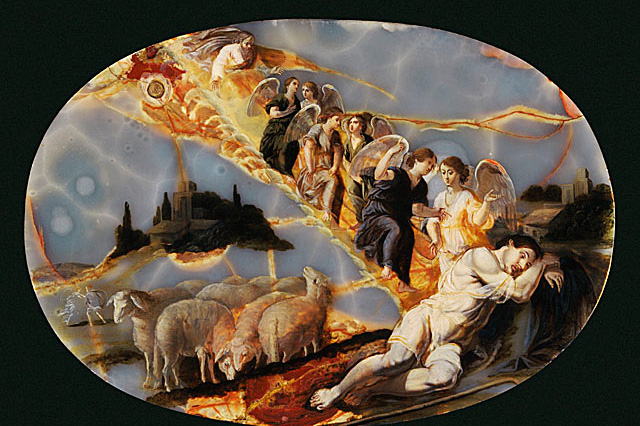
There came a critical moment in Jacob’s life where God’s love reached down and worked a transformation.
It was a dark and sleepless night in the desert. And for reasons too lengthy to describe here, Jacob had come to a point in his life where he realized that he had to try and reconcile with his brother Esau. He realized that this carried risk, and that his brother might kill him, having found him (he did not, they were later to be beautifully reconciled).
Perhaps this was the reason for his troubled sleep, and perhaps too, his desire to reconcile with his brother pleased God. But whatever the reason, God reached down to touch Jacob.
We pick up the story at Genesis 32:21
I. DISTRESSED man – The text says, So the [peace] offering [to Esau] passed on before him; and he himself lodged that night in the camp. The same night he arose and took his two wives, his two maids, and his eleven children, and crossed the ford of the Jabbok. He took them and sent them across the stream, and likewise everything that he had. And Jacob was left alone; and a man wrestled with him until the breaking of the day. (Gen 32:21-24)
Jacob is distressed. He has, somewhat willingly, and yet also for reasons of his own sued for peace with his brother Esau so as to be able to return to his homeland. How his brother will react is unknown to him. And thus he is distressed and sleepless.
And so it is for many of us that our sins have a way of catching up with us. If we indulge them, sooner or later we are no longer able to sleep the sleep of the just, and all the promises of sin now become bills that are overdue.
Having come to this distressed and critical place in his life, God goes to work on Jacob to purify him and test him. On a dark and lonely night in the desert, Jacob finds himself alone and afraid, and God will meet him. Note three things about how God works:
1. God brings Jacob to a place of isolation – This is difficult for God to do! Oh how we love distraction, noise and company. We surround ourselves with so many diversions, usually in an attempt to avoid considering who we are, what we are doing, where we are going, and who is God. So God brings Jacob to a kind of isolation, on a dark and sleepless night in the desert. The text says, And Jacob was left alone; It’s time to think, it’s time to pray and look to deeper issues.
2. God brings Jacob to a place of confrontation – verse 24b says, and a man wrestled with him until the breaking of the day.
Who is this “man?” The Book of Hosea answers and supplies other details of the event: He strove with the angel and prevailed, he wept and sought his favor. He met God at Bethel, and there God spoke with him– the LORD the God of hosts, the LORD is his name: (Hos 12:4-5)
Yes, it is the Lord who wrestles, who strives with Jacob. God mixes it up with him, and shakes him up. And here is an image for the spiritual life. Too many today think God only exists to affirm and console us. He can, and does do this, but God has a way of afflicting the comfortable as well as comforting the afflicted. Yes, God needs to wrestle us to the ground at times, to throw us off balance to get us to think, and try new things, and to discover strengths we did not know we had.
3. God brings Jacob to a place of desperation – the text says, When the man saw that he did not prevail against Jacob, he touched the hollow of his thigh; and Jacob’s thigh was put out of joint as he wrestled with him(Gen 32:25).
It is interesting to consider that God cannot “prevail” over Jacob. But though omnipotent, God will not simply overrule our will. And thus, in striving with Jacob, God can only bring him so far. But God will leave him with a lingering memory of this night, and the lesson that Jacob must learn to lean and trust.
He is a hard case so God disables him. Having knocked out Jacob’s sciatic muscle, God leaves him with the necessity to literally limp and lean on a cane the rest of his life. Jacob must learn to lean, and he will never forget this lesson, since he must physically lean from now on.
Thus Jacob, a distressed man on a dark desert night wrestles with God beneath the stars and learns that the answer to his distress is to strive with God, to walk with God, to wrestle with the issues in his life, with God. Jacob up to now has not well trusted and walked with God. He has schemed, manipulated and maneuvered his way through life. Now he has learned to lean, to trust, and realize he is a dependent man.
II. DEPENDENT man – The text next records: Then the man said, “Let me go, for the day is breaking.” But Jacob said, “I will not let you go, unless you bless me.”
If the “the man” is God, as the text of Hosea teaches, then it seems odd that God would have to ask someone to “let him go,” and for a mere man, as Jacob is, to say to God “I will not let you go” as if man could “not let” God do anything!
But the request of “the man” may also be understood as a rhetorical device, pulling from Jacob the required request. So the Man says, “Let me go!” But God wants Jacob, and us, to come to the place where we say, “I will not let you go!”
In saying, “I will not let you go,” Jacob is finally saying, “Don’t go, I need your blessing! Lord you’re my only hope. I need you, without you I am sunk”
God needs to get all of us to this place!
This critical moment has brought Jacob an insight that he must have God’s blessing, that he wholly depends on God. And this leads us to the next stage:
III. DIFFERENT Man – The text records: And the man said to him, “What is your name?” And he said, “Jacob.” Then he said, “Your name shall no more be called Jacob, but Israel, for you have striven with God and with men, and have prevailed.” (Gen 32:27-28)
Here is the critical moment. Jacob finally owns his name. Before he had lied to his Father Isaac who, when blind, asked him: “What is your name?” And Jacob lied saying: “I am Esau.”
But but after this encounter with God, Jacob finally speaks the truth saying, “My name is Jacob.” And in saying there is a kind of confession: “My name is Jacob…my name is deceiver, grabber, usurper, con artist, and shyster!”
Thus Jacob makes a confession, acknowledging all that his name “literally” implies of him has been true.
But receiving this confession, God wipes this slate clean and gives him a new name: Israel, a name that means, “He who wrestles, or strives with God.”
And in being renamed he becomes a new man. He is different now, he is dependent. He will walk a new path and walk in a new way, with a humble limp, leaning on the Lord, and striving with him, not against him.
And thus Jacob (Israel) wins by losing! God had to break him to bless him, and cripple him to crown him. Jacob would never be the same again, he would limp for life and always remember how God blessed him in his brokenness. Scripture says, A broken and a contrite heart, O God, thou wilt not despise. (Ps 51:17)
Postscript – There is a kind of picture of the “New Man” Jacob had become in the Book of Hebrews: By faith Jacob, when he was a dying, blessed both the sons of Joseph; and worshiped, leaning upon the top of his staff. (Heb 11:21) Yes, he had learned to lean. He limped the rest of his life. He needed a staff to support him. He learned to lean.
Have you learned to lean?
There is a battle you can’t afford to win, the battle with God. Yes, that is a battle you cannot afford to win! Learn to lean, and delight to depend: the story of Jacob’s conversion. How about yours?
I was talking to a priest friend of mine today who is the pastor of one of our parishes in the Archdiocese of Washington. His parish is experiencing significant growth in recent years thanks to an influx of immigrants. He speaks Spanish fluently and has begun a Spanish Mass. The numbers at that Mass have tripled in recent months and he expects his overall parish to double in size in the next year.
Not all parishes are shrinking, and neither is the Church worldwide shrinking. There are areas in the world such as Europe where the numbers are way down. But in Africa the number of Catholics has increased by 7,000% in the past fifty years. The Church is shifting south and is getting “browner.”
Here in America too there is something of a contrast between the northeast and the southwest in terms of Catholic trends. The “up-town” of the old Northern Catholic Church is shifting lower down, to the South where the Catholic presence in the old “Bible belt” is now quite full.
The cities of the Northeast and upper Midwest were once teeming with Catholics. The city centers featured many and thriving Catholic parishes of various ethnic derivations. Catholics were uptown, down town and all around town. Some of the blocks in the older Chicago neighborhoods would even feature several parishes: there was the Polish Parish, the Irish, the German, and Italian, each of them little cities within themselves. Consider a description of old Chicago and other Catholic cities of the Northeast, by John McGreevy in his Book, Parish Boundaries which I summarize:
Virtually all the Catholic immigrant groups were within two generations of immigration, and all placed enormous financial, social, and cultural weight on the parish church as an organizer of local life. A Detroit study found 70% of Catholics claiming to attend services once a week, as opposed to 33% of the city’s white Protestants, and 12% of the city’s Jews….
The Catholic churches whether they were Polish, Italian, Portuguese, or Irish, simply dominated the life and activities of the community. The Catholic world, supervised by priests was disciplined and local. Many parishes sponsored enormous neighborhood carnivals each year (with local politicians making appearances and local businesses donating supplies).
Most parishes also contained a large number of formal organizations – including youth groups, mother’s clubs, parish choirs, and fraternal organizations – each with a priest moderator, the requisite fundraisers and group masses. Parish sports teams for even the youngest boys shaped parish identity, with fierce rivalries developing in Catholic sports leagues.
The dense social networks centered themselves around an institutional structure of enormous magnitude. Virtually every parish in the northern cities included a church (often of remarkable scale), a parochial school, a convent, a rectory and often ancillary gymnasiums or auditoriums. Even hostile observers professed admiration for the marvelous organization and discipline of the Roman Catholic Church. [e.g. Holy Family Church in Chicago with its massive school next door, more buildings are behind].
Brooklyn alone contained on hundred and twenty-nine parishes and over one hundred Catholic elementary schools. In New York city more generally forty-five orders of religious men lived. Nuns managed twenty-five hospitals…schools enrolled 214,000 students. This list of summer camps, colleges and universities , retreat centers, retirement homes, seminaries and orphanages was daunting.
For all Euro-American Catholic groups, neighborhood, parish, and religion were constantly intertwined…Small statues of Mary or local saints appeared in neighborhood yards, while crosses and religious artifacts decorated individual rooms. Catholic parishes routinely sponsored parades and processions through the streets of the parish.
Catholic leaders leaders deliberately created a Catholic counterpart for virtually every secular organization. The assumption was that the parish must make every effort to become the real center of attraction in the lives of the parishioners, it must become the hub around which a large number of their interests revolve. [McGreevy, pp. 13-28]
Decline – We are well aware and have discussed on this blog frequently that many of these once thriving centers of Catholicism are in decline. Parishes and schools are closing in large numbers. The dramatic decline in Mass attendance from numbers near or above 70% down to our current 27% is part of the explanation. But another part of the explanation in the migration of Catholics out of the cities and out of the Northeast.
The first of the great migrations took place after the Second World War when Catholic moved in large numbers to the newly created and growing suburbs. They moved from uptown and downtown to “out of town.” The once great churches of the city center grew gradually more empty and less vital.
The initial experience in the suburbs was similar: large parishes, large schools, large buildings, all packed to the gills, and many activities. But suburban life was less tightly knit and ethnic ties were also being lost in those days in the great melting pot of the American experience. In a very subtle, but steady way, the cohesiveness of Catholics and parish life was becoming less a dominant force. Slowly Catholics ventured out of the Catholic “Ghetto” and sought wider connections and approval outside the Catholic world. The election of John F. Kennedy both symbolized and furthered this trend.
Then in successive waves, the sexual revolution, and the over all cultural revolution of the late 1960s caught Catholics and the Church unprepared. As secularism has grown and eroded the influence faith once had, even many of the flourishing suburban parishes of the post-war era are now much smaller and far less vital.
The second of the great migrations is occurring right now as Catholics, in large numbers, have left the “uptowns,” “downtowns” and “just out of towns” of the northeast and are headed “low down” to the south, and the Southeast. A quote from a CARA study back in 2010 illustrates this point:
[Consider that], in 2001, the Archdiocese of Atlanta had more than 320,000 Catholics, 131 active diocesan priests, and 77 parishes (note in 1991, the Archdiocese had 176,000 Catholics and 65 parishes). Moving a decade ahead, the diocese now has 900,000 Catholics, 141 active diocesan priests, and 87 parishes. Thus, the number of Catholics increased by 181% in the last decade but the number priests only increased by 8% and the number of parishes by 13%. This means the number of Catholics per parish in the Archdiocese has grown from 4,156 in 2001 to 10,345 in 2011. Ten new parishes have been added to accommodate 580,000 additional Catholics. [1]
Now that is remarkable growth. And many cities of the South and Southwest are having similar experiences. As can be seen, the growth is so remarkable and so quick that it is difficult to keep up. Due to a shortage of priests and other resources, the usual approach of southern and southwestern dioceses is to build large churches that can seat well over 1000 and establish what is, in effect a mega church.
I have celebrated masses in the deep south, in some of these parishes, and the experience is quite amazing. One parish near Jacksonville, Fla, where I celebrated one Sunday, seated over 2200. It was a tasteful, in fact a very beautiful Church, but it was big, with a fan shaped main floor and a spacious balcony ringing three sides. The place was packed that morning, with three other masses scheduled and a vigil the night before, all filled or at least well attended. Forty-eight extraordinary ministers of Holy Communion came forward to assist with the distribution. The parking lot outside featured shuttle buses to get the farthest parkers back and forth. The pastor explained that this was the trend in the south. With few priests, parishes have to built big to get as many Catholics in at one time as possible and keep the number of masses manageable for the priests.
At one level it all seems very exciting to hear of booming Catholic Parishes that need parking shuttle buses. It reminds one of the massive and flourishing parishes that once filled the northeastern cities. But there are some concerns that go with these mega-parishes. It is articulated at the CARA blog:
[A] study, conducted by CARA, … finds that larger U.S. parishes tend to have lower rates of attendance, lower levels of sacramental activity per household, and less giving per registered household than what is reported in smaller parishes. [So], there appears to be a size limit at which the parish community begins to become less active and less giving. [2]
In other words, such parishes risk loosing personal contact with souls. And without personal contact and a sense of being an integral member of a community, it is easier for people to drift and fall away. Large numbers can hide steady erosion for a while but it would seem that the impersonal nature of large parishes allows the faithful to become disengaged. They can also hide behind the notion that “someone in this big parish will handle the trouble that the pastor is enunciating.” As impressive as large parishes are, it is clear from our experiences after the war, and now, that they can also become unraveled very quickly if no one feels essential.
The CARA study concludes:
As we have shown in a previous post, there are not a lot of dioceses building new parishes in areas where the Catholic population moved and is growing strongly…..But a parish building boom will likely be needed in the U.S. Sun Belt in the 21st century….It may be time to ask, with great care as well, when and how do we open new parishes where they are needed? After moving, will Catholics always have a new Catholic home to “come home” to? [3]
I do not know what the perfect size for a parish is. And even if I say a number, vocations to the priesthood are simply going to be a factor. As for me, I have 900 registered families and about 550 on a Sunday morning. For me, this is a perfect number. It is large enough for us to be financially viable, indeed we do very well, money wise. It is also large enough that I can have a fairly diverse cadre of volunteers to accomplish needed tasks. Yet is small enough for one priest to handle and even can get to know many people well. It is small enough too that people know each other well and people are missed when the drift away. But this model cannot be sustained diocesan-wide. We just don’t have enough priests to staff enough parishes at this scale.
But, it would seem, that large parishes still need a small town feel and experience, according to the CARA study. It makes sense, otherwise, people get lost. So, small targeted groups that gather in large parishes are needed to provide the personal encounters so necessary in our Christian walk. Perhaps it is targeted Bible studies, fraternal organizations, mother’s groups, etc.
The great mega parishes of the 20th Century urban north had their day but collapsed quickly, for it would seem that their communal ties declined after the War, or were not as deep as they were thought to be. People left too quickly for us to conclude that urban and ethnic communities had ties that really bound them together after WWII. It would seem we were a 1000 miles wide, but only two inches thick. The large suburban parishes of the postwar suburban north and east have also struggled to keep Catholics tied in. Big looks great but it isn’t necessarily better. While it is true we cannot simply build lots of small parishes, we have to be creative and build communities within parishes wherein there is accountability and love, something personal and engaging, something which makes people experience that they are essential to the Lord and to the Church. Doin’ the uptown, low down, may not be the dance we want to recreate as the Church spreads (low down) to the south.
I am interested in your thoughts, especially if you are member of a large Catholic Parish.
Photo Credits:
Holy Family Church (Upper Right) from the Archdiocese of Chicago Archive,
Lower Left, Our Lady Queen of the Universe, Orlando, from the Website.
–
Here are some fond remembrances of going to Catholic School in Chicago:
In the afterglow of the Feast of Corpus Christi we do well to reflect a bit further on the gift of Holy Communion with our Lord and the need to receive Him worthily by his grace. I celebrated with a local Latin Mass Community last Thursday, the actual day of the Feast of Corpus Christi, and in the context of that liturgy the sequence Hymn Lauda Sion was sung. In the magnificent Hymn by Aquinas, are these words of reminder and warning that we receive Christ is a worthy manner, free from mortal sin:
Sumunt boni, sumunt mali: sorte tamen inaequali, vitae vel interitus.
Both the wicked and the good
Eat of this celestial food,
But with ends how opposite.
Mors est malis, vita bonis: vide paris sumptionis quam sit dispar exitus.
Here is life and there is death
The same yet issuing to each
In a difference infinite.
St. Thomas is clearly basing this teaching on what Scripture says, as we shall see in a moment. But these lines could not be clearer that unworthy reception of Holy Communion does not only not help, it harms.
Thus, Pastors have the duty first to instruct in a general sort of way that the faithful ought not approach the Sacrament of Holy Communion if they are aware of serious (mortal) sin, or are in grave disunity with the teachings of the Church. It is usually helpful to instruct them based on the scriptural admonition of St. Paul:
Therefore, whoever eats the bread or drinks the cup of the Lord in an unworthy manner will be guilty of sinning against the body and blood of the Lord. A man ought to examine himself before he eats of the bread and drinks of the cup. For anyone who eats and drinks without recognizing the body of the Lord eats and drinks judgment on himself. That is why many among you are weak and sick, and a number of you have fallen asleep. But if we judged ourselves, we would not come under judgment. When we are judged by the Lord, we are being disciplined so that we will not be condemned with the world. (1 Cor 11:27-32)
The context of St. Paul’s admonition makes it clear that he has in mind serious sins that include more than merely sexual matters, but also matters that extend to a grave lack of charity toward others, something which too few judge as very serious today.
And thus the Pastor ought to instruct in a general kind of way, taking care not to excite grave scrupulosity, but being clear of the need for regular confession, especially in the case of habitual serious sin.
More specifically the pastor may sometimes need to approach certain individuals and, after ascertaining the facts, warn serious sinners in a private and clear way to repent and to stay away from Communion until such time as they are ready to do so wholeheartedly. Cardinal Ratzinger cited this as a clear duty of pastors.
For my own part, and speaking in a very general sort of way, I have indeed undertaken this duty in more than a few cases to warn certain individuals in serious sin to repent. This was not, in every case, sinners who were only in sinful sexual liaisons, and almost never did it include politicians. It also included certain people who were exhibiting a very grave lack of charity or causing serious harm in their family or the parish.
It was my duty in all such cases not only to warn them that they should stay back from Communion, but also that they risked Hell. For when one is in so serious a state that they should refrain from Communion, this is not their only problem! The prospect of strict judgement and hell are also very serious and real likelihoods.
Hence, when the Church teaches on the manner of receiving communion worthily, it is good and important to broaden the discussion beyond certain politicians or certain subjects. Otherwise it appears that our agenda is more political than spiritual. Pastors (and Bishops too) thus should look to teach on this matter in broad as well as specific ways.
There are many sins that can and should exclude one from receiving Holy Communion unless and until repentance is manifest and Sacramental confession is received (or, in specific circumstances, a perfect act of contrition with the intent to receive the Confession is made):
One might habitually skip mass, and thus be in mortal sin.
One might ridicule sacred things or person and thus harm seriously the faith of children or others.
One might give grave scandal or harm the reputations of others in serious ways by gossip.
One might be gravely lacking charity or unreasonably refusing of mercy.
One might be seriously derelict in their duties toward parents or family.
One might be seriously insubordinate and cause grave harm to unity.
One might be reckless in their behavior and thus seriously endanger the lives or well being of others.
One might have procured or assisted in the procuring of abortion.
One might be in sinful and wrongful sexual liaisons, have engaged in seductive behaviors that led others to sin, or may be sexually uncontrolled and irresponsible.
One might have born false witness or told lies that seriously misled, endangered others or caused others to make seriously wrong choices or conclusions.
One might have taken from others, or failed to render what others were due in significant ways.
One might be seriously derelict in their duties to the poor and needy.
And might can be locked into serious greed that unreasonably seeks to posses what belongs to others or is needed by others.
We tend, in our culture and times to emphasize certain things to the exclusion of others. But there are many things from which we should repent and which, when repentance is lacking should require us to step back from the Sacrament of Communion, the Holy Sacrament of love, union and charity.
Jesus says,
“Therefore, if you are offering your gift at the altar and there remember that your brother has something against you, leave your gift there in front of the altar. First go and be reconciled to your brother; then come and offer your gift.” (Matt 5:23-24)
We all do well to, as St. Paul says, “examine ourselves,” and be frequent in confession if we are going to frequent the altar. Then Cardinal Ratzinger has said,
Presenting oneself to receive Holy Communion should be a conscious decision, based on a reasoned judgment regarding one’s worthiness to do so, according to the Church’s objective criteria, asking such questions as: “Am I in full communion with the Catholic Church? Am I guilty of grave sin? Have I incurred a penalty (e.g. excommunication, interdict) that forbids me to receive Holy Communion? Have I prepared myself by fasting for at least an hour?” The practice of indiscriminately presenting oneself to receive Holy Communion, merely as a consequence of being present at Mass, is an abuse that must be corrected (Worthiness to Receive Holy Communion # 1).
And this admonition is for us all, not just for some, lest we fall condemned under the condemnation of the Prophets, such as these words from Isaiah and Amos:
“The multitude of your sacrifices— what are they to me?” says the Lord. “I have had more than enough of burnt offerings, of rams and the fat of fattened animals;….Stop bringing meaningless offerings! Your incense is detestable to me. New Moons, Sabbaths and convocations— I cannot bear your evil assemblies. Your New Moon festivals and your appointed feasts my soul hates. They have become a burden to me; I am weary of bearing them. When you spread out your hands in prayer, I will hide my eyes from you; even if you offer many prayers, I will not listen. Your hands are full of blood; wash and make yourselves clean. Take your evil deeds out of my sight! Stop doing wrong, learn to do right! Seek justice, encourage the oppressed. Defend the cause of the fatherless, plead the case of the widow. “Come now, let us reason together,” says the Lord. “Though your sins are like scarlet, they shall be as white as snow; though they are red as crimson, they shall be like wool. If you are willing and obedient, you will eat the best from the land; but if you resist and rebel, you will be devoured by the sword.” For the mouth of the Lord has spoken. (Is 11:11-20ff).
I hate, I spurn your feasts, says the LORD, I take no pleasure in your solemnities; Your cereal offerings I will not accept, nor consider your stall-fed peace offerings. Away with your noisy songs! I will not listen to the melodies of your harps. But if you would offer me burnt offerings, then let justice surge like water, and goodness like an unfailing stream. (Amos 5:21-24)
Though it is right that we trust in God’s mercy, the door to that mercy is repentance and humility. God is clearly not pleased with presumption, vain worship or sinful Communion. A message for us all.
Here’s a video I put together for the Feast of Corpus Christi. The Music is by Fiocco and the text is: Homo quidam fecit coenam magnam, et misit servum suum hora coenae dicere invitatis ut venirent: Quia parata sunt omnia. (A certain Man made a great banquet, and sent his servants at the hour of the feast to say to the invited that they should come: for everything is prepared). For it happens that a common sin today is the widespread neglect of the Lord’s feast of the Lord’s Body and Blood for us. Remain devoted to Jesus and say, “Though all forsake you Jesus, I will never forsake you.”
On the Feast of Corpus Christi we do well to mediate on the Desire of the Lord to feed his people and the shocking indifference many have to this fact. And the indifference is not just those who do not come, but it is even found in the Pews too often populated by people largely indifferent to the fact that most don’t come any more. On this feast we all do well to acknowledge the passionate concern the Lord has to feed all his people, yes even your wayward spouse or children.
Let’s consider the Gospel for today in three ways.
I. Despairing Diagnosis –Jesus has been teaching the crowds all day by the lake. At this point the Text says, As the day was drawing to a close, the Twelve approached him and said, “Dismiss the crowd so that they can go to the surrounding villages and farms and find lodging and provisions; for we are in a deserted place here.”
Now we can note a diagnosis, namely that the crowd is hungry. And here is a diagnosis of the human condition: we are hungry.
How are we hungry? Let us count the ways. We are a veritable sea of desires. We desire food, and drink, life, health, honor, respect, popularity, so many necessities, intimacy, family, security, goodness, beauty, truth, serenity, justice, and so much more. Yes, so many desires. We are hungry. And herein lies an insight for evangelization. For some how in all this hunger, God is calling. We are like the woman at the well who came thirsty for the world’s water and the Lord taught her it was really Him that she desired, and only He who could satisfy.
It is sad that every advertiser on Madison Avenue knows how to tap into people’s desire and draw forth loyalty and relationship, but we Christians have so little insight. For the people of this world are more shrewd in dealing with their own kind than are the people of the light (Lk 16:8).
And thus we are like the apostles standing around, irritated and clueless that people have needs. In effect we say, “They are needy send them away” rather than “They are needy. Wow have I got an answer for you, have I got a meal you need! You want want what is good, true and beautiful? You want what satisfies. Wow, do I have an answer for you!”
So the diagnosis is clear, the crowd is hungry, sadly though the Church in that moment was “out to lunch” and out of ideas. And this could well describe us today.
II. Deep Desire– Note that the Lord has a desire to feed these people, a deep desire. He said to them, “Give them some food yourselves.”The apostles of course can only protest impossibility. They are staring right in the face of Jesus Christ and think it impossible to feed this crowd. They see only five loaves and two fishes, but they can’t see Jesus. They don’t know Jesus! Do you see their lack of faith. How about yours?
Yes, here too is a picture of many in the Church today who think that nothing can possibly be done to turn the decline of our culture around or get people back to Church.They see only our meager five loaves and two fishes and forget that we have Jesus who is still in the miracle working business.
Jesus will not allow all their negativity and playing the poor man crush his desire. Yes, the Lord insists and has a deep desire to feed them and all this foolishness about being unable does not impress him. He says:
“Have them sit down in groups of about fifty.”They did so and made them all sit down. In other words, “Enough of all this negativity. I am in charge here,” says the Lord, “Lets get to work now.”
What is this about “groups of fifty?” It is debatable, but I would say it points to what we have come to call the “parish” system. That is, the whole world is divided up into smaller and manageable units we call , today, parishes wherein a pastor and his flock are responsible to see that all the people in that territory have been invited to the wedding feast of the Lamb. The Lord desires to feed every one in every parish and he says to me and my parish, “give them something to eat yourselves.” In other words draw them to the Eucharistic table! Draw them to me!”
Yes, the Lord has a deep desire to feed us, and others. Consider this: What loving parent who saw that their child had stopped eating would not move heaven and earth to find out why and get them back to eating saving food? Yes, they would go emergency rooms and doctors offices until their child returned to eating.
Why is this not so with our Eucharistic food? Clearly the Lord is deeply desirous of feeding us. Why aren’t we as desirous to be sure others, especially our children and family, are receiving the Lord?
To all this the Lords says, “Give them something to eat!” Yes, you, he is not talking to the person next to, it is you he addresses: “Bring them to me, give them something to eat!”
And we so easily reply, “But I have so little, just five loaves and two fishes, I am not eloquent, I have not studied the faint and I don’t have an answer to everyone’s questions!” Still the Lord says, “Give me what you have and have them sit down. Work the fifty I have assigned you and your parish.”
III. Directive for the Disciples– The text says of the disciples, They did so and made them all sit down. Then taking the five loaves and the two fish, and looking up to heaven, he said the blessing over them, broke them, and gave them to the disciples to set before the crowd. They all ate and were satisfied. And when the leftover fragments were picked up, they filled twelve wicker baskets.
Note well that the Lord is determined to feed these people and he insists that his disciples help him to do it. They are expected to gather the faithful in groups of fifty and have them sit in groups. Then the Lord, note the Lord himself, blesses and multiplies the food. But once again, he gives it to his apostles to set before the multitude.
And this is the Church. Jesus is the Great High Priest of every Liturgy. It is He who takes our meager offerings and multiples and transubstantiates them. But he works this ministry through his priests, and in an extended sense, through the whole Church. The Lord feeds his people, but he feeds us through others. It is the role of the Church to take what Jesus sets before us and see that it is distributed to others in due season.
On the Feast of Corpus Christi we acknowledge that the Lord feeds us through his Body and Blood, but he does this through the ministry of priests and through his Church. Do we see this as central to our mission? Is the liturgy really at the heart of our parish life. Or are Liturgies rushed and hurried so we can get to the Men’s Club Meeting and make sure people aren’t late to tune into the game? What is our priority? Is it the same priority of Jesus rooted in the deep desire he has to feed his people?
Note too, they all ate and were satisfied. Does this describe liturgy at your parish? Are people being fed, and do they experience an abundance at the Lord’s Banquet? Or is Mass something to get through, something more akin to a flu shot which we hope is as quick and painless as possible?
Of course the Liturgy should be satisfying to God’s people. It should be a place and time where they are instructed in God’s word and have that work cause their hearts to catch fire with joy, inspiration and yes, conviction on the need for repentance. The Eucharist which we celebrate ought to be something the faithful are taught to expect and experience great transformation on account of. How can we fruitfully receive the Body of Christ and not experience great change and be satisfied?
Yet sadly, most people put more faith in Tylenol than the Eucharist, since, when they take Tylenol, they expect something to happen: the pain to go away, the swelling to go down, healing to be helped. Do people expect this of the Eucharist? And if not, why not?
On this Feast of Corpus Christi, please understand that the Lord want to feed you, want to feed your loved ones! And he wants to do this to save them and to satisfy them. Do you and I care about this? Is this a reality to us, or just a ritual? Why not ask the Lord this Feast day to strike deep within you the same desire he has to feed others and make of you a magnet to draw people to him. Who are the fifty the Lord has put in your charge. Listen to the Lord! Gather them and have them seated in Church next Sunday.
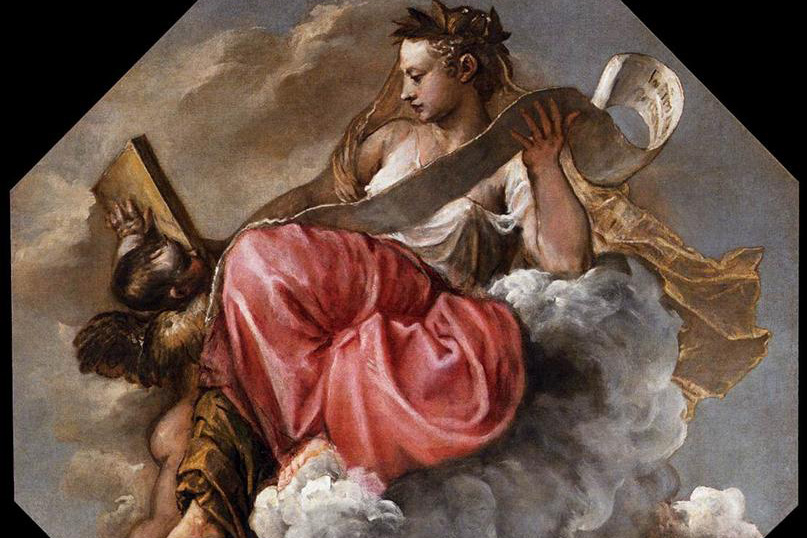
In the video below I was reminded, though imperfectly, of the great Wisdom tradition of the Old Testament. In that tradition, Wisdom (Sophia) is portrayed as a beautiful woman whose presence indwells all of creation imbuing it with God’s magnificent vision and sustaining Word. And thus we read:
Before all other things wisdom was created; and prudent understanding, from eternity.The root of wisdom—to whom has it been revealed. Her subtleties—who knows them? There is but one, wise and truly awesome,seated upon his throne—the Lord. It is he who created her, saw her and measured her,Poured her forth upon all his works, upon every living thing according to his bounty, lavished her upon those who love him. (Sirach 1:4-10)
And thus, God’s wisdom infuses and sustains all things.
What would happen if God were ever to remove his sustaining wisdom. What would happen if his abiding presence should ever cease to be present? Truly, all things would cease instantly to exist at all, vanishing. For if the cause be removed, so also the effect.
The video below shows a more mitigated scenario. What happens to a world where the main spring, or main gear of God’s wisdom cease her functioning or somehow no longer has her influence?
The video answers the question artistically. For when wisdom, portrayed as a beautiful woman, is no longer in her exulted place, perhaps because she is under-appreciated, all turns grey, dreary and drab. And everything stops moving, as if to say things no longer work.
Only if the beautiful “lady wisdom” is restored to her central place and exalted will all things be restored to proper order and functioning. And thus, in the video, when she returns to her place, things begin to function again, and magnificent color is restored.
And here’s a paradigm for our age, which has so cast aside much of the ancient wisdom of God. So much color has gone from our world, and though endless pleasures abound, boredom, and a kind of sadness overtakes us. When everything is pleasurable, nothing is pleasurable and when everything is available nothing seems special. The eye is never satisfied with what it sees, the ear with what it ears, boredom overtakes us.
And such dysfunctionality sets in. Our basic structures, no longer work. The family, and other basic institutions such as schools, government, and even many religious structures become dysfunctional.
Only if wisdom is once again in her place will proper function be restored and will radiant color be restored.
Enjoy this beautiful video that so captures Lady Wisdom.
The Gospel from Wednesday of this week describes well a spiritual gift to be sought. It is from Mark 10:32 and says,
The disciples were on the way, going up to Jerusalem, and Jesus went ahead of them. They were amazed, and those who followed were afraid.
Fr. Robert Barron Titles one of the Episodes in his Catholicism Series, “Amazed and Afraid” and he does a wonderful job applying it that section. My Purpose here is more modest and must be more brief, but I speak to the same balance that Fr. Barron sets forth.
We need to be both amazed and afraid, and the proper balance. Theologians have in the past described the balance with Latin phrase fascinosum et temendum. It is phrase that speaks of reverent bowing and Holy Fear before the Holy One who draws me close bids me to seek His face.
Fascinosum is where we get the word fascinating. It refers to something that calls to me, draws me, peaks my interest, something that strongly attracts and inspires reverence.
Tremendumis where we get the word tremendous. It refers to something awesome; something overwhelming and too big to comprehend or grasp. Hence we draw back in a kind of reverential fear mixed with a kind of bewilderment. And we feel small before the tremendous.
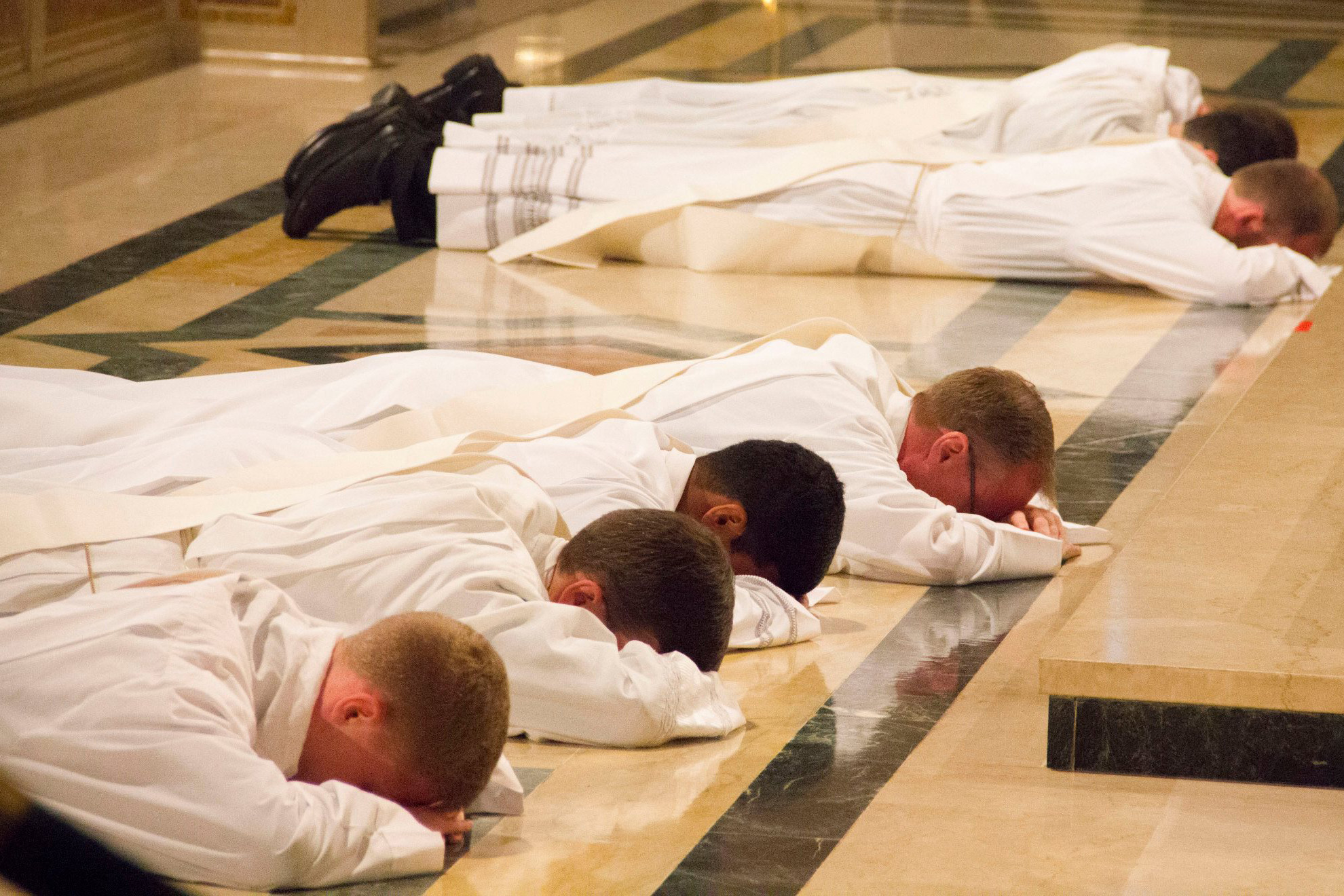
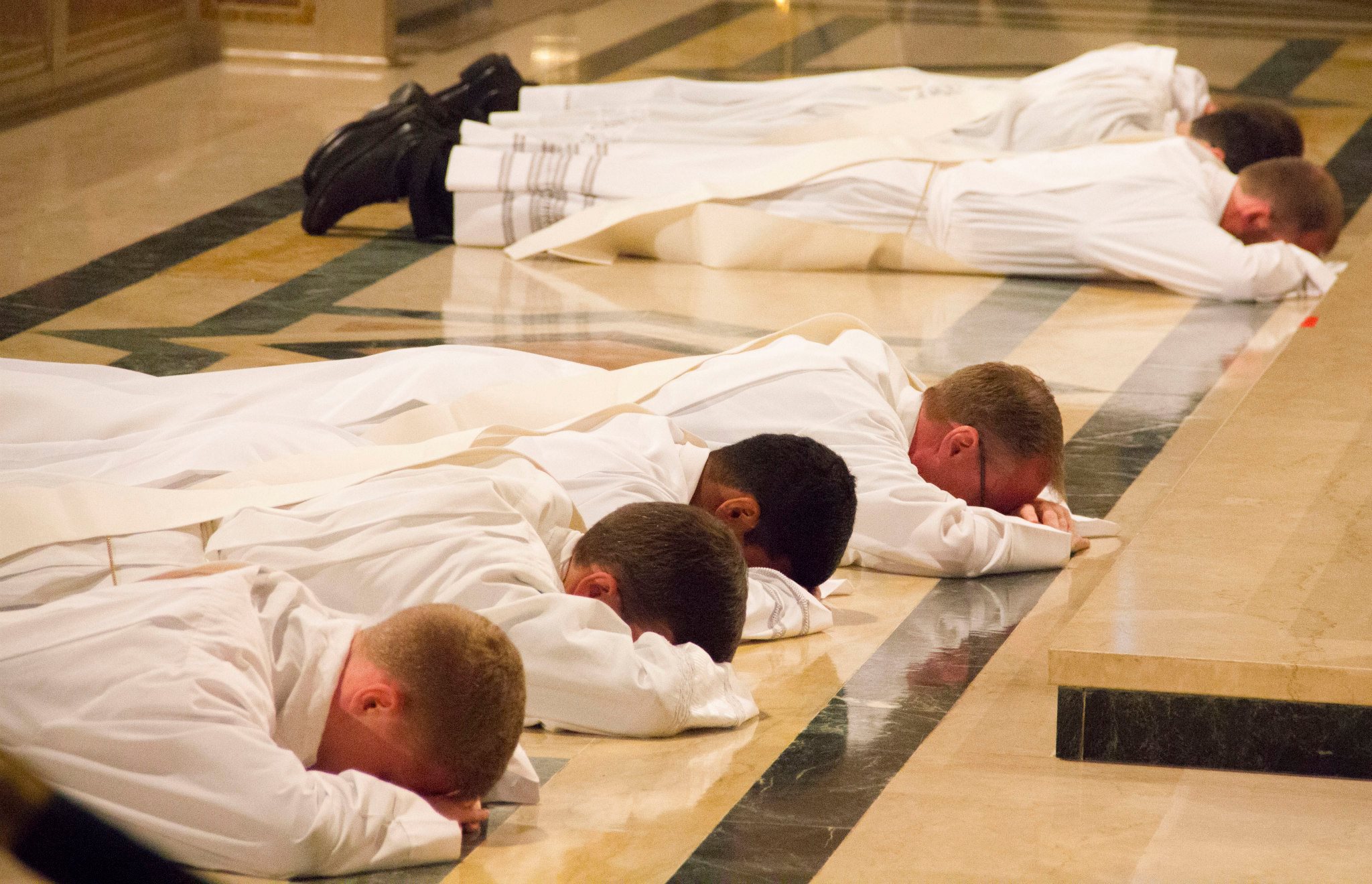
And these words well describe the proper state of the human person before the mystery of God: drawn by God’s inexorable beauty yet compelled to fall prostrate before His awesome majesty. Scripture speaks of this experience in many places. Here are but a few:
I saw the Lord seated on a high and lofty throne, with the train of his garment filling the temple. Seraphim were stationed above; each of them had six wings: with two they veiled their faces, with two they veiled their feet, and with two they hovered aloft. “Holy, holy, holy is the LORD of hosts!” they cried one to the other. “All the earth is filled with his glory!” At the sound of that cry, the frame of the door shook and the house was filled with smoke. And then I said, “Woe is me, I am doomed! For I am a man of unclean lips, living among a people of unclean lips; yet my eyes have seen the King, the LORD of hosts!” Then one of the Seraphim flew to me, holding an ember which he had taken with tongs from the altar. He touched my mouth with it. “See,” he said, “now that this has touched your lips, your wickedness is removed, your sin purged.” (Isaiah 6:1-5) And so Isaiah is draw and captivated by the beauty and glory he sees (fascinosum) but is then bewildered, fearful and alarmed at his unworthiness (Tremendum).
And Jesus was transfigured before them; his face shone like the sun and his clothes became white as light. And behold, Moses and Elijah appeared to them, conversing with him. Then Peter said to Jesus in reply, “Lord, it is good that we are here. If you wish, I will make three tents here, one for you, one for Moses, and one for Elijah.” While he was still speaking, behold, a bright cloud cast a shadow over them, then from the cloud came a voice that said, “This is my beloved Son, with whom I am well pleased; listen to him.” When the disciples heard this, they fell prostrate and were very much afraid. But Jesus came and touched them, saying, “Rise, and do not be afraid.” (Matt 17:1-6) Yes! It is good to be here (fascinosum) but soon enough, they fall to their faces and are very much afraid (tremendum)
I [John] saw seven gold lampstands and in the midst of the lampstands one like a son of man, wearing an ankle-length robe, with a gold sash around his chest. The hair of his head was as white as white wool or as snow, and his eyes were like a fiery flame. His feet were like polished brass refined in a furnace, and his voice was like the sound of rushing water. In his right hand he held seven stars. A sharp two-edged sword came out of his mouth, and his face shone like the sun at its brightest. When I caught sight of him, I fell down at his feet as though dead. He touched me with his right hand and said, “Do not be afraid. I am the first and the last, the one who lives. (Rev 1:15-17) Such a vision! But he falls down in fear!
Note the pattern of these theophanies: They are drawn by God and behold his beauty (fascinosum), they instinctively fall prostrate, and need to be reassured by God (tremendum). It is an awesome thing to fall into the hands of a living God! (Heb 10:31).
The most interesting passage to me is the third one involving John the Beloved. This is the same John who, at the Last Supper, was perfectly capable of leaning back on the Lord’s shoulder to ask him a question. Yet now, as he beholds the full glory of Christ in the heavenly realm, he falls to his face. The Lord’s glory is fully unveiled here and John, who appreciates the beauty and describes it to us is ultimately compelled to fall down.
We have come through an era that has trivialized God in many ways. Perhaps it was an over correction to a more severe time of the 1950s when any misstep of ours could result in a quick trip to hell if we didn’t get to confession immediately. Mortal sin was understood only objectively by many in those days and by God, even if there were two feet of snow on the ground and you missed Church, your were in sin and had to get to confession asap. Fear was a strong motivator for many in those days.
But we over corrected and by the 1970s the usual notion was that God didn’t seem to care what we did. He was rendered quite “harmless” actually and it seemed that his main purpose was to affirm us.
As for Jesus, gone was the unrelenting and uncompromising prophet of the Scriptures, only to replaced by a kind of harmless hippie version, or, for others, a “Mr Rogers,” or “Buddy Jesus” version who just went about saying nice things. The Jesus who cleansed the Temple, rebuked unbelief, demanded first place in our life, insisted on the cross, warned of coming judgement and hell, and spoke with such authority that even the guards sent to arrest him came back empty-handed saying “no one has ever spoken like that man”, this Jesus was no where to be found by the 1970s
And thus we have needed a return to the balance that fascinosum et tremendum offers. Surely we sense a deep desire for God, we are drawn to him in all his beauty and glory. But we are encountering God here, and we are but creatures. A reverential fear is appropriate for the Father and the Son, and the Holy Spirit. It may well be that God will reassure us, but our instinct to tremendum is a proper and biblical one. The Biblical saints knew both fascinosum and tremendum and they show us what a true encounter with God includes.
This does not mean that our liturgies need be somber, for reverence and joy can occupy the same heart. But in the end, it is God whom we worship and falling to our knees is wholly appropriate. Seeking the necessary purification and striving for the holiness without which no one will see God (Heb 12:14) is appropriate.
Make your journey with Christ as one who is amazed and afraid. Do not trivialize him. He is savior, he is our brother, he loves us, but he is also the Lord, He is God and is deepest reverence and holy fear is due him. Make your journey in fascinosumettremendum!
Here’s a video where Cardinal “Glitch” gets the balance a little wrong:
Maybe this is a little closer to where we need to be:
I think one of the joys of heaven will be to finally see what our prayers actually wrought. Yes, even our distracted and imperfect prayers, by God’s grace may well have had the power to bring immense healing, cast out demons, cancel discouragement, push back temptation and even turn away wars.
I know that I am the result of prayer. My conversion to the Lord and my subsequent healing over the years are inexplicable to me, except that someone, indeed, some many, were praying for me.
And so, something tells me that a special joy of heaven will be to know and see what prayer did for us, and what our prayers did for others. For now, things can seem discouraging at times. The effects of our prayers may seem subtle or even non-existent. But God is working his purposes out and collecting and dispensing the fruits of our prayer in due season.
Anyway, I thought of all this yesterday as I was reading from The Dialogue of Catherine of Siena. And therein, the Lord speaks to her of what the prayers of the faithful do and how they release grace and set souls free. Here are some excerpts:
The sufferings you endure will, through the power of charity, suffice to win both atonement and reward for you and others…The stains of your foolishness will be blotted out, and I will no longer remember that you have ever offended me.
As for the others, because of your loving charity, I will pardon them in proportion to their receptiveness….They will come in this way to truly know and regret their sins, and so, because of my servants’ prayers they will receive the fruit of grace….They will receive both forgiveness and its gifts, unless their stubbornness is such that they despair….
I look on them and give them light. I rouse the dog of conscience within them. I make them sensitive to the perfume of virtue and give them delight in the fellowship of my servants. Sometimes I allow the world to show them its true colors….that they may know how inconstant it is and be more eager to seek their homeland in eternal life.
The eye cannot see nor the tongue tell, nor can the heart imagine how many paths and methods I have, solely for love and to lead them back to grace so that my truth may be realized in them. (Dialogue # 4)
Yes, here is what prayer and sacrifice unleash. Continue to pray and do not doubt the words of the Lord who says that our heart cannot imagine all the paths he can open for others back to grace, the Church and the Sacraments, back to Him.
Of this I am a witness that, by the prayers of others, especially my Grandmother and mother, that the dog of conscience was roused, the glory of virtue came to be appreciated, the gift of walking in fellowship with the Church was restored, the true colors of the world were seen, and the goal of heaven loved more dearly. I have see these things come alive, mysteriously, but truly. And I know it was not me. It was the prayers, and it was the Lord.
Keep praying and don’t lose heart. It was bear its fruit in due season.


 Some of God’s gifts come in strange and terrifying packages. And I was reminded of this earlier this week when I read from the book of Job in the Office of Readings the following lines: