Pray, Pray, Pray for Priests! A Meditation on Something My Mother Taught Me

061613Last week I blogged on how priests pray for God’s people. indeed, such prayers are built into our daily schedule.

And this post is the other side of the equation, the need that priests have for your prayers. Indeed, I will say, pray, pray, pray for priests. We need your prayers!

I attended another ordination this week, my second this month. It is a good thing for a priest to return each year to his roots, and see other, younger brothers ordained. The rite is so rich and the readings so transformative, the instructions of the rite and the Bishop so necessary. Cardinal Wuerl was in good form and I hope to share some of his thoughts later.

This year though, my heart was heavy as I thought of two brother priests who are in real crisis right now. Pray for them.

Satan hates priests and seeks above all to get to us. Jesus remarked laconically and pointedly, quoting from Zechariah (13:7): Strike the shepherd, and the sheep of the flock will be scattered.’ And thus Satan hates priests and seeks to topple them above all, corruptio optime pessima (the corruption of the best is the worst).

In this regard of praying for priests, I must say, have always felt my mother’s prayers very powerfully. My mother, Nancy Geiman Pope who died in 2005, and is now at home, I pray, with the Lord, always told me that she was praying for me! I often attributed her prayers to her tendency to worry. But I have learned of the power of her prayers, and the necessity of them. She said the Lord had told her that Satan wanted me and all priests, and that she had better pray for me. I never doubt she did, and still does.

I remember once, a week before my ordination in 1989, I was up on the roof of our family house, cleaning out the gutters. She came out and told me to come down from the roof at once and that she would hire some one to clean them. She insisted, I was to come down at once. She explained later that her concern was that I, so near ordination, was now a special target of the evil one.

She always told me she was praying for me. I usually thought she was just fretting. But, as I have seen too many of my brother priests struggle and fall over the years, I have come to see her wisdom and the need for her prayers. I have also come to value the prayers of so many of my parishioners who have told me they were praying. Yes, I need a hedge of protection. And so do all other priests. Pray for priests! Pray, pray, pray!

My mother has long since gone home to the Lord. But I still feel her prayers. Somehow she knew I needed them in a way that I, in my pride, did not always know. But I have come to know.

Thanks be to God, I have been a faithful and fruitful priest for almost 25 years. But I know it was not me. It was the Lord and the prayers of so many, like my mother, who have prayed for me.

Back in my 33rd year of life and 5th year of priesthood I was severely attacked by the evil one. He made his move and sought to discourage and destroy me. He did not succeed. My mother and others were praying. My parishioners too, saw my distress and rallied to pray for me and hold me up. And now, almost 20 years later, I feel strong, alive, joyful and grateful.

But I am no fool, Satan will try again. I pray only for the prayers of God’s holy people and for my own sober awareness of the need to pray and to fulfill the mandate of the Lord who said, Watch and pray so that you will not fall into temptation. The spirit is willing, but the flesh is weak (Matt 26:41)

Yes, somehow during Saturday’s ordination of six news priests, I was joyful, yet sober and prayerful for two for my brothers who are suffering. I thought too of at least a dozen I have known who fell under the burden of office and are no longer in the active priesthood.

And somewhere, in the midst of all of it, my thoughts stretched to my mother. Thanks Mom, for your prayers, and for your wisdom. You knew that precious gifts, like the priesthood, come also with crushing burdens and temptations that require sober and vigilant prayer. One day you called me down from the “roof” of my pride and told me to keep my feet on solid ground. Yes, you knew, and you prayed. You warned and prayed some more.

Thank you mom for your prayers. And thank you dear readers and beloved parishioners for your prayers. They have sustained me. Better men than I are suffering, and better men than I have fallen under the burden of office. It is only your prayers that have kept me. Yes, pray, pray, pray for priests. Join your prayers to those of my mother Nancy Geiman Pope, and others in the great beyond, and many others here on this earth. Pray for priests. Pray, pray, pray.

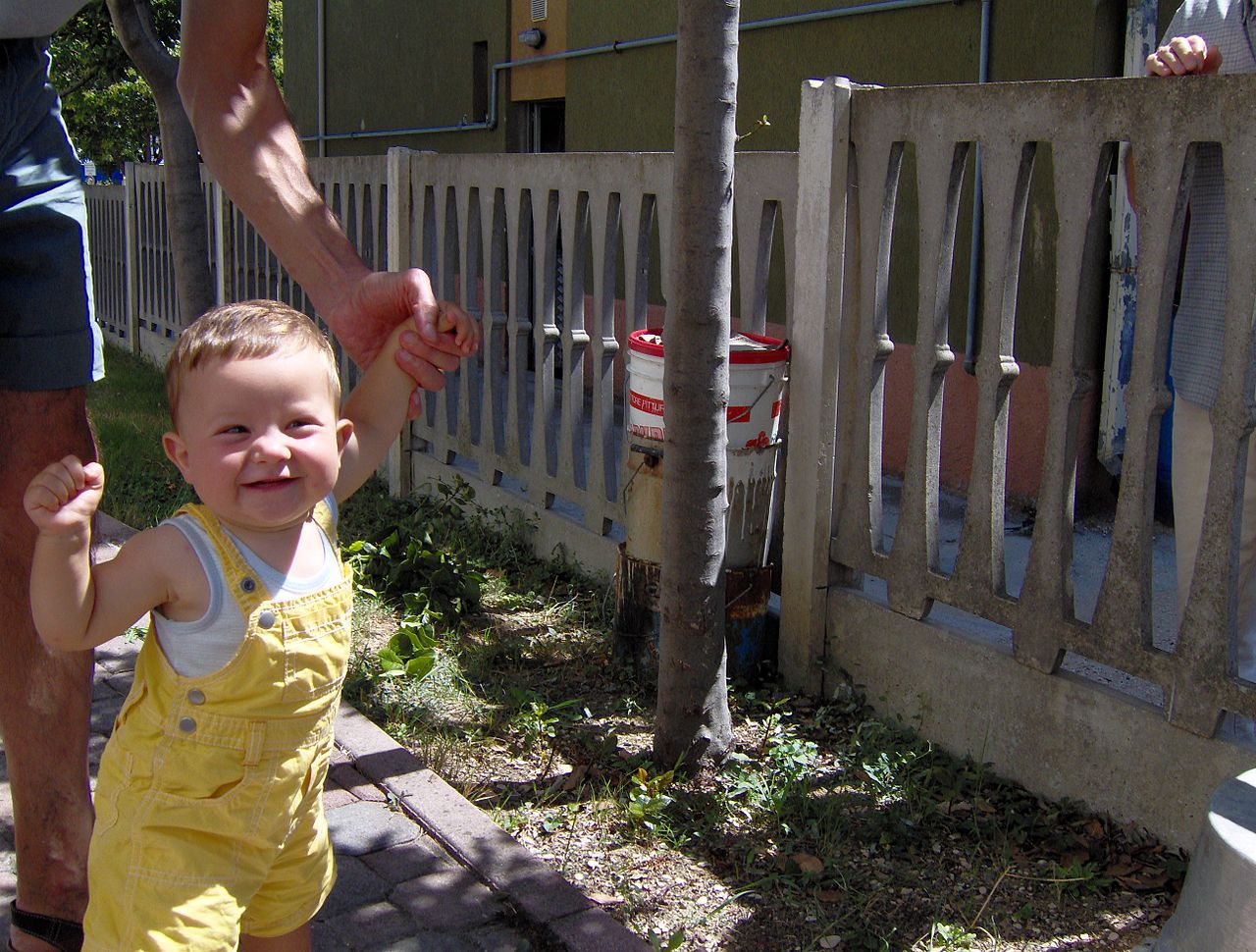
The photo at the top? Yeah, that’s me, in a needy moment and my mom holding me up in prayer and care. She still does this from her current location, closer to the Lord. Her prayers still hold me, and mine, for her. Requiescat in Pace.

Always Remember: A Homily for the 11th Sunday of the Year

061513Every now and then it will be said by some that the Church should speak less of sin and emphasize more positive things. It is said that honey attracts more flies than vinegar. And indeed, we in the Church have been collectively de-emphasizing sin to a large degree for more than forty years. But, despite predictions, our churches have been getting emptier and emptier. Maybe this is because people are a little more complicated than the “flies” in the old saying.

Jesus also gives the reason in today’s Gospel as to why our churches are getting emptier. Simply put there is less love. He says, But the one to whom little is forgiven, loves little. (Luke 7:47)

Why is there less love? As Jesus says, there is less love because there is less appreciation of what the Lord has done for us and the debt He paid for us. Because debt of sin is no longer preached as it should be, we are less aware of just how grave our condition is. Thus we under-appreciate what the Lord has done for us. This in turn diminishes love,  and a lack of love leads to absence and neglect.

Understanding sin is essential for us to understand what the Lord has done for us. Remembering what the Lord has done for us brings gratitude and love. To those who want the Church to de-emphasize sin Jesus warns, But the one to whom little is forgiven, loves little. (Luke 7:47)

Here then is the gospel in summary form, and the short, TV Mass version of my sermon. If you wish to ponder more, here follows a further commentary:

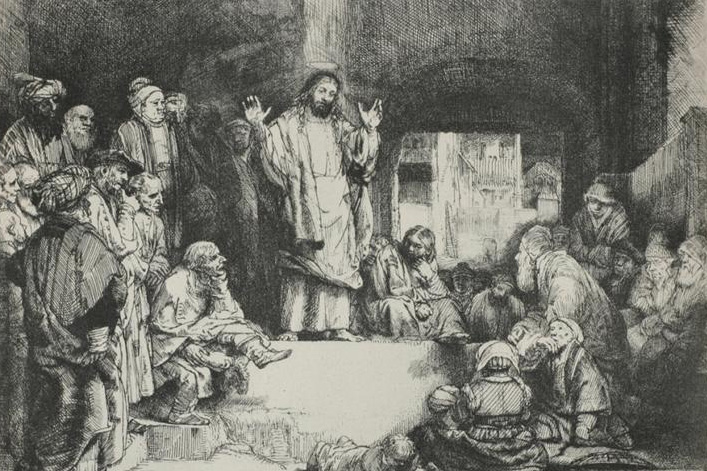
I. Rich Love – The Gospel opens with a sign of extravagant love. The text says, A Pharisee invited Jesus to dine with him, and he entered the Pharisee’s house and reclined at table. Now there was a sinful woman in the city who learned that he was at table in the house of the Pharisee. Bringing an alabaster flask of ointment, she stood behind him at his feet weeping and began to bathe his feet with her tears. Then she wiped them with her hair,
kissed them, and anointed them with the ointment.

One may argue as to the value of the ointment in this passage. Some have wished to opine that she was a wealthy on account of prostitution, and could thus afford an expensive ointment. Fine. But her tears were far more costly than any ointment. Yes, her tears are the most costly thing in her life, born on great pain and costly sorrow.

It is true, many of her sorrows are likely the result of her own foolishness. But that does not decrease her pain, it increases it. Yes, the most costly thing with which she anoints the Lord’s feet is her tears. There is nothing more precious to the Lord than the love of his faithful, than their sorrow for sins, and their turning to him in love and repentance; no greater gift.

In Jesus day people ate a formal dinner reclining on the floor, on a mat, on their left side. Their feet were behind them and they ate with their right hand. This explains the ability of the woman to approach Jesus’ feet from behind.

In this sense she is able to “surprise” Jesus by her love. Perhaps she was not ready to look upon his face and behold his holy countenance. Just his feet, the lowliest aspect of his sacred humanity, that is where she begins. She humbles herself to serve that part of him that most engages our lowly earth. There, even the Son of God had callouses, perhaps even a wound or two. Yes, there she saw reflected her own humility, saw her own callouses and wounds. There she would discover the first wounds the Savior endured for us; wounds that reflected that He knew what this world can do to a person.

She loves, sharing the incalculable gift of her own sorrows, sorrow for sin and sorrow on account of others who sinned against her. And there she found a friend in Jesus who, though sinless himself, had suffered mightily on account of the sins of others and would suffer more.

Such love, such relief. And, as we shall see, her love is rooted in an experience of mercy. And her experience of mercy is rooted in a deep knowledge of her sinfulness. That experience led her to deep gratitude for the love the Lord had shown her. As we shall also see, her experience of the depths of God’s mercy is something we must all some how experience.

And we too are called to go to the Lord in sorrow and love. And there at the foot of the cross we look up. And what is the first thing we see? His feet. And there, like the woman, we are called to love, to weeping for our sins, and to the remembrance of His mercy for us.

II. Rebuke – When the Pharisee who had invited him saw this he said to himself, “If this man were a prophet, he would know who and what sort of woman this is who is touching him, that she is a sinner.

Here is a dangerous comparison. The Pharisee accounts himself and others to be better or more holy than she. He seems to have no idea that he is also in need of grace and mercy as well.

There is a great danger in thinking that we can attain to heaven merely by being better than someone else. But that is NOT the standard. The Standard, to obtain heaven is to be like Jesus. And if we will lay hold of that, we will see that we are ALL going a lot of grace and mercy to even stand a chance! Yes, to this Pharisee and to some of us the cry must go out: “Danger (Will Robinson)!”

The danger for us is a danger that prevents us from experiencing God’s grace mercy and love. The danger is our prideful presumption that we are less needy that others who are more sinful.

While it is true that, a purely human level, some many have sins more serious than others, at the divine level we are ALL poor and blind beggars who don’t stand a chance in comparison with the perfection and holiness of God. Even if I were to have $500 in comparison to your $50, the true value necessary to be able to endure God’s holiness is $50 Trillion. Thus, whatever differences may exist between you and I are nothing in comparison to the boatloads of grace mercy we will both need to ever hope to see God.

The Pharisee’s exasperation is borne on a blindness to his own sin. And, being blind in this way, his heart is ill-equipped to love or even experience love. He has no sense he needs it all! His sense is that he is has earned God’s love and that God somehow owes him. But God does not owe him. His only hope is grace, love and mercy from God.

Having no sense of his sin, he smugly dismisses this woman’s action as reprehensible. And he even considers Jesus naïve and of no account for accepting her love. Yet, Jesus is not naïve and the Pharisee had ought to be rather more careful since the measure that he measures will be measured back to him. His lack of mercy for her, brings a standard of strict justice on him. But he cannot endure this sort of justice. He is badly misled.

III. RejoinderJesus said to him in reply, “Simon, I have something to say to you.” “Tell me, teacher, ” he said. “Two people were in debt to a certain creditor; one owed five hundred days’ wages and the other owed fifty. Since they were unable to repay the debt, he forgave it for both. Which of them will love him more?” Simon said in reply, “The one, I suppose, whose larger debt was forgiven.” He said to him, “You have judged rightly.

And here comes the central point of this gospel, a point we have too widely set aside today. And the point is simply that, to appreciate the glory of the good news, we must first lay hold of the of the bad news. We must grasp the depths of our sin to appreciate the heights of God’s love and mercy.

But in this modern age which minimizes sins and has said, in effect, “I’m OK you’re OK,” little penetration of the depths of sin is made. And thus, there is little appreciation for the glory for God’s steadfast love and mercy.

Jesus could not be clearer, until we know the bill of our sins and grasp that we cannot even come close to paying it, we will make light of mercy and consider the gift of salvation wrought for us as of little or no account.

How tragic it is then, that many preachers in Church have stopped preaching sin. The effect of course, as was mentioned above, has been to minimize love and empty our churches. Knowing our sin, if such knowledge is of the Holy Spirit, leads to love. Jesus now points to the woman as a picture of what is necessary.

IV. Remembrance – Jesus points to the Woman and says, “Do you see this woman? When I entered your house, you did not give me water for my feet, but she has bathed them with her tears and wiped them with her hair. You did not give me a kiss, but she has not ceased kissing my feet since the time I entered. You did not anoint my head with oil, but she anointed my feet with ointment. So I tell you, her many sins have been forgiven because she has shown great love. But the one to whom little is forgiven, loves little.

Yes, behold her love, a love which is the fruit of a remembrance of what the Lord has done for her. She knows and remembers that she has been forgiven much. It is fixed in her mind what the Lord has done for her and she is grateful and different.

And here is the heart of what it means to remember. Has not the Lord told us all to remember what he has done for us? Indeed, he says it at every Mass: Do this in remembrance of me.
What does it mean to remember? It means to have so present in my mind and heart what the Lord has done for you that you’re grateful, and you’re different.

This woman cannot forget what Jesus has done for her. She remembers, she is grateful and she is different.

We too must be willing to go to the foot of the cross and let it dawn on us what the Lord has done for us, to let it dawn so that we are grateful and different, so that we are moved to love for the Lord and for others.

Go with me to the foot of the cross and pray (in the words of psalm 38):

Foul and festering are my sores,
at the face of my own foolishness.
I am stooped and turned deeply inward
And I walk about, all the day in sorrow.

I am afflicted and deeply humiliated
I groan in the weeping of my heart.

Before you O Lord are all my desires,
And my weeping is not hid from you.
My hearts shudders, my strength forsakes me,
And the very light itself has gone from my eyes.

But it is there, at the foot of the cross, that his mercy dawns on us, there in the shadow of our own sins does the power of his mercy break through our broken and humbled hearts:

I Love the Lord for he has heard
The voice of my lamentation.
For he turned his ear to me
On the day I called to him!

The lines of death had surrounded me,
And the anguish of Hell had found me.
In my tribulation and sorrow I called on the Lord,
“O Lord save my soul!”

Ah, The Lord is merciful and just,
Our God has had mercy!
The Lord guards his little ones.
I was humbled and he saved me!

Be turned back my soul to your rest,
My eyes, from tears, and my feet from slipping!
For I will walk in the presence of the Lord,
In the land of the living. (Psalm 116)

Always remember what the Lord has done for you. Go to the foot of the Cross. Let the Lord show you what he has done for you. Always remember and never forget. If you do, you will be grateful and different.

Some time ago the world cast off sorrow for sin as “unhealthy.” And, sadly, the larger part of the Church bought into the self esteem craze of the 1970s and 80s. It is true, there such a thing as morbid and unhealthy guilt. But there is also a godly sorrow of which St. Paul writes:

If I caused you sorrow by my letter, I do not regret it. Though I did regret it—I see that my letter hurt you, but only for a little while— yet now I am happy, not because you were made sorry, but because your sorrow led you to repentance. For you became sorrowful as God intended and so were not harmed in any way by us. Godly sorrow brings repentance that leads to salvation and leaves no regret, but worldly sorrow brings death. See what this godly sorrow has produced in you: what earnestness, what eagerness to clear yourselves, what indignation, what alarm, what longing, what concern, what readiness to see justice done. (2 Cor 7:8-11)

It is time for us all to rediscover godly sorrow, a sorrow for sins that comes from the Holy Spirit and which is the root of love and gratitude for the salvation of God. Without it we are too easily like the Pharisee in today’s Gospel: arrogant, harsh, dismissive, and self satisfied. As the Lord says, The one to whom little is forgiven, loves little. But with it we are like the woman: grateful, loving, serving, and extravagant.

Remember what the Lord has done for you. That is, let what the Lord has done for you be so present in your mind and heart that you are grateful and you are different.

Always Remember.


On the Ultimate Unity of All things in God, As Seen in a Science Video.

061413The video below, which was featured on NewAdvent.org yesterday shows a remarkable relationship and unity between two things we seldom think of together: sound and geometry. And yet, there it is.

From my own studies I have long seen a kind of relationship between music and math. For example, the current 12-Tone scale was developed in the 15th Century using the Pythagorean theorem. Clearly music and geometry come together since the length of a string or a pipe determines the pitch of the sound made. Thus, geometry and sound DO relate.

More artistically I have always relished the mathematical precision of Baroque music, especially of the Bach fugue, which amounts to a kind of mathematical progression on a musical theme.

But all my linking of math and music was something I thought of as largely a manner of thinking, an intellectual connection if you will. But the video below shows that there more than intellectual abstraction going on. The connection between sound and geometry is also physical. As each tone is produced, the geometry is produced and visible to the eye. As the tone changes, so does the picture created.

Frankly: Wowza! It is a wonder and awe moment!

And why shouldn’t there be a clear relationship? At the end of the day, all things are one, and connected because the one God who is simple and and one, produced them all. We see his fingerprints in everything he has made. In the video, God’s fingerprints are beautifully displayed.

Most people don’t connect sound and geometry. But since they both come from God, they are connected, and it merely falls to us to discover the relationship.

For years now scientists have sought to find a unifying and simple theory that explains everything. Some decades ago it was called the “Grand-unified Theory.” More recently the media coined the term “God-particle.” Whatever you want to call is, the hunt is one for the one thing that explains everything.

Theologians have known the answer for thousands of years, and expressed it in our own terms. The grand unified theory, the one thing that explains everything is Love. God is love, and He who IS love explains everything. Why is there something as opposed to nothing? Love. Why is the universe so big and so diverse, why such extravagance? Love. Why is there justice, why is there beauty, why is there order, why is there desire? Love!

Love is not merely something God does, it is not a mere attribute. God IS love. And as love, he has done all things. Love explains everything. God is Love and Love loves, that’s what love does, it loves. Why are sound and geometry ultimately one? Because the same Love made them both and resonates in them both. The same Love sustains them.

Do not misinterpret this. Distinctions are important, at least for us humans. We need to distinguish and must distinguish. It is the basis of thought for us, who are contingent and limited beings. But at the end of the day, what we distinguish as more in common that it has in distinction. Why? Because God who is Love made and sustains everything. We ought never forget, as we distinguish, (for we must), that there is a deeper and mystical union to all things.

Perhaps I can end with a “Desert Father” story which I do not recall as to its origin, but I recite it from memory:

One day, a disciple came to the Abbot and asked, “What am I to do about the distance I experience with God?” The Abbot replied, “Understand that it isn’t there.” “Does that mean that God and I are one?” said the monk? Father Abbot said, “No one….not two.” “How can that be?” said the perplexed monk. The Abbot looked at him and said, “The ocean and its wave, the singer and his song, the candle flame and its light…..not one, not two.”

And the point is that all our little categories and distinctions fall short as we draw near to God. Even the simply defined 2 versus 1. As humans, in our experience we must distinguish. For as limited beings we can only see pieces at a time. But our distinctions are ultimately a sort of analogy. Things also have a unity we cannot deny. Why? God is love, and Love made and infuses all things.

A chair, a monkey, a water molecule, sound, light, and geometry, ultimately have more in common than they have apart. Distinctions for us are a kind of necessary evil. But we ought remember, at the end of the day, that Christ hold all creation together in himself. And that at the end, there will be, in the words of St. Augustine: Unus Christus, amans seipsum. (One Christ, loving himself).

This is not pantheism. For God transcends all he has made. He is bigger than all this. But he unites all this. The Grand unified theory is simply this: God is love. Love is the answer to the ultimate why and how of all things.

Now the video. Behold the fingerprints of God’s love.

When you Break Big Laws, You Get Small Laws. A Meditation on a Teaching By Chesterton

061313GK Chesterton once observed that “When you break the big laws you do not get freedom. You do not even get anarchy. You get small laws.” (Daily News, July 29, 1905).

Yes, small laws, lots of small laws. Trifling and irritating small laws that regulate every human interaction and transaction. It is death by a thousand cuts. And thus, when we as a society set aside the bigger picture of, say, respecting life, of mutual respect and consideration for the common good, we get ten thousand laws.

As of 2012 there were just over 160,000 pages of law and rules from the feds alone in the Federal Code and elsewhere. States and localities have likely doubled that. Even legal specialists can’t keep up. The tax code is incomprehensible, even the Secretary of the Treasury cannot file an accurate return. The nanny State only adds to the problem: enter Mayor Bloomberg, and his “law” forbidding the sale of soft drinks larger than 16 oz.

But the bottom line is, if we neglect the bigger laws;  if we neglect the biblical moral vision that insists on moderation, condemns greed and excess, prescribes sexual responsibility, faithfulness to commitments made, truthfulness, respect for the goods of another, obedience to lawful authority, and commands a reverential acknowledgement of God, and a holy fear for the consequences of unrepented moral turpitude; if we neglect that, this is what you get: a huge legal code regulating marriage, divorce, property rights, child support, alimony, child protection, family violence, “hate” speech, noise ordinances, public drunkenness, debt management, bankruptcy, liability, and on and on….

Frankly, an out of control Federal Legislature reflects our more personal and local tendency to be out of control and on moral vacation. Ignoring the big picture and the moral vision that used to be given us by the Scriptures, natural law, common sense and mutual respect, has now given way to an endless proliferation of small laws that regulate even when you can run your lawn mower.

I also want to note a couple of what I would call corollaries to Chesterton’s insight.

First, in failing to fear the Lord we seem to fear everything else. In our culture, fear is an industry. We are to fear crime, fear for every possible health issue, we fear infertility AND pregnancy, we fear economic setbacks, climate change, and even ordinary weather and storms. We fear asteroids and any number of other disaster scenarios. We fear asbestos and all sorts of other environmental threats. We fear that the “other party” will utterly end life in America as we know it if their candidate wins…., and on an on it goes.

Today there was an absurd illustration of the fear mongering here on the East Coast. This morning my clock radio came on with urgent news of a line of thunder storms coming in from the West. We were told to be afraid, to be VERY afraid. We were told, there could actually be high winds, hail, and heavy rain! Maybe even a tornado. Now of course such storms are a regular feature on the East Coast in Summer, and happen even dozens of times in the course of June, July and August. And yes, even occasionally a tornado is in the mix.

But honestly the absurdity of listening to a reporter telling us how to hunker down in our bathtub or other interior room was too much, and was topped only by the announcement of the Federal Government that workers could stay home and telecommute due to the coming thunderstorms.

Yes, that is right, the Federal Government advised workers to stay home because of thunderstorms. And by the way, it did rain, and we did survive. There were a few downed trees, and scattered power outages. Someone saw a twister north of DC too. Welcome to summer in Washington.

How have we come to the point that we can be baited to fear about ordinary weather? Actually it is not hard. Just abandon a proper and holy fear of God, and pretty soon you fear everyone and everything else.

It is a corollary to Chesterton’s  remark on Law above: Stop obeying big laws and you get lots of little laws. The corollary is, Stop fearing God, and you start fearing everything else.

I would like to recall that God has a better plan. In effect he counsels that we develop a Holy Fear of Him, and then we don’t need to fear anyone or anything else. The Apostles, when told to fear what the temple leaders could do to them responded respectfully, “We must obey God rather than men.” Life gets a lot simpler when we report to one ultimate authority.

And Holy Fear leads to trust, and trust abates a lot of lesser fears. When my focus is on God and the good things waiting for me in heaven, I am less fearful of property loss, whether or not I get the promotion, less fearful of health and even death. I fear and trust the Lord. Whatever happens, God wills it and will see me through it. All things work together for good to those that Love and trust the Lord and are called according to his purposes.”

While the believer is not called to fool-hardy actions, neither is fear easily incited in him or her. The fear of the Lord ushers in a serenity that is not easily disturbed by the threats of human beings or by silly fears incited by a media trying to sell ads and to rivet us to the TV in fear.

Thus, fear the Lord and other fears largely diminish and go away. But fail to fear the Lord and the result is not no fear, it is ten thousand little fears and vulnerability to endless manipulation through fear.

And Second and related corollary is related to our obsession with physical health. The modern secular world celebrates a kind of “liberation” from: concerns about the soul, a sense of guilt, and concerns for the effects of sin and so forth.

But what happens when the soul is neglected is not a liberation from concerns, guilt or the effects of sin at all. Rather, to neglect the bigger and lasting concern about the soul, is to receive ten thousand concerns about the body: This causes cancer, that makes you fat, this has cholesterol, watch your pressure, don’t eat salt, drink more water, eat more fiber, exercise! And even the normal effects of aging are to be feared: hot flashes, “Low-T” gray hair… And even normal functions such as fertility are feared and must be medicated away. Pregnancy is treated as a potentially deadly condition. Women must be sterilized, others rush to remove their breasts, BEFORE cancer ever touches them.

Gad zooks! We have never lived so long and been so healthy, and yet, we have never been so anxious about our health. Never mind that our body is going to decline and die anyway no matter what we do.

There is a proper love and concern we should have for our body, this is part of a well-ordered self love. But when we do not integrate and balance our love for our body with our love for our soul, things go out of order and, as experience shows, we do not have less concerns but more. And those concerns are ultimately futile, for the body will die anyway.

Thus the corollary to Chesterton’s rule is When you set aside the most critical concerns necessary for the soul, you do not get fewer concerns. You get lots of small concerns that pile up unreasonably. You do not get less guilt, you get more of it wherein the list of bad or forbidden foods grows ever longer, as does the list of duties regarding exercise, dietary supplements, medicines and so forth. There are not less dos and don’ts, there are far more.

Yes, welcome to the modern world of “out of wack” and out of balance notions. When you break the big laws you do not get freedom. You do not even get anarchy. You get small laws.” It is death by a thousand cuts.

This video reminds that it is better to have a salutary fear of death and judgment than most of the stuff we get worked up about:

Somebody is praying for you! Priests and the ministry of prayer

061213Ordination season is upon us now and a new group of men are being ordained all over the country. Never forget how necessary priests are not just in the obvious and external ways but also in more hidden ways.

Holy Order – As priests we are ordained to Holy Orders. Thus, among the many ways we can understand the ministry of the ordained clergy is that we provide “holy order” by our obedience to the Bishop or Superior and by unifying the faithful under our care to the Bishop and the Church. Nothing is more egregious (and also silly) as a disobedient priest who thereby creates disorder. By our obedient link to the Bishop we help exercise a threefold office of teaching, governing and sanctifying. Priests preserve order in the Church by uniting their parishioners in the truth of the Gospel. And, like it or not, priests also unify the faithful by the charitable but clear authority of the priestly office which is meant to resolve conflicts, set directions and  observe proper limits. Unity is a very precious gift from the Lord which He, by his own design, has rooted in the Sacrament named for that very gift of Holy Order.

Sanctifying Ministry – I would like to mention only very briefly one aspect of the sanctifying ministry of the priest. Surely we sanctify the faithful in a unique way through the celebration of the Sacraments and the proclamation of God’s Word. But another way we do this, a way perhaps more hidden and ordinary, is to pray for our people. The Church both commends us to pray for the faithful under our care and also commands it.

A Ministry of Prayer – How does she command it? By the obligation to pray the Liturgy of the Hours, also known as the Breviary. Every day we priests are obligated to pray this somewhat lengthy series of prayers and to earnestly pray for the faithful and in union with the whole Church. The basic series of prayer of the Liturgy of the Hours includes: The Office of Readings, Morning Prayer, Mid Day Prayer, Evening Prayer and Night Prayer. Ideally we should pray it through out the day at each appointed hour. But, due to our busy and often unpredictable schedules many of us pray large sections of it in the morning and another part of it later in the evening.

An image: But you must know that your priests pray for you. As I hold the Breviary in my hands I often imagine I am holding the faithful of my parish in my very hands. It is my duty and privilege to pray for them, and also for the whole Church.

Someone is praying for you – I want to keep this brief (always a challenge for me) because I simply want you to know that someone is praying for you. Surely my prayers are especially for my parishioners. But you who regularly read this blog are parishioners of mine too. I pray for you each day.

I also wanted to keep this short in hopes that you might see this video which is a very touching way of depicting how priests pray for their people and their people pray for them.

Lets Show a Little More Sophistication in Understanding Modes of Speech

In the use of language certain sophistication is necessary that appreciates the different modes of speech that are often used. A lot of communication breaks down today because many lack the sophistication necessary to understand when various modes of speech are being employed and how they are to be interpreted.

Not only does this lead to poor communication, but it also affects Biblical interpretation and also the way in which many understand Church teaching and practices.

In hopes of greater understanding of the often subtle and different modes of speech, perhaps we can review some terms and distinctions related to modes of speech.

Denotation vs. Connotation – Denotation refers to the literal, dictionary meaning of a word, usually the first meaning of word listed there. For example, the denotative meaning of the word “snake” is “any of numerous scaly, legless, often venomous reptiles of long and cylindrical body and found in most tropical as well as temperate regions.”

Connotation, on the other hand, refers to the associations that are connected to a certain word or the emotional suggestions related to that word. The connotative meanings of a word tap into the denotative meanings but also point beyond the merely literal meaning. The connotations for the word snake could include evil or danger. Thus to call snake would speak to their poisonous, predatory or dangerous tendencies. A snake connotes danger and sinister practices.

Connotation opens language to a wide variety of meanings and interpretations based on context.  Such deviations from literal meaning are called “figures of speech” or figurative language. There are many different kinds of figures of speech, such as

Simile, – A simile is a comparison between two dissimilar objects using a word like as or like to connect them. Notice that simile means something is “like” something else in certain respects. It does not mean that they are identical.

Thus, when Jesus warned against casting our pearls before swine, he is using a simile and saying that human beings can adopt certain traits associated with pigs. He is not say humans ARE pigs. Since, pigs only value what they can eat,  putting fine but inedible things before pigs mean that they will simply be trampled underfoot. And some people who rather carnal can develop the same attitude toward the pearls of “spiritual gifts” since they do not provide simple bodily pleasure. In this sense people are like (simul) pigs by having a similar trait, but Jesus is not saying they actually are pigs. And this is simile.

Metaphor,  – A metaphor is like a simile, except that a metaphor compares two dissimilar objects without using a word like as or like. If you say, “My girlfriend is an angel” you are using metaphor. But again a certain trait of an angel is being borrowed, not the full angelic reality. Even though one says, “My girlfriend is an angel” this is not a declaration that she has a complete angelic nature and is not, in fact, human.

If you say, in the words of an old song: “When I take my sugar to tea,” “sugar” here does not refer to the granular sucrose material, but to a woman. And the woman is not actual sugar. Yes, she is a “sweetie,” but possessed of female human nature.

This is metaphor: two dissimilar objects are compared or have some common trait though they are distinct.

In the Bible some err in understanding certain texts because they miss the metaphor. Thus, in Genesis when there is reference to a race of “giants” (Gen 6:1-4), one need not necessarily take this as a literal declaration that there used to be people on the planet who were over ten feet tall. For example, of the generation of priests in the 1940s and 1950s I might say, “They were real giants!” Or I might speak of that era as the “age of the giants.” But I do not refer to their physical stature. But rather to their influence and power. It is a metaphor, a figure of speech.

And thus in biblical texts we ought to consider that the use of metaphor may explain certain things like giants. It is not always clear when metaphor is being used, but reading everything in an unvarying literalistic way, many yield poor results, and thus the Church permits recourse to the possibility and likelihood of metaphor in many cases.

Personification –  One may describe an inanimate object, animal, or abstraction with human qualities and characteristics, as though it were a person this is personification.

For example, I call my older model Crown Victoria car, “Betty Grable” as a term of affection, for its stately but older quality, and because I got it from my parents after their death. And Betty Grable speaks to their generation. My Secretary calls her call “Betty Boop” because it is a spunky and sportier car, with a lot of pizzaz.

Hyperbole (sometimes called overstatement) – occurs when you exaggerate a point that you are trying to make for emphasis. If you say, “There must have been a million people there,” you are using hyperbole. There were not likely an exact million in attendance, but the point is there were a lot of people.

When Jesus says, if your eye causes you to sin, gouge it out (e.g. Matt 5), He is not giving a command that we mutilate ourselves. He is using an exaggeration that emphasizes we ought to be serious about sin and removing its causes, and that it is more serious to sin that to lose an eye.

Understatement –  is related to hyperbole in that understatement is the opposite of hyperbole: Understatement implies more than is actually stated. Let’s say an event was standing room only, and when someone asks you if there were many people there, you say, “Oh yes, there were a few people there.”

Paradox – refers to a form a speech that provocatively goes against the common way of understanding something. Paradox seems initially to have contradictory elements, but after some reflection and contextualizing, those elements can later make sense.

For example, when Jesus says we must lose our life to preserve or save it, we are initially puzzled, since we usually do not think we can possess or preserve something we have lost. Losing money (for example) is the opposite of saving it. Thus, the saying of Jesus that we must lose in order to save is paradoxical.

But of course what he means is that we must often lose one thing to make room for something greater. We must let go of lesser and passing things to inherit greater and eternal things. And thus the context helps resolve the tension of the paradox.

A pun – is a play on word that occurs when one word is used that reminds you of another word, or words. You can, for example, use a word that looks like or sounds like another word.

For example, English-speaking Christians can play on the word Sun and Son perhaps by saying, “The women went out to the tomb very early at the rising of the son (sun).” When spoken aloud (as opposed to writing – wherein the words are spelled differently) an English speaker can play on the similar sound and thus use a creative figure of speech.

Another example of a pun occurs in the playful words of an old country song: “Ever since you hung up on me, I’m hung up on you.” In this sentence the phrase “hung up” is being used playfully in two very different senses. One puns by playfully interposing two different senses in the same sentence.

Verbal Irony – Irony involves a contradiction. Being ironic means that you say something but mean the opposite to what you say.

For example, suppose some one tells me that he had a big repair bill on something and I say, “Well, aren’t you lucky!” I mean exactly the opposite of what I actually say.

Or suppose you are on a basketball court and one player makes a great shot, and the other players say (in admiration) “He’s bad!” Which actually means he is good!

In John’s gospel there are many verses dripping with irony. For example, the man born blind comes to see who Jesus is, while the Pharisees who could see, will not recognize Jesus. This causes Jesus to say, “For judgment I have come into this world, so that the blind will see and those who see will become blind.”

Later in John the Temple leaders, who are unjustly seeking to kill the Son of God will not come into the Praetorium (governor’s house) because they do not want to sin by incurring ritual impurity before the Sabbath. John records this fact with an almost derisive irony.

Frankly there are dozens of other modes of speech and rhetorical devices that enter into human speech and writing.

Too many today have lost touch with the subtlety of human language and this causes error, tension, misunderstanding, and the taking of offense when none is intended. On the Internet forum misunderstanding is often magnified, since the helpful signals of facial expression and tone of voice are missing. I have often written something in a light-hearted and jocose way, only to be interpreted as being deadly serious by some who also take offense where I mean none.

Thus, more than ever, we do well to remember that speech has modes, and employs a lot of subtle and sophisticated devices.

So how about a little sophistication from us all who read? How about also giving the benefit of the doubt to the writer, and presuming more often a benign interpretation of the words before rushing to extreme conclusion.

Just sayin…. (by which I really mean I am just writing, and also by which I don’t mean say I am JUST writing, for I am also thinking… )

Boy! (an interjective, personification of an imaginary interlocutor) I think I’d just better quit (by which I really just mean to stop temporarily) while I’m ahead (a spatial allusion not to be literally interpreted). Do you get my drift?

"Because We Can!" Is not a moral argument. We must still answer, "Should We?"

061013At the bottom of this post is a powerful video that asks a fundamental moral question of a new and powerful scientific ability: “Should We?”

One of the great ethical and moral questions that besets us with new technologies, especially medical technologies, is whether our sheer capacity to do something thereby permits us to do that thing. Of course the answer to this ought to be “no.” Ability alone does not permit us to do anything we like.

I, for example, have the capacity, at least physically to do a lot of things I ought not do. I can steal, lie, damage, destroy and kill. Simply being able to do these things, even if I have “my own good reasons” for wanting to do them, does not give me carte blanche to in fact do them.

Groups and nations also have many capacities that they ought not act on. Perhaps one group more powerful than another can force its will on another, or one nation more powerful than another invade and enslave another nation. But again the mere power or capacity to act, does not give the group or nation the simple right to act. And of course the group or nation having the power will claim to have good reasons for doing what they do, but at the end of the day those reasons must judged by others, not merely asserted by the one who has the power.

Power without recognized limits can be a very ugly and destructive thing. And the power or capacity alone to do something is NOT a moral argument.

To some extent, everyone will recognize what has just been said as reasonable. But often, when it comes to science and new technologies, thinking becomes suddenly more fuzzy. This is especially the case in the realm of medicine, and medical technologies such as embryonic stem cell research, genetic manipulation, cloning, and many types of “reproductive” technologies such as in-vitro fertilization.

It will be granted that such matters often involve a lot of technical details that are difficult to understand. It is also understandable that many heart-wrenching issues revolve around such discussions, such as the hope to end disease or to overcome infertility.

But, too frequently we are asked refrain from any moral judgement by proponents of such things, and are often asked to accept the unreasonable notion that we ought to be able to do something merely because we are able to that thing, and the proponents have self-proclaimed good reasons to do it.

But as we saw above, in less heart-wrenching scenarios, mere ability, even if coupled with self-proclaimed good reasons is not alone a worthy moral argument. Many very ugly things have happened in human history on such faulty terms.

Again, let it be clearly stated, the ability to do something does not thereby confer the right to do it. Power does amount to a moral argument, and to the contrary, power often demands greater moral restraint of its possessor.

In the video below, which I hope you get a chance to see, the question is asked. “Should we?” For it would seem that we are close to capacity to bring certain extinct species back to life on this planet. Can we do this? It would seem we are close. But should we? Now THAT is a worthy and necessary moral consideration.

We have generally been conditioned by environmentalists to see extinction as always bad. But perhaps some extinction is necessary and god in the cycle of nature. Who gets to say what particular species might be good to reintroduce and what ones ought not?

Think about it. And think too about the modern moral tendency, especially in medicine to equate capacity with permission and moral rectitude. Many today demand the right to engage in certain scientific procedures and medical interventions simply because we can. Well, we can…but should we?

On Sloth and the Noonday Devil

"Hammock nap on patio"  by Michael Nutt from New York, US - David asleep in hammock.  Licensed under C  C BY-SA 2.0 via Wikimedia Commons
“Hammock nap on patio” by Michael Nutt from New York, US – David asleep in hammock. Licensed under C C BY-SA 2.0 via Wikimedia Commons

One of the more misunderstood of the deadly sins is sloth. In the wider culture sloth is often equated simply with laziness.

But sloth has a lot more subtleties than simple laziness. In fact, sloth can sometimes manifest as workaholism and other frantic worldly activities and busyness.

This is because sloth is most fundamentally defined as a “sorrow or aversion to the good things that God offers” such as a moral life, and deeper spiritual fruitfulness etc. There are some who find such things unappealing, and instead of joyfully accepting these gifts, they are sorrowful toward them or averse. One way to avoid God, and to avoid engaging in spiritual practices is to busy one’s self with the world, to dive into career and become a kind of a workaholic. Thus one simply says, “I’m far too busy to pray, or to spend time reflecting, or to read Scripture, or go to church etc. Such a person is not lazy but they are slothful.

Other forms of sloth do more consistently manifest in the form of a kind of laziness. Some people permit themselves to be mired in laziness or boredom, and a kind of tiredness such that they cannot rouse themselves to prayer other spiritual activities.

Yet another form of sloth, a form that is subtler, is a kind of discouragement that sets in once one has embarked on the spiritual path or vocation, and been at it a few years. And thus, one may get married, or become a religious or be ordained a priest, and after four or five years, when the newness worn off, a kind of Discouragement and boredom set in. And this boredom tempts one to think they made a mistake or must leave the path simply because the thrill and newness is gone.

The secular world often refers to this sort of sloth as the “five-year itch.” And usually applies this expression to marriage. And it is a very common thing that after four or five years of marriage, the greatest danger for divorce arises. The same is true of the priesthood and religious life. Four or five years into a vocation is a critical time period. The newness and thrill have worn off and now it comes time for the daily living, without the previous emotional intensity.

CS Lewis in the Screwtape Letters has “Uncle Screwtape” explain the slothful discouragement to Wormwood in this way, and instructs his “student demon” thus:

Work hard, then, on the disappointment or anticlimax which is certainly coming….It occurs when lovers have got married and begin the real task of learning to live together. In every department of life it marks the transition from dreaming aspiration to laborious doing…..[Careful my dear Wormwood], If once they get through this initial dryness successfully, they become much less dependent on emotion and therefore much harder to tempt! (Letter 2)

And by this form of discouragement (a subtle form of sloth) one is tempted to give up one’s current course of action and run off to something new and seemingly more thrilling. Grave becomes the temptation at this point to stray from, or end marriages, leave the priesthood or religious life, or some other spiritual course. One is no longer thrilled and excited of the gift that God has given. But now there is sorrow and a kind of aversion to it. This is sloth.

The Desert Fathers of the Church, based on Psalm 91 referred to this type of sloth as the “noonday devil.” (Psalm 91:6 in the Latin Vulgate spoke of a morsu insanientis meridie – the scourge that bites at noon, i.e. the “noonday devil”).

Indeed, most of us experience this noonday devil, at least from time to time, between noon and 3 PM as a kind of sluggishness sleepiness that sets in on us. Many cultures, rather than battle this, have introduced an afternoon siesta.

Whatever the case, shortly after lunch, a sleepiness and boredom sets in. The newness of the day is gone and the day now seems to drag on and cannot end fast enough. The eyes are heavy and one longs to sleep. Yes, the noonday devil is upon us.

And this noonday devil which besets us is also a symbol  of the discouragement that often sets in when one has embarked on a vocation or spiritual path that is no longer new, and now requires the daily work which may no longer thrill. Early afternoon in ones vocational or spiritual walk is a dangerous and tempting time.

One of the Desert Fathers, Evagrius of Pontus (A. D. 345-399) writes as follows:

The demon of acedia (sloth), also called the “noonday demon,” is the most oppressive of all demons. He attacks the monk about the fourth hour and besieges his soul until the eighth hour….He makes the sun appear sluggish and immobile as if the day had fifty hours…. Moreover the demon sends him hatred against the place…. and makes him think he has lost the love…. and stirs the monk to long for different places…and to flee from the race-course. (On Eight Evil Thoughts, Acedia)

A pretty clear description of the kind of temptation besets many, both in their vocations and in their Christian walk.

Beware of sloth, beware of the noonday devil. See it for what it is; name it; know its moves. Understand too, that the noonday devil manifests for only a time. If one will persevere through the midday hours of life and the Christian walk, one will also find that the noonday devil eventually departs, as one settles in to a proper and steady rhythm of the Christian walk or vocation.

However mystifying, disconcerting, and discouraging the noonday devil may seem, most who are able to persevere are glad they did, and that they stayed the course.

Always remember, the devil is a liar. Life cannot be and should not be thrilling at every moment, or lived at a 1000 miles an hour. Such a pace and intensity cannot be maintained. Slow, steady and organic growth is ultimately what is best for the human person.

Stay the course and ignore the noonday devil who taps into the subtleties of the wound in our soul called the deadly sin of sloth. Presuming that one has properly discerned the Christian walk and particular vocation, one should trust in the Lord and stay the course.

Whatever the emotional state steady as you go, Age quod agis – Do what you are doing! Rebuke the noonday devil in the Name of Jesus.