
Yes, They Ate Locust – A Review of Some Common Foods at the Time of Jesus

071614Generally speaking, the Israelites of the time of Christ were frugal eaters. Frankly, until about 100 years ago, frugality in eating was more imposed than chosen. Food was more scarce and less convenient than it is today. Its availability was seasonal and all the elements needed to be made from scratch; even water needed to be hauled in from wells, etc.

Bread was the essential, basic food. So basic was it that in Hebrew “to eat bread” and “to have a meal” are the same thing. Bread was treated with great respect and many rules existed to preserve that reverence. Any crumbs larger than about the size of an olive were expected to be gathered, never simply discarded. Bread was never to be cut, always broken. The poor ate barley bread, while the rich ate bread of wheat. Flour was made by grinding barley or wheat grains between two millstones.  This was done in the home, almost always by women. Then the dough was made and worked in kneading troughs. To make the heavy barley bread rise, women used very strong millets and barley yeast. The loaves were usually made round, and thus one spoke of “a round of bread,” or simply “a round.” Because bread would quickly become moldy, one would only bake enough for a day or two.

Corn (grain) – Though the Bible mentions corn, it has nothing to do with what we call corn today. Such a crop was unknown in the Middle East. “Corn” in the Bible refers to what we call grain today.

Milk – Cows’ milk was rare, and in any case it was not liked as much as the more common milk of ewe lambs and of goats. Since milk tended to spoil quickly, cheese making was very common.

Honey was the sweetener that was used for most things. Cane sugar was unknown in the Holy Land. The source of honey was bees, which were colonized as they are today. Sap from various trees and the thickened juice of grapes (jelly) were also common sweeteners. So much honey was made in the Holy Land that some of it was exported.

Eggs – As for eggs, very few of them were eaten. The thought of eating eggs was something brought into the Holy Land only from the outside, especially the East. Eggs tended to be food only for the very wealthy. Indeed, the eating of poultry at all seems to have come to Jewish regions only after the exile in Babylon (587 – 500 BC).

Vegetables – The diet of ordinary people included a great many vegetables, beans and lentils foremost on the list. Cucumbers as well were very much esteemed. Onions were very popular.

Meat – There was far less meat consumed than is the case today. Meat was a food of luxury and only the wealthy ate a great deal of it. Poor people never slaughtered an animal for their own eating except when there was a family feast. Generally when such a feast approached an older animal was chosen and fattened up by feeding it grain. Such an animal spent its last months eating well and working little so that its muscles were softer and fattier. Goats and lambs provided the most common meat, but occasionally a calf (i.e., a cow) was slaughtered. The animal was usually roasted. Chickens were scarce while pigeons and turtledoves were cheap. Game was much sought after but generally only the wealthy ate much of it. Deer and gazelle were considered kingly dishes and peacock was reckoned a great delicacy.

Fish – For most common people fish was more important than meat. A typical meal consisted of bread and fish. This is illustrated by the miracle of the loaves and the fishes as well as the meal at the lakeside in Galilee at which Christ prepared fish over a charcoal fire. The Sea of Galilee had great quantities of fish, and fish were also gotten from the Mediterranean Sea. Since fish soon went bad it was often salted. The consumption of fish was so great that some of it had to be imported.

Locust – One of the most surprising forms of food was the locust. (But perhaps it is no stranger than some of the things we eat today such as frog’s legs, snails, and live oysters.) An ancient Jewish document claims that there were 800 different kinds of edible locust. Sometimes they were cooked rapidly in salt water and had a shrimp-like taste and color. Usually the head and legs were removed. Sometimes they were dried in the sun. After being dried, some were ground down to a powder known as locust powder, which tasted rather bitter and was often mixed with flour to make a much-prized bitter biscuit.

Butter (oil) – Butter was rarely used; olive oil was much more common. So abundant were olives and olive oil, that the excess was exported. Many olives were eaten directly, but others had the oil pressed from them using an oil press at home (see left). Olive oil was highly prized and many passages in the Bible hold it up as a symbol of strength and health.

Fruit – Fruit had an important place in the people’s diet. They had many melons and figs along with pomegranates, blackberries, and dates. Since fruit was in abundance, it was often exported as well.

Nuts – Nuts were also in some abundance, especially walnuts, almonds, and pistachios. As is done today, they were often roasted.

As for seasonings and other condiments, the ancient Jews seemed to like their food strongly seasoned. There was salt in abundance from the Dead Sea area and it was used to preserve certain foods. Other common spices were mustard, capers, cumin, rue, saffron, coriander, mint, dill, rosemary, garlic, onions, and shallots. Pepper, however, was scarce and expensive as was cinnamon, both of which came from the Far East.

Salted – Without refrigeration, fish, meat, and some vegetables were preserved by salting or pickling them.

Pork was absolutely forbidden as was rabbit and any meat with blood still in it. Meat had to be carefully drained of all blood, for it was believed that life was in the blood and life belonged to God.

Drinks – People drank water when it was pure, and spring water was strongly preferred to well water. Milk and vinegar diluted with water were also consumed. Juice from pomegranates or dates was a favorite. And a kind of light beer was made from barley and millets.

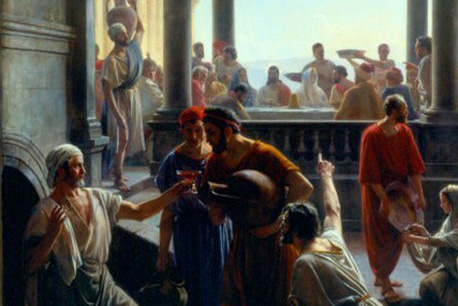
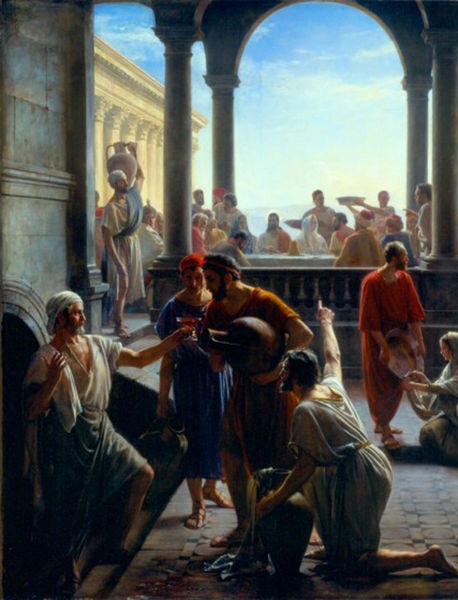
Wine was a very important staple; it is said that God himself first showed Noah how it was made. Vineyards and grapes were in abundance in ancient Israel. The grapes were occasionally eaten directly but most of them went toward making wine. Psalm 103:15 says that wine is joy to a man’s heart. The book of Proverbs (31:6-7) also prescribes that there should be wine for the afflicted hearts. In Ecclesiastes 31:27 the author wonders what kind of life one could lead without it. Indeed, the vine was a symbol for Israel in the Scriptures. Since wine was considered sacred, it had to be kosher, that is, made only by Jewish hands. Only red wine that was consumed in biblical times; there is not even one mention of white wine. Wine was always spoken of as having the color of blood and thus it was a deep red or purple color. They kept wine either in tall jars or in wineskins (made out of the hides of goats) with wooden stoppers. Wine was filtered before it was consumed. Just as is the case today, there were different qualities of wine: some drier, some sweeter, some considered inferior, some more desirable. They drink wine out of metal goblets or earthenware mugs; although glass was known, it was scarce and expensive

Wine in moderation was considered a great blessing but the ancient Jews were also well aware that excessive wine could be dangerous. Scripture is full of warnings about drunkenness. Nevertheless, wine was often consumed in some quantity because the water was often not pure. When Paul told Timothy to drink some wine to settle his stomach, he was alluding to the fact that water alone tended to cause the stomach to be sore and inflamed and to bring about either diarrhea or constipation. Wine had the medicinal effect of helping kill water-born bacteria (of which the ancients knew nothing) as well as that of cheering the heart.

Food of course was very seasonal in its availability. And thus the diet would be affected by the harvest cycles. Here is a rough timetable.

Mid-September: Plowing time
Mid-October to November: Olive harvest
Mid-November: Grain is planted. Rainy season begins.
February: Flax harvest
Late March: Barley harvest
May: Wheat harvest
Mid-June: Figs
July: Grapes and vintage
August: Dates and late figs

Four Fundamentals for a Favorable Future

071514
“Raft-slab”. Licensed under CC BY 2.5 via Wikipedia

I was privileged today to give a talk to some young people, mostly late high school and early college age. Here are some notes from the talk:

I. Faith – The world in which we lives says we are great if we are rich, good looking, popular, powerful, and possess many things. But none of that can save you. You can climb the ladder of success, but if it is leaning against the wrong wall you will climb it and go right over into Hell. And so Jesus says, What does it profit a person to gain the whole world and yet lose his soul? (Mark 8:36) Thus, what makes you great is if you know the Lord. In the end faith is all that matters because faith is the way we respond to God, the way we says yes to him, the way we open the door. Faith is the supernaturally transformed human element that invites and accepts the Lord Jesus, who alone can save us.

Now this first point is so important that if you don’t get it or don’t want to follow it, none of the other points will matter, since you’ll be going to Hell and then who cares about the other three points! But if you will lay hold of it, you will welcome into your life the only one who can save you: Jesus.

Yet faith is not just accepting Jesus one day; it is obeying him every day. For faith is strongly connected to obedience, and thus Jesus says, “Why do you call me Lord, Lord and not do what I tell you?” (Lk 6:46) Or again, “It is not those who cry Lord, Lord who will enter the Kingdom, but only those who do the will of my Father” (Matt 7:21).

Jesus sets forth pretty clearly who is wise and who is a fool when it comes to the central question of faith and to the obedience of faith:

Therefore everyone who hears these words of mine and puts them into practice is like a wise man who built his house on the rock. The rain came down, the streams rose, and the winds blew and beat against that house; yet it did not fall, because it had its foundation on the rock. But everyone who hears these words of mine and does not put them into practice is like a foolish man who built his house on sand. The rain came down, the streams rose, and the winds blew and beat against that house, and it fell with a great crash” (Mat 7:24-27).

So look, there’s just nothing more important than your faith and the obedience of faith. The other stuff like land,  possessions, and big hair is just a distraction. Only Jesus Christ can save you. If you grasp this and call to Him you are wise, if not you are a fool and you don’t need to worry about or pay attention to any of the rest of this talk—the exit doors are over there. Enjoy your house with its granite countertops, at least until the next wind or heavy rain comes. And then, well … you’re on your own.

II. Friends – OK, if you’re still with me I’m glad. So let’s talk about a critical issue: friends. Let’s begin with the positive: friends are a real and necessary blessing. Scripture says, 

Two are better than one, because they have a good reward for their toil. For if they fall, one will lift up his fellow; but woe to him who is alone when he falls and has not another to lift him up. And though a man might prevail against one who is alone, two will withstand him. A threefold cord is not quickly broken (Eccles 4:9-12).

Amen! So friends are necessary and good. But, be very careful about the friends you choose! Again, scripture says,

  1. I wrote to you in my letter not to associate with immoral men … I wrote to you not to associate with any one who bears the name of brother if he is guilty of immorality or greed, or is an idolater, reviler, drunkard, or robber — not even to eat with such a one (1 Cor 5:9-11).
  2. Do not be deceived: “Bad company corrupts good morals.” Come to your right mind, and sin no more. For some have no knowledge of God (1 Cor 15:33).
  3. A righteous man is cautious in friendship, but the way of the wicked leads them astray (Prov 12:26).
  4. Do not make friends with a hot-tempered man, do not associate with one easily angered, or you may learn his ways and get yourself ensnared (Prov 22:24).

 I cannot tell you how important this dimension of your future is! The friends you choose can raise you or ruin you. I remember my high school years and what happened to people who were ruined by their so-called friends, who led them astray. I’ll admit I got lucky. I just happened to fall in with good friends who helped me make better choices. But don’t you depend on luck. Be deliberate about the friends you choose. Be careful!

You don’t have to be a snob and all “stuck-up” (as we said when I was your age). Be kind and polite to all, but be careful whom you call your close friends. Scripture says,

Let your acquaintances be many, but for advisers choose one out of a thousand. If you want to make a friend, take him on trial, and do not be in a hurry to trust him (Sirach 6:6-7).

III. Family – We may and must choose our friends but we cannot do so with our family. And thus with family there is more complexity. But the general message is clear: we should honor our parents and elders and be open to learning from the generations before us. 

The Bible commands us to keep our family ties strong especially by honoring our parents:

  1. Honor your father and your mother, that your days may be long in the land which the LORD your God gives you (Ex 20:12).
  2. Hearken to your father who begot you, and do not despise your mother when she is old. The father of the righteous will greatly rejoice; he who begets a wise son will be glad in him. Let your father and mother be glad, let her who bore you rejoice (Prov 23:22-25).
Now today we live in a culture that ridicules adults and authority. Sit-coms feature wise children and clueless parents. The father, especially, is often portrayed as a buffoon. Do not watch these shows or succumb to the lie that your elders, parents, and teachers are fools. We are not perfect, but God intends for the wisdom of the previous ages to be handed down through the elders in your life. Remember, the wisdom of old has stood the test of time and has survived to be handed down for good reason: it works.
God insists on respect because without it there can be no teaching. And without teaching you are condemned to make foolish mistakes that were resolved generations ago. The rebellion against authority and tradition in our culture is “stupidity on steroids.” Do not succumb to foolish notions of rebellion or to the idea that you or your generation know something better than the “old time religion” that God want us to hear and heed. Calls for “relevance” and being up-to-date are usually just foolishness in hip and trendy disguise. Have nothing to do with it and seek your wisdom from the ancient, unchanging, and time-tested wisdom of God found in Scripture and Sacred Tradition. Do not despise your elders and those set in authority over you, especially when you know they speak to you for your own good.
You might say, “But my family is a mess; I’ve got some nuts falling from my family tree.” Perhaps your family is not perfect; there may even be some deep pain there. Well, how do you know that God didn’t send you to them to be a source of healing and peace? Be careful before you upbraid those whom God sets in authority.  I hope you’ll stay close to your family; this is what God intends. He’s paired us up with our family for a reason and only in very rare circumstances should we separate.

IV. Fervor – An awful lot of success in life just comes down to hard work. Even before the Fall in the Garden, God had work for Adam and Eve to do. Why? Because work builds us and perfects us; it is part of the way we become the man or woman God has made us to be and it is the way we bless each other. Work connects us and helps keep us from being selfish. God doesn’t recommend work just to make us jump through hoops. He summons us to work in order to complete us and perfect us, not just individually but also collectively. 

Scripture says,

  1. Hard work always pays off; mere talk puts no bread on the table (Prov 14:23).
  2. And we exhort you, brethren, admonish the idlers (1 Thess 5:14).
  3. Now we command you, brethren, in the name of our Lord Jesus Christ, that you keep away from any brother who is living in idleness and not in accord with the tradition that you received from us. For you yourselves know how you ought to imitate us; we were not idle when we were with you, we did not eat any one’s bread without paying, but with toil and labor we worked night and day, that we might not burden any of you. It was not because we have not that right, but to give you in our conduct an example to imitate. For even when we were with you, we gave you this command: If any one will not work, let him not eat. For we hear that some of you are living in idleness, mere busybodies, not doing any work (2 Thess 3:6-12).
  4. You lazy fool, look at an ant. Watch it closely; let it teach you a thing or two. Nobody has to tell it what to do. All summer it stores up food; at harvest it stockpiles provisions. So how long are you going to laze around doing nothing? How long before you get out of bed? 10A nap here, a nap there, a day off here, a day off there, sit back, take it easy—do you know what comes next?  Just this: You can look forward to a dirt-poor life, poverty your permanent houseguest! (Prov 6:6-11)
  5. The path of lazy people is overgrown with briers; the diligent walk down a smooth road (Prov 15:19).

OK, you get the point. Hard work pays off; laziness is a path to poverty and a disgrace. Learn good work skills. Rest is important but so is work. Too many people today want things for nothing. Life does not work that way. Hard work is part of life in this fallen world. But hard work also brings reward. Laziness brings short-term comfort but long-term hardship. Develop good work habits. God expects it of you and others need it from you.

So here are four fundamentals for a favorable future. God’s word affirms them; experience approves and witnesses to them. What of you? Will you listen and apply or reject and invite ruin?

The Lord loves you and wants what is best for you. But you have choices to make; He will not force your answer. But the guidance is clear enough: faith, friends, family, and fervor. Do this and you will live (cf Lk 10:28). Reject it and there’s a bad moon on the rise:

Sinful Curiosity is at the Root of Many Sins

OLYMPUS DIGITAL CAMERA

Curiosity is one of those qualities of the human person that are double-edged swords. It can cut a path to glory or it can be like a dagger of sin that cuts deep into the soul.

As to its glory, it is one of  the chief ingredients in the capacity of the human person to,  as Scripture says, “subdue the earth,” to gain mastery over the many aspects of creation of which God made us stewards. So much of our ingenuity and innovation is rooted in our wonder and awe of God’s creation, and those two little questions, “How?” and “Why?”

Yes, we are curious as to how things work and why they work as they do. This curiosity burns within us and motivates us to unlock many of nature’s secrets. Curiosity drives us to learn and to gain mastery—often for good, but sometimes for ill.

What a powerful force within us, this thing we call curiosity! It is a passion to know! Generally, it seems quite exclusive to us who are rational, for animals manifest little or none of it. Occasionally an animal might seem to manifest curiosity: a sound might draw its attention causing it to look more closely. But the investigation is probably more motivated by seeing whether the sound is a threat or a food source rather than by curiosity. True curiosity asks the deeper metaphysical questions of what, how, and why. True curiosity seeks to explore formal and final causality as well as efficient and material causality. It seeks to learn, sometimes for learning’s own sake. Sometimes, and potentially more darkly, curiosity seeks to learn so we can exert control.

Of itself, curiosity can be a magnificent quality, rooted in the gifts of wonder and awe as well as in the deeply profound gift of man’s intellect or rational nature.

However, as a double-edged sword, curiosity can also wound us very deeply and mire us in serious sin. Indeed, it can be a very sinful drive within us. Eve grew curious of the Tree of the Knowledge of Good and Evil and thus Satan was easily able to turn her curiosity into a deep dagger that has reached every human heart.

Understood this way (as a sinful drive), curiosity is a desire to gain knowledge of things we have no right to know. A more mitigated form of sinful curiosity is the desire to know things that are in no way useful to us. In this sense, curiosity is a form of spiritual gluttony that exposes us to innumerable tricks of the evil one.

Sinful curiosity causes us to meddle in the lives of others, to pry.  This can then lead us to gossip, potentially defaming others and ruining reputations in the process. Nothing is a bigger invitation to sin and gossip than the phrase “Have you heard the latest news about so-and-so?” Heads turn, ears perk up, and meddlesome curiosity is immediately incited. Almost never is the news that follows such a question positive or even edifying. Sinful curiosity is at the root of almost all gossip, defamation, slander, and even calumny. Ninety percent of what we hear through gossip is none of our business. And yet, through sinful curiosity, somehow we feel that we have the right to this information.

There is a whole branch of news, barely distinguishable from gossip columns and scandal sheets, that has emerged based on the people’s “right to know.”  Too much secrecy can be unhealthy but that is hardly the problem in this day and age. Today, too many people know too many things about too many people. Even what is reported (most of it unnecessary) about so-called public figures is not really helpful for us to know. This is not to say we should have no concerns whatsoever about what is happening in the world or about the character of our leaders; rather, it is an invitation to distinguish between what is truly useful and necessary for us to know and that which is simply rooted in sinful curiosity.

 Sinful curiosity is also at the root of a lot of lust and immodesty. A man may be happily married, but when he sees a woman walk past on the sidewalk he may temporarily push that to the back of his mind. Part of his problem is lust.  And in that lustful mindset, he reduces the woman—a person—to her curves and other physical attributes. But another aspect of his struggle, is a sinfully curious question: “I wonder what she’d be like?”  Well, sir, that is none of your business! Now mind you he’s happily married, but he already knows his wife well. Pardon the expression, but the mystery of his wife has been unveiled. This other woman he sees, however, still has a shroud of mystery that incites in him a sinful curiosity. Immodesty also taps into the sinful curiosity of others by revealing more than it should. Modesty is reverence for mystery. Immodesty jettisons this reverence and seeks to incite sinful curiosity.
Sinful curiosity has also been turned into a consumer industry by many talk shows that publicly feature topics that should be discussed discreetly. Further, many guests on such shows reveal details about their life that should not be discussed in a public forum. Too many people discuss terrible struggles of a very personal nature and too many people tune in to listen. This is a form of immodesty as well, even if it does not involve sexual matters, for modesty is reverence for mystery and respects appropriate boundaries and degrees of intimacy in conversations. “Baring one’s soul” is neither prudent nor appropriate in all situations with all people and it too easily excites sinful curiosity and sets loose a wave of gossip and uncharitable banter of all sorts. Some things are just not meant to be dealt with in public, and many are incapable of handling such information without easily straying into sin.

A mitigated form of sinful curiosity is the excessive desire to know too many things all at once. This is a kind of “information gluttony.” This sort of desire, though not necessarily sinful, can become so by excess. It is catered to by the 24-by-7 news services. Being informed is good, but being over-informed can easily lead to becoming overwhelmed and discouraged.  Generally speaking, indulging in such a steady stream of news (along with talk radio, etc.) incites a great deal of anxiety, discouragement, and a sense of being overwhelmed. Such news services tend to generate interest by inciting alarm. Bad and bloody news predominates; the exotic and strange are headlined; the titillating and shocking lead the news hour, that which generates controversy and ratings is emphasized. It’s not long before we have moved away from necessary and important news and back into the sinful curiosity that sets tongues wagging and heads shaking.

Sinful curiosity, even of this mitigated form, so easily draws us into very negative, dark, and even depressing places. News junkies would do well to balance their diet with other more edifying things than what is the latest scandal or threat.

St. Paul gives good advice to all of us when it comes to sinful curiosity and our tendency to collect unnecessary, unhelpful, and unenlightening news. In effect, he invites us to discipline our minds with the following good and solid advice:

Finally, brothers and sisters, whatever is true, whatever is noble, whatever is right, whatever is pure, whatever is lovely, whatever is admirable—if anything is excellent or praiseworthy—think about such things (Phil 4:8).

Curiosity—the double-edged sword—so noble yet so easily ignoble, so wonderful yet so easily debased.

Why would God sow seeds he knows will bear little or no fruit? A further reflection on the Parable of the Sower.

071314We heard the parable of the sower at yesterday’s Sunday Mass. Someone asked me the following question: “Since the sower is the Son of Man, Jesus himself, why would the Lord, who knows everything ahead of time, sow seed he knew would not bear fruit?”

First, let’s review the text:

“A sower went out to sow. And as he sowed, some seed fell on the path, and birds came and ate it up. Some fell on rocky ground, where it had little soil. It sprang up at once because the soil was not deep, and when the sun rose it was scorched, and it withered for lack of roots. Some seed fell among thorns, and the thorns grew up and choked it. But some seed fell on rich soil, and produced fruit, a hundred or sixty or thirtyfold. Whoever has ears ought to hear” (Matt 13:1-9).

And thus the question, why would God waste any seed on rocky or thin soil, or on the path?

Perhaps a series of possible “answers” is all we can venture. I place “answers” in quotes since we are in fact touching on some mysteries here on which we can only speculate. So, here are some potential “answers.”

I. God is extravagant – It is not just seed He scatters liberally; it is everything. There are hundreds of billions of stars in over 100 billion galaxies, most of these seemingly devoid of life as we understand it. Between these 100 billion galaxies are huge amounts of what seems to be empty space. On this planet, where one species of bird would do, there are thousands of species, tens of thousands of different sorts of insects, and a vast array of different sorts of trees, mammals, fish, etc. “Extravagant” barely covers it. The word “extravagant” means “going or wandering beyond.” And God has gone vastly beyond anything we can imagine. But God is love and love is extravagant. The image of Him sowing seeds in almost a careless way is thus consistent with the usual way of God.

This, of course, is less an answer to the question before us than a deepening of the question. The answer, if there is one, is caught up in the mystery of love. Love does not say, “What is the least I can do?” It says, “What more can I do?” If a man loves a woman he does not look for the cheapest gift on her birthday, rather he looks for an extravagant gift. God is Love and God is extravagant.

II. Even if a failed seed represents one who ultimately rejects Him, God loves that seed anyway. Remember, as Jesus goes on to explain, the seeds that fail to bear fruit are symbols of those who allow riches, worldly preoccupation, persecution, and other things to draw them away from God. But even knowing this God still loves them. He still wills their existence. Scripture says elsewhere, But I tell you, Love your enemies and pray for those who persecute you, that you may be sons of your Father in heaven. He causes his sun to rise on the evil and the good, and sends rain on the righteous and the unrighteous (Matt 5:44-45).

Yes, God loves even those who will ultimately reject him and He will not, despite knowing ahead of time of that rejection, say to them, “You cannot exist.” He thus scatters that seed  even though He knows it will not bear the fruit He wishes. Further, He continues to send the sun and rain even on those who will reject him.

Hence this parable shows forth God’s unfailing love. He sows seeds even knowing they will not bear the fruit He wants. He wills the existence of all, even those who He knows ahead of time will reject him.

III. The fact that God sows seeds and allows them to fall on bad soil is indicative of God’s justice. The various places the seed falls is indicative of human freedom more than illustrative of the intent of God. For one may still ask “Why would God ‘allow’ seed to fall on the path, or among thorns, or in rocky soil?” And the only answer here is that God has made us free.

Were the Lord to take back the seeds that fell in unfruitful places, one could argue that God withdrew His grace and that one was lost on account of this.  In other words, God manipulated the process by withdrawing every possible grace. But God, in justice, calls everyone and offers sufficient grace for all to come to faith and salvation. And thus the sowing of the seed everywhere is indicative of God’s justice.

IV. The variety of outcomes teaches us to persevere and look to sowing faithfully rather than merely harvesting. Sometimes we can become a bit downcast when it seems our work has borne little fruit. And the temptation is to give up. But, as an old saying goes, “God calls us to be faithful, not successful.” In other words, it is up to us to be the means through which the Lord sows the seed of His Word. By God’s grace, the Word is in our hands, but the harvest is not.

This parable teaches us that not every seed we sow will bear fruit. In fact a lot of it will not, for the reasons described by the Lord in a later part of the parable.

The simple mandate that remains is this: preach the Word. Go unto all the nations and make disciples.  St. Paul would later preach to Timothy, Preach the Word; be prepared in season and out of season; correct, rebuke and encourage–with great patience and careful instruction (2 Tim 4:2). In other words, sometimes the gospel is accepted; sometimes it is rejected. Preach it anyway. Sometimes the gospel is popular, sometimes not. Preach it anyway. Sometimes the gospel is in season, sometimes it is out of season. Preach it anyway. Sow the seeds, don’t give up.

Discharge your duty! St. Paul goes on to remark sadly, For the time will come when people will not put up with sound doctrine. Instead, to suit their own desires, they will gather around them a great number of teachers to say what their itching ears want to hear. They will turn their ears away from the truth and turn aside to myths. But you, keep your head in all situations, endure hardship, do the work of an evangelist, discharge all the duties of your ministry (2 Tim 4:3-5). Once again the message is the same: preach anyway; sow the seed of the Word; persevere; do not give up; do not be discouraged. Discharge your duty and be willing to endure hardship; just preach! Some of the seed will yield a rich harvest, some will not; preach anyway.

So, permit these “answers.” God sows seed He knows will bear no fruit because He is extravagant, because He loves and wills the existence even of those He knows will reject Him, because of His justice, and because he wants to teach us to persevere whatever the outcome.

I interpret this video to mean that God will never withdraw His offer rather than that He is trying to force a solution. For though He wants to save us and promises never to let us go, He respects our freedom to let go.

Information or Transformation – A Sermon on the Goal of the Word of God for the 15th Sunday of the Year

071214What do you expect from reading and hearing God’s Word? Do you expect to encounter something that will change you? Frankly, from my discussions with people over the years, many do not even understand the question and, after puzzled looks, respond to me with another question: “What do mean by ‘expect’?”  I then follow up with “Just what I said, ‘What do you look to have happen in your life from having heard or read God’s Word?'” This is greeted with puzzled looks and finally something vague like, “I dunno” or “Like, maybe, to get advice?” Some might even go so far as to say that they expect to be encouraged or instructed. But in the end, most of the responses to my question are pretty tepid, lukewarm, and uninspired. Most really don’t expect much and, frankly, haven’t expected much. Reading or hearing God’s word is more of a tedious ritual for them than a transformative reality.

Here again, I lay some of blame at the feet of clergy who don’t really teach the faithful to expect much. But this Sunday it is clearly set forth that God’s Word is able to transform, change, renew, encourage, and empower us. And we ought to begin to expect great things from our faithful and attentive reception of the Word of God.

Let’s look at what the Lord teaches in three steps.

I. Promise – That the Word of God can utterly transform us and bring forth a great harvest in our lives is clearly set forth in today’s first reading:

Just as from the heavens the rain and snow come down and do not return there till they have watered the earth, making it fertile and fruitful, giving seed to the one who sows and bread to the one who eats, so shall my word be that goes forth from my mouth; my word shall not return to me void (Isaiah 55:10-11).

God’s Word has power! If we authentically and attentively listen to God’s Word it will refresh us and bring forth the fruit of transformation. No one can authentically attend to God’s word and go away unchanged. If listened to with any alertness, God’s Word can open our minds to new realities, give us hope, teach us the fundamental meaning of our life, instruct us, thrill us, frighten us, make us wonder, make us repent, make us rejoice, and it can also transform us. It can make us mad, sad, or glad, but if we attend to it, it’s pretty hard to go away neutral from this Word, of which Scripture itself says,

  • The word of God is living and active. Sharper than any double-edged sword, it penetrates even to dividing soul and spirit, joints and marrow; it judges the thoughts and attitudes of the heart (Heb 4:12).
  • God says in the book of Jeremiah, Is not my word like fire,” declares the LORD, “and like a hammer that breaks a rock in pieces?” (Jer 23:29)
  • And Jeremiah himself said, But if I say, “I will not mention him or speak any more in his name,” his word is in my heart like a fire, a fire shut up in my bones. I am weary of holding it in; indeed, I cannot (Jer 20:9).
  • And yet again he cries out, My heart pounds within me, I cannot keep silent. For I have heard the sound of the trumpet; I have heard the battle cry! (Jer 4:19)
  • Amos echoes, The lion has roared–who will not fear? The Sovereign LORD has spoken–who can but prophesy? (Amos 3:8)
  • The Apostles join the great company of preachers and declare, For we cannot help speaking about what we have seen and heard (Acts 4:20).
  • Yes, the Lord gave the Word, and great was the company of the preachers! (Ps 68:11)
  • And through his preachers the Lord wants to set us on fire! I will make my words in your mouth a fire and these people the wood it consumes (Jer 5:14).
  • Yes, if we will let him, He will set us ablaze with His Word. Thus He will also set the world on fire through us.

Yes, God’s Word, effectively preached and thoughtfully attended to, is fire that transforms. Pray for fiery preachers. Pray for ears attentive to God’s Word. Pray for a soul alive and alert to the sound of God’s trumpet. Pray for a mind capable of appreciating God’s Word in all its subtlety and all its plain meaning.  It can change your life.

II. Problems – But the Lord also alerts us to some problems that can arise in the human person. For while God’s Word does not lack power, neither does it violate God’s respect for our freedom and our call to love.

God speaks to inanimate objects and they must obey:

  • And God said, Let there be light. And there was light (Gen 1:3).
  • And to the sea, This far you may come and no farther; here is where your proud waves halt (Job 38:11). And the sea obeys.
  • And he says to the mountains, “Move!” and they shake and melt like wax before his glance. (cf Ps 97:5)

But the human person is not inanimate. We are possessed of a soul and gifted with freedom so that we may love. God speaks to us and, remarkably, we are free to say, “No.” And the Lord Jesus warns us in today’s Gospel that our freedom is ultimately respected. So the power of God’s Word remains, but God Himself has made it dependent on our “Yes.” Consider, then, some of the problems Jesus warns us of,  some issues that can cut off or reduce the power of God’s Word:

A. RejectionJesus says of some that they look but do not see and hear but do not listen or understand … Gross is the heart of this people, they will hardly hear with their ears, they have closed their eyes, lest they see with their eyes and hear with their ears and understand with their hearts and be converted, and I heal them (Matt 13:13-15). The Greek word translated here as “gross” is  παχύνω (pachuno), meaning fat, thick, or dull. By extension, it means having an insensitive or hardened heart. Hence there are some who have hardened their hearts to God and His Word.

God once observed about us, through Isaiah,  I know that you are obstinate, and your neck is an iron sinew and your forehead brass (Is 48:4).   This is another way of saying, “I know that you are stubborn. Like iron, you are hardheaded. Like bronze, nothing gets through your thick skull.” For many of us, this tendency to be stiff-necked is gradually softened by the power of grace, the medicine of the Sacraments, instruction by God’s Word, and the humility that can come from these.

But for some the stubbornness never abates. In fact it grows even stronger as a descent into pride and an increasing hard-heartedness sets up. The deeper this descent, the more obnoxious the truth seems and the less likely conversion. As things progress these people are not just resistant to the truth, but hostile to it. They harden their hearts, stiffen their necks, and at some point it would seem they reach the point of no return.

There are some texts in the Scriptures that speak of God Himself hardening the hearts of sinners. This is a very deep mystery and tied up in the deeper mystery of God’s primary causality of everything. But the text before us today emphasizes the hardening of the heart from the human perspective. And thus those of hardened hearts have closed their eyes lest they see.  They don’t listen either lest they be confronted with something they would rather not hear and sense the need for repentance and conversion.

The Word of God can have no place in them for they altogether reject it and hence its offered power is cast aside.

B. Reflection The text says, The seed sown on the path is the one who hears the word of the kingdom without understanding it, and the evil one comes and steals away what was sown in his heart (Matt 13:19). The Greek word translated here as “understand” is συνίημι (syniemi), which means to put (or set) together. Figuratively, it means to connect the dots, to synthesize. In other words, a person who does not “understand” gives little thought or reflection to the Word of God. He does not try to connect it to his life or understand its practical application. He does not “set it together” with his experience, or seek to apply it in his life. This Word will not last in him due to his inattentiveness to its meaning and its deeper role in his life. Thus the Word stays only on the surface and in the short-term memory. Satan is able to take it away quickly with little resistance from the man, who has not really connected it to his life anyway. Here, too, there can be little or no transformation, for the power of God’s Word is little appreciated and is not admitted into the deeper recesses of the man’s soul.

C. Rootlessness The text says,  The seed sown on rocky ground is the one who hears the word and receives it at once with joy.  But he has no root and lasts only for a time.  When some tribulation or persecution comes because of the word, he immediately falls away (Matt 13:20-21). The image here is of a plant that thrives when the weather is good and calm. But let the wind pick up and the plant blows away for lack of roots. There are some who can rejoice in the Word of God as along as it paints fair pictures and tickles their ears. But when the Word convicts them, or causes them any negative reaction within, or persecution without they scram. When the wind blows they are gone. A common line from the Old Spirituals says, “Some go to church for to sing and shout. Before six month’s they’s all turned out.” As long as the preacher speaks of “fair weather,” and there are no consequences to the Word, they’re shouting “Amen!” and singing the refrains of the songs. But let that preacher step on their toes or let someone in the world raise an eyebrow to them and they’re gone, gone with the wind. Here, too, the power of God’s Word to transform is cast aside.

D. Ripples The text says, The seed sown among thorns is the one who hears the word, but then worldly anxiety … chokes it off (Matt 13:22). This describes people who are simply too distracted by the things of the world to spend time with the Word of God. They allow the water of their life to be rippled and disturbed and there is never enough calm for them to be reflective. They obsess over every small ripple that rocks the boat and do not trust God enough to relax and ponder His will and His Word. They are ever-busy making adjustments to their life and responding to the alarms of life. The word “distract” means to draw away. And hence they allow the world to draw them away from reflection on God’s Word. This, too, limits the transformative power of God’s Word.

E. Riches The text also speaks of the lure of riches [which] choke the word and it bears no fruit (Matt 13:22). Riches divide the heart. Scripture says elsewhere, People who want to get rich fall into temptation and a trap and into many foolish and harmful desires that plunge men into ruin and destruction. For the love of money is a root of all kinds of evil. Some people, eager for money, have wandered from the faith and pierced themselves with many griefs (1 Tim 6:9-10). The Lord says, For where your treasure is, there your heart will be also (Matt 6:21). Hence if our treasure is in riches, our heart will not be with God’s Word. Job says, I have esteemed the words of his mouth more than my necessary food (Job 23:12). Only with a heart set on God’s Word as a treasure will we hunger for it and reflect on it enough to be truly transformed by it.

III. Produce – The text says, But blessed are your eyes, because they see, and your ears, because they hear… the seed sown on rich soil is the one who hears the word and understands it, who indeed bears fruit and yields a hundred or sixty or thirtyfold (Matt 13:23). Here then the promise is reiterated that the Word of God is powerful and will produce a radical transformation in us of thirty, sixty, or one hundredfold! Note that this is for those who receive the Word with understanding. That is, as we saw earlier, those with  συνίημι (syniemi), with a will to connect the dots, to synthesize, those who seek to understand the Word and apply it to their life.

I am a witness to the power of God’s Word to transform life and to yield abundant fruit. I have learned to expect a lot from God’s Word: a new mind, a new heart, and a new life. And God has not failed me. I have seen my life change dramatically for the better in so many ways. God has been good to me and He has been true to His Word, which says, If anyone is in Christ, he is a new creation (2 Cor 5:17).  I cannot take credit for this new life I have received. It is the gift of God and He has given it to me through the power of His Word and the grace of His Sacraments.

Yes, I am a witness; how about you?

This clip is from a performance of Handel’s Messiah and features the following: “The Lord gave the Word. Great was the company of the preachers!” It’s not as easy to sing as you might think. The long melismatic lines are difficult for the singers to coordinate while staying on tempo; it’s quite a little workout. Pray for fiery preachers!

Get me to the Church on Time! A short meditation on Sunday morning struggles.

071114One thing I surely have easy as a priest is getting to Church on Sunday. All I have to do is walk down the stairs, go through the dining room and walk the passage through to the Church. And there I am. I realize that it is not as easy for most of my parishioners and I am always grateful to see them, knowing the sacrifices many have made to get here.

These days many of my parishioners are “commuters” who live up to 30 miles away from the parish and come back each Sunday because of liturgical preferences (we have an excellent choir) and historical ties. Not only do they have to drive, but finding parking in the city can be a challenge.

But praise God, here they are most Sundays. Given some of the challenges, we are not famous for starting on time. It’s almost laughable how empty the church looks at the appointed start time. We usually start about ten minutes late and the Church isn’t full until about the homily time.

Every Sunday I look out and say, “Thank God.” I really love my people, God’s people. I look forward to being with them each Sunday and am always amazed at the joy and the faith they manifest.

And once again, I know it’s not easy. I know of the frazzled nerves and little conflicts it took to get out of the house and the challenges faced as they headed down the road. Just a little rain or snow makes it harder, not to mention that “low fuel” light that comes on when they are already running late. So in they straggle, during the Gloria, the first reading, the second reading, the Gospel, and even the homily.

But thank God, I think. Thank God they are here. Yes, thank God.

Enjoy these videos of getting to Church.

Ask for the Grace to”Tear Up the Memo”

Feature-071014At the bottom of this post is a video of dogs and cats who apparently never “got the memo” that they are supposed to fear and hate each other. As the video makes clear, they are bosom buddies who love to romp, play, wrestle, and even snuggle. How unlikely! And yet there it is before our eyes.

While the interactions between animals are mysterious and not to be compared with human relationships, I can’t help thinking of humanity as I look at these animals. What would things be like if some of the “memos” we pass back and forth were never received or got lost?

I remember some years ago when the former Yugoslavia broke apart as the long reign of communism concluded. It was good news, as Soviet-style rule there ended. But then a horrible bloodbath ensued and the Bosnian, Serbians, and Croatians turned on one another, rekindling old hatreds going back hundreds of years. I remember wondering how people who had lived largely without violence for so long could still hate one another so. It seemed that the injustices of the past predated most of the people who were alive now.

Bosnian babies were not born hating Croatian babies. Someone must have taught them to hate one another. Someone “gave them the memo.” So when the “strongman,” Tito, left the scene, ancient hatreds that had continued to be handed down from parent to child exploded. Looking with my American eyes, I wondered how the Bosnian, Croatian, and Serbian people could even distinguish one another. To me they all “looked alike.” But they surely knew the differences, drew the lines, and spiraled right down into the hell of hatred.

I realize that I may be oversimplifying things, but there is also the tendency to overcomplicate matters. The fact is, children do not enter this world with an intrinsic hated of an entire group of other children. Someone teaches them that. That part isn’t complicated.

Another awful example of this was what happened in Rwanda in the early 1990s. There, the Hutu and Tutsi tribes had separated back in 1959. But suddenly in 1990 civil war exploded and in 1994 a Tutsi Tribe undertook an attempted genocide of the Hutu tribe killing as many as a million people in a very short period of time. Some argued that the tensions went all the way back to colonial times. But here, too, most of grievances seemed to predate the soldiers and vigilantes who undertook the massacres. Who taught them this hatred? Who “gave them the memo”?

When I was a child, I lived in Chicago, Illinois. I never remember my parents ever telling me to hate or even be wary of black people. I give them a lot of credit for that. Neither do I remember any awareness of racial tension or hatred in my neighborhood. However, to be clear, I was still very young and the racial riots that followed Dr. King’s assassination did not really register in my 7-year-old mind.

But in 1969 we moved to Northern Florida (think “Southern Georgia”). And there racial tension was in the air. I remember being confused and bewildered by the unexplained resentments and fears. I guess I was too young. I was a newcomer and had not “read the memo” telling me that I should be suspicious, hateful, and that I should in no way mix with “them.” I remember seeing black children on the other side of the playground and they were playing with some “really cool” toys. Not having “read the memo,” I went to join them. I was rebuffed not only by fellow whites, but also by some of the black children who were unaware that I had not “read the memo” and considered my “incursion” unwanted and even threatening.

Crazy stuff. We are not born hating any person, any race, or any ethnicity. Someone teaches us that. And this very fact increases the total disgrace that such hatred is. There is an old phrase that talks about “burying the hatchet.” You may call me naive and simplistic, even myopic, but I wonder what might happen if we could just “tear up the memo.”

I hope most of you know me by now well enough by now to understand that I am no moral relativist. I am not suggesting there is no such thing as truth, right and wrong, injustice, etc. Neither am I one to dispense platitudes such as “Can’t we all just get along?” or “Coexist.” For these sorts of bromides often rest on the faulty premise that there is no real truth to announce or protect. But honestly, some of the hatreds we struggle with go back to things long gone, things that predate any of us here today, and which, quite frankly, are not even grievances we know much about.  There are just some “memos” that need to go to the shredder.

The Catechism makes some very helpful observations:

Deliberate hatred is contrary to charity. Hatred of the neighbor is a sin when one deliberately wishes him evil. Hatred of the neighbor is a grave sin when one deliberately desires him grave harm. “But I say to you, Love your enemies and pray for those who persecute you, so that you may be sons of your Father who is in heaven.” …

Peace is not merely the absence of war, and it is not limited to maintaining a balance of powers between adversaries. Peace cannot be attained on earth without safeguarding the goods of persons, free communication among men, respect for the dignity of persons and peoples, and the assiduous practice of fraternity. Peace is the tranquility of order. Peace is the work of justice and the effect of charity …

Injustice, excessive economic or social inequalities, envy, distrust, and pride raging among men and nations constantly threaten peace and cause wars. Everything done to overcome these disorders contributes to building up peace and avoiding war: Insofar as men are sinners, the threat of war hangs over them and will so continue until Christ comes again; but insofar as they can vanquish sin by coming together in charity, violence itself will be vanquished and these words will be fulfilled: “they shall beat their swords into plowshares, and their spears into pruning hooks; nation shall not lift up sword against nation, neither shall they learn war any more (CCC # 2303,2304, 2317).

Well if nothing else, enjoy this video of animals who never “got the memo” that they are supposed to be mortal enemies and consider joining me in the dream that some of us humans, too, will never “get the memo.”

What Was the Climate and Weather Of Israel Like at the Time of Jesus?

070914The climate in Palestine both today and at the time of Jesus has two distinct seasons. The wet or rainy season is from the middle of October to the middle of April. The dry or summer season lasts from the middle of June until the middle of September. It is quite dry in these months and rainfall is very unusual. Although the temperature in summer can get very hot, it often does not feel this way. Cool breezes and low humidity are typical, making the summers very pleasant, especially in areas directly on the coast or on the higher slopes of the hills. During these months the sky is almost always cloudless and sunny. Throughout the summer rain does fall because of the dominance of high-pressure zones in the area. This provides challenges for farmers, who have to develop special methods for trapping water during the rainy season. The rainy season does not feature rain every day, but there can be significant rains that cause streams to flood from time to time. While it gets cool in winter, and certain higher altitudes near Jerusalem and Bethlehem can even see snow, this is rare and limited to brief periods during December and January. Though the Bible mentions snow, it is mostly described as being in the mountains to the north near Mt. Hermon.

The climate of the Holy Land varies from north to south and from east to west. Since the topography is varied there can be dramatic differences within the span of just a few miles. Generally there is more rain on the eastern part of Palestine and it gets hotter the farther south you travel. The Dead Sea region and the area around Jericho are deep crevasses and pure desert. The mountainous regions have more rain on the west side than on the east side. The hottest days of the year are during the transition between the two seasons

The climate of Israel in Jesus’ time may not have been quite as warm and dry as it is today. Several references in Scripture would seem to imply that the land was wetter and more suitable for agriculture in the past, not requiring  the significant irrigation prevalent in the Middle East now. For example,

And Lot lifted up his eyes, and beheld all the plain of Jordan, that it was well watered everywhere, before the LORD destroyed Sodom and Gomorrah, even as the garden of the LORD, like the land of Egypt, as thou comest unto Zoar (Genesis 13:10).

And the LORD said, I have surely seen the affliction of my people which are in Egypt, and have heard their cry by reason of their taskmasters; for I know their sorrows; And I am come down to deliver them out of the hand of the Egyptians, and to bring them up out of that land unto a good land and a large, unto a land flowing with milk and honey (Exodus 3:7,8).

The Bible also describes Solomon’s use of prodigious quantities lumber to build the Temple and many other buildings in around 1000 BC.

Land-use studies throughout the Mediterranean, North Africa, and the Mid-East show the prevalence of crops and forests, which were suited to cooler, wetter climates in the period before 1000 B.C.

In Jesus’ time though, just like today, the hilly, mountainous topography (with the deep rift in the earth near the Dead Sea), strongly affected the microclimate from mile to mile. 

Lower Galilee (at left), where Jesus lived most of his life, was Israel’s lushest region, known for its sunny, temperate climate and its spring-watered lands. Each spring the valleys and slopes became an ocean of wildflowers and blossoming trees. Beginning in March, the area was covered by a vast blanket of green. The fertile land was a texture of vineyards and fruit orchards. Grapes, figs, olives, pomegranates, oranges, and other fruits flourished in its pleasant, subtropical climate.

First century Jewish historian Flavius Josephus, who knew the area well, wrote this about it:

Its nature is wonderful as well as its beauty; its soil is so fruitful that all sorts of trees can grow upon it, and the inhabitants accordingly plant all sorts of trees there; for the temper of the air is so well mixed, that it agrees very well with those several sorts, particularly walnuts, which require the coldest air, flourish there in vast plenty; there are palm trees also, which grow best in hot air; fig trees also and olives grow near them, which yet require an air that is more temperate. One may call this place the ambition of nature, where it forces those plants that are naturally enemies to one another to agree together; it is a happy contention of the seasons, as if every one of them laid claim to this country; for it not only nourishes different sorts of autumnal fruit beyond men’s expectation, but preserves them a great while; it supplies men with the principal fruits, with grapes and figs continually, during ten months of the year and the rest of the fruits as they become ripe together through the whole year” (The Jewish War, Book 3, Chapter 10:8).

Around the Sea of Galilee crops were plentiful and fish were abundant. The Sea of Galilee is a fresh water lake that is about 13 miles long and 8 miles wide. The typical crops grown in the region were grain, olives, and grapes. The area to the east of the Sea of Galilee was drier and had less vegetation.

An area to the south between Galilee and Samaria is called the Valley of Jezreel (at right), and many regions here featured rich soil and moderate rainfall. Judea, south of Samaria, has a gradual change in landscape. The most distinct change is the decreased rainfall.

Since Jesus’ time the overall area of the Holy Land has undergone gradual desertification. Desertification is described as a process by which a region is turned into desert either by natural processes or as a result of poor use of the land. Desertification has become especially noticeable during the last several centuries, though this process has been going on since even before Jesus’ time. 

Desertification such as this leads to less water, 
less arable land, 
warmer days, 
and cooler nights. 

The chief human contributions to this have been war and poor land management. Deforestation became a big issue during the war with the Romans (67-70 AD). But in the past 2000 years there have been many other wars and struggles that have caused environmental damage as well.

So it is a reasonable conclusion that in the time of Jesus, the climate would have been noticeably more moderate and wet than it is today. However, there still are many beautiful regions, especially in Galilee in the north. So we ought not overestimate the difference in climate. It would be noticeable to people of Jesus’ time were they to visit us today, but it would not astonish them. 

They would likely notice that it seemed a bit warmer and drier than they were used to and that there were fewer trees.

Note that Israel currently has a program underway that is attempting to reverse the desertification by planting trees (cedars—the same type used by Solomon!) This program that has received huge amounts of private financial support. They are in effect attempting to partially reforest Israel. The expected result will be that the land will hold more water, so more water will be available for farming, and thus more land can be farmed.

Then, as now, the area to the east of Jerusalem and Bethany over the Mount of Olives drops into a deep rift valley, well over 1000 feet below sea level. The area is deep desert. Jericho, in the region of the Judean Desert,  is an oasis, but the area is otherwise one where almost nothing can grow. It is mountainous and extremely dry.

Disclaimer: I am writing a series of reflections to prepare for a Bible Study of Life at the Time of Jesus. I am sharing some of these here. Please do NOT consider this article as associated in any way with the currently raging climate change debate. If there are differences in the climate today compared to 2000 years ago, they are minor. Climate is always changing on this planet in both macroscopic and microscopic ways. To what degree man is involved in this I cannot say. This is not a science blog and I do not wish to engage in a discussion of that issue here.

I put this video together to celebrate the beautiful gardens of God throughout the world: