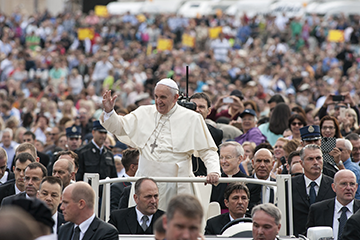
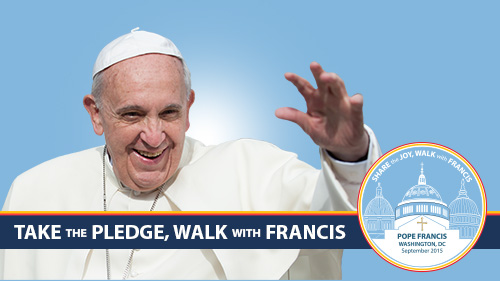
 Today we welcome Pope Francis to the United States. In so doing, we welcome more than just a popular public figure. We welcome someone whom the Lord prays for in a very special manner. Simon Peter and his successors enjoy a special charism to unite us, by the Lord’s prayer and grace. Let’s look at the scriptural foundation of this prayer and charism and see how essential the office of the pope is for us.
One day, near the final ascent to Jerusalem, the Lord warned of a fundamental problem that the Church would face: disunity. He turned to Simon Peter and said of the Twelve,
Simon, Simon, behold, Satan demanded to have you all that he might sift you like wheat, but I have prayed for you, Simon, that your faith may not fail. And when you have turned again, strengthen your brothers (Luke 22:31-32).
To “sift like wheat” is to divide, and Satan would work hard at it in order to divide the apostles, and the Church with them. The debate about who was the greatest only served to show what a mess we human beings, when left to our own devices, will make of something.
Yes, Jesus plainly says that the devil is going to work hard to divide you. And Jesus’ plan is not to write a book and then just hope that everyone follows it and interprets it in the same way. His plan is not to pray that they all work out their differences.
Jesus’ plan is to pray for one man, Simon Peter. Now Peter is not invisible, nor do his words require interpretation. For if anyone wants to ask, “What do you mean by this?” he can just go right up to Peter and say, “Peter, what do you mean by this?” And the real Peter can answer.
So, the Lord’s plan for unity is to have one visible man; one living, breathing source of unity. The Lord will pray for him; thus we can be assured of right outcomes in matters of faith and morals if we follow Peter (and his successors, the popes) in matters that might divide us.
Peter fulfilled this task of unity well and consistently, as recounted in the Acts of the Apostles, the history of the early Church. He rose to settle the question of Judas’ successor (Acts 1:15ff). He preached the first public sermon (Acts 2). He was inspired in a dream and then baptized the first Gentile converts (Acts 10). He arose at the Council of Jerusalem to settle the dispute between the “Party of James” and Paul, Barnabas, and others about Gentile converts (Acts 15).
Yes, Peter strengthened and unified the brethren. This does not mean that he did so without sin. On one occasion St. Paul even had to rebuke Peter (cf Gal 2). For though Peter had taught correctly (that Gentiles were in without lots of customary Jewish observances), he did not fully live the teaching, drawing back from close association with the Gentiles in order to avoid offending Jewish Christians. We do not argue that Peter and his successors are sinless, only that in solemnly teaching on faith and morals they enjoy the prayer of the Lord and the inspiration of the Holy Spirit, never to teach error and thus unite us in the truth.
Peter’s successors must unite us. Though they are not sinless men, we trust in God’s protection for their solemn teachings and thus preserve union through the prayers of the Lord for Peter.
And boy do we need it! We Catholics are a difficult lot. Shepherding Catholics is harder than herding cats. But thanks be to God for the Lord’s Prayer and for the Holy Spirit. If it were not for these, the Church wouldn’t have lasted twenty minutes! But here we are more than two thousand years later, not without our troubles and tensions, but here and fundamentally united (with legitimate diversity). There is just no other way to describe the fundamental unity of the Catholic Church for all these years than as a miracle.
Compare this to the Protestant denominations, which severed their ties to Simon Peter and have now divided and subdivided some thirty thousand times—sifted like wheat to say the least. And the divisions are not just about minor things like vestments or the type of music. The differences are about fundamental and essential doctrines such as how one is saved, if once saved means always saved, if Baptism is necessary, if adultery is grounds for divorce, whether homosexual acts are sinful, if abortion is wrong, whether there is a priesthood, and how critical texts of the Bible are to be understood. The moral and doctrinal divisions are deep and concern foundational matters related to salvation. So divided is Protestantism that many Evangelicals have more in common with Catholics (on the moral issues) than with the old, mainline Protestants.
The tragic disunity of Christendom is not entirely the fault of the Protestants. We Catholics contributed to breaks that happened in the 12th century (with the Orthodox) and the 16th century (with the Protestants).
But the disunity among Protestants does put to the lie that people can be united by a book or by the inspiration of the Holy Spirit (apart from the authentic discernment of the Church’s magisterium).
The simple fact is that we have to have a pope. And if no one is pope, everyone is pope. Some may be dismissive of the need for “some pope” to tell them what to think. But truth be told, by not acknowledging some visible authority outside their own mind, they are merely appointing themselves as pope of their own little “denomination of one.”
The pope is not possessed of unlimited power. He is the Servant of Divine Revelation, not its source. He cannot overrule dogmatically defined faith that comes from Holy Scripture and Sacred Tradition. Neither does he micromanage every aspect of Church life. But in service of the Lord’s prayer and vision, Simon Peter and his successors strengthen and unite us by working with the bishops to resolve significant matters that arise in the Church in terms of discipline and the understanding of doctrine.
But without him, we are trouble, serious trouble—trouble times thirty thousand!
In welcoming Pope Francis, we welcome the visible source of our unity. It is not merely that Jorge Bergoglio is a good negotiator. Whatever personal skills he may have, our faith lies not in those skills but in the prayer of the Lord Jesus for him to strengthen and unify us. Unity is not always easy. To accept the leadership of another is, frankly, hard. But the unity the Lord intends us to have with Simon Peter is a lot easier than the endless divisions we create on our own, apart from the Lord’s Prayer for Peter.
Welcome Pope Francis today and pray for unity among all Catholics and Christians. We may have minor differences and even a few hurtful ones, but thank God we don’t have thirty thousand differences!
SORRY TO SAY THE COMMENTS SERVER IS DOWN – WE’RE WORKING ON IT!