Sinful Curiosity is at the Root of Many Sins

blog2-24Curiosity is one of those qualities of the human person that are double-edged swords. It can cut a path to glory or it can be like a dagger of sin that cuts deep into the soul.

As to its glory, it is one of the chief ingredients in the capacity of the human person to, as Scripture says, “subdue the earth,” to gain mastery over the many aspects of creation of which God made us stewards. So much of our ingenuity and innovation is rooted in our wonder and awe of God’s creation and in those two little questions, “How?” and “Why?”

Yes, we are curious as to how things work and why they work as they do. This curiosity burns within us and motivates us to unlock many of nature’s secrets. Curiosity drives us to learn and to gain mastery—often for good, but sometimes for ill.

What a powerful force within us, this thing we call curiosity! It is a passion to know! Generally, it seems quite exclusive to us who are rational, for animals manifest little or none of it. Occasionally an animal might seem to manifest curiosity: a sound might draw its attention causing it to look more closely. But the investigation is probably more motivated by seeing whether the sound is a threat or a food source rather than by curiosity. True curiosity asks the deeper metaphysical questions of what, how, and why. True curiosity seeks to explore formal and final causality as well as efficient and material causality. It seeks to learn, sometimes for learning’s own sake. Sometimes, and potentially more darkly, curiosity seeks to learn so we can exert control.

Of itself, curiosity can be a magnificent quality, rooted in the gifts of wonder and awe as well as in the deeply profound gift of man’s intellect or rational nature.

However, as a double-edged sword, curiosity can also wound us very deeply and mire us in serious sin. Indeed, it can be a very sinful drive within us. Eve grew curious of the Tree of the Knowledge of Good and Evil and thus Satan was easily able to turn her curiosity into a deep dagger that has reached every human heart.

Understood this way (as a sinful drive), curiosity is a desire to gain knowledge of things we have no right to know. A more mitigated form of sinful curiosity is the desire to know things that are in no way useful to us. In this sense, curiosity is a form of spiritual gluttony that exposes us to innumerable tricks of the evil one.

Sinful curiosity causes us to meddle in the lives of others, to pry. This can then lead us to gossip, potentially defaming others and ruining reputations in the process. Nothing is a bigger invitation to sin and gossip than the phrase “Have you heard the latest news about so-and-so?” Heads turn, ears perk up, and meddlesome curiosity is immediately incited. Almost never is the news that follows such a question positive or even edifying. Sinful curiosity is at the root of almost all gossip, defamation, slander, and even calumny. The vast majority of what we hear through gossip is none of our business. And yet, through sinful curiosity, somehow we feel that we have the right to this information.

There is a whole branch of news, barely distinguishable from gossip columns and scandal sheets, that has emerged based on the people’s “right to know.” Too much secrecy can be unhealthy, but that is hardly the problem in this day and age. Today, too many people know too many things about too many people. Even what is reported (most of it unnecessary) about so-called public figures is not really helpful for us to know. This is not to say that we should have no interest whatsoever in what is happening in the world or in the character of our leaders; rather, it is an invitation to distinguish between what is truly useful and necessary for us to know and that which arises from sinful curiosity.

Sinful curiosity is also at the root of a lot of lust and immodesty. A man may be happily married, but when he sees a woman walk past on the sidewalk he may temporarily push that to the back of his mind. Part of his problem is lust. And in that lustful mindset, he reduces the woman—a person—to her curves and other physical attributes. But another aspect of his struggle is the sinfully curious question “I wonder what she’d be like?”  Well, sir, that is none of your business! Now mind you he’s happily married, but he already knows his wife well. Pardon the expression, but the mystery of his wife has been unveiled. This other woman he sees, however, still has a shroud of mystery that incites in him a sinful curiosity. Immodesty also taps into the sinful curiosity of others by revealing more than it should. Modesty is reverence for mystery. Immodesty jettisons this reverence and seeks to incite sinful curiosity.

Sinful curiosity has been turned into a consumer industry by many talk shows that publicly feature topics that should be discussed discreetly. Further, many guests on such shows reveal details about their lives that should not be discussed in a public forum. Too many people discuss terrible struggles of a very personal nature and too many people tune in to listen. This is a form of immodesty as well, even if it does not involve sexual matters; modesty is reverence for mystery and it respects appropriate boundaries and degrees of intimacy in conversations. “Baring one’s soul” is neither prudent nor appropriate in all situations or with all people; it too easily excites sinful curiosity and sets loose a wave of gossip and uncharitable banter. Some things are just not meant to be dealt with in public, and many are incapable of handling such information without easily straying into sin.

A mitigated form of sinful curiosity is the excessive desire to know too many things all at once. This is a kind of “information gluttony.” This sort of desire, though not necessarily sinful, can become so by excess. It is catered to by the 24-by-7 news services. Being informed is good, but being over-informed can easily lead to becoming overwhelmed and discouraged. Generally speaking, indulging in such a steady stream of news (along with talk radio, etc.) provokes anxiety, discouragement, and a sense of being overwhelmed. Such news services tend to generate interest by inciting alarm. Bad and bloody news predominates; the exotic and strange are headlined; the titillating and shocking lead the news hour; that which generates controversy and ratings is emphasized. It’s not long before we have moved away from necessary and important news and back into the sinful curiosity that sets tongues wagging and heads shaking.

Sinful curiosity, even of this mitigated form, so easily draws us into very negative, dark, and even depressing places. News junkies would do well to balance their diet with other more edifying things than what is the latest scandal or threat.

St. Paul gives good advice to all of us when it comes to sinful curiosity and our tendency to collect unnecessary, unhelpful, and unenlightening news. In effect, he invites us to discipline our minds with the following good and solid advice:

Finally, brothers and sisters, whatever is true, whatever is noble, whatever is right, whatever is pure, whatever is lovely, whatever is admirable—if anything is excellent or praiseworthy—think about such things (Phil 4:8).

Curiosity—the double-edged sword—so noble yet so easily ignoble, so wonderful yet so easily debased.

On Straining out Gnats and Swallowing Camels, as Seen in a Persistent Biblical Debate

February 23 BlogThe teaching contained in the Gospel for yesterday (Tuesday of the 2nd Week of Lent) is one that is easy to miss by overanalyzing the details. Catholics are frequently questioned about the passage: Jesus says, “Call no man on earth your father.” That one line spurs a battle! On one side, Evangelicals stand poised to rebuke the Catholic practice of calling priests “Father,” and on the other are Catholics ready to defend the practice.

Yes, before the sentence is even fully uttered, many folks are locked and loaded. Let the debate begin!

It’s strangely ironic that such a debate springs forth from a Gospel reading that is about humility. While debates can be civil, they seldom display humility. This does not mean that there is no right answer to the issue; it’s more about the way we get to the answer: trying to score “gotcha” points and making sure that we win the debate.

But again, the irony of all this is that Matthew 23:1-12 is really about humility. It is not about banning words or titles like Rabbi, Teacher, Master, or Father. Rather, this Gospel passage is about the problem of pride and vainglory among the clergy, leaders, and those who follow them.

Sadly we would often rather debate the details than listen to the actual teaching. We tend to do this with a lot of things in life: we maximize the minimum and minimize the maximum. As Jesus puts it, we like to strain out gnats while swallowing camels (cf. Matt 23:24).

Let’s examine this teaching about humility.

The Gospel begins with a salutary reminder to all those who are under authority that they consider to be less than perfect:

Jesus spoke to the crowds and to his disciples, saying, “The scribes and the Pharisees have taken their seat on the chair of Moses. Therefore, do and observe all things whatsoever they tell you.”

This reminder is for all of us: we are to obey lawful authority in all things that do not contradict God’s higher law. This is the case even if we do not like them, or they are not conservative or liberal enough for our tastes, or have moral flaws (real or perceived). Even Jesus submitted Himself to be judged by Caiaphas and Pilate. Although Jesus would eventually establish the New Covenant and the apostles would come to authority, for now they must learn humility through obedience to lawful authority, even though all lawful authority in this world is exercised by imperfect human beings. Humility through obedience is the essential point.

Jesus next proceeds to exhort humility in those who have authority:

… but do not follow their example. For they preach but they do not practice. They tie up heavy burdens hard to carry and lay them on people’s shoulders, but they will not lift a finger to move them. All their works are performed to be seen. They widen their phylacteries and lengthen their tassels. They love places of honor at banquets, seats of honor in synagogues, greetings in marketplaces, and the salutation “Rabbi.” As for you, do not be called “Rabbi.” You have but one teacher, and you are all brothers. Call no one on earth your father; you have but one Father in heaven. Do not be called “Master”; you have but one master, the Christ.

Those in authority, especially within the Church, must first be humble servants. Their humility must begin by being obedient to the gospel they preach. They are to practice what they preach and to admit humbly that to do any less is sinful. They must pray humbly and do good works even when no one is looking, when no one can or will applaud them. They are not to seek the favor of men, whether through ostentatious acts or clothes, titles, or seats of honor. To the extent that they do, they incur sin through pride and vainglory.

The main point is humility. The Lord is not forbidding clothes, or seats of honor, or titles per se; rather, He forbids seeking after these things. Good works are obviously to be done. Prayers are to be done. Of course these are not forbidden! The point is that they are not to be “performed in order to be seen.”

It is not forbidden that there be seats of honor in worship and in public gatherings. People instinctively want to esteem leaders, invited guests, and honorees (e.g., a bride and groom or a person celebrating his birthday) with seats of honor or a place at the head table. But while seats are not forbidden, the “love of places of honor” is forbidden. Titles such as “Father,” “Reverend,” “Your Honor,” “Teacher,” and “Rabbi” are not banished either. People of every nation and tongue use titles to honor those who hold offices. What is banished is the “love” of these titles, either by the one having the title or the one bestowing the title. For indeed it sometimes happens that people bestow excessive titles and honorifics as a manifestation of a kind of communal pride; in exalting their leaders they are really exalting themselves.

Regarding the specific the term “Father” (some seem to single out that particular title and not Rabbi or Teacher), if Jesus’ purpose was to forbid the use of the word “father” in reference to human males why did the other New Testament authors do so? In the New Testament alone there are 195 uses of the word “father(s)” to refer to human males. Hence, it seems clear that interpreting this passage as an absolute banishment of the term “father” for anyone but God Himself is not supported by the practice evident in Scripture.

So once again, the point is humility. It is not the outright banishment of words, or seats of honor, or public praying, or the performance of good works. By engaging in endless debates about who is right or wrong in this or that practice, we risk missing the entire point of this Gospel reading. Our debates can too easily become about winning, with no hint of humility.

Don’t miss the point (humility) by straining out gnats and swallowing camels, by maximizing the minimum and minimizing the maximum.

What Does It Mean to Be an Enemy of the Cross?

2.22blogIn the epistle for the Second Sunday of Lent (Phil. 3:17-4:1), St. Paul laments those whom he calls enemies of the cross of Christ: For many, of whom I have often told you and now tell you even with tears, walk as enemies of the cross of Christ (Phil 3:18).

What does it mean to be an enemy of the cross? And how do people end up in this condition of being inimical to the very thing and the very One who alone can save them? St. Paul not only laments the situation, but shows how they get into this condition. He does so in a very succinct way, in one verse, as we shall see below.

But first, let’s rescue the word enemy from too narrow an understanding. In modern (American) English the word “enemy” tends to be associated with a distant foe, perhaps one with missiles aimed at us or armies ready to conquer us. It is often reserved for those who threaten our life or are opposed to us in the most extreme ways. In practice it is considered almost impolite to refer to difficult people who oppose us in some way as enemies.

Enemy comes from the Latin inimici. And while inimici is best translated “enemies,” its roots are in (not) + amicus (friend). So our enemies are those who are not our friends, who oppose our values, who do not wish us well or stand ready to assist us.

This understanding helps us to grasp that enemies may be very close to home, not merely on distant shores. Enemies are not just those who plot the most serious hostilities against us. Thus, when Jesus tells us to love our enemies He has more in mind than just a distant group in some foreign land. He is also referring to those who are near—even within our own families—who are not friendly, who oppose us or the things and people we value.

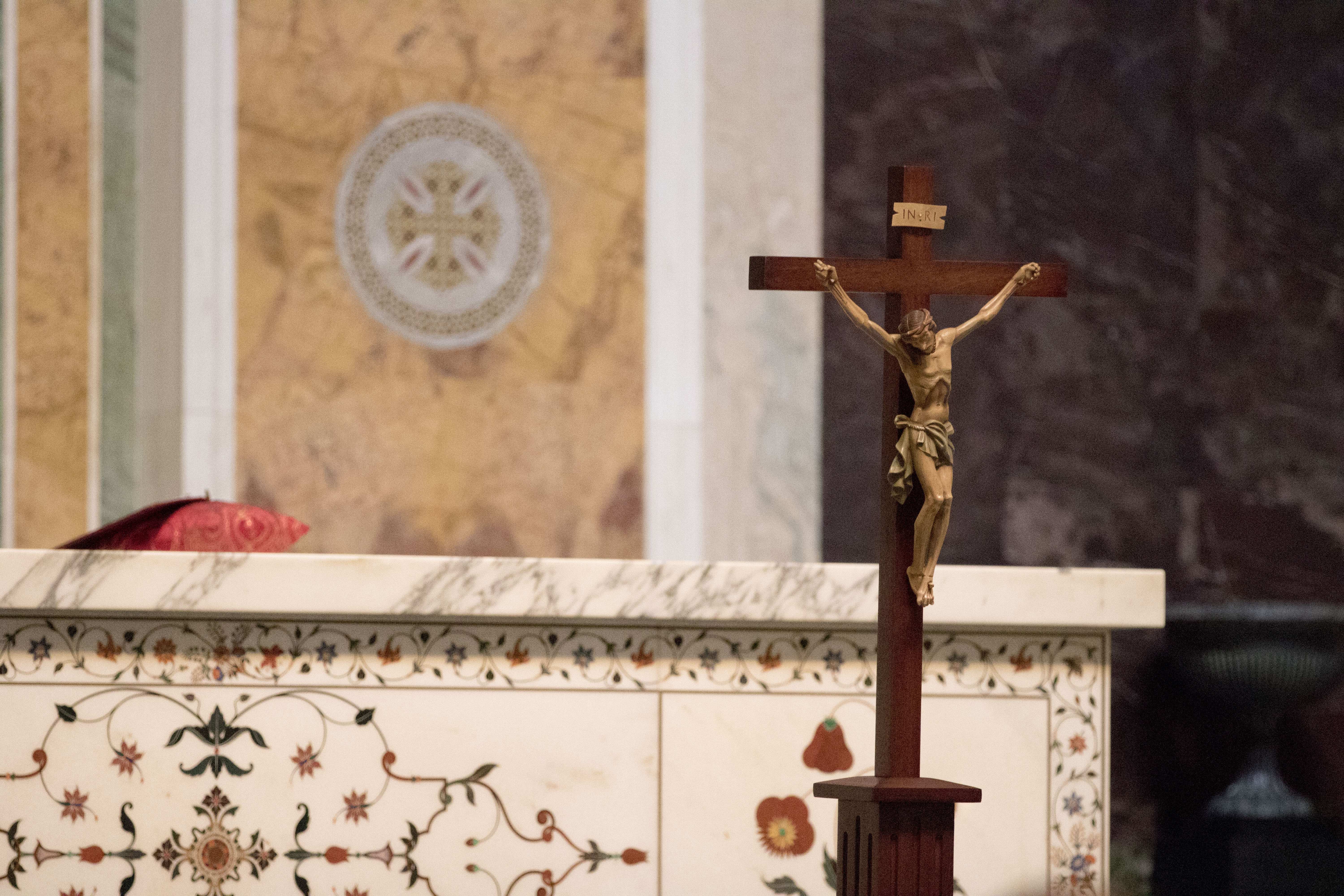
So when St. Paul speaks of those who are enemies of the cross of Christ, he is not just referring to those who go around tearing crucifixes off walls or demanding that crosses be removed from public property. In his very brief description, St. Paul emphasizes an opposition that escalates from mere worldliness to the outright idolatry of comfort and pleasure. Indeed, if we take St. Paul seriously and are honest with ourselves, some of us who have crucifixes in our homes and march in processions with the crucifix before us as we sing “Lift High the Cross” might find that we are in some opposition to the cross.

So let’s take a deeper look at St. Paul’s description of the enemies of the cross of Christ. St. Paul describes the inimical stance of some in a fourfold way: Their end is destruction, their god is their belly, and they glory in their shame, with minds set on earthly things (Phil 3:19).

St. Paul, like many ancient authors, states the result first, followed by the causes. Because that is not the usual way to present a point of view, in the reflection that follows I am going to reverse St. Paul’s order. By reversing his order, I will try to show how things can escalate so that one can become an enemy of the cross.

The text says, For many, of whom I have often told you and now tell you even with tears, walk as enemies of the cross of Christ. Their end is destruction, their god is their belly, and they glory in their shame, with minds set on earthly things (Phil 3:18-19).

St. Paul describes the escalation that can make a person more and more an enemy of the cross of Christ.

I. Foolish Preoccupations – The text says that the enemies of the cross are characterized by having minds set on earthly things.

Of the threefold origin of temptation (the world, the flesh, and the devil), the world is understood not so much as a physical place in which we live, but as a mindset, a collection of thoughts, priorities, premises, values, and goals that are opposed to God and His Word. The fundamental values and priorities of this world include the amassing of possessions, power, prestige, and pleasure. Goals such as autonomy and instant gratification, and views rooted in materialism, secularism, anthropocentrism, secular humanism, utilitarianism, and utopianism are emphasized.

There are many in this world who not only accept these flawed premises and values, but also advance them. They do this because when one follows the world’s agenda, one is frequently rewarded with wealth, access, popularity, and approval.

But we were not made for these things. The finite world cannot satisfy the infinite desires that are within us. The world may well grant us temporary comforts and benefits, but in the end it takes everything back and assigns us to a stone-cold tomb.

For this reason, having our minds set on earthly things is a foolish preoccupation. Scripture says,

Do not love the world or the things in the world. If anyone loves the world, the love of the Father is not in him. For all that is in the world—the desires of the flesh and the desires of the eyes and pride of life—is not from the Father but is from the world. And the world is passing away along with its desires, but whoever does the will of God abides forever (1 John 2:15-17).

In a world that tells us to “scratch where it itches,” there is going to be a cross of self-denial and of trusting God, who teaches us that we are made for more than mere trinkets. The world and devil promise pleasure now and then send you the bill later. The Lord speaks to sacrifice and discipline now and points to the fruits and blessings that come later.

To refuse this and insist exclusively on pleasure now is to become an enemy of the cross of Christ, who warns us to refuse to give our hearts over to the false promises and passing pleasures of this world. We are to crucify our excessive passions and desires (Gal 5:24). We are not to conform to the pattern of this world, but to be transformed by the renewing of our mind, so that we may be able to test and approve what God’s will is (Rom 12:2).

Historically, this has meant the cross and suffering for Christians who live this way. The world and the consensus it desires (and often demands) does not take lightly the rejection inherent in true Christianity. The long legacy of persecution and hatred of Christians demonstrates this. It is one thing to choose to live our values in a personal way, but it is quite another to stand opposed (as we must) to the excesses and errors of the world and to seek to snatch others from its illusions and false promises. Marketers, industrialists, politicians, advocacy groups, ideologues, and the like all depend on a widespread “buy-in” in order for their products, projects, and schemes to advance. If we are not easily manipulated by the fears, anxieties, and guilt that the world uses to separate us from our love and loyalty to God, and our basic sense of truth, we are “off-message.” We must, therefore, be silenced, either by pressure to conform or through shame. And if these do not work, then persecution: the cross.

But Scripture warns us that such crosses must be endured. Jesus says, If you were of the world, the world would love you as its own; but because you are not of the world, but I chose you out of the world, therefore the world hates you. Remember the word that I said to you: ‘A servant is not greater than his master.’ If they persecuted me, they will also persecute you (John 15:19-20). And St. James adds, You adulterous people! Do you not know that friendship with the world is enmity with God? Therefore whoever wishes to be a friend of the world makes himself an enemy of God (James 4:4).

Many Christians find resisting the world and its errant demands a cross too difficult to bear. It is easier to cave in to the world’s demands, to “go along to get along.” This can be done in a thousand little ways through small and growing compromises, or in larger, clearer ways in which one denies truths of the faith in order to receive the praise of men and the blessings that come with conformity to the ways of the world.

To the degree that this happens in our life, we subtly and increasingly become enemies of the cross of Christ. We refuse the self-denial that is necessary and foolishly set our mind on worldly things, which can neither save nor satisfy.

II Festive Perversions – The text says of the enemies of the cross that they glory in their shame.

As people deepen their alliance with the ways of the world, their initial compunction is gradually and steadily eroded by rationalization and by surrounding themselves with teachers who tickle their ears (2 Tim 4:3). St. Paul speaks of those who, on account of their sinfulness, suppress the truth. Claiming to be wise, they become fools as their senseless minds are darkened (Rom 1:18, 21).

And as the darkness deepens, not only do they move further away from repentance, but they actually glory in their shame. Of their lack of shame over sinful acts. St. Paul says, they not only do them but give approval to those who practice them (Rom 1:32).

And thus today we live in times of “gay pride” parades and the celebration of “gender diversity.” Further, there are movies that glorify mob violence and political corruption and glamorize all sorts of evil. Some forms of music celebrate rebellion, hatred of authority, and misogyny. “Greed is good” was the theme of a movie about Wall Street in the late 1980s.

Being an enemy of the cross of Christ deepens in this stage. Not only are the crosses of self-control, self-discipline, and living within limits set aside due to human weakness, but now there is a prideful “doubling-down” in which one declares that what God calls sin ought instead to be celebrated.

This gradually becomes an outright mockery of the cross of Christ because it would seem to say that Jesus died for nothing, that the sins He died to save us from are not only not sins but are actually things worth celebrating.

These enemies of the cross see any limits as unreasonable. And if this weren’t bad enough, as their inimical stance to the cross deepens they celebrate their rejection as a virtue of which to be proud. Their glory in their shame is a twisted and deformed version of tolerance; anyone who does not join in their celebration is guilty of one of the few sins left in their worldview: intolerance. Traditional biblical morality now becomes a form of hate, of intolerant bigotry.

This leads to a de facto rejection of God, at least the true God of Scripture:

III. Fallen Passions – The texts says of the enemies of the cross, their god is their belly.

At some point the enmity toward the cross grows deep enough that the passions and pleasures of the world reach a godlike status, and indulging them becomes in effect a form of idolatry. All human beings struggle at some level with unruly passions and desires. But as long as we struggle and engage in the battle we are still clinging to the cross. Having rejected the cross by outright glorying in their shame, enemies of the Cross now begin to imbue their sins with a kind of godlike quality.

We know how easily money can become like a god to some; they give their whole life over to its acquisition. For them it is the most worthy and valuable thing they have. It is at the center, where God properly belongs.

In the sexual arena the idolatry is more subtle, but it is still evident in the way some talk. Consider that many today attribute their sexually irregular state to God Himself. They say, “God made me this way” and speak of sins and sinful desires as a gift from God. Some equate their desire with the very voice of God; the simple fact that they have a desire must mean that God put it there, and if God put it there it must be good.

In this way a fallen and disordered desire is thought to come from the very voice and will of God, and should therefore be accorded the reverence and obedience due to God Himself.

In this third stage, those who entertain such notions have entered idolatry’s clutches. In effect, they reinvent God and ignore His actual revelation in Scripture and Sacred Tradition. But a reinvented god is not the one, true God, and to worship and obey such a false god is idolatrous.

IV. Final Place The text says of these enemies of the Cross: their end is destruction.

Only the true Christ and His true cross can save. Those who stand opposed to the cross embrace a poor destiny indeed. An old litany says, “Sow a thought, reap a deed. Sow a deed, reap a habit. Sow a habit, reap a character. Sow a character, reap a destiny.” And so we see how our stances deepen within us, either for or against God.

It is therefore a serious matter to permit enmity for the cross to grow within us in any way. It begins with simple weakness and aversion to the more difficult and narrow way of the cross. Then we begin to surround ourselves with teachers who assure us that our sins aren’t all that important or even that we can outright celebrate our sins. This then leads to a growing form of idolatry in which we reinvent and reimagine God, going so far as to call our sinful desires godly. The final stage is destruction, for a fake god, an idol, cannot save us. Only the One true God, who told us to take up our cross daily, can save us.

Beware the tendency to become an enemy of the cross of Christ. Spare us, O Lord, from our foolish tendency to substitute false religion. With St. Paul and all the saints may I be determined to know nothing except Jesus Christ, and Him crucified (1 Cor 2:2).


Count The Stars If You Can! A Meditation on the Glory of the Night Sky Most Modern People Never See

2.21blogIn the first reading of Mass on Sunday (the 2nd Sunday of Lent), we read,

The Lord God took Abram outside and said, “Look up at the sky and count the stars, if you can. Just so,” he added, “shall your descendants be” (Gen 15:5-6).

I wonder if any of us city-dwellers have any idea of the glory that Abram saw as he looked upward that night, indeed most nights.

Most of us don’t realize what we’re missing when it comes to the night sky. Up until about 100 years ago the night sky was illumined with billions of points of light; it was a breath-taking display that most of us probably haven’t experienced.

My first and only real glimpse of the magnificent Milky Way was about 20 years ago. I was visiting a priest friend (recently deceased) in rural North Dakota. It was mid-January, the very heart of winter. The sky was cloudless, the temperature was just below zero, and the humidity was very low (thus, no haze). But the wind was light so we took a nighttime walk. Only the light from an occasional house illuminated the ground. As we away from the town, only about half a mile, I looked up and couldn’t believe my eyes.

What is that?” I asked. “Are clouds coming in?”
What do you mean?” my friend responded. “There are no clouds.”
“Well then, what is all that?” I asked, arching my arm upward.
He smiled and replied, “Those are the stars. That’s the Milky Way.”

I was astounded, but also felt a tinge of anger that I’d been deprived of such a magnificent view all my life. So this is what the ancients saw every night! This is what inspired the psalmist to write, The heavens declare the glory of God; the firmament shows forth the work of His hand … night unto night takes up the message (Ps 19:1ff).

This is what God meant when he told Abraham, “Look up at the heavens and count the stars–if indeed you can count them.” Then he said to him, “So shall your offspring be” (Gen 15:5).

Frankly, on the East Coast of the U.S. I can count the stars. But the true night sky has an astonishing number. An old hymn says,

The spacious firmament on high,
With all the blue ethereal sky,
And spangled heavens, a shining frame
Their great Original proclaim …

Soon as the evening shades prevail
The moon takes up the wondrous tale …
While all the stars that round her burn
And all the planets in their turn,
Confirm the tidings as they roll,
And spread the truth from pole to pole.

What though in solemn silence all
Move round our dark terrestrial ball?
What though no real voice nor sound
Amid the radiant orbs be found?
In reason’s ear they all rejoice,
And utter forth a glorious voice,
Forever singing as they shine,
“The hand that made us is divine.”

If there is ever a widespread power outage on the East Coast, I pray that it will happen on a cloudless night with low humidity. If it does, I will ask my neighbors to join me outside and behold the gift above.

We moderns may think we know what Abram saw when he looked up, but I believe that most of us city-dwellers really have little idea of what he could see. The sky that the ancients saw every night and that some in rural regions see even today is more glorious than most of us can imagine: the stars in unbelievable numbers forever singing as they shine, the hand that made us is divine.

Here’s a video I put together featuring real photographs of the night sky, interspersed with more fanciful images. Some of the pictures depict what the night sky would look like if there without light pollution.

The second half of this next video (in high definition) shows some wonderful views of the stars in the night sky. If your monitor is a good one, you might want to maximize the view of this video; it shows nicely even on large screens.

The Cross is a Fruit-Bearing Tree – A Homily for the Second Sunday of Lent

TransfigurationThe second Sunday of Lent always features the Transfiguration. The first reason for this is that the trek up Mt. Tabor was one of the stops Jesus Himself made with Peter, James, and John on His final journey to Jerusalem. It is commonly held that Jesus did this to prepare His apostles for the difficult days ahead. There’s a line from an old spiritual that says, “Sometimes I’m up, sometimes I’m down, sometimes I’m almost to the ground … but see what the end shall be.” And this is what the Lord is doing here: He is showing us what the end shall be. There is a cross to get through, but there is glory on the other side.

There also seems a purpose in placing this account here in that it helps describe the pattern of the Christian life, which is the Paschal mystery. For we are always dying and rising with Christ in repeated cycles as we journey to an eternal Easter (cf 2 Cor4:10). This gospel passage shows forth the pattern of the cross in the climb, the rising, and in the glory of the mountaintop; then it is back down the mountain again, only to climb another one (Golgotha) and through it find another glory (Easter Sunday). Yes, this is the pattern of the Christian life: the Paschal mystery. Let’s look a little closer at three aspects of today’s gospel passage.

I. The Purpose of Trials – The text says, Jesus took Peter, John, and James and went up the mountain to pray. We often pass over the fact that they had to climb the mountain, and the climb was no easy task. Anyone who has been to Mt. Tabor knows just what a high mountain it is. The climb to the top is almost 2000 feet, and steep as well. It would have taken the better part of a day and probably had its dangers. Looking down from the top is like looking from an airplane window out on the Jezreel Valley (a.k.a. Megiddo or Armageddon).

So here is a symbol of the cross and of struggle. The climb was up the rough side of the mountain; it was exhausting, difficult, and tested their strength.

I have it on the best of authority that as they climbed they were singing gospel songs like these: “I’m comin’ up on the rough side of the mountain, and I’m doin’ my best to carry on!” and “My soul looks back and wonders how I got over!” and “We are climbing Jacob’s ladder, every round goes higher, higher.”

This climb is reminiscent of our life. We have often had to climb, to endure, and to have our strength tested. Perhaps it was the climb of earning a college degree. Perhaps it was the climb of raising children, or building a career. What do you have that you really value that did not come at the price of a steep climb, of effort, and of struggle?

Most of us know that though the climb is difficult there is glory at the top if we but persevere. Life’s difficulties are often the prelude to success and greater strength.

Though we might wish that life had no struggles, it would seem that the Lord intends a climb for us. For the cross alone leads to true glory. Where would we be without some of the crosses in our life? Let’s ponder some of the purposes of problems in our life.

1. God uses problems to DIRECT us. Sometimes God must light a fire under you to get you moving. Problems often point us in a new directions and motivate us to change. Is God trying to get your attention? Sometimes it takes a painful situation to make us change our ways. Proverbs 20:30 says, Blows and wounds cleanse away evil, and beatings purge the inner most being. An old gospel song speaks of the need for suffering to keep us focused on God: “Now the way may not be too easy. But you never said it would be. ‘Cause when our way gets a little too easy, you know we tend to stray from thee.” It’s sad but true: God sometimes needs to use problems to direct our steps toward Him.

2. God uses problems to INSPECT us. People are like tea bags; if you want to know what’s inside them just drop them into hot water! Has God ever tested your faith with a problem? What do problems reveal about you? Our problems have a way of helping to see what we’re really made of. Through trials, I have discovered many strengths I never knew I had. There is a test in every testimony. Trials have a way of purifying and strengthening our faith as well as inspecting it to see whether it is really genuine. 1 Peter 1:6 says, In this you greatly rejoice, though now for a little while you may have had to suffer grief in all kinds of trials. These trials are only to test your faith, to see whether or not it is strong and pure.

3. God uses problems to CORRECT us. Some lessons we seem to learn only through pain and failure. It’s likely that when you were a child your parents told you not to touch the hot stove. But you probably really learned by being burned. Sometimes we only realize the value of something (health, money, a relationship) by losing it. Scripture says. It was good for me to be afflicted so that I might learn your decrees (Psalm 119:71-72), and Before I was afflicted, I strayed. But now I keep you word (Psalm 119:67).

4. God uses problems to PROTECT us. A problem can be a blessing in disguise if it prevents you from being harmed by something more serious. A man was fired for refusing to do something unethical that his boss had asked him to do. His unemployment was a problem for him and his family, but it saved him from being sent to prison a year later when management’s actions were discovered. In Genesis 50:20 Joseph says to his brothers, You intended to harm me, but God intended it for good to accomplish what is now being done, the saving of many lives.

5. God uses problems to PERFECT us. Problems, when responded to correctly, are character-building. God is far more interested in your character than your comfort. Romans 5:3 says, We can rejoice, too, when we run into problems and trials, for we know that they are good for us they help us learn to be patient. And patience develops strength of character in us and helps us trust God more each time we use it until finally our hope and faith are strong and steady. And 1 Peter 1:7 says, You are being tested as fire tests gold and purifies it and your faith is far more precious to God than mere gold; so if your faith remains strong after being tried in the fiery trials, it will bring you much praise and glory and honor on the day of his return.

So the climb symbolizes the cross, but after the cross comes the glory.

II. The Productiveness of Trials – The text says, While he was praying his face changed in appearance and his clothing became dazzling white. And behold, two men were conversing with him, Moses and Elijah, who appeared in glory and spoke of his exodus that he was going to accomplish in Jerusalem. Peter and his companions had been overcome by sleep, but becoming fully awake, they saw his glory and the two men standing with him. As they were about to part from him, Peter said to Jesus, “Master, it is good that we are here; let us make three tents, one for you, one for Moses, and one for Elijah.” But he did not know what he was saying. While he was still speaking, a cloud came and cast a shadow over them, and they became frightened when they entered the cloud. Then from the cloud came a voice that said, “This is my chosen Son; listen to him.”

All the climbing has paid off. Now comes the fruit of all that hard work! The Lord gives them a glimpse of glory! They get to see the glory that Jesus has always had with the Father. He is dazzlingly bright. A similar vision from the Book of Revelation gives us more detail:

I turned around to see the voice that was speaking to me. And when I turned I saw seven golden lampstands, and among the lampstands was someone like a son of man, dressed in a robe reaching down to his feet and with a golden sash around his chest. The hair on his head was white like wool, as white as snow, and his eyes were like blazing fire. His feet were like bronze glowing in a furnace, and his voice was like the sound of rushing waters. In his right hand he held seven stars … His face was like the sun shining in all its brilliance. When I saw him, I fell at his feet as though dead. Then he placed his right hand on me and said, “Do not be afraid. I am the First and the Last. I am the Living One; I was dead, and now look, I am alive for ever and ever! And I hold the keys of death and Hades” (Rev 1:12-17).

Yes, all the climbing has paid off. Now comes the glory, the life, the reward for endurance and struggle. Are you enjoying any of the fruits of your crosses now? If we carried our crosses in faith, they have made us stronger and more confident. Some of us have discovered gifts, abilities, and endurance we never knew we had. Our crosses have brought us life!

  1. The other night I went over to the church and played the pipe organ. It was most enjoyable, but it was the fruit of years of hard work.
  2. Not only have my own crosses brought me life, but the crosses of others have done the same for me. I live and work in buildings that others scrimped, saved, labored to be able to erect. I have a faith that martyrs died to hand on to me and that missionaries journeyed long distances to proclaim. See, trials do produce; enjoy it!
  3. Paul says that this momentary affliction is producing for us a weight of glory beyond all compare (2 Cor 4:14). And in Romans he says, For I consider that the sufferings of this present time are not worth comparing with the glory that is to be revealed to us (Rom 8:18).
  4. An old gospel song says, “By and by, when the morning comes, and all the saints of God are gathered home, we’ll tell the story, of how we’ve overcome. And we’ll understand it better, by and by.”

So the glory comes after the climb. This is the life that comes from the cross. This is the Paschal mystery: Always carrying about in our selves the dying of Christ so also that [the rising of Christ] the life of Christ may be manifest in us (2 Cor 4:10).

III. The Pattern of Trials – The text says, After the voice had spoken, Jesus was found alone. They fell silent and did not at that time tell anyone what they had seen.

Notice that although Peter wants to stay, Jesus makes it clear that they must go down the mountain and then walk a very dark valley to another hill: Golgotha. For now, the pattern must repeat. The cross has led to glory but more crosses are needed before final glory. An old spiritual says, “We are climbing Jacob’s ladder … every round goes higher, higher, soldiers of the cross!”

Yes, this is our life: Always carrying about in our selves the dying of Christ so also that [the rising of Christ] the life of Christ may be manifest in us (2 Cor 4:10).

There are difficult days ahead for Jesus and the apostles, but the crosses lead to a final and lasting glory. This is our life, too: The Paschal mystery, the pattern and rhythm of our life.

This Homily was recorded and is available in mp3 format here: http://frpope.com/audio/2%20Lent%20A%202011.mp3.

Here is a rendition of the song We Are Climbing Jacob’s Ladder. The lyrics say that “every round goes higher, higher!” One can picture a spiral staircase as each round is pitched higher and higher musically. For this is the pattern of our life: we die with Christ so as to live with Him. And each time we come back around to the cross, or back around to glory, we are one round higher and one level closer to final glory.


On the Coarsening of Culture and What We Have Lost – As Seen In a Movie

There was a movie that came out in 1999 called Blast from The Past. The movie begins in the early 1960s at the height of the Cuban Missile Crisis. An eccentric man and his pregnant wife have built an elaborate fallout shelter underground in their backyard. It is no ordinary bomb shelter, but a large, well-stocked one that has many amenities, including the ability to grow food and raise fish.

When a plane crashes nearby, they think that the country is under attack and that an atomic bomb has hit. They run into the shelter and lock it behind them, setting the automatic locks not to open for 35 years when the radiation will have dissipated.

During this time the wife gives birth to their son, Adam, whom they raise in the shelter. Adam receives the usual education one would expect for the time, with a strong emphasis on reading, writing, arithmetic, and history. He also obtains a liberal arts college education from his father, who had been a professor. This education included learning Latin, Greek, French, and German. Adam also learns the social skills of that time such as basic manners, the proper treatment of a lady, ballroom dancing, and the meaning of life. He is also raised to reverence God.

In a way the family was frozen in time and preserved the value of the early 1960s. The film does not present that era as being flawless: the mother has a bit of a drinking problem and the father is rather eccentric and xenophobic.

Suddenly it is 1997 and the locks open. The family makes its first excursion out into the world since the bomb (supposedly) went off. The father expects to find that those who survived will show the effects of radiation poisoning and that the world will manifest many signs of the destruction the bomb surely wrought. So they go forth from the shelter cautiously.

Now, you and I know that no atomic bomb did go off. Or did it?

As they emerge from the bomb shelter, they see that their once quaint neighborhood has become a red-light district. They see shocking things: not only prostitutes and adult book stores, but also drug addicts, trash-filled streets, and signs of grave disorder. People are coarse in their behavior. The family runs back into the shelter, concluding that things are even worse than they had expected. They send their son Adam out to get provisions and possibly find a wife (if he can locate a woman who has been less affected by the “radiation”). Then they will once again throw the locks on the shelter and wait for things to improve on the outside before venturing out again, lest they be poisoned by it all. In the following scene, Adam emerges from the shelter and encounters a drug addict who thinks Adam is God. Adam proceeds farther and sees things and people outside for the first time.

As Adam goes forth, he discovers that beyond the red-light district there are other less-devastated areas, but he still struggles with what he experiences. Families seem to be in disarray; people are coarse, cynical, and use God’s name in vain. The technology amazes him, but so do simple things like rain, the open sky, and the ocean. In this scene he is troubled by some modern cultural trends, but then is overwhelmed with awe upon seeing the ocean for the first time:

As the movie progresses, it becomes quite clear that much has been lost. Adam is head and shoulders above the modern people who surround him. He is kind, respectful, polite, and innocent in his interpretation of the world. He is much better educated than those around him as well, having amassed quite an encyclopedic knowledge in comparison. In the following scene, two things are illustrated: Adam’s superior education and his coming to grips with modern technology. How can a computer (a giant thing in his world) be inside a house?

And Adam can dance, really dance! It’s not the gyrating that is common on modern dance floors but 1940s swing, flawlessly executed, which is natural to him due to the daily training he received from his parents. Here is a dance scene showing that although dancing was a little risqué even back then, it still required training and talent. Pardon some of the language in this clip, but remember that the coarsening of culture is what is on display here.

Adam is befriended by a young lady named Eve and her brother. At first they think Adam to be strange and naive but come to discover that he has much to teach them. In this scene, they ponder something he has taught them about graciousness, kindness, and the blessing of strong family ties.

This movie is well worth seeing. Unlike me, it is not “preachy.” It gently suggests to us that we have lost some important things in the past 50 years or so: things like kindness, optimism, the value of traditional education, and the importance of parents teaching and raising their children. In many ways the movie intimates that we have become coarse and cynical—even vulgar. Family ties have often been severed and our culture has melted down to a more base level. Education is less thorough and broad. Simple things like learning to dance have been lost.

As I have already said, the early 1960s was not a perfect time. Many troublesome cultural trends were already well underway. These do not go unreported in the movie. But still the point remains: some things of great value have been lost. The family entered the shelter at the end of an era; when they emerge they step out of the past and are bewildered by what they find. Technology is impressive, but people seem lost and cynical. The world is hostile and disordered. Adam brings with him out of the shelter some healing balm, some of the best virtues of the past to remind us all that we have lost some important things along the way.

A bomb did go off—not an atomic bomb, but an even more devastating, cultural one. Rebuilding will take time.

A Meditation on the Escalating Attack of Satan

2.18blogLast Sunday, we read the passage from the Gospel of Luke about the testing of Christ in the desert by Satan. In his Summa Theologica, St. Thomas Aquinas makes some interesting observations. He treats the temptations as having occurred in an escalating manner; he also connects Christ’s experience to that of Adam in the Garden of Eden.

St. Thomas writes,

Thus, too, did the devil set about the temptation of the first man. For at first he enticed his mind to consent to the eating of the forbidden fruit, saying (Genesis 3:1), “Why hath God commanded you that you should not eat of every tree of paradise?” Secondly [he tempted him] to vainglory by saying, “Your eyes shall be opened.” Thirdly, he led the temptation to the extreme height of pride, saying, “You shall be as gods, knowing good and evil.”

This same order did he observe in tempting Christ. For at first he tempted Him to that which men desire, however spiritual they may be—namely, the support of the corporeal nature by food. Secondly, he advanced to that matter in which spiritual men are sometimes found wanting, inasmuch as they do certain things for show, which pertains to vainglory. Thirdly, he led the temptation on to that in which no spiritual men, but only carnal men, have a part—namely, to desire worldly riches and fame, to the extent of holding God in contempt (Summa Theologica III, 41.4).

Notice the escalating quality of the temptations. There is the baser temptation of the body. Then there is the temptation of the psyche with its interest in interpersonal relationships. Finally, there is the highest temptation, which attacks our relationship with God.

Let’s look at each in more detail.

The first (and most base) temptation is one of the body. It seeks to destroy the proper relationship of a person with his or her own soul and body. Jesus is tempted to consider eating bread, which was forbidden because the Holy Spirit had led Him to fast. Adam is bodily tempted by the offer of fruit, forbidden to him by God. But the fruit seems to Adam and Eve as: good for food, and [that it was] a delight to the eyes (Gen 3:6).

To us, too, come temptations to gratify the faculties of the body and our baser passions. These sorts of temptations seek to destroy the right relationship we need to have with our bodies and with the physical world of creation.

The second temptation attacks the intellect through an appeal to vainglory. Satan says that if Jesus will worship him, it will be granted to Him that all nations will glorify Him and He will have authority over them (Lk 4:6). Similarly, Adam is told, Your eyes shall be opened (Gen 3:5).

These sorts of temptations appeal to our excessive pride, encouraging us to seek things that are beyond us and to esteem ourselves more than we ought. We also have a tendency to seek fame and the praise of other men. This distorts the proper and well-ordered sense of ourselves as well as our relationships with others; we inordinately seek their praise and, even more darkly, desire to have power over them.

The third and highest temptation is one that attacks our soul and its proper relationship with God. It seeks to have us hold God in contempt. Satan tells Jesus to cast Himself recklessly from the highest pinnacle and thereby sinfully presume that God will rescue Him no matter what He does. Similarly, Adam and Eve are told, You will be as gods (Gen 3:5). Adam is tempted to hold God in contempt by sinfully presuming that he is God’s equal or rival.

We, too, are tempted to trivialize God and to hold Him in contempt by disregarding His warnings about the inevitable consequences of serious and unrepented sin, and by substituting our own notions over and against His truth. We think we have a better understanding of justice than He does and that His warnings about sin can be lightly set aside, that He will save us no matter how blatant our rejection of His plan.

Thus we see how the temptations of Adam and Jesus (and us) are not simply three categories of temptation, but a sequence that escalates in seriousness.

For us, the lesson is clear: as we allow baser temptations to take hold, more serious temptations aimed at our higher faculties also set in. As we give way to these lower sinful desires, our intellect becomes darkened and our will weakened. And as the intellect and will are attacked, so also is our relationship with God. With the mind and will wounded by baser bodily desires, the higher things of God seem more difficult and we can become contemptuously dismissive of His teachings and of our need for His grace and mercy.

It is a threefold, escalating attack of which we must be aware. Heed the wisdom of Scripture, as explained by St. Thomas!

While Earth Rolls Onward into Light – A Beautiful Meditation on Time from an Old Hymn

ClocksMy blog is usually posted in the evening at about 21:00 (9:00 PM) U.S. Eastern Time. But in Sydney, Australia, it is 1:00 in the afternoon of the following day. As I prepare for bed, they are eating lunch on a day that has not even begun for me. And proceeding farther west from there, in the Philippines and Japan the afternoon is winding down and the workday is coming to an end!

Time. What could be simpler than for me to look at the clock and say that it is 9:00 PM on Wednesday, February 17th? But on the other hand, what could be more mysterious? Time is a human reckoning of a mysterious passage.

And yet the mystery is also beautiful. At any given time, some people are asleep in the night, while others are at midday. There is a wonderful verse in an old English hymn that says,

The sun that bids us rest is waking
Our brethren ‘neath the western sky,
And hour by hour fresh lips are making
Thy wondrous doings heard on high.

Here are two other beautiful verses from the same hymn:

We thank Thee that thy Church unsleeping,
While earth rolls onward into light,
Through all the world her watch is keeping,
And rests not now by day or night
.

As o’er each continent and island,
The dawn leads on another day,
The voice of prayer is never silent,
nor dies the strain of praise away
.

Magnificent lines! The hymn contains a beautiful and poetic description of the Church: always praising, always sighing, always at worship. Although some are asleep, the praises continue. One of the Psalms says, Let the name of the Lord be praised, both now and forevermore. From the rising of the sun to the going down of the same, the name of the Lord is to be praised. The Lord is exalted over all the nations (Psalm 113:2-4). The praises never end, for the sun is always rising somewhere even as it is setting somewhere else.

Malachi, prophesying the glory of the Mass celebrated worldwide says, My name will be great among the nations, from the rising to the setting of the sun. In every place incense and pure offerings will be brought to my name, because my name will be great among the nations,” says the LORD Almighty (Mal 1:11). At any given time, Mass is surely being offered somewhere on this earth. The Liturgy of the Hours, too, always uttering forth from the lips of the faithful somewhere. Yes, in the mystery of time, this planet of ours is a place of perpetual praise. And our praises join the perpetual praises of Heaven, for as the Liturgy proclaims (in the words of the new translation), And so, Angels and Archangels, with Thrones and Dominions, and with all the host and Powers of heaven, as we sing the hymn of your glory, without end we acclaim: Holy, Holy, Holy Lord God of hosts

Yes, the mystery of time and our praises caught up in the ever moving sweep of time. What St. Paul says to us as individuals is fulfilled by the worldwide Church. His advice is so simple and yet so profound. St. Paul says, Pray always (1 Thess 5:17).

Here is a rendition of the entirety of the hymn (The Day Thou Gavest, Lord, is Ended) that was quoted above. The complete lyrics are available here: The Day Thou Gavest.