Training for Testimony is Missing in Many Parishes

credit – Jaclyn Lippelmann, Catholic Standard

Catholicism has glorious liturgical and intellectual traditions, but because we have not excelled in training Catholics to give joyful witness to wonder of the Lord and our faith, they are among the best kept secrets around.

In certain denominations, giving witness is a major focus, and congregants are well-trained for it both through personal testimony (witness talks are common in Protestant liturgies) and in their musical tradition. Pastoring in African-American parishes for most of my priesthood has introduced me to this training ground. The “Black experience” is more relaxed with testimony and witness.

Even when I am in a store in an African-American area it is not uncommon for people to say to me, “You got a word for me today pastor?” They are interested in knowing about my church and tell me of their own. They ask for prayers and often engage in certain “call-response” acclamations. Someone will say to me, “God is good!” I reply, “All the time!” To which the response is “And all the time …” I then call back, “God is good!” Then we conclude the ritual with a joint “Amen.” Right there in the aisle of the local Safeway we “have a little Church up in here” as the expression goes.

The testimonies exchanged in this sort of tradition are not highly theological or complex, but they don’t need to be. It can be a simple and joyful statement such as this: “God’s been good to me,” or an expression of hope in a difficult moment: “God’ll make a way for you,” or “I know He’ll see you through.”

Much of this courage and relaxed sharing is the result of a certain kind of liturgical training. The giving of testimonies is common both in and out of church.

There is also the musical tradition that teaches worshippers to recall that God is in the blessing business and that His mercies are not exhausted. It also teaches that one’s relationship with God is transformative and that reform and healing should be expected.

The song “He’s Blessing Me” says,

He’s blessing me, over and over again, He’s blessing me, right here where I stand, Every time I turn around, he making a way somehow. Over and over again he blessing me!

You may not be able to see, just what the Lord is doing for me, but over and over again he’s blessing me! He’s in my heart and soul, from the crown of my head to the tips of my toes, Over and over again he’s blessing me.

The message is simple and yet attractive and beautiful. It trains people for joyful testimony and witness.

The song “He’s Done So Much for Me” says says,

He’s done so much for me,
I cannot tell it all….

He washed my sins away;
I cannot tell it all,

He walks and talks with me;
I cannot tell it all,

He gave me victory;
I cannot tell it all
, I cannot tell it all!

Other songs speak to conversion. One song says, “Something on the inside, working on the outside, I’ve seen a change in my life.” Another song says, “I’m not what I want to be, but I’m not what I used to be. A change, a change has come over me.” Yet another song goes like this: “Great change since I’ve been born! … Places I used to go, I don’t go no more. … Things I used to do, I don’t do no more. … Company I used to keep, I don’t keep no more. … There’s been a great change since I’ve been born.”

These are just a few examples of the kind of “training” that many receive in the evangelical denominations. Frankly, we Catholics have received far less of this. As result, many Catholics are uncomfortable speaking about the Lord and what He has done. Sometimes we simply lack the vocabulary and the models that others have. Even more tragically, many are not even taught to expect a great deal from their walk with Christ. How many Catholics are told to expect a “great change”? Not expecting much often leads to not experiencing much, and not experiencing much makes it pretty hard for a person to testify to what he has seen and heard.

The Catholic faithful need to be better prepared for evangelization. This is more than manifesting joy; it also includes the ability to witness to a moral renewal that also serves to call others to soulful repentance. If we know deep down that we have been rescued from sin and from this present evil age, we are grateful and joyful and we have an experience to speak of that will encourage others.

As a concluding model, perhaps the following song is of value: “I really love the Lord. I really love the Lord. … You don’t know what He’s done for me. He gave me the victory. I love Him, I really love the Lord!”

Can you honestly say that? 

Who is Really on Trial in Our Life?

Pope Emeritus Benedict XVI possesses a keen ability to summarize the ideas and problems of our times both cogently and succinctly. Consider the following assessment of our age that he made during a 2015 interview:

For the man of today…. things are, in a certain sense, inverted, or rather, man no longer believes he needs justification before God, but rather he is of the opinion that God is obliged to justify himself because of all the horrible things in the world and in the face of the misery of being human, all of which ultimately depend on Him (Benedict XVI, Interview with Jacques Servais, L’Osservatore Romano, English edition, March 2016).

This is quite a profound diagnosis of the hubris of our times. This hubris is apparent among both unbelievers and believers. While Benedict sets the problem in the context of the mystery of evil and suffering, my own experience is that the problem is wider than that. Many people don’t merely demand an accounting from God for the existence of evil, they also demand justification from Him for any teaching of His Scripture or the Church that does not accord with their views. The premise is that the teachings of Scripture and the Church must conform to modern notions or else stand convicted of being out-of-touch, useless, irrelevant, or even intolerant, harsh, and hurtful.

All of this is completely backwards. For any Catholic, it is the world and its views that should be on trial. God should not need to justify His teachings or render an account to us, rather it is the world that should be required to explain how its views do not contradict God.

Jesus said that when the Holy Spirit comes to us, He will convict the world in regard to sin (Jn 16:8). Therefore, every Catholic should have the world on trial, not God. We should demand that the world justify its views and square them with God’s teachings. Anything that does not agree with what God teaches is to be rejected by us, convicted of being erroneous and set aside in favor of God’s law and teaching.

St. Paul says, Test everything; hold fast what is good. Abstain from every form of evil (1 Thess 5:21-22). In other words, square everything with the measure of God’s Word and reject anything that is contrary to it while retaining what is good.

Is this what most Catholics do? Sadly, many do just the opposite. The Word of God and the teachings of the Church are put on trial and convicted if they do not conform to worldly thinking, to what is currently popular. If one talks about a text that speaks a truth contrary to modern notions, there is a wide range of reactions: raised eyebrows; objections; scoffing; accusations of insensitivity, intolerance, or hate; demands for retractions and apologies.

This begs the question, “Who is on trial here, God or the world?” Yes, Benedict’s observation about our times stands true. Whereas we once sought grace to be justified before God, many now demand that God justify Himself to us.

In our hubris, we’ve turned the tables on God. It’s time to turn them back in humility. St. Paul reminds us who the true judge is to whom we must render an account:

It matters little to me that I should be judged by you or by any human court. In fact, I do not even judge myself. For though I am not aware of anything against myself, I am not thereby acquitted. It is the Lord who judges me (1 Cor 4:5-6).

Make sure you’re on the right side of the judge’s bench.

This portion of Mozart’s Requiem says (translated),

Wondrous sound the trumpet flingeth
Through earth’s sepulchers it ringeth
All before the throne it bringeth

When the judge his seat attaineth
And each hidden deed arraigneth
Nothing unavenged remaineth.

Finding the Church in a Bach Fugue

credit: Jaclyn Lippelmann, Catholic Standard

Many of you have likely read the classic description of the Church from the 1951 novel Dan England and the Noonday Devil, by Myles Connolly. It is a wonderful reminder that the Church is not an institution, but a Body, made up of members who, each in his own unique way, give witness to the one Body, which is Christ. Here is an excerpt from the book:

What is the Church?

The Church to me is all important things everywhere. It is authority and guidance. It is love and inspiration. It is hope and assurance. It is God the Father, God the Son, and God the Holy Spirit. It is our Lady and St. Joseph. It is St. Peter and Pius XII. It is the bishop and the pastor. It is the catechism and it is our mother leaning over the crib teaching us our evening prayers. It is the cathedral at Chartres and the cross-tipped hut on Ulithi. It is the martyrs in the Colosseum and the martyrs in Uganda, the martyrs at Tyburn and the martyrs at Nagasaki. It is the wrinkled old nun and the eager-eyed postulant. It is the radiant face of the young priest saying his first Mass, and the sleepy boy acolyte with his soiled white sneakers showing under his black cassock….

It is the spire glimpsed from a train window and the cruciform miniature of a church seen far below on the earth from an airplane. It is six o’clock Mass with its handful of unknown saints at the communion rail in the gray dark and it is pontifical High Mass with its crowds and glowing grandeur in St. Peter’s….It is the Sistine Choir and it is the May procession of Chinese children singing the Regina Coeli in Peking.

It is the Carthusian at prime on Monte Allegro and the Jesuit teaching epistemology in Tokyo. It is the Scheutveld Father fighting sleeping sickness in the Congo and the Redemptorist fighting prejudice in Vermont. It is the Benedictine, the Augustinian, the Passionist, the Dominican, the Franciscan. It is all religious and especially the great unnamed Order of the Parish Priest.

It is the Carmelite Sister lighting the tapers for vespers in the drear cold of Iceland and the Sister of Notre Dame de Namur making veils for First Communion in Kwango. It is the Vincentian Sister nursing a Negro Baptist dying of cancer in Alabama and the Maryknoll Sister facing a Communist commissar in Manchuria. It is the White Sister teaching the Arabs carpetmaking in the Sahara and the Good Shepherd Sister in St. Louis giving sanctuary to a derelict child, a home to a lamb who was lost. It is the Little Sister of the Poor salving the sores of a forgotten old man in Marseilles, the Grey Sister serving the destitute in Haiti, the Blessed Sacrament Sister helping a young Negro write poetry in New Orleans. It is the Sister of Charity… It is all the Sisters everywhere.

It is the crippled woman who keeps fresh flowers before our Lady’s altar and the young woman catechist who teaches the barefooted neophytes in the distant hills. It is the girl who gives up her bridge game to drive the Sisters to the prisons and the homes of the poor, and it is the woman who goes from door to door begging for help for the orphanage. It is the proud mother of the priest and the heartbroken mother of the criminal. It is all mothers and sisters everywhere who weep and suffer and pray that sons and brothers may keep the Faith.

….It is the bad sermon and the good, the false vocation and the true. It is the tall young man who says the Stations of the Cross every evening and it is the father of ten who wheels the sick to Mass every Sunday morning at the County Hospital.

It is St. Martin and Martin de Porres, St. Augustine and St. Phocas, Gregory the Great and Gregory Thaumaturgus, St. Ambrose and Charles de Foucauld, St. Ignatius and Ignatius the Martyr, St. Thomas More and St. Barnabas. It is St. Teresa and St. Philomena, Joan of Arc and St. Winefride, St. Agnes and St. Mary Euphrasia. It is all the saints, ancient and new, named and unnamed, and all the sinners.

It is the bursting out of the Gloria on Holy Saturday and the dim crib at dawn Mass on Christmas. It is the rose vestments on Laetare Sunday and the blue overalls of the priest working with the laborers in a mine in the Ruhr.

It is the shiny, new shoes and reverent faces of the June bride and groom kneeling before the white-flowered altar at nuptial Mass, and it is the pale, troubled young mother at the baptismal font, her joy mingled with distress as she watches her first-born wail its protest against the sacramental water. It is the long, shadowy, uneven line of penitents waiting outside the confessional in the dusk of a wintry afternoon, each separate and solemnly alone with his sins, and it is the stooped figure of a priest, silhouetted against the headlights of a police car in the darkness of the highway as he says the last prayers over a broken body lying on the pavement beside a shattered automobile.

It is the Magnificat and it is grace before meals. It is the worn missal and the chipped statue of St. Anthony, the poor box and the cracked church bell. It is peace and truth and salvation. It is the Door through which I entered into the Faith and the Door through which I shall leave, please God, for eternity.

So there it is: The Church. Somewhere in this picture is you, sharing your gift and serving in your role. The Church is Christ. And all of us who are baptized are baptized into Christ, members of His Body.

Somehow I sense the rhythm of a Bach fugue as I read the description above. You probably think I’m stretching things, but consider this:

In the video below, an organist plays Bach’s Fugue in C Major. As with any musical fugue, the organist begins by announcing the theme, playing it with his right hand. Soon enough the left hand answers and eventually the feet play the theme in the pedal. The fugue then takes the theme through a series of mathematical progressions. Eighth notes become 16th notes and then even 32nd notes, but the basic theme is always being developed.

Now think of the organist as Christ, the Head of the Body, and the organ as the Body of Christ. The organ, like any body, has many parts. Because the purpose of an organ is to make sounds, the different pipes are used to make different sounds. There are diapasons, the reeds, the flutes, and the string pipes. The reeds are made up of various sounds like the trumpet, oboe, and vox humana. The string pipes make different sounds as well, such as viola, salicional, and dulciana. The flutes also come in many varieties as do the diapasons. There are wonderful mixtures that give brightness. The deep, low notes of the pedal, sometimes as low as the 32′ contra Bombarde, make the whole building shake. This, too, is an image of the Church. Christ is able to make beautiful music with this wonderful variety.

How does Jesus make this music? Like an organist playing a fugue, Jesus announces the basic theme that underlies every other aspect of the song. This theme is the truth of the Gospel. Every voice of the Church takes up that theme and sings it out in its own sound, using its own gift—but it is Christ who plays. Jesus expands and enriches the theme in a kind of development of doctrine that He leads the Church to proclaim. Rich diverse sounds develop and build thematically, but there is always the basic theme, the fundamental truth.

Yes, here is an image of the Church in a Bach fugue and in a virtuoso organist making beautiful music through unity with a wondrous instrument.

Heaven is an Acquired Taste

There is a tendency today to forget that Heaven is an acquired taste; not everyone wants what God offers. While everyone wants to be happy, often happiness is conceived of in an egocentric way. Heaven is thought of as a personally designed paradise where we will be happy on our own terms.

But that is not what Heaven is. Heaven is the Kingdom of God in all its fullness. Its values and qualities are manifold but include many things that are not immediately desirable to those who live with hearts and minds that are worldly and sinful. The Kingdom of God features ideas that are often unpopular: love of one’s enemies, generosity, love of the poor, and chastity. Heaven features God and His teachings at the center, not me and what I think. Yes, Heaven is a place where every aspect of God’s law is perfectly manifested. Yet many find some of these things not only undesirable but downright obnoxious; some even call them hateful and intolerant. To those in darkness, the light seems harsh.

Yes, Heaven is an acquired taste. This helps to explain that the existence of Hell is not due to a “mean” God trying to remove people whom He doesn’t like from His presence. It is a respectful acceptance by God of the free decision made by those who do not want what He is offering. They do not want to think differently or even be told what to think. They do not want to give up their favorite sins or have their hearts purified of unruly or disordered appetites. In the end, God will not force us to love what and whom He loves. He will not force us to live in His Kingdom.

In his book The Great Divorce, C.S. Lewis makes this very point. In it, many people come to “tour” Heaven, some of whom do not like what they find. Some struggle to adjust, others are resentful and say, in effect, “No thanks.” If you have not read it, I strongly encourage you to do so; it is an important book to read and ponder.

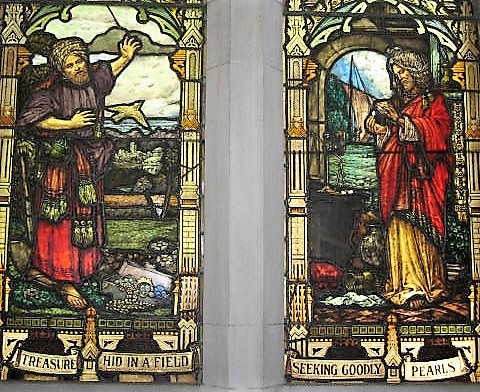
In yesterday’s Gospel, the Lord inquires after our hearts by giving us the images of buried treasure and a pearl of great price. The one who finds them goes and sells all he has in order to obtain them. Does this describe your heart? Does it describe the hearts of our family, friends, and compatriots? Often, the answer is no. Most people are not will to give up everything for the Kingdom of Heaven. Our hearts are disordered. We easily desire things that are sinful and harmful, and not so much those that are good, holy, and lasting. We prefer apparent goods to true goods. If we are faithful, the Lord can get us to that disposition of heart—but it takes time. At least grant Him your willingness to get to that place!

In yesterday’s Gospel the Lord also speaks of a dragnet. While he uses it as an image for the final judgment, that final judgement ultimately depends on the myriad judgments we make in our daily life. As you haul the net of your life ashore, what do you keep, finding it valuable, and what do you discard? Do you value what God is offering and retain it or do you more highly value other things in the net? What do you keep and what do you discard? The answers to questions like these points to your place in the net at the last judgment. God will gather into His Kingdom those who have desired it, not those who have rejected it.

Give the Lord your heart. Open when He knocks. Let Him create a desire in you for the very things He is offering. In the end, Heaven is an acquired taste, more so than we commonly imagine. Let God give you a taste for better and higher things.

This song says, “I’m trying to make heaven my home!”

Give Me Jesus – A Sermon for the 17th Sunday of the Year

Scots’ Church, Melbourne

The Gospel today asks a fundamental question: “What is it that you value most?” In other words, He’s asking us what we want most. We tend to answer questions like this the way we think we should, rather than genuinely. When we’re with the doctor (and Jesus is our doctor) our best bet is to answer honestly so that we can begin a true healing process. The fact is, we all need a heart transplant; we need a new heart, one that desires God and the things awaiting us in Heaven more so than any earthly thing.

Let’s take a look at this Gospel, which sets forth in three fundamental movements the picture and price of the Kingdom of God along with a peril that reminds us that we must make a choice.

I. The Picture – The Gospel uses three images for the kingdom, two of which we will look at here (a buried treasure and a pearl), and the third of which (a net) we will examine later. Both the treasure and pearl symbols are used elsewhere in Scripture. Studying those other passages can be helpful in fine-tuning our understanding of the gift of the Kingdom, which Jesus is discussing in today’s Gospel.

Buried Treasure – The concept of treasure (buried in the case of today’s Gospel) is mentioned elsewhere by Jesus:

Do not store up for yourselves treasures on earth, where moth and rust destroy, and where thieves break in and steal. But store up for yourselves treasures in heaven, where moth and rust do not destroy, and where thieves do not break in and steal. For where your treasure is, there your heart will be also (Matt 6:19-21).

Although we tend to think of treasure as a bunch of “stuff,” the image of treasure that Jesus uses in today’s Gospel is more a symbol for the heart and for our deepest desires, because our treasure is linked to our heart. One of the greatest gifts that God offers us is the gift a new heart, one that values most what He offers: holiness and Himself. One of the most fundamental prophetic texts of the Old Testament announces what Jesus has fulfilled:

Oh, my people, I will sprinkle clean water on you, and you will be clean; I will cleanse you from all your impurities and from all your idols. I will give you a new heart and put a new spirit in you; I will remove from you your heart of stone and give you a heart of flesh. And I will put my Spirit in you and move you to follow my decrees and be careful to keep my laws (Ezekiel 36:25-27).

The great treasure of the Kingdom of God gives us a new heart, by choosing it our heart is changed. To have a new heart is to experience our desires changing. We become less focused on passing, worldly things and more interested in the lasting treasure of the Kingdom of Heaven. We begin to love what and whom God loves. We begin to love holiness, justice, chastity, goodness, righteousness, and truth. We begin to love our spouse, family, the poor, and even our enemies the way God loves them. Our heart becomes alive with joy and zeal for the Kingdom of God and an evangelical spirit impels us to speak what we know to be true.

Yes, the buried, hidden treasure of the Kingdom of God unlocks our heart, bringing new life coursing through our veins, through our very soul. In choosing this treasure we get a new heart, for where our treasure is, there also will be our heart.

A Pearl – The second image comes from the Wisdom tradition, in which holy Wisdom is likened to a pearl. Here, too, is described one of the most precious gifts of the Kingdom of God: a new mind through holy Wisdom. What is this new mind? It is one that begins to think more and more as God does, one that shares His priorities and vision, one that sees as He does; it is the mind of Christ (cf 1 Cor 2:16). With this new mind we see through and reject worldly thinking, priorities, and agendas. We come to rejoice in God’s truth and to grasp more deeply its beauty and sensibility. What a precious gift the new mind is, thinking with God and having the mind of Christ!

So here are two precious manifestations of the Kingdom of God: a new heart and a new mind, which is really another way of saying, “a whole new self.” God is offering us a new life, a new self, a complete transformation.

II. The Price – What are these offerings of the Kingdom worth and what do they ultimately cost? The answer is clear in today’s Gospel: they cost, and are worth, everything. Regarding the hidden treasure and the pearl, the text says that both men went and sold all they had for them. They were willing to forsake everything for these precious items.

Be careful not to reduce this Gospel to a moralism. Notice that these men were eager to go and sell, to forsake, everything else. They did this not so much because they had to, but because they wanted to. They wanted to pay the price and did so with eagerness because they were so enamored of the glory they had found. Here is the gift to seek from the Lord: a willing and eager heart for the Kingdom of God, so eager that we are willing to forsake anything and everything for it.

For ultimately the Kingdom of God does cost everything and we will not fully inherit it until we are fully done with this world and its claims on our heart.

The gift to seek from the Lord is not that we forsake the world with sullen faces and depressed spirits, as if we were paying taxes. No! The gift to seek is that we, like these men, be so taken by the glory of God and His kingdom that we are more than willing to set aside anything that gets in our way, that we are so eager for the things of the Kingdom that loss of the world’s intoxicating trinkets means almost nothing.

Do you see? This is the gift: a heart that appreciates the true worth of the Kingdom of God such that no price is too high. Scripture says elsewhere,

  What is more, I consider everything a loss compared to the surpassing greatness of knowing Christ Jesus my Lord, for whose sake I have lost all things. I consider them rubbish, that I may gain Christ (Phil 3:8).

  For this light momentary affliction is preparing for us an eternal weight of glory beyond all comparison (2 Cor 4:17).

  I consider that our present sufferings are not worth comparing with the glory that will be revealed in us (Rom 8:18).

  No eye has seen, no ear has heard, no mind has conceived what God has prepared for those who love him (1 Cor 2:9).

  But one thing I do: Forgetting what is behind and straining toward what is ahead, I press on toward the goal to win the prize for which God has called me heavenward in Christ Jesus (Phil 3:13-14).

Yes, the Kingdom of God is more than worth any price we must pay, and ultimately we will pay all for it. Pray for an eager and willing spirit that comes from appreciating the unsurpassed worth of the Kingdom!

III. The Peril – The final movement contains a warning about our upcoming judgment. Ultimately, we either want the Kingdom of God or we don’t. Hence the Lord speaks of a net that captures everything (referring to our summons to the judgment). Those who want the Kingdom and have accepted its value and price will be gathered in; those who do not want the Kingdom of God and do not accept its value will be cast aside.

There are clearly some who do not value the Kingdom. They may desire “heaven,” but it is one of their own making, not the real Heaven. The true Heaven is the Kingdom of God in all its fullness. The Kingdom of God includes things like forgiveness, mercy, justice, chastity, love of the poor, love of one’s enemies, and the celebration of what is good, true, and beautiful. The Kingdom of God has God, not man, at its center.

Yes, there are many who neither want nor value some or even most of these things. When the net is drawn in, our decision is made final. Though we may wish for a fairy tale ending, one in which opponents of the Kingdom suddenly love it, God quite clearly says that at the judgment one’s decision for or against the Kingdom becomes final; it is fixed forever.

An old song says, “Better choose the Lord today, for tomorrow very well might be too late.” Thus we are warned that the judgment looms and that we ought to be earnest in seeking a heart from the Lord that eagerly desires the Kingdom and appreciates its worth above all people and all things. In the end, we get what we want. Either we will have chosen the Kingdom or not.

Pray for a new heart, one that values the Kingdom of Heaven above all else. We ought to consider ourselves warned.

The Gospel today is about what we truly value, and is presented in three movements.

This song says, “You can have all this world, just give me Jesus.”

The Power of Repentance to Rewrite the Record

This animated short contrasts the consuming quality of envy, anger, and hate with the overwhelming power of love and forgiveness. It also depicts the possibility of repentance upon recognizing the damage caused.

In the video, a little girl’s written resentments of her older sister spring forth from her diary to wreak their havoc. Witnessing the frightening result and trying to halt the damage, the young girl tears the passages from her journal. She then attempts to create a repentant, loving message from the shredded remnants. It is a very creative illustration of how God puts our sins behind Him and remembers them no more. Enjoy!

“>

What Does It Mean to Trust God? Maybe Not What You Think

We are often told to trust in God, and many of us have counseled others who are anxious or downcast to do so. But what does that mean?

In some cases, when people give this counsel they mean this: Don’t worry, God will eventually give you what want. God will come around to your way of thinking at some point. Hang in there and wait for God to answer (your way). He’ll take care of things (in a way that pleases you).

This is not trust.

To trust is to move to the stable conviction that whatever God decides to do is the right thing. It means being at peace with what He does, what He decides. It is to accept that God often acts in paradoxical ways, in ways that are different from, or even contrary to, our notions of what is best. God often permits evils for some greater good, even if this greater good is hidden from us.

At the foot of the cross, we realize that even a total disaster can produce immense good. We call that terrible day “Good Friday” for a reason. The apparent “total loss” of that day ushered in the New Covenant and made more than enough grace and mercy available to save the entire human race—if we but ask.

Many of us have experienced difficulties that were quite devastating to us at the time. In some cases, we have subsequently come to understand why God permitted them. We can see how we grew from the experience or how new opportunities were opened to us that, while not our preference at the time, were in fact best. In other cases, however, what went through still make little sense to us. But if we have learned to trust God, we can be at peace with His apparent “No” to our desired outcome. Trust says, “It is well with my soul.”

An old hymn with that title says,

When peace, like a river, attendeth my way,
when sorrows like sea billows roll;
whatever my lot, thou hast taught me to say,
It is well, it is well with my soul
.

That is trust: the ability to say, “Whatever my lot, it is well with my soul.” It is not wrong to present our wants and wishes to God, but trusting Him means being at peace with His answer, not resenting it.

We are forever asking God to bless what we are doing, but when do we ever seek what God is blessing and then do that?

Trusting God doesn’t mean thinking that He’ll eventually give me what I want. Trusting God means being at peace with whatever He wants; knowing that He wants it is enough for me; there is peace and it is well with my soul.

Three Characteristics of the Diabolic That Are Widely Evident Today

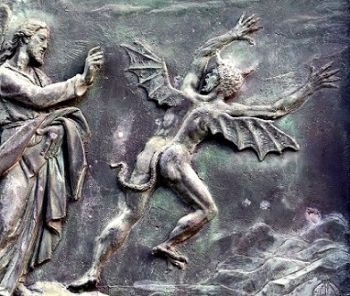
door panel, Pisa Baptistery

The video at the bottom of this post is of Archbishop Fulton J. Sheen. It is a fascinating excerpt from a longer presentation he did. In it, he analyzes the diabolic (anything of or relating to the Devil) from several different perspectives. Archbishop Sheen identifies three characteristics of the diabolic by examining the story of the Gerasene demoniac, which is presented in the synoptic Gospels. Here is the beginning of the story as it appears in the Gospel of Luke:

They sailed to the region of the Gerasenes, which is across the lake from Galilee. When Jesus stepped ashore, he was met by a demon-possessed man from the town. For a long time, this man had not worn clothes or lived in a house, but had lived in the tombs. When he saw Jesus, he cried out and fell at his feet, shouting at the top of his voice, “What do you want with me, Jesus, Son of the Most High God? I beg you, don’t torture me!” For Jesus had commanded the evil spirit to come out of the man. Many times it had seized him, and though he was chained hand and foot and kept under guard, he had broken his chains and had been driven by the demon into solitary places. Jesus asked him, “What is your name?” “Legion,” he replied, because many demons had gone into him (Luke 8:26-30).

Following this, Jesus drove the demon(s) out the man and into the herd of swine.

From this story, and also based on an insight from Dr. Rollo May, a psychologist of his time (the talk was given in the mid-1970s), Archbishop Sheen sets forth these three characteristics of the diabolic:

  1. Love of NudityFor a long time this man had not worn clothes.
  2. Violence… though he was chained hand and foot and kept under guard, he had broken his chains. The version of the story in Mark’s Gospel has more vivid detail: For he had often been chained hand and foot, but he tore the chains apart and broke the irons on his feet. No one was strong enough to subdue him.
  3. Division (split personalities, disjointed minds) – … many demons had gone into him. In Mark’s version, the demoniac replies, My name is Legion, for we are many (Mk 5:9). All of the versions say that the demoniac lived apart from others or in solitary places.

It does not take much effort to recognize that these three characteristics of the diabolic are alive and flourishing in the modern world, at least in the West. Let’s examine the evidence we can see all around us today:

1. Love of Nudity – This is obvious in the modern world on several levels. First, there is the widespread tendency toward immodest dress. We have discussed modesty here before on this blog, noting that the words “modesty” and “moderation” come from the word “mode,” which refers to the most commonly occurring value in a set of data. Hence, while we want to avoid oppressively puritanical notions about dress that impose heavy burdens (especially on women) and regard the body as somewhat evil, we must also critique many modern forms of dress that are at the other extreme. These “fashions” reveal more than is reasonable and are generally intended to draw attention to aspects of the body that are private and reserved for sexual union within marriage. Too many in our culture see no problem with parading about in various stages of undress, wearing clothing that seems intended to call attention to, rather than conceal, the private areas of the body. This love of disclosure and titillation is surely an aspect of the Evil One’s love of nudity.

Pornography, though nothing new in this fallen world, has surely reached epidemic proportions thanks to the Internet. Any psychotherapist, counselor, or priest will tell you that addiction to pornography is a huge problem today. Millions of Americans are viewing enormous amounts of pornography and the “industry” appears to be growing rapidly. What once required a visit to a hidden-away adult bookstore is now available in one’s home with just a click of the mouse. And the thought that browsing habits are easily discoverable matters little to the addicts of this latest form of slavery. Many are on a steep slope downward into ever-more-deviant forms of pornography. Some end up at illegal sites and before know what’s happened, the FBI is knocking on their door. Yes, Satan’s love of nudity has possessed many!

The overall sexualization of our culture also ties in to Satan’s love of nudity. We sexualize women in order to sell products. We even sexualize children. Our sitcoms feature endless immature chatter about sex. Collectively, we act like oversexed teenagers obsessed with something we don’t really understand. Yes, Satan loves nudity and everything that goes with it.

Then of course there is the utter confusion that celebrates homosexual activity. What Scripture calls gravely sinful, disordered, and contrary to nature (παρὰ φύσιν – para physin – Rom 1:26), is openly celebrated by many in our culture. Those afflicted with such desires openly and proudly identify themselves with what tempts them. Rather than lamenting the trials faced by those with such an affliction, and offering love, support, and the truth that they should live celibately (as all the unmarried are called to do), our sex-saturated culture, blinded and darkened by its own wild lust, affirms and even encourages them to indulge in what can only bring further harm to them and others. They have exchanged the truth of God for a lie … (Rom 1:25). It is no surprise that as a result of this celebration of darkness and confusion, the even more deeply confused notion of “transgenderism” has taken root.

Thus, the love of the nudity and the related obsession with (and confusion about) sex is manifest in our culture. It is surely a sign of the diabolic.

2. Violence – Collectively, have turned violence into a form of entertainment. Adventure movies and video games turn violent retribution into fun and death into a “solution.” Recent popes have warned us of the culture of death, a culture in which death is put forward as the solution to problems. Violence begins in the womb as the innocent are attacked as we defend “choice” and “rights.” The embrace of death continues to pervade the culture through contraception, gang activity, frequent recourse to war, and capital punishment. The past century was perhaps the bloodiest ever known on this planet: two world wars, hundreds of regional wars and conflicts, starvation campaigns, and genocides. Paul Johnson, in his book Modern Times estimates that over 100 million people died violently in just the first 50 years of the 20th century. With every death, Satan did his “Snoopy dance.” Satan loves violence; he loves to set fires and then watch us blame one another as we all burn.

3. Division – Satan loves to divide. Archbishop Sheen says that the word “diabolic” comes from two Greek words, dia and ballein, meaning “to tear apart.” Most literally, dia means “through” or “between” and ballein means “to throw or to cast.” Satan “casts things between us” in order to divide and distract us. Thus, we see our families, the Church, and our country divided. These divisions occur in almost every facet of our lives: race, sex, religion, politics, economics. We are divided on the basis of age, region, blue vs. red states, the coasts vs. the heartland, liturgy, music, language, and more trivialities.

Our families are broken. Divorce is rampant. Commitments of any sort are rejected as too difficult or even impossible. The Church is broken, divided into factions. Though we once we agreed on the essentials, now even appeals to shared truth are called intolerant.

Inwardly, we struggle with many divisive drives, with figurative and literal schizophrenia. We are drawn to what is good, true, and beautiful and yet at the same time to what is base, false, and evil. We know what is good, but desire what is evil; we seek love, but indulge in hate and revenge. We admire innocence but often revel in destroying it or at least in replacing it with cynicism.

Three characteristics of the diabolic: love of nudity, violence, and division. What do you think? Is the prince of this world working his agenda? Even more important, are we conniving with him? The first step in overcoming the enemy’s agenda is to recognize his tactics, name them, and then rebuke them in the name of Jesus.

Thank you, Archbishop Sheen. Your wisdom — God’s wisdom — never ages.

Pay attention to what the good archbishop has to say!