Some years ago, Fr. Patrick Smith, a friend of mine and a priest of this archdiocese, preached a sermon in which he asked if the Church was a clubhouse or a lighthouse.
It seems that many people want the Church just to be a friendly place where people can gather. Many of these same people get angry when the Church shines the light of truth on something. They declare that the Church should just be open and inviting. They object when She is challenging or points to the demands of the gospel.
The Church must be more than just a clubhouse; otherwise, She is no different than a bowling league or the Moose Lodge. She is most certainly meant to be a lighthouse, warning of danger and giving light to those in darkness, but She also must risk that some who are accustomed to the darkness will complain of the Light of Christ She reflects.
It was indeed a fine sermon, and its message is essential and profound. I was mindful of that sermon when I ran across the video below from Ignitermedia.com, which asks if the Church is a cruise ship or a battleship.
Many people surely think of the Church as a cruise ship, existing to provide pleasure and entertainment. “Peel me a grape!” seems to be the attitude that some bring to Church. The video does a good job making its point by listing the questions often asked when evaluating a luxury cruise ship:
Do I like the music they play in the ballroom?
Do I like the captain and his crew?
Is the service good?
Am I well fed?
Are my needs met promptly?
Is the cruise pleasant?
Am I comfortable?
Do I want to cruise with them again?
Our parishes ought to work very hard to ensure that the faithful are effectively served and are helped to find God. Good sermons, reverent liturgy, good music, a beautiful church building, and dedicated clergy and lay staff are all important. God deserves the very best and so do His people.
However, it the world does not exist merely to please us. No parish we attend will ever be exactly the way we want it. No priest preaches perfectly every Sunday. The choir does not always sing our favorites.
Some people stay away from Church, calling it boring or saying they aren’t being “fed.” But in the end it’s not about you! We go to Mass to worship God because He is worthy, because He deserves our praise, and because He has commanded us to do so. God has something important to say to us whether we want to hear it or not. He directs us to eat His flesh and drink His blood, whether we like it or not. We must eat or else we will die. Holy Mass is about God and what He is saying and doing.
The video goes on to suggest that a better image for the Church is a battleship. I was less impressed with the way they compared the Church and a battleship, so I have added my some of my own questions as well:
Is the ship on a clear and noble mission?
Is the ship able to endure storms at sea?
Does the captain submit to a higher authority?
Are the tactics and moves of the enemy well understood by the crew?
Does the crew have proper training and experience?
Are the crew members equipped to succeed?
Does the crew cooperate with the captain and other leaders?
Are they taught to be disciplined and vigilant?
Are they at their posts?
Do they take the battle seriously?
Does the ship have adequate first aid and medical help?
Is the crew properly able to distinguish lesser threats from greater ones?
Some dislike any military imagery in reference to the faith. One person angrily told me that the Church is not a battleship; She is a fishing vessel. Perhaps, but one image does not preclude another. Pugna spiritalis (spiritual battle) is simply a fact. We are besieged by the world, the flesh, and the devil. We are called to engage the battle and by God’s grace win through to victory. Our weapons are the Word of God, the teachings of the Church, the Sacraments, and prayer. We cannot win on our own but must work together under the authority of the Church, which is herself under God’s care and authority. We are rooted in the wisdom of tradition and guided by it. A certain pontiff emeritus suggested that the Church is taking on water lately but will not go under because the Lord is sleeping in the back quarters.
The Barque of St. Peter has endured many storms yet has never sunk. She is a sure a steady ship on a clear and noble mission. She is a well-armed battleship, armed with grace and truth.
As this Easter Season is nearing a close, we do well to ponder the picture of the early Church described in the Acts of the Apostles. The kind of persecution and suffering they endured in those days should serve to remind us of the sacrifices we are often unwilling to make.
Yet these early descriptions are also an affirmation of what we in effect (at least structurally) are. In these descriptions we see the ministry of St. Peter, of the first apostles: bishops, priests, deacons, and the lay faithful. We see sacraments being celebrated and the basic structure of the liturgy set forth. In these passages our Catholic faith is strongly affirmed. We see the Church in seminal form, already with her basic form and structures in place, all of which are recognizable to us.
Perhaps, though, we should examine the more challenging part of these descriptions, beyond the structure to the sacrifice. In Acts 5, there is a challenging portrait for the Church. This brief passage goes deeper than structures. It points toward the fundamental mission of the Church, a mission in which she courageously proclaims the truth, summons new followers to Christ, brings hope and healing, and drives out demons.
This is where all the structure “meets the road” and bears fruit for the kingdom of God. Thus, in this brief passage are many challenges for us as a Church. With all our structure and all our organization, do we accomplish these basic works of God? That is the challenge of such a reading.
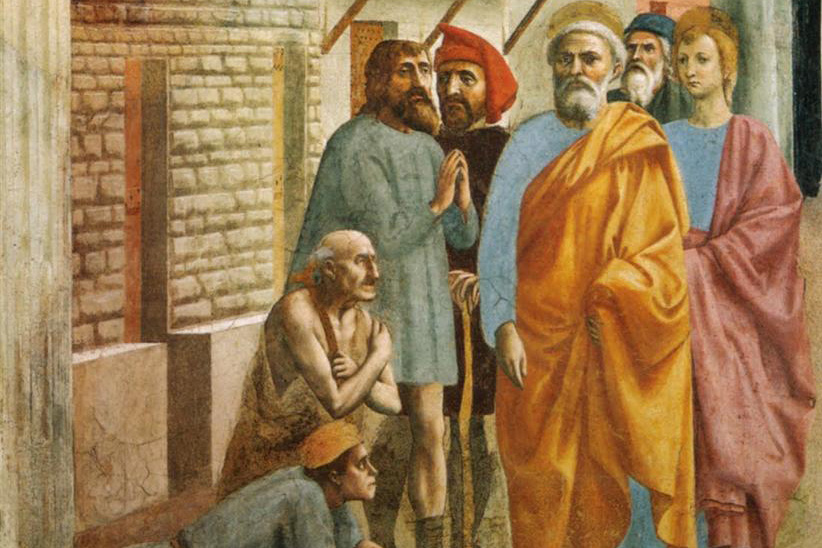
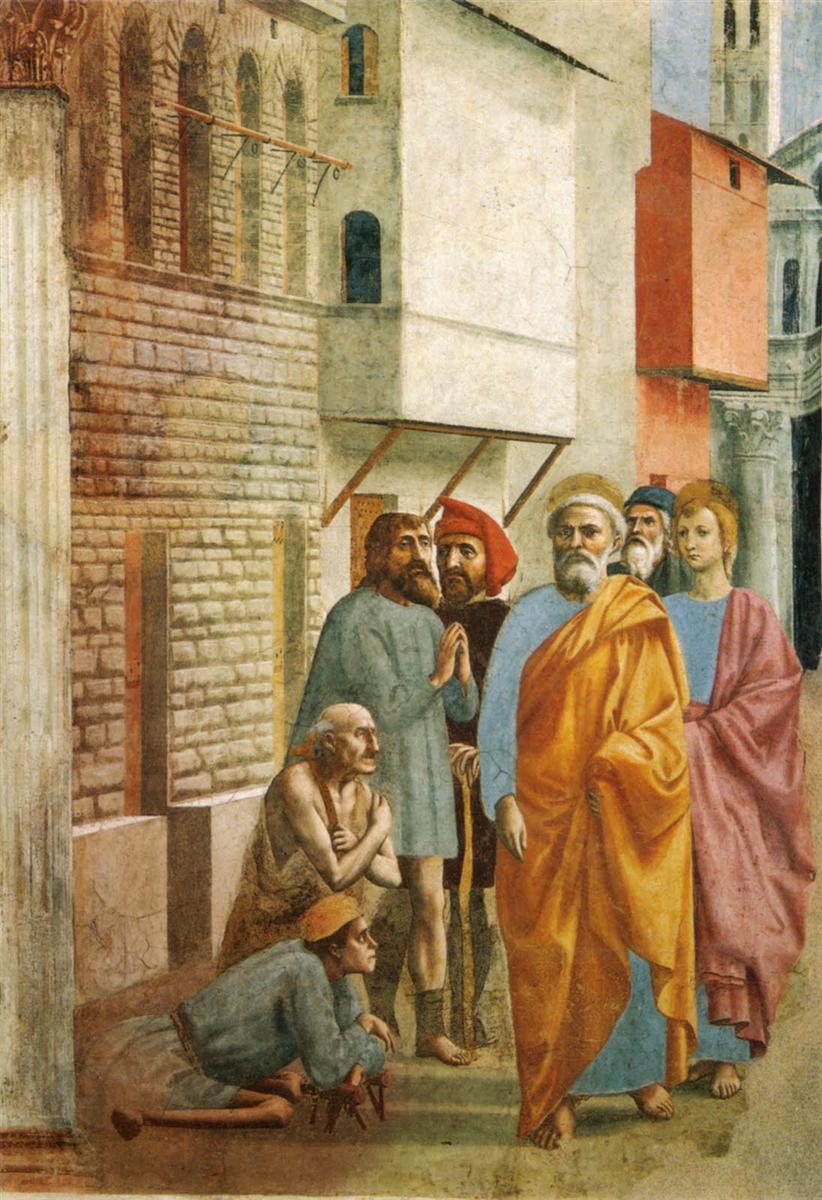
Many signs and wonders were done among the people at the hands of the apostles. They were all together in Solomon’s portico. None of the others dared to join them, but the people esteemed them. Yet more than ever, believers in the Lord, great numbers of men and women, were added to them. Thus they even carried the sick out into the streets and laid them on cots and mats so that when Peter came by, at least his shadow might fall on one or another of them. A large number of people from the towns in the vicinity of Jerusalem also gathered, bringing the sick and those disturbed by unclean spirits, and they were all cured. (Acts 5:12-16)
Let’s examine this passage in four stages:
I. Courageous clergy – The text says, They were all together in Solomon’s portico. None of the others dared to join them, but the people esteemed them.
Note something remarkable: clergy—in this case the first bishops, the apostles—are out and about among the people of God! They are making a bold and public proclamation of Jesus Christ. They are not just speaking among friends or whispering quietly at closed Church gatherings. They are out in the Temple, the very stronghold of some of their most formidable opponents, risking arrest, detainment, and even their lives to announce Jesus Christ.
These are courageous clergy! They will not deny the truth; they will not compromise. Their own safety is secondary to them. They want only to announce Jesus Christ and Him crucified, to announce that He is Lord and Savior and that all must come to faith in Him in order to be saved.
Soon these apostles will be arrested for their bold proclamations (Acts 5:17ff). Yet despite this they will praise God that they were deemed worthy to suffer for the sake of the name (Acts 5:41). They will also experience rescue by God and see that no weapon waged against them will prevail.
The text says, “they were altogether in Solomon’s portico,” but the Greek word used is far more descriptive and specific than simply implying that they were all physically together in one place. The Greek word is ὁμοθυμαδόν (homothumadon) and means “to have the same passion, to be of one accord, to have the same desire.” It comes from homou, meaning “same,” and thumos, meaning “passion or desire.” In other words, these apostles were of one accord, one desire, one mind. They agreed on priorities and were focused on the one desire, on the one thing necessary.
Divided, we present an uncertain trumpet; and who will follow an uncertain trumpet? Oh, that we would see the kind of unity described here, wherein the apostles were in such agreement with one another. They preached coherently and with unity, Jesus Christ, crucified yet raised from the dead.
In these opening lines, we see clergy who are courageous, out among both the faithful and their enemies, boldly preaching, and unified in the essentials. This is a vision for the Church that is challenging and too often lacking today.
Pray for greater unity rooted in doctrinal truth and for clergy who are willing to preach the gospel in season and out of season (2 Tim 4:2).
II. Engaged in Evangelizing – The text goes on to say, Yet, more than ever, great numbers of men and women, believers in the Lord, were added to them.
The essential work of the Church—job one, if you will—is the Great Commission: Go therefore unto all the nations, teach them all that I commanded you, and baptize them, in the Name of the Father, and of the Son, and of the Holy Spirit (Matthew 28:19). Here in Acts we see a Church focused on this essential mission: adding great numbers to those who know and love the Lord Jesus and are called according to His purpose.
Oh, that every pastor and every parish would understand that they have an obligation to bring every man, woman, and child within their parish boundaries to know the Lord Jesus and to worship Him in spirit and in truth. Too many parishes have an “enclave mentality” rather than an evangelical one.
The evangelization plan of most parishes amounts to little more than opening the doors and hoping people come. This is not enough. It is not sufficient to relegate evangelization to some small committee. Evangelization is the constant work of the clergy and all the people of God together. Every parish must be summoning every person within its boundaries to know Jesus, to love Him, to worship Him, to obey him, and to experience His healing power in Word, Sacrament, and in the Sacred Liturgy.
Too many of our parishes are merely buildings in a neighborhood, fortresses of rock, expanses of parking lot. Meanwhile, thousands within their boundaries either know nothing of Jesus or what they know is erroneous. Are the clergy and people out engaging their neighbors and being the presence to them? Or are they simply ensconced in the rectory or in the parish hall, having parish council meetings and debates about which group should sponsor this year’s spaghetti dinner?
Fellowship is fine, but evangelization must be first and foremost. Too often in our parishes we maximize the minimum and minimize the maximum. We are too inwardly focused to be outwardly focused. Many souls are lost because we are not engaging in the primary work of evangelization.
If America has become a darkened culture—and it has—it happened on our watch. You can blame this on various factors, but we are the primary reason. We can’t just blame bishops or pastors. All of us allowed this to happen.
The early Church was engaged in “job one”: calling people to Jesus. What about your parish? What will you do to get the parish more focused on evangelization? Don’t just complain about your pastor; what will you do?
III. Hope and healing – The text says, Thus, they even carried the sick out into the streets and laid them on cots and mats, so that when Peter came by, at least his shadow might fall on one or another of them.
Here is described the essential work of the Church, which is to bring hope and healing to the multitudes. We must stand four-square against many things in our culture today: abortion, fornication, promiscuity, homosexual acts, same-sex unions, and embryonic stem cell research. We cannot, however, allow ourselves to be defined simply by what we are against. We must effectively proclaim what we are for.
What we are for, fundamentally, is the health and healing of the human person, both individually and collectively. Today, vast numbers are among the walking wounded. They are devastated by the effects of sin, strife, and painful situations. Some have physical ailments, others, spiritual ones. Some have been victims of abuse, often coming from broken and dysfunctional families that are so common today. Still others suffer financially.
Do those who are suffering see and experience the Church as a place to find healing, support, and encouragement? Many people today assert that if there any rules at all, if there is any mention of sin at all, then it is not a place of healing or of love. This is a false dichotomy, for law and love are not opposed, but rather facets of the same reality. Because God loves us, He commands us. His love and His law are one and the same.
As a Church, we have a lot of work to do. We must re-propose the gospel to a cynical, rebellious age. Even though this work is hard, we are not excused from doing it. We must be known as communities of healing, places where sinners can find a home and hear the truth in love.
For too long now, we have allowed our opponents to demonize us. As our culture continues to melt down, as our families are destroyed, as the effects of sin loom ever larger, we must continue to articulate a better way: the way of Jesus. Is it hard? Sure! But it was not easy for the first apostles, either, and yet they did it anyway.
In this passage from Acts we see the amazement of many at the healing that was found even in the mere shadow of Simon Peter. The sick and the suffering were amazed at Jesus’ power, in His early Church, to bring forth healing.
Do we boldly request healing from God? Do we even expect it? Do the sick, the suffering, the addicted, and the tormented know that they can come to a Catholic parish and have clergy and lay people pray over them? Are parishes places where they know that people will walk with them in their journey of repentance and give them encouragement?
Or are we just going through the motions? Are we busy with parish meetings, figuring out how to raise funds for the next trip, or organizing the annual parish carnival? How are we known and perceived in the community? Are we a clubhouse or a lighthouse? Are we just some big meeting hall or are we a hospital, with ministry and healing for people with real suffering and sorrow?
A word about Peter’s “shadow” – The Church is called to engage individuals, both directly and indirectly. Because we are human beings, we do not always have the resources or the ability to engage everyone at a deeply personal level. But even here, the shadow of the Church is meant to fall on the community and bring healing. Perhaps this shadow is the ringing of the church bells. Perhaps it is the sight of clergy and religious sisters moving about the community in their religious attire. Perhaps it is processions of the faithful in May or on Corpus Christi. Perhaps it is the beauty of religious art and church buildings. Perhaps it is the memorable stories of the Bible, beautifully retold in poetry.
However she does it, the Church is meant to engage the culture, both implicitly and explicitly. It is clear today that the relationship between faith and culture has broken down. Holy days have been replaced by holidays. As the world becomes increasingly secular, it is even more important for us to celebrate our faith publicly, to make our presence in the culture widely known.
In recent times, Catholics have been all too willing to abandon their faith, their culture, their distinctiveness. The shadow of Catholicism no longer brings a moment of coolness in the heat of our cultural firestorm. Too many Catholics hide their faith. No longer do they wear signs of the faith or adorn their homes with Christian symbols. We have sought to fit in, to blend in, and have as a result become almost invisible.
The healing, cooling shadow of the Church and of faith must be felt in our culture.
IV. Delivering from Demons – The text concludes by saying, A large number of people from the towns in the vicinity of Jerusalem also gathered, bringing the sick, and those disturbed by unclean spirits, and they were all cured.
In this portion of the text, the Church is described as a place of deliverance for many who were troubled by unclean spirits, by demons.
One of the great mistakes of the Church in the 1970s was our retreat from the spiritual work of deliverance. It is nothing short of malfeasance on the part of many in the clergy, who have surrendered one of their most essential works and relegated it to the secular order.
It often happens that people arrive at our rectories troubled, tormented by demons. Perhaps they hear voices or experience a dark presence. Perhaps they are tormented by depression and anxiety. While there are psychological dimensions, we cannot and should not simply conclude that psychotherapy is all that is needed. People may need such help, but they also need deliverance.
The Scriptures are clear that demons and satanic influence are realities we face. Demons are active and operative in our world. While it is wrong for us to reject the help that psychotherapy and medical intervention can provide, as God’s ministers we must be willing to play our role: praying for their deliverance from the demons who torment them.
The faithful must also be engaged in deliverance ministry. Scripture does not present the deliverance from demons as merely a work of the clergy. The Lord gave authority to drive out demons not just to the 12 but also to the 72 (cf also Mk 16:17-18, inter al). Major exorcism is reserved to the clergy, but deliverance prayers are something we should all pray for one another.
A central work of the Church is to deliver people from the power of Satan, to transfer them from the kingdom of darkness unto the Kingdom of Light, to shepherd God’s people out of bondage and into freedom. When people come to us tormented by demonic incursions, we can and ought to pray for them. Parishes should be places where people can find clergy and others trained in deliverance ministry to lay hands on them and pray for their deliverance.
Deliverance ministry also involves walking with people for a lengthy period, helping them to name the demons that afflict them, to renounce any agreement with those demons, to repent, and to receive deliverance and the power of Jesus’ name. Any good deliverance ministry will interact with psychotherapy and medical intervention but will also insist on the regular celebration of the Sacraments of Confession and Holy Communion.
Deliverance ministry can and must become a regular feature of parish life once again. Priests and parishes must reengage in this work of the Church, of delivering souls from bondage and bringing them to Jesus Christ, the author and perfecter of our freedom.
This passage is such a powerful and challenging portrait of the early Church! As Catholics, we have the glory of reflecting quite clearly the structure and form of the early Church, but structure alone is not enough. We must also be infused with and come alive again with the gifts described.
Share this reflection with your pastor, but do not make it all depend on him. Pray for him, but also take your own rightful role in the parish and in the wider community for effective change and powerful ministry. God deserves it, and his wounded people need it.
In the first reading for Wednesday of the 7th Week of Easter, St. Paul warns of perhaps the most damaging and wrenching evil that the Church must face: dissension from within.
I know that after my departure savage wolves will come among you, and they will not spare the flock. And from your own group, men will come forward perverting the truth to draw the disciples away after them. (Acts 20:30-31).
St. Paul calls them savage wolves. Is this hyperbole? No, for their work is to devour the flock. They may do this with subtlety and smooth words, but they (and the evil one who inspires them) devour the flock nonetheless. Let’s ponder this troubling truth in three ways:
I. There are false prophets.
Scripture warns of this repeatedly:
Beware of false prophets, who come to you in sheep’s clothing but inwardly are ravenous wolves. You will recognize them by their fruits …. Every tree that does not bear good fruit is cut down and thrown into the fire (Mat 7:15, 19-20).
And many false prophets will arise and lead many astray …. For false christs and false prophets will arise and perform great signs and wonders, so as to lead astray, if possible, even the elect. See, I have told you beforehand (Mat 24:11, 24-25).
But false prophets also arose among the people, just as there will be false teachers among you, who will secretly bring in destructive heresies, even denying the Master who bought them, bringing upon themselves swift destruction. And many will follow their sensuality, and because of them the way of truth will be blasphemed. And in their greed, they will exploit you with false words. Their condemnation from long ago is not idle, and their destruction is not asleep. For if God did not spare angels when they sinned, but cast them into hell … (2 Peter 2:1-4).
There are some things in them that are hard to understand, which the ignorant and unstable twist to their own destruction, as they do the other Scriptures. You therefore, beloved, knowing this beforehand, take care that you are not carried away with the error of lawless people and lose your own stability (2 Peter 3:16-17).
But you must remember, beloved, the predictions of the apostles of our Lord Jesus Christ. They said to you, “In the last time there will be scoffers, following their own ungodly passions.” It is these who cause divisions, worldly people, devoid of the Spirit (Jude 1:17-23).
Children, it is the last hour; and just as you have heard that the antichrist is coming, so now many antichrists have appeared. This is how we know it is the last hour. They went out from us, but they did not belong to us. For if they had belonged to us, they would have remained with us. But their departure made it clear that none of them belonged to us (1 John 2:18-19).
There are more passages like these, but allow this sample to demonstrate the consistent warning of the apostles that deceivers, scoffers, and false prophets would arise.
II. Of special concern are false prophets who come from within.
There is a special subtlety in this kind of deceiver, especially if he wears a collar or priestly robes, and even more if he be of the rank of bishop. Down through the centuries there has been particular harm caused by wayward clergy. The grief is especially deep because so many of the faithful have been rightly encouraged to love and listen to the clergy.
Therefore, in the passage from the Acts of the Apostles, St. Paul calls them savage wolves. This terminology is true on its face because their goal is to devour and scatter the flock, but St. Paul’s language also indicates an especially sharp pain caused by this sort of betrayal. Other scriptures affirm this deep pain:
For it is not an enemy who taunts me—then I could bear it; it is not an adversary who deals insolently with me— then I could hide from him. But it is you, a man, my equal, my companion, my familiar friend. We used to take sweet counsel together; within God’s house we walked in the throng. Let death steal over them; let them go down to Sheol alive; for evil is in their dwelling place and in their heart (Psalm 55:12-15).
Even my close friend in whom I trusted, who ate my bread, has lifted up his heel against me (Psalm 41:9).
Even my trusted friends, watching for my fall, say, “Perhaps he will be deceived, so that we may prevail against him and take our revenge on him” (Jer 20:21).
The one who has dipped his hand into the bowl with Me will betray Me (Mat 26:23).
Look! The hand of My betrayer is with Me, even at the table (Luke 22:21).
Judas, would you betray the Son of Man with a kiss? (Luke 22:48)
Yes, there is a special grief when error and sin come from within the Church. It should be enough that the world hates and derides us, but internal wounds are the most painful of all.
Our Lady spoke to St. Agnes Sasagawa in Akita, Japan (an approved apparition) and said with sadness,
The work of the devil will infiltrate even into the Church in such a way that one will see cardinals opposing cardinals, bishops against bishops. The priests who venerate me will be scorned and opposed by their confreres … churches and altars sacked; the Church will be full of those who accept compromises and the demon will press many priests and consecrated souls to leave the service of the Lord. The demon will be especially implacable against souls consecrated to God (Message of Oct 13, 1973).
III. What are the faithful to do?
First, from the Scriptures above, we must understand the warning that such things would happen. Indeed, they have happened down through history. False prophets arise, even from within. The Lord says thorough His apostles, “Remember that I have told these things would inevitably occur.” Therefore, we ought not be dismayed, but rather sober.
The first Letter of St. John says,
Who is the liar, if it is not the one who denies that Jesus is the Christ? This is the antichrist, who denies the Father and the Son. No one who denies the Son can have the Father; whoever confesses the Son has the Father as well. As for you, let what you have heard from the beginning remain in you. If it does, you will also remain in the Son and in the Father. And this is the promise that He Himself made to us: eternal life. I have written these things to you about those who are trying to deceive you…And now, little children, remain in Him, so that when He appears, we may be confident and unashamed before Him at His coming. (1 John 2:15ff).
St. Paul adds,
Evidently some people are troubling you and trying to distort the gospel of Christ. But even if we or an angel from heaven should preach a gospel contrary to the one we preached to you, let him be anathema (under a divine curse!) As we have said before, so now I say again: If anyone is preaching to you a gospel contrary to the one you embraced from us, let him be under a divine curse! (Galatians 1:7-9)
The Letter of Jude says,
But you, beloved, build yourselves up in your most holy faith and praying in the Holy Spirit, keep yourselves in the love of God, waiting for the mercy of our Lord Jesus Christ that leads to eternal life. And have mercy on those who doubt; save others by snatching them out of the fire; to others show mercy with fear, hating even the garment stained by the flesh (Jude 1:20-23).
Catholics today must remember that the teaching of the faith is not simply anything that any clergy of any rank utters. The magisterium is more than that! Everything we hear is to be squared with the consistent teaching of the Church, back through the centuries, as articulated in Scripture and in the doctrinal and dogmatic teachings of the Church. Stay close to the catechism, close to Scripture, close to the Fathers of the Church!
We began with St. Paul’s lament of savage wolves who would seek to mislead and scatter the flock he had labored so hard to build. Mysteriously, the Lord allows some degree of dissent, but He has left us with warnings. Our task is to heed these warnings and judge everything we hear by the deposit of the faith as articulated consistently in the Church down through the ages. Look to the most certain sources: Scripture, the fundamental dogmas of the Faith, the Fathers of the Church, the Catechism, and St. Thomas Aquinas. These are bulwarks for us.
I look to the faithful in the land
that they may dwell with me.
He who walk in the way of perfection
shall be my friend (Psalm 101:6).
The first reading from Tuesday’s Mass is Paul’s farewell speech to the presbyters (priests) of the early Church. Here is a skilled bishop and pastor exhorting others who have pastoral roles within the Church. Let’s examine this text and apply its wisdom to bishops and priests as well as to parents and other leaders in the Church.
Paul’s Farewell Sermon – The scene is Miletus, a town in Asia Minor on the coast not far from Ephesus. Paul, who is about to depart for Jerusalem, summons the presbyters of the early Church at Ephesus. He has ministered there for three years and now summons the priests for this final exhortation. In the sermon, St. Paul cites his own example of having been a zealous teacher of the faith who did not fail to preach the “whole counsel of God.” He did not merely preach what suited him or made him popular; he preached it all. To these early priests, Paul leaves this legacy and would have them follow in his footsteps. Let’s look at some excerpts from this final exhortation.
From Miletus Paul had the presbyters of the Church at Ephesus summoned. When they came to him, he addressed them, “You know how I lived among you the whole time from the day I first came to the province of Asia. I served the Lord with all humility and with the tears and trials that came to me … and I did not at all shrink from telling you what was for your benefit, or from teaching you in public or in your homes. I earnestly bore witness for both Jews and Greeks to repentance before God and to faith in our Lord Jesus … But now, compelled by the Spirit, I am going to Jerusalem … But now I know that none of you to whom I preached the kingdom during my travels will ever see my face again. And so I solemnly declare to you this day that I am not responsible for the blood of any of you, for I did not shrink from proclaiming to you the entire plan of God … (Acts 20:17-27 selected).
Here, then, is the prescription for every bishop, priest, deacon, catechist, parent, and Catholic: we should preach the whole counsel, the entire plan of God. It is too easy for us to emphasize only that which pleases us, or makes sense to us, or fits in with our world view. There are some who love the Lord’s sermons on love but cannot abide his teachings on death, judgment, Heaven, and Hell. Some love to discuss liturgy and ceremony, but the care of the poor is far from them. Others point to His compassion but neglect His call to repentance. Some love the way He dispatches the Pharisees and other leaders of the day but suddenly become deaf when the Lord warns against fornication or insists that we love our spouse, neighbor, and enemy. Some love to focus inwardly and debate doctrine but neglect the outward focus of true evangelization to which we are commanded (cf Mat 28:19).
In the Church today, we too easily divide out rather predictably along certain lines and emphases: life issues here and social justice over there, strong moral preaching here and compassionate inclusiveness over there. When one side speaks, the other side says, “There they go again!”
We must be able to say, like St. Paul, that we did not shrink from proclaiming the whole counsel of God. While this is especially incumbent on the clergy, it is also the responsibility of parents and all who attain any leadership in the Church. All the issues above are important and must have their proper places in the preaching and witness of every Catholic, both clergy and lay. While we may have particular gifts to work in certain areas, we should learn to appreciate the whole counsel and the fact that others in the Church may be needed to balance and complete our work. While we must exclude notions that stray from revealed doctrine, within doctrine’s protective walls it is necessary that we not shrink from proclaiming and appreciating the whole counsel of God.
If we do this, we will suffer. Paul speaks above of tears and trials. In preaching the whole counsel of God (not just your favorite passages or politically correct, “safe” themes), expect to suffer. Expect to not quite fit in with people’s expectations. Jesus got into trouble with just about everyone. He didn’t offend just the elite and powerful. For example, even His own disciples puzzled over His teachings on divorce, saying, “If that is the case of man not being able to divorce his wife it is better never to marry!” (Matt 19) As a result of Jesus’ teaching on the Eucharist, many left Him and would no longer walk in His company (John 6). When Jesus spoke of His divine origins, many took up stones with which to stone Him, but He passed through their midst unharmed (Jn 8). In addition, Jesus spoke of taking up crosses, forgiving one’s enemies, and preferring nothing to Him. He forbade even lustful thoughts, let alone fornication, and insisted we learn to curb our unrighteous anger. Yes, preaching the whole counsel of God is guaranteed to earn us the wrath of many.
Sadly, over my years as a priest, I have had to bid farewell to many congregations. This farewell speech of Paul is a critical one I use to examine my ministry. Did I preach even the difficult things? Was I willing to suffer for the truth? Did my people hear from me the whole counsel of God or just what was “safe”?
What about you? Have you proclaimed the whole counsel of God? If you are a clergyman, when you move on; if you are a parent, when your child leaves for college; if you are a youth catechist, when the children are ready to be confirmed; if you teach in RCIA, when the time comes for Easter sacraments—can you say you preached it all? God warned Ezekiel that if he failed to warn the sinner, that sinner would surely die for his sins but that Ezekiel himself would be responsible for his death (Ez 3:17 ff). Paul can truthfully say that he is not responsible for the death (the blood) of any of them because he did not shrink from proclaiming the whole counsel of God. What about us?
We must proclaim the whole counsel of God, not just the safe or popular things, not just what agrees with our own politics or those of our friends. We must present the whole counsel, even the hard parts, even the things that are ridiculed. Yes, we must proclaim the whole counsel of God.
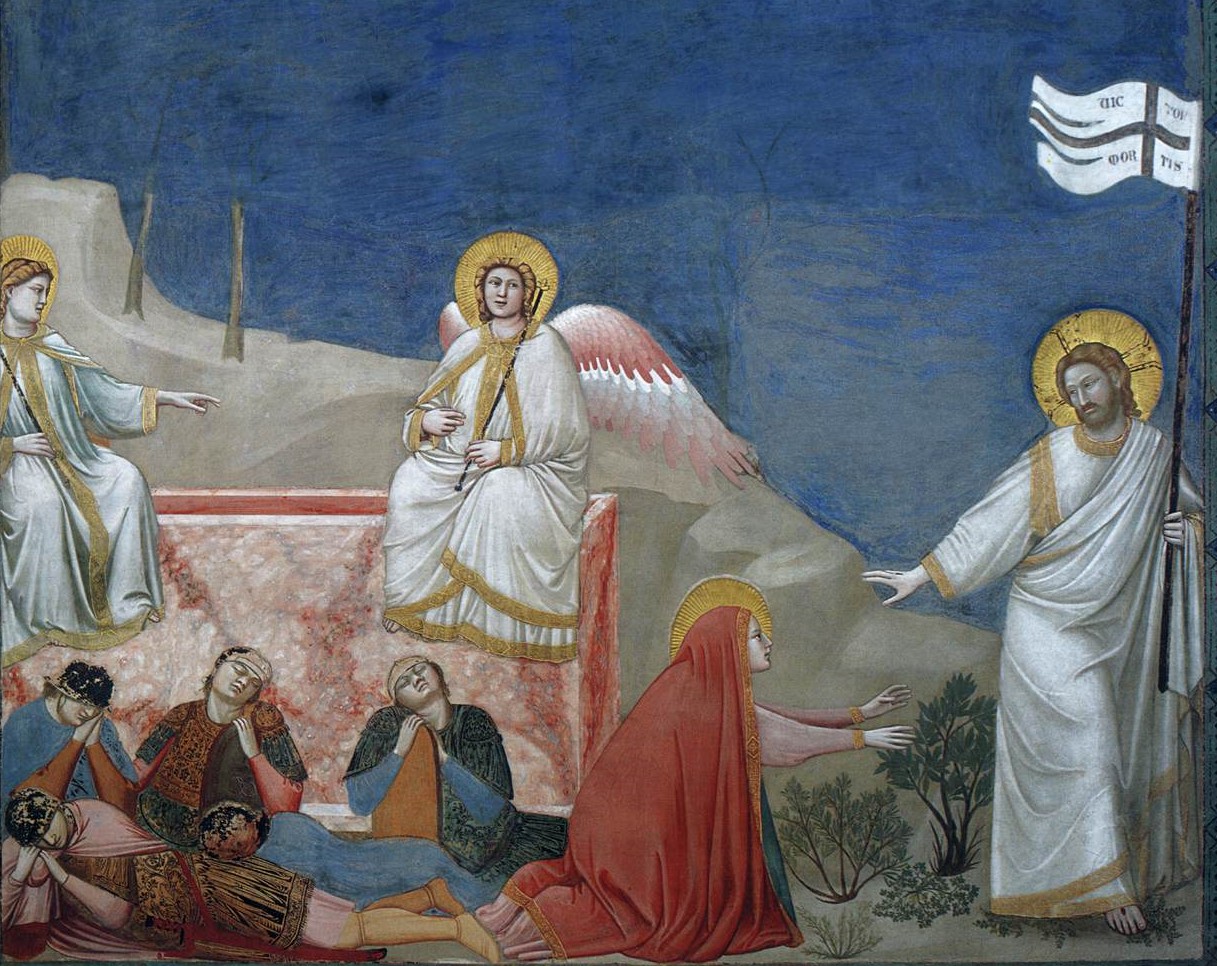
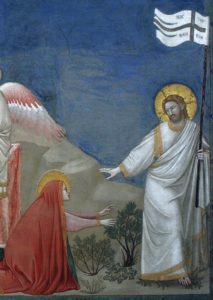
“Noli Me Tangere,” Giotto (1304-06)There is an interaction between Jesus and Mary Magdalene, recounted in John’s Gospel, teaching that Christ’s ascension is about more than just His going up to Heaven. In this, His ascension is like all of His actions: they are not just for Him but also for us.
As Christ ascends, we are called to ascend in at least two ways:
The event with Mary Magdalene takes place early in the morning on the day of His resurrection. Mary recognizes the Lord and runs to embrace Him:
Jesus said to her, “Mary.” She turned and said to Him in Aramaic, “Rabboni!” (which means Teacher). “Do not cling to Me,” Jesus said, “for I have not yet ascended to the Father. But go and tell My brothers, ‘I am ascending to My Father and your Father, to My God and your God.’” Mary Magdalene went and announced to the disciples, “I have seen the Lord!” And she told them what He had said to her (Jn 20:16-18).
Mary’s first reaction is to call Jesus by His earthly title, Rabboni. He is that, but much more. At one point, Jesus bids her to look at Him again. She is clinging to Him, not just to His Body but to her earthly notions of Him as well. To her, He is Jesus, teacher, the hoped-for Messiah. Jesus has her step back and take another look:
Go instead to my brothers and tell them, ‘I am ascending to my Father and your Father, to My God and your God.’
Mary steps back and does see something more. When she returns to the brethren she says, “I have seen the Lord!”
This is the full proclamation of the resurrection. Yes, a corpse has come back to life, but it is more than that. Jesus’ humanity is gloriously transformed and He is now seen as “the Lord.” He has always been, but except at His transfiguration, this has not been seen by any of the disciples.
This is our first understanding of ascension as it applies to us. The Lord is ascending in the sight of the apostles in the sense that they are seeing more of who He really is. He is exalted in their sight. He is ascending in their minds, hearts, and understanding.
Pope St. Leo the Great said,
They made such progress through his ascension that … they were able to fix their minds on Christ’s divinity … What was presented to their bodily eyes no longer hindered them from turning all their attention to the realization that he had not left his Father when he came down to earth, nor had he abandoned his disciples as he ascended into heaven.
The truth is that the Son of Man was revealed as Son of God in a more perfect and transcendent way once he had entered into his Father’s glory; he now began to be indescribably more present in his divinity to those from whom he was further removed in his humanity.
A more mature faith enabled their minds to stretch upward to the Son in his equality with the Father; it no longer needed contact with Christ’s tangible body, in which as man he is inferior to the Father. For while his glorified body retained the same nature, the faith of those who believed in him was now summoned to heights where, as the Father’s equal, the only-begotten Son is reached not by physical handling but by spiritual discernment (from a sermon by Saint Leo the Great, pope (Sermo 2 de Ascensione 1-4: PL 54,397-399)).
Thus, the Lord ascends in their minds and hearts as He ascends to glory. Even prior to his ascension forty days after the resurrection, He was ascending in their estimation and understanding.
So, too, for us, who must come to understand the Lord more deeply as we go. He is a teacher, savior, brother, and friend to be sure, but above all His is the Lord. In our understanding, He is ascending and must ascend so that we see Him more clearly as Lord and God.
There is another sense in which the Lord ascends for us and we must ascend with Him. As He passes beyond our physical sight, we must learn to see Him by faith. We must ascend to a higher place through faith, for faith concerns what is not seen. Scripture says, Now faith is the substance of things hoped for, the evidence of things not seen (Heb 11:1).
Pope St. Leo the Great continued,
Our present rejoicing is on account of his ascension into heaven. With all due solemnity we are commemorating that day on which our poor human nature was carried up, in Christ, above all the hosts of heaven, above all the ranks of angels, beyond the highest heavenly powers to the very throne of God the Father …. And so our Redeemer’s visible presence has passed into the sacraments. Our faith is nobler and stronger because sight has been replaced by a doctrine whose authority is accepted by believing hearts, enlightened from on high.
This faith was increased by the Lord’s ascension and strengthened by the gift of the Spirit; it would remain unshaken by fetters and imprisonment, exile and hunger, fire and ravening beasts, and the most refined tortures ever devised by brutal persecutors … (Ibid).
So, the ascension is not merely something that the Lord did for His own sake as He rose to Heaven. It was for us as well. It is something that must be happening with us in a different way as we gain insight into His glory and move from mere seeing to faith.
Is the Lord ascending in your life? Is your faith ascending to new heights? Is your vision upward? Do you see Him more clearly as the Lord?
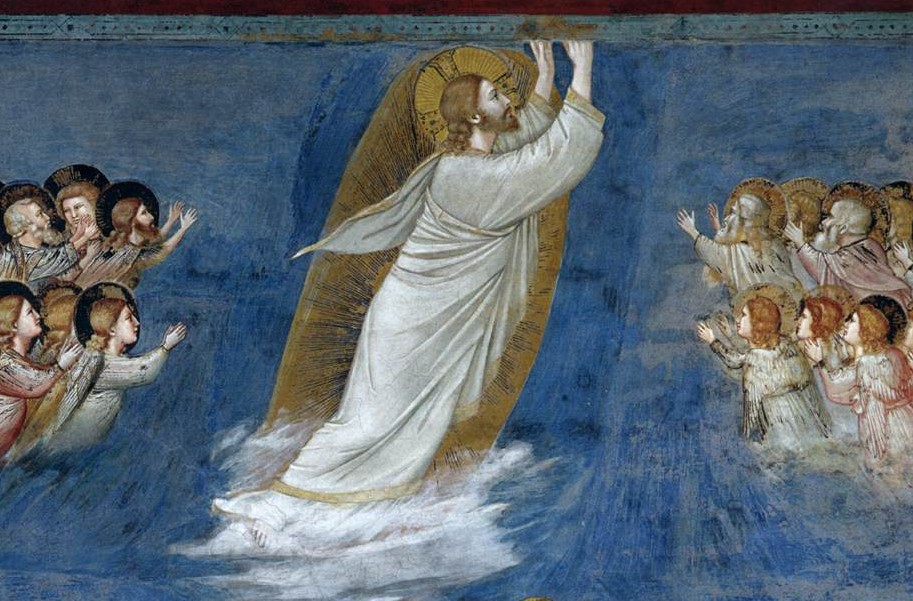
The Ascension of the Lord, Giotto (1304-06)This marvelous feast is not merely about something that took place two thousand years ago, for although Christ our Head has ascended, we the members of His body are ascending with Him. Because He ascended, we too have ascended. In my own life as a Christian, I am brought higher every year by the Lord, who is drawing me up with Him. This is not some mere slogan; it is something I am actually experiencing. An old Baptist hymn says, “I was sinking deep in sin, far from the peaceful shore. Very deeply stained with sin, sinking to rise no more. But the master of the sea, heard my despairing cry. And from the waters lifted me. Now safe am I. Love lifted me, when nothing else could help. Love lifted me.”
Yes, if we are faithful, the feast of the Lord’s Ascension is our feast, too. Let’s look at it from three perspectives.
I. The Fact of the Ascension – The readings today describe a wondrous event that the apostles witnessed. The Lord, by His own power, is taken to Heaven. In so doing He opens a path for us, too. The gates of paradise swing open again: Lift up your heads, O gates! and be lifted up, O ancient doors! that the King of glory may come in (Psalm 24:7). In Christ, man returns to God. Consider three things about the Ascension:
The Reality – Imagine the glory of this moment. Scripture says, As they were looking on, he was lifted up and cloud took him from their sight … they were looking intently in the sky as he was going (Acts 1:9). So impressive was the sight that the angels had to beckon them to get along to Jerusalem as the Lord had said, “Men of Galilee,” they said, “why do you stand here looking into the sky? This same Jesus, who has been taken from you into heaven, will come back in the same way you have seen him go into heaven” (Acts 1:11). Yes, it was glorious. As a summons to faith, Jesus had once said, What if you were to see the Son of Man ascending to where he was before? (John 6:62) He had also encouraged them by saying, Truly, truly, I say to you, you will see heaven opened, and the angels of God ascending and descending upon the Son of man (John 1:51). So here is a glorious reality and a fulfillment of what Jesus had said.
The Rescue – In the Ascension it does not seem that the Lord entered Heaven alone. In His mystical body we also ascend with Him. Consider this remarkable text, which affirms that: Therefore, it is said, “When he ascended on high he led a host of captives, and he gave gifts to men.” In saying, “He ascended,” what does it mean but that he had also descended into the lower parts of the earth? He who descended is he who also ascended far above all the heavens, that he might fill all things (Eph 4:8ff). Yes, the Lord had earlier, just after His death, descended to Sheol, awakened the dead, and preached the gospel to them (cf 1 Peter 4:6). Now, for those He had justified, came the moment to ascend with Jesus as a “host,” as an army of former captives now set free. Behold the great procession that enters behind Christ through the now-opened gates of Heaven: Adam and Eve, Noah, Abraham, Sarah, Isaac, Jacob, Rachel, Judith, Deborah, David, Samuel, Isaiah, Jeremiah, Ezekiel, Malachi, John the Baptist, … and one day, you! Yes, this is a great rescue. Adam and his descendants have not simply been restored to some paradisiacal garden; they have entered Heaven.
The Rejoicing– Consider how this once captive train sings exultantly as they follow Christ upward to Heaven. The liturgy today presents a song they likely sang: God mounts his throne to shouts of Joy! The Lord amid trumpet blasts. All you peoples clap your hands, shout to God with cries of gladness, for the Lord, the most high, the awesome, is the great king over all the earth. God reigns over the nations, God sits upon his holy throne (Psalm 47:6-7). I also have it on the best of authority that they were singing this old gospel song: “I’m so glad, Jesus lifted me!” They were even singing this old Motown song: “Your love is lifting me higher, than I’ve ever been lifted before!”
II. The Fellowship of the Ascension – When Christ ascends, we ascend. Why and how? Scripture says, Now you are the body of Christ and individually members of it (1 Cor 12:27). It also says, All of us who were baptized into Christ Jesus were baptized into his death. By baptism we were buried together with him so that Just as Christ was raised from the dead by the glory of God the Father, we too might live a new and glorious life. For if we have been united with him by likeness to his death we shall be united with him by likeness to his resurrection (Rom 6:3ff). So, when Christ died, we died. When Christ rose, we rose. When Christ ascends, we ascend.
But, you may say, He is in glory while I am still here. How is it that I am ascended or ascending? Consider the following humorous example about our physical bodies. When I get on an elevator and push the button for the top floor, although the top of my head gets there before the soles of my feet, my whole body will get there (unless some strange loss of integrity or tragic dismemberment takes place). So it is also with Jesus’ mystical body. In Christ, our head, we are already in glory. Some members of His body have already gotten there. We will get there too, provided we remain members of His Body. Yes, we are already ascended in Christ, our head. If we hold fast and remain members of His Body, we are already enthroned in glory with Him. This is the fellowship of the Ascension.
III. The Fruitfulness of the Ascension – Jesus does not return to Heaven in order to abandon us. In fact, He is more present to us than we are to ourselves. He is with us always to the end of the age (cf Matt 28:20). In ascending (without abandoning us) He goes to procure some very important things. Consider four of them:
Holy Ghost power – Jesus teaches very clearly that He is ascending in order to send us the Holy Spirit: Nevertheless, I tell you the truth: it is to your advantage that I go away, for if I do not go away, the Counselor will not come to you; but if I go, I will send him to you (Jn 16:7ff). He also says, These things I have spoken to you, while I am still with you. But the Counselor, the Holy Spirit, whom the Father will send in my name, he will teach you all things, and bring to your remembrance all that I have said to you (Jn 14:25ff). Later He says, I still have many things to say to you, but you cannot bear them now. When the Spirit of truth comes, he will guide you into all the truth, for he will not speak on his own authority, but whatever he hears he will speak, and he will declare to you the things that are to come (Jn 16:13-14). So, the Lord goes so that He might, with the Father, send the Holy Spirit to live within us as in a temple. In this way, and through the Eucharist, He will dwell with us even more intimately than when He walked this earth.
Harvest– Jesus says, And I, if I be lifted up from the earth, will draw all men unto me (John 12:32). While the immediate context of this verse is the crucifixion, the wonder of John’s Gospel is that there are often intentional double meanings. Clearly Christ’s glorification is His crucifixion, but it also includes his resurrection and ascension. So, from His place in glory, Christ is drawing all people to Himself. He is also bestowing grace on us, from His Father’s right hand, to be His co-workers in the harvest: But you shall receive power when the Holy Spirit has come upon you; and you shall be my witnesses in Jerusalem and in all Judea and Samaria and to the end of the earth (Acts 1:8). Yes, from His place in glory, Christ is bringing in a great harvest. As He said in Scripture, Do you not say, “Four months more and then the harvest”? I tell you, open your eyes and look at the fields! They are ripe for harvest. Even now the reaper draws his wages, even now he harvests the crop for eternal life, so that the sower and the reaper may be glad together. Thus, the saying “One sows and another reaps” is true. I sent you to reap what you have not worked for. Others have done the hard work, and you have reaped the benefits of their labor (Jn 4:35-38). Harvest! And it is the Lord’s work from Heaven in which we participate.
Help– At the Father’s right hand, Jesus intercedes for us. Scripture says, Consequently he is able, for all time, to save those who draw near to God through him, since he lives always to make intercession for them (Heb 7:25). The Lord links His ascension to an unleashing of special power: Amen, amen, I say to you, he who believes in me will also do the works that I do; and greater works than these will he do, because I go to the Father. Whatever you ask in my name, I will do it, that the Father may be glorified in the Son (Jn 14:12). We must not understand that asking in the name of Jesus is some incantation. To ask in His name means to ask in accordance with His will. Yet we must come to experience the power of Jesus to draw us up to great and wondrous things in His sight. Despite the mystery of iniquity all about us, we trust that Christ is conquering, even in the apparent and puzzling victories of this world’s rebellion. In putting everything under him, God left nothing that is not subject to him. Though, at present we do not see everything subject to him, yet we see Jesus, who was made a little lower than the angels, now crowned with glory and honor….so that by his death he might destroy him who holds the power of death—that is, the devil—and free those who all their lives were held in slavery by their fear of death (Heb 2:8-9; 14-15). Thus, from Heaven, we have the help of the Lord’s grace, which, if we will accept it, is an ever-present help unto our salvation.
Habitation– Simply put, Jesus indicates that in going to Heaven He is preparing a place for us: In my Father’s house are many mansions: if it were not so, I would have told you. I go to prepare a place for you. And if I go and prepare a place for you, I will come again, and receive you unto myself; that where I am, there ye may be also (Jn 14:2ff). Yes indeed, He has the blueprints out and a hard hat on. He is overseeing the construction of a mansion for each of us so that we may dwell with Him, the Father, and the Spirit forever.
Here, then, are the ways that Christ, by His love, is lifting us higher (than we’ve ever been lifted before). Yes, love lifted me, when nothing else could help; love lifted me.
The commercial below demonstrates, in a limited way, the chaos caused by becoming “unplugged” from a mere computer. In it, a new employee unwittingly unplugs a main computer, causing everything to go haywire around the globe.
Imagine how much worse things are when we unplug from God. Actually, things wouldn’t be worse, they just wouldn’t be at all! God is ipsum esse, the very act of “to be” Himself. All being depends on Him.
Scripture says of Jesus, For in Him all things were created, things in heaven and on earth, visible and invisible, whether thrones or dominions or rulers or authorities. All things were created through Him and for Him. He is before all things, and in Him all things hold together (Colossians 1:16-17).
The mere loss of a major computer can cause havoc, confusion, chaos, pandemonium, and death. As our age unplugs from God with increasing fervor, we see these things: havoc, confusion, chaos, pandemonium, and death.
There is a passage in John 16 that is unusual for its repetition. This past Sunday it was the assigned Gospel in the Extraordinary Form of the Roman Rite. The expression “in a little while” is repeated seven times in the brief passage. Its repetition is almost to the point of being annoying, such that the reader is tempted to say, “All right, already. I get it!” Obviously, John, Jesus, and the Holy Spirit want to drill this point into us.
Let’s look at the whole passage:
Jesus went on to say, “In a little while you will see me no more, and then after a little while you will see me.” At this, some of his disciples said to one another, “What does he mean by saying, ‘In a little while you will see me no more, and then after a little while you will see me,’ and ‘Because I am going to the Father’?” They kept asking, “What does he mean by ‘a little while’? We don’t understand what he is saying.” Jesus saw that they wanted to ask him about this, so he said to them, “Are you asking one another what I meant when I said, ‘In a little while you will see me no more, and then after a little while you will see me’? Very truly I tell you, you will weep and mourn while the world rejoices. You will grieve, but your grief will turn to joy. A woman giving birth to a child has pain because her time has come; but when her baby is born she forgets the anguish because of her joy that a child is born into the world. So, with you: Now is your time of grief, but I will see you again and you will rejoice, and no one will take away your joy (John 16:16-22).
Do you get it? A little while! This text is a perfect illustration of the old expression repetitio mater studiorum (repetition is the mother of studies). We’re supposed to lay hold of this because it clearly was significant to the Lord.
The Greek word translated here as “a little while” is even more evocative of brevity. It is μικρὸν (mikron) which, at least in its English connotation, speaks of something very little.
Contextually, the Lord seems to be referring to the brief time between His death and His resurrection. Indeed, that time was brief. He was trying to prepare His disciples (in the hope?) that they might not lose faith and would be able to endure His passion. However, it seems that these and other words promising His resurrection “in a little while” (on the third day) had no real impact on them. All but John fled in fear, and all of them were astonished and incredulous at the resurrection when it first broke in to their reality.
In a more extended and pastoral context, the words of Jesus are also intended for us. He wants us to grasp that “in a little while” we will see Him.
This is a very important perspective for us to gain: life is short! This truth is both consoling and challenging.
It is consoling because whatever pain we are going through, we are going through it; if we are faithful, it is not our destination. Whatever the current difficulties, they will be over “in a little while.” An old African-American spiritual says, “Hold on just a little longer, everything’s gonna be all right.” Another says, “Trouble don’t last always.” As most of us who are a bit older know, life passes quickly—so very quickly. Whatever our troubles, they will be over in a little while. If we have been faithful, eternity dawns with far great glories than the trouble we have endured for just “a little while.”
We ought to expect that life here will be a little uncomfortable. We live in a paradise lost. We live in a fallen world, governed by a fallen angel, and we have fallen natures. We who are baptized now live in this world as strangers and aliens. We’re just passing through a world with strange customs and a strange language. We’re living out of a suitcase and have all the discomforts of travel. In a little while, though, we get to go home—if we but hold on to God’s unchanging hand.
Scripture speaks often of this aspect.
In all this you greatly rejoice, though now for a little while you may have had to suffer grief in all kinds of trials. These have come so that the proven genuineness of your faith—of greater worth than gold, which perishes even though refined by fire—may result in praise, glory and honor when Jesus Christ is revealed (1 Peter 1:6-7).
Therefore, we do not lose heart. Though outwardly we are wasting away, yet inwardly we are being renewed day by day. For our light and momentary troubles are achieving for us an eternal glory that far outweighs them all. So, we fix our eyes not on what is seen, but on what is unseen, since what is seen is temporary, but what is unseen is eternal (2 Cor 4:16-18).
We ought to be consoled by this perspective that whatever difficulties we’re currently going through will be over in a little while if we stay faithful. Meanwhile it is producing and storing up glory for you.
It is also challenging to consider the “little while” of this life. Simply put, you are going to die, and you don’t get to say when. You are not promised even the next beat of your heart. Tomorrow is not promised, so you’d better choose the Lord today. Do not delay your conversion to the Lord.
Life passes so very swiftly. I’ve been a priest for nearly 30 years now. Wow, how did that happen? I feel like I just got out of high school! Scripture says,
Our life is over like a sigh. Our span is seventy years, or eighty for those who are strong. And most of these are emptiness and pain. They pass swiftly, and we are gone (Ps 90:9-11).
But as for man, he is like the grass, of the flower of the field. The wind blows, and he is gone and his place never sees him again (Ps 103:15-16).
Remember your Creator—before the silver cord is severed, and the golden bowl is broken; before the pitcher is shattered at the spring, and the wheel broken at the well, and the dust returns to the ground it came from, and the spirit returns to God who gave it (Eccles 12: finis).
Yes, life passes quickly. For most of us, the memory of our existence will linger but a generation here on earth.
Here comes the challenge: Life is short—prepare for judgment. Scripture says,
It is appointed unto men once to die, and after this the judgment (Heb 9:27).
For we must all appear before the judgment seat of Christ, so that each of us may receive what is due us for the things done while in the body, whether good or bad (2 Cor 5:10).
Nothing in all creation is hidden from God’s sight. Everything is uncovered and laid bare before the eyes of him to whom we must give account (Heb 4:13).
Jesus also warns,
Be on guard! Be alert! You do not know when that time will come. It’s like a man going away: He leaves his house and puts his servants in charge, each with their assigned task, and tells the one at the door to keep watch. “Therefore, keep watch because you do not know when the owner of the house will come back—whether in the evening, or at midnight, or when the rooster crows, or at dawn. If he comes suddenly, do not let him find you sleeping! What I say to you, I say to everyone: ‘Watch!’” (Mark 13:33-37)
I am coming SOON; hold fast what you have, so that no one may seize your crown…. Behold, I am coming SOON, bringing my recompense, to repay everyone for what he has done (Rev 3:11; 22:12).
Yes, life is short, and in a little while we must report to the judgment seat of Christ for a very honest conversation. Prepare confidently, with faith but not presumption—which is a denial of the faith. The Lord has said that we must be sober, awake, and ready. In just a little while the moment will come. You will die, and you don’t get to say when. Get ready.
There it is, perspective. The consolation is that the troubles of this life pass in “a little while.” The challenge is to be ready, for in just a little while our time here is up and the question is called.
In a little while!
He who testifies to these things says, “Surely I am coming SOON.” Amen. Come, Lord Jesus! (Rev 22:20)

 Some years ago, Fr. Patrick Smith, a friend of mine and a priest of this archdiocese, preached a sermon in which he asked if the Church was a clubhouse or a lighthouse.