I Wanna Be Ready to Put on a Long White Robe – A Homily for the Second Sunday of Advent

Preaching of John the Baptist, Baciccio (1690)

But who may abide the day of his coming and who shall stand when he appeareth? This is the cry that goes up from the final pages of the Old Testament (Mal 3:2). The Lord himself gives the answer:

See, I will send you the prophet Elijah before that great and dreadful day of the Lord comes. He will turn the hearts of the fathers to their children, and the hearts of the children to their fathers; lest I come and strike the land with doom! (Mal 4:5-6)

With these words the Old Testament ends.

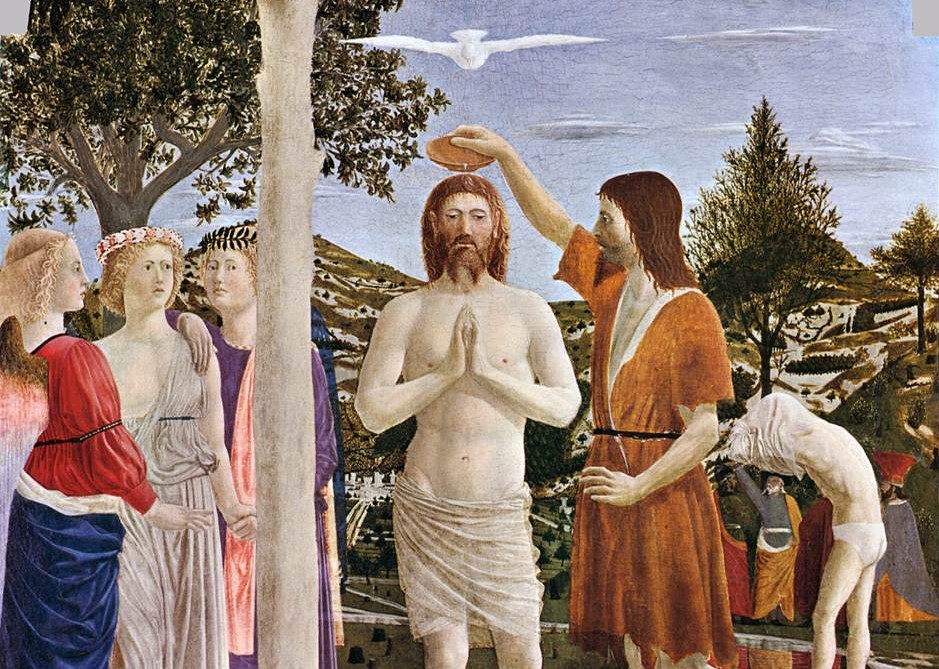
The New Testament opens in the desert near the banks of the River Jordan, with John the Baptist, of whom Jesus says, He is the Elijah who was to come (Mt 11:14). In John the Baptist is the fulfillment of the Elijah figure, who was to come to prepare the hearts of the people for the great coming of the Messiah.

All of this leads us to this Sunday’s Gospel, in which John the Baptist summons the faithful to repentance so that they will be ready when the Messiah arrives. Those of us who want to be ready also need to go into the wilderness and listen to John’s message: Prepare the way of the Lord! Although only the Lord can finally get us ready, we must be able to say to Him, “I’m as ready as I can be.”

Let’s look at this Gospel reading in three stages, going into the wilderness with John the Baptist as our teacher:

1. Context – Luke sets forth the context meticulously: In the fifteenth year of the reign of Tiberius Caesar, when Pontius Pilate was governor of Judea, and Herod was tetrarch of Galilee, and his brother Philip tetrarch of the region of Ituraea and Trachonitis, and Lysanias was tetrarch of Abilene, during the high priesthood of Annas and Caiaphas, the word of God came to John the son of Zechariah in the desert.

What’s going on here? Why all the specifics? It almost seems as if we are reading an ancient Middle Eastern phone book or a “Who’s Who in the Eastern Mediterranean.” Yes, notice the following:

The Prestige – You might say that this is a parade of the prestigious, a roll call of royalty, a list of leaders! There is an emperor (i.e., the federal government), a local governor (i.e., the state government), three tetrarchs (state and local officials), and two religious (and secular) leaders. Anybody who is anybody is in the list, yet it was not to any of them that the Word of God came.

The Person – It was John the Baptist, the simple man in the desert, to whom the Word came. Who? He was not on anyone’s list! John the who? Where do you say he lives? He doesn’t live in the palace or even in Jerusalem? Recall these Scripture passages:

But God chose what is weak in the world to shame the strong, God chose what is low and despised in the world, even things that are not, to bring to nothing things that are, so that no human being might boast in the presence of God (1 Cor 1:27-29).

At that time Jesus, full of joy through the Holy Spirit, said, “I praise you, Father, Lord of heaven and earth, because you have hidden these things from the wise and learned, and revealed them to little children. Yes, Father, for this was your good pleasure (Luke 10:21).

He has lifted up the lowly, and the rich he has sent away empty. To this simple, unlettered man, the Word of God came, and many went out to hear him speak the Word of God in wisdom.

The Place – Where is the Word of God proclaimed? Where is John the Baptist found? Where will Jesus appear? In a palace? In the “Ivy League” town of Jerusalem? No indeed; not in a palace, not in some air-conditioned environment, not in a place of power, but in a place of vulnerability, where one experiences one’s limitations. In the desert, neediness reaches out and grabs you. Yes, it is in a hot desert that the prophet was found.

It is in this hostile climate that we go to hear the call and feel its power. Do you understand the context? It is not be overlooked. The context is not found in the halls of power; it is found in the desert, where thirst and hunger hit rich and poor alike. It is here that the Word of God is found and heard.

2. Call – The text says, John went throughout the whole region of the Jordan, proclaiming a baptism of repentance for the forgiveness of sins, as it is written in the book of the words of the prophet Isaiah: A voice of one crying out in the desert.

Here we have a basic biblical call, “Repent and believe in the good news!” John said this, but so did Jesus in His opening call: After John was put in prison, Jesus went into Galilee, proclaiming the good news of God. “The time has come,” he said. “The kingdom of God is near. Repent and believe the good news!” (Mk 1:14 -15)

There must be balance in preaching. Repent and believe the good news! Modern thinking and practice have strayed from this kerygmatic balance between “Repent” and “Believe the good news!” Many today only want to hear or proclaim the “good news.” The good news only makes sense, though, if we understand that we are in dire need of a divine physician. Repenting sets the stage for the good news.

As we have discussed in other posts, metanoia means more than moral conversion. It means, more literally, to have one’s thinking changed (meta = change, noia = thought), to have one’s mind renewed, to think in a new way. The basic message is to have our mind converted from worldly self-satisfaction and self-righteousness and to be convinced of our need for forgiveness and for a savior. Yes, we are sinners in need of a savior. We are bound for eternal death and destruction and cannot save ourselves. There is good news, though: the Savior is here, even at the door! We must arise and be ready to answer when He knocks.

Our modern world, concerned more with comfort and relief than with healing, needs to experience something of the desert. There’s nothing like it to remind us of our frailty and neediness. Today in the Church we often try to make everyone feel comfortable; we don’t want to risk talking about sin or other controversial topics because it might unsettle someone. Where’s the desert in that? John wasn’t found in some air-conditioned marble palace. He was in the searing desert with no creature comforts to be found. There was and is just the call to come to a new mind, to reorder misplaced priorities, to surrender self-righteousness, and to accept that we are frail sinners who need a savior.

With the “bad news” established, the good news makes sense—and it really is good news: the savior is near, even at the door. However, we have to go out into the desert and listen to a humble man, not one of the rich and powerful. We must listen to John, a man clothed in camel hair and subsisting on wild honey and locusts.

He does proclaim good news, but we must be ready for it.

3. Content – What does it mean to repent? John says, Prepare the way of the Lord, make straight his paths. Every valley shall be filled, and every mountain and hill shall be made low. The winding roads shall be made straight, and the rough ways made smooth, and all flesh shall see the salvation of God.

Notice the elements of the content:

Ready – The text says, Prepare the way of the Lord. This is a hectic season; we’re all getting ready for Christmas, but mostly in a social way (buying presents, going to parties, and decorating the house). Will we be spiritually ready for Christmas? We know how to get ready for a lot of things. We prepare for tax day. We make sure to be on time for work. We know how to catch a plane. We know how to get to a movie or a sporting event at the right time. We spend years getting ready for careers. Why don’t we spend more time getting ready for God? The one thing that is most certain is that we will die one day and stand before God. Are you ready? As the text says, Prepare the way of the Lord! This world will pass away, but the things of God remain. Careers and promotions are not certain, but death and judgment are. Why do we get ready for uncertain, worldly things and yet not spend time on spiritual things?

Right – The text says, make straight his paths. The winding roads shall be made straight! A winding road is a symbol of shifting priorities, of waywardness, of a heart that is not steadfast and straight. Too often we are all over the moral map; we are inconsistent and crooked. Scripture says,

In all your ways acknowledge him, and he will make straight your paths (Prov 3:6).

Put away from you crooked speech and put devious talk far from you. Let your eyes look directly forward, and your gaze be straight before you. Take heed to the path of your feet, then all your ways will be sure. Do not swerve to the right or to the left; turn your foot away from evil (Prov 4:24-27).

Consider this example. If I am driving from Washington, D.C. to New York City and see a sign that says, “South to Richmond,” I know that following the sign would be foolish; it would lead me in the wrong direction. We know how to set a course for worldly destinations and how to avoid going the wrong way, but what about our course home to Heaven? We might sing, “I’m on my way to Heaven and I’m so glad the world can’t do me no harm,” but then we see an exit marked, “Sin City, Next Exit” and sure enough we take it. Why? Many of us are outraged to hear that we can’t just go whichever way we please, do whatever we want, and still end up in Heaven. Then comes all the anger directed at the Church, the Bible, the preacher, and anyone who might remind us that we have to make straight the ways of the Lord. You can’t go down to go up. You can’t turn left or right and say you’re going straight. Thus, the text says that we should make straight the way of the Lord.

Reverent – The text says, Every valley shall be filled, and every mountain and hill shall be made low.

The mountain represents pride. Every sin is rooted in pride, because it asserts that our way is better than God’s. We think that we know better than God. We are modern; Scripture is old fashioned. We are with it while the Church is out of touch. This is the mountain of pride and we must let it go. God hates pride; He just can’t stand it. There is nothing that excludes us more from Heaven than pride, thinking that we know better than God does.

The valley symbolizes low self-esteem and despair. It may not be obvious, but a lot of sins come from low self-esteem. For example, we gossip and denigrate others because we think that if they are brought low, we will feel better about our own self. We also give way to peer pressure easily because we can only feel better about our own self if we “fit in” and are approved by others. Sometimes we’ll even sin in order to accomplish that. Some young women will fornicate for the price of a nice meal, selling their bodies for less than a prostitute would—all because they fear that they won’t be loved if they don’t. Young men pressure young women and disrespect them because they think that they must in order to “be a man.” Many young men join gangs—even drop out and commit crimes—all to “belong” and be “cool.” Low self-esteem is an ugly business that leads us to commit many sins. These valleys have to be filled in.

The solution to both pride and low self-esteem is fear of the Lord, reverence. The fear of human beings and what they will think is at the root of much sin. That is why the Scriptures admonish us to fear the Lord instead. When I fear the Lord, I don’t need to fear anyone else. When I reverence the Lord, my pride is dissolved. Mountains are made low and valleys are leveled when we have a reverential and loving fear of the Lord.

Refined – The text says, the rough ways shall be made smooth. Rough ways are filled with obstacles, stumbling blocks, and pitfalls. What are some of the things that hinder our ways? What are some of our obstacles and pitfalls?

What are some of the specific things that cause me to stumble? Are they habits, excesses, or unlawful pleasures? What are the things that make me rough and difficult to live with? Am I unyielding, unforgiving, unmerciful, or unkind? Am I lax, frivolous, unspiritual, or unaccountable? What are the rough ways in me and in my path that need smoothing? What trips me up? What in me needs softening and smoothing?

Recognizing – The text says, and all flesh shall see the salvation of God. The Greek word used in this passage is ὁράω (horao). While it is translated as “see,” it involves an active receptivity, more in the sense of looking than merely having something overshadow us or cross our visual path. The danger is that we can close our eyes. Thus, we must remain active and receptive. We must look for salvation and redemption; we must seek it. It is a gift, but we must open our eyes and accustom ourselves to its light and to its ways.

Learning the ways of the faith is very much like learning a language. Until we learn the letters, the meaning of the words, and the grammar, a different language can look or sound like gibberish. For many today, the ways of faith are just that: gibberish. For us who believe, though, because we have been made ready for God, because we make straight his paths, because we reverence God and reject roughness, we are able to recognize our redemption and rejoice in its presence.

A Shocking Loss of Faith: Reflecting on the Closing of So Many Churches

Lincoln Congregational Temple in Shaw, credit: NCinDC, Flickr

As I walk or drive through my Capitol Hill neighborhood here in Washington, D.C., I pass by more than twenty churches (all of them Protestant) that have been closed in the past decade. Many of them are grand and prominent buildings. (Click here to see four of them.) Most of the them have been converted to condominiums, likely due to historic preservation norms that seek to retain the exterior appearance of historic buildings.

A recent study by the local non-profit organization Sacred Spaces Conservancy confirms my anecdotal evidence about the large number of closures. On Capitol Hill, a growing neighborhood with a tremendous number of row houses, about 40 percent of buildings used for worship have closed [*]. Such a figure is shocking and demonstrates a collapse of religious observance. Our Catholic parishes have suffered as well, but thankfully none of them have closed.

As always, there is important detail behind the numbers. At the root is a dramatic demographic shift in the population of the District of Columbia. The once majority-black city is no longer so; African-Americans now make up less than 50 percent of the population. The new arrivals to the city are also younger. To say that the city is undergoing gentrification is not really accurate. The majority of the new residents are not gentry at all; they are largely young adults, saddled with college debt and unable to afford to own property. The median home price in this area is close to one million dollars. Because most of them do not have the means to buy a home, they rent, and even then must usually share with others to make it affordable.

This is the new demographic reality: A once solidly African-American area is now more racially diverse and younger as well. The new residents are in general less religiously observant and those who are “religious” are less tied to particular denominations or congregations. This is a challenge to institutions established in a very different world.

This has affected Protestant and Catholics in different ways.

The Protestant Experience:

There are reasons that the Protestant congregations have been more affected by the changes than the Catholic parishes. In general, Protestant denominations were and are divided in that they served specific groups defined by both racial and sectarian lines. For example, there might have been ten “Baptist” churches in a fairly small area, but they weren’t serving just different Baptist denominations; there were White Baptists, Black Baptists, Primitive Baptists, Free Will Baptists, and so forth. Add to this a slew of other denominations and distinctions such as African Methodist Episcopal, Evangelical Lutheran, Missouri Synod Lutheran, High Church Episcopal, Low Church Episcopal, and Broad Church Episcopal. The city churches were built during a time when these distinctions mattered.

However, it is the racial focus of Protestant churches that looms largest of all in this city. Dr. Martin Luther King once observed that the most segregated day of the week is Sunday. This still rings largely true. It wasn’t just race, it was the length of the service and styles of worship, preaching, and music. Black churches in solidly black neighborhoods could flourish in many varieties from storefront churches to megachurches to historical “anchor” churches such as Metropolitan Baptist and Foundry United Methodist. African-American congregations that identify strongly with black traditions of worship have not adjusted easily to the demographic shifts of recent years. Thus, they face the choice of either moving to where their congregants have moved or closing. It isn’t just “inflexible” niche marketing that is the problem; whites who move in are not easily persuaded to attend their services. Whether it is liturgical style, preaching content, or just the “awkward” experience of being a minority, whites and other non-African-American arrivals don’t join in large enough numbers to shore up a declining congregation.

In short, the combination of changing demographics and denominational division has spelled disaster for many traditionally black congregations. Some of them have moved to the suburbs; others have closed. Focusing on a niche market is a problem when the niche disappears or moves away.

As for the mainline (largely white) Protestant churches, I would argue that a collapse of faith has depleted them, at least collectively. Many of them ceased preaching the “old time religion” a long time ago, having largely assimilated to a post-Christian world and acclimated to the sexual revolution. Gone are the moral demands of the gospel, which have been replaced by a social “gospel.” Gone is the drama of salvation. Jesus is less Lord and Savior and more a good man and ethical teacher. For those who think the Catholic Church should chart a similar course, please note that as much as we have declined, the mainline Protestant churches have collectively seen an utter collapse in attendance [**].

The Catholic experience:

The experience of the Catholic parishes on Capitol Hill has not been ideal, but it is better, and we can survive collectively. There are reasons for this.

Our first commitment is generally to serve a neighborhood or region. In a certain sense, the whole world is divided up into parishes. Every diocesan parish has a boundary. Boundaries used to tell Catholics where they should attend Mass. Today, boundaries tell the Church where we are supposed to go. A parish is responsible for every person who lives within its boundaries. Thus, with few exceptions, the parish stays put whether its founding parishioners remain or move away. Although there are a few ethnic parishes here and there (mainly due to language and/or a special rite) that aim to serve only a particular group, this sort of “niche marketing” is generally frowned upon.

The Catholic Church is catholic (universal). My own parish has gone from a solidly African-American parish to one that is more than 40 percent non-African-American. In this, it is beginning to reflect the current makeup of the neighborhood, which is more racially diverse and much younger than it was. Noting this, we did a very Catholic thing. Although the changes brought stress, we went out to meet our neighbors. We knocked on doors; we talked to them in the park and at the local market. Over time we’ve adjusted to their needs; at their request we began an evening Mass that has become quite popular (it seems that younger people tend to be night owls). We still have our longer, vibrant Gospel Mass for the benefit of our traditional parishioners, some of whom have stayed in the neighborhood and others who have moved away but continue to attend Mass here on Sundays. This has been the second big sea-change in this parish and neighborhood. (The first one took place after World War II, when the neighborhood became solidly black.) Through it all, our parish stays and cares for whoever lives here.

That said, things are not nearly as good or strong as they should be in the Catholic Parishes of Capitol Hill. Not one of them has more than 1000 people in attendance on Sunday. The largest has just under 900; mine has 600; two of them have fewer than 200. Several of our schools have closed. Part of the reason for the smaller number of parishioners is that all these parishes were built before the advent of the automobile and thus are much closer to one another than is true in the suburbs. People in my neighborhood have three Catholic parishes within walking distance, with Masses offered at all sorts of different times, lowering the number in any one parish.

Yet, truth be told, all our Capitol Hill parishes were once much fuller. The parish schools were bursting with children and our rectories and convents were brimming. To some degree, the fact that all our parishes are still open is based on inertia from prior times. We were bigger than the Protestant congregations to begin with and so it’s taken longer to erode. The danger is that we are parking on someone else’s dime; the fuel that those of the past left us is dwindling to mere fumes. The generation that built our parish churches was poorer than we are in a monetary sense but seemingly richer in faith. There was a time when more than 80 percent of Catholics went to Mass weekly. Today it’s only about 20 percent and the figure has been dropping by the year. The current scandal has surely not helped, but the problem is deeper, older, and wider than that. Despite the steep drop in attendance, it has often been “business as usual”; our focus seems to be institutional more so than Christological or eschatological.

The problem is not a local one in Capitol Hill. This steep decline has occurred throughout the Western world. A secular world has, by definition, a worldly focus and little time or thought for God. The Catholic Church has not always responded well to this.

There isn’t the time to set up a complete scheme for evangelization, but as most of you who read here know, I think accommodation/watering down of the faith is precisely the wrong path. We must shine brightly in a world of increasing darkness. As Catholics and Catholic parishes, we are called to love everyone, but we must love them enough to tell them the truth. A fiery love for Christ that holds Him in awe and deeply respects His teachings must be combined with a true love for souls such that we strive to save them rather than merely pleasing them.

In a neighborhood with an increasing population, no church that was once full should close. We cannot simply blame demographics for decreasing numbers of parishioners. If every parishioner found one convert or returnee, the parish would double in size. Is that really so hard? What percentage of our parishioners can say they have ever gotten even one person to return to Church and the sacraments? Blaming demographics is a convenient excuse.

If secularism has swept in, we cannot simply lament it; we must accept the responsibility that it has happened on our watch. We must meet the challenge with fortitude and with the knowledge that the Lord built a worldwide Church with a cadre of leaders who hardly looked promising. He did it against all odds. He asks that we bring our five loaves and two fishes and promises to multiply the harvest of holiness and the numbers as well. His graces are not exhausted, and His mercies are not withheld if we but ask and act.

What are your five loaves and two fishes? What are your parish’s five loaves and two fishes? Not one Catholic parish should close in a neighborhood where people still live. Even if the “old-timers” have moved on, there is still a harvest of human beings to bring in. The harvest is plentiful, so ask the Lord of the harvest, “Lord, who is that one person in my family or among my friends to whom you are sending me? Show me, Lord, and I will go to work.”

Do You Want to Have a Good Christmas? Then Listen Carefully to this Advent Message: “You Need a Savior!”

Advent-wreath-balls-w1-5One of the goals of Advent (in many ways a penitential season) is to meditate on our need for a savior. In daily Mass and in the Liturgy of the Hours, we read lengthy passages from Isaiah and the other prophets, who speak boldly and bluntly about the people’s sin. Some of the passages are even a bit humorous. Here are a few:

  1. Hear, O heavens! Listen, O earth! For the LORD has spoken: “I reared children and brought them up, but they have rebelled against me. The ox knows his master, the donkey his owner’s manger, but Israel does not know, my people do not understand.” Ah, sinful nation, a people loaded with guilt, a brood of evildoers, children given to corruption! They have forsaken the LORD; they have spurned the Holy One of Israel and turned their backs on him. Why should you be beaten anymore? Why do you persist in rebellion? Your whole head is injured, your whole heart afflicted. From the sole of your foot to the top of your head there is no soundness—only wounds and welts and open sores, not cleansed or bandaged or soothed with oil (Isaiah 1: 2-6).
  2. Hear this, O House of Jacob, called by the name Israel, sprung from the stock of Judah. You swear by the name of the Lord and invoke the God of Israel, but without sincerity or justice. …. I know that you are stubborn, that you neck is like an iron sinew and you forehead is bronze (Isaiah 48:1, 4).
  3. All of us have become like one who is unclean, and all our righteous acts are like filthy rags; we all shrivel up like a leaf, and like the wind our sins sweep us away. No one calls on your name or strives to lay hold of you; for you have hidden your face from us and made us waste away because of our sins. Yet, O LORD, you are our Father. We are the clay; you are the potter; we are all the work of your hand. … Oh, that you would rend the heavens and come down, that the mountains would tremble before you (Isaiah 64:6-8,1).

The problem is not just a collective one; each of us is personally sinful and needs a savior. If we are honest we must admit that we can be selfish, egotistical, rude, insensitive, prideful, lustful, greedy, unkind, and ungrateful. We can be dishonest, insincere, shallow, inconsistent, double-minded, and uncommitted. We can be stingy, selfish, petty, spiteful, hateful, wrathful, vengeful, and just plain mean. We struggle with laziness, indifference, worldliness, and lack of discipline. We routinely fail to give witness to Christ and to our faith. We fail to submit our will to God, to give good example, to act justly, to show mercy, and to repent. We fail to obey God, lead a holy life, stand up for justice, speak the truth, call sinners to Christ, and pray for others. Did I mention somewhere that we need a savior?

To a large extent, Advent lays out the bad news so that we appreciate the magnificence of the good news of a cure. This is to prepare us for a Christmas that is really the joyful “counterpoint” to sin. After a devoutly celebrated Advent, at Christmas we can declare with ancient Israel, Today is born our Savior, Christ the Lord! Advent sets the stage for Christmas joy by reminding us of the drama of sin that threatens to destroy us. Suddenly, Christ appears to cast out our ancient enemy! And then we can say, Today is born our Savior, Christ the Lord.

One of the great problems in the Church today is the suppression of the “bad news.” Many in the Church prefer not to talk clearly and directly about sin. If it is mentioned at all, it is usually by way of abstractions and generalities. The paradoxical result of this suppression is not a happier Church, but a lukewarm, in some ways sadder one. Largely gone are the religious festivals, the joyful processions, and the confident public expression of Catholic faith.

So, remember this: a good Advent sets the stage for a joyful Christmas. This joy is different from the sentimentality about snow, lights, and tinsel. It is a deep, grateful joy that comes from knowing we are loved and have been rescued despite our sin. Permanent joy and salvation await us if we persevere in running the race of faith. Paradoxically, it comes from being deeply aware of our sinful condition.

Make a good Advent. Listen carefully to its message: “You need a savior!” If you deny sin, you deny the Savior. If you deny the Savior and the need for salvation, then Christmas and the cross are emptied of meaning.

Will Christmas be for you a mere holiday, or will it be a holy day?

This song, “O Come, O Come, Emmanuel,” speaks of Israel as a captive in need of ransom, mourning in exile. But then comes this refrain: “Rejoice, Rejoice! Emmanuel shall come to thee, O Israel.”

Is It as Good to Pray the Breviary from Electronic Devices as It Is from Traditional Books?

It is hard to overestimate the convenience of praying the Liturgy of the Hours from an online breviary. Not only are they convenient but they also help to lessen the complexities that often go with setting up the traditional book. For example,

  • Do the psalms come from the day or the Common?
  • Do we use the Common of Pastors or that of the Doctors of the Church?
  • Do the Advent weekday prayers and antiphons outrank the sanctoral ones?
  • Is today a memorial or a feast in the U.S.?

Setting the ribbons correctly can be a challenge, and the complexity of the “rules” during the Octave of Christmas is almost nightmarish.

The availability of these breviary apps has lessened the likelihood that we are without a way to pray the Liturgy of the Hours merely because we don’t have our prayer book with us. Most of us today are rarely without our cell phone close at hand.

So, what could be the problem with using an electronic breviary? The problem is the loss of the “sacred.”

To say that something is “sacred” not only indicates that it is holy but that it has been set aside for a unique and special purpose. For example, the chalices used at Mass are not ordinary cups. They are set apart for only one special use: to contain the Precious Blood. It would be wrong to use them in the rectory for a dinner party. It would also be wrong to bring ordinary cups over from the rectory to use as “chalices” for the Precious Blood. Sacred things normally have but one use or are used only for things related to God and the worship of Him.

This also applies to sacred books and texts. In the liturgy it is expected that we normally read the prayers and readings directly from sacred books such as the Lectionary, the Book of Gospels, and the Missal; liturgists and bishops’ conferences have generally frowned upon using digital readers. For example, the bishops of New Zealand banned the use of iPads as Missals in the liturgy, explaining that because “iPads and other electronic devices have a variety of uses, e.g., playing games, using the internet, watching videos, and checking email,” the bishops have decided that “This alone makes their use in the liturgy inappropriate” [*].

Cardinal Robert Sarah, Prefect of the Congregation for Divine Worship, has a similar view: “Perhaps it is very practical to pray the breviary with my own mobile phone or tablet, but it is not worthy: it desacralizes prayer” [**]. This is not a formal instruction from him in an official capacity, but his views should elicit thoughtful consideration even when it comes to the private recitation of the Liturgy of the Hours.

Some may consider such objections fussy or puritanical, but I think they make some sense. A sacred text, as a general norm, deserves a sacred book where it is preserved and from which it is read.

General norms are not absolute norms, so there will be exceptions, even generous ones, given the pace and mobility of modern life and the seeming need to have many things at hand. Perhaps one is traveling or wants quick reference to the texts in order to pray on a busy day. Maybe the complexity of the Divine Office, which can serve as a barrier to the laity with less liturgical background, can be overcome with the use of a cell phone app to direct prayer.

Striving to protect the general norm of keeping sacred books and texts together accomplishes certain worthy goals. Let me mention just two.

First, it reinforces the idea of the sacred, which has been so eroded today.

To some degree, our sacred actions should look, feel, sound, and be sacred or “set apart” from ordinary things. For example, church buildings should look different, sound different, even smell different from the world around them. Their essential function should be as a place for the worship of God; they should not merely be assembly halls.

The liturgy itself should have a sacral character. In the past this was emphasized by the use of Latin, particular styles of music, and specific gestures and tones of voice. Much of this has been lost today and it is often a difficult or even controversial path to bring it back. Even if the vernacular and a wider variety of music have their place, the sacred “otherness” and “set apart” quality of the Church and the liturgy has severely diminished.

Praying the breviary out of sacred books is a small step in the right direction. This is certainly more important in public recitations of the breviary, but even in our private recitation there is value in keeping that sacred time an experience that is at least somewhat “set apart” from ordinary things.

Second, it reminds us that prayer should involve some sacrifice.

We live in times when people are unduly insistent that everything should be convenient, easy, and fast—and often quick to become indignant when that is not the case.

There will be times when it is helpful to have immediate access to the breviary texts, but we ought not to forget that in biblical thinking, prayer and sacrifice are joined. The notion of prayer without sacrifice is a modern Western one. Biblical prayer involved offering a “sacrifice of praise.” Thanksgivings were made by way of sacrifices such as the offering of first fruits and libations of wine and oil.

Demands for worship that is convenient, quick, and with little cost are not usually indicative of a heart full of extravagant love (see Luke 7:44-47).

We do not want all forms of prayer and worship to become so burdensome or difficult that people avoid them, but certain small sacrifices such as using the sacred book even in private recitation of the breviary can be an act of love and a step back from the excessive insistence on convenience.

As I hold the breviary each day, I feel that I am holding God’s people in my hands as I pray for them and with the universal Church. I just don’t get that feeling when I pray using my iPhone.

More could be said, but allow this to suffice. Please accept these thoughts as general norms or observations; they are not absolutes. There are exceptions we ought not to presume that anyone who does not follow this way of thinking is impious. Every now and again, though, we do well to consider the meanings of even small actions; it is part of living a reflective life.

Creation, Too, “Longs” for the Healing That Christ Will Bring

In the first reading for Tuesday of the first week of Advent is expressed the implicit longing of all creation for healing. Isaiah tells us of the healing that will one day come to creation when prey lie down in peace with their predators:

The wolf will live with the lamb, the leopard will lie down with the goat, the calf and the lion and the yearling together; and a little child will lead them. The cow will feed with the bear, their young will lie down together, and the lion will eat straw like the ox. The infant will play near the hole of the cobra, and the young child put his hand into the viper’s nest. They will neither harm nor destroy on all my holy mountain, for the earth will be full of the knowledge of the Lord as the waters cover the sea (Isaiah 11:6-9).

Hence, when Christ from His judgment seat shall finally say, “Behold, I make all things new” (Rev 21:5), and when with John we see “a new heavens and a new earth” (Rev 21:1), I have little doubt that animals will share in that recreated and renewed kingdom where death shall be no more (Rev 21:4).

In this passage, St. Paul goes so far as to “personify” creation:

For indeed, creation waits in eager expectation for the sons of God to be revealed. For the creation was subjected to frustration, not by its own choice, but by the will of the one who subjected it, in hope that the creation itself will be liberated from its bondage to decay and brought into the glorious freedom of the children of God (Romans 8:19-21).

Yes, creation itself eagerly awaits the day when God will say (in the words of an old spiritual), “Oh, Preacher, fold your Bible, for the last soul’s converted!” Then creation itself will be set free from its bondage to death and decay and will be gloriously remade into its original harmony and the life-possessing glory that was once paradise.

Maybe now, through the mystery of our interaction with our pets, God is giving us a glimpse of the harmony we will one day enjoy with all creation. Perhaps our pets are ambassadors for the rest of creation, a kind of early delegation sent by God to prepare the way and begin to forge the connections of the new and restored creation. Maybe they are urging us on in our task of making the number of the elect complete so that all creation can sooner receive its renewal and be restored to the glory and harmony it once had. Who knows? But I see a kind of urgency in the pets I have had over the years. They are filled with joy, enthusiasm, and the expectation of something great.

They show joyful expectation! Yes, there was a kind of joyful expectation in the dogs of my youth: running in circles around me, dashing to greet me when I arrived home, and jumping for joy when I announced a car ride or a walk. My cats have always sauntered over to meet me at the door with a meow, an arched back, and a rub up against my leg. Somehow our pets manifest the passage above: creation waits in eager expectation for the sons of God to be revealed (Romans 8:19).

While I realize that we humans often project what we want their behavior to mean, I am still fascinated by the way our pets come to “know” us and set up a kind of communication with us.

Dogs, especially, are very demonstrative, interactive, and able to make knowing responses. Cats are more subtle. My cat, Jewel, knows my patterns. She also knows how to communicate to me that she wants water, food, or just a back rub. She’s a big talker, too, meowing each time I enter the room. Sometimes I wish she could just tell me what she wanted!

Yes, this interaction with our pets is indeed mysterious. I am not suggesting that animals are on a par with humans intellectually or morally; Scripture is unambiguous that animals are given to us by God and that we are sovereign stewards over them. However, animals—especially our pets—are to be appreciated as gifts from Him. Scripture is also clear that animals will be part of the renewed creation that God will bring about when Christ comes again in glory.

They are part of the Kingdom! Without elevating pets (no matter how precious to us) to the full dignity of human beings, it is not wrong to think that they will be part of the Kingdom of God in all its restored harmony and beauty.

One day when Christ comes again, creation, now yearning, will receive the healing for which it longs.

The first song in this video, “Lo, How a Rose E’er Blooming,” takes some of its lyrics from earlier verses in Isaiah Chapter 11, from which we read this day.

Preparing our Hearts for Mystery in Advent

As we look toward Christmas and ponder the incarnation, we ought to remember that so profound was truth of the incarnation that the early Church fell to her knees at these words: “and He was incarnate by the Holy Spirit, from the virgin Mary, and became man.” This act of falling to one’s knees at these words is still practiced in the extraordinary form of the Roman Rite; in the ordinary form, we are asked to bow.

These gestures acknowledge the profound mystery of the truth of the Incarnation. How does the infinite enter the finite? How does He, whom the very heavens cannot contain, enter the womb of Mary. How can He, who holds all creation together in Himself, be held in Mary’s arms?

In modern times we tend to trivialize God. In this age of empiricism and science we want to fit Him into our categories. But God is not just one more thing in the universe (even if very big or powerful) — He is existence itself. Our feeble words betray more than bespeak Him. We know Him as unknown. Our words about Him, even if true, say more about what He is not than what He is.

To some degree the ancients grasped this better than we; they remained astounded at things like the Incarnation. We avoid the tension of this deep mystery by sentimentalizing it. We speak of “the baby Jesus” and sing sentimental songs. This is not wrong, but one wonders if we do this to avoid the astounding mystery and the tension that such mysteries and imponderables summon.

In a passage we read this week in the Office of Readings, St. Gregory Nazianzen wrote of this mystery:

The very Son of God, older than the ages, the invisible, the incomprehensible, the incorporeal, the beginning of beginning, the light of light, the fountain of life and immortality, the image of the archetype, the immovable seal, the perfect likeness, the definition and word of the Father: he it is who comes to his own image and takes our nature for the good of our nature, and unites himself to an intelligent soul for the good of my soul, to purify like by like. He takes to himself all that is human, except for sin …. He who makes rich is made poor; he takes on the poverty of my flesh, that I may gain the riches of his divinity. He who is full is made empty; he is emptied for a brief space of his glory, that I may share in his fullness. What is this wealth of goodness? What is this mystery that surrounds me? (Sermon, Oratio, 49)

We must all fall silent during Advent to ponder such things. There is a place for sentimentality, but wonder and awe — even shock — should also bring us to our knees. The cooing and crying of the little Infant is the same voice, the same Word that summoned creation into existence. It is an ineffable mystery, an unfathomable truth. And this Eternal Word made Flesh brings gifts to us at Christmas’ approach. An old song by St. Ambrose says,

O equal to thy Father, Thou,
Gird on thy fleshly mantle now
The weakness of our mortal state
With deathless might invigorate
.

Hush, fall silent before the mystery; less analysis and more wonder and awe.

A Recipe for Readiness – A Homily for the First Sunday of Advent

As we begin the Advent Season, we are immediately drawn into its principal theme of preparation and readiness for the coming of the Lord. His first coming has already been fulfilled at Bethlehem, and while we should prepare spiritually for the coming Christmas Feast, these first weeks of Advent bid us to focus even more on His second coming in glory.

As the curtains draw back on the opening scene of Advent, we are warned by the Lord that He will come on the clouds with great power and glory and that we must be prepared. He says, “Beware … Be vigilant at all times and pray that you have the strength to escape the tribulations that are imminent and to stand before the Son of Man.”

Today’s Gospel is taken from the Mt. Olivet discourse. The historical context in which the Lord was speaking was not the end of the world, but the destruction of the Temple and Jerusalem. For those ancient Jews, however, it was the end of the world as they knew it. The destruction of Ancient Jerusalem is also symbolic of the end of the world. The world will end for us either by our own death or by His coming to us in the second coming. Either way, the message is the same: Be ready!

With that in mind we do well to study this Gospel and heed its message, set forth in two stages.

DOUBLE VISION – The Gospel opens with a description of tribulations that are about to come on the land and two different reactions to it.

There will be signs in the sun, the moon, and the stars, and on earth nations will be in dismay, perplexed by the roaring of the sea and the waves. People will die of fright in anticipation of what is coming upon the world, for the powers of the heavens will be shaken. And then they will see the Son of Man coming in a cloud with power and great glory. But when these signs begin to happen, stand erect and raise your heads because your redemption is at hand.

Many will be frightened, shocked, bewildered, and dismayed when fixed points in this world such as the sun, moon, stars, and sea are shaken,

There is a second reaction that is prescribed:

But when these signs begin to happen, stand erect and raise your heads because your redemption is at hand.

Yes, it is a very different reaction, one of expectant joy and serene confidence. So, we see here a kind of double vision.

  • Some cry out with fear and say, “He is wrathful!” Others with faith say, “He is wonderful!”
  • To some He is frightening, to others He is fabulous.
  • To some these events are awful, to others they are awe-inspiring.
  • Some shout, “Horror on every side!” others sing, “Hallelujah to the King of Kings!

In order for us to celebrate on that day when the Lord shall come, there are prerequisites that must be met. That leads us to the next stage of this Gospel.

DIRECTIVE The Lord goes on to instruct us in how to be ready for the great and terrible day of the Lord:

Beware that your hearts do not become drowsy from carousing and drunkenness and the anxieties of daily life, and that day catch you by surprise like a trap. For that day will assault everyone who lives on the face of the earth. Be vigilant at all times and pray that you have the strength to escape the tribulations that are imminent and to stand before the Son of Man.

Notice that the Lord announces the effect (drowsiness) and then the causes (carousing, drunkenness, and anxieties of daily life). This is typical of ancient practice. In modern times, however, it is more common to speak of the causes and then describe the effects. Hence, we will proceed with our study in a slightly different order than that in which it was presented.

Cause 1: DEBAUCHERY The Lord warns of the problem of “carousing.” The Greek word used is κραιπάλῃ (kraipale), meaning most literally the giddiness and headache caused by drinking wine to excess. More generally it means the excessive indulgence of our passions or living life to excess. Other translators render the Greek word as “dissipation,” referring to the general squandering and loss of resources resulting from excessive indulgence.

We, of course, live in times that make it easy to (over)satisfy our every need. At the market there is not merely bread, there are fifty different types of bread. Our oversupply and overindulgence are literally reflected in our bodies: obesity, high blood pressure, diabetes, high cholesterol, and heart disease plague us.

It is not just food that is excessive; it is everything. We are excessively busy with the nonessentials of life. There are innumerable ways to occupy our minds. Our minds are so overstimulated that we cannot hear that “still, small voice.” Most people have a very short attention span due to this overstimulation. All day long the noise from the radio, mp3 player, TV, DVD player, CD player, PC, iPad, and cell phone compete for our attention. It jams our mind and breaks our union with Christ and even with our very self. Then there are the 24-hour news channels generating hype about even ordinary events: “Breaking news!” Our e-mail is flooded with junk mail and spam, offering false hopes and products and services we don’t really need. There are endless money-making schemes, lotteries, and sweepstakes. And oh, the sales: Black Friday, Cyber Monday, pre-holiday, post-holiday! It makes me think of the carnival hucksters calling, “Step right up!” It is worse than that, though, because it seems we cannot get away from it.

We spend, spend, spend and then borrow, borrow, borrow to support our spending. We need two incomes and 60-hour work weeks so that we can afford our lifestyle. Once we have acquired “the goods,” we’re never there to enjoy them. We sacrifice family on the altar of pleasure. We have an excess of everything except children, because they cost money and thus impede our ability to consume.

Even our recreation is excessive. Our weekends and vacations often leave us exhausted, disquieted, and unprepared for the coming week. A simple, quiet weekend, spent reflecting on God’s wonders or spending time at home with family? No way! It’s off to watch the myriad activities of our overscheduled children. The weekends meant for rest instead feature distinctly unrestful activities such as shopping, dancing in loud bars, watching football games, and drinking.

Yes, it’s all excess. It weighs us down, wearies us, costs a lot of time and money, and isn’t really all that satisfying anyway. It is dissipation. In the end, we are left with something like that headache and hung-over feeling of which the Greek word kraipale speaks. Up goes the cry anyway: “One more round!” Excess, dissipation, carousing; more, more, more!

Cause 2: DIVISIONS The Lord warns of the “anxieties” of daily life. The Greek word used is μερίμναις (merimnais), meaning more literally “a part separated from the whole,” “that which divides and fractures a person into parts.” The human person, overwhelmed with excess, becomes incapable of distinguishing the urgent from the important, the merely pleasurable from the productive. On account of our overstimulation, our excess, we are pulled in many different directions. We can’t decide; our loyalties are divided and conflicting. We are endlessly distracted by a thousand contrary drives and concerns.

Anxiety is the condition of being overwhelmed and divided by many and contrary drives, demands, and priorities. Anxiety freezes and perplexes us. There is too much at stake and no central governing principle to direct our decisions. All of this overwhelms us and clouds our mind and heart. We are anxious about many things and cannot determine the “one thing necessary” that will order all of the details (cf Luke 10:42). The Lord lists anxiety as among those things that destroy our readiness to stand before Him with joy.

Cause 3: DRUNKENNESS Here the Greek word used is straightforward: μέθῃ (methe), meaning drunk on wine. Why do we drink? We drink to medicate our anxiety. Overwhelmed by the excess that leads to anxiety (inner division and conflict) we drink to medicate our sense of being overwhelmed. Something has to soothe us. Instead of slowing down and seeking God, we drink. We anesthetize our mind. Alcohol is not the only thing we use. We use things, people, power, sex, entertainment, diversions, and distractions; all to soothe our tense, anxious mind.

This, of course, only deepens the central problem. All these things only add to the very problem that has disturbed us in the first place: the kraipale that is excess and dissipation. The solution is to get clear about our priorities, to seek God and allow Him to order our life. Instead of seeking a clear mind, however, we do the opposite and tune out. A little wine is a gift from God (cf Psalm 104:15) to cheer our hearts, but with excess, we go beyond cheer to dull our mind.

To be sober is to have a clear mind, one that knows and is in touch with reality and final ends. To be sober is to be alert, honest, and reasonable; to act in a way that bespeaks thoughtful and deliberate movement toward a rational and worthy goal. The sober person acts consciously and with purpose toward a unifying goal: being with God. St. Paul says, But this one thing I do: Forgetting what is behind and straining toward what is ahead, I press on toward the goal to win the prize for which God has called me heavenward in Christ Jesus (Phil 3:13-14).

Lacking the one unifying thing, torn apart within, and anxious on account of our excesses, we dull our mind with alcohol. The Lord calls us to clarity, but we retreat into insobriety. We are, in effect, “hung over” from indulging in the excesses of this world and then “medicating” the resulting inner divisions. Our minds go dull and we tune out.

The Effect: DROWSINESS The Lord says, Beware that your hearts do not become drowsy. The Greek word used here is βαρηθῶσιν (barethosin), meaning “burdened, heavily laden, overcome, or weighted down.” Thus, we see that the effect that all the above things have is to weigh us down, to burden our heart. Laden with excess, divided by contrary demands, and medicating the stress with insobriety, our heart becomes tired and burdened. Our heart is no longer inflamed and animated with love. It has become weary, distracted, bored, and tired of holy things and of the Lord. Instead of being watchful in prayer, our heart sleeps on, weighed down in sin, excess, division, and insobriety. It no longer keeps watch for the Lord, whom it is called to love.

Yes, the world, and our sinful preoccupation with it weighs our hearts down. It captures our love and attention and we become drowsy toward spiritual things.

In the garden, the Lord asked the apostles to pray, but they had spent their energy that evening arguing with Jesus and debating among themselves about who was greatest. Divided within, they wanted Jesus, but they also wanted the world and its fame and power. Struck by the conflict and tension that Jesus’ words about suffering and dying brought, they were divided and anxious. So, they medicated themselves and tuned out. They likely had more than a few drinks of wine that night. Weighed down and exhausted by worldly preoccupations and priorities, their burdened hearts were too drowsy to pray; and so they slept. (Satan, however, did not sleep that night.)

Consider the words of Jesus to the Church at Ephesus: You have forsaken your first love. Remember the height from which you have fallen! Repent and do the things you did at first. If you do not repent, I will come to you and remove your lampstand from its place (Rev 2:5-6). Jesus also warns, Because of the increase of wickedness, the love of most will grow cold (Mat 24:12). Yes, sinful indulgence divides and stresses us. Because it is too much, we tune out and dull our mind; thus, our heart grows cold, burdened, and heavy with sin. Heavy and weary, our heart goes to sleep, and we lose our first love. Jesus described the pattern: Beware that your hearts do not become drowsy from carousing and drunkenness and the anxieties of daily life, and that day catch you by surprise like a trap. This is the cycle.

What to do about this awful cycle?

The Directive: DUE DILIGENCE The Lord says, Be vigilant at all times and pray that you have the strength to escape the tribulations that are imminent and to stand before the Son of Man.

The Lord does not describe this terrible cycle of debauchery (excess), division (anxiety), drunkenness (self-medication), and drowsiness (heavy hearts) merely to define the problem. Having diagnosed our condition, He prescribes the remedy of prayerful vigilance.

To be vigilantly prayerful is to be in living, conscious contact with God. It is to have our heart and mind focused on the one thing necessary (cf Luke 10:42), and thus to have our life ordered. With this order properly established, our excesses fall away, and the many associated anxieties and divisions depart. Once they are gone, we no longer need to medicate and soothe our anxious mind. This lightens our heart; its heaviness goes away. It is free to love and desire with well-ordered love.

Once we have set our sights on God through vigilant prayer, everything else in our life becomes ordered. Then, when Christ comes, He will not disrupt our world but confirm what we are already used to: Jesus Christ as the center and meaning of our life.

Through prayerful vigilance we can stand erect and raise [our] head because [our] redemption is at hand. Why? Because we are used to seeing Him and experiencing His authority. He thus comes not to destroy and usurp our disordered life, but to confirm and fulfill what has always been true for us: that Jesus is the center of our life.