One of the great human inadequacies is our inability to give proper and adequate thanks to God. Perhaps the biggest problem is that we don’t even realize the vast majority of what He does for us; it is hidden from our eyes.
A further problem is that in our fallen condition we seem to be wired to magnify our problems and minimize or discount the enormous blessings of each moment. God sustains every fiber of our being and every atom of creation. God’s blessings are countless and yet we get angry if our iPhone malfunctions or if a few of His myriad blessings are withdrawn.
An old gospel song says it well:
I’ve got so much to thank God for; So many wonderful blessings and so many open doors. A brand new mercy along with each new day. That’s why I praise You and for this I give You praise. For waking me up this morning, For starting me on my way, For letting me see the sunshine, of a brand new day. That’s why I praise You and for this I give You praise. So many times You´ve met my needs, So many times You rescued me. That’s why I praise You.
For every mountain You brought me over, For every trial you’ve seen me through, For every blessing, For this I give You praise.
Fundamental Question – The question at the heart of this Sunday’s Gospel is best expressed in the Book of Psalms: What return shall I make to the Lord for all the good he has done for me? The same psalm goes on to answer the question in this way: The cup of salvation I will take up and call on the name of the Lord (Psalm 116:12).
The Mass is signified – Indeed, how can I possibly thank the Lord for all the good He has done for me? Notice that the psalm points to the Eucharist in saying, The cup of salvation I will take up …. As you know, the word Eucharist is a Greek word meaning “thanksgiving.” We cannot thank God our Father adequately, but Jesus can. In every Mass, we join our meager thanksgiving to His perfect one. At every Mass, Jesus takes up the cup of salvation through the priest and shows it to us. This is the perfect and superabundant thanks to the Father that only Jesus can offer. In every Mass, Jesus joins us to His perfect sacrifice of thanks. That is how we give thanks in a way commensurate with the manifold blessings we have received.
Hidden Mass – The Gospel for this day makes the point that the Mass is the perfect offering of thanks to the Father in a remarkable and almost hidden way. But for Catholics, it is right there for us to see if we have eyes to see it. The Gospel contains all the essential elements of Holy Mass. It is about giving thanks and reminds us once again that it is the Mass that is the perfect thanksgiving, the perfect “Eucharist.”
Let’s look and see how it is a Mass:
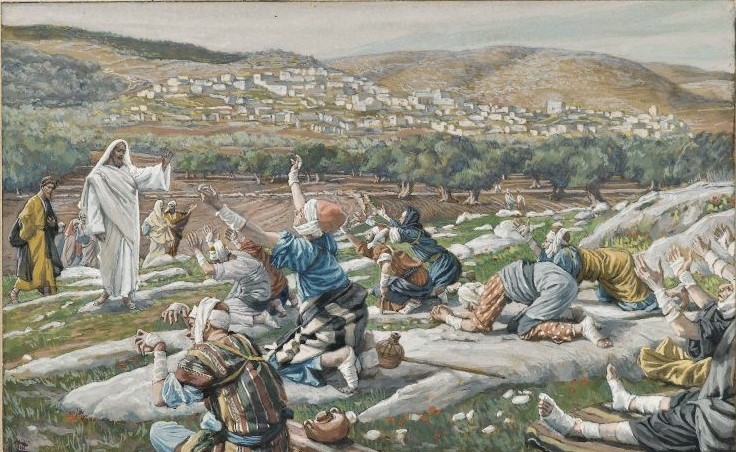
1. Gathering – Ten lepers (symbolizing us) have gathered and Jesus comes near as He passes on His way. We do this in every Mass: we gather and the Lord draws near. In the person of the priest, who is the sacrament, the sign of His presence, Jesus walks the aisle of our church just as He walked those ancient roads.
2. Kyrie – The lepers cry out for mercy, just as we do at every Mass. Lord, have mercy! Jesus, Master, have pity on us!
3. Liturgy of the Word – Jesus quotes Scripture and then applies it to their lives, just as He does for us at every Mass. (In saying, “Go show yourselves to the priests,” Jesus is referencing Leviticus 13, which gives detailed instructions on how the priests of old were to diagnose leprosy or its having been cured.) Yes, this is what we do at every Mass: we listen to the Lord Jesus, through the priest or deacon, proclaiming God’s Word and then applying it to our lives.
4. Liturgy of the Eucharist – The Gospel relates that one of them fell at the feet of Jesus and thanked him. This is what we do during the Eucharistic prayer: we kneel and thank Jesus, and along with Him, give thanks to the Father. As we have noted, the word “Eucharist” comes from the Greek and means “thanksgiving.” Here is the perfect thanks rendered to the Father. Those who claim that they can stay home and give adequate thanks to God should be rebuked for being prideful. Only Jesus can give perfect thanks to the Father, and we can only give adequate thanks by following Jesus’ command to “Do this in memory of me.” We have to be at Mass.
5. Ite, missa est – Finally, Jesus sends the thankful leper on his way, saying, Stand up and go; your faith has saved you. We, too, are sent forth by Jesus at the end of every Mass, when He speaks through the priest or deacon: “The Mass is ended, go in peace.”
So, there it is. Within this Gospel, which very clearly instructs us to give thanks to God, is the very structure of the Mass. If you want to give proper thanks to God, the right place to do it is at Mass. Only at Mass is perfect and proper thanks given to God.
It was all prefigured in the psalm long ago: What return shall I make to the Lord for all the good he has done for me? The cup of salvation I will take up and call on the name of the Lord (Psalm 116:12). Yes, it is the very cup of salvation, the chalice containing Christ’s blood, that is held up at every Mass. It is the perfect sacrifice of thanks. It is the prescribed sacrifice of praise. It is the proper sacrifice of praise.
Once each week I try to find a commercial or short video that reflects an aspect of the Kingdom of God in some positive way. Today, however, I instead present a commercial that I think illustrates a common problem of our day: excessive idiosyncrasy. The singer in the background croons, “We are all strange,” while the footage shows some of the strange and outlandish ways that people dress and act today.
I suppose that back in the 1950s and before we were a little too conformist, and many people were pressured to comply to a rather narrow and rigid definition of what was proper. I would argue that today we have gone too far in the other direction. Every day things seem to get stranger and stranger. There is a kind of existentialism prevalent that says, “I’ll make up my own reality and live within it. You need to adjust to me.” At some point such an attitude offends against the common good.
What is displayed in many of the images in this commercial is more than mere cultural diversity; it seems to be just weirdness for its own sake. It’s as if people are daring me to make a comment so that they can upbraid me for my narrow-mindedness (or bigotry or hatred). The overall effect of the commercial is not a positive one. The depictions are strange, chaotic, and unappealing—in some cases even ugly. To a large degree, though, this is where we are in this country today.
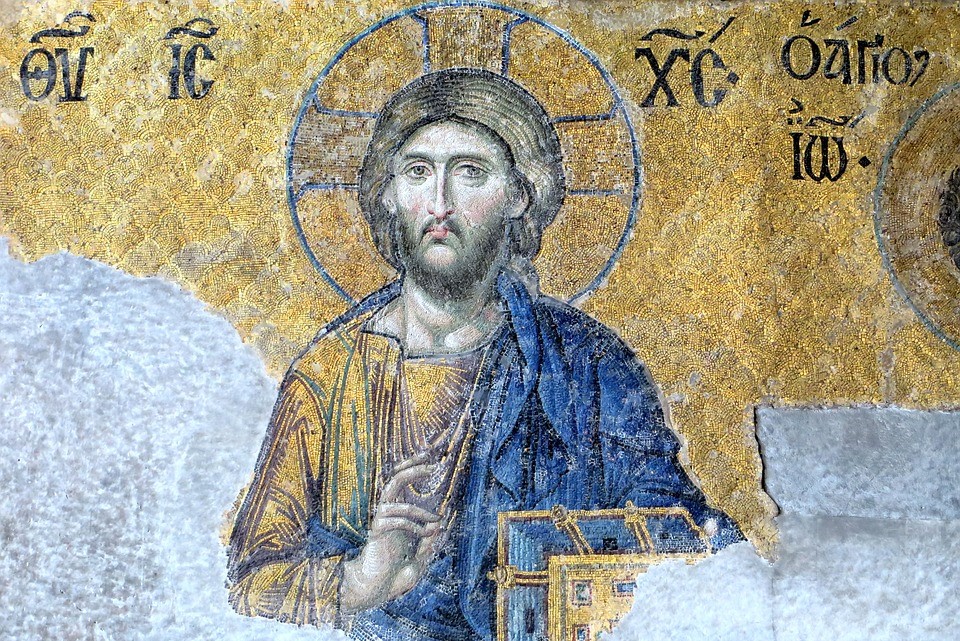
The biblical evidence of Jesus’ divinity is remarkably rich and consistent throughout the New Testament. Although I present many Scripture passages below, I cannot include most of them because doing so would dwarf the rest of the post. Perhaps at some point in the future I will publish a version containing all of the detailed citations. For now, though, let these examples suffice to demonstrate scriptural affirmation of the divinity of Our Lord Jesus Christ.
To begin, recall that the divinity of Christ is a dogma of the Faith (de Fide). The divinity and divine Sonship of Jesus are expressed in all of the creeds. It is perhaps most clearly stated in the Athanasian Creed (Quicumque):
… we believe and confess that Our Lord Jesus Christ is the Son of God. He is God and man. He is God begotten of the substance of the Father before all ages and man born in time of the substance of His Mother. He is Perfect God and perfect man.
Many passages in the Old Testament express the qualities of the coming Messiah:
a prophet (see Dt 18:15,18)
a priest (see Psalm 109:4)
a shepherd (see Ez 34:23ff)
King and Lord (see Ps 2, Ps 44, Ps 109, Zach 9:9)
a suffering servant (see Is 53)
the Son of God (see Ps 2:7, 109:3)
Emmanuel (God with us) (see Is 7:14, Is 8:8)
Wonderful Counselor, Mighty God, Father of the World to Come, Prince of Peace (see Is 9:6)
Eternal King (see Dan 7:14)
Many passages in the New Testament ascribe divine qualities to Jesus:
omnipotence, manifest in the creation and the conservation of the world (see Col 1:15-17, 1 Cor 8:6, Heb 1:2ff)
omniscience – In Christ are hidden all the treasures of wisdom and knowledge (Col 2:3).
eternity – He is before all things, and in him all things hold together (Col 1:17).
immutability (see Heb 1:12, 13:8)
adorability (see Phil 2:10, Heb 1:6)
In the New Testament, the Father attests to the divine Sonship of Jesus:
See Mt 3:17, 17:5, Mk 9:7, Lk 3:22, 9:35, Jn 1:34, and 2 Pet 1:17.
In the Gospels, the Lord Jesus gives testimony to His own divinity and self-knowledge. He is of noble stature. He is aware of His dignity and power and expresses it frequently.
Jesus indicates that He transcends the prophets and Kings of the Old Covenant.
Jonah and Solomon (see Mt 12:41ff, Lk 11:31ff)
Moses and Elijah (see Matt 17:3, Mk 9:4, Lk 9:30)
King David – See Mt 22:43ff Mk 12:36, Lk 20:42ff
He says that the least born into His Kingdom will be greater than John the Baptist who, until that time, was considered the greatest man born of woman (see Mt 11:11, Lk 7:28).
Jesus teaches that He is superior to the angels.
The angels are His servants and minister to Him (see Mt 4:11, Mk 1:13, Lk 4:13).
The angels are His army (see Mt 26:53).
The angels will accompany Him at His second coming and do His will (see Mt 16:27, 25:31, Mk 8:38, Lk 9:26).
Jesus appropriates divine actions unto Himself and thus sets forth an assimilation unto the Lord God.
He declares that it was He who sent the prophets and doctors of the Law (see Mt 23:34, Lk 11:49).
He gives the promise of His assistance and grace (see Lk 21:15).
He forgives sins, which power belongs to God alone (e.g., Mt 9:2).
He, by His own authority, completes and changes some precepts of the Law (See Mt 5:21ff).
He declares Himself to be Lord of the Sabbath (see Mt 12:8, Mk 2:28, Lk 6:5, Jn 5:17).
Like the Heavenly Father, He makes a covenant with His followers (see Mt 26:28, Mk 14:24, Lk 22:20).
Jesus makes divine demands upon his followers.
He rebukes some for lack of faith in Him (see Mt 8:10-12, 15:28).
He rewards faith in Him (see Mt 8:13, 9:2, 22:29, 15:28, Mk 10:52, Lk 7:50, 17:19).
He demands faith in His own person (see Jn 14:1, 5:24, 6:40,47, 8:51, 11:25ff).
He teaches that rejection of Him and His teachings will be the standard of final judgement (see Lk 9:26, Mt 11:6).
Jesus demands supreme love for Him, which surpasses all earthly loves (see Mt 10:37,39; Lk 17:33).
He accepts religious veneration by allowing people to fall at His feet, an honor due to God alone (See Mt 15:25, 8:2, 9:18, 14:33, 28:9,17).
Jesus is well aware of His own power (see Mt 28:18).
He works many miracles in His own name.
He transfers this power to His disciples.
Jesus knows and teaches that His own death will be an adequate atonement for the forgiveness of the sins of the whole human race (see Mt 20:28, 26:28).
Jesus appropriates to Himself the office of Judge of the World, which according to the Old Testament (e.g., Ps 49:1-6) God would exercise (e.g., Mt 16:27). His judgment extends to every idle word (see Mt 12:36) and will be final and executed immediately (see Mt 25:46).
Jesus knows that He is the Son of God.
Jesus clearly distinguishes His claim in this regard from His disciples’ relationship to the Father. When He speaks of His own relationship with God He says, “My Father.” However, when He addresses the disciples, He calls God “Your Father.” He never unites Himself with them in the formula “Our Father,” thus maintaining a distinction (see Jn 20:17).
Jesus first reveals Himself to be the Son of God in the temple, when He remarks to Mary and Joseph that He must be about His Father’s business (see Lk 2:49).
Jesus claims to be both Messiah and Son of God in the presence of the Sanhedrin (see Mk 14:62). The Sanhedrin deem this to be blasphemous.
Jesus tells a story of Himself in the Parable of the Evil Husbandmen, thus confessing himself to be the only Son of God.
Jesus is aware of being one with the Father (The Father and I are one (Jn 10:30,38)). The Jews respond by accusing Him of blasphemy.
In John’s Gospel, Jesus indicates that
He is eternal (Before Abraham was, I am (Jn 8:58)),
He has full knowledge of the Father (see Jn 7:29, 8:55, 10:14ff),
He has equal power and efficacy with the Father (see Jn 5:17),
He can forgive sins (Jn 8:11 et sicut supra),
He is Judge of the World (Jn 5:22,27 et sicut supra),
He is rightly to be adored (see Jn 5:23),
He is the light of the world (see Jn 8:12),
He is the way, the truth, and the light (see Jn 14:6),
His disciples may and ought to pray to the Father in His name (see Jn 14:13ff, 16:23ff),
His disciples may pray to Him (see Jn 14:13ff, 16:23ff),
the solemn confession of the Apostle Thomas, “My Lord and my God,” is acceptable and in fact an act of faith (see Jn 20:28).
Here are a few other New Testament passages on Christ’s divinity:
And we know that the Son of God is Come and has given us Understanding that we may know the true God and may be in His True Son, this is the True God and Life Eternal (1 John 5:20).
In the beginning was the Word and the Word was with God and the Word was God (Jn 1:1-14).
Your attitude should be the same as that of Christ Jesus: Who, being in very nature God, did not consider equality with God something to be grasped … and every tongue must confess to the Glory of God the Father that Jesus Christ is Lord (Phil 2:5-11).
… to them [the Israelites] belong the patriarchs and of their race, according to the flesh is the Christ, who is God over all blessed forever (Rom 9:5).
Looking for the blessed hope and coming of the glory of the great God and our Savior, Jesus Christ (Titus 2:13).
But to the Son [God says]: Your Throne, O God is for ever and ever (Heb 1:8).
Well, I hope you get the point. Those who state that Jesus didn’t know He was God or that He never made divine claims haven’t read enough Scripture. Jesus is Lord; He is God. All things came to be through Him, and He holds all creation together in Himself. Those who deny His divinity will one day fall to prostrate before His glory (see Rev. 1:17).
Here is a powerful clip from the movie The Gospel of John. The words you will hear are taken directly from Scripture.
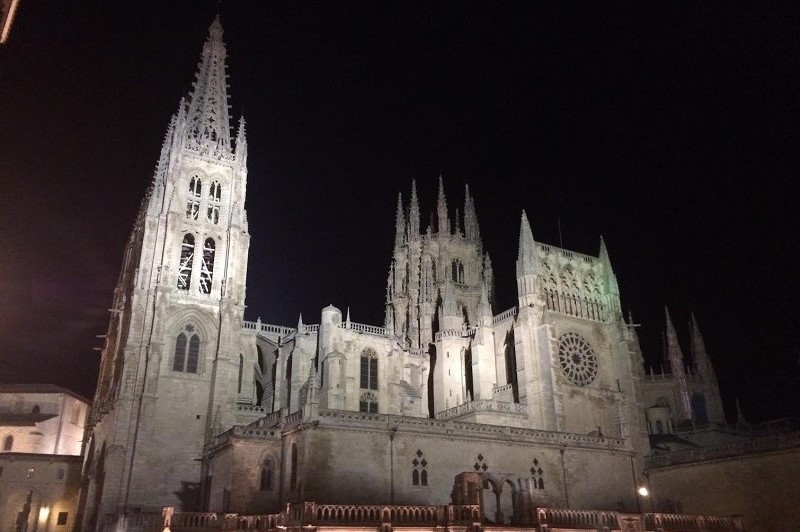
I was recently in Burgos, Spain and saw the splendid cathedral there. My first view of it came at night and I took the photo above. What a magnificent building; such proportion and symmetry! It reminds me of tall trees in a forest, majestically reaching up to the heavens. The flying buttresses supporting the soaring walls and towers showcase a great advance in building technique.
These were the skyscrapers of the Middle Ages. Such angular, geometric, and vertical beauty; a fair flower of the 13th century echoing God’s creation and pointing to Him in a great work of human praise.
Two medieval phrases come to mind in the beauty of this building:
Beauty is id quod visum placet – Beauty is that which pleases when seen.
Pulchra dicuntur quae visa placent – Things that give pleasure when seen are called beautiful.
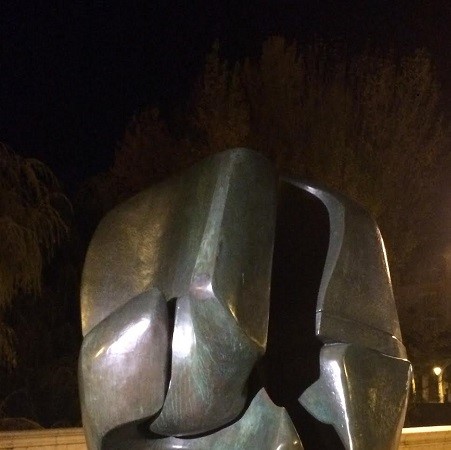
A mere thirty yards from this beautiful cathedral in the town square is something that is not beautiful in any traditional sense. I took the photo of it that is on the left. It was not uplifting and seemed to correspond to nothing in creation (unless one were to imagine a dinosaur dropping or a huge stumbling block). Like most modern abstract art, it looks more to me like someone’s nightmare. It seems to have little to say other than “Try to figure me out, you ignoramus.” Indeed, that is what I am usually called by art critics when I express dismay at these sorts of ugly blobs that clutter too many of our public squares and “art” museums.
Some disparagingly refer to the Middle Ages as the “dark ages” while referring to the current age as “enlightened.” Certainly, no age is perfect, but compare and contrast the two items in the photos here: uplifting, soaring, and inspiring; the other is dark and brooding, and its meaning is opaque. One is an uplifting building from the 13th century, the other a dark “who knows what” from the 20th century. Based on representational art, which age seems more inspiring? Which seems more enlightened? Decide for yourself, but I’ll take the 13th century!
St. Thomas Aquinas (also from the 13th century) spoke of beauty as consisting of integritas, consonantia, and claritas. He writes,
For beauty includes three conditions: “integrity” or “perfection,” since those things which are impaired are by the very fact ugly; due “proportion” or “harmony”; and lastly, “brightness” or “clarity,” whence things are called beautiful which have a bright color [Summa Theologica I, 38, art 8].
In applying these criteria to human art and architecture, we might consider the following:
Integritas (Integrity) – This speaks to the manner in which something echoes the beauty of what God has done. Thomas says that every created being is beautiful because God gives beauty to all created beings by a certain participation in the divine beauty. Therefore, human art and architecture are said to have integrity insofar as they participate in and point to the divine beauty of things. This need not mean an exact mimicry, but it does require at least a respectful glance to creation, holding forth some aspect of it so as to edify us with better and higher things. The cathedral pictured above points to a majestic forest as its form, its soaring stone to the mountains. Its colored glass allows the natural light to dazzle the eye and tell the stories of the Gospels. It is a sermon in glass and stone. As such, it has integrity, because it puts forth God’s glory. I’m not sure what the dark metal blob says. To what does it point? I have no idea. Because it is not integrated into the glory of creation (in any way that I can discern, at least) it does not have integrity. Rather, it seems to mock creation. If you think it is beautiful and has integrity, I invite you to explain why and how; I am at a loss to see any meaning at all in it.
Consonantia (Proportion) – This refers to the order and unity within a given thing. What God creates has a unity and purpose in its parts, which work together in an orderly fashion to direct something to its proper function or end. Thus, art and architecture intrinsically bespeak a unity and functionality, or they point to it extrinsically. They make sense of the world and respect what is given, reflecting the beauty of order, purpose, and design that God has set forth. The cathedral is beautiful because its parts act together in an orderly and harmonious way. There is balance, proportion, and symmetry. There is a recta ratio factibilium (something made according to right reason). As such, the building participates in God’s good order, and that is a beautiful thing. As for the dark metal “blob” (I don’t know what else to call it), it doesn’t seem to me to have any proportion. It is roundish, but not really. Does it have parts? Do they work together for some end? If so, what end? I cannot tell. Rather than pointing to order, it makes me think of chaos. I see no beauty echoed or pointed to.
Claritas (Clarity) – It is through clarity that we can answer the question “What is it?” with some degree of precision and understanding. Claritas also refers to the brightness or radiance of a thing. Something of God’s glory shines through; something about it gives light; something teaches us and reminds us of God—and God and light are beautiful. The gorgeous cathedral reflects the light shining on it, even at night. During the day it proclaims the glory of God by its soaring majesty, its sculptures, its windows, its order, its proportionality. It is a bright light showing forth the brightness of God and participating in it. As for the metal thing, it seems more to suck the light out of the room; it broods. I see no clarity, no brightness. I still cannot answer the question that clarity demands: “What is it?” There is no clear message. As such, it lacks beauty.
The criteria of beauty discussed here cannot be used for labeling things “beautiful” with absolute certainty, as if by applying a formula. They are more like guidelines to help us pin down some notion of beauty that is not purely subjective. Not all these criteria must be met for an object to be considered beautiful, and the presence of one does not guarantee beauty.
So again, you decide for yourself. Each of the two structures pictured above is representative of its age. Were the Dark Ages really so dark? Is ours really so enlightened? Compare and contrast!
As we read Scripture, we should be very attentive when Jesus asks a question. In particular, we should understand that Jesus is posing the question to us as well. It is easy to treat the Gospels like a spectator sport and wait to see what the response is, but that is not the only way we should engage with the text. Not just the Gospels but the entire biblical narrative is our story, too. We are in the story, and the story is in us. (I have written on this topic more thoroughly here: 100 Questions That Jesus Asked and You Must Answer.)
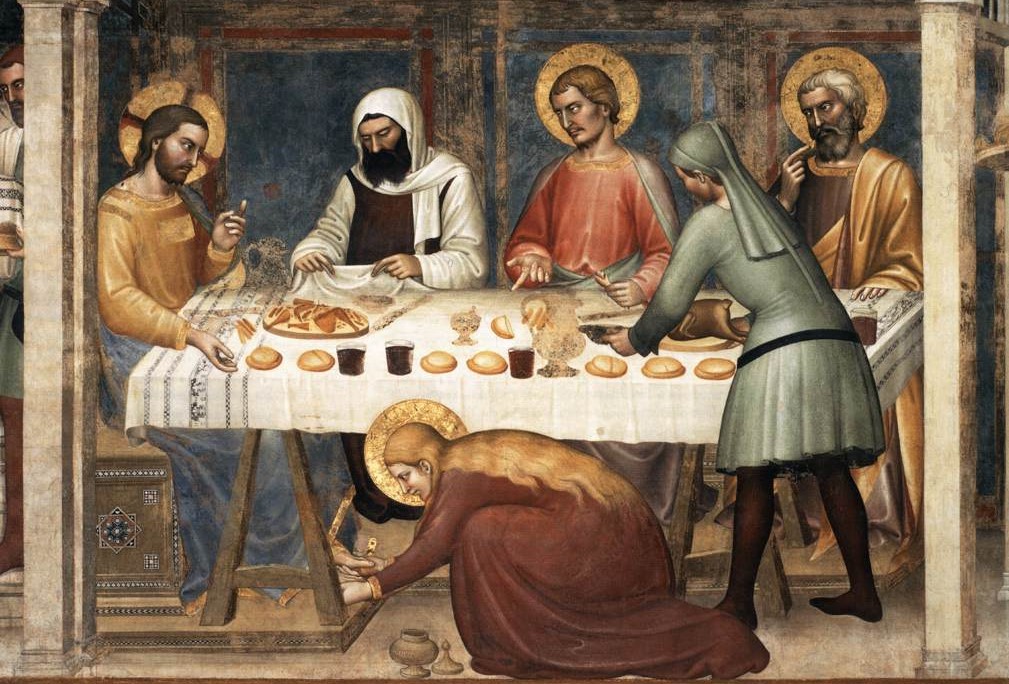
Let’s ponder a question that Jesus asked in last week’s Gospel reading. (Note: I was at a meeting of the Catholic Bar Association in St. Louis, MO, this past weekend, and Fr. James Mason, the rector of Kenrick-Glennon Seminaryhelped me to appreciate a new level to this question.) The question comes in Luke 7, when Jesus is dining at the house of Simon the Pharisee. As Jesus reclined at table, a sinful woman came up behind Him; she washed His feet with her tears, dried them with her hair, and anointed them with expensive perfume. The text tells us that Simon thought to himself, “If this man were a prophet, He would know who this is and what kind of woman is touching Him, for she is a sinner” (Lk 7:39). A few moments later Jesus asks Simon,
“Do you see this woman?” (Lk 7:44)
Now, let the question linger for a moment and ponder its depths. There is more here than an inquiry as to whether Simon is aware of her physical presence.
“Do you see this woman?”
He does not. He sees a sinner, likely a prostitute, but he does not see her.
Whatever this woman’s sins, and they may be many, she is still a child of God. Something terrible must have happened in her life that she has fallen into such self-destructive sin. What a miserable life of forced intimacy! Has her poverty driven her to this? Was she disowned by her family? She has not lost her way entirely, however, for she has crossed paths with Jesus. Propelled by sorrow for her sin, she reaches for Jesus in the hope of receiving His mercy.
“Do you see this woman?”
We can be inclined to treat people the way Simon treated this woman. It is easy to forget that behind the many labels we can put on another person is a human being, a child of God, someone’s son or daughter, perhaps someone’s father or mother, perhaps someone’s brother or sister. It is a form of reductionism in which we focus on a single aspect of a person, forgetting the full, complex human being that exists.
For example, in the sin of lust, one reduces another person to his or her body for the purpose of one’s own sexual pleasure. Love regards the person, but lust cares only for the body. Pornography not only reveals too much, it also reveals too little; the body is displayed, but the person is not. I encourage those who struggle with pornography to ask for the gift of tears; to realize that what they are looking at is a tragedy. (Because the vast majority of those who fight this battle are men, I will word the rest of this paragraph from that standpoint, however, the message is the same for women who face this struggle.) The woman a man lusts after is a person, a child of God, someone’s daughter, perhaps someone’s mother, perhaps someone’s sister. Something has gone terribly wrong in her life. When she was a child she surely did not dream of this life. She probably wanted to find a good husband and have a family. Something tragic must have brought her to this place.
“Do you see this woman?”
There are many other ways we can reduce people and forget their humanity. We see that criminal or that member of the wrong political party. We savage many of our leaders and sometimes even their children. We look at others and see only their race or their sex or how they are dressed. Behind all these labels is a person who has a story. In my role as a priest, I have come to recognize that few of us ever really understand the struggles and sorrows of others. Many people carry burdens of which we are unaware. We need to remember this, especially when dealing with troubled people in our lives. Many of them are troubled for a reason. This does not always excuse their behaviors, but remembering this can help us to be more patient, more understanding, and less quick to condemn.
“Do you see this woman?”
Conversely, there are some people who insist that we reduce them and see them only in the light of a single aspect of who they are. In today’s world of identity politics, some label themselves as LGBTQ, some emphasize their race, some emphasize a particular disability, and others want us to see them only as victims of this or that. Why should I see people simply in terms of what sexually tempts them or merely as victims of “the system”? Are they not also free human beings? Are they not also children and siblings and parents? Are they not also lawyers and teachers and mechanics? Why do they insist that I focus on only one thing? When I am constantly confronted with labels or narrow categories, I often don’t ever get to meet the real people behind them. I don’t get to know if they root for my favorite team, or have a similar love for photography and music, or have had ups and downs in life similar to my own.
Simon the Pharisee looked at a woman and saw only a prostitute. What do I see when I look at others, especially the most troubled?
Of all the prophets, Jonah is perhaps the most reluctant; his struggle with sin is not hidden. We are currently reading Jonah’s story in daily Mass. In the story we see a portrait of sin and of God’s love for sinners. Psalm 139 says, beautifully,
Whither shall I go from thy spirit? Or whither shall I flee from thy face? If I ascend into heaven, thou art there; if I descend into hell, thou art present. If I take my wings early in the morning, and dwell in the uttermost parts of the sea, Even there also shall thy hand lead me, and thy right hand shall hold me (Ps 139: 7-10).
Let’s examine the story of Jonah and allow its teachings to reach us.
I. Defiance –This is the word of the LORD that came to Jonah, son of Amittai: “Set out for the great city of Nineveh, and preach against it; their wickedness has come up before me.” But Jonah made ready to flee to Tarshish away from the LORD.
To defy means to resist what one is told to do, openly and boldly. Defiance also indicates a lack of faith because it comes from the Latin “dis” (against) and “fidere” (believe). Hence Jonah is not just insubordinate; he is unbelieving and untrusting.
His scoffing and defiance likely result from hatred or excessive nationalism. Nineveh is the capital of Syria, the mortal enemy of Israel. Jonah instinctively knows that if they repent of their sinfulness they will grow stronger. Rather than trusting God, he brazenly disobeys, foolishly thinking that he can outrun God.
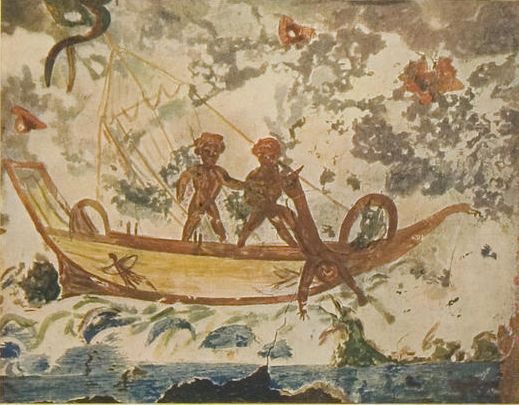
II. Distance –He went down to Joppa, found a ship going to Tarshish, paid the fare, and went aboard to journey with them to Tarshish, away from the LORD.
Tarshish is widely held to refer to the coastline of modern-day Spain. In order to avoid going 500 miles into God’s will, Jonah runs some 1500 miles away. It’s always a longer journey when you disobey God.
Note that he also puts down good money in order to flee. Indeed, many people spend lots of money and go miles out of their way in order to be able to stay in sin. Yes, sin is usually very expensive—but many seem quite willing to pay the price.
The simplicity of holiness is often far less onerous and less costly as well. Like Jonah, though, many line up to pay the price and take the long, painful journey deeper into defiance and sin.
How much of our trouble comes from our sin? The great majority of it. So much suffering, so much expense, so much extra mileage could be avoided if we just obeyed God. The bottom line (if you’ll pardon the financial pun) is that sinful choices are usually very costly.
III. Disturbance –The LORD, however, hurled a violent wind upon the sea, and in the furious tempest that arose the ship was on the point of breaking up. Then the mariners became frightened and each one cried to his god. To lighten the ship for themselves, they threw its cargo into the sea.
Jonah’s defiance sends him and others headlong into a storm that grows ever deeper. The teaching is clear: persistent and unrepentant sin brings storms, disturbances, and troubles. As our defiance deepens, the headwinds become ever stronger and the destructive forces ever more powerful.
Note that Jonah’s defiance also endangers others. This is another important lesson: in our sin, our defiance, we often bring storms not only into our own life but also into the lives of others. What we do, or fail to do, affects others.
The mariners, fearing for their lives, also lose wealth and suffer great losses (by throwing their cargo overboard) on account of Jonah’s sinfulness.
Similarly, in our own culture today a good deal of pain and loss results from the defiant, selfish, and bad behavior of many. On account of selfishness and sexual misbehavior, many families have been torn apart. There is abortion, disease, teenage pregnancy, children with no fathers, and all the grief and pain that come from broken or malformed families. It is of course the children who suffer the most pain and injustice as a result of so much bad adult behavior.
To all this pain can be added many other sufferings caused by our greed, addiction, lack of forgiveness, pride, impatience, and lack of charity. These and many other sins unleash storms that affect not only us but others around us as well.
No one is merely an individual; we are also members of the Body, members of the community, whether we want to admit it or not.
Jonah is a danger and a cause of grief to others around him. So, too, are we when we defiantly indulge sinfulness.
IV. Delirium –Meanwhile, Jonah had gone down into the hold of the ship, and lay there fast asleep.
While all these storms (which he caused) are raging, Jonah is asleep. Often the last one to know or admit the damage he does is the sinner himself. Too many wander around in a kind of delirium, a moral sleep, talking about their rights and insisting that what they do is “nobody else’s business.” Yet all the while the storm winds buffet and others suffer for what they do. So easily they remain locked in self-deception and rationalizations, ignoring the damage they are inflicting upon others.
Many people today talk about “victimless sins,” actions that supposedly don’t hurt anyone. Those who are morally alert do not say such things; those who are in the darkness of delirium, in a moral slumber, say them. Meanwhile, the gales grow stronger and civilization continues to crumble. All the while, they continue to ramble on about their right to do as they please.
V. Dressing Down –The captain came to him and said, “What are you doing asleep? Rise up, call upon your God! Perhaps God will be mindful of us so that we may not perish.” Then they said to one another, “Come, let us cast lots to find out on whose account we have met with this misfortune.” So they cast lots, and thus singled out Jonah. “Tell us,” they said, “what is your business? Where do you come from? What is your country, and to what people do you belong?” Jonah answered them, “I am a Hebrew, I worship the LORD, the God of heaven, who made the sea and the dry land.” Now the men were seized with great fear and said to him, “How could you do such a thing?” They knew that he was fleeing from the LORD, because he had told them.
In a remarkable turn in the story, those who are not believers in the God of Israel dress down Jonah, who is to be God’s prophet, unto repentance! It’s a pretty bad day for a prophet when those whom he is supposed to address, must turn and call him to conversion. They seem to fear God more than he does!
First there comes the pointed question, “What are you doing asleep?” Yes, what are you doing? Do you have any idea how your behavior, your sins, are affecting the rest of us? Wake up from your delusions. Stop with your self-justifying slogans and look at what’s really going on!
Next they say to him, “Pray!” In other words, get back in touch with God, from whom you’re running. If you won’t do it for your own sake, then do it for ours—but call on the Lord!
This is what every sinner, whether outside the Church or inside, needs to hear: wake up and look at what you’re doing; see how you’re affecting yourself and all of us. Turn back to God lest we all perish.
VI. Despair –They asked, “What shall we do with you, that the sea may quiet down for us?” For the sea was growing more and more turbulent. Jonah said to them, “Pick me up and throw me into the sea, that it may quiet down for you; since I know it is because of me that this violent storm has come upon you.”
Jonah is now beginning to come to his senses, but not with godly sorrow, more with worldly sorrow. Godly sorrow brings repentance that leads to salvation and leaves no regret. Worldly sorrow brings death (2 Cor 7:10). Somewhat like Judas, Jonah and many other sinners do not repent to the Lord but rather are merely ashamed of themselves.
In effect, Jonah says to them, “Kill me. I do not deserve to live.” This is not repentance; it is despair.
VII. Dignity –still the men rowed hard to regain the land, but they could not, for the sea grew ever more turbulent.
Surprisingly, the men are not willing to kill him, at least not as the first recourse. Despite his sin, Jonah does not lose his dignity. Even the fallen deserve our love and respect as fellow human beings. It is too easy for us to wish to destroy those who have harmed us, returning crime for crime, sin for sin.
But God would have us reach out to the sinner, to correct with love.
It is true, however, that not everyone is willing or able to be corrected. Some things must ultimately be left to God. Our first instinct should always be to respect the dignity of every person—even great sinners—and strive to bring them to the Lord with loving correction.
VIII. Deliverance –Then they cried to the LORD, “We beseech you, O LORD, let us not perish for taking this man’s life; do not charge us with shedding innocent blood, for you, LORD, have done as you saw fit.” Then they took Jonah and threw him into the sea, and the sea’s raging abated. Struck with great fear of the LORD, the men offered sacrifice and made vows to him. But the LORD sent a large fish, that swallowed Jonah; and Jonah remained in the belly of the fish three days and three nights. From the belly of the fish Jonah prayed to the LORD, his God. Then the LORD commanded the fish to spew Jonah upon the shore.
In the end, the men must hand Jonah over to the Lord. Somehow, they sense His just verdict yet they fear their own judgment and ask for His mercy.
In many American courtrooms, upon the pronouncement of a death sentence, the judge says, “May God have mercy on your soul.” Even in the sad situation in which we can do little but prevent people from ever harming others, we ought to appreciate their need for God’s mercy as well as our own.
God does deliver Jonah. After his “whale” of a ride, a ride in which he must experience the full depths and acidic truth of his sinfulness, Jonah is finally delivered by God right back to the shore of Joppa where it all began.
IX. Determination –Then the word of the Lord came to Jonah a second time: “Go to the great city of Nineveh and proclaim to it the message I give you.” Jonah obeyed the word of the Lord and went to Nineveh (Jonah 3:1-3).
Yes, God works with the sinner, drawing him back. He is the God of the second chance. Thank you, Lord, for your grace and mercy. He remembers our sins no more. In effect, God says to Jonah, “Now, where were we?”
God does not save us merely for our own sake, but also for the sake of others with whom our life is intertwined. Jonah will go finally to Nineveh and there proclaim a message that will be heeded by those who are so lost in sin that they do not know their right hand from their left (see Jonah 4:11). Hmm, now why does this description seem so familiar?
Here is a video of a performance of the Peccavimus (we have sinned) from the oratorio “Jonas,” by Giacomo Carissimi. It is a luscious, heartfelt piece depicting the repentance of the Ninevites. I wonder if (and hope that) the young people who sang it understood its significance for them, too.
I was at the Kennedy Center last night with friends to hear a performance of the popular cantata Carmina Burana. It was composed by Carl Orff in the mid-1930s and consists of a collection of poems from the Middle Ages (set to music). The poems, mostly of a secular nature, were found in Benediktbeuern Abbey in Bavaria in the early 1800s.
Among the poems is Estuans interius (Seething inside), a lament on the price one pays for indulging the passions (e.g., lust, greed, gluttony). Satisfying our passions can provide temporary gratification, but eventually there is a price to be paid.
Lines from the poem are shown in bold, black italics while my comments are in plain red text.
Burning inwardly with strong anger, in my bitterness I speak to my soul; created out of matter, ashes of the earth, I am like a leaf with which the winds play.
Indulgence often leads to compulsions and addictions that lock us into a cycle of disappointment, bitterness, and self-reproach. This is seldom helpful because it robs us of the very self-regard that could motivate us to focus on our true potential and thereby improve. It is what St. Paul calls worldly sorrow, which is deadly, as opposed to Godly sorrow, which restores us to God’s care (see 2 Cor 7:10).
Left to our unrestrained passions we are blown about like a leaf in the wind.
Whereas it is proper for a wise man to place his foundations on rock, I, in my folly, am like a flowing river, never staying on the same course.
This is another image of the foolishness of intemperance. Our life meanders like a river, and we lose touch with our goal. We’re all over the map, not living as though we know where we are headed; we cannot accomplish earthly goals let alone heavenly ones.
Jesus said, Everyone then who hears these words of mine and does them will be like a wise man who built his house on the rock. And the rain fell, and the floods came, and the winds blew and beat on that house, but it did not fall, because it had been founded on the rock. And everyone who hears these words of mine and does not do them will be like a foolish man who built his house on the sand. And the rain fell, and the floods came, and the winds blew and beat against that house, and it fell, and great was the fall of it (see Mat 7:24-27).
I am borne along like a ship without a sailor, just as a wandering bird is carried along paths of air.
If we do not subject our passions to our reason, we are easily carried along by worldly forces. Scripture says,
Jesus Christ is the same yesterday and today and forever. Do not be carried away by all kinds of strange teachings (Hebrews 13:8-9).
Therefore, beloved, since you already know these things, be on your guard so that you will not be carried away by the error of the lawless and fall from your secure standing (1 Peter 3:17).
No longer be infants, tossed about by the waves and carried around by every wind of teaching and by the clever cunning of men in their deceitful scheming (Eph 4:14).
Though secular in source, this poem conforms to the teaching of Scripture: our passions, especially when indulged, make us susceptible to all sorts of foolishness. Our minds become darkened and we are an easy target for even the most ludicrous and deluded teachings and philosophies. Why does this happen? Because Christ is not the captain of our thoughts, and reason is not the pilot of our life; rather, our unmoored passions are at the helm, and the result is a darkened mind and increasing compulsion and addiction.
Chains do not keep me nor does a key; I seek men like myself, and I am joined with rogues.
When the passions are indulged, it becomes harder and harder to resist them. St. Augustine wrote, “For of a forward will, was a lust made; and a lust served, became custom; and custom not resisted, became necessity” (Confessions, 8.5.10).
Sinners tend to seek one another out both for comfort and validation. St. Paul warned, For the time will come when people will not put up with sound doctrine. Instead, to suit their own desires, they will gather around them a great number of teachers to say what their itching ears want to hear (2 Tim 4:3). When we are both surrounded by and validated by sinners, our passions are further excited. Over time, we keep company with a worse and worse crowd.
I go on the broad way after the manner of youth; and I entangle myself in vice, forgetful of virtue; greedy for pleasure more than for salvation, I, dead in my soul, attend to the needs of my flesh.
Of this “broad way” Jesus said, Enter through the narrow gate. For wide is the gate and broad is the way that leads to destruction, and many enter through it. But small is the gate and narrow the way that leads to salvation, and only a few find it (Mat 7:13-14). Why is the way to salvation narrow? Because it is the way of the cross and most people do not want to control their passions or say no to sin. As the poem says, most people want momentary pleasure more than eternal salvation; at some point they become so dead in mortal sin that they only attend to the needs of the flesh.
Yes, these are great words of wisdom from the Carmina Burana. Spare us, O Lord, from the slavery of intemperance!
Here is a performance of the sung version (in Latin) of the poem Estuans interius:
The readings for this Sunday’s Mass richly describe some essential qualities of faith. There are five fundamentals that can be seen:
Wanting–The apostles said to the Lord, “Increase our faith” (Luke 17:5-6).
There’s an old saying that what you want, you get. Many doubt this, thinking that they have wanted many things that they did not get. The reason for this, however, is usually because they didn’t want it enough. When we really want something (provided it is not an impossibility) we usually get it, because we have a passion for it and work at it.
Many people who say that they don’t have time to pray or to go to Mass still find time to golf and watch TV television. They find the time because they want to do these things. They don’t find time to pray or to go to Mass because they do not want to do these things enough.
When the apostles ask the Lord to increase their faith, they are asking for a deeper desire to know Him. Too often we miss a step in our prayer. We might ask the Lord to help us to pray when we really should be asking Him to give us the desire to pray. When we want to pray, we will pray. When we want to be holy, we will naturally strive for holy practices. It is about what we truly desire. Ask the Lord to help you want Him and His kingdom. Ask the Lord for a new heart that has proper wants and desires. Ask the Lord for a new mind that has the proper priorities and prefers to think about what is good, true, and beautiful. What you want, you get.
Waiting– The first reading speaks of our need to wait for the Lord’s action: How long, O LORD? I cry for help, but you do not listen! I cry out to you, “Violence!” but you do not intervene. Why do you let me see ruin; why must I look at misery? Destruction and violence are before me; there is strife, and clamorous discord. … Then the LORD answered me and said, Write down the vision clearly upon the tablets, so that one can read it readily. For the vision still has its time, presses on to fulfillment, and will not disappoint; if it delays, wait for it, it will surely come, it will not be late. The rash one has no integrity (Hab 1:2-3; 2:2-4).
Waiting is one of the great mysteries of the Christian life. It is not always clear why God makes us wait. Perhaps He is trying to strengthen our faith. Perhaps He is helping us to clarify or confirm our desires. Scripture consistently tells us that we must learn to wait for the Lord and that there are blessings for those of us who do. Here are some examples:
Fret not yourself; it tends only to evil … those who wait for the LORD shall possess the land (Ps 37:8).
Those who wait for me shall not be put to shame (Is 49:23).
The LORD is good to those who wait for him, to the soul that seeks him. It is good that one should wait quietly for the salvation of the LORD (Lam 3:25).
But they who wait for the LORD shall renew their strength, they shall mount up with wings like eagles, they shall run and not be weary, they shall walk and not faint (Is 40:31).
Waiting is a fundamental of firm faith. Gospel music is replete with waiting themes. One song says, “You can’t hurry God, you just have to wait, trust, and never doubt him, no matter how long it takes. He may not come when you want him but he’s always right on time.” Another song says, “Weeping may endure for a night, but joy will come with the morning light.” Other songs counsel that we must hold on and hold out:
“I promised the Lord that I would hold out, he said he’d meet me in Galilee.”
“Hold on just a little while longer, everything’s gonna be all right.”
“Keep your hand on the plow. Hold on!”
“Lord help me to hold out until my change comes!”
The reading from Habakkuk above warns that the rash man has no integrity. That is another way of saying that waiting is integral to the Christian life; it is a fundamental of faith. To have integrity means to have all the necessary parts that make up the whole. To lack patience, then, is to lack integrity, to lack a fundamental of the Christian faith.
Withstanding– The second reading counsels us, God did not give us a spirit of cowardice but rather of power and love and self-control. So do not be ashamed of your testimony to our Lord, nor of me, a prisoner for his sake; but bear your share of hardship for the gospel with the strength that comes from God (2 Tim 1:6-8).
This passage tells us that life has difficulties and challenges. Becoming a Christian does not necessarily make things easier. In fact, things often get harder, because we must endure the hatred and ridicule of the world. A fundamental of the Christian Faith is that being able to withstand such trials with courage.
Notice that this courage, power, and love come from God, not from us. Hence, it is grace that is being described here. This is not a moral slogan. Withstanding means that God is “standing with” us, and we with Him. Such withstanding is only possible by the relationship with God that comes by faith. In this way, we discover the power, the capacity, to withstand, to live the Christian faith courageously in a hostile world.
Working– The Gospel teaches, Who among you would say to your servant who has just come in from plowing or tending sheep in the field, “Come here immediately and take your place at table”? Would he not rather say to him, “Prepare something for me to eat. Put on your apron and wait on me while I eat and drink. You may eat and drink when I am finished”? Is he grateful to that servant because he did what was commanded? So should it be with you. When you have done all you have been commanded, say, “We are unprofitable servants; we have done what we were obliged to do” (Luke 17:6-10).
This teaching of the Lord’s can irritate us and even seem hurtful if we misunderstand grace and seek to understand this text by the flesh. Our flesh is self-centered and thinks we deserve praise and good things from God in return for the good things we do. The flesh expects—even demands—rewards, but God can never be indebted to us, never. Our good works are not our gift to God; they are His gift to us.
All our works of charity and faith, for which our flesh wants credit, are God’s work and His gift. This is made clear in this passage from the Letter to the Ephesians:
For by grace you have been saved through faith; and this is not your own doing, it is the gift of God– not because of works, lest any man should boast. For we are his workmanship, created in Christ Jesus for good works, which God prepared beforehand, that we should walk in them (Eph 2:8-10).
If I think that I did something deserving of praise and reward, I am thinking in terms of the flesh, not the Spirit. When I have done something good all I can really do is to say, “Thank you” to God. His grace alone permitted me to do it. God may speak elsewhere of rewarding us, but that is His business. He is not indebted to us in any way. When we have done everything we ought, our one disposition should be gratitude. We are useless servants in the sense that we can do nothing without God’s grace. We can only do what He enables us to do.
That said, it is clear that work is a pillar of faith. The text from today’s Gospel and the text from Ephesians above both make clear that work is something God has for us. So faith by itself, if it has no works, is dead (James 2:17). Likewise, Jesus says, “It was not you who chose me. It was I who chose you that you should go and bear fruit that will last” (Jn 15:16). Yes, work is a fundamental of faith.
Winning– We conclude with a reference back to the first reading: For the vision still has its time, it presses on to fulfillment and it will not disappoint. If it delays, wait for it, it will surely come, it will not be late (Hab 2:3).
See what the end shall be! It is true that we must want, wait, withstand, and work, but we do not do so for no reason. We have a cross to carry, but if we carry it with the Lord, we carry it to glory. There is an old gospel song with these lyrics:
Harder yet may be the fight, Right may often yield to might, Wickedness awhile may reign, Satan’s cause may seem to gain, There is a God that rules above, With hand of power and heart of love, If I am right, He’ll fight my battle, I shall have peace some day. I do not know how long ’twill be, nor what the future holds for me. But this I know, if Jesus leads me, I shall get home someday.
This is just what Habakkuk describes: we will win with Jesus. He describes a victory that is
Future – the vision still has its time; it presses on to fulfillment
Fantastic – it will not disappoint
Firm – it will surely come
Fixed – it will not be late
For all those who walk with Jesus on the way of the cross, there is victory ahead. Even here in this life we already enjoy the fruits of crosses past. Our withstanding in the past has given us strength for today. Our waiting in the past has had its fulfillment and provides the hope that our current waiting will also be fruitful. Our past work, by God’s grace, has already granted benefits to us and to others.
These are but a small foretaste of a greater glory to come, the glory that waits for us in Heaven. Yes, if we want, wait, withstand, and work, we will win! I promise it to you in the Lord Jesus Christ.