I have met a good number of people who said that they would never become Catholic and now are. Some are lay leaders in the Church and some are even priests! I have met other people who said they would never believe in God, yield to any religious instruction, or confess to “any man” and now do (and teach others to do the same).
Growing up I never thought I’d become a priest; the thought just never occurred to me. And if you told me in those days that I would one day be a priest, I would have shaken my head in ridiculing laughter. But here I am, 26 years a priest and quite happy, thank you.
“Never say never.” It’s one of those wonderful phrases in which you break the rule in the very act of announcing it. God must laugh when we tell him our plans, and especially when we say, “Never.”
Pray God, though, that we never say that final “No” to Him, and that we never leave our sacred duties. May we seldom say never, but when we do, may it be when it matters.
At the bottom of this post is a 2010 CBS news story reporting hat anything you’ve copied on a digital copier going back years is stored on a hard drive inside the copier. These drives are evidently so large that they can store more than 20,000 documents and hundreds of thousands of pages.
Hence if you have ever photocopied personal materials (e.g., social security numbers, checking info, personal data) it is likely on that hard drive. The CBS news crew showed how easy it is to remove the hard drive and download its contents. It’s a stunning little segment; I recommend you watch it and share it with 500 of your closest friends!
When it comes to privacy there are problems in two different senses.
The first is the usual one: the erosion of privacy we have come to expect in this day and age. Our data is out there in cyberspace and can too easily be intercepted. GPS devices track our whereabouts, Internet browsing history is retained, and “cookies” on our computer track our habits. YouTube and our cable boxes faithfully record our viewing habits. And, as you can see in the video below, just about everything we have ever copied on any copier built after 2002 is dutifully saved. I’m not sure why this is done, but the information is there.
In many ways our life is an open book. In some ways having our information out there is a convenience. In other ways, though, it is alarming and arouses suspicion. There is less and less privacy each day. And don’t even get me started on those full body scanners at airports!
There is a second, very different sense in which privacy is a problem. In a very important way we must remember that to God, there has never been anything private about our life. He sees everything. He is the searcher of minds and hearts. The Book of Hebrews says, to him everything lies naked and exposed (Heb 4:13). No thought, deliberation, or action of ours is hidden from God.
One of the problems of the modern age is that we too easily forget the fact that God witnesses everything we do. In school settings I have often reminded students (who are pretending they’ve done nothing wrong), “Now be careful. God is watching and knows everything you do. He also knows if you are lying to me. You might slip something by me but you won’t fool God!” But it is not only children who need to be reminded of this. Yes, God sees and knows everything we think and do. In this sense there is no privacy. God is watching. Deep down we know this, but our weak minds forget. And when we do remember our crafty minds try to reinvent God by saying foolish things such as, “God doesn’t mind,” or “God understands,” or “God doesn’t punish.”
Absolute privacy is an illusion. We may well be able to carve out some privacy from one another, and well we should. But we should not seek privacy from God, nor can we. There is something medicinal about recognizing the presence of God. The more we experience that God is present and watching, the more we accept Him on His own terms; we do not try to reinvent Him. The more we do this, the more our behavior can be reformed. A little salutary fear can be medicinal while we wait for the more perfect motive of love to drive out sin.
Frankly, acknowledging the fact that not only is God watching us but others are as well, can have a positive effect. We may not approve of the fact that others might be watching us, but in the end it can be helpful. A few examples might help illustrate what I mean.
Internet Pornography – As a confessor, I increasingly hear the sin of Internet pornography confessed. One of the things I try to remind penitents of is the fact that when they are on the Internet they are essentially out in public with a name tag on. All of their browsing habits are stored on their own computers, on the sites they visit, and in the browsing engine they use. If they think they are in the privacy of their own room they ought to think again. Personally, this knowledge keeps me far away from bad sites of any kind on the Internet. There is a kind of salutary fear in knowing that I am out in public when I’m surfing the Internet.
Cable TV – Those boxes send data about what I watch and for how long back to the cable company. My viewing habits are known to those who can find them. Frankly, it keeps me out of trouble. I hope other virtues do as well, but remembering that I am in public is very helpful.
E-mail, Facebook, blogs, etc. – Once you press send or publish, you’ve just made history. The contents of what you have said are out there to stay. You may delete it, but the information will remain on servers for potentially a very long time. Be very careful what you say, because no matter how private you may think it is, it is not. You are always within earshot of some server that loves to keep your data. What you type in the darkness will be brought to light and what you post in secret will shouted from the housetop (to paraphrase Luke 12:3). I may not like that what I send or post is ultimately public, but in the end it makes me more careful about what I say and type.
Accountability – As a priest, I think it is important to live a rather transparent life. I very rarely just slip away from the rectory. I almost always tell someone on the staff where I am going (at least generally) and when I expect to return. I am a public figure. Sure, I have some privacy up in my rectory suite, but overall I make it a rule to account for my whereabouts. I also usually wear my clerical attire (except on a day off). There are certainly times when I expect the rectory to be a private home (after 9 PM), but even then I live with three other priests. And though we have separate apartments, the communal quality of the rectory provides a salutary sort of accountability in terms of personal behavior.
What I am ultimately saying is that demanding too much privacy can also be a problem. In the end, the Lord intends for us to live in community, such that we are accountable to others. Some degree of accountability and transparency is both helpful to and necessary for us.
It is clear that there are significant problems with the erosion of our privacy today. We ought to continue to insist that proper boundaries be respected.
However, we should also remember that some demands for privacy are unrealistic. At some point, we simply need to accept that the being online is the same as being out in public with your name tag on. That’s just the way it is, so behave yourself.
Finding the proper balance between our public and private lives can be difficult. Certainly privacy is to be insisted upon in many cases. But it is also true that overly expansive assumptions of privacy are neither possible nor always healthy. Being in public will always be a necessary part of life and thus being aware when we are in public is important. In fact, you are in public right now because you are online.
Before commenting, please take a few minutes and watch this video. (And never sell your copier without insisting that you be permitted to destroy the information on the hard drive!) This report was a real eye-opener and will make me more cautious about how, when, and where I copy confidential documents and personal information.
Our relationship with God’s law is complex and we don’t often get it right. When it comes to God’s law we cannot forget that it is personal. That is, it is given to us by a loving God who wants to save us. Therefore, it is important to know both the law and the lawgiver, who is God.
In the Deuteronomiccode, each law is often followed by the phrase “I am the Lord.” It is as if the Lord is saying, “This is God talking, the God who saved you, parted the Red Sea for you, and led you through the desert and into the Promised Land. I, the one who loves you, am telling you this.” The old rabbis put it this way: When God added to the law the phrase “I am the Lord,” He was saying, “Look, I am the one who fished you out of the mud; now come over here and listen to me.” J
So the law is personal and we must strive to know both the law and the lawgiver. Two errors are to be avoided when it comes to the law:
The first error is that of legalism, which elevates the law to the point of idolatry, such that one is kept “safe” by the law rather than by a saving relationship with God, the lawgiver. In such a system there is little room for understanding the Lord’s intent. There is also a failure to grasp the often general nature of God’s law, which covers common circumstances but does not address every specific situation perfectly. For example, the obligation to attend Mass is generally binding, but illness or the need to care for the ill can be a valid excuse.
The other error is assuming a kind of autonomy based on the claim that one knows God so well that the law is largely irrelevant. A common form of this is resorting to a “God is love” argument to set aside the moral law. Never mind that God Himself gave us the moral law. Making this error I claim that God doesn’t care if I skip Mass, live with my girlfriend, etc. He doesn’t care about that sort of stuff because He is a loving God, affirming and merciful, who is not uptight the way the Church is. A person with such an attitude dismisses large parts of the moral law based on his own authority and the exaggerated notion that he knows God better than even God’s very own revealed word. He claims that a loving and kind God wouldn’t ask difficult things or rebuke sin. But such a notion confuses true love with mere kindness. While kindness is an aspect of love, so are challenge, rebuke, and even punishment.
Neither error will do. The key is to find a balance such that both the law and the lawgiver are properly respected.
As usual, St. Thomas Aquinas provides great insight. And while the context of his remarks is the arena of civil law, the principles he sets forth are applicable to divine and ecclesial law as well. He takes up the question of law and the lawgiver in Question 96 (article 6) in the Prima Secundae of the Summa Theologica.
St. Thomas considers whether one who is under a law may act apart from the letter of the law.
St. Thomas answers with a qualified yes and, as always, provides important distinctions and premises. He begins with a helpful quote from Hilary of Poitiers, who notes that the limits of written law are subject to the limits of all speech, including in its written form:
Hilary says (De Trin. iv): “The meaning of what is said is according to the motive for saying it: because things are not subject to speech, but speech to things.” Therefore, we should take account of the motive of the lawgiver, rather than [merely] of his very words (I, IIae, Q 96, art 6, Sed contra).
St. Thomas goes on to note that laws are intended for the common good and speak to the general or common situations, but that no lawgiver can envision every circumstance, and this should be taken into account. Thomas writes,
Now it happens often that the observance of some point of law conduces to the common weal in the majority of instances, and yet, in some cases, is very hurtful. Since then the lawgiver cannot have in view every single case, he shapes the law according to what happens most frequently, by directing his attention to the common good. Wherefore if a case arises wherein the observance of that law would be hurtful to the general welfare, it should not be observed (Ibid, respondeo).
St. Thomas imagines the following example:
For instance, suppose that in a besieged city it be an established law that the gates of the city are to be kept closed, this is good for public welfare as a general rule: but, it were to happen that the enemy are in pursuit of certain citizens, who are defenders of the city, it would be a great loss to the city, if the gates were not opened to them: and so in that case the gates ought to be opened, contrary to the letter of the law, in order to maintain the common weal, which the lawgiver had in view.
I’m we can all think of more modern examples such as breaking the speed limit to rush someone to the hospital, or jaywalking to hasten across a street help someone in trouble. Charity is the highest law and saving life is more important than observing laws that are merely cautionary.
But St. Thomas next notes the important point that it is only in urgent cases that the law may be set aside without consultation with lawful authority:
Nevertheless, it must be noted, that if the observance of the law according to the letter does not involve any sudden risk needing instant remedy, it is not competent for everyone to expound what is useful and what is not useful to the state: those alone can do this who are in authority, and who, on account of such like cases, have the power to dispense from the laws.
If, however, the peril be so sudden as not to allow of the delay involved by referring the matter to authority, the mere necessity brings with it a dispensation, since necessity knows no law.
Thus urgency and necessity permit quick dispensations of the law, whereas ordinary situations require us to consult and defer to those to whom jurisprudence and legislation are consigned.
Now again, St. Thomas is referring here essentially to civil law. But if these truths and distinctions apply to human civil law, with all its imperfections, how much more so to God’s law. If civil law ought not be casually set aside without consultation and deference to proper authority, how much more so God’s law.
God has set forth a lawful authority in the Magisterium of the Church, to ponder His revealed law and teachings and to interpret them properly and authoritatively. He has also given the Church the power to bind and loose. What Thomas says regarding civil law (it is not competent for everyone to expound what is useful and what is not useful … those alone can do this who are in authority, and who, on account of such like cases, have the power to dispense from the laws) is also the case with respect to God’s law and Church law. No Catholic (except in urgent moments of grave necessity) should dispense with the moral law on his own. No one is a judge in his own case.
That said, even God’s law needs proper application to particular circumstances. St. Thomas (quoting Hilary) noted the following: The meaning of what is said is according to the motive for saying it, because things are not subject to speech, but speech to things. Therefore, we should take account of the motive of the lawgiver, rather than [merely] of his very words. He also commented, then the lawgiver cannot have in view every single case, he shapes the law according to what happens most frequently, by directing his attention to the common good. Therefore, the Lord left His Church to apply His word to particular circumstances. Without the remembrance that even God’s law speaks to the general and not to every specific case, the written law, univocally read without any reference to God’s overall will, could be reduced to obtuse absurdities and a hurtful legalism.
Consider the often bewildering legalisms in Jesus’ day related to work on the Sabbath. A law given to us by God for our sake became a kind of prison cell and often an occasion for a grave lack of charity toward others. Jesus had to remind people that the Sabbath was made for man, not man for the Sabbath (Mk 2:27).
So law—especially God’s law—is essential, and it usually applies. But there are exceptional circumstances, and many laws can and do admit of certain exceptions. St. Thomas traces out for us a good balance to seek between legalism and a sort of autonomy that claims the personal right to be dismissive of law as one sees fit. This is good advice for a balance that many in the modern world get wrong.
Here’s a song that reflects the immature, rebellious attitude toward the law that is common today:
At every funeral I celebrate, I spend a good portion of the sermon urging everyone, including myself, to be more intent on preparing for death and judgement. I remind the assembled of Jesus’ numerous parables on this theme. I remind them that no one loves them more than does Jesus, and yet no one issued more warnings of judgment and Hell than He did. I do this at funerals because the overwhelming majority of people I see there do not attend church at any other time. I feel that I have to take advantage of the opportunity to wrest them from the sin of presumption that is so prevalent today.
Indeed, the sin of presumption seems to be at an all-time high. This is due to many factors in the world where sin is minimized or declared of little import. Even within the Church, due to the error of “universalism” (the belief that most (if not all) people will go to Heaven), a view almost completely contradictory to Scripture, few people are earnest in preparing for death and judgment. This is tragic. While we shouldn’t run around in a panic, we ought to have a lot more urgency in working for salvation. We can do this through daily prayer, frequent Confession and Holy Communion, holy fellowship, and reading/studying Scripture and Church teaching. We must practice the virtues learned in these holy sources and consistently seek the Lord’s grace and mercy.
It is foolish to fail to do this, to put it off day after day. St. Alphonsus Liguori makes this point beautifully and powerfully in his classic work Preparation for Death. He writes,
What would you say of the man who put off his preparation for a trial on which his life depended, till the day of the trial arrived? Would you not stigmatize as a fool the general who should not begin to lay in a supply of provisions and arms, till the city is besieged? Would it not be folly in a pilot [of a ship] to neglect till the time of the tempest to provide the vessel with an anchor and a helm? Such is the folly of a Christian who neglects his conscience till death arrives …. The Lord called the virgins foolish who wished to prepare their lamps with the spouse came (Preparation for Death, 8th Ed., edited by Stephen Winchell, p. 91).
And yet this is precisely what most people do. Too many are busy pursuing lesser things such as career, money, and worldly possessions. Meanwhile, death and judgment, which are both more important and more certain, get little attention. Even comparatively frivolous things like sports, television, and gossip are often given more passion and priority than preparing to die well and in God’s favor. People tend to maximize the minimum and minimize the maximum.
According to the Lord, this is the very definition of foolishness. And yet most assume that either they will be able to repent in a flash as death approaches, or that God doesn’t really care about all the things He said He cares about.
There is no basis in Scripture for the idea that last minute repentance or pleas will win the day. In the “Parable of the Wise and Foolish Virgins” as well as in almost every similar parable, those excluded from the Kingdom (who hear the Lord say, “I know you not”) all protest and lament loudly. Some of the passages speak of wailing and grinding of teeth as the damned depart into outer darkness or into the fire prepared for the devil and his angels.
Why is this so? Why does God disregard such pleas? Don’t those pleas represent proper repentance? If they do, then why does God seemingly ignore them?
St. Thomas Aquinas provides some insight:
A person may repent of his sin in two ways: in one way, directly, in another way indirectly. He repents of sin directly who hates sin as such; and repents indirectly who hates it on account of something connected with it, for instance punishment. Accordingly, the wicked will not repent of their sin directly, because consent in the malice of sin remains in them. But they will repent indirectly, inasmuch as they will suffer from the punishment inflicted on them for sin. The damned still will wickedness but shun punishment. And thus indirectly they repent of the wickedness committed (Summa Theologica, Sup. 98. Art. 2).
It would seem that their repentance is not a proper repentance from sin, but rather represents more of a regret at the consequences. It is impossible to enter Heaven while still loving sin. Their repentance is not sufficient to grant the healing necessary to enter Heaven.
St. Alphonsus gives us an insight as to why direct repentance (i.e., the repentance of one who hates sin as such) is unlikely to be found suddenly at the moment of death:
It is necessary at death to hate sin, and to love God above all things. But how can he, then, hate forbidden pleasures who has loved them to till that moment? … It is for this reason that God is deaf to their cry … (Preparation for Death, 8th Ed., edited by Stephen Winchell, p. 92).
This is perfectly sensible. Most are simply not able to shift their desires 180 degrees in a moment. The Lord warns that if our desires at the time of our death are not for God and the values of His kingdom, it is highly unlikely that we will have a sudden change of heart. Further, when we die, our disposition either for or against God is forever fixed. The wicked do not depart wailing and grinding their teeth because they suddenly hate sin and love God and holiness. No, they wail due to more selfish motives, such as the fear of punishment. They hate the consequences, but not the sin.
Consider well these admonitions from two great saints, which speak directly and clearly against the presumptiveness and foolishness of our age. Get to work while there is still time. Tell everyone you love to set his or her house in order before the day of reckoning. Do not delay your conversion to the Lord!
The animated short video below is a humorous reminder that when technology changes so rapidly, some of us can easily get left behind.
In it, there is also something of an admonition to the Church, that we not act too much like the man in the video.
1. It would seem that the old man has been sheltered away in his apartment for too long while the world has passed him by. We in the Church also have been hunkered down for too long, afraid to engage the outside world.
For the last 50 years, we have been very inwardly focused, debating things like liturgy, who should have power and authority in the Church, how to structure this or that internal program, etc. And though these are all important, while we were focused inwardly, the culture headed away from us at warp speed.
Our primary job (“Go and make disciples”) was set aside and almost wholly eclipsed by lesser (though still important) matters. And thus we are much like the old man in his apartment, seemingly out of touch with what has happened on the outside.
2. The specific text of the letter he is typing is also telling for the Church. The letter (written in German) begins this way: Dear Friend, It is about time I write you again, not simply because I owe you some long lines, or my guilty conscience has gotten to me … Indeed, in many ways the Church has been too silent, at least collectively speaking. Many Catholics tell me that they never hear topics addressed from their pulpits that need addressing: abortion, divorce, homosexuality, same-sex “unions,” fornication, modesty, the obligation to attend Sunday Mass, death, judgment, Heaven, Hell, euthanasia, witness, courage, and so forth.
Yes, many Catholics would attest that Church leaders might well begin by saying, “It is about time that I write you, that I speak to you …”
And if Catholics in the pews feel that way, how much more so unbelievers in the street? A Church too silent, too inward in her preoccupation, needs to begin the conversation with many again: “It is long past time that I speak with you …”
3. The old man is still typing using an outdated method of communication: the manual typewriter. This is a problem for the Church, too. While it is true that we proclaim an ancient and unchanging wisdom, the challenge for us it that our proclamation of it must be non nova, sed novae (not a new thing, but in a new way).
Not only have we been slow to pick up on the “new media” but we also struggle to proclaim our magnificent faith in compelling ways. Collectively, we are doing much better, but we have a long way to go. Many parishes and priests still have little Internet presence. Too many homilies are filled with abstractions and generalities and do not apply the faith to modern issues frequently enough. Too many catechisms look like comic books from the 1970s.
And while some may wonder how it is possible to stay abreast of all the latest technology, it is too important to ignore. Parishes and dioceses must invest resources and enlist skilled staff to ensure that all forms of modern communication are being used and that the results are professional.
Please be assured, dear reader, that I do not mean that the Church’s job is merely to be “relevant” and to reflect the current age. That is not our job. Our job is to represent the teachings of our founder and head, Jesus Christ. But we cannot be content to use the equivalent of a manual typewriter in doing so.
We have to be as wise as serpents in the use of new technology, while being innocent as doves when it comes to embracing the false relevance insisted on by the worldly minded. The message cannot change but the means must progress and the results must be both professional and savvy.
4. At last the man journeys out into the world and finds out what has been going on.A crisis and the inability to continue on as usual has driven him to venture out into the world. Similarly, the Church, like a sleeping giant, is now waking up and going back out into the world. We cannot continue to do business as usual. The various crises within and outside of the Church have driven us forth. The Church’s presence in the new media is growing and is becoming more and more professional. EWTN, Catholic Answers, New Advent, and many other Catholic websites are now engaging the culture.
5. But then comes the twist at the end of the video.The man, while having made some progress, misses the boat. We discover that his use and understanding of the new technology is flawed at best.
Similarly, we in the Church must not simply think that having all the latest technology is enough. We have to know how best and most effectively to use it. Otherwise, we risk making silly mistakes like the one made by the man in the cartoon.
Enjoy this video and learn its lesson. Pray for the Church, that we learn to get it right and that we have the courage to journey outside the comfort of our own four walls to preach effectively the truth we have received.
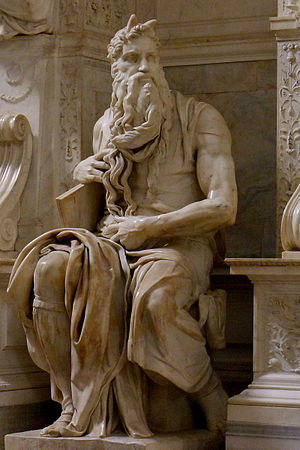
Michelangelo was asked how he could make a beautiful sculpture like his “Moses” out of a block of marble. His famous response was that he simply chipped away everything that wasn’t “Moses.”
This is a paradigm for us in two senses.
First, the Lord must chip away everything within us that is not Jesus. Yes, everything that is not of the Lord must go. St. Paul said, “I live; no not I, Christ lives in me” (Gal 2:20). The Lord chips away all in us that is not of Him, so that we may become the image of God in Christ.
Second, there is also a very personal sense. Not only must we become Christ, but we must authentically become our very selves. We are called to reflect Christ, but the Lord has made each of us individually to reflect something particular about Him in a unique way. You and I therefore must become the man or woman that God made us to be.
Sometimes I lament the fact that I am not more like St. John Vianney, or St. Francis Xavier, etc. To that, the Lord might well respond that he already has a St. John Vianney and a St. Francis Xavier; what He needs is a you.
For me, the Lord must chip away everything that is not Charles Pope. He made me (and you) to be a particular reflection of His glory. Ultimately, we are each called to reflect Christ in the particular way that only we can. Part of our journey is to discover our true self, as God has made us to be, and to become that true self. We must allow the Lord to chip away everything that is not of Him, or of the person He made us to be.
This is not an invitation to strange idiosyncrasies or to a hyper-individualized version of the truth. No, God does not speak out of both sides of His mouth. The truth about us will ultimately always be subsumed into the fundamental truth of who Jesus is, in whose likeness God created the human person to be. And thus as the Lord sculpts He is not doing abstract art. Rather, He is working in the context of His revealed truth, while also realizing it in a very particular way in each one of us.
A few final thoughts about carving and chipping away:
First, it is slow and painstaking. Great care and thoughtfulness is required of the artist. And we, who are being sculpted by the Lord, must learn to be patient and allow Him to do His work carefully and creatively. Too often we are impatient. But true art requires that the artist step back and look, work, and then reflect. Give the Lord the time and authority He needs.
Second, there is some bewilderment as well as a kind of pain. Sculpting and chipping away is difficult—even painful—for the subject. As we are being sculpted, we may not know or appreciate what the Lord is doing. We may worry as to what our final appearance will be. But no more than the marble should claim greater wisdom than the sculptor, should we claim a greater wisdom than God, who sculpts us.
The Lord admonishes,
Woe to those who quarrel with their Maker, those who are nothing but potsherds among the potsherds on the ground. Does the clay say to the potter, “What are you making?” Does your work say, “The potter has no hands”? Woe to the one who says to a father, “What have you begotten?” or to a mother, “What have you brought to birth?” Thus says the Lord, the Holy One of Israel and its Maker: Concerning things to come, do you question me about my children, or give me orders about the work of my hands? It is I who made the earth and created mankind on it (Isaiah 45:9-12).
We must allow the Lord to do His work. Ultimately, everything that is not Jesus, and everything that is not the person God made us to be, must be chipped away.
In the end, God must be able to say to you, “I simply chipped away everything that was not of my Son, and everything that was not of you, as I made you to be from all eternity.”
The following post contains some adult content. There is nothing inappropriate, but it does speak frankly to an aspect of sexual desire. Exercise caution if reading it to younger children.
There is a secret, once known and widely shared among women, that the best way to get and hold a man’s attention is through modesty. Near nakedness can get a man’s attention, but it is modesty that will hold it.
Why is this so? It is because mystery is powerfully attractive. It entices; it draws and holds one in a kind of suspense. At its heart, modesty is a reverence for mystery. It uses mystery to build the very relationship that is meant to unlock its secrets: Holy Matrimony.
Relationships are not built by a mere glance. Modesty helps to hold the glance while the relationship has time to grow and be tested.
Modesty is not prudishness. The word modesty comes from the word mode, which refers to a central tendency of a group of numbers. As such, modesty is a kind of middle ground that does not seek to burden women with excessive coverings but that also considers the needs of others, so as not to inflame passions and lust. True modesty reveals beauty, but also reminds that much more remains hidden and must be reserved only for the deepest relationship of Holy Matrimony.
Sadly, many women today have not been taught this essential feminine virtue. Men are too often treated to a “full disclosure” or to disclosures that leave little to the imagination. This does excite a kind of “animal” attraction in a man, but it cannot usually hold that attention for very long. Why? Because mystery, once disclosed, is no longer mystery, and its attractive power vanishes quickly. Soon enough, a man who is not attached to a woman for deeper reasons loses interest and starts to be drawn to other women, whose mystery still attracts because it has not been uncovered.
Many men are not even consciously aware that this is why they have lost interest; they do not intend to be crass. But at the level of desire, mystery is important. Once the key has been turned and the mystery unlocked, a powerful card has been played.
Women used to instinctively and collectively know this. They used modesty to hold the man’s attention, build the relationship, summon his proposal of marriage, and then draw him to the marriage bed—not to the back seat of a car or an apartment couch. In the context of a more fully formed relationship the fuller mystery of her was finally revealed and shared. Children usually came quickly in those days and this, too, helped to hold the man fast. Though her mysteries had been revealed, there was now more to keep the man’s attention. For by now, after courtship and engagement, he now knew her more richly in the depth of her person. They had shared memories and become part of each other’s extended families. And even more, their own children were now here, or at least on the way.
The mystery kept secret by modesty was now revealed, but the ties that bind were now operative and filled the role that modesty had assisted in bringing about. And most women of previous generations also knew that even after marriage modesty still had some role, for her modest attire and demeanor still could draw his glance somehow.
Yes, modesty is a great feminine secret, once known by most women. Now, though, many have foolishly cast it aside.
I pray that many will once again discover modesty’s paradoxical draw. While immodesty may attract a man’s quick, animal attention, only modesty can really hold his attention and root it in something higher and better than animal desire. Believe it or not, men have rational souls too! Higher and better motives still work and attract men. Modesty is both powerful and attractive. Here’s to a great “secret weapon”!
The second reading from last Sunday’s Mass (5th Sunday of Easter) is very Catholic, and too informative to merely pass up. It presents the Church as rather highly organized and possessed of some of the structures we know today in full form. Granted, some of these structures are in seminal form, but they are there.
We will also notice qualities of the original kerygma that are at variance with what some modern thinkers declare should be the methodology of the Church. The soft Christianity of those who replace the cross with a pillow and who insist on solely inclusion and affirmation is strangely absent in this early setting.
Let’s look the first reading from the Acts of the Apostles (Acts 14:21-27) and see there the true path of priests, teachers, and leaders in the Church. Four steps are prescribed for our consideration, by noting that they went forth announcing, admonishing, appointing, and accounting.
I. Announcing – The text says, After Paul and Barnabas had proclaimed the good news to that city and made a considerable number of disciples …
Notice that the happiness is linked to the harvest. By proclaiming the Good News, they yield a great harvest. As Catholics, we are not sent out merely to proclaim a list of duties; we are sent to proclaim the Gospel. And the Gospel is this: God so loved the world that He sent his Son, who by dying and rising from the dead has purchased for us a whole new life, free from sin and the rebellious obsessions of this world. He is victorious over all the death-directed drives of this world. Simply put, he has triumphed over these forces and enabled us to walk in newness of life.
God save us from brands of the faith in which rules and obligations are all that is heard by sour-faced saints, dead disciples, fussy Pharisees, bored believers, and frozen chosen. Save us from Pharisaical philosophers who are obsessed with particulars not even commanded by God, who sneer at things they consider beneath than their preferences.
No, we are sent to announce a new life, a life free from the bondage of sin, rebellion, sensuality, greed, lust, domination, and revenge. We are sent to announce a life of joy, confidence, purity, chastity, generosity, and devotion to the truth rooted in Love.
Yes, here is a joyful announcement rooted in the cry Anastasis (Resurrection)! New Life! The old order of sin is gone and a new life of freedom from sin is here!
Did everyone accept this as good news? No. Some, indeed many, were offended and sought to convict Christians as “disturbers of the peace.” Some don’t like to have their sin and bondage called out as such. They prefer bondage, sin, and darkness to light, holiness, and freedom.
As Catholics, we announce what is intrinsically good news, and we ought to start sounding like it by proclaiming it with joy. We must proclaim it without the bitterness and anger that are indicative of those who are more interested in winning an argument than in joyfully announcing something wonderful, freeing, and true.
II. Admonishing – The text says, … they returned to Lystra and to Iconium and to Antioch. They strengthened the spirits of the disciples and exhorted them to persevere in the faith, saying, “It is necessary for us to undergo many hardships to enter the kingdom of God.”
Preaching/teaching is a process. You don’t just preach or teach once and then move on; you return and reiterate. Paul and Barnabas are retracing their steps back through towns they have already evangelized. They do not just come, have a tent revival, and move on. They return and, as we shall see, they establish the Church.
Notice what they do:
1. Encourage – They strengthened the spirits of the disciples. 2. Exhort – They exhorted them to persevere in the faith. 3. Explain – They explained by saying, “It is necessary for us to undergo many hardships to enter the kingdom of God.”
Let’s focus especially on the last the point. Paul and Barnabas teach that if you’re not willing to endure the cross, no crown will come your way. If you can’t stand a little disappointment, if you can’t stand being talked about, if you think you should always be up and never down, then I’ve come to remind you: No cross, no crown.
Yes, beware of “cross-less” Christianity. We do have good news to proclaim but there is also the truth that we get to the resurrection and the glory through the cross. There is a test in every testimony, a trial in every triumph. There are demands of discipleship, requirements for renewal, laws of love, and sufferings set forth for Saints.
Good preaching combines the hardship and the happiness in one message. It is a joy to follow in the footsteps of our Lord, who endured hostility, hardship, and the horrors of the cross but still triumphed and showed that the wisdom of this world is foolishness to God. Yes, He caught the wise in their craftiness and showed that the thoughts of the wise in this word are futile (cf 1 Cor 3:20). He made a public spectacle of them, triumphing over them (paradoxically) by the cross (cf Col 2:15).
Thus, St. Paul and Barnabas announce the cross, a stumbling block to the Jews and foolishness to the Gentiles (cf 1 Cor 1:23). Many today insist that the Church soft-pedal the cross, that she use honey, not vinegar. No can do. We joyfully announce and uphold the paradox of the cross. We must be willing to be a sign of contradiction to this world, which sees only pleasure and the indulgence of sinful drives as the way forward, which exalts freedom without truth or obedience, and which calls good what God calls sinful.
Too many so-called Christian denominations have adopted the pillow as their image and have a “give the people what they want” mentality. That is 180 degrees out of phase with the cross.
The Catholic Church does not exist to reflect the views of its members, but to reflect the views of its founder and head, Jesus Christ. As He went out to die, Jesus announced the cross without ambiguity, saying, Now is the time for judgment on this world; now the prince of this world will be driven out. And I, when I am lifted up from the earth, will draw all men to me (John 12:31-32).
And so we announce the cross not merely as suffering, but as life, power, and love. By the power of the cross, it is possible to live without sin, to overcome rebellion, pride, lust, and greed; it is possible to learn to forgive and to live the truth in love.
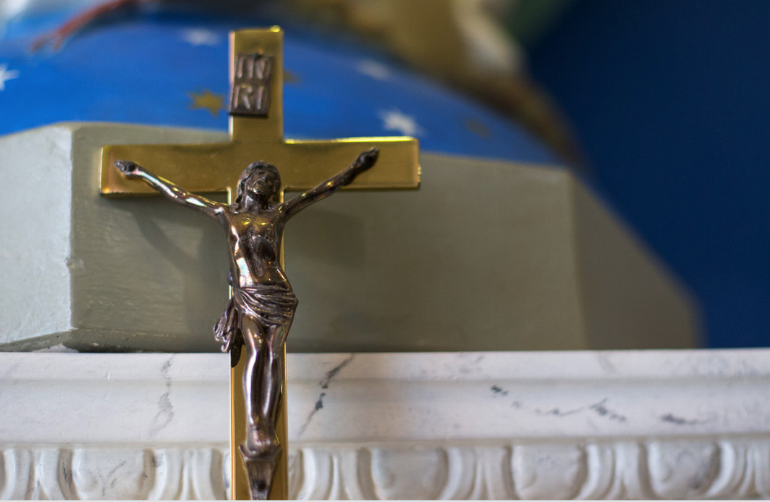
The world will hate us for this. But such hardships, such crosses, are necessary preludes to the hallelujah of Heaven. The Church can do no less than to point to the cross. The center of our faith is a cross not a pillow. And the cross is our only hope (Ave Crux spes unica nostra (Hail, O Cross, our only hope).
Yes, the Church announces the cross and admonishes a world obsessed with pleasure and with passing, fake happiness.
III. Appointing– The text says, They appointed presbyters for them in each church and,with prayer and fasting, commended them to the Lord in whom they had put their faith. Then they traveled through Pisidia and reached Pamphylia. After proclaiming the word at Perga they went down to Attalia.
And thus we see the ordination of priest leaders in every place. “Priest” is just an English mispronunciation of the word “presbyter.” Paul and Barnabas did not simply go about vaguely preaching and then moving on. They established local churches with a structure of authority. The whole Pauline corpus of writings indicates a need to continue oversight of these local churches and to stay in touch with the priest leaders established to lead these local parishes.
Later, St. Paul spoke of the need for this structure in other places when he wrote (to Titus),
This is why I left you in Crete, that you might amend what was defective, and appoint presbyters in every town as I directed you (Titus 1:5).
This appointment was done through the laying on of hands and is called ordination today. It was a way of establishing order and office in the Church to make sure that the work continued and that the Church was governed by order. This is why we call the sacrament involved here the “Sacrament of Holy Orders.”
Note, too, that a critical task for leaders in the Church is to develop and train new leaders. Too many parishes depend on individual charismatic and gifted leaders whose inevitable departure leaves a void, not an ongoing ministry or organization. This should not be so. Good leaders train new leaders.
IV. Accounting – The text says, From there they sailed to Antioch, where they had been commended to the grace of God for the work they had now accomplished. And when they arrived, they called the church together and reported what God had done with them and how he had opened the door of faith to the Gentiles.
Note that Paul and Barnabas are now returning to render an account for what they have done. Accountability is part of a healthy Church. Every priest should render an account to his bishop, every bishop to his metropolitan and to the Pope. Today’s ad limina visits of bishops to the Pope is the way this is done. Further, priests are accountable to their bishop through various mechanisms such as yearly reports and other meetings.
A further background to this text is that Paul and Barnabas are returning to Antioch because it was from there that they were sent forth by the local bishops and priests on this missionary task.
While they were worshiping the Lord and fasting, the Holy Spirit said, “Set apart for me Barnabas and Saul for the work to which I have called them.” Then after fasting and praying they laid their hands on them and sent them off (Acts 13:2).
Thus St. Paul was not the lone ranger that some think him to be. He was sent and was accountable.
But when he who had set me apart before I was born, and had called me through his grace, was pleased to reveal his Son to me, in order that I might preach him among the Gentiles, I did not confer with flesh and blood, nor did I go up to Jerusalem to those who were apostles before me, but I went away into Arabia; and again I returned to Damascus. Then after three years I went up to Jerusalem to visit Cephas, and remained with him fifteen days (Gal 1:15-18).
Then after fourteen years I went up again to Jerusalem with Barnabas, taking Titus along with me. I went up by revelation; and I laid before them (but privately before those who were of repute) the gospel which I preach among the Gentiles, lest somehow I should be running or had run in vain (Gal 2:1).
The preacher and teacher must be accountable: For we shall all stand before the judgment seat of God; for it is written, “As I live, says the Lord, every knee shall bow to me, and every tongue shall give praise to God.” So each of us shall give account of himself to God (Rom 14:10-12).
And thus we see some paths for priests, preachers, teachers, and leaders. We must announce the Gospel as good news, with joy and confidence. We must admonish a world obsessed with pleasures to embrace the cross as our only hope. We must continue to develop, train, and appoint leaders to follow after us. And we must be accountable to one another.
A nice and quick portrait of some healthy traits for the Church!

 I have met a good number of people who said that they would never become Catholic and now are. Some are lay leaders in the Church and some are even priests! I have met other people who said they would never believe in God, yield to any religious instruction, or confess to “any man” and now do (and teach others to do the same).