Some of God’s gifts come in strange and terrifying packages. I was reminded of this when I read the following lines from the book of Job in the Office of Readings:
The earth, though out of it comes forth bread,is in fiery upheaval underneath (Job 28:2).
We live just above a fiery cauldron, separated from it by a thin membrane of earthly crust rife with cracks through which fire routinely flares in volcanoes, a crust that is always shifting and even shaking violently in earthquakes.
And yet, were it not for this cauldron beneath us, it seems unlikely that we would have life here at all. Volcanoes and other tectonic activity keep our soil rich and recycled. In this fiery cauldron are brewed some of our most useful minerals and our most beautiful gems. Entire island chains and land masses are formed by eruptions; geothermal energy is a resource we have just begun to tap. Many scientists think that volcanoes had a profound influence on the formation of Earth’s atmosphere and that the molten core of the Earth has an important influence on the Van Allen belts, magnetic fields that keep the harmful portion of the sun’s radiation away from the Earth’s surface.
Yes, Job had it right: some of God’s gifts come in strange packages. Earth’s capacity to bring forth bread is directly connected to the fact that it is on fire underneath its surface. And while responsible for many gifts, seismic activity has claimed an enormous number of lives and massive amounts of property.
Water, such a rich blessing and sustainer of life, can also become in a moment a destroyer of life in huge numbers. Floods and tsunamis can sweep away huge areas in the blink of an eye.
And yet who could ever deny that without water, life would be impossible? Ah, water, nothing more essential to life, yet nothing more deadly. Yes, some of God’s gifts come in strange and terrifying packages.
I have often wondered why so many cities throughout the world are built on or near floodplains or along the “ring of fire” with its frequent earthquakes and volcanic eruptions. But of course the answer is clear enough: It is in these very areas that some of the richest soil and most abundant natural resources can be found.
God’s and nature’s most life-giving gifts are but a few degrees separated from death and disaster. We live on the edge of an abyss because that is where life is found.
It’s such a thin line, really.Mors et vita duello, conflixere mirando! (Death and life compete in a stupendous conflict!) To live is to cheat death.
All of the basic elements and forces: earth, air, water, and fire, are so death-dealing and yet so life-giving. They are all part of the great cycle of living and dying that God intends.
Only God is existence itself; the rest of us are contingent beings and part of a cycle. Only in union with Christ, who said, I am the life, will we ever cheat death. As Fulton Sheen once said, Christ gave the earth the only serious wound it ever received, the wound of an empty tomb. With Christ, and only with Christ, will we one day give the earth that same wound.
For now, we live upon a thin crust above the cauldron; beneath us burns a tremendous fire. But somehow, mysteriously, it is the source of our bread.
The earth, though out of it comes forth bread,is in fiery upheaval underneath (Job 28:2).
Yes, some of God’s greatest gifts come in strange and terrifying packages.
How does it happen that so many people insist on living obstinately in sin until they are ultimately lost? As with all progressive diseases, sin is a sickness that moves through stages, further debilitating and hardening the sinner in his ways.
St. Alphonsus Liguori laid out five stages through which sin (if not resisted and repented of in its initial attacks) takes an increasing toll on the human person, making repentance less likely and more difficult.
While the names of the stages are mine, I am summarizing the insights of St. Alphonsus, who details these stages in his lengthy essay, “Considerations on the Eternal Maxims” (also called “Preparation for Death”) in Chapter 22, “On Evil Habits.” I have added some of my own additional insights as well.
Stage 1 – Impairment – The first effect of habitual sin is that it blinds the understanding. Scripture says, Their own malice blinded them (Wisdom 2:21). Yes, every sin produces blindness, and the more that sins are multiplied, the greater the blindness they produce.
A further effect of this blindness is a foolish and dangerous walking about. Scripture provides several references for this:
The wicked walk round about (Ps. 12:8).
They stagger as with strong drink, they reel in vision, they stumble in giving judgment (Is 28:7).
Behold, the wicked man conceives evil and is pregnant with mischief and gives birth to lies. He makes a pit, digging it out, and falls into the pit that he has made (Ps 7:14-15).
And thus habitual sin leads to impaired vision and an impaired walk. Not seeing, the wicked stumble about and fall into a pit that they themselves made.
Stage 2 – Indifference – After an evil habit is contracted, the sins that previously excited sorrow are now viewed with increasing indifference. Scripture says the following:
Fools destroy themselves because of their indifference (Prov 1:32).
But he who is careless of conduct will die (Prov 19:16).
And to the increasingly indifferent and careless, the Lord gives this solemn and salutary warning: In little more than a year you who feel secure will tremble; the grape harvest will fail, and the harvest of fruit will not come (Is 32:10).
And thus, as unrepented sin grows, not only does the sinner stagger about and fall into pits, he cares less and less about the foolishness of his ways. The sins that once caused shame, or the thought of which caused sorrow and aversion, are either unnoticed or seem normal—even attractive.
Stage 3 – Improbability – As sin deepens its hold, the willingness and even the capacity to repent decreases. Why is this? St. Augustine answers well when he says, dum servitur libidini, facta est consuetudo, et dum consuetudini non resistitur, facta est necessitas (when lust was served it became habit, and when habit was not resisted it became necessity) (Confessions, 8.5.10). Sin deepens its hold on the sinner in this way.
Stage 4 – Incorrigibility – As Scripture says, The wicked man, when he is come into the depths of sins, has contempt (Proverbs 18:3). St. John Chrysostom commented on this verse, saying that habitual sinners, being sunk in the abyss of darkness, despise corrections, sermons, censures, Hell, and God; they despise everything.
A bad habit hardens the heart and the habitual sinner remains increasingly unmoved and mired in contempt for any correction or remedy. Scripture says of them, At your rebuke O God of Jacob, they have all slumbered (Psalm 76:7). An evil habit gradually takes away all remorse and supplants it with angry indignation at any attempted correction.
And then it happens that, instead of regretting his sins, the sinner rejoices in them, even laughing and boasting of them. Scripture says, They are glad when they have done evil and rejoice in the perverseness of evil (Proverbs 2:14). A fool works mischief as if it were for sport (Proverbs 10:23).
Thus they are incorrigible. They laugh at attempted correction and celebrate their sins with pride.
Stage 5 – Indisposition – When the understanding is deprived of light and the heart is hardened, the sinner ordinarily dies obstinate in his sin. Scripture says, A hard heart shall fare ill at the end (Ecclesiastes 3:27).
Some may say that they will amend their ways before they die, but it’s very difficult for a habitual sinner, even in old age, to change his life. St. Bernard said, “The man on whom the weight of a bad habit presses, rises with difficulty.”
Indeed, how can a sinner, weakened and wounded by habitual sin, have the strength to rise? Even if he sees the way out, he often considers the remedies too severe, too difficult. Though conversion is not impossible, he is indisposed because it all seems like too much work. In addition, his love has likely grown cold for the good things that God offers.
And thus, even on their deathbeds, many sinners remain unmoved and unwilling to change; the darkness is deep, the heart is hardened, and sloth has solidified.
In these ways sin is like a progressive illness, a deepening disease; it moves through stages much as does cancer. Repentance at any stage is possible, but it becomes increasingly unlikely, especially by stage four, when the sinner becomes proud of his sin and joyful in his iniquity.
The Gospel for today’s Mass features three hard sayings of the Lord. They are difficult for us moderns to hear because they offend against modern sensibilities; we easily taken aback by their abrupt quality. Here are the first two “offensive” sayings:
Do not give what is holy to dogs, (Mt 7:6)
or throw your pearls before swine, lest they trample them underfoot, and turn and tear you to pieces (Mt 7:6).
The modern notion offended against here is this: You’re not supposed to call people ugly names. This idea, though not wrong in itself, has become rather excessively applied in our times. We live in thin-skinned times of fragile egos; people are easily offended. The merest slight is often met with the threat of a lawsuit. Even observations intended to be humorous are labeled hurtful and out-of-line. But horror of horrors, here we have Jesus calling certain (unnamed) people dogs and swine; we demand an explanation for such horrible words coming forth from the sinless Lord Jesus!
Sophistication is needed. One of the reasons we are so easily offended today is, frankly, that we lack sophistication. We seem to have lost understanding of simile and metaphor.
Metaphors and similes are figures of speech that achieve their effect through association, comparison, and resemblance. They can highlight hidden similarities between two different things.
A simile directly compares two different things and normally includes words such as “like,” “as,” or their equivalent. Similes are “hit you over the head” comparisons such as this: “He is as swift as a cheetah!”
Some references say that similes are just a specific subset of metaphors, while others say that metaphors cannot use “like,” or “as.” But in either case, here is an example of a metaphor that is not a simile: “He’s a real workhorse!” Metaphors (that are not similes) are usually more effective (and subtle) than similes because the basis for comparison is often ambiguous. For example, if I were to observe someone doing something cruel I might say, “Wow, he’s a dog!” Now obviously I don’t mean that I believe that he is actually a dog. Rather, I mean that he is manifesting some of the qualities of a dog. However, just how many or which qualities he shares with an actual dog is left open to interpretation.
The point is that some sophistication and some appreciation for the nuances of language are necessary as we negotiate life’s road. We seem to have lost some of this today and so are easily offended.
This does not mean that no one ever intends offense; it only means that more care is necessary than simply interpreting everything in a literal way. In my example, the man acting cruelly would likely take offense and say, “Hey, he called me a dog!” What the speaker means is that you have taken on some of the qualities of a wild dog. Now to what extent he means that you are like a dog is intentionally ambiguous; it’s an invitation for you to think about how you may have surrendered some of your humanity and become more like a baser creature.
Examining what the Lord says – This sort of sophistication is necessary when examining the Lord’s “offensive” sayings. Let’s look at both of them in terms of their historical roots and in terms of the lesson being taught.
Obviously the Jewish people were not pointing out positive traits when they referred to people as a dog or swine. In the ancient world, dogs were not pets; they were wild animals that ran in packs. Pigs were unclean animals and something no Jew would ever touch, let alone eat. These are strong metaphors indicating significant aversion to some aspect of the person.
Do not give what is holy to dogs. This was a Jewish saying rooted in tradition. Some of the meat that was sacrificed to God in the Temple could be eaten by humans (especially the Levites), but in no way was it ever to be thrown to dogs or other animals to eat. If it was not consumed by humans, then it was to be burned. Sanctified meat was not to be thrown to dogs because it was holy.
[Do not] throw your pearls before swine, lest they trample them underfoot. In the Old Testament, pearls were an image for wisdom. But pigs only value what they can eat. If pigs were to come across pearls, they would sniff them, determine that they were not edible, and then simply trample them underfoot.
So what is being said? Sacred things, sacred matters, and participation in sacred matters should not be easily offered to those who are incapable of appreciating them. There are those who despise what we call holy. There is little that can be done in such cases except to deny them the pleasure of tearing apart or trampling underfoot what is holy. Jesus is saying that some people are like dogs, who would irreverently tear apart blessed food dedicated to God, having no concept of its holiness. Some people are like swine, who would trample underfoot anything that they could not eat or use for their pleasure.
There are also some who, though not hostile, are ignorant of sacred realities for some reason. Even if they do not intend offense, they must be instructed before being admitted to sacred rites. In the Western Rite, for example, children are not given the Holy Eucharist until they can distinguish it from ordinary food. In addition, more advanced spiritual notions such as contemplative prayer are often not appreciated unless one has been led in stages.
The Lord is thus indicating that holy things are to be shared in appropriate ways with those who are able to appreciate them. It is usually necessary to be led into the Holy and just walk in unprepared or unappreciative.
In the ancient Church there was something known as the disciplina arcani (discipline of the secret), wherein only the baptized and confirmed were admitted to the sacred mysteries of the Liturgy. Given the holiness with which the early Christians regarded the Mass, they exactly followed what the Lord is saying here. Careful instruction and gradual introduction to sacred truth was required before someone could enter something so holy as the Sacred Liturgy. Even the unintentional trampling underfoot of sacred realities through simple ignorance was to be strictly avoided. These were difficult times for the Church and persecution was common. Hence, the Lord’s warning to protect the holy things was not just so that they would not be trampled underfoot, but also so that those who were like dogs and swine would not turn and tear you to pieces (Mat 7:6).
In the centuries after the Edict of Constantine, the disciplina arcani gradually dissipated. Some remnants of it were revived in the modern Rite of Christian Initiation of Adults (RCIA), wherein the catechumens are dismissed halfway through the Mass so that they may reflect more fully on the Liturgy of the Word. Despite this, we have much to relearn today about a deep reverence for the Sacred Liturgy. It would not seem appropriate to lock our Church doors as was done in ancient times. But preserving good order in the Liturgy, inspiring reverence, encouraging proper dress, and instilling deeper knowledge of the true meaning of the Sacred Liturgy are all important ways to ensure that we do not trample underfoot what is sacred.
The Lord’s third hard saying destroys a notion that is, to most moderns, practically a dogma. The “dogma” is that just about everyone is going to Heaven. It is one of the most damaging notions of modern times because it removes the necessary sense of urgency in earnestly seeking our salvation, in staying on the narrow road that leads to salvation. In direct opposition to this destructive and presumptuous notion of practically universal salvation Jesus says,
Enter through the narrow gate; for the gate is wide and the road broad that leads to destruction, and those who enter through it are many. How small the gate and narrow the road that leads to life. And those who find it are few (Matt 7:12-13).
Pay close attention to the word few. We need to sober up and come to the biblical understanding that our salvation must be earnestly desired and sought. God’s love for us is not lacking but our love for him often is. In contrast, Jesus says that many are on a path of indifference or outright rejection of the kingdom, which leads to destruction.
The Kingdom of God is not some abstraction. It’s not a golf course or playground up in the sky. The Kingdom of God is the full realization of God’s will and His plan. It includes values like justice, mercy, kindness, chastity, and love of God and neighbor. It is clear that many (to quote Jesus) live in opposition or indifference to these values, while only a few (to quote Jesus) come to appreciate and are willing to receive these into their life wholeheartedly.
Yes, this is a hard saying of Jesus’. Many are on the path to destruction while only a few are on the road to salvation. The Lord is telling us the truth not to panic us, but to jolt us into earnestly desiring our own salvation and seeking it from God with devotion. It is also to make us sober about the condition of others; we must stop making light of sin and indifference, and work urgently to evangelize and to call sinners to repentance.
We need to realize that our tendency is to turn away from God. There is a great drama to our lives; we are either on one road or the other. No third way is given. It is not a popular teaching to be sure. It offends against modern sensibilities. But it is true; Jesus says it to us in love.
Ad old song says, “Sinner please don’t let this harvest pass, and die and lose your soul at last.”
The situation of the man in this commercial reminds me of modern life in general. We talk a lot about freedom, but compulsiveness, addiction, and lack of self-control are more the case with the average person. We have collectively rejected the “Ten Big Laws of God,” declaring our freedom from being told what to do. But the result has not been that we have fewer laws; rather we now have thousands of “little laws,” imposed upon us through oppressive government, by which we are told what we must do under penalty of law. Many cultural revolutionaries have marched under the banners of freedom and tolerance, but once having gained a foothold they have tyrannically forced their agenda on others by law. The talk of tolerance and respect for differences turned out to be just that—talk.
The man in this advertisement talks a lot about how important mobility is to him, but the reality of his life is far from his self-description. In fact, he seems quite unaware of his condition. Does he not seem familiar?
Photo Credit: Jaclyn Lipplemann, Catholic Standard
Allow me to begin with a simple parable. Every now and then I take a perfectly good paper clip and untwist it, reconfiguring it for some other purpose. Once, I used them to hang Christmas ornaments on my tree. Another time I fashioned a paperclip into a hook to keep my broken file drawer from rolling open. Now if paperclips could see or think, they might be horrified and saddened to see a fellow paperclip so deformed. Perhaps I could try to explain that not only were their “deformed” brethren not a disaster, they were actually quite useful and important to me in their condition. But alas, paperclips can’t understand this; they just “look on” with sadness and horror. After all, how can you expect a paperclip to understand any function other than holding together sheets of paper? They can’t understand things beyond the world that they know.
I have often wondered if this isn’t somewhat analogous to our understanding of things such as disability, birth defects, and the personal challenges of some of our fellow humans. As we look upon the disabled, the handicapped, the deformed, and the mentally ill, we are often moved to sadness and even horror. And we sometimes ask why God allows this. We often conclude that such people’s lives are unhappy or that they will never reach their full potential.
And yet I wonder if we really know what we’re talking about. Who of us can really say what our own purpose is in God’s plan is, let alone anyone else’s? We are like paperclips; we know only one thing. Our minds are too small to ever comprehend the very special and significant role that even the most “impaired” in our world play. Perhaps in Heaven we will realize what indispensable and central roles they had in God’s plan and His victory. Of all the paperclips in my drawer, some of the most useful to me are the ones I’ve twisted and refashioned.
A knowledge too high – I pray that you will accept my humble example of a paperclip. I mean no disrespect to humanity in comparing us to paperclips. We are surely more precious and complicated and God does not use us cavalierly like paperclips. But my example must be humble in order to illustrate what is a knowledge too high for us to grasp: the dignity and essential purpose of every human being to God and His plan.
Our judgment in this matter isn’t much better than that of a paperclip, when compared to God’s omniscient wisdom. If it is absurd for us to imagine that a paperclip could understand our ways, is it any less absurd to think we can understand God’s ways? And if we can’t understand His ways, then why do we make judgments as to another person’s role, usefulness, beatitude, or status?
It is easy for us to look down on the poor, but Scripture says that we should look up to them. God is especially close to the poor, the suffering, the brokenhearted, and the humble. Scripture says that God uses the lowly to humble the proud. And yet we so easily look with pity on those we consider disadvantaged.
Over twenty years ago, I worked for a year with the profoundly mentally disabled. They lay in beds and wheelchairs, often having little control over their muscles. None of them could talk and only a few could engage in even the most rudimentary communication. There was one man in his forties who had never emerged from a fetal position. He lay in a large crib, his tiny yet clearly adult body curled up like a newborn. But on his face was an angelic smile that almost never diminished.
He had been baptized as an infant and to my knowledge could not have sinned. Each visit, I looked with marvel upon his innocent and beatific countenance. What an astonishing gift he was! And who knows, except God, why he was this way? But God does know; I think He had very important reasons for permitting this. There was something central and indispensable in this man’s existence, some role that only he could fill. Apparently I was not able to fill it.
In this sense he was not disabled—he was differently abled, uniquely abled for something out of the ordinary. Looking upon him, I had little doubt that he was directly in touch with God in a way that I never had been; his radiant face conveyed that. With our human eyes we can be saddened, even appalled. But we’ll understand it better someday. One day, in the great by and by, we may be surprised to learn that the most critical people in God’s plan were the most humble and the most broken, and that we would never have made it without them.
This video depicts the paradox of disability that sometimes shines through to teach us that we do not see the whole picture. Patrick Henry Hughes was born with significant defects, but as he grew, remarkable gifts showed forth. This is just a little reminder from God, a glimpse of what God sees. To Him, the disabled are differently and wonderfully abled.
Following up on Sunday’s Gospel, I would like to propose the following reflection. There was a woman who was so moved by Jesus’ mercy that she wept for joy and showed extravagant, grateful love. Are we that way? Too often we are not. And as Jesus pointed out, a big reason for that is that we do not understand the magnitude of our sin. We miss the greatness of God’s mercy; we lack gratitude for what He has done for us and thus our love is lukewarm.
There is an old saying, “If you don’t know the bad news, the good news is no news.” Not knowing or being only vaguely aware of how serious our sin is, we are out of touch with the bad news. Therefore, the good news of salvation and forgiveness of sin has little effect on us; it barely moves us. Because of this we are less grateful and less loving.
In order to unlock the good news, let’s spend some time on the bad news.
I’d like to begin by saying that your condition is grave—so is mine. There’s some serious stuff wrong with us; you might say we have a few issues!
Yes, I’ve got your spiritual “medical chart” (and mine) open, and I’m looking at the test results; the numbers don’t look good.
The tests say we tend toward being dishonest, egotistical, undisciplined, weak, immature, arrogant, self-centered, pompous, insincere, unchaste, grasping, judgmental, impatient, and shallow.
We’ve tested positive for being inconsistent, unfaithful, immoral, ungrateful, disobedient, selfish, lukewarm, slothful, unloving, uncommitted, and just plain sinful.
Further tests indicate the presence of fear, indifference, contempt, impurity, hatred, laziness, cowardice, and anger.
Test results indicate the presence of greed, jealousy, revenge fullness, disobedience, hardheartedness, pride, envy, stinginess, selfishness, pettiness, spite, self-indulgence, lust, careless neglect, and prejudice.
Our spiritual “medical history” indicates that we have sinned against justice, modesty, purity, and the truth. We’ve committed sins against the human person: children, the innocent and trusting, the frail and elderly, the unborn, the weak and powerless, immigrants and strangers, and the disadvantaged.
Further test results indicate the absence of important key indicators: failure to give witness to Christ, failure to join our will to God, failure to provide a good example to others, failure to seek God above all things, failure to act justly, failure to show mercy, failure to repent of our sins, failure to obey the commandments, failure to curb our earthly desires, failure to lead a holy life, failure to speak the truth, failure to pray for others, failure to assist those in need, and failure to console the grieving.
Well, you can see that we’re in bad shape! And though you might think that I’m exaggerating, I suspect that if you’re honest with yourself you’ll admit that you’ve committed many if not most of these sins.
Yes, without a lot of grace and mercy from God, we’re doomed!
But here’s the good news: the doctor, Jesus, is in! And the doctor has a prescription to cure us:
daily prayer,
daily reading of Scripture,
reception of Holy Communion every Sunday (and Holy Day of Obligation),
frequent Confession (at least four times a year—more often if mortal sin is a problem),
frequent doses of the Catechism, the lives of the saints, and devotions such as the rosary and novenas,
keeping good company, and
custody of the eyes and ears.
Yes, we need help; we’ve got some stuff going on that will kill us eternally. But Jesus has a hospital (the Church) and medicine (the sacraments). There is spiritual “medical” advice available: from the Word of God, from sermons, from the teachings of the Church, and from encouraging “doctors” and “nurses” such as priests, religious, and fellow Catholics.
Whether we care to admit it or not we need regular check-ups and serious medicine. Jesus is guiding His Church in giving skillful advice and distributing powerful medicine.
Do you think of the sacraments as medicine? Many think of them simply as rituals. But the truth is that they are powerful medicine. I’m a witness to this. After more than twenty-five years of seeing the doctor, Jesus, and letting Him minister to me through sacraments, His Word, and His Church, a wonderful change has come over me. I’m not what I want to be, but I’m not what I used to be.
We’ve got it bad and that ain’t good. But the doctor is in (and you know you need Him)! Whatever your struggles, reach out for Him. He’s waiting to minister to you, especially in the liturgy and the sacraments. You can’t do it alone. Join us every Sunday at the “holy hospital,” the Church. Yes, the doctor is in! As you heal, your gratitude will increase. And grateful people are different people; they are more joyful, generous, forgiving, and loving.
Here’s a humorous little video that I created, which demonstrates that sometimes the doctor can give us a surprising diagnosis. For it’s often the case that we claim that everyone else has a problem, while in reality the problem is in us—and so is the solution. Please pardon the video; I have a face for radio!
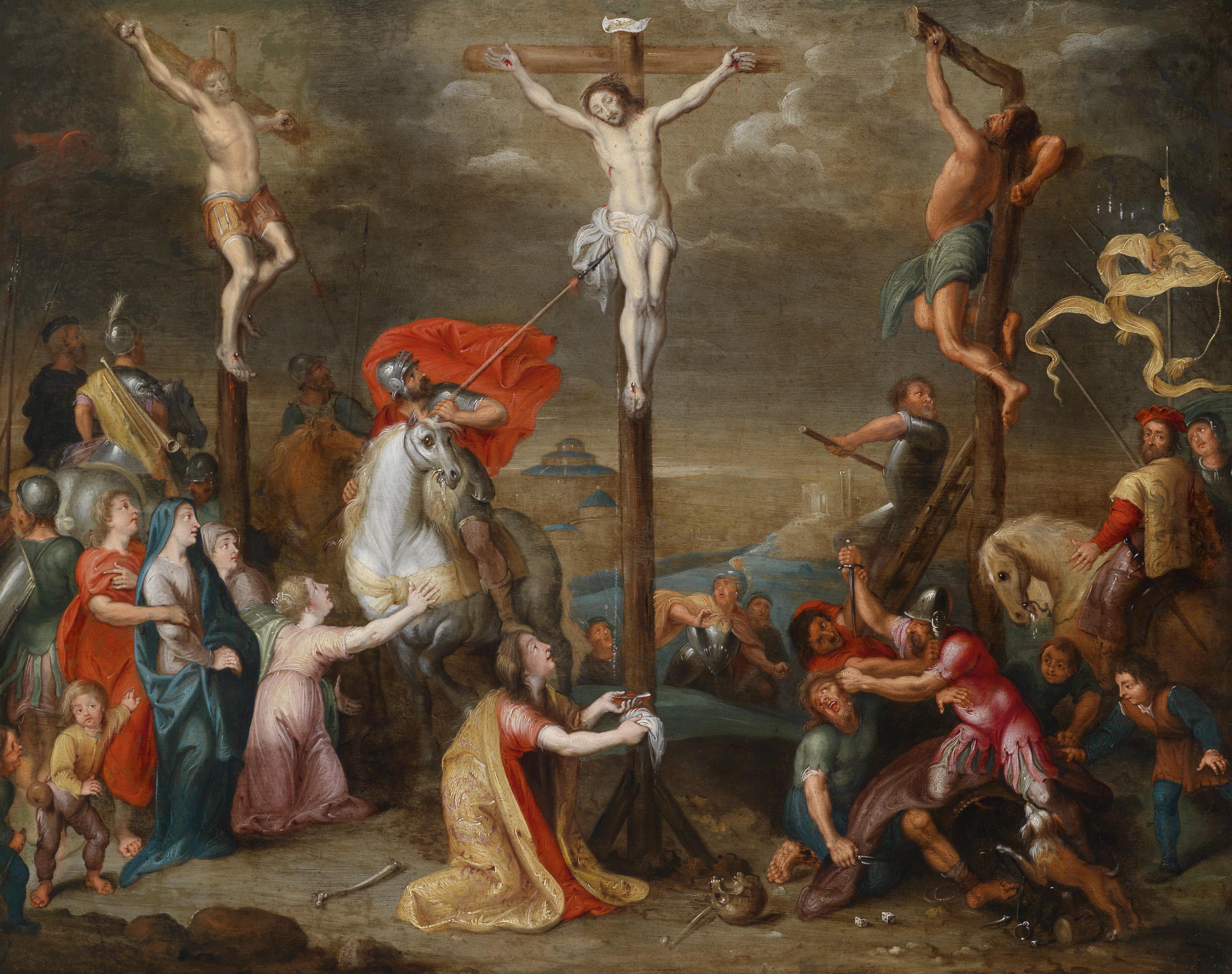
There is a bit of puzzlement at the following question: Why was Christ crucified between two thieves? It might make one wonder why one would ask this question at all. Perhaps one could also ask why the Passion was on a Friday, or, why Jesus died at 3:00 PM instead of 4:00 PM. These sorts of questions could go on forever.
Nevertheless, some of the best insights come from pondering seemingly insignificant questions. Seldom do the Gospel writers and the Holy Spirit provide a detail in the accounts that they do not want us to wonder about, or that is not in the text for a good reason.
So then why was Christ crucified between two thieves? Was it just an historical accident? One can hardly imagine that God permitted any detail of the most pivotal moment in salvation history to occur merely by accident.
St. Thomas Aquinas proposes a number of answers. The first is the one with which I am most familiar. Referencing St. Jerome, St. Thomas writes,
As Christ became accursed of the cross for us, so for our salvation He was crucified as a guilty one among the guilty (Comm. xxxiii in Matth) (Summa Theologica III, 46, 11).
In other words, Jesus bore our guilt and our shame, though He Himself was sinless (see 1 Peter 2:24 and Isaiah 53:4). He was assigned a grave with the wicked, and with the rich in his death, though he had done no violence, nor was any deceit in his mouth (Is 53:9). And thus Christ took up and endured the reproaches we deserved.
The second and more interesting answer from St. Thomas is this:
As Pope Leo observes (Serm. iv de Passione): “Two thieves were crucified, one on His right hand and one on His left, to set forth by the very appearance of the gibbet that separation of all men which shall be made in His hour of judgment.” And Augustine on John 7:36: “The very cross, if thou mark it well, was a judgment-seat: for the judge being set in the midst, the one who believed was delivered, the other who mocked Him was condemned. Already He has signified what He shall do to the quick and the dead; some He will set on His right, others on His left hand.” … because of the cleavage between believers and unbelievers, the multitude is divided into right and left, those on the right being saved by the justification of faith (Summa Theologica III, 46, 11).
Thus this moment points to the final judgment, when Christ, seated on His throne as Judge of the World and Lord of all, will have some to His right and others to His left; some will be the sheep and others the goats; some will be the wise virgins and others the foolish ones. Those on His right will hear, Come, you who are blessed by my Father, inherit the kingdom prepared for you from the foundation of the world (Matt 25:34). Those on his left will hear, Depart from me, you cursed, into the eternal fire prepared for the devil and his angels (Matt 25:41).
St. Thomas also addresses an expected objection that in Matthew’s version both thieves reviled him:
As Augustine says (De Consensu Evang. iii): We can understand Matthew “as putting the plural for the singular” when he said, “the thieves reproached Him.” Or it may be said, with Jerome, that “at first both blasphemed Him, but afterwards one Believed in Him on witnessing the wonders” (Ibid, ad 3).
It is a remarkable image of the crucifixion: Christ is seated on the throne of His cross. His arms are extended in mercy, offering mercy to the very end. But only the repentant thief accepted the offer. Thus he heard, “Today you will be with me in paradise.”
This vision of Christ on the cross as depicting His role as judge presents Christ as a judge who poses a question to the thieves more so than as one who merely passes sentence on them. There is no recounting of the sins and crimes of the thieves, no lengthy weighing of the evidence. There is the offer of mercy and the awaiting of a response.
For these men, and one day for us, this is the final moment. The responses are given and are final. The one thief repents and receives paradise; mysteriously, the other curses and condemns himself to living apart from mercy in Hell. The rejection of God’s offer always remains deeply mysterious; it must, it would seem, proceed from a heart that is obtuse and hardened.
Jesus laments the fact that many, not few, end by rejecting Him and His offer: For the gate is wide and the way is easy that leads to destruction, and those who enter by it are many. For the gate is narrow, and the way is hard, that leads to life, and those who find it are few (Matthew 7:13-14). In this passage He gives a partial explanation for their rejection: it is because “the way is hard.”
The third answer by St. Thomas as to why Jesus was crucified between two thieves is this:
Bede says on Mark 15:27: “The thieves crucified with our Lord denote those who, believing in and confessing Christ, either endure the conflict of martyrdom or keep the institutes of stricter observance. But those who do the like for the sake of everlasting glory are denoted by the faith of the thief on the right; while others who do so for the sake of human applause copy the mind and behavior of the one on the left.”
Yes, to follow Christ on this earth involves suffering and rejection. It also involves a stricter observance, which postpones certain passing pleasures in order to inherit greater and lasting ones, which rejects apparent goods in order to receives true goods. There are some who are willing to endure this and others who are not.
The bad thief wanted to be taken down, not to go up. The good thief was willing to endure the cross to go up to paradise.
There are some powerful insights here.
Thank you, Lord, for being counted among the wicked, though innocent, in order to save us. Thank you for your offer of mercy. Help us to remember that the decision is ultimately ours and that we access your mercy through the repentance manifested by the good thief. Help us, Lord, to endure and be taken up, rather than to insist on being taken down.
In the Gospel today (Tuesday of the 10th week) the Lord describes metaphorically what a Christian is and what He expects of us.
You are the salt of the earth … You are the light of the World … But if salt goes flat it is good for nothing … No one lights a lamp and puts it under a basket.
Note the metaphor of salt: You are either salt, or you are nothing—in fact, good for nothing. It’s very much an all-or-nothing scenario. Jesus says that if you’ve decided to be my disciple you’re either going to do that or be nothing. You may go on to be a doctor, lawyer, teacher, laborer, or social worker. But the Lord has plenty of those (and so does the devil). Your first and only mission is to be a true and uncompromised Christian; everything else is commentary. You may be a great doctor, but if you don’t do it as a clear and visible Christian you’re nothing. You may be a skilled social worker, but if you don’t do it as a Christian, you’re good for nothing. Any non-believer can be socially useful as a doctor, actor, lawyer, or social worker. But only a Christian can be a Christian. If you don’t do “job one,” you’re nothing. If you buy your kids every good thing, send them off to college (paid in full), but don’t bring them to Christ by being a Christian witness to them, you’re good for nothing. Parents can give their kids material things, but only Christians can give them Christ. Got it? You’re either salt (a true Christian) or you’re nothing.
The text speaks of salt going “flat.” What this meant historically is rooted in the fact that salt at that time was typically less pure than it is today. Impurities often interacted with the salt, and over time it became bitter in taste. It was then good for nothing except to become pavement. But what does it mean to be salt?
Let’s consider some of the properties of salt:
Salt seasons. Christians are called to add spice to life; to bring beauty, joy, and hope to the world. Joy is the surest sign of a Christian. Even our keeping of the commandments is a source of joy as we experience God’s power to put sin to death in us and to bring forth order, self-discipline, and holiness. Hope, too, ought to distinguish us from a world that is often cynical and thinks that sin is inevitable. To this world we are not only to declare that keeping the commandments is possible and brings joy, but we are to demonstrate it in our very lives. We are to be zesty, passionate, alive, and free from sin in Christ. Yet, sadly, we Christians are known more for what we are against. Too many Christians are not spicy; they do not really add flavor; they are more like bored believers, depressed disciples, fearful faithful, and frozen chosen. In our best moments, though, look what spicy things the faith has contributed: art, music, churches, hospitals, universities, the scholastic and scientific methods, and holidays (a mispronunciation of Holy Days). Note how our tradition and our scriptural teachings of justice mercy, love, and the dignity of the human person have blessed the world. Do you bring spice to the lives of others? Do you bring hope and joy? Scripture says, Always be prepared to make a defense to anyone who calls you to account for the hope that is in you (1 Peter 3:15). Well that means that people must notice a hope in you! Do they? How?
Salt preserves. Before refrigeration, people often used salt to cure or preserve meat. The salt killed the bacteria and other microorganisms that caused rot and decay. As Christians, we are called to prevent further decay in this sin-soaked world. The truth that we proclaim is meant to preserve people from the decay of sin and overindulgence. Chastity, justice, generosity, the proclamation of the truth, etc. are like salt that preserves the world from decay. We must be salt; if we are not then nothing else is. You are the salt.
Salt heals. In the ancient world, salt was used on wounds. It helped to stop bleeding; it killed bacteria and prevented further infection. So, too, the Christian faith. Through our doctrinal and moral teaching—and our living of it—we are called to bring healing to this world, which is wounded by sin, strife, war, jealousy, anger, bitterness, retribution, promiscuity, unfaithfulness, greed, and countless other errors. The Word of God and His plan are healing medicine for what ails this world.
Salt burns. Yes, salt stings when applied to wounds. We Christians aren’t just sugar and spice and everything nice. When salt is applied to wounds it burns and often causes loud protest. The truth stings, and the truth of the Gospel can be irritating to a world that is wounded by sin. But despite the protests of the world, the sting is a healing one. It is driving out the bacteria and disease of the world and preventing further infection. Just because people protest the Church and howl in complaint at the truth of the Gospel does not mean that we have done anything wrong. The protests often mean we are doing exactly what we must.
Note finally that the Lord says you are the salt of the earth. He did not say you are the salt of the Church. For salt to be effective it has to get out of the shaker! Too many Christians are bold in the pew but cowardly out in the world. They will speak of the faith in the relative security of the Church and among certain friends. But don’t ask them to preach to their spouse or co-worker, or even to their children. That’s too scary. And don’t even think about asking them to knock on doors, or go to the local mall and witness, or stand in front of an abortion clinic.
Salt in the shaker is useless. It has to come out of the shaker to make any difference. You don’t salt salt. Witnessing to fellow Christians may have a limited benefit, but it is not really the true destination of salt. The salt has to go forth. When the priest or deacon says that the Mass is ended and to go in peace, he might as well be holding up a salt shaker and shaking it.
In tomorrow’s post, we’ll consider the Lord’s image of light.

 Some of God’s gifts come in strange and terrifying packages. I was reminded of this when I read the following lines from the book of Job in the Office of Readings: