Ninety-Nine and a Half Won’t Do—A Homily for the Feast of All Saints

All Saints

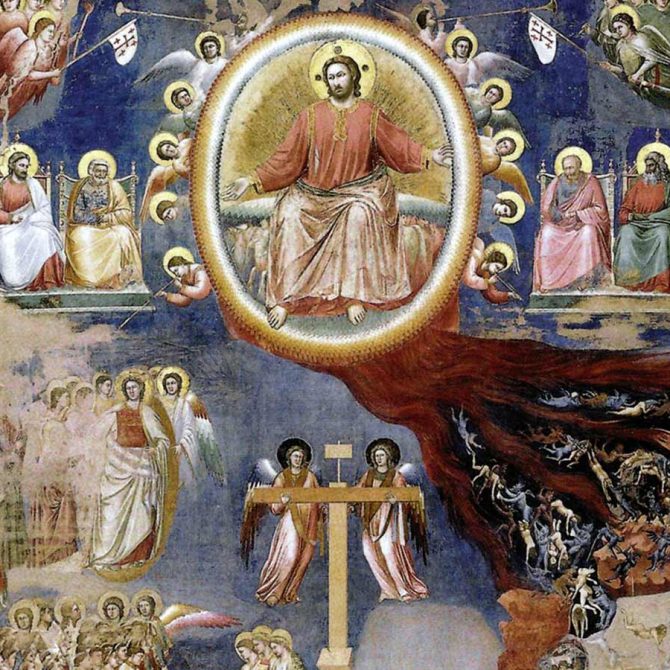
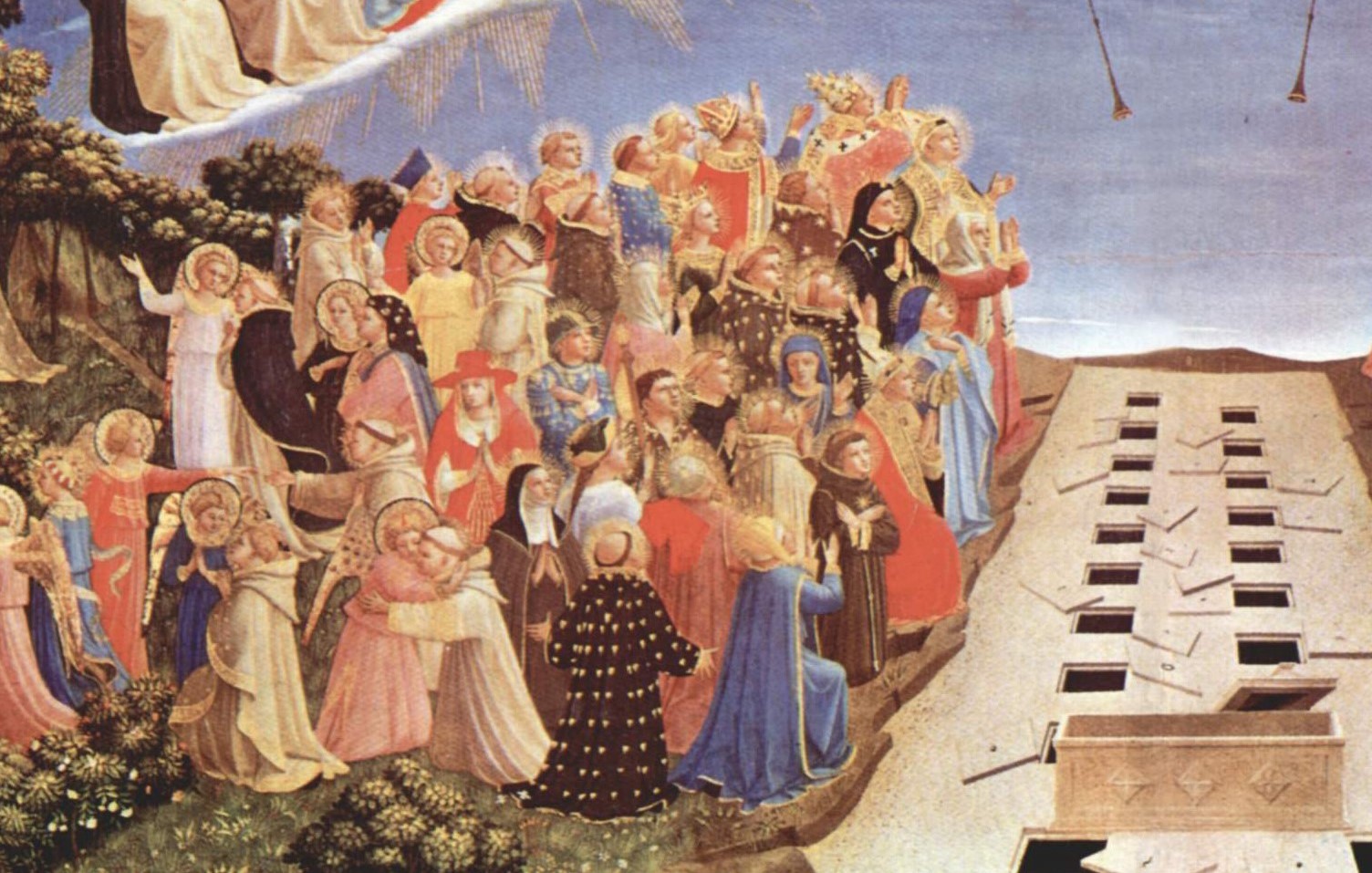
Today is the Feast of All Saints. Some saints of the Church have a particular day on the calendar associated with them and are commonly recognized by name. Many more, though not as familiar to us, are still known by God and have been caught up with Him to glory. Today is their day, the day of the countless multitude who have made it home to glory by God’s grace and by their “Amen” to the gracious call of God. Let’s consider these saints under three headings, based on today’s readings.

Their Privileged Place: The first reading today, from Revelation, speaks to us of saints: from every nation, race, people, and tongue. They stood before the throne and before the Lamb, wearing white robes and holding palm branches in their hands. They cry out in a loud voice, “Salvation comes from our God, who is seated on the throne, and from the Lamb.”…They prostrated themselves before the throne, worshiped God, and exclaimed, “Amen. Blessing and glory, wisdom and thanksgiving, honor, power, and might be to our God forever and ever. Amen.”

Note how liturgical the description is.In fact, the most common way that Heaven is described is in liturgical imagery. The liturgy is a kind of dress rehearsal for Heaven. To those who claim that Mass “boring,” this description can be challenging.

Indeed, many people today have rather egocentric notions of Heaven.Heaven is a place where Iwill be happy, where Iwill see myfamily, where Iwill take leisure. Iwill have mymansion; Iwill no longer get sick; Ican play all the golf I want. Heaven is a “better place,” but this better place is generally understood in personal terms; it’s a kind of designer Heaven. But Heaven is what it is, not what we want or conceive it to be.

At the heart of the real Heaven is being with God,looking upon His glorious face and thereby having all our inexpressible longings satisfied. In Heaven, the saints behold the glorious face of God and rejoice. It is their joy to praise Him and to rejoice in His truth, goodness, and beauty.

Note, too, the sense of communion of the saints with both God and one another.The biblical portraits are of a multitude, a vast crowd. The biblical way to understand the multitudes in Heaven is not to envision physical crowding but rather deep communion. In other words, the Communion of Saints is not just a bunch of people standing around chatting.

St. Paul teaches, So we, who are many, are one body in Christ, and individually members, one of another(Rom 12:5). Although we experience this imperfectly here on earth, we will experience it perfectly in Heaven. As members of one another, we will have profound communion, knowing and being known in a deep and rich way. Your memories, gifts, and insights will be mine and mine will be yours. There will be profound understanding and appreciation, a rich love, and sense of how we all complete one another and are one in Christ.

Imagine the glory of billions of new thoughts, stories, and insights that will come from being perfectly members of Christand of one another. Imagine the peace that will come from understanding and being understood. This is deep, satisfying, wonderful communion—not crowds of strangers.

St. Augustine had in mind the wonderful satisfaction of this deep communion with Godand one another in Christ when he described Heaven as Unus Christus amans seipsum (One Christ loving Himself). This is not some selfish Christ turned in on Himself. This is Christ, the Head, in deep communion with all the members of His body. This is all the members in Christ experiencing deep, mystical communion with Him and one another, all swept up into the life of the Trinity. Again, as St. Paul says, and you are Christ’s, and Christ is God’s(1 Cor 3:23).

TheirPrize of Perfection: The second reading, from the First Letter of John, says, Beloved, we are God’s children now; what we shall be has not yet been revealed. We do know that when it is revealed we shall be like him, for we shall see him as he is.

We cannot even imagine the glory of the saints in Heaven. Our Heavenly Father once told St. Catherine that if she were ever to see a saint in his or her transformed heavenly glory, she would fall down and worship because she would think she was looking at God Himself.

This is our future, if we are faithful. We will reflect the glory of God and be transformed by the look of love and glory. Just one look, and oh, the glory we will reflect, God’s very own glory!

I gotta make a hundred; ninety-nine and a half won’t do. When God is through with you and me, oh, the glory!

The Picture to Ponder: The Gospel today (the Matthean beatitudes) sets forth a portrait of sanctity. The beatitudes are the description of the transformed human person; they describe what happens to us as Jesus begins to live His life in us through the Holy Spirit.

This picture is not one that merely waits for Heaven; it is one that is true of us even now as we grow into the likeness of Christ.

I have written more on the beatitudes hereand here. For the purpose of today’s feast, we need to acknowledge that a beatitude isnot something we do but rather something we receive. A beatitude declares an objective reality as the result of a divine act.

The present indicative mood of the beatitudes should be taken seriously. They should not be interpreted as imperatives of exhortation, as though Jesus were saying, “Start being meek and thenGod will bless you.” Rather, He is saying that when the transformative power of the cross brings about in us a greater meekness, poverty of spirit, and so forth, we will experience that we are being blessed.

Beatitude is a work of God and results when we yield to His saving work in us. We are blessed when we accept and submit to the work that God alone can do. With this understanding, we see the beatitudes not as a prescription of what we must do per se, but as a description of a human being whom Jesus Christ is transforming into a saint! And this transformation is a growing, stable, deep, and serene beatitude and holiness.

Therefore, today’s feast of all saints does not merely point to the completed saints in Heaven, but to us who would be saints, not just someday in the future but beginning now and in increasing degree.

At the end there will be saints and ain’ts. Which do you choose? As for me, ninety-nine and a half won’t do. I gotta make a hundred.

A Word of Encouragement in One of Jesus’ Stranger Sayings

It’s one of the stranger dialogues that occurs in the Gospel. We read it last week in daily Mass and it is difficult not to rejoice in Jesus’ aplomb.

Some Pharisees, likely disingenuous in their motives, approach Jesus and warn Him to leave immediately: Go away, leave this area because Herod wants to kill you. Jesus, more likely speaking to them than to Herod, says the following:

Go and tell that fox, ‘Behold, I cast out demons and I perform healings today and tomorrow, and on the third day I accomplish my purpose’ (Lk 13:32).

Surely Jesus has more in mind than the next three days on the calendar! He’s obviously referring to the Paschal mystery: His passion, death, and resurrection. Jesus is saying, in effect, that anyone who would threaten to kill Him is only undermining his own power while facilitating the fulfillment of Jesus’ purpose.

Nailed to a cross, Jesus will be casting out demons and bringing healing. The next day He will descend to Sheol to awaken the dead, summon them to righteousness, and bring healing in life. On the third day He will arise, fully accomplishing His purpose and casting off death like a garment.

There is no way that Herod or the Pharisees or Satan himself can win, for in “winning,” they lose.

This is also the case for all who align themselves with the darkness rather than the light. No matter how deep the darkness, the dawn inevitably comes, scattering the darkness; the darkness cannot prevail. Scripture says, The light shines in the darkness, and the darkness has not overcome it (Jn 1:5).

In this strange and provocative saying of Jesus from the Gospel of Luke is an important perspective: evil, no matter how powerful it may seem, cannot stand; it will ultimately self-destruct and be overcome by the light. No matter how awful Good Friday seemed to those first disciples, Jesus was casting out demons and bring healing in that very act of suffering. His apparent disappearance into death and His descent into the place of the dead was only for the purposes of turning out the Devil’s trophy room, bringing life into the place of the dead and healing to the deep wounds caused by sin.

While Resurrection Sunday is an obvious triumph, even Good Friday and Holy Saturday were already manifesting Jesus’ great victory.

In this saying of Jesus and in the facts of the Paschal Mystery, two things are taught to us about evil: that we should never glamorize it and that we should not utterly fear it.

As for glamorizing evil, we certainly do a lot of that, particularly through movies and television. Whether it’s “The Untouchables,” “The Godfather,” “Goodfellas,” “Ocean’s 8,” or other films that glamorize wrongdoing as a way to achieve wealth, power, and/or glory, we eagerly consume this fare. This is illusion; evil is not glamorous. It may have its day, but the Word of the Lord remains forever. One of the Psalms says,

I have seen the wicked triumphant, towering like a cedar of Lebanon. I passed by again; he was gone. I searched; he was nowhere to be found (Psalm 37:35-36).

Neither should we inordinately fear evil’s passing power. Yes, we should soberly confront it and resist its demands, but we should not tremble in fear.

No, evil cannot stand. To glorify evil or to fear it inordinately is to miss the lesson of both Scripture and history: evil does not last.

What does last is God’s holy Word and His Church. Despite repeated attempts to persecute, diminish, and destroy the Church, she has outlived every one of her opponents. Her history extends back even more than 2000 years into the heritage of God’s people, the Jews. God rescued the Jews from slavery in Egypt and gave His Word on Mount Sinai. In spite of every attempt to ridicule, reduce, and redefine God’s Word, His promise to Abraham, His Word from Sinai, or His Word from The Sermon the Mount, all these persist through to this day.

This is what lasts: God’s Word and the Church He founded. This is verifiable by the study of history. Empires have come and gone, wicked philosophies risen to popularity and diminished, scoffers and persecutors have arrived and departed, all in the age of the Church. Yet we are still here, and they have all gone. To those who claim power now, who laugh at us and say that we’re through: when you are gone, the Church will still be here.

I have seen the wicked triumphant, towering like a cedar of Lebanon. I passed by again; he was gone. I searched; he was nowhere to be found (Psalm 37:35-36).

Evil, error, pride, and perversion, do not last; but God does and so does His Word and the Church to which He has entrusted it.

Thus, Jesus, when threatened by the Pharisees and indirectly by Herod, simply says,

Go and tell that fox, ‘Behold, I cast out demons and I perform healings today and tomorrow, and on the third day I accomplish my purpose (Lk 13:32).

In other words, neither you nor Herod can thwart my plans. In killing me you merely assist me in accomplishing my plan; I will break the back of your power. When you persecute my disciples or shed the blood of my Church members, you are sowing seeds for the Church. Whatever “victory” you claim is hollow; it is really my victory.

Yes, go tell that fox that I accomplish my purpose. By these words the Lord decodes history for us. There’s no need to obsess over this temporary loss or that apparent defeat. The world and the devil may gloat over an apparent victory. In the end, the Lord holds the cards; and the house—His House—always wins.

It is true; read history. Do not admire evil or fear its apparent ascendance. Jesus has won, and His victory is shown time and time again. Don’t let the Devil fool you. Do not be deceived. Evil cannot stand. The devil is a liar.

Indeed, in the name and power of Jesus, Go and tell that fox [the devil], ‘Behold, I cast out demons and I perform healings today and tomorrow, and on the third day I accomplish my purpose’ (Lk 13:32).

https://youtu.be/aNDjuSJFPtY

Solemn Pontifical Mass in Washington D.C. Seeks to Unify Catholics

I am pleased to announce that a Solemn Pontifical High Mass in the Extraordinary Form will be offered by Archbishop Salvatore Cordileone of San Francisco on Saturday, November 16, 2019, at 10:00 AM at the National Shrine of the Immaculate Conception in Washington, D.C. Further details appear at the bottom of the post, but first allow me to provide some background.

There is great diversity in the Catholic world. I am sometimes amazed when I look out at my congregation or see pictures of other parishes; we look like some meeting of the United Nations. Catholics truly come from everywhere.

One of the challenges of such diversity is finding opportunities to reach across cultures and ethnicities to experience greater unity.One example of this occurs in December of each year. Within the space of one week there are two great Marian feasts: Our Lady of the Immaculate Conception on December 8th and Our Lady of Guadalupe on December 12th. December 8th is celebrated as a solemnity and is a holy day of obligation; under the title of “The Immaculate Conception,” Our Blessed Mother is the Patroness of the United States. December 12th is particularly important to Hispanic Catholics, especially those from Mexico. Somos Guadalupanos!

Bringing these feasts together in our hearts and recognizing their importance is a way to greater unity. Whatever our background, we all love Our Lady; she unites us as does any good mother.

This reaching across ethnic distinctions is at the heart of a pastoral outreach by Archbishop Cordileone and the Archdiocese of San Francisco. Seeking to better unite Catholics of Central and South America with those of North America, the Archbishop first commissioned a new musical setting of the Mass, to be called The Mass of the Americas. He approached composer Frank La Rocca, who commented, “The commission I was given by Archbishop Cordileone—to take beloved Mexican devotional songs and to weave them into a ‘high church’ classical Mass—was challenging and unlike anything I had been asked to do before.” La Rocca also spoke of how deeply satisfying the six-month effort was [*].

Archbishop Cordileone speaks of Mary as the great evangelizer and unifier. He notes that her appearance at Tepeyac was the reason for the unity of Mexican people in faith and that both the Mexican and Spanish peoples were able to recognize the mother of God: “A new Christian people is formed from the two, a mestizo people; a new Christian civilization is born from the union brought about by her who is venerated as la Morenita and la Inmaculada. How blessed is Mexico, for truly God has not done this for any other nation!” the archbishop said [**].

Now the good Archbishop seeks to take this unifying message to a new levelby celebrating the Mass of the Americas in the Extraordinary Form here in in Washington, D.C. I am privileged to be able to serve as Deacon of the Throne at that Mass. While the Ordinary Form setting features texts in Spanish, Latin, English, and Nahuatl (the language in which Our Lady of Guadalupe spoke to St. Juan Diego), the music has been adjusted to suit the norms of the Extraordinary Form and is fully in Latin.

In this way, Catholics dedicated to the beautiful traditions of the Extraordinary Form and Catholics from the Americas devoted to Our Lady of Guadalupe can worship the Lord together. Our Lady is indeed the great unifier.

I am grateful to Archbishop Cordileone for this outreach. In times of deep division in the Church, he points to Our Lady, who so beautifully opened doors in Mexico in the 16thcentury and still seeks to unite us now. May Our Lady be honored by this outreach as we beautifully and solemnly worship her Son and Our Lord.

The Mass will be followed by an afternoon conference, beginning at 2:00 PM, cosponsored by the Benedict XVI Institute and The Catholic University of America’s Rome School of Music, Drama, and Art.

There is no charge to attend the Mass or conference, but registration is requested.

A Facebook event has been created for this Mass. You may also download the PDF flyer to help spread the word about this Mass and conference.


When Theology Must Fall Silent: A Reflection on a Teaching from St. Bonaventure

silence and light

Saints sometimes say daring things. Today, on the feast of St. Bonaventure I’d like to reflect on a saying by him. First, though, let’s consider a certain idiom he used, drawn from biblical times.

In Scripture there is an “absolute” way of speaking that many of us moderns misconstrue. For example, Jesus says (quoting Hosea 6:6), For I desire mercy not sacrifice (Matt 9:13). To those untrained in Jewish and biblical idioms, the meaning would seem to be, “Skip all the sacrifice; God just wants you to be nice.” However, that misses the point of the idiom, which more accurately means this: “Practice mercy without neglecting sacrifice, for sacrifice is in service of mercy.” All of our rituals have the goal of drawing us to greater charity for God and neighbor. Caritas suprema lex (Charity is the highest law). Although charity is the highest law, that does not mean it is the only one. The basic Jewish and biblical idiom goes like this:

“I desire A, not B.”

This means that A is the goal, not B.
However, B is not to be neglected because it is a means or a way to A (the goal).

With all this in mind, let’s consider a teaching from St. Bonaventure, who wrote something very daring—even dangerous. Because he is a saint, we must grant him the liberty that we would not give to lesser men. As a saint he ponders truth and is thoroughly reputable. In his sanctity, his thoughts go where words no longer “work.” In a sense, he must explode our categories lest we become locked in them and forget that God is greater than words or human thoughts can express.

St. Bonaventure wrote of a kind of “passover” we must make wherein we must pass from the world of words, categories, images, pictures, and preconceived notions; to God, who is mystically beyond all that. It is a moment when the “ology” (words) of our theology must step aside for the Theos (God) of our Theology. As you read this quote, remember the cautions and context we have just reviewed, especially regarding the “I desire A, not B” idiom.

For [our] Passover to be perfect, we must suspend all the operations of the mind and we must transform the peak of our affections, directing them to God alone. This is a sacred mystical experience. It cannot be comprehended by anyone unless he surrenders himself to it; nor can he surrender himself to it unless he longs for it; nor can he long for it unless the Holy Spirit … inflame his innermost soul ….

If you ask how such things can occur, seek the answer in God’s grace, not in doctrine; in the longing of the will, not in the understanding; in the sighs of prayer, not in research; seek the bridegroom not the teacher; God and not man; darkness not daylight; and look not to the light but rather to the raging fire that carries the soul to God with intense fervor and glowing love. The fire is God 

[From The Journey of the Mind to God, by Saint Bonaventure, bishop (Cap. 7, 1.2.4.6: Opera omnia 5, 312-313)].

Unschooled readers will cringe at the apparent dichotomies: grace not doctrine, longing not understanding, sighs not research, bridegroom not teacher, darkness not daylight.

But this is why we studied the idiom beforehand. “I desire A, not B” means that B serves A, not that B is of no value. Thus, doctrine leads to and serves grace. Our teachings point to heights where words no longer suffice. Our understanding and intellect inspire the will to desire Him whom our minds could never fully contain or comprehend.

Thus our goal is not doctrine (precious and necessary though that this). Our goal is Him to whom the doctrine rightly points. Doctrine is the roadmap, the path, not the destination. Follow the map! It is foolish to try to invent your own religion. Yes, follow the map! But remember, the map is not the goal; it is not the destination. God is the goal and desired destination, and He cannot be reduced to our words or categories.

The great theologian Bonaventure knew the limits of theology. Theology makes the introductions sets the foundation, set limits beyond which we may not go. But there comes a moment for silence and a dark night of the senses and even the intellect. Now the heart and the fiery light of God’s Holy Spirit must do His work. He will not overrule doctrine but build upon and transcend it.

St. Peter speaks to this same process:

We also have the message of the prophets, which has been confirmed beyond doubt. And you will do well to pay attention to this message, as to a lamp shining in a dark place, until the day dawns and the morning star rises in your hearts (2 Peter 1:18-19).

Yes, the prophets and the teachings must be attended to; they are like a lamp shining in a dark place. But there comes a moment when those teachings are confirmed and a greater light dawns, the Morning Star rises in our hearts. The truth of doctrine gives way to the Truth Himself, who is also the Way and the Light.

Listen to Bonaventure; listen to Peter. The Creed is essential. Memorize it and don’t you dare go off and invent your own religion! But there comes a moment when the creed steps aside and, pointing to God, says, “He is the one of whom I speak. Go to Him and sit silently at His feet.”

Cross-posted at the Catholic Standard: When Theology Must Fall Silent: A Reflection on a Teaching from St. Bonaventure

Fix Me, Jesus; Fix Me – Three Reasons Even Our Spiritual Life Needs Fixing

When I was a good bit younger – in college, actually – I took a few courses in economics and marketing. I remember thinking to myself, “God has a bad marketing department,” because it seemed to me that things like Scripture and prayer were often so difficult to understand and do. God wants us to pray, but everyone I ever asked admitted that prayer was difficult even if the specific reasons were different in each case. I wondered why God didn’t just make prayer delightful. “Yes,” I thought, “God has a bad marketing plan.”

God isn’t selling products, of course—He’s raising children. He’s healing hearts, and heart surgery is a lengthy procedure that often involves pain for the patient. Many purifications, mortifications, and changes are going to be necessary if we want to attain holiness and get to Heaven.

Let’s look at three reasons our soul needs purification. Note that purifications of the soul are akin to, but distinct from, the mortifications necessary for our body to control the passions related to it (e.g., gluttony, lust, and greed). Our soul, too, can be weighed down with excesses and defects.

Drawing from the spiritual masters and St. Thomas Aquinas, Fr. Reginald Garrigou-Lagrange details three reasons that our soul needs purification, especially as we begin to make progress. They are spiritual pride, spiritual gluttony, and spiritual sloth. Each of these brings conditions and temptations to a soul that is beginning to make some progress in prayer and fervency. The very gifts of progress and fervency are also possible dangers to the ongoing growth that is needed. God purifies us in different ways in order to avoid having these traps capture us entirely.

Let’s look at each in turn. The writing is my own, but the insights and inspiration came from Fr. Garrigou-LaGrange’s Three Ages of the Interior Life, Volume two, pp. 44ff, Tan Publications.

I. Spiritual pride This comes when a person, having made some progress and experienced consolations as well as the deeper prayer of a proficient, begins to consider himself a spiritual master. He may also start to pass judgement on others who seem to have made less progress.

A person afflicted with spiritual pride often “shops around” for a spiritual director, looking for someone who affirms rather than challenges his insights. Further, he tends to minimize his sins out of a desire to appear better than he really is.

Soon enough he becomes a Pharisee of sorts, regarding himself too favorably and others too harshly. He also tends towards hypocrisy, playing the role of a spiritual master and proficient, when he is not.

God, therefore, must often humble the soul that has begun to make progress. In a certain sense He slows the growth, lest the greatest enemy—pride—claim all the growth.

II. Spiritual sensuality – This is a kind of spiritual gluttony, which consists in being immoderately attached to spiritual consolations. God does sometimes grant these to the soul, but the danger is that the consolations can come to be sought for their own sake. One starts to love the consolations of God more than the God of all consolations. Growth in the love of God for His own sake can easily be lost or become confused and entangled. Even worse, it may become contingent upon consolations, visions, and the like.

Hence, God must often withhold consolations so that the soul can master the discipline of prayer with or without consolations and learn to love God for His own sake. Uncorrected, spiritual gluttony can lead to spiritual sloth.

III. Spiritual sloth This emerges when spiritual gluttony or other expectations of prayer are not met. There sets up a kind of impatience or even disgust for prayer and for the narrow way of the spiritual life. Flowing from this is discouragement, a sluggishness that cancels zeal, and the dissipation of prayer and other spiritual practices. One begins to fall prey to distraction, to make excuses to avoid prayer, and to shorten prayer and other spiritual exercises or do them in a perfunctory manner.

Here, too, God must seek to purify the soul of attachment to consolations, lest such sloth lead to a complete disgust and a refusal to walk the narrow way of the spiritual life. The Lord can effect this sort of purification through a spiritual director who insists on prayer no matter how difficult. God sometimes uses certain seasons such as Lent and Advent or other ember days to bring greater zeal to the soul weighed down by spiritual sloth.

Clearly, God must correct spiritual sloth and help us to accept Him and prayer on His terms, not ours. The insistence on delight and consolations on our own terms is a great enemy to the docility and humility necessary for true growth.

Yes, we need many purifications, whether we like to admit it or not. We might like to think that our spiritual life would be free from excess or defect or at least would be a sign of great progress, but often even the most beautiful prayer experiences and spiritual stages are replete with the need for purification and further growth. Perhaps this is what Isaiah meant when he wrote,

In our sins we have been a long time, and shall we be saved?  We have all become like one who is unclean, and even our righteous deeds are like a polluted garment (Is 64:5-6).

This song says, “Fix me, Jesus; Fix me.”

https://youtu.be/6L479BPsDlk

Cross-posted with the Catholic Standard: Fix Me, Jesus; Fix Me – Three Reasons Even Our Spiritual Life Needs Fixing

The Whole Counsel of God

The first reading from Tuesday’s Mass is Paul’s farewell speech to the presbyters (priests) of the early Church. Here is a skilled bishop and pastor exhorting others who have pastoral roles within the Church. Let’s examine this text and apply its wisdom to bishops and priests as well as to parents and other leaders in the Church.

The scene is Miletus, a coastal town in Asia Minor not far from Ephesus. Paul, who is about to depart for Jerusalem, summons the presbyters of the early Church at Ephesus. He has ministered there for three years and now summons the priests for this final exhortation. In the sermon, St. Paul cites his own example of having been a zealous teacher of the faith who did not fail to preach the “whole counsel of God.” He did not merely preach what suited him or made him popular; he preached it all. To these early priests, Paul leaves this legacy and would have them follow in his footsteps. Let’s look at some excerpts from this final exhortation.

From Miletus Paul had the presbyters of the Church at Ephesus summoned. When they came to him, he addressed them, “You know how I lived among you the whole time from the day I first came to the province of Asia. I served the Lord with all humility and with the tears and trials that came to me … and I did not at all shrink from telling you what was for your benefit, or from teaching you in public or in your homes. I earnestly bore witness for both Jews and Greeks to repentance before God and to faith in our Lord Jesus … But now, compelled by the Spirit, I am going to Jerusalem … But now I know that none of you to whom I preached the kingdom during my travels will ever see my face again. And so I solemnly declare to you this day that I am not responsible for the blood of any of you, for I did not shrink from proclaiming to you the entire plan of God … (Acts 20:1-38, selected).

Here, then, is the prescription for every Catholic, whether bishop, priest, deacon, catechist, or parent: we should preach the whole counsel, the entire plan of God. It is too easy for us to emphasize only that which pleases us, or makes sense to us, or fits in with our world view. There are some who treasure the Lord’s sermons on love but cannot abide His teachings on death, judgment, Heaven, and Hell. Some love to discuss liturgy and ceremony but the care of the poor is far from them. Others point God’s compassion but neglect His call to repentance. Some love the way He dispatches the Pharisees and other leaders of the day but suddenly become deaf when the Lord warns against fornication or insists that we love our spouse, neighbor, and enemy. Some focus inward on Church politics but neglect the outward focus of true evangelization the Lord commands (cf Mat 28:19).

In the Church today, we too easily divide out rather predictably along certain lines and emphases: life issues here and social justice over there, strong moral preaching here and compassionate inclusiveness over there. When one side speaks, the other side says, “There they go again!”

We must be able to say, like St. Paul, that we did not shrink from proclaiming the whole counsel of God. While this is especially incumbent on the clergy, it is also the responsibility of parents and all who attain any leadership position in the Church. It is also the call of Catholic politicians, many of whom have lamentably chosen party over faith, what is expedient over what is eternal. All of us must remember that we will appear before the judgment seat of Christ one day and will have to render an account for what we have done and what we have failed to do.

All the issues above are important, and each must have its proper place in the preaching and witness of every Catholic, whether clergy or lay. While we may have particular gifts to work in certain areas, we should learn to appreciate the whole counsel and the fact that others in the Church may be needed to balance and complete our work. While we must exclude notions that stray from revealed doctrine, within doctrine’s protective walls we must not shrink from appreciating and proclaiming the whole counsel of God.

If we do this, we will suffer. Paul speaks of tears and trials. In preaching the whole counsel of God (not just your favorite passages or politically correct, “safe” themes), expect to suffer. Expect to not quite fit in with people’s expectations. Jesus got into trouble with nearly everyone. He didn’t offend just the elite and powerful. For example, even His own disciples puzzled over His teachings on divorce, saying, “If that is the case of a man not being able to divorce his wife it is better never to marry” (Matt 19). As a result of Jesus’ teaching on the Eucharist, many left Him and would no longer walk in His company (John 6). When Jesus spoke of His divine origins, many took up stones with which to stone Him, but He passed through their midst unharmed (Jn 8). In addition, Jesus spoke of taking up crosses, forgiving one’s enemies, and preferring nothing to Him. He forbade even lustful thoughts, let alone fornication, and insisted we learn to curb our unrighteous anger. Yes, preaching the whole counsel of God is guaranteed to bring the wrath of many upon us.

Have you proclaimed the whole counsel of God? If you are a clergyman, before you move on to another assignment; if you are a parent, before your child leaves for college; if you are a youth catechist, before the children are ready to be confirmed; if you teach in RCIA, before the time comes for Easter sacraments—can you say you preached it all? God warned Ezekiel that if he failed to warn the sinner, that sinner would surely die for his sins but that Ezekiel himself would be responsible for his death (Ez 3:17 ff). Paul can truthfully say that he is not responsible for the death (the blood) of any of them because he did not shrink from proclaiming the whole counsel of God. What about us?

https://youtu.be/TWZKprMCFp4

Cross-posted at the Catholic Standard: The Whole Counsel of God

On the Futile Quest to Find Happiness from the World, as Seen in an Animated Short

The video below is a humorous depiction of the utter frustration of seeking fulfillment in or from this world. It features a pig, Ormie, who goes to ridiculous lengths to obtain some cookies that are just beyond his reach.

Many people are like this, sparing no expense in search of illusory happiness. Some practically self-destruct in their quest to fill the God-sized hole in their heart.

It never works, though, because our desires are infinite; a finite world will always leave us unsatisfied. Complete fulfillment can only be found with God. For now, we walk by faith toward Him, of whom our heart says, “Seek His face. Seek always the face of the Lord!”

Seeking the Lord does several things for us. It helps us to stop thinking that finite things can really satisfy us. It increasingly ends our frustrating, futile, intense pursuit of those things. As our prayerful union with God deepens, our satisfaction with Him increases and He becomes more desirable than the things of this world. More and more we can say that God really does satisfy us.

In the video, Ormie is a very unhappy pig because no matter how hard he tries, he can’t get what he wants. The world seems to taunt him as he tries again and again. Frankly, even if he did get the cookies, they would probably only satisfy him for about twenty minutes!

Allow the cookies to represent happiness. Ormie expends all his effort on pursuing something that this world can’t give him. An awful lot of people live like that, forever chasing butterflies. Somehow, they think that if they can just get that one thing, then they will be happy. They will not—at least not in the infinite sense that their heart really desires. Wealth brings comfort, not happiness. The finite world just can’t provide what many want it to give them.

Enjoy this amusing animated short. Often humor registers in us because it contains an element of truth that we recognize in our own self. Laugh and learn with Ormie the Pig!

Cross-posted at the Catholic Standard:  On the Futile Quest to Find Happiness from the World

The Greatness of Little Things: A Reflection on a Quote From St. Augustine

I have found that one of my favorite quotes from St. Augustine is not all that well known. Here it is in Latin, followed by my own translation:

Quod minimum, minimum est,
Sed in minimo fidelem esse,
magnum est.

What is a little thing, is (just) a little thing.
But to be faithful in a little thing
is a great thing.

(from St. Augustine’s De Doctrina Christiana, IV, 35)

I first saw this quote on the frontispiece of a book by Adrian Fortescue. Fortescue applied it to the intricate details of celebrating the Old Latin Mass. That form of the Mass has an enormous amount of detail to learn: how exactly to hold the hands, when and how to bow, what tone of voice to use, what fingers should be used to pick up the host, and on and on. Some might see these details as picky and overwhelming. But as the quote above states and Fortescue apparently wanted us to think, love is often shown through reverence for the little things. (See the second video below.)

It’s so easy to become lazy, even about sacred things like saying Mass. I often have to remind myself about little things like the condition of my shoes. Are my vestments clean? How about the altar linens, are they properly cared for? Do I bow and pause at Mass when I should? How is my tone of voice? Do I walk reverently in the sanctuary? Am I careful to pronounce the sacred words of the liturgy with care and a prayerful spirit? Some may find such questions tedious or even too scrupulous. But when you love, little things are often important.

Married couples may also struggle to remember the little things that show love: a kind remark, a simple thank you, flowers brought home for no particular reason, a simple look, the gift of listening attentively, cleaning up after yourself in the kitchen, a simple reassurance like “I’m glad I married you” or “You’re a great father to our children,” a quick phone call saying, “I love you and was thinking about you.”

They’re just little things. But to be faithful in little things is a great thing. A gospel passage comes to mind:

Well done, good and faithful servant! You have been faithful with a few things; I will put you in charge of many things. Come and share your master’s happiness! (Matt 25:21)

Another passage says,

Whoever can be trusted with very little can also be trusted with much, and whoever is dishonest with very little will also be dishonest with much (Luke 16:10).

Little things—who cares? God does. Little things are great things to those who love.

This song says, “You must be faithful over a few things to be ruler over many things. Be thou faithful unto death and God will give you a crown of life.” It ends in a rousing chorus: “Well done good and faithful servant, well done!”

And since I mentioned the details of the traditional Latin Mass, here is a video that illustrates how little things can mean a lot. Some unaccustomed to this form may find such details stuffy, but to those who appreciate them, these “little things” are small signs of love for God and are a way of suppressing a kind of careless informality.

Cross-posted at the Catholic Standard: The Greatness of Little Things: A Reflection on a Quote From St. Augustine