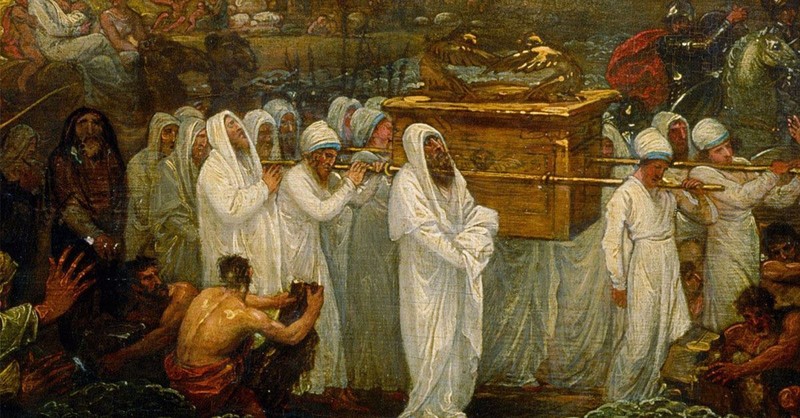
The ancient Jews had in their possession the Ark of the Covenant. It was a box of acacia wood, three cubits by two cubits (a cubit was the distance from a man’s elbow to the tip of his middle finger, or about 18 inches). In the Ark were the stone tablets of the Ten Commandments, the staff of Aaron, and a jar of the Manna. More important, it carried the presence of God! In some ways it resembles our tabernacles. The wings of the angels carved on its lid were said to form the mercy seat of God. Because the Ark sometimes had to be carried by the priests for long distances in the desert, there were two poles attached to its sides.
There came a moment with the Ark that seems to speak directly to our times—really to any moment of crisis or decision.
Early the next morning Joshua got up and left Shittim with all the Israelites. They went as far as the Jordan, where they camped before crossing over. After three days the officers went through the camp and commanded the people: “When you see the ark of the covenant of the LORD your God being carried by the Levitical priests, you are to set out from your positions and follow it…so that you can see the way to go, since we have never been this way before” (Joshua 3:1-4).
The instructions were addressed to a people who faced dangers and threats in this crossing. The Jordan River was in flood stage; the current was swift and the waters wide. Second, once in the Promised Land, they faced formidable enemies who were sure to resist their entrance. So terrifying was this threat that forty years earlier most had balked at the idea of going to the Promised Land. Although God had said that they would endure, they did not trust Him. For this lack of faith, God had them remain in the desert for forty years while He purified and strengthened them; during that time that sinful generation largely died out (Numbers 13:25-33, Numbers 14:1-25).
Forty years later, the instruction to follow the Ark was both instructive and reassuring. Most simply, it meant: Follow the Lord and trust His power; trust His promise to vanquish foes and to deliver you to the Promised Land.
Today we find ourselves in a crisis of our own. We are struggling to emerge from a pandemic while many are still crippled with fear. We are experiencing a time of great civil unrest rooted in accusations of racial injustice and sinful reactions of looting, destruction of private and public property, and physical assault. Further, the nomination of a Supreme Court Justice has stirred strong feelings nearly across the board. Add to all this an approaching presidential election whose result is likely to be unknown until well after election day and which may be contested regardless of the result.
Yes, we are heading into difficult waters as were the Israelites of long ago. A “flood” of animosity grips our nation. The divisions are so deep that civil discussions are becoming increasingly rare. It is simple, raw power that seeks to prevail. Nietzsche roams our streets.
Though the events are separated by thousands of years, the instruction is the same: Follow the Ark of the Lord, for we have never been this way before. While there have been riots before, and there have been contested elections, we have never had both of those in addition to an unprecedented lockdown amidst a pandemic. The combination of political, racial, economic and health crises makes this arguably the worst time in this country since the 1860s. There are legitimate concerns expressed for the very future of our nation. In our lifetime, we have truly “never been this way before.”
In times like these, draw near to the Lord through prayer, Eucharistic Adoration, the rosary, and the Divine Mercy chaplet. Pour out your heart to God on behalf of our country. Humbly request His mercy and grace. If you are able, consider fasting and/or abstinence.
Uniting our country, recovering from a pandemic, addressing injustice, and stopping violence may not be things we can do on our own. Going to the Lord in humility, combining our prayers with others, and crying out together “Heal our Land, Lord!” will be our way of keeping our eye on the Ark of the Covenant and following where He leads, for, we have never been this way before. Seek the Lord, then, and follow Him.
As a kind of follow-up from yesterday’s Gospel about the workers in the vineyard, we do we do well to examine. a kind of “mathematics of the Kingdom of God.” As noted yesterday, be very, very careful before you ask God to be fair. If God were fair, were all in big trouble. What we need most from God now is that he be merciful. And, having experienced God’s mercy he calls us to be merciful. Mercy is a very important aspect of the mathematics of the Kingdom of God.
In effect the Lord says to us, “Pay attention! You are going to be judged by the same standard by which you treat and judge others. So do the math, and realize that you were storing up for yourselves a kind of standard by which I will judge you.”
The key principle and text in this “math” comes in Luke’s Gospel wherein the Lord says the measure with which you measure will in return be measured out to you (Luke 6:38). But this statement comes at the end of a long string of statements were in the Lord summons us to be generous, forgiving, merciful, patient, and reluctant to condemn others.
In effect, the Lord says “Do the math, and realize it if you are merciful you’ll be judged with mercy. But if you are harsh and critical you will be judged with a harsh and critical standard. If you have refused to forgive, you will not be forgiven.
Like it or not, this is the mathematics of the Kingdom of God that, while it does not mean we earn salvation, but it does mean that we have a lot of influence over the standard by which we will be judged.
So, if you are going to need mercy and grace on the day of judgment, (and we all are) it is good to do the math of the Kingdom, and store up mercy and grace for that day.
We will all, one day, answer to God. And that day, as Scripture repeatedly teaches, it is a day about which we should be sober. Sadly, there are many who give little thought to this truth, and some who outright scoff at it.
So, again, wecan influence the manner in which God will judge us, the standard he will use! Now here, we speak of the manner of God’s judgment, that is Namely, whether he will judge us strictly, and or severely, or with lenience, and great mercy. On the day of our judgment, God will judge our deeds with pure justice. But part of that Justice is how we have treated others.
Let’s consider a few scripture passages wherein we are taught that we can have some influence over the manner in which God will judge us. Lets look at four related areas that will have influence:
I. Whether we show mercy –
Jesus says, Blessed are the merciful, for they shall obtain mercy (Matthew 5:7). James says something similar, and develops a bit when he says Always speak and act as those were going to be judged under the law of freedom, because judgment without mercy will be shown to anyone who has not been merciful. So mercy triumphs over judgment! (James 2:12 – 13). And thus we are taught that by observing mercy, and patience, in our relations with one another, we will influence the manner in which we are judged.
It is a fact that, sometimes in life, it will be required of us, especially if we are parents, or in leadership roles, that we will need to punish, and/or assign consequences for those who transgress moral laws, or legal limits. Hence, texts like these do not mean we should never correct with punitive measures. Such a way of living is unwise, and often confirms people in bad behaviors. But even when corrective or punitive measures are needed, it makes sense that we should seek to be lenient where possible, and use lesser measures before firmer ones are employed.
It is also clear from these biblical texts, that it is highly foolish to go through life with severity toward others, with a lack of compassion, or a harsh unyielding attitude. We are all going to need a lot of grace and mercy at our judgment. Therefore, how misguided, how foolish it is for us to be harsh and unmerciful toward others. For indeed, these text tell us the merciful are blessed, and warn that the unmerciful will be shown no mercy. Can you or I really expect, that we will make it on the day of judgment, without boatloads of Mercy?
Now therefore is the time for us to seek to invoke the promise of the Lord, Blessed are the merciful for they shall obtain mercy.
II. Whether we have been strict or lenient
In a related text, and as noted above, the Lord Jesus says, The measure that you measure to others, will be measured back to you (Mark 4:24). Here again, if we hope for, and need a merciful judgment, if we want a merciful measure or standard to be used, the Lord makes it clear that he will use the measure or standard that we have used for others. Have we been strict? He will be strict. Have we been merciful? He will be merciful, and so forth. Be very careful before demanding that sinners and others who transgress receive the strongest penalties. There may be a time for penalties, but it is not always true that the most severe punishments be used.
In John 8 the Pharisees wanted to invoke the most severe penalty for a woman caught in adultery (stoning to death). Jesus reasons with them that before they demand he throw the book at her, they might want to recall there are a few things about them that are also written in the book. One by one they drift away, seemingly considering the foolishness of their demands for the most severe penalty. Somehow they realize that the measure they want to measure to her, will be measured back to them.
III. Whether we are generous to the poor –
Luke, relates this text more specifically to our generosity: Give and it will be given to you, good measure, pressed down, shaken together, and running over, will be poured into your lap. For the measure that you measure to others will be measured back to you (Luke 6:38). And this leads us to a second area which the Scriptures teach us that we can influence the day of our judgment.
Jesus, after rebuking the Scribes Pharisees for their severity, and their extreme legalism, says to them, who obsessed about cleaning the outside of the dish, You fools, did not the one who made the outside of the cup make the inside also? But if you give what is inside the cup as alms to the poor, everything will be made clean for you (Luke 11:40 – 41). It is a daring text, in the light of the theology of Grace, and almost implies that we could somehow “purchase” forgiveness. But of course, it is the Lord himself who says it, and he does not say we can somehow purchase forgiveness. But surely, he does teach that generosity to the poor will in fact influence the day of our judgment.
Later in Luke’s Gospel, Jesus develops the thought saying,I tell you, use your worldly wealth to gain friends for yourselves, so that when it is gone, you will be welcomed into trouble dwellings (Lk 16:9). It is a complicated text, but Jesus seems to be saying that our generosity to the poor, will surely gain for us advantages at the day of our judgment. Indeed, blessing the poor gives us powerful intercessors, for the Lord hears the cries of the poor. And on the day of our death, and our judgment, the picture that is painted here is of those very poor welcoming us into eternal dwellings.
Scripture elsewhere warns, If a man shuts his ears to the cry of the poor, he too will cry out and not be heard (Proverbs 21:13). So once again, it would seem that we can have some influence over the manner, measure or standard that will be used by God at our judgment. To the merciful, mercy will be shown. The generous too will experience that their cries are heard, for they heard the cries of the poor. And the Lord more than implies that those who have been generous to the poor will have powerful advocates praying and interceding for them on the day of judgment. Indeed, a number of the Fathers of the Church remind us that, in this life, the poor need us, but in the life to come, we will need them.
IV. Whether we have been forgiving –
A final area to explore in terms of how we might have influence over the manner of our judgment is the matter of forgiveness. Just after giving us the “Our Father,” the Lord Jesus says the following, For if you forgive others when they sin against you, your heavenly Father will also forgive you. But if you do not forgive others their sins, your Father will not forgive your sins (Matthew 6:14 – 15).
Later in Matthew, Jesus tells a terrifying parable of a man who had huge debt, a debt that was forgiven him. But when he refused to forgive his brother a much smaller debt, the king grew angry and threw him into debtors prison. Jesus concludes the parable by saying, This is how my heavenly Father will treat each of you, unless you forgive your brother from your heart (Matthew 18:35).
So yes, it would seem that we can have some influence over the manner in which God will judge us, over the standard he will use. And while it is true, God will judge will judge us by our deeds (cf Romans 2:6), yet the manner in which God judges us, whether with strictness or leniency, does seem to be a matter over which we have influence.
So, do the math and consider well the mathematics of the Kingdom of God! It is a plain fact that we are all going to need lots of grace and mercy, for we will all have much to answer for. All the more reason for us to follow the teachings of the Lord, in his Scripture, and be sure that on the day of our judgment, mercy, and the grace of leniency will prevail. Do we want mercy? Then show mercy. Do we want a gentle standard? Then we must measure out gentleness. Do we want forgiveness? Then we must offer forgiveness. Recruit some good intercessors for the day of judgment, by giving to the poor. They will be the most powerful intercessors for us as we leave this life and go to judgment.
So, God has shown us how we can store up a treasure of mercy, waiting for us in heaven, at the judgment seat of Christ. Some good lessons here to heed.
Here’s a funny video that illustrates that the measure we measure to others will be measured back to us:
The birth of Jesus was prophesied in many and varied places in the Old Testament. The birth of John the Baptist was also prophesied (Malachi 4:5-6; Matt. 11:14). But Mary, the Mother of Jesus our Lord, had her birth and existence prophesied as well. On this her birthday let’s take a look at some of those texts with some commentary from me.
We begin right at the beginning in the Book of Genesis. Original Sin had just been committed by Adam and Eve. Eve said the serpent deceived her. God put Satan under a curse and then pointed forward to a new Eve who would say, “yes” where Eve had said, “no.” God warned Satan:
And I will put enmity between you and the woman, and between your seed and her seed. He will crush your head, and you will strike his heel.” (Gen. 3:15)
God therefore points to Mary and to the unique quality of her motherhood. She alone brought forth our Savior who, by his divine power and human obedience crushed the head of Satan. And, since women are not said to have seed, this unusual phrase attributed to Mary, points to her as being the sole source of Christ’s humanity (by God’s power) and that the Heavenly Father was Jesus’ true Father.
A second prophecy of Mary comes in Isaiah. King Ahaz is resisting Isaiah’s message not to fear Aram and Ephraim who are poised to invade Judah. When King Ahaz is told to ask for a sign he refused. Isaiah impatiently replies thus:
Therefore the Lord Himself will give you a sign: Behold, the virgin will be with child and will give birth to a son, and will call Him Immanuel. (Isaiah 7:14)
Many modern Scripture scholars dismiss this as a reference to Mary, arguing it could not be a sign for Ahaz who died hundreds of years before its fulfillment. They also argue that “virgin” could just mean “maiden” (or young wife) and not refer to a true virgin conceiving. But apparently the Holy Spirit and St. Matthew never got the memo since they apply this Prophecy to Mary. (cf Matt, 1:23)
Isaiah also points to Mary in the following text. And while contextually he speaks of Jerusalem allegorically as a Mother giving birth, the details were only fulfilled by Mary.
This is what the LORD says: “Heaven is My throne, and earth is My footstool. What kind of house will you build for Me? Or where will My place of repose be? Has not My hand made all these things?And so they came into being,” declares the LORD. “This is the one I will esteem: he who is humble and contrite in spirit, who trembles at My word….Hear the uproar from the city; listen to the voice from the temple! “Before she was in labor, she gave birth; before she was in pain, she delivered a boy. Who has heard of such as this? Who has seen such things? (Is 66:1-2; 6-8)
This text is why many of the Church Fathers teach that Mary brought forth Jesus miraculously and without the pain of childbirth. Although the people of Isaiah’s time did not see or hear of such things, those of Jesus’ time have heard and seen it fulfilled.
The Prophet Micah also points to Mary in the following text:
But you, Bethlehem Ephrathah, who are small among the clans of Judah, out of you will come forth for Me One to be ruler over Israel—One whose origins are of old, from the days of eternity. Therefore Israel will be abandoned until she who is in labor has given birth; then the rest of His brothers will return to the children of Israel. (Micah 5:2-3)
Yes, salvation would wait until Mary was born, said “yes” in the place of Eve’s “no” and, by God’s power, brought forth Jesus our eternal savior and ruler.
The following text is from he Book of Revelation. And, since it was written after the birth and life of Christ on this earth it is not, strictly speaking, a prophecy. However, it is in the form of a meta-history. As such, it poetically and sweepingly writes of the great conflicts between good and evil, God and Satan that raged before Christ and, to a lesser degree after. I have here rearranged the text a bit to unite the heavenly war verses:
And a great sign appeared in heaven: a woman clothed in the sun, with the moon under her feet and a crown of twelve stars on her head. She was pregnant and crying out in the pain and agony of giving birth. Then another sign appeared in heaven: a huge red dragon with seven heads, ten horns, and seven royal crowns on his heads. His tail swept a third of the stars from the sky, tossing them to the earth….Then a war broke out in heaven: Michael and his angels fought against the dragon, and the dragon and his angels fought back. But the dragon was not strong enough, and no longer was any place found in heaven for him and his angels. And the great dragon was hurled down—that ancient serpent called the devil and Satan, the deceiver of the whole world. He was hurled to the earth, and his angels with him.
We see here a kind of heavenly prophecy of Mary in the sign of the Woman clothed with the sun who was pregnant and giving birth. Ancient traditions hold that when God revealed his plans to save humanity by joining them, Lucifer, a high ranking angel balked at the plan and pridefully resisted it. Angels were far more worthy of God’sgifts than the mud doll humans. Lucifer thus led a rebellion and there was war in heaven.
And the dragon stood before the woman who was about to give birth, ready to devour her child as soon as she gave birth. And she gave birth to a son, a male child, who will rule all the nations with an iron scepter. And her child was caught up to God and to His throne. And the woman fled into the wilderness, where God had prepared a place for her to be nourished for 1,260 days.
There are many layers here. Historically, the woman can only be Mary since the Son she gives birth to can only be Christ. Allegorically the woman can also represent Israel and the Church. Though Satan sought Christ and searched for him all his earthly life, after an apparent victory at the Cross, the text tells us that Jesus was caught up to heaven where he is enthroned. The woman fleeing into the wilderness may remind us of the flight into Egypt but the 1260 days (three and a half months) is more likely a reference to yet another layer of this text, wherein Mary images the early Church. In 70 AD the early Church in Jerusalem fled to desert to the city of Pella as the Romans laid siege tot he City for three and a half months.
The wrenching depiction of Revelation 12 ends with an ominous note:
And the dragon was enraged at the woman, and went to make war on the rest of her children, who keep the commandments of God and hold to the testimony of Jesus. And the dragon stood on the shore of the sea.
Here too, we can note that the woman is both Mary and the Church. Mary as Mother of Christ is also our Mother since we are members of the Body of Christ. And, if Mary gave birth to the Head of the Church (Christ) she also gave birth to the Body of Christ and all its members. The Church too is mother to us since she is the Bride of Christ as we are born from the chaste union of Christ and his Bride, the Church. And here we see a prophecy that we who are the children of Mary and the Church will suffer persecution in this “paradise lost.” We therefore must cling to our Mother the Church and to Mary. We must also cling to the Lord and his sacraments for we have an enemy, Satan, and he stands on the shore of the sea (the sea was a symbol for chaos) looking for opportunities.
May our Lady hide us in her mantle and may our Lord and his Angels bestow on us every good grace.
May our Blessed Lady be highly venerated on this, her birthday.
In today’s first reading (Thursday of the 22nd week of the year) St. Paul writes:
Do not deceive yourselves. If any one of you thinks he is wise by the standards of this age, he should become a “fool” so that he may become wise. For the wisdom of this world is foolishness in God’s sight. As it is written: “He catches the wise in their craftiness”and again, “The Lord knows that the thoughts of the wise are futile.”So then, no more boasting about men! (1 Cor 3:18-21).
Ah, to be a fool for Christ! Now that is a wise thing indeed. But it is so daring and frightening that few even among priests and religious get there. To be a fool for Christ is to be mocked, scorned and hated by this world, to be the butt of jokes, to be held in derision. How many of any of us are willing to accept this? We have such a powerful instinct to fit in, be liked, be approved by men. The martyrs of the early Church accepted death for proclaiming and living Christ but we can barely endure a raised eyebrow! Maybe it is ambition that keeps us from the goal. Maybe it is an overly developed wish to live in peace with the world. Maybe it is fear or maybe it is just plain laziness. But few of us Christians can bear the notion of really being thought a fool by this world and so we desperately strive to fit in.
If you evangelize or really seek to live the gospel, expect to get it with both barrels. Expect to be scorned, rebuffed and ignored. Expect your children and grandchildren to roll their eyes and say, “There you go again.!” Expect a fallen away member of the family to ridicule you and recite your own past sins. Evangelizing and living in counter-cultural ways is hard. Sometimes the fruits seem lacking despite repeated attempts. And it is often our own family members that grieve us the most.
But all of this is just fine. We have to remember that in spite of negative reactions we haven’t done anything wrong. We often think, probably from childhood, that when some one is angry at us we have done something wrong. Not necessarily. Sometimes it means we have done something right. A doctor often causes pain and discomfort in order to bring healing and so it is that the Word of God is sharper that any two edged sword. Sometimes people are angry and “hurt” because we have done something precisely right. The protest of pain often precedes the healing that follows.
But in the end, the biggest obstacle to evangelization is our fragile ego. We are often so afraid to incite a negative reaction, to incur another’s wrath or even worse, ridicule. Perhaps we will be asked a question we cannot answer or the other person will “out maneuver” us with Bible quotes and “win” the argument. Perhaps a fallen away family member will succeed in embarrassing us about our past sins. Perhaps it is just too painful to be told “no” again by a spouse or child who refuses to go to Church. Perhaps we will end up feeling like a fool.
And there it is, that word again: fool! Are you and I willing to be made a fool for Christ’s sake? Are we willing to risk ridicule and failure in order to announce Jesus Christ? The world has gone mad and the Gospel is “out of season.” More than ever the Lord needs a few fools to risk ridicule and hatred to proclaim his gospel to a hostile world that often thinks it is a foolish doctrine that is hopelessly out of touch.
It is said that among some of the Monks of the Orthodox Church it is common to place upon their tombstone the phrase: “Fool for Christ” Not bad. I pray that I will increasingly live a life worthy of the title. And if I do, kindly grant me the favor of inscribing on MY tombstone: “Fool for Christ.”
Here’s a little video showing forth Christ as “fool.” After this discourse the cry went up, “How can anyone take him seriously!” (Jn 6:60)
In yesterday’s Gospel Jesus set forth the need to accept the crosses of our life and carry them. As we reviewed in yesterday’s homily notes, crosses are not merely the big sufferings in life such as disease, the death of a loved one, the loss of a job, and so forth. There are also the daily crosses of self-discipline, hard work, obedience, setbacks, consequences for our decisions, limits to what we can do, and the cross of resisting temptation.
Opposed to this teaching from the Lord is hedonism. Most people today link hedonism with sexual excess and perhaps drinking. But Hedonism is a far wider notion and it is why St. Paul said: We preach Christ crucified: a stumbling block to Jews and foolishness to Gentiles (1 For 1:23). To the Jews, Christ crucified was a stumbling block since they believed that anyone hung from a tree was cursed by God (see Deut 21:23). But to the Greeks and Romans, the cross was an absurdity due to the widespread philosophy of hedonism among them. So what is hedonism?
Hedonism is the doctrine that pleasure or happiness is the sole or chief good in life. It comes from the Greek word hēdonē, meaning “pleasure” and is akin to the Greek hēdys, meaning “sweet.”
Of course pleasure is to be desired and to some degree sought, but it is not the only good in life. Indeed, some of our greatest goods and accomplishments require sacrifice: years of study and preparation for a career; the blood, sweat, and tears of raising children.
Hedonism seeks to avoid sacrifice and suffering at all costs. It is directly opposed to the theology of the Cross. St. Paul spoke in his day of the enemies of the cross of Christ. Their end is destruction, their god is the belly, and they glory in their shame, with minds set on earthly things (Php 3:18–19). As noted, he also taught that the cross was an absurdity to the Gentiles (1 Cor 1:23).
Things have not changed, my friends. The world reacts with great indignation whenever the cross or suffering is even implied. So the world will cry out with bewildered exasperation and ask incredulously of the Church, are you saying that a woman who was raped must carry the child to term and cannot abort? Yes, we are. Are you saying that a “gay” person must live celibately and may never “marry” his or her same-sex lover? Yes, we are. Are you saying that a handicapped child in the womb must be “condemned” to live in the world and cannot be aborted and put out of his (more accurately our) “misery”? Yes, we are. Are you saying that a suffering person cannot be euthanized to avoid the pain? Yes, we are.
The shock expressed in these sorts of questions shows how deeply hedonism has infected the modern mind. The concept of the cross is not only absurd, it is downright “immoral” in the hedonist mentality, which sees pleasure as the only true human good. To the hedonist, a life without enough pleasure is a life not worth living, and anyone who would seek to set limits on the lawful (and sometime unlawful) pleasures of others is mean, hateful, absurd, obtuse, intolerant, and just plain evil.
When pleasure is life’s only goal or good, how dare you, or the Church, or anyone seek to set limits on it let alone suggest that the way of the cross is better or required! You must be banished, silenced, and destroyed.
Many faithful Catholics in the pews are deeply infected with the illusion of hedonism and thus take up the voice of bewilderment, anger, and scoffing whenever the Church points to the cross and insists on self-denial, sacrifice, and doing the right thing even when the cost is great. The head wagging in congregations is often visible if a priest dares to preach that abortion, euthanasia, in vitro fertilization, and contraception are wrong regardless of the cost, or if he speaks about the reality of the cross. The faithful who swim in the waters of a hedonistic culture are often shocked at anything that might limit the pleasure that others want to pursue.
Hedonism makes the central Christian mysteries of the cross and redemptive suffering seem like something from a distant planet or a parallel and strange universe. The opening word from Jesus’ mouth, “Repent,” seems strange to the hedonistic world, which has even reconstructed Jesus Himself to be someone who just wants us to be happy and content. The cry goes up, even among the faithful, doesn’t God want me to be happy? On this basis, all kinds of sinful behavior is supposed to be tolerated because insisting on the opposite is “hard” and because it seems “mean” to speak of the cross or of self-discipline in a hedonistic culture.
Bringing people back to the real Jesus and to the real message of the Gospel, which features the cross as the way to glory, takes a lot of work and a long conversation. We must be prepared to engage in that extended conversation with people.
We are in times of strident political protest that includes a lot of harsh language, personal attacks, name calling, and even debased and profane terms. There are tweets, and angry monologues, harsh commentary on news networks, and interruptive press conferences and news interviews that sound more like a brawl than a debate. To put it all more pleasantly, these are times of “colorful” discourse.
What is the overall teaching of Scripture when it comes to this sort of colorful language? Are there some limits and ground rules? Let’s take a look.
The word “civility”dates back to the mid-16th century and has an older meaning that referred to one who possessed the quality of having been schooled in the humanities. In academic settings, debate (at least historically) was governed by a tendency to be nuanced, careful, cautious, formal, and trained in rhetoric. Its rules often included referring to one’s opponents with honorary titles (Doctor, Professor, etc.) and euphemisms such as “my worthy opponent.” Hence as the word entered common usage, it has come to mean speech or behavior that is polite, courteous, gentle, and measured.
As one might guess, there are a lot of cultural variancesin what is civil. And this insight is very important when we look at the biblical data on what constituted civil discourse. Frankly, the biblical world was far less dainty about discourse than we have become in 21st-century America. The Scriptures, including the New Testament, are filled with vigorous discourse. Jesus, for example, really mixes it up with His opponents—even calling them names. We shall see more of this in a moment. But the Scriptures also counsel charity and warn of unnecessarily angry speech. In the end, a balance of the scriptural witness to civility must be sought along with an appreciation of the cultural variables at work.
Let’s examine a few of the texts that counsel charityas well as a modern and American notion of civility:
Anyone who says to his brother, “Raqa” is answerable to the Sanhedrin. But anyone who says, “You fool!” will be in danger of the fire of hell(Matt 5:22).
Do not let any unwholesome talk come out of your mouths, but only what is helpful for building others up according to their needs, that it may benefit those who listen(Eph 4:29).
Fathers, do not provoke your children, lest they become discouraged(Col 3:21).
With the tongue we praise our Lord and Father, and with it we curse men, who have been made in God’s likeness. Out of the same mouth come praise and cursing. My brothers, this should not be (James 3:9-10).
Everyone should be quick to listen, slow to speak, and slow to become angry(James 1:19).
Let your conversation be always full of grace, seasoned with salt(Col 4:6).
Therefore encourage one another and build each other up(1 Thess 5:11).
But now you must rid yourselves of all such things as these: anger, rage, malice, slander, and filthy language from your lips(Col 3:8).
Words from a wise man’s mouth are gracious, but a fool is consumed by his own lips(Eccl 10:12).
The quiet words of the wise are more to be heeded than the shouts of a ruler of fools(Eccles 9:17).
Let us therefore make every effort to do what leads to peace and to mutual edification(Rom 14:19).
Brothers, if anyone is caught in any transgression, you who are spiritual should restore him in a spirit of gentleness. Yet do not regard him as an enemy, but warn him as a brother(Gal 6:1).
Now instead, you ought to forgive and comfort [the repentant sinner], so that he will not be overwhelmed by excessive sorrow(2 Cor 2:7).
All these texts counsel a measured, charitable, and edifying discourse. Name-calling and hateful or unnecessary expressions of anger are out of place. And this is a strong biblical tradition, especially in the New Testament.
But there are also strong contrasts to this instruction evident in the Bible. And a lot of it comes from an unlikely source: Jesus. Paul too, who wrote many of the counsels above, often engages in strident denunciations of his opponents and even members of the early Church. Consider some of the passages below, first by Jesus, then by Paul and other Apostles:
Jesus said, “You brood of vipers, how can you who are evil say anything good?”(Matthew 12:34)
And Jesus turned on them and said, “Woe to you, teachers of the law and Pharisees, you hypocrites! You shut the kingdom of heaven in men’s faces. You yourselves do not enter, nor will you let those enter who are trying to. “Woe to you, teachers of the law and Pharisees, you hypocrites! You travel over land and sea to win a single convert, and when he becomes one, you make him twice as much a son of hell as you are. “Woe to you, blind guides! … You strain out a gnat but swallow a camel. “Woe to you, teachers of the law and Pharisees, you hypocrites! You clean the outside of the cup and dish, but inside they are full of greed and self-indulgence. … You hypocrites! You are like whitewashed tombs, which look beautiful on the outside but on the inside are full of dead men’s bones and everything unclean. … And you say, ‘If we had lived in the days of our forefathers, we would not have taken part with them in shedding the blood of the prophets.’ So you testify against yourselves that you are the descendants of those who murdered the prophets. Fill up, then, the measure of the sin of your forefathers! “You snakes! You brood of vipers! How will you escape being condemned to hell?”(Matt 23 varia)
Jesus said to them, “If God were your Father, you would love me, for I came from God and now am here. I have not come on my own; but he sent me. … You belong to your father, the devil, and you want to carry out your father’s desire. … He who belongs to God hears what God says. The reason you do not hear is that you do not belong to God” (John 8:42-47).
Jesus said, Isaiah was right when he prophesied about you hypocrites; as it is written: “These people honor me with their lips, but their hearts are far from me”(Mark 7:6).
And Jesus answered them, O faithless generation, how long am I to be with you? How long must I tolerate you?(Mark 9:19)
Jesus said to the disciples, “If you, then, though you are evil, know how to give good gifts to your children, how much more will your Father in heaven give good gifts to those who ask him!” (Matt 7:11)
Jesus said to the crowd, “I do not acceptpraise from men, but I know you. I know that you do not have the love of God in your hearts”(Jn 5:41-42).
So he made a whip out of cords, and drove all from the temple area, both sheep and cattle; he scattered the coins of the money changers and overturned their tables(John 2:15).
Then Jesus replied, “Have I not chosen you, the Twelve? Yet one of you is a devil!”(John 6:70)
Paul: O senseless Galatians, who hath bewitched you that you should not obey the truth … As for those circumcisers, I wish they would go the whole way and emasculate themselves!(Galatians 3, 5)
Paul against the false apostles:And I will keep on doing what I am doing in order to cut the ground from under those who want an opportunity to be considered equal with us in the things they boast about. For such men are false apostles, deceitful workmen, masquerading as apostles of Christ. And no wonder, for Satan himself masquerades as an angel of light. It is not surprising, then, if his servants masquerade as servants of righteousness. Their end will be what their actions deserve (2 Cor 11:11-14).
Paul on the Cretans:Even one of their own prophets has said, “Cretans are always liars, evil brutes, lazy gluttons.” This testimony is true. Therefore, rebuke them sharply, so that they will be sound in the faith(Titus 1:12-13).
Peter against dissenters:Bold and arrogant, these men are not afraid to slander celestial beings…these men blaspheme in matters they do not understand. They are like brute beasts, creatures of instinct, born only to be caught and destroyed, and like beasts they too will perish. … They will be paid back with harm for the harm they have done. … They are blots and blemishes, reveling in their pleasures while they feast with you. With eyes full of adultery, they never stop sinning; they seduce the unstable; they are experts in greed—an accursed brood! … Of them the proverbs are true: “A dog returns to its vomit,” and, “A sow that is washed goes back to her wallowing in the mud”(2 Peter 2, varia).
Jude against dissenters:These dreamers pollute their own bodies, reject authority and slander celestial beings….these men speak abusively against whatever they do not understand; and what things they do understand by instinct, like unreasoning animals—these are the very things that destroy them. Woe to them! They have taken the way of Cain; … These men are blemishes at your love feasts, eating with you without the slightest qualm—shepherds who feed only themselves. They are clouds without rain, blown along by the wind; autumn trees, without fruit and uprooted—twice dead. They are wild waves of the sea, foaming up their shame; wandering stars, for whom blackest darkness has been reserved forever. … These men are grumblers and fault finders; they follow their own evil desires; they boast about themselves and flatter others for their own advantage(Jude 1:varia).
Now most of the passages above would violate modern norms about civil discourse.Are they sinful? They are God’s word! And yet they seem rather shocking to modern ears. Imagine getting into your time machine and going to hear Jesus denounce the crowds and calling them children of the devil. It really blows a 21st-century mind!
I want to suggest to you that these sorts of quotes go a long way toward illustrating the cultural dimension of what it means to be civil.The bottom line is that there is a great deal of variability in what people consider civil discourse. In some cultures there is a greater tolerance for anger. In New York and Boston, edgy comments and passionate interruptive debate are common. But in the upper-Midwest and parts of the Deep South, conversation is more gentle and reserved.
At the time of Jesus, angry discourse was apparently more “normal,”for as we see, Jesus Himself engages in a lot of it, even calling people names like “hypocrites,” “brood of vipers,” “liars,” and “wicked.” Yet the same Scriptures that record these facts about Jesus also teach that He never sinned. Hence at that time, the utterance of such terms was not considered sinful.
Careful, now—be careful here. This does not mean it is simply OK for us to talk like this because Jesus did. We do not live then; we live now; and in our culture such dialogue is seldom acceptable and often backfires. There ARE cultural norms we have to respect to remain in the realm of Charity. Exactly how to define civility in every instance is not always clear. An old answer to these hard-to-define things is “I know it when I see it.” So perhaps it is more art than science to define civility. But clearly we tend to prefer gentler discourse in this day and age.
On the other hand, we also tend to be a little thin-skinnedand hyper-sensitive. And the paradoxical result of insisting on greater civility is that we are too easily “outraged” (one of the more overused words in English today). We take offense where none is intended and we presume that the mere act of disagreeing is somehow arrogant, intentionally hurtful, or even hateful. We seem so easily provoked and so quick to be offended. All of this escalates anger further, and charges of hate and intolerance are launched back and forth when there is merely sincere disagreement.
Balance– The Scriptures give us two balanced reminders. First, that we should speak the truth in love, and with compassion and understanding. But it also portrays to us a time when people had thicker skin and were less sensitive and anxious in the presence of disagreement. We can learn from both biblical traditions. The biblical formula seems to be “clarity” with “charity,” the truth with a balance of toughness and tenderness. An old saying comes to mind: “Say what you mean, mean what you say, but don’t say it mean.”
Here is a video that depicts the zeal of Jesus and a bit of his anger.
One of the beatitudes taught by Jesus is often misunderstood, largely due to the popular translations of it from the Greek text: “Blessed are the pure of heart,” or “Blessed are the clean of heart.” Let’s look at three facets of the beatitude: its fundamental meaning, its focus, and the freedom it gives.
I. Fundamental Meaning – While the words “pure” and “clean,” are not inauthentic translations of the Greek word καθαρός (katharos), a more literal translation is “to be without admixture, to be simply one thing.” Hence it means to purely and simply be that one thing with nothing else mixed in. Another helpful way of translating the Greek μακάριοι οἱ καθαροὶ τῇ καρδίᾳ (makarioi hoi katharoi te kardia) is “Blessed are the single-hearted.”
The reason I suggest that the phrase “single-hearted” is more descriptive is that in modern English the words “pure” and “clean” tend to evoke a moral sense of being free of sin, of being morally upright. And while this is surely a significant part, being single-hearted is a deeper and richer concept than simply being well-behaved, since to be well-behaved is the result of the deeper truth of being one thing, of not being duplicitous, of not having a divided heart.
II. Focus – Fr. Reginald Garrigou-Lagrange says, Simplicity is opposed not only to duplicity, but to every useless complexity, to all that is pretentious or tainted with affectation … Christ says to us “If thy eye be single thy whole body shall be lightsome” (Mat 6:22); that is, if our intention is upright and simple, our whole life be one, true and luminous, instead of being divided, like that of those who try to serve two masters … The perfect soul is thus a simplified soul … willing things only for God (Three Ages of the Interior Life, Tan Publishers, Vol 2, pp. 162-163).
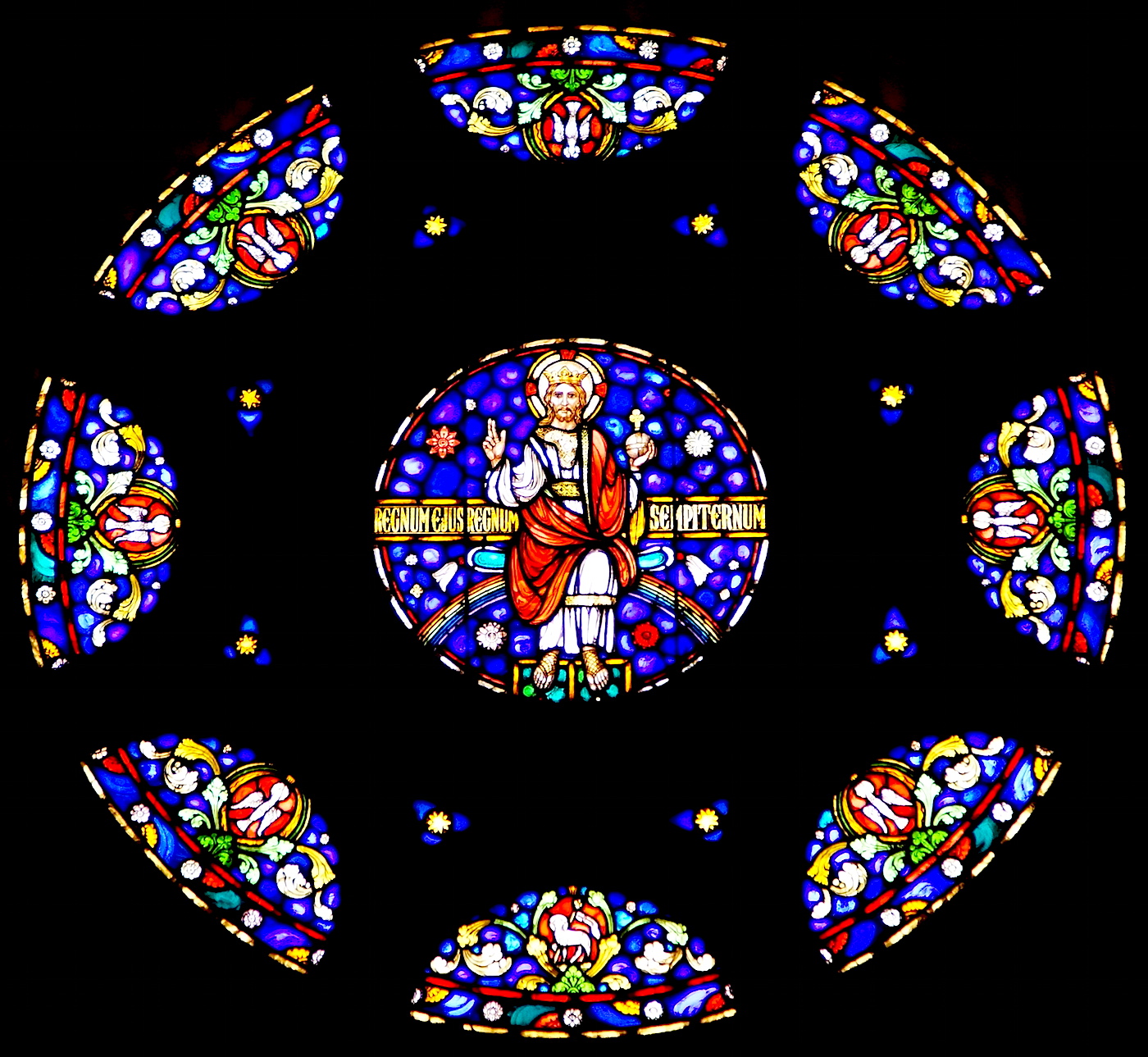
The image of the rose window in my church (see above), which I have used before on this blog, is a good illustration of what it means to be single-hearted. It does not deny that life has different facets, but rather shows that every facet of life is ordered around and points to Christ, is subsumed in Jesus and His heavenly kingdom along with the Father and the Spirit as the ordering principle of every other thing. And thus career, family, marriage, finances, spending priorities, use of time, where one lives, and any other imaginable aspect of life is subsumed in Christ, points to Him, and leads to the Lord and His kingdom on high.
So the single-hearted life is a well-ordered life. Each step, each decision leads in the right direction. St. Paul said, This one thing I do: forgetting what lies behind and reaching forward to what lies ahead, I press on toward the goal for the prize of the upward call of God in Christ Jesus (Philippians 3:13-14). While Paul made many journeys to many places, he was really on one journey and headed to one place. This simplified and ordered his life. He was single-hearted.
A simple life is a well-ordered, singly focused life. But duplicity introduces many complexities and disorders. Jesus says, He who does not gather with me, scatters (Luke 11:23). Unfortunately, this image of scattering or being hindered describes many Christians whose lives are not ordered on the one thing necessary, who are not single-hearted, whose hearts are not focused on the one thing they should be. Such people have lives that are often scattered, confused, disordered, and filled with a jumble of conflicting drives that hinder them from the true goal of life. The double minded man is unstable in all his ways (James 1:8).
St. Thomas Aquinas wrote that simplicity is related to the virtue of veracity, since it opposes the duplicity that James denounced (Summa Theologica IIa IIae q. 109 art. 2, the 4th).
III. Freedom – Finally, being single-hearted, being pure of heart, not only orders our life but it also grants us freedom. In modern Western thinking, freedom is often equated with doing more rather than less. Freedom is interpreted as “being able to do anything I please.” This attitude has led to the kind of jumbled mess that much of modern life has become: a tangled web of contrary desires with little unifying direction or purpose. We tend to think of freedom in abstract terms and hence we tend to get abstract and disconnected results.
But biblically and spiritually, freedom is the capacity or ability to do what is right, best, and proper. And thus, paradoxically, freedom often means doing less, not more.
Being single-hearted helps to focus us and to pare away a lot of the unnecessary baggage of modern life. Life gets simpler, and simplicity is a form of freedom that allows us to focus on what is important more so than on what is urgent. We discover that what often seems to be urgent is not really so necessary or urgent after all. Regarding the good options in life, St. Paul said, All things are lawful to me, but not all things are expedient (1 Cor 6:12).
Pray for the gift to become more single-hearted. More than ever in this modern age, with its myriad distractions and endless possibilities, we need to learn the lesson of the rose window and center our lives on Christ, the one thing necessary.
I have used the video below in other posts. Please pardon a brief profane word in the clip, but it does help emphasize the point being made.
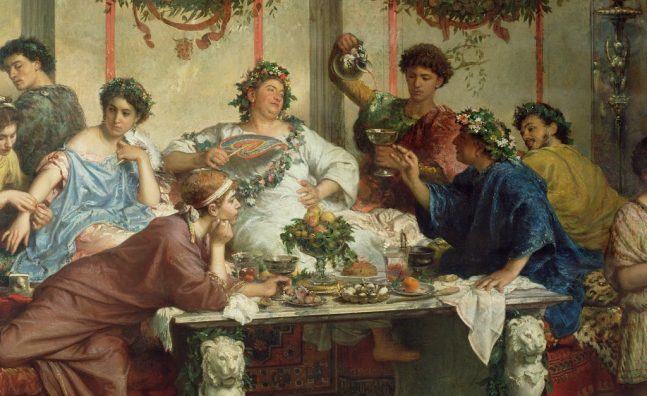
The Gospel from Thursday’s Mass (Thursday of the 20th Week of the Year) contains one of the most shocking parables Jesus ever told. It is the Parable of the Wedding Feast from the Gospel of Matthew, and it tells the story of a king who gives a wedding banquet for his son. Most know it well, but in case you want to review it, the full text is available here: Parable of the Wedding Feast.
It does not take a degree in biblical theology to understand that this parable is an allegory. The “king” is God the Father, the “son” is Jesus, and the wedding feast is the great wedding feast of the Lamb described in the Book of Revelation:
Then I heard what sounded like a great multitude, like the roar of rushing waters and like loud peals of thunder, shouting: “Hallelujah! For our Lord God Almighty reigns. Let us rejoice and be glad and give him glory! For the wedding of the Lamb has come, and his bride has made herself ready. Fine linen, bright and clean, was given her to wear.” (Fine linen stands for the righteousness of God’s holy people.) Then the angel said to me, “Write this: Blessed are those who are invited to the wedding supper of the Lamb!” And he added, “These are the true words of God” (Revelation 19:6-9).
The invited guests are the Jewish people of that time who, when the feast is ready, ignore or reject it for various reasons. Some guests express concerns for land (I just bought a farm) or profit (I own a business). And a group of them (for unknown reasons) lay hold of the king’s servants (who represent the prophets and, later, the Apostles), beating and even killing them.
This rejection represents not just the rejection by the Jews of history, but also the long human history of ignoring or rejecting God in favor of worldliness (land), profit (business), and hostility to the truth (the beating and killing of the king’s servants (the prophets and Apostles)).
And yet the focus is on the rejection by the Jews of the time, for the parable calls them the “invited guests.”
The reaction to their rejection, related by Jesus Himself, is that the king (God the Father) was enraged and sent his troops, destroyed those murderers, and burned their city (Matt 22:6).
This detail is especially shocking to many modern readers, because we have bought into a watered down notion of the holiness of God and the significance of human choice for or against Him. The common modern vision of the Father is that of a doting older man (like George Burns or Morgan Freeman) who exists more to get us out of trouble and offer friendly advice than to summon us to holiness, obedience, and a critical choice.
But take note: this detail of the king burning their city is told by Jesus Himself. However we want to “rework” God and render Him harmless, however we want to try to oppose God’s love and justice, however we want to render human choice insignificant, the biblical text will have none of it. The bottom line is that no one loves you more than does Jesus Christ, yet no one warned of judgment and Hell more than He did.
Don’t be surprised if this parable shocks you; it is meant to do so. It is a call to sobriety in the face of the four most critical truths of our life: death, judgment, Heaven, and Hell. This parable teaches that we will either enter the wedding feast and celebrate with the Father or we will be caught up in the conflagration when the Lord comes to judge this world by fire (e.g., 2 Pet 3:7; Malachi 4:1; 2 Thess 1:7).
Add to this shock the fact that the parable was actually fulfilled in 70 A.D. (as a kind of precursor to the final end of the age) when, after forty years of pleading with the Jewish people to come to Christ, a fiery destruction came upon Jerusalem. After rejecting the Lord’s warnings (cf Matthew 24, 25; Mark 13; Luke 21), rejecting the call of the early Apostles and Church, and picking a pointless war with the Romans, the Jewish nation was utterly defeated. Jerusalem was sacked and burned and more than a million Jews were killed.
The choice is ours, but the judgment is certain to come: “God gave Noah the rainbow sign,no more water but the fire next time!” (Negro spiritual)
The only safe place to be is at the wedding feast of the Jesus the Lamb, who saves us from the wrath to come (1 Thess 1:10).
Jesus, with weeping, had warned,
Jerusalem, Jerusalem, you who kill the prophets and stone those sent to you, how often I have longed to gather your children together, as a hen gathers her chicks under her wings, and you were not willing. Look, your house is left to you desolate (Matt 23:37).
The next shocking part of the parable comes in the second half. The enraged king (God the Father) orders his servants to go into the streets and gather everyone they can. This detail represents going out to the Gentiles and the Great Commission.
Thanks be to God that the response is good and the banquet is filled. But then comes yet another shock:
When the king came in to meet the guests he saw a man there not dressed in a wedding garment. He said to him, ‘My friend, how is it that you came in here without a wedding garment?’ But he was reduced to silence. Then the king said to his attendants, ‘Bind his hands and feet, and cast him into the darkness outside, where there will be wailing and grinding of teeth.’ Many are invited, but few are chosen.
This makes us moderns wince. Perhaps part of our trouble with these verses is that we may think that the newly invited guests were dragged in right off the street with no chance to change clothes. But there is nothing in the text to suggest that they were not given time to don their wedding clothes. The other guests all seem to be clothed properly and the focus shifts to one man who is not properly dressed.
Whatever the debated cultural parameters of the story, the theological parameters are more clear. The wedding garment is provided by the king (God the Father), who clothes us in righteousness at our baptism.
For the wedding of the Lamb has come, and his bride has made herself ready. Fine linen, bright and clean, was given her to wear. (Fine linen stands for the righteousness of God’s holy people.) (Rev 19:8)
Yes, this is the baptismal gown, the robe of righteousness, which God gives to the baptized, who have been washed in the blood of the Lamb! In the Baptismal Rite, the celebrant points to the white garment of the newly baptized and says,
You have clothed yourself in Christ. Receive this baptismal garment and bring it unstained to the judgment seat of our Lord Jesus Christ, so that you may have everlasting life (# 578).
In the parable, the man is without a wedding garment not because he is poor or was pulled in off the street, but because he cast aside the garment he was given. Remember that the garment is no mere piece of cloth; it represents righteousness. And this righteousness is received and must be cherished. Without it, we cannot endure or remain at the Wedding Feast of the Lamb, which is Heaven.
Thus ends one of the most shocking parables Jesus ever told. (We will examine the “many are called but few are chosen” aspect of the text this coming Sunday.) And though the parameters of this parable do shock, Jesus speaks them with an urgent love to bring forth godly repentance from us and to stir an evangelical urgency in us to reach others before “Great and Terrible Day of the Lord” comes (cf Joel 2:31; Mal 4:5 inter al). On that day there will be only two places: safe at the wedding feast with the Lord or outside in the fiery judgment that is coming on this world.
An old spiritual says,
“God’s gonna set this world on Fire one of these days.”
Another old spiritual goes like this:
“I got a robe, you got a robe, all God’s children got a robe. When I get to heaven gonna put on my robe and go wear it all over God’s heaven! Everybody talkin’ bout heaven ain’t a goin’ there!”
Make sure you’ve got your robe and keep it washed in the blood of the Lamb.