A few days ago, I was out with a couple of friends. We shared a pizza and the usual, “what’s happening in our lives.” We found ourselves talking about the freedom that is found when we begin to practice living the presence of God – the kind of living that begs us to let go of the past and to hand over everything we fear about the future. The kind of living that calls out to us and asks us to live in this very moment. Ironically, or perhaps beautifully, it’s the kind of living that heals our past wounds and gives us the grace to overcome the fears we face.
When we practice living in the present moment something miraculous happens. We begin to open ourselves to receiving the gift of Jesus Himself – fully present, active and alive in our hearts. It’s easy in this world, especially as a young adult to become overwhelmed by what the future holds. We are continuously faced with questions like: Is this the right career for me? Is God EVER going to send me a husband or wife? Am I doing enough to care for and protect my family? Will these wounds from my past ruin my current relationship? Am I living God’s will for me? These questions often burden and sometimes even paralyze us. The questions in themselves are not bad – for God gave us the Holy Spirit to help us discern His will and dream (and dream big I might add). However, sometimes the questions block our minds and hearts from hearing the answers we are seeking. The good news – Jesus is fully present within us and waits for us with great joy and patience. He invites us to live with Him in the now, to be present with Him at this very moment and receive gifts beyond imagination. Sometimes He leaves us with answers we might not want, but we must trust in the fact that He always wants the best for us. Today let us ask for the grace to mindfully live with Jesus. Maybe we’ll be surprised at what He reveals to us!
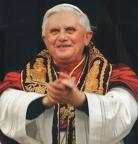
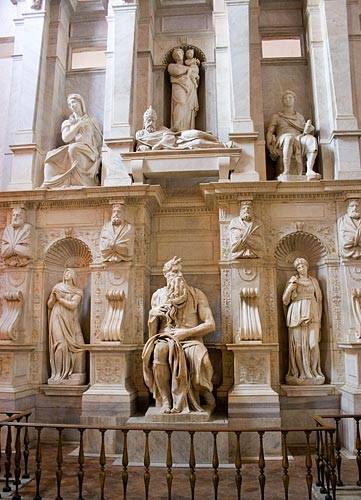
Today, Pope Benedict XVI greeted pilgrims at the weekly audience. What a grand way to begin the Consistory pilgrimage! Read more about the audience. Following the audience, pilgrims left St. Peter’s to travel to the Church of St. Peter in Chains. Here we remember that Peter was imprisoned in Jerusalem and the chains at the base of the altar are said to be the chains that imprisoned him. While at the church, the pilgrims will also see Michelangelo’s famous statue of Moses with “horns.” These horns were popular among artists in Medieval time as a symbol of holiness because in Hebrew, the word for “beams of light” and “horns” is similar. The exterior horns are a sign of the interior radiance of the Lord.
Read: Luke 19:11-18
Reflect: Fr. Justin Huber was the celebrant of the Pilgrmage Mass and asked pilgrims to conside what our checkbooks and our calendars say about the outward expression of our interior lives.
“…the Lord uses this parable to speak to us about the perennial truths of the spiritual life. It is interesting to note that money is the tool that is able to store and transport material or worldly value. It acts as a neutral intermediary between good ands services, which can be converted into nearly anything. But, one could ask: could a carrier of material value be converted into something of spiritual value? Is there something that stands at this interface between the material and the spiritual?
It has been said that if you want to know what a person truly values in life, then look at their calendar and their checkbook. Time and money are the two resources that we use to acquire the things that we value. In our Gospel today, Christ is inviting each of us to invest what we value most. Beyond just time and money, he is asked each of us to offer over to him our entire life; this includes our gifts and our talents and all that we are. For, it is none other than Christ who stands at the interface between the material and the spiritual. Union with God is both the origin and the final goal of humanity and it is Christ who leads us back to the father. It is in Christ’s will, in the offering of our lives over to his will, that we find the opportunities that will lead to our own growth and that of the Kingdom of God. Anything less is not merely standing still, but it is moving backward.
On Wednesday, October 20th, shortly before announcing the Consistory, which will create 24 new cardinals, Pope Benedict XVI remembered the life of St. Elizabeth of Hungary. She offered over her life, the life of a noblewoman, to the service of the poor. As providence would have it, we celebrate her feast today, 779 years after this humble woman’s death.
Saint Peter also offered over his life. The humble fisherman, who became the Prince of the Apostles, placed his entire life, the good and the bad, in Christ’s hands and it was transformed. The chains beneath this altar, which are said to have bound him as he lie in prison in Jerusalem, were miraculously unfastened by an Angel, as accounted in the Acts of the Apostles. Today, we still venerate them as a sign of the transformative power of God. The place of his burial has now been transformed into the largest Basilica on Earth and has become a place of spiritual pilgrimage, a place were we will go to pray on Saturday morning as Cardinal-designate Wuerl will receive the red biretta and become Donald Cardinal Wuerl.
Indeed, even Rome stands as a visible witness to the transformative power of God. The art and architecture, which has transformed the city, dot the paths of the saints, who were transformed by God and who themselves transformed the Church. As we follow these paths on our pilgrim journey, we offer our lives anew to the Lord, who alone has the power to bring extraordinary growth from the ordinary offering of our daily lives.”
Respond
Take a look at your checkbook and calendar for the past month…what is it saying?
In my school, we have a small display board dedicated to Black Catholic history. One of the items on the board is the biography of the Pope Victor I. Pope Victor I was the 14th Bishop of Rome and the first from Africa. In fact, there are three popes who are African, the other two being Pope Militiades who reigned from 311 to 314 A.D. and Pope Gelasius who reigned from 492 until 496 A.D. Out of all of the facts on this board, the fact that there have been Black Pontiffs seems to gain the most interest – and sometimes, disbelief.
Black Catholic History in the Archdiocese of Washington
I was blessed to grow up in the Archdiocese of Washington. We have had a strong and vibrant Black Catholic culture here for generations and thus, the ethnicity of Pope Victor I is not incredible to me. We have parishes dating back to before the Civil War such as St. Augustine Roman Catholic Parish, which was founded in 1858. We have the examples of pioneering Black priests such as Rev. Patrick Healy, SJ (pictured above) who served as the president of Georgetown University from 1874 until 1882. Even the first Black permanent deacons where ordained for the Archdiocese of Washington as part of the inaugural class in early 1970’s. Growing up here, I knew that there had been Popes of African decent, parishes where our culture and style of worship is integrated into the Mass and priests, deacons and religious that continue to serve our community with passion and love.
More to come
For the next few posts, I hope to share some of these facts and stories with you. I may also share how these stories have helped me to celebrate the diversity of the Roman Catholic Church.
The video at the bottom is of Archbishop Timothy Dolan speaking on Dorothy Day. It is a clip of a longer sermon you can see here: Archbishop Dolan on Dorothy Day
In the Sermon the Archbishop speaks of Dorothy Day’s love for the Church. He remarks that there are many people today who want Christ without the Church. For Dorothy Day and for us: No can do. Christ is found with his Church: warts and all, sinners and saints, even me, Oh Lord! Jesus Christ was found among sinners, such that it scandalized many. He was crucified between two thieves. He was found in very questionable company. Do you get it? You won’t find Christ by walking away from the company he keeps.
The hatred of the Church is growing in our culture and many of the ring leaders claim to know Christ and think they can find him only in purer air, a room of their own choosing. But Christ is found where he is found. The Pharisees expected to find the Messiah on their terms. But Jesus was found where he was found. He was not from the educated in Jerusalem, but of the peasants in Galilee. He spoke with a Galilean “hick” accent and walked among the poor, the nobodies, the sinners, the uninformed and unenlightened.
Today, the menu is a little different. In Jesus’ time it was a religious aristocracy that sneered at his followers. Today, the world is secular and those who sneer see believers as simple-minded, unscientific, unenlightened and intolerant. And we are sinners to be sure. Some of the charges against us are true. Actual sinners are we. The Church is a hospital for sick people who need a doctor. Some of the other charges of our sinfulness are less deserved: that we are collectively intolerant, hateful, bigoted, etc.
But despite all this, I know by faith that this is where Christ is found. Those who want Jesus without his Church not only seek him in vain, they risk reinventing him altogether. He is found where he is found.
Dorothy Day’s Witness and help – But what of the Church’s imperfections? In the video Archbishop Dolan reminds us: Ecclesia semper reformanda (The Church is always reforming). It’s people like Dorothy Day (and many of you) through whom God works this work. Dorothy Day was very sober about the Church’s imperfections and spoke of them often. She was a prophet and true prophets know how to comfort the afflicted and afflict the comfortable (and we are all in both categories from time to time).
What I most like about Dorothy Day is that I knew she loved the Church and because of that I trust her. I have found that, in order to stretch my boundaries and be truly challenged, I need to trust my teachers and leaders. It’s people I can trust who lead me to stretch my horizons. Knowing that Dorothy Day so loved the Church, the liturgy and the Lord in the Blessed Sacrament makes be trust her judgment. She, like Jesus, was not easily categorized. She will not simply conform to earthly categories for she had heard from heaven.
I’d like to say a little more of Dorothy in weeks to come on the blog for I think she is one who can help get both wings of the Church flying together. There is a tendency for the Church to divide out between the moral issues, and the social issues. But it takes two wings to fly, and Dorothy Day is one of those who show how it can be done. Allow me a little time to get a few thoughts together. And some of you might also point me in the right direction with suggestions.
For today simply this reflection: Dorothy Day loved the Church. And any true reformer of the Church must love her and her Lord and Spouse, Jesus.
Some of my favorite Dorothy Day quotes are:
Don’t call me a saint. I don’t want to be dismissed so easily.
I firmly believe that our salvation depends on the poor.
Men are beginning to realize that they are not individuals but persons in society, that man [who is] alone is weak and adrift, that he must seek strength in common action.
Together with the Works of Mercy, feeding, clothing and sheltering our brothers, we must indoctrinate.
We are eating while there is famine in the world.
We cannot build up the idea of the apostolate of the laity without the foundation of the liturgy.
Tradition! We scarcely know the word anymore. We are afraid to be either proud of our ancestors or ashamed of them. We scorn nobility in name and in fact. We cling to a bourgeois mediocrity….
I really only love God as much as I love the person I love the least
You will know your vocation by the joy that it brings you. You will know.
Life itself is a haphazard, untidy, messy affair.
We can throw our pebble in the pond and be confident that its ever widening circle will reach around the world. We repeat, there is nothing we can do but love, and, dear God, please enlarge our hearts to love each other, to love our neighbor, to love our enemy as our friend.
My strength returns to me with my cup of coffee and the reading of the psalms.
Don’t worry about being effective. Just concentrate on being faithful to the truth.
Those who cannot see Christ in the poor are atheists indeed.
Once a priest told us that no one gets up in the pulpit without promulgating a heresy. He was joking, of course, but what I suppose he meant was the truth was so pure, so holy, that it was hard to emphasize one aspect of the truth without underestimating another, that we did not see things as a whole, but through a glass darkly, as St. Paul said.
On this glorious fall day, runners and walkers from all over the archdiocese are winding their way across the National Mall, through the streets of D.C. ,over the bridge and into Virginia as they compete in the Marine Corps Marathon and Marine Corps 10 K race.
ON A MISSION
Not only did they make the commitment more than six months ago to train for one of the two races, the 10K folks promised to raise $250.00 each and the marathoners $450.00 each to support vocations work in the archdiocese. Runners hosted benefit nights at Five Guys Burgers, bake sales at their places of work and parishes, and practiced the age-old monastic art of begging family, friends, co-workers and neighbors. More importantly, they committed some of their time to pray for vocations. They have prayed for our men at every stage of formation for priesthood. They have prayed for men considering priesthood to be open to God’s calling and to make the commitment to explore the possibility. I know when I trained for the 10 k last year, when the running got tough, I prayed a rosary–on-the–run for vocations and for many other intentions!
IT’S NOT TOO LATE TO PARTICIPATE
This year, I am on cheering duty, I will be out on the mall to give encouragement and offer a few prayers for our competitors. We can’t be more proud and more grateful for their support. Whether they have the race of their lives or a really tough run, they have succeeded in helping our Vocation Office continue to expand its work–so as St. Paul’s exhorts, “they have competed well for the faith!” And you too can participate! Please take some time today to pray for our racers, to pray for vocations and to pray for our priests who serve our archdiocese so well.
The Gospel today is of the familiar and endearing story of Zacchaeus, a man too short to see Jesus, who climbs a tree, encounters Jesus, and is changed. The danger with familiar stories is that they are familiar and we can miss remarkable qualities. Perhaps it is well that we look afresh and search for the symbolic in the ordinary details.
1. Shortsighted Sinner – Zacchaeus was physically short, and so, could not see the Lord. But let me ask you, do you think that Luke has told us this merely to indicate his physical stature? Well, I’m a preacher and I’m counting on the fact that there is more at work here than a physical description. I suspect it is also a moral description. Zacchaeus cannot see the Lord because of the blindness sin brings. It is his moral stature that is the real cause of his inability to see the Lord. Consider some of the following texts from scripture that link sin to a kind of blindness:
My iniquities have overtaken me, till I cannot see. (Ps 40:12)
I will bring distress on the people and they will walk like blind men, because they have sinned against the LORD (Zeph 1:17)
They know not, nor do they discern; for God has shut their eyes; so that they cannot see, and their minds so that they cannot understand (Is 44:18)
Because of the sins of her prophets and the iniquities of her priests, who shed within her the blood of the righteous, now they grope through the streets like men who are blind (Lam 4:13)
Unless one is born again by water and the Spirit, he cannot see the Kingdom of God. (John 3:5)
Blessed are the pure of heart for they shall see God. (Matt 5:8)
So sin brings blindness, an inability to see the Lord. Now Zacchaeus has fallen short through sin and hence he cannot see Jesus. “How has he sinned?” You might say. Well, he is the chief tax collector of Jericho. Tax collectors were wicked men, I tell you no lie. The Romans recruited the mobsters of that day to collect taxes. These were bad guys. They ruffed people up and extorted money from them. The Romans permitted them to charge beyond the tax as their “cut” of the deal. They were corrupt, they exploited the poor and schmoozed the powerful. These were men who were both feared and hated, and for good reason. They were, to a man, wicked and unjust. Zacchaeus was not just any Tax Collector, he was Chief Tax collector. He was a mafia boss, a Don, a “Godfather.” Got the picture? Zacchaeus isn’t just physically short. He’s the lowest of the low, he doesn’t measure up morally, he comes up short in terms of justice, he’s a financial giant, but a moral midget. Zacchaeus is a shrimp, well short of a full moral deck. That he cannot see the Lord is not just a physical problem, it is a moral one.
Now I am not picking on Zacchaeus. For the truth be told we are all Zacchaeus, Zacchaeus is us. You say, “Wait a minute, I’m not that bad.” Maybe not but you’re not that good either. In fact we’re a lot closer to being like Zacchaeus that to being like Jesus. The fact that we are not yet ready to look on the face of the Lord is demonstrable by the fact that we’re still here. We’re not ready and not righteous enough to look upon the unveiled face of God. How will Zacchaeus ever hope to see the Lord? How will we? Let’s read on.
2. Saving Sycamore– Zacchaeus climbs a tree to see Jesus. So must we. And the only tree that can really help us to see the Lord is the tree of the Cross. Zacchaeus has to cling to the wood of that old sycamore to climb it, and we too must cling to the wood of the old rugged cross. Only by the wood of cross and power of Jesus’ blood can we ever hope to climb high enough to see the Lord. There is an old Latin chant that says, Dulce lignum, dulce clavos, dulce pondus sustinet (sweet the wood, sweet the nails, sweet the weight (that is) sustained). So Zacchaeus foreshadows for us the righteous that comes from the cross by climbing a tree and being able to get a glimpse of Jesus.
3. Sanctifying Savior– Jesus stops by that tree, for we always meet Jesus at the cross. And there at that tree, that cross, he invites Zacchaeus into a saving and transformative relationship. It is not a surprise that Jesus invites himself for what amounts to dinner at Zacchaeus’ house. Though dinner is not mentioned here, it was just a basic aspect of Jewish hospitality. But remember, it is Jesus who ultimately serves the meal. Consider these texts:
Here I am! I stand at the door and knock. If anyone hears my voice and opens the door, I will come in and eat with him, and he with me. (Rev 3:20)
And I confer on you a kingdom, just as my Father conferred one on me, so that you may eat and drink at my table in my kingdom (Luke 22:29).
As they approached the village to which they were going, Jesus acted as if he were going farther. But they urged him strongly, “Stay with us, for it is nearly evening; the day is almost over.” So he went in to stay with them. When he was at the table with them, he took bread, gave thanks, broke it and began to give it to them. (Luke 24:28-30)
Yes, Zacchaeus has now begun to see the Lord, and the Lord invites him into a Holy Communion, a relationship and a liturgy that will begin to transform him. And Zacchaeus is us. We too have begun to see the Lord through the power of the Cross to cast out our blindness and the Lord draws us to sacred Communion with him. The liturgy and Holy Communion are essential for this, as the Lord invites himself to our house, that is to say, our soul and our parishes.
4. Started Surrender – Zacchaeus is experiencing the start of a transformative relationship. But this is just the start. Note that Zacchaeus promises to return four-fold the money he has extorted and also to give half his money to the poor. Now there’s an old song that says, “I surrender all….” but Zacchaeus isn’t quite there yet, and, probably most of us aren’t either. Eventually Zacchaeus will surrender all, and so will we. But in time. For now he needs to stay near the cross to see and continue to allow Jesus to have communion with him. One day all will be surrendered.
So here is the start for Zacchaeus and us. The best is yet to come. You might say, that the Gospel ends here to make a long story short 🙂
This song says, “I was sinking deep in sin, far from the peaceful shore. Very deeply stained within, sinking to rise no more. But the master of the sea heard my desparing cry and from the waters lifted me, now safe am I. Love lifted me! When nothing else could help, love lifted me!”
Catholics have often endured the charge that we are an unbiblical Church. Strange accusation, really, for the Church that collected the Scriptures, determined the canon of Scripture and preached it for 1,500 years before there ever was a Protestant denomination. The fact is we are quite biblical and often in ways that are stunningly powerful.
For the Church, the Scriptures are more than merely ink spots on a page. The Scriptures are manifest in how we live, how we are organized hierarchically, our sacraments, our liturgy and even in our buildings. Long before most people could read, the Church was preaching the Gospel and to do so she used the very structure of her buildings to preach. Many of our older builds are a sermon in stone and stained glass. The Scriptures come alive in our art, statues, paintings, and majestic stained glass windows that soar along the walls of our Churches like jewels of light. Even the height and shape of our older churches preach the word. The height draws our sights up to heaven as if to say, Since you have been raised to new life with Christ, seek the things that are above where Christ is seated at God’s right hand (Col 3:1). And the shape of most of our older churches is the shape of a cross. As if to say, May I never glory in anything, save the Cross of my Lord Jesus Christ (Gal 6:14).
My own Parish Church is a sermon in stone and wood and glass. It is designed around the book of revelation, Chapters 4 and 5 in which John is caught up into heaven and describes it in detail. The fundamental design of the sanctuary drawn from Revelation 4 and 5 includes the throne-like altar (Rev 4:2), seven tall candles around the throne (Rev 4:5), the four living creatures in the clerestory windows above the altar (Rev 4:6-8). At the center of the altar is the tabernacle wherein dwells the Lamb once slain who lives forever, Jesus (Rev 5:6). Around the throne (altar) are seated the twenty-four elders (Rev. 4:4) symbolized by the 12 wooden pillars on the back sanctuary wall and the 12 stained glass windows of the Apostles in the transept windows. The multitude of angels who surround the throne (Rev 5:11) are symbolized by the blue and gold diamonds on the apse wall.
In effect the builders of my Church (built in 1939) were saying, when you walk into this church, you have entered heaven. Indeed, it is a replica of the heavenly vision of John. And when we celebrate the liturgy it is more than a replica for we are taken up to heaven in every Mass where we join countless angels and saints around the heavenly altar. There we worship God with them. We don’t have to wait for some rapture, we go there in every Mass.
I have assembled pictures of these details along with the scripture texts from Revelation in the following PDF document:
Perhaps your own parish buildings also speak to you in stone and wood and glass. It is sad that many more modern Church buildings have little to say or teach as ancient traditions of church building were set aside in the 1960s. But I think that is beginning to change. Some of the very newest churches have returned to the more ancient practices. I pray it continues. Our buildings are meant to be a testimony to our faith.
Here’s a little video I put together on the architectural details of Holy Comforter – St. Cyprian Church:
There’s an old saying on pride that goes: “Faults in others I can see, but praise the Lord, they’re none in me!” It’s a steel trap statement because one is snared in sin by the very act of claiming they have no sin. And it’s the biggest sin of all: Pride!
In today’s Gospel, the Lord illustrates this very point in speaking to us of two men who go to to the temple and pray. One man commits the greatest sin of all, pride, and leaves unjustified. The other, though a great sinner, receives the gift of justification through humility. Let’s look at what the Lord teaches us.
1. Prideful Premise – Jesus addressed this parable to those who were convinced of their own righteousness . When it comes to parables, it is possible for us to go right to the parable and miss the introductory statement that often tells us what spurred Jesus to give the parable. Many simply see this parable as being about arrogance. But there is more to it than that. Jesus is addressing this parable to those who are convinced of their own righteousness. They are under the illusion that they are capable of justifying and saving themselves. They think they can have their “own righteousness,” and that it will be enough to save them. But the truth is, there is no saving righteousness apart from Christ’s righteousness. I do not care how many spiritual push-ups you do, how many good works you do, how many commandments you keep. It will never be enough for you to earn heaven. On your own you are not holy enough, to ever enter heaven or save yourself. Scripture says, One cannot redeem himself, pay to God a ransom. Too high the price to redeem a life; he would never have enough (Psalm 49:8-9) Only Christ and HIS righteousness can ever close the gap, can ever get you to heaven. Even if we do have good works, they are not our gift to God, they are his gift to us. We cannot boast of them, they are his. Again Scripture says, For by grace you have been saved through faith, and this is not from you; it is the gift of God; it is not from works, so no one may boast. For we are his handiwork, created in Christ Jesus for the good works that God has prepared in advance, that we should walk in them (Eph 2:8-10).
But the Pharisee in the Parable has a prideful premise that is operative. Jesus says he is convinced of his OWN righteousness. Notice how, in his brief prayer he says “I” four times:
I thank you
I am not like the rest of humanity – greed, dishonest, adulterous
I fast
I pay tithes
It is also interesting that the Lord, when telling the of the prideful Pharisee, indicates that he “spoke this prayer to himself.” Some think it merely means he did not say the prayer out loud. But others suspect that more is at work here, a double meaning if you will. In effect, the Lord is saying that his prayer is so wholly self-centered, so devoid of any true appreciation of God that it is actually spoken only to himself. He is congratulating himself more than really praying to God, and his “thank you” is purely perfunctory and serves more a premise for his own prideful self adulation. He is speaking to himself alright. He is so prideful that God can’t even hear him.
Hence we see a prideful premise on the part of the Pharisee who sees his righteous as his own, as something he has achieved. He is badly mistaken.
2. Problematic Perspective– and despised everyone else. To “despise” means to look down on others with contempt, to perceive others as beneath us. Now the Lord says the Pharisee did this. Notice how the Pharisee is glad to report that he is “not like the rest of humanity.” Not only is his remark foolish, it is also impertinent. For, it is a simple fact that you and I will not get to heaven merely by being a little better than someone else. No indeed, being better than a tax collector, prostitute, drug dealer, or dishonest business man is not the standard we must meet. The standard we must meet is Jesus. He is the standard. And Jesus said, Be perfect, therefore, as your heavenly Father is perfect (Matt 5:48). Now, somebody say, Lord have mercy! It is so dangerous, and a total waste of time, to compare our self with others because it wholly misses the point. The point is that we are to compare our selves to Jesus and to be conformed to him by the work of his grace. And, truth be told, any honest comparison of our self to Jesus should make us fall to our knees and cry out for mercy, because the only way we stand a chance is with boatloads of grace and mercy.
It is so silly, laughable really, that we compare our selves to others. What a pointless pursuit! What a fool’s errand! What a waste of time! God is very holy and we need to leave behind the problematic perspective of looking down on others and trying to be just a little better than some poor (and fellow) sinner. It just won’t cut it. There’s a lot of talk today about being “basically a nice person.” But being nice isn’t how we get to heaven. We get to heaven by being Jesus. The goal in life isn’t to be nice, the goal is to be made holy. We need to set aside all the tepid and merely humanistic notions of righteousness and come to understand how radical the call to holiness is and how unattainable it is by human effort. Looking to be average, or a little better than others, is a problematic perspective. It has to go and be replaced by the Jesus standard.
Let’s put it in terms of something we all can understand: money. Let’s say that we’re on our way to heaven and you have $50 and I have $500. Now I might laugh at you and feel all superior to you. I might ridicule you and say, “I have ten times as much as you!” But then we get to heaven and find out the cost to enter is 70 trillion dollars. Oops. Looks like we’re both going to need a LOT of mercy and grace to get in the door. In the end, we are both in the same boat and all my boasting was a waste of time and quite silly to boot. We have a task so enormous and unattainable that we simply have to let God grant it and accomplish it for us. And this leads to the final point.
3. Prescribed Practice – But the tax collector stood off at a distance and would not even raise his eyes to heaven but beat his breast and prayed, ‘O God, be merciful to me a sinner.’ Given everything we have reflected on, we can only bow our head and cry from the heart, “Lord have mercy!” Deep humility coupled with lively hope are the only answers. And here too, being humble isn’t something we can do. We have to ask God for a humble and contrite heart. Without this gift we will never be saved. We are just to proud and egotistical in our flesh. So God needs to give us a new heart, a new mind. Notice that the tax collector in today’s parable did three things, three things we ought to do:
Realize your distance – the text says he stood off at a distance. He realizes that he is a long way from the goal. He knows how holy God is, and he himself is very distant. But his recognition of his distance is already a grace and a mercy. God is already granting the humility by which he stands a chance.
Recognize your disability – The text says he would not even raise his eyes to heaven. Scripture says, No one can see on God and live (Ex 33:20). We are not ready to look on the face of God in all its glory. That is evident by the fact that we are still here. Scripture also says, “Blessed are the pure of heart for they shall see God” (Matt 5:8). This tax collector recognizes his disability, his inability to look on the face of God for his heart is not yet pure enough. So in humility he looks down. But his recognition of his disability is already a grace and a mercy. God is already granting the humility by which he stands a chance.
Request your deliverance – the text says he beat his breast and prayed, ‘O God be merciful to me, a sinner.” Notice then how his humility is steeped in hope. He cannot save himself but God can. He cannot have a saving righteousness of his own, but Jesus does. So this tax collector summons those twins called grace and mercy. In this man’s humility, a grace given him by God. He stands a chance. For, by this humility, he invokes Jesus Christ who alone can make him righteous and save him. Beg for humility. Only God can really give it to us. The humble, contrite heart the Lord will not spurn (Ps 51:17). And thus Jesus says, whoever humbles himself will be exalted.
Beware of Pride. It is our worst enemy. Beg for the gift of humility, for only with it do we even stand a chance.
I have it on the best of authority that, as he left the Temple, the tax collector sang this song: “It’s Me O Lord, Standing in the Need of Prayer!” Here it is sung by a German choir which explains their unusual pronunciation of “prayer.” It’s OK though, I don’t pronounce “Geschwindigkeitsbegrenzung” (speed limit) very well either!

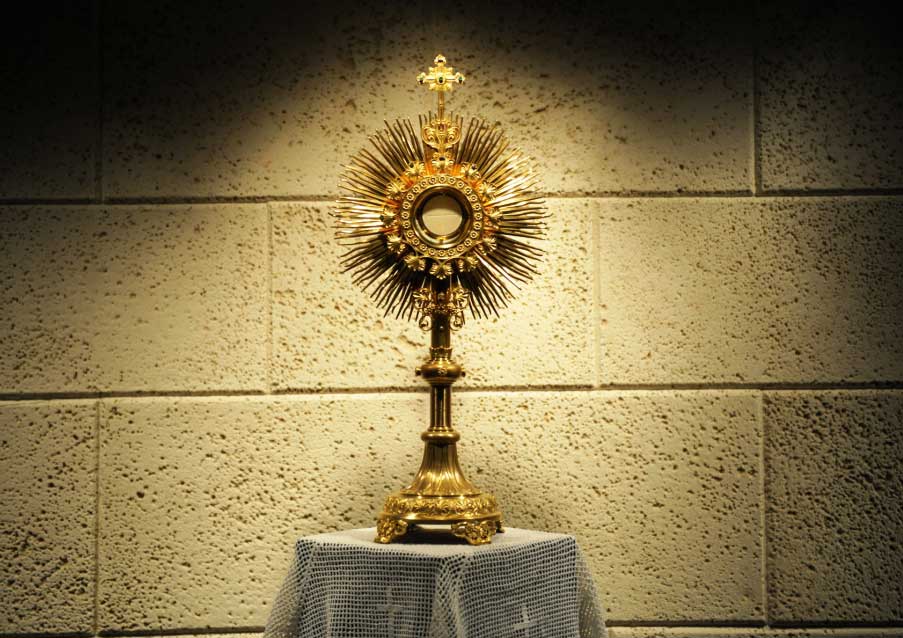 A few days ago, I was out with a couple of friends. We shared a pizza and the usual, “what’s happening in our lives.” We found ourselves talking about the freedom that is found when we begin to practice living the presence of God – the kind of living that begs us to let go of the past and to hand over everything we fear about the future. The kind of living that calls out to us and asks us to live in this very moment. Ironically, or perhaps beautifully, it’s the kind of living that heals our past wounds and gives us the grace to overcome the fears we face.