In the Gospel of Monday of this week, the Feast of St. Martha, there is an interesting dialogue between Jesus and Martha. Martha begins by saying, Lord, if you had been here, my brother would not have died. But even now I know that whatever you ask of God, God will give you. And thus Martha expresses her faith and hope in Jesus. But Jesus seeks to draw her out a bit and to get her to focus her faith in the moment. And thus the dialogue between them continues:
Jesus said to her, “Your brother will rise.” Martha said to him, “I know he will rise, in the resurrection on the last day.” Jesus told her, “I am the resurrection and the life…(John 11:22-23)
In this exchange St Martha articulates a common human tendency to “futurize” the blessings of God. And thus when Jesus speaks of her brother rising, she says, as we all do in effect: “Yes, I know that there will be blessings for me in some distant, and future heaven.”
But Jesus interjects, saying, “I AM the resurrection.” Notice that he does not say, “I will be the resurrection.” In effect he says to her and to us, “I am your resurrection to new life now, not merely in a future heaven. The new life, the eternal life, the life of grace that I died to give you is available to you now. Yes, even at this very moment a whole new way of living, a new and transformed life is available to you.”
Yes Jesus is our resurrection. We have already died and risen with him to the new life he offers. St Paul says in Romans:
All of us who were baptized into Christ Jesus were baptized into his death. We were therefore buried with him through baptism into death in order that, just as Christ was raised from the dead through the glory of the Father, we too may live a new life. (Romans 6:3-4)
So eternal life is now. Surely it will be full in heaven. But it began at our baptism, continues now and, if we are faithful, continues to grow. The phrase “eternal life” does not merely specify the length of life, but also the fulness of life.
Of this I am a witness. At age 52 my body is older, but my soul is more alive than I ever was at 22. I am more confident, more serene, more joyful and prayerful, more aware of God and more loving of God and neighbor. I have seen sins put to death and many new graces and talents come alive. I am more alive at 52 than I have ever been before. And wait till you see me at 82!
And thus Jesus says to St. Martha, and to us: “I AM the resurrection. The life I offer you is now.”
Yet, so easily we can either doubt this, or even seek to defer it. Perhaps we doubt it on account of some struggles or suffering we are currently enduring. Or perhaps we are discouraged by a lack of progress in some area of our life. And so some of us in weakness doubt that the new and eternal life is now.
But our deferring of new and resurrected life is more pernicious for it is rooted in sloth. Too easily we can slip into a kind of excuse-making disposition that prefers to focus on our present limits than on God’s present gifts. And so we will think or say: “I am not responsible for my failings. My mother dropped me on my head when I was two, and my Father was mean….I am only human after all and I am going through a few things now.”
Whether they are true or not, focusing on our present limits and past wounds provides an easy out for the demands of our higher calling. For, if it is true that Jesus has brought us to a new and more glorious life and has set us free, with that freedom and life comes a greater responsibility and higher expectations. But all that is “too much trouble” and so we flee from it and prefer to see heaven and eternal (full) life as something off in the distant future.
This is sloth, namely sorrow, sadness or aversion at the good things God is offering. Rather than to joyfully accept the new life God offers, we draw back into the lesser but more familiar doldrums of mediocrity where excuses and lower expectations dominate.
To all this, Jesus says, “I AM the resurrection.” That is, “Begin now. Lay hold of the life I died to give you. Do not be satisfied with anything less that the vigorous transformation I offer you beginning now! Why not become totally fire?!”
St Martha thought of the blessings only in some future context. It is doubtful that she thought this merely in sloth for she was shocked and saddened by the death of her brother and not yet heir to the gospel as fully preached.
But we too often DO postpone heaven for slothful reasons. And like the Ancients Jews who often seemed to prefer the slavery of Egypt (with its fleshpots and melons and leeks) to the freedom of the desert with its challenges and responsibilities.
Again to us us Jesus offers this simple declaration and invitation: “I AM (now) the resurrection….Do you believe this?”
Beware of sloth and pray for joy at what God offers and zeal to lay hold of it.
Recent remarks by the retired Anglican Bishop Desmond Tutu are not surprising for an Anglican prelate these days, but remain disturbing. Briefly put, the Archbishop says he would rather go to hell than go to a “homophobic heaven.” Here’s some more complete report page of his remarks, in yesterdays Washington Times.
South Africa’s iconic retired archbishop, Desmond Tutu, said on Friday that if he had his pick, he’d go to hell before heading to a heaven that condemned homosexuality as sin. “I would not worship a God who is homophobic and that is how deeply I feel about this,” he said, by way of denouncing religions that discriminate against gays, in Agence France-Presse….He added, AFP reported: “I would refuse to go to a homophobic heaven. No, I would say sorry, I mean I would much rather go to the other place.” [1][2]
In fairness to the good Archbishop, the full context of these remarks is not included in the report but includes (but is not limited to) concerns about violence directed against homosexuals. Further, his many works on behalf of racial justice remain intact and were part of a noble struggle.
That said, there are several disturbing aspects to the archbishops comments:
1. He describes his opponents over-generally in this matter by using the term “homophobic.”And while it may be true that somewhere on this planet there are individuals who are truly “fearful” (=phobia) of homosexual persons, or who hate them merely because they are homosexual, the use of the word “homophobic” is it best unhelpful, and at worse an uncharitable and inaccurate description. Most of us who oppose the approval or celebration of homosexual acts do so not in fear, but on principle, based on biblical and natural law reasons.
It is possible that the good archbishop is speaking only of the tiny minority who fear or hate homosexuals simply for their existence. And there are legitimate concerns, as expressed by the Archbishop, about countries where homosexual acts are criminalized (along with fornication and adultery). Perhaps this is not the best way to deal with these matters. Where there are acts of violence against homosexual persons, they are rightly condemned, as a are any acts of violence.
But I was not born yesterday, and it seems clear enough that Archbishop Tutu also means people like me when he uses the term “homophobic.” And he most likely includes the Catholic Church when he denounces religious bodies that “discriminate” against homosexual persons (a charge I certainly deny) because we do not condone homosexual activity. Yes, it would seem he surely includes us in his category of “homophobic.” For he has chosen to use a word that is widely bandied about to refer to all persons, even those of sincere conscience, who oppose the militant homosexual agenda. And if the archbishop does not mean me or the Catholic Church, at the very least I should hope for a clarification on his part.
It is a tired old tactic of many who support the approval and celebration of homosexual acts to use terms to describe their opponents that are both ridiculing, and paint us in the darkest possible terms (e.g. hateful, bigoted, discriminatory etc). Surely the Archbishop must know, even if he does not agree with many of us who oppose approval of homosexual activity and same-sex unions, that we think and speak out of an ancient biblical tradition which we believe to be the very word of God.
And while some today employ many dubious, or at least debatable interpretive theories of Scripture to avoid what the biblical texts clearly do say, it remains very evident to many of us that at every stage of biblical revelation, from the first pages of the Bible all the way to its concluding pages, that homosexual activity is condemned as sinful. I have written more on that here: Letter on Homosexuality
Disagree with me if you sadly must, but I am no more homophobic than I am forniphobic for opposing fornication.
A simple request, of the archbishop would be a clarification and to avoid name-calling and simplifying the positions of his opponents. Likewise, for all who use similar tactics. It isn’t becoming to serious conversation, and surely is unbecoming of a Christian archbishop.
2. Any version of the words “I’d rather go to hell” should not pass the lips of anyone, let alone a Christian, even more so a Christian leader. Statements like these tend to invite unwanted demonic activity, and open the door to the wrong sorts of forces and drives.
While one can certainly hold the good archbishop was engaged in rhetorical flourish and hyperbole, it remains true that words to wit: “I’d rather go to hell” should not be uttered for the reasons stated.
And even if it be so that it is merely hyperbole, why should such anger be engaged and deployed so widely? Does he really mean to speak this way, about a behavior that is reasonably rejected among Christians who read God’s word?
If the good archbishop considers me his enemy in this matter, did not the Lord say something about loving our enemies? If the archbishop considers me and others like me his persecutors, did not the Lord say that we should pray for our persecutors? Why would an archbishop theoretically familiar with God’s Word, say to me or others like me in effect, “I’d rather go to hell than live with you in heaven.” Whence this anger, and the great lack of charity? It is wrong even to speak this way about those who who do act violently or hatefully toward homosexuals. Enemies are to be loved, persecutors prayed for.
3. Archbishop Tutu in an excerpt not quoted above but available by clicking on the links above equates the struggle against “homophobia” with the struggle against apartheid. As the pastor of a largely African American Parish, I know many Blacks who are troubled by the equating of the demands of homosexual activists with those of the civil rights activists some years ago. The concerns about homosexual acts regard behavior, whereas the concern of the civil rights movement was about race and discrimination based solely on that, not on behavior.
In particular, the Catholic Church distinguishes between homosexual orientation (disordered, but not per se sinful) and homosexual acts (sinful, as are acts of fornication and adultery in accord with the clear teaching of Sacred Scripture).
It is unjust to excoriate others for their opposition of behavior with the logic that pertains to a non-behavioral trait such as race.
Some will argue that “God made them this way.” I am not so sure about that but will accept that most do not simply choose sexual orientation. That said, alcoholics, diabetics, and people who struggle with anger, do not choose these inclinations or struggles either. Nevertheless they must strive to act uprightly in spite of them. Heterosexuals are also summoned to act uprightly in spite of the often unruly sexual passions we possess. The God made me this way argument is does not set aside the question of behavior.
The opposition of the Church is about behavior, not how one is tempted or inclined. Chastity remains the rule for all. Those who have not received the Sacrament of Holy Matrimony and the Scriptures set it forth must refrain form genital sexual contact. Those who have received Holy Matrimony must stay faithful to one to their husband or wife.
4. Some note should be given to the phrase “homophobic heaven” spoken by the Archbishop.
First of all the concept of a “homophobic heaven” is a null set. For if there is true homophobia, it is rooted in fear and possibly in hate and these do not pertain to heaven. But as for the opposition to homosexual acts (along with heterosexual acts such as fornication and adultery), that is not homophobia, it is the stated opposition of God to such acts as clearly recorded in scripture. God is not homophobic, but he does oppose homosexual acts. Calling God homophobic, or his Church or St. Paul or any other person does not make them homophobic. Opposition to the radical Gay agenda does not thereby make God or heaven “homophobic.” If it does not please Archbishop Tutu that homosexual acts are not approved or celebrated in heaven I suppose he does not have to go there. But he cannot simply expect heaven to be on his terms. Heaven is what it is, the fullness of the Kingdom of God and all it values, one of which is Chastity, and opposition to all acts contrary to it.
There is a lamentable tendency today for many Christians to define heaven on their own terms: “Heaven will be a place of pleasure, as I define pleasure. I will be among the company of those I choose, and everything will be on my terms.”
But of course, this is not what heaven is. Heaven is the fullness of the kingdom of God, the fullness of the values of the kingdom of God. Heaven is to be with God himself who is justice and truth, as he has set these forth. Heaven is about things like love of God, the liturgical worship of the Lord, love for the poor, love for my enemy, mercy, forgiveness, and yes, chastity!
Rather than to define what Heaven is for us, it is our work, to learn who God is and what heaven is as God has revealed it, and to begin by his grace to acclimate ourselves for the heaven that really is. Yes, we must be prepared to meet the real God, the biblical God, not some fake god. And we should be prepared to go to the real heaven, not some fake “designer heaven.”
Pillar of truth – We have no better indication of who God really is, what heaven is, and what God really expects of us than the revealed Word of God, in the Scriptures and the Sacred Tradition of the Church.
Sadly, the larger portion of the Anglican denomination departed from these pillars sometime ago. Scripture is radically reinterpreted so that it often does not mean what the text clearly says. Further, The ancient biblical wisdom, both in the Old Covenant and the New, along with the apostolic and sacred Tradition have been set aside in favor of modern teachings barely 20 to 30 years old. This sadly is the course that the Anglican denomination, along with many other mainline Protestant denominations have taken.
On the other hand, the sure and certain testimony of the Word of God, about who God really is, this is where I, and others like me must stand. I can do no other, for God has revealed no other certain and surer source to know who He is what I must do. If this makes me the Archbishop’s enemy such that he would rather live in Hell than with with me, so be it.
But here I stand, I can do no other, for the Word of the Lord has spoken through his Church and the Sacred Scripture entrusted once and for all to his Church.
One of the great “evils” of our time is satiation. I put the word “evil” into quotes here to emphasize that no particular good thing that God has made is, in itself evil. But we, on account of our own inordinate drives, accumulate and indulge beyond reason. And in becoming satiated, that is filled, we leave little room for God or others for that matter.
The more affluent we become in material things, the more spiritually poor we seem to become. The higher our standard of living, the lower our overall morals. The more filled our coffers, the emptier our Churches. This is the evil of our times. And it is no theory. The numbers demonstrate well that, over the past 60 years that as our standard of living has risen, church attendance and other signs of belief and spirituality have plummeted. So has family time, and the developing of deeper human relationships. Marriage rates have plummeted, divorce has soared. Birthrates are down. Kids are a burden in a satiated world with a high standard of living.
And it isn’t just wealth. It’s all the things which distract and divert us. There are so many things, most of them lawful pleasures, but often just too much of a good thing.
One might imagine another scenario wherein we were astonished by God’s providence and fell to our knees in gratitude, and in our riches, and possession of many good things and pleasures went to prayer and church even more, out of sheer gratefulness. Alas this is seldom the case today.
Proverbs 30 says,Give me neither poverty nor riches; Feed me [only] with food that I need for today: Lest I be full, and deny you, and say, Who is the LORD? or lest I be poor, and steal, and take the name of my God in vain. (Proverbs 30:9-10).
Yes, indeed…lest I be full and denying you say, “Who is the Lord?” It is indeed a snare in our times that many think they do not need God, or others. Our affluence creates the illusion of self sufficiency and self fulfillment.
St. Augustine sadly noted in a time far less satiated than our own: I, unlovely, rushed heedlessly among the things of beauty You made. You were with me, but I was not with You. Those things kept me far from You, which, unless they were in You, would not be. (Conf 10.27).
Many other scriptures warn of the spiritual danger posed by wealth and worldly satiation:
But those who desire to be rich fall into temptation, into a snare, into many senseless and hurtful desires that plunge men into ruin and destruction. For the love of money is the root of all evils; it is through this craving that some have wandered away from the faith and pierced their hearts with many pangs. (1 Tim 6:9-10)
No servant can serve two masters. Either he will hate the one and love the other, or he will be devoted to the one and despise the other. You cannot serve both God and Money! (Luke 16:13)
But woe to you who are rich, for you have already received your comfort. Woe to you who are well fed now, for you will go hungry. Woe to you who laugh now, for you will mourn and weep. (Luke 6:24-25)
But many that are first will be last, and the last first! (Mat 19:30).
How hard it is for the rich to enter the kingdom of God!” …It is easier for a camel to go through the eye of a needle than for a rich man to enter the kingdom of God.” (Mk 10:23-25)
It is amazing that, hearing all this most of us still want to be rich and would jump for joy if we won the lottery, instead of soberly cringe with fear and look for good ways to shed our excess.We still continue down a path of unreasonable desire and satiation.
Alas, the human condition, at least the fallen version of it. It isn’t very pretty and is proof positive that we are going to need a lot of grace and mercy to get home.
Think of that this as you watch this video. It’s a pretty stark portrait of the modern man. Consider how full, yet lonely he is. He speaks only of himself, and seems to interact with almost no one: lost in a self-referential world of excess, filled with every good thing, but too full for God. Somehow the man knows that the worldly things fill him for only a moment and pass. But still the answer is more! Quite a little portrait here of too many today.
We are reading the parable of the Sower in Daily Mass. Someone asked me a question: Since the sower is the Son of Man, Jesus himself, why would the Lord, who knows everything ahead of time, sow seed he knew would not bear fruit?
First, let’s review the text:
“A sower went out to sow. And as he sowed, some seed fell on the path, and birds came and ate it up. Some fell on rocky ground, where it had little soil. It sprang up at once because the soil was not deep, and when the sun rose it was scorched, and it withered for lack of roots. Some seed fell among thorns, and the thorns grew up and choked it. But some seed fell on rich soil, and produced fruit, a hundred or sixty or thirtyfold. Whoever has ears ought to hear.” (Matt 13:1-9)
So the question presents, Why then would God waste any seed on rocky or thin soil, or the path?
Perhaps a series of possible “answers” is all we can venture. I place “answers” in quotes since we are in fact touching on some mysteries here of which we can only speculate. So, here are some “answers.”
I. God is extravagant – it is not just seed He scatters liberally, it is everything. There are hundreds of billions of stars in over 100 billion galaxies, most of these seemingly devoid of life as we understand it. Between these 100 billion galaxies are huge amounts of, what seems to be, empty space. On this planet where one species of bird would do, there are thousands of species, tens of thousands of different sorts of insects, a vast array of different sorts of trees, mammals, fish etc. “Extravagant” barely covers it. The word “extravagant” means “to go, or wander beyond.” And God has gone vastly beyond anything we can imagine. But God is love, and love is extravagant. The image of him sowing seeds, almost in a careless way is thus consistent with the usual way of God.
This of course is less an answer to the question before us than a deepening of the question. The answer, if there is one, is caught up in the mystery of love. Love does not say, what is the least I can do? It says “What more can I do.” If a man loves a woman, he does not look for the cheapest gift on her birthday, rather he looks for an extravagant gift. God is Love and God is extravagant.
II. Even if the failed seed represents those who ultimately reject him, God loves that seed anyway. Remember, as Jesus goes on to explain, the seeds that fail to bear fruit, are symbols of those who allow riches, worldly preoccupation, persecution and other things to draw them away from God. But, even knowing this, does not change God’s love for them. He still wills their existence. Scripture says elsewhere, But I tell you: Love your enemies and pray for those who persecute you, that you may be sons of your Father in heaven. He causes his sun to rise on the evil and the good, and sends rain on the righteous and the unrighteous (Matt 5:44-45).
Yes, God loves even those who will reject him and will not, knowing ahead of that rejection, say to them, “You cannot exist.” He thus scatters even that seed, knowing ahead of time that it will not bear fruit. Further, he continues to send the sun and rain, even on those who will reject him.
Hence this parable shows forth God’s unfailing love. He sows seeds, even knowing they will not bear the fruit he wants. He wills the existence of all, even those who he knows ahead of time will reject him.
III. That God sows seeds and allows them to fall on bad soil is indicative of God’s justice. The various places the seed falls is indicative of human freedom, more than illustrative of the intent of God. For one may still question, “Why would God “allow” seed to fall on the path, or among thorns, or in rocky soil?” And the only answer here is that God has made us free. Were He to go and take back the seeds that fell in unfruitful places one could argue that God withdrew his grace and that one was lost on account of this, namely that God manipulated the process by withdrawing every possible grace. But God, in justice calls everyone and offers sufficient grace for all to come to faith and salvation. And thus the sowing of the seed everywhere is indicative of God’s justice.
IV. The variety of outcomes teaches us to persevere and look to faithfully sowing, rather than merely to the harvest. Sometimes we can become a bit downcast when it seems our work has born little fruit. And the temptation is to give up. But, as an old saying goes, “God calls us to be faithful, not successful.” In other words, it is up to us to be the means the means whereby the Lord sows the seed of his Word. The Word is in our hands, by God’s grace, but the harvest is not.
This parable teaches us that not every seed we sow will bear fruit. In fact a lot of it will not, for the reasons described by the Lord in a later part of the parable.
The simple mandate remains ad is this: preach the Word, Go unto all the nations and make disciples. St. Paul would later preach to Timothy: Preach the Word; be prepared in season and out of season; correct, rebuke and encourage–with great patience and careful instruction (2 Tim 4:2). In other words, sometimes the gospel is accepted, sometimes it is rejected. Preach it any way. Sometimes the gospel is popular, sometimes not. Preach it anyway. Sometimes the Gospel is in season, sometimes it is out of season. Preach it anyway. Sow the seeds, don’t give up.
Discharge your duty! St. Paul goes on to sadly remark, For the time will come when people will not put up with sound doctrine. Instead, to suit their own desires, they will gather around them a great number of teachers to say what their itching ears want to hear. They will turn their ears away from the truth and turn aside to myths. But you, keep your head in all situations, endure hardship, do the work of an evangelist, discharge all the duties of your ministry. (2 Tim 4:3-5). Once again the message is the same: preach anyway, sow the seed of the Word, persevere, do not give up, do not be discouraged. Discharge your duty and be willing to endure hardship, just preach! Some of the seed will yield a rich harvest, some will not, preach anyway.
So, permit these “answers.” God sows seed he knows will bear no fruit because he is extravagant, because he loves and wills the existence even of those he knows will reject him, because of his justice, and to teach us to persevere, whatever the outcome.
I interpret this video to mean that God will never withdraw his offer, not that he is trying to force a solution. For though he wants to save us, and promises never to let go, he respects our freedom to let go.
In the Office of Readings today we read from 2 Corinthians 4 where St. Paul well describes the work of the Church in the Public square: Setting forth the truth plainly, we commend ourselves to every man’s conscience in the sight of God (2 Cor 4:2). Not a bad description of our posture and practice toward the secular world.
Yet, that is not often the impression many take from our posture. In what I would called a misplaced fear, many think of the Church as trying impose her power and views on others. In much of the heated public debate on the HHS mandate (that the Catholic Church pay for contraceptives, abortifacients, and sterilization) and over gay “marriage,” there is a strain to the conversation, that somehow, the Catholic Church is trying to “force” people to follow what she teaches.
To think that we have such power is fanciful, but the charge comes up a lot and in different forms. Consider the following comments I gleaned from various sources, mainly from the comboxes of several secular papers. These comments are not made up by me. I cut and pasted them into a reference file over the last two years, they are actual quotes of readers. All of them see us as trying to use power to force others to do what we want. (I have added a few responses in Red just because I can’t resist):
Inasmuch as we can neither prove nor disprove the existence of God, everyone should be free to follow their own path as individuals. You are. The Church doesn’t have the power to force you to do anything. But you are going further than “following your own path.” You are asking for legal recognition of something that has never been recognized before (i.e. Same-sex unions). Expect a little push back. Further, the Catholic Church does not only appeal to God and the Bible but also to Natural Law, because we recognize that not everyone sees the Scriptures with the kind of reverence we do.
When it comes to owning a business that accepts public funds and which will employ believers of every stripe as well as non-believers, the owners have no right dictating the choice of others – Actually it is the Government that is dictating choice. In the HHS mandate, only the government has the power here to compel and punish non-compliance, and they are saying that we must give contraceptives free to anyone who asks for them. The “mandate” says that Catholics, and anyone who objects to sterilization, to abortifacients and contraceptives, (for it is not only Catholics), must pay for them whether they like it or not. As for Gay “marriage,” it is once again the Government that is requiring everyone to recognize what has never been recognized before, that same-sex couples are “married.” And, by gosh, if we don’t recognize them and treat them as married then we will be decertified from adoption services and have to stop providing marital health benefits for our married employees (as happened with Catholic Charities). So there IS a lot of forcing going on here, but it isn’t the Church. We don’t have that power, the State does. And frankly that should make everyone sober, even those who don’t agree with us on these specific issues. EVERYONE ought to be mighty concerned when the State seeks to compel people to act against their conscience.
Just one more example why one should never vote for a Roman Catholic politician who would more likely march in lockstep to the dictates of the Church than follow constitution.Whew! Dream on, we have the opposite problem. Very FEW Catholic politicians live their faith when it comes to political agendas. And if they do, they, like anyone else, they have to face the voters every few years. Further, why is it wrong for politicians to follow, say, environmental agendas, or homosexual agendas, or social justice agendas, but it is WRONG for them to follow religiously inspired agendas?Since when do people of faith have no voice or seat at the table in the world of politics? Are we not citizens who have the right to petition the government for redress etc?
This is about the Catholic church (sic) demanding that people who do not have any allegiance to that church or its dogma live by its rules. We don’t have this power. It is the State (and you?) who are instituting that we pay for what we consider wrong. Why should I have to pay for your contraceptives? Why should you simply demand to get them free?
Today, they are gunning for the gays. Next will be your birth control.We don’t have this power. What we are asking is that we not be compelled to pay for things we consider wrong and sinful.
In pushing your definition of marriage on to all other people and churches, you are in fact trying to ensure that Catholic law remains state law.We don’t have this power. As citizens, and for principled reasons rooted in Scripture and Natural Law, we argue that the law that Has ALWAYS been the law in this land, remain unchanged. We have a right, as citizens, to be part of the political process. One side is going to win, right now it looks like the pro-gay -pseudo marriage folks. How would you feel if I said, “You are pushing your definition of marriage and trying to make it State law?” Why don’t we just admit that we both have a right to be in the public square and advocate for what we think is right? I think you’re wrong headed and confused about marriage and your type loves to call me intolerant and bigoted. I’ll see you at the ballot box. Oh! but wait a minute! Here in DC your advocates on the DC Council would not allow a referendum, you try NOT to allow votes on such matters, but use the legal system to impose your views. And, gee, when we do win at the ballot box as we have in several states, your side runs to a judge and tries to overturn the will of the voters. Hmm….who is throwing power around here? Who’s pushing whose definition on whom? Hmm…?
the church will be better off the more that it gives up its hold on political power.What power? If we’re so powerful, why is the moral meltdown so advanced? Again, are you simply striving to say we should have no voice in the political process? We have a right as citizens to try and influence outcomes, just like you. Frankly we haven’t been very successful lately. I’d love to find out where all this political power we theoretically have is hidden.
OK, well you get the point. A LOT of people think we have a lot more power than we do. Frankly it’s laughable to think think the Catholic Church has all this power. We can’t even unify our own believers. I have written before (with love) that unifying Catholics is like herding cats! I would to God that we could really unify around anything. Then we might be a political force to be reckoned with. And as citizens we would have every right to be such a force. But as it is, we are (sadly) a rather divided lot, even on abortion. I can assure you , most Catholic politicians do NOT have a hotline to the Vatican or take even a scintilla of advice from the Pope or Bishops. And even if they accidentally agree with the Pope or the bishops, for most of them, it is because the politics make sense, not that the faith has “compelled” them. No, don’t worry too much about the “power” of the Church.
That said, I have already commented above (in the red remarks) that Catholics, as citizens of the Untied States of America have the same rights as any other citizen to petition the government, to seek to enact laws that reflect our values and concerns. But we have no more or less power or voice than any other citizen of this Land. We, like others, often band together with coalitions. But again, if this is somehow wrong, then why is it not wrong for feminists, or environmentalists, or unions, or advocates of any number of hundred of other causes to do the same? We are Americans with rights. And people of faith have just as much right to be in the public square and the public conversation as any one else.
Some of the commenters in Comboxes, I survey like to recite grievances from the Middle Ages about Church power then etc. Why not leave the 14th Century politics in the 14th Century, and let’s stay in the 21st Century. There was a LOT of bad stuff in the old days. It wasn’t just the Church, governments too were different then. Modern democratic republics were unknown in those days. Today the political landscape is different. And if the Church ever did have all the power (and some of the claims are exaggerated and the Inquisition is often cartoonishly portrayed) that is not the case today. For our purposes we are in the 21st Century West.
Finally, I return to the quote from St. Paul in today’s office that rather well distills what we, as a Church, and as believers, seek to do in the public square of America. More than acquire power (which is not easy in a wide and pluralistic culture), we seek to commend ourselves, and our message to everyone’s conscience. St. Paul says in context,
Rather, renouncing secret and shameful ways; we do not use deception, nor do we distort the Word of God. On the contrary, by setting forth the truth plainly, we commend ourselves to every man’s conscience in the sight of God (2 Cor 4:2)
Yes, frankly we do have vigorous disagreement with secret (and not so secret), and shameful practices. And we will not, in order to be popular or conformed to these times, distort or misrepresent the Word of God. Abortion is wrong. Fornication, adultery, and homosexual acts are wrong. Divorce, and chosen single parenthood, and so called gay “marriage” are wrong. Contraception, sterilization, embryonic stem cell research, euthanasia, wrong, wrong wrong.
But I cannot force you to obey me. Rather I commend myself to your conscience. And even if Scripture will not be acceptable to you, I will have recourse to Natural Law. I, indeed the whole Church, will continue to commend ourselves to your conscience. And even though the gospel is currently “out of season” (cf 2 Tim 4:2) and you laugh at me and call me names like intolerant, bigoted etc., I will continue to commend myself to your conscience.
As long as I live I will speak the truth in love. And however you choose to understand me I will continue to speak. You may wish to call me hateful. I am not. I invite you to conscientiously consider what I say. I cannot command you, so do not fear me. But I do commend myself to your conscience.
I will meet you in the public square, for that is my right as much as yours. But in the end, mandates and forced adherence are not in my power. I commend myself to your conscience, I do not, I cannot, command you.
Those of this world may choose on their own to be pleased or displeased by what we say. As for me, my prayer is and must remain: May the words of my mouth and the meditations of my heart be pleasing to you my God (Psalm 19:14).
George Weigel recently published an article in First Things that offers a good critique of a common practice in most U.S. Dioceses, that of moving pastors every six to ten years. While some priests are lucky enough to stay longer, most find themselves moving every six or more years. Frankly, both priests and parishes usually suffer as a result.
There are, of course times when it is a good idea for a pastor to move on. Sometimes he is a poor match for the parish in question, sometimes there has been a change in the parish for which he is ill-equipped (e.g. demographic changes, language issues etc). Sometimes health and age are a factor. And sometimes there is a sense by the priest and/or the parish that the pastor’s work there is done and that a fresh perspective will be healthy for all.
But more often than not the change of a pastor is at best stressful, and at worst a serious shock to the priest and parish in question.
Before I say more, let’s look at some of what George Weigel has to say. As usual I will print his remarks in bold, black, italic text, and make some remarks of my own in plain red text. I present excerpts. His full article is here: Pastors are not Interchangeable Parts
Priests’ councils and clergy personnel boards were set up after Vatican II to give operational meaning to the council’s teaching that priests form a kind of presbyteral college around the local bishop and share with him in the governance of the diocese; such bodies were also intended to provide some protection for priests against the whims and crotchets of arbitrary or authoritarian bishops. Both were laudable goals. Yet…the result, too often, is to intensify, not diminish, clerical careerism and ambition.
OK, perhaps there is some of this. But to be fair, I think most personnel boards try to be even handed, and work hard to match pastoral openings with perceived gifts and talents of priests.
I have served on such boards and generally it is hard and honest work. It is even harder today, since most dioceses are trying to make the best of a very difficult situation where there simply aren’t enough priests to meet all the needs.
Further, certain parishes present complexities that must be handled by an experienced pastor. Some parishes are bigger and have schools. Some have special ethnic qualities. Others have debt, and need a steady proven hand at the helm. Other parishes are small, and can be good starter parishes for a new pastor.
Frankly there isn’t a lot of room for careerism and ambition. It is “all hands on deck” to meet an increasingly critical shortage. While vocations are up, the pipeline hasn’t delivered enough new priests to overcome the death and retirement of older priests. Addressing critical needs, and even filling gaps mid year, due to sudden illness or loss, is the usual work of personnel boards these days. It more about bailing water than paving paths for careers and satisfying ambitions.
That is surely what’s happening when priests’ councils or clergy personnel boards, composed of priests working under the bishop, treat parishes as square holes into which pastors are fitted like interchangeable pegs. There are “good parishes” and “tough parishes”; good parishes are given out as rewards; tough parishes are assigned as a matter of sharing burdens within a presbyterate (or worse, as warnings or punishments); and all of this happens according to a fixed time-table in which pastors have specific terms of office It’s…hard to imagine anything farther removed from the New Evangelization.
I suppose all dioceses have certain “plum parishes.” But frankly they are fewer, and the list of “likely suspects” to fill the plum parishes isn’t what it used to be. Men are made pastors younger and younger, and there aren’t the ranks of priests that is really the catalyst for a lot of cronyism.
From my own work on personnel boards the more critical question is whether a given priest would fit the profile of the parish, and the needs of the people well, not merely that “he has earned it” or “he is a prominent guy who needs a prominent assignment.”
But it is Mr Weigel’s last statement that most rings true and critical to me: the problem of assignment changes occurring on a fixed time-table, in which pastors have fixed terms of office. And he is most correct to declare this as highly problematic in relation to the New Evangelization.
In my own diocese, pastors have terms of six years. After that time, we can be moved, but this does not necessarily mean we will be moved, only that we can. But frankly, after six years, most pastors know our time is short, and that we could be asked at any time to move. It is unnerving and tends to shut down any long-range planning after the six year mark. Sad too, because it takes a good four or five years to get a good enough sense of the parish and people to do good long-range planning. But by that time the clock has substantially ebbed.
Mr Weigel articulates the problems well in this next paragraph.
As I wrote in Evangelical Catholicism: Deep Reform in the 21st Century Church, building the Church of the New Evangelization takes time and patience in a parish setting. The time involved will vary from situation to situation, and it certainly can’t be measured in un-renewable terms of office for pastors. Moreover, once Evangelical Catholicism has taken hold in a parish—
the gospel is being preached with conviction, the liturgy is being celebrated with dignity, the parish is attracting many new Catholics, religious and priestly vocations and solid Catholic marriages are being nurtured, the works of charity and service are flourishing, and the parish finances are in order—
— moving a pastor out because “his term is up” is about as old Church, as institutional-maintenance Church, as you can get…. There is no reason to let clergy personnel policy be shaped by anything other than the demands of the New Evangelization in a challenging cultural moment.
Actually its not an “old Church” practice at all. It came about in the 1970s. Prior to that time, pastors had great stability and often stayed twenty to thirty years. It was the age of giants! Only in the past thirty to forty years has the idea of a “term of office” set up.
At any rate, Mr Weigel is certainly correct that the needs of the New Evangelization are best served by greater stability in leadership, and this principle should, other things being equal, hold sway.
It takes a long time to get a parish in order, and many parishes have fallen into disorder in the past decades. And even once that is done, it takes even longer to get the parish focused on what really matters most. Yes it takes time! Six years just isn’t enough.
Thus a priority task for the local bishop as agent of the New Evangelization is the re-evangelization of his priests, especially in long-established dioceses where the mindset of institutional-maintenance Catholicism and the habits of clerical careerism and ambition are most likely to be deeply entrenched. For priests, too, can be tempted to think of each other as interchangeable parts, some of those parts more popular than others. As long as they do, clergy personnel policy will be an obstacle, not an asset, to the New Evangelization.
It is certainly true that maintenance Catholicism has got to go. Too many priests and parishes have a “open the door and hope they come” mentality, where an shrinking and aging group is being served, but no new ground is being broken. Many parishes have seriously eroded and many are past critical. Business as usual will not due.
Bishops and priests do need do need to be re-evangelized and retooled. But having done so, (and many younger priests do GET the new evangelization), a priest and pastor will need time to train and reignite an often moribund, business as usual parish to think and act differently. Frequent shifts in pastoral leadership may well weaken whatever gains are made by a re-evangelized clergy.
His point that pastors are not just interchangeable parts is very powerful. Priests are not meant to be mere administrators or even just sacramental providers. We are to be the spiritual father of our people. Priests are to deeply love their people. And pray God they love him too.
Thus the transfer of a pastor is like a death, or at least it ought to be, if priest and people learn to love each other as they ought. Death is very traumatic and some parishes do not easily or quickly recover from the often sudden loss of a pastor. It often takes years for a parish to get back in rhythm with a new pastor. That’s right, pastors are not interchangeable parts.
Finally, a word of sympathy for bishops in this regard. Frankly, most of them are making the best of a difficult situation. My own Archbishop prefers stability for pastors and tries to maintain it if possible. But, as stated above, the combination of complex pastoral situations combined with fewer priests “on the bench” makes his task difficult.
In the “emergency room” of most hospitals certain protocols have to be set aside due to the urgency of the moment.
Priest Personnel meetings increasingly look like emergency rooms: “Fr. Jones” has stage four pancreatic cancer and must step aside immediately. His parish is bilingual and has a school that is in financial difficulty, and the principal just quit last week under allegations of financial irregularities. Who can take his parish?! And suddenly the dominoes start falling as one experienced bilingual priest is moved in, and now his parish needs filling, but has “needs” as well. So another must step in. And, before you know it, five parishes have been affected to close the gap.
Pray for vocations! We need “a bench.” Currently most dioceses not only do not have a bench of ready players, they don’t even have all the positions of the field filled.
But George Weigel is right. We have to work hard to find an maintain stability for pastors where the match between pastor and parish is good.
How say you?
Thanks to Patrick Coffin of Catholic Answers. I was honored to be on his show last night and we briefly discussed this article, which I had missed.
This video speaks of priests as soldiers. And it is true, we are soldiers who need to have a fight in us. But we are first and foremost Fathers who love our family, love our parish.
One of the key elements in any contest is to understand the tactics of your opponent and to recognize the subtleties of the strategy or moves they may employ. In the spiritual battle of life we need to develop some sophistication in recognizing, naming, and understanding the subtleties of common tactics of the Devil.
A 2011 book by Fr. Louis Cameli, The Devil You Don’t Know is of great assistance in this matter. Having read it recently, I think it would be of value to reflect on four broad categories of the Devil’s tactics that Fr. Cameli analyzes.
While the four categories are Fr. Cameli’s, the reflections here are largely my own, but surely rooted in Fr. Cameli’s excellent work, so recently read by me. I recommend the work highly to you where these categories are aptly and fully described more than my brief reflection here can do.
And thus we examine four common tactics of the devil.
I. Deception – Jesus says The devil was a murderer from the beginning he does not stand in the truth, because there is no truth in him. When he lies he speaks according to his own nature, he is a liar and the father of lies. (John 8:44).
The devil deceives us with many false and empty promises. Most of these relate to the lie that we will be happier and more fulfilled if we sin, or deny aspects of the truth. Whatever passing pleasures come with sin, they are in fact passing. Great and accumulated suffering eventually comes with almost all sinful activity. Yet, despite this experience, we human beings remain very gullible, we seem to love empty promises and put all sorts of false hopes of them.
The devil also deceives us by suggesting all sorts of complexities, especially in our thinking. And thus he seeks to confuse and conceal the fundamental truth about our action. Our minds are very wily and love to indulge complexity as a way of avoiding the truth and making excuses. So we, conniving with the devil, entertain endless complications by asking “But what if this….and What about that….??!” Along with the devil, we project all sorts of possible difficulties, exceptions, or potential sob stories, to avoid insisting that we or others behave well and live according to the truth.
The devil also seeks to deceive us with “wordsmithing.” And thus the dismemberment and murder of a child through abortion becomes “reproductive freedom” or “Choice.” Sodomy is called “gay” (a word which used to mean “happy”). Our luminous Faith and ancient wisdom is called “darkness” and “ignorance.” Fornication is called “cohabitation.” And the redefinition of marriage as it is been known for some 5000 years, is labeled “marriage freedom.” And thus, through exaggerations and outright false labeling, the devil deceives us, and we too easily connive by calling good, or “no big deal,” what God calls sinful.
The devil also deceives us through the sheer volume of information. Information is not the same is truth, and data can be assembled very craftily to make deceitful points. Further, certain facts and figures can be emphasized, in exclusion to other, balancing truths. And thus even information or data which is true in itself becomes a form of deception. The news media, and other sources of information, sometimes exercise their greatest power in what they do not report. And this too is a way that the devil brings deceptions upon us.
We do well to carefully assess the many ways Satan seeks to deceive us. Do not believe everything you think or hear. While we ought not be cynical, we ought to be sober, and seek to verify what we see and hear and square it with God’s revealed truth.
II. Division – One of Jesus’ final prayers for us was that we would be one (cf John 17:22). He prayed this, at the Last Supper just before he went out to suffer and die for us. As such, he highlights that a chief aspect of his work on the Cross is to overcome the divisions intensified by Satan. Some argue that the Greek root of the word “diabolical” (diabolein) means to cut, tear, or divide. Jesus prays and works to reunify what the devil divides.
The devil’s work of division starts within each one of us as we experience many contrary drives, some noble, creative, and edifying, others base, sinful, and destructive. So often, we struggle within and feel torn apart, much as Paul describes in Romans chapter 7: The good that I want to do, I do not do…, and when I try to do good, evil is at hand. This is the work of the devil, to divide us within. And as St. Paul lays out in Romans 8, the chief work of the Lord is to establish within us the unity of soul and body, in accordance with the unity of His truth.
And of course the devil’s attack against our inner unity, spills out into many divisions among us externally. So many things help drive this division, and the devil surely taps into them all: anger, past hurts, resentments, fears, misunderstandings, greed, pride, and arrogance. There is also the impatience that we so easily develop regarding those we love, and the flawed notion that somehow, other more perfect and desirable people should be sought. And thus many abandon their marriages, family, churches and communities, always in search of the elusive goal of finding better and more perfect people and situations.
Yes, the devil has a real field day tapping in to a whole plethora of sinful drives within us, but his goal is always to divide us within ourselves, and among ourselves. We do well to recognize that, whatever our struggles with others, we all share a common enemy who seeks to divide and destroy us. As St Paul writes, For our struggle is not against flesh and blood, but against the rulers, against the authorities, against the powers of this dark world and against the spiritual forces of evil in the heavenly realms (Eph 6:12). Feuding Brothers reconcile when there is a maniac at the door. But step one is notice the maniac, and then set aside our lesser divisions.
III. Diversion – To be diverted is to be turned away from what is our primary goal or task. And for all of us, the most critical focus is God and the good things waiting for us in heaven. Our path is toward heaven, along the path of faith and obedience to the truth, love of God and love of neighbor. And thus the devil does all that he can to divert, that is, turn us away from our one true goal.
Perhaps he will do this by way of making us to be absorbed in the passing things of the world. So many claim that they are so busy that they have no time to pray, or get the church, or seek other forms of spiritual nourishment. They become absorbed in worldly things which pass, and ignore lasting reality which looms.
Anxieties and fears also cause us many distractions. And by these, the devil causes us to fixate on fears about passing things, and thereby not to have a proper fear of the judgment which awaits us. Jesus says Do not be afraid of those who kill the body but cannot kill the soul. Rather, be afraid of the One who can destroy both soul and body in hell (Matt 10:28). In other words, we should have a holy reverence and fear directed towards the Lord, and in this way, many of our other fears will be seen in better perspective, or will go away altogether. But in this matter of fear, the devil says just the opposite: we should fear 10,000 things that might afflict us on this passing earth, and not think at all of the one most significant thing that awaits us, our judgment.
At the heart of all diversion is that the devil wants us to focus on lesser things to avoid focusing on greater things, such as a moral decisions, and the overall direction of our life.
Once again, we must learn to focus on what matters most, and decisively refuse to be diverted to lesser things.
IV. Discouragement – As human beings, and certainly as Christians, we ought to have high aspirations. This is good. But as in all good things, Satan often seeks to poison that which is good. For having high aspirations, it is also true that we sometimes lack the humility that recognizes that we must make a journey to that which is good, and best. Too easily then, Satan temps us to impatience with our self or others. And, in our aspirations, expected in unreasonably quick time, there comes a lack of charity toward our self or others. Some grow discouraged with themselves or others and give up on the pursuit of holiness. Others give up on the church because of the imperfections found there.
The devil also discourages us, because aspirations are generally open-ended. The fact is, there is always room for improvement, and we can always do more. But here the devil enters, for, when we can always do more, it is also possible to think we’ve never done enough. And thus the devil discourages us, sowing thoughts of unreasonable demands within us as to what we can or should do they day by day.
The devil also discourages us through simple things like fatigue, the personal failings that we all experience, setbacks, and other obstacles that are common to our human condition, and common to living in a fallen world with limited resources.
In all these ways to devil seeks to discourage us, to make us want, at some level, to give up. Only a properly developed sense of humility can help to save us from these discouraging works of Satan. For the fact is, humility, which is reverence for the truth about ourselves, teaches us that we grow and develop slowly and in stages, and that we do in fact have setbacks, and live in a world that is hard, and far from perfect. Recognizing these things, and being humble, helps us to lean more on the Lord, and trust in his providential help, which grows in us incrementally.
Here then are four common tactics of the devil. Learn to recognize and name them. In this way we start to gain authority over them. Consider buying the book by Fr. Louis Cameli to learn more.
In this song I like to think that the “Mama [who] loves me” is Mother Church.
Last week in the Breviary we read the remarkable story of King Jehoshaphat and the victory of Israel against the Moabites, Ammonites and Meunites (2 Chronicles 20). It is a story that speaks of the power of praise to defeat a numberless army. Simply singing a hymn of praise can cast out demons, avert war, and send evil threats limping away.
Yes, praise! It is not always weapons of iron and steal and fiery bombs that wins the day. Often it is simple praise, hands lifted in prayer, voices raised in praise.
Never underestimate the power of the liturgy to change world history, to turn back threats and see the devil’s power crushed. Indeed, scripture says, Through the praise of children and infants you have established a stronghold against your enemies, to silence the foe and the avenger (Psalm 8:2).
I would like to take a more detailed look at this passage from Second Chronicles to see what praise and communal prayer can do. As a Church musician myself, and now a priest, I have often used this text to speak to Church Choirs of the power of praise. For, in this text we see that it is the choir, not the army that wins the day! Lets look at the text.
I. THE ANXIETY PORTRAYED –We begin with a description of a looming Crisis. The text says, After this the Moabites and Ammonites, and with them some of the Meunites, came against Jehoshaphat for battle. Some men came and told Jehoshaphat, “A great multitude is coming against you from Edom, from beyond the sea; and, behold, they are in Hazazontamar” (that is, Engedi). Then Jehoshaphat feared, and set himself to seek the LORD, and proclaimed a fast throughout all Judah. (2 Chron 20:1-3)
Now all this may seem a bit remote to us moderns. Indeed it my sound more like recitation for an ancient atlas or recitations from a “Jewish telephone book.” Don’t let all the names and places distract you. You and I also face a triple threat from the world, the flesh and the devil; from sins, sorrows and sufferings or just that situation you’re going through!
Indeed, as a pastor I am keenly aware that many come into our parishes on Sunday fighting demons and enemies. Many are overwhelmed, discouraged and afraid. They seek wisdom from God through his word and Sacraments.
And we who would pastor and lead parishes must seek above all to make our parishes, and the celebration of our liturgies, healing moments for God’s people, moments that give them hope and victory over afflictions and demons and difficulties. It is much like the disciples on the road to Emmaus who, encountering the Lord, had their hearts set on fire and their path redirected toward the heavenly Jerusalem.
People come with burdens, and we must be a place of blessing, or instruction in the Lord and a place that reminds of victory to those who persevere. And thus it makes sense that we head to the next step where in the faithful are assembled to seek healing, blessing and victory.
II. THE ASSEMBLING OF THE PEOPLE – The text says, And Judah assembled to seek help from the LORD; from all the cities of Judah they came to seek the LORD. And Jehoshaphat stood in the assembly of Judah and Jerusalem, in the house of the LORD, before the new court, and said, “O LORD, God of our fathers, art thou not God in heaven? Dost thou not rule over all the kingdoms of the nations? In thy hand are power and might, so that none is able to withstand thee. Didst thou not, O our God, drive out the inhabitants of this land before thy people Israel, and give it for ever to the descendants of Abraham thy friend? And they have dwelt in it, and have built thee in it a sanctuary for thy name, saying, ‘If evil comes upon us, the sword, judgment, or pestilence, or famine, we will stand before this house, and before thee, for thy name is in this house, and cry to thee in our affliction, and thou wilt hear and save.’ And now behold, the men of Ammon and Moab and Mount Seir, whom thou would not let Israel invade when they came from the land of Egypt, and whom they avoided and did not destroy– behold, they reward us by coming to drive us out of thy possession, which thou hast given us to inherit. O our God, wilt thou not execute judgment upon them? For we are powerless against this great multitude that is coming against us. We do not know what to do, but our eyes are upon thee.” Meanwhile all the men of Judah stood before the LORD, with their little ones, their wives, and their children. (2 Chron 20:4-11)
Notice that the people all assemble: Men and women, young and old, children too. Here is sacred assembly and the power of communal prayer. Private prayer is both necessary and good. But there comes a time each week when all the faithful must assemble and join their collective prayers and praises. Here is a time of collective praise and, as we shall see of the sharing of wisdom and mutual support.
Isn’t this what we do each Sunday? We face demons and enemies and struggle with fear, just as did these people of old. But we, like them assemble and find strength. We tell the biblical and personal stories of how we’ve overcome and we draw strength from our story. Yes, there we are, clergy and people together with our God who instructs us in the battle reminds us of the victory, feeds us to strengthen us, and gives us a pledge of future glory in the Eucharist.
The Book of Hebrews says,And let us consider how to stir up one another to love and good works, not neglecting to meet together, as is the habit of some, but encouraging one another, and all the more as you see the Day drawing near. (Heb 10:24-25)
Note that in this ancient gathering Jehoshaphat and the people do four things. There is:
1. The PRAISE of POWER (OF GOD)- For they say: O LORD, God of our fathers, art thou not God in heaven? Dost thou not rule over all the kingdoms of the nations? In thy hand are power and might, so that none is able to withstand thee. (vv. 4-6). And this is very much what we do in the Gloria, our collects, and in the Preface of the Eucharistic Prayer. In praising the power of God we acknowledge his capacity to save us and are stirred to hope that He, who can make a way out of no way, will save us.
2. The PROCLAMATION of PAST DEEDS – For they recall that God settled them in this land as blessed them day by day. And they recall God’s promise to answer their prayer. And we too, as we read God’s word every Sunday of affliction, but then of deliverance. We learn that weaping ay endure for a night, but Joy does come with the morning light! This proclamation and reminder of God’s steadfast help in the past, steels our confidence that, as Scripture says, But this I will call to mind; therefore I will hope: The LORD’s mercy is not exhausted, his compassion is not spent; They are renewed each morning—great is your faithfulness! The LORD is my portion, I tell myself therefore I will hope in him. The LORD is good to those who trust in him, to the one that seeks him; It is good to hope in silence for the LORD’s deliverance. -(Lamentations 3:21-26). Yes, we tell the story of how we’ve overcome and we’ll understand it better, by an by! In remembering the Lord’s mercy and deeds of the past we are encouraged that he did not bring us this far to leave us.
3. The PRESENTATION of the PROBLEM – For they say, And now behold, the men of Ammon and Moab and Mount Seir…are coming to drive us out of thy possession, which thou hast given us to inherit. (vv. 10 – 11) Yes, Lord we are afflicted on every side, be it these ancient enemies or the even more ancient enemies of the World the flesh and the devil. Yes, Lord we are in need, we are afflicted.
4. The PETITION of the POWERLESS – And thus they say standing before the Lord with hands raised: O our God, wilt thou not execute judgment upon them? For we are powerless against this great multitude that is coming against us. (v. 11-12) And we too cry out: Help us, save us, have mercy on us, and keep us O Lord by thy grace. We afflicted and powerless! Save us O Lord, spare us! And in acknowledging our powerlessness, comes our true power for then we start to rely on God.
III. THE ANSWER PROCLAIMED –And the Spirit of the LORD came upon Jahaziel the son of Zechariah, son of Benaiah, son of Jeiel, son of Mattaniah, a Levite of the sons of Asaph, in the midst of the assembly. And he said, “Hearken, all Judah and inhabitants of Jerusalem, and King Jehoshaphat: Thus says the LORD to you, ‘Fear not, and be not dismayed at this great multitude; for the battle is not yours but God’s. Tomorrow go down against them; behold, they will come up by the ascent of Ziz; you will find them at the end of the valley, east of the wilderness of Jeruel. You will not need to fight in this battle; take your position, stand still, and see the victory of the LORD on your behalf, O Judah and Jerusalem.’ Fear not, and be not dismayed; tomorrow go out against them, and the LORD will be with you.” Then Jehoshaphat bowed his head with his face to the ground, and all Judah and the inhabitants of Jerusalem fell down before the LORD, worshiping the LORD. And the Levites, of the Kohathites and the Korahites, stood up to praise the LORD, the God of Israel, with a very loud voice. 2 Chron 20:14-14)
And thus in this sacred assembly comes an answer from God. And thus we note:
1. RESPONSE – For God speaks an answer through the Prophet Jahaziel, just as the prophetic voice of His Church continues to speak for him today. And notice too its in the context of the assembled community that the answer comes.
2. REASSURANCE – And Jahaziel says, Fear not, and be not dismayed at this great multitude; for the battle is not yours but God’s….‘ Fear not, and be not dismayed; tomorrow go out against them, and the LORD will be with you.”Yes, we do well to remember that the battle is ultimately the Lord’s. It is he who will win, it does not all depend on us alone. And we do well to remember this today when we are beset by many difficulties and discouraging cultural trends. The Lord has already won. Nations may rise and fall, empires come and go, wicked philosophies have their time, and this has all happened in the age of the Church, but the Church and the Lord and the Gospel are still here and we have buried every one and everything that announced our death. Where is Caesar? Where is Napoleon, where is the USSR? God has already won, only the news has not yet dawned on some who choose the losing side.
3. REQUIREMENT –Tomorrow go down against them; behold, they will come up by the ascent of Ziz; you will find them at the end of the valley, east of the wilderness of Jeruel. You will not need to fight in this battle; take your position, stand still, and see the victory of the LORD on your behalf, O Judah and Jerusalem. But the Lord who made us without us, with not save us without us. He DOES have something for each of us to do. Our task is to discover our role and take our position on the field! Perhaps it is being a priest, catechist, teacher or parent. Perhaps it is the witness to and renewal of the temporal order. Perhaps it is raising children in Godly fear or summoning others to holiness. But find your place on the battlefield and be still and stable there, doing what the Lord says, knowing that he is with us and that the battle is His and that he does the real fighting.
In effect we have here a quick synopsis of what a good homily should be. A homily should give, using God’s Word and the teachings of the Church, a response and reassurance regarding the issues and afflictions faced by God’s people. And, it should remind us of our role in finding our place on the battlefield, remaining stably there and doing what the Lord asks, but to do so in supreme confidence.
IV. THE AWESOME POWER OF PRAISE – And finally comes the remarkable victory, a victory not won by military power, but by mighty praise. It is the praise of God that defeats his enemies round about. The text says: And they rose early in the morning and went out into the wilderness of Tekoa; and as they went out, Jehoshaphat stood and said, “Hear me, Judah and inhabitants of Jerusalem! Believe in the LORD your God, and you will be established; believe his prophets, and you will succeed.” And when he had taken counsel with the people, he appointed those who were to sing to the LORD and praise him in holy array, as they went before the army, and say, “Give thanks to the LORD, for his steadfast love endures for ever.” And when they began to sing and praise, the LORD set an ambush against the men of Ammon, Moab, and Mount Seir, who had come against Judah, so that they were routed. For the men of Ammon and Moab rose against the inhabitants of Mount Seir, destroying them utterly, and when they had made an end of the inhabitants of Seir, they all helped to destroy one another. When Judah came to the watchtower of the wilderness, they looked toward the multitude; and behold, they were dead bodies lying on the ground; none had escaped. When Jehoshaphat and his people came to take the spoil from them, they found cattle in great numbers, goods, clothing, and precious things, which they took for themselves until they could carry no more. They were three days in taking the spoil, it was so much. On the fourth day they assembled in the Valley of Beracah, for there they blessed the LORD; therefore the name of that place has been called the Valley of Beracah to this day. (2 Chronicles 20:20-26)
Note carefully that the Choir, dressed in holy array went in front of the Army! It is praise that will prevail this day! And as they go in front they sing: Give thanks to the LORD, for his steadfast love endures for ever! And this praise throws the enemy into confusion! The threefold opposing armies turn on each other. No one escaped, they were all killed by one another.
Pay attention, there is power in praise. Nothing discourages the evil one more than the praise. Nothing confutes and confuses the world, the flesh and devil more than the joyful shout of a Christian. There is a glory and a power to joy and confident praise that cannot be denied.
I myself am a witness to the transformative power of God’s praise and its capacity to put the world, the flesh and devil to flight. I have spent most of my priesthood in African American Parishes where jubilant praise is a constant practice. Songs of hope, and joy and blessings abound and even our many songs that summon us to repentance are quite often humorous and hopeful, warning of judgment, but promising mercy to the steadfast. And this praise has changed my life. It has put demons to flight, subdued fleshly anxiety, sins, and thinking, and put the world on trial. I am more confident, more courageous, and more equipped to speak the truth in love.
Praise works, my life has had to many victories to say anything else. When the praises go up, the blessings come down and the victory is won. Yes, I am a witness. How about you?
Lord, save us from sour-faced saints! God grant us joyful, confident and praise-filled Catholics all throughout this world. For in our praise, and joyful confidence in the truth of God’s Word and teaching comes a witness that is hard to refute. Yes Lord, even from the mouth of babes you have found praise to foil your enemies! (Ps 8:2). Yes Lord, teach us to praise you! Teach us the power of our song and of our joyful testimony.
Happy the people that know the joyful shout; that walk, O LORD, in the light of Thy face. (Psalm 89:16)

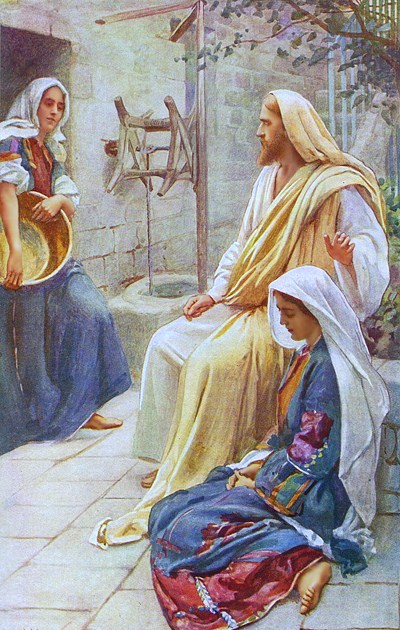 In the Gospel of Monday of this week, the Feast of St. Martha, there is an interesting dialogue between Jesus and Martha. Martha begins by saying, Lord, if you had been here, my brother would not have died. But even now I know that whatever you ask of God, God will give you. And thus Martha expresses her faith and hope in Jesus. But Jesus seeks to draw her out a bit and to get her to focus her faith in the moment. And thus the dialogue between them continues: