It is a common notion that the number of priests has plummeted in this country. Many speak of the halcyon days when there were four and five priests per parish, and the seminaries were packed. And while some of these memories are accurate, they are drawn from a time in this country that was very brief.
The fact is, the number of priests per parish spiked sharply after 1950 and has now leveled back to the levels of 1950 and before.
Note the graph at the upper right from the Center for Research in the Apostolate (CARA). It depicts the number of priests per parish. In 1950 there was an average of one priest per parish. Last year there was an average of one priest per parish. Welcome to 1950.
Mark Gray, writing at the CARA blog says:
There was about one active diocesan priest per parish then as there is now. The late 1950s into the 1970s represent an exceptional period in American history when there were significantly more active diocesan priests available than there were parishes. Age and mortality has and continues to diminish the size of the diocesan clergy population. Although ordinations have remained stable for decades, these are not sufficient to make up for the number of priests lost each year to retirement or death. [1]
Frankly, even in the glory days, America did not produce the number of priests we need to fill our needs. Back in the 1950s through the 1970s a tremendous number of FBI (foreign born Irish) priests were enlisted to meet American needs. My own diocese had a large number of them brought in, beginning in the 1950s.
Many ethnic groups in the Urban North also brought large numbers of priests to serve them from overseas. Today there are many dioceses that rely on Nigeria and other booming Catholic countries to supply extra priests.
It is true, most American Seminaries were bursting at the seams especially after World War II. But that boom would seem to be as short as it was impressive. Here on the East Coast, Roland Park in Baltimore and St. Charles Borromeo in Philadelphia had more than 500 seminarians in mammoth buildings that looked like Versailles as you drove up.
But as the graph shows, the spike was sudden and has settled back to the more common US experience of about one priest per parish. Again, according to the CARA study:
Nearly one in five U.S. parishes do not have a resident priest pastor. Seven in ten have a diocesan priest serving in this capacity and religious priests serve as resident pastors in 11% of parishes. In 17% of parishes a priest is serving as a non-resident pastor…in 2.5% of all parishes, due to a shortage of priests, a deacon or lay person is entrusted with the pastoral care of a parish…[who]….must still do their best to arrange for priests to be available for Masses and other sacraments.
Priests cannot be in two places at once and there are only so many hours in a Sunday. We have a good understanding of how many parishes there are in the United States and how many priests are available. The map below (click for full size) shows the number of active diocesan priests subtracted from number of parishes in each diocese…. In 60% of dioceses, those marked in yellow and red, there is no surplus of diocesan priests active in ministry relative to the number of parishes in the diocese. The green areas on the map have more active diocesan priests than parishes. [2]
There is more that can be read at the CARA blog that analyzes these numbers more deeply. But data like this reminds us that our knowledge of history is at time inaccurate since it is based on a rather narrow sliver of our own experience. That the Catholic Church in America grew enormously in the first half of the 20th century is indisputable. This was due to large waves of immigrants from Catholic Countries in Europe that were in one crisis after another. But even at the center point of that remarkable period of Catholic growth, the number of priests per parish was not so high as we remember, and even after it spiked (nearly doubled) between 1950 and 1960, it did not last, and a long leveling back to our current numbers has restored us to the mid century mark.
And yet, 1950, would be a year most Catholics think of being a high water mark. It was not, at least in terms of the number of priests per parish. Yes, welcome to 1950.
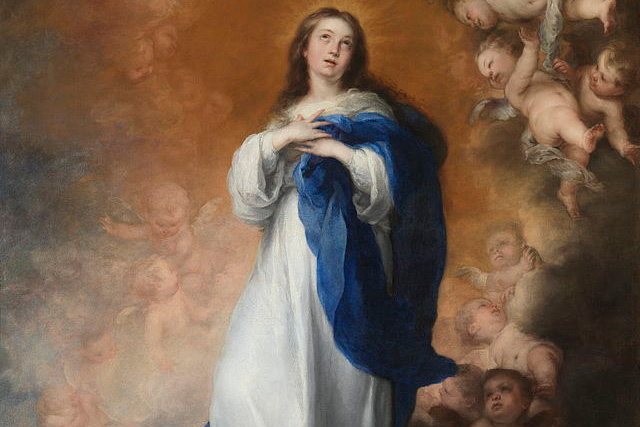
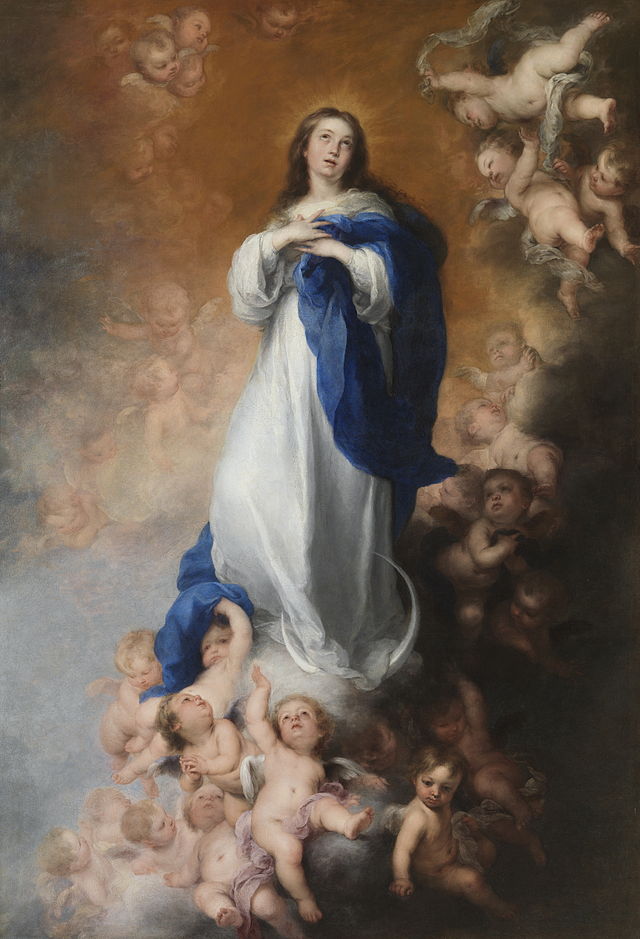
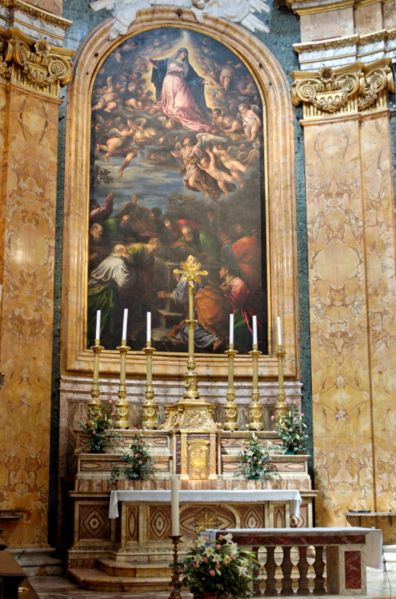
While the actual event of the Assumption of Mary in Heaven is not recorded in the Scriptures, nevertheless there is a biblical basis for the teaching that, considered as a whole, confirms Catholic teaching as both fitting and in keeping with biblical principles. Let’s ponder this feast in three stages:
1. Explained – To be “assumed” means to be taken up by God bodily into heaven. As far back as the Church can remember we have celebrated the fact that Mary was taken up into heaven. We do not just acknowledge that her soul was taken to heaven, as is the case with all the rest of the faithful who are taken there (likely after purgation). Rather Mary was taken up, soul AND body into heaven after her sojourn on this earth was complete. There is no earthly tomb containing her body, neither are there relics of her body to be found among the Christian faithful. This is our ancient memory and what we celebrate today, Mary was taken up, body and soul into heaven.
2. Exemplified – The actual event of the Assumption is not described in Scripture. However, there are “assumptions” recorded in the Scriptures and the concept is thus biblical.
It happened to Enoch in the Old Testament The Book of Genesis records: Enoch walked with God; then he was no more, because God took him away (Gen. 5:24). Hebrews 11: 5 elaborates: By faith Enoch was taken up so that he should not see death; and he was not found, because God had taken him. Now before he was taken he was attested as having pleased God.
It also happened to Elijah as he walked with Elisha: And as they still went on and talked, behold, a chariot of fire and horses of fire separated the two of them. And Elijah went up by a whirlwind into heaven….And he was seen no more. (2 Kings 2:11 ).
Some say Moses too was taken up since his grave is not known. As we read in yesterday’s first reading at Mass: He was buried in Moab, in the valley opposite Beth Peor, but to this day no one knows where his grave is (Dt. 34:6). The text of course does not say his body was taken up and if it was, it occurred after death and burial. Jude 1:9 hints at the fact when is says, But even the archangel Michael, when he was disputing with the devil about the body of Moses….. (Jude 1:9) Some further credibility is lent to the view of him being assumed by the fact that he appears alongside Elijah in the Transfiguration account. Some of the Church Fathers held this view and there is also a Jewish work from the 6th Century AD entitled The Assumption of Moses that represents the tradition of his assumption. But in the end the Assumption of Moses only a view held by some and it not officially held by the Church.
And While it is true that the historical event of the assumption is not recorded in Scripture nor are there historical accounts of the event, there may be one other scriptural account that evidences Mary’s whereabouts, body and soul. The Church presents for our consideration in today’s second reading a passage from the Book of Revelation wherein John records his sighting of the Ark of God:
Then God’s temple in heaven was opened, and within his temple was seen the ark of his covenant. And there came flashes of lightning, rumblings, peals of thunder, an earthquake and a great hailstorm. A great and wondrous sign appeared in heaven: a woman clothed with the sun, with the moon under her feet and a crown of twelve stars on her head. She was pregnant and cried out in pain as she was about to give birth. Then another sign appeared in heaven: an enormous red dragon with seven heads and ten horns and seven crowns on his heads… The dragon stood in front of the woman who was about to give birth, so that he might devour her child the moment it was born. She gave birth to a son, a male child, who will rule all the nations with an iron scepter. (Rev 11:19 – 12:5)
The Woman is clearly Mary since the child is clearly Jesus (though she also likely allegorizes other realities such as Israel, and Mother Zion). And where is Mary seen? In heaven.
Now some may argue the text does not necessarily indicate her body is in heaven but may only be referring to her soul. However the physicality of the description of her is rather strong. Some also argue that Mary is linked to John’s sighting of the Ark of the Convent which is seen by John in Heaven. He mentions the Ark and goes on to describe the woman clothed with the sun (Mary) and there is a possibility that he is still describing the Ark he sees in Heaven. (I have written on this elsewhere. See here: Mary: The Ark of the New Covenant) If she is the Ark described that Ark is clearly described as being in heaven.
So, the Biblical record, while not recording the event of the Assumption, does set forth other assumptions and thus shows that assumption is a biblical concept. Further, Mary’s physical presence in heaven seems hinted at by John and some would argue that the passage actually attests to her physical presence there.
But remember, the Church does not rely solely on Scripture. In this case what we celebrate is most fundamentally taught to us by Sacred Tradition in that the memory of Mary’s assumption goes back as long as we can remember.
3. Extended – The Feast of the Assumption may be of theological interest to some and may provide for interesting biblical reflection but eventually the question is bound to come: “So What?” How does what happened to Mary have impact on my life and what does it mean for me? The answer to this question is bound up in nearly every Marian Doctrine. Simply put, what happened to Mary in an profound and preliminary way will also happen for us in the end. As Mary bore Christ into he world, we too bear him there in the Holy Communion we receive and in the witness of his indwelling presence in our life. As Mary is (and always was) sinless, so too will we one day be sinless (immaculate) with God in heaven. As Mary cared for Christ in his need, so do we care for him in the poor, the suffering, needy and afflicted. And as Mary was assumed, body and soul into heaven so too will we be there one day, body and soul.
For now our souls go to heaven once purified but our body lie in a tomb. But one day when the trumpet shall sound, on that “great gettin’ up morning” our bodies will rise and be joined to our soul:
For we will all be changed— in a flash, in the twinkling of an eye, at the last trumpet. For the trumpet will sound, the dead will be raised imperishable, and we will be changed. For the perishable must clothe itself with the imperishable, and the mortal with immortality. When the perishable has been clothed with the imperishable, and the mortal with immortality, then the saying that is written will come true: “Death has been swallowed up in victory.” “Where, O death, is your victory? Where, O death, is your sting?”…….Thanks be to God! He gives us the victory through our Lord Jesus Christ. (1 Cor 15:51-57)
So our bodies shall rise shall be assumed and joined to our soul.
Improved model! Now a older woman once said to me upon hearing that her body would rise: “Father if this old body has to rise, I’m hoping for an improved model!” Yes indeed! Me too! I want my hair back, my slender figure and knees that work! I want to upgrade from a general issue late model version, to a luxury model. And God will in fact do that. Scripture says:
He will take these lowly bodies of ours and transform them to be like his own glorified body. (Phil 3:21)
But someone may ask, “How are the dead raised? With what kind of body will they come?” How foolish! What you sow does not come to life unless it dies. When you sow, you do not plant the body that will be, but just a seed, perhaps of wheat or of something else. But God gives it a body as he has determined, and to each kind of seed he gives its own body…..So will it be with the resurrection of the dead. The body that is sown is perishable, it is raised imperishable; it is sown in dishonor, it is raised in glory; it is sown in weakness, it is raised in power; …..And just as we have borne the likeness of the earthly man, so shall we bear the likeness of the man from heaven. (1 Cor 15:35-49)
Yes we shall also be taken up, assumed, and then shall be fulfilled for us the saying of Job: I know that my Redeemer lives, and that in the end he will stand upon the earth. And after my skin has been destroyed, yet in my flesh I will see God; I myself will see him with my own eyes—I, and not another ‘s (Job 19:25-27).
The assumption of our bodies, prefigured by Christ in his own power and also in Mary by the gift of God, will one day be our gift too. For now, it waits till that “great gettin’ up morning.” Until that day, and on that day, fare you well, fare you well!
This song is an African American Spiritual and speaks of that Great Gettin’ up morning when our bodies will rise. And if we have been faithful they will rise to glory!
I’m gonna tell you about the coming of the judgement (Fare you well) There’s a better day a coming….In that great gettin’ up morning fare you well! Oh preacher fold your Bible, For the last soul’s converted….Blow your trumpet Gabriel…..Lord, how loud shall I blow it? Blow it right calm and easy Do not alarm all my people….Tell them to come to the judgement…….In that great gettin’ up morning fare you well. Do you see them coffins bursting? Do you see them folks is rising? Do you see the world on fire? Do you see the stars a falling? Do you see that smoke and lightning? Do you hear the rumbling thunder? Oh Fare you well poor sinner. In that great gettin’ up morning fare you well.
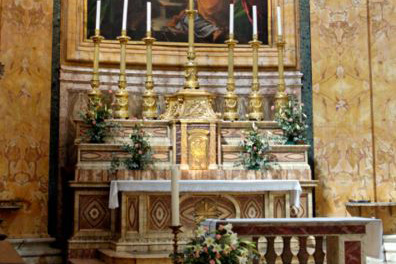
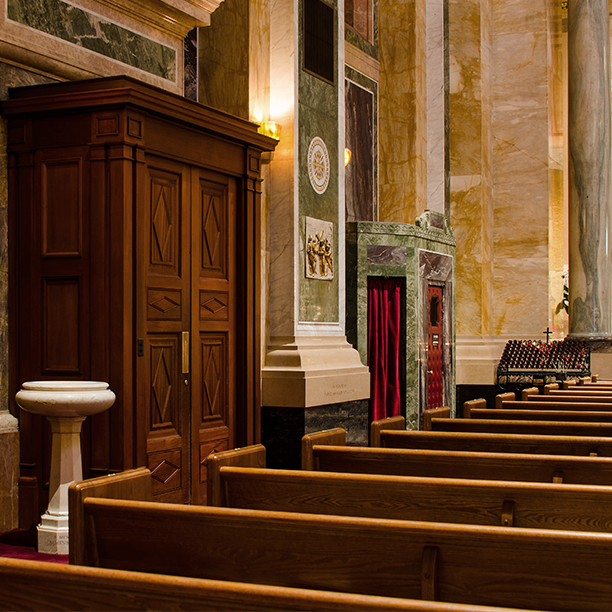
Most Catholics are unaware of how our traditional church buildings are based on designs given by God himself. Designs that stretch all the way back to Mount Sinai when God set forth the design for the sanctuary in the desert and the tent of meeting. Many of the fundamental aspects of our church layouts still follow that plan and the stone version of it that became the Jewish Temple in Jerusalem. Our traditional church buildings also have numerous references to the Book of Revelation and the Book of Hebrews, both of which describe the heavenly liturgy and heaven itself.
There is not time to develop these roots at length in this post today, though I hope to do so in a series of future posts.
Sadly in recent decades there was a casting off of these biblical roots in favor of a “meeting house” approach to church design. No longer was the thinking that our churches should reflect heavenly realities, teach the faith, and follow biblical plans. Rather the thinking was that the Church simply provided a space for the people to meet and conduct various liturgies.
In some cases the liturgical space came to be considered “fungible” in that it could be reconfigured to suit various needs: Mass today, concert tomorrow, spaghetti dinner on Wednesday. This thinking began to be set forth as early as the 1950s. Pews were often replaced by chairs which could be moved to suit various functions. And even in parishes which did not go so far as to allow spaghetti dinners in the nave, (mine did in the 1970s), the notion of a church as essentially a meeting space prevailed.
Thus churches looked less and less like churches and more like meeting halls. Bare essentials such as an altar, pews or chairs, a pulpit and very minimal statuary were used, but the main point was simply to provide a place for people to come together. There was very little sense that the structure was to reflect heaven or even remind us of it.
That is beginning to change as newer architects are returning more and more to sacred and biblical principles in church design. Further, many Catholics are becoming more educated on the meaning of church art as something beyond what is merely “pretty,” and coming to understand the rich symbolism or art and architecture as revealing the faith and expressing heavenly realities.
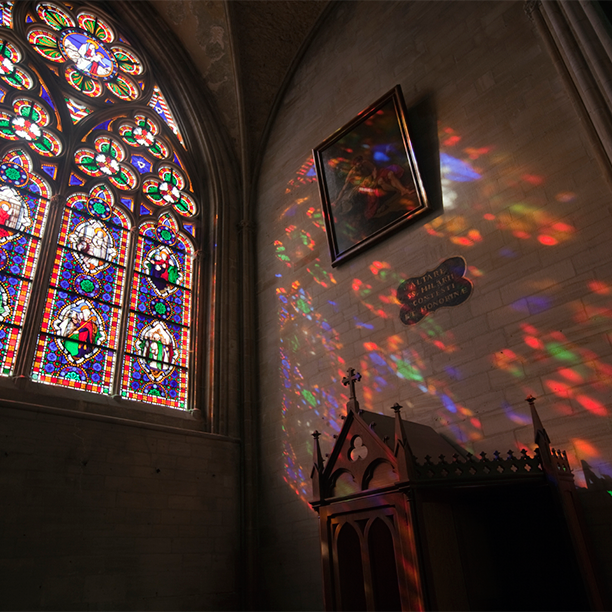
Take stained glass for instance. Stained glass is more than just pretty colors, pictures and symbols. Stained glass was used for centuries to teach the faith through picture and symbol. Until the past 200 years most people, even among the upper classes, could not read well, or at all. How does the Church teach the faith in such a setting? Preaching, art, passion plays, statues, and stained glass.
Stained glass depicted biblical stories, saints, sacraments, and glimpses into heaven. Over the centuries a rich shorthand of symbols also developed: crossed keys = St. Peter, a sword = St. Paul, a large boat = the Church, shell = baptism, and so forth. And so the church taught the faith through the exquisite art of stained glass.
But stained glass also served another purpose, that of imaging the foundational walls of heaven. For, recall that traditional church architecture saw the church as an image of heaven. Hence it’s design was based on the descriptions of heaven found in the Scriptures. Now among other things, heaven is described in the Book of Revelation as having high walls with rows of jewels embedded in the foundations of those walls:
One of the seven angels…showed me the Holy City, Jerusalem, coming down out of heaven from God. It shone with the glory of God, and its brilliance was like that of a very precious jewel, like a jasper, clear as crystal. It had a great, high wall with twelve gates….The foundations of the city walls were decorated with every kind of precious stone. The first foundation was jasper, the second sapphire, the third chalcedony, the fourth emerald, the fifth sardonyx, the sixth carnelian, the seventh chrysolite, the eighth beryl, the ninth topaz, the tenth chrysoprase, the eleventh jacinth, and the twelfth amethyst.... (Revelation 21:varia)
Thus, because heaven had great high walls, older churches almost always had a lot of verticality. The lower foundational walls gave way to the higher clerestory, and above the clerestory the vaults of the ceiling rise even higher. And in the lower sections of the walls, extending even as high as the clerestory, the jewel-like stained glass recalls the precious jeweled gemstones described in the lower walls of heaven, according to Revelation 21.
The compelling effect of a traditional church is to say to the believer, you are in heaven now. In my own parish church, the floors are a green jasper color, and the clerestory walls, red jasper. On the clerestory are painted the saints gathered before the throne-like altar in heaven (Heb 12:1; Rev. 7:9) . In the apse is the throne like altar, with Jesus at the center (Rev 5:6), the seven lamp stands are surrounding him in seven candles (Rev 4:5). In the stained glass of the transept are 12 apostles, joined with the 12 patriarchs symbolized by 12 wooden pillars. Together they form the 24 elders who surround the throne in heaven (Rev 4:4). Above the high altar in the clerestory windows are the four living creatures also said to surround the throne (Rev 4:6-7).
Yes, amazing. I stand in my church and realize its message: you are in heaven when you enter here and celebrate the sacred mysteries: sursum corda! (hearts aloft)!
Photo above: San Chapelle, Paris France
Here’s a video I put together on stained glass. Enjoy these jewels of light that recall the lower walls of heaven as the choir sings Christe Lux mundi (O Christ you are the Light of the world).
The Sources of many of the photos in this video are:
Homosexual activists and advocates often state that they merely want recognition and certain legal rights, and that churches and other objectors to their life style remain free to have their opinions and state them in a free culture. And any expressed fears regarding compulsory recognition or punitive measures directed against objectors are dismissed as fear mongering.
Never mind that these fears are based in real experiences in Canada and Europe where clergy have been arrested and fined for presenting the biblical case against homosexuality in the pulpits of their own churches or the pages of their bulletins.
In the end we who raise alarms about the increasingly strident declaration of our objections as “hate speech” and as “human rights violations” remain concerned about legal punishment etc., despite “reassurances” from pro-homosexual advocates and government officials.
Today there is more confirmation about the price that is paid by those who object to the cultural juggernaut that activism is becoming. Gospel Artist Donnie McClurkin has had his appearance canceled by the Mayor’s Office here in DC due to his views on homosexuality. Here is the clip from a local Station, Fox 5 News:
Gospel star Donnie McClurkin made headlines several years ago, when he claimed god “delivered” him from homosexuality.
Now, he’s sounding off about a decision by D.C. leaders, to cancel his appearance at a concert over the weekend.
McClurkin was set to perform at a concert on Saturday, celebrating the 50th anniversary of the March on Washington.
In a video, McClurkin says he was on his way to the airport, when Mayor Vincent Gray’s office called him to tell him his appearance was cancelled.
“These are bully tactics simply because of stances that I took, never ever demeaning, never ever derogatory, any lifestyle – this is a civil rights infringement situation,” McClurkin said.[1]
Donnie McClurkin is renowned in Gospel music. He has a powerful, joyful and celebratory musical gift. I especially like his “Caribbean Medley” but there are so many great songs. In no way is he strident about his views and they do not figure prominently in his performances. But he has shared publicly on occasion his past struggles, and how God delivered him from homosexual tendencies, among other things.
Well of course there are now those in the ascendency among the cultural elites who will not permit even one scintilla of objection to homosexual behavior. And those who do so must be marginalized and excluded. No dissent from the new dogma of the elites is to be permitted. Dissent must be punished severely and swiftly.
I use words like “dogma” and “dissent” intentionally, since those who like to denounce religious rules and dogma and raise all sorts of objections to past “excesses” of excommunication and inquisition (limited those these were), have now adopted their own fervor for their new anti-religion. And many are far more dogmatic, punitive and excluding than any religious group of recent memory. If you object to the new cultural agenda, you have to go. You must be excluded as dangerous and evil.
Some one may say, “The city can choose who it wants to be at a city concert.” Legally that is true, though one wonders if other performers, say a pro-abortion artist we be so summarily excluded.
But the point to be raised and discussed here is not a legal point but a cultural and moral one. Actions like these put to the lie any notion that homosexual activists merely seek to inculcate respect. They intend much more. Namely to destroy any dissent, marginalize and increasingly coerce consent for their agenda, and apply state sanctioned exclusion for any one who dares question their behavior.
The exclusion of Mr. McClurkin is only another step. Invited clergy are probably already being screened and excluded from any place on any dais if they do not have the politically correct view on this. Exclusions and restrictions are sure to increase and become more severe.
It is a common feature that radicals who march under the banner of tolerance and “libertas!” soon enough usher in their own reign of terror. Because when they say “tolerance” they don’t really mean it and certainly don’t mean they have to tolerate you. For them “tolerance” means your obligation to accept them, and freedom is your right and liberty to agree with whatever they say.
There seems to be absolutely no leeway that will in any way be granted. They will not, it seems, even brook the notion that for many who oppose the celebration of homosexual acts, the opposition is a matter of sincere conscience, not “hate.” If quoting the Bible or the Catechism equals hate, then night has surely come to the West. But we can do no other than adhere to God’s clear and consistent teaching all through the Scriptures at every stage which consigns homosexual acts to the realm of sin. Here I must stay, I can do no other. I will not overrule God to please men, gain access, or be considered acceptable to government officials and powerful lobby groups.
Now that these cultural radicals are politically ensconced the banners of tolerance and freedom are discarded. They never really meant it, and sure never meant the likes of Mr. McClurkin or other bible-believing Christians who object.
These exclusionary tactics are bound to increase and to become more punitive unless enough Americans begin to wake up and realize that all the talk about “tolerance” is not really what this agenda of the radicals has ever been about.
Rainbows may seem pretty, but they usually occur in the midst of a storm. This storm looks to get a lot worse.
Some years ago the theologian Fr. Jonathan Robinson wrote a commentary on the modern experience of the Sacred liturgy and entitled it, The Mass and Modernity: Walking to Heaven Backward. It is a compelling image of so much of what is wrong with the celebration of the Liturgy in many parishes today.
While Fr. Robinson certainly had the celebration of Mass “facing the people” in mind, his concerns are broader than that.
Indeed, we have the strange modern concept of the “closed circle” in so many modern conceptions of the Mass. Too often we are tediously self-referential and anthropocentric. So much of modern liturgy includes long lists of congratulatory references, both done by, but also expected of the celebrant.
Instead of the Liturgy being upwardly focused to God and outwardly toward the mission of the Church (to make disciples of all the nations), we tend today to “gather” and hunker down in rather closed circles looking at each other, and speaking at great length about ourselves.
We have even enshrined this architecturally in our modern circular and fan shaped churches that facilitate us looking at each other, and focusing inwardly, not up or put. The author Thomas Day once described Modern Catholic Liturgy as, “the aware, gathered community celebrating itself.” [1]
In the ancient orientation or “stance” of the Mass that was ubiquitous until 1965, the focus was outward and upward. Though disparaged by many in recent decades as the priest “having his back to the people” even this description shows the self obsession of the modern age. And to those speak this way about the liturgical orientation of almost 2,000 years, the answer must come, “The priest does not have his back to you. Actually it is not about you at all. The liturgy is about God. And the priest, and all the faithful are turned outward and upward to God.”
The liturgical questions of the history of the eastward orientation and its recent loss, of how and why we got into the modern closed circle mentality, and the erroneous understandings of the liturgists of the 1950s about the practice of the early Church, are all discussed more aptly by others more liturgically versed than I.
Please consider dear reader that my proposal is not for a sudden and swift change in our liturgical stance. Rather, that we begin to ponder if, by our inwardly focused stance in circular and fan shaped churches, facing each other, we are communicating what we really intend. Does our stance project that our real focus here is God? Does it communicate the goal of the liturgy to lead us to God? Does it inculcate a spirit of leadership in our clergy who are called to lead us to God? Does a largely closed circle manifest an outward trajectory to evangelize outward and unto the ends of the earth?
Whatever pastoral blessings come with “facing the people” (and there are some blessings) there may be value in continuing to reassess whether our modern pastoral stance of an inwardly focused liturgy serves us well and communicates what we are really doing and experiencing.
I would like to link the current “closed circle” liturgical experience to another struggle of Church life today: the crisis of leadership. Many of the lay faithful have come to decry the crisis of leadership among the clergy. And while there are excesses in way these concerns are expressed (according to me), there is surely a grave hesitancy on the part of too many clergy to lead. Too rare are clergy today who point to God and the will of God in clear and unambiguous terms. Too many of us prefer to speak in abstractions and generalities. I do concur that we have experienced so degree of a crisis in leadership. There are notable exceptions to this problem, but it remains a widespread issue. And of course the primary place that the faithful ought to experience leadership is in the sacred Liturgy, where the clergy unambiguously point to God and lead others to Him.
But the stance of the Liturgy as a kind of closed circle does not easily support this sort of thinking.
To be sure, there are many reasons for the current crisis of leadership in the Church. Surely the overall crisis of manhood in our culture, along with passive or missing fathers is a central cause. Also related is the rise of feminism and the designation of normal male tendencies to competition and leadership as “pathological” and misogynist. Many normal school boys, full of spit and vinegar, and a tendency to rough-house are “diagnosed” and medicated, and told explicitly to behave more like girls.
There are also modern tendencies that are unreasonably hateful or suspicious about power and the use of authority, along with a kind of hyper-vigilance not to offend, and to be obsessed with how others “feel” about things. And while “getting along” with people and being respectful of their feelings are good dispositions in themselves, they are not absolute virtues and must sometimes be set aside for the higher good of pointing to the truth of God and insisting on it.
Hence, there are many factors that have fed the crisis of the leadership among the clergy. But I propose that liturgical orientation is both emblematic of the crisis of leadership and also fuels it.
While a priest is called to love his people, speak to their hearts and even to learn form them, he is most especially tasked to lead them to God. And while, in the Liturgy of the Word, it makes sense that he turns to them to instruct and engage them, there ought to be a moment when he turns to God and leads his people toward God.
The Eucharistic Prayer is surely this time. As priest, he leads. Acting in persona Christi, he leads the people, (for Christ said, “follow me”) out to Calvary, to the death and resurrection, to new Life. In this Jesus, acting through the priest, also leads back to the Father. He is leading us somewhere.
But leaders do not walk backward facing their followers. They are out front, at the head of the procession. One of the Collects of the Breviary asks that the humble flock may reach where the brave Shepherd has gone before.
But there is usually very little sense of leadership in the current liturgical environment. There seems the unspoken demand that the leader, our celebrant, focus on us, rather than God. His job is to please and enrich us, rather than point to God and insist that we follow. Leadership suffers under this kind of expectation of “enriching” and affirming, rather than summoning to discipleship and pointing unambiguously to God.
The direction of the Liturgy should be an “onward and upward” trajectory. But too often today it is inward, and it is difficult to perceive a motion upward to God or outward to evangelization.
I realize that a post like this will generate considerable controversy. But remember that this is only a discussion. I do not argue for sudden or radical shifts in our liturgical stance, only that we should continue to discuss it and explore various options. I am only a priest, not a bishop and I do not argue that priests act independent of their bishop in significant matters such as this. Further, some settings are better for a change of stance than others. Great pastoral discretion is required in matters like these.
Neither do I argue for a return to Mass wholly facing the altar as was done in the past and still often is in the Extraordinary form. The Liturgy of the Word is authentically directed to the people of God for their edification, instruction and attention. It ought to be proclaimed to and toward them, as is fitting to its purpose and end. But the Eucharistic Prayer is directed to God, and not the celebrant is leading the faithful on procession to God. St. Augustine often ended the his sermon and the Liturgy of the Word by saying, “Let us turn to the Lord” and he then went up to the altar, facing it and leading the people to God.
So this is a discussion, that is all. And I pray it be conducted with mutual charity and, I might add, brevity. For while I heartily endorse the discussion of the Sacred Liturgy, it has well been observed that we Catholics run the risk of being so focused on what goes on inside Church that we lose any focus on the mission of getting outside and evangelizing! It would be ironic indeed and a countersign if, in arguing that our liturgy is too inwardly focused, that we who agreed or debated spent too long focused “inwardly” discussing the problem. Truth be told, Liturgy debates sometimes use up too much oxygen!
So have at it. And remember the focus of this post is not merely liturgical. Rather what I am pondering is how well our liturgical stance reflects and supports what should be our pastoral stance.
In the Gospel for this weekend (Luke 12:32-40) the Lord Jesus presents a “Recipe for Readiness.” He gives this recipe so that we can lay hold of his offer that we not be afraid. But he is not simply saying, “Be not afraid.” He is explaining how we can battle fear by being ready.
It is frequent problem in the modern experience of the Christian life that many remain vague about what is necessary to be ready to meet God. Many also make light of the day of Judgment and consider it all but certain that they and most of humanity will be found approved.
Jesus does not however adopt this posture. In fact he teaches the exact opposite and consistently warns of the need to be ready for our judgment. As such, He does not counsel a foolish fearlessness rooted in the deception that all or most will be saved. Rather he counsels a fearlessness based on solid preparation for the day of judgement. Jesus tells us at least five things to do in order to be ready, and therefore not afraid.
If we are not ready by these sorts of preparations, Jesus warns, later in this text that He will come when we least expect and, like a thief, take away all that we wrongly call our own. Jesus says elsewhere, But watch yourselves lest your hearts be weighed down with dissipation and drunkenness and cares of this life, and that day come upon you suddenly like a trap (Lk 21:34) And the apostolic tradition adds, that to those unprepared, disaster will fall on them as suddenly as a pregnant woman’s labor pains begin. And there will be no escape. (1 Thess 5:3).
Thus, while Jesus begins by saying that we ought not fear, (for the Father wants to grant us the kingdom), he also warns that being free of fear is contingent on embracing and following a plan that he (Jesus) sets forth for our life.
So lets look at this plan and see how we can forsake fear by becoming and remaining ready. Jesus gives us five specific and concrete things to do that will help us to be ready when the Lord shall call us. It is not an exhaustive list, for no one passage of Scripture is the whole of Scripture. But here are some very practical and specific things to reflect on and do.
I. REASSESS YOUR WEALTH. Jesus says, Do not be afraid any longer, little flock, for your Father is pleased to give you the kingdom. Sell your belongings and give alms. Provide money bags for yourselves that do not wear out, an inexhaustible treasure in heaven that no thief can reach nor moth destroy. For where your treasure is, there also will your heart be. In effect the Lord is giving us here a triple teaching on wealth. First he says that we ought to
Fore-go Fear. In the end it is fear that makes us greedy and worldly. We grab up the things of this world because we are terrified of not having enough for tomorrow. But what if we could receive the gift to trust God more and know and experience that he will give us our daily bread? He has given us the Kingdom, why not everything else besides? He may not give us everything we want but we can learn to trust that he will give us what we really need. Seek ye first the Kingdom of God and His righteousness and all these other things will be given unto to you (Matt 6:21). If we can just allow God to diminish our fear we will be surprised how easy it is for us to be generous with what we have and not hoard it.
Forward your Fortune– We store up treasure for ourselves in heaven when we are generous to the needy and poor. Treasure is not stored in heaven by way of a rocket ship or balloon. It is stored there by generously distributing our wealth to others in wise and creative ways. This was discussed in last week’s reading more substantially see here: Instructions on Income While it may not be appropriate for us to sell everything and go live on a park bench, the Lord is surely telling us to be less attached to and passionate about money and things for they root us in this world. And where our treasure is, there also will our heart be.
Fix your focus– Our focus is wrong and worldly because most of us have our treasure here. But once we become less fearful and more generous, our obsession with worldly treasure subsides and our joy in heavenly treasure grows. And this fixes our broken focus. For now our heart is where our treasure really is and ought to be: in heaven with God. So simplify, be less rooted in this world and come to experience that your greatest treasure is God and the things waiting for you in heaven.
So, reassess your wealth. What is it and where is it? That will tell you a lot about your heart too.
II. READY TO WORK – The Lord says “Gird your loins” which is the ancient equivalent of “roll up your sleeves.” The Lord has a work for us and wants us to get about it.
Surely the Lord has more than a worldly career in mind. He has in mind things like raising kids in godly fear, pursuing justice, and growing in holiness. The Lord wants us to work in his Kingdom. We must commit to prayer, Sunday worship, the reception of the Sacraments, to obedience and holiness.
And the Lord has a particular work for us based on our gifts. Some can teach, others are good with senior citizens, still others are good entrepreneurs and can provide good work for others at a just wage. Some are skilled at medicine and the care of the sick. Some are called to priesthood and the religious life. Some are called to suffering and to offer that suffering for the salvation of souls. Some serve in strength, others in weakness. But all are called to serve, called to work.
So work with what the Lord gave you to advance his kingdom. Part of being ready means doing our work.
III. READ THE WORD – The Lord says, “light your lamps.”
At one level, the phrase “light your lamps” is simply a symbol for readiness (eg. the Wise and Foolish Virgins in Matt. 25:1-13)
But in another sense “lamp” is also a symbol for Scripture. For example, You Word O Lord is a lamp unto my feet and a light unto my path (Ps 119:105). Or again, We possess the prophetic message that is altogether reliable. You will do well to be attentive to it, as to a lamp shining in a dark place, until day dawns and the morning star rises in your hearts (2 Peter 1:19).
So here we can also understand that the Lord is teaching us that an essential part of being ready is to be rooted and immersed in the Scriptures and the Teachings of the Church. It makes sense of course. There is just too much stinking thinking in this increasingly secular world hostile to the faith to think that our mind is going to be anything but sullied if we are not reading Scripture every day. How will our minds be sober and clear if we are inebriated by the world?
Clearly, being ready means reading Scripture each day and basing our life on it.
IV. REMAIN WATCHFUL – The Lord says, “And be like servants who await their master’s return from a wedding, ready to open immediately when he comes and knocks…..Be sure of this: if the master of the house had known the hour when the thief was coming, he would not have let his house be broken into. You also must be prepared, for at an hour you do not expect, the Son of Man will come”
Now there are different ways to watch and wait. There is the passive watching and waiting that we may do when waiting for a bus. We just sit there and look down the street. But there is another way of waiting that is more active. Consider the kind of watchfulness that one has who waits on tables. This is an active waiting and watching. It observes what is necessary and what will soon become necessary and moves to supply what is needed.
There is also an eager sort of waiting intended here much like the eager waiting of a child on Christmas Eve. The Child does not wait in dread for the coming of “Santa” but with eager expectation.
And so it is that a watchful waiting and an eager waiting are what the Lord has in mind here. It is like that active waiting when we have invited a guest to our home eagerly prepared the house, and all is readiness. We know that his arrival is imminent and so we joyfully prepare and place all in order.
And to set our house in order is to sweep clean our soul of sin and all unrighteousness by God’s grace, and to remove all the clutter of the worldliness. Regular confession, daily repentance, sweep clean the house, and simplifying our lives and freeing ourselves from worldly attachments de-clutters the house of our soul.
Have you prepared the home of your soul for the Lord’s arrival? If not, the Lord says, you may experience him as a thief. Now the Lord is not really a thief for everything belongs to him. But if you and I have not renounced our worldliness and greed, if we have not de-cluttered our lives of attachments to this world, the Lord WILL come to and take back what is his, but he will seem like a thief because we think it is ours.
It’s never a good idea to call God, the Lord and owner of all, a thief. Bad move.
V. REFLECT on your reWARD – The Lord says, Blessed are those servants whom the master finds vigilant on his arrival. Amen, I say to you, he will gird himself, have them recline at table, and proceed to wait on them. And should he come in the second or third watch and find them prepared in this way, blessed are those servants. –
The Lord is clear that he has a reward for those who are found ready!
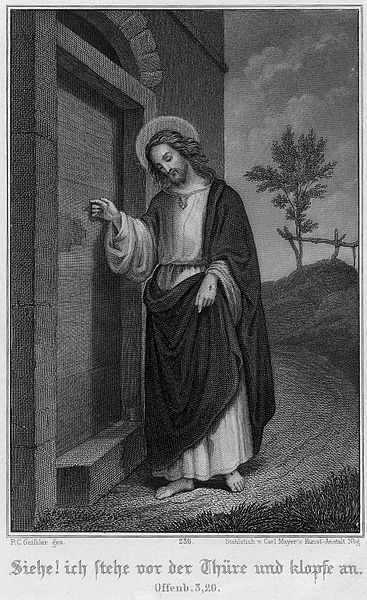
It is prefigured in the banquet of the Eucharist wherein the Lord prepares a meal and feeds us. The Lord says, Behold, I stand at the door and knock. If anyone hears my voice and opens the door, I will come in to him and eat with him, and he with me (Rev 3:20). And again, And I confer a kingdom on you, just as my Father has conferred one on me, that you may eat and drink at my table in my kingdom (Luke 22:30). We have so much easy food today but in the ancient world one of the most pleasant things they looked forward to was a hearty meal in the company of good friends and family.
The Lord offers us the magnificent blessing of heaven wherein we will be with him and those whom we love forever in unspeakable joy and peace.
Do you meditate often on heaven and long for its rewards? One of the stranger aspects of the modern world is that, even among believers, we talk so little of heaven. True, it is not a place any of us have been yet so it’s hard to fully understand what it will be like. But reflect often on the joy waiting for you in heaven.
Part of being ready to go home to Lord is to long for that day to come. When we want to do something we eagerly prepare for it, we are motivated and make sacrifices to do it. When we desire it we will more naturally get ready and lay aside whatever is necessary to make the passage there.
So here are five elements constituting a recipe for readiness. Better set your house in order ’cause he may be coming soon!
On one particular morning, just two weeks after His resurrection, Jesus stood on the shore of the Sea of Galilee. And, seeing the Apostles in a boat just off shore he said, Little Children, Have you caught anything? (John 21:5).
It is a rather strange way to speak to grown men: “Little Children” (παιδία = paidia = little ones, children, infants, the diminutive of pais (child), hence “little ones”). And yet how deeply affectionate it is.
We often think of ourselves in grander terms, terms that bespeak power, wisdom, age and strength. But I suspect that, to God, we must always seem as little children.
When I do infant Baptisms I normally use the Gospel of Mark where the Lord says, among other things, Whoever does not receive the kingdom of God like a little child (παιδίον) shall not enter it (Mark 10:15). And thus, we must finally come to realize that however rich, or powerful, capable or mature we my think ourselves to be, we depend radically on Abba for everything, even the next beat of our heart. The infants I baptize are already preaching the Gospel of the Kingdom simply by their littleness. They summon us who think we are strong and independent to know who and what we really are: little children, so needful of Abba for everything.
I am often moved as I walk the halls of nursing homes and see many once powerful “adults” now reflecting to their truest state. And thus, like little children, they have become dependent. Many cannot talk any longer. Many just sing and hold dolls, wear diapers, need to be fed and cry for help and comfort. It has always been so for them (for us), it is just now more evident.
This Sunday’s Gospel begins with the Lord calling us his “little flock.” And so we are, little, and yet loved.
And somewhere, standing on the seashore of your life the Lord is calling out: “Little One…have you anything to eat?”
I though of this when I saw this video. I wondered as I viewed it if it doesn’t depict us all as God really sees us. The folk in this video think they are “big and bad.” But for a moment we them as God sees them. Enjoy this.
In a kind of follow up from yesterday’s blog on the call to repentance, it seems it might be helpful to list what the Bible describes as some of the more serious sins.
One of the great deceptions of our time is that serious sin is a remote possibility for most people, and that it is only committed by very wicked people. And too many people assess their moral standing with unhelpful slogans such as “I’m basically a good person,” or “I haven’t murdered anybody.”
We have to be more serious and mature in our discernment than this. Of course God does not leave us in such a fog of uncertainty. His word is actually quite clear to list some of the more serious sins that we ought to be aware of so that we can humbly recognize our tendency to do these very things.
Rather than give lots of commentary, I just want to post five biblical lists of the more serious sins that exclude one from the kingdom of God. Saying that these are sins that “exclude one from the kingdom of heaven” is the biblical way of saying they are mortal sins.
It remains true that some of the sins listed, such as lying, can admit of lighter matter. But as we all know, there are very serious and harmful lies that we can all tell.
And so the Lord, in love wants to urgently warn us of the sins that exclude us from heaven. In all the lists that follow, avoid adopting a legalistic mentality. Take them to heart and allow them to become part of your daily moral reflection. The Lord warns us in love that sin is very serious. Even smaller sins, unattended to, begin to grow like a cancer and can ultimately kill us spiritually.
Be serious about it, do not buy into the deception that makes light of sin. God loves us, and because he loves us, he warns us that unrepentant sin is very serious and can rob our hearts of the desire for God, heaven and the good things waiting for us there.
Here then are five lists. they are not exhaustive and there are other sins mentioned elsewhere (e.g. refusal to forgive, cf Matt 6:15) Please reflect on, and share these lists.
1 Cor 6:9-10 Or do you not know that wrongdoers will not inherit the kingdom of God? Do not be deceived: Neither the sexually immoral nor idolaters nor adulterers nor homosexual offenders, nor thieves nor the greedy nor drunkards nor slanderers nor swindlers will inherit the kingdom of God. And that is what some of you were.
Gal 5:19-21 The acts of the flesh are obvious: sexual immorality, impurity and debauchery; idolatry and witchcraft; hatred, discord, jealousy, fits of rage, selfish ambition, dissensions, factions and envy; drunkenness, orgies, and the like. I warn you, as I did before, that those who live like this will not inherit the kingdom of God.
Eph 5:3-6 But among you there must not be even a hint of sexual immorality, or of any kind of impurity, or of greed, because these are improper for God’s holy people. Nor should there be obscenity, foolish talk or coarse joking, which are out of place, but rather thanksgiving. For of this you can be sure: No sexually immoral, impure or greedy person—such a person is an idolater—has any inheritance in the kingdom of Christ and of God. Let no one deceive you with empty words, for because of such things God’s wrath comes on those who are disobedient. Therefore do not be partners with them.
Rev. 22:12-16 “Look, I am coming soon! My reward is with me, and I will give to each person according to what they have done. I am the Alpha and the Omega, the First and the Last, the Beginning and the End. “Blessed are those who wash their robes, that they may have the right to the tree of life and may go through the gates into the city. Outside are the dogs, those who practice magic arts, the sexually immoral, the murderers, the idolaters and everyone who loves and practices falsehood. “I, Jesus, have sent my angel to give you this testimony for the churches. I am the Root and the Offspring of David, and the bright Morning Star.”
Matt 25:41-46 “Then he will say to those on his left, ‘Depart from me, you who are cursed, into the eternal fire prepared for the devil and his angels. For I was hungry and you gave me nothing to eat, I was thirsty and you gave me nothing to drink, I was a stranger and you did not invite me in, I needed clothes and you did not clothe me, I was sick and in prison and you did not look after me.’ “They also will answer, ‘Lord, when did we see you hungry or thirsty or a stranger or needing clothes or sick or in prison, and did not help you?’ “He will reply, ‘Truly I tell you, whatever you did not do for one of the least of these, you did not do for me.’ “Then they will go away to eternal punishment, but the righteous to eternal life.”
And finally just a general warning from the Lord:
John 5:28-29 “Do not be amazed at this, for a time is coming when all who are in their graves will hear his voice and come out—those who have done what is good will rise to live, and those who have done what is evil will rise to be condemned. By myself I can do nothing; I judge only as I hear, and my judgment is just, for I seek not to please myself but him who sent me.
Here is Allegri’s Miserere (Psalm 51) Have mercy on me O God According to thy great Kindness.

 It is a common notion that the number of priests has plummeted in this country. Many speak of the halcyon days when there were four and five priests per parish, and the seminaries were packed. And while some of these memories are accurate, they are drawn from a time in this country that was very brief.
 Nearly one in five U.S. parishes do not have a resident priest pastor. Seven in ten have a diocesan priest serving in this capacity and religious priests serve as resident pastors in 11% of parishes. In 17% of parishes a priest is serving as a non-resident pastor…in 2.5% of all parishes, due to a shortage of priests, a deacon or lay person is entrusted with the pastoral care of a parish…[who]….must still do their best to arrange for priests to be available for Masses and other sacraments.