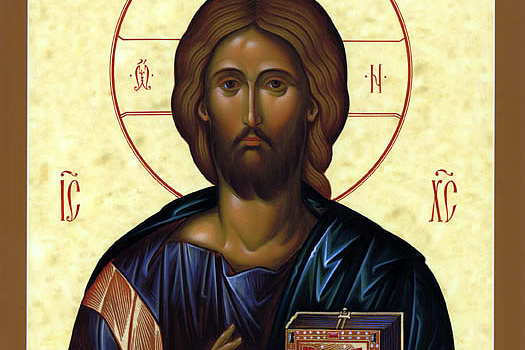
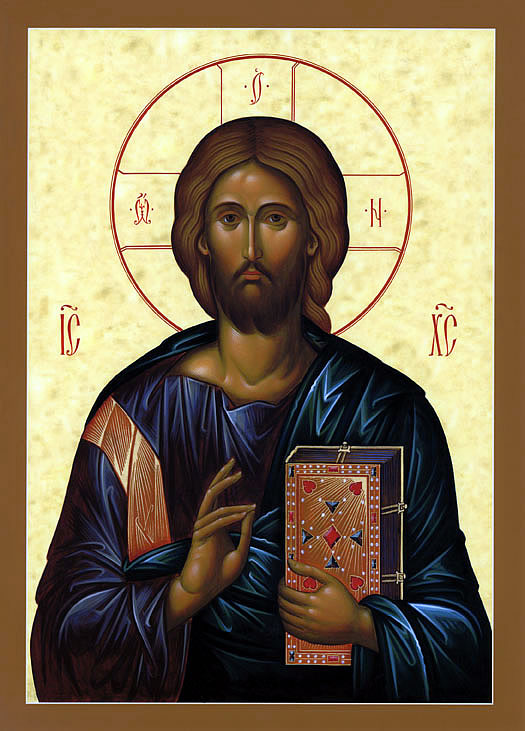
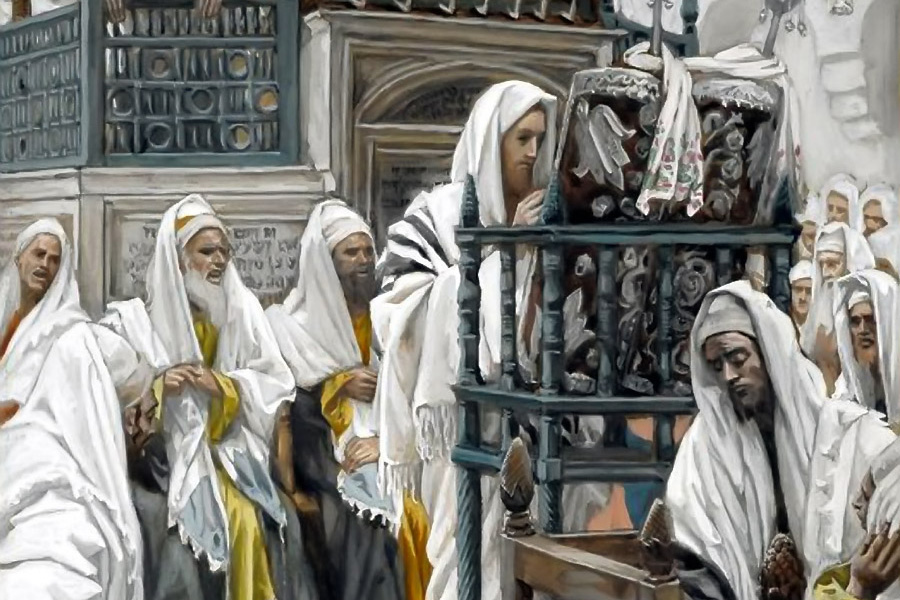
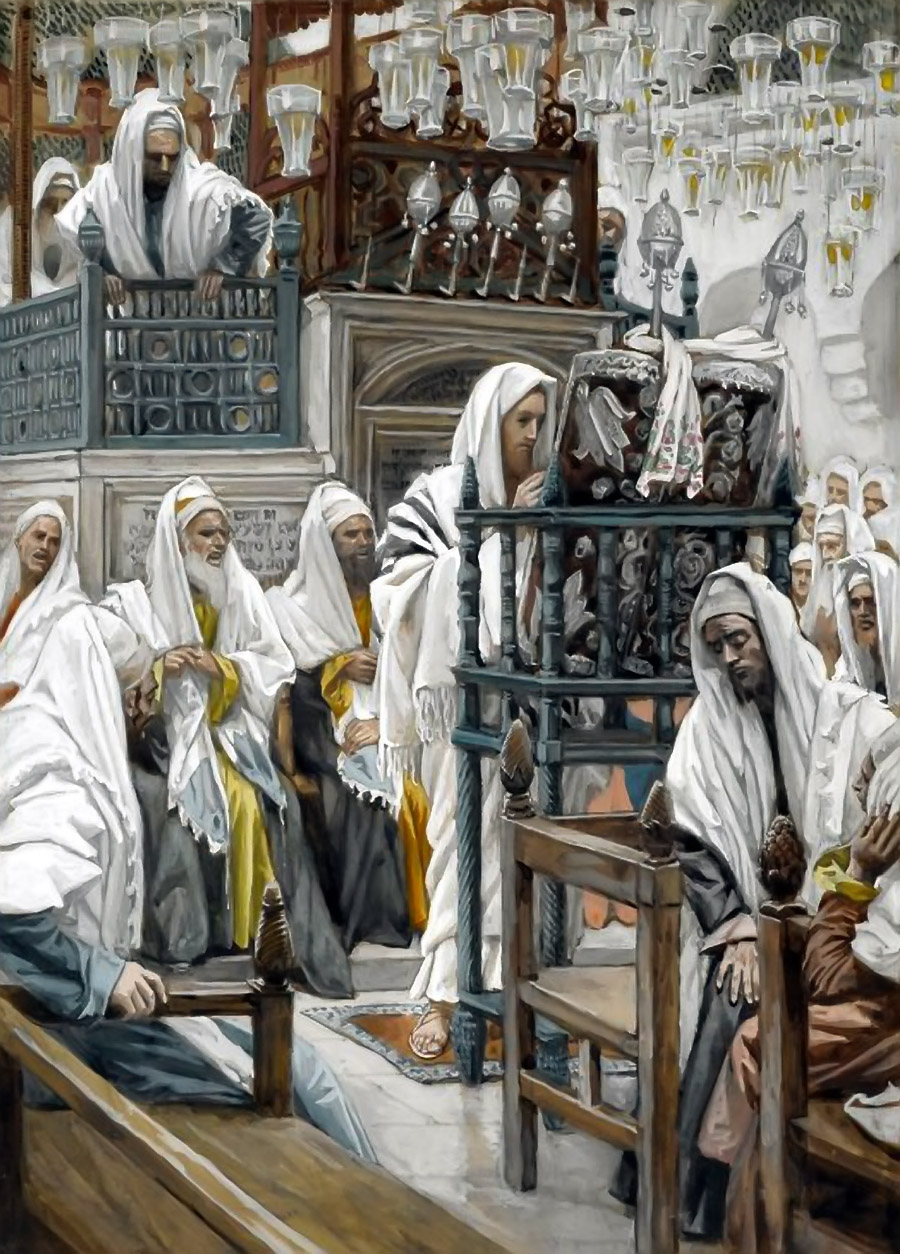
I have a large Icon of Christ in my room (see photo at right). What icons from the Eastern tradition do best is to capture “the Look.” No matter where I move in the room, Christ is looking right at me. His look is intense, though not severe. In the Eastern spirituality, Icons are windows into heaven. Hence, this icon is no mere portrait that reminds one of Christ, it is an image which mediates his presence. When I look upon him, I experience that he knows me. It is a knowing look and a comprehensive look.
The Book of Hebrews says of Jesus, No creature is concealed from him, but everything is naked and exposed to the eyes of him to whom we must render an account. (Heb 4:13).
But his look in the Icon is not fearsome; it is serene and confident. Hence the text from Hebrews goes on to say, Therefore, since we have a great high priest who has passed through the heavens, Jesus, the Son of God, let us hold fast to our confession. For we do not have a high priest who is unable to sympathize with our weaknesses, but one who has similarly been tested in every way, yet without sin. So let us confidently approach the throne of grace to receive mercy and to find grace for timely help. (Heb 4:14-16)
Particularly in Mark’s Gospel, there is great emphasis on the eyes and the look of Jesus. A frequent expression in that Gospel is “And looking at them He said….” Such a phrase or version like it occurs over 25 times in Mark’s Gospel referring to Jesus.
Looking on Christ and allowing him to look on you is a powerful moment of conversion. Jesus himself said, For my Father’s will is that everyone who looks to the Son and believes in him shall have eternal life, and I will raise him up at the last day.” (Jn 6:40) and the First Letter of John says, What we shall later be has not yet been revealed. We do know that when it is revealed we shall be like him, for we shall see him as he is (1 Jn 3:2).
There is just something within us that seeks the face of God and desires that look of love that alone can heal and perfect us. I often think of this verse from Scripture when I am at Eucharistic Adoration: Look! There he stands behind our wall, gazing through the windows, peering through the lattice. (Song 2:9). Yes, I long to see the Lord, and the Scripture also speaks of his longing to “see” us.
Here are some scriptures that remind us to seek the face of the Lord and to look to him:
Seek the LORD and his strength; seek his presence continually! (1 Chron 16:11)
If my people, who are called by my name, will humble themselves and pray and seek my face and turn from their wicked ways, then will I hear from heaven and will forgive their sin and will heal their land. (2 Chron 7:14)
You have said, “Seek my face.” My heart says to you, “Your face, LORD, do I seek.” (Ps 27:8)
Look to the LORD and his strength; seek his face always. (Ps 105:4)
I [the Lord] will return again to my place, until they acknowledge their guilt and seek my face, and in their distress earnestly seek me. (Hosea 5:15)
Everyone who looks to the Son and believes in him shall have eternal life, and I will raise him up at the last day. (John 6:40)
He who loves me will be loved by my Father, and I too will love him and show myself to him. (John 14:21)
Blessed are the pure in heart, for they will see God. (Matt 5:8)
Now we see but a poor reflection as in a mirror; then we shall see face to face. (1 Cor 13:12)
For God, who said, “Let light shine out of darkness,” made his light shine in our hearts to give us the light of the knowledge of the glory of God in the face of Christ. (2 Cor 4:6)
An old song says, We shall behold Him,Face to face in all of His glory…The angel will sound, the shout of His coming, And the sleeping shall rise, from their slumbering place. And those remaining shall be changed in a moment. And we shall behold him, then face to face.
Allow Christ to look on you.
This video is a wonderful collection of many of the looks of Jesus and the reaction of the people following those looks. Pay special attention. The video also features a lot of “looks” that come from us. Notice how people look upon Jesus, and how they, as human beings react, as they look on Jesus. Look for the “looks” in this video. The final looks are especially moving.
“Kittyply edit1” by David Corby, Edited by: Arad – Image:Kittyplya03042006.JPG. Licensed under CC BY 2.5 via Wikimedia Commons
One of the main threads that ran through Sunday’s Gospel about the raising of Lazarus was faith, the need for faith and the Lord’s desire to draw others to a deeper faith. Jesus permits the illness and subsequent death of Lazarus, and even delays coming in order to increase their faith. He persistently questions both Martha and Mary about their faith and prays aloud that the crowd will come to come to greater faith. Yes, Jesus wants to grow everyone’s faith. This is something about which he is passionate – but why?
Simply put, faith is the door that must be opened by us in order for the Lord to go to work. And while faith itself is a grace – a gift – it is a grace that interacts with our freedom. Faith is the supernaturally granted, assisted, and transformed human element that opens the door for every other work of God.
Over and over again, the Lord Jesus links faith to his saving work. Either it is something he inquires about before a miracle, or he announces it after a miracle. Sometimes, due to the lack of faith, he “cannot” work a miracle. Consider some of the following texts that link faith to the work of Jesus:
• When he had gone indoors, the blind men came to him, and he asked them, “Do you believe that I am able to do this?” “Yes, Lord,” they replied. Then he touched their eyes and said, “According to your faith let it be done to you.” (Mt 9:28-29)
• But Jesus turning and seeing [the woman who touched his garment] said, “Daughter, take courage; your faith has made you well.” At once the woman was made well. (Matt 9:22)
• Then Jesus said to the centurion, “Go! Let it be done just as you believed it would.” And his servant was healed at that moment. (Matt 8:13)
• Some men brought to him a paralyzed man, lying on a mat. When Jesus saw their faith, he said to the man, “Take heart, son; your sins are forgiven.” (Matt 9:2)
• Then Jesus said to her, “Woman, you have great faith! Your request is granted.” And her daughter was healed at that moment. (Matt 15:28)
• “Go,” said Jesus, “your faith has healed you.” Immediately he received his sight and followed Jesus along the road. (Mk 10:52)
• Then he said to him, “Rise and go; your faith has made you well.” (Lk 17:19)
• Jesus said to her, “I am the resurrection and the life; he who believes in Me will live even if he dies, and everyone who lives and believes in Me will never die. Do you believe this?” (Jn 11:25-26)
• Jesus said to them, “A prophet is not without honor except in his hometown and among his own relatives and in his own household.” And He could do no miracle there except that He laid His hands on a few sick people and healed them. And He wondered at their unbelief. (Mk 6:4-6)
So in these and many other places, the Lord is absolutely insistent upon and needful of our faith in order to go to work. Faith is our “Yes.” Faith is our opening of the door to the Lord, who stands outside and knocks (cf Rev 3:20).
But why is this so? Perhaps an image or analogy will work. It is a humble one to be sure, but it may help to illustrate why the Lord “needs” our faith.
I have lived in the city for most of my twenty-five years as a priest. Now cities have streets, streets have alleys, and alleys have alley cats. And I have discovered that it is a very good thing to take care of the alley cats. It is because of them that there are very few if any rats in our alley. And this is a very great blessing. In gratitude, I take care of the alley cats – or at least I try to.
I say “try” because I have learned that there are three different categories of alley cat (get it? “CATegories…?). And depending upon which category they fall into, I am more or less able to help them.
The first category contains those alley cats that greatly trust me. They are the ones who come up onto the back porch when I return home and greet me. They rub up against my leg and arch their backs. They let me rub their necks. Among these alley cats have been Ellen Bayne, Jenny June, Katie Bell, Gracie Allen, and Oscar Wilde. (Yes, I name them all.) So trusting are these cats that I’m able not only to feed them, but often to get them necessary medical help. Because of their trust, I am able to help them greatly. Their trust, you might say their “faith,” opens the door and allows me to be a great help to them.
The second category contains those alley cats that stand at a distance and will not come close to me. They will allow me to put food out on the back porch, but they wait until I close the door to come up and partake of it. However, they usually only get the leftovers after Ellen Bayne and the others have already had their fill. This second type will not allow me to touch them, so they never get their necks rubbed, nor am I able to help them when they are injured or need medicine. Because they trust me less, I am able to do less for them.
The third category contains those that will have nothing to do with me simply because I am a human being. The very scent of a human being means that they will have nothing to do with anything carrying that scent. These cats will never come up the steps of my back porch, and any food that I would put out would go uneaten because it carries that human scent. Because they do not trust me at all, there’s nothing I can do for them, absolutely nothing.
And in all of this, there is a lesson. Trust opens the door, and then I can help the cats. A lot of trust yields a lot of help; a little trust yields a little help; no trust yields no help. And it is this way with us and God. Jesus needs our trust and our faith in order to be able to go to work, in order to “be able” to help us. What CATegory are you in?
While it is true that God could simply overrule us and force his help upon us, he does not generally do this. He needs our faith, our opening of the door, our trust to be able to go to work.
And this is why Jesus is so insistent in yesterday’s Gospel, on drawing out faith from those who lament Lazarus. This is why, all throughout the Gospels, the Lord connects his greatest works with faith and trust. He looks for faith, demands faith, needs faith in order to work miracles. And when he works them, he commends the faith of those who receive them. It is faith that opens the door.
Yes, what CATegory are you in? See how important faith is and how it opens the door? Lord increase our faith! I do believe Lord; help my unbelief!
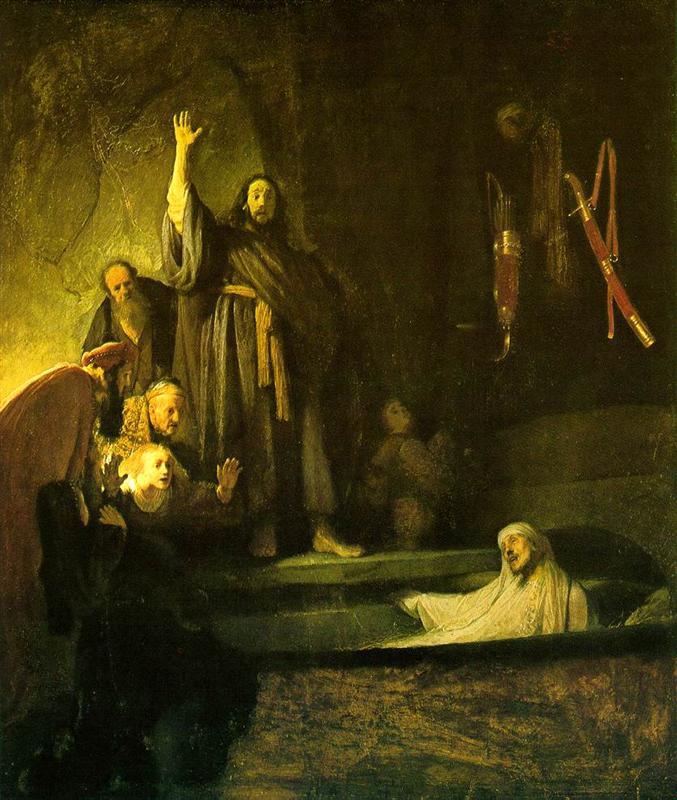
In today’s Gospel, we hear the story of the raising of Lazarus from the dead. The story is a significant turning point in the ministry of Jesus, for as we shall see, it is because of this incident that the Temple leadership in Jerusalem resolves to have Jesus killed.
As is proper with all the gospel accounts, we must not see this as merely an historical happening of some two thousand years ago. Rather, we must recall that we are Lazarus; we are Martha and Mary. This is also the story of how Jesus is acting in our life.
Let’s look at this Gospel in stages and learn how the Lord acts to save us and raise us to new life. This gospel has six stages that describe what Jesus does to save us.
I. HE PERMITS. Sometimes there are trials in our life, by God’s mysterious design, to bring us to greater things. The Lord permits these trials and difficulties for various reasons. But, if we are faithful, every trial is ultimately for our glory and the glory of God. The text says,
Now a man was ill, Lazarus from Bethany, the village of Mary, and her sister Martha. Mary was the one who had anointed the Lord with perfumed oil and dried his feet with her hair; it was her brother Lazarus who was ill. So the sisters sent word to him saying, “Master, the one you love is ill.” When Jesus heard this he said, “This illness is not to end in death, but is for the glory of God, that the Son of God may be glorified through it.”
Notice therefore that Jesus does not rush to prevent the illness of Lazarus. Rather, he permits it for now in order that something greater, God’s Glory in Jesus, be manifest. In addition, it is for Lazarus’ own good and his share in God’s glory.
It is this way with us as well. We do not always understand what God is up to in our life. His ways are often mysterious, even troubling to us. But our faith teaches us that his mysterious permission of our difficulties is ultimately for our good and for our glory.
Scripture says,
Rejoice in this. You may for a time have to suffer the distress of many trials. But this so that your faith, more precious than any fire-tried gold, may lead to praise, honor, and glory when Jesus Christ appears. (1 Peter 1: 10)
But he knows the way that I take; when he has tested me, I will come forth as gold. (Job 23:10)
For our light and momentary troubles are producing for us an eternal glory that far outweighs them all. So we fix our eyes not on what is seen, but on what is unseen, since what is seen is temporary, but what is unseen is eternal. (2 Cor 4:17-18)
An old gospel hymn says, “Trials dark on every hand, and we cannot understand, all the way that God will lead us to that blessed promised land. But He guides us with his eye and we follow till we die, and we’ll understand it better, by and by. By and by, when the morning comes, and all the saints of God are gathered home, we’ll tell the story of how we’ve overcome, and we’ll understand it better by and by.”
For now, it is enough for us to know that God permits our struggles for a season and for a reason.
II. HE PAUSES. Here to we confront a mystery. Sometimes God says, “Wait.” Again, this is to prepare us for greater things than those for which we ask. The text says,
Now Jesus loved Martha and her sister and Lazarus. So when he heard that he was ill, he remained for two days in the place where he was.
Note that the text says that Jesus waits because he loved Martha and Mary and Lazarus. This of course is paradoxical since we expect love to make one rush to the aid of the afflicted.
Yet Scripture often counsels us to wait.
Wait on the LORD: be of good courage, and he shall strengthen thine heart: wait, I say, on the LORD. (Ps 27:14)
For thus says the Lord God, the holy one of Israel, “By waiting and by calm you shall be saved, in quiet an in trust, your strength lies. (Isaiah 30:15)
The Lord is not slow in keeping his promise, as some understand slowness. He is patient with you, not wanting anyone to perish, but everyone to come to repentance…God’s patience is directed to our salvation. (2 Pet 3:9)
Thus, somehow our waiting is tied to strengthening us and preparing us for something greater. Ultimately, we need God’s patience in order for us to come to full repentance; so it may not be wise to ask God to rush things. Yet still his delay often mystifies us, especially when the need is urgent.
Note too how Jesus’ delay here enables something even greater to take place. For, it is one thing to heal an ailing man. It is another and greater thing to raise a man who has been dead four days. To use an analogy, Jesus is preparing a meal. Do you want a microwave dinner or a great feast? Great feasts take longer to prepare. Jesus delays but he’s preparing something great.
For ourselves we can only ask for the grace to hold out. An old gospel song says, “Lord help me to hold out, until my change comes.” Another song says, “Hold on just a little while longer, everything’s gonna be all right.”
III. HE PAYS. Despite the design of God and his apparent delay, he is determined to bless us and save us. Jesus is determined to go and help Lazarus even though he puts himself in great danger in doing so. Notice in the following text how the apostles are anxious about going to Judea. For it is a fact that some there are plotting to kill Jesus. In order to help Lazarus, Jesus must put himself at great risk. The Text says,
Then after this he said to his disciples, “Let us go back to Judea.” The disciples said to him, “Rabbi, the Jews were just trying to stone you, and you want to go back there?” Jesus answered, “Are there not twelve hours in a day? If one walks during the day, he does not stumble, because he sees the light of this world. But if one walks at night, he stumbles, because the light is not in him.” He said this, and then told them, “Our friend Lazarus is asleep, but I am going to awaken him.” So the disciples said to him, “Master, if he is asleep, he will be saved.” But Jesus was talking about his death, while they thought that he meant ordinary sleep. So then Jesus said to them clearly, “Lazarus has died. And I am glad for you that I was not there, that you may believe. Let us go to him.” So Thomas, called Didymus, said to his fellow disciples, “Let us also go to die with him.”
We must never forget the price that Jesus has paid for our healing and salvation. Scripture says, “You know that you were ransomed from the futile ways inherited from your fathers, not with perishable things such as silver or gold, but with the precious blood of Christ, like that of a lamb without blemish or spot.” (1 Pet 1:18).
Indeed, the apostles’ concerns are borne out when we see that because Jesus raised Lazarus from the dead, the Temple leaders from that point on plot to kill him (cf John 11:53). It is of course dripping with irony that they should plot to kill Jesus for raising a man from the dead. We can only thank the Lord who, for our sake, endured even death on a cross to purchase our salvation by his own blood.
IV. HE PRESCRIBES.The Lord will die to save us. But there is only one way that saving love can reach us and that is through our faith. Faith opens the door to God’s blessings and it is a door we must open by God’s grace. Thus Jesus inquires into the faith of Martha and later that of Mary. The text says,
Martha said to Jesus, “Lord, if you had been here, my brother would not have died. But even now I know that whatever you ask of God, God will give you.” Jesus said to her, “Your brother will rise.” Martha said to him, “I know he will rise, in the resurrection on the last day.” Jesus told her, “I am the resurrection and the life; whoever believes in me, even if he dies, will live, and everyone who lives and believes in me will never die. Do you believe this?” She said to him, “Yes, Lord. I have come to believe that you are the Christ, the Son of God, the one who is coming into the world.”
Jesus prescribes faith because there is no other way. Our faith and our soul are more important to God than our bodies and creature comforts. For what good is it to gain the whole world and lose our soul? We tend to focus on physical things like our bodies, our health, and our possessions. But God focuses on the spiritual things. And so before raising Lazarus and dispelling grief, Jesus checks the condition of Martha’s faith and elicits an act of faith: “Do you believe this?” “Yes, Lord, I have come to believe.”
Scripture connects faith to seeing and experiencing great things.
All things are possible to him who believes. Mk 9:23
If you had faith as small as a mustard seed, you could say to this mountain, ‘Move from here to there’ and it would move. Nothing would be impossible for you.” (Mt 17:20)
And he did not do many miracles there because of their lack of faith. (Matt 13:58)
When he had gone indoors, the blind men came to him, and he asked them, “Do you believe that I am able to do this?” “Yes, Lord,” they replied. Then he touched their eyes and said, “According to your faith will it be done to you.” (Mat 9:28)
So Jesus has just asked you and me a question: “Do you believe this?” And how will you answer? Now be careful. I know how we should answer. But how do we really and truthfully answer?
V. HE IS PASSIONATE. Coming upon the scene Jesus is described as deeply moved, as perturbed, as weeping. The text says,
When Jesus saw her weeping and the Jews who had come with her weeping, he became perturbed and deeply troubled, and said, “Where have you laid him?” They said to him, “Sir, come and see.” And Jesus wept. So the Jews said, “See how he loved him.” But some of them said, “Could not the one who opened the eyes of the blind man have done something so that this man would not have died?” So Jesus, perturbed again, came to the tomb. It was a cave, and a stone lay across it. Jesus said, “Take away the stone.” Martha, the dead man’s sister, said to him, “Lord, by now there will be a stench; he has been dead for four days.” Jesus said to her, “Did I not tell you that if you believe you will see the glory of God?” So they took away the stone. And Jesus raised his eyes and said, “Father, I thank you for hearing me. I know that you always hear me; but because of the crowd here I have said this, that they may believe that you sent me.”
In his human heart, Jesus experiences the full force of the loss and the blow that death delivers. That he weeps is something of mystery since he will raise Lazarus in moments. But for this moment, Jesus enters and experiences grief and loss with us. Its full force comes over him and he weeps; so much so that the bystanders say, “See how much he loved him.”
But there is more going on here. The English text also describes Jesus as being perturbed. The Greek word here is Greek word ἐμβριμάομαι (embrimaomai), which means literally to snort with anger, to have great indignation. It is a very strong word, and it includes the notion of being moved to admonish sternly. What is this anger of Jesus and at whom is it directed? It is hard to know exactly, but the best answer would seem to be that he is angry at death, and at what sin has done. For it was by sin that suffering and death entered the world. It is almost as though Jesus is on the front lines of the battle and has a focused anger against Satan and what he has done. For Scripture says, by the envy of the devil death entered the world. (Wisdom 2:23). And God has said, “As surely as I live, declares the Sovereign LORD, I take no pleasure in the death of the wicked, but rather that they turn from their ways and live. Turn! Turn from your evil ways! Why will you die, O house of Israel?” (Ez 33:11).
I do remember at the death of some of my loved ones, experiencing not only sorrow, but also anger. Death should NOT be. But there it is; it glares back at us, taunts us, and pursues us.
Yes, Jesus experiences the full range of what we do. And out of his sorrow and anger, he is moved to act on our behalf. God’s wrath is his passion to set things right. And Jesus is about to act.
VI. HE PREVAILS.In the end, Jesus always wins. And you can go to the end of the Bible and see that Jesus wins there too. You might just as well get on the winning team. He will not be overcome by Satan, even when all seems lost. God is a good God; he is a great God; he can do anything but fail. Jesus can make a way out of no way. The text says,
He cried out in a loud voice, “Lazarus, come out!” The dead man came out, tied hand and foot with burial bands, and his face was wrapped in a cloth. So Jesus said to them, “Untie him and let him go free.”
I have it on the best of authority that as Lazarus came out of the tomb he was singing a gospel song: “Faithful is our God! I’m reaping the harvest God promised me, take back what devil stole from me, and I rejoice today, for I shall recover it all!”
But notice something important here. Although Jesus raises Lazarus, and gives him new life, Jesus also commands the bystanders (this means you and me) to untie Lazarus and let him go free. So Christ raises us, but he has work for the Church to do: to untie those he has raised in Baptism, and to let them go free.
To have a personal relationship with Jesus is crucial, but it is also essential to have a relationship to the Church. For after raising Lazarus (us), Jesus entrusts him to the care of others. Jesus speaks to the Church – to parents, priests, catechists, all members of the Church – and gives this standing order regarding the souls he has raised to new life: “Untie them and let them go free.”
We are Lazarus and we were dead in our sin. But we have been raised to new life. And yet we can still be bound by the effects of sin. And this is why we need the sacraments, Scripture, prayer, and other ministry of the Church through catechesis, preaching, and teaching. Lazarus’ healing wasn’t a “one and you’re done” scenario, and neither is ours.
We are also the bystanders. And just as we are in need of being untied and set free, so we who are also members of the Church also have this obligation to others. Parents and elders must untie their children and let them go free by God’s grace, and so pastors must do with their flocks. As a priest, I too have realized how my people have helped to untie me and let me go free, how they have strengthened my faith, encouraged me, admonished me, and restored me.
This is the Lord’s mandate to the Church regarding every soul he has raised: “Untie him and let him go free.” This is the Lord’s work, but just as Jesus involved the bystanders then, he still involves the Church (which includes us) now.
Yes, faithful is our God. I shall recover it all.
This is the song Lazarus sang as he came forth (I have it on the best of authority).
This is one of those videos that I think you should watch before I say much about it. There is something shocking about the end of it, something awful.
And yet the request by the young man in the video is a common one today, though it often comes in more subtle forms wherein people use one another in the most crass, utilitarian, and selfish ways. Do others exist merely to give you pleasure? Is this not often the message of cohabitation and sex without marital commitment?
Let me ask you one question about the ending of the video: why does what the young man says shock you?
Some of the long soliloquies of Jesus in the Gospel of John are admittedly complex. For example, the farewell discourse and priestly prayer of Jesus spanning over four chapters (John 14 to 17) has many layers and moving parts. The Gospel from today’s Mass (Thursday of the fourth week of Lent), in which Jesus rebukes the unbelief of many ancient Jews, also features many aspects and layers that can overwhelm us, especially if we are unfamiliar with higher forms of rhetorical argumentation.
With these concerns in mind, it seems important to spend a little time pondering what Jesus teaches in this passage, since it can seem complex to us. I will provide a two-sentence summary, then a three-paragraph summary, and finally I will focus on a particular problem that Jesus raises about the suspicious quality of our unbelief. You can read the full passage, which I merely summarize, by clicking here: Jesus Rebukes our Unbelief (John 5:31-47).
Two-sentence summary: Jesus addresses himself to our human tendency to refuse to believe in God. While it is true that some struggle to believe, and reasonably seek some degree of evidence, there comes a point at which it becomes clear that, no matter how much evidence is presented, a person simply and sinfully refuses to believe in God.
Three-Paragraph summary: Jesus rebukes the unbelievers before him by saying in effect:
Although you say you love God and have God for your Father, and you cherish the word of God and the Law of Moses, none of this is really true. For if it were true, you would listen to my Father who is speaking in the depths of your heart about me. And if it really were true that you cherished the word of God and the Law of Moses you claim to know so well, then you would see how dramatically I fulfill all that it says the Messiah and Savior would do.
Your unbelief is simply sinful stubbornness, for I have given you at least four lines of proof that demonstrate that I am both Savior and Lord. First, my Father is speaking to you in the depths of your heart, and giving you the grace to believe. Secondly I have fulfilled countless scriptures which demonstrate that I am the Messiah who was said to come. Thirdly I have worked many, many miracles in your sight that were both prophesied and are proof that I am who I say I am. Fourthly, the most credible prophet of your day, whose holiness and credibility you cannot deny, pointed to me and said I am Messiah and Lord.
Therefore, your refusal to believe in me can only be described as sinfully stubborn; as an example of hardness of heart, and that you do not have the love of God in you, neither do you trust in his word. In the end all your claims to having a special relationship with God, and love for Moses and the word will only serve to condemn you more severely. For you who should know better, simply refuse to believe. You will ultimately be held accountable for your sinful refusal to believe that I am both Savior and Lord.
Now we ought to heed well these words that are addressed not only to ancient peoples, but also to us in our current world. Though it may be true that some in our time do struggle to believe, it is even more often the case that many simply refuse to believe.
While there are many facets to this modern problem of unbelief, let’s look at one line in particular that the Lord speaks, and see how it applies in our own times. Jesus says,
I came in the name of my Father, but you do not accept me; yet if another comes in his own name, you will accept him. How can you believe, when you accept praise from one another, and do not seek the praise that comes from the only God? (John 5:43-44)
Yes, here is a problem quite common today. We easily believe and accept what mere (and fallible) human beings say, but “cop an attitude” when God summons us to believe.
Consider that although we live in times in which many pride themselves on intellectual rigor, urban myths and foolish rumors are easily accepted and bandied about. There is often great credence and legitimacy given to things said by newscasters, certain populist scientists and scientific programs, and even to lesser sources such as Hollywood stars and other popular figures. So easily and quickly do many people believe almost anything said by these sources. Many assertions go almost unquestioned, especially those made by popular scientists and shows on the Science Channel and the History Channel.
Now there are facts that science legitimately presents to us that are supported by large amounts of evidence, and that ought to command some reasonable degree of acceptance from us. Yet even in the physical sciences, many theories that have had widespread acceptance in the past have come to be either significantly altered or entirely set aside. For example, even in my own brief lifetime of 53 years there have been some dramatic shifts in the sciences. When I was a child, I was taught that the universe was in a steady state. There was a theory proposed by a Catholic Priest and scientist named George Lemaitre SJ, that the universe was in fact expanding. Many ridiculed it as the “Big Bang.” By the time I was in high school, the Big Bang Theory was accepted by almost every scientist! Within the span of ten short years, a fundamental scientific premise had gone from being called ludicrous, to being called orthodoxy, and settled science.
Other basic theories and rules have also been called into question with the emergence of quantum theory. Basic axioms of Newtonian physics and even aspects of the Theory of Relativity now have more questions associated with them.
So even the physical sciences, though quite reliable in many ways, often present a moving target for some of the truths they proclaim. And yet, so easily do we simply accept as absolutely and always true whatever certain popular scientists say. Many good and thoughtful scientists are often more careful in the way they express their theories. Unfortunately, many presentations of science are flawed in that they present as certain that which is only theory and even under debate. The Science Channel and the History Channel often present scientists and theories that are more populist than true science. They speak of theories as if they were absolute facts. Thus, we are told that billions of years ago, comets rained down and filled our oceans with water; the Science Channel then obliges by showing us graphics and animated depictions of this as if it were absolutely true beyond any shadow of a doubt. We are then told that all the continents once made up one large continent call Pangaea; once again, the History Channel obliges by showing us an actual depiction of what this continent looked like, as if one could actually know its exact shape and size! The impression is thereby given that this is simply an irrefutable fact.
But the real problem isn’t the populist scientists, or the channels that want to sell ads and keep our attention. The problem is that so many of us looking at this stuff just say, “Oh, I guess that’s how it was. Look it’s right there on TV… look, the scientists are saying so.” And thus we just accept it as true, almost without question. Seldom do we pause and say, “Really? Are they that sure? What is the evidence? How certain is it?”
The same is true with so many things we hear on the news or read on the Internet. We say, “Look, it must be so; it says so right here!”
The point is, we accept so easily what is presented to us. And even if there are often good reasons to do so, because the evidence seems substantial, isn’t it interesting how quickly we “cop an attitude” when it comes to the truths of faith, and what Scripture says and reports, and what our ancient venerable faith reports as true. Suddenly, a lot of people who easily believe almost anything they see or read get skeptical and cynical and say, “Oh, no! You’re going to have to present me all kind of evidence for that! If I can’t see with my own eyes, I won’t accept it!”
Never mind that there’s lots of evidence for the truth of the Scriptures, or that creation shouts, “I was designed, I was designed!” Never mind that there are many miracles such as the Shroud of Turin, or the blood sample from Januarius the Martyr, which liquefies and boils every year on his feast day; or that there are healings, and even more exotic things like weeping statues. Never mind all that. Never mind too, that the ancient wisdom of the Church has stood the test of time as nations have come and gone. Empires have risen and fallen, political and scientific theories have come and gone, fads have become popular and then passé. “No! No matter what you tell me, I’m going to need a lot more evidence than that!”
And this suddenly cynical attitude stands in great contrast to the rather easy-going credulity that we have for things reported from far less substantial, reputable, or lasting sources.
Consider too, that the Holy Scriptures are one of the most numerous and consistent texts from antiquity. Far more ancient copies of it exist than of almost any other ancient document about any ancient historical period or person. The sources in Scripture are remarkably consistent and credible compared to those of other ancient documents. Yet look at the amount of dubious criticism and parsing of every small detail. Look at the dismissal of the Scriptures as being credible or accurate. There is more evidence by far of the existence of Jesus than of any other figure of antiquity. Yet notice that no one doubts the existence of Julius Caesar. But many simply dismiss out of hand any reference to Jesus. Many doubt that what is written of what Jesus said and did is factual; they even doubt that he existed at all. No other ancient figure or document must withstand the kind of scrutiny that Jesus and the Scriptures do. Why is this?
Yes, some of the same human beings who are so gullible that urban myths easily proliferate suddenly become hostile, prosecuting attorneys, debating every fact when it comes to believing in God.
This is what Jesus means when he rebukes us for so easily believing what someone says simply in his own name, but when God and the things of faith are involved, suddenly we are doubtful, cynical, hostile, and rejecting of evidence no matter how varied and numerous.
Jesus is pointing to the strange, obtuse, and mysterious stubbornness of the human heart. It somehow just doesn’t want to believe! So many who easily believe almost anything suddenly dig in their heels when it comes to believing in God!
Jesus is surely on point when he says to us that the problem of faith is not a lack of evidence from the outside, it is a problem on the inside. It is a problem of the human heart; it is the resistance of the flesh.
Pray for faith, pray for the grace to believe and see your faith increased day by day. Be sober that there is a strange stubbornness in the human heart towards believing in God.
Jesus directs our attention inward to our stubborn, impenitent, and unbelieving hearts, and urges us to pray. In the words of the Apostles, “Lord increase our faith!” or those of the Centurion, “I do believe Lord; help my unbelief.”
This song celebrates how creation shouts the existence of God.
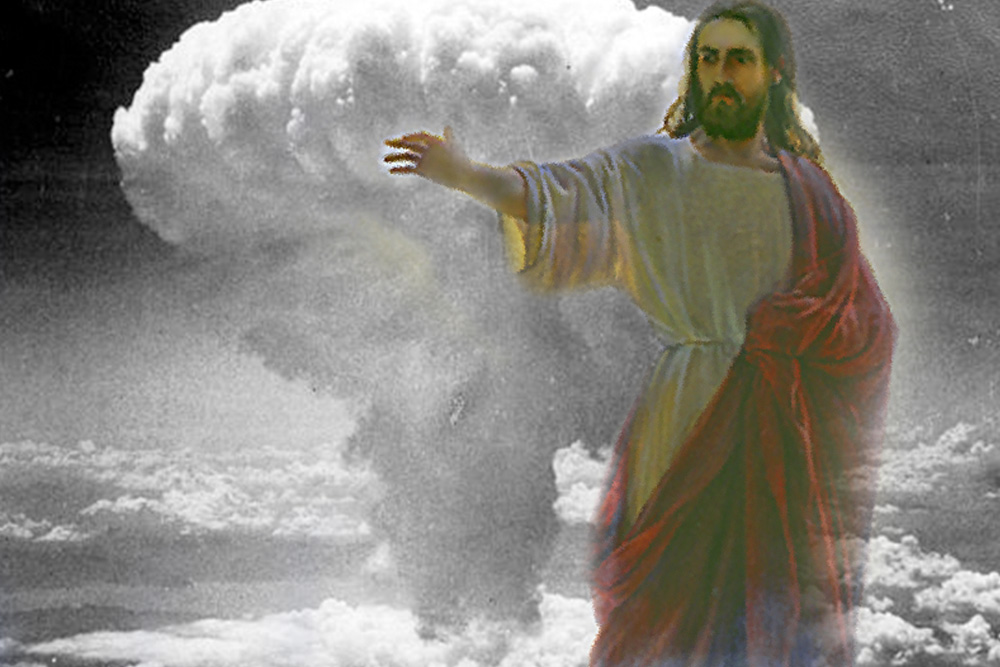
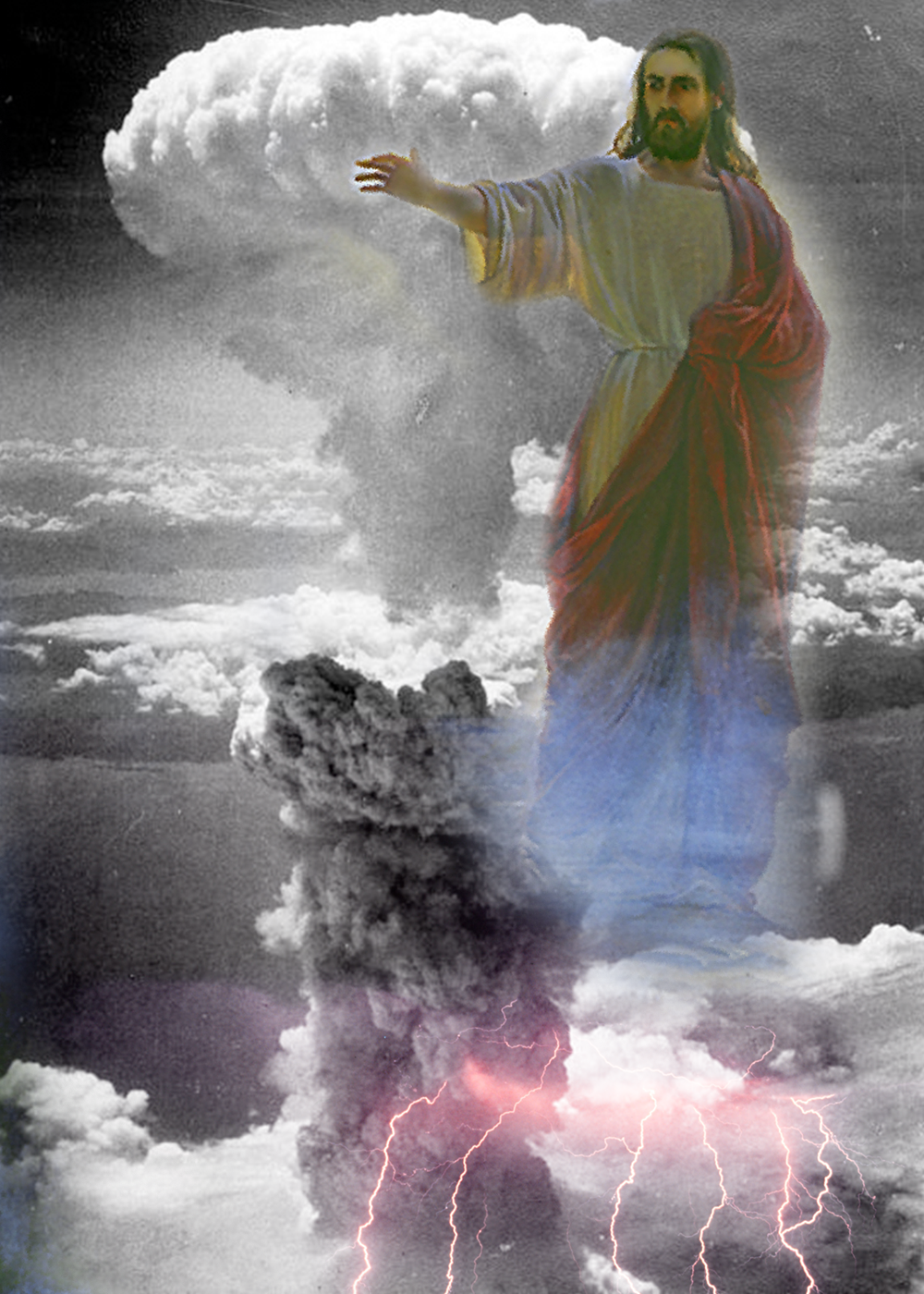
There’s a Gospel song, written back in the 1950’s, called “Jesus Hits Like an Atom Bomb!” It is a warning to be prepared for death. Here are a few of the lyrics:
Everybody’s worried ’bout that Atom Bomb. No one seems worried about the Day my Lord shall come! Better set your house in order, He may be coming soon, and He’ll hit like an Atom Bomb when He comes!
Playful yet clear. But what does it mean to set your house in order? If we’re not careful, we might come up with a long list of things to which we should attend. A long list might tend to overwhelm us and be difficult to remember.
Perhaps this is why Scripture gives us a clear, four-point plan that describes the Christian life. It is found in Acts 2. Peter has just preached a sermon in which he warns his listeners to repent and believe the Good News. He says to them, “Save yourselves from this corrupt generation.” Those who accepted his message were baptized, and about three thousand were added to their number that day. (Acts 2:40-41). Now they are baptized and in the Church of the Living of God. (Notice too, that the verse does not say that they said the “sinners’ prayer” to be saved, it just says that they were baptized.) And unlike some of our Protestant brethren, who hold a kind of “once saved, always saved” mentality, the text does not stop there. These new disciples now have a life to lead that will help them be ready to meet God, and that will help them to set their house in order. And so in the very next verse we read:
They devoted themselves to the apostles’ teaching and to the fellowship, to the breaking of bread and to prayer. (Acts 2:42)
So here is our “four-point plan” for setting our house in order once we have come to faith. There are four components listed below, four pillars if you will. Please note that the text says that they devoted themselves to these four pillars of the Christian life. They did not merely do them occasionally, or when they felt like it, or when the time seemed right. They were consistent; they were devoted to this four-fold rule of life. Let’s look at each pillar in turn, as we consider how to set our house in order.
I. The Apostles’ Teaching– This first pillar of the Christian life is fascinating, not only for what it says, but also for what it does not say. When we think of the “Apostles’ Teaching” we think first of the four Gospels and the New Testament Epistles. And these would surely be true components of the Apostles’ teaching for a modern Christian. But notice that the text does not say that they devoted themselves to Scripture, but rather to the Apostles’ Teaching.
For a Catholic, the Apostolic Teaching consists not only of the New Testament Scriptures, but also the Sacred Tradition, which comes to us from the Apostles, and which has been understood and articulated by the living Magisterium of the Church. The Protestants would largely interpret this first pillar as an exhortation to read the Bible every day and base our lives on it. This is a true understanding, but only a partial one. The early Christians, as you recall, did not have the New Testament in its final form from day one, and thus could not have lived this text in such a way. The Bible as we now have it was not yet completed, edited, or canonized. Yet they had received the Apostolic teaching, because it had been preached to them by the Apostles and their deputed representatives, the bishops, priests and deacons.
St. Paul wrote to the Thessalonians,Sothen, brothers, stand firm and hold to the teachings we passed on to you, whether by word of mouth or by letter (2 Thess 2:15). Therefore, the Catholic application of this first pillar is truer and fuller in that we are devoted to the Apostles’ teaching not in Scripture alone, but also in Sacred Tradition as passed down and interpreted by the living Magisterium of the Church.
To live this first pillar with devotion means to set our house in order by carefully and diligently studying what the apostles have handed down to us. We do this by the daily, devoted reading of Scripture, and/or the diligent study of the faith through the Catechism or other approved manuals. We should make it a daily habit to read Scripture and study the faith, attempting to grow in our knowledge of what God has revealed through his prophets and apostles, and then basing our life on what we learn, and repenting of what is not in line with the revealed truth. Pillar number one is being devoted to the Apostles’ teaching.
II. The Fellowship – the word fellowship may be a little weak here as a translation of the Greek τῇ κοινωνίᾳ (te koinonia). Most people who hear the word fellowship think of coffee and doughnuts after Mass. But the more theological way of translating this word is probably “a communion.” The sacred gathering of the faithful is better termed a “communion,” or in Latin “communio.” It is a gathering of the members of Christ’s Body the Church into one, a communion of Christ with his Bride the Church.
The early Christians, according to this text, devoted themselves to this communal gathering. Hence, the second pillar of the Christian life, through which we are helped to set our house in order, is “fellowship,” or even better, “communio.”
The Commandment is clear: Keep holy the Sabbath. It doesn’t make sense to think that we can disregard one of the Ten Commandments and then claim that our house is in order. Some argue that this commandment does not say explicitly that we should be in Church on Sunday. But Leviticus 23:3 says regarding this Commandment, “You shall do no work and you shall keep sacred assembly, it is the Sabbath of the Lord.” Sacred assembly means “Church.” It is the fellowship, the koinonia, the communio. There is no way around it. God expects us to be in his house on our Sabbath, which is Sunday. The Book of Hebrews also says, “And let us not neglect to meet together regularly and to encourage one another, all the more since the Day draws near.” See here how the Last “Day” and being prepared for it is linked to “meeting together regularly.”
So the second pillar of the Christian life is to set our house in order by going to Mass every Sunday and Holy Day. In the Mass, we both encourage others, and are encouraged by them. We also receive instruction in the Word of God by the anointed and deputed ministers of that Word, the bishops, priests, and deacons. In so doing, we also fulfill the third pillar, to which we now turn our attention.
III. The Breaking of the Bread – The phrase “the breaking of the bread” in the New Testament usually meant the reception of Holy Communion, or the Eucharist.
The worthy reception of Holy Communion is directly connected to having our House in Order, for there are wonderful promises made to those who are faithful in this regard. Jesus makes a promise in John 6:40 that Whoever eats my flesh and drinks my blood remains in me, and I will raise him up on the last day. That’s quite a promise in terms of being ready! Jesus is saying that frequent reception of the Eucharist is essential preparation for the Last Day. Jesus also warns us not to stay away from “the breaking of the bread” or Holy Communion. Unless you eat the flesh of the Son of Man and drink his blood, you do not have life in you (Jn 6:53).
Without Holy Communion, we’re not going to make it. Gotta receive regularly to be ready! We cannot claim that our house is in order if we willfully stay away from Holy Communion.
By extension, we must allow this reference to one Sacrament (Holy Communion) to be a reference to all the Sacraments. Clearly, a Catholic approach to this third pillar of preparation would include being baptized and confirmed. It would also include weekly reception of Holy Communion, regular confession, anointing of the sick when necessary, and where possible, the reception of Holy Matrimony or Holy Orders.
The Sacraments are our spiritual medicine. We have a bad condition called concupiscence (a strong inclination to sin). It is like spiritual high blood pressure or diabetes. Hence, we must take our medicine and be properly nourished. The Sacraments, as our medicine, help us to avoid dying from our sinful condition. So the third pillar of the Christian life is to set our house in order by receiving Holy Communion worthily every Sunday, and the other Sacraments at appropriate times.
IV. Prayer– This final pillar requires more of us than just saying our prayers in some sort of perfunctory way. The Greek word here is προσευχαῖς (Proseuchais), and is best translated just as we have it here: “prayers.” However the Greek root proseuche is from pros (toward or immediately before) + euchomai (to pray or vow). But the prefix pros would convey the sense of being immediately before Him. And hence the ideas of adoration, devotion, and worship are included.
Thus prayer is understood as more than simply “saying one’s prayers.” What is called for is worshipful, attentive, and adoring prayer. Prayer is experiencing God’s presence. Jesus says of prayer that it is necessary for us lest we fall. Watch and pray so that you will not fall into temptation (Matt 26:41). Hence, the fourth pillar is prayer, through which we put our house in order through regular, worshipful, attentive, and adoring prayer of God. This serves as a kind of medicine lest we fall deeply into temptation.
So here are four basic pillars of preparation for the Day of Judgment. Follow them and then even if Jesus “hits like an atom bomb,” you’ll be able to look up and be ready knowing that your redemption is at hand.
Enjoy this video. Observe in it all the readiness preparations for the atomic bomb that some of us who are older may remember. In a way, all the preparations you see in the video are a little silly, since diving under a desk wouldn’t help much if an atom bomb really hit! But the preparations I have mentioned above really ARE helpful since God gives them to us. If the people in this video were trying to get ready with measures that probably wouldn’t help much, how much more important it is for us to do so, who DO stand a chance since God himself has instructed us! Set your house in order! !
The beautiful video at the bottom of this post reminded me of a time a few years ago when I was privileged to take part in a webinar focused on providing support, Church teaching, and information to families who receive a pre-natal diagnosis that their child will be disabled in some way. Perhaps they are informed that the child will have Down Syndrome, or perhaps a birth defect that will lead either to early death, or to a lifetime of challenges.
The pressure on such families to abort is often enormous. They are told, “It is the right thing to do,” and, “You should not make the child suffer.” Some are even made to feel they are doing something “unethical” by bringing forth such children. There are also time pressures placed on such parents. Doctors often want the decision to terminate made quickly, within a matter of days.
A life not worth living? There seems to be operative a notion on the part of many in our culture that there is such a thing as a life not worth living. We have stumbled upon the very unusual and tragically ironic concept that death is a form of therapy, that the “treatment” for disabled babies is to kill them. Of course, death is neither a treatment nor a therapy; it cannot be considered a “solution” for the one who loses his or her life. Yet tragically, this is often the advice that many parents with a poor pre-natal diagnosis receive. And further, there is urgent pressure that they terminate the pregnancy now.
Ninety percent are lost. All this pressure goes a long way toward explaining that just over 90% of families who receive a poor pre-natal diagnosis choose to abort. We in the Church cannot remain silent in the face of this. We must reach out prophetically and compassionately to families in such a crisis. Many of them are devastated by the news that their baby may have serious disabilities. Often they descend into shock and are overwhelmed by fear, conflicting feelings, and even anger at God or others. Sometimes the greatest gifts we can give them are time, information, and the framework of faith. Simply considering some of the following may help:
1. They do not have to rush, despite what they are told. Serious, life-changing decisions should never have to be made within a 48- to 72-hour time period. Pressure should never be applied to families by medical personnel, and the family should consider such pressure a grave injustice.
2. Pre-natal diagnoses are not always right. We often think of medicine as an exact science; it is not. Data can be misinterpreted and premises can sometimes be wrong. Further, there is a difference between the result of a screening and an actual diagnosis. Screenings can point to potential problems and probabilities, but they are not an actual diagnosis. Further study is always needed if a screening indicates potential problems. Quite frequently, further tests after a screening reveal no problem at all.
3. Disabilities are not always as terrible a reality as we, in our “perfect-insistent” world, think. Many people with disabilities live very full lives and are a tremendous gift to their families, the Church, and the world. Providing families with further information about disabilities and connecting them with other families who have experience in these areas are both essential to helping them avoid the doomsday mentality that sometimes sets in when an adverse pre-natal diagnosis is received.
4. For those with faith, it is essential to connect them with the most basic truths of our Christian faith. The cross is an absurdity to the world. But to those of the Christian faith, the cross brings life and blessings, even despite its pain. Were it not for our crosses, most of us could never be saved. Bringing forth a disabled child will not be easy, but God never fails. He can make a way out of no way, and do anything except fail. My own sister was mentally ill and she carried a cross. We too had a share in that cross. But my sister, Mary Anne, brought blessings to our family as well. I don’t know if I’d be a priest today if it were not for her. I am sure I would not be as compassionate, and I doubt I could be saved were it not for the important lessons she taught me. I know she brought out strength and mercy, not to mention humility, from all of us in the family. Her cross and ours brought grace, strength, and many personal gifts to all of us. Yes, the cross is painful, but it brings life as well. Easter Sunday is not possible without Good Friday. To the world, the cross is an absurdity, but to us, who believe it is salvation, it is life, it is our only real hope, it is our truest glory to carry it as Christ did.
5. Disability is not an all-or-nothing thing. Disability exists on a continuum. In some way, all of us are disabled. Some of us have very serious weight problems, others diabetes, high blood pressure, heart problems, etc. Some of us are intellectually challenged in certain areas. Some of us struggle with anxiety, or depression, or addictions, or compulsions. Some experience losses in mobility through an accident or just due to age. All of us have abilities and disabilities. Some of our disabilities are more visible than others; some disabilities are more serious than others. But in most cases, we are able to adjust to what disables us and still live reasonably full lives. We may not be able to do all we would like, but life still has blessings for us. And even our weaknesses and disabilities can, and do, bring us blessings by helping to keep us humble. How much disability is too much? Can you really be the judge of that? Can you or I really decide for someone else that his or her life is not worth living?
6. Life is not usually what it seems. In this world, we esteem things like wealth, ability, strength, and power. But God is not all that impressed by these sorts of things. God has a special place for the poor and the humble. The Lord has said that many who are last in this life are going to be first in the next (cf Mat 19:30). There is a great reversal coming wherein the mighty are cast down and the lowly are raised up. In this world, we may look upon those who suffer disability with a misplaced sense of pity. But understand this: they are going to be the exalted ones in the kingdom of heaven. As we accept the disabled and the needy into our midst, we are accepting those who will be the royalty in heaven. We ought to learn to look up to them, beg their prayers, and only hope that their coattails may also help us to attain some of the glory they will specially enjoy. They have a dignity that this world may refuse to see, but we who believe cannot fail to remember that the last are going to be first. Life is not always what it seems.
What of those who aborted? We as a Church cannot avoid our responsibility to declare the dignity and worth of the disabled. More than ever, our world needs the Church’s testimony, for it is a startling statistic that 90% of parents choose to abort in cases of a poor pre-natal diagnosis. Even as we witness to the dignity of the disabled, and to the wrongness of abortion in these cases, we must also embrace those who have chosen abortion and now struggle with that choice. We are called to reconcile and to bring healing to all who have faced this crisis and fallen. Many were pressured, and felt alone and afraid. We offer this embrace through confession, and through healing ministries like Project Rachael, which offers counseling, spiritual direction, support groups, and prayer services. Even as the Church is prophetic in speaking against abortion, she must also reconcile those who have fallen under the weight of these heavy issues.
Here’s the video I mentioned above that inspired this memory. In case your browser doesn’t support embedded video, click the direct link: HAPPY World Down Syndrome Day
One of the graces of deeper prayer, if we persevere through the years, is that the Lord turns us upward and outward. And, gradually, our prayer turns more toward God and is less anxious about our own aches and pains. It becomes enough to give them to God and trust in His providence. Gradually, we simply prefer to experience the Lord quietly, in increasingly wordless contemplation. God draws us to a kind of silence in prayer as we advance along its ways. But that silence is more than an absence of sound; it is a result of our being turned more toward God. An old monastic tale from, I know not where, says,
Sometimes there would be a rush of noisy visitors and the silence of the monastery would be shattered. This would upset the disciples; but not the Abbot, who seemed just as content with the noise as with the silence. To his protesting disciples he said one day, “Silence is not the absence of sound, but the absence of self.”
Yes, as prayer deepens and becomes more contemplative, the human person is turned more to God, and a kind of holy silence becomes private prayer’s more common pattern. This does not mean that nothing is happening; the soul has a communion with God that is deeper than words or images. It is heart speaking to heart (cor ad cor loquitur). This is a deep communion with God that results from our being turned outward again to God. And the gift of silence comes from resting in God, from being less focused on ourselves, and more and more on God. Let all mortal flesh keep silence, and with (holy) fear and trembling stand, ponder nothing earthly minded… Yes, there is a time for intercessory prayer, but not now. Don’t just do something; stand there. Don’t rush to express; rest to experience. Be still, and know that He is God. An old spiritual says, Hush….Somebody’s callin’ my name. Yes, pray for and desire holy silence, praying beyond words and images. These are the beginnings of contemplative prayer.
St. Paul speaks of the unspeakable quality of deep prayer as well, though his experience likely goes beyond what we call contemplative prayer.
I know a man in Christ who fourteen years ago was caught up to the third heaven. Whether it was in the body or out of the body I do not know—God knows. And I know that this man—whether in the body or apart from the body I do not know, but God knows— was caught up to paradise. He heard inexpressible things, things that man is not permitted to tell. (2 Cor 12:2-4)
Yes, it is “unsayable,” and words fail. St. Augustine was said to remark of the Christian mysteries, If you don’t ask me, I know. If you ask me, I don’t know.
Another gift that is given to those who are experiencing deeper prayer is a sense of spaciousness and openness. As the soul is less turned inward and increasingly turned outward, it makes sense that one would experience a kind of spaciousness. Those who have attained deeper prayer often speak of this Scripture does as well. Consider some of the following passages:
For the Lord has brought me out to a wide-open place. He rescued me because he was pleased with me. (Ps 18:19)
I called on the LORD in distress: the LORD answered me, and set me in a large place. (Ps 118:5)
The Lord brought me out into a spacious place; he rescued me because he delighted in me. (2 Sam 22:20)
You have not handed me over to the enemy but have set my feet in a spacious place. (Psalm 31:8)
Hear me when I call, O God of my righteousness: you have enlarged me when I was in distress; have mercy on me, and hear my prayer (Ps 4:1)
And I shall walk in a wide place, for I have sought your precepts. (Psalm 119:45)
And he moved from there and dug another well, and they did not quarrel over it. So he called its name Rehoboth (a Hebrew word which means latitude or width), saying, “For now the LORD has made room for us, and we shall be fruitful in the land.” (Gen 26:22)
See how consistently this spaciousness is mentioned. As we are turned outward and upward to God, we soon enough experience the spaciousness, and latitude of knowing God. No longer pressed and confined by the experience of being turned inward (curvatus in se), the soul has room to breathe. Many people who begin to experience contemplative prayer, though not able to reduce the experience to words, express an experience of the spaciousness of God. But this spaciousness is more than a physical sense of space; it is a sense of openness, of lightness, of freedom from burden and from being pressed down; it is an experience of relief. But again, all who experience it agree; words cannot really express it well.
Yes, here too is a gift of deepening prayer to be sought: spaciousness, and that openness that comes from being turned outward and upward by God. An old Spiritual says, My God is so high, you can’t get over him, He’s so low, you can’t get under him, he so wide, you can’t get round him. You must come IN, by and through the Lamb.
Two gifts of the deeper prayer we call contemplative prayer, prayer that moves beyond words and images, beyond the self to God Himself.