A study recently came out analyzing the damage to the brain caused by pot smoking. Unfortunately, it came out during the week of the Triduum, and a Catholic blog like this had another focus at that time. But it’s time to circle back and have a look.
I wrote some time ago of my anecdotal observation that the pot smokers I knew all developed serious problems with motivation, and that the effects of being “high” lingered long after toking a joint and went on to become semi-permanent. It involved a glazed look, a shuffling gait, and a lethargic attitude largely exemplified by the phrase: “Hey man…I ain’t gotta do what the man says; I ain’t gotta go to the man’s class…” When some of the kids I grew up with started using pot, there was a very noticeable change in their personalities. Again, I have written more on that here: The Problem of Pot
Now comes a more scientific study from Harvard that affirms what experience has taught. Below are some pertinent excerpts (in bold) along with my brief commentary (in red). The full article is here: Harvard Study links Pot and Brain Damage
According to a new study published in the Journal of Neuroscience, researchers from Harvard and Northwestern studied the brains of 18- to 25-year-olds, half of whom smoked pot recreationally and half of whom didn’t. What they found was rather shocking: even those who only smoked few times a week had significant brain abnormalities in the areas that control emotion and motivation.
Exactly. But I wonder why the author of the article used the word “shocking”? As I have said, and many of you have commented, getting stoned makes you groggy, unmotivated, and induces a sort of personality change. I think it would have been shocking not to find any brain abnormalities. The phenomenon of becoming unmotivated is very observable.
Note too the phrase “significant brain abnormalities.”
Similar studies have found a correlation between heavy pot use and brain abnormalities, but this is the first study that has found the same link with recreational users.
The study described “recreational users” as those who smoked pot between one and four times a week.
Using three different neuroimaging techniques, researchers then looked at…areas [of the brain] … responsible for gauging the benefit or loss of doing certain things, and providing feelings of reward for pleasurable activities such as food, sex, and social interactions. “This is a part of the brain that you absolutely never ever want to touch,” said [Hans] Breiter, co-author of the study….These are fundamental in terms of what people find pleasurable in the world and assessing that against the bad things.”
Pay attention! Pot affects judgment. The study seems to make clear that not only are pot smokers damaging their motivation, they are also affecting their ability to make sound judgments about what is good vs. bad, helpful vs. harmful.
This may go a long way to affirm another connection I have made anecdotally between drug use and the cultural revolution. How else can we describe the cultural and sexual revolutions of the 1960s and 1970s other than as a long stream of bad decisions, poor judgment, the abandonment of common sense, and just plain stupid and foolish thinking? In other words, an awful lot of the leaders, drivers, and participants in this these revolutions were stoned and their brains were damaged.
And even today, when there is so much evidence of the social harm caused by these revolutions, many still can’t make the connections; they want more of the same; they want to drive us deeper into revolution. Are their brains damaged? I don’t know. You decide.
But the widespread lack of common sense in our culture, especially among the Baby Boomers, has a kind of surreal quality to it. It’s a little like a bad dream that you’d expect people to eventually wake up from—but many don’t. Perhaps their brains are too damaged to wake up or to think clearly. I don’t know. You decide.
Shockingly, every single person in the marijuana group, including those who only smoked once a week, had noticeable abnormalities.
OK, so at least according to this study, even “moderate” use causes harm. Studies will continue, but honestly, the data have been pretty clear to me for a long time just from my personal experience with pot smokers. It ain’t cool or pretty. They just look glazed, stoned, unmotivated, and “dulled out.” Their whole sad demeanor shouts to me: “Don’t do drugs!”
I am not going to address here the issue of how drug use should be dealt with by the legal system. I am not certain that putting users in jail is the answer. But the legalization push that is rampaging through this country is yet another example of bad judgment. Let’s slow down the train and at least adopt the same attitude toward pot that we have toward cigarettes.
Pot should barely be tolerated within fifty miles of where anyone lives. And if it is “legal” it ought to be pushed to the margins of our society with no less scorn than tobacco has recently been given. When I see a tobacco smoker I think, “How sad. How foolish…given all we now know.” There is no less reason to consider pot smokers in this same manner. They are not cool, hip, or glamorous. Smoking pot is sad and foolish behavior.
To address the “Yeah, but what about alcohol?” objection, I will make a few quick observations:
Drunkenness is a sin.
Would our society be better off without any alcohol? Probably. But if so, why would we want to add another substance with problematic associations to the mix?
I am not aware of any study that says that moderate or occasional use of alcoholic beverages permanently damages the human brain. But it is clear that excessive use of alcohol has severe bodily consequences, including effects on the brain.
The Bible, while condemning drunkenness, does not forbid the use of alcohol and even commends the proper use of wine, etc.
The moderate use of alcohol is not in the same category as pot smoking and the two should be discussed as separate matters. The expression “Drugs and Alcohol” is an equivocation that lumps together two different realities that are separated by wide gulfs of culture, history, experience, and medical study.
When I was growing up in the 60s and 70s, a lot of music “celebrated” pot. Here is one of those popular “songs.” It made a joke out of being stoned. At the end of the day though, it was just dumb.
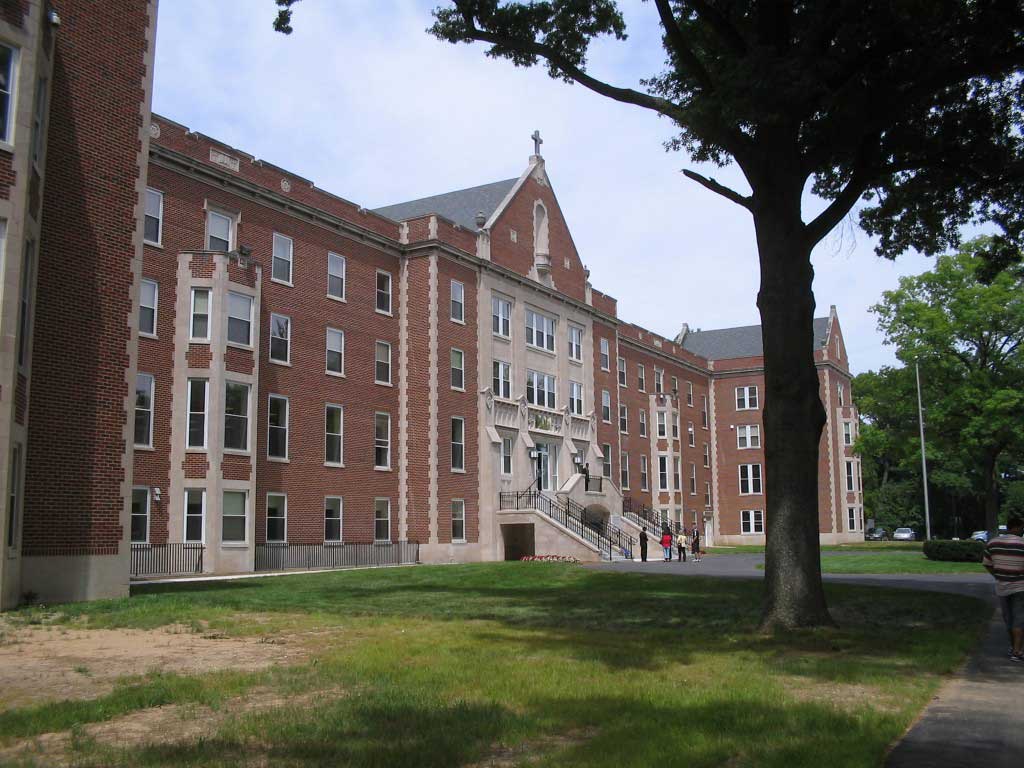
I was at a meeting of the Seminary Council today for one of our diocesan seminaries. It is the Redemptoris Mater Seminary that is currently training almost thirty of our Washington men for priestly Ministry. Four men are currently stepping forward for Holy Orders this spring, and each spoke to the Council seeking our prayers and recommendation to the Cardinal.
They are all fine men, but what most impressed me was that when asked to tell us a little something about themselves, they went beyond the mundane (date of birth, country of origin, basic course of studies, etc.). Instead, each man gave personal testimony of how the Lord has both ministered to and transformed him. These men were witnesses of the Lord and His power.
Each of them spoke of how the Lord rescued him from various afflictions, family and personal struggles, and agnostic or ambivalent tendencies. Each spoke of how the Lord called him and made a way for him, how the Lord has transformed his own life.
I told them how important it is to share this personal witness with the people they serve. They really did not need for me to say this, since the Neocatechumenal Way has personal witness and testimony as an important hallmark of their formation and liturgical experience.
I too have discovered the importance of the priest bearing personal witness to the gospel in his preaching, teaching, and daily life. I have discovered that our people need—are hungry—for those of us who preach to move beyond mere aphorisms and abstract homilies to a personal witness of the truth. We cannot simply proclaim the truth; we have to know it; we have to experience that it is true. We have to be firsthand witnesses and be able to articulate how we have personally experienced the power of the Cross of Jesus Christ to put sin to death and bring newness of life to us.
Earlier this week, I was privileged to preach to almost 200 priests on retreat and shared some of these thoughts with them. We who preach are called to be witnesses, not just those who pass on information or instruction.
St. Paul wrote, If anyone is in Christ, he is a new creation(2 Cor 5:17). The danger for a bishop, priest, or deacon who preaches is that he merely quotes the Scripture as a handy phrase or slogan. What is supposed to happen is that the preacher is able to say,
Yes, if anyone is in Christ he IS a new creation, and I can personally say to you, my people, that this is true not only because it is in the Bible, but because it is happening in my life. I, am a new creation. I am seeing my life changed and transformed by the cross of Jesus Christ. Through the sacraments, his Word, prayer, and the ministry of the Church, Jesus Christ is setting me free from sin and every negative thing in my life. He is breaking the chains of the things that held me in bondage. He is giving me a new mind and a new heart. I love people I never thought I could love! I am more chaste than I ever thought possible. Serenity and joy are replacing fear and depression. I am more and more a man of hope, confidence, and courage. Yes, I AM a new creation. What the Lord says is true, and I am a witness. I’m not what I want to be, but I’m not what I used to be. A wonderful change has come over me.
I am convinced that many Catholics long to hear their clergy speak with conviction—like men who have actually met Jesus Christ. Of course, before they speak such things, they actually have to be true!
I am glad that the men who testified today have actually met Jesus Christ and experienced His power. They have something to say because something real has happened to them. And herein lies the necessity not only for clergy, but for parents, and for all Christians, who are called to evangelize. It is absolutely critical that we personally know the Lord Jesus Christ, the Love of His Father, and the fellowship of the Holy Spirit. It is essential that, in the laboratory of our own lives, we have tested the Word of God and found it to be true. And from these experiences we can preach, speak, and witness with authority.
We preach with authority only if we have met the “author” and felt His power to transform our lives. Otherwise we risk giving information, but without the conviction or personal witness that helps people to transformation. We can say all the right and orthodox things, but then comes the ultimate question: “That’s all very nice, but how do I know it’s true?” And the preacher, the teacher, the parent, the catechist, or the evangelizer has got to be able to say in response, “Look at me…I promise you it is true because it is happening in my life. I promise you in the Name of the Lord Jesus Christ that a completely new life is available to you, and I am a firsthand witness of it.”
The Greek word for authority is “exousia” which more literally means to preach out of (one’s own) substance. It means to preach as one who has substantially experienced what he speaks of.
Of course to be able to say all this requires that it is actually happening! That’s why it is so important for priests, parents, and all Church leaders to tend to their own spiritual lives—to study the Word of God and see its truth in the laboratory of their own lives, to consider well the evidence and gather their own testimony.
Fulton Sheen once remarked that we have tried seemingly every other way to evangelize and grow the Church: seminars, workshops, committees, new music, liturgical creativity—all to little avail. But one thing only has not been tried: holiness. Yes, authentic transformation comes only when we finally take the Lord up on His offer—and take His word seriously—that we are and can become a new creation.
“If anyone is in Christ, he is a new creation.” St. Paul couldn’t just look this up and quote it like a slogan. He had to write it. And before he wrote it he actually experienced it. So when Paul says this, it’s not a slogan; it is a surety; it is an experienced truth.
This is what the Church needs: humble but strong preachers who have confirmed the Word of God in their own lives. Men who can boast, not of what they have done, but of what the Lord has done for them through the power of His cross to put sin to death and bring grace alive. And from experience comes authority, for they have met the Author of their salvation.
Thanks be to God for these men at the seminary today and for their witness, their testimony, their “boasting” in the Cross of our Lord Jesus Christ (cf Gal 6:14).
The photo at the above-right (taken by yours truly) is of the Redemptoris Mater Seminary in Washington, D.C.
This song says, You Should be Witness…Why don’t you testify? Don’t be afraid to be a witness for the Lord…Stand up and be a witness!
There is a concise summary of the work and experience of the Church given by Jesus in the discourse with Nicodemus:
Amen, amen I say to you, we speak of what we know and we testify to what we have seen, but you people do not accept our testimony. (Jn 3:11)
I. Plural – Note that while Jesus speaks to Nicodemus he does not say, “I speak to you,” he says, “We speak to you.” This first-person plural is common in Johannine literature. For example, at the beginning of the First Letter of John it is said, “That which was from the beginning, which we have heard, which we have seen with our eyes, which we have looked at and our hands have touched—this we proclaim concerning the Word of life.” (1 John 1:1).
Who is the “we” referred to here? As with most things Scripture, there are layers of meaning. Certainly it means, first of all, the apostolic college. And at another, wider level, it refers to those first eyewitnesses, the disciples who heard and saw Jesus and were able to report what he said and did. Yet more widely, the “we” referred to here is the Church down through the centuries.
It is ultimately the Church which says to our world, “We speak of what we know, and we testify to what we have seen.”
II. Proclamation –This therefore is the proclamation of the Church down through the centuries to our present day and to the world, “We speak of what we know, and we testify to what we have seen.” If the Church can no longer say this, she is no longer the Church! If the church could no longer say, “Jesus is Lord…and we know this, we experience this, and we see it with our eyes…” then the Church would no longer be the Church.
Note that in the Biblical sense, the word “know” does not simply refer to intellectual knowing, as if the Church were simply reciting words written centuries ago and then handing them out. Biblical knowing emphasizes experience; something known means something actually seen and experienced, not just learned in the abstract. The Church does not simply know Jesus as Lord and speak of what she knows, as if reciting ancient formulas, precious though they are. Rather, she speaks of her experience with the Lord Jesus Christ in the sacred liturgy, and of His powerful ministry to all her Children and members down through the centuries to this very day.
The proclamation of the Church is that we speak to the world of what we know, that is, what we have experienced. And to emphasize, Jesus adds that the proclamation of the Church is not simply what we know, but what we have “seen.” And here too, a tangible experience is referred to. This is not simply the recitation of ancient formulas, but of ancient truths, presently experienced—seen. In other words, the Church can raise her right hand and swear to the truth of all that Jesus has said and done because she knows it; she experiences it; she has seen it—she has witnessed it occurring in her very sight.
For indeed, souls are healed and set free, and human beings are transformed gloriously by the celebration of her sacred liturgy with her blessed Groom and Lord, Jesus Christ.
The Church announces her experience with Jesus Christ, with the capacity of His Word and truth to transform her and her members. So the Church says to the world, “We testify to what we have known, and what we have seen.”
This is the proclamation of the Church, and if the Church could no longer say this to the world, she would no longer be the Church.
III. Persecution –Then Jesus says to Nicodemus, and by extension to the world, “You do not accept our testimony.”
That is to say, it is often the lot of the Church to be scorned, ridiculed, and mocked—even hated and persecuted—because of our proclamation. There are many who demand that the Church conform to the world and its ideas and values.
Yet as Pope Paul VI noted in “Humanae Vitae,” one of the Church’s most rejected encyclicals,
There is too much clamorous outcry against the voice of the Church, and this is intensified by modern means of communication. But it comes as no surprise to the Church that she, no less than her divine Founder, is destined to be a “sign of contradiction.” She does not, because of this, evade the duty imposed on her of proclaiming humbly but firmly the entire moral law, both natural and evangelical. (#18)
It is often the lot of the Church to be this sign of contradiction. Yes, we must often stand up before a worldly consensus and say, “No,” no matter how many there are around us who say, “Yes.” It is the lot of the Church to experience rejection and to have to say, “You do not accept our testimony.”
And yet this is judgment, for Jesus says, “Light has come into the world, but people loved darkness instead of light because their deeds were evil. Everyone who does evil hates the light.” (John 3:19-20) And St. Paul also adds, “For the time will come when people will not put up with sound doctrine. Instead, to suit their own desires, they will gather around them a great number of teachers to say what their itching ears want to hear.” (2 Tim 4:3). And Simeon as he held the infant Jesus, and thereby the infant Church, said, “This child is destined to cause the falling and rising of many in Israel, and to be a sign that will be contradicted.” (Lk 2:34)
Yes, here is our place—among the persecuted, scorned, and derided. The Church must be willing to say to the world, “You do not accept our testimony.” We must not “cave.” Too many today, desiring the Church to be “relevant,” and “acceptable,” insist that we alter our doctrines so that the world will accept our testimony. But God forbid the Church ever do this. We would no longer be the Church!
Here then is Jesus’ Charter—His mandate—for the Church: that we should say to the world, “We speak to you of what we know, and of what we have seen, but you do not accept our testimony.”
Every now and then, a word just catches your ear and several times in the space of a day it jumps out at you and you’re tempted to say, “There it is again!”
Yesterday it was the word “consider,” an ordinary, everyday word…or is it? Why did it suddenly strike me so?
With my knowledge of Latin, it occurred to me that “consider” has something to do with the stars, for the Latin word sidera means “stars” or “heavenly bodies.” How interesting! I have use the word for the better part of fifty years and that had never crossed my mind before. But as sometimes happens, I was too busy to check it out and got on to other things, the insight forgotten as quickly as it had come.
But then this morning in the reading from the morning office, there it was again. Paul’s Letter to the Romans says,
You must consider yourselves dead to sin but alive for God in Christ Jesus (Rom 6:11).
“Okay Lord, I got the message. You want me to consider the word ‘consider.’ There’s something mystical and spiritual about it isn’t there, Lord?” The Lord didn’t need to answer. After prayer I spent some time checking out my hypothesis.
Sure enough, the word “consider” comes from the Latin root words cum (with) and sidera (stars), thus meaning literally “with the stars.”
The dictionary assigns the following meanings to the word ‘consider’: to think about carefully, to think of especially with regard to taking some action, to take into account, to regard or treat in an attentive or kindly way, to gaze on steadily or reflectively, and to come to regard.
And all these meanings are accurate enough.
But the root meaning referring to the stars also brings the word so much more alive. Thus my definition would include the following perspectives: to reflect upon as if pondering the stars, to gaze as if with wonder and awe, to think carefully and reflectively as when one looks up and out at the night sky.
Yes, to look up and out, billions of miles out into the vast sweep of space with over 100 billion galaxies and untold numbers more of stars in each one. Yes, to “consider” from its literal root is to base our thoughts in the perspective of the stars. This fills us with wonder and awe, reminds of the extravagance of God’s love, and humbles us by the sheer vastness of all the things that God has done. It is to see by the light of God’s glory and his expansive love. To consider is to think in a way that sees the present moment as caught up in something far more immense and ancient than the mere here and now; it is to experience the moment, the place and time, as part of something more vast and timeless than we can imagine.
And thus in St. Paul’s admonition, “you must consider yourselves dead to sin but alive for God in Christ Jesus,” we are being invited to grasp that God’s mercy and love are bigger than any sin we may have committed. We are summoned to look beyond the present moment and to behold with wonder and awe the perfection that God has already accomplished.
And as we see and behold that reality, we start to live out of it now. As we cast our thoughts out among the stars, as we think cum sidera, we look outward and upward from the present reality to the glory waiting for us in heaven. And, as St Paul exhorts, making this “consideration” helps that reality begin to break into the present moment and become ever more real to us and for us.
And as it does break in, sins begin to be put to death and virtues come alive. Our life begins to change as we look beyond the present, in which there may be weakness and pain, and we see (out there past the stars) to the victory that is already ours and is so much bigger than this mere moment. And thus we become alive to God in Christ Jesus.
All this from one word, “consider”: to reflect as if pondering the stars, to gaze as if with wonder and awe, to think carefully and reflectively as when one looks up and out at the night sky.
Yes words are wonderful and many of them are mystical. Think about it: the stars get you to look up and out, to gaze beyond with wonder and awe, to consider.
Not a bad thing to do when seeking perspective or pondering paths, when searching for answers, searching for meaning, searching for God.
Give it some consideration.
In a similar vein, Fr. Robert Barron has described how the word “recognize” means (literally) to rethink something, to take up a thought that has already been thought (re (again) + cogitare (to think)). We live in an intelligible world, a world that was thought into being by God. And thus when we recognize something, we are thinking something that God has already thought into being; we are rethinking it. Think about it! Can you not recognize this? Indeed, consider it well!
A recent popular movie entitled Heaven is for Real is probably well-intentioned, but according to some it taps into many modern errors related to death, judgment, Heaven, and Hell. We have discussed in the past on this blog some of the many modern errors related to these issues.
Chief among these modern errors is the notion of “universalism,” which accords the vast majority, if not practically everyone, the reward of Heaven. But of course this notion runs directly contrary to Scripture, which says that many will be lost. And while we cannot assign percentages or make judgments in individual cases, nevertheless we ought not entertain the fanciful notion that “many” being lost actually means “just a few,” let alone “hardly anyone at all.”
To its credit, the Washington Post recently published an article allowing critics of the movie to speak of their concerns. Though no Catholic theologians were interviewed, the concerns and critiques voiced by the Evangelical pastors consulted for the article articulate fairly well that the movie Heaven is for Real, while often referring to Scripture, is a movie essentially rooted in popular culture, which has become unmoored from 2000 years of biblical tradition.
Let’s look at some of the critiques in the article. As usual, the text of the article is denoted by bold italics, while my remarks are in red text. The full article is available here: Movie on Heaven has its Critics.
I want to emphasize that my comments here are on the critique; I have not seen the movie. My remarks here are to affirm what the critique says, not of the movie, but of our modern culture.
Heaven is not only “for real,” it’s pretty much for everyone in the new movie based on the near-death experience visions of a precocious preschooler.
We know we’re already in trouble when a movie involving any theological speculation at all relies on the visions of a preschool student, even if a precocious one. The book was published over two years ago, and frankly, when I noted that it was based on the visions of a preschooler, it never occurred to me to buy the book, let alone read it or take it seriously. While it is true that children can have beautiful spiritual visions, the accuracy of those visions cannot be guaranteed, and surely they are in very childlike categories, which often lack important distinctions, etc.
In this opening critique we are told that the film says that Heaven is “for everyone.” So it seems according to the critics that the film is rooted in the modern heresy of universalism described above. The article continues with,
…the film jettisons doctrine. Instead, it celebrates an unabashed “God is love” view that goodness in this life gets you, your friends, and your family a crown and wings in the next.
The essence of heresy is not the outright denial of all Christian truth. Rather, it is the taking of one or several teachings and emphasizing them to the exclusion of other teachings meant to balance and frame them. It is true that God is love. But we ought not set up a false dichotomy between love and God’s judgment of our final disposition in terms of His offer of love. Love does not mean that there is no accountability, no consequence, no judgment, no day when God will determine our final disposition based on our for regard for Him and the values of His Kingdom.
Yes, God is love, and no one loves you more than Jesus Christ does. Yet no one warned you more than Jesus did about judgment and the possibility of Hell. Jesus did so in parable after parable, warning after warning. There are sheep and goats (Matt 25), some who are taken and some who are left (Matt 24:40), some who are at the right and called to the Kingdom prepared for them and others to the left who are told to depart into the flames prepared for them and the devil (Mat 7). There are wise virgins and foolish virgins (Matt 25), there are the merciful who obtain mercy (Matt 5) and those who are not and are judged without mercy. There are those who have forgiven and are thus forgiven by God (Matt 6), and those who did not forgive and are therefore not forgiven by God. There are those courageous souls who announced and lived God’s Word in chaste purity and fidelity, but there are also those who are on the outside, whom the Lord calls dogs, cowards, fornicators, liars, and so forth (Rev 21). The list could go on.
And while there is something of a tension between judgment and love, to say that love cannot be squared with judgment is to set up a false dichotomy and to offend the testimony of Scripture. The same Jesus who loves us and died for us is also the Jesus who will judge us. And He says to us that the judgment is essentially in our hands; either we will love the light and will choose Him and His Father’s Kingdom, or we will prefer the darkness and will not choose the Kingdom.
The modern heresy of universalism seeks to resolve the tension between God’s love and justice by choosing love and discarding justice. And yet part of His justice is to respect the freedom of our choice for or against Him and what He values! The heresy of detaching God’s love from His respectful justice turns His love into a doting, fawning, inconsequential love. It is a one-sided love in which God calls the shots and our own stance really doesn’t matter. But of course this is not really true love; it is a kind of paternalism wherein we never really attain the glorious freedom of Children of God because our choices never really mattered anyway.
Pay attention, fellow Christians! Modern, “cheesy,” sentimental notions of God’s love are unbiblical, beneath the dignity of God, and also beneath the dignity of the human person. At the heart of our dignity is the fact that we have real decisions to make, decisions with consequences, decisions that actually matter.
Yes, God is love, but that love requests, respectfully, to be loved in return. It is a love that respects our freedom, and while seeking our “yes,” is willing to accept our “no.” Only then does our “yes” have true meaning.
Heaven is a real place, not just a concept…We just wish many people would go to the Bible, rather than the cinema, to find out what heaven is.
This is well said; Heaven is a real place. Heaven is not just some “designer” place; Heaven is the Kingdom of God in all of its fullness and with all of its values lived perfectly. And frankly, many of the values of the Kingdom of Heaven are not popular today – values such as chastity, love of enemies, forgiveness, generosity as opposed to greed, etc. Heaven is not just some egocentric place of our own design. It is the place where we will see God, as He really is, in all of His justice and mercy.
Reducing Heaven to merely sentimental notions such as mansions and streets lined with gold, nice though these things seem, is to ignore the most essential aspect of Heaven. The heart of Heaven is the encounter with God, in all of His glory and in all of His truth. Heaven is also very liturgical, resembling to a great degree the Catholic Mass. There are priests in long white robes, candles, incense, a book, the lamb on the altar, hymns, praise of God, and so forth. Given the empty churches of today, many apparently find this vision less than appealing.
Heaven isn’t just “for real,” it is what it really is, not what we want it to be. Some find it attractive and glorious. But as Scripture says, many will find the “real” Heaven intolerable. Why? Because as Jesus says, This is the judgment, that the light has come into the world, but many prefer the darkness because their deeds are sinful. (Jn 3:19)
But who wants to tell…[a parishioner] that her soldier-son may not be in heaven after all?…[Pastor] Challies knows he’s up against a cultural tide that celebrates “the heaven we want, the Jesus we want, not the Jesus we’ve really got who is worthy of worship and won’t allow unholiness in heaven.”
Yes, the cultural challenges are enormous; the uphill climb really does seem rather steep. Scripture is clear regarding Heaven: nothing impure shall enter there (Rev 21:27). We need to be serious about our preparation. I DO think it is possible to speak boldly of this at funerals without getting too personal about the deceased. We cannot be their judge one way or the other. But we can still ask prayers for the deceased and can warn the living. I have published a funeral sermon here:Funeral Sermon
While heaven books delight publishers with divine sales numbers, the afterlife actually isn’t a top-of-mind issue for many people: 46 percent told a 2011 LifeWay Research survey they never wonder whether they will go to heaven. But it’s unknown whether they are unconcerned because they already feel sure of their ultimate fate one way or another.
And here’s the ultimate harm of heresy: it has God’s people locked in the clutches of evil one. They have bought into his lies that Heaven is a done deal, in direct contradiction of Jesus’ words that we must endure to the end in order to be saved (Mat 24:13). We must grow in virtue and struggle to be free of sin.
The sin described here is one of presumption. It is sin against hope; for who hopes for what he already has? Hope is confident expectation of God help. It is a good thing to be confident, but it is the kind of confidence that summons us to battle, not to the sofa or to the victor’s box before the race is even run!
The indulgence of the heresy of universalism means that many do not take their own battle seriously, nor do they battle seriously for the souls of others. The result is that many souls are likely lost.
Hence according to the critique, the movie seems at best flawed, at worst harmful. For though it draws from Scripture, it does so selectively, and uses as its main source a preschool child and the popular imagination of heaven, which has been unmoored from 2,000 years of Christian teachings.
Given the tenor of some of the comments rolling in let me repeat what I said above: I want to emphasize that my comments here are on the critique; I have not seen the movie. My remarks here are to affirm what the critique says, not of the movie, but of our modern culture.
In today’s Gospel we see that the Risen Lord appeared to the apostles, who were gathered together in one place. The fact that they were gathered in one place is not without significance, for it is there that the Lord appears to them. One of them, as we shall see, was not in the gathering and thus missed the blessing of seeing and experiencing the risen Lord. It might be said that Thomas, the absent disciple, “blocked” his blessing.
Some people want Jesus without the Church. No can do. Jesus is found in his Church among those who have gathered. There is surely a joy in a personal relationship with Jesus, but the Lord also announced a special presence whenever two or three are gathered in his name (cf Mat 18:20). It is essential for us to discover how attending Mass and walking in fellowship with the Church are both essential for us if we want to experience the blessing and healing of the Lord. This Gospel has a lot to say to us about the need to gather together to find the Lord’s blessing in the community of the Church, in his Word, and in the Sacraments. Let’s look at the gospel in five stages.
I. The Fearful Fellowship – Notice how the text describes the apostles gathering: On the evening of that first day of the week, when the doors were locked where the disciples were, for fear of the Jews… These men are frightened, but they are in the right place. It is Sunday, the first day of the week, and they have gathered together. The text says nothing about what they are doing other than that they have gathered. But in a sense this is all we need to know, for this will set the stage for blessing and for the presence of the Lord.
And these are men who need a blessing. The locked doors signify their fear of the Jewish authorities. One may also presume that they are discouraged, lacking in hope, even angry. For they have experienced the earthquake that Jesus’ crucifixion was for them. It is true that some of the women in their midst claimed to have seen Jesus alive. But now it is night and there have been no other sightings of which they have heard.
But, thanks be to God, they have gathered. It is not uncommon for those who have “stuff” going on in their lives to retreat, withdraw, even hide. Of course this is probably the worst thing one can do. And it would seem that Thomas may have taken this approach, though his absence is not explained. Their gathering, as we shall see, is an essential part of the solution to all that afflicts them. This gathering is the place where their new hope, new hearts, and new minds will dawn.
And for us too, afflicted in many ways, troubled at times yet joyful at others, there is the critical importance of gathering each Sunday, each first day of the week. Here too for us in every Mass, is the place where the Lord prepares blessings for us. I am powerfully aware of how every Mass I celebrate, especially Sunday Mass, is a source of powerful blessings for me. Not only does God instruct me with his Word and feed me with his Body and Blood, but he also helps form me through the presence and praise of others: the people I have been privileged to serve. I don’t know where I’d be if it were not for the strong and steady support of the People of God: their prayers, their praise, their witness, and their encouragement.
The Book of Hebrews states well the purpose and blessings of our liturgical gatherings:
Let us hold fast the confession of our hope without wavering, for He who promised is faithful; and let us consider how to stir up one another to love and good deeds, not neglecting to meet together, as is the habit of some, but encouraging one another; and all the more as you see the Day drawing near. Heb 10:22-25
So here are the Apostles meeting together, encouraging one another. And as we shall see, they are about to be blessed. But the blessing occurs only in the context of the gathering. One of the apostles, Thomas, is missing, and thus will miss the blessing. This blessing is only for those who are there. And so it is for us, who also have blessings waiting, but only if we are present, gathered for holy Mass. Don’t block your blessings!
II. The Fabulous Fact – And sure enough here comes the blessing, For where two or three are gathered in my name, there am I among them (Matt 18:20). The text from today’s Gospel says, Jesus came and stood in their midst and said to them, “Peace be with you.” When he had said this, he showed them his hands and his side. The disciples rejoiced when they saw the Lord. Jesus said to them again, “Peace be with you.”
Suddenly there is a completely new reality, a new hope, a new vision. Note too that there is also a new serenity, a peace, a shalom. For not only do they see and come to experience a wholly new reality, but they also receive an inner peace. Observe again, this is only for those who are present.
And here is a basic purpose of walking in Fellowship with the Church and of the gathering we call the sacred liturgy. For it is here that we are invited to encounter the Living Lord, who ministers to us and offers us peace. Through his word, we are increasingly enabled to see things in a wholly new way, a way that gives us hope, clarity, and confidence. Our lives are reordered. Inwardly too, a greater peace is meant to come upon us as the truth of this newer vision begins to transform us, giving us a new mind and heart. And, looking to the altar, we draw confidence that the Lord has prepared a table for me in the sight of my enemies and my cup is overflowing (Ps 23). The Eucharist is thus the sign of our victory and election and, as we receive the Body and the Blood of the Lord, we are gradually transformed into the very likeness of Christ.
Elaboration: Is this your experience of the gathering we call the Mass? Is it a transformative reality, or just a tedious ritual?
As for me, I can say that I am being changed, transformed into a new man, into Christ, by this weekly, indeed, daily gathering we call the Mass. I have seen both my mind and heart changed and renewed. I see things more clearly, and have greater hope, joy, and serenity. I cannot imagine what my life would be like, were it not for this gathering of the Holy Sacrifice of the Mass where Jesus is present to me and says, “Shalom, peace be with you.” Over the years, I am a changed man.
Yes, the Mass works; it transforms, giving a new mind and heart. Don’t block your blessings; be there every Sunday.
III. Forgiving Fidelity – Next comes something quite extraordinary that also underscores the necessity of gathering and simply cannot take place in a solitary notion of faith. The text says, “As the Father has sent me, so I send you.” And when he had said this, he breathed on them and said to them, “Receive the Holy Spirit. Whose sins you forgive are forgiven them, and whose sins you retain are retained.”
In this remarkable moment, the Lord gives the apostles the power to forgive sin. Note that he is not simply giving them the ability to announce that we are forgiven. He is giving them a juridical power to forgive, or in certain cases to withhold or delay forgiveness. This is extraordinary. Not only has he given this authority to men (cf Matt 9:8), but he has given it to particular men, all but one of whom abandoned him at his crucifixion. These are men well aware of their shortcomings! Perhaps it is only because of this awareness that the Lord can truly trust them with such power.
Here is the heart of Divine Mercy Sunday: the Lord’s mercy for us, and that mercy available to us through his presence on earth, through his mystical Body, the Church.
Elaboration: There are those who deny that Confession is a Biblical sacrament. But here it is, right here in this biblical text. There are other texts in Scripture that also show confession to be quite biblical. For example,
Also many of those who were now believers came, confessing and divulging their practices. (Acts 19:18).
Is any one of you sick? He should call the presbyters of the church to pray over him and anoint him with oil in the name of the Lord. And the prayer offered in faith will make the sick person well; the Lord will raise him up. If he has sinned, he will be forgiven. Therefore confess your sins to one another and pray for each other so that you may be healed. The prayer of a righteous man is powerful and effective. (James 5:14-16).
Many consider it sufficient merely to talk to God privately about their sins. But the Scriptures once again instruct us away from such a solitary notion and bid us to approach the Church. The Lord gives the apostles the authority to adjudicate and then absolve or retain sin, but this presupposes that someone has first approached them personally. Paul, too, was approached by the believers in Ephesus, who made open declaration of their sins. The Book of James places the forgiveness of sins in the context of the calling of the presbyters, the priests of the Church, and sees this as the fulfillment of the text, “declare your sins to one another…the prayer of the righteous man has great power.”
Thus again, there is a communal context for blessing, not merely a private one. More on the biblical roots of confession can be found here: Confession is Biblical
IV. Faltering Fellowship – We have already noted that Thomas blocked his blessing by not being present. The text says, Thomas, called Didymus, one of the Twelve, was not with them when Jesus came. So the other disciples said to him, “We have seen the Lord.” But he said to them, “Unless I see the mark of the nails in his hands and put my finger into the nail marks and put my hand into his side, I will not believe.”
Thomas exhibits faltering fellowship in two ways.
First, he is not with the other apostles on resurrection evening. Thus he misses the blessing of seeing and experiencing the resurrection and the Lord.
Second, Thomas refuses to believe the testimony of the Church that the Lord has risen.
One of the most problematic aspects of many people’s faith is that they do not understand that the Church is an object of faith. In the Creed every Sunday, we profess to believe in God the Father, and to believe in Jesus Christ, his only Son, our Lord, and to believe in the Holy Spirit, the Lord and giver of life. But we are not done yet. We go on to say that we believe in one, holy, catholic, and apostolic Church. We know and believe what we do about Jesus Christ on the basis of what the Church hands down from the apostles. Some say, “No, I believe in what the Bible says.” But the Bible is a Book of the Church. God has given it to us through the Church who, by God’s grace, collected and compiled its contents, and vouches for the veracity of the Scriptures. Without the Church there would be no Bible.
So in rejecting the testimony of the Church, Thomas is breaking fellowship and refusing to believe in what the Church, established by Christ to speak in his name (e.g. Lk 24:48; Lk 10:16; Matt 18:17; Jn 14:26; 1 Tim 3:15; inter al.), has testified. And so we falter in our fellowship with the Church if we refuse to believe the testimony of the Church in matters of faith and morals. Here too is a privatization of faith, a rejection of fellowship, and a refusal to gather with the Church and accept what she proclaims through her Scriptures, Tradition, and the Catechism.
But note that as long as Thomas is not present, he has blocked his blessings. He must return to gather with the others in order to overcome his struggle with the faith.
V. Firmer Faith – Thomas returns to fellowship with the other Apostles. We do not know the reason for his absence, and his return is also unexplained. Some may want to chalk up his absence to some insignificant factor such as being busy, or in ill health, or some other largely neutral factor. But John seldom provides us details for neutral reasons. Further, Thomas DOES refuse to believe the testimony of the other apostles, which is not a neutral fact.
But, praise God, he is back with the others now and in the proper place for a blessing. Whatever his struggle with the faith, he has chosen to work it out in the context of fellowship with the Church. He has gathered with the others. And now comes the blessing.
You know the story, but the point here is that whatever our doubts and difficulties with the faith, we need to keep gathering with the Church. In some ways, faith is like a stained glass window that is best appreciated when one goes inside the Church. From the outside, there may be very little about it that seems beautiful. It may even look dirty and leaden. But once one is inside and adjusted to the light, one can see that the window radiates beauty.
It is often this way with the faith. I have found that I could only fully appreciate some of the more difficult teachings of the Church after years of fellowship and instruction by the Church, through her liturgy as well as in other ways. As my fellowship and communion have grown more intense, so my faith has become clearer and more firm.
Now that Thomas is inside the room, he sees the Lord. Outside he did not see and doubted. The eyes of our faith see far more than our fleshly eyes. But in order to see and experience our blessings, we must gather; we must be in the Church.
Finally, it is a provocative but essential truth that Christ is found in the Church. Some want Christ without the Church. No can do. He is found in the gathering of the Church, the ekklesia, the assembly of those called out. Whatever aspects of His presence are found outside are mere glimpses, shadows emanating from the Church. Jesus must be sought where he is to be found: among sinners in his Church. The Church is his Body and his Bride. Here he is found. That his presence may be “felt” while alone on some mountaintop can never be compared to hearing the words of the priest, “Behold the Lamb of God.”
Thomas found Jesus, but only when he gathered with the others. It is Christ’s will to gather us and unite us (Jn 17:21). Congregavit nos in unum Christi amor (the love of Christ has gathered us in one).
The Image at the top of the blog is from Florence.
The following song says that we “need each other to survive.” Don’t block your blessings, get to Church on Sunday!
In this video, Cardinal Dolan speaks of those who want Christ without the Church:
There is a saying in theological circles, “Grace builds on Nature.” It means a number of things: first, that grace perfects rather than destroys or replaces our nature. It also means that while grace opens our nature to the supernatural, it does not usually do so in freakish ways. We do not start leaping tall buildings in a single bound, nor do we usually gain instant encyclopedic knowledge of the Bible instantly upon stepping out of the baptismal font.
Rather, our growth in grace tends to reflect our natural tendency to grow and change slowly, organically, incrementally, and in stages. Grace augments; it enhances and opens us to things above our nature, but in ways that make use of our nature. And grace can and does grow as it expands our natural capacities and talents.
Our bodies, the physical aspect of our nature, are informed, and thus reflective of our soul – the spiritual aspect of our nature. And thus our body, which grows and changes slowly, almost imperceptibly, is also reflective of the soul, which tends to do likewise. We gain wisdom and insight, and grow in virtues like Faith, Hope, and Love slowly, and in stages that befit us.
And while many of us often become impatient with the pace of our growth, or that of others, God seems to have willed that the best and deepest growth is not the sort that comes with sudden conversion or change, but rather the kind that emerges from slow, steady growth, and daily practice. Many little things add up to a lot. Daily practices such as prayer, spiritual reading, weekly Mass, and frequent but consistent confession are little things that add up to a lot. “Biggie-wow” things have an occasional place, but it’s the small, steady, and persistent practices that make the most difference.
Think of that as you watch this video. From moment to moment there is little change. Yet within four minutes, a human person goes from being an infant to a 14-year-old young lady. And so it is also with our spiritual journey – if we cooperate faithfully. Grace builds on nature, and it is our nature to change slowly. Cooperate with grace and the Lord seeks to build on your nature and open you to the supernatural.
But, beware! While physical growth and change are inevitable, spiritual growth is not; it requires our cooperation. Scripture says,
We have much to say about this, but it is hard to make it clear to you because you no longer try to understand. In fact, though by this time you ought to be teachers, you need someone to teach you the elementary truths of God’s word all over again. You need milk, not solid food! Anyone who lives on milk, being still an infant, is not acquainted with the teaching about righteousness. But solid food is for the mature, who by constant use have trained themselves to distinguish good from evil. Therefore let us move beyond the elementary teachings about Christ and be taken forward to maturity… (Hebrews 5:11-6:1)
And I, brethren, could not speak to you as to spiritual men, but as to men of flesh, as to infants in Christ. I gave you milk to drink, not solid food; for you were not yet able to receive it. Indeed, even now you are not yet able (1 Cor 3:1-2)
So Christ himself gave the apostles, the prophets, the evangelists, the pastors and teachers, to equip his people for works of service, so that the body of Christ may be built up until we all reach unity in the faith and in the knowledge of the Son of God and become mature, attaining to the whole measure of the fullness of Christ. Then we will no longer be infants, tossed back and forth by the waves, and blown here and there by every wind of teaching and by the cunning and craftiness of people in their deceitful scheming. Instead, speaking the truth in love, we will grow to become in every respect the mature body of him who is the head, that is, Christ. (Eph 4:11-15)
Allow grace to perfect and mature your nature, and to give you “super-nature.”
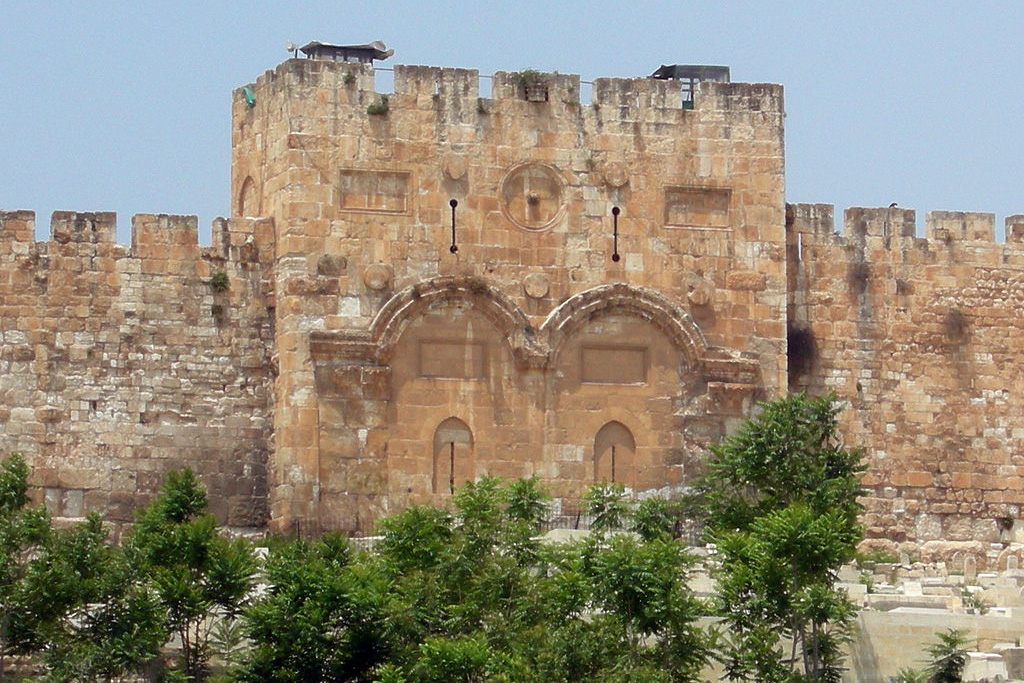
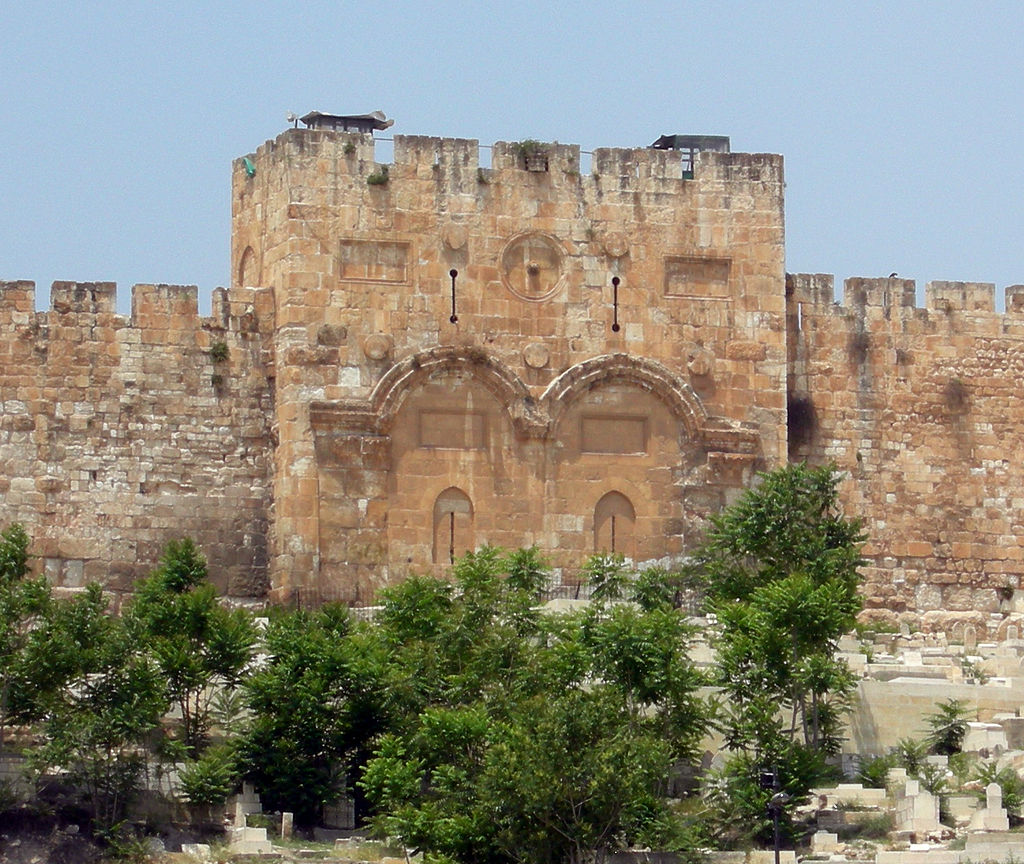
At the daily masses of the Easter Octave, we have been reading about, among other things, the story of a paralyzed man whom Peter and John encounter just outside the Temple at the Gate called “Beautiful.” This paralyzed man’s story is our story and as we read it we learn something of our own spiritual journey to the Lord and to heaven, symbolized here by the Temple. Let’s look at this moving story, as it is not merely the recounting of an event taking place 2000 years ago; rather it is our story. (N.B. You can see “the Beautiful Gate” (the gold-plated doors) in the foreground of the picture to the right.)
1. As the Story opens, we see that Peter and John were going up to the temple area for the three o’clock hour of prayer. Allow if you will that Peter and John represent the Church. Both of them are bishops: Peter, the great leader and first Pope, holding the keys of the Kingdom of heaven; and John the great contemplative and mystic. Here is the Church, with the authority to preach and teach in Jesus’ Name, and also given the great gift to mystically contemplate the Lord, whom she announces. And what are they (the Church) doing? They (She) are journeying to the Temple. Allow going to the Temple (though now surpassed by Christ’s body) to symbolize going up to heaven and to God himself. Yes, here is the (visible) head of the Church shown forth by Peter, and the heart of the Church shown forth by John, and they are on a pilgrimage to be with God in prayer. They are going up to worship him (as we all will one day, pray God), to be caught up into the heavenly liturgy.
2. What time is it? The text says it is three in the afternoon. Now the Jewish context for this, is that this was a time for regular prayer. Fair enough. But in the Christian context three o’clock is the hour of mercy. It is the hour when Christ died. It is the hour when salvation’s price is paid. It is the hour when we begin to stand a chance to ever make it out of the long reign of sin. It is three o’clock in the afternoon.
3. And a man crippled from birth was carried and placed at the gate of the temple called “the Beautiful Gate” every day to beg for alms from the people who entered the temple. Who is this man? We are. We are crippled from our birth, incapable of, and lacking the strength, to walk uprightly. And what has this man done in his condition? He has turned to the world around him to seek help. People carry him so that he can beg. But notice that they can only place him outside the Gate called Beautiful. He is still outside the Temple itself. He cannot get in on his own, and no one has gotten him beyond that gate. He is outside the Temple, outside of the Kingdom of Heaven. He cannot save himself. Neither has the world saved him or gotten him inside the gate.
This describes us. We cannot save ourselves. We do not have the strength to walk uprightly through the beautiful gate and into heaven. And the world cannot help us either. It can only carry us to the gate, not beyond it. Life will only deliver us to death. Medicine cannot save us. Science cannot save us. Philosophy, education, money, and power cannot save us. The world carries us a certain distance but cannot close the gap; it cannot get us inside the gate.
And so we sit outside the gate, begging for mercy, incapable of saving ourselves or of being saved by others, who can do no more than toss us the equivalent of coins in the face of our massive debt.
4. But thanks be to God it is three o’clock and the Church has come to pray, and by God’s grace, to enter heaven.
5. Disclosure – When [the crippled man] saw Peter and John about to go into the temple, he asked for alms. But Peter looked intently at him, as did John,and said, “Look at us.”He paid attention to them, expecting to receive something from them.
Something of a “theology of disclosure” is unfolding here. As the man first encounters Peter and John (that is, the Church) he does not see anything extraordinary. He thinks that perhaps they will be a source of money. But money is not what he really needs. What he needs is to get inside the gate, into the Temple, which symbolizes the Kingdom of God and heaven.
As he looks at Peter and John, he is unaware of anything unique. Many people see the Church in this way. They are content for the Church to be merely a place of social gathering and they think of her only in human terms. Even worse, they see her as merely a human institution and call her “it.” They regard her liturgy as ordinary and focus more on the human elements such as who the celebrant was, how good his sermon was, whether the music was good, or the congregation pleasant. They see only the human, the ordinary.
They do not know that her liturgy draws us up to heaven where Christ, the Bridegroom and High Priest, ministers to us and leads us in perfect worship of the Father. They do not see her sacraments as powerful beyond measure, and the Word she proclaims as bearing the transformative power of God. Like this crippled man, who saw Peter and John (the Church) as ordinary, so do many today continue to see the Church as ordinary.
But Peter looks intently at him and says: “Look at us!” In other words, look again. See something beyond the human. For Christ is the head of the Body, the Church. He indwells his Church and has mystical union with her. The “us” here is not merely Peter and John, it is the Church and Christ! And so the Church rightfully declares, “Look at us!” And we who are crippled must first overcome our blindness and learn to see Christ ministering in and through his Church.
6. Word – Peter said, “I have neither silver nor gold, but what I do have I give you: in the name of Jesus Christ the Nazorean, rise and walk.” Then Peter took him by the right hand and raised him up, and immediately his feet and ankles grew strong.
It is right that the Church should feed the poor, help the sick, clothe the naked, and engage in all the corporal works of mercy. But she has even more to offer; she has Christ himself. And we who are the crippled man learn to seek Christ, not just worldly improvements and consolations. And then Peter and John, the Church, do what the Church must always do, they (she) announce Jesus Christ. And in his name, and by the power of his Word speaking through them, (a Word that does not just inform but also performs and transforms), they say what the Church has always said to a fallen and crippled world: “Rise and Walk!” Rise, for you are dead to your sins, and walk, for though you have not had the strength to walk uprightly before, now by God’s grace you do! The world is skeptical of the Church’s moral vision, for they do not figure on grace and the power of God’s Word to transform. But the Church does not bid us to end fornication, addiction, anger, greed, and so forth by our flesh, but rather in the Name of Jesus Christ. That is, by the power of His grace, now present and available, we have the capacity, the strength, to rise and walk.
7. And Sacrament – And notice too, Peter does not merely speak the Word to him, but also takes him by the hand and raises him up. Hence the Church does not merely preach God’s word, she stretches out her hand through the Sacraments and the liturgy to strengthen and heal us by God’s power working through them. Every Sacrament touches us somehow. Perhaps it is water splashing on us in Baptism to make us rise from the dead; or oil being applied to strengthen and sanctify us in confirmation, anointing of the sick, or holy orders; or hands being laid on us in those same Sacraments and in confession. And, most preeminently, it is the Church stretching out a hand to feed us so that we are nourished by the Lord through Holy Communion.
So the Church does not just stand in a pulpit and preach, she stretches out a hand and touches us. And that hand is really the hand of Jesus Christ mystically united with her and extended through the priests of the Church.
By the power of God’s Word, spoken through the Church, and the outstretched hand symbolizing the touch of the Sacraments, the man becomes strong and is now, by the grace of God, standing.
8. He walks, upright, and enters! He leaped up, stood, and walked around, and went into the temple with them, walking and jumping and praising God. And now comes the astonishing fact that he enters through the Gate into the Temple, which symbolizes the Kingdom of God and Heaven. By the Grace of God, he has made it through the gate!
And notice that the grace of God did not come in some merely personal, private way. Rather it came by and through the ministry of the Church. Christ has worked his justification through the ministry of the Church, which he established to teach, govern, and sanctify in His Name. Notice that the text says that the man went into the Temple WITH THEM. He is now within the Kingdom. Before him looms the inner court of the Temple and the Holy of Holies, a great testimony to the presence of God, experienced now, and one day, perfectly, in heaven.
9. This ancient Temple in which they stand will soon be destroyed, but its place will be taken by every Catholic church, wherein dwells the more perfect Holy of Holies, the Tabernacle. For we, who are (or were) the crippled man, have now been strengthened through the ministry of the Church, and are standing within the Church. The tabernacle looms before us as the great presence of God.
Every journey we make up the aisle is symbolic of the pilgrimage we are on to Heaven. We now have the strength to walk that final leg into the Holy of Holies if we but persevere and allow Christ to minister to us through His Church. We who once were crippled and unable to walk, through baptism, confirmation, and the Eucharist are now strengthened to walk uprightly (with confession to help with the stumbles) toward the Holy of Holies. And one day, by God’s grace working through the Church, we shall journey fully into the Holy of Holies.
All this at the Gate Called Beautiful: A Picture of the Church and Our Spiritual Journey.


 A study recently came out analyzing the damage to the brain caused by pot smoking. Unfortunately, it came out during the week of the Triduum, and a Catholic blog like this had another focus at that time. But it’s time to circle back and have a look.