Every Round Goes Higher, Higher – A Homily for the 22nd Sunday of the Year

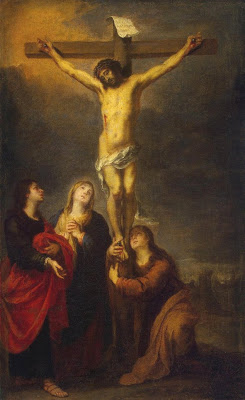
083014In today’s Gospel the Lord firmly sets before us the need for the Cross, not as an end in itself, but as the way to glory. Let’s consider the Gospel in three stages.

I. The Pattern that is Announced – The text says, Jesus began to show his disciples that he must go to Jerusalem and suffer greatly from the elders, the chief priests, and the scribes, and be killed and on the third day be raised.

Note here that the Lord does not announce only the Cross, but also the Resurrection. In effect, He announces the pattern of the Christian life, which we have come to call the “Paschal Mystery.”

The expression “Paschal Mystery” refers to the suffering, death, resurrection, and glorification of Jesus as a whole. The word “Paschal” is related to the Hebrew word for Passover, “Pesach.” Just as the shed blood of a lamb saved the people from the angel of death and signaled their deliverance, so does Jesus’ death, his Blood, save us from death and deliver us from slavery to sin.

So He is announcing a pattern: the Cross leads somewhere; it accomplishes something. It is not an end in itself; it has a purpose; it is part of a pattern.

St. Paul articulates the pattern of the Paschal Mystery in this way: We always carry around in our body the death of Jesus, so that the life of Jesus may also be revealed in our body (2 Cor 4:10). It is like an upward spiral in which the Cross brings blessings we enjoy. But we often circle back to the crosses God permits, and then there come even greater blessings and higher capacities. Cross, growth, cross, growth—and so the pattern continues until we reach the end, dying with Christ so as to live with Him.

This is the pattern of our life. We are dying to our old self, dying to this world, dying to our sins; but rising to new life, rising to the Kingdom of God, becoming victorious over sin. The Cross brings life; it is a prelude to growth. We die in order to live more richly. An old spiritual says of this repeated pattern that “every round goes higher, higher.”

Do you see the pattern that Jesus announces? The Lord does not announce the Cross to burden us, neither does the Church. No, the Cross is part of a pattern that, if accepted with faith, brings blessing, new life, and greater strength.

II. The Prevention that is Attempted – The text says, Then Peter took Jesus aside and began to rebuke him, “God forbid, Lord! No such thing shall ever happen to you.” He turned and said to Peter, “Get behind me, Satan! You are an obstacle to me. You are thinking not as God does, but as human beings do.”

Notice Peter’s exact wording: “No such thing shall ever happen to you.” And we ought to ask, “What such thing?” For in precluding that Jesus suffer and die he also implicitly blocks the rising and glorification of Jesus. For Christ cannot rise unless He dies.

Peter, of course, is not thinking this all the way through; he is not connecting the dots. But neither do we when we seek to avoid crosses for ourselves or to hinder others improperly from accepting the Cross. For the Cross brings glory and growth and we run the risk of depriving ourselves and others of these if we rush to eliminate all the crosses, demands, and difficulties of life. Perhaps we do this by enabling behaviors; perhaps we do it by spoiling children.

We also hinder our own growth by refusing to accept the crosses of self-discipline, hard work, obedience, resistance of temptation, and acceptance of suffering, consequences, and limits. In rejecting the Cross we also reject its fruits.

All this explains Jesus’ severe reaction to Peter’s words. He even goes so far as to call Peter, “Satan,” for it pertains to Satan to pretend to befriend us in protesting our crosses while it is really that he wants to thwart our blessings. Peter may not know what he is doing, but Satan does, and he seeks to become an obstacle to Jesus’ work.

Jesus’ severe reaction is rooted in protecting our blessings.

III.  The Prescription that is Awarding – Jesus goes on to teach further on the need for and wisdom of the Cross. The text says, Then Jesus said to his disciples, “Whoever wishes to come after me must deny himself, take up his cross, and follow me. For whoever wishes to save his life will lose it, but whoever loses his life for my sake will find it. What profit would there be for one to gain the whole world and forfeit his life? Or what can one give in exchange for his life? For the Son of Man will come with his angels in his Father’s glory, and then he will repay all according to his conduct.”

The heart of Jesus’ teaching here is the deep paradox that in order to find our life we must lose it. More specifically, in order to gain Heaven we must die to this world. And that dying is a process more so than just an event at the end of our physical life here. Though we cling to life in this world, it is really not life at all. It is a mere spark compared to the fire of love that God offers; it is a single note compared to the great symphony God directs.

Jesus instructs us to be willing to exchange this tiny and dying life for that which is true life. The Lord says that whatever small blessings come from clinging to this life and this world are really no benefit at all. If you choose life in this world rather than the true life God offers, you’re nothing but a big loser.

Of course what the world’s cheap trinkets offer is immediate gratification and evasion of the Cross. We may feel relief for a moment, but our growth is stunted and those cheap little trinkets slip through our fingers. We gain the world (cheap little trinket that it is) but lose our souls. Total loss. Or to quote a modern expression, “FAIL!”

Jesus’ final words, however, remind us that the choice is ours. For the day will come when He will respond to our choice. Either we accept true life and win, or we choose the passing, dying life of this world and we lose. The choice is ours.

This songs speaks of life as a kind of spiral climb between cross and glory. As the spiritual says, “Every round goes higher, higher, soldiers of the Cross.”

On Staying the Course with Mother Church, As seen on TV

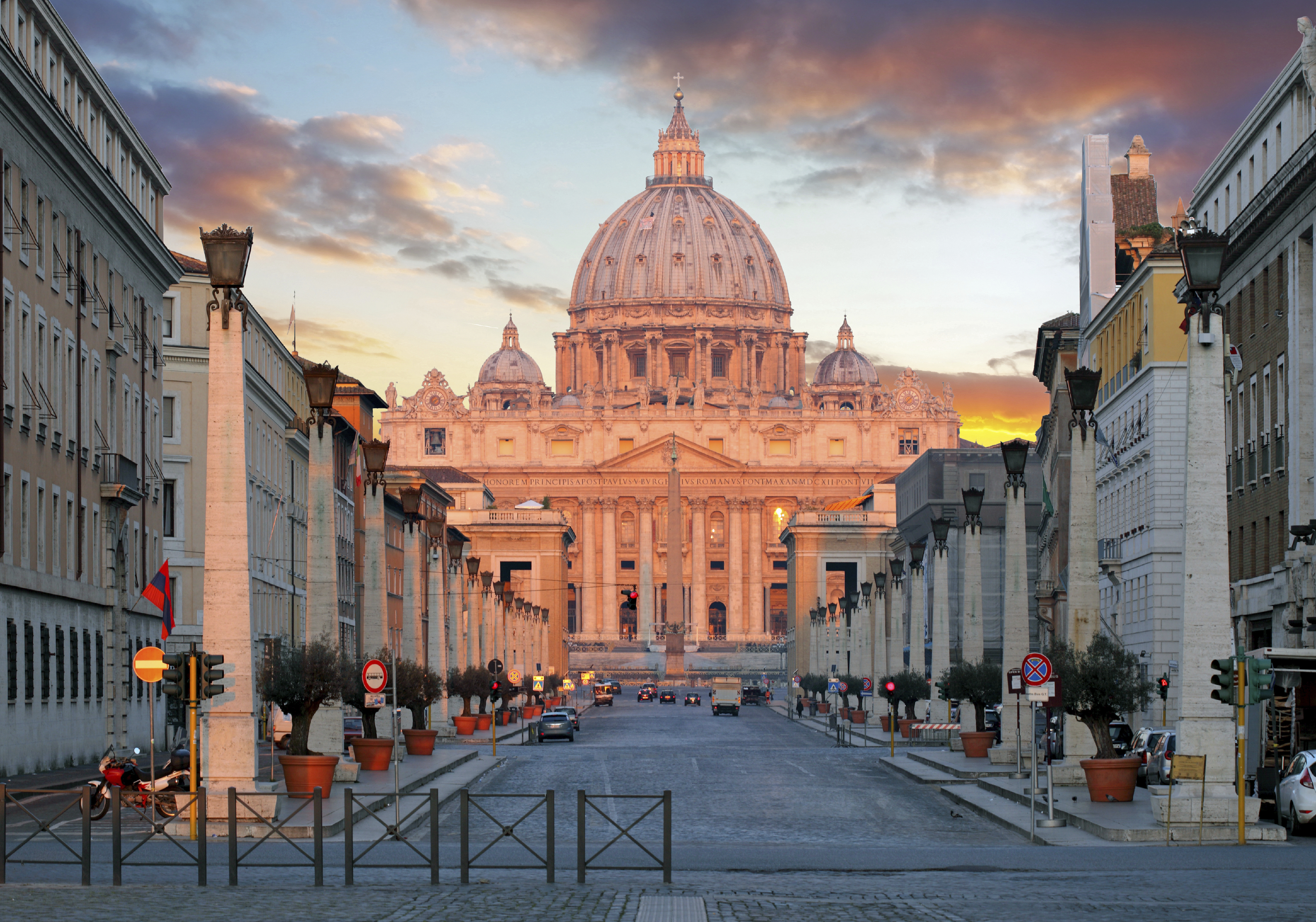
Rome, Vatican city
Rome, Vatican city

One of the cultural challenges we face in both living and proclaiming the faith is that the true faith often doesn’t fit our frantic pace or our expectation of instantaneous results. Consider that many today, including those of us who believe, demand the “quick fix.” Whatever the situation—be it sickness, the needed repair of something we own, the delivery of something we’ve purchased, a resolution of family troubles, or even deeper issues such as inner peace—we want it fixed right now.

But many things do not lend themselves to a quick fix, especially the deeper matters of the human soul. And the faith we proclaim does not suggest that it is so simple. In this sense the faith is less “marketable” to our quick-fix culture. We do not (and cannot) say, “Just come to Mass for six sequential Sundays and your problems will be over.” Rather, we say, “Give your life to Christ.”

The solution of God and of the true faith insists on an often slow but steady movement toward God, wherein He draws us in stages ever deeper to Him, to holiness, to perfection. Little by little our fears fade and our sins diminish; we become more loving, patient, compassionate, chaste, serene, and so forth. The process usually takes decades—no quick fixes here.

And many medicines need to be consistently applied: daily prayer, daily Scripture and spiritual reading, weekly Mass and Communion, frequent confession, and communal life in the Church including helpful friendships, faith-filled relationships, and works of charity.

There is an old saying, “Grace builds on nature.” That is to say, God’s grace respects the way we are made by Him. And just as it pertains to our physical nature to change slowly (but surely) and almost imperceptibly, our spiritual nature follows the same pattern. And while there may be “growth spurts,” it is more often the subtle and steady growth that makes the deepest difference.

I can surely say this has been my experience. I have been serious about my spiritual life for the last 30 of my 53 years—daily Mass, daily Scripture, daily holy hour, weekly confession, fellowship with my people, holy friendships, and spiritual direction. And wow, what a change! But it has taken me 30 years to get here, and most of my growth was imperceptible from day to day. I’m not what I want to be, but I’m not what I used to be; a wonderful change has come over me.

Not the quick fix, not the fast rush, just “a inching along like a poor inchworm” (as an old Spiritual says). But praise God I am where I am today.

Lifelong plans may not “sell,” but they are the way God insists on working.

On Fridays, I often try to keep the post a little shorter and I frequently use a commercial to make my point. So how about this one:

  1. In the commercial below there is a man named Jerry who is in a “state of regret.” In a certain sense (as we shall see) Jerry represents all who stray from the Church and God’s lifelong plan of faith—looking for a fast rush and a quick fix elsewhere, apart from the faith and the Church.
  2. Sure enough, Jerry’s regret is that he dropped his State Farm Insurance and went with “the other company.” Let’s call that company “Quick Fix Auto Insurance.” In allowing State Farm to represent the Church, I intend no endorsement, but I do note that “farming” is no quick-fix business; it involves a lot of patient waiting and persistent working. Such is the work of the Lord and His Church—no quick fix, it’s more like farming.
  3. Jerry complains to his former agent, “Jessica” (but let’s call her “Mother Church”). His complaint is “It only took me 15 minutes to sign with that other company but it’s taking a lot longer to hear back.” OK, so now he’s learned that there really is NO SUCH THING as a “quick fix” when it comes to many matters. And so must we learn this same truth. The world, the flesh, and the devil often make such promises and sow seeds of impatience in us when God does not act immediately, when the Church bids us to be patient and persistent. But now Jerry’s impatience has brought him further troubles, as we shall see.
  4. Jerry explains that he’s had a “fender bender.” The truth is that Jerry has bent far more than a fender; he is in real trouble. We too often like to minimize our sorry state when we’ve made bad decisions.
  5. Jessica (Mother Church) is sympathetic but wonders what she can do, since Jerry has ended his relationship with her. Without a relationship, how can she help him? Mother Church often wants to help us but must have a relationship with us in order to be able to help. God, too, seeks communion with us in order to help us. But communion, a relationship with the Lord and his Bride the Church, is necessary for help to be extended.
  6. Indeed Jessica (Mother Church) knows Jerry well and she seems, like a mother, to intuit exactly what he has done. She knows he’s in real trouble and has “put his car up a pole” (again). There’s just something about Mother Church; she knows her children and what we do; she knows and understands.
  7. Upon hearing Jessica’s (Mother Church’s) knowing but compassionate words, Jerry breaks down and says, “I miss you, Jessica!” The ad then says, “Let it out Jerry! Then come back to State Farm.” Yes, indeed. And so too for us. Soulful and tearful repentance and the restoration of our relationship with the Lord and His Church are the way out.
  8. Quick Fix Insurance Company can’t cut the deal. Come back to the Lord and His Church. The solution may not be “quick” but it will be sure if we stay the course.

C=JL² This is the Metaphysical Math and Source of All Creation. It is the Grand Unified Theory

082814In my years as a priest, I have often had people ask me why God, who we say needs nothing and is fully content and joyful in Himself, created anything outside Himself. Does His act of creation indicate that He lacked something or that He needed others?

This is difficult for us humans to understand. To some degree that difficulty arises from us, who are often motivated most by need. We tend to project our own realities onto God. But need and incompleteness are  not the only things that motivate.

In the Summa Theologica, St. Thomas Aquinas has a beautiful reflection on how and why God willed to create things outside Himself:

For natural things have a natural inclination not only towards their own proper good, to acquire it if not possessed, and, if possessed, to rest therein; but also to spread abroad their own good amongst others, so far as possible … to communicate as far as possible to others the good possessed; and especially does this pertain to the divine will, from which all perfection is derived in some kind of likeness. Hence, if natural things, in so far as they are perfect, communicate their good to others, much more does it appertain to the divine will to communicate by likeness its own good to others as much as possible … (Summa Ia, q.19, art 2).

As I read St Thomas I think of examples. For example a tree spreads it pollen for the sake of other trees and future trees. Flowers do the same and interact with bees and other insects. Elements interact with other elements to become compounds. Compounds become chemicals and so forth. An atom alone is very limited. Joined to other atoms, it can become a mighty structure. All this echoes something of the God who made it.

To be sure, it is true that God is able to savor the good that He is and to rest in it, to enjoy it fully. God can find complete satisfaction in the perfection of His own being, of His own glory.

But, as St. Thomas points out, even in us who are imperfect creatures, there is an aspect of our love and joy that wants to be effusive and diffusive, to radiate outward. It is not so much that love and joy are lacking something, but rather just the opposite—they overflow to others from us quite naturally. We do not share joy and love because we have to, but because we want to, and because they naturally shine forth.

When one is joyful, it is hard to hide it. Joy shows; it is effusive; it shines forth and naturally reaches others who will notice it and then immediately ask, “What are you smiling about? Why are you so happy?” Yes, those who are filled with joy and the experience of love seek naturally to share that with others. Someone who has heard good news or has experienced something wonderful can barely contain himself and immediately seeks to share it.

It is the same with love, though in more diverse and sometimes subtle ways. Love radiates; it motivates; it moves out and shines forth. Again, not because love is lacking, but more simply because that is what love does. It moves outward and bears fruit.

And so it is with God, who is Love. His love is not lacking something, but, as love, He radiates. He shines forth; He bears fruit. He delights in sharing. And He, whose nature is ‘to be’ who is existence itself, allows his love to radiate outward in a creation distinct from Him but proclaiming of his love and joy.

Behold! All creation is a shining forth God’s love and joy. See its immense size, its awesome diversity and fruitfulness—and then understand why the universe is expanding outward at such a rapid rate!

Scientists are looking for some grand unified theory, one simple principle or formula that explains everything. In a word, it is love. It is God, who is Love, and His joy rushing and radiating outward, bearing fruit and saying, “Come, share my joy!”  People, and especially scientists, like formulas, so how about this one?

C=JL²

That is, Creation equals Joy times Love squared. Love, of course, is the constant; it is ever-abiding and never withheld.  And yet it is mysteriously expanding outward. Why is love squared? I don’t know, but it makes the formula memorable! At the end of the day, God’s love is infinite. So then what is the square of infinity? Anyway it’s very big and it’s a constant.

Is God lacking something? No. Then why does He create? Because that’s what love does. But why then will it all end as Scripture says it will? It will not end in annihilation; it will “end” in a perfection that, though different, will be the fulfillment of all that is. Jesus, who holds all creation together in Himself  (cf Col 1:17), says at the end, “Behold I make all things new!” (Rev 21:5) And then will be fulfilled what St. Augustine said of what shall finally be for us and the Lord: Unus Chritus, amans seipsum (One Christ, loving Himself).

We are living in the love of God; yes, even those who reject it are living in His love.

People Need People, As Seen at the Beach

082714I spent a few days at Bethany Beach (in Delaware) this week with four other priests, thanks to some very generous lay people who allowed us to stay in their house. In Washington we speak of going to the beach. But in nearby Baltimore they say, “We’re goin’ down-e-ocean.” I think in New Jersey they call it  “going down the shore,” as in the Jersey shore. At any rate, thank God for a restful time, lots of long walks along the shoreline, interesting discussions, and good food. In fact, according to the Scripture story of the road to Emmaus, walking, talking, and dining provide an image of the Kingdom.

A brief thought occurred to me today as I walked along the water, this time alone. I began my walk right in the center of Bethany Beach, just down from the center of the boardwalk. The beach was rather crowded—lots of people, chairs and umbrellas everywhere, kids running back and forth into and out of the water.

As I headed north walking right on the shore, I noticed that the crowd thinned out quite quickly, so that within a hundred yards of where the boardwalk ended the beach became quite empty with just a few folks here and there.

Why, I wondered, did people huddle together so? I would think that people would prefer to spread out a little, would want some privacy, and might be willing to walk a ways to get it. Instead, they crowded together in an eight-block area along the Bethany Beach Boardwalk.

It occurred to me that despite our often-expressed desire for space and privacy, this image of people huddling together had important lessons to teach.

The chief and uniting lesson is that ultimately people need people. Crowding close together at the beach meant that there were others to provide not only company but safety. There were plenty of lifeguards, and if any trouble were to arise, plenty of people nearby to help. Where there are people there are also many conveniences near at hand. There were food vendors up on the nearby boardwalk as well as vendors selling beach gear. There was even a free town Wi-Fi signal in the air. Public bathrooms were nearby as was a safety station and a police presence. A lot of children, some of whom had only just met that day, were playing together, teaching each other to surf, riding boogie boards, or building sand castles.

A simple lesson, really, but somehow beautifully painted for me at Bethany Beach—people need people. People benefit from other people. People take care of other people and provide necessary services, protection, and company. Space and solitude have their place, but it really is more instinctual, even in this wide-open country, to cluster together in cities. For all of our complaints about crowds, in the end it’s good to have other people close at hand.

It was all a painting of what Scripture says, Woe to the solitary man! For if he should fall, he has no one to lift him up (Ecclesiastes 4:11).

Beach Baby from Tom Stillwell on Vimeo.


The Reform of the Whole World Takes Place One Soul at a Time, Starting with My Own

082614Yesterday’s blog on the increasing darkness in our culture received a lot of good feedback. Special thanks to Patrick Madrid for spreading the word. Reading such data can cause us to feel discouraged at times. Here are a few thoughts on this discouragement and what we can do about it.

1. The beatitude “Blessed are those who mourn, for they will be comforted” comes to mind. Who are those who mourn? It is they who see the awful state of God’s people: that so many do not know Him or honor Him. Those who mourn are those who see how many do not know why they were made and spend their lives on lesser or even useless things (and get lost in sin and the deadly wages of sin). Seeing this, they mourn. But this mourning is not depression; it is a sadness rooted in love, and so, as the beatitude says, they are “comforted.” But here the word comforted is to be understood more in relation to its Latin root confirmare which means to strengthen. Hence those who mourn because they love God’s people and see their awful state are also those who will be strengthened and motivated to go to work to make a difference.

2. Indeed, there is an old Chinese proverb that says, “A journey of a thousand miles begins with a single step.” And though we may feel things have descended deeply and rapidly, just keep preaching, teaching, and striving for holiness. God has a way of multiplying our works when we least expect it. The harvest will come; for now, just keep sowing seeds and watering them with your tears of love.

3. Another saying goes, “It is easier to wear slippers than to carpet the whole of the earth.” Further, we are instructed just before a flight that in the event of an emergency we should don our own mask before assisting others with theirs. In both of these instances, we hear the additional advice that we should initiate any reform by first tending to our own heart and life. If the world is going to reform, it has to begin with me, with my own decisions. Scripture says, “They made me a keeper of vineyards, but my own vineyard I have not kept” (Song, 1:6). May it not be so for us.

There are many things we can do, big and small, that can begin to make a difference. Some involve small personal changes, others summon us to greater courage in relationships, and still others call us to greater generosity. Here is a list of some possible avenues. Please add to it! (Note: this list was not created with any particular order in mind.)

  • Participate in pro-life vigils and “40 Days for Life.”
  • Inform others, including media companies and manufacturers, when they have done well. Warn them when they cooperate in evils such as abortion (via support of Planned Parenthood) or homosexual activism.
  • Ask for the gifts of joy, gratitude, and serenity. Others will notice and ask you about it!
  • Read Catholic media; listen to Catholic Answers and EWTN radio. Grow in your faith!
  • Work on overcoming your most frequent sins. Make a particular examen to help this.
  • Pray over the news; don’t just watch it or read it, or, even worse, just complain about how awful things are. Pray as you listen and read.
  • Sign up for Eucharistic adoration; encourage others to do so.
  • Repent; go to confession frequently.
  • Ask a friend to Mass; if he says “no,” ask again later and/or ask another person. But resolve to seldom come to Mass alone.
  • Spend time with younger people; encourage in them what is good; explain what they misunderstand.
  • Be consistent with prayer.
  • Consider praying the rosary every day; if you can, add the Divine Mercy Chaplet as well.
  • Support cloistered religious communities and ask their prayers.
  • Be willing to take the risk and correct a fellow sinner; be humble but clear.
  • Have the courage to warn those in your own family who may be mired in sins such as greed, fornication, cohabitation, unforgiveness, planning a divorce, etc.
  • Have more children; be generous with life!
  • If you are older, support those who do have many children by assisting with childcare or providing other necessary help.
  • Support outreach to the poor, especially those programs that help them to break the cycle of poverty and to become more deeply rooted in the life of faith.
  • Encourage bishops, priests, and deacons who are courageous in addressing what ails us.
  • Support Catholic groups that seek to engage the culture and summon the world to reform and to Jesus.
  • Pray! And then pray some more. If you can, fast occasionally.
  • Pray some more!

In other words, consecrate your life to God and begin the great reform by looking to your own heart and mind. When people start to notice, ask them to join you. Many little things add up to a lot. We can’t change the culture overnight, but we surely can begin to make a difference in our own life and in the vineyard of our family, parish, and community, all of which the Lord has asked us to tend.

Here’s a beautiful song that you might print and pray often. (For a printable copy, Click here: Prayer of Consecration).

Take my life, and let it be
Consecrated, Lord, to Thee;
Take my moments and my days,
Let them flow in ceaseless praise.

Take my hands, and let them move
At the impulse of Thy love;
Take my feet, and let them be
Swift and beautiful for Thee.

Take my voice, and let me sing
Always, only, for my King;
Take my lips, and let them be
Filled with messages from Thee.

Take my silver and my gold:
Not a mite would I withhold;
Take my intellect, and use
Every power as you choose.

Take my will, and make it Thine,
It shall be no longer mine;
Take my heart, it is Thine own,
It shall be Thy royal throne.

Take my love, my Lord, I pour
At Thy feet its treasure store;
Take myself, and I will be,
Ever, only, all for Thee.

Words: Frances R. Havergal 1874.

Here is a beautiful version, sung by Chris Tomlin.

Recent Gallup Poll Is a Snapshot of the Moral and Cultural Revolution

082514The results of a recent Gallup poll on a range of moral issues do a pretty good job of showing how dramatically America has changed in a rather short period of time. Many behaviors now deemed “largely acceptable” were once considered very wrong. In fact, most of us over fifty remember an America that was very different.

Until the mid-1960s, birth control was unapproved—even illegal to sell in many jurisdictions. It was associated with prostitution.

Divorce was something that people whispered about. And until 1969 it was so difficult to get a divorce that the few who did want them were willing to go to Mexico to in order to obtain them.

As for gambling, Catholics were less adamant about it and permitted “light” forms of gambling like bingo. But among the Protestants, “gambling” was synonymous with sin. Some of the old spirituals warned gamblers of the fires of Hell: “I would not be a gambler. I’ll tell you the reason why. I’m afraid my Lord might call my name and I wouldn’t be ready to die.”

Having a baby outside of marriage was considered so shameful that girls who got pregnant were often sent away to have the baby, which was then usually put up for adoption. Frankly, the final result was often better for the infant, who was usually adopted quickly by a married couple. Catholic orders of nuns were often the ones who handled these matters, and did so discreetly and lovingly.

Sex before marriage happened, but far less frequently—and almost no one thought it was OK. In those days there were also many protections that society insisted upon to help prevent sex before marriage. For example, young people were often chaperoned on dates. Dances and other group events were commonly arranged by adults in order to encourage young people to meet, but there were prudent limits set. Parents were more vigilant and insisted that their youngsters be home at a reasonable hour. Women’s dormitories at colleges were more strictly guarded and a young man who called was expected to meet his young lady in the lobby and say farewell to her there. Young people also got married a lot sooner. Most did so right after high school or college.

Homosexual activity of any sort was not just considered shocking; it was deemed repulsive.

Abortion was illegal—an unmentionable horror. It was associated with prostitution and utter desperation. Frankly, I don’t think I ever heard the word abortion before 1970, though I admit I was only about ten at that time.

Only the death penalty and wearing fur were more acceptable in the pre-revolution days than they are today.

Behold the cultural revolution! And revolution is the only word for it. America before the revolution was NOT a perfect culture. Racism was more widespread; there were two major wars before 1950, and there was a rather decadent period in the 1920s. But overall, we were a lot clearer about the values necessary to ensure our future: marriage, sex, and children. People got married and usually stayed married. We frowned upon, limited, and punished  behaviors and attitudes that destroyed our families: sex before marriage, homosexual acts, abortion, and divorce. Today most of these behaviors are not only widely tolerated, but outright celebrated.

Why has this happened and why so suddenly? The world, the flesh, and the devil.

At the level of the demonic, there surely is strong satanic influence in the “high places” of Hollywood, the music industry, Madison Avenue, and Pennsylvania Avenue (at both ends of the block). American culture, via movies and music, generates a steady stream of sewer-like themes that celebrate fornication, divorce, adultery, and homosexuality, and that portray abortion sympathetically.

At the level of the flesh, Americans consume filth in enormous quantities. Internet porn sites are among the most frequently visited. Most Americans are no longer shocked by foul language, pornographic themes, or nudity in movies and music. Granted, the desire to consume this material comes from weakness due to our sinful human nature, but indulging these weaknesses leads to successively darker places, to a dulling of the sense of morality,  to enslavement by the senses, and ultimately to a downright craving for the filth.

At the level of the world there is the rebellion that is at its heart. The “world,” in the scriptural sense of the term, refers to that collection of interests and powers arrayed against God and His Kingdom. To build its power, the world entices in order to enslave; it offers pleasures but then sends the bill. The world works quite handily with Satan.

At the end of the day, however, we in the Church bear a lot of the responsibility. This has happened on our watch. Jesus commissioned us to be the light of the world. So why is the world in such darkness? I have little doubt that the Lord has allowed a kind of satanic incursion for His own mysterious reasons. Perhaps the Church needs to be purified. Perhaps the West needs to be plowed under, as many previous eras and empires have been. Perhaps He is preparing a great renewal. I just don’t know.

But I do know that we must work more consciously to be the light we are supposed to be. This poll is a gauge of the extent of the darkness. Usually the lights go out as a result of a power failure. But in this case it is a moral failure. It is a failure of our mission as Christians that has led us here. Start with your own life and with your own family. Work in your own parish. Start lighting candles and living in the light.

Demons Believe and Tremble: A Reflection on the Theft of the Eucharist by Satanists

082414A couple of years ago I wrote of an unusual experience I had at Mass wherein a person who was troubled by a demon had those demons manifest themselves at the consecration, causing the person to run out of the Church. More on that in a moment.

I thought of that long-ago incident in relation to the current events transpiring in Oklahoma City, where a satanic cult stole the Eucharist from a Catholic parish and announced plans to desecrate it at a satanic “mass” in September. Archbishop Paul Coakley filed a lawsuit, asking a judge to stop the desecration by requiring the group to return the stolen property. He indicated in the suit that the Host was to be desecrated in the vilest ways imaginable as an offering in sacrifice to Satan.

A spokesman from the satanic group, Adam Daniels, said, “The whole basis of the [satanic] mass  is that we take the consecrated host and give it a blessing or offering to Satan. We’re censoring it, [I think he means using incense], doing all things that’s [sic] normally done to bless a sacrifice, which is obviously the host body of Christ. Then we’re taking that and we’re reconsecrating it, or the Devil does …”

[The bracketed comment and the single quotation marks within the above quote are mine.]

In light of the threatened lawsuit, the group returned the consecrated host to the Church. Thanks be to God. But did you notice the satanic spokesman’s attestation regarding the host: “which is obviously the host body of Christ”?

Grave and sad though this incident was (and it wasn’t the first), these Satanists obviously consider the Catholic Eucharist to be the Body of Christ. Unless I missed it, there have been no attempts by Satanists to steal and use a Methodist host, or an Episcopal one, or a Baptist one, or a Lutheran one, etc. It is a Catholic host they seek. Here then is an affirmation of the Scripture which says, Even the demons believe—and shudder (James 2:19).

Elsewhere, Scripture says of a demon that afflicted a man among the tombs, And when he saw Jesus from afar, he ran and worshiped him (Mark 5:6). And in Luke’s Gospel, And demons also came out of many, crying, “You are the Son of God!” But he rebuked them, and would not allow them to speak, because they knew that he was the Christ (Lk 4:41-42).

Indeed, as many who have assisted at exorcisms can attest, there is wonderful power in holy water, relics, the exorcist’s cross, the touch of a priest’s stole, and so forth in afflicting demons and urging them to leave. Yet so many Catholics and others discount these sacramentals (as well as the Sacraments), using them carelessly, infrequently, or not at all. Many people, even faithful Catholics, consider them of little significance. But demons do not. Shamefully, demons sometimes manifest more faith (out of fear) in these things than actual believers who ought to revere them out of loving faith.  Even this Satanist in Oklahoma acknowledges that Jesus is truly present in the Eucharist and he seeks a host for that reason, although obviously for nefarious and perverse purposes.

And that leads to a story of my own that I published a long while back. Here is an excerpt from that piece:

It was almost 15 years ago. I was At Old St. Mary’s here in D.C. celebrating Mass in the Latin (Extraordinary Form). It was a solemn high Mass. I don’t suppose I thought it any different than most Sundays, but something quite amazing was about to happen.

As you may know, the ancient Latin Mass is celebrated “ad orientem” (toward the Liturgical East). Priest and people all face in one direction. What this means practically for the celebrant is that the people are behind him. It was time for the consecration. At this time, the priest is directed to bow low with his forearms on the altar table and the host between his fingers.

As directed, the venerable words of Consecration were said in a low but distinct voiceHoc est enim Corpus meum (For this is my Body). The bells rang as I genuflected.

But behind me there was a disturbance of some sort; a shaking or rustling sound came from the front pews behind me to my right. And then a moaning or grumbling. “What was that?” I wondered. It did not really sound human, more like the grumbling of a large animal such as a boar or a bear, along with a plaintive moan that also did not seem human. I elevated the host and again wondered, “What was that?” Then silence. As the celebrant in the ancient Latin Mass I could not easily turn to look. But still I thought, “What was that?”

It was time for the consecration of the chalice. Again I bowed low, pronouncing clearly and distinctly but in a low voice, Hic est enim calix sanguinis mei, novi et æterni testamenti; mysterium fidei; qui pro vobis et pro multis effundetur in remissionem pecatorum. Haec quotiescumque feceritis in mei memoriam facietis (for this is the cup of my Blood, of the new and eternal covenant; the mystery of faith; which will for the many be shed unto the remission of sins. Whensoever you do this, you do it in my memory.)

Then, I heard another sound, this time an undeniable moan and then a shriek as someone cried out, “Leave me alone, Jesus! Why do you torture me?” Suddenly there was a scuffling noise and someone ran out with the groaning sound of having been injured. The back doors swung open and then closed. Then silence.

Realization – I could not turn to look for I was raising the Chalice high over my head. But I knew in an instant that some poor demon-tormented soul had encountered Christ in the Eucharist and could not endure His real presence displayed for all to see. And the words of Scripture occurred to me: Even Demons believe and tremble (James 2:19).

Repentance – But just as James used those words to rebuke the weak faith of his flock, I too had to repent. Why was a demon-troubled man more aware of the true presence and more astonished by it than I was? He was moved in a negative sense and ran. Why was I not more moved in a positive but comparable way? What of the other believers in the pews? I don’t doubt that all of us believed intellectually in the true presence. But there is something very different and far more wonderful in being moved to the depth of your soul! It is so easy for us to be sleepy in the presence of the Divine, to be forgetful of the miraculous and awesome Presence available to us.

Let the record show that on that day, almost 15 years ago, it was made quite plain to me that I held in my hands the Lord of Glory, the King of Heaven and earth, the just Judge and Ruler of the kings of the earth. Is the Lord truly present in the Eucharist? You’d better believe it; even demons believe that!