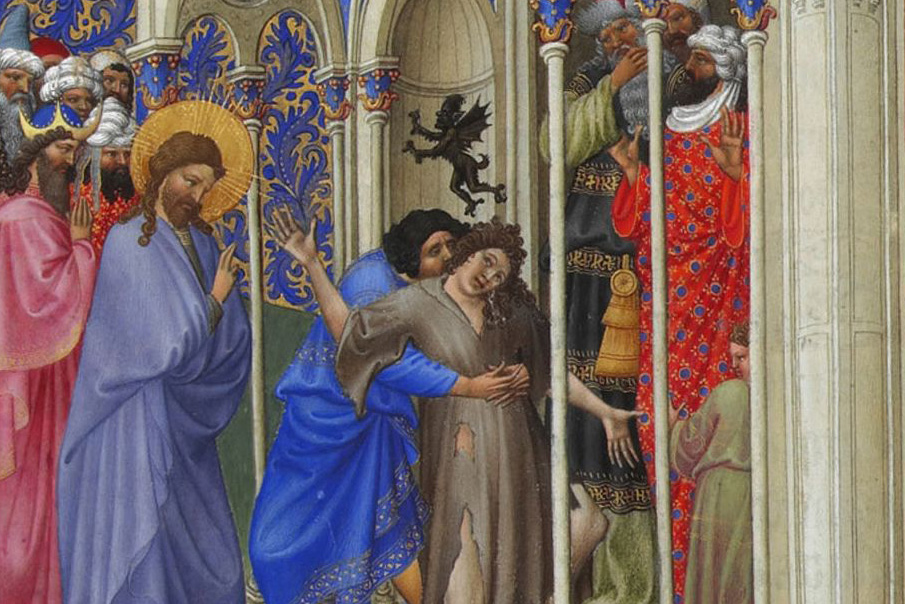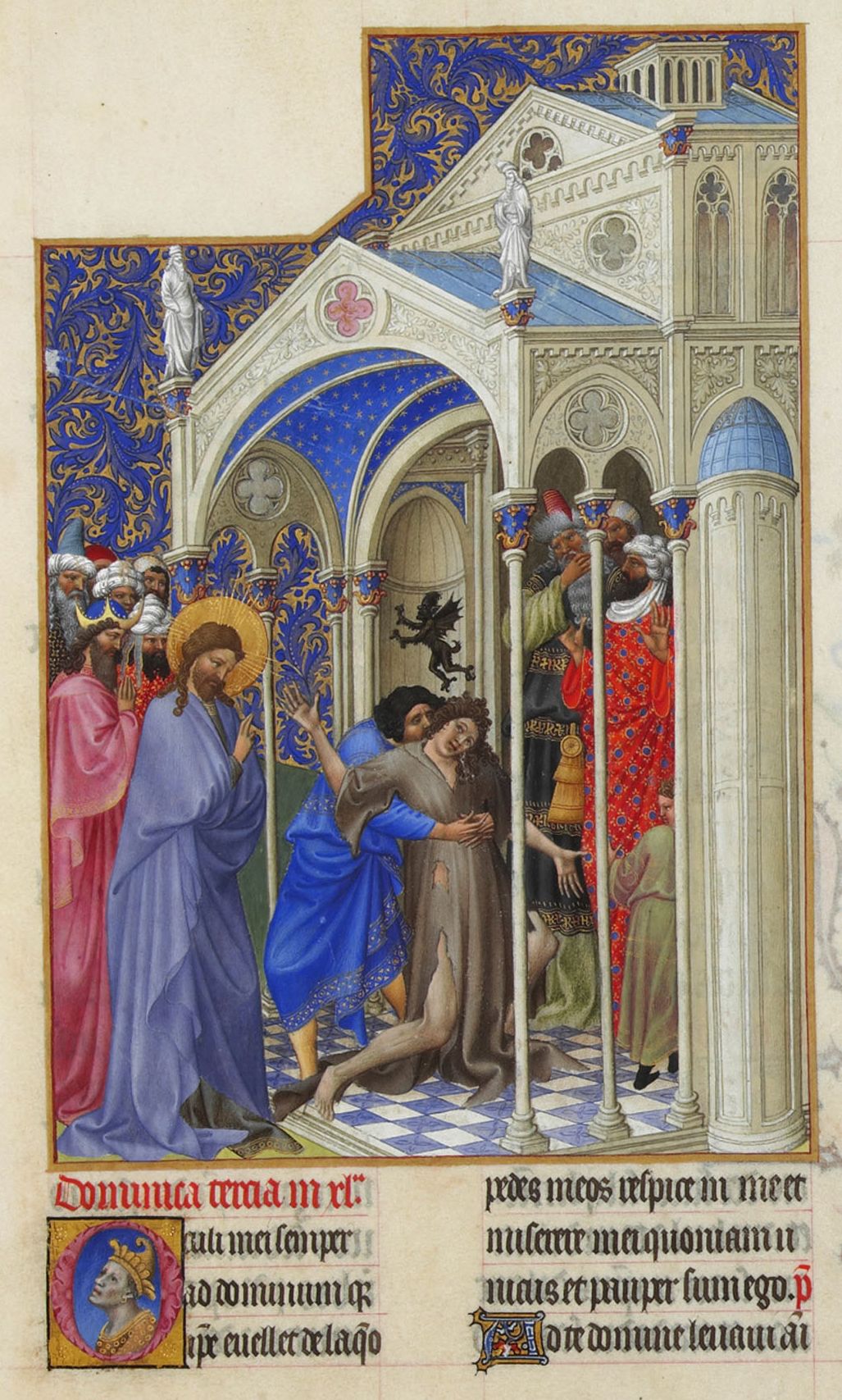
How Can a Demon, Driven Out, Return With Seven More? A Meditation on a Puzzling Parable

The Gospel for the Third Sunday of Lent in the Extraordinary Form features the puzzling parable about the cast-out demon who returns with seven other demons. What is most puzzling is that finding the house (soul) “swept and clean” brings further trouble. One would think a house that is swept and clean is a good thing.

How can we understand this parable? As is often the case, recourse to both the subtleties of the Greek text and the context can help us.

For reference, here is the parable:

When the unclean spirit has gone out of a man, he roams through waterless places in search of rest; and finding none, he says, “I will return to my house which I left.” And when he has come to it, he finds the place swept and clean. Then he goes and takes seven other spirits more evil than himself, and they enter in and dwell there; and the last state of that man becomes worse that the first (Lk 11:24-25).

Again, a house swept and clean seems like a good thing, one that would discourage a demon from  coming back rather than to return with a coven of fellow demons!

1. Let’s consider first of all the Greek text.

A puzzling aspect of looking to the Greek text is that what some Greek texts describe with three adjectives, almost every English translation renders with only two. Why is this? Because some of the Greek manuscripts lack the third word, which translates as “empty.”

I am a pastor, and while I can read the Greek text of the New Testament with relative ease, I am not an expert in the ancient Greek or in the relative value of differing Greek manuscripts. The translation “swept and clean” or “swept and ordered” is almost universal among English renderings of this text. See HERE for an example.

However, to my mind, the inclusion of “empty” is essential, otherwise something very important is left out. Let’s look at the Greek description of the “house” (i.e., soul) to which the demon returns:

καὶ ἐλθὸν εὑρίσκει σχολάζοντα, σεσαρωμένον καὶ κεκοσμημένον
Kai elthon heuriskei scholazonta, sesarōmenon kai kekosmēmenon
And having come it finds (it) empty, swept, and put in order (ornate)

That the house (soul) is empty is its chief problem. Empty things need filling. Sadly, if good things do not fill empty spaces, evil things do. And this seems to be at the heart of the Lord’s warning.

A second issue is the translation of the word “kekosmēmenon.” Does “ordered,” or “put in order” really capture what the word is trying to convey? Most of us hear the word “order” and think of either systematic or moral order.

However, the Greek lexicon defines the root of kekosmēmenon, kosméō,  as  “to beautify, having the right arrangement (sequence) by ordering; to adorn, make compellingly attractivevery appealing(invitingawesomely gorgeous).” It is the root of the English word “cosmetics,” things that adorn  or “order” the face.

Thus, the “order” described here is more an order related to beauty. Hence the translation “ornate” may better capture what is meant by this word than either “clean” or “orderly.” So as we read this parable, we should consider that the description of the house as “swept and clean” may lack the subtlety of the Greek words. And while it is also true we should be wary of etymological fallacy, the original root meaning (kosemo = cosmetics = ornate, rather than merely “ordered”) ought not be wholly forsaken!

With these in mind, let’s consider the more rich possibility that the Lord describes the “house” (an image for the soul) in three ways:

1. Empty – This is the key description that some ancient manuscripts omit. And yet it is the main problem. An empty house is a vulnerable house. An empty house, devoid of human presence, can no longer repel threats or repair damage that make it vulnerable. But more significantly from the standpoint of grace, an empty house, devoid of the presence of God, is a vacuum ready to be filled with demons and every form of human sin, pride, and confusion.

Empty buildings are vulnerable, open to attack by termites, extreme weather, mold, rodents, and every other kind of threat. As an uncultivated field goes to weed, so an unattended house slides into decline and decay. So, too, goes the empty human soul, a soul devoid of the presence of God or of gratitude to Him and openness to His satisfying presence.

Yes, here is the spiritual lesson: let the Lord and the good things of the Kingdom of God fill every void, every empty space! Emptiness is too easily filled with many evil things!

Consider a man who gives up alcohol for Lent. He does well, ending a lawful pleasure and making greater room for God. But what if God, or something of God, does not fill the space? Usually something of the devil, or something of the flesh, will fill it. Perhaps he will think, “I am approved because I, by my own power, have given this up.” But sadly, pride fills the empty space, not God. This gets ugly and the man’s second state is worse than before he gave up the lawful pleasure!

2. Swept – It is good if a person has, by God’s grace, been able to sweep sin from his life. But praise be to the Lord, not to the man or woman! Otherwise this is an open door for pride. Perhaps the sinner who succeeds  in a Lentan observance will say, “Look what I have done! I am approved and better than others who are less committed!” And thus grace is snatched by Satan. The house (soul) swept and in good order must also be filled with humble gratitude to God. Thus the Lord warns of a house that is “swept,” but empty of humility and gratitude. For then ugly pride fills the gap and the second state of the man will be worse than the the first.

3. Ornate – While some translate this as “ordered,” it would seem that, given the context, ornate would be a better rendering as we saw above. Hence we are warned to beware vanity and also of esteeming beauty more than charity.   The warning is for those who, though they appreciate beauty, become smug and disdainful of all others who do not share their aesthetic preferences.

Thus a connoisseur of fine wine may scoff at people who enjoy wine sold in a box (“cow”) or who like White Zinfandel. And God forbid that they might like beer instead! In this way, an appreciation for the finer things like wine becomes pride and leads to the last state of the man being worse than the first.

Beauty and the appreciation of it has its place, but if it cancels charity, the last state of the man is worse than the first.

One may appreciate the beauty of the Latin Mass, but if love for the aesthetic causes one to scorn a priest who forgets to bow at the Gloria Patri or who wears gothic vestments instead of the preferered roman fiddlebacks, then too easily the love of beauty (a good thing) destroys charity (a better thing).

2. Let us also consider the context. This interpretation considers the contextual setting in which the Lord places this parable: as an answer to those who pridefully rebuke His casting out of a demon, attributing it to Beelzebub. Just prior to the parable of the empty house and the seven demons is the following event and rebuke:

Jesus was casting out a devil, and the same was dumb; and when He had cast out the devil, the dumb man spoke. And the crowds marveled. But some of them said, By Beelzebub, the prince of devils, He casts out devils. And others, to test Him, demanded from Him a sign from heaven. But He, seeing their thoughts, said to them: Every kingdom divided against itself is brought to desolation, and house will fall upon house. If, then, Satan also is divided against himself, how shall his kingdom stand? because you say that I cast out devils by Beelzebub!  (Lk 11:14-16)

In other words, these religiously observant people (a good thing) had allowed their lives, all swept and clean, but EMPTY, to be filled with doubt, scorn, and pride.

That they followed the Law was a beautiful thing. Their lives were swept clean and ornate, but empty. And the emptiness was filled with pride and cynicism.

Pay attention, fellow religiously observant! We are in the middle of Lent and have, I pray, undertaken certain practices and purifications. But beware, so that these mortifications do not create a space that, though clean, is empty and vulnerable to being filled with pride, greed, lust, anger, gluttony, envy, and sloth … the seven ugly cousins of the sin we were trying to drive out in the first place. If so, our second condition will be worse than our first. Failure to fill the first gap with God opens us to all seven deadly sins.

Look out! The devil can use even our piety to ensnare us in his seven-fold bondage! Have you engaged in some active purifications? If so, you do well. But be sure that the space opened, all swept and and ordered, is filled with God, with humility, and with gratitude. Otherwise it will too easily be filled with seven very ugly demons and sins: pride, greed, lust, anger, gluttony, envy, and sloth.

A parable decoded or muddled? You decide. Comments are open, swept and clean. Please do not fill them with wrath and mere contentiousness. Charity is requested to fill the open and now empty space! 🙂

A Picture of the Transformed Human Person – A Homily for the 3rd Sunday of Lent

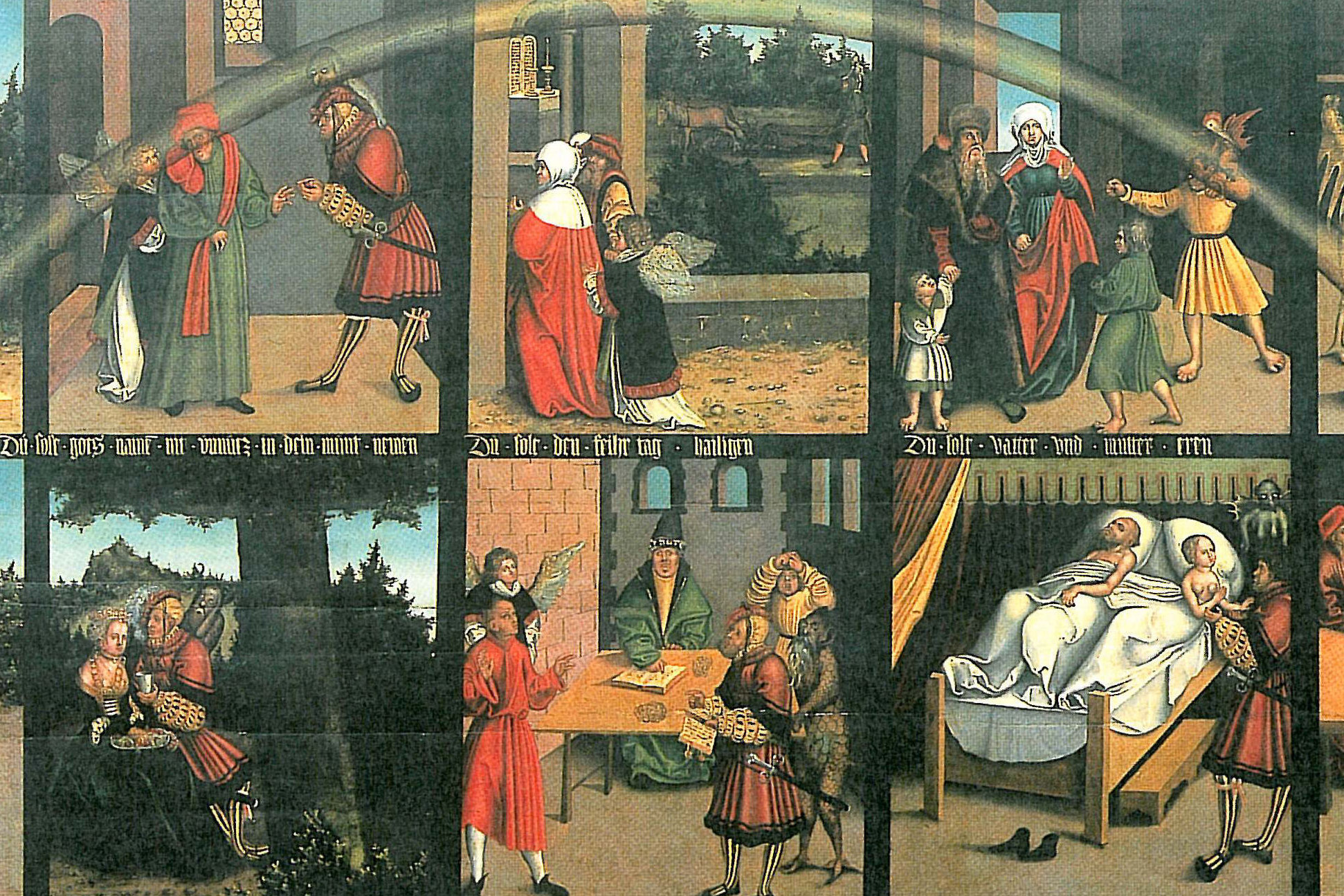
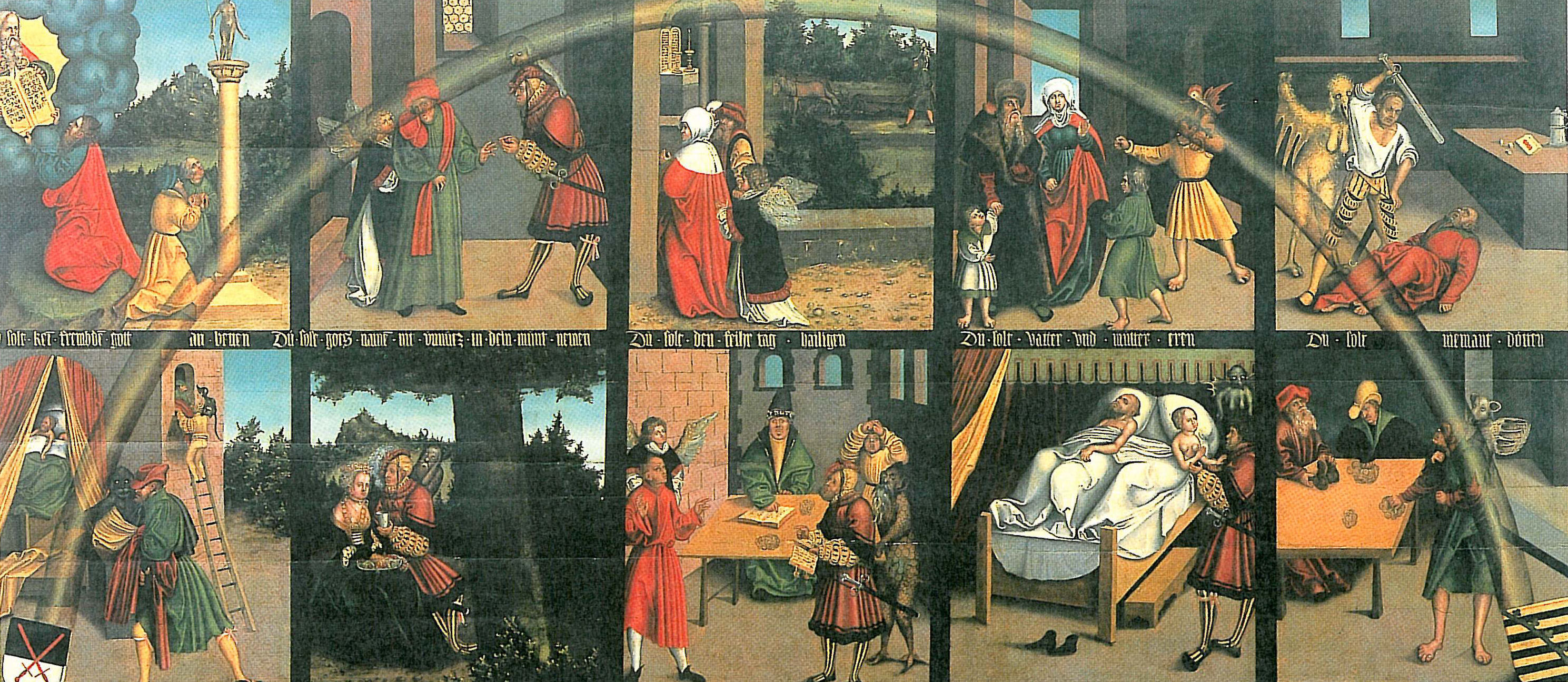
030715The first reading today contains the Ten Commandments and thereby communicates a brief but sweeping summary of the Christian and biblical moral vision. Too often, there is a tendency to reduce the Christian moral vision merely to a set of rules. And it is a sad fact that many resent the the Church for her “rules” because of this reductionist notion of our moral vision.

To be fair, EVERY group and activity has rules. If you join a bowling league there are rules; if you drive on the highway there are rules. If you go work or even to the store there are rules; if you speak a language there are rules. Rules are a necessary reality whenever two or more people interact.

But to see the Christian moral vision or the Ten Commandments  simply as a set a rules is to wholly miss the point. For the Commandments seek not so much to have us obey as to have us be open to what God can do for us. They seek not so much to compel us as to conform us to the image of the transformed and glorious humanity that Christ died to give us.

The Commandments do not so much prescribe, as describe what the transformed human person is like. And their imperative form is not to order us about, but rather to convey the power that comes from God’s Word. For the same God who commands, “Let there be light” and thus there is light,  also says, “Be holy” and thus conveys to us the power to actually become holy, if we will accept His transformative work. He thus commands to create in us the very holiness He announces.

If we would but see the Commandments as promises, as power, as proleptic (i.e., announcing ahead of time what will become fully the case later), many would be far less resentful and far more joyful in what the Lord offers. Let’s consider aspects of these Commandments that may help us come to a richer understanding of the Christian and biblical moral vision. They describe the life Jesus died to give us, a wholly transformed and increasingly glorified life, as we see sins put to death and every kind of virtue come alive.

I. I, the LORD, am your God, who brought you out of the land of Egypt, that place of slavery. You shall not have other gods besides me. You shall not carve idols for yourselves in the shape of anything in the sky above or on the earth below or in the waters beneath the earth; you shall not bow down before them or worship them. In this first commandment is the promise that we experience increasing love of God above all things, above all people, and above life in this world.

We were made to know God and to have our life centered on Him. This is what properly orders and orients us. Whenever we value any person or thing above God, our life becomes miserable and disordered very quickly. If we live for money, power, sex, possessions, popularity, or anything other than God, we are unhappy and our life goes out of order very quickly.

In the first commandment, God promises us an increasingly well-ordered heart, one that loves Him and His heavenly kingdom above all earthly things. He promises us freedom from the shackles of this world, which seeks to claim us, divide our hearts, and misdirect our life from its true goal.

In this commandment, the Lord seeks to heal our duplicitous and adulterous hearts and to order us to the “one thing necessary,” which is to know and love God above all things. What a blessing, what a promise, to have our petulant, divided, wounded hearts made whole and directed to God!

So much serenity comes from being focused on the ONE, who is God. And God can do this for us.

II. You shall not take the name of the LORD, your God, in vain. In this commandment, the Lord  promises a heart with which to love Him. For to revere the Name of God is to have a deep love for God, a deep sense of wonder and awe. It is also to have experienced God’s tender and abiding love for us. And with this gift to love God comes a heart that is sensitive and open to every gift the Lord wants to give us.

When we love God we keep his ways, not because we have to but because we want to. To fear His name is to revere and love Him, to have deep gratitude to Him, and to be docile and open to His every word. We love God’s name because we love Him.

God can give us this gift to love Him in a deep and abiding way. He promises it in this commandment.

III. Remember to keep holy the sabbath day. Six days you may labor and do all your work, but the seventh day is the sabbath of the LORD, your God. In this commandment, the Lord promises us a joyful sense of resting in Him and of allowing Him to minister to us.

Too many today see Church as a duty. But to those who are transformed by God and abide in His love, Holy Mass is the greatest privilege of their lives. What a joy to go and be with God and among God’s people, to hear the joyful shout, and to praise the God we love! What a privilege to be taught by God and fed with His Body and Blood, to be strengthened for every good work!

As the Lord begins to transform our heart, we begin to look forward to the greatest day of the week, Sunday. We joyfully anticipate being with our Lord, hearing His voice, and having deep communion with Him and all the angels and saints.

Yes, God can give us a heart for worship, a desire to praise, a hunger for His Word and for the Body, Blood, Soul, and Divinity of Jesus. No more is Mass a tedious ritual; it is a transformative reality. Again, God promises this, and He can do it for us.

IV. Honor your father and your mother, that you may have a long life in the land which the LORD, your God, is giving you. Here, too, is a promise by God, a promise to give us a deep love for our parents, elders, and lawful authority, and an openness to the wisdom of those who have long preceded us. He promises to cool our pride and the rebelliousness that close us off from the blessings of reverence for the wisdom of elders.

One of the chief problems of the modern age is disrespect for elders. Even those who are not perfect (and none are) have important things to teach us. I probably learned as much from my parents struggles as from their strengths.

Without reverence and respect, there can be no teaching, no handing on of wisdom and knowledge. We live in times that are largely cut off from the past and we tend to  be dismissive of previous generations.

Because of our pride, there comes forth a hermeneutic of discontinuity, of disconnectedness from the past. We do a lot of stupid things today and we seem to lack the wisdom that was common in the past. In this commandment, the Lord promises us a heart that is docile (i.e., open to instruction), a heart that reveres and listens to the wisdom of elders, lawful authority, and past generations.

The Lord wants to unlock for us the collected wisdom of thousands of years of experience, wherein He taught our ancestors and guided them over and through many trials, difficulties, victories, and joys.  In this commandment, the Lord describes and promises to quell the rebelliousness and pride that lock us down and turn us inward on ourselves.

V. You shall not kill. In this commandment, the Lord promises to quell the anger, hate, resentfulness, and vengefulness that eat at us and unleash terrible destruction.

The Lord describes a transformed person, one who has authority over his anger and is able to love even his enemies, one who is able to forgive and maintain serenity even under trial.

The Lord describes a person who loves and respects life, a person who works to build up life in others rather than tearing it down.

He describes a person who reverences the sacredness of every human life and sees in it the hand and the love of God.

God describes here one who is joyful in this life, ecstatic over the prospect of eternal life, and eager to share life and love with others, both here and in the life to come. What a gift it is simply to love others! And God can do this for us.

VI. You shall not commit adultery. Here the Lord promises to quell the often unruly passions of lust. He declares that the transformed human person has authority over his or her sexuality. The Lord also offers us a joyful reverence for the sacredness of human life and for marriage.

Too many people today are slaves to sexuality through addiction to pornography. Many struggle with fornication, masturbation, and adultery. Homosexual acting out is also a terrible problem today. And the consequences of all the sexual bondage of our times are high: STDs, AIDS, abortion, teenage pregnancy, single motherhood (absent fatherhood), high divorce rates, cohabitation, and the huge toll all this takes on children who are raised amidst this confusion and lack of proper family foundations.

God wants to set us free. He wants to cool our lusts, to give us authority over our sexuality, and to bring us to sexual maturity.

The transformed human person God describes here reverences the gift of sexuality and knows its purpose and place. God can give us pure hearts and minds, and He promises it in this commandment.

VII. You shall not steal. In this commandment, the Lord wants to instill in us a gratitude for what we have, to quell our greed, and to cool our fear. For some steal out of fear that they do not have enough, others on account of greed, still others because they are not satisfied with what they have.

God also wants to give us a love for the poor and a desire to share our excess with them. For if I have two coats, one of them belongs to the poor. To withhold my excess from the poor unreasonably is a form of theft.

The transformed human person God describes is generous, grateful, and increasingly free of the fear that makes him hoard. Here, too, God promises a new and generous heart. He who commands it is He who will accomplish it.

VIII. You shall not bear false witness against your neighbor. God here describes and promises a great love for the truth and a respect for the reputation of others. In a way, there is nothing more precious in human terms than our reputation, for by it all other doors are opened.

The transformed human person loves others and is eager to point out their gifts, even while some would detract or calumniate. He is not interested in sharing or hearing unnecessary information about others and says only the good things that people really need to hear.

The transformed person speaks the truth in love. He has a well-trained tongue and speaks only to glorify God. His conversation is always full of grace, seasoned with salt (Col 4:6). God, who commands this, is the same God who can and will do this for us.

IX & X . You shall not covet your neighbor’s house. You shall not covet your neighbor’s wife, nor his male or female slave, nor his ox or ass, nor anything else that belongs to him. Here the Lord whats to quell within us the fires of greed. Greed is the insatiable desire for more. And when greed takes off, we are miserable, never having enough, always wanting and needing more.

The Lord wants to set us free from the aching desire to possess what another has.

He wants to give us a heart that is increasingly focused upon and satisfied with the good things waiting for us in Heaven. Once again, the Lord describes the transformed human person as one freed from enslaving passions.

God who commands this is also the God who can do this.

See how different this understanding is from merely seeing the Christian and biblical moral vision as rules? They are not rules; they are releases. They are not hoops to jump through; they are hopes that inspire. How do you see the Commandments?

In the Gospel today, Jesus cleanses the temple, saying that they have turned it into a marketplace. But you are the Temple of God, and the danger for us is that we sell ourselves short by accepting mediocrity. We sell our souls to the world, the flesh, and the devil, taking in exchange their false and empty promises.

The Lord enters the temple of our souls and seeks to drive out every huckster who seeks to buy us out. Jesus has already paid the price of our redemption. And our totally transformed life, the life described in the commandments and the moral vision of the Scriptures, is the life that Christ died to give us. Do not settle for anything less. 99 1/2% won’t do; got to make 100!

On Lust and Loss – As Seen in an Animated Story

030615The video below is an old (1989) Pixar “short” depicting, in a darkly humorous way, the sin of lust. As is often the case in Pixar movies, toys come alive and tell us more about ourselves than we might have known. You might want to view it before reading my commentary.

As the video opens, we scan the shelf of toys and spy a toy woman who seems too good to be true. Like Barbie, her figure is impossible, or, rather, possible only by way of surgery. Yes, here is the woman of Hollywood, or worse, the woman of the pornographers: surgically altered, airbrushed, and “Photoshopped.” She is meant to make normal women feel inadequate and to make men fantasize about unreality such that real women seem substandard. Yes, here is Satan’s tactic in lust: to shift normal attraction, meant to draw us to one another, into distorted attraction, which turns us inward to fantasy and away from one another and from reality.

Now we meet the snowman, cold on the outside but burning with lust on the inside. He is clearly bored with what he has, bored with his reality. Scripture says, All things are wearisome, more than one can say. The eye never has enough of seeing, nor the ear its fill of hearing (Eccl 1:8).

And then he sees her! She’s too good to be true (and she is in fact not real, not true, as we have discussed). Now the fires of lust are kindled in him and he engages in a series of destructive actions, all to satisfy his lust.

Is this not often what lust does? Those trapped by it will often throw everything overboard to possess its object. They will endanger and inflict harm on their very selves; they will throw loved ones overboard; they will squander, use up, and destroy their wealth and all they have. Some have destroyed marriages and families, forsaken children, and brought disease and poverty on themselves, all for what lust promises: the latest voluptuous one, “Baby if you’ve got the curves, I’ve got the angles.”

Not a few of the actions of this toy snowman are of great symbolism:

1. Spying her, he fixes his eyes. For everything in the world–the cravings of sinful man, the lust of his eyes and the boasting of what he has and does–comes not from the Father but from the world (1 John 2:16).

2. His conscience speaks. Suddenly there is a sound from above and he looks up. Is this the voice of his conscience, or the voice of God? Thoughtful, he looks down and considers for a moment. Scripture personifies lust and the voice that our snowman must hear as he looks up and down.

My son, pay attention to my wisdom, listen well to my words of insight, that you may maintain discretion, and your lips may preserve knowledge. For the lips of an adulteress drip honey, and her speech is smoother than oil; but in the end she is bitter as gall, sharp as a double-edged sword. Her feet go down to hell, her steps lead straight to the grave. She gives no thought to the way of life; her paths are crooked, but she knows it not. Now then, my sons, listen to me; do not turn aside from what I say. Keep to a path far from her, do not go near the door of her house, lest you give your best strength to others (Prov 5:2-8).

(Pardon the quote, ladies, for it lays the sin at the feet only of the woman. But remember, lust is being personified here, and it is a father speaking to his son in the passage.)

3. Lust wins. He looks up angrily and curses the glass “boundary” that prevents the fulfillment of his lustful desire. The boundary must go! The same Scripture says,  The evil deeds of a wicked man ensnare him; the cords of his sin hold him fast. He will die for lack of discipline, led astray by his own great folly (Prov 5:23-25).

4. Lust, the home wrecker. The first thing he throws away is his home. He literally hurls it at the glass boundary. With it, we can presume go his wife and family. Again, scripture says, You give your best strength to others and your years to one who is cruel. Drink water from your own cistern, running water from your own well. Should your springs overflow in the streets, your streams of water in the public squares? Let them be yours alone, never to be shared with strangers. May your fountain be blessed, and may you rejoice in the wife of your youth. A loving doe, a graceful deer—may her breasts satisfy you always, may you ever be captivated by her love. Why be captivated, my son, by an adulteress? (Prov 5:9, 15-20)

5. He goes on a reckless path of self-destruction. He literally cuts off his nose (to spite his face). We also see his face become increasingly distorted as he wreaks havoc on himself and his world. His whole world, and everything and everyone in it, is shaken. Like Jonah, who brought storms to others when he ran from God, this snowman makes the world around him shake and storm by his lust. He sows in the wind and reaps the whirlwind. And this is quite literally illustrated as a great storm swirls within his little world.

6. He descends deeper into sin. Because he has affected others, his whole world descends with him. So, too, for us, whom lust has brought low together. Our whole culture has descended and lust is a huge reason for this. Scripture says of lust personified, Her feet go down to death; her steps lead straight to hell (Prov 5:4-5). And so this snowman and his world slide off the shelf and descend deeper into sin while “lady lust” looks on.

7. The downward cycle continues and he is imprisoned in his lust. Quite literally drowning in his lusts, our snowman spies a buxom mermaid and lunges for her. But his prison finds him and once again he discovers the truth with which we began, The eye never has enough of seeing, nor the ear its fill of hearing (Eccl 1:8). Indeed he is locked in his lusts. Again, as Scripture says,  The evil deeds of a wicked man ensnare him; the cords of his sin hold him fast (Prov 5:22).

And so we leave our snowman locked in his lust. He has lost his home and family, disfigured himself, and fallen mighty low, taking his world and others with him. Such can be the toll of lust.

A rather serious post, I suppose, especially given the rather light fare of the video. But I hope you can see that the humor within it has a dark side, and that this little movie goes a long way in giving a poignant portrait of lust. “Enjoy” the video.

The Night Prayer of the Church as a "Rehearsal for Death"

030515Some years ago I was addressing a group of young adults at a “Theology on Tap” gathering. I was asked by an attendee of some ways to avoid temptation. Among the things I offered was to meditate frequently on death, especially at night before going to bed. The bar got very quiet and everyone looked at me as though I had just been speaking Swahili. “What did he just say?…Could you repeat that?” Perhaps my remarks were the right answer but the wrong answer at the same time. In these modern, medically advanced times, those in their 20s don’t really relate to death as a concept or near reality. Meditating on death seems strange and foreign to most of them.

But the instinct of the Church has always been to link night prayer to death, by way of a kind of “dress rehearsal.” Consider these prayers:

1. Into your hands O Lord I commend my sprit. This is a reference to Jesus’ dying words, “Father! Into your hands I commend my spirit” (Lk 23:46).

2. Lord, now you let your servant go in peace, your word has been fulfilled. My own eyes have seen the salvation which you have prepared in the sight of your people. These are the words of Simeon, who had been promised he would not see death until he had beheld the Messiah. Now that he has held the infant Jesus in his arms he can die peacefully.

3. May the Lord grant us a peaceful night and a peaceful death. This is the concluding line of night prayer just before the Salve Regina, where we ask the Blessed Mother to “tuck us in” for the night.

There are also many beautiful references in the hymns of night prayer. For example,

Guard us waking guard us sleeping;
and when we die,
May we in thy mighty keeping
all peaceful lie.
When the last dread call shall wake us,
Do not Our God forsake us
But to reign in glory take us
With thee on high.

(From the Hymn “Day is Done” – 2nd Verse)

Teach me to live that I may dread
The grave as little as my bed;
Teach me to die, so that I may
Rise glorious at the awful Day.

(From the Hymn “Glory to Thee, my God this night.”- 3rd verse)

These are just some of the references. But night prayer is a time to remember that we will die and to ponder this with sobriety. Sleep is, to some degree, like death; we become “dead” to the world. We are no longer aware of the rhythms, demands, and fascinations of this world. We are “out” to this world, out of touch with it. We lie still as in death, unaware and disinterested, at a kind of comatose distance from the things that obsess us in our waking hours. And though we awake from sleep, one day we will sleep to this world and never awake, never return to its demands. Our coffin, like a little bed, will claim us. It will be closed and this world will know us no more.

Night prayer serves as a gentle reminder of this looming summons. We entrust ourselves to the care of our Lord, who alone can lead us over the valley of the shadow of death. We ask, too, Our Lady’s prayers. We ask that she, as a good mother, console us and assure us that after this our exile we will see the glorious face of her Son and be restored to our Father in the warm love of the Holy Spirit.

Even if you don’t have time to pray the other hours of the Divine Office, I strongly recommend night prayer (Compline). It is brief and beautiful, sober and serene. It is the great dress rehearsal for our death. If we are faithful, this will be the greatest day of our life on this earth. On that day, we will be called to Him who loves us. Surely our judgment looms, but even that, if we are faithful, will usher in our final purification and freedom from the shackles of sin and the woes of this world.

May the Lord grant us a restful night and a peaceful death.

God, who made the earth and heaven,
Darkness and light:
You the day for work have given,
For rest the night.
May your angel guards defend us,
Slumber sweet your mercy send us,
Holy dreams and hopes attend us
All through the night.

And when morn again shall call us
To run life’s way,
May we still, whatever befall us,
Your will obey.
From the power of evil hide us,
In the narrow pathway guide us,
Never be your smile denied us
All through the day.

Guard us waking, guard us sleeping, 
And when we die,
May we in your mighty keeping
All peaceful lie.
When the last dread call shall wake us,
Then, O Lord, do not forsake us,
But to reign in glory take us
With you on high.

Holy Father, throned in heaven,
All holy Son,
Holy Spirit, freely given, 
Blest Three in One:
Grant us grace, we now implore you,
Till we lay our crowns before you
And in worthier strains adore you
While ages run.

What Are Passive Purifications and Why Are They Needed?

Have you undertaken certain Lenten practices or abstinences to assist you growth in holiness? If so, you do well. Practices such as these are included in what are known as “active purifications.” Active purifications consist of our holy works and efforts and our mortifications, which, by the grace of God, help to purify our mind, our heart, and what is called our “sensitive appetite.”

However, there are also “passive purifications,” which are quite essential for our growth in holiness and our readiness to see God one day. These purifications are called passive because they are worked in us by God. They are necessary to attain to the promises of God because mere human effort, through the practice of the virtues, is not enough to attain to the lofty and wonderful perfection God has promised us.

Jesus speaks to this need and this process and says,

I am the true vine, and my Father is the gardener. He cuts off every branch in me that bears no fruit, while every branch that does bear fruit he prunes so that it will be even more fruitful (John 15:1-2).

St. Thomas Aquinas, in his Commentary on the Gospel of John, says,

In the life of nature it happens that a palm tree, having many sprouts bears less fruit because of the diffusion of the sap to all the branches. Thus  in order that it may bear more fruit,  cultivators trim away its superfluous shoots. So it is in man … [if] his affections incline to [too] many things, his virtue decreases and he becomes more ineffective in doing good. And so, in order that the just who bear fruit may bear still more, God frequently cuts away in them whatever is still superfluous. He purifies them by sending tribulations and permitting temptations in the midst of which they show themselves more generous and stronger. No one is so pure in this life that he no longer needs to be more and more purified (St. Thomas In Joannem 15:1).

And thus, St. Thomas notes the need for and the means of passive purification.

The fact is, even undertaking many active purifications (e.g., fasting, prayer, and almsgiving) will not be enough to effect the changes required to attain the perfection and deep contemplative union to which we are summoned. We are often unable to completely and accurately see what purgings are required for us. Neither are we well equipped to know the specific temporal order and severity required to bring about the needed purity. Just as it is difficult, if not impossible, for a person to perform surgery on himself, so too are we often incapable of undertaking the work of passive purification. Only God knows when, how, and to what degree this work must take place.

Here are some excerpts from Fr. Reginald Garrigou-Lagrange that further explain passive purifications and why they are needed:

There is in our lives a light and shade that is at times striking … Even in the baptized, concupiscence and many tendencies to sensuality, to vanity, and to pride remain. A profound purification is necessary; not only that which we must impose on ourselves, and which is called mortification, but that which God imposes, when, according to Christ’s expression, He wishes to prune, to trim the branches of the vine that they may bring forth more fruit …

Not without suffering indeed, is complete victory obtained over egoism, sensuality, laziness, impatience, jealousy, envy, injustice in judgment, self-love, foolish pretensions, and also self-seeking in piety, the immoderate desire of consolations, intellectual and spiritual pride, and all that is opposed to the spirit of faith …

To show that the act of purification which we impose ourselves does not suffice, St. John of the Cross writes, “For after all the efforts of the soul, it cannot, by any exertion of its own, actively purify itself so as to be in the slightest degree fit for the divine union of perfection in the love of God, if God himself does not take it into his own hands and purify it in the fire, dark to the soul …” (Dark Night I.3) 

First of all, the soul is weaned from sensible consolations … Whence the necessity of the passive purification of the senses which places the soul in sensible aridity and leads it to a spiritual life that is much more freed from the senses and the imagination … despite a painful obscurity, this initiates the soul profoundly into the things of God … 

In the night of the senses there is a striking light and shade. The sensible appetites are cast into obscurity and dryness by the disappearance of sensible graces on which the soul dwelt with an egotistical complacency. But in the midst of this obscurity, the higher faculties begin to be illumined by the light of life which goes beyond reasoned meditation and leads to a loving and prolonged gaze upon God during prayer…. 

But even after this purification … the soul to the faithful must be purified from every human attachment to their judgment, to their excessively personal manner of seeing, willing, acting, and from every human attachment to the good works to which they devote themselves …

It is commonly said that the roots of knowledge are bitter, and its fruits are sweet. And this can be said of the roots and fruits of infused contemplation, [but] it would be a great error to confound [i.e confuse] this contemplation with consolations which do not always accompany it [The Three Ages of the Interior Life Vol. 1, 189-194].

In other words, many passive purifications are needed for us! When trials and difficulties beset us, it is so easy for us to become resentful or discouraged. We often ask, “Why does God permit this?” And the answer may well be that we very much need it! Truth be told, we need a lot of purifications in order to grow and, ultimately, to be ready for Heaven. We are “hard cases” and deep surgery is necessary, repeated surgery too.

Perhaps the best we can say is, “Be as gentle as possible, Lord, but do what you need to do.”

Here’s an old hymn on the troubles of the African-American experience. One of the verses says,

We are often tossed and driven
On the restless sea of time,
Somber skies and howling tempests
Oft succeed a bright sunshine
In the land of perfect day
When the mists have rolled away
We will understand it better
By and By

Designer Religion: A Critique of a Recent Description of Faith in a National Publication

030315We live in times of what I would call “designer religion.” Many people seem to think they have a right to assemble religious teachings they like and discard what they do not. The idea that faith is revealed by God and that we are to discover what He has revealed (in both creation and Scripture) and conform ourselves to it is at odds with our consumer culture. But faith is not a consumer product. We can’t just select the commandments we like or the doctrines we prefer, and still remain faithful to God, who reveals on His terms, not ours.

An article was written recently by Ana Marie Cox at The Daily Beast that shows forth some of these trends. I’d like to comment on some of what she has written.

I want to be careful as well. I do not take lightly critiquing someone else’s description of his or her faith. However, when one writes publicly and in a way that reflects or reinforces problematic trends, some response seems necessary.

Perhaps I would do well to emphasize that I am responding to Ms. Cox’s article because I think she articulates what a LOT of people think today of faith and how they express it. Hence, please see my critique of her description of faith more as concern for erroneous trends than as a personal assessment of her. She is getting my reply because she wrote the article. However, she is not alone in these views and so my criticism should not be seen as a personal rebuke of her, but more as a rebuke of the mindset of our culture related to what I would call “designer religion.

The full article is available here: Why I’m Coming out as a Christian. In the excerpts that follow, her words are in bold, black italics, while my comments are in plain, red text.

Ana Marie Cox writes,

I’ve lately observed conservatives questioning Obama’s faith with more than professional interest. Because if Obama’s not Christian, what does that make me?

For the record, I am not interested here in the question of the President’s faith except insofar as it affects his salvation. I want everyone to be saved.

But for context, her article focuses on “conservatives” who question President Obama’s faith. I have certainly heard these critiques and do not wish to comment on that viewpoint except to say that his personal faith rises more to the fore due to his often hostile stance against “believers.”

As Catholics, we have suffered many violations of our religious liberty and have had to spend millions defending our rights in court against HHS mandates, etc.  

The President has also spoken quite glowingly about Islam while at the same time being quick to critique Christian “extremism,” both historically and at present. But as a political question, I am not that interested in the matter.

I am more interested in what Ms. Cox says about faith, because, sadly, I think what she writes here reflects the erroneous views of many about faith. Those are the things I want to reflect on here in my “commentary on her commentary.”

I have not been public about my faith …

This is problem one, and rather reflective of most Christians today, especially Catholics. We seem to more anxious to blend in, to be undercover Christians and secret agent saints than to be doing job one: making disciples of all nations by witnessing to the faith. However, maybe it is just as well that she is not too public about her views in this matter, as we shall see.

In my personal life, my faith is not something I struggle with or something I take particular pride in. It is just part of who I am.

And here are problems two, three, and four. As she describes it, it would seem that the faith she has is a minor part of her landscape. She does not “struggle” with it.  But is not a dynamic faith unsettling, something that should challenge us and summon us to struggle against the drives of our flesh? Does not St. Paul speak of the deep conflict between our spirit and the flesh? Is not the purgative summons of the Lord something that calls us to often-times difficult choices and the carrying of the cross? Many today have the idea that faith is something more to console us than challenge us. Faith should challenge us and draw us into the battle of struggling for our soul and the souls of others. 

I could go on, but note problem three, wherein she says she is not proud of her faith. Why not? To be clear, the pride I refer to here is not sinful pride. Rather, it is the joyful exuberance of someone who has found real answers that he is convinced will really help others, or of someone who has laid hold of an amazing vision she wants to share. Is this not the appropriate stance of someone who has life-changing faith?

As for problem four, she also says faith is “just part of who I am.” Is it? I cannot say in Ms. Cox’s case, but too many Christians pay mere lip service to the Lord and to the faith He bestows. Their faith, to the degree it exists at all, is too often tucked under their politics, career, and secular views. And if the faith comes into any conflict with these areas, guess which has to give way? True faith has to be more than “just part of who I am.” In fact it has to be our foundation, and the very template by which we see the world, determine what is to be done, and judge what is right and wrong.

… My hesitancy to flaunt my faith has nothing to do with fear of judgment by non-believers … I am not smart enough to argue with those that cling to disbelief. Centuries of philosophers have made better arguments than I could, and I am comfortable with just pointing in their direction if an acquaintance insists, “If there is a God, then why [insert atrocity]?” For me, belief didn’t come after I had the answer to that question. Belief came when I stopped needing the answer. Nicely put.

No, I’m nervous to come out as a Christian because I worry I’m not good enough of one. I’m not scared that non-believers will make me feel an outcast. I’m scared that Christians will.

After this she goes back to citing those who question President Obama’s faith, etc. As stated, I am not interested in that particular question.

However, her objection to Christians questioning her faith or her degree of commitment is rather too sweeping in my view. I will grant that Christians can be a little too hard on one another, but I will not grant that there is no legitimacy to insisting on some baseline of both creedal beliefs and moral views rooted in what the Lord clearly teaches.

“Branding” is important, especially in the corporate world and in areas such as sports. Those who like baseball, for example, are right to insist on certain standards, boundaries, equipment, and rules for baseball to be baseball. At some point if even a few of these things are cast aside, the sport ceases to be baseball and becomes something else.

In the world of marketing, if a woman buys a Gucci bag and then discovers later it is not the real thing, but is Gucci “in name only,” she has a right to be angry and to demand reparation. 

It is the same with faith. Christians are right to insist on certain basics, even if agreement on every small detail cannot reasonably be demanded. No one should be outraged by this.

Jesus said things like, Whoever is not with me is against me, and whoever does not gather with me scatters (Lk 11:23), and, For what is a man profited if he gains the whole world, and loses or forfeits himself? For whoever is ashamed of Me and My words, the Son of Man will be ashamed of him when He comes in His glory (Lk 9:25-26).

So the content and authenticity of our faith as well as the stance we make to the world ARE important. And pardon me for saying so. 

Ms. Cox, after setting aside other metrics for being a believer (like going to Church), next takes up knowledge of Scripture. She writes,

What about Bible literacy? Mine is mostly limited to dimly remembered excerpts from the Old Testament we read in my college humanities class and a daily verse email. I read spiritual meditations, but the Word is still a second language I speak less than fluently …

OK, so let’s set aside the extreme notion that everyone must be a Bible scholar and be able to conjugate Greek verbs.

But honestly, is it wrong to ask that Christians have a little more than “dimly remembered excerpts” of Scripture?  

Maybe one reason that she and others she describes don’t know Scripture very well is that they think Church attendance isn’t important.

But whatever the case, knowing Scripture and at least squaring your beliefs with the revealed word of God is important!

Too many people today think they can make up anything they want to believe in or reject whatever they please and yet still go on calling themselves “Christians” or even “devout Catholics.” It doesn’t work that way.

“Designer religion” is a serious problem today. A fundamental baseline for Christian belief has to be a faith that is squared with the revealed Word of God. And as a Catholic, I would add that the true faith must be squared with God’s Word as understood by and in Sacred Tradition.

Making up your own faith used to be called heresy. Making up your own version of God used to be called idolatry.

Ms. Cox goes on to say that she personally knows Jesus Christ. I cannot read her heart, but I do agree with St. Jerome, who said that ignorance of Scripture is ignorance of Christ. That she has met Christ is good news. But has she met the real Christ? And how would she know, since her Bible literacy is limited to “dimly remembered excerpts from the Old Testament”?

Many claim to have met Christ. But remember, Satan masquerades as an angel of light! Discernment rooted in the revelation of God is necessary to be sure you have met the real Jesus.

Here is why I believe I am a Christian: I believe I have a personal relationship with my Lord and Savior. I believe in the grace offered by the Resurrection. I believe that whatever spiritual rewards I may reap come directly from trying to live the example set by Christ. Whether or not I succeed in living up to that example is primarily between Him and me.

So here is her “money quote.” Except for the last sentence, what she has said is OK, but it is also incomplete for the reasons already stated.

I will ask further, what “example” set by Christ does she mean, since she says her knowledge of Scripture is “dim”?  Here too, I do not refer simply to her, but to the legions of people today who refer to the “example” set by Christ but do not mean it in a scriptural way. Usually the “example” to which they refer is kindness detached from truth, detached from the deeper love that insists on commitment and obedience. One of the great errors of our day is the proclamation of mercy without repentance.

If I have a relationship with Jesus, I want to make sure it is the real Jesus, not some “fake Jesus” I invented who just so happens to agree with me on nearly everything and almost never challenges me. To know the real Jesus, I must come to know Him not just “personally,” but also in relation to the revealed Scripture and His Body, the Church, which has known him for over 2000 years.

Everyone should have a personal relationship with Jesus, but not a relationship isolated from Scripture and Sacred Tradition or the Liturgy.

Again, I do not mean to single out Ms. Cox here. She represents multitudes today who share her view. Her final sentence, referring to her faith and faithfulness as only being “between her and Jesus,” is emblematic of an isolated faith, a silo mentality.

But Faith comes by hearing, so it is not merely personal. St. Paul says that for faith to be heard, authentic and approved  preachers have to go forth. The same Paul corrects error and insists on Church discipline (e.g 1 Cor 11- 14; 1 Cor 5; 1 and 2 Timothy, Titus, inter al). He also tells Christians to instruct and admonish one another (Col 3). Jesus sets forth an order of fraternal correction (Matt 18:15ff) that starts with the individual but ends with “telling it to the Church” and indicates that His apostles have the capacity to forgive or retain sin (Jn 20). I could go on and on. Ms. Cox is not alone in her erroneous and unbiblical notions about purely “personal” faith and relationship with Jesus. Legions think this way, including many Catholics.

I will leave it to you, dear reader, to read the rest of her article if you wish. Please remember that I do not know Ms. Cox and do not believe I have ever even heard of her before. My critique is not of her personally. I leave that to God. But I DO critique her publicly stated and (I would argue) deeply flawed notions about faith. I respond to them to answer not just her but the many who think just like her.

In summary, “designer religion” and a purely “personal” faith without reference to the sources of Revelation and Christian antiquity is a grave danger today. It is dangerous because it takes up the trappings of the true faith but without its saving truth. This amounts to a strong delusion, having the form of godliness but not laying hold of its power (cf 2 Tim 3:5). It lives revealed truth not on its terms, but rather insists on merely “personal” notions. It reports to a “god” of one’s own personal understanding, the “god-within,” not the God who has revealed Himself.

I usually like gospel music, but this song gets it wrong. It says, “Long as I got King Jesus, I don’t need nobody else.” Sorry, that’s wrong. Jesus has many members of His body. We all have different functions, but we need each other. Jesus set it up that way.

The Cross in the Cosmos – A Meditation on a Teaching by Joseph Cardinal Ratzinger

Processed with VSCOcam with hb1 preset

The Wisdom Tradition of the Scriptures emphasizes that God speaks and is discerned in things He has made. Scripture says, The heavens declare the glory of God, the firmament (stars) shows forth his handiwork (Psalm 19:1). Indeed, when God spoke His Word, creation came forth.

And the Word that God spoke was the Logos, Jesus. Scripture says, Through him all things were made; without him nothing was made that has been made (Jn 1:3). It also says, For by Him all things were created, both in the heavens and on earth, visible and invisible, whether thrones or dominions or rulers or authorities–all things have been created through Him and for Him (Colossians 1:16).

It makes sense, then, that creation would reflect Jesus Christ and point to Him. For from Him and through Him all things are. And central to Christ is His Cross. So it also makes sense that we would find His Cross etched into the very heavens and earth.

As the Wisdom Tradition in the Scriptures (Wisdom, Sirach, Ecclesiastes, Proverbs, etc.) teaches, the created world has a Logike (a kind of logic) based on the fact that God made it through His Logos (Word).

The New Testament takes this up and teaches that when God spoke creation into existence through His Word (Logos), His Logos set things forth and impressed them with a Logike (logic) that is discernible. We draw from this scriptural teaching, Natural Law. In effect, we can discern a logic of rationality to what God has made, and come to know of God and His will for us. Central to this Logike is the Cross.

Pope Benedict (as Joseph Cardinal Ratzinger) wrote of the Cross that it is etched in the very cosmos. I want to present some excerpts from his teaching here, along with a few comments of my own. These are drawn from his work The Spirit of the Liturgy, which is now taken up in his Collected Works Volume XI: Theology of the Liturgy, pp 111-114. Enjoy this thrilling excursion into cosmology. As always, quotes from the book are in bold, black italics, while my remarks are in plain, red text.

The Fathers belonging to the Greek cultural world were … directly affected by another discovery. In the writings of Plato, they found the remarkable idea of a cross inscribed upon the cosmos. Plato took this from the Pythagorean tradition, which in its turn had a connection with the traditions of the ancient East.  [There are] the two great movements of the stars with which ancient astronomy was familiar: the ecliptic (the great circle in the heavens along which the sun appears to run its course) and the orbit of the earth. These two intersect and form together the Greek letter, Chi which is written in the form of a cross (like an X). The sign of the cross is inscribed on the whole cosmos.

In the video below, I have cued the footage to begin where this X, this cross, is observable. The video generally shows the dual X-like motion of the stars rotating at one angle:  while the earth turns at the other: /  We can see this easily in fast-forward motion. It is remarkable that the ancients (who knew and observed the heavens far better than the average person today) could perceive this dual motion at the slower pace of “real time.” 

St. Justin martyr … came across this platonic text and did not hesitate to link it with the doctrine of the Triune God and his action in salvation history in the person of Jesus Christ … The Cross of Golgotha is foreshadowed in the structure of the universe itself … The cosmos speaks to us of the cross, and the cross solves for us the enigma of the cosmos. It is the real key to all reality.

Quite stunning. The cross is the true crux, the intersection of God and creation. The downward thrust of man’s pride in the tall beam is intersected with the wide beam of God’s love in the outstretched arms of Christ on the Cross. Or, alternately, the downward action of Jesus’ descent from the realms of heavenly glory intersects with the world turning up and out toward God, who alone can save us. Here is the cosmos’ inclusion in the divine perichoresis, the movement of love in the Trinity, the dance of loving union. God descends and earth turns up and out in dance of love and unity, meeting at the intersection of the cosmic cross. This is the deeper and truer reality of what is going on. It is what St. Paul described when he said, 

For the creation waits in eager expectation for the children of God to be revealed. For the creation was subjected to frustration, not by its own choice, but by the will of the one who subjected it, in hope that the creation itself will be liberated from its bondage to decay and brought into the freedom and glory of the children of God. We know that the whole creation has been groaning as in the pains of childbirth right up to the present time (Rom 8:19-22).

[This was] one of the fundamental ideas in patristic theology … that the crucified one is the very word of Almighty God, who penetrates our universe by an invisible presence. And for this reason he embraces the whole world in its breadth and length, height and depth. For through the Word of God all things are guided into order. And the son of God is crucified in them, since, in the form of the cross he is imprinted upon all things.

Jesus, the Word of God, orders all things, and through His cross imprinted on the cosmos, restores all things. We now, in our souls, are the first fruits, but one day all creation will be liberated. The great Cross in the sky announces this! 

The epistle to the Ephesians exhorts us to be rooted and grounded in love, so that, we “May have the power to comprehend with all the saints what is the breadth and length and height and depth, and to know the love of Christ which surpasses knowledge” (Eph 3:18 ff). There can be little doubt that this epistle emanating from the school of St. Paul is referring to the cosmic cross, and thereby taking up traditions about the cross-shaped tree of the world that holds everything together.

Indeed, like sturdy branches holding all the leaves and smaller branches together.

In his eschatological discourse, Jesus had announced that at the end of time “the sign of the Son of Man” would appear in the heavens (Matthew 24:30). The eye of faith is now able to recognize that this sign has been inscribed into the cosmos from the beginning, and thus see [our] faith in the crucified Redeemer confirmed by the cosmos.

Once again, the Cross is the key. It has always been there to see, but now in these last days, through faith, we can see it plainly. And in doing so, we can take up with all creation the hymn we have only lately learned, but the cosmos has always known and sung:

CRUX fidelis,
inter omnes
arbor una nobilis;
nulla talem silva profert,
flore, fronde, germine.
Dulce lignum, dulci clavo,
dulce pondus sustinens!
FAITHFUL Cross!
above all other,
one and only noble Tree!
None in foliage, none in blossom,
none in fruit thy peers may be;
sweetest wood and sweetest iron!
Sweetest Weight is hung on thee!
Flecte ramos, arbor alta,
tensa laxa viscera,
et rigor lentescat ille,
quem dedit nativitas,
ut superni membra Regis
miti tendas stipite.
Lofty tree, bend down thy branches,
to embrace thy sacred load;
oh, relax the native tension
of that all too rigid wood;
gently, gently bear the members
of thy dying King and God.
Sola digna tu fuisti
ferre saeculi pretium,
atque portum praeparare
nauta mundo naufrago,
quem sacer cruor perunxit,
fusus Agni corpore.
Tree, which solely wast found worthy
the world’s Victim to sustain.
harbor from the raging tempest!
ark, that saved the world again!
Tree, with sacred blood anointed
of the Lamb for sinners slain.


Here’s the video showing the chiastic movement of the stars and earth. Note the double movement: the stars moving downward to the right and the earth turning slowly upward to the left. A few of the angles feature a moving camera, which obscures the result a bit, but you still get the point. (Sorry for the brief concert interruptions.) To experience the greatest effect, click on full screen; it is awesome that way!

Order! Order in the Universe! – A Meditation on the Wisdom That Creation Reflects

030115

In a courtroom, the judge can bring an unruly outburst to an end by shouting, “Order! Order in the court!” I often feel the same urge in the debates of our time about God’s existence and His role in the created universe. It is not so much that the debates can get unruly, but that I, with the  insistence of a town crier, want to shout, “Order! Order, there IS order the universe!” And I want to ask everyone to be quiet and listen to the universe herself declaring, “I am ordered! I am designed! I am remarkably complex, from the largest galaxies to the smallest atoms! And even what you think is chaos is but an order currently hidden from your limited view.”

As a prelude to a series of articles I plan to post this week on cosmology, liturgy, and Sacraments, I would like to begin with a summons to this call: “Order! Order in the universe!” I want to apply some of the insights of creation, a kind of root “sacrament” that underlies the seven Sacraments, and the reason for liturgy. For our seven Sacraments presuppose that matter and creation are not just dumbly present but that they bespeak order and purpose, and manifest God, their maker. Today I’d like to simply ponder order and then listen to a liturgical hymn that celebrates, in the Wisdom tradition, the One who in His wisdom designed and ordered the cosmos.

It is a strange and remarkable thing to me that in this day and age, when we have discovered magnificent realities that show a universe steeped in order and unbelievable size, increasing numbers of people claim that the whole thing is just dumbly there, that it’s all the result of a series of random mutations. In other words, to more and more people today, the obvious order of the universe is accidental; we human beings are simply the result of random, blind, unguided mutations. All the order of creation we can plainly observe and all the sophisticated, interdependent systems that give rise to complex life are all just accidental. We are asked to believe that all this obvious order, order that no one can miss, somehow leapt together, unguided and accidentally, from a primordial soup; that from disorder came order.

Although things tend to fall apart and go back to their basic components (the Law of Entropy), we are asked to believe that in this case, in a random and accidental way, things actually moved from disorder to order all on their own, even though, as some insist, no outside force, energy, or intelligence acted on them.

To me, this sort of belief requires more “faith” than simply believing that a higher and intelligent being (whom we call God) both created and introduced the order that is so obvious in the universe, not to mention in our bodies, down to the smallest cells and atoms. And to be sure, the atheist/secularist notion of random, unguided, accidental order is itself a belief, for its conclusion is outside of what science can study or demonstrate. For all the denunciation by many atheists of philosophy, theology and metaphysics, those who deny God’s role in creation are not making a scientific claim; they are staking out their own philosophical, theological, and metaphysical claim and asking others to believe it. To me, such a “belief” in the random, unguided, and accidental existence of things, in the face of such overwhelming and consistent order, is unreasonable in the extreme.

The whole universe shouts, “Order! Consistency! Intelligibility!” Our bodies and every delicately functioning system on this planet echo back the refrain, “Order! Consistency! Intelligibility!” And while I cannot, and do not, ask scientists to specifically affirm the biblical and Christian God and our whole Catholic theological tradition, the existence of consistent order in the universe is obvious and serves as the basis of the whole scientific method. For if things were truly random, rather than orderly, intelligible, and predictable, science could not propose theories, test results, or verify them. No experiment would produce similar results if everything acted randomly. The scientific method presupposes order and consistency within a verifiable range. Thus while science need not draw conclusions as to how this order came about, it is wholly inappropriate (as some scientists have done) to be dismissive of believers, who conclude from order that someone ordered it so.

Yes, what a glorious and magnificent thing creation is! And to this believer, it loudly proclaims the God who made it.

There is a beautiful hymn, one that I have seldom heard sung in Catholic parishes, that takes up the voice of creation, especially that part of creation we call the stars (firmament) and the planets. The hymn is based on Psalm 19, and I think it is a minor masterpiece of English poetry. It was written by Joseph Addison in 1712.

It comes from a time before skeptical agnosticism and hostility to the very notion (let alone existence) of God had taken deep root in our culture. And, frankly, it also comes from a more sober time, when people accepted the plainly obvious fact that creation is ordered, and therefore that it was ordered by someone in a purposeful and intelligent manner. That someone we believers call God.

Consider the beautiful words of this song and its reasoned conclusion that, as Psalm 19 notes, creation shouts its Creator.

The spacious firmament on high,
with all the blue ethereal sky,
and spangled heavens, a shining frame,
their great Original proclaim.
The unwearied sun from day to day
does his Creator’s power display;
and publishes to every land
the work of an almighty hand.

Soon as the evening shades prevail,
the moon takes up the wondrous tale,
and nightly to the listening earth
repeats the story of her birth:
whilst all the stars that round her burn,
and all the planets in their turn,
confirm the tidings, as they roll
and spread the truth from pole to pole.

What though in solemn silence all
move round the dark terrestrial ball?
What though no real voice nor sound
amid their radiant orbs be found?
In reason’s ear they all rejoice,
and utter forth a glorious voice;
for ever singing as they shine,
“The hand that made us is divine.”

Yes, the hand that made us is divine, and He has done a marvelous thing!

Here is a sung version: