On one particular morning, just two weeks after His resurrection, Jesus stood on the shore of the Sea of Galilee. Seeing the Apostles in a boat just off the shore, he said, Little Children, Have you caught anything? (John 21:5)
It is a rather strange way to speak to grown men: “Little Children” (παιδία = paidia = little ones, children, infants, the diminutive of pais (child), hence “little ones”). And yet how deeply affectionate it is.
We often think of ourselves in grander terms, terms that bespeak power, wisdom, age, and strength. But I suspect that, to God, we must always seem like little children.
When I do infant Baptisms I normally use a passage from the Gospel of Mark in which the Lord says (among other things), Whoever does not receive the kingdom of God like a little child (παιδίον) shall not enter it (Mark 10:15). And thus we must finally come to realize that however rich, powerful, capable, or mature we my think ourselves to be, we depend radically on Abba for everything—even the next beat of our heart. The infants I baptize are already preaching the Gospel of the Kingdom simply by their littleness. They summon us who think we are strong and independent to know who and what we really are: little children, so needful of Abba for everything.
I am often moved as I walk the halls of nursing homes and see many once powerful “adults” now reflecting their truest state. Like little children, they have become dependent. Some can no longer talk. Others just sing and hold dolls. Still others wear diapers, need to be fed, and cry out for help and comfort. It has always been so for them (and for us); it is just now more evident.
This Sunday’s gospel begins with the Lord calling us his “little flock.” And so we are—little and yet loved.
And somewhere, standing on the seashore of your life, the Lord is calling out, “Little One … have you anything to eat?”
I though of all this when I saw the video below. I wondered as I viewed it if it doesn’t depict all of us as God really sees us. The folks in this video think they are “big and bad.” But for a moment we them as God does. Enjoy this.
The Nicene Creed fittingly noted four marks of the True Church: one, holy, Catholic, and apostolic. These marks identify four essential qualities and characteristics of the Church that distinguish the True Church from any false claimants. Now my surname may be “Pope,” but I surely cannot add authoritatively to this venerable list. Nevertheless, permit me a couple of “prayerful additions” to the four marks of the Church. These cannot join the official list but I humbly submit these “marks” for your consideration to serve in a similar way in distinguishing the True Church from false claimants and giving insight into the Church’s truest identity.
The 5th Mark of the Church: She is Hated by the World. Jesus consistently taught us to expect the hatred of the world if we are true disciples.
If the world hates you, keep in mind that it hated me first. If you belonged to the world, it would love you as its own. As it is, you do not belong to the world, but I have chosen you out of the world. That is why the world hates you. Remember the words I spoke to you: ‘No servant is greater than his master.’ If they persecuted me, they will persecute you also. If they obeyed my teaching, they will obey yours also (John 15:18-20).
All men will hate you because of me, but he who stands firm to the end will be saved. A student is not above his teacher, nor a servant above his master. It is enough for the student to be like his teacher, and the servant like his master. If the head of the house has been called Beelzebub,how much more the members of his household! (Matt 10:22-24)
Woe to you when all men speak well of you, for that is how their fathers treated the false prophets (Luke 6:26).
One of the more painful aspects of Church life, yet one of those of which I am the most “proud,” is that we are hated very specially by the world. While it is true that some of the Evangelicals are ridiculed, few can deny that there is a very special and intense hatred for the Catholic Church, and it is widely on display. It’s never OK (nor should it be) to scorn Jews or Muslims, or to mock or attack their faith traditions. Most of the other Christian denominations (with the exception of the Evangelicals) escape the bulk of the hatred. But the Catholic Church—ah, the Catholic Church—on her it seems to be open season. We are scorned and portrayed unsympathetically in movies. Our history is misrepresented; our sins (and we do have them) are exaggerated; our teachings are called bigoted, backward, unrealistic, and out-of-date. And no matter how ugly, bigoted, and inaccurate the world’s hatred is, very few express any outrage at how we are treated and misrepresented. Try any of this on Muslims, Jews, Buddhists, etc. and the outrage and claims of bigotry are echoed by the media (as they should be). Meanwhile, Dan Brown, et al. get to go on and on about “evil” priests and bishops; a crucifix can be submerged in urine or the Blessed Mother smeared with dung and this is praised as “art” and funded by government grants.
Now I am not complaining (though these things are certainly wrong). I am actually quite hopeful that this means we are doing something right. We are a sign of contradiction to the world and we are hated for it. We speak the truth to a world gone mad; we hold on to that “old time religion.” That we are hated puts us in good company with Jesus and the prophets and martyrs who stood with Him. If we are really doing what we should, the Church ought to experience significant hatred from the world. Being hated by the world is an essential mark of the Church, if you ask me. We do not look to be hated, nor do we seek out conflict. But in preaching Christ crucified, in preaching the whole counsel of God and not some watered-down version of it, we surely do find that hatred and conflict come to us. Some people and some denominations try to fit in with the world. They accept its ways and compromise the clear teaching of Christ. But the True Church speaks the whole truth of God in love and does not cave in to the world’s demands. The true Church, by Christ’s promise, is hated by the world and by those allied with and wedded to it. But there’s no need to fear … the sixth “mark” is here!
The Sixth Mark of the Church: She is Perduring. To perdure means to permanently endure. Here, too, Christ firmly established this principle and promise to the true Church:
And I tell you that you are Peter, and on this rock I will build my Church, and the gates of Hell will not prevail against it (Matt 16:18).
There are no governments or nations that have lasted 2000 years. Very little else in this world can claim such antiquity and even if it tries, can it claim to have remained essentially unchanged in its dogma or teaching? The Catholic Church is one, even after 2000 years. We have an unbroken line of popes going back to Peter and an unbroken line of succession for all the bishops back to the Apostles through the laying on of hands. Not bad. Now consider that this is a miracle! If the Church were dependent upon human beings in order to exist and stay unified, how long do think she would have lasted? Probably about twenty minutes, tops! Our history is not without some pretty questionable moments in terms of the human elements. That the gates of Hell would never prevail against the Church certainly suggests that they would try again and again. But here we are, a miracle, still standing after all these years. Christ is true to his promise to remain with us all days unto the consummation of the world. We, the human elements of the Church, may not live Christ’s teachings perfectly, but the Church has never failed to teach what Christ taught even (as now) when the world hated us for it. At times we are tepid and struggle to find our voice, but Christ still speaks and ministers even in our weakness. Yes, the Catholic Church is a miracle, the Work of Jesus Christ. And thus the sixth mark of the Church is that she perdures. By God’s grace we exhibit this sixth mark. Nations have come and gone, empires risen and fallen, eras opened and closed, but through it all we have perdured.
So there it is. I believe in one, holy, catholic, apostolic, (and, if you don’t mind my adding) hated, and perduring Church.
Here’s a very interesting hip-hop song by the rapper Akalyte on these two additional “marks” of the Church.
None of us who commit to prayer and the spiritual life enjoy those periods during which prayer, liturgy, or spiritual reading seem dry or dull. But such moments are necessary—or so it would seem—for God permits them. If something were always pleasant, we would not be sure if we loved God or merely the pleasantries. An old saying asks if we love the consolations of God or the God of all consolation. It is the dry and difficult times that help us to determine the answer.
There are other reasons for dryness or “aridity” and they are well stated by Fr. Reginald Garrigou-Lagrange:
We must allow ourselves to be led by the path which our Lord has chosen for us. There is, to be sure, the common and indispensable way, that of humility and conformity to the divine will.
But on this common road, one part is shaded, the other has nothing to protect it from the burning rays of the sun; one section is flat, followed by long steep hills that lead to high plateaus where we may enjoy a marvelous view. The good shepherd leads his sheep as he judges best.
He leaves certain souls for a rather long time in difficulties in order to inure them to the struggle … [But] if aridity is prolonged we should [determine] that it does not spring from lukewarmness, provided that we have no taste for the things of the world but rather concern for our spiritual progress.
Aridity [in this case] … is very useful, like fire that must dry out the wood before setting it ablaze. Aridity is needed precisely to dry up our too lively, too impetuous, exuberant, and tumultuous sensibility, so that finally, the sensible appetites may be quieted and may become submissive to the spirit (Fr. Reginald Garrigou-Lagrange, The Three Ages of the Interior Life, Vol. 1, Tan Publications, pp. 459-60).
Yes, indeed, in overstimulated times like these, our passions and senses are “off the chain” if something does not help to moderate them and limit their ever-growing demands for something newer, brighter, glitzier, and more exciting. In this case, “aridity” can help us to slow down to the pace of life that God has intended for us. A little silence, a little waiting, and little experience of the passing quality of earthly thrills is good for the soul. It is the parched soul that best appreciates water.
The latest tragic twist in the “Bruce Jenner saga” (more on that below) illustrates yet again one of the great errors of our day: the rejection of the truth that our bodies have something to tell us about who we are and what we are called to do and be. Most moderns see the body as merely a tool of sorts. Assertions are made that one can do as one pleases with one’s own body, and that a person’s sex (male or female) is purely incidental—merely an arbitrary quality one “happens to have.” Many say that our sex should not speak to anything deeper than genitals and that other “mere” physical differences are to be set aside to one degree or another. In effect, it would seem that our bodies have little or nothing to say to us. According to modern culture they are incidental.
The rejection of the body as instructive or in any way determinative has reached its zenith in the attempted normalization of homosexual activity, the redefinition of marriage, and now, sexual “reassignment” surgery.
As regards homosexual acts, any non-ideological analysis of the body will indicate that the man was not made for the man, nor the woman for the woman. Rather, the man is made for the woman and the woman for the man. This is set forth quite clearly in the pure physicality of things. St. Paul calls homosexual acts παρὰ φύσιν (para physin), meaning “contrary to the nature of things.”
As regards so-called sex “reassignment” surgery, I must point out that the soul is the form of the body. Now of course I can hear the objection that somehow we are not only physical beings and thus to use simply physical arguments is not proper. While this is true, but the body cannot be ignored. The soul is the form of the body. That is to say, our soul, its essence and abilities, gives rise to the structure and physical attributes of the body.
What is meant by saying that the soul is the form of the body? Consider for a moment a glove. What is the form of a glove? What determines how a glove is formed, shaped, and designed? Well, of course, it is the hand. It is both the shape of the hand and its capacities that give rise to the design and function of the glove. A glove with only three fingers or one with eight fingers would be a poor glove indeed. The proper form of the glove is the hand. And it is not just the shape of the hand that dictates the design of the glove, it is also the required functioning of the hand. Fingers need to move and work together for the hand to achieve its purpose. A glove that was extremely stiff and permitted the fingers no movement would be a poor glove. A good glove protects the hand but also permits it to achieve its proper end. Thus the fully functioning hand is the form (or blueprint) of the glove.
St Thomas says of the soul as form of the body: Since the form is not for the matter, but rather the matter for the form, we must gather from the form the reason why the matter is such as it is; and not conversely. ST I, 76.5 Aquinas says that because matter of the body exists for the sake of form, rather than form for the sake of matter, the reason the matter of our body is the way it is due to the form itself. [***]
So in this way, the soul is the form (or blueprint) of the body. Our bodies have the design they do because of the capacities of our souls. We are able to talk because our souls have something to say. Our fingers are nimble yet strong because our souls have the capacity to work at tasks that require both strength and agility. We have highly developed brains because our souls have the capacity to think and reason. Animals have less of all this because their souls have little capacity in any of these regards. My cat, Daniel, does not speak. This is not because he has no physical capacity to form words; but because he has nothing to say. The lack of capacity in his animal soul (or life-giving principle) is reflected in the design of his body. Another old saying goes: “Birds don’t fly because they have wings, Birds have wings because birds can fly.”
Sexuality is more than skin-deep. When it comes to sexuality in the human person, our sex (or as some incorrectly call it, gender, (gender is a grammatical term that refers to the classification of nouns and pronouns)) is not just a coin toss. Our soul is either male or female and our body reflects that fact. I don’t just “happen” to be male; I am male. My soul is male; my spirit is male; hence, my body is male. So called “sex-change” operations are a lie. Cross-dressing is a lie. “Transgender” and other made-up and confused assertions cannot change the truth of what the soul is. You can adapt the body but you cannot adapt the soul. The soul simply says, “Sum quod sum” (I am what I am).
The modern age has chosen simply to set all this aside and to see the body as incidental or arbitrary. This is a key error and has led to a lot of confusion. We have already seen how the widespread approval of homosexual acts has stemmed from this, but there are other confusions that have arisen as well.
Consider for example how the body speaks to the question of marriage. That the body has a nuptial (i.e., marital) meaning is literally inscribed in our bodies. God observed of Adam “It is not good for the man to be alone.” This fact is also evident in our bodies. I do not wish to be too explicit here but it is clear that the woman has physical aspects that are designed to find completion in union with a man, her husband. Likewise the man has physical aspects that are designed to find completion with a woman, his wife. The body has a “nuptial” meaning. It is our destiny; it is written in our nature to be in a complementary relationship with “the other.” But the complementarity is not just a physical one. Remember, the soul is the form (or blueprint) of the body. Hence, the intended complementarity extends beyond the physical, to the soul. We are made to find completion in the complementarity of the other. A man brings things to the relationship (physical and spiritual) that a woman cannot. A woman brings things to the relationship (physical and spiritual) that a man cannot. It is literally written in our bodies that we are generally meant to be completed and complemented by someone of the “opposite” (i.e., complementary) sex. And this complementarity is meant to bear fruit. The physical complementarity of spouses is fertile, fruitful. Here, too, the body reflects the soul. The fruitfulness is more than merely physical; it is spiritual and soulful as well.
It is true that not everyone finds a suitable marriage partner. But, from the standpoint of the nuptial meaning of the body, this is seen as less than ideal rather than as merely a neutral “alternative” lifestyle called the “single life.” (Uh-oh, there I go again.) If one is single with little possibility of this changing, then the nuptial meaning of the body is lived through some call of love and service to the Church (understood as the Bride of Christ or the Body of Christ), and by extension to the community.
Another consideration in this has to be the question of celibacy in the Church and of the male priesthood. If the body has, among other things, a nuptial meaning, whence do celibacy and virginity for the sake of the Kingdom find their place? Simply in this: priests and religious sisters are not single. A religious sister is a bride of Christ. She weds her soul to Christ and is a beautiful image of the Church as bride (cf Eph 5:21ff). Fully professed sisters even wear the ring. As a priest, I do not consider myself a bachelor. I have a bride, the Church. She is a beautiful, though demanding, bride! And do you know how many people call me “Father”? The religious in my parish are usually called “Sister,” but the Superior is called “Mother” by all of us. And here, too, our bodies reflect the reality of our call. A woman images the Church as bride. A man images Christ as groom.
It is another error of modern times to say that a woman can be a priest. Jesus Christ didn’t just “happen” to be a man. He is the Groom of the Church; the Church is His Bride. The maleness of the Messiah, Jesus, was not just the result of a coin toss. Nor was it rooted merely in the “sociological requirements of the patriarchal culture of his time.” It is not merely incidental to His mission. He is male because He is groom. The priests who are configured to Him are also male because the body has a nuptial meaning and the Church is in a nuptial relationship to Christ. Christ is the groom; the priests through whom He ministers to His bride are thus male. To say that a female can image the groom is, frankly, silly. It demonstrates how far our culture has gone in thinking of the body as merely incidental, rather than essential and nuptial.
The body does not lie. Our culture lies and distorts, but the body does not. Many today choose to consider the body incidental, a mere tool that can be refashioned at will. But the Church is heir to a well-tested and far longer understanding that the body is essential, not incidental, to who we are. Our differences are more than skin deep. The soul is the form (or blueprint) of the body and thus our differences and our complementarity are deep and essential. Our dignity is equal, but our complementarity cannot and should not be denied. God himself has made this distinction and intends it for our instruction. The body does not lie and we must once again choose to learn from it.
Bruce Jenner needs our concern, not our applause. He cannot undo his maleness by amputation and silicone bags. There is something deeply sad here in him and those like him. They need real help to accept themselves as God made them. Some years ago, Johns Hopkins Hospital stopped doing these surgeries since many of the staff there were uncomfortable cutting off healthy organs and mutilating bodies. Dr. Paul McHugh of Johns Hopkins explained recently why it is better to understand this issue as one of mental illness that deserves care not affirmation:
This intensely felt sense of being transgendered constitutes a mental disorder in two respects. The first is that the idea of sex misalignment is simply mistaken–it does not correspond with physical reality. The second is that it can lead to grim psychological outcomes.” [Elsewhere in the article he notes the high suicide rates, etc.]
The transgendered person’s disorder, said Dr. McHugh, is in the person’s “assumption” that they are different than the physical reality of their body, their maleness or femaleness, as assigned by nature. It is a disorder similar to a “dangerously thin” person suffering anorexia who looks in the mirror and thinks they are “overweight,” said McHugh. [**]
There is something equally sick in the so-called “transabled” movement, wherein people cut off their own limbs because they “feel” that their body is “supposed to be” disabled. They disown certain limbs and use power saws to cut them off. Please tell me the difference between those who cut off limbs and those who mutilate their genitals or cut off their breasts. More on the “transabled” movement can be found here: Choosing to be disabled.
We are in a time of grave distortion and even the loss of simple common sense. It doesn’t seem that things can get much more confused than “gender reassignment.” I am sure, however, that things are going to get a lot more confused. But this confusion is not for us, fellow Christians. Our bodies are not ours to do with as we please. They are not canvases to be tattooed with slogans or endlessly pierced; they are not to be used for fornication, adultery, or homosexual acts. Neither are they to be mutilated or carved up into apparently new forms.
Do you not know that your body is a temple of the Holy Spirit who is in you, whom you have from God, and that you are not your own? For you have been bought with a price: therefore glorify God in your body (1 Cor 6:19-20).
Do not be deceived. Do not be confused. God was not “mistaken” in the sex He made you. Whatever internal drives, temptations, or disturbing thoughts one might have, the body was not made for sexual immorality or to be mutilated based on any internal rejection of our self. The call for every human being is to be chaste and to love our body as from God.
Here is a quirky and clever video that turns the table on the question of ordination. It also goes a long way to say that we cannot, in the end, simply pretend to be what we are not. Our bodies do not lie, even if we try to.
Here is perhaps the most revolutionary of the Spiritual works of mercy. It is the one tied most directly to the Cross of our Lord Jesus Christ. To decide to bear wrongs patiently is nothing less than to declare a revolution and to wage a very paradoxical counteroffensive against this world and its economy of anger.
There is a cycle of violence and retribution in which the devil seeks to engage us. The cycle begins with one person harming or slighting another, perhaps tempted to do so by the devil or by the world or flesh, manipulated by him. And then, the harm having been worked, the victim retaliates and escalates. The salvos go back and forth with increasing fervor, often including others as well. Meanwhile, Satan observes from the wings with delight as he reaps a bountiful harvest of anger, fear, bitterness, violence, and poisonous personal and social venom. Through such cycles, he is able to bring down friendships, families, cultures, and nations. Indeed, world wars can set much of the planet ablaze.
This is Satan’s economy. Its currency is hatred and its coinage is revenge. He would have us develop diverse portfolios of grievances and fears, and fill our coffers with memories of past wrongs stretching back hundreds or even thousands of years. So clever are Satan’s marketers that those who are consumers and suppliers think their vengeance is righteous—even holy. And so the economy of Satan grows and grows, fueled by vengeance, bankrolled by grievances.
Into this economy, this cycle of violence and retribution, the Christian who bears wrongs patiently engages in the revolutionary act of saying, even if on a small scale, “the cycle of violence, anger, and retribution ends with me.” It is like throwing a wrench into the gears of Satan’s economy. Even if it is just the bearing of very small wrongs, it slows the machine of hatred and retribution, and causes the economy of Satan to grind more slowly. The person who does this engages in a revolutionary act, a paradoxical act of sabotage.
It is the same paradox we see on the Cross, where Christ won by bearing patiently and bravely the venom, hatred, and violence of this world to the end. He bore it, not opening His mouth, not retaliating, not hating, but loving and enduring unto the end. The Cross is a huge wrench cast into the gears of Satan’s economy. Every Christian who bears wrongs patiently increases the size of that Cross by the fact that Christ unites our sufferings to His.
Note the logic of this revolution: darkness cannot drive our darkness, only light can do that; hatred cannot drive out hatred, only love can do that; pride cannot drive out pride, only humility can do that. And thus Jesus, and every Christian who bears wrongs patiently, drives out darkness by light, hatred by love, and pride by humility. It is nothing short of a revolution, a cry of civil disobedience in a regime that demands escalation and further retribution.
Is such a stance to be absolute? Must we bear every wrong patiently? No. There are times when we must defend ourselves and others, when the only way to repel the grave harm caused by a serious injustice is to disable it and remove it. There are times when we must refuse to cooperate in evil, even if it means suffering arrest or even the loss of life. There are also times when we must actively resist evil and stand in its way. But in all this, retaliation must not be our goal. Rather our goal must be justice, established in love and respect, with a desire to end the cycle, not merely to continue it as the victor. Evil is to be resisted and robbed of further prey. If I seek to conquer and destroy evil, too easily I can become the very evil I seek to destroy. Even as I declare my victory, the evil still lives to strike again, but now it lives in my own heart.
The cycle must end. The Christian who bears wrongs patiently says, in effect, “It ends with me.” I will take the blow (like my savior on the Cross) but I will not return it. This does not make me spineless, but rather courageous and crafty. Jesus once said, To one who strikes you on the cheek, offer the other also (Mat 5:39).
Many interpret this passage as weakness. It is not. It is revolutionary and strong. In effect, the one who turns the other cheek looks the perpetrator in the eye. He does not flee in fear. Rather, he refuses to enter into the world of the perpetrator, into the economy of hatred, by escalating the hatred. No, he stands his ground, neither fleeing in fear nor losing by becoming like his enemy and retaliating. He remains himself, drawing his dignity not from the praise of men, but from the Lord. Is he weak? Was Jesus weak on the Cross or strong?
Yes, bearing wrongs patiently can seem irksome to us. Perhaps we think we are compromising with evil. This is only true if we compromise by doing evil. That must be resisted and to those who would seek to force us to comply we can only respectfully respond, “I cannot comply.” But in the end, to bear wrongs patiently is to declare a revolution against Satan’s regime, to break the cycle of his economy and say, “The cycle of violence and revenge ends with me.” It robs Satan of prey, of dividends.
Throw a little revolution. Never cooperate with evil, but where possible, bear wrongs patiently. It is like putting sand in the gears; Satan loses a little something every time.
Here is the death scene from The Passion of the Christ. Note that at the end, Satan seems to know he has lost, that he has been denied his true desire. He seems to realize that the Cross, like a wrench, has been thrown into the gears of his hateful economy.
I have begun a series on the blog that I am tagging the “Courage” series. (Our new blog format, to be unveiled soon, will feature tags at the bottom of each post.) I will be highlighting courageous persons and acts both from both Scripture and Church history. It’s going to take a lot of courage going forward.
Bishops, priests, and God’s people are going to have to be willing to accept persecution, fines (which we should refuse to pay), jail, and even death for insisting on biblical truth and morality. Radicalized Islam has already claimed many victims, but militant secularism and those who accuse us of “hate speach” for quoting Scripture and the Catechsim are also growing bold in their threats and legal maneuvers. It’s going to take courage and the heart of a lion.
In this installment I want to highlight a remarkable event that took place between the Emperor Theodosius and St. Ambrose, Bishop of Milan. What makes it remarkable is that it shows an ancient bishop (Ambrose) and a politician (Theodosius) interacting over the dignity of human life. The Emperor Theodosius had the power of life and death over Ambrose the Bishop. St. Ambrose knew he had to correct the Emperor but also knew that this might endanger his freedom or even his life. Nevertheless, he did it and wrote a personal letter of rebuke to the Emperor.
Let’s look at this remarkable incident of a courageous bishop.
The Offending Incident – Theodosius (Roman Emperor from 378 to 392) was in many ways an extraordinary emperor. He had successfully dealt with the Goths and other tribes and brought greater unity to the troubled Roman Empire in the West. But he was also known to have a very bad temper. In 390 A.D. in Thessalonica, a terrible riot broke out, which resulted in the death of Botheric, the captain of the Roman garrison there. It seems that a certain charioteer had become very popular with the crowds. Now this charioteer also lived a rather debauched life. This offended Botheric, a Goth, and also a very upright and disciplined man. He had the charioteer arrested for debauchery. The crowds rioted, rising up in favor of the charioteer. In addition to the arrest there may also have been ethnic jealously involved on both sides since the Roman Garrison was comprised largely of Goths and the town was largely Greek. In the riot Botheric, the Captain was killed.
When Theodosius heard of this, he was incensed. He ordered the Roman army to round up the entire town and place them in the stadium to be slaughtered. 7000 were killed that day! The day after issuing the order, when his temper had cooled, Theodosius regretted his decision and sent another messenger to try to stop the massacre, but it was too late.
Theodosius was mortified. He went to Milan to seek solace from St. Ambrose. But Ambrose, fearing the Church was just being used as a political prop or fig leaf, left the city before Theodosius arrived, in effect refusing to meet with the emperor. This surely endangered Ambrose, for it risked inflaming the emperor’s infamous temper once more.
Ambrose then wrote the emperor a private letter (now known as Letter 51). You can read the whole letter here: http://www.newadvent.org/fathers/340951.htm . The letter was a respectful but clear call to public repentance by the emperor and a refusal to admit him to the Holy Sacrifice of the Mass or to celebrate it in his presence until such public repentance had occurred. Here are some excerpts:
The memory of your old friendship is pleasant to me, and I gratefully call to mind the kindnesses which, in reply to my frequent intercessions, you have most graciously conferred on others. Whence it may be inferred that I did not from any ungrateful feeling avoid meeting you on your arrival, which I had always before earnestly desired. And I will now briefly set forth the reason for my acting as I did …
Listen, august Emperor, I cannot deny that you have a zeal for the faith; I do confess that you have the fear of God. But you have a natural vehemence [i.e., temper] , which … if any one stirs it up, you rouse it so much more that you can scarcely restrain it … Would that … no one may inflame it! … restrain yourself, and overcome your natural vehemence by the love of piety …
This vehemence of yours I preferred to commend privately to your own consideration, rather than possibly raise it by any action of mine in public …
There was that done in the city of the Thessalonians of which no similar record exists, which I was not able to prevent happening; which, indeed, I had before said would be most atrocious when I so often petitioned against it, and that which you yourself show by revoking it too late you consider to be grave, this I could not extenuate [i.e., minimize] when done. When it was first heard of … there was not one who did not lament it, not one who thought lightly of it; your being in fellowship with Ambrose was no excuse for your deed …
Are you ashamed, O Emperor, to do that which the royal prophet David, the forefather of Christ, according to the flesh, did? … he said: I have sinned against the Lord. Bear it, then, without impatience, O Emperor, if it be said to you: You have done that which was spoken of … say: I have sinned against the Lord. If you repeat those words of the royal prophet: O come let us worship and fall down before Him, and mourn before the Lord our God, Who made us. [I]t shall be said to you also: Since you repent, the Lord puts away your sin, and you shall not die.
Holy Job, himself also powerful in this world, says: I hid not my sin, but declared it before all the people …
I have written this, not in order to confound you, but that the examples of these kings may stir you up to put away this sin from your kingdom, for you will do it away by humbling your soul before God. You are a man, and it has come upon you, conquer it. Sin is not done away but by tears and penitence. Neither angel can do it, nor archangel. The Lord Himself, Who alone can say, I am with you, Matthew 28:20 if we have sinned, does not forgive any but those who repent …
I urge, I beg, I exhort, I warn, for it is a grief to me, that you who were an example of unusual piety, who were conspicuous for clemency … The devil envied that which was your most excellent possession. Conquer him while you still possess that wherewith you may conquer. Do not add another sin to your sin by a course of action which has injured many.
I, indeed, though a debtor to your kindness, for which I cannot be ungrateful, that kindness which has surpassed that of many emperors … but have cause for fear; I dare not offer the sacrifice if you intend to be present. Is that which is not allowed after shedding the blood of one innocent person, allowed after shedding the blood of many? I do not think so.
Lastly, I am writing with my own hand that which you alone may read … Our God gives warnings in many ways, by heavenly signs, by the precepts of the prophets; by the visions even of sinners He wills that we should understand, that we should entreat Him to take away all disturbances, to preserve peace for you emperors, that the faith and peace of the Church, whose advantage it is that emperors should be Christians and devout, may continue.
You certainly desire to be approved by God. To everything there is a time, Ecclesiastes 3:1 as it is written: It is time for You, Lord, to work. It is an acceptable time, O Lord. You shall then make your offering when you have received permission to sacrifice, when your offering shall be acceptable to God. Would it not delight me to enjoy the favor of the Emperor, to act according to your wish, if the case allowed it….when the oblation would bring offense, for the one is a sign of humility, the other of contempt. For the Word of God Himself tells us that He prefers the performance of His commandments to the offering of sacrifice. God proclaims this, Moses declares it to the people, Paul preaches it to the Gentiles. … Are they not, then, rather Christians in truth who condemn their own sin, than they who think to defend it? The just is an accuser of himself in the beginning of his words. He who accuses himself when he has sinned is just, not he who praises himself.
… But thanks be to the Lord, Who wills to chastise His servants, that He may not lose them. This I have in common with the prophets, and you shall have it in common with the saints … If you believe me, be guided by me … acknowledge what I say; if you believe me not, pardon that which I do, in that I set God before you. May you, most august Emperor, with your holy offspring, enjoy perpetual peace with perfect happiness and prosperity.
Assessment – So here is a bishop speaking the truth to the emperor and calling him to repentance. Remember there were no laws protecting Ambrose from execution or exile for doing this. An emperor could act with impunity doing either. Yet St. Ambrose speaks a rebuke meant to provoke sincere repentance. Neither would Ambrose allow the Church to be used as a prop for some false and flattering acclamation. What was needed was sincere and public repentance. He rebukes both with the emperor’s salvation in mind as well as the good of the faithful. He used the Shepherd’s staff (which is a weapon used to defend the Sheep) to defend the flock from damnation, error, and discouragement. He insisted on truth when it could have gotten him killed by the wolf.
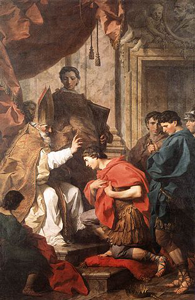
So what did Emperor Theodosius do? He went to the Cathedral of Milan and brought his whole entourage. Ambrose agreed to meet him there. The emperor walked into the door of the cathedral, shed his royal robes and insignia, and bowed down in public penance. One year later, in 391, he personally went to Thessalonica and asked for forgiveness. Theodosius died in 395 at the age of 48 and likely saved his soul by listening to Ambrose and placing his faith higher than his civil authority.
This is a remarkable story of the power of the gospel to transform the hearts of all. It is a remarkable story showing what risking to speak the truth can do. May God be praised.
Disclaimer – I do not relate this story to critique the modern struggle of some bishops (and priests) to speak the truth to those in power. Rather, I write to encourage us all through an epic tale from the past. Every bishop must make prudential judgments in each situation based on the individual politician or prominent person involved, on what is best for the faithful, and on the common good. Some have judged to speak forth as did Ambrose. Others in different circumstances pursue quieter measures. Still others judge that public rebukes would only make heroes of those being rebuked. It is a prudential judgment that every bishop has to make. A bishop in the Midwest may face one set of circumstances while a bishop in the Northeast faces another. The faithful do well to encourage their bishops and priests and pray for them to make good judgments.
Finally, I am indebted to Rev. Michael John Witt, Church History Professor at Kenrick-Glennon Seminary in St. Louis for the background on this story. He maintains a wonderful Church history site here: http://www.michaeljohnwitt.com/ The site includes hundreds of engaging and inspiring lectures on Church history that manifest a great love for the Church.
Priests, too, face challenges in speaking forthrightly to their congregations. They need courage to announce that which may not always be popular or may be out-of-season. In this clip, the famous preacher Vernon Johns (who preceded Dr. Martin Luther King in Birmingham) seeks to rouse a sleepy congregation to realize its own role in perpetuating injustice. Even as bishops and priests are called to speak up, so, too, are the laity. This clip is a remarkable glimpse of what a prophet must sound like. My favorite moment is the classic line, “Are you worthy of Jesus or are you just worthy of the State of Alabama?”
Courage, fellow clergy and people of God, courage!
There is an old spiritual that says, “My God is so high, you can’t get over him, he’s so low you can’t get under him, he’s so wide you can’t get ’round him, you must come in, by and through the Lamb.”
That’s not a bad way of saying that God is other; He is beyond what human words can tell or describe; He is beyond what human thoughts can conjure. And on the Feast of the Most Holy Trinity we do well to remember that we are pondering a mystery we cannot fit in our minds.
A mystery, though, is not something wholly unknown. In the Christian tradition the word “mystery” refers (among other things) to something that is only partially revealed, to something of which much more remains hidden. Thus, as we ponder the teaching on the Trinity, there are some things we can know by revelation but much more that is beyond our understanding.
Let’s ponder the Trinity by exploring it, seeing how it is exhibited in Scripture, and considering how we, who are made in God’s image, experience it.
I. The Teaching of the Trinity Explored – Perhaps we do best to begin by quoting the Catechism, which says, The Trinity is One. We do not confess three Gods, but one God in three persons: [Father, Son and Holy Spirit] … The divine persons do not share the one divinity among themselves but each of them is God whole and entire (Catechism, 253).
So there is one God, and the three persons of the Trinity each possess the one divine nature fully. The Father is God; He is not one-third of God. Likewise the Son, Jesus, is God; He is not one-third of God. And so, too, the Holy Spirit is God, not a mere third of God. So each of the three persons possesses the one divine nature fully.
In our experience, if there is only one of something and I possess that something fully, there is nothing left for you. Yet, mysteriously, each of the Three Persons fully possesses the one and only divine nature fully, while remaining a distinct person.
One of the great masterpieces of the Latin Liturgy is the preface for Trinity Sunday. Compactly yet clearly, the preface sets forth the Christian teaching on the Trinity. The following translation of the Latin is my own:
It is truly fitting and just, right and helpful unto salvation that we should always and everywhere give thanks to you O Holy Lord, Father almighty and eternal God: who, with your only begotten Son and the Holy Spirit are one God, one Lord: not in the oneness of a single person, but in a Trinity of one substance. For that which we believe from your revelation concerning your glory, we acknowledge of your Son and the Holy Spirit without difference or distinction. Thus, in the confession of the true and eternal Godhead there is adored a distinctness of persons, a oneness in essence, and an equality in majesty, whom the angels and archangels, the Cherubim also and the Seraphim, do not cease to daily cry out with one voice saying: Holy Holy, Holy …
Wowza! A careful and clear masterpiece, but one that baffles the mind as its words and phrases come forth. So deep is this mystery that we had to “invent” a paradoxical word to summarize it: triune (or Trinity). “Triune” literally means, “three-one” (tri+unus). “Trinity is a conflation of “tri-” and “unity,” meaning the “three-oneness” of God.
If all this baffles you, good! If you were to claim you fully understood all this, I would have to call you a likely heretic. For the teaching on the Trinity, while not contrary to reason per se, does transcend it and surely transcends human understanding.
Dance? Perhaps, too, in order to avoid an overly static notion of the Trinity, it is helpful to understand God in terms of the dynamic relationships between the Persons: the Father begetting the Son, the Son eternally begotten of the Father, and the movement of love between them, who is the Holy Spirit. The Eastern Fathers speak of this great movement of love between and among the Three Persons as the divine perichoresis. It is a kind of dance of love, dynamic and vivid. It is a glorious movement, yes, a kind of dance.
A final image before we leave our exploration stage: the picture at the upper right is of an experiment I remember doing back in high school. We took three projectors, each of which projected a colored circle: one red, one green, and one blue (the three primary colors). At the point of intersection, the color was white. Mysteriously, within the color white the three primary colors are present, but only white shows forth. The analogy is not perfect (no analogy is or it wouldn’t be an analogy) because Father, Son, and Spirit do not “blend” to make God. But the analogy does manifest a mysterious “three-oneness” of the color white. Somehow in the one, three are present. (By the way, this experiment only works with light; don’t try it with paint!)
II. The Teaching of the Trinity Exhibited – Scripture, too, presents images and pictures of the Trinity. Interestingly enough, most of the pictures I want to present are from the Old Testament.
Now I want to say, as a disclaimer, that Scripture scholars debate the meaning of the texts I am about to present; that’s what they get paid the big bucks to do. Let me be clear in saying that I am reading these texts as a New Testament Christian and seeing in them a doctrine that later became clear. I am not getting in a time machine and trying to understand them as a Jew from the 8th century B.C. might have understood them. And why should I? That’s not what I am. I am reading these texts as a Christian in the light of the New Testament, as I have a perfect right to do. You, of course, are free to decide for yourself if these texts really are images or hints of the Trinity. Take them or leave them. Here they are:
1. Then God said, “Let us make man in our image, after our likenesss …”(Gen 1:26). So God speaks of Himself in the plural. Some claim that this is just an instance of the “royal we” being used. Perhaps, but I see an image of the Trinity. There is one (“God said”) but there is also a plural (us, our). Right at the very beginning, in Genesis, there is already a hint that God is not all by Himself, but rather is in a communion of love.
2. Elohim?In the passage above, the word actually used for God is אֱלֹהִ֔ים (Elohim). It is interesting that this word is in a plural form. From the view point of pure grammatical form, Elohim means “Gods.” However, the Jewish people understood the sense of the word to be singular. This is a much-debated point and you can read more about it from a Jewish perspective here: Elohim as Plural yet Singular. My point here is not to try to understand it as would a Jew from the 8th century B.C. or even a Jew of today. Rather, I find it interesting that one of the main words for God in the Old Testament is plural yet singular, singular yet plural. It is one yet also plural. God is one yet He is three. I say this as a Christian observing this about one of the main titles of God: I see an image of the Trinity.
3. 3 or 1? And the LORD appeared to [Abram] by the oaks of Mamre, as he sat at the door of his tent in the heat of the day. He lifted up his eyes and looked, and behold, three men stood in front of him. When he saw them, he ran from the tent door to meet them, and bowed himself to the earth, and said, “My Lord, if I have found favor in your sight, do not pass by your servant. Let a little water be brought, and wash your feet, and rest yourselves under the tree, while I fetch a morsel of bread, that you may refresh yourselves, and after that you may pass on — since you have come to your servant.” So they said, “Do as you have said” (Gen 18:1-5). From a purely grammatical point of view, this passage is very difficult, since it switches back and forth from singular references to plural ones. Note first that the Lord (singular) appeared to Abram. (In this case יְהוָ֔ה Yahweh (YHWH) is the name used for God.) And yet what Abram sees is three men. Some have said that this is just God and two angels. But I see the Trinity being imaged or alluded to here. And yet when Abram addresses “them” he says, “My Lord” (singular). The “tortured” grammar continues as Abram asks that water be fetched so that he can “wash your feet” (singular) and that the “Lord” (singular) can “rest yourselves” (plural). The same thing happens in the next sentence: Abram wants to fetch bread “that you” (singular) “may refresh yourselves” (plural). In the end, the Lord (singular) gives answer, but it is rendered, “So they said.” Plural, singular … which is it? Both. God is one; God is three. For me, as a Christian, this is a picture of the Trinity. Since the reality of God cannot be reduced to words we have here a grammatically difficult passage. But I “see” what is going on. God is one and God is three; He is singular and yet plural.
4. Lord … Lord … Lord! Having come down in a cloud, the Lord stood with Moses there and proclaimed his Name, “Lord.” Thus the Lord passed before him and cried out, “The Lord, the Lord, a merciful and gracious God, slow to anger and rich in kindness and fidelity” (Exodus 34:5). Here we see that when God announces His name, He does so in a threefold way: Lord! … The Lord, the Lord. There is implicit a threefold introduction or announcement of God. Coincidence or of significance? You decide.
5. Holy, Holy, Holy – In the year that King Uzziah died I saw the Lord sitting upon a throne, high and lifted up; and his train filled the temple. Above him stood the Seraphim; each had six wings: with two he covered his face, and with two he covered his feet, and with two he flew. And one called to another and said: “Holy, holy, holy is the LORD of hosts; the whole earth is full of his glory” (Is 6:1-3). God is holy, holy, and yet again, holy. Some say that this is just a Jewish way of saying “very holy,” but as Christian I see more. I see a reference to each of the Three Persons. Perfect praise here requires three “holys.” Why? Omni Trinum Perfectum (all things are perfect in threes). But why? As a Christian, I see the angels not just using the superlative but also praising each of the Three Persons. God is three (Holy, Holy, Holy) and God is one, and so the text says, “… Holy is the Lord.” Three declarations of “holy.” Coincidence or of significance? You decide.
6. There are many such references in the New Testament, but let me refer to just three quickly:
Jesus says, The Father and I are one (Jn 10:30).
He says again, To have seen me is to have seen the Father (Jn. 14:9).
And, have you ever noticed that in the baptismal formula Jesus uses “bad” grammar? He says, Baptize them in the Name (not names as it grammatically “should” be) of the Father and of the Son and of the Holy Spirit (Matt 28:19). God is one (name) and God is three (Father, Son, and Holy Spirit).
Thus Scripture exhibits the teaching of the Trinity, going back even to the very beginning.
III. The Teaching of the Trinity Experienced – We who are made in the image and likeness of God ought to experience something of the mystery of the Trinity within us. And sure enough we do.
It is clear that we are all distinct individuals. I am not you; you are not I. Yet it is also true that we are made for communion. As humans, we cannot exist apart from one another. Obviously we depend on our parents, through whom God made us. But even beyond physical descent, we need one another for completion.
Despite what the song says, no man is a rock or an island. There is no such thing as a self-made man. Even the private business owner needs customers, suppliers, shippers, and other middlemen. He uses roads he did not build, has electricity supplied to him over lines he did not string, and speaks a language to his customers that he did not create. Further, whatever the product he makes, he is likely the beneficiary of technologies and processes he did not invent. The list could go on and on.
We are individuals but we are social. We are one but linked to many. Clearly we do not possess the kind of unity that God does, but the “three-oneness” of God echoes in us. We are one yet we are many.
We have entered into perilous times, times in which our interdependence and communal influence are underappreciated. The attitude that prevails today is a rather extreme individualism that says, “I can do as I please.” There is a reduced sense of how our individual choices affect the whole of the community, Church, or nation. Although I am an individual, I live in communion with others and must respect that dimension of who I am. I exist not only for me but for others as well. What I do affects others, whether for good or ill.
The “It’s none of my business what others do” attitude also needs some attention. Privacy and discretion have important places in our life, but so does having concern for what others do and think, the choices they make, and the effects that such things have on others. It is important to cultivate a common moral and religious vision. We should care about fundamental things like respect for life, love, care for the poor, education, marriage, and family. Indeed, marriage and family are fundamental to community, nation, and the Church. I am one, but I am also in communion with others and they with me.
Finally, there is a rather remarkable conclusion that some have drawn: the best image of God in us is not a man alone or a woman alone, but a man and a woman together in a lasting and fruitful relationship we call marriage. For when God said, “Let us make man in our image” (Genesis 1:26), the text goes on to say, “Male and female he created them” (Genesis 1:27). And God says to them, “Be fruitful and multiply” (Gen 1:28). So the image of God (as God sets it forth most perfectly) is the married and fruitful couple.
Here of course we must be careful to understand that what we manifest sexually, God manifests spiritually. For God is not male or female in His essence. Thus we may say that the First Person loves the Second Person and the Second Person loves the First Person. And so real is that love that it bears fruit in the Third Person. In this way the married couple images God, for the husband loves his wife, the wife loves her husband, and their love bears fruit in their children. [1]
So today, as we extol the great mystery of the Trinity, we look not merely outward and upward to understand, but also inward to discover that mystery at work in us, who are made in the image and likeness of God.
Here’s another song that reminds us that we were made for communion.
When I saw the commercial below, I was struck with a twinge of guilt. The words of a poem by William Butler Yeats came to mind:
Things fall apart; the centre cannot hold;
Mere anarchy is loosed upon the world,
The blood-dimmed tide is loosed,
and everywhere
The ceremony of innocence is drowned;
The best lack all conviction, while the worst
Are full of passionate intensity.
Yes, something struck me. In this commercial, anarchy, destruction, injustice, violence, and pure chaos are shown. And yet all the while our superhero, with the “bat phone” screeching in the background calling for help, is wholly distracted, flipping through the channels unaware that the world around him is descending right into Hell. He is turned inward, wholly focused on his own little world.
Is this what we’re doing? Are we the superhero slouching on the couch as the world and Western culture descend into a maelstrom? Innocence lost, the blood-dimmed tide of the 20th century with perhaps more 100 million put to death in war and for ideological purposes, moral anarchy swept in on the four horsemen of the apocalypse: relativism, secularism, individualism, and the sexual revolution.
And while the wicked have been marching with passionate intensity, the good have largely been asleep, lacking any intensity for the battle. All around us are divorce, abortion, teenage pregnancy, sexually transmitted diseases, broken families, increasing lack of self-control and discipline, declining school test scores and graduation rates, the inability to live within our means, climbing poverty rates for children, drug and alcohol addiction, plummeting Church attendance … the list could go on and on.
And where have we been as a Church—as Christians—in a world gone mad? Where, for example was the Church in 1969, when “no-fault divorce” laws began to be passed? It would seem we were inwardly focused: moving furniture around in our sanctuaries, tuning our guitars, having debates about liturgy, Church authority, and why women can’t be ordained. These are not unimportant issues, but in being so focused on them, we lost the culture.
Yes, it happened on our watch. I am now past fifty, and I cannot say that it is all the fault of the previous generation. Even in my relatively short span on this earth, the world as I knew it has largely been swept away, especially in terms of family life. And now it is up to me to try to make a difference.
How about you? It will take courage and an increasing conviction to live the Catholic faith openly. No more of this “undercover Catholic” stuff, no more trying to fit in and be liked. It is long past midnight for our culture, our families, and our children.
In the commercial there is something very wrong with the scenario: the superhero ignores the cries for help as the phone screeches. It’s time for our superhero to get off the couch, pick up the phone, re-engage, and get to work. It is interesting to note that the movie he is watching shows a wolf being set loose. Jesus says, Watch out for false prophets. They come to you in sheep’s clothing, but inwardly they are ferocious wolves (Matt 7:15). Indeed, many wolves preaching (false) tolerance and spouting other pleasantries have badly misled people and spread error, calling what is sin “good” and misrepresenting biblical tradition.
Well, fellow superheroes, the last time I checked, we are supposed to be the salt of the earth and the light of the world. It’s time—long past time—to bring Christ’s power back to this world. It’s time for us to get off the couch, pick up the phone, re-engage, and get to work.


 On one particular morning, just two weeks after His resurrection, Jesus stood on the shore of the Sea of Galilee. Seeing the Apostles in a boat just off the shore, he said, Little Children, Have you caught anything? (John 21:5)