Vive la différence – Discovering, Accepting and Appreciating that Men and Women are Different

Early in the pages of Scripture God decreed that It is not good for the man to be alone. I will make a suitable helpmate for him (Gen 2:18). And God made woman. Now the fact is that a woman is VERY different from a man. The physical differences are obvious but these physical differences arise from important differences in the soul. It is the soul that is the form of the body and the qualities of the male and female soul give rise to physical differences. I know that this is politically incorrect today, but it is true. It is a common modern error to be dismissive of the profound differences between the sexes. No one can deny the physical differences but they are dismissed as surface only, of no real significance. But the truth is that our bodies are expressions of the faculties of our soul and male and female differences are far more than skin deep.

It remains true that these differences often give rise to tensions in the marriage and the overall relationships between men and women. That men and women perceive differently, think differently, and have different emotional experiences is just a fact and it is always healthy to recognize and  accept reality. Too often in the modern age there has been a tendency to dismiss these deep differences as just archetypes of bygone “sexist” era. But what ends up happening is that an expectation is created that these differences will just go away when we decide to ignore them or pretend they don’t exist. But guess what , they don’t. And thus resentments and anger follow. Too many marriages end in power struggles because neither spouse can accept that it was not good for them to be alone and that God gave them a spouse who, by design, is very different so that they could be challenged and completed.

It is true, Original sin has intensified our pain at the experience of these given differences. The Catechism links the tension surrounding these difference to the Fall of Adam and Eve:

[The] union [of husband and wife] has always been threatened by discord, a spirit of domination, infidelity, jealousy, and conflicts that can escalate into hatred and separation. This disorder can manifest itself more or less acutely, and can be more or less overcome according to the circumstances of cultures, eras, and individuals, but it does seem to have a universal character. According to faith the disorder we notice so painfully does not stem from the nature of man and woman, nor from the nature of their relations, but from sin. As a break with God, the first sin had for its first consequence the rupture of the original communion between man and woman. Their relations were distorted by mutual recriminations;their mutual attraction, the Creator’s own gift, changed into a relationship of domination and lust; and the beautiful vocation of man and woman to be fruitful, multiply, and subdue the earth was burdened by the pain of childbirth and the toil of work. Nevertheless, the order of creation persists, though seriously disturbed. To heal the wounds of sin, man and woman need the help of the grace that God in his infinite mercy never refuses them. Without his help man and woman cannot achieve the union of their lives for which God created them “in the beginning.”  (CCC #s 1606-1608)

In the end, it seems clear that we need to return to an appreciation of the necessity of our differences. Though our differences can be be intensified by sin, it is a fact that God made us different for a reason. These differences help spouses to complete each other. A husband should say, “My wife has some things important to teach me. I am incomplete without her.”  Likewise the wife should be able  to say that her husband has important things to teach her and that he somehow completes her. In this way we move beyond power struggles and what is right and wrong in every case and learn to experience that some tension is good. No tension, no change. God intends many of these differences to change and complete spouses. God calls the very difference humans he has made “suitable” partners.

And humor never hurts. Here is a wonderful and funny comedy routine about the differences between a man’s brain and a woman’s brain. Humor is often the best of medicines to defuse some of the tensions that arise from our differences.  Vive la difference!

(By the way, as with any humor,  stereotypes are used a bit here. But things are usually funny because they ring true. It is also a fact that not every individual man or woman has every trait described here (for example, I don’t have a very big “nothing box”) but enjoy this video for the humorous descriptions of the general situation).
A Feast that is Missing in Action?

Today (January 1st)  we celebrated  the Solemnity of Mary, Mother of God.  In the past we celebrated the Feast of the Circumcision of the Lord, a Feast that is currently missing in action. We can discuss that in a moment.

But as for the Feast of Mary Mother of God, it is a great opportunity for us to reflect on who Jesus Christ is. Mary is Mother of God because Jesus is God. Some may want to argue that she only gave birth to his human nature and hence is only mother of what is human in him. But Jesus is ONE PERSON with two natures. This is something called in theology the “hypostatic union” and it is an essential teaching of Christ. He unites in one person the human nature and the divine nature. There are not two Jesuses. Neither is it true that his divine nature came upon him at a later time such as his baptism. No, his two natures were united in his one person from the moment of of his human conception. And since Jesus is one, Mary gives birth and is mother to the whole Christ. Mary is Mother of God because Jesus is God. This title was given to Mary at the Council of Ephesus in 431 in defense of Christ’s divinity. The Greek form of this title is Θεοτόκος (Theotokos) translated more literally as “God Bearer.”

Evidence for the celebration of this feast goes back in the Roman Church all the way to the 7th Century. Prior to that there is evidence of this feast being celebrated in other parts of Europe but usually on the Fourth Sunday of Advent. By the 13th and 14th Centuries However the Feast of the Circumcision of the Lord came to replace this feast, and the Feast of Mary Mother of God was eventually moved to October 11th and renamed the feast of the “Maternity of the Blessed Virgin Mary.” Just after Vatican II The more ancient Feast of Mary Mother of God was restored to January 1st.

That said, and as much as I love the Blessed Mother and affirm her under this proper title, I regret the loss of the Feast of the Circumcision. I generally prefer to stick as close to the Biblical narrative as possible. In this case Scripture is clear, on the eighth day (i.e. January 1st for us), Jesus was Circumcised and his name given. Three important truths and events are celebrated here. First that Jesus was born under the law and submitted himself to it so that he might fulfill it. Secondly there is the first shedding of blood, and this refers to the passion. Thirdly his name is announced: Jesus, a name which means “God saves.” There is no other name given to men by which we are to be saved, there is no other blood that can atone for our sins than the blood of Jesus and there is no one who can fulfill the Law as Jesus does. It seems a bit of a loss not to explicitly celebrate these events in Jesus life and these truth about him on the very day (the eighth day) they happened.

You may wish to dispute this regret of mine and I hope you will use the comments section to advance your points. Obviously the Church has decided to return to the more ancient observance of Mary Mother of God and so this is out of my hands. But I thought it might be appropriate at least give a nod to the Feast of the Circumcision.

I suppose if I had it my what here is what I would do:

  1. Celebrate the Feast of Mary Mother of God on the Sunday Between Christmas and January 1st.
  2. Move the Feast of the Holy Family to the Sunday after Epiphany (where it used to be before 1968). In fact, I would also like to say that the Feast of the Holy Family is rather confusing where it currently is since most the Gospel most years is of the Finding of Jesus in the Temple when he was 12 years old. So, suddenly after Christmas he is 12, and then at Epiphany, days later he is back to being an infant. A little confusing. So this Feast seems better celebrated after Epiphany as a kind of bridge: Jesus at 12 years of age links the infant Chirst and the adult Christ as we return to Ordinary time.
  3. Restore the Feast of the Circumcision to January 1st.
  4. But nobody is asking me from Rome what I think!  🙂  So enjoy my “rant” for what it is, just a slight grief for a feast that is missing in action and a wish to tweek the Christmas calendar so it flows a little better.

For the record, it is still possible to celebrate the Feast of the Circumcision using the Old Latin Mass (Extraordinary Form). However even there, the prayers are a little unusual in that none of them mention the circumcision at all. Rather, they are prayers that focus on the motherhood of Mary. Only the Gospel mentions the Circumcision. Any way don’t fail to thank the Lord Jesus for accepting  humbly the obligations of the Law, shedding his first Blood and for revealing his precious and saving name!

Enjoy The Ave Maria by Rachmanivov on this Solemnity of Mary, Mother of God.

Which Was the Son Of

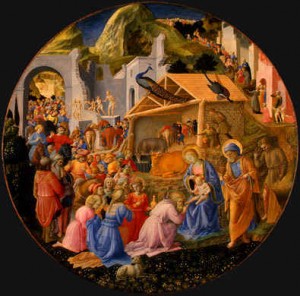
The_Adoration_of_the_Magi_by_Fra_Angelico_and_Filippo_Lippi-763314

On Christmas Eve, in the Office of the Liturgy of the Hours, the genealogy of Jesus is read from Luke 5. This passage which is difficult enough to read aloud was set to music by the contemporary Estonian composer Arvo Part, whose inspiration for many of his classical pieces comes from Gregorian chant.

It is a beautiful song that for me brings alive the unfolding of the story of salvation as seen in the mind of God. The song is called “Which was the son of.” It is a perfect reflection for the eve of Christmas.

Open Luke 5 to verse 23 and read along as the choir sings

May you have a happy and holy Christmas.

****


****

Reaching Young Adults – Some Recent and Fascinating Findings

It is usually thought by most Catholics that the Evangelical “mega Churches” have lots of young adults and that many of our Catholic young adults have gone there. There is, no doubt, a great absence of young adults in most Catholic Parishes. There seems to be a quite literal and physical generation gap, the “gap” being the empty spaces in the Church that young adults would occupy. However, Eric Sammons at his blog The Divine Life  (excellent Blog – Check it out!) has called attention to a very interesting article that reveals that absent young adults is a very common problem in Evangelical Churches too. The article appears in the Broken Arrow Ledger entitled “Where have the Young People Gone?” The article also reveals some Churches where young adults are increasing in number and you may be surprised where. Here are some excerpts along with my comments in RED

 Two-thirds of young adults who have grown up in evangelical churches are leaving, according to Ham and Beemer. [Authors of a forthcoming book “Already Gone,” by Ken Ham and Britt Beemer, with Todd Hillard]…Information in the book is based on data collected from 20,000 phone calls and detailed surveys of 1,000 20-to-29-year-olds who used to attend evangelical churches on a regular basis but have since left them behind…..This is no small survey. Most major surveys feature much smaller sampling groups

“They (young people) have written church off as a moralistic bad guy that wants to keep them from enjoying their life…. I had this attitude when I was young too. My “lack of belief” was not a “studied atheism” but rather a more angry agnosticism. I didn’t like being told what to do. And I allowed what I wanted to do to be the basis of what I would accept. I don’t suppose that every yound adult goes through this phase but many do. In the Archdiocese we have certain forums like Theology on Tap where we try to engage young adults on important moral issues and demonstrate the credibility and sensibility of Catholic teaching. But, it is a long discussion to be had over many years. But if only we can keep them in the discussion, we may win some of them back.

Young people no longer believe in Genesis, which is the basis for Christianity, Garland said. They question everything from creation to the divinity of Christ, and for that he credits laws that require the evolution theory be taught in public school classrooms and ban instruction on Biblical creation. As I pointed out yesterday in my Blog Post I don’t think it is necessarily that they don’t believe but rather that we have failedto set the Biblical narrative forth in a compelling way because, in many cases we have stripped the plot of it’s central conflict which is the terrible reality of sin and the consequent need to be saved. I don’t think it is difficult to demonstrate to young adults that sin is a very serious matter. They have seen friends die from drug overdoes and drunk driving accidents. They know of the reality of STDs and the shallowness of most modern “substitutes” for marriage. They have experienced hurts and betrayals.  They are aware of violence, poverty and injustice. I think we just have to get in the game and show them how the Scriptures and the doctrine of Original Sin go a long way toward explaining the broken down nature of the this fallen world. Our teaching is sensible if we focus in on the main problem of sin and disorder, the “problem of evil.”  Without this Genesis and the whole Biblical narrative seems but a quaint and fanciful story that does not connect. And with no concept of the problem of sin and the great drama of their lives, young adults see no relevance to salvation, the necessity of prayer and sacraments. They just disconnect.

There is an exception, however. Traditional churches that are liturgical churches and smaller evangelical churches seem to be retaining their twenty-something members in greater numbers than larger and mega-churches…..Now you’d think the Catholic Church would fall into this category. But to some extent we are not reaping this harvest because most of our liturgies lack the flavor of tradition. More on this in a moment. [Rev John] Wilke said the only church he knows of that is experiencing growth in the 20-to-29-year old age group is the Greek Orthodox Church.“The Greek Orthodox Church is a liturgical church. Kids want to return to something different from what they get from the world. If we want to reach these kids again, we are going to have to return to what the early church was doing. We need to raise the bar,” he said…..There is sort of a strange rebound in some of the ancient liturgies, such as Catholic, Greek Orthodox and Episcopalian. What we would call the emerging church is something that is very appealing to that age group. Places that have a sense of order, mystery and transcendence are very appealing….I have experienced a lot of this in my discussion with some young adults who do not find the current liturgical experience of most Catholic Parishes satisfying. Many of them are turning up at the Traditional Latin Mass at I St Mary’s and other locations. I say Mass the Traditional Latin Mass once a month at St. Mary’s and find a growing and  vigorous group of young adults there. For the last several years, more than half my weddings come from the Latin Mass group. Most of these young adults were dissatisfied with liturgies in their local parish which they found trendy and ephemeral. Remember, the 1960s folk music is a long time ago to them! Folk singing seems dated to many (not all) young adults. Many are discovering the riches of traditional worship that were dropped in the 1970s. Now I want to say that I do not think that the majority of young adults are asking for the Latin Mass. But what IS observable is that one area of the Church that is attracting and retaining young adults is the Traditional Latin Mass. Also, at a neighboring Parish, St. Peters on Capitol Hill,  there are many young adults that turn out for Eucharistic adoration. My data is anecdotal only, but there seems to be a consistent message that many young adults are looking for more traditional forms, they are increasingly attracted by a presentation of the faith that is substantial and serious. This is also evident in the recent trend in vocations to the priesthood and religious life wherein most of the young adults who answer the call are far more traditional than they were 20 to 30 years ago. They prefer traditional forms and insist on orthodoxy. [W]here entertainment is the approach to worship. It doesn’t really satisfy. I think there is a richness in the ancient traditions that speaks at levels where contemporary music fails….[Rev. Shelby Scott agrees]: traditional liturgies and such things as incense and mystery – has become something of a strength and intrigue for the younger generation,” he said.

The Rev. John Wilke, senior pastor of Immanuel Lutheran Church,…cited one of Luther’s writings as something for church leaders to consider: “A faith that costs nothing and demands nothing is worth nothing.” “I think that is where the church is today. I get too many things in the mail from churches that say, ‘Come just the way you are, you don’t have to change,’” Wilke said. “While God loves you where you are, he expects you to change. We don’t put the fear of God in our churches, we don’t have that respect. We’ve made Jesus our homeboy. He’s not our homeboy, he’s our Saviour.”…Rev Scott agrees….that Christian worship is going through a significant change. He believes young people are looking for a doctrine that requires more of them than just showing up at church. Here too my own experience bears this out. While it is true that many young adults may still be in the “I don’t want to be told what to do” mode. I think it is also true that many young adults also move to a stage when that begins to abate and they are looking for meaning and answers. Further, I am convinced that most of the rebellious,  deep down inside,  are glad that some one is challenging them. Somewhere under all the layers they want to know the truth even if they are not ready to fully embrace it. When I was a teenager I was well aware when I was being patronized and I usually respected adults less who humored me and tried to “relate” to me. Frankly they looked silly try to be like a teenager. Young adults too, I suspect, know when we are watering things down in an attempt to be popular. A faith that is integral and properly demanding command more resepct in the end. We will not be taken seriously by young adults unless we ARE serious. Trendy and cheesy gimmicks will backfire in the end unless there is a serious and reasonably demanding faith that is expressed.

******

The following video was an PBS special I taped on the Latin Mass. Among the topics discussed is the appeal that many young adults find with it.


Advent’s Poetic Climax

oantiphons

If I were to conduct a poll that asked you  to name Advent hymns, the hymn most mentioned would be O Come, O Come Emmanuel. In some years, I am pretty tired of it by the end of Advent because it seems to be so many parish’s “go-to- hymn.”  The hymn has  certain pride of place in that it summarizes well the meaning of Advent. It is the great Advent poem put to music. It is the sung version of  the O Antiphons.

The O Antiphons

The O Antiphons are the Magnificat antiphons in the Church’s Evening Prayer from December 17 to 24. These 7 acclamations have been part of the church’s prayer since the time of Charlemagne (742 A.D.-814 A.D). More recently, they have begun to be used as the Acclamation verse before the Gospel at Mass on these days.

An Old Testament Treasure

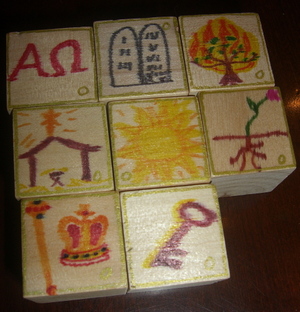
The antiphons use biblical images from the Old Testament as divine titles for the Messiah.  O Sapienta, O Adonai, O Radix Jesse, O Clavis David, O Oriens, O Rex Gentium, O Emmanuel.  Word lovers will also appreciate that Medieval poets took the first letters of these titles for Christ to form a reverse acrostic (a word for which each letter stands for another word)that in Latin spells “ero cras”: Tomorrow, I will come .

Whether as you pray Evening Prayer or listen for the Gospel Acclamation at Mass, you are invited to pray with the Church:

Come, Wisdom of our God…

Come, Leader of Ancient Israel…

Come, Flower of Jesse’s Stem

Come, Key of David

Come, Radiant Dawn

Come, King of Nations

Come, Emmanuel

Talking (Tough) Truth at Funerals

I celebrate just over 50 funerals a year;  about one a week. (People are dying to come to church here). And most of these funerals feature  large numbers of fallen away Catholics and unchurched individuals. Most of these people I see ONLY at funerals and sometimes weddings. For this reason, in recent years, I have altered my approach at funerals and direct almost half of the sermon to the unchurched and call them to repent and return home. Surely in the first part I speak of the deceased, offer thanks to God for their life, entrust them to God and ask the congregation to pray for the repose of the deceased soul. I never fail to menton judgment and purgatory as reasons for this prayer. That is too often not mentioned at Catholic funerals, a terrible oversight if you ask me. But the bottom line is that I spend the first half of the sermon commending the deceased person to God’s benevolent mercy and care.

But given the terribly high loss in the practice of faith and the consequent grave condition of many of the souls at any given funeral I cannot allow (any longer) an omission to be made of summoning them to Christ. How can it be that God has led them to my parish and I would say nothing to them to dissuade them from their path away from God and his sacraments? So many souls today are not only unchurched and backslidden (fallen away), but they are often locked in serious, mortal sin. I cannot know this about any particular individual but it is clear that many are lost like sheep without a shepherd. While conscious of my own sin, I cannot remain silent (any longer) and fail to call the unchurched and fallen away back. And trust me, even at the funeral of strong Catholic families there are MANY who are fallen away. Add to that the fact that many funerals I celebrate are for people who themselves were not always fervent in the practice of the faith. Families of such as these have even more members in need of a sobering  wake up call.

In the video below is an excerpt from a funeral I preached some time ago for a man named Henry who practiced his own faith quite well but whose children and grandchildren largely did not. No more details about this funeral are necessary or appropriate. But with approval of a family member and since the passage of time is significant and the venue undisclosed I do not think any of you readers would have any idea who this individual is or his family. I will not even indicate the city in which this funeral took place. But in it is a good example of what I do at most every funeral in recent years in terms of the second half of the funeral wherein I turn my attention to the unchurched and fallen away.

I will admit that some of the things I say are tough. But remember, I only have them once and I have to come right to the point. No one will follow an uncertain trumpet. A very few have criticized my approach by insisting that funerals are sensitive times and we ought just to console the grieving family and say pleasant and encouraging things. Others, especially the older ones come to me and say, “Thanks Father, there are people in my family that needed to hear it!”  But in the end I cannot preach either to please or displease man. Rather, I have a conviction that this is what God would have me do. I cannot waste an opportunity to clearly warn, as Jesus often did, that judgment day is coming, and maybe sooner than you or I expect. We have to be ready for, at an hour that we do not expect the Son of Man will come (eg Mat 24:44). For those who do not have the time to listen to the video the fundamental points are these:

  1. I hope you will not forget to pray also for yourself today because you are going to die.
  2. What are you doing to get ready to meet God?
  3. There are too many people today who are not serious about their spiritual life. They are goofing off, playing around and laughing their way through life as if it were all some big joke. They do not pray, go to Church or read Scripture. They are committing serious sin and not repenting of it.
  4. If this is you, you are not going to be ready to meet God.
  5. I exhort you to get ready now, delay not your conversion. Be serious about your walk with God by praying every day; reading scripture every day, Church every Sunday.
  6. If you are in serious and unrepented sin, get on your knees today and beg God’s mercy and help. You may not even know how to stop, but tell God you’re sorry and need his help to stop. But do not go on calling good what God has called sinful.
  7. Be serious about it.
  8. Hold to God’s unchanging hand!

I think that without some exhortation of this sort the funeral service can be worse than a missed opportunity, it can be downright harmful. Why do I say this? Because our silence speaks volumes. To many who are locked in serious sin, or fallen away, never to hear a work of exhortation becomes a kind of affirmation, a tacit approval that every thing is fine when it is not. This is harmful silence. To those who say funerals are not good times to speak in strong language, then I say,  “When?”  When will I get a similar opportunity to speak to so many unchurched? When will they hear the “come to Jesus” talk if not then? When?

Here’s the sermon excerpt. I’ve included pictures related to funerals this is really just an audio recording of my sermon with a slide show attached. Remember it is only the second half of a sermon. The first half was largely a commending of Henry to God’s mercy and acknowledgment of his strong faith and love of God; a joyful acknowledgment of his being a gift to us from God. I also reminded the congregation to pray for him since he goes to judgment wherein God may need to purge him of any remaining sorrows, sins or pains brought from this world. And then comes this second half:

In celebration of John of the Cross

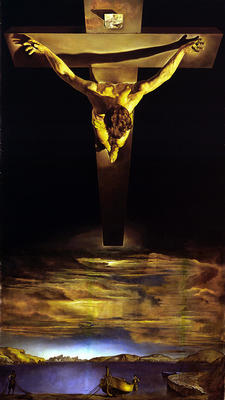
dali

Today is the feast of St. John of the Cross, a 16th century Spainard, who with Teresa of Avila reformed the Carmelite community. Teresa and John were a powerhouse of a friendship–exlporing the depths of the spiritual life and  discovering the rich Catholic expression of contemplative prayer. Like many close firendships, Teresa and John were very different in personality. Teresa was extroverted, funny, and engaging, John was serious and introspective, to the point that Teresa reports, she had to tell him to “lighten up!”

The Dark Night of the Soul

John’s contribution to the spiritual life is the exploration of what we  call the “dark night.”  Many of us know well the expereince of coming to know God through recognizing his presence in our lives, experiencing moments of grace and knowing they are gifts from God. There is another way we deepen our faith, a way that is part of our maturing in faith and giving ourselves fully over to God’s love–it is the experience of absence. At times we feel the absence of God, we feel abandoned, like Job, we feel that we are being tormented and though crying out to God we hear nothing.  Do we believe that indeed God has abandon us or failed us, or do we go on trusting that God is present and that all will be made well in God’s time? John helps us to navigate our way through the dark nights when all seems empty, only to experience a deeper union with our Lord.

The poetry of music and art

Loreena McKennit takes John of the Cross’s famous poem The Dark Night and sets it to the artwork of another famous Catholic, Salvator Dali.  it is here for you to enjoy.


 From today’s Morning Prayer, we pray in thanksgiving for all those who are learned and are as radiant as the sky in all its beauty; those who instruct the people in goodness and who will shine like stars for all eternity.

The Most Important Building Isn’t Even on the Tour!

I live in Washington DC on East Capitol Street. If you picture the United States Capitol in your mind, one side faces the long grassy Mall where so many large gatherings and protests take place. Behind the Capitol, on the exact opposite side is a long street that stretches through the Capitol Hill Neighborhood called “East Capitol Street.”  My parish is just 14 blocks up on the right. It is a “merged” Parish of St. Cyprian (building lost in 1966) and Holy Comforter (a title of the Holy Spirit).

I want to tell you of the two most important buildings on East Capitol Street. Let me begin with the second most important building, the United States Capitol.

The United States Capitol is the epicenter of the free world. It is the nerve center in the Capital of the most powerful country on this planet. It is here that some of the most powerful people in the world craft legislation and ponder great issues. Presidents have stood in the well of the House chamber to deliver important addresses. Other heads of state have also visited here. In fact people from all over the world travel to this country just to visit and perhaps transact business with the United States Government. Decisions are made in this building that impact the lives of over 300 million  Americans and even more all around the world. Decisions are made here that change world history. Decisions about more money than you can imagine are made in this building on a daily basis. Perhaps no other building is more identified with this great country of ours than the US Capitol. It’s beauty and grandeur bespeak a powerful and confident land. The US Capitol: the second most important building on East Capitol Street in Washington DC.

What then you ask is the MOST important building on East Capitol Street in Washington DC?! It is Holy Comforter – St Cyprian Roman Catholic Church at 1357 East Capitol Street. In this holy place, some one greater than any head of state, God himself,  dwells in the tabernacle. Jesus the Lord and King of the whole universe dwells here, speaks here, ministers here. The prayers and worship that take place in Holy Comforter Church not only change world history but these prayers are also what enable the decisions at the second most important building on East Capitol to have any good effect. In the US Capitol human work takes place. In Holy Comforter Catholic Church God’s work takes place. In the US Capitol important but ordinary things happen. In Holy Comforter Church miracles happen as ordinary bread and wine become the Body and Blood of Jesus, as sins are forgiven, as heaven is opened. In the US Capitol many words are exchanged and written that impact the day to day activities of America. In Holy Comforter Catholic Church, the Word of God does not just inform, it performs and it transforms. Many people come to visit the US Capitol. But in Holy Comforter Catholic Church the congregation is joined in worship by myriads upon myraids of angels and a company of saints which cannot be numbered. The US Capitol represents a government that we hope will endure for a long time but Holy Comforter is an outpost of a Church that the gates of Hell will never prevail against. In the US Capitol laws are passed that may one day be changed. But in Holy Comforter Church there is announced each week a law that will never pass away. The Senate majority leader and the Speaker of the House will come and go, changing year by year. But the High Priest, Jesus Christ who ministers at Holy Comforter Church will never die and has a kingdom that will never be destroyed.

Well, OK I suspect you know by now why the US Capitol is the second most important building on East Capitol Street in the Nation’s Capital. Holy Comforter – St Cyprian Roman Catholic Church far outranks in dignity and importance any other building on the street. This is true not because of the human elements involved, but rather the Divine. But I hope you will agree, the US Capitol is the second most important building on East Capitol Street, a distant second!

Funny thing though, all the tour buses drive right past Holy Comforter Church on their way to the second most important building. Wonder what that’s about? You’d think they’d at least stop to take a few pictures and ask to see God. Hmm…. There’s just no accounting for taste is there?  Imagine, driving right past the House of God to see “the man”  and his house. Imagine that! In your visits to Washington, perhaps you too missed seeing the most important building on East Capitol Street. It’s probably not your fault. Those silly tour companies just don’t know any better and you depended on them to get you around. But here for you in the video below are pictures, historical and current of the MOST important building on East Capitol Street in the Nation’s Capital.