 There’s an old Johnny Cash song that is rooted in today’s Gospel, a song that says,
You can run on for a long time, But sooner or later God will cut you down. Go tell that long tongue liar, go and tell that midnight rider, tell the rambler, the gambler, the back-biter, tell em that God’s gonna cut em down, sooner or later God’ll cut em down.
Now of course these verses of the song go right to the end point of judgement. But there is more to the story, a story of offered mercy and patience, but in the end there is a judgment.
We live in times that are dismissive of judgment, or that the judgment will result in anything but instant entrance to glory.
Today’s gospel contains a kind of necessary balance that speaks of God’s patience and care now, but also speaks of the day of reckoning, the day of judgment that must finally come when our decision is final and also adjudicated by God, and there will be no turning back.
Let’s look at this Gospel in two main parts:
I. The Proclamation of the Problem – The Gospel opens with the following lines:
Some people told Jesus about the Galileans whose blood Pilate had mingled with the blood of their sacrifices. Jesus said to them in reply, “Do you think that because these Galileans suffered in this way they were greater sinners than all other Galileans? By no means! But I tell you, if you do not repent, you will all perish as they did! Or those eighteen people who were killed when the tower at Siloam fell on them — do you think they were more guilty than everyone else who lived in Jerusalem? By no means! But I tell you, if you do not repent, you will all perish as they did!”
In effect what Jesus is saying is that is so easy for us to focus on the sins of others and fail to discern our own need for repentance and mercy. Before God we are all beggars, all of us have sinned and fallen short of the glory of God (cf Romans 3:23). Every one of us is in need of boatloads of grace and mercy. And while we may rightly distinguish that there is a difference here on earth in the sanctity of a Mother Theresa and the wretchedness of Hitler, yet before God we are all far short of the glory and holiness of God. We are all beggars.
Sin surely does have its effects in the lives of others and we are not asked to be blind to that. There is important truth in learning from the example of others, and we can learn form good example as well as bad example. But the point is to learn! We miss the point if all we do is stand around when someone suffers the effects of sin and say, “My, my my, God don’t like ugly!” Well then, if that be the case, what about the ugly in us? What about our own sin?
And thus to our all-too-eager question, “What about them O Lord!?” Jesus replies, “What about you? Stay in your own lane and work on your issues and leave their final fate to me. Judgement and punishment don’t just come others, if you don’t watch out, they will come to you as well.” And just to make sure we get it the Lord adds: [And] I tell you, if you do not repent, you will all perish as they did!
In effect, the Lord tells us to get serious about our sin and what it can do to us. The most serious problem in life is not the manner of our death, or even that we physically die. The most serious problem we face is not Pilate, or any political misfortune; it is not falling towers or any physical threat; it is not financial setback, or suffering, or losing our job, or losing our possessions. The most serious problem we face is our sin.
Now we don’t think like this. We minimize the maximum and maximize the minimum. We get all worked up about lesser things, and often completely ignore greater things. We are forever worked up about passing things like health and money, and give little heed to the things of eternity and to getting ready to go and meet God. Let our physical health be threatened even for a moment and we are instantly on our knees begging God for deliverance. But let our sins pile up and sinful drives be eating at our very soul and we take little notice and have little care to be delivered from things that are far more serious than mere cancer.
The Lord says, If your right hand causes you to sin cut it off and throw it away. It is better to lose one of your members than to have your whole body cast into hell (Matt 5:30). Pay attention, the Lord is saying that it is more serious to sin than to lose my right hand.
Again, we don’t think like this. If I were to lose my right hand I would lament this day for the rest of my life. The very thought of losing my hand gives me stabbing grief. But then why don’t we think of our sin this way? See how obtuse we are? See how distorted our priorities are?
One day the Lord looked at a paralyzed man and decided to cure his most serious problem. And thus he said to the quadriplegic, Your sins are forgiven. Could his sins have been more serious than his paralysis? Yes!
And thus the Lord warns us that we ought to be more serious about our sins lest we perish, not merely losing our earthly life, but more so, our eternal life. . The very fact that the solution to our problem required the death of the Son of God, indicates that we are evidently in worse shape than we think and that without our repentance and the magnificent mercy of God, something far worse than having a tower fall on us, or our enemies kill us might happen. Elsewhere the Lord says: I tell you, my friends, do not be afraid of those who kill the body and after that can do no more. But I will show you whom you should fear: Fear him who, after the killing of the body, has power to throw you into hell. Yes, I tell you, fear him. (Lk 12:4-5). Now, to be sure, the Lord does not counsel here a cringing and avoidant fear, but a respectful fear that is willing to be serious about judgement day, and realize that its effect is eternal unlike the passing quality of any earthly encounter.
Having portrayed the problem and underscored its seriousness both here and in other places, the Lord them reminds us that he is willing to help us to get ready with his grace and mercy. And, hence, he sets forth a process in which we must cooperate, for the day of judgment will surely come. Lets look at the Process.
II. The Portrayal of the Process – And thus the Lord tells a parable that sets forth the process in which we are currently engaged, a process of patience and mercy but leading ultimately to the finality of judgment. Note the following steps:
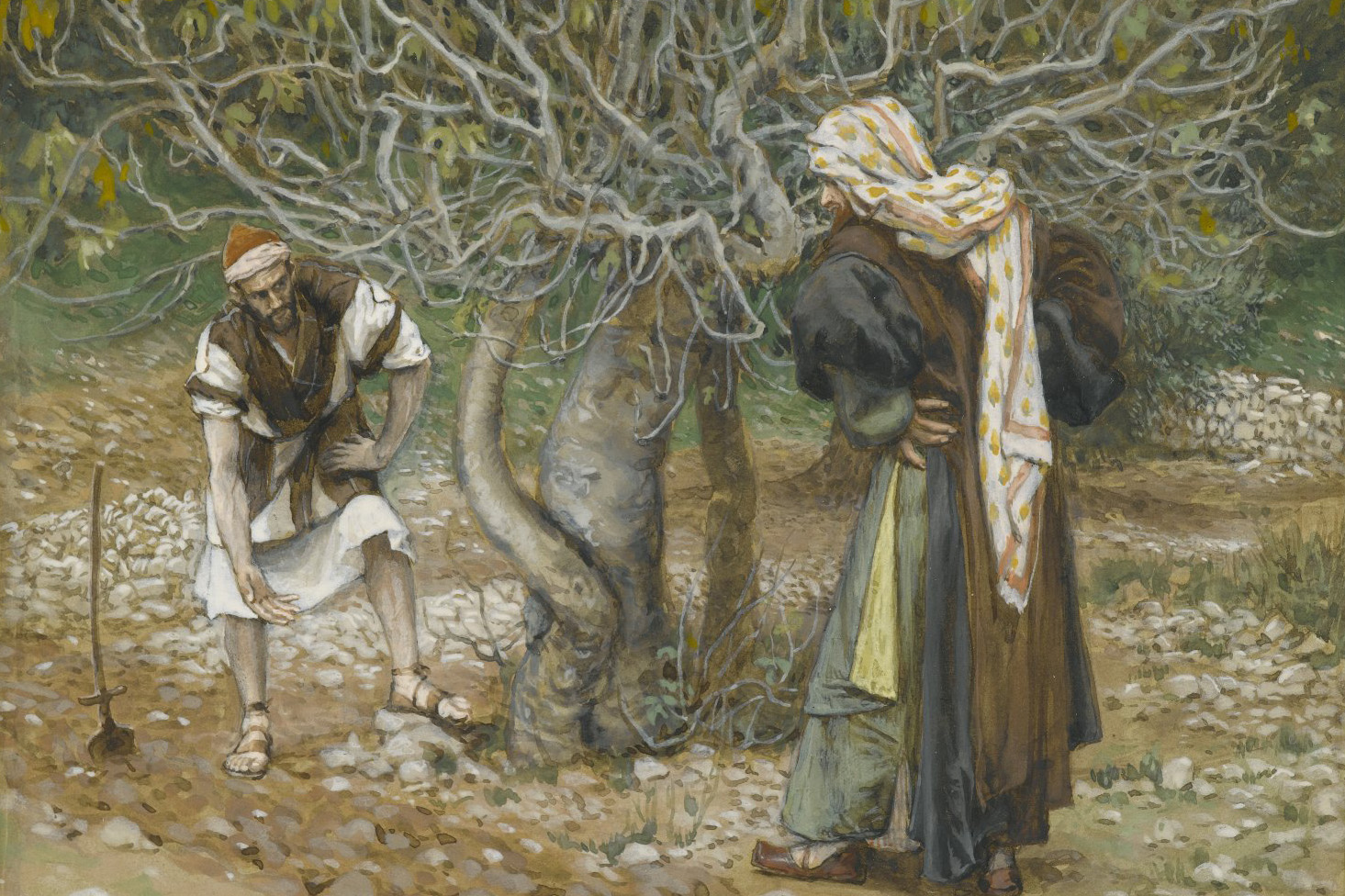
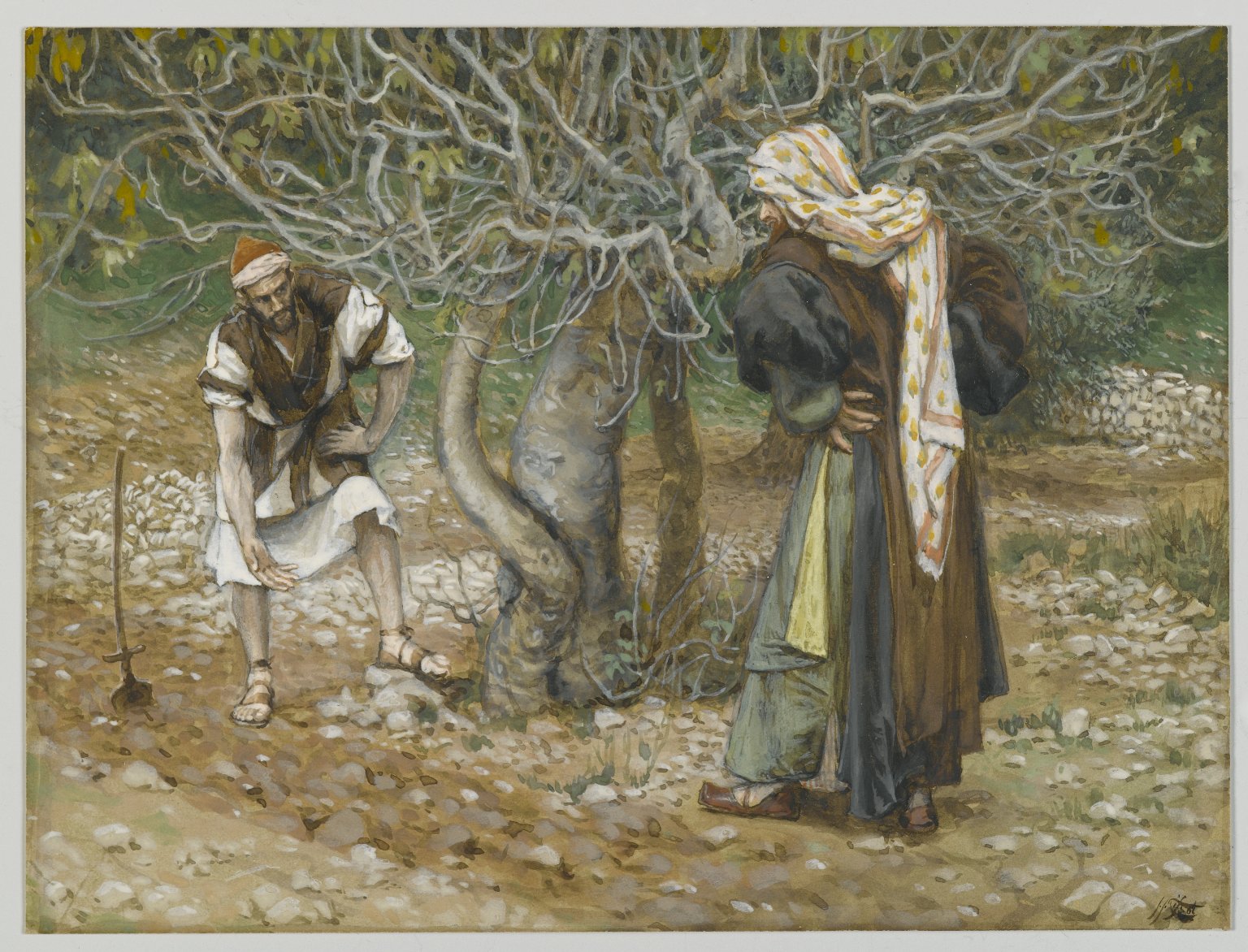
1. ASSESSMENT – There was once a person who had a fig tree planted in his orchard and when he came in search of fruit on it and found none said to the gardener, “For three years now I have come in search of fruit on this tree and have found none. So cut it down. Why should it exhaust the soil?”
Faith is a fruit bearing tree. It is to bear the fruits of love, of justice, of the keeping of the commandments. Now the Lord looks for these fruits and often, through our conscience and by his Word, and He assesses if such fruits are present.
Many claim to have faith, many claim to be fruitful in what the Lord seeks. But, as owner of the field, it is He who sets the terms. We are not a judge in our own case. It is the Lord’s on-going work to assess our progress and and fruitfulness and it is he who has the right to determine if the necessary fruits are present.
Yet many today in this proud age claim the right to assess their own status, and many make bold proclamations that God would not “dare” find in them anything substantial to be lacking. And in presumption many declare themselves to be safe, fruitful and righteous.
But this is not for us to say. In the parable it is the owner, the Lord, who makes the assessment. And note that in this parable he proposes that something significant is lacking.
And yet, some interlocutor, here called the gardener, but let us call her the Church, asks mercy and time. And as we shall see such mercy and time is granted along with necessary supplies (grace) to help accomplish what is sought, namely the fruit of faith. And this leads us to stage two in the process.
2. ASSISTANCE – The text goes on to describe the prayers and requests of the gardener, in this case Mother Church: Sir leave it for this year also. I shall cultivate the ground around it and fertilize it. It may bear fruit in the future.
And thus we see that the Lord, the owner of the garden not only grants the request but will also be the one to supply the necessary helps to draw forth the fruits patiently awaited.
Indeed, the Lord sends us help and graces in so many ways:
- He speaks in our conscience, has written his law in our hearts
- He gave us the law
- He sent us prophets
- He punishes our wrong doings to bring us to repentance. Before I was afflicted I strayed. But now I have kept your word. (Ps 119:67) And again, But God disciplines us for our good, that we may share his holiness. For the moment all discipline seems painful rather than pleasant; later it yields the peaceful fruit of righteousness to those who have been trained by it. (Heb 12:10)
- Sent us his Son!
- Who established the Church
- And gave us the grace and the Sacraments
- And It was he who gave some to be apostles, some to be prophets, some to be evangelists, and some to be pastors and teachers, to prepare God’s people for works of service, so that the body of Christ may be built up until we all reach unity in the faith and in the knowledge of the Son of God and become mature, attaining to the whole measure of the fullness of Christ. [That we be] no longer be infants, tossed back and forth by the waves, and blown here and there by every wind of teaching and by the cunning and craftiness of men in their deceitful scheming. Instead, speaking the truth in love, in all things grow up into him who is the Head, that is, Christ. (Eph 4: 11-17)
Yes, see how much God has done for us! He has graced us in every way and entrusted to the Church, in answer to here pleas, every necessary grace to bear fruit. And now he patiently awaits. Looking to return again to seek the fruits that are necessary for those who claim to have saving faith, fruits that are necessary to be able to endure the day of his comings, fruits which are necessary that we have the holiness without which no one will see the Lord (Heb 12:14)! Indeed we cannot see or endure his presence without the fruit of holiness by his grace. For as Scripture says, Who may ascend the mountain of the Lord? Or Who may stand in his holy place?Only he who has clean hands and a pure heart (Ps 24:3-4). And only God can accomplish this. But he who made us without us will not save us without us, and thus we must, by his grace, renounce our sin and accept his grace.
3. ACCEPTANCE – The parable ends simply with this line: If not you can cut it down.
The word “acceptance” is chosen carefully here, for judgement is not so much God’s decision, but rather, is his acceptance of our decision to bear fruit or to refuse to bear fruit, to accept or refuse his offer of the bearing the fruits of faith such as chastity, mercy, forgiveness, reconciliation, love of the poor, appreciation of the truth and so forth.
The day of judgement amounts to the day when God accepts our final choice. Our judgment is not so much a passing of sentence on us but is rather the recognition of the final and absolute choice we have made.
Mysteriously it would seem that there comes a day when change for us is no longer possible. What we are remains fixed forever. Even as we get older we note how it is harder to change. We are like concrete that sets, and becomes ever harder. We are like pottery which begins moist and malleable but when subjected to the fire has a shape that is forever fixed.
And thus the Lord teaches us to be serious about sin and about the day of judgement. For now there is mercy and every grace available to us, thank you Jesus! But there comes a day when our decision is finally called, and forever fixed.
The Gospel today teaches beautifully of God’s patience, but ultimately of our need for mercy, (we are all beggars before God), and warns us that our decision will finally be called. Yes, there is a Day of Judgement and it closes in on us all.
Talking about how we sang “Kum bah ya” etc., will not suffice. St. Paul also warns in today’s second reading against presumption and of us trying to serve as a judge in our own case:
Our ancestors were all under the cloud and all passed through the sea, and all of them were baptized into Moses in the cloud and in the sea. All ate the same spiritual food, and all drank the same spiritual drink, for they drank from a spiritual rock that followed them, and the rock was the Christ. Yet God was not pleased with most of them, for they were struck down in the desert. These things happened as examples for us, so that we might not desire evil things, as they did. Do not grumble as some of them did, and suffered death by the destroyer. These things happened to them as an example, and they have been written down as a warning to us, upon whom the end of the ages has come. Therefore, whoever thinks he is standing secure should take care not to fall. (1 Cor 10:1:ff)
For now there is mercy! But there comes a day of ratification, of judgement, when the question is called and the lasting answer is supplied, not so much by God as by us.
Be careful, your flesh says, “No worries!” But the Lord says “Repent!”
This song by Johnny Cash rooted in the image from today’s parable warns:
You can run on for a long time
Run on for a long time,
run on for a long time
Sooner or later God’ll cut you down
Well, you may throw your rock
and hide your hand
Workin’ in the dark against your fellow man
But as sure as God made black and white
What’s down in the dark will be brought to the light.
Go tell that long tongue liar,
go and tell that midnight rider
Tell the rambler, the gambler,
the back biter
Tell ’em that God’s gonna cut you down